Polities, Kinship & Ethics/van-ji/
Vañci (Karūr / Kodungallur Debate)
TA வஞ்சி / கரூர் ML വഞ്ചി / കരൂർ
Chera royal capital name associated both with inland Karūr on the Amaravathi and later coastal traditions.
Scholars debate whether Early Historic Vañci was inland Karūr on the Amaravathi, which Chera coins and the Pugalur inscriptions support, or coastal Kodungallur/Tiruvanchikulam in Kerala. Either way, the early capital must be kept separate from medieval Makotai, which belongs to a later period.
Statements that use this word (9)
The early Chera seat of Vanchi fits Karur better than Kodungallur, Chera silver portrait coins carry Tamil-Brahmi names and titles, Karur excavations show trade; most coin finds lack context, Silappadikaram shows city work and justice, not a real itinerary
Ports, Vessels & Sea/pey-ri-yaa-ru/
Pēriyāṟu (Cuḷḷiyam Pēriyāṟu)
TA பேரியாறு / சுள்ளியம் பேரியாறு ML പെരിയാർ
'Great river' – specifically the Periyar in Akanāṉūṟu 149 where ships arrived at Muciri with white foam.
Sedimentary cores confirm significant historical channel changes across the lower Periyar delta.
Two Tamil poems use Muziris's wealth for different ends, Today's dammed Periyar is a poor guide to the ancient river, Sediment cores cannot yet fix the Periyar mouth of Muziris’s time
Ports, Vessels & Sea/ka-lam/
kalam
TA கலம் ML കലം
Large decked or sea-going vessel; also a clay vessel or measure depending on context.
Used in Akanāṉūṟu 149 ('yavaṉar naṉkalam' – fine vessels of the Yavanas) and maritime poems.
Two Tamil poems use Muziris's wealth for different ends, Ancient ship hulls and sails: what wrecks and Red Sea finds show, Hoq cave names western Indian sailors; Sumhuram has a Tamil name
Ports, Vessels & Sea/naa-vaay/
nāvāy
TA நாவாய் ML നാവായ്
Sea-going merchant ship or multi-masted sailing craft.
Well attested in early Tamil maritime descriptions; linguists compare Indo-Aryan/Indo-European *nāu-* while debating direction and chronology of borrowing.
Ancient ship hulls and sails: what wrecks and Red Sea finds show, Hoq cave names western Indian sailors; Sumhuram has a Tamil name
Ports, Vessels & Sea/ti-mil/
timil
TA திமில் ML തിമിൽ
Sturdy coastal fishing boat or catamaran craft operated by paratavar.
Built for surf-zone launching and coastal fishing along the Malabar and Coromandel shores.
Ancient ship hulls and sails: what wrecks and Red Sea finds show, Parathavar poems show fishers with a stake in salt, not pilots
Ports, Vessels & Sea/to-ni / am-pi/
tōṇi / ampi
TA தோணி / அம்பி ML തോണി / അമ്പി
River dugout canoe, ferry boat, or backwater lighter.
Represented archaeologically by the 6-metre Anjili wood dugout canoe excavated at Pattanam.
Pattanam's radiocarbon dates give no single date for its wharf, Ancient ship hulls and sails: what wrecks and Red Sea finds show, Hoq cave names western Indian sailors; Sumhuram has a Tamil name
Ports, Vessels & Sea/ya-va-nar/
Yavaṉar
TA யவனர் ML യവനർ
Early Tamil term initially denoting Mediterranean (Greek/Roman/Egyptian Red Sea) traders and later broader western foreigners.
Derived via Prakrit Yona / Sanskrit Yavana from Ionian; context determines whether merchants, artisans, or guards are meant.
Statements that use this word (1)
Two Tamil poems use Muziris's wealth for different ends, The label Yavana named different roles, not one nationality, Muziris Papyrus records credit, cargo values and a quarter tax, Kodungallur digs found medieval layers, Pattanam much older ones
Ports, Vessels & Sea/hip-pa-los/
Hippalos (Southwest Monsoon Wind)
TA இப்பாலஸ் / தென்மேற்குப் பருவக்காற்று ML ഹിപ്പാലസ് / കാലവർഷം
Term used in the Periplus (§57) for a pilot named Hippalos and in Pliny for the southwest summer monsoon wind itself.
Whether a historical pilot named Hippalos existed and what route he pioneered is debated among modern scholars; Arab, Indian, and Austronesian mariners already used seasonal wind reversals, and the wind is a seasonal window rather than a fixed timetable.
Monsoon winds shaped ancient sailing without fixing one timetable, Pliny's forty days run from Ocelis to Muziris, not from Egypt, The Periplus describes linked ports on the southwest Indian coast
Ports, Vessels & Sea/u-ma-nar/
umaṇar
TA உமணர் ML ഉമണർ
Itinerant salt merchants who sold and transported sea salt inland by ox-cart (while coastal Parathavar are described with a stake in the salt pans).
Key connectors between coastal neytal economies and upland farming villages.
Statements that use this word (1)
A route has three layers: places, carriers and owners, Salt was made on the coast and carted inland in early South India, Everyday food: the evidence shows ingredients and work, not menus
Ports, Vessels & Sea/pan-da-ga-saa-lai / pat-ti-nam/
paṇṭakacālai (warehouse) & paṭṭiṉam (port-town)
TA பண்டகசாலை / பட்டினம் ML പണ്ടകശാല / പട്ടണം
Paired maritime terms: paṇṭakacālai denotes a port warehouse or customs storehouse, whereas paṭṭiṉam denotes a coastal port town or maritime settlement.
In Paṭṭiṉappālai, goods gathered in port storehouses were stamped with the Chola tiger emblem at the paṭṭiṉam of Pukār.
Statements that use this word (1)
No customs rate or procedure is known for ancient Muziris, Pattinappalai shows a taxed, busy port, not a customs bureau, Voyage loans: who bore a cargo's loss depended on the agreement, Poompuhar's drowned remains show coastal change, not a lost land
Megaliths & Burials/ku-dak-kal-lu/
kuṭakkallu
TA குடைக்கல் ML കുടക്കല്ല്
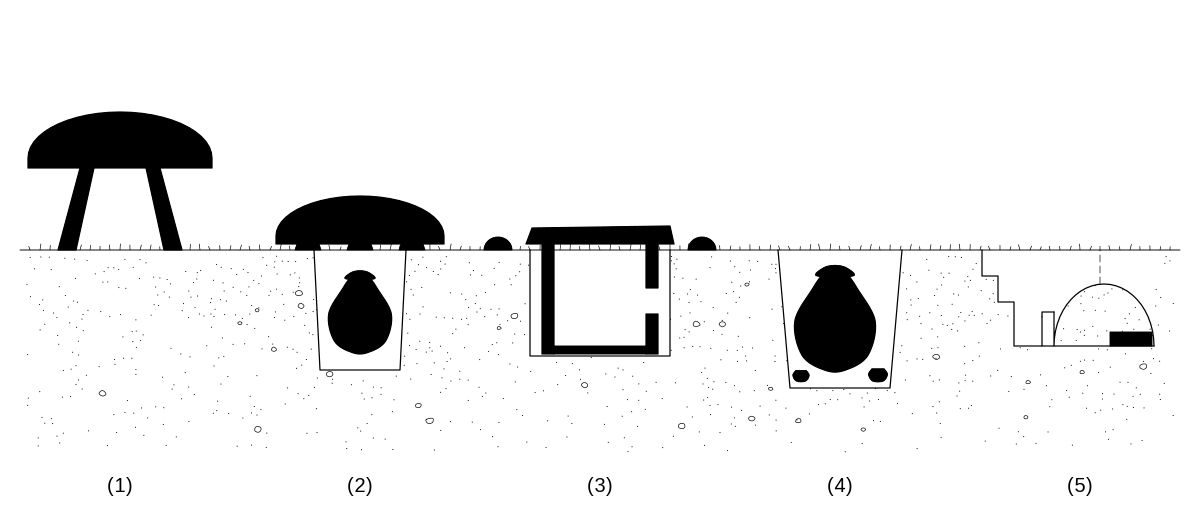
'Umbrella stone' – distinctive Kerala megalithic monument with a hemispherical laterite dome over four inward-leaning slabs (clinostats).
Concentrated in the central/northern Kerala laterite belt (Cheramanangad, Ariyannur, Porkalam area).
Umbrella stones and rock-cut tombs: distinctive but not unique, Cheramanangad’s stone markers do not predict what lies beneath
Megaliths & Burials/top-pik-kal-lu/
toppikkallu
TA தொப்பிக்கல் ML തൊപ്പിക്കല്ല്
'Hat stone' – circular plano-convex laterite megalithic capstone documented in two overlapping Kerala typological conventions: in older surveys (Babington, Krishnaswami, Satyamurthy) a capstone set on three or four low ground-hugging inward-leaning slabs (clinostats), whereas in site-specific conservation inventories at Cheramanangad (Kudakkalluparambhu) capstones resting directly on the ground without supporting orthostats.
At Cheramanangad (Kudakkalluparambhu), S. Rahul and B. Vinuraj's conservation report distinguishes ground-resting topikkal capstones from umbrella stones (kudakkal) raised on four inward-leaning slabs (clinostats), while older regional typologies use Thoppikkallu (Toppikallu) for low-support laterite capstones.
Umbrella stones and rock-cut tombs: distinctive but not unique, Cheramanangad’s stone markers do not predict what lies beneath
Megaliths & Burials/mu-ni-ya-ra/
muṉiyaṟa / muṉiyaṟai (kaṟpatukkai)
TA முனியறை / கற்பதுக்கை ML മുനിയറ / കൽപ്പടുക്കൈ
Above-ground granite slab dolmen or megalithic cist chamber.
Prominent in upland granite zones such as Marayoor (Anjunad valley) and the Palakkad/Coimbatore uplands.
Umbrella stones and rock-cut tombs: distinctive but not unique, Marayoor has dense dolmens, but their link to a route is untested, Machad’s 1974 excavation found a granite-capped urn and a cist
Megaliths & Burials/na-du-kal/
naṭukal
TA நடுகல் ML നടുകല്ല് / വീരക്കല്ല്
'Planted stone' – memorial hero stone erected to honour a fallen warrior or commemorated person.
Sangam poems describe hero stones. Early Tamil-Brāhmī memorial stones at Pulimankombai and Thathappatti are dated by their letter forms to about the 2nd–1st century BCE. The third Pulimankombai stone records a death in a cattle raid. Later Vaṭṭeḻuttu hero stones, such as Thandarampattu (c. 7th–8th century CE, dated by a king’s reign or by letter forms), fall after the 600 CE window.
Early Tamil hero stones record names and a cattle raid, Chengam hero stones: no simple sequence of weapons or scripts
Megaliths & Burials/mu-du-mak-kal taa-zhi / nan-nan-gaa-di/
mutumakkaḷ tāḻi
TA முதுமக்கள் தாழி ML നന്നങ്ങാടി / മുതുമക്കൾ താഴി
Large pyriform or globular terracotta burial urn used for primary or secondary interment.
Excavated across Kerala (Porkalam, globular urns at Mangadu, Anakkara – called nannangāḍi in Malayalam) and Tamil Nadu (Adichanallur, Sivagalai).
Adichanallur cemetery: varied burials over a long span of time, Sivagalai's dated rice grain came from inside a burial urn, Porkalam 1948: one urn burial that became a reference point, Mangadu's urn burials give southern Kerala early dated charcoal
Megaliths & Burials/chen-kal gu-ha/
kuṭaivarai-p-patukkai (TA) / ceṅkal guha (ML, laterite rock-cut burial cave)
TA குடைவரைப் பதுக்கை ML ചെങ്കൽ ഗുഹ
Subterranean mortuary chamber carved into laterite bedrock with benches and a stepped court or side entrance; some examples have pillars or a top opening, while others (such as Kattakampal) have no central pillar.
Characteristic of northern and central Kerala (Kattakampal, Chovvanur, Eyyal, Kunhimangalam).
Umbrella stones and rock-cut tombs: distinctive but not unique, Kattakampal's burial cave: four chambers and no central pillar, Northern Kerala's rock-cut burial caves vary widely in form, Four northern Kerala Iron Age burials differ in form and finds
Sacred Landscapes & Ascetics/pa-li / paa-zhi/
paḷi / paḷḷi & pāḻi (amaṇa-p-pāḻi)
TA பளி / பள்ளி & பாழி ML പാഴി / പള്ളി
Natural rock shelter fitted with a chiselled rainwater drip-ledge and polished stone sleeping beds for Jain/śramaṇa ascetics.
Distinguishes epigraphic paḷi / paḷḷi (பளி / பள்ளி, ML പള്ളി – the Tamil-Brāhmī rock-shelter term in early donor inscriptions at Mangulam, Jambai, and Pugalur; the early Arittapatti inscriptions use muḻākai) from literary pāḻi (பாழி, ML പാഴി – a cavern or ascetic hermitage).
Statements that use this word (1)
Mangulam's inscriptions name a ruler's servant, kin and a guild, Early Jain-related shelters: strong in Tamil Nadu, thin in Kerala, Arittapatti's cave inscriptions name two early donors, Pulankurichi rock texts record land rights, officers and temples
Megaliths & Burials/kar-pa-duk-kai/
paṭukkai / kaṟpaṭukkai
TA கற்படுக்கை ML കൽപ്പടുക്കൈ
Polished stone ascetic bed carved into rock shelter floors or boulder circles.
Often inscribed on the pillow-edge with the name of the patron and the ascetic recipient.
Early Jain-related shelters: strong in Tamil Nadu, thin in Kerala, Sittanavasal's rock beds and cave temple come from different eras, Pulankurichi rock texts record land rights, officers and temples
Megaliths & Burials/kal-vat-tam/
kal-vaṭṭam (Stone Circle & Cist)
TA கல்வட்டம் ML കൽവട്ടം
Circular boulder perimeter enclosing a subsurface orthostat cist (often with a porthole slab) or urn.
Documented at Porkalam, Kodumanal, Porunthal, and Anakkara.
Umbrella stones and rock-cut tombs: distinctive but not unique, Porunthal's graves hold dated rice; the writing claim is disputed, Kodumanal made stone beads and smelted iron on site, Porkalam 1948: one urn burial that became a reference point
Megaliths & Burials/ne-dun-gal / kut-tuk-kal/
neṭuṅkal / kuttukkal
TA குத்துக்கல் / நெடுங்கல் ML നാട്ടുകല്ല് / കുത്തുകല്ല്
Monolithic standing stone (menhir) marking a burial locus or memorial site.
Recorded across central Kerala, Idukki uplands, and the Noyyal/Amaravathi valleys.
Umbrella stones and rock-cut tombs: distinctive but not unique, Anakkara: excavated burials in Kerala's Bharathapuzha valley, Machad’s 1974 excavation found a granite-capped urn and a cist
Scripts & Epigraphy/ta-mi-zhi/
Tamiḻi (Tamil-Brāhmī)
TA தமிழி (தமிழ் பிராமி) ML തമിഴി (തമിഴ് ബ്രാഹ്മി)
Earliest attested phonetic script of Tamilakam, adapted from Brāhmī with special Dravidian letters. Mahadevan dates it c. 2nd century BCE – 4th century CE; earlier starts argued from radiocarbon dates remain debated.
Used both on rock-shelter monuments and on hundreds of post-firing inscribed potsherds from Kerala to the Red Sea.
Statements that use this word (13)
Vatteluttu grew gradually and unevenly from late Tamil-Brahmi, Keezhadi's inscribed pots show writing in everyday life, Tamil-Brahmi comes from Brahmi; when it began is still disputed, Mangulam's inscriptions name a ruler's servant, kin and a guild
Scripts & Epigraphy/vat-te-zhut-tu/
Vaṭṭeḻuttu
TA வட்டெழுத்து ML വട്ടെഴുത്ത്
'Rounded script' that evolved out of late Tamil-Brāhmī from the 5th–6th centuries CE onward across Tamil Nadu and Kerala.
Remained an important script for inscriptions in Kerala for centuries, often used alongside Grantha. How dominant it was, and for how long, needs a study of the later records.
Statements that use this word (5)
Vatteluttu grew gradually and unevenly from late Tamil-Brahmi, Chengam hero stones: no simple sequence of weapons or scripts, Written Malayalam is clearly documented from the 800s
Scripts & Epigraphy/gran-tha/
Grantha
TA கிரந்தம் ML ഗ്രന്ഥലിപി
Southern script developed (attested from the 6th–7th c. CE onward in Pallava/Pandya inscriptions) to write Sanskrit and Prakrit phonemes alongside Tamil/Vaṭṭeḻuttu.
In the usual handbook account, its later Kerala form (Ārya-eḻuttu) supplied most letters of modern Malayalam, with a few Dravidian letters from Vaṭṭeḻuttu. Our studies do not yet cover this history.
Statements that use this word (1)
Vatteluttu grew gradually and unevenly from late Tamil-Brahmi, Written Malayalam is clearly documented from the 800s
Scripts & Epigraphy/oo-lai/
ōlai (tāḷiyōlai)
TA ஓலை / பனையோலை ML ഓല / താളിയോല
Cured and seasoned palmyra or talipot palm leaf used as a writing surface for everyday and literary texts.
Perishable in humid tropical soils, which helps explain why stone and potsherd inscriptions survive while palm-leaf texts lasted only by being copied again. How often leaves were recopied is not established.
Ring shape alone does not show whether a feature was a well, Palm-leaf texts survived because people kept copying them
Scripts & Epigraphy/e-zhut-taa-ni/
eḻuttāṇi
TA எழுத்தாணி ML എഴുത്താണി
Pointed iron stylus used to incise letters into palm leaves (and capable of scratching ownership marks on fired pottery).
A popular explanation links the rounded letters of Vaṭṭeḻuttu to writing with a stylus on palm leaves. No dated series of letters has shown this; Gopinatha Rao (1908) pointed to joined strokes and writing habit instead.
Palm-leaf texts survived because people kept copying them, Vatteluttu grew gradually and unevenly from late Tamil-Brahmi
Scripts & Epigraphy/pul-li/
puḷḷi
TA புள்ளி ML പുള്ളി / ചന്ദ്രക്കല
Diacritic dot placed above a consonant letter to mute its inherent 'a' vowel or mark a short 'e'/'o' in early Tamil orthography.
Described in the grammar Tolkāppiyam. In inscriptions it is absent from the earliest Tamil-Brāhmī and appears rarely from about the end of the 1st century CE. At Pulankurichi (c. 5th century CE) it is used almost regularly.
Vatteluttu grew gradually and unevenly from late Tamil-Brahmi, Tamil-Brahmi comes from Brahmi; when it began is still disputed, Tolkappiyam grammar: what it shows about marriage, war and rank, Pulankurichi rock texts record land rights, officers and temples
Scripts & Epigraphy/zha (tongue curled back without touching palate)/
ḻa (Retroflex Approximant ழ / ഴ)
TA ழ ML ഴ
Signature South Dravidian retroflex approximant shared by Tamil and Malayalam (as in Tamiḻ, Vaṭṭeḻuttu, Kuḻi, Pūḻi).
Represented by a distinct palaeographic glyph in Tamil-Brāhmī and preserved as a dedicated letter through historical script developments in modern Tamil (ழ) and Malayalam (ഴ).
Vatteluttu grew gradually and unevenly from late Tamil-Brahmi, Tamil-Brahmi comes from Brahmi; when it began is still disputed, Written Malayalam is clearly documented from the 800s
Landscapes & Tiṇai/a-ga-val/
akaval (āciriyappā)
TA அகவல் / ஆசிரியப்பா ML അകവൽ
Foundational calling/declaratory metre of early Sangam poetry, structured by prosodic feet (cīr) and line links.
Used in Akanāṉūṟu, Puṟanāṉūṟu, Kuṟuntokai, and Naṟṟiṇai (whereas Paṭṭiṉappālai mixes vañci and āciriyam lines).
Hear the Sangam poem before using its evidence, 'Every place is home': Purananuru 192 read as a whole poem, The yāḻ harp is known from poems, not from excavated finds
Landscapes & Tiṇai/tu-rai/
tuṟai
TA துறை ML തുറ
Literally a river ford or harbour; in poetics, the specific thematic situation or colophon micro-genre of a poem.
Colophons noting a poem's tiṇai, tuṟai, and speaker were attached by anthology compilers and commentators.
Hear the Sangam poem before using its evidence, The Patiṟṟuppattu is layered Chera praise poetry, not an archive
Landscapes & Tiṇai/pa-di-gam/
patikam
TA பதிகம் ML പതികം
Prologue or epilogue colophon attached to each decade of Patiṟṟuppattu summarizing Chera royal deeds and gifts.
Must be read critically as a slightly later redactional layer rather than identical in date to the verse bodies.
Early Chera rulers seen through stone, edict, poem and coin, The Patiṟṟuppattu is layered Chera praise poetry, not an archive, Hear the Sangam poem before using its evidence
Scripts & Epigraphy/kee-ral/
kīṟal (Graffiti Marks)
TA கீறல் குறியீடுகள் ML പോറൽ ചിഹ്നങ്ങൾ
Undeciphered geometric, astral, or linear symbols incised on Iron Age and Early Historic pottery whose linguistic status and exact function (proposed as owner, potter, guild, or clan marks) remain unestablished.
Found at Keezhadi, Kodumanal, Pattanam, and Porkalam; studied as precursors or companions to phonetic script.
Keezhadi's excavations reveal a substantial brick settlement, Keezhadi's inscribed pots show writing in everyday life, Kodumanal made stone beads and smelted iron on site, Black-and-red ware owes its colours to carbon, iron and firing
Craft & Metallurgy/u-ruk-ku/
urukku / eḵku (Kannada/Telugu ukku)
TA உருக்கு / எஃகு ML ഉരുക്ക്
High-carbon crucible steel ('wootz') produced by heating iron with carbon-rich plant matter in sealed clay crucibles.
While crucible steel processes are documented in South India and Sri Lanka, whether specific Kodumanal furnace and vitrified crucible contexts represent true liquid wootz or bloomery carburization remains debated.
Iron or steel: four questions to ask of early South Indian finds, Kodumanal made stone beads and smelted iron on site, Three Tamil Nadu digs: shell workshop, inscribed pots, coffins, Iron weapons predate 600 CE, but Kalaripayattu came much later
Craft & Metallurgy/ma-ni/
maṇi
TA மணி ML മണി / കൽമുത്ത് (മുത്ത് = കടൽമുത്ത്)
Gemstone or glass bead (quartz, beryl, carnelian, agate, amethyst, or drawn glass).
Local quartz and beryl working is demonstrated by debitage and blanks at Kodumanal, while non-local carnelian provenance (Deccan/Gujarat hypotheses; Kelly's analyzed samples) and Pattanam lapidary finds are evaluated separately.
Pattanam's stone beads show pecking; their drilling is unresolved, Glass beads: where glass was made, shaped and found can differ, Kodumanal made stone beads and smelted iron on site, Agaram and Manalur: no site dates in the excavation reports yet
Craft & Metallurgy/ka-rup-pu si-vap-pu paa-nai/
karuppu-civappu pāṉai (Black-and-Red Ware)
TA கருப்பு சிவப்பு பானை ML കറുപ്പും ചുവപ്പും മൺപാത്രങ്ങൾ
Diagnostic Iron Age and Early Historic ceramic ware fired by inverted firing so the interior/rim turns black and the exterior base turns red.
Found across burials and settlements in both Kerala and Tamil Nadu; often bears Tamil-Brāhmī inscriptions.
Statements that use this word (2)
Keezhadi's excavations reveal a substantial brick settlement, Porkalam 1948: one urn burial that became a reference point, Russet-coated ware occurs in Kerala; its source and age are open, Crops at six sites: millets and pulses persist as rice spreads
Craft & Metallurgy/rus-set coa-ted ware/
Russet-Coated Painted Ware (Āndhra/Kongu Ware)
TA வண்ணம் தீட்டிய பானை ML ചായം പൂശിയ മൺപാത്രങ്ങൾ
Fine pottery with white wavy or rectilinear lines under a russet slip (the white pigment is often called kaolin; it has not been analysed in the studies used here).
Usually dated between about the 3rd century BCE and the 3rd century CE across parts of South India (including Coimbatore/Kongu, the Palakkad Gap, and central Kerala); its place of manufacture and exchange role remain open.
Statements that use this word (4)
Anakkara: excavated burials in Kerala's Bharathapuzha valley, Russet-coated ware occurs in Kerala; its source and age are open, Deccan cities and Konkan ports fed linked trade toward Muziris, Crops at six sites: millets and pulses persist as rice spreads
Craft & Metallurgy/shan-gu / chan-gu/
caṅku (Turbinella pyrum)
TA சங்கு ML ശംഖ്
Sacred chank shell harvested in the Gulf of Mannar and sawn with iron wire/saws into bangles, rings, and inlays.
Sawn chank shell bangle fragments and rings are documented across early historic sites including Korkai, Alagankulam, and Keezhadi, with dedicated shell-working waste and unfinished bangle cores concentrated at Gulf of Mannar/coastal workshops such as Korkai and Alagankulam.
Ancient texts link Korkai with pearls, conch and Pandyan rulers, Korkai shows chank-shell working; Keezhadi has finished bangles, Sri Lanka and the Tamil coast shared pottery, beads and writing
Craft & Metallurgy/u-rai ki-na-ru/
uṟai-kiṇaṟu
TA உறைகிணறு ML ഉറക്കിണർ
Terracotta ring well built from stacked baked-clay cylinders for clean domestic water or wastewater soakage.
Signature urban feature at Keezhadi, Arikamedu, Puhar, and Pattanam.
Ring shape alone does not show whether a feature was a well, Early houses survive as walls, post-holes and tiles, not plans, Keezhadi's excavations reveal a substantial brick settlement, Konthagai's urn graves beside Keezhadi await direct dates and DNA
Craft & Metallurgy/kaa-su / kaa-shu/
kācu
TA காசு ML കാശ്
Coin, metallic currency unit, or gold/silver bead weight.
Early Kerala and Tamil Nadu used silver punch-marked coins, dynastic copper issues, Chera portrait silver, and Roman aurei/denarii simultaneously.
Kerala's Roman coin hoards show inland movement, not motive, Chera silver portrait coins carry Tamil-Brahmi names and titles, Kerala's punch-marked silver shows exchange, not Mauryan rule, Eyyal's 1945 hoard held Roman coins and punch-marked silver
Craft & Metallurgy/ven-ga-lam/
veṇkalam (bronze / bell-metal & high-tin beta-bronze)
TA வெண்கலம் ML വെങ്കലം / ഓട്
General Tamil/Malayalam term for bronze or bell-metal; in archaeometallurgy, encompasses specialized ~21–24% tin beta-bronze vessels hot-forged and quenched for resonant strength.
High-tin beta-bronze bowls and vessels are documented in Adichanallur and Nilgiri burial assemblages and studied alongside broader South Indian bronze working traditions.
Statements that use this word (4)
Adichanallur cemetery: varied burials over a long span of time, High-tin bronze bowls show real skill but no single recipe, Iron weapons predate 600 CE, but Kalaripayattu came much later
Craft & Metallurgy/aan-ji-li/
āññili / ayini (Artocarpus hirsutus)
TA அயினி / ஆஞ்சிலி ML ആഞ്ഞിലി / അയിനി
Endemic Western Ghats timber prized for durability in water and used for dugout canoes and house construction.
Wood-anatomy analysis confirmed the 6-metre excavated Pattanam canoe was carved from a single Anjili trunk.
Pattanam's radiocarbon dates give no single date for its wharf, Teak in Indian Ocean trade: no proven Western Ghats source, Hoq cave names western Indian sailors; Sumhuram has a Tamil name
Craft & Metallurgy/koo-di / tu-gil/
kōṭi / tukil
TA கோடி / துகில் ML കോടി / തുകിൽ
Fine woven cotton cloth; kōṭi denotes newly woven unbleached/crisp fabric.
Spindle whorls and other craft finds attest textile production at sites including Keezhadi, Kodumanal, Uraiyur, and Arikamedu. Keezhadi’s proposed dyeing or textile-processing tanks remain interpretations; diagnostic residue evidence is needed to establish their function.
Spinning and weaving in early Tamil Nadu and the Red Sea, Agaram and Manalur: no site dates in the excavation reports yet, Keezhadi's excavations reveal a substantial brick settlement, Uraiyur was a substantial, long-lived settlement on the Kaveri
Craft & Metallurgy/tu-rut-ti/
turutti
TA துருத்தி ML തുരുത്തി
Leather smith's bellows driving air through clay tuyères (ūtu-kuḻal) into iron-smelting or forging hearths.
Described in Sangam similes and matched by vitrified tuyère nozzles in excavated workshops.
Iron or steel: four questions to ask of early South Indian finds, Iron weapons predate 600 CE, but Kalaripayattu came much later, South India made early high-carbon steel; early wootz is unproven, Kodumanal made stone beads and smelted iron on site
Craft & Metallurgy/tor-pe-do jar/
Torpedo Jar (West Asian Transport Amphora)
TA மேற்காசியச் சாடி ML പേർഷ്യൻ ഗൾഫ് ഭരണികൾ
Tall, handleless cylindrical ceramic transport jar lined inside with bitumen, produced in Mesopotamia/Persian Gulf.
Excavated at Pattanam and Vizhinjam primarily in Sasanian to Early Islamic horizons (with occasional Parthian-period precursors), attesting West Asian ceramic containers on the Malabar coast without by itself proving direct Persian Gulf-to-Pattanam point-to-point voyages.
Pattanam's radiocarbon dates give no single date for its wharf, Vizhinjam's earliest phase: sea foods and West Asian jars, Pattanam's torpedo jars show trade links, not Persian settlers, Kerala mudbanks calm monsoon seas; their ancient use is unproven
Food, Farming & Labour/nel / a-ri-si/
nel (arici)
TA நெல் / அரிசி ML നെല്ല് / അരി
Unhusked paddy grain (nel) and husked rice (arici).
Directly dated by AMS radiocarbon on paddy grains in burial urn A2–Urn 3 at Sivagalai (2950 ± 30 BP) and grave jars at Porunthal, alongside Pattanam archaeobotany.
Everyday food: the evidence shows ingredients and work, not menus, Sivagalai's dated rice grain came from inside a burial urn, Porunthal's graves hold dated rice; the writing claim is disputed, Early Kerala rice labour: no proven link to Pulayar or Cherumar
Food, Farming & Labour/mi-la-gu/
miḷaku (kaṟi)
TA மிளகு / கறி ML മുളക് / കുരുമുളക്
Black pepper (Piper nigrum), a vine of the wet forests of south-west India and Sri Lanka; most authorities give the Western Ghats as its home, and a 2026 genetic study points to Sri Lankan relatives.
Akanāṉūṟu 149 describes Yavana ships coming for 'kaṟi' (pepper); more than 7.5 kg of peppercorns were excavated in a 1st c. CE jar at Berenike.
Statements that use this word (1)
Everyday food: the evidence shows ingredients and work, not menus, Two Tamil poems use Muziris's wealth for different ends, Texts link pepper to inland Cottonara, not a whole route, Kerala's spice coast grew from habitats, cultivation and trade
Food, Farming & Labour/ey-lam/
ēlam
TA ஏலம் ML ഏലം
Green cardamom (Elettaria cardamomum) harvested from moist evergreen Western Ghats understoreys.
Requires distinguishing botanical origin in the southern Ghats from transshipment port names in foreign texts.
Cinnamon and cassia: what a fragrant name can and cannot identify, No secure clove or nutmeg find is known yet from early Pattanam, Malabathrum and cardamom: Kerala hill origins not shown
Food, Farming & Labour/up-pu/
uppu (uppaḷam)
TA உப்பு / உப்பளம் ML ഉപ്പ് / ഉപ്പളം
Culinary sea salt solar-evaporated in coastal salt pans (uppaḷam).
Poems such as Akanāṉūṟu 140 and 390 describe salt exchanged for paddy or rice in inland barter.
Everyday food: the evidence shows ingredients and work, not menus, Parathavar poems show fishers with a stake in salt, not pilots, Salt was made on the coast and carted inland in early South India
Food, Farming & Labour/pe-run-cho-ru/
peruñcōṟu
TA பெருஞ்சோறு ML പെരുംചോറ്
Great communal feast of cooked rice and meat shared by a ruler or patron with warriors and bards.
One of our studies examines it both as a real redistributive practice and as a later mythicized literary motif.
Statements that use this word (2)
Everyday food: the evidence shows ingredients and work, not menus, Peruñcōṟu, royal food-giving in Tamil poems, had several meanings
Food, Farming & Labour/u-zha-var/
uḻavar
TA உழவர் ML ഉഴവർ
Plough cultivators of the riverine marutam plains.
Worked alongside field labourers and women transplanters/weeders (kaṭaiciyar) in marutam wet-rice ecosystems.
Early Kerala rice labour: no proven link to Pulayar or Cherumar, Early South Indian farming mixed rain-fed crops and managed water, Early Tamil records show rank, not the later caste order
Food, Farming & Labour/pa-ra-da-var/
paratavar
TA பரதவர் ML പരതവർ
Coastal fishing, pearl-diving, and maritime trading communities of the neytal shore.
Central actors in Korkai, Alagankulam, Puhar, and Malabar littoral economies.
Ancient texts link Korkai with pearls, conch and Pandyan rulers, Parathavar poems show fishers with a stake in salt, not pilots, Sri Lanka and the Tamil coast shared pottery, beads and writing, Early Tamil records show rank, not the later caste order
Food, Farming & Labour/ku-ra-var/
kuṟavar
TA குறவர் ML കുറവർ
Mountain and forest dwellers of the kuṟiñci hills skilled in upland millet farming, trapping, and forest produce.
Poems place kuṟavar in the hills with millet, honey and forest produce; who gathered pepper for the ports is not recorded.
Texts link pepper to inland Cottonara, not a whole route, Five Tamil landscapes are a poetic code, not a map of economies, Western Ghats uplands were settled; forest producers are unnamed
Food, Farming & Labour/kal / tey-ral/
kaḷ (mattu / tēṟal)
TA கள் / தேறல் ML കള്ള്
Fermented palm toddy or clarified aged beverage shared in hospitality and festivals.
Often matured in buried clay jars or bamboo tubes according to Sangam verse descriptions.
Everyday food: the evidence shows ingredients and work, not menus, 'Every place is home': Purananuru 192 read as a whole poem
Food, Farming & Labour/vet-ri-lai paak-ku/
veṟṟilai & pākku (Betel & Areca)
TA வெற்றிலை பாக்கு ML വെറ്റിലയും അടയ്ക്കയും
Betel leaf (Piper betle), areca nut (Areca catechu), and slaked shell lime chewed in social hospitality.
One of our studies separates the textual and plant evidence from before 600 CE from later medieval court rituals.
Betel leaf and lime appear in poems; early finds unverified
Polities, Kinship & Ethics/moo-veyn-dar/
Mūvēntar
TA மூவேந்தர் ML മൂവേന്തർ
The 'Three Crowned Kings' of early Tamilakam: Chera (Cēral), Chola (Cōḻar), and Pandya (Pāṇṭiyar).
Named outside Sangam poetry in Ashoka's 3rd c. BCE Rock Edicts (Keralaputo, Choda, Pandya); later Kharavela's Hathigumpha inscription mentions a 'tramira' confederacy whose exact correspondence is debated.
Early Chera rulers seen through stone, edict, poem and coin, The early Chera seat of Vanchi fits Karur better than Kodungallur, Pandya and Chola power is well attested, but not as a king list
Polities, Kinship & Ethics/chey-ral/
Cēral / Kēraḷaputra
TA சேரல் / சேரர் ML ചേരൻ / കേരളപുത്ര
Ruling lineage of western Tamilakam (Kongu/Karur) and the Kerala coast, associated with the bow emblem and the palmyra (paṉai) garland.
Pugalur names a three-generation Irumpoṟai line that scholars classify as Chera; Edakkal has a reading with cēra/kaṭummipuda cēra (Mahadevan), alongside Makkotai/Kuttuvan Kotai silver coins, Patiṟṟuppattu, and Greco-Roman 'Keprobotos' / 'Celebothras'.
Early Chera rulers seen through stone, edict, poem and coin, The early Chera seat of Vanchi fits Karur better than Kodungallur, Chera silver portrait coins carry Tamil-Brahmi names and titles, Pugalur inscriptions record a three-generation royal genealogy
Polities, Kinship & Ethics/vey-lir/
Vēḷir
TA வேளிர் ML വേളിർ
Named local rulers and lineages (such as Pāri, Āy, Atiyamāṉ, Nannaṉ, and Pēkaṉ) recorded across varied hill, forest, and agricultural domains rather than a single uniform hill-chief system.
Maintained shifting alliances, marriage ties, and conflicts with the Mūvēntar; attested in the Jambai Tamil-Brāhmī inscription ('Satiyaputo Atiyan Neduman Anji').
Early Chera rulers seen through stone, edict, poem and coin, Velir chiefs were named local rulers, not one hill-chief system, Early Tamil poems name Ay rulers but do not map an Ay kingdom, Poems tie Nannan to Eḻil, but naval power at Ezhimala is unproven
Polities, Kinship & Ethics/key-lir/
kēḷir
TA கேளிர் ML കേളിർ (ബന്ധുക്കൾ)
Kin, relatives, or trusted companions bound by mutual care.
Immortalized in Kaniyan Punkunranar's Puṟanāṉūṟu 192: 'Yātum ūrē yāvarum kēḷir' (Every town is our home town; all people are our kin).
A wedding in Sangam poetry: Akananuru 136, 'Every place is home': Purananuru 192 read as a whole poem
Polities, Kinship & Ethics/oor/
ūr
TA ஊர் ML ഊർ / ഊര്
Inhabited settlement, village, or home town.
Fundamental spatial unit across Dravidian place-names (e.g., Kodungallur, Karur, Ariyannur, Uraiyur) and civic poetry.
Early houses survive as walls, post-holes and tiles, not plans, Ring shape alone does not show whether a feature was a well, 'Every place is home': Purananuru 192 read as a whole poem, Konthagai's urn graves beside Keezhadi await direct dates and DNA
Polities, Kinship & Ethics/man-ram/
maṉṟam / potiyil
TA மன்றம் / பொதியில் ML മന്റം / പൊതിയിൽ
Open village assembly ground, often beneath a central tree, where disputes were heard, guests received, and bards performed.
Precursor to later institutional sabhā/ūr assemblies.
Ring shape alone does not show whether a feature was a well, 'Every place is home': Purananuru 192 read as a whole poem
Polities, Kinship & Ethics/ko-dai/
koṭai (īkai)
TA கொடை / ஈகை ML കൊട / ദാനം
Generous giving, patronage, or hospitality extended to suppliants, bards (pāṇar), dancers (viṟaliyar), and ascetics.
Our studies distinguish it from later transactional temple land grants.
'Every place is home': Purananuru 192 read as a whole poem, Purananuru gift poems show poets judging how gifts were given, Chera poems show bards and dancers travelling for royal gifts, Star lore in early Tamil poems does not give exact dates
Polities, Kinship & Ethics/a-ram/
aṟam
TA அறம் ML അറം / ധർമ്മം
Ethical conduct, justice, reciprocity, and righteous obligation in household, war, and governance.
Central theme of Tirukkuṟaḷ, Nālaṭiyār, and Puṟanāṉūṟu didactic discourse.
'Every place is home': Purananuru 192 read as a whole poem, Silappadikaram shows city work and justice, not a real itinerary, Tolkappiyam grammar: what it shows about marriage, war and rank, The yāḻ harp is known from poems, not from excavated finds
Sacred Landscapes & Ascetics/kaa-vu/
kāvu
TA காவு / பொழில் ML കാവ്
Protected sacred grove, wooded shrine, or biodiverse forest sanctuary.
One of our studies examines how early tree-and-grove veneration relates to – and differs from – later institutional Kerala kāvu traditions.
Early Tamil poems place the sacred in songs, rivers and gestures, Kerala's serpent groves are not shown to date to the Iron Age
Sacred Landscapes & Ascetics/kor-ra-vai/
Koṟṟavai
TA கொற்றவை ML കൊറ്റവൈ
Ancient goddess of victory, wilderness, and fierce protection venerated in upland and arid landscapes.
One of our studies examines her without equating the early poems’ war goddess with the later Bhagavati of temple images.
Statements that use this word (3)
Early Tamil poems place the sacred in songs, rivers and gestures, Korravai resembles Kerala's Bhadrakali; no dated line joins them
Sacred Landscapes & Ascetics/sa-ma-nar/
camaṇar / amaṇar
TA சமணர் / அமணர் ML ശ്രമണർ / സമണർ
Jain (and more broadly non-Vedic śramaṇa) ascetics who inhabited rock shelters and taught ethical discipline.
Directly attested by dozens of early Tamil-Brāhmī rock-shelter inscriptions across the Madurai, Pudukkottai, and Karur corridors in Tamil Nadu, whereas Kerala's documented Jain rock-shelter monuments belong primarily to later medieval horizons.
Early Jain-related shelters: strong in Tamil Nadu, thin in Kerala, Kerala's early Jain sites are not dated before 600 CE, Samanar Malai: an early inscription and later Jain reliefs, Pulankurichi rock texts record land rights, officers and temples
Sacred Landscapes & Ascetics/pal-li/
paḷḷi
TA பள்ளி ML പള്ളി
A dwelling, hermitage, sleeping place, or seat; in many early inscriptions and later usage, associated with Jain and Buddhist monastic establishments, though not an automatic sect marker in every rock-shelter record.
Early rock-shelter inscriptions use paḷi / paḷḷi for an ascetic dwelling; scholars connect this śramaṇa usage with the word's later religious meanings in Malayalam and Tamil.
Early Jain-related shelters: strong in Tamil Nadu, thin in Kerala, Śrīmūlavāsa monastery: first recorded in Paliyam plates (898 CE), Kerala's early Jain sites are not dated before 600 CE, Pulankurichi rock texts record land rights, officers and temples
Sacred Landscapes & Ascetics/sri-moo-la-vaa-sam/
Śrīmūlavāsam
TA ஸ்ரீமூலவாசம் ML ശ്രീമൂലവാസം
Renowned coastal Buddhist vihāra in Kerala known from inscriptions and later literary traditions; its exact archaeological location remains unverified.
Attested in the 9th-century Paliyam copper plates of Vikramāditya Varaguṇa, Atula's 11th-century Sanskrit kāvya Mūṣikavaṃśa, and a caption reading 'Dakṣiṇāpathe Mūlavāsa-Lokanātha' beside a miniature in an 11th-century Nepalese Prajñāpāramitā manuscript (CUL Add.1643, published by Foucher 1900; its link to the Kerala vihāra is a scholarly inference). Often associated with coastal erosion in central/southern Kerala.
Śrīmūlavāsa monastery: first recorded in Paliyam plates (898 CE), Kerala's Buddha statues are usually placed after 600 CE
Sacred Landscapes & Ascetics/ve-ri-yaat-tu/
veṟiyāṭṭu
TA வெறியாட்டு ML വെറിയാട്ട്
Ecstatic ritual possession dance performed by a Vēlaṉ priest invoking Murukaṉ/Cēyōṉ in Sangam poetry.
One of our studies compares it with the later Theyyam and Tira traditions of northern Kerala without assuming that the practice stayed unchanged for 2,000 years.
Korravai resembles Kerala's Bhadrakali; no dated line joins them, Early Tamil poems place the sacred in songs, rivers and gestures, Theyyam's present form is placed in the late medieval period
Landscapes & Tiṇai/paa-lak-kaat-tu chu-ram/
Pālakkāṭṭu Curam / Kaṇavāy (Palakkad / Palghat Gap)
TA பாலக்காட்டுக் கணவாய் ML പാലക്കാട് ചുരം
The ~30-kilometre pass cutting through the Western Ghats between Coimbatore/Kongu Nadu and central Kerala.
Proposed route for the movement of coins, beads and iron between the Bharathappuzha basin and Kodumanal/Karur; the studies grade this Likely at best.
Statements that use this word (3)
Anakkara: excavated burials in Kerala's Bharathapuzha valley, Bharathappuzha basin: many burials, little dated settlement, Kerala's Roman coin hoards show inland movement, not motive, Kodumanal made stone beads and smelted iron on site
Landscapes & Tiṇai/chaa-ka-ra/
cākara (Malabar Seasonal Mudbank Roadstead)
TA சேற்றுப்படுகை (மலபார் சாகரை) ML ചാകര
Calm nearshore fluid-mud suspension zones that form seasonally along the Kerala coast during the turbulent Southwest Monsoon.
Dampened heavy monsoon wave energy along the central Malabar littoral, providing sheltered natural anchorages and rich marine fishing grounds near estuarine ports.
Monsoon winds shaped ancient sailing without fixing one timetable, Vembanad lagoon is far older than 1000 BCE and kept changing, Pantalayani Kollam's dated port history is medieval, not ancient, Sediment cores record coastal change, not port or flood dates
Landscapes & Tiṇai/i-da-vap-paa-thi / thu-laa-var-sham/
iṭavappāti & tulāvarṣam (Dual Monsoon Regimes)
TA தென்மேற்கு & வடகிழக்குப் பருவமழை ML ഇടവപ്പാതിയും തുലാവർഷവും
The two seasonal rain and wind regimes governing Southern India: the June–September Southwest Monsoon (Edavappathi) and October–December Northeast Monsoon (Tulavarsham).
Structured both agricultural sowing calendars across river basins and the open-ocean sailing schedule between the Red Sea and Malabar ports.
Monsoon winds shaped ancient sailing without fixing one timetable, Star lore in early Tamil poems does not give exact dates, Kuttanad's buried peat and wood do not date ancient rice fields, Inland lake and peat cores show climate more clearly than people
Landscapes & Tiṇai/chaa-li-yaa-ru/
Cāliyāṟu & Nilampūr (Gold-Bearing River Corridor)
TA சாலியாறு & நிலம்பூர் ML ചാലിയാറും നിലമ്പൂരും
Major northern Kerala river basin draining the auriferous Wayanad–Nilgiri slopes into the Arabian Sea near Beypore/Kadalundi.
Gold deposits occur near Nilambur. A river corridor carrying gold, timber and iron to the coast during 1000 BCE–600 CE is a hypothesis; dated ancient exploitation and transport evidence is still needed.
Colonial records alone document Nilambur gold washing, Tyndis was a real Malabar market, but its site is still unknown, Northern Kerala's rock-cut burial caves vary widely in form
Landscapes & Tiṇai/kaa-vi-ri / noy-yal/
Kāviri (Poṉṉi) & Noyyal valleys
TA காவிரி (பொன்னி) & நொய்யல் ML കാവേരി (പൊന്നി) & നൊയ്യൽ
Riverine system spanning the Kongu upland sites (including Kodumanal) and Karur (a likely Chera inland centre) eastward to the Kaveri delta near Poompuhar.
Major east-flowing river basins across western and central Tamil Nadu; proposed links between sites along these valleys remain scholarly inferences rather than excavated roads.
Kodumanal made stone beads and smelted iron on site, Poompuhar: a river-mouth port landscape partly lost to the sea, Karur excavations show trade; most coin finds lack context, Kallanai: an old Kaveri weir whose building date is unknown
Landscapes & Tiṇai/vai-yai / po-ru-nai/
Vaiyai (Vaigai) & Porunai (Tamiraparani) Basins
TA வையை & பொருநை (தாமிரபரணி) ML വൈഗൈ, താമ്രപർണി നദീതടങ്ങൾ
The two principal southern Tamil Nadu river valleys hosting Keezhadi (on the Vaigai) and Adichanallur, Sivagalai, and Korkai (on the Tamiraparani).
Anchor key stratigraphic and AMS radiocarbon sequences for early urbanization, Tamil-Brāhmī literacy, and Iron Age urn cemeteries.
Statements that use this word (1)
Keezhadi's excavations reveal a substantial brick settlement, Sivagalai's dated rice grain came from inside a burial urn, Adichanallur cemetery: varied burials over a long span of time, Ancient texts link Korkai with pearls, conch and Pandyan rulers
Ports, Vessels & Sea/mu-zi-ris pa-py-rus/
Muziris Papyrus (SB XVIII 13167 / P.Vindob. G 40822)
TA முசிறிப் பாப்பிரஸ் ஆவணம் ML മുസിരിസ് പാപ്പിറസ് രേഖ
Mid-2nd-century CE Greek maritime loan and customs assessment papyrus recording a high-value cargo shipment connected to the ship Hermapollon from the Muziris trade.
Surviving Greek lines explicitly record Gangetic nard, sound ivory tusks, and schidai – which Federico De Romanis (2014; 2020, ch. 9) reinterprets as ivory trimmings/fragments, whereas earlier papyrological editions read fabric/textiles – while black pepper and malabathron are scholarly reconstructions for lost lines, and the Hermapollon's exact ocean-going vs Red Sea carrier role remains debated. Morelli reads the surviving three-parts (post-quarter-tax) total as 1,151 talents 5,852 drachmas (= 6,911,852 drachmas, which is the basis of Palme's ~6.9 million sesterces approximation), while ~9.2 million sesterces is a conditional pre-tax gross-up rather than a separate surviving entry.
Statements that use this word (1)
Muziris Papyrus records credit, cargo values and a quarter tax, Voyage loans: who bore a cargo's loss depended on the agreement, Pattanam is a candidate for ancient Muziris, Texts link pepper to inland Cottonara, not a whole route
Ports, Vessels & Sea/pe-ri-plus ma-ris e-ry-thrae-i/
Periplus Maris Erythraei
TA பெரிப்ளஸ் (செங்கடல் பயண நூல்) ML പെരിപ്ലസ് മാരിസ് എറിത്രേയി
First-century CE Greek merchant handbook describing ports, rulers, distances, and cargoes along the Red Sea, Arabian Sea, Malabar, and Coromandel coasts.
Provides the most detailed contemporary account of Naura, Tyndis, Muziris, Nelkynda, Bakare, Comari, Colchi (Korkai), and Cottonara black pepper exports.
The Periplus describes linked ports on the southwest Indian coast, Pattanam is a candidate for ancient Muziris, Nelkynda and Bakare were a linked river port and anchorage, Texts link pepper to inland Cottonara, not a whole route
Ports, Vessels & Sea/dres-sel am-pho-ra/
Dressel 2–4 Amphora
TA டிரெஸெல் 2–4 ஆம்போரா சாடி ML ഡ്രെസ്സൽ 2–4 ആംഫോറ ഭരണി
Double-rod (bifid) handled Mediterranean ceramic transport jar used primarily to ship Italian, Koan, and Egyptian wine (while olive oil and garum fish sauce were typically carried in other amphora forms).
Diagnostic imported ceramic indicator recovered in Early Historic strata at Pattanam, Arikamedu, Alagankulam, and Vasavasamudram.
Pattanam is a candidate for ancient Muziris, Arikamedu was a South Indian craft port, not a Roman colony, Alagankulam's pots and coins show changing sea links, Pattanam's torpedo jars show trade links, not Persian settlers
Ports, Vessels & Sea/ter-ra si-gil-la-ta/
Terra Sigillata (Arretine / Eastern Sigillata Ware)
TA டெர்ரா சிஜில்லாட்டா மண்பாண்டம் ML ടെറ സിജില്ലാറ്റ മൺപാത്രങ്ങൾ
Fine red-slipped Roman and Eastern Mediterranean tableware, sometimes bearing potter stamps (such as VIBII or CAMVRI at Arikamedu).
Provides tight chronological cross-dating (1st century BCE – 1st century CE) where recovered in stratified port layers.
Arikamedu was a South Indian craft port, not a Roman colony, Pattanam is a candidate for ancient Muziris, Alagankulam's pots and coins show changing sea links, Kerala mudbanks calm monsoon seas; their ancient use is unproven
Ports, Vessels & Sea/rou-let-ted ware/
Rouletted Ware (cakkara-p-poṟippu pāṉai)
TA சக்கரப் பொறிப்பு மண்பாண்டம் (ரௌலட்டட் பாண்டம்) ML റൗലറ്റഡ് വെയർ (കൊത്തുപണി മൺപാത്രങ്ങൾ)
Fine grey-and-black wheel-thrown dish ware decorated on the interior base with concentric rings of wedge-shaped chattered impressions.
Once mistaken for a Roman import by Wheeler, subsequent mineralogical and trace-element analyses indicate South Asian (Bengal/Coromandel) manufacture distributed from Bengal and Tamilakam to Bali and Berenike.
Statements that use this word (6)
- Well supported Rouletted ware is a South Asian pottery, not a Roman import (R114 · Alagankulam's pots and coins show changing sea links)
- Well supported People lived at Arikamedu before Mediterranean imports and Rouletted Ware arrived. (R116 · Arikamedu was a South Indian craft port, not a Roman colony)
- Likely Rouletted Ware was made in South Asia, though not proven to be made at Arikamedu. (R116 · Arikamedu was a South Indian craft port, not a Roman colony)
- Not known Whether Rouletted Ware was fired at Arikamedu itself, or whether Mediterranean merchants lived there permanently. (R116 · Arikamedu was a South Indian craft port, not a Roman colony)
- Well supported Rouletted Ware of the studied types was made in South Asia, not by Romans. (R205 · Uraiyur was a substantial, long-lived settlement on the Kaveri)
- Well supported Rouletted ware was made in South Asia, not imported from the Roman world. (R241 · Sri Lanka and the Tamil coast shared pottery, beads and writing)
Arikamedu was a South Indian craft port, not a Roman colony, Alagankulam's pots and coins show changing sea links, Pattanam is a candidate for ancient Muziris, Sri Lanka and the Tamil coast shared pottery, beads and writing
Ports, Vessels & Sea/ka-ya-ru kat-tu/
kayaṟu-k-kaṭṭu (Coir-Sewn Plank Hull / Madarata)
TA கயிறு பிணைத்த மரக்கலம் ML കയറുകൊണ്ട് തുന്നിയ മരക്കപ്പൽ
Traditional Indian Ocean shipbuilding technique stitching hull planks together with twisted coconut-husk coir cordage without iron nails.
Inferred for the Early Historic period from Periplus references to sewn vessels and later historical and ethnographic accounts of flexible surf-crossing craft (such as masula and odam boats) along the Malabar, Coromandel, and Sri Lankan coasts.
Ancient ship hulls and sails: what wrecks and Red Sea finds show, Ancient ship rope and seam coatings: what each trace can show, Sri Lanka and the Tamil coast shared pottery, beads and writing
Ports, Vessels & Sea/be-re-ni-ke / my-os hor-mos/
Berenike & Myos Hormos (Quseir al-Qadim)
TA பெரெனிகே & மியோஸ் ஹோர்மோஸ் ML ബെറനിക്കെയും മയോസ് ഹോർമോസും
The two primary Red Sea ports of Roman Egypt from which merchant ships sailed across the Arabian Sea to Muziris and Nelkynda.
Excavations yielded more than 7.5 kg of black pepper in an Indian-made storage jar at Berenike. Published Tamil-Brāhmī readings include kaṇaṉ and cātaṉ at Quseir al-Qadim (Mahadevan). At Berenike, Mahadevan read korra-puman (diacritics not checked against the published edition; Nagaswamy disputed the reading and Tamil attribution).
Tamil writing found on pots at Egypt's Red Sea ports, Texts link pepper to inland Cottonara, not a whole route, Pattanam is a candidate for ancient Muziris, Muziris Papyrus records credit, cargo values and a quarter tax
Ports, Vessels & Sea/hoq / qa-na/
Hoq Cave (Socotra) & Qana’ (Bir Ali)
TA சொக்கோத்ரா குகை & கானா துறைமுகம் ML സൊക്കോത്ര ഹോഖ് ഗുഹയും ഖാന തുറമുഖവും
Western Indian Ocean island sanctuary (Socotra) and Hadramawt frankincense port (Yemen) situated at the entrance to the Gulf of Aden.
Hoq Cave preserves about 200 Indian inscriptions (Brāhmī and Kharōṣṭhī) among c. 250 texts and drawings – alongside South Arabian and Greek texts – left by sailors and ship captains (nāvika) between the 1st and 5th centuries CE.
Hoq cave names western Indian sailors; Sumhuram has a Tamil name, Tamil writing found on pots at Egypt's Red Sea ports
Megaliths & Burials/thu-lai-yu-dai-ya kar-pa-duk-kai/
tuḷaiyuṭaiya kaṟpatukkai (Porthole Slab Cist)
TA துளையுடைய கற்பதுக்கை ML പഴുതുള്ള കല്ലറ (പോർട്ട്ഹോൾ സിസ്റ്റ്)
Subsurface or semi-subterranean granite/laterite box chamber built of four orthostat slabs with a circular or trapezoidal porthole cut into the eastern slab.
Characteristic of Iron Age cemeteries at Kodumanal, Porkalam, Marayoor, and Brahmagiri, allowing periodic secondary offerings or bone placement.
Kodumanal made stone beads and smelted iron on site, Porkalam 1948: one urn burial that became a reference point, Marayoor has dense dolmens, but their link to a route is untested, Sulur grave coin, later gold aurei, and Vellalur denarii
Megaliths & Burials/ee-mat-thot-ti/
īmattoṭṭi (Legged Terracotta Sarcophagus)
TA ஈமத்தொட்டி ML ഈമത്തൊട്ടി (കളിമൺ ശവമഞ്ചം)
Oblong bathtub-shaped terracotta burial trough supported on multiple rows of hollow cylindrical clay legs.
Attested in northern Tamil Nadu (such as Perumbair) and Andhra Iron Age cemeteries alongside urn and cist interments.
Adichanallur cemetery: varied burials over a long span of time, Porkalam 1948: one urn burial that became a reference point, Early Tamil hero stones record names and a cattle raid, Tamil Nadu: no single Iron Age to Early Historic boundary shown
Megaliths & Burials/i-rum-pu ee-map-po-rut-kal/
irumpu īmapporuṭkaḷ (Megalithic Iron Hoards)
TA இரும்பு ஈமப்பொருட்கள் ML മഹാശിലായുഗ ഇരുമ്പായുധങ്ങൾ
Iron weapons, agricultural tools, and equestrian gear (daggers, swords, tridents, billhooks, axes, tripods, and horse bits) deposited in Iron Age burials.
Iron grave goods are documented at Porkalam, Adichanallur, Kodumanal, Mangadu, and Kattakampal. Tool repertoires vary by site: Mangadu in Kollam, Kerala, yielded wedges, knives, a sickle and blades.
Porkalam 1948: one urn burial that became a reference point, Adichanallur cemetery: varied burials over a long span of time, Mangadu's urn burials give southern Kerala early dated charcoal, Iron or steel: four questions to ask of early South Indian finds
Megaliths & Burials/vel-lai ko-du ma-ni/
veḷḷai-k-kōṭu maṇi (Etched Carnelian Beads)
TA வெள்ளைக்கோடு பதித்த கார்னீலியன் மணி ML എച്ച്ഡ് കാർണീലിയൻ മുത്തുകൾ
Translucent red carnelian beads decorated with permanent white geometric patterns produced by painting soda-alkali and plant-ash paste before kiln heating.
Found inside high-status megalithic cists and urns at Porkalam, Kodumanal, Sulur, and Niramakulam, evidencing long-distance lapidary exchange.
Porkalam 1948: one urn burial that became a reference point, Kodumanal made stone beads and smelted iron on site, Sulur grave coin, later gold aurei, and Vellalur denarii, Pattanam's stone beads show pecking; their drilling is unresolved
Megaliths & Burials/se-con-da-ry bu-ri-al/
Secondary Fractional Burial
TA இரண்டாம் நிலை எலும்பு அடக்கம் ML ദ്വിതീയ അസ്ഥി അടക്കം ചെയ്യൽ
Mortuary practice in which selected disarticulated long bones and crania were collected and placed inside burial urns, cists or rock-cut chambers.
Disarticulated bone bundles in several South Indian urns and caves are often interpreted as secondary burial, whereas porthole apertures in slab cists are a separate architectural feature.
Adichanallur cemetery: varied burials over a long span of time, Porkalam 1948: one urn burial that became a reference point, Kattakampal's burial cave: four chambers and no central pillar, Mangadu's urn burials give southern Kerala early dated charcoal
Megaliths & Burials/chen-kal / vet-tu-kal/
ceṅkal (ML) / veṭṭukal (Laterite Bedrock Architecture)
TA செம்புறைக்கல் / செம்பாறை / வெட்டுக்கல் ML ചെങ്കല്ല് / വെട്ടുകല്ല്
Iron- and aluminium-rich weathered rock found across coastal and midland Kerala, which can be grooved, cut and dressed with hand tools (note: Malayalam ceṅkallu is laterite, whereas Tamil செங்கல் ceṅkal means fired brick).
Kerala’s rock-cut burial caves (Kattakampal, Ummichipoyil), Kudakkallu umbrella stones and Thoppikkallu hat stones were made in it. The familiar saying that laterite is soft underground and hardens only in the air is not a safe general rule: in the Kerala quarry studied by Ollier and Rajaguru, blocks were already fairly hard when cut and hardened only a little afterwards.
Cheramanangad’s stone markers do not predict what lies beneath, Kattakampal's burial cave: four chambers and no central pillar, Umbrella stones and rock-cut tombs: distinctive but not unique, Northern Kerala's rock-cut burial caves vary widely in form
Megaliths & Burials/white-pain-ted wares/
White-Painted Wares (White-Painted Black-and-Red & Russet-Slipped Wares)
TA வெள்ளை வண்ணம் தீட்டிய பானைகள் ML വെളുത്ത ചായം പൂശിയ മൺപാത്രങ്ങൾ
Ceramic vessels decorated with white linear lattices and chevron bands under or over a slip (the white pigment is often called kaolin, though it has not been analysed in the studies used here).
Occurs in late Iron Age mortuary assemblages and Early Historic habitation layers across the Tamiraparani, Vaigai, and Noyyal–Bharathappuzha basins.
Black-and-red ware owes its colours to carbon, iron and firing, Russet-coated ware occurs in Kerala; its source and age are open, Sivagalai's dated rice grain came from inside a burial urn, Kodumanal made stone beads and smelted iron on site
Megaliths & Burials/tran-sep-ted cist/
Transepted Cist with Bench & Porthole
TA இடைச்சுவர் கொண்ட கற்பதுக்கை ML ഇടഭിത്തിയുള്ള മഹാശിലാ കല്ലറ
Multi-compartment megalithic stone chamber divided internally by a central septa slab pierced with an inner porthole.
Documented in the Coimbatore–Kongu–Palakkad corridor and high-range dolmen clusters, reflecting complex family or lineage mortuary architecture.
Kodumanal made stone beads and smelted iron on site, Marayoor has dense dolmens, but their link to a route is untested, Anakkara: excavated burials in Kerala's Bharathapuzha valley, Machad’s 1974 excavation found a granite-capped urn and a cist
Scripts & Epigraphy/ko-le-zhut-thu/
Kōleḻuttu (Koleluttu)
TA கோலெழுத்து ML കോലെഴുത്ത്
'Rod/stylus script': a later cursive Kerala form of Vaṭṭeḻuttu. Handbook accounts link its simpler strokes to fast writing on palm leaves; our studies do not yet cover it.
Used across northern and central Kerala courts and archives alongside Vaṭṭeḻuttu and Ārya-eḻuttu into the early modern period.
Vatteluttu grew gradually and unevenly from late Tamil-Brahmi, Written Malayalam is clearly documented from the 800s, Palm-leaf texts survived because people kept copying them
Scripts & Epigraphy/ma-la-yaan-ma / aar-ya e-zhut-thu/
Malayāṇma & Ārya-eḻuttu
TA மலையாண்மை & ஆரிய எழுத்து ML മലയാണ്മയും ആര്യയെഴുത്തും
Names for two scripts of later Kerala: Malayāṇma, described as a regional form of Vaṭṭeḻuttu, and Ārya-eḻuttu, described as Kerala’s form of Grantha.
In the usual handbook account, Ārya-eḻuttu supplied most modern Malayalam letters, and Vaṭṭeḻuttu a few Dravidian ones (ḻa, ṟa, in some accounts ḷa). Our studies do not yet cover this history.
Vatteluttu grew gradually and unevenly from late Tamil-Brahmi, Written Malayalam is clearly documented from the 800s, Palm-leaf texts survived because people kept copying them
Scripts & Epigraphy/pah-la-vi cross/
Pahlavi (Middle Persian) Cross Inscriptions
TA பஹ்லவி (மத்திய பாரசீக) சிலுவைக் கல்வெட்டு ML പഹ്ലവി (മധ്യ പേർഷ്യൻ) കുരിശു ലിഖിതങ്ങൾ
Granite bas-relief crosses inscribed around the arch in cursive Book/Inscriptional Pahlavi (Middle Persian) found at Kadamattam, Kottayam, Muthuchira, Alangad, and Mylapore.
Dated palaeographically to the 7th–9th+ centuries CE, falling after this site's 600 CE boundary and recording post-600 Persian Christian communities.
Statements that use this word (2)
Pahlavi crosses show Persian Christian links but no sure date, Cosmas names five pepper marts of Malê and a church there
Scripts & Epigraphy/pra-krit brah-mi / kha-rosh-thi/
Prakrit Brāhmī & Kharōṣṭhī Mercantile Graffiti
TA பிராகிருத பிராமி & கரோஷ்டி பொறிப்புகள் ML പ്രാകൃത ബ്രാഹ്മിയും ഖരോഷ്ഠി പോറൽ ലിഖിതങ്ങളും
Middle Indo-Aryan Prakrit Brāhmī (attested alongside Tamil-Brāhmī at Arikamedu, Alagankulam, Kodumanal, Keezhadi, Socotra, and Sri Lanka) and Northwestern Kharōṣṭhī / Kharōṣṭhī-Brāhmī inscriptions (reported on specific finds from the Coromandel/Palk Strait, Red Sea, and Thailand, though some hybrid readings remain debated).
Shows Prakrit and Tamil-Brāhmī appearing on pottery in overlapping Early Historic port and craft assemblages across South India, Sri Lanka and the Indian Ocean.
Keezhadi's inscribed pots show writing in everyday life, Alagankulam's pots and coins show changing sea links, Arikamedu was a South Indian craft port, not a Roman colony, Hoq cave names western Indian sailors; Sumhuram has a Tamil name
Scripts & Epigraphy/pu-li-maan-kom-bai/
Pulimāṉkōmpai & Tāttāppaṭṭi Hero-Stone Epigraphs
TA புலிமான்கோம்பை & தாத்தாப்பட்டி நடுகல் கல்வெட்டுகள் ML പുലിമാൻകോമ്പൈ, താത്താപ്പട്ടി വീരക്കൽ ലിഖിതങ്ങൾ
Early Tamil-Brāhmī inscribed memorial stones (naṭukal) from the Vaigai valley. One (Pulimankombai No. 93) commemorates Tīyaṉ Antavaṉ, who died in a cattle raid (ākōḷ, 'cattle seizure') at Kūṭalūr. The others name persons, places, or a subordinate (aṭiyōṉ) without stating a cause of death.
Mahadevan dates Pulimankombai Nos. 91–92 to c. 2nd century BCE and No. 93 to c. 1st century BCE. An earlier 3rd-century-BCE date has circulated; the study we used could not trace its source.
Chengam hero stones: no simple sequence of weapons or scripts, Early Tamil hero stones record names and a cattle raid, Tamil-Brahmi comes from Brahmi; when it began is still disputed
Scripts & Epigraphy/e-dak-kal kal-vet-tu/
Edakkal Cave Tamil-Brāhmī & Sanskrit/Prakrit Epigraphs
TA எடக்கல் குகைத் தமிழி & பிராகிருதக் கல்வெட்டுகள் ML എടക്കൽ ഗുഹാ തമിഴ്-ബ്രാഹ്മി, സംസ്കൃത/പ്രാകൃത ലിഖിതങ്ങൾ
Short inscriptions of c. 3rd–5th century CE cut into the Ambukuthi Mala rock shelter in Wayanad, beside older rock engravings.
Mahadevan reads Tamil-Brāhmī labels such as kō-[v]=ātaṉ ('Ātaṉ, the king') and kaṭummiputa cēra, both c. 3rd century CE (for entry 82, kō-[v]=ātaṉ, S. Dhiraj 2018 cites pp. 122 and 435 of Mahadevan's 2003 printed edition for the 3rd century CE, whereas the online photographic corpus header prints '3rd century BCE' – an apparent cataloguing discrepancy rather than an archaeological redating). He dates two Early Vaṭṭeḻuttu labels to c. 5th century CE, and reads i paḻama ('this is ancient') as late 4th–early 5th century CE. M. R. Raghava Varier read that last label as 'Sree Vazhumi', and Manu V. Devadevan proposed other readings of the Vaṭṭeḻuttu labels. A Sanskrit label names Viṣṇuvarman of the Kuṭumbiya family, often linked to a Kadamba ruler of c. 485–497 CE.
Edakkal's inscriptions are dated more securely than its rock art, Wayanad pass roads are documented from the late 1700s, Vatteluttu grew gradually and unevenly from late Tamil-Brahmi
Scripts & Epigraphy/sa-ti-ya-pu-to a-ti-yan ne-du-maan an-ji/
Satiyaputō Atiyaṉ Neṭumāṉ Añci
TA சதியபுதோ அதியன் நெடுமான் அஞ்சி ML സതിയപുതോ അതിയൻ നെടുമാൻ അഞ്ചി
Jambai cave inscription of c. 1st century CE, read by Mahadevan as 'satiyaputō atiyaṉ neṭumāṉ añci ītta paḷi'. The stone writes atiyan neṭumān with the dental n, which he calls a scribal error.
The inscription is widely accepted as linking Ashoka’s ‘Satiyaputa’ (Rock Edict II) with the Atiyamāṉ lineage. Identifying the donor with the patron Avvaiyār praises in Puṟanāṉūṟu is a strong comparison, but it is an inference from matching names, not something the stone states.
The Jambai inscription ties Aśoka's Satiyaputo to the Atiyan line, Adiyamankottai: an early settlement, a twelfth-century rampart
Scripts & Epigraphy/pu-ga-loor i-rum-po-rai/
Pukaḷūr (Āṟunāṭṭārmalai) Chera Irumpoṟai Inscription
TA புகளூர் சேரல் இரும்பொறை தமிழி கல்வெட்டு ML പുകളൂർ ചേര ഇരുമ്പൊറൈ തമിഴ്-ബ്രാഹ്മി ലിഖിതം
Tamil-Brāhmī rock-shelter inscriptions near Karur (Nos. 61–62), c. 2nd century CE in Mahadevan's dating. They name three generations of Chera Irumpoṟai rulers: Kō Ātaṉ Cel Irumpoṟai, Peruṅkaṭuṅkōṉ and Iḷaṅkaṭuṅkō.
The inscriptions give a three-generation sequence of Irumpoṟai rulers near Karur. Matching these rulers with the kings praised in the later colophons (patikams) of Patiṟṟuppattu is an influential but debated interpretation.
Pugalur inscriptions record a three-generation royal genealogy, The Patiṟṟuppattu is layered Chera praise poetry, not an archive, Karur excavations show trade; most coin finds lack context
Craft & Metallurgy/oo-thu ku-zhal/
ūtu-kuḻal (Terracotta Tuyère / Bellows Nozzle)
TA ஊதுகுழல் (உலைக் குழாய்) ML ഊതുകുഴൽ (ചൂളക്കുഴൽ / ട്യൂയർ)
Thick-walled refractory clay pipe inserted into the base of an iron-smelting or glass-working furnace to channel air from leather bellows (turutti).
Vitrified, slag-encrusted tuyère tips at Kodumanal, Keezhadi, Pattanam, and Perur provide direct archaeological proof of on-site high-temperature pyrotechnology.
Iron or steel: four questions to ask of early South Indian finds, Kodumanal made stone beads and smelted iron on site, Palakkad graves show early iron use, not yet local smelting, South India made early high-carbon steel; early wootz is unproven
Craft & Metallurgy/i-rum-puk kit-tam/
irumpu-k-kiṭṭam (Metallurgical Tap Slag & Furnace Bloom)
TA இரும்புக் கிட்டம் ML ഇരുമ്പുകിട്ടം (സ്ലാഗ്)
Silicate and iron-oxide waste separated from molten or spongy bloomery iron during smelting and secondary smithing.
Distinguishing primary smelting slag heaps from finished iron grave goods is essential for proving where iron was actually smelted rather than merely deposited.
Iron or steel: four questions to ask of early South Indian finds, Sivagalai's dated rice grain came from inside a burial urn, Palakkad graves show early iron use, not yet local smelting, South India made early high-carbon steel; early wootz is unproven
Craft & Metallurgy/de-bi-tage / rough-outs/
Lapidary Debitage, Rough-Outs & Unperforated Blanks
TA மணி செய்யும் கற்கழிவுகள் & துளையிடா மணிகள் ML പണിതീരാത്ത മുത്തുകളും കൽച്ചീളുകളും (ഡെബിറ്റാജും ബ്ലാങ്കുകളും)
Diagnostic stone-bead workshop waste: raw nodules, knapped rough-outs, ground unperforated blanks, drill-misfire halves, and micro-flake debitage.
Finished carnelian or quartz beads can travel far by trade; finding raw nodules, rough-outs, blanks and waste chips together (as in quartz working at Kodumanal) shows on-site manufacture.
Kodumanal made stone beads and smelted iron on site, Pattanam's stone beads show pecking; their drilling is unresolved, Pattanam is a candidate for ancient Muziris, Kerala mudbanks calm monsoon seas; their ancient use is unproven
Craft & Metallurgy/bi-co-ni-cal drill/
Twin-Cone Bead Drilling (Bow Drill)
TA இருமுனை மணித் துளைப்பான் (வில் துளைப்பான்) ML ഇരട്ടക്കോൺ മുത്തുതുളയ്ക്കൽ (വില്ലുഡ്രിൽ)
Lapidary perforation geometry in which a bow-driven drill bores from opposite ends of a hard stone bead so the two tapered channels meet near the centre.
Twin-cone perforation describes hole geometry and reduced exit spalling rather than a single bit material; G. O. Kelly's 2009 SEM silicone-impression study of four Kodumanal pieces distinguishes diamond-tipped drilling from copper/abrasive drilling by microscopic striation patterns rather than twin-cone profile alone.
Kodumanal made stone beads and smelted iron on site, Pattanam's stone beads show pecking; their drilling is unresolved, Glass beads: where glass was made, shaped and found can differ
Craft & Metallurgy/maak-ko-thai / kut-tu-van ko-thai/
Mākkōtai & Kuṭṭuvaṉ Kōtai Chera Portrait Coins
TA மாக்கோதை & குட்டுவன் கோதை சேர நாணயங்கள் ML മാക്കോതൈ, കുട്ടുവൻ കോതൈ ചേര നാണയങ്ങൾ
Early Historic silver portrait coins recovered primarily from the Amaravati riverbed at Karur bearing royal busts and Tamil-Brāhmī legends naming Chera rulers.
Combines Roman-inspired portrait die conventions on the obverse with indigenous Tamil-Brāhmī royal legends (Mākkōtai, Kuṭṭuvaṉ Kōtai) and a plain reverse, distinct from uninscribed or bow-and-arrow copper issues.
Chera silver portrait coins carry Tamil-Brahmi names and titles, Karur excavations show trade; most coin finds lack context, The early Chera seat of Vanchi fits Karur better than Kodungallur
Craft & Metallurgy/kaar-shaa-pa-na/
kārṣāpaṇa / purāṇa (Silver Punch-Marked Coins)
TA கார்ஷாபணம் / காசாபணம் / முத்திரை நாணயங்கள் ML കാർഷാപണം / പഞ്ച്-മാർക്ക്ഡ് വെള്ളി നാണയങ്ങൾ
Early historic punch-marked silver coins struck on cut blanks: five-symbol imperial series (typically bearing sun, six-armed emblem, and three additional symbols) circulated alongside regional four-symbol issues.
Circulated into Kerala and Tamilakam alongside early local issues and Roman denarii, as attested in the Eyyal and Mambalam hoards.
Kerala's punch-marked silver shows exchange, not Mauryan rule, Eyyal's 1945 hoard held Roman coins and punch-marked silver, Kerala's Roman coin hoards show inland movement, not motive
Craft & Metallurgy/au-re-us / de-na-ri-us/
Roman Gold Aurei & Silver Denarii Hoards
TA உரோமானிய தங்க ஆரியஸ் & வெள்ளி தினாரியஸ் ML റോമൻ സ്വർണ്ണ ഔറിയസ്, വെള്ളി ദിനാരിയസ് നാണയശേഖരങ്ങൾ
Roman imperial gold aurei and silver denarii (Republican to Trajanic denarii and aurei at Eyyal, latest coin 98–99 CE; mainly Augustus–Nero aurei at Kottayam, with an Antoninus Pius coin reported by Sewell (1904) and a Caracalla coin in the modern Oxford record, both doubted as part of the hoard; Nero–Antoninus Pius aurei at Valluvally) recovered in hoards across Kerala and the Kongu corridor.
Major Kerala hoards include Kottayam (1847), Eyyal (1945), and Valluvally (1983); on specific Julio-Claudian specimens, scholars distinguish chisel slashes/countermarks (debated as assay or demonetization marks) from suspension piercings/loops for ornament use, while noting that no slash or clipping marks are documented in the inspected Valluvally sources.
Kerala's Roman coin hoards show inland movement, not motive, Kottayam's Roman gold hoard came from North Malabar, near Kannur, Valluvally's 1983 hoard held Roman gold aurei and imitations, Eyyal's 1945 hoard held Roman coins and punch-marked silver
Craft & Metallurgy/ca-bo-chon blank/
Banded Agate & Chalcedony Cabochon Blanks (Lapidary Roughouts)
TA பட்டைக் கல் மணிகள் (அரைகுறைக் கற்கள்) ML അഗേറ്റ് കബോച്ചൺ ബ്ലാങ്കുകൾ (പട്ടണം)
Roughly shaped quartz, chalcedony, and banded agate stone roughouts and cabochon blanks documented in the lapidary assemblage at Pattanam.
Alongside raw nodules, waste flakes, and finished beads, these worked stone blanks indicate that local lapidary shaping occurred at Pattanam in addition to maritime transit trade.
Pattanam is a candidate for ancient Muziris, Kerala mudbanks calm monsoon seas; their ancient use is unproven, Pattanam's stone beads show pecking; their drilling is unresolved
Craft & Metallurgy/thak-ka-li / ka-thir/
takkaḷi / nūṟpu-k-katir (Terracotta Spindle Whorls & Loom Weights)
TA தக்களி / நூற்புக் கதிர் & தறி எடைக்கற்கள் ML തക്ലി / നൂൽക്കതിരും തറിക്കല്ലുകളും
Perforated terracotta discs (often recycled from ground potsherds or moulded clay) fitted onto iron or wooden spindles to maintain rotational momentum while spinning cotton yarn.
Found in hundreds at Keezhadi, Kodumanal, Arikamedu, and Pattanam, testifying to household and workshop textile production.
Spinning and weaving in early Tamil Nadu and the Red Sea, Keezhadi's excavations reveal a substantial brick settlement, Kodumanal made stone beads and smelted iron on site, Three Tamil Nadu digs: shell workshop, inscribed pots, coffins
Craft & Metallurgy/tur-quoise glazed pot-te-ry/
Turquoise Glazed Pottery (TGP)
TA நீலப்பச்சை மெருகூட்டிய மேற்காசிய மண்பாண்டம் ML ടർക്കോയ്സ് ഗ്ലേസ്ഡ് മൺപാത്രങ്ങൾ (TGP)
Alkaline-glazed earthenwares manufactured in Parthian and Sasanian Mesopotamia/Persian Gulf and exported across the Western Indian Ocean.
Recovered at Pattanam and Vizhinjam primarily in Sasanian to Early Islamic horizons (and in the ceramic layer beneath the Pattanam dugout canoe), attesting West Asian glazed ceramic circulation along Indian Ocean routes.
Pattanam's torpedo jars show trade links, not Persian settlers, Pattanam is a candidate for ancient Muziris, Vizhinjam's earliest phase: sea foods and West Asian jars
Food, Farming & Labour/in-ji / chuk-ku/
iñci & cukku (Ginger – Zingiber officinale)
TA இஞ்சி & சுக்கு ML ഇഞ്ചിയും ചുക്കും
Fresh rhizome (iñci) and sun-dried medicinal ginger (cukku) cultivated across Kerala and Tamilakam forest gardens.
Historical linguists widely trace Greek zingiberis and English 'ginger' through Prakrit siṅgivēra to a Dravidian root related to Old Tamil/Malayalam iñci-vēr ('ginger-root'), though intermediate loan pathways remain discussed.
Malabathrum and cardamom: Kerala hill origins not shown, Ayurvedic texts: author, text and manuscript have different dates, Early South Indian farming mixed rain-fed crops and managed water
Food, Farming & Labour/man-jal / man-nyal/
mañcaḷ (Turmeric – Curcuma longa)
TA மஞ்சள் ML മഞ്ഞൾ
Rhizomatous culinary, dye, and ritual plant native to tropical South Asia and grown in moist midland gardens alongside pepper and ginger.
Attested in Sangam poetry as a fragrant domestic paste and threshold offering across upland and lowland settlements.
Malabathrum and cardamom: Kerala hill origins not shown, Western Ghats uplands were settled; forest producers are unnamed, Early South Indian farming mixed rain-fed crops and managed water
Food, Farming & Labour/ka-ru-vaa / ma-la-ba-thrum/
kaṟuvā (Cinnamon Bark) & tamālapatra (Malabathron Leaf)
TA கறுவா & தமாலபத்திரம் ML കറുവപ്പട്ടയും തമാലപത്രവും (വഴനയില)
Distinguishes aromatic Cinnamomum leaves (traded in Greco-Roman commerce as 'malabathron' / tamālapatra) from cinnamon/cassia bark (kaṟuvā), harvested from Western Ghats and South Asian forest zones.
The Periplus (§56) lists malabathron among Limyrike's exports as 'brought from the interior'; it does not list cinnamon bark, and a Western Ghats origin is not shown.
Statements that use this word (1)
Cinnamon and cassia: what a fragrant name can and cannot identify, No secure clove or nutmeg find is known yet from early Pattanam, Malabathrum and cardamom: Kerala hill origins not shown, The Periplus describes linked ports on the southwest Indian coast
Food, Farming & Labour/a-kil / chan-tha-nam/
akil (Agarwood) & cantaṉam (Sandalwood)
TA அகில் & சந்தனம் ML അകിലും ചന്ദനവും
Resinous heartwood of agarwood (akil, Aquilaria spp., native to Northeast India and Southeast Asia and traded through South Indian ports alongside regional aromatic woods) and fragrant sandalwood (cantaṉam, Santalum album, native to the southern Indian hills).
Celebrated in Paṭṭiṉappālai and Akanāṉūṟu as high-value aromatics traded at coastal ports and burned as incense; botanical origin regions for imported or regional akil remain distinct from southern hill sandalwood.
Teak in Indian Ocean trade: no proven Western Ghats source, Western Ghats uplands were settled; forest producers are unnamed, Pattinappalai shows a taxed, busy port, not a customs bureau, Malabathrum and cardamom: Kerala hill origins not shown
Food, Farming & Labour/teyn / ti-nai/
tēṉ & tiṉai (Wild Hill Honey & Foxtail Millet)
TA தேன் & தினை ML തേനും തിനയും
The signature food pair of the kuṟiñci mountain ecological zone: cliff-harvested wild bee honey (tēṉ) and upland foxtail millet (Setaria italica, tiṉai).
Guarding ripening tiṉai millet fields against parrots and wild elephants is one of the central dramatic settings of Sangam kuṟiñci love poetry.
Western Ghats uplands were settled; forest producers are unnamed, Five Tamil landscapes are a poetic code, not a map of economies, Early South Indian farming mixed rain-fed crops and managed water
Food, Farming & Labour/va-ra-ku / kol-lu/
varaku, cāmai, kēḻvaraku / keḷvaraku & koḷḷu (Dryland Millets & Pulses)
TA வரகு, சாமை, கேள்வரகு & கொள்ளு ML വരക്, ചാമ, റാഗി (പഞ്ഞപ്പുല്ല്), മുതിര
Drought-resilient rainfed millets and legumes – known in Tamil literary vocabulary as varaku, cāmai, and tinai alongside horsegram (Macrotyloma uniflorum, koḷḷu).
Archaeobotanical macro-remains from Kodumanal, Porunthal, and Perur identify browntop millet (Urochloa ramosa, syn. Brachiaria ramosa), little millet (Panicum sumatrense), Setaria-type grains, and horse gram alongside rice (Oryza sativa), though equating ancient poetic millet names with modern botanical species requires caution and neither kodo nor finger millet is directly attested in those assemblages.
Early South Indian farming mixed rain-fed crops and managed water, Early Kerala rice labour: no proven link to Pulayar or Cherumar, Porunthal's graves hold dated rice; the writing claim is disputed, Perur yielded glass beads but no sign that they were made there
Food, Farming & Labour/pa-nai / then-gu/
paṉai (Palmyra Palm) & teṅku (Coconut Palm)
TA பனை & தெங்கு (தென்னை) ML പനയും തെങ്ങും
Foundational coastal and dryland palms providing writing leaves (ōlai), thatch, timber, sweet sap/toddy, edible kernels, and coir cordage (kayaṟu).
The palmyra palm (Borassus flabellifer) furnished the floral garland (pōntai) of the Cheras (whose dynastic emblem was the bow) and the primary medium for manuscript transmission across Southern India.
Ancient ship rope and seam coatings: what each trace can show, Kuttanad's buried peat and wood do not date ancient rice fields, Palm-leaf texts survived because people kept copying them, Early South Indian farming mixed rain-fed crops and managed water
Food, Farming & Labour/flo-ta-tion / phy-to-lith/
Archaeobotanical Flotation & Silica Phytoliths
TA தொல்தாவர மிதவைப் பகுப்பாய்வு & பைட்டோலித் ML ആർക്കിയോബൊട്ടാണിക്കൽ ഫ്ലോട്ടേഷനും ഫൈറ്റോലിത്തുകളും
Laboratory recovery of charred seeds by water flotation and microscopic silica plant-cell casts (phytoliths) that survive even in acidic tropical soils.
Morphological inspection of rice spikelet bases (smooth wild shattering vs. rough domesticated tearing scars) establishes true crop domestication.
Early South Indian farming mixed rain-fed crops and managed water, Sivagalai's dated rice grain came from inside a burial urn, Porunthal's graves hold dated rice; the writing claim is disputed, Kuttanad's buried peat and wood do not date ancient rice fields
Polities, Kinship & Ethics/an-ju-van-nam/
añcuvaṇṇam (West Asian Maritime Merchant Guild)
TA அஞ்சுவண்ணம் ML അഞ്ചുവണ്ണം
Corporate maritime merchant guild composed primarily of West Asian (Jewish, Christian, and later Muslim/Persian) overseas traders operating in Malabar and Tamil ports.
Prominent in early medieval Kerala copper-plate charters (such as the Kollam Terisappalli and Cochin Jewish plates), centuries after the pre-300 CE references to Yavaṉar.
Pantalayani Kollam's dated port history is medieval, not ancient, Cosmas names five pepper marts of Malê and a church there, Velvikkudi plates: an eighth-century memory of the Kalabhras
Polities, Kinship & Ethics/ma-ni-graa-mam / naa-naa-de-si/
maṇigrāmam & nāṉādēśi (Merchant Corporations)
TA மணிகிராமம் & நானாதேசி ML മണിഗ്രാമവും നാനാദേശികളും
Supra-regional South Indian merchant guilds that organized caravan and maritime trade across Kerala, Tamil Nadu, Sri Lanka, and Southeast Asia.
Studied alongside earlier Early Historic merchant bodies (nikamam) as powerful self-governing commercial networks from the post-Sangam and early medieval centuries onward.
Pantalayani Kollam's dated port history is medieval, not ancient, A Tamil-inscribed stone links a Thai bead site to South India, Sri Lanka and the Tamil coast shared pottery, beads and writing
Polities, Kinship & Ethics/ni-ga-mam/
nikamam (Merchant Guild / Market Town in Tamil-Brāhmī)
TA நிகமம் (வணிகர் குழு) ML നിഗമം (വ്യാപാര സംഘം)
Early Historic merchant corporation or guild assembly attested directly in Tamil-Brāhmī inscriptions (such as Mangulam's 'veḷ-aṟai nikamattōr').
Shows merchant guilds, acting as groups, paying for rock-shelter gifts alongside royal and chiefly patrons as early as the 2nd century BCE.
Statements that use this word (2)
Mangulam's inscriptions name a ruler's servant, kin and a guild, Tamil-Brahmi comes from Brahmi; when it began is still disputed, Arittapatti's cave inscriptions name two early donors
Polities, Kinship & Ethics/paa-nar / vi-ra-li-yar/
pāṇar (Bards) & viṟaliyar (Dancers / Vocalists)
TA பாணர் & விறலியர் ML പാണരും വിറലിയരും
Itinerant male and female musical performers, lute-players, and dancers who travelled across ecological zones singing praise and love poetry.
Central voices of the Sangam anthologies and Pattuppāṭṭu guide poems (āṟṟuppaṭai), mediating prestige, ethics, and reciprocity (koṭai) at chiefly courts.
Statements that use this word (2)
Malaipadukadam: mountain travel, sound and welcome in Tamil verse, The yāḻ harp is known from poems, not from excavated finds, Five Tamil landscapes are a poetic code, not a map of economies
Landscapes & Tiṇai/yaazh / mu-zha-vu/
yāḻ (Arched Harp) & muḻavu (Concert Drum)
TA யாழ் & முழவு ML യാഴും മുഴവും
The premier stringed and percussion instruments of early Tamilakam: the multi-stringed boat/arched harp (pēriyāḻ, cīṟiyāḻ) and tuned skin drum (muḻavu).
Described with extraordinary organological precision – resonator skin, tuning pegs, and string tension – in Malaipaṭukaṭām, Perumpāṇāṟṟuppaṭai, and Cilappatikāram.
Statements that use this word (3)
The yāḻ harp is known from poems, not from excavated finds, Malaipadukadam: mountain travel, sound and welcome in Tamil verse, Silappadikaram shows city work and justice, not a real itinerary
Landscapes & Tiṇai/a-kam / pu-ram/
akam (Interior Poetics) & puṟam (Public / Exterior Poetics)
TA அகம் & புறம் ML അകവും പുറവും
The foundational two-fold division of classical Sangam poetics: akam explores anonymous inner emotional and domestic life, while puṟam addresses named rulers, war, elegy, and public ethics.
Codified in Tolkāppiyam Poruḷatikāram; explains why personal names of kings and ports appear explicitly in Puṟanāṉūṟu and Patiṟṟuppattu or as landscape similes in Akanāṉūṟu.
Statements that use this word (2)
Five Tamil landscapes are a poetic code, not a map of economies, Tolkappiyam grammar: what it shows about marriage, war and rank, Two Tamil poems use Muziris's wealth for different ends, 'Every place is home': Purananuru 192 read as a whole poem
Landscapes & Tiṇai/aat-rup-pa-dai/
āṟṟuppaṭai (Bardic Guide-Poem Genre)
TA ஆற்றுப்படை ML ആറ്റുപ്പടൈ (വഴികാട്ടി കാവ്യശൈലി)
Poetic genre in which a rewarded bard, dancer, or supplicant meets an impoverished fellow artist on the road and guides them through each landscape toward a generous patron.
Provides vivid, ground-level itineraries of ancient roads, salt carts, hill passes, cookfires, and ports in Malaipaṭukaṭām, Perumpāṇāṟṟuppaṭai, and Ciṟupāṇāṟṟuppaṭai.
Malaipadukadam: mountain travel, sound and welcome in Tamil verse, Five Tamil landscapes are a poetic code, not a map of economies
Polities, Kinship & Ethics/ka-zhan-ju / kaa-nam/
kaḻañcu (kaḷañcu) & kāṇam (Gold Weight & Coinage Standards)
TA கழஞ்சு (களஞ்சு) & காணம் ML കഴഞ്ചും കാണവും
Indigenous South Indian metrological and gold-accounting units: the kaḻañcu / kaḷañcu (traditionally named after the Molucca bean, Caesalpinia bonduc, whose natural seeds vary in mass) and the smaller fractional kāṇam unit.
Historical kaḻañcu / kaḷañcu standards varied by period, region, and inscription rather than following a single uniform mass: C. H. Biddulph (Coins of the Cholas, 1968, pp. 18–19) notes both a 50–60 grain standard (~3.2–3.9 g) and medieval Chola theoretical standards of ~72 grains (~4.67 g) and occasionally 80 grains (~5.18 g), used alongside kāṇam fractions to weigh bullion, ornaments, and coins.
Kottayam's Roman gold hoard came from North Malabar, near Kannur, Valluvally's 1983 hoard held Roman gold aurei and imitations, Kerala's Roman coin hoards show inland movement, not motive, Eyyal's 1945 hoard held Roman coins and punch-marked silver
Craft & Metallurgy/stra-ti-gra-phy / a-m-s/
Stratigraphic Superposition & AMS ¹⁴C Calibration
TA மண்ணடுக்கு ஆய்வியல் & கதிரியக்கக் கரிமக் காலக்கணிப்பு ML സ്ട്രാറ്റിഗ്രാഫിയും എ.എം.എസ്. റേഡിയോകാർബൺ കാലനിർണ്ണയവും
Archaeological dating combining soil-layer order (superposition) with Accelerator Mass Spectrometry radiocarbon measurements calibrated against internationally agreed calibration curves (IntCal).
Published South Indian dates use varying calibration curves (such as IntCal13 or IntCal20) or print single intercepts; short-lived seeds (such as the paddy grains at Sivagalai and Porunthal) avoid heartwood 'old-wood' offsets.
Pattanam's radiocarbon dates give no single date for its wharf, Sivagalai's dated rice grain came from inside a burial urn, Keezhadi's excavations reveal a substantial brick settlement, Tamil Nadu: no single Iron Age to Early Historic boundary shown
Sacred Landscapes & Ascetics/mu-ru-gan / cey-on/
Murukaṉ / Cēyōṉ (Deity of the Kuṟiñci Hills)
TA முருகன் / சேயோன் ML മുരുകൻ / ചേയോൻ
'The Red/Youthful One' – regional deity of the mountainous kuṟiñci landscape associated with kadamba/vēṅkai trees, hill spears (vēl), and ecstatic veṟiyāṭṭu possession.
Celebrated in Tirumurukāṟṟuppaṭai and Paripāṭal; iron spearheads (vēl-like objects) and bronze cock figures at Adichanallur are sometimes discussed alongside later upland traditions, though the site's studies note that amulet and deity labels on early objects go beyond the evidence.
Statements that use this word (2)
Korravai resembles Kerala's Bhadrakali; no dated line joins them, Adichanallur cemetery: varied burials over a long span of time, Five Tamil landscapes are a poetic code, not a map of economies, Tolkappiyam grammar: what it shows about marriage, war and rank
Sacred Landscapes & Ascetics/maa-yon / ven-than / va-ru-nan/
Māyōṉ, Vēntaṉ & Varuṇaṉ (Tiṇai Landscape Deities)
TA மாயோன், வேந்தன் & வருணன் ML മായോൻ, വേന്തൻ, വരുണൻ
Poetic deities paired in Tolkāppiyam Sūtra 5 with ecological zones: Māyōṉ (Dark One) of mullai pastures, Vēntaṉ (Indra) of marutam plains, and Varuṇaṉ of neytal coasts.
Illustrates how early Tamil poetics mapped sacred presence directly onto lived ecological zones rather than a single centralized temple pantheon.
Statements that use this word (1)
Tolkappiyam grammar: what it shows about marriage, war and rank, Five Tamil landscapes are a poetic code, not a map of economies, Korravai resembles Kerala's Bhadrakali; no dated line joins them
Sacred Landscapes & Ascetics/a-yi-rai ma-lai/
Ayirai Malai (Sacred Western Ghats Peak of the Cheras)
TA அயிரை மலை ML അയിരൈ മല
Prominent Western Ghats mountain shrine (often located by commentators near the Palakkad Gap / Anaimalai hills, though exact peak identification is debated) venerated by Chera rulers in Patiṟṟuppattu as the abode of Koṟṟavai.
Interpreted by modern literary geographers of Patiṟṟuppattu as a symbolic highland hinge between the Cheras' inland Kongu domain (Karur) and their western Malabar coastal ports (Muciri and Toṇṭi).
The Patiṟṟuppattu is layered Chera praise poetry, not an archive, Korravai resembles Kerala's Bhadrakali; no dated line joins them, Aryankavu pass offered a crossing, but no ancient road is shown
Sacred Landscapes & Ascetics/paa-vai non-bu / thai nee-raa-dal/
pāvai nōṉpu & tai-nīrāṭal (Seasonal River-Bathing Vow)
TA பாவை நோன்பு & தை நீராடல் ML പാവൈ നോമ്പും തൈ നീരാടലും
Dawn ritual bathing in cool rivers and tanks during the month of Tai/Mārkaḻi performed by young women praying for timely rains and community fertility.
Vividly described in Paripāṭal (on the Vaigai river) and Naṟṟiṇai, and frequently compared by scholars with later Tiruppāvai, Tiruvempāvai, and Kerala Thiruvathira observances.
Star lore in early Tamil poems does not give exact dates, Korravai resembles Kerala's Bhadrakali; no dated line joins them, Five Tamil landscapes are a poetic code, not a map of economies
Sacred Landscapes & Ascetics/kan-thu / kan-tha-zhi/
kantu (Sacred Pillar) & kantaḻi
TA கந்து & கந்தழி ML കന്തും കന്തഴിയും
Early Sangam ritual concepts: kantu denotes an anointed wooden or stone post in a village podiyil/maṉṟam housing a deity, while kantaḻi denotes reality transcending material support.
Sangam poems describe open-air worship posts (kantu) in village meeting places, whereas monumental stone vimāna temples appear in Tamilakam from about the 7th century CE onward.
Kerala's serpent groves are not shown to date to the Iron Age, Korravai resembles Kerala's Bhadrakali; no dated line joins them, Tolkappiyam grammar: what it shows about marriage, war and rank
Sacred Landscapes & Ascetics/pat-ti-ni / kan-na-ki/
Pattiṉi / Kaṇṇaki Cult & Vañci Stone Tradition
TA பத்தினி (கண்ணகி) வழிபாடு ML പത്തിനി / കണ്ണകി ആരാധന
Veneration of the chaste heroine Kaṇṇaki enshrined at Vañci by Chera king Ceṅkuṭṭuvaṉ in the Vañcikkāṇṭam of Cilappatikāram.
While Cilappatikāram is a post-Sangam epic whose composition date remains disputed (often placed c. 5th century CE by scholars such as Parthasarathy), its Vañci books preserve literary traditions concerning Chera royal memory and a debated narrative synchronism with Sri Lankan king Gajabāhu.
Silappadikaram shows city work and justice, not a real itinerary, Kerala's serpent groves are not shown to date to the Iron Age, Sri Lanka and the Tamil coast shared pottery, beads and writing
Sacred Landscapes & Ascetics/e-zha-dip-pat-tam / va-dak-ki-rut-thal/
ēḻaṭippaṭṭam (Jaina Rock Beds) & vaṭakkiruttal / sallekhanā Debates
TA ஏழடிப்பட்டம் (சமணக் கற்படுக்கைகள்) & வடக்கிருத்தல் ML ഏഴടിപ്പട്ടവും (ജൈന കൽക്കിടക്കകൾ) വടക്കിരുത്തലും
Polished rock-shelter beds (such as Sittanavasal's Ēḻaṭippaṭṭam with its c. 1st-century BCE Tamil-Brāhmī donor inscription) prepared for Jaina monastics, studied alongside later fasting memorials (niṣīdhikā, such as the 6th-century CE Early Vaṭṭeḻuttu inscription at Tirunatharkunru).
While popular summaries often call early Tamil-Brāhmī rock beds 'fasting-to-death beds' and equate the Sangam practice of vaṭakkiruttal ('sitting facing north') with Jain sallekhanā, Sittanavasal Inscription 49 does not state that its occupant died on the bed, and the equivalence between literary vaṭakkiruttal and Jain sallekhanā remains an unestablished modern comparison.
Early Jain-related shelters: strong in Tamil Nadu, thin in Kerala, Sittanavasal's rock beds and cave temple come from different eras, Tirunatharkunru stone remembers a Jain teacher's 57-day fast, Samanar Malai: an early inscription and later Jain reliefs
Sacred Landscapes & Ascetics/pee-di-kai / vi-haa-ra/
pīṭikai & vihāra (Early Buddhist Sanctuary & Monastery)
TA பீடிகை & பௌத்த விகாரம் ML ബുദ്ധ പീഠികയും വിഹാരവും
Early Buddhist sacred architecture in Tamilakam and Kerala: flower-altar footprint shrines (pīṭikai) and brick monastic residences (vihāra / paḷḷi).
Excavated at Pallavanesvaram in Poompuhar (4th–5th century CE brick vihara and Buddhapada) and celebrated in the post-Sangam Buddhist epic Maṇimēkalai.
Manimekalai: Tamil Buddhist poem on hunger, argument and voyages, Poompuhar: a river-mouth port landscape partly lost to the sea, Śrīmūlavāsa monastery: first recorded in Paliyam plates (898 CE), Kerala's Buddha statues are usually placed after 600 CE