Places on the atlas that name this study.
- Land & water
- Marayoor
In Tamil love poems, who speaks matters as much as the landscape
Early Tamil love poems tie feelings to five landscapes, but reading them well means asking who speaks, to whom, and in what situation.
- This page
- 1,866 words · revision 4
Draft study · Awaiting specialist review · Updated
001Dates and places
Places on the atlas that name this study.
- Marayoor & Kovilkadavu Dolmen Fields
Protected heritage zone · Marayoor / Kovilkadavu, Idukki
Dates in this study are stated in words only.
- 1 Well supported
- 1 Likely
- 2 Not known
002How sure
In brief
Classical Tamil akam, or love, poems link situations of love with five landscapes: hills, pasture or woodland, farmland, coast and dry country. This study reads selected poems in Tamil and in Vaidehi Herbert's translations, with Gardner Harris's 2018 article on time in Tamil poetry. It finds that the speaker, the listener, the situation and the sense of time matter at least as much as the landscape. In Kuruntokai 40, two hearts mingle like rain with red earth. Yet the poem is not evidence that every family accepted a freely chosen partner. In Ainkurunuru 203, a woman prefers water stirred up by deer in her lover's country to the honey and milk of home. A female speaker does not by herself show a female poet, and the speaker labels come from the editions, not the poems' lines. Poem dates and speaker readings have not yet been checked against critical editions.
Key researchers cited in this study: Vaidehi Herbert (Sangam Poetry Translations & Commentaries) · Eva Wilden (Sangam Critical Editions & Manuscriptology) · Full bibliography
How sure
- Well supported
Akam poems pair situations of love with five conventional landscapes.
Set out in translators' guides and scholarship as recurring conventions, not fixed rules.
- Likely
Speaker, listener and situation shape a poem's meaning as much as its landscape.
The study's central reading, drawn from translators' notes and scholarship; not yet checked against critical editions.
- Not known
The poems describe how real households treated marriage and women.
Each poem gives one voiced situation; social practice needs other kinds of evidence.
- Not known
When individual poems were composed.
An early third-century CE setting for the Ainkurunuru collection does not date each poem.
Why it matters
It shows how to read love poetry as poetry, so that one speaker's voice is not mistaken for a rule of ancient society.
003Key findings
What the study concludes
- Speaker, addressee, situation and perceived time are essential to reading the landscapes.
- Literary voices and landscape associations cannot establish universal social practice or securely date every individual line.
In the study’s own words. How sure each point is, is shown above.
The summary above is the short read. The full study is the complete text it was drawn from, with its tables and source notes.
What the full study covers
- Main findings
- Begin with a relationship, not a flower
- Five associations, not five enclosed provinces
- Kuruntokai 40: rain does not certify a social revolution
- Ainkurunuru 203: attachment changes the taste of a place
- Waiting is an experience of time, not an empty interval
- What chronology permits – and what it does not
- Findings and remaining work
- What remains uncertain
- References and access notes
004The study
Main findings
- Speaker, addressee, situation and perceived time are essential to reading the landscapes.
- Literary voices and landscape associations cannot establish universal social practice or securely date every individual line.
Begin with a relationship, not a flower
A coastline can be a workplace, departure point, place of reunion or location from which someone watches. The literary question is not simply which plants grow there, but what a speaker notices, why it matters and who interprets it. This study approaches landscape as an aspect of relationship rather than decorative detail. In classical Tamil akam poetry, the convention of tiṇai coordinates situations of love with landscape, time and characteristic elements of the human and nonhuman world. It is more than a catalogue of regional plants. The conventional contrast with puram distinguishes the intimate poetic sphere from such public concerns as praise, war and social action, but it does not make one category pure fantasy and the other documentary fact. Both require interpretation as poetry. 1; 2 A poetic landscape may illuminate emotional expectations without establishing the exact ecology, property arrangements or daily practices of a particular ancient port.
Five associations, not five enclosed provinces
The following is an orientation, not a mechanical decoder. The associations are recurrent conventions; a poem’s wording and speaking situation remain decisive. 3; 1
| Tiṇai | Broad landscape association | Frequently associated situation |
|---|---|---|
| Kurinci | Hills and mountain country | Meeting and union |
| Mullai | Pastoral or woodland country | Waiting with an expectation of return |
| Marutam | Cultivated, riverine country | Domestic disagreement and tensions around fidelity |
| Neytal | Coast and littoral | Anxious absence and lament |
| Palai | Aridity and difficult passage | Separation and the journey |
The table is not a map of five sharply bounded peoples. It does not imply that every coastal person must grieve, every mountain passage must concern union or every account of aridity describes a permanent desert. The categories explain conventions without replacing attention to a particular poem.
A convention is not a rule determining every experience of a place. The association of a plant or landscape with an emotion must be read through the speaker’s particular situation rather than inserted as a universal cultural equation. “Five Tamil landscapes are a poetic code, not a map of economies” reads the five landscapes as poetic ecology and asks how far they reflect land and livelihood.
Equally important are who says the words and who hears them. The conventional voices include the heroine, hero, female friend, mothers and other participants. A poem can also depend on someone overhearing a speech apparently addressed elsewhere. Its dramatic speaker is not automatically its attributed poet; its addressee is not necessarily the person the speaker hopes to influence. The central lovers may remain unnamed even when the poem includes named places or historical allusions. 1 These distinctions guard against several tempting errors. A female speaker does not by herself establish female authorship. An attributed female poet does not make every speech autobiographical. A lover’s claim about what women need is not automatically a legal or social rule applying to all women. A confident friend may be persuading rather than reporting. The explanatory headings or colophons supplied with editions can make a poem much easier to read, but they must remain distinguishable from its lines. Modern critical work makes that distinction visible through manuscript comparison and textual apparatus. The EFEO description of Wilden’s Akananuru edition, for example, describes an edition based on multiple manuscripts with annotation and translation, not the recovery of a single transparent authorial transcript. 4; 5 Identify who speaks, to whom, in whose presence and with what desired effect. A general label such as sadness can conceal a more complex situation: a friend may reassure a woman while also trying to influence a man listening nearby. The transmitted speaker framing must remain visible. “Hear the Sangam poem before using its evidence” makes the wider case for identifying a poem’s speaker and dramatic situation before using it as historical evidence.
Tolkappiyam: text page from the 1847/1848 printed edition – A later printed witness to an older work, not an ancient manuscript
1847 (catalogue also notes 1848)
Kuruntokai 40: rain does not certify a social revolution
Kuruntokai 40 moves from the lack of an established relationship between the lovers’ families and earlier lives to an image of their hearts mingling like rainwater with red earth. The image makes intimacy feel both unexpected and inseparable. It is evidence of a poetic way to represent love, not evidence that every family accepted an independently chosen partner. 6 (poem 40); 7 Two different claims must therefore be separated. “The poem imagines love that exceeds prior connections” is a reading grounded in the text. “The society of the poem had no serious barriers to such love” is a historical conclusion requiring other evidence. The second does not follow automatically from the first. The comparison changes how a relationship can be perceived rather than merely decorating an emotion already explained. That is a literary effect to examine in the poem. A modern translation’s phrasing remains the translator’s work.
Ainkurunuru 203: attachment changes the taste of a place
In Ainkurunuru 203, the speaker values water from the beloved’s country – even water disturbed by deer – over the honey-and-milk richness associated with home. The contrast is not simply between objectively better and worse refreshments. It dramatizes how attachment can reorder value. Herbert’s notes also illustrate why a familiar vocative cannot be interpreted mechanically: the speaking situation identifies an address to the friend rather than requiring that every affectionate address be literal kinship. 8 A modern reader need not conclude that the woman is correct about everything, that unsafe water is harmless, or that a bride’s adjustment always ends happily. The poem gives one voiced valuation. It does not erase the possibility of homesickness or loss outside that moment.
Attachment need not make perceptions identical. One person’s liking and another’s explanation of it are different perspectives. This is an interpretive question prompted by the poem, not a complete account of the private preferences of a historical couple.
Waiting is an experience of time, not an empty interval
Gardner Harris reads selected Tamil love poems through their treatment of lived time. In his discussion of Kuruntokai 228, repeated coastal movement and the experience of absence support a reading of duration and weariness; he distinguishes his interpretation from another reading of the waves as a messenger. This is valuable precisely because it shows a scholarly disagreement over how imagery works, not a single compulsory code. 2; 6 (poem 228) On this reading, waiting is lived time rather than an empty interval, though it need not mean that every other aspect of life has disappeared. The poem’s selected attention does not establish the whole distribution of work within an actual household. The bodily effects of separation in poetry require similar care. A poetic description of pallor or loosened jewelry should not be converted automatically into a modern medical diagnosis. Nor should every expression of longing be taken as direct evidence for the actual health of a historical population. The present study concerns representation and voice, not retrospective clinical claims.
What chronology permits – and what it does not
The Columbia publisher’s description of Selby’s Ainkurunuru translation places that collection in the early decades of the third century CE, within the period Layers of the South covers. Composition, collection and manuscript transmission remain separate questions; the dating of each poem is not thereby settled. A broad label such as “Sangam” cannot resolve them. 3; 5 Different uses require different evidence. A later-attested poem can be studied as a literary witness without establishing that its wording was available in an earlier century. A thematic resemblance across texts does not itself date either text or prove a common historical incident. This is not a reason to abandon poetic resonance. It is a reason to label resonance accurately.
Findings and remaining work
Speaker, situation and perceived time matter at least as much as the five landscape associations. Literary voice does not establish universal social practice, and broad corpus dates do not date every line. A close reading preserves differences of attention, preference and perspective rather than making one speaker explain a whole culture. Poem-specific dating claims and the chosen speaker interpretations have not yet been checked against critical editions. This essay offers a method of reading grounded in scholarship, not a complete ethnography of ancient love.
Sunrise light on mountain peak near Munnar Kerala – Modern mountain landscape for understanding a poetic landscape category
Photographed 2023-02-26
What remains uncertain
- Poem-specific chronology and transmitted speaker interpretations remain open to review.
- A poetic relationship cannot be treated as representative of every household or woman.
References and access notes
1 Vaidehi Herbert, Sangam Poems Translated by Vaidehi. Akam Conventions. Source type: Translator’s guide to literary conventions. Access scope: Guide consulted for landscape associations, speakers, addressees, overhearers and the distinction between anonymous central lovers and named allusions. Used as orientation, not as a substitute for a critical edition of the Tolkappiyam. Consulted date: 2026-10-10. Open source: sangamtranslationsbyvaidehi.com
2 Gardner Harris, Asian Literature and Translation 5(1), 2018, pp. 104–126; DOI 10.18573/alt.32. The Phenomenology of Time in Classical Tamil Poetry. Source type: Scholarly article in an institutional repository. Access scope: Abstract and selected full-text sections, particularly Kuruntokai 228 and 331, consulted. Harris’s interpretation of temporal experience is identified as an interpretation, not the only reading. Public PDF: orca.cardiff.ac.uk. Consulted date: 2026-10-10. Open source: orca.cardiff.ac.uk
3 Martha Ann Selby, translator; Columbia University Press, 2011. Tamil Love Poetry: The Five Hundred Short Poems of the Ainkurunuru. Source type: Academic-publisher book description. Access scope: Publisher description and contents consulted, including the proposed early-third-century setting and the five-part arrangement. The full translation volume was not read. Consulted date: 2026-10-10. Open source: cup.columbia.edu
4 Eva Wilden; École française d’Extrême-Orient / Institut français de Pondichéry. A Critical Edition and an Annotated Translation of the Akananuru, Part 1: Kalirriyanainirai. Source type: Academic-publisher edition description. Access scope: Description of the critical edition and its manuscript basis consulted. Neither all 120 edited poems nor its full apparatus was read. Consulted date: 2026-10-10. Open source: publications.efeo.fr
5 Eva Maria Wilden, 2014; Studies in Manuscript Cultures 3; DOI 10.1515/9783110352764. Manuscript, Print and Memory: Relics of the Cankam in Tamilnadu. Source type: Academic-book record and description. Access scope: Institutional book description consulted for the history of transmission. The complete monograph was not read. Consulted date: 2026-10-10. Open source: www.csmc.uni-hamburg.de
Montane landscape in the Nilgiris, Western Ghats (modern ecological context)
Photographed 2025-08-25
6 Project Madurai, electronic edition 0110. Kuruntokai – Tamil text. Source type: Ancient primary text in a modern electronic edition. Access scope: Selected poems 40, 135, 228 and 331 consulted alongside translations and scholarship. Speaker notes are treated as transmitted/editorial framing rather than as autograph evidence. Consulted date: 2026-10-10. Open source: www.projectmadurai.org
7 Vaidehi Herbert, Sangam Poems Translated by Vaidehi. Kuruntokai 1–200. Source type: Modern translation, Tamil text and notes. Access scope: Selected entries, especially poems 40 and 135, consulted. No wholesale reproduction of the modern translation. Consulted date: 2026-10-10. Open source: sangamtranslationsbyvaidehi.com
8 Vaidehi Herbert, Sangam Poems Translated by Vaidehi. Ainkurunuru – poem 203. Source type: Ancient poem with modern translation and notes. Access scope: Poem 203, Tamil text, translation and explanatory notes consulted. The drinking-water comparison is treated as a poetic valuation, not a claim about water safety or a household survey. Consulted date: 2026-10-10. Open source: sangamtranslationsbyvaidehi.com
005Photographs
Photographs of the places and objects this study discusses. Each item carries its creator’s credit, licence and documented source. See all 412 photographs and source images ↗

1847 (catalogue also notes 1848)
Tolkappiyam: text page from the 1847/1848 printed edition – A later printed witness to an older work, not an ancient manuscript
Tolkappiyam: text page from the 1847/1848 printed edition. A later printed witness to an older work, not an ancient manuscript.

Photographed 2023-02-26 06:45:35
Sunrise light on mountain peak near Munnar Kerala – Modern mountain landscape for understanding a poetic landscape category
Sunrise light on mountain peak near Munnar Kerala. Modern mountain landscape for understanding a poetic landscape category; not a photograph of Sangam-period land use.

Photographed 2025-08-25 12:12:09
Montane landscape in the Nilgiris, Western Ghats (modern ecological context)
Montane landscape in the Nilgiris, Western Ghats, shown for ecological context.
Photographed 2011-10-22 12:29:47
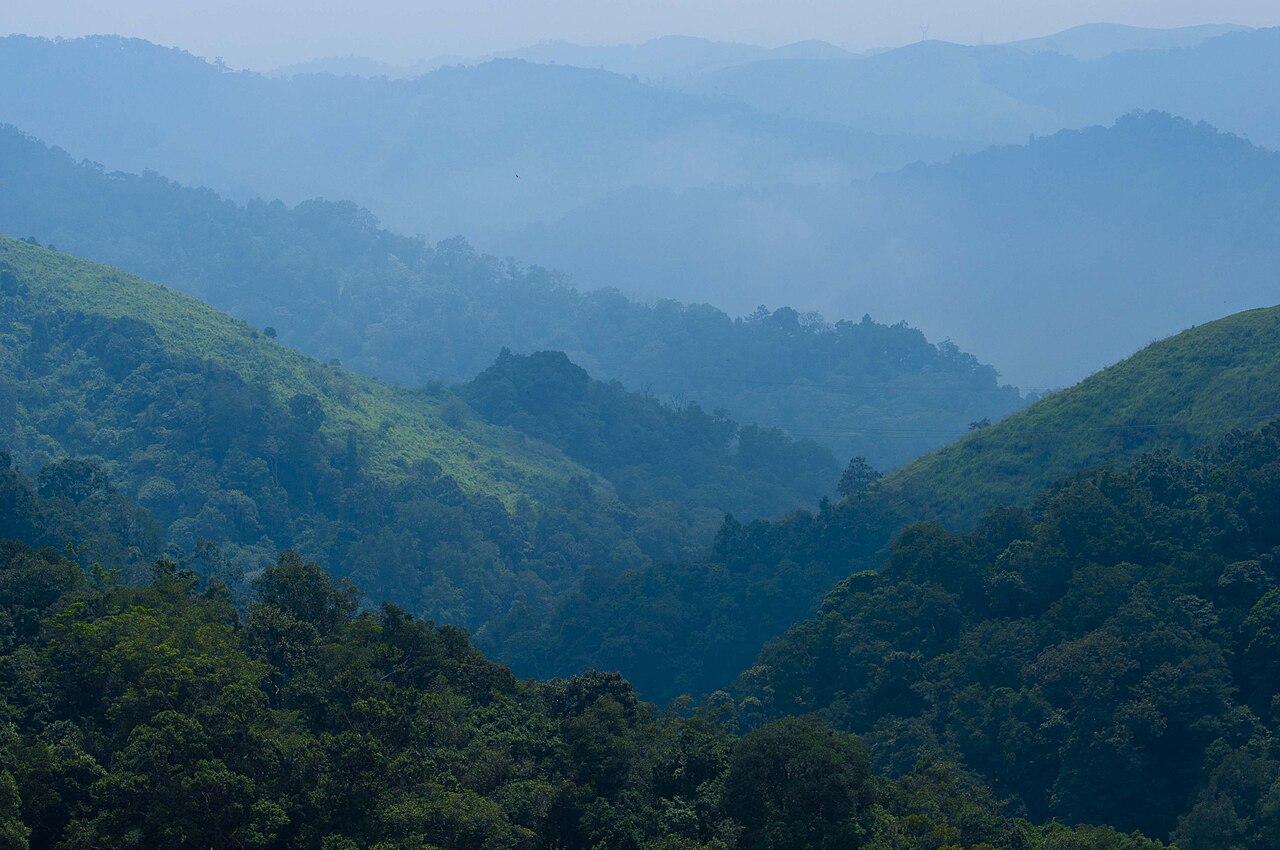
Mountains of Western Ghats – Modern woodland context
Mountains of Western Ghats. Modern woodland context; no inference of unchanged communities or ancient vegetation.
Photographed 2015-10-03 11:48:12
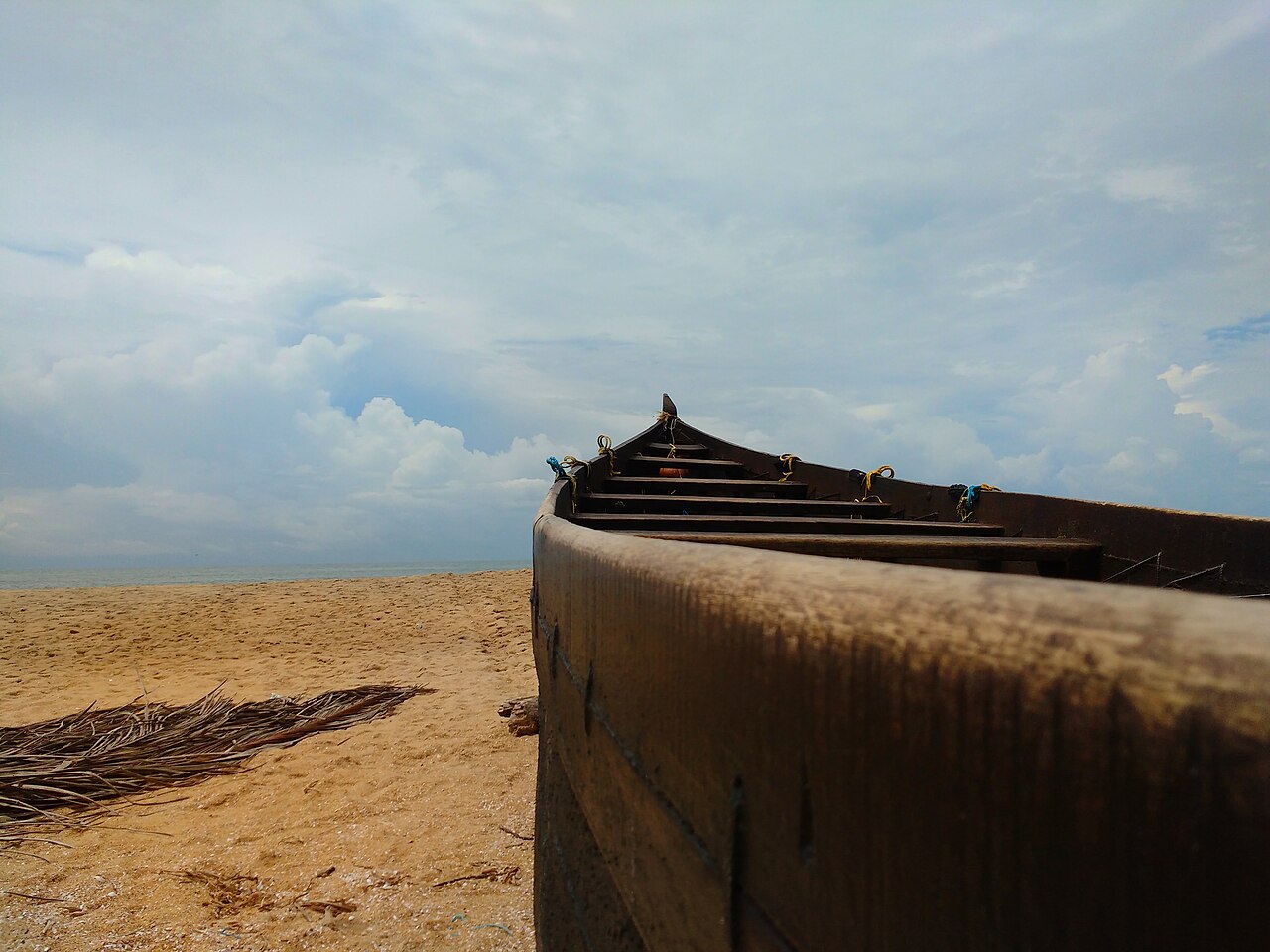
Traditional boat of kerala – Modern coast/fishing scene, for landscape comparison
Traditional boat of kerala. Modern coast/fishing scene, for landscape comparison; people and craft are modern.

Photographed 2021-07-30 07:07:47
Western Ghats foothills at Malampuzha, Palakkad Gap margin (modern woodland context)
Western Ghats foothills at Malampuzha near the Palakkad Gap, Kerala.
006Two views
Both views are shown at equal weight; this site does not choose between them.
What the repeated waves in Kuruntokai 228 convey
- One view
- Gardner Harris (2018): the repeated movement of the waves conveys the long, wearying time of waiting.
- Another view
- Another reading, which Harris distinguishes from his own, treats the waves as a messenger.
- What would settle it
- No single find; closer study of the poem with critical editions and commentaries could narrow the readings.
007Where next

Same place: Marayoor
On the atlasMarayoor & Kovilkadavu Dolmen FieldsProtected heritage zone · Marayoor / Kovilkadavu, Idukki
Explore nextTolkappiyam: text page from the 1847/1848 printed edition – A later printed witness to an older work, not an ancient manuscriptAll related studies, connected material, books and sources24 · 8
Elsewhere on this site
Excavation Atlas Sites: Marayoor & Kovilkadavu Dolmen Fields
Connected material
Photographs, drawings, books, videos and other studies linked to this study. A link helps you explore; it does not prove a historical claim.
- Tolkappiyam: text page from the 1847/1848 printed edition – A later printed witness to an older work, not an ancient manuscripthistorical printed textBackground
- Sunrise light on mountain peak near Munnar Kerala – Modern mountain landscape for understanding a poetic landscape categoryphotographBackground
- Montane landscape in the Nilgiris, Western Ghats (modern ecological context)photographBackground
- Western Ghats foothills at Malampuzha, Palakkad Gap margin (modern woodland context)photographBackground
- Mountains of Western Ghats – Modern woodland contextphotographBackground
- Traditional boat of kerala – Modern coast/fishing scene, for landscape comparisonphotographBackground
- From upland forest to estuaryillustrationThe five tiṇai and their usual moods follow this study’s table of poetic associations.
- A landscape in a poemdiagramThe five landscape and situation pairings follow this study’s table of tiṇai associations.
Books, videos and websites
Outside reading on this topic. These are not part of the study and we have not checked every claim in them. See all books and videos
- Dean's Lecture Series: Martha Ann Selby on Old Tamil Poetry Video · Martha Ann Selby · University of Texas at Austin (at the 29 April 2022 event) · 1:05:47 · Landscape as Affective Space in Old Tamil Poetry examines literary convention, emotional content and the limits of reading poems only through landscape categories. A close fit for the website’s aim to treat poems as crafted literature before extracting historical evidence. Interpretive scholarship, not an archaeological dating lecture. Automatic translations have not been checked.
008Sources
The study lists the sources it consulted; we have not rechecked them. A working link does not show that a source was read, and a valid identifier does not show that it supports a claim. We do not link to unofficial uploads or copies of publications. Where a study cited one, we show the published citation, or a publisher, DOI or Internet Archive link when we have one. Tracking codes are removed from links, and the sources themselves are not republished here.
Vaidehi Herbert, Sangam Poems Translated by Vaidehi. Akam Conventions. Source type: Translator’s guide to literary conventions. Access scope: Guide consulted for landscape associations, speakers, addressees, overhearers and the distinction between anonymous central lovers and named allusions. Used as orientation, not as a substitute for a critical edition of the Tolkappiyam. Consulted date: 2026-10-10.
Gardner Harris, Asian Literature and Translation 5(1), 2018, pp. 104–126; DOI 10.18573/alt.32. The Phenomenology of Time in Classical Tamil Poetry. Source type: Scholarly article in an institutional repository. Access scope: Abstract and selected full-text sections, particularly Kuruntokai 228 and 331, consulted. Harris’s interpretation of temporal experience is identified as an interpretation, not the only reading. Public PDF: orca.cardiff.ac.uk. Consulted date: 2026-10-10.
Martha Ann Selby, translator; Columbia University Press, 2011. Tamil Love Poetry: The Five Hundred Short Poems of the Ainkurunuru. Source type: Academic-publisher book description. Access scope: Publisher description and contents consulted, including the proposed early-third-century setting and the five-part arrangement. The full translation volume was not read. Consulted date: 2026-10-10.
Eva Wilden; École française d’Extrême-Orient / Institut français de Pondichéry. A Critical Edition and an Annotated Translation of the Akananuru, Part 1: Kalirriyanainirai. Source type: Academic-publisher edition description. Access scope: Description of the critical edition and its manuscript basis consulted. Neither all 120 edited poems nor its full apparatus was read. Consulted date: 2026-10-10.
Eva Maria Wilden, 2014; Studies in Manuscript Cultures 3; DOI 10.1515/9783110352764. Manuscript, Print and Memory: Relics of the Cankam in Tamilnadu. Source type: Academic-book record and description. Access scope: Institutional book description consulted for the history of transmission. The complete monograph was not read. Consulted date: 2026-10-10.
Project Madurai, electronic edition 0110. Kuruntokai – Tamil text. Source type: Ancient primary text in a modern electronic edition. Access scope: Selected poems 40, 135, 228 and 331 consulted alongside translations and scholarship. Speaker notes are treated as transmitted/editorial framing rather than as autograph evidence. Consulted date: 2026-10-10.
Vaidehi Herbert, Sangam Poems Translated by Vaidehi. Kuruntokai 1–200. Source type: Modern translation, Tamil text and notes. Access scope: Selected entries, especially poems 40 and 135, consulted. No wholesale reproduction of the modern translation. Consulted date: 2026-10-10.
Vaidehi Herbert, Sangam Poems Translated by Vaidehi. Ainkurunuru – poem 203. Source type: Ancient poem with modern translation and notes. Access scope: Poem 203, Tamil text, translation and explanatory notes consulted. The drinking-water comparison is treated as a poetic valuation, not a claim about water safety or a household survey. Consulted date: 2026-10-10.
Researchers and institutions whose work this study uses: Vaidehi Herbert, Eva Wilden
How we know The evidence, claims and dates behind this study
What this study draws on
- Close reading of selected poems in the Project Madurai Tamil texts and Vaidehi Herbert's translations and notes
- Gardner Harris's 2018 article on time in classical Tamil poetry (Kuruntokai 228 and 331)
- Publisher and institutional descriptions of Martha Ann Selby's Ainkurunuru translation and Eva Wilden's editions; the full volumes were not read
Dates in this study
This study has no dates recorded in a form we can chart, so there is no date chart. Any dates it gives are in the full study.
The study’s claims
0 claims · 0 source passages · 22 paragraphs
Browse the study paragraph by paragraphThis study has no separately listed claims. Its paragraphs can be browsed one by one.
About this study Status, corrections and how it was made
Status
Draft study, revision 4. No historian, archaeologist, or Tamil or Malayalam specialist has reviewed it yet.
How it was made
Compiled as an editorial synthesis from published scholarship around questions we framed. About this project & workflow
The summary, How sure lines and Two views notes on this page were prepared from this study and cross-checked against its passages. That is an editorial check, not a specialist review.
Technical details
Study code R086. The text fingerprint changes whenever the study text changes.
- The study text is shown as written. Links from its paragraphs to citations help you move around the study; they are not new claims or checked source passages.
See how this study’s records were extracted
Text fingerprint (SHA-256): R086 · 0242288df1866f92e6a26227… · v4
Evidence tables and technical details are on the web page: https://layersofthesouth.org/read/8c10230c89