Rock-cut beds in the Alagarmalai cavern between Alagarmalai and Kidampatti
Alagarmalai
Photographed Taken on 22 September 2012,
- Belief & memory
Early Jain-related shelters: strong in Tamil Nadu, thin in Kerala
Inscribed rock beds near Madurai record Jain-related ascetics and their donors; the sources checked found no comparable early set in Kerala.
- This page
- 6,575 words · revision 7
Draft study · Awaiting specialist review · Updated
001Dates and places

No mapped place in this study.
Dates in this study are stated in words only.
- 1 Well supported
- 2 Likely
- 1 Not known
002How sure
In brief
Natural granite shelters near Madurai in Tamil Nadu were adapted for ascetic use by the later centuries BCE. People cut drip-ledges to shed rain, prepared stone beds and carved short Tamil-Brahmi inscriptions. Iravatham Mahadevan's corpus dates these inscriptions by letter forms, not by laboratory tests. At Sittannavasal, a bed inscription of about the first century BCE calls a female ascetic Kavuti, which Mahadevan reads as a Jain nun. Other beds there carry inscriptions of about the eighth century CE, so one hill holds many dates. Donors at Alagarmalai included people in salt, sugar, iron and textiles, and named donors also appear at Jambai and Pugalur. The earliest records name no sect, so calling them Digambara is too specific. Kerala has early inscriptions at Edakkal, but the sources used found no securely Jain shelter before 600 CE.
Key researchers cited in this study: Iravatham Mahadevan (Tamil-Brāhmī Epigraphy) · Full bibliography
How sure
- Well supported
Shelters near Madurai were adapted with stone beds, drip-ledges and donor inscriptions.
Documented in Mahadevan's inscription corpus and Hanlon's field survey of twenty caves.
- Likely
The earliest of these inscriptions date to the second and first centuries BCE.
Mahadevan dates them by letter forms; no laboratory dates were found.
- Likely
Some of the early records belong to Jain ascetics.
Supported by wording such as Kavuti and the wider corpus; each identification remains an interpretation.
- Not known
Whether Kerala had Jain rock shelters like these before 600 CE.
None was found in the sources used; Edakkal's early inscription is not identified as Jain.
Why it matters
These shelters show traders and rulers supporting ascetics, and they show why each bed, inscription and shrine needs its own date.
003Key findings
What the study concludes
- Early Jain-related archaeology in Tamil Nadu is often an archaeology of adapted natural shelters, not monumental temples: rain control, prepared beds or seats and inscriptions form the crucial evidence package.
- A dated inscription can closely constrain one feature without dating every feature on the hill. Sittannavasal is the clearest example.
- Donor inscriptions preserve workaday economic roles – including salt, sugar, iron, textiles, goldsmithing and accounting – behind ascetic patronage.
- “Jain” and “Digambara” are not interchangeable chronological labels; the earliest cave records do not themselves supply the later sectarian classification.
- Kerala preserves significant early epigraphy, but the sources read here do not yet establish a comparably secure pre-600 CE Jain cave-bed corpus. Chitharal's best-supported visible Jain phase is later and belongs to present-day Tamil Nadu.
In the study’s own words. How sure each point is, is shown above.
The summary above is the short read. The full study is the complete text it was drawn from, with its tables and source notes.
What the full study covers
004The study
Framing and public orientation
Question and scope
What evidence documents early Jain-related cave use, inscriptions and ascetic settings in Kerala and Tamil Nadu?
Region: Tamil Nadu; Kerala; and, where historically relevant, the southern Travancore–Kanniyakumari borderland. Chitharal/Tiruchcharanattumalai is treated as a site in present-day Tamil Nadu, while noting that older literature described it within Travancore.
Period classification: mixed chronology. The period studied is 1000 BCE–600 CE, distinguishing evidence within that range from early-medieval sculptures, shrines, inscriptions, and later reuse.
This page dates historical records, not living faith.
Two findings shape this study. First, the strongest securely dated early evidence recovered here is concentrated in Tamil Nadu, above all in the Madurai–Pudukkottai cave-inscription tradition. The accessible evidence read for Kerala proper does not establish an equivalent pre-600 CE corpus combining demonstrably Jain rock beds, drip-ledges and donor inscriptions. Kerala certainly has early inscriptions – notably at Edakkal – but the passages read in Mahadevan's corpus do not identify those records as Jain; securely Jain evidence read for Eswarankod is later. ↗1 ↗2
Second, the label “Digambara Jainism” is too specific when applied to the earliest Tamil cave inscriptions. Mahadevan explicitly treats the absence of sect names as significant and argues that this early epigraphic phase precedes the later Digambara–Śvetāmbara division visible in other evidence. P. B. Desai's broader history also rejects a simple picture of South India as exclusively Digambara from the beginning. The safe historical label for the earliest material is therefore Jain-related, with particular identifications attributed inscription by inscription. ↗3 ↗1
Orientation
A granite shelter can preserve several different histories at once. A shallow groove above its brow may divert monsoon runoff. A flattened ledge may have been prepared as a bed or seat. A short inscription may name a donor or ascetic. Centuries later, new writing, carved Jinas or a shrine may transform the same hill into a visibly different religious setting. The central question is therefore not simply whether a hill can be called “Jain,” but which particular feature carries the Jain identification, what dates that feature, and whether neighbouring features are genuinely contemporary. Mahadevan's documentation of Sittannavasal is especially valuable because an early Tamil-Brahmi inscription attached to one prepared bed can be distinguished from additional beds and inscriptions of later date. ↗1
Tamil Nadu provides substantial evidence for ascetic shelters modified through stone-working, accompanied by Tamil-Brahmi inscriptions and patronage from people in varied occupations. Later field-based reassessment adds water-management, route and settlement context. Chitharal, by contrast, is securely represented in the consulted evidence principally by early-medieval sculptures and inscriptions, while the investigated Kerala material remains much thinner for the specific pre-600 CE cave-bed question. The result is a history of uneven evidence, not a single undifferentiated “Tamilakam and Kerala Jain cave tradition.” ↗1 ↗2 ↗4 ↗5
Explanation and investigation
Accessible explanation
Many of the places called “Jain caves” in discussions of early Tamil Nadu are not deep chambers excavated into a mountain. They are natural rock shelters, often on granite hills, that were made more usable by relatively modest but purposeful work. Rock surfaces could be flattened into beds or seats. A groove could be cut into the brow of the shelter so that rain running down the rock face would fall away from the protected surface rather than soak it. Mahadevan discusses such physical modifications together with postholes and arrangements that may have supported temporary screens or roofing, while Julie Hanlon's later survey work emphasizes drip-ledges, drainage channels, beds and other water-management features as part of the practical architecture of the cave establishments. ↗1 ↗5
These features cannot be declared Jain simply from appearance. Mahadevan's treatment of words such as palli and atittanam is a useful warning: in this epigraphic setting they can describe a hermitage, dwelling, seat or fixed place, but they are not automatic sect labels. Religious identification becomes stronger when the physical arrangement is combined with names or titles interpreted as belonging to Jain ascetics, recurrent donor formulas and a wider inscriptional context. At Sittannavasal, for instance, Mahadevan reads the designation Kavuti in the early bed inscription as referring to a Jain nun. That epigraphic interpretation gives the bed a much firmer Jain context than the existence of a smooth rock surface could do by itself. ↗1
The inscriptions also bring ordinary economic life into view. At Alagarmalai near Madurai, Mahadevan's synthesis identifies donors connected with salt, sugar, iron and textiles, as well as a goldsmith and an accountant. This is important because ascetic landscapes depended on work outside the cave: quarrying or dressing stone, moving provisions, obtaining water, manufacturing goods and maintaining relationships with settlements. Hanlon's analysis counts numerous named donors and merchant or guild associations in the early Tamil-Brahmi cave corpus and argues that the location of many sites near settlements and routes helped make relationships with lay supporters practical. A road beside a cave does not prove a missionary itinerary, but the combined evidence does place ascetic retreats within lived economic landscapes rather than outside them. ↗1 ↗5
Second view of the rock-cut beds in the Alagarmalai cavern
Alagarmalai
Photographed Taken on 22 September 2012,
Sittannavasal demonstrates why beds, inscriptions, sculptures and temples must each be dated separately. At the natural shelter known as Eḻatippattam, Mahadevan records a well-made stone bed carrying a Tamil-Brahmi inscription and assigns the inscription approximately to the first century BCE on palaeographic grounds. The text is engraved along edges adjoining the bed. In the same shelter he reports another sixteen beds, some associated with much later Tamil inscriptions of approximately the eighth century CE. The early inscribed bed therefore cannot be used to date every bed in the shelter, still less the famous rock-cut shrine and painted surfaces elsewhere at Sittannavasal. ↗1
Samanar Malai near Keelakuyilkudi in Madurai district is an important comparison. A 2012 report by V. Vedachalam and V. Muthukumar in Āvaṇam 23 records a Tamil-Brāhmī inscription on the brow of a natural cavern there, assigned on letter forms to about the second century BCE (consistent with the dating noted in “Samanar Malai: an early inscription and later Jain reliefs”). Epigraphists read the short text differently – as a cavern or spring (ayam) made or given by a person or headman of Peru-tōrūr/tērūr – and the full Tamil article and estampage were not checked directly. ↗6
Chitharal needs an even stronger chronological warning. The present Kanniyakumari district heritage page assigns the site's Tirthankara and attendant sculptures to the ninth century CE. Desai, using the older name Tiruchchanattumalai and locating it in then-Travancore, discusses rock-cut Jain figures and places the ascetic Ajjanandi associated with one epigraphic phase broadly in the eighth–ninth centuries by palaeography. Rajan's review of Jain evidence in Kerala also cites earlier scholarship describing a ninth-century shrine at Chitharal. Those dates are outside the 600 CE cutoff of this study. Chitharal belongs in this study as later reception and as a useful example of shifting political geography, but the consulted evidence does not make it a secure example of pre-600 Jain cave monasticism in Kerala. ↗3 ↗2 ↗4
Kerala proper presents a different evidentiary picture. Mahadevan's corpus includes Edakkal in Wayanad and dates one Tamil-Brahmi inscription there to approximately the third century CE; his reading associates it with a Cēra figure. He also treats Early Vattezhuthu (Vaṭṭeḻuttu / Vatteluttu) material at Edakkal as later, around the fifth century. Yet the consulted discussion does not identify the early Edakkal inscription as Jain, and it specifically notes the absence of votive objects associated with that inscription in the cave. At Eswarankod in Palakkad, Rajan concludes that the Jain material is early medieval and states that the pillow-side inscriptions known from stone beds at some other Jain sites were not found there. These sources justify an evidence-limited conclusion: the consulted sources do not establish a secure pre-600 CE Kerala assemblage comparable to the Jain-related Tamil cave-bed corpus. They do not justify saying that Jain people were absent from early Kerala. ↗1 ↗2
Main investigation
The early Tamil evidence is a system of shelter, labour and inscription
Iravatham Mahadevan's Early Tamil Epigraphy: From the Earliest Times to the Sixth Century A.D. is the principal read edition for this study. It is not merely a general historical summary: Mahadevan describes a corpus assembled through fieldwork and epigraphic procedures including inspection of stones, tracings and estampages, and the work provides transliteration, translation, commentary, corpus numbering and illustrations. His chronological tables place several Tamil cave sites in the second and first centuries BCE and continue the sequence into Late Tamil-Brahmi and Early Vatteluttu phases. This makes the work especially useful for keeping script history, site context and individual inscriptions distinct. ↗1
The material setting described across this corpus is not reducible to “a bed carved in a cave.” Mahadevan reconstructs shelters in which the protected rock surface could include prepared sleeping or sitting places, raised pillow-like ends, drip-ledges at the brow, postholes and access to water. Some reconstruction – particularly the use of posts, screens or temporary canopies – is interpretive and must not be turned into a universal architectural plan. The directly observable point is narrower: natural shelters were intentionally modified to improve habitability. That work would have mattered most during wet weather and repeated occupation, making rain control and dry sleeping surfaces significant evidence for the practical conditions of ascetic residence. ↗1
Hanlon's more recent study adds a landscape-scale comparison. Drawing on surveys of twenty caves, she identifies drip-ledges and drainage channels as especially important early interventions and records beds and postholes among the modifications. She also argues that many early Jain cave sites were close enough to settlements to sustain interaction with lay communities. Her donor count – approximately eighty-three named individuals in the corpus she studied, with a substantial merchant/guild component – is an analytical reconstruction rather than an inscriptional total that should be repeated without attribution. Still, it reinforces the conclusion that ascetic retreat and economic society were connected rather than separate worlds. ↗5
Sittannavasal: one hill, several chronological layers
The Eḻatippattam shelter at Sittannavasal contains one of the clearest combinations of physical setting and inscription in the investigated corpus. Mahadevan's Corpus no. 49 describes a Tamil-Brahmi inscription running along adjoining edges of a prepared stone bed; he gives a locus, dimensions, a tracing and an estampage, and assigns the inscription approximately to the first century BCE. His translation records a seat made for Kavuti, whom he interprets as a Jain nun, associated with Kumulur in Eruminatu. The interpretation that this is a Jain ascetic context belongs to Mahadevan and should be cited as such, rather than presented as though the stone itself carries a modern sect label. ↗1 “Sittanavasal's rock beds and cave temple come from different eras” examines this inscription and the later Sittannavasal temple in more detail.
Mahadevan's discussion of the same shelter then provides a built-in control against overdating. Sixteen additional stone beds are reported, and some have inscriptions assigned to around the eighth century CE. This means that “the Sittannavasal stone beds” do not have one single archaeological date. It is safer to say that a particular inscribed bed belongs to an early phase and that the shelter contains evidence for later use. Beds, inscriptions and later monumental features should therefore be dated separately. ↗1
A further chronological layer appears in Mahadevan's treatment of Sittannavasal-B, assigned broadly to around the fifth century CE in his palaeographic scheme. Both are separate from the famous painted rock-cut sanctuary on the hill: an inscription at the shrine records its ninth-century CE renovation under the Pāṇḍya king Śrīmāṟa Śrīvallabha by the Jain teacher Iḷaṅ Gautamaṉ, as examined in “Sittanavasal’s inscribed bed is centuries older than its painted temple” (K. R. Srinivasan's monograph and the ASI monument guide were not read here). The natural cave's first-century-BCE bed inscription therefore does not date the later shrine or its paintings. ↗1
Mangulam shows the same layering on another hill. The Tamil Nadu Department of Archaeology's account of the 2006–07 excavation distinguishes early and medieval cultural phases. It describes structures on the cave terrace and a pedestal that may belong to the Sangam period, while a thirteenth- or fourteenth-century copper coin comes from a trench near Meenakshipuram. These are observations from different contexts, not conflicting dates for one event: objects from one trench cannot date every feature on the hill. The account was read through an indexed copy, not a full excavation report. ↗14 “Mangulam's inscriptions name a ruler's servant, kin and a guild” and “Arittapatti's cave inscriptions name two early donors” discuss the Mangulam inscriptions themselves.
Donors make everyday economies visible
Alagarmalai is particularly useful for moving the story beyond rulers. Mahadevan reports thirteen Tamil-Brahmi inscriptions at the cave, one associated with a bed and others on the brow, and assigns the group approximately to the first century BCE. His reading of donor descriptions identifies people involved in salt, sugar, iron and textile activity, alongside a goldsmith and an accountant; his synthesis also includes a Jain nun and a probable Pandya prince among the wider donor context. The historical value lies precisely in that diversity. Religious patronage was not an activity only of kings: the inscriptional landscape records people whose livelihoods involved everyday commodities, craft production and administration. ↗1
This evidence also cautions against an overly “trade-route” narrative. Merchant and craft identities make economic connectivity plausible, and Hanlon's spatial analysis gives good reason to study routes and settlement proximity, but a donor described through an occupation is not automatically evidence for long-distance trade, migration or missionary movement. The inscriptions support patronage relationships. Routes provide geographical context. A claim that Jain teachers entered a region along a particular corridor is a further historical inference requiring separate argument. ↗1 ↗5
Named people behind the gifts. Some inscriptions name the people behind a gift of a shelter, a bed, or a seat. The five below are witnesses spread across roughly five centuries, not one snapshot of a single society.
- Viyakkan, a salt merchant, in Alagarmalai inscription 39, dated to about the first century BCE in a digital presentation of Mahadevan's readings. “Salt was made on the coast and carted inland in early South India” discusses the same reading. ↗9
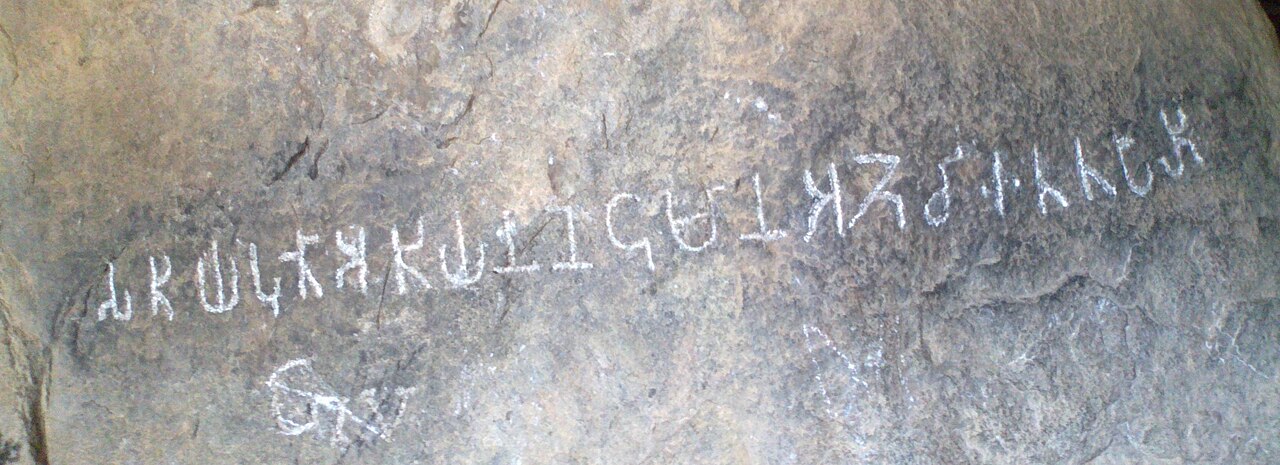
- Atiyan Netuman Anci, titled Satiyaputo, whose gift of a pali (a hermitage) at Jambai the Tamil Nadu Department of Archaeology dates to the first century CE on palaeographic grounds. “The Jambai inscription ties Aśoka's Satiyaputo to the Atiyan line” studies this inscription. ↗10
- Kunraththur (Varichiyur) cavern inscriptions: Mahadevan (Early Tamil Epigraphy, nos. 15–17) dates the three damaged Tamil-Brāhmī inscriptions in a natural cavern with rock beds near Varichiyur to about the second century BCE, whereas the Tamil Nadu Department of Archaeology webpage assigns them to the first century CE and reads a donor name (Ilanathan) in connection with making the stone cave (the exact reading of that name was not collated directly against Mahadevan no. 17). ↗13
- Kiran Korri, young daughter of Pittan of Nalliyur, named in Pugalur inscription 65 in connection with the making of a palli, about the second century CE. “Early Tamil records show rank, not the later caste order” reads inscriptions 65 and 66 as naming the same woman. ↗11
- Natti, a gold merchant of Karuvur, named in Pugalur inscription 69 on a stone bed, in association with a donated seat or resting place, about the third century CE. “Pugalur inscriptions record a three-generation royal genealogy” covers the Pugalur inscriptions. ↗12
These records keep individual associations that a broad label can hide. “Women supported ascetics” is less exact than the bounded statement that this reading identifies this woman with this gift at this place. In the same way, a recorded trade such as “salt merchant” should not be upgraded to pepper exporter, guild member or overseas trader. A small donor can stand beside a ruler without the two being ranked in an imagined hierarchy; two inscriptions are two witnesses, not a census. None of these gifts reveals the donor's motive or what the residents believed.
Samanar Malai: multi-period hill and early cavern inscription
Samanar Malai near Keelakuyilkudi preserves evidence of more than one period of Jain activity. For its early phase, Vedachalam and Muthukumar (Āvaṇam 23, 2012) reported a Tamil-Brāhmī inscription on the brow of a natural cavern, assigned on letter forms to about the second century BCE (see also “Samanar Malai: an early inscription and later Jain reliefs”, which reviews the dated phases at Samanar Malai including an early Tamil-Brāhmī inscription dated after Mahadevan to about the second century BCE). Epigraphists read the short text differently – as a cavern or spring (ayam) made or given by a person or headman of Peru-tōrūr/tērūr – and the full Tamil article and estampage were not checked directly. As elsewhere, later relief sculptures on the hill should not be backdated from the early cave inscription. ↗6
Chitharal: important Jain heritage, but principally later for this question
Chitharal illustrates why modern fame can distort chronology. The site is in present-day Kanniyakumari district, Tamil Nadu. Older authors used forms such as Chitaral and Tiruchchanattumalai and discussed it within Travancore, reflecting the political geography under which they wrote. Desai explicitly describes a series of rock-cut Jain figures there. The current district heritage page identifies Tirthankara and attendant sculptures and dates them to the ninth century CE. Those sources are compatible on the crucial point: the visually prominent sculptural phase is early medieval rather than part of the earliest Tamil-Brahmi cave horizon. ↗3 ↗4
Desai's palaeographic discussion places Ajjanandi, associated with one inscriptional phase, broadly in the eighth–ninth centuries. Rajan, reviewing Kerala Jain evidence, cites earlier scholarship describing a ninth-century Jain shrine at the site. These are historical dating arguments, not scientific dates, and should remain attributed. No radiocarbon, thermoluminescence or other laboratory determination for the site was recovered or used here. ↗3 ↗2
The consulted evidence does not support treating Chitharal as an early cave, drip-ledge and rock-bed site comparable with Samanar Malai and Sittannavasal. A bibliographic lead points to an older Travancore Archaeological Series treatment of the Jain temple at Chitral, and Rajan cites Gopinatha Rao's work on Jain and Buddhist vestiges in Travancore, but those original passages were not checked directly. Any claim for first-century-BCE beds or pre-600 Jain cave use at Chitharal therefore remains unverified and should not be inferred from the site's later Jain sculptures. ↗2 ↗7
Kerala: early writing is not automatically early Jain monasticism
Edakkal is the most important guardrail against conflating “early inscription” with “Jain cave inscription.” Mahadevan's Corpus Edakal-A gives a Tamil-Brahmi record that he dates around the third century CE, with his reading referring to Katumiputta and “the Cēra.” Elsewhere his chronological treatment places Early Vatteluttu inscriptions from Edakkal around the fifth century. These are unquestionably relevant to early writing and mobility across the western side of the peninsula, but the consulted passages do not identify this inscriptional context as Jain. Mahadevan also remarks that no votive objects are associated with the particular early cave inscription he discusses. ↗1 “Edakkal's inscriptions are dated more securely than its rock art” separates the rock-art and inscription phases at Edakkal.
An additional 2012 Āvaṇam abstract reports M. R. Raghava Varier's publication of a newly identified Brahmi inscription from Edakkal and dates that reported record to the fifth–sixth centuries CE. Again, nothing in the accessible abstract read here is sufficient to turn the record into Jain evidence. It is retained as a lead relevant to Kerala's epigraphic chronology, not as support for a Jain cave claim. ↗6
Eswarankod in Palakkad offers securely Jain material, but Rajan's 2018 analysis describes it as early medieval, not early historic in the narrow sense used by the period studied here. Rajan notes two images, regards only one as clearly identifiable as Mahavira, and emphasizes the lack of documentary evidence for a more exact date; elsewhere in the article the material is discussed broadly around a ninth–tenth-century horizon. Especially relevant here, Rajan observes that inscriptions placed on the pillow-side of stone beds are known at other Jain contexts but were not found at Eswarankod. ↗2
Rajan himself characterizes reconstruction of Kerala's Jain tradition as resting on relatively thin evidence. That does not mean the tradition was historically unimportant; it means the archaeological and epigraphic record available for particular questions is uneven. The negative result must therefore be phrased carefully: no securely identified, comparably documented pre-600 CE Jain cave-bed assemblage in Kerala proper appears in the consulted sources. That reflects the limits of published evidence reviewed here rather than proof of archaeological absence. ↗2 “Kerala's early Jain sites are not dated before 600 CE” examines Kerala's later Jain-associated monuments site by site.
Sectarian identity: Jain is not automatically Digambara
The earliest cave records do not give historians permission to project later institutional identities backwards. Mahadevan observes that explicit sectarian references are absent in the earliest phase and argues that these cave inscriptions belong before the historical division into Digambara and Śvetāmbara communities is visible in this evidence. Desai's much older synthesis, despite its heavy attention to Digambara traditions, likewise discusses evidence that complicates any assertion that the whole South was Digambara from the outset. A phrase such as “extensive footprint of Digambara Jainism” should therefore give way to “substantial early Jain-related cave and inscription evidence in parts of Tamil Nadu,” with sect labels added only where separately supported. ↗3 ↗1
Background: Jain texts explain the discipline, not local dates
Jain texts help explain the discipline of Jain ascetics and how they could accept gifts, although the texts are not evidence from these sites. In Hermann Jacobi's 1884 translation of Ācārāṅga I.1.2, responsibility for harm extends beyond a person's own act to causing or approving another's act. It is a demanding account of restraint, not only a ban on conspicuous cruelty, and Jacobi's inserted explanations are not the original words. ↗15 Ācārāṅga I.2.1 names family, provisions and possessions as sources of attachment, so the household is present even in the argument for leaving it. ↗16
Jasmine Kelly's Jainpedia article ties non-harming (ahiṃsā) to living souls, karma and release from rebirth. It distinguishes the duties of mendicants from those of lay followers and treats carefulness as an active discipline; its modern examples should not be moved back into antiquity. ↗17 Nalini Balbir's Jainpedia article on Śvetāmbara lists of fundamental texts discusses an image from the Daśavaikālika: a bee gathers from a flower without injuring it, as a mendicant should take alms without harming those who give them. Balbir separates legendary authorship from later institutional practice, and the modern curricula she describes are not an ancient Tamil syllabus. ↗18
These texts explain a discipline; they do not date any practice at a Tamil or Kerala shelter. As the section above on sect identity explains, Mahadevan places the earliest Tamil cave records before the Digambara–Śvetāmbara division is visible in this evidence. A text from the Śvetāmbara lists should therefore not be presented as the rule of the early Tamil shelters. Read from the other side, a donated shelter records support and a remembered name, not what its residents believed or taught.
Routes and interregional connections remain interpretations
Mahadevan interprets the Sittannavasal inscription's place-name connections and the designation Kavuti as evidence bearing on contacts between Jain communities in the Tamil and Karnataka regions. That is an epigraphically grounded historical interpretation, but not proof of a particular individual's journey. Hanlon's later geospatial work offers a different large-scale proposal: the directional pattern of the earliest Tamil Jain cave evidence may fit entry from the northeast better than a simple Karnataka-first expansion model. This is a genuine interpretive disagreement about regional development, not a choice between one “correct map” and another. ↗1 ↗5
The evidence that could sharpen this question would include independently dated early sites along the proposed corridors, closely dated inscriptional palaeography, explicit place-name links and archaeological evidence for repeated occupation. Similar rock beds on two hills, by themselves, would not establish transmission, ethnicity or a travel route.
What the evidence now supports
The best-supported reconstruction is therefore modest but substantial. By the later centuries BCE, parts of Tamil Nadu – particularly around Madurai – contained natural rock shelters deliberately modified for ascetic use and marked by Tamil-Brahmi inscriptions recording donors, ascetics or gifts. Water control, beds or seats and access to supporters made those shelters workable environments. Some records can be identified as Jain with reasonable confidence through their wording and corpus context, but individual religious identifications remain interpretive and the early records do not justify a blanket Digambara label. Sittannavasal provides especially good evidence for long reuse because its early bed and inscription can be distinguished from later beds and inscriptions. ↗1 ↗5
Kerala contributes important early epigraphy but, on the consulted evidence, not an equally secure early Jain cave-bed assemblage. Chitharal's visually striking Jain heritage belongs predominantly to a later early-medieval phase and to present-day Tamil Nadu, even though older Travancore scholarship makes it important for Kerala-connected history. ↗1 ↗2 ↗4
Evidence architecture
Interpretation and sources
Interpretations, disagreements and limits
What counts as Jain? A prepared bed is observation. A Tamil-Brahmi inscription beside it is another observation. Reading the text is philological analysis. Calling the occupant Jain is an identification that may depend on the personal designation and comparison with the wider corpus. Calling that person specifically Digambara is a still narrower historical claim. Keeping those layers apart prevents a physical resemblance from doing more interpretive work than it can bear. Mahadevan's own caution about terminology and sectarian labels supports this separation. ↗1
How early is the cave tradition? Mahadevan's corpus places several southern Tamil cave inscriptions in the later centuries BCE, and his broader chronology gives an early horizon extending into the second century BCE. These dates depend chiefly on palaeographic and epigraphic arguments, with broader script chronology informed by other archaeological evidence. This study does not turn those ranges into radiocarbon-like precision. A palaeographic “ca. first century BCE” remains a palaeographic estimate. ↗1
Do drip-ledges prove monasteries? They are strong evidence for deliberate water management at shelters. Beds and inscriptions strengthen the case for repeated human use. Jain identification depends on additional evidence. Hanlon's interpretation of water-management as an early architectural priority is persuasive as a pattern across her surveyed sites, but an isolated groove should not be labelled a Jain installation without contextual evidence. ↗5
Was Jainism brought from Karnataka? Mahadevan's reading of Sittannavasal points toward cross-regional contacts, while Hanlon's spatial pattern suggests that the earliest spread into the Tamil region may fit a northeastern direction better than a straightforward Karnataka-first model. Neither claim should be transformed into a biography of a monk travelling along a known road. Resolving the issue requires a denser distribution of independently dated early sites and inscriptional place-name evidence. ↗1 ↗5
What does Kerala's thinner evidence mean? Only that the specific cave-bed-inscription package is not securely established there by the sources read for this study. Edakkal prevents any claim that early writing was absent. Eswarankod and the wider literature prevent any claim that Jain history was absent. What remains unresolved is the narrower archaeological question: whether pre-600 CE Kerala has securely documented shelters in which physical beds or rain-management features and explicitly Jain inscriptions occur together. ↗1 ↗2
Chitharal needs primary epigraphic reinspection. Its later Jain character is well supported, but a decisive answer about alleged earlier beds requires direct inspection of the older Travancore Archaeological Series reports, the Gopinatha Rao article and later specialist editions. Until that is done, Chitharal should be presented to audiences as a later comparator, not as one of the best examples of the earliest Tamil-Brahmi cave horizon. ↗3 ↗2 ↗4
Samanar Malai requires direct collation of the Tamil report. The 2012 inscription is assigned on letter forms to about the second century BCE, but epigraphists differ on its short reading; checking the full Tamil article and estampage directly would clarify the preferred reading. ↗6
Source register
** – Iravatham Mahadevan, Early Tamil Epigraphy: From the Earliest Times to the Sixth Century A.D. Cre-A, 2003.**
Language: English, with Tamil/Prakrit inscriptional material in transliteration. Type: inscription edition / scholarly monograph. How it was read: partial text with extensive relevant passages and illustrated corpus documentation read; relevant online scan/OCR opened. Key read material includes the Sittannavasal corpus entry, Alagarmalai synthesis, cave-architecture terminology, chronological tables, Edakkal and sectarian discussion. Direct durable access used: https://search.worldcat.org/title/52720601. Supports C001–C007, C011, C013–C014. citation use only at present. The online OCR is not substituted for inspection of figures where an image was material to the claim. ↗1
** – Julie A. Hanlon, “New Approaches to Studying the History of Jainism in South India,” Jaina Studies 15 (March 2020), pp. 49–52.**
Language: English. Type: research article / research note. How it was read: full relevant text read. Direct access used through the author's accessible online copy. The article summarizes geospatial and field-survey work on early Tamil Jain caves, donors, settlement relationships and water-management architecture. Supports C001, C007 and C014. Hanlon's proposed route pattern is an interpretation, not direct archaeological proof of migration. ↗5
** – P. B. Desai, Jainism in South India and Some Jaina Epigraphs. Sholapur, 1957.**
Language: English. Type: scholarly book / epigraphic synthesis. How it was read: partial text read. Direct digital scan metadata and relevant pages were opened. Useful here primarily for Chitaral/Tiruchchanattumalai and for the older historiography of sectarian identities. It is foundational but not preferred over later inscription editions for individual early Tamil records. Supports C005, C009 and C015. Direct access used: Internet Archive scan of the ASI Central Archaeological Library copy. ↗8 ↗3
** – V. Vedachalam and V. Muthukumar, “Tamil Brahmi (Tamili) inscription at Samanar malai,” Āvaṇam 23 (2012).**
Research article (English abstract consulted; full Tamil article and estampage were not checked directly). Reports a Tamil-Brāhmī inscription on the brow of a natural cavern at Samanar Malai, assigned on letter forms to about the second century BCE with divergent epigraphic readings. ↗6
** – M. R. Raghava Varier, “A new Brahmi inscription from Edakal caves, Wayanad,” Āvaṇam 23 (2012), bibliographic/abstract lead.**
How it was read: abstract-level lead only. The accessible issue text describes a fifth–sixth-century record but does not, in the consulted abstract, establish Jain identity. Context source for Kerala epigraphy; not evidence for a Jain cave claim. ↗6
** – K. Rajan, “Jaina Traces at Eswarankod in Palakkad, Kerala,” Heritage 6 (2018), pp. 505–514.**
Language: English. Type: research article. How it was read: PDF text plus relevant page images read. Page images for printed pp. 505, 508 and 513 were examined, satisfying the distinction between extracted PDF text and visual page inspection. Rajan describes the evidence as early medieval, notes the absence of pillow-side stone-bed inscriptions at Eswarankod and stresses uncertainties in reconstructing Kerala Jain chronology. Supports C009–C012. ↗2
** – T. A. Gopinatha Rao, “Jaina and Baudha Vestiges in Travancore, with Illustrations,” Travancore Archaeological Series, vol. II, part II, pp. 125–130 (as cited by Rajan).**
Archaeological/epigraphic report; original pages were not checked directly. ↗2
** – “Jain temple at Chitral,” Travancore Archaeological Series vol. IV (1923–24), pp. 146–148.**
Primary Travancore archaeological report for Chitharal; original pages were not checked directly. ↗7
** – Kanniyakumari District Administration, “Chitharal Jain Temple,” official district heritage page.**
https://kanniyakumari.nic.in/tourist-place/chidaral-jain-temple/. Records the present-day location and ninth-century sculpture attribution. ↗4
** – M. R. Raghava Varier, Jainamatam Keralattil (Kottayam: National Book Stall, 2011; cited by Rajan).**
Malayalam monograph; was not consulted directly for this study. ↗2
K. R. Srinivasan, Cave-Temples of the Pallavas (New Delhi: Archaeological Survey of India, 1964) and ASI Sittannavasal monument guide.
Not read for this study; listed as further reading on the rock-cut shrine.
** – Tamil Brahmi digital project (readings attributed to Iravatham Mahadevan): Alagarmalai inscription 39 (site entry 12.39).**
https://brahmi.mvbhaskar.com/Alagarmalai/Alagarmalai_12_39/Alagarmalai_interactive_12_39.html. Records Viyakkan, salt merchant (ca. first century BCE). ↗9
** – Tamil Nadu Department of Archaeology, “Brahmi Inscription: Jambai.”**
https://www.tnarch.gov.in/brahmi-inscription-0. Records Satiyaputo Atiyan Netuman Anci's gift of a pali (first century CE palaeographic date). ↗10
Rock-cut beds at the Jambai Jain shelter
Jambai
Photographed 2011-12-25
** – Tamil Brahmi digital project (Iravatham Mahadevan's readings): Pugalur inscription 65 (Pugalur 5).**
https://brahmi.mvbhaskar.com/Pugalur/Pugalur_20_65/Pugalur_interactive_20_65.html. Records Kiran Korri, daughter of Pittan of Nalliyur (ca. second century CE). ↗11
** – Tamil Brahmi digital project (Iravatham Mahadevan's readings): Pugalur inscription 69 (Pugalur 9).**
https://brahmi.mvbhaskar.com/Pugalur/Pugalur_20_69/Pugalur_interactive_20_69.html. Records Natti, gold merchant of Karuvur (ca. third century CE). ↗12
** – Tamil Nadu Department of Archaeology, “Kalvettu Padukkaigal & Murugan Koil, Varichiyur.”**
https://www.tnarch.gov.in/KalvettuPadukkaigalMuruganKoil-Varichiyur. Summarizes the Kunraththur cavern and three damaged inscriptions (departmental first-century CE date vs. Mahadevan nos. 15–17, ca. second century BCE). ↗13
Interior of the boulder shelter and stone beds at Kundrakudi (Kunnakkudi)
Kunnakkudi
Photographed 2025-08-06
** – Tamil Nadu Department of Archaeology, “Mangulam: excavation account” (2006–2007).**
https://www.tnarch.gov.in/mangulam. Distinguishes early terrace features from a thirteenth-/fourteenth-century coin in the Meenakshipuram trench. ↗14
** – Hermann Jacobi, translator (1884). Ācārāṅga Sūtra: earth-bodied beings and responsibility.**
Ācārāṅga I.1.2, selected discussion of earth-bodied beings and acting through others. How it was read: Selected translated lesson read in the electronic presentation. Jacobi’s English terminology and inserted explanations are distinguished from the underlying text. No new Prakrit translation or precise Kerala circulation date is claimed. Direct access used: https://sacred-texts.com/book/jaina-sutras-part-i/read/book-i-lecture-1-lesson-2. ↗15
** – Hermann Jacobi, translator (1884). Ācārāṅga Sūtra: household attachments and the call to renunciation.**
Ācārāṅga I.2.1, opening discussion of family, provisions and attachment. How it was read: Selected translated lesson read in the electronic presentation. An ascetic argument about attachment, not a register of an actual family or a description of all lay Jain conduct. Direct access used: https://sacred-texts.com/book/jaina-sutras-part-i/read/book-i-lecture-2-lesson-1. ↗16
** – Jasmine Kelly, Jainpedia (Undated scholarly web article). Non-violence.**
Definition; Effects of violence; Self-control and carefulness. How it was read: Definition, effects of violence, and carefulness sections read. A contemporary scholarly explanation helps identify conceptual distinctions; its present-day examples are not projected onto the ancient past. Direct access used: https://jainpedia.org/article/themes/principles/jain-beliefs/non-violence/. ↗17
** – Nalini Balbir, Jainpedia (Undated scholarly web article). Mūla-sūtras.**
Identity and status; modern curriculum; Daśavaikālika chapter 1. How it was read: Identity/status, curriculum and selected content sections read. The described modern curricula and sectarian lists are dated comparisons, not an ancient Tamil syllabus. The article separates legendary authorship from textual and institutional evidence. Direct access used: https://jainpedia.org/article/themes/principles/sacred-writings/svetambara-canon/mula-sutras/. ↗18
Source dependence note. Rajan often reports earlier scholarship, including Gopinatha Rao and H. Sarkar. Those references do not count here as independent read confirmations unless their originals were also opened. Likewise, the district Chitharal page is evidence for the institution's published description, not independent proof of every historical statement on that page.
Knowledge graph
Learning and claims tested
Key points
Grounded takeaways
- Early Jain-related archaeology in Tamil Nadu is often an archaeology of adapted natural shelters, not monumental temples: rain control, prepared beds or seats and inscriptions form the crucial evidence package. ↗1 ↗5
- A dated inscription can closely constrain one feature without dating every feature on the hill. Sittannavasal is the clearest example. ↗1
- Donor inscriptions preserve workaday economic roles – including salt, sugar, iron, textiles, goldsmithing and accounting – behind ascetic patronage. ↗1
- “Jain” and “Digambara” are not interchangeable chronological labels; the earliest cave records do not themselves supply the later sectarian classification. ↗3 ↗1
- Kerala preserves significant early epigraphy, but the sources read here do not yet establish a comparably secure pre-600 CE Jain cave-bed corpus. Chitharal's best-supported visible Jain phase is later and belongs to present-day Tamil Nadu. ↗1 ↗2 ↗4
Glossary
| Term | Working explanation | Note |
|---|---|---|
| Tamil-Brahmi | Modern scholarly designation for the early Brahmi-derived script used for Tamil-language inscriptions central to this corpus. | A modern scholarly name, not an ancient one. |
| palli | In relevant early inscriptional contexts, a shelter/hermitage or related dwelling term; not inherently a Jain sect marker. | Its meaning depends on the Tamil context. ↗1 |
| atittanam | Interpreted by Mahadevan in this corpus as a seat/fixed abode associated with prepared space. | Its spelling and form still need specialist review. ↗1 |
| Kavuti | Mahadevan's reading of the designation attached to the female ascetic at Sittannavasal, interpreted by him as a Jain nun. | Treat as an epigraphic reading, not a reconstructed biography. ↗1 |
| drip-ledge | Modern archaeological term for a groove cut to direct rainwater away from a protected rock-shelter surface. | Protects prepared sleeping and sitting areas from monsoon runoff. ↗5 |
Useful next questions include: Which Madurai-region records identify Jain ascetics through explicit wording rather than broader corpus context? Can the full Samanar Malai article and facsimile establish its precise date and reading? Do the original Travancore Archaeological Series pages document genuinely early beds at Chitharal, and what is their dating basis? Are there Kerala inscriptions before 600 CE that combine unambiguous Jain terminology with a rock-shelter context? How do female ascetic designations such as Mahadevan's Kavuti compare across the wider inscriptional corpus?
Evidence challenge: A natural cave contains a smooth bed and Tamil-Brahmi writing. Does that prove that a Digambara Jain monk lived there? No. The bed is a physical observation. The inscription must be read and independently dated. Jain identification may depend on names, terminology and comparison with other records. “Digambara” requires an additional sectarian argument that the earliest inscriptions usually cannot supply. At Sittannavasal the reading Kavuti gives relatively strong Jain-related evidence, but the record still does not name the later Digambara sect. ↗1
Historical propositions compared
| Historical proposition | Assessment | Result |
|---|---|---|
| Early Tamil cave sites were specifically Digambara | Qualified | Substantial early Jain-related cave evidence exists in Tamil Nadu, but “Digambara” overstates what the earliest inscriptions establish. ↗3 ↗1 |
| Natural granite caverns modified with drip-ledges and stone beds | Supported for Tamil Nadu; unresolved for early Kerala | Mahadevan and Hanlon document modified natural shelters and water-management features; individual beds must be dated separately. ↗1 ↗5 |
| Economically diverse lay donors | Supported | Documented at Alagarmalai (salt, sugar, iron, textiles, goldsmithing, accounting), Jambai, Varichiyur, and Pugalur. ↗1 |
| Samanar Malai early cavern inscription | Qualified | Reported in 2012 (Āvaṇam 23) and assigned on letter forms to ca. 2nd c. BCE; epigraphists differ on its short reading (see “Samanar Malai: an early inscription and later Jain reliefs”). ↗6 |
| Sittannavasal multi-phase chronology | Supported | First-century-BCE bed inscription in Eḻatippattam is distinct from 8th c. beds and from the 9th c. Pāṇḍya-period renovation of the rock-cut shrine (K. R. Srinivasan / ASI guide). ↗1 |
| Chitharal as an early-medieval site | Supported as later reception | Visible Tirthankara sculpture and Ajjanandi phase date to the 8th–9th c. CE; pre-600 cave-bed claims remain unverified. ↗3 ↗4 |
| Pre-600 Kerala Jain cave-bed corpus | Not known (evidence-limited) | Early Kerala inscriptions exist (Edakkal), but no securely Jain pre-600 cave-bed assemblage appears in the consulted sources. ↗1 ↗2 |
Still open: direct checking of the original Chitharal Travancore Archaeological Series pages and Gopinatha Rao; full Tamil/estampage collation of the 2012 Samanar Malai article and Varichiyur Mahadevan no. 17; verification of exact page citations in K. R. Srinivasan's Cave-Temples of the Pallavas and the ASI Sittannavasal guide; and specialist review of Jainamatam Keralattil.
Conclusion
Supported by the sources consulted: the distinction between early Tamil Nadu Jain-related cave evidence and later Chitharal/Eswarankod material; Sittannavasal's multi-phase chronology; avoiding a blanket retrospective Digambara label; Alagarmalai's diverse donor occupations; and the evidence-limited Kerala comparison. ↗1 ↗2
Needs further study: direct collation of the 2012 Samanar Malai Tamil article and Varichiyur readings; any claim for pre-600 beds at Chitharal; primary pages for the Sittannavasal shrine renovation; and Malayalam specialist scholarship.
Not supported as fact: a blanket “early South Indian Digambara cave network”; a pre-600 date for Chitharal's visible Jain sculptural complex; a Jain classification of Edakkal's early inscriptions without further evidence; or any claim that the absence of a published Kerala pre-600 cave-bed corpus proves Jain ascetics were absent from Kerala.
005Photographs
Photographs of the places and objects this study discusses. Each item carries its creator’s credit, licence and documented source. See all 412 photographs and source images ↗

Alagarmalai · Photographed Taken on 22 September 2012, 12:35:44
Rock-cut beds in the Alagarmalai cavern between Alagarmalai and Kidampatti

Jambai · Photographed 2011-12-25
Rock-cut beds at the Jambai Jain shelter

Kunnakkudi · Photographed 2025-08-06 16:57:27
Interior of the boulder shelter and stone beds at Kundrakudi (Kunnakkudi)

Sittanavasal · Photographed 2018-08-10 12:53:36
Rock-cut beds beneath the overhang at Ezhadippattam, Sittanavasal
Not every bed and inscription visible here dates from the time of the early Tamil-Brāhmī inscription.

Arittapatti · Photographed 2017-01-09 11:41:18
Tamil-Brahmi inscription on the rock face at Arittapatti

Samanar Malai · Photographed 2020-09-02 12:23:47
Group of later Jain reliefs at Samanar Malai
Group of later Jain reliefs at Samanar Malai; the file title calls them beds, but the image depicts carved figures.

Mangulam · Photographed 2015-02-13 05:18:25
Granite outcrop at Mangulam (Ovamalai), photographed as the setting of the Tamil-Brahmi inscription site

Tirupparankunram · Photographed 2006-06-07
Palms and the granite hill at Tirupparankunram
Show 12 more photographs and source images ↓

Alagarmalai · Photographed Taken on 22 September 2012, 12:37:31
Second view of the rock-cut beds in the Alagarmalai cavern

Jambai · Photographed 2011-12-25
Entrance and floor of the Jain rock shelter at Jambaimalai

Kunnakkudi · Photographed 2025-08-06 16:55:45
Closer view of the inscribed rock face at Kundrakudi (Kunnakkudi)

Sittanavasal · Photographed Taken on 16 May 2012, 18:03:51
Rock-cut bed and inscription at Ezhadippattam, Sittanavasal
Not every bed and inscription visible here dates from the time of the early Tamil-Brāhmī inscription.

Arittapatti · Photographed 2017-01-09 11:08:25
Vegetation rooted in the granite rock face at Arittapatti

Samanar Malai · Photographed Taken on 6 September 2017, 10:31
Later Jain reliefs along the rock face at Samanar Malai
Later Jain reliefs along the rock face at Samanar Malai; these are not the site's early Tamil-Brahmi inscription.

Tirupparankunram · Photographed 2018-08-31 15:49:59
Rocky hillside and vegetation at Tirupparankunram

Alagarmalai · Photographed Taken on 22 September 2012, 12:53:04
Rocky hill containing the Alagarmalai cavern and Panchapandava beds
Jambai · Photographed 2011-12-25
Jambai Tamil-Brahmi inscription on the rock surface, with modern highlighting visible

Kunnakkudi · Photographed 2025-08-06 16:54:30
Boulder overhang sheltering the beds and inscriptions at Kundrakudi (Kunnakkudi)

Sittanavasal · Photographed 2018-08-10 12:53:31
Close view of a rock-cut bed and surrounding inscriptions at Ezhadippattam, Sittanavasal
Not every bed and inscription visible here dates from the time of the early Tamil-Brāhmī inscription.
Arittapatti · Photographed 2017-01-09 07:06:02
Modern approach road and vegetation near the rocky hills of Arittapatti
006Two views
Both views are shown at equal weight; this site does not choose between them.
Which way Jain ascetics first reached the Tamil region
- One view
- Iravatham Mahadevan reads place-names and the title Kavuti at Sittannavasal as evidence of contact with Jain communities in Karnataka.
- Another view
- Julie Hanlon's mapping of the earliest caves suggests that entry from the northeast fits better than a Karnataka-first model.
- What would settle it
- More independently dated early sites along the proposed routes, and inscriptions with explicit place-name links.
007Where next
All related studies, connected material, books and sources23 · 18
Elsewhere on this site
Multi-Script Glossary Terms: paḷi / paḷḷi & pāḻi (amaṇa-p-pāḻi) (பளி / பள்ளி & பாழி / പാഴി / പള്ളി) · paṭukkai / kaṟpaṭukkai (கற்படுக்கை / കൽപ്പടുക്കൈ) · camaṇar / amaṇar (சமணர் / அமணர் / ശ്രമണർ / സമണർ) · paḷḷi (பள்ளி / പള്ളി) · ēḻaṭippaṭṭam (Jaina Rock Beds) & vaṭakkiruttal / sallekhanā Debates (ஏழடிப்பட்டம் (சமணக் கற்படுக்கைகள்) & வடக்கிருத்தல் / ഏഴടിപ്പട്ടവും (ജൈന കൽക്കിടക്കകൾ) വടക്കിരുത്തലും)
Connected material
Photographs, drawings, books, videos and other studies linked to this study. A link helps you explore; it does not prove a historical claim.
- Granite outcrop at Mangulam (Ovamalai), photographed as the setting of the Tamil-Brahmi inscription sitephotographBackground
- Jambai Tamil-Brahmi inscription on the rock surface, with modern highlighting visiblephotographBackground
- Boulder landscape at Jambaimalai, near the inscription and rock shelterphotographBackground
- Granite rock face at Jambaimalai, in the setting of the Jambai inscriptionphotographBackground
- Rock-cut beds at the Jambai Jain shelterphotographBackground
- Rock-cut pit or basin at JambaimalaiphotographBackground
- Entrance and floor of the Jain rock shelter at JambaimalaiphotographBackground
- Jambaimalai hill and adjoining water body in the modern landscapephotographBackground
- Tamil-Brahmi inscription on the rock face at ArittapattiphotographBackground
- Open habitat and rocky hills in the Arittapatti landscapephotographBackground
- Modern approach road and vegetation near the rocky hills of ArittapattiphotographBackground
- Upright granite boulder in Arittapatti's rocky landscapephotographBackground
- Vegetation rooted in the granite rock face at ArittapattiphotographBackground
- Rock-cut bed and inscription at Ezhadippattam, SittanavasalphotographBackground
- Protected rock-shelter ledge at Ezhadippattam, SittanavasalphotographBackground
- Rock-cut beds beneath the overhang at Ezhadippattam, SittanavasalphotographBackground
- Close view of a rock-cut bed and surrounding inscriptions at Ezhadippattam, SittanavasalphotographBackground
- Narrow modern access passage beside the rock face at SittanavasalphotographBackground
- Inscribed raised edge of a rock-cut bed at Ezhadippattam, SittanavasalphotographBackground
- Boulder overhang sheltering the beds and inscriptions at Kundrakudi (Kunnakkudi)photographBackground
- Rock surface above the bed shelter at Kundrakudi (Kunnakkudi)photographBackground
- Closer view of the inscribed rock face at Kundrakudi (Kunnakkudi)photographBackground
- Rock-cut beds beneath the low boulder overhang at Kundrakudi (Kunnakkudi)photographBackground
- Interior of the boulder shelter and stone beds at Kundrakudi (Kunnakkudi)photographBackground
- Exterior of the protected Kundrakudi boulder shelter with modern site information boardphotographBackground
- Side view of the large boulder covering the Kundrakudi bed shelterphotographBackground
- Rocky hillside and vegetation at TirupparankunramphotographBackground
- Palms and the granite hill at TirupparankunramphotographBackground
- Samanar Malai hill near Madurai in its modern landscape settingphotographBackground
- Later Jain reliefs along the rock face at Samanar MalaiphotographBackground
- Jain relief beside the cave opening at Samanar Malai, belonging to the site's later sculptural phasephotographBackground
- Detail of a later Jain Tirthankara relief at Samanar MalaiphotographBackground
- Modern ascent route over exposed granite at Samanar MalaiphotographBackground
- Group of later Jain reliefs at Samanar MalaiphotographBackground
- Rock-cut beds in the Alagarmalai cavern between Alagarmalai and KidampattiphotographShows the subject
- Second view of the rock-cut beds in the Alagarmalai cavernphotographShows the subject
- Rocky hill containing the Alagarmalai cavern and Panchapandava bedsphotographBackground
Books, videos and websites
Outside reading on this topic. These are not part of the study and we have not checked every claim in them. See all books and videos
- 17 | Dr. V. Selvakumar | Early Tamil Society literature, epigraphy and archaeology |11 April 2017 Video · V. Selvakumar · Tamil University, Thanjavur · 2:02:22 · The second session covers early scripts, inscriptions on different media, religious and mercantile connections, and archaeological reconstruction. A useful bridge from individual inscriptions to the evidence and reasoning used by archaeologists. The description explicitly presents earlier starting dates as research proposals. Preserve that uncertainty; the recording is from 2017.
008Sources
The study lists the sources it consulted; we have not rechecked them. A working link does not show that a source was read, and a valid identifier does not show that it supports a claim. We do not link to unofficial uploads or copies of publications. Where a study cited one, we show the published citation, or a publisher, DOI or Internet Archive link when we have one. Tracking codes are removed from links, and the sources themselves are not republished here.
Iravatham Mahadevan Early Tamil Epigraphy From The Earliest Times To The Sixth Century A. D.
heritageuniversityofkerala.com · 20.pdf
archive.org · in.gov.ignca.6891
kanniyakumari.nic.in · chidaral jain temple
Unofficial online copy (link not shown)
New Approaches to Studying the History of Jainism in South India (source link 5)
Online copy not linked · use the published editionSource recordAvanam Journal Collections
Online copy not linked · use the published editionSource recordUnofficial online copy (link not shown)
Jain Bibliography Romanized (source link 7)
Online copy not linked · use the published editionSource recordJainism in South India and some Jaina Epigraphs : Desai, P.B. : Free Download, Borrow, and Streaming : Internet Archive
Tamil Brahmi digital project; readings and interpretation attributed to Iravatham Mahadevan. Alagarmalai inscription 39 (site entry 12.39). Source type: published epigraphic edition. Where in the source: Translation, locus, date and notes: Viyakkan, salt merchant. How much was read: Published entry text read; no independent visual epigraphic collation. Limits: ca. first century BCE; occupation does not establish guild, cargo network or motives. Access date: 2026-10-10.
Tamil Nadu Department of Archaeology. Brahmi Inscription: Jambai. Source type: official epigraphic presentation. Where in the source: Satiyaputo Atiyan Netuman Anci; gift of pali; palaeographic date. How much was read: Indexed official entry consulted; direct page access blocked. Limits: First-century CE assignment is broad, not a date for 21 CE. No direct stone collation. Access date: 2026-10-10.
Tamil Brahmi digital project; Iravatham Mahadevan’s readings. Pugalur inscription 65 (Pugalur 5). Source type: published epigraphic edition. Where in the source: Kiran Korri, daughter of Pittan; palli; date and locus. How much was read: Full indexed entry consulted; full text not yet checked. Limits: ca. second century CE. Named female donor does not define all women’s rights or religious status. Access date: 2026-10-10.
Tamil Brahmi digital project; Iravatham Mahadevan’s readings. Pugalur inscription 69 (Pugalur 9). Source type: published epigraphic edition. Where in the source: Natti, gold merchant of Karuvur; stone-bed locus; date and reading notes. How much was read: Full indexed entry consulted; full text not yet checked. Limits: ca. third century CE, a later comparison. Reading variants noted; not independently collated. Access date: 2026-10-10.
Tamil Nadu Department of Archaeology (Undated institutional record). Kalvettu Padukkaigal & Murugan Koil, Varichiyur. Historical backgrounds: Kunraththur cavern and three damaged inscriptions. Indexed institutional description read; direct page full text not yet checked. A first-century CE attribution is the department’s, not a new palaeographic examination. Damaged inscriptions do not furnish a complete community roster.
Tamil Nadu Department of Archaeology (Undated page; excavation 2006–2007). Mangulam: excavation account. Excavation 2006–2007 account: terrace, Meenakshipuram trench and two cultural periods. Indexed official text read; direct page full text not yet checked. The department calls an early pedestal assignment tentative and reports a thirteenth-/fourteenth-century coin in a specified trench. Neither dates every feature of the caves.
Hermann Jacobi, translator (1884). Ācārāṅga Sūtra: earth-bodied beings and responsibility. Ācārāṅga I.1.2, selected discussion of earth-bodied beings and acting through others. Selected translated lesson read in the electronic presentation. Jacobi’s English terminology and inserted explanations are distinguished from the underlying text. No new Prakrit translation or precise Kerala circulation date is claimed.
Hermann Jacobi, translator (1884). Ācārāṅga Sūtra: household attachments and the call to renunciation. Ācārāṅga I.2.1, opening discussion of family, provisions and attachment. Selected translated lesson read in the electronic presentation. An ascetic argument about attachment, not a register of an actual family or a description of all lay Jain conduct.
Jasmine Kelly, Jainpedia (Undated scholarly web article). Non-violence. Definition; Effects of violence; Self-control and carefulness. Definition, effects of violence, and carefulness sections read. A contemporary scholarly explanation helps identify conceptual distinctions; its present-day examples are not projected onto first-century Pattanam.
Nalini Balbir, Jainpedia (Undated scholarly web article). Mūla-sūtras. Identity and status; modern curriculum; Daśavaikālika chapter 1. Identity/status, curriculum and selected content sections read. The described modern curricula and sectarian lists are dated comparisons, not an ancient Tamil syllabus. The article separates legendary authorship from textual and institutional evidence.
Researchers and institutions whose work this study uses: Iravatham Mahadevan
How we know The evidence, claims and dates behind this study
What this study draws on
- Iravatham Mahadevan's Early Tamil Epigraphy (2003): inscription readings with tracings and estampages, dated by letter forms.
- Julie Hanlon's 2020 report on field and map surveys of early Tamil Jain caves.
- K. Rajan's 2018 study of Eswarankod, P. B. Desai's 1957 history and the district record for Chitharal.
- Readings of named donors at Alagarmalai, Jambai, Varichiyur and Pugalur from digital editions and official summaries.
Dates in this study
This study has no dates recorded in a form we can chart, so there is no date chart. Any dates it gives are in the full study.
The study’s claims
15 claims · 0 source passages · 81 paragraphs
Browse the study paragraph by paragraphEarly Jain-related caves in Tamil Nadu combine modified natural shelters, prepared stone surfaces, rain-management features and inscriptions.
Supported in this study
Supports. The combination varies by site; it is not a checklist proving Jain identity at every shelter.
A prepared bed at Eḻatippattam, Sittannavasal carries a Tamil-Brahmi inscription dated by Mahadevan to about the 1st c. BCE, referring in his reading to Kavuti.
Supported with qualifications
Supports. “Jain nun” is Mahadevan's interpretation of Kavuti.
Additional beds and later inscriptions at Sittannavasal show that all beds in the shelter cannot be assigned the early bed's date.
Supported in this study
Supports; some later inscriptions are placed around the 8th c. CE.
Terms such as palli and atittanam require context and cannot alone prove sectarian identity.
Supported in this study
Supports; lexical meanings and religious context are separate questions.
The earliest Jain-related cave records should not automatically be classified as Digambara.
Supported in this study
Supports; both sources undermine a blanket retrospective sect label.
Alagarmalai inscriptions record donors connected with salt, sugar, iron, textiles, goldsmithing and accounting.
Supported in this study
Supports ordinary-work interpretation, but occupation terms remain Mahadevan's readings/translations.
Hanlon finds water-management features important among early cave modifications and situates many sites near settlements/routes and lay support.
Supported with qualifications
Supports material/landscape connection; route direction remains interpretive.
A 2012 report describes a Tamil-Brahmi inscription on the brow of a natural cavern at Samanar Malai.
Supported with qualifications
Supports existence/context only. Ancient date withheld because accessible OCR is corrupt and facsimile uninspected.
The securely read Chitharal material is principally early medieval, including sculpture dated to the 9th c. CE.
Supported with qualifications
Supports later-reception classification; does not exclude undiscovered or unverified earlier activity.
No comparable securely Jain pre-600 CE Kerala cave-bed corpus was recovered in this study.
Supported with qualifications
Supports an evidence-limited negative result, not archaeological absence.
Edakkal preserves early Tamil-Brahmi/Early Vatteluttu inscriptions, but the consulted Mahadevan passages do not identify the early cave record as Jain.
Supported in this study
Supports distinction between early epigraphy and Jain evidence.
Rajan's Eswarankod evidence is early medieval and lacks the pillow-side bed inscriptions he notes at some Jain sites elsewhere.
Supported in this study
Supports later chronology; exact settlement date remains uncertain.
The early Sittannavasal bed inscription cannot date the site's later rock-cut shrine and paintings.
Supported in this study
Supports separation of features; exact shrine chronology withheld because dedicated monograph uninspected.
Mahadevan and Hanlon permit different reconstructions of wider Jain movement/connection; no single route is established by the caves alone.
Supported with qualifications
Mahadevan emphasizes Karnataka-related contacts; Hanlon proposes a northeast-oriented model for earliest expansion.
Chitharal is in present-day Tamil Nadu but older scholarship locates it in Travancore.
Supported in this study
Context only; administrative geography does not date ancient occupation.
About this study Status, corrections and how it was made
Status
Draft study, revision 7. No historian, archaeologist, or Tamil or Malayalam specialist has reviewed it yet.
How it was made
Compiled as an editorial synthesis from published scholarship around questions we framed. About this project & workflow
The summary, How sure lines and Two views notes on this page were prepared from this study and cross-checked against its passages. That is an editorial check, not a specialist review.
Technical details
Study code R131. The text fingerprint changes whenever the study text changes.
- Table headings decide what each column means. Citation links, sample mentions and dates copied as text are kept apart from checked source passages and calibrated measurements.
See how this study’s records were extracted
Text fingerprint (SHA-256): R131 · 0b8b55ec0cc807f5390fac33… · v7
Evidence tables and technical details are on the web page: https://layersofthesouth.org/read/6e54c7ea24