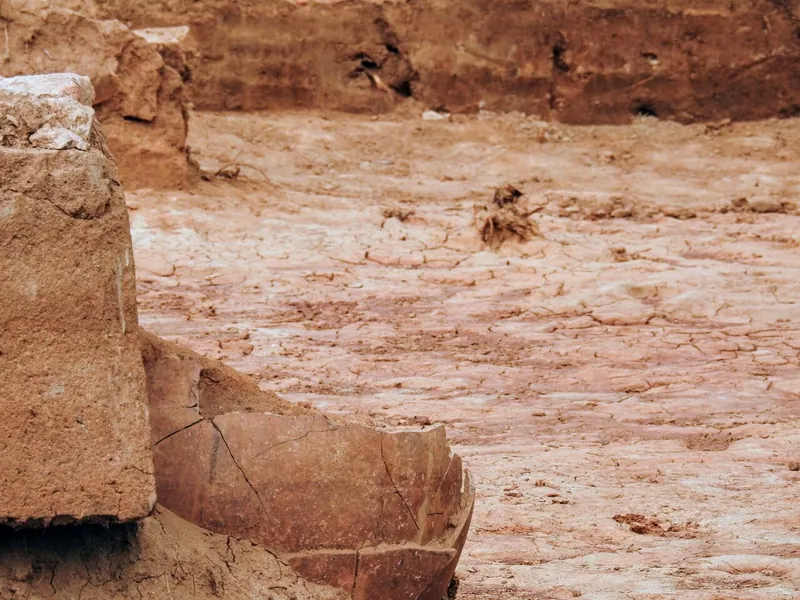
A pottery vessel exposed within the excavated ground at Keezhadi (Keeladi)
Keezhadi
Photographed 2019-09-06
- Made by hand
- Kodumanal
- Keezhadi
- Adichanallur
Black-and-red ware owes its colours to carbon, iron and firing
Black-and-red ware gets its colours from firing conditions, iron chemistry and, on tested black surfaces, carbon. Different analytical methods reveal different parts of that process. Evidence for reduced iron does not by itself identify one crystalline pigment as the sole cause of the black colour.
- This page
- 5,262 words · revision 6
Draft study · Awaiting specialist review · Updated
001Dates and places
Places on the atlas that name this study.
- Kodumanal
Excavated site zone · Noyyal River, Erode District
- Keezhadi
Public on-site museum & open-air excavated brick gallery
- Adichanallur Urn Field & Habitation Mound
Protected ASI monument & on-site museum · Thoothukudi District
- Sivagalai Urn Burial & Habitation Complex
Excavated site zone · Thoothukudi District
- Porunthal Habitation & Megalithic Grave Site
Coarse village orientation · Palani foothills, Dindigul
1000–500 BCE
Different beginnings
500–200 BCE
Marks & materials
200 BCE–300 CE
Connected worlds
300–600 CE
Change & continuity
- Keezhadi occupation range reported in Odelli et al. 2020
- Alagankulam occupation range reported in Odelli et al. 2020
- Laboratory date
Each date belongs to what was dated (a sample, an object, a layer or a text), which is not always the event the study asks about.
Each period has the same width, so spacing is not to scale.
The full table of dates, with their ranges, is under How we know.
- 1 Well supported
- 2 Likely
- 1 Not known
002How sure
In brief
Black-and-red ware is pottery with a black interior and rim and a red lower exterior. Versions of it were made in many parts of India; this study concerns the South Indian Iron Age and Early Historic ware. In a Keezhadi sample, Raman spectroscopy found carbon on the black surface and hematite, a red iron oxide, on the red one. The researchers link this to vessels fired upside down with plant matter, which starved one surface of oxygen. An Adichanallur sample was reduction-fired at about 500–750°C; Kodumanal pottery was fired at about 500–800°C. A quoted 950°C figure is a comparison threshold, not a measured firing temperature. Keezhadi black-and-red and common wares contain minerals from the local rocks, so they were probably made nearby. The white 'kaolin' paint on russet-coated painted ware has not been tested instrumentally in any study reviewed here. The sources checked include no laboratory analysis of Kerala black-and-red ware; the Kerala comparison sample is red ware.
Key researchers cited in this study: V. Selvakumar (Maritime & Prehistoric Archaeology) · B. K. Thapar (Porkalam & Maski Megalithic Excavations) · Full bibliography
How sure
- Well supported
In a Keezhadi sample, the black surface holds carbon and the red surface holds hematite.
Measured directly by Raman spectroscopy on a Keezhadi sample in a fully read study.
- Likely
Pots were fired inverted with plant matter, so one side lacked oxygen.
The model rests on excavated kilns, but the exact firing steps are reconstructed.
- Likely
Common black-and-red ware at Keezhadi was made locally.
Petrography, mineralogy and chemistry all match the surrounding geology, though no clay pit is identified.
- Not known
The white designs on russet-coated painted ware were painted with kaolin.
Older literature names kaolin, but the sources checked include no instrumental analysis of a white motif.
Why it matters
The two colours record deliberate control of fire and air, so these pots preserve evidence of potters' skill that their look alone hides.
003Key findings
What the study concludes
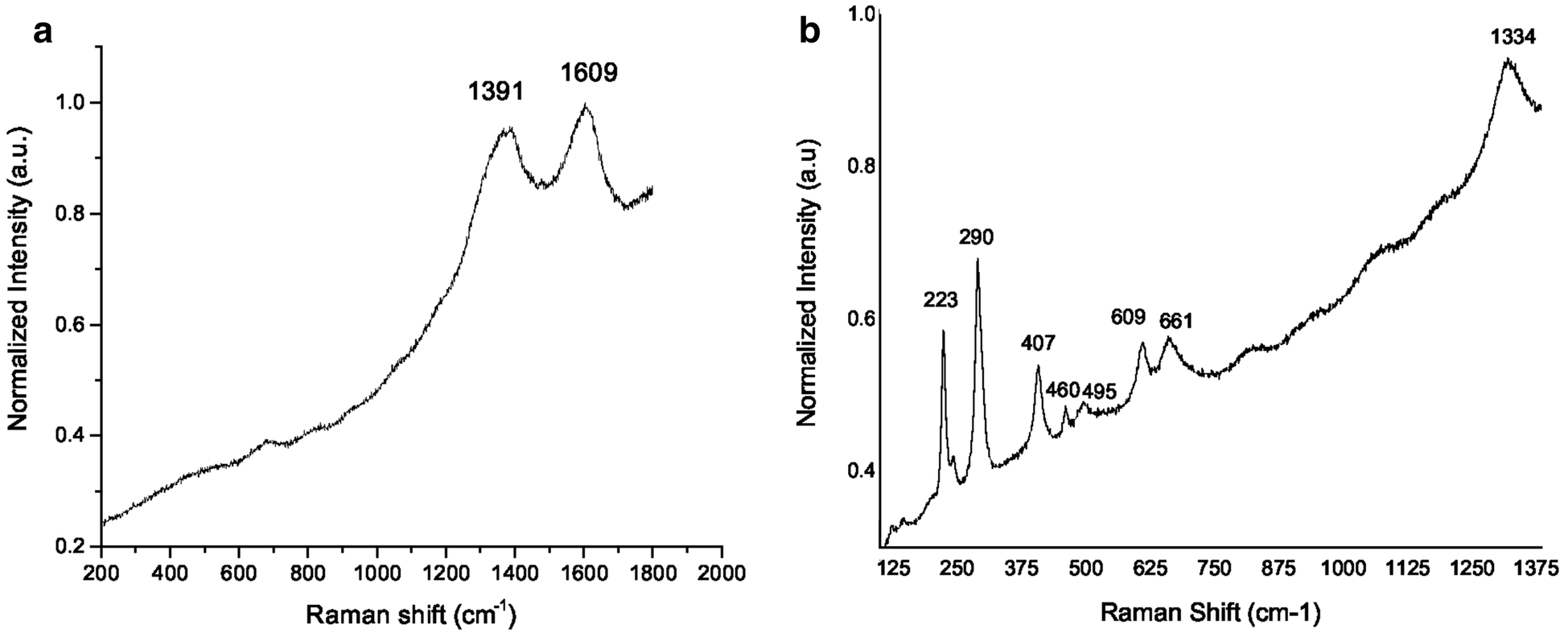
- Raman analysis of Keezhadi Black-and-Red Ware directly identifies amorphous carbon on the black surface and hematite on the red surface, supporting differential redox conditions and carbon-rich inverse firing.
- Adichanallur sample ADR4, explicitly classified as Black & Red ware, was interpreted as reduction-fired and fired at approximately 500–750°C on combined FTIR and SEM evidence.
- Kodumanal pottery analyzed by Seetha and Velraj was fired within an overall approximately 500–800°C range under both reducing and oxidizing conditions; the three red-and-black samples do not all produce the same bulk redox signature.
- The in-scope Thiruvanchikulam red-ware comparator is interpreted from FTIR/XRD/Mössbauer evidence as ferric, oxidizing-fired pottery at approximately 650–700°C.
In the study’s own words. How sure each point is, is shown above.
The summary above is the short read. The full study is the complete text it was drawn from, with its tables and source notes.
What the full study covers
004The study
Answer in Brief
The strongest archaeometric evidence now supports a combined redox-and-carbon model for South Indian Black-and-Red Ware rather than a single-pigment explanation. In a directly analyzed Keezhadi BRW sample, Raman spectroscopy found amorphous carbon on the black surface and hematite on the red surface, with only a possible trace of magnetite on the latter. The investigators interpret the carbon on rims and interiors as residue from vegetal material placed inside vessels during an “inverse firing” routine: the vessel interior was oxygen-starved and carbon-rich while the exterior remained accessible to oxygen and developed a hematite-rich red surface. ↗1
Black-and-red ware: a pot with a black top and a red bottom, for looking and colouring. A drawing of the kind of pot, not of one pot.
A pot of black-and-red ware, the kind of pottery this study tested.
Layers of the South editorial illustration
That result fits, rather than supersedes, the older iron-redox literature. FTIR, XRD, and especially ^57Fe Mössbauer work on South Indian pottery repeatedly correlates red color with ferric iron and hematite (Fe₂O₃) and black color with reducing conditions, enhanced Fe²⁺, and – in some studies – magnetite (Fe₃O₄) or inferred FeO. A crucial distinction is that Mössbauer detection of ferrous iron is evidence for the oxidation state of iron; it is not automatically proof that crystalline wüstite/FeO is the sole black pigment. The later Raman work shows that carbon itself is physically present on genuine BRW black surfaces. ↗2
Adichanallur gives unusually direct evidence because the 2012 study separately identifies one specimen, ADR4, as Black-and-Red Ware. FTIR classified ADR4 as reduction-fired, with a magnetite-to-hematite intensity ratio of 6.28; SEM showed no vitrification and led the authors to estimate roughly 500–750°C for ADR4. Two black wares fell in the same 500–750°C range, whereas two red wares were assigned 800–850°C under oxidizing conditions. These are sample-specific estimates, not a universal BRW recipe. ↗3
Kodumanal likewise does not support a single fixed temperature. Seetha and Velraj analyzed nine sherds, including three classified as red-and-black ware, and concluded that the assemblage was fired approximately 500–800°C. FTIR assigned KDL6 and KDL7, both red-and-black sherds, to reducing conditions, while KDL9 – also classified red-and-black – was assigned an oxidizing bulk signature. SEM put KDL6 and KDL7 around 750–800°C, while several other pieces remained below about 750°C. XRD nevertheless detected both hematite and magnetite in the assemblage. ↗4 This apparent inconsistency is archaeometrically important: powder analyses of an entire sherd can average together a deliberately heterogeneous black surface, red surface, and differently oxidized ceramic core.
The newer Keeladi XRD/FTIR/XRF study reports a broader 600–900°C firing range and identifies quartz, calcite, hematite, and magnetite, but its accessible publisher abstract does not provide a BRW-by-BRW surface-resolved redox reconstruction. It therefore strengthens the broad temperature envelope but should not be used to claim that every Keeladi BRW vessel reached 900°C. ↗5 On the sources read for this study, 950°C is not a securely demonstrated firing temperature for a core Iron Age/Early Historic Tamil BRW sample; 850–950°C appears in the Kodumanal paper as a generic vitrification threshold from comparative ceramic science, while the actual Kodumanal specimens were judged below 800°C. ↗6
For provenance, the best evidence is thin-section petrography plus mineralogical and chemical comparison rather than elemental clustering alone. At Keezhadi, BRW and coarse red ware contain mineral assemblages compatible with nearby pyroxene granulites and charnockitic gneisses; the researchers infer use of non-calcareous illitic clays and local rock inclusions. The single Alagankulam BRW sample A21 also falls within a Tamil-local technological/provenance group. By contrast, much of Alagankulam's fine tableware has a composition unlike Keezhadi's common wares and is interpreted as non-local, probably deriving from northern Indian production traditions; a Keeladi red-polished sample, K2, contains granitoid inclusions incompatible with the immediate geology and is tentatively linked to the Tiruchirappalli region. ↗7 Thus the archaeometry supports a mixed economy: ordinary BRW could be locally or regionally produced while selected fine wares moved substantially farther.
Eight archaeological pottery sherds from Alagankulam, samples A15–A22
Alagankulam
The figure caption calls A16 sigillata, but the paper’s discussion questions this, so it is not a proven Roman import.
Kodumanal is more ambiguous. Its XRF/EDS chemistry divided nine sherds into four groups based partly on Si/Al ratios and cluster analysis. The authors suggested multiple origins, trade, changing clay sources, or chronological differences. Because the study did not establish those four groups against a systematic library of sampled clay beds, however, it demonstrates compositional heterogeneity, not four geographically identified production centers. ↗8
The “riverine clay” proposition is likewise best stated cautiously. A recent Lower Kaveri archaeometric study recovered freshwater diatoms from archaeological ceramic fabrics and used them to argue that the clays derived from freshwater environments. That is meaningful evidence for aquatic/alluvial raw-material acquisition, but freshwater microfossils do not by themselves identify a particular riverbank, workshop, or clay pit. ↗9 Keezhadi's local geological match is therefore stronger evidence for regional locality, while freshwater inclusions are stronger evidence for depositional environment.
The weakest part of the evidence is the white “kaolin” paint. Older South Indian archaeological literature explicitly describes Russet-Coated Painted Ware as receiving a red-ochre/russet wash on the leather-hard pot, followed after drying by designs in kaolin and then firing; that literature also remarks that the painted surface developed a high polish. ↗10 But in the archaeometric corpus read here, no directly sampled RCPW white design from Kerala or Tamil Nadu was demonstrated by micro-XRD, Raman, SEM-EDS, or FTIR to consist of kaolinite/kaolin. Consequently, “kaolin-painted” is a published archaeological identification or technological description, not yet a securely replicated instrumental result for the specific RCPW corpus reviewed here. Rare painted BRW is also archaeologically documented, but its white pigment should not simply be equated with the RCPW material without direct analysis. ↗11
No laboratory analysis (XRD, FTIR, Mössbauer, or petrography) of Porkalam sherds was found in the literature consulted, so Porkalam’s excavated ceramic sequence is kept separate from the instrumented Tamil Nadu datasets below. ↗13
Scope & Chronological Control
This study uses the Layers of the South period of 1000 BCE–600 CE as an editorial filter, not as a claim that every cited laboratory specimen has independently been dated within those limits. That distinction matters because the South Indian spectroscopy literature repeatedly reuses comparable analytical methods on pottery considerably later than the Iron Age/Early Historic period. This study therefore gives priority to specimens with an in-scope archaeological context and relegates later samples to methodological comparison.
Keezhadi is particularly useful because Odelli and colleagues report BRW throughout the excavated sequence, from levels assigned approximately to the fifth century BCE through the second–first centuries BCE. Their analyzed corpus contains nine Keezhadi BRW specimens among seventeen Keezhadi sherds. Alagankulam's analyzed assemblage includes one BRW specimen, A21, from strata assigned to approximately the second century BCE–first century CE; site occupation is reported somewhat more broadly from the fourth–third centuries BCE into the first century CE. These chronological statements derive from the excavation chronology supplied to the authors; the article itself notes that some radiocarbon information came through the Tamil Nadu State Archaeology Department as personal communication rather than publishing laboratory determinations in the archaeometric paper. ↗14
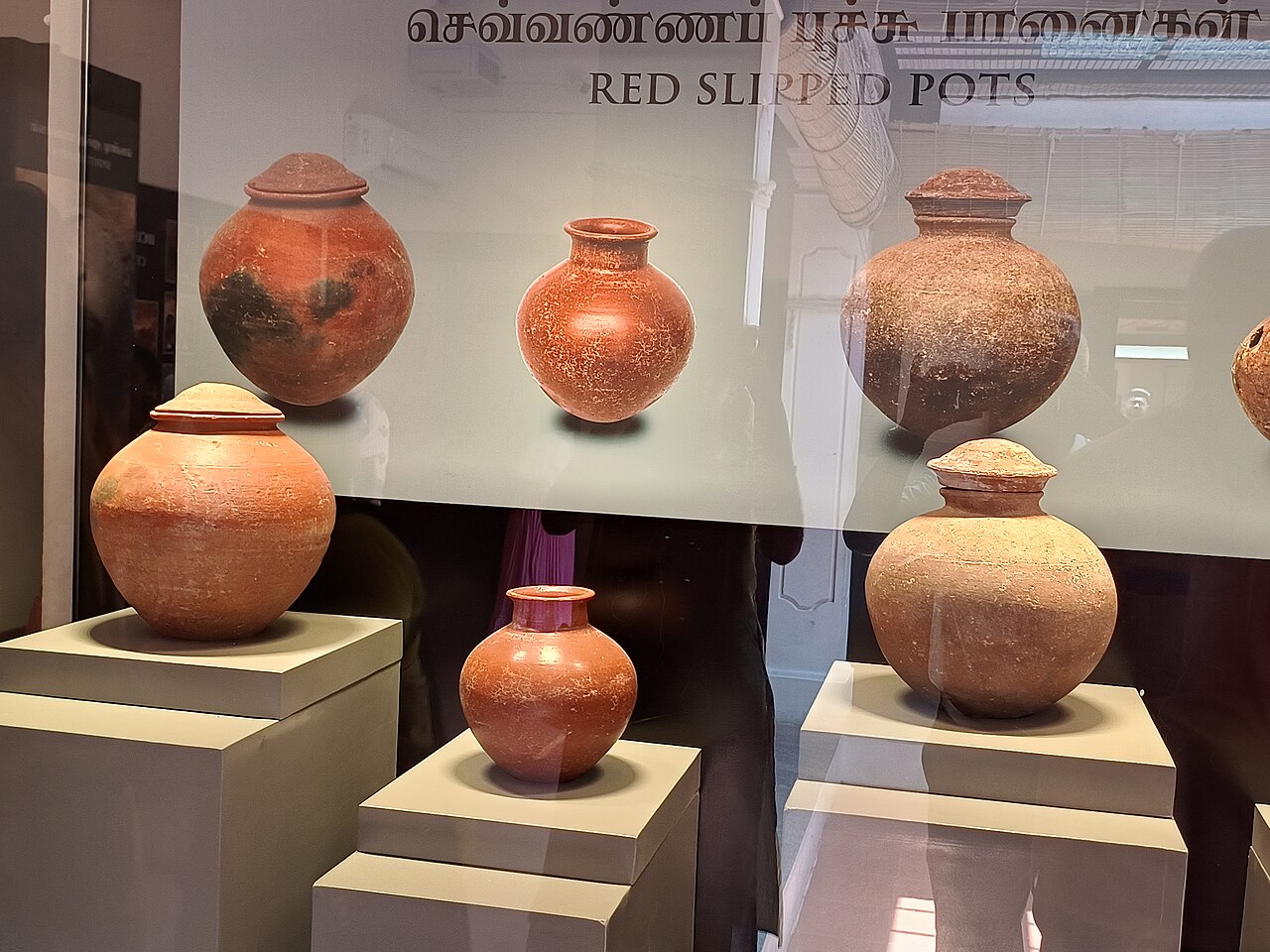
Red-slipped pottery vessels excavated at Keezhadi, photographed in a museum display
Keezhadi
Photographed 2025-06-01
The Adichanallur analytical article characterizes its material broadly as “megalithic” and situates the relevant archaeological horizon within approximately 1000–300 BCE, but it does not furnish sample-specific radiocarbon laboratory numbers for ADR1–ADR5. This study consequently treats this as an archaeological-period attribution, not a calibrated date for ADR4. ↗3
Kodumanal's laboratory article describes the settlement as an ancient industrial center on the Noyyal and on the corridor through the Palghat Gap toward the west coast, but its analytical claims concern firing and composition rather than independent absolute dating. The sample set comprises KDL1–KDL9: black, red, and three explicitly “red & black” pieces, KDL6, KDL7, and KDL9. ↗15 The important fact here is therefore not an invented date for each KDL code but the association of those samples with the excavated Kodumanal ceramic sequence.
For Kerala, the most useful directly read spectroscopic evidence is the Thiruvanchikulam red ware in a 2003 NIScPR-published study that also analysed material from Sriperumbudur and Elichanur. The authors report an archaeomagnetic age of about 100 CE for the Thiruvanchikulam red ware, placing that particular specimen comfortably inside the 1000 BCE–600 CE period. Their Sriperumbudur age of about 610 CE falls just beyond the formal cutoff, and Elichanur's reported date is substantially later. Only Thiruvanchikulam is therefore used here as an in-scope Kerala firing comparator. It is red ware, and no laboratory analysis of black-and-red ware from Kerala itself was located in the sources read here. ↗16
The 2012 Perumalpattu–Theriruveli Mössbauer study is analytically valuable but chronologically out of scope according to its own dating discussion: it places Perumalpattu in the ninth century CE and Theriruveli in the eighth–tenth centuries CE. Its exceptionally clear Fe²⁺/Fe³⁺ data are consequently used below only to test whether the redox mechanism inferred in earlier wares is physically coherent; they are not treated as evidence for Iron Age/Early Historic production organization. ↗17
The same distinction applies to institutional and site names. Porkalam is a canonical Kerala megalithic excavation, first published by B. K. Thapar, and later syntheses – including work by Deccan College scholars R. K. Mohanty and V. Selvakumar – discuss it within the South Indian Iron Age/megalithic record. ↗18 Yet archaeological occurrence of BRW at Porkalam is not equivalent to an archaeometric measurement of a Porkalam sherd. No firing temperature, magnetite/hematite ratio, or elemental provenance is assigned to Porkalam here unless tied to a consulted laboratory source.
This chronological control leads to three evidential levels:
Physical / textual observation. A mineral, element, spectroscopic band, microstructure, ceramic fabric, excavated ware, or source statement actually reported in the consulted publication.
Scholarly interpretation. The original analysts' conversion of those observations into conclusions about reducing or oxidizing atmospheres, firing temperatures, clay provenance, workshop localization, trade, or manufacturing sequence.
Unresolved / debated. Inferences that outrun the sampling design – for example, converting a compositional cluster into a named production center, assuming every black surface has the same Fe phase, or treating the traditional label “kaolin paint” as though a modern pigment analysis had already confirmed it.
Primary Archaeological & Textual Evidence
The evidence is most transparent when methods are kept separate. FTIR generally establishes mineral transformations and lower firing bounds; XRD identifies surviving crystalline phases; SEM microstructure and porosity can constrain upper temperatures and vitrification; Mössbauer resolves iron oxidation states; Raman can identify surface carbon and iron oxides; thin-section petrography identifies fabric and lithic inclusions; XRF/EDS supplies chemical grouping information. No single one of these methods reconstructs the entire firing event.
| Site / material | Physical observation | Published interpretation | Evidential qualification |
|---|---|---|---|
| Keezhadi BRW | Raman of a BRW black slip showed amorphous-carbon bands; red slip showed hematite bands, with a possible magnetite trace. ↗19 | Carbon on rim/interior is interpreted as vegetal-fuel residue from inverse firing; exterior remained oxidizing and red. ↗19 | Direct surface evidence and currently the strongest source for how the two colors coexisted on one vessel. |
| Adichanallur ADR4 BRW | FTIR iron-oxide ratio favored magnetite; SEM showed no vitrification; study classifies ADR4 as black-and-red ware. ↗3 | Reducing atmosphere; approximately 500–750°C. ↗3 | One explicitly identified BRW sample; not proof that every Adichanallur BRW vessel used identical conditions. |
| Kodumanal KDL6/KDL7/KDL9 BRW | KDL6/7 FTIR signatures were assigned magnetite/reduction; KDL9 hematite/oxidation. XRD detected magnetite and hematite in the overall sample set. ↗20 | Corpus fired about 500–800°C; multiple atmospheres were used. ↗12 | Bulk powders can erase intentionally different inner/outer surface chemistry. KDL9 warns against equating ware label with one homogeneous redox state. |
| Adichanallur red wares ADR3/ADR5 | Hematite-dominant FTIR; initial vitrification by SEM. ↗3 | Oxidizing, approximately 800–850°C. | Comparative evidence for red ferric firing, not BRW-specific firing temperature. |
| Thiruvanchikulam red ware, Kerala | XRD/FTIR/Mössbauer study reports quartz/feldspar mineralogy and ferric iron without ferrous component in the red sample. ↗21 | Approximately 650–700°C under oxidizing conditions. ↗21 | In-scope Kerala comparator, but the analyzed specimen is red ware rather than a bifacial BRW vessel. |
| Keeladi general pottery corpus, 2025 | XRD/FTIR/XRF detected quartz, calcite, hematite and magnetite. ↗5 | Firing range reported as 600–900°C. | Publisher-accessible evidence read here is abstract-level and does not provide surface-resolved BRW measurements. |
| Perumalpattu/Theriruveli black and red pottery | Black specimens contain high Fe²⁺ proportions and lack the hematite component seen in red examples; red wares carry Fe³⁺/Fe₂O₃. ↗22 | Strong reduction yields black; oxidation yields red; carbon from smoke may augment blackening. ↗17 | Excellent Mössbauer control experiment from Tamil Nadu, but the samples are eighth–tenth century CE and therefore outside the 1000 BCE–600 CE period. |
The Adichanallur results deserve emphasis because they directly undermine two common simplifications. First, red and black are not mere decorative paints laid over an otherwise identical thermochemical body. The authors see distinct iron-oxide and vitrification signatures. Second, color does not encode temperature alone. ADR4 could remain black/red at a lower estimated temperature than ADR3 and ADR5 because oxygen availability and iron valence were as consequential as maximum temperature. ↗3
Kodumanal reinforces that point. All nine specimens lost the diagnostic clay octahedral-sheet bands used to establish a firing floor, while SEM divided them into non-vitrified and initially vitrified fabrics. KDL1 and KDL5–KDL7 were interpreted around 750–800°C, whereas KDL2, KDL4, KDL8, and KDL9 were below about 750°C; the overall conclusion remained 500–800°C. Most samples were non-calcareous, with KDL3 the exception. ↗6 The key archaeological inference is controlled variability, not industrial uniformity.
The Mössbauer results illuminate the chemistry behind those visual categories. In the later comparative corpus, black PMU and TRI specimens typically contain approximately 56–75% Fe²⁺ spectral area, while red specimens contain ferric iron plus an identifiable hematite component; the study explicitly links strong reducing conditions to elevated ferrous iron and reddish colors to hematite/ferric iron. ↗22 Earlier South Indian work likewise uses Fe²⁺/Fe³⁺ ratios to infer atmosphere. This is entirely compatible with the Keezhadi Raman result: iron reduction and carbon deposition are complementary processes under oxygen-poor firing, not mutually exclusive theories.
The most defensible physical sequence for classic BRW is therefore:
Observation: the red surface can be hematite-rich; the black surface can retain amorphous carbon; reduced iron compounds occur in black/reduction-fired South Indian ceramics. ↗23
Interpretation: vessels were arranged so that different surfaces experienced different oxygen fugacities. Vegetal matter inside or around the inverted vessel consumed oxygen and supplied carbonaceous smoke; restricted interiors and rims became reduced/carbonized while the more exposed exterior reoxidized or remained oxidizing enough to form hematite. ↗1
Unresolved: the precise sequence – whether peak reduction was followed by controlled reoxidation, how rapidly cooling occurred, how much blackness comes from carbon versus magnetite/ferrous phases, and how stacking geometry varied between workshops – has not been experimentally reconstructed for every named archaeological production group.
The white designs and the RCPW problem
The older ceramic literature gives a specific technological recipe for Russet-Coated Painted Ware: a vessel was shaped, allowed to reach a leather-hard condition, coated with a russet/red-ochre wash, dried again, decorated with what the author calls kaolin, and fired; the painted ware was described as acquiring a highly polished finish after firing. The same source records bands, waves, arches, circles, oblique lines, lattices, chevrons, and dots among the designs. ↗10
That is a textual observation about the published archaeological classification and reconstruction. It is not equivalent to an FTIR spectrum from an excavated white stroke. The consulted Kodumanal, Adichanallur, Keezhadi, and Thiruvanchikulam analytical papers do not supply a surface microanalysis demonstrating kaolinite in RCPW paint. Nor does the presence or destruction of kaolinite in a vessel's body clay prove that a separate white decorative layer was kaolin.
This distinction matters chemically because kaolinite loses structural hydroxyls as firing proceeds and transforms toward metakaolin; a high-fired white layer might therefore no longer preserve a pristine kaolinite diffraction signature. The 2025 Keeladi paper itself cites experimental work on thermally modified kaolin, illustrating the analytical issue, but it does not thereby prove RCPW pigment composition. ↗5 A rigorous future test would require microscopic sampling of an actual white motif and its adjacent russet coating, followed by Raman/FTIR, SEM-EDS or electron microprobe, and preferably micro-XRD.
The same caution applies to painted BRW. Archaeological descriptions record rare painted BRW, including dotted or slanting decoration, but direct pigment chemistry is not supplied by the core papers reviewed here. ↗24 It is therefore unsafe to turn “white-painted BRW” into “analytically proven kaolin-painted BRW.” “Russet-coated ware occurs in Kerala; its source and age are open” examines Russet-Coated Painted Ware itself in more detail.
Analytical Comparison & Competing Interpretations
The principal interpretations can be reconciled by treating a fired pot as a spatially heterogeneous object rather than a single chemical sample.
How scientists think the pots got their two colours: fired upside down with plants, so one side got less air. A model, not a picture of a real firing.
The firing model this study rates Likely: pots fired upside down with plant matter, so one side lacked air.
Layers of the South editorial illustration
The hematite-versus-magnetite model correctly captures a large part of the iron chemistry. Hematite, dominated by Fe³⁺, is characteristically associated in these studies with oxidizing, red-fired fabrics. Magnetite contains both Fe²⁺ and Fe³⁺ and is compatible with more reducing conditions. Mössbauer adds information inaccessible to ordinary bulk XRD by directly distinguishing ferric and ferrous iron environments. ↗25
The carbon-smudging model has stronger direct support for the actual black surface of Keezhadi BRW: Raman spectroscopy physically detected amorphous carbon there. The red side, meanwhile, was hematitic. ↗19 This means a description such as “BRW is black because the clay turned to magnetite” is too simple. A better statement is that reducing firing alters iron valence and iron-oxide phases while smoke and organic fuel can simultaneously deposit or preserve carbon at the oxygen-starved surface.
The “double firing” versus “inverse firing” terminology also needs discipline. Archaeological syntheses sometimes use “inverted” or “double” firing loosely for the bicolor effect. The Keezhadi Raman evidence demonstrates differential atmosphere and carbon consistent with an inverse-firing arrangement, but it does not by itself demonstrate two completely separate kiln firings. The simplest source-bound reconstruction is a controlled firing cycle in which vessel position, fuel placement, oxygen supply, and possibly reoxidation during cooling generated different microenvironments. ↗1
The temperature evidence likewise forms overlapping ranges rather than one canonical temperature:
| Dataset | Reported/estimated temperature | What the range actually establishes |
|---|---|---|
| Adichanallur ADR4 BRW | 500–750°C | Reduction-fired BRW can be produced below 800°C; SEM showed no vitrification. ↗3 |
| Adichanallur red ADR3/ADR5 | 800–850°C | Some oxidized red wares at the same site reached higher temperatures. ↗3 |
| Kodumanal corpus | 500–800°C | Both reducing and oxidizing wares occur within a moderate firing envelope. ↗12 |
| Thiruvanchikulam red ware | 650–700°C | Kerala Early Historic oxidized pottery could be effectively fired in this range. ↗21 |
| Keeladi 2025 corpus | 600–900°C | Broad spectroscopic/mineralogical envelope across the studied pottery; not a single BRW set-point. ↗5 |
| Kodumanal comparative vitrification criteria | 850–950°C and above for certain vitrification stages | Reference threshold used to interpret ceramic microstructure, not an observed firing temperature for the Kodumanal BRW samples. ↗26 |
This comparison is why a single blanket “650–950°C BRW firing range” would be misleading. The source-bound core is closer to roughly 500/600–900°C across different assemblages and methods, with many directly analyzed BRW examples clustering below 800°C. The apparent precision of any individual range is also method-dependent: FTIR refiring usually supplies a lower bound, SEM vitrification an upper or narrower range, and phase survival can depend on clay chemistry, duration, atmosphere, burial alteration, and heating rate. The Adichanallur authors themselves stress the need to combine methods rather than infer manufacturing temperature from a single signal. ↗3
Provenance and movement
The provenance studies produce a similarly layered answer.
At Keezhadi, thin sections show rock and mineral inclusions compatible with the surrounding geological province. XRD matches the petrographic observations, and portable XRF/PCA differentiates Keezhadi's common wares from the fine Alagankulam group. The authors identify non-calcareous illitic clay and intermediate rock fragments, including material compatible with pyroxene granulites and charnockitic gneiss, and regard the BRW/common-ware group as local. ↗7 This is strong regional provenance evidence because mineralogy, fabric, and chemistry converge. Such inclusions still need interpretation rather than automatic naming as added temper: some grains may already belong to the clay deposit while others were introduced deliberately, and telling them apart needs the form, composition and context of the particles.
Thin-section microphotographs of Alagankulam samples A18–A21
Alagankulam
The Alagankulam A21 BRW is petrographically unlike the site's fine-tableware group and is attributed to Tamil-local production. The authors interpret its presence at the coastal site as evidence for movement between inland production areas and the coast. ↗19 That finding is especially useful for Layers of the South: “local production” need not mean “never moved.” A pot can be made from Tamil raw materials and still circulate tens or hundreds of kilometers through regional exchange.
The same study provides a contrasting signal for fine tableware. Most Alagankulam fine wares form a comparatively homogeneous compositional group distinct from Keezhadi's locally derived common wares; the authors argue that much of this fine repertoire was non-local, plausibly northern Indian. ↗19 “Alagankulam's pots and coins show changing sea links” covers the Alagankulam fine wares in full. Keezhadi's red-polished K16 appears to be a local imitation, while K2 contains granitoid fragments incompatible with Keezhadi's immediate geology; the investigators tentatively suggest a source around Tiruchirappalli, where appropriate granites occur. ↗19 Thus local production, regional circulation, imitation, and long-distance import coexisted.
At Kodumanal, the evidence is different. Seetha and Velraj's elemental analyses divide nine specimens into four chemical clusters: KDL5/KDL6; KDL4/KDL9; KDL3/KDL7/KDL8; and KDL1/KDL2. They interpret the divisions as potentially reflecting different origins and discuss multiple raw-material sources, trade with neighboring sites, or differences through the excavated sequence. ↗8 The observation – four compositional groups – is solid within the sample. The geographic interpretation is not uniquely determined because no four matching clay-source localities were demonstrated. Paste recipes and temper addition can also alter elemental and mineralogical composition, a caveat the authors themselves acknowledge. ↗26
Comparative Lower Kaveri work using diatoms adds an independent line of evidence. Freshwater diatoms embedded in archaeological ceramic fabrics indicate that some clays or clay-bearing sediments came from freshwater depositional environments. ↗9 This strengthens the plausibility of riverine/alluvial clay procurement across Tamil landscapes. It does not establish that a given sherd was made beside the river where it was excavated: floodplain sediments can be transported, similar freshwater assemblages may occur along a river system, and prepared paste may combine several sources.
The resulting provenance hierarchy is therefore:
Established most strongly: Keezhadi BRW/common ware is mineralogically compatible with local geology; Alagankulam A21 is Tamil-local rather than part of the site's non-local fine-ware group. ↗19
Supported but less geographically precise: Kodumanal contained multiple compositional groups; some Lower Kaveri pottery used clay deriving from freshwater depositional settings. ↗27
Not established: a particular ancient clay pit for each BRW cluster; four specific external production centers for Kodumanal; or a general rule that BRW was always local while polished/fine wares were always imported.
Evidential Limits & Common Misconceptions
“Black-and-red” does not mean two mineral paints. For Keezhadi BRW, the black surface contains amorphous carbon and the red surface hematite; elsewhere, reduced iron is also associated with black fabrics. The color boundary is therefore a product of manufacturing atmosphere and surface treatment, not merely post-forming application of black and red pigments. ↗28
Magnetite is not a complete explanation for the black surface. Kodumanal XRD identifies magnetite even in samples whose overall atmosphere was classified as oxidizing, while Keezhadi Raman directly detects carbon on black BRW. Mineral phases inside a powdered sherd and colorants concentrated in a thin surface layer answer different questions. ↗29
Fe²⁺ detected by Mössbauer is not identical to XRD proof of crystalline FeO. The South Indian Mössbauer literature interprets abundant ferrous iron in black pottery as consistent with ferrous compounds and sometimes specifically invokes FeO; the physically safest claim is that black wares experienced stronger reduction and preserve more Fe²⁺. ↗17
A firing temperature is a reconstructed interval, not a kiln thermometer reading. Archaeometric temperatures rely on mineral transformations, refiring behavior, vitrification, and porosity. Different clay chemistries and firing durations can shift thresholds. Hence Adichanallur's 500–750°C and Keezhadi's 600–900°C are not contradictory measurements of a universal process; they describe different sample sets using different inferential resolutions. ↗30
Color is not a thermometer either. In an outside-region control experiment, De Bonis and colleagues fired two different Bay of Naples clays under oxidizing conditions and followed the changes in color. Their abstract connects the results with composition, temperature, iron-oxide development and the passage of oxygen within the ceramic body; even under a stated atmosphere, the clays did not yield one simple color sequence. A black core cannot, by itself, specify one firing installation or a universal recipe. Nor is every darker sherd necessarily hotter-fired than every redder one. The study was read at abstract level only, and it is a way to challenge over-simple explanations, not a temperature chart for South Indian clays. (A. De Bonis, G. Cultrone, C. Grifa, A. Langella, A. P. Leone, M. Mercurio and V. Morra (2017). Different shades of red: The complexity of mineralogical and physicochemical factors influencing the colour of ceramics)
950°C should not be quoted as though directly measured for the core BRW specimens. The Kodumanal paper discusses 850–950°C as comparative vitrification behavior, then concludes its actual specimens were below 800°C. ↗6
“Local clay” and “river clay” are not synonyms. A local petrographic match identifies a geological province. Freshwater diatoms identify an aquatic sedimentary environment. Neither automatically establishes the exact extraction point. ↗31
Chemical clustering alone does not map trade routes. Kodumanal's four groups demonstrate compositional structure, but source geography remains open because the study did not match each cluster to a sampled raw-clay bed. ↗8
Fine ware did move farther than some common BRW, but the distinction is not absolute. At Alagankulam/Keezhadi, the archaeometry supports locally derived common BRW alongside non-local fine wares, local copies, and regionally traded pieces. This is a pattern in that corpus, not a universal economic law for South India. ↗19
The shine itself remains less securely explained than the color. Archaeological descriptions emphasize polished or burnished surfaces, and RCPW literature describes a highly polished painted finish after firing. ↗10 The consulted BRW studies, however, primarily analyze mineralogy, oxidation state, carbon, fabric, and firing temperature. They do not experimentally isolate whether BRW luster resulted from pre-firing burnishing, a refined slip, post-forming polishing, organic additions, or some combination. Calling the surface a “magnetite glaze” would therefore exceed the evidence.
Kaolin-painted RCPW is a published archaeological identification, not yet an archaeometric certainty in this dataset. The descriptive literature explicitly uses the term kaolin, but no instrumentally characterized white RCPW stroke from the Kerala/Tamil Nadu corpus appears in the studies reviewed here. ↗10 A future microanalytical study could confirm, refine, or overturn that identification.
Porkalam should not be given laboratory numbers by association. Porkalam is central to Kerala’s megalithic ceramic sequence, ↗32 ↗33 yet no published XRD, FTIR, Mössbauer, or petrographic analysis of Porkalam sherds was found in the literature consulted.
The central unresolved experimental question is consequently quite precise: a controlled replication should reproduce South Indian BRW vessel forms with geologically appropriate Tamil or Kerala clays, vary vegetal packing, vessel inversion, air access, peak temperature, soak time, and cooling/reoxidation, then section the experimental vessels and compare Raman carbon, Mössbauer Fe²⁺/Fe³⁺, XRD hematite/magnetite, FTIR mineral transformations, and surface microstructure against archaeological black interiors, red exteriors, and cores. Until such matched experiments exist, the inverse-firing model is strongly supported, but exact kiln choreography remains partly reconstructed. For Kerala, a parallel test would compare phase-specific coarsewares and finewares from Pattanam with the Alagankulam, Keeladi and Arikamedu petrographic datasets.
Bibliography & Source Register
Odelli, E., T. Selvaraj, J. Perumal, V. Palleschi, S. Legnaioli, and S. Raneri. 2020. “Pottery production and trades in Tamil Nadu region: new insights from Alagankulam and Keeladi excavation sites.” Heritage Science 8, 56. Full open-access article read, including corpus table, petrographic/XRD/XRF/Raman methods, Raman results, and provenance discussion. This is the strongest integrated BRW technology and provenance source reviewed here. ↗34
Seetha, D., and G. Velraj. 2015. “Spectroscopic and statistical approach of archaeological artifacts recently excavated from Tamilnadu, South India.” Spectrochimica Acta Part A: Molecular and Biomolecular Spectroscopy 149: 59–68. Full article text read through an author/repository copy. FTIR, XRD, SEM-EDS, EDXRF, firing-atmosphere estimates, sample classifications, and cluster analysis were checked. ↗35
Velraj, G., R. Ramya, and R. Hemamalini. 2012. “FT-IR spectroscopy, scanning electron microscopy and porosity measurements to determine the firing temperature of ancient megalithic period potteries excavated at Adichanallur in Tamilnadu, South India.” Journal of Molecular Structure 1028: 16–21. DOI: https://doi.org/10.1016/j.molstruc.2012.06.026. Tables 2, 3 and 5 and the conclusion were read in a third-party copy, not the publisher's text. The paper explicitly identifies ADR4 as BRW and assigns it a reducing atmosphere and 500–750°C range. ↗3
Venkatachalapathy, R., D. Gournis, C. Manoharan, S. Dhanapandian, and K. Deenadayalan. 2003. “Application of FTIR and Mössbauer spectroscopy in analysis of some South Indian archaeological potteries.” Indian Journal of Pure & Applied Physics 41: 833–838. Official NIScPR repository copy read. Thiruvanchikulam provides the principal in-scope Kerala comparator; the article combines FTIR, XRD, and room-temperature Mössbauer spectroscopy. ↗16
Dhanapandian, S., C. Manoharan, and P. Sutharsan. 2012. “Applications of FTIR and ^57Fe Mössbauer Techniques in Studies of Recently Excavated Indian Archaeological Pottery.” Acta Physica Polonica A 121. Official full PDF read, including Tables II–III. Its Fe²⁺/Fe³⁺ evidence is analytically useful, but its Perumalpattu and Theriruveli specimens are outside the dossier's 600 CE cutoff and are used only as methodological comparators. ↗22
Vijay, G., T. A. Luiz, and A. Chandrasekaran. 2025. “Ancient potteries of Keeladi: A multidisciplinary analysis using Fourier transform infrared spectroscopy, X-ray powder diffraction and X-ray fluorescence spectroscopy.” Archaeometry 67(5): 1118–1128. Publisher abstract and bibliographic page read. The accessible text reports 600–900°C and quartz, calcite, hematite, and magnetite; sample-level details were not accessible in the consulted publisher text, so claims here are limited accordingly. ↗5
Thacker, M., A. Dwivedi, C. R. Gayathri, and B. Karthick. 2024. “Diatoms from ancient pots: exploring pottery sherds and palaeoenvironmental insights in the lower Kaveri River Basin archaeological landscape, Tamil Nadu, India.” Current Science 126(8). Used comparatively for freshwater-source evidence in ceramic clay; it does not identify Keezhadi or Kodumanal production pits. ↗9
Potteries in Ancient India, section on South Indian ceramic industries. Digitized scan read through Internet Archive. The relevant passage describes RCPW as receiving a russet/ochre wash followed by “kaolin” designs before kiln firing and describes the resulting polish. The scanned text is treated as archaeological descriptive scholarship, not as an instrumental pigment analysis; complete bibliographic metadata was not independently reconstructed where the consulted scan did not make it unambiguous. ↗10
Mohanty, R. K., and V. Selvakumar. 2002. “The Archaeology of the Megaliths in India: 1947–1997,” in Indian Archaeology in Retrospect, Vol. I: Prehistory: Archaeology of South Asia. Read as a Deccan College-associated synthesis relevant to the history of Porkalam research; it is not a Porkalam archaeometric ceramic study. ↗33
Thapar, B. K. 1952. “Porkalam 1948: Excavation of a Megalithic Urn Burial.” Ancient India 8. Bibliographic record located through later scholarly citation rather than direct full-text inspection; therefore no uninspected laboratory result is attributed to it. ↗36
Ambily, C. S., et al. 2025. “Russet-coated painted ware pottery: The potential chronological, social, and economic significance of a poorly-understood south Indian ceramic type.” Publisher/abstract record located as a recent dedicated RCPW reassessment. The full argument was not available in the consulted result, so it is registered rather than used to supply unverified pigment chemistry. ↗37
Taken together, the physical evidence is sufficient to replace a simplistic “black paint/red paint” story with a materially grounded one: moderate-temperature firing, carefully differentiated oxygen access, ferric-versus-ferrous iron chemistry, and carbon-rich smudging jointly produced South Indian BRW's bicolor surfaces. ↗38 Petrography and chemistry further show that this technological tradition was compatible with substantial local production while fine tablewares and some regional imitations circulated between distinct geological zones. ↗19 What remains to be discovered – not invented – is the precise workshop-level firing sequence, the source pits behind compositional groups, and direct instrumental confirmation of the conventionally identified kaolin paint on South Indian RCPW.
005Photographs
Photographs of the places and objects this study discusses. Each item carries its creator’s credit, licence and documented source. See all 412 photographs and source images ↗
Keezhadi · Photographed 2019-09-06
A pottery vessel exposed within the excavated ground at Keezhadi

Alagankulam
Eight archaeological pottery sherds from Alagankulam, samples A15–A22
The figure caption calls A16 sigillata, but the paper’s discussion questions this, so it is not a proven Roman import.

Mantai
Mantai – Figure 4: Microstructural images of pottery body cross-sections from representative samples
Figure 4 of the Mantai study: microscope images of cross-sections through local, Indian red, Roman red and Roman black ware sherds.

Alagankulam and Keezhadi
Published chemical-composition analysis of pottery from Alagankulam and Keezhadi

Photographed 2018-09-17 17:54:56
PotierKerala – Modern potter at work
PotierKerala. Modern potter at work; not a reconstruction of an ancient workshop.
Keezhadi · Photographed 2025-06-01 12:17:30
Red-slipped pottery vessels excavated at Keezhadi, photographed in a museum display

Alagankulam
Thin-section microphotographs of Alagankulam samples A18–A21
Thin-section microphotographs of Alagankulam samples A18–A21; scale bars 500 micrometres.

Mantai
Mantai – Figure 2: Representative pottery samples excavated from the Mantai port site
Figure 2 of the Mantai study: excavated sherds that the authors class as Indian red and grey wares, Roman red and black wares, and local black-and-red ware.
Show 5 more photographs and source images ↓
Keezhadi · Photographed 2016-10-11
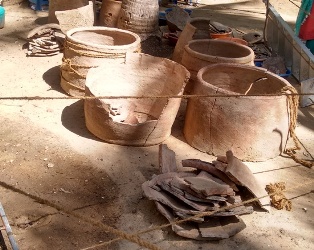
Excavated pottery vessels and sherds laid out at Keezhadi in 2016
Keezhadi · Photographed 2024-12-26 11:19:42
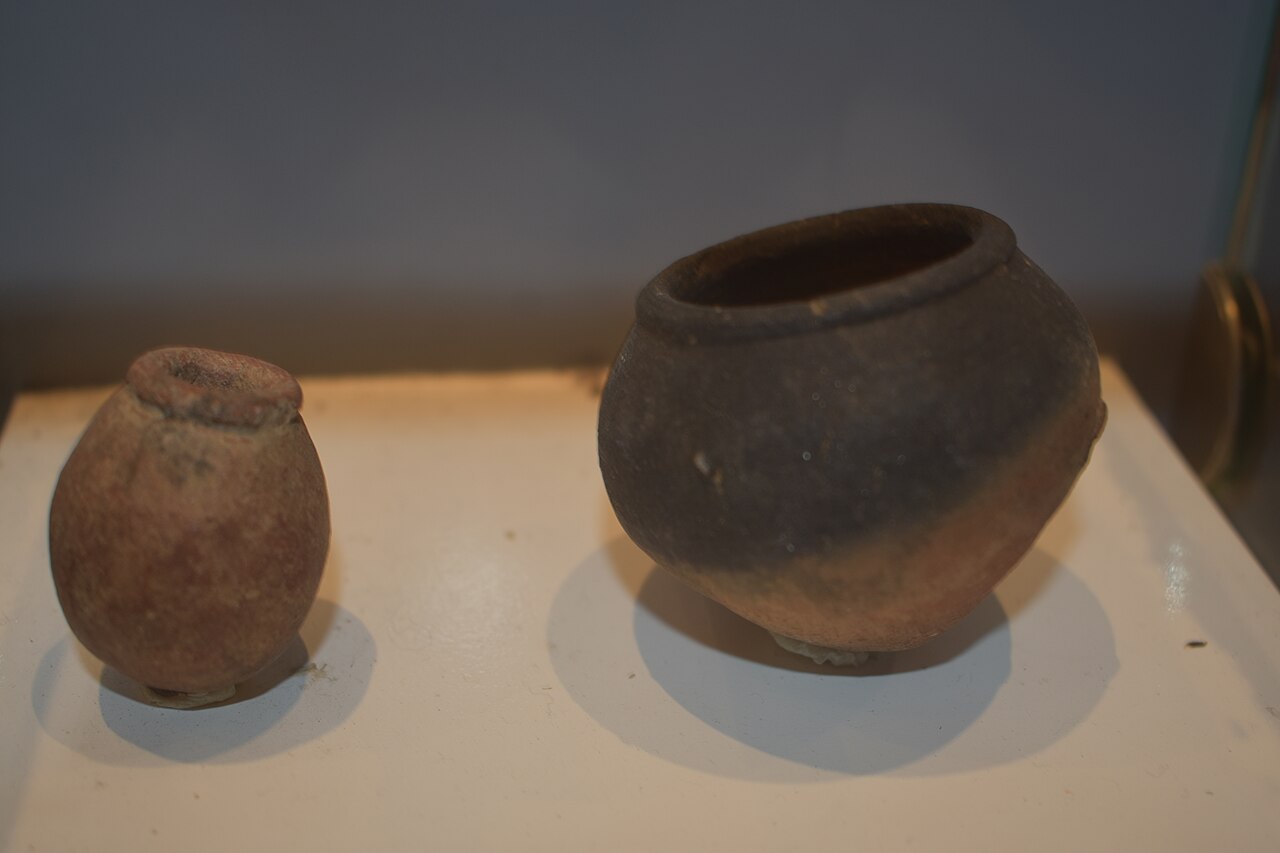
Two archaeological pottery vessels on display in the Keezhadi museum

Keezhadi
Six pottery fragments from Keezhadi, samples K7, K9, K1, K11, K16 and K2

Keezhadi
Thin-section microphotographs of Keezhadi samples K5, K1, K3, K9, K2 and K16
Thin-section microphotographs of Keezhadi samples K5, K1, K3, K9, K2 and K16; scale bars 500 micrometres.
Keezhadi
Published Raman spectra for black and red surfaces of Keezhadi sherd K15
006Two views
Both views are shown at equal weight; this site does not choose between them.
What makes the black surface black
- One view
- Older FTIR and Mössbauer studies of South Indian pottery link black colour to reducing conditions, ferrous iron and, in some cases, magnetite.
- Another view
- Odelli and colleagues' Raman analysis of a Keezhadi sample found amorphous carbon on the black surface, deposited during oxygen-starved firing. This study reads the two explanations as working together.
- What would settle it
- Matched firing experiments with local clays, comparing surface carbon, iron oxidation states and iron-oxide phases with archaeological sherds.
007Where next
 Related study
All related studies, connected material, books and sources31 · 11
Elsewhere on this site
Excavation Atlas Sites: Kodumanal (Noyyal River Craft & Trade Town) · Keezhadi (Vaigai River Brick Settlement) · Adichanallur Urn Field & Habitation Mound · Sivagalai Urn Burial & Habitation Complex · Porunthal Habitation & Megalithic Grave Site
Junior Detective Quests: The Bead Workshop: Waste Shows Where Beads Were Made
Classroom Lesson Plans: Module 5 · Iron, Stone Monuments & Everyday Craft: Technology in Early South India
Multi-Script Glossary Terms: Tamiḻi (Tamil-Brāhmī) (தமிழி (தமிழ் பிராமி) / തമിഴി (തമിഴ് ബ്രാഹ്മി)) · kīṟal (Graffiti Marks) (கீறல் குறியீடுகள் / പോറൽ ചിഹ്നങ്ങൾ) · karuppu-civappu pāṉai (Black-and-Red Ware) (கருப்பு சிவப்பு பானை / കറുപ്പും ചുവപ്പും മൺപാത്രങ്ങൾ) · Russet-Coated Painted Ware (Āndhra/Kongu Ware) (வண்ணம் தீட்டிய பானை / ചായം പൂശിയ മൺപാത്രങ്ങൾ) · White-Painted Wares (White-Painted Black-and-Red & Russet-Slipped Wares) (வெள்ளை வண்ணம் தீட்டிய பானைகள் / വെളുത്ത ചായം പൂശിയ മൺപാത്രങ്ങൾ)
Connected material
Photographs, drawings, books, videos and other studies linked to this study. A link helps you explore; it does not prove a historical claim.
- Excavated pottery vessels and sherds laid out at Keezhadi in 2016photographShows the subject
- A pottery vessel exposed within the excavated ground at KeezhadiphotographShows the subject
- Two archaeological pottery vessels on display in the Keezhadi museumphotographShows the subject
- Red-slipped pottery vessels excavated at Keezhadi, photographed in a museum displayphotographShows the subject
- Eight archaeological pottery sherds from Alagankulam, samples A15–A22photographic plateShows the subject
- Six pottery fragments from Keezhadi, samples K7, K9, K1, K11, K16 and K2photographic plateShows the subject
- Thin-section microphotographs of Alagankulam samples A18–A21scientific micrographShows the subject
- Thin-section microphotographs of Keezhadi samples K5, K1, K3, K9, K2 and K16scientific micrographShows the subject
- Published chemical-composition analysis of pottery from Alagankulam and Keezhadiscientific plotBackground
- Published Raman spectra for black and red surfaces of Keezhadi sherd K15scientific plotBackground
- Pottery sample A15 from Alagankulam, photographed in Odelli and colleagues' 2020 studyphotograph (detail)Shows the subject
- Pottery sample A16 from Alagankulam, photographed in Odelli and colleagues' 2020 studyphotograph (detail)Shows the subject
- Pottery sample A17 from Alagankulam, photographed in Odelli and colleagues' 2020 studyphotograph (detail)Shows the subject
- Pottery sample A18 from Alagankulam, photographed in Odelli and colleagues' 2020 studyphotograph (detail)Shows the subject
- Pottery sample A19 from Alagankulam, photographed in Odelli and colleagues' 2020 studyphotograph (detail)Shows the subject
- Pottery sample A20 from Alagankulam, photographed in Odelli and colleagues' 2020 studyphotograph (detail)Shows the subject
- Pottery sample A21 from Alagankulam, photographed in Odelli and colleagues' 2020 studyphotograph (detail)Shows the subject
- Pottery sample A22 from Alagankulam, photographed in Odelli and colleagues' 2020 studyphotograph (detail)Shows the subject
- Pottery sample K7 from Keezhadi, photographed in Odelli and colleagues' 2020 studyphotograph (detail)Shows the subject
- Pottery sample K9 from Keezhadi, photographed in Odelli and colleagues' 2020 studyphotograph (detail)Shows the subject
- Pottery sample K1 from Keezhadi, photographed in Odelli and colleagues' 2020 studyphotograph (detail)Shows the subject
- Pottery sample K11 from Keezhadi, photographed in Odelli and colleagues' 2020 studyphotograph (detail)Shows the subject
- Pottery sample K16 from Keezhadi, photographed in Odelli and colleagues' 2020 studyphotograph (detail)Shows the subject
- Pottery sample K2 from Keezhadi, photographed in Odelli and colleagues' 2020 studyphotograph (detail)Shows the subject
- Mantai – Figure 2: Representative pottery samples excavated from the Mantai port sitephotographic plateBackground
- Mantai – Figure 4: Microstructural images of pottery body cross-sections from representative samplesscientific micrographBackground
- PotierKerala – Modern potter at workphotographBackground
- A black-and-red potdiagramA pot of black-and-red ware, the kind of pottery this study tested.
- Pots upside down in a firediagramThe firing model this study rates Likely: pots fired upside down with plant matter, so one side lacked air.
Books, videos and websites
Outside reading on this topic. These are not part of the study and we have not checked every claim in them. See all books and videos
- Pottery traditions of the Pattanam region KCHR BM production 2012 A documentary Video · Kerala Council for Historical Research (KCHR), British Museum & participating potters of the Pattanam region · 12:29 · A documentary following pottery traditions in the Pattanam region during a 2012 research survey. Shows the work behind pottery and makes researchers and craftspeople visible rather than treating finished objects as anonymous. Modern ethnoarchaeology, not footage of ancient production. It cannot alone establish how ancient black-and-red ware was fired. Confirm named artisans and film credits during audiovisual review.
008Sources
The study lists the sources it consulted; we have not rechecked them. A working link does not show that a source was read, and a valid identifier does not show that it supports a claim. We do not link to unofficial uploads or copies of publications. Where a study cited one, we show the published citation, or a publisher, DOI or Internet Archive link when we have one. Tracking codes are removed from links, and the sources themselves are not republished here.
Pottery production and trades in Tamil Nadu region: new insights from Alagankulam and Keeladi excavation sites
Odelli, E., T. Selvaraj, J. Perumal, V. Palleschi, S. Legnaioli, and S. Raneri. 2020. Heritage Science 8:56.
Spectroscopic and statistical approach of archaeological artifacts recently excavated from Tamilnadu, South India
Seetha, D., and G. Velraj. 2015. Spectrochimica Acta Part A: Molecular and Biomolecular Spectroscopy 149:59–68. DOI 10.1016/j.saa.2015.04.041.
FT-IR spectroscopy, scanning electron microscopy and porosity measurements to determine the firing temperature of ancient megalithic period potteries excavated at Adichanallur in Tamilnadu, South India
Velraj, G., R. Ramya, and R. Hemamalini. 2012. Journal of Molecular Structure 1028:16–21. DOI 10.1016/j.molstruc.2012.06.026.
Application of FTIR and Mössbauer spectroscopy in analysis of some South Indian archaeological potteries
Venkatachalapathy, R., D. Gournis, C. Manoharan, S. Dhanapandian, and K. Deenadayalan. 2003. Indian Journal of Pure & Applied Physics 41:833–838.
Ancient potteries of Keeladi: A multidisciplinary analysis using Fourier transform infrared spectroscopy, X-ray powder diffraction and X-ray fluorescence spectroscopy
Vijay, G., T. A. Luiz, and A. Chandrasekaran. 2025. Archaeometry 67(5):1118–1128. DOI 10.1111/arcm.13070.
Applications of FTIR and 57Fe Mössbauer Techniques in Studies of Recently Excavated Indian Archaeological Pottery
Dhanapandian, S., C. Manoharan, and P. Sutharsan. 2012. Acta Physica Polonica A 121.
Diatoms from ancient pots: exploring pottery sherds and palaeoenvironmental insights in the lower Kaveri River Basin archaeological landscape, Tamil Nadu, India
Thacker, M., A. Dwivedi, C. R. Gayathri, and B. Karthick. 2024. Current Science 126(8).
Print or offline sourceSource recordPotteries in Ancient India, digitized volume; read section on South Indian ceramic industries and Russet-Coated Painted Ware.
Porkalam 1948: Excavation of a Megalithic Urn Burial
Thapar, B. K. 1952. Ancient India 8.
Print or offline sourceSource recordThe Archaeology of the Megaliths in India: 1947–1997
Mohanty, R. K., and V. Selvakumar. 2002. In Indian Archaeology in Retrospect, Vol. I: Prehistory: Archaeology of South Asia.
Russet-coated painted ware pottery: The potential chronological, social, and economic significance of a poorly-understood south Indian ceramic type
Ambily, C. S., et al. 2025. Dedicated recent study of Russet-Coated Painted Ware.
Researchers and institutions whose work this study uses: V. Selvakumar, B. K. Thapar
How we know The evidence, claims and dates behind this study
What this study draws on
- Raman, petrography, XRD and XRF on Keezhadi and Alagankulam sherds (Odelli and colleagues, 2020).
- FTIR and electron-microscope firing estimates for Adichanallur (2012) and Kodumanal (2015) samples.
- Mössbauer and FTIR studies, including a Thiruvanchikulam red ware (2003) and later Tamil Nadu control samples.
- Older descriptive accounts of russet-coated painted ware, and an outside-region colour experiment (De Bonis and colleagues, 2017).
Dates in this study
| What is dated | Date | How it was dated |
|---|---|---|
| Keezhadi occupation range reported in Odelli et al. 2020 | 600–1 BCE | Laboratory date |
| Alagankulam occupation range reported in Odelli et al. 2020 | 400 BCE – 100 CE | Laboratory date |
See these dates on the timeline
The study’s claims
5 claims · 14 source passages · 76 paragraphs
Browse the study paragraph by paragraphRaman analysis of Keezhadi Black-and-Red Ware directly identifies amorphous carbon on the black surface and hematite on the red surface, supporting differential redox conditions and carbon-rich inverse firing.
Supported in this study
Directly demonstrated on analyzed BRW surfaces in the Odelli et al. corpus; not proof that every South Indian BRW workshop followed an identical sequence. Carbon deposition and reduced iron chemistry are complementary rather than mutually exclusive mechanisms.
The Alagankulam–Keezhadi archaeometric corpus demonstrates coexistence of local common BRW, regional movement or imitation, and compositionally non-local fine tableware.
Supported in this study
The inferred northern origin of much Alagankulam fine ware is a scholarly provenance interpretation based on compositional contrasts and comparative literature. The possible Tiruchirappalli source for K2 is explicitly tentative.
Older South Indian ceramic scholarship describes Russet-Coated Painted Ware as receiving a russet/ochre wash followed by 'kaolin' painting before firing, but the consulted archaeometric corpus does not directly instrumentally confirm kaolin in a sampled RCPW white motif.
Supported with qualifications
The positive kaolin identification is textual/descriptive in the consulted source. No consulted RCPW micro-XRD, Raman, SEM-EDS or FTIR pigment analysis directly confirmed the white paint composition.
Freshwater microfossils in Lower Kaveri archaeological pottery support clay or sediment procurement from freshwater depositional environments but do not by themselves identify exact workshops or clay pits.
Supported with qualifications
Comparative Lower Kaveri evidence, not a direct provenancing result for every Keezhadi or Kodumanal BRW specimen.
Porkalam is archaeologically documented within Kerala's megalithic record, but no source read for this study provides an XRD, FTIR, Mossbauer or thin-section provenance dataset on Porkalam sherds attributable to Deccan College or Baroda.
Unresolved in this study
Failure to locate an indexed publication is not proof that no unpublished thesis, laboratory report or inaccessible paper exists. No laboratory values are supplied for Porkalam in this study.
Trace one claim through the study’s records
Explore the evidenceOther source lists
Numbered citation links from the study
The numbered links in the study text point here.
Pottery production and trades in Tamil Nadu region: new insights from Alagankulam and Keeladi excavation sites | npj Heritage Science
przyrbwn.icm.edu.pl
Velraj, G., R. Ramya, and R. Hemamalini. "FT-IR spectroscopy, scanning electron microscopy and porosity measurements to determine the firing temperature of ancient megalithic period potteries excavated at Adichanallur," Journal of Molecular Structure 1028 (2012): 16–21
Spectroscopic and Statistical Approach of Archaeological Artifacts Recently Excavated From Tamilnadu, South India
Ancient potteries of Keeladi: A multidisciplinary analysis using Fourier transform infrared spectroscopy, X‐ray powder diffraction and X‐ray fluorescence spectroscopy - Vijay - 2025 - Archaeometry - Wiley Online Library
Spectroscopic and Statistical Approach of Archaeological Artifacts Recently Excavated From Tamilnadu, South India
Pottery production and trades in Tamil Nadu region: new insights from Alagankulam and Keeladi excavation sites | npj Heritage Science
Spectroscopic and Statistical Approach of Archaeological Artifacts Recently Excavated From Tamilnadu, South India
Diatoms from ancient pots: exploring pottery sherds and ...
Potteries In Ancient India
A Study of Ceramics as Grave Goods
Spectroscopic and Statistical Approach of Archaeological Artifacts Recently Excavated From Tamilnadu, South India
The archaeology of the megaliths in India: 1947-1997
Pottery production and trades in Tamil Nadu region: new insights from Alagankulam and Keeladi excavation sites | npj Heritage Science
Spectroscopic and Statistical Approach of Archaeological Artifacts Recently Excavated From Tamilnadu, South India
nopr.niscpr.res.in
przyrbwn.icm.edu.pl
Velraj, G., R. Ramya, and R. Hemamalini. "FT-IR spectroscopy, scanning electron microscopy and porosity measurements to determine the firing temperature of ancient megalithic period potteries excavated at Adichanallur," Journal of Molecular Structure 1028 (2012): 16–21
A Study of Ceramics as Grave Goods
przyrbwn.icm.edu.pl
Spectroscopic and Statistical Approach of Archaeological Artifacts Recently Excavated From Tamilnadu, South India
Spectroscopic and Statistical Approach of Archaeological Artifacts Recently Excavated From Tamilnadu, South India
Pottery production and trades in Tamil Nadu region: new insights from Alagankulam and Keeladi excavation sites | npj Heritage Science
Spectroscopic and Statistical Approach of Archaeological Artifacts Recently Excavated From Tamilnadu, South India
Velraj, G., R. Ramya, and R. Hemamalini. "FT-IR spectroscopy, scanning electron microscopy and porosity measurements to determine the firing temperature of ancient megalithic period potteries excavated at Adichanallur," Journal of Molecular Structure 1028 (2012): 16–21
Pottery production and trades in Tamil Nadu region: new insights from Alagankulam and Keeladi excavation sites | npj Heritage Science
A Study on the Ceramic Sequence in the Megalithic ...
Online copy not linked · use the published editionThe archaeology of the megaliths in India: 1947-1997
Pottery production and trades in Tamil Nadu region: new insights from Alagankulam and Keeladi excavation sites | npj Heritage Science
Spectroscopic and Statistical Approach of Archaeological Artifacts Recently Excavated From Tamilnadu, South India
Where Are They Now? The Human Skeletal Remains from ...
Russet-coated painted ware pottery: The potential ...
Velraj, G., R. Ramya, and R. Hemamalini. "FT-IR spectroscopy, scanning electron microscopy and porosity measurements to determine the firing temperature of ancient megalithic period potteries excavated at Adichanallur," Journal of Molecular Structure 1028 (2012): 16–21
About this study Status, corrections and how it was made
Status
Draft study, revision 6. No historian, archaeologist, or Tamil or Malayalam specialist has reviewed it yet.
The study itself says more research is needed before its question can be settled.
How it was made
Compiled as an editorial synthesis from published scholarship around questions we framed. About this project & workflow
The summary, How sure lines and Two views notes on this page were prepared from this study and cross-checked against its passages. That is an editorial check, not a specialist review.
Technical details
Study code R250. The text fingerprint changes whenever the study text changes.
- The study text is shown as written. Links from its paragraphs to citations help you move around the study; they are not new claims or checked source passages.
See how this study’s records were extracted
Text fingerprint (SHA-256): R250 · bdfd0354871a5212faf3e332… · v6
Evidence tables and technical details are on the web page: https://layersofthesouth.org/read/4c48239ecf