Two carnelian intaglios displayed at Pattanam Museum, photographed through the case
Pattanam
Photographed 2019-01-13
- Across the water
Voyage loans: who bore a cargo's loss depended on the agreement
The Muziris Papyrus and the sea loan in Against Lacritus tie credit to voyages and pledged goods; neither gives a general rule for losses.
- This page
- 1,778 words · revision 7
Draft study · Awaiting specialist review · Updated
001Dates and places

No mapped place in this study.
Dates in this study are stated in words only.
- 1 Well supported
- 1 Likely
- 2 Not known
002How sure
In brief
The Muziris Papyrus is a damaged second-century CE document that refers to a loan agreement for a cargo. Its surviving lines set terms for moving and controlling the goods across Egypt toward Alexandria. Gerhard Thür in 1988 and Lionel Casson in 1990 reconstructed the agreement in different ways. Thür replied to Casson's earlier view, and Casson later revised his own, so each view needs its year. A fourth-century BCE sea loan quoted in the court speech Against Lacritus states its terms openly. It ties the loan to one voyage and covers jettison, payments to enemies and goods saved from a wreck. A voyage promise, a pledge of goods and a full transfer of risk are three different things. A seal or a non-payment clause does not prove delivery or default. This study does not settle where the Muziris agreement was made or its full interest terms.
Key researchers cited in this study: Lionel Casson (Periplus Maris Erythraei Philology) · Full bibliography
How sure
- Well supported
The Muziris loan kept the lender's interest in the cargo as it crossed Egypt.
The surviving clauses cover representatives, storage, control, customs and non-payment.
- Likely
The ship itself was not the pledged object.
Thür and Casson both reject that early reading, though the damaged text leaves the wider reconstruction disputed.
- Not known
Where and when the surviving Muziris agreement was drawn up.
Thür and Casson place it differently, and later scholars propose further reconstructions not settled here.
- Not known
Whether the Muziris lender carried the risks of the sea voyage.
No complete risk clause survives; Thür (1988) and Casson (1990), the two studies read here, reconstruct the missing terms differently, and later scholars (reported in the companion Muziris Papyrus study) propose further views.
Why it matters
It shows how lenders and merchants could share a cargo's risks, without assuming modern insurance.
003Key findings
What the study concludes
- The surviving Muziris Papyrus refers to another loan agreement and governs transport, sealing, customs assessment, and custody between the Red Sea and Alexandria.
- Thür’s (1988) and Casson’s (1990) reconstructions differ over the agreement’s setting and opening quantities, showing why scholarly editions must be cited with precision.
- Comparing the Muziris Papyrus with the maritime loan in Against Lacritus clarifies how voyage-linked credit, pledged cargo, and risk allocation operated across different legal settings.
In the study’s own words. How sure each point is, is shown above.
The summary above is the short read. The full study is the complete text it was drawn from, with its tables and source notes.
What the full study covers
- One papyrus, more than one documentary problem
- Egyptian transport could carry financial conditions
- Two reconstructions, not one seamless modern story
- An earlier voyage agreement makes its exceptions explicit
- A loss is physical; its allocation is an agreement
- What the commercial evidence establishes
- What remains uncertain
- The next questions
- References and access notes
- Further reading and listening
004The study
One papyrus, more than one documentary problem
The Muziris Papyrus, P. Vindob. G 40822, is generally assigned to the second century CE. Its surviving sides concern an agreement and a cargo account; the Austrian National Library connects it with Indian Ocean commerce and Egyptian customs. Damage prevents a complete account of the parties, negotiations and cargo. 1 The recto refers to repayment terms in another loan agreement. Casson and Thür both distinguish that underlying loan from the document now surviving and reject the early interpretation that a ship itself was the pledged object. Their disagreement concerns the larger reconstruction. Their shared distinction matters: a reader should not mistake a fragment of an associated arrangement for a complete preserved maritime loan. 23 The reference to another agreement shows that the surviving text is not the whole documentary story; it does not let us fill every missing clause with a familiar arrangement from another century. “Muziris Papyrus records credit, cargo values and a quarter tax” covers the papyrus as a whole, using Morelli’s 2011 re-reading of the original and later work by De Romanis. This study asks a narrower question: how voyage credit divided risk and loss.
Egyptian transport could carry financial conditions
In the surviving terms as presented in the consulted editions, the movement toward Coptos and Alexandria includes arrangements for representatives, storage and control, followed by provisions concerning customs and non-payment. The lender’s interest did not simply disappear when the sea passage ended. 45 “Muziris Papyrus records credit, cargo values and a quarter tax” sets out these clauses in detail. Four cautions follow. A condition about non-payment does not prove that the particular borrower actually defaulted. A seal may help control access; it is not by itself proof of quality, delivery, ownership or payment. Establishing that a text concerns a customs assessment does not establish a merchant’s net return. A very valuable cargo can demonstrate the scale of a particular undertaking without demonstrating what every participant earned, or that its owner made a profit at all.
Two reconstructions, not one seamless modern story
Thür’s 1988 account reconstructs one undertaking financed from Alexandria, with distinct loan and security documents. He understands the surviving transport precautions as part of the security arrangement. Casson’s 1990 study instead locates the surviving arrangement after the goods had reached an Egyptian Red Sea port, and connects that interpretation with a new reading of the opening quantity. This is a genuine difference in argument, not merely two spellings of the same itinerary. 6 7 Chronology matters within the scholarship too. Thür’s article responds to Casson’s earlier interpretation. Casson subsequently revises his own explanation. Repeating the earlier account as “Casson’s view,” while quoting the later article’s authority, would create a composite argument that neither published work actually makes. This study therefore attaches the interpretation to author and year rather than portraying a single settled explanation. The disagreement has consequences beyond where to place a pin on a map. An agreement written before departure and one written after the goods are present answer different practical problems. They also give different weight to a line describing an actual quantity. Only Thür (1988) and Casson (1990) were read for this study; later reconstructions by Rathbone, Morelli, and De Romanis are reported in secondary scholarship (not read here; the companion Muziris Papyrus cargo study discusses Morelli's 2011 re-reading).
An earlier voyage agreement makes its exceptions explicit
The agreement inserted in Against Lacritus 35.10–13 connects a loan with a specified voyage, pledged goods and repayment after arrival. It addresses further borrowing on the same security, certain jettison and enemy-payment deductions, default and goods saved from a wreck. The text survives within an adversarial speech about an earlier Aegean and Black Sea transaction, not as the physical original contract. Its inserted-document transmission is also a matter for critical examination. 89 Its comparison with Muziris must therefore remain limited. It is evidence for the terms of a particular transmitted model, not proof that all long-distance lenders accepted every sea loss. The useful research question is which event changed the obligation, not whether “ancient merchants had insurance” in an unspecified modern sense. A promise tied to a voyage, a pledge of goods and a comprehensive transfer of risk are three different propositions. One should not substitute for another. An obligation quoted in a speech and an allegation that someone ignored it are different kinds of evidence. What was promised, what was done and what a litigant later alleged must not be collapsed into one established event.
Stone moulds and small seal-like objects in a Pattanam Museum display
Pattanam
Photographed 2019-01-05
A loss is physical; its allocation is an agreement
The fact of damage alone does not settle who carried a loss. It leaves open who owned the goods, who was responsible for looking after them, whether their condition had already been accepted, and whether a debt was still payable. An economic history of risk therefore needs the handling history and the relevant terms together. The sources read here reveal selected ways of stating obligations, but not a general probability of loss or a universal interest rate. Calculating a typical return would require a defensible population of transactions, including failures and ordinary cases that attract less attention than a spectacular cargo. A single unusually informative papyrus cannot carry that statistical burden. It can instead show the specific questions its surviving words were designed to address.
What the commercial evidence establishes
Moving goods and retaining the freedom to decide their fate were not necessarily the same thing. Some surviving agreements specify transport, custody, deadlines and risk. Their clauses differ. An intention, a commitment and an enforceable promise should therefore be distinguished rather than turned into a uniform law for the region.
“Muziris Papyrus records credit, cargo values and a quarter tax” treats the Muziris text edition by edition, with its uncertain letters, competing restorations, translated clauses and reconstructed cargo totals. This study adds named evidence of the arrangements that could make a journey possible, and of the restrictions that could remain after the traveler reached shore.
What remains uncertain
- The Muziris Papyrus is assigned to the second century CE, damaged, and debated; this study does not settle its exact execution place or full original interest terms.
- Later studies by Rathbone (2000), Morelli (2011), and De Romanis (2020) reconstruct the missing loan and risk terms differently; only Thür (1988) and Casson (1990) were consulted directly for this study, while De Romanis’s 2020 chapter was checked at publisher-abstract level.
The next questions
- Compare De Romanis (2020) with Casson (1990) and Thür (1988) line by line on the surviving Muziris Papyrus columns.
- Inspect South Indian epigraphic and literary evidence for merchant guilds, pledges, and coastal warehouse custody.
References and access notes
1 Bernhard Palme (2018). Der Muziris-Papyrus. Institutional account of the papyrus: date, recto/verso and commercial setting. German webpage text read. The lost exact date is distinguished from a palaeographic placement around the middle of the second century CE. Quantitative cargo tables were not used in this edition. Open source: www.onb.ac.at
2 Lionel Casson (1990). New Light on Maritime Loans: P. Vindob. G 40822. Casson 1990, p.202, opening of section IV. Article text read, including translation and discussion; rendered PDF pages 195 and 200 read. No papyrus autopsy. Casson revises his own earlier interpretation in this article. Restorations, cargo identifications and units must be attached to the edition; the surviving arrangement and the underlying loan are not identical documents. Open PDF mirror: www.ancientportsantiques.com (replacing retired www.uni-koeln.de link)
3 Gerhard Thür (1988). Zum Seedarlehen kata Mouzeirin. P. Vindob. G 40822. Thür 1988, p.230. German article text read, especially pp.229–231. no papyrus image was read or retranscribed. Distinguish original publication 1988 from later online deposit dates. The discussion responds to Casson’s earlier account, not to his still-future 1990 revision. No independent German/Greek specialist review. Open source: tyche.univie.ac.at
Terracotta amphora (storage jar), 1st century CE
1st century CE
4 Bernhard Palme (2018). Der Muziris-Papyrus. Explanation of the transport, creditor and customs provisions. German webpage text read. The lost exact date is distinguished from a palaeographic placement around the middle of the second century CE. Quantitative cargo tables were not used in this edition. Open source: www.onb.ac.at
5 Lionel Casson (1990). New Light on Maritime Loans: P. Vindob. G 40822. Recto col.II 1–26, translated on pp.199–200. Article text read, including translation and discussion; rendered PDF pages 195 and 200 read. No papyrus autopsy. Casson revises his own earlier interpretation in this article. Restorations, cargo identifications and units must be attached to the edition; the surviving arrangement and the underlying loan are not identical documents. Open PDF mirror: www.ancientportsantiques.com (replacing retired www.uni-koeln.de link)
6 Gerhard Thür (1988). Zum Seedarlehen kata Mouzeirin. P. Vindob. G 40822. Thür 1988, pp.230–231. German article text read, especially pp.229–231. no papyrus image was read or retranscribed. Distinguish original publication 1988 from later online deposit dates. The discussion responds to Casson’s earlier account, not to his still-future 1990 revision. No independent German/Greek specialist review. Open source: tyche.univie.ac.at
7 Lionel Casson (1990). New Light on Maritime Loans: P. Vindob. G 40822. Casson 1990, pp.202–206. Article text read, including translation and discussion; rendered PDF pages 195 and 200 read. No papyrus autopsy. Casson revises his own earlier interpretation in this article. Restorations, cargo identifications and units must be attached to the edition; the surviving arrangement and the underlying loan are not identical documents. Open PDF mirror: www.ancientportsantiques.com (replacing retired www.uni-koeln.de link)
Photograph of the Muziris Papyrus facsimile displayed at the Pattanam Museum, taken by KannanVM in 2019
Original text: mid-2nd century CE; pictured display/facsimile modern
8 Demosthenic corpus; English text hosted by MIT course materials (Fourth century BCE litigation; later transmitted text). Against Lacritus, speech 35, inserted loan agreement. Against Lacritus 35.10–13; surrounding litigation. English agreement at §§10–13 and its surrounding speech read. No manuscript comparison; see also Casson 1990, p.204 n.25 on inserted-document transmission. Earlier Aegean/Black Sea comparison, not a model automatically binding Indo-Roman loans. The inserted contract’s transmission and the litigant’s rhetoric require caution. Open source: stuff.mit.edu
9 Lionel Casson (1990). New Light on Maritime Loans: P. Vindob. G 40822. Casson 1990, p.204 n.25, on the inserted agreement. Article text read, including translation and discussion; rendered PDF pages 195 and 200 read. No papyrus autopsy. Casson revises his own earlier interpretation in this article. Restorations, cargo identifications and units must be attached to the edition; the surviving arrangement and the underlying loan are not identical documents. Open PDF mirror: www.ancientportsantiques.com (replacing retired www.uni-koeln.de link)
Further reading and listening
Onward resources, not additional evidence for this article. The recorded access limits still apply. Federico De Romanis (2020). Text and Translation of Extant Columns. Publisher-indexed chapter metadata/abstract read; full chapter not read. Further-reading lead, not a text used to settle disputed readings. Later edition is a priority for follow-up before publication of exact reconstructed cargo totals or a definitive account of the debate. Open source: academic.oup.com
005Photographs
Photographs of the places and objects this study discusses. Each item carries its creator’s credit, licence and documented source. See all 412 photographs and source images ↗
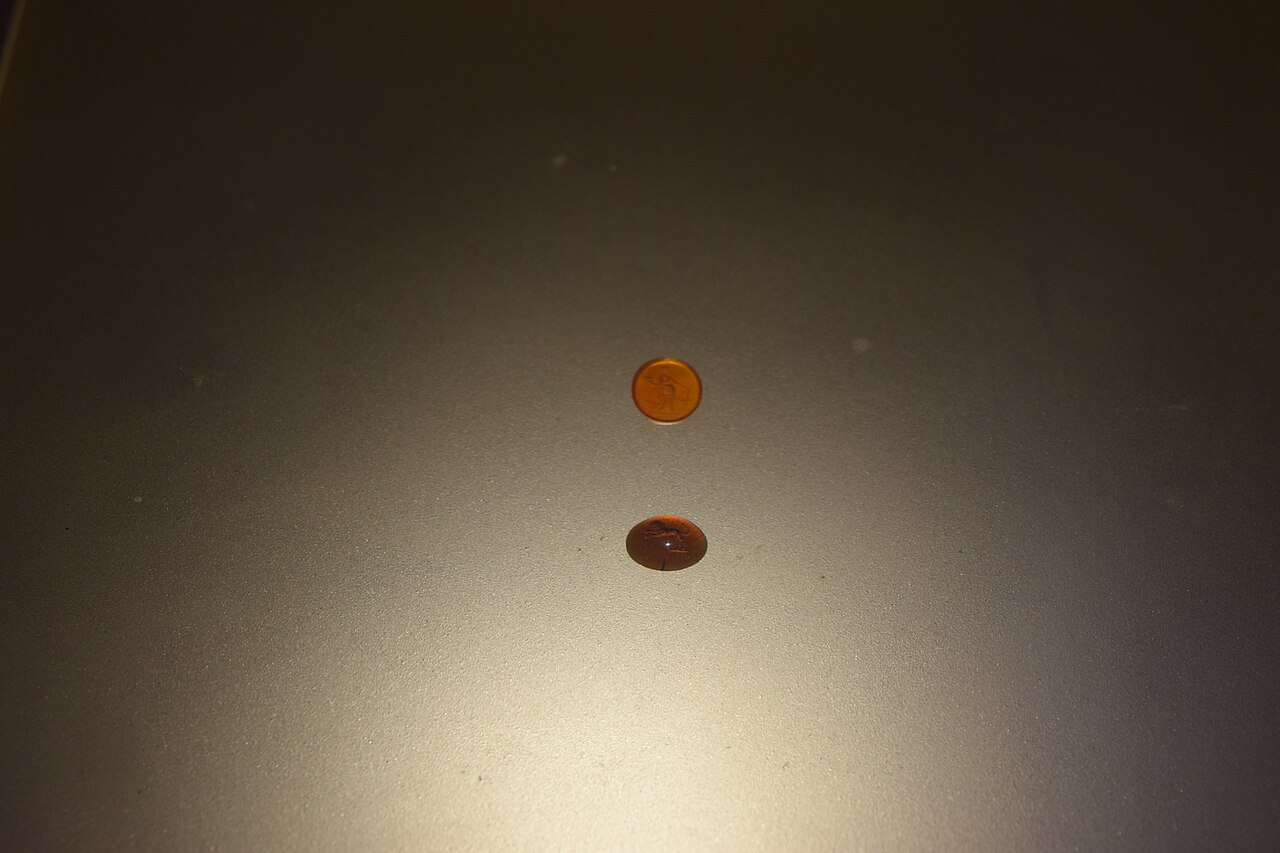
Pattanam · Photographed 2019-01-13 15:33:34
Two carnelian intaglios displayed at Pattanam Museum, photographed through the case
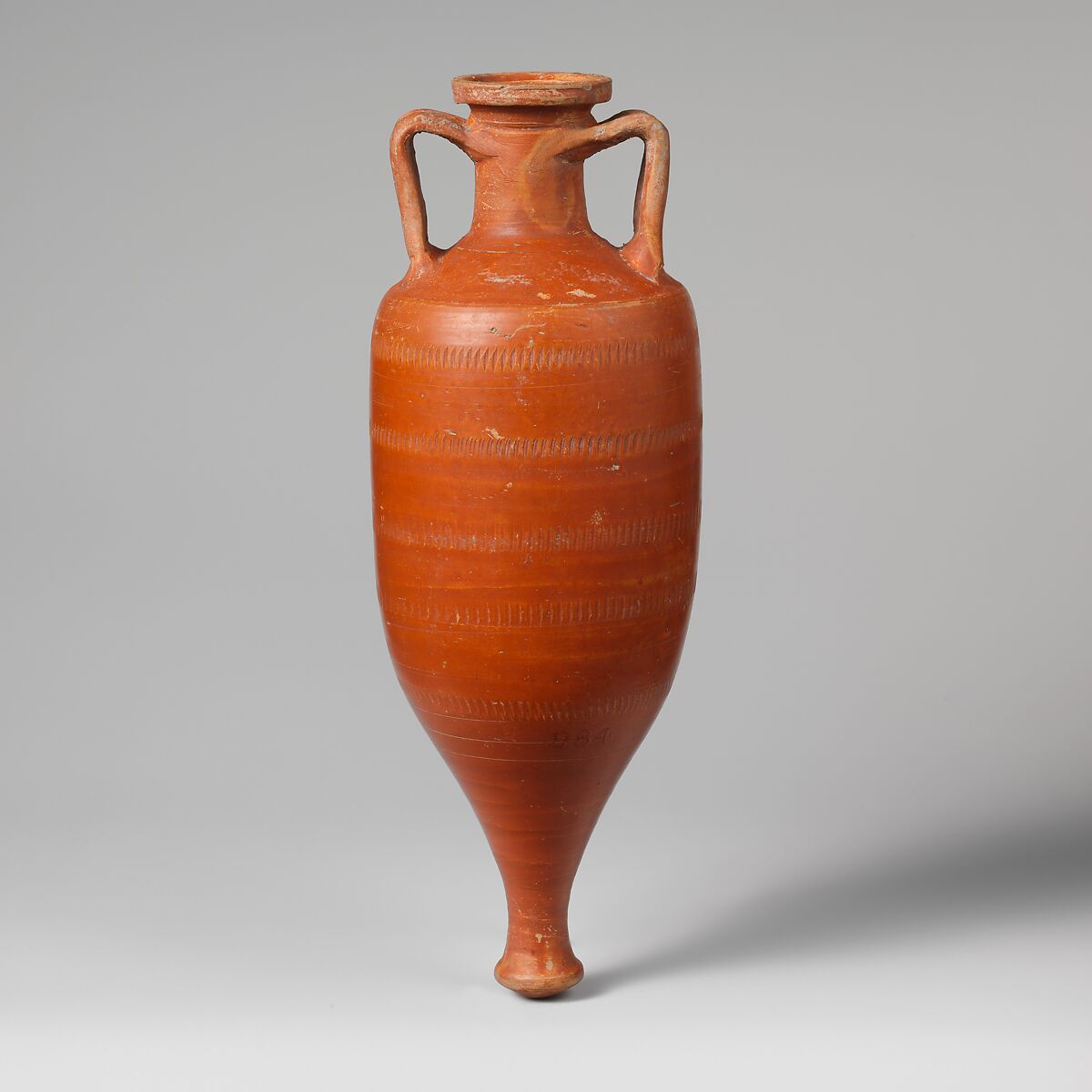
1st century CE
Terracotta amphora (storage jar), 1st century CE
Terracotta amphora (storage jar), 1st century CE. This fineware vessel imitates a transport amphora at smaller scale. It is not a Kerala excavation find or a full-size cargo amphora.
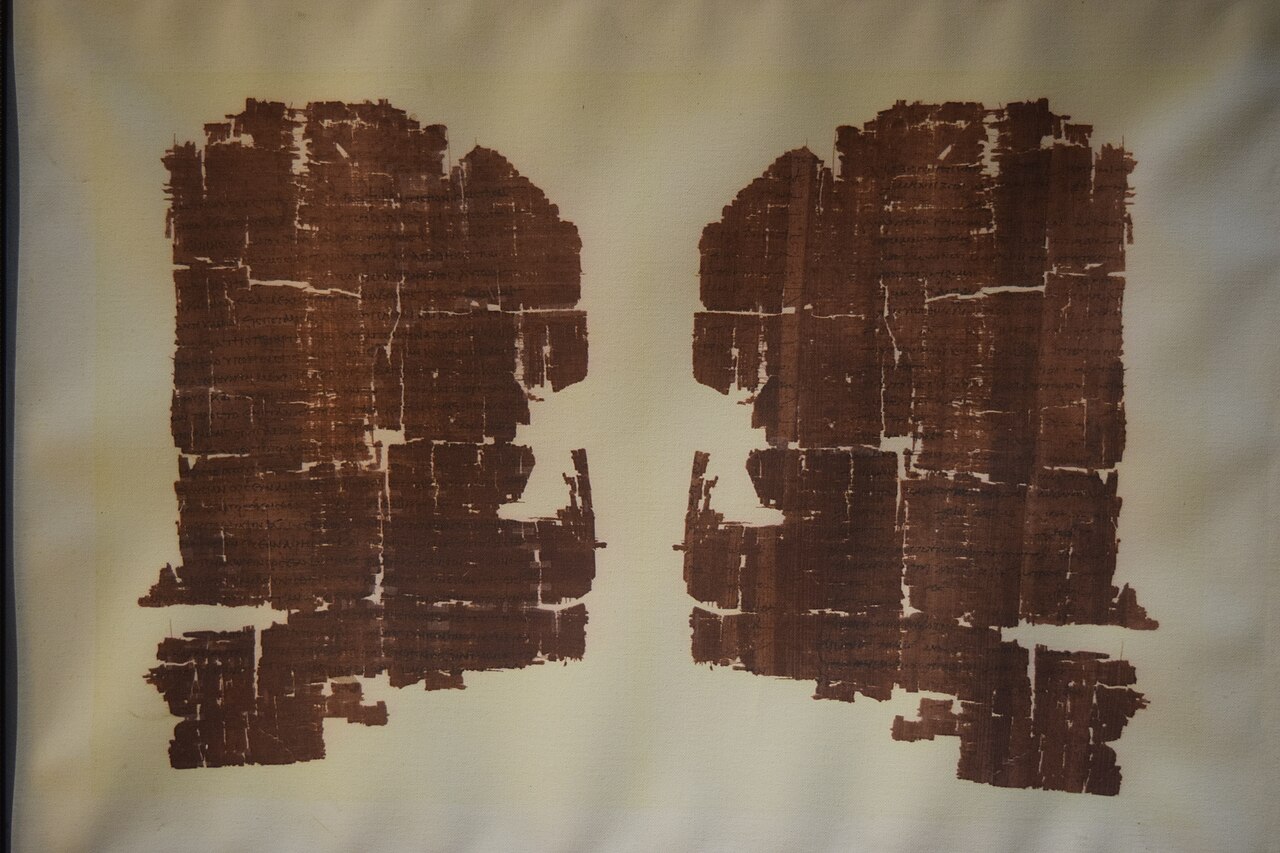
Original text: mid-2nd century CE; pictured display/facsimile modern
Photograph of the Muziris Papyrus facsimile displayed at the Pattanam Museum, taken by KannanVM in 2019
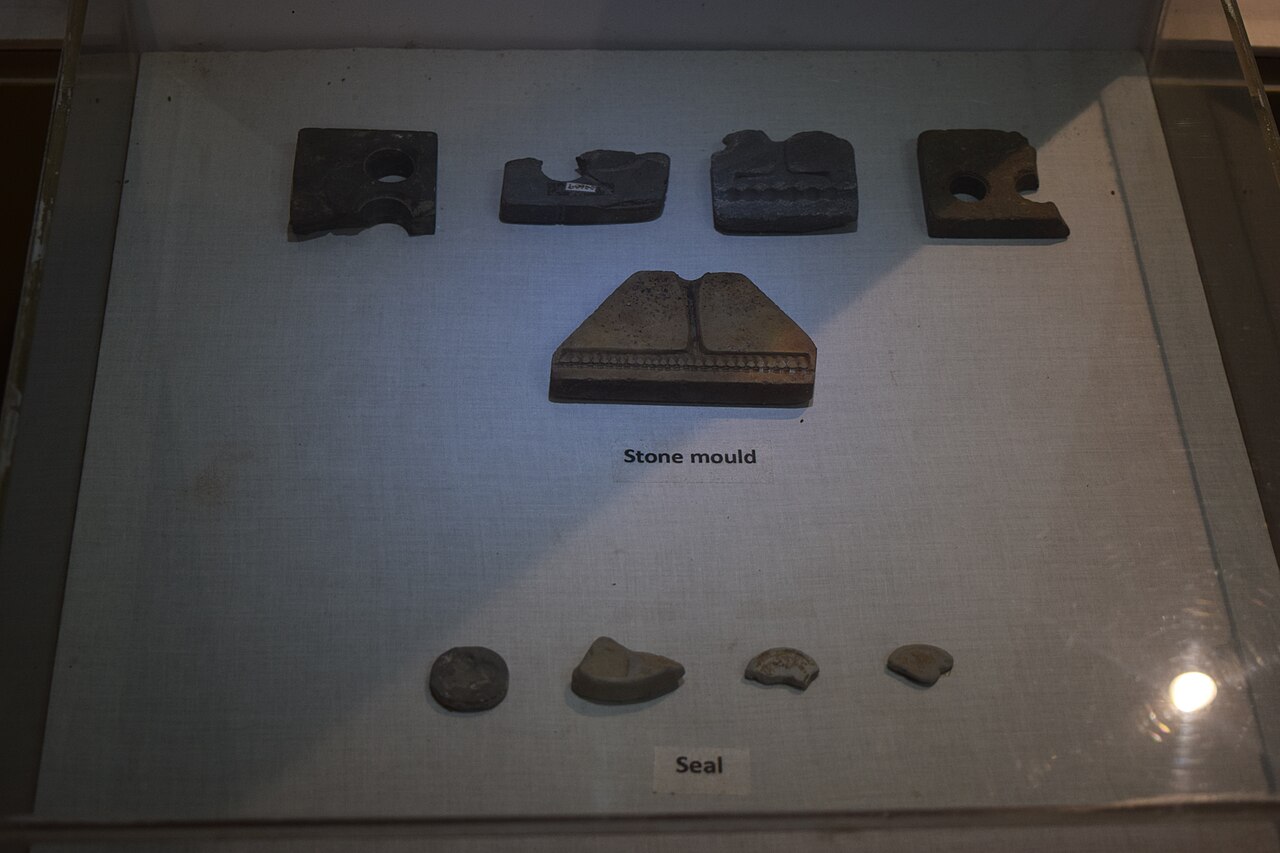
Pattanam · Photographed 2019-01-05 16:28:00
Stone moulds and small seal-like objects in a Pattanam Museum display
006Two views
Both views are shown at equal weight; this site does not choose between them.
Where the surviving agreement was made and what it secured
- One view
- Thür (1988): one undertaking financed from Alexandria, with separate loan and security documents; the transport precautions belong to the security.
- Another view
- Casson (1990): an arrangement made after the goods reached an Egyptian Red Sea port, tied to his new reading of the opening quantity.
- What would settle it
- A line-by-line comparison of the surviving columns in Thür's, Casson's and De Romanis's readings.
007Where next
All related studies, connected material, books and sources10 · 9
Elsewhere on this site
Multi-Script Glossary Terms: paṇṭakacālai (warehouse) & paṭṭiṉam (port-town) (பண்டகசாலை / பட்டினம் / പണ്ടകശാല / പട്ടണം) · Muziris Papyrus (SB XVIII 13167 / P.Vindob. G 40822) (முசிறிப் பாப்பிரஸ் ஆவணம் / മുസിരിസ് പാപ്പിറസ് രേഖ)
Connected material
Photographs, drawings, books, videos and other studies linked to this study. A link helps you explore; it does not prove a historical claim.
- Stone moulds and small seal-like objects in a Pattanam Museum displayphotographShows the subject
- Two carnelian intaglios displayed at Pattanam Museum, photographed through the casephotographShows the subject
- Two carnelian intaglios (standing figure and leaping lion) displayed at Pattanam MuseumphotographShows the subject
- Photograph of the Muziris Papyrus facsimile displayed at the Pattanam Museum, taken by KannanVM in 2019photograph of museum facsimileBackground
- Terracotta amphora (storage jar), 1st century CEphotographBackground
008Sources
The study lists the sources it consulted; we have not rechecked them. A working link does not show that a source was read, and a valid identifier does not show that it supports a claim. We do not link to unofficial uploads or copies of publications. Where a study cited one, we show the published citation, or a publisher, DOI or Internet Archive link when we have one. Tracking codes are removed from links, and the sources themselves are not republished here.
Bernhard Palme (2018). Der Muziris-Papyrus. Institutional account of the papyrus: date, recto/verso and commercial setting. German webpage text read. The lost exact date is distinguished from a palaeographic placement around the middle of the second century CE. Quantitative cargo tables were not used in this edition.
Lionel Casson (1990). New Light on Maritime Loans: P. Vindob. G 40822. Casson 1990, p.202, opening of section IV. Article text read, including translation and discussion; rendered PDF pages 195 and 200 read. Other screenshot requests failed. No papyrus autopsy. Casson revises his own earlier interpretation in this article. Restorations, cargo identifications and units must be attached to the edition; the surviving arrangement and the underlying loan are not identical documents.
Online copy not linked · use the published editionSource recordGerhard Thür (1988). Zum Seedarlehen kata Mouzeirin. P. Vindob. G 40822. Thür 1988, p.230. German article text read, especially pp.229–231. PDF rendering was attempted but failed; no papyrus image was read or retranscribed. Distinguish original publication 1988 from later online deposit dates. The discussion responds to Casson’s earlier account, not to his still-future 1990 revision. No independent German/Greek specialist review.
Bernhard Palme (2018). Der Muziris-Papyrus. Explanation of the transport, creditor and customs provisions. German webpage text read. The lost exact date is distinguished from a palaeographic placement around the middle of the second century CE. Quantitative cargo tables were not used in this edition.
Lionel Casson (1990). New Light on Maritime Loans: P. Vindob. G 40822. Recto col.II 1–26, translated on pp.199–200. Article text read, including translation and discussion; rendered PDF pages 195 and 200 read. Other screenshot requests failed. No papyrus autopsy. Casson revises his own earlier interpretation in this article. Restorations, cargo identifications and units must be attached to the edition; the surviving arrangement and the underlying loan are not identical documents.
Online copy not linked · use the published editionSource recordGerhard Thür (1988). Zum Seedarlehen kata Mouzeirin. P. Vindob. G 40822. Thür 1988, pp.230–231. German article text read, especially pp.229–231. PDF rendering was attempted but failed; no papyrus image was read or retranscribed. Distinguish original publication 1988 from later online deposit dates. The discussion responds to Casson’s earlier account, not to his still-future 1990 revision. No independent German/Greek specialist review.
Lionel Casson (1990). New Light on Maritime Loans: P. Vindob. G 40822. Casson 1990, pp.202–206. Article text read, including translation and discussion; rendered PDF pages 195 and 200 read. Other screenshot requests failed. No papyrus autopsy. Casson revises his own earlier interpretation in this article. Restorations, cargo identifications and units must be attached to the edition; the surviving arrangement and the underlying loan are not identical documents.
Online copy not linked · use the published editionSource recordDemosthenic corpus; English text hosted by MIT course materials (Fourth century BCE litigation; later transmitted text). Against Lacritus, speech 35, inserted loan agreement. Against Lacritus 35.10–13; surrounding litigation. English agreement at §§10–13 and its surrounding speech read. No manuscript comparison; see also Casson 1990, p.204 n.25 on inserted-document transmission. Earlier Aegean/Black Sea comparison, not a model automatically binding Indo-Roman loans. The inserted contract’s transmission and the litigant’s rhetoric require caution.
Lionel Casson (1990). New Light on Maritime Loans: P. Vindob. G 40822. Casson 1990, p.204 n.25, on the inserted agreement. Article text read, including translation and discussion; rendered PDF pages 195 and 200 read. Other screenshot requests failed. No papyrus autopsy. Casson revises his own earlier interpretation in this article. Restorations, cargo identifications and units must be attached to the edition; the surviving arrangement and the underlying loan are not identical documents.
Online copy not linked · use the published editionSource record
Researchers and institutions whose work this study uses: Lionel Casson
How we know The evidence, claims and dates behind this study
What this study draws on
- Casson's 1990 edition and translation and Thür's 1988 German article, both read directly; no papyrus autopsy.
- Bernhard Palme's 2018 institutional account of the papyrus.
- The sea-loan agreement quoted in the Demosthenic speech Against Lacritus (35.10–13), read in English translation.
- De Romanis's later edition was seen only at abstract level.
Dates in this study
This study has no dates recorded in a form we can chart, so there is no date chart. Any dates it gives are in the full study.
The study’s claims
0 claims · 0 source passages · 19 paragraphs
Browse the study paragraph by paragraphThis study has no separately listed claims. Its paragraphs can be browsed one by one.
About this study Status, corrections and how it was made
Status
Draft study, revision 7. No historian, archaeologist, or Tamil or Malayalam specialist has reviewed it yet.
How it was made
Compiled as an editorial synthesis from published scholarship around questions we framed. About this project & workflow
The summary, How sure lines and Two views notes on this page were prepared from this study and cross-checked against its passages. That is an editorial check, not a specialist review.
Technical details
Study code R036. The text fingerprint changes whenever the study text changes.
- The study text is shown as written. Links from its paragraphs to citations help you move around the study; they are not new claims or checked source passages.
See how this study’s records were extracted
Text fingerprint (SHA-256): R036 · 71182fdb144b08ade8a15c57… · v7
Evidence tables and technical details are on the web page: https://layersofthesouth.org/read/e755372067