Each period has the same width, so spacing is not to scale.
- Words & worlds
The yāḻ harp is known from poems, not from excavated finds
Early Tamil poems describe the yāḻ harp's hide-covered body, wooden arm and tensioned strings, but the reports checked include no excavated instrument.
- This page
- 4,903 words · revision 5
Draft study · Awaiting specialist review · Updated
001Dates and places

No mapped place in this study.
Before 1000 BCE
1000–500 BCE
Different beginnings
500–200 BCE
Marks & materials
200 BCE–300 CE
Connected worlds
300–600 CE
Change & continuity
- Adichanallur site-level preliminary thermoluminescence range reported by Government Museum survey
- Amaravati casing slab Acc. No. 221 museum catalogue date
- Laboratory date
- How it was dated is not stated
Each date belongs to what was dated (a sample, an object, a layer or a text), which is not always the event the study asks about.
Each period has the same width, so spacing is not to scale.
The full table of dates, with their ranges, is under How we know.
- 1 Well supported
- 2 Likely
- 1 Possible
002How sure
In brief
The yāḻ was the harp of early Tamil bards. Poems such as Perumpāṇāṟṟuppaṭai and Ciṟupāṇāṟṟuppaṭai describe its hollow body, hide covering, curved wooden arm and tightly twisted strings. One passage names maral plant fibre for a bow-shaped yāḻ, so not every yāḻ need have used gut strings. Later commentary explains tivavu as a binding that holds the strings, not a fret. The Cilappatikāram epic describes a fourteen-string yāḻ tuned through seven named notes, while the familiar four-type string counts (usually given as 21, 19, 14 and 7 from medieval commentary, though Dikshitar's 1939 appendix gives 17 for the makara-yāḻ) belong to later tradition rather than the early poems themselves. A carved slab from Amaravati in Andhra Pradesh, catalogued to 200–250 CE, shows a harp and drum together, and bronze and iron bells come from Adichanallur and Nilgiri burials. The excavation reports checked include no early wooden yāḻ, since wood, hide and string rarely survive.
Key researchers cited in this study: Vaidehi Herbert (Sangam Poetry Translations & Commentaries) · A. Aiyappan (Feroke Rock-Cut Cave-Tombs & Museum Studies) · V. R. Ramachandra Dikshitar (Sangam Literature & South Indian History) · Full bibliography
How sure
- Well supported
Early Tamil poems describe the yāḻ as a hollow, hide-covered body with a wooden arm and tensioned strings.
The poems state it directly.
- Likely
The yāḻ was an open harp, not a fretted lute.
Poems, the tuning passage and Amaravati sculpture agree, but no Tamil yāḻ survives to confirm it.
- Likely
Tivavu was a binding that held the strings, not a fret.
Traditional commentary defines it so, but its exact mechanics remain unresolved.
- Possible
A medieval commentarial tradition assigns counts of 21, 19, 14 and 7 strings to four yāḻ types.
Secondary accounts attribute 21, 19, 14 and 7 strings to verses quoted in Aṭiyārkkunallār's commentary (not checked in the Tamil edition here), while Dikshitar's 1939 appendix gives 17 for the makara-yāḻ.
Why it matters
It separates what poems, later commentary and surviving objects can each tell us about early Tamil music.
003Key findings
What the study concludes
- The Pattuppattu textual tradition describes the yal as a composite chordophone with a hollow resonating body, hide covering, wooden curved/stem element, multiple tensioned strings and specialized string-fastening or tension apparatus.
- Tivavu is more securely understood as part of the yal string-binding/tension system than as a fret; whether all occurrences denote a peg-like device is unresolved.
- The Arangerrukkatai preserves a systematic fourteen-string and seven-note tuning discourse with named palai transformations, establishing deliberate pitch organization beyond generic poetic references to pleasant sound.
- An Amaravati casing slab in the Government Museum, Chennai, catalogued to 200–250 CE is officially described as depicting a harp and drum, providing an early southern-Deccan iconographic comparator for the literary acoustic world.
In the study’s own words. How sure each point is, is shown above.
The summary above is the short read. The full study is the complete text it was drawn from, with its tables and source notes.
What the full study covers
004The study
Answer in Brief
The source-bound answer is stronger for musical technology and performance practice in the literary record than it is for excavated instruments. The Pattuppāṭṭu poems preserve unusually concrete descriptions of the yāḻ: a hollow resonating body, a fitted hide or leather covering, a curved or raised wooden member, multiple tensioned strings, and fastening/tension apparatus. Perumpāṇāṟṟuppaṭai compares details of the instrument to familiar crafted objects and places the large yāḻ against the performer’s left side; Ciṟupāṇāṟṟuppaṭai describes tightly twisted strings and the realization of a named paṇ; Perumpāṇāṟṟuppaṭai also describes a bow-yāḻ whose stringing involves maral plant fiber. The terminology is sufficiently specific to establish a sophisticated chordophone-making tradition, although it does not justify reconstructing every component as if a complete archaeological specimen survived. ↗1
A particularly important correction concerns tivavu (திவவு). It should not simply be translated as “fret,” and it is not securely synonymous with a modern tuning peg. Tamil Virtual University’s traditional lexical/commentarial material defines it as a vār-k-kaṭṭu, a binding by which yāḻ strings are held under tension; another commentary explicitly distinguishes māṭakam, a twisting peg, from tivavu, the binding. A modern TVU teaching page, by contrast, explains tivavu as a wooden screw-like tensioning device. The safest historical formulation is therefore string-fastening/tension apparatus, with its exact mechanics unresolved. This matters because a harp, unlike a fretted lute, does not require frets, and Dīkshitar likewise understood the yāḻ strings as sounded open. ↗2
The Araṅkēṟṟukkātai of the Cilappatikāram supplies the clearest evidence for formal tuning theory. In Dīkshitar’s translation of lines 70–94, a fourteen-string instrument is tuned through named pitches including kural, tuttam, kaikkiḷai, uḻai, iḷi, viḷari, and tāram, while named pālai formations are generated through changes of tonal relationship. Dīkshitar interpreted this as a fourteen-string cakoṭa-yāḻ and as evidence that strings carried fixed pitches while tonal functions could shift. Whatever modern theoretical vocabulary is applied, the primary observation is secure: the transmitted text describes seven note-names, fourteen strings, systematic relations among them, and transformations among named pālai structures. It is less secure to equate these directly, one-for-one, with present-day Carnatic svara, rāga, or mēḷakarta practice. ↗3
The poems also locate instruments in a bardic performance ecology rather than as isolated technologies. The āṟṟuppaṭai poems are organized around itinerant performers and patronage; small- and large-yāḻ players carry their instruments, know appropriate paṇ, and perform according to inherited convention. Malaipaṭukaṭām enumerates an ensemble including muḻavu, ākuḷi, pāṇḍil, kōṭu, several tūmpu wind instruments, flute, taṭṭai, ellari, patalai, and other sound-makers. Its descriptions place voice, instrumental music, dance, landscape, procession, and patronal hospitality in the same acoustic world. ↗4
The archaeology is much thinner but not silent. No securely excavated pre-600 CE wooden yāḻ from Tamilakam was identified in the consulted excavation literature. That absence is unsurprising: untreated archaeological wood and other organic components normally disappear unless exceptional conditions such as anoxia, waterlogging, charring, mineral replacement, or extreme desiccation intervene. A yāḻ combining wood, hide and organic string is therefore almost the worst possible instrument for routine survival in ordinary aerated deposits. Historic England summarizes the preservation problem directly: archaeological wood is uncommon, while waterlogged/anoxic conditions can greatly slow the biological processes that normally destroy organic remains. ↗5
There are, however, durable acoustic anchors. An official Government Museum, Chennai catalogue identifies a harp and drum on an Amaravati casing slab catalogued to 200–250 CE, giving a securely material, southern-Deccan comparison for the instrument combination described in Tamil literary sources. An older Madras Government Museum publication reports bronze and iron bells in both Nilgiri burial collections and Adichanallur; these demonstrate durable sound-producing objects but do not, by themselves, connect those bells with pāṇar, viraliyar, court ensembles, or yāḻ performance. ↗6
Bottom line: before 600 CE, the combined record supports a technically developed South Indian acoustic culture in which arched/open-string harps, drums, flutes, horns and idiophones could be coordinated with song and dance; it also supports a seven-note conceptual vocabulary and deliberate modal/scalar transformations. What it does not presently establish is a recovered Tamil yāḻ, an archaeologically verified string count for each named yāḻ type, an exact reconstruction of its tuning hardware, or a demonstrable one-to-one continuity between early paṇ/pālai theory and modern Carnatic theory. ↗7
Scope & Chronological Control
This study covers 1000 BCE–600 CE, the site's main period, with Tamil Nadu, Kerala and immediately connected South Indian/Indian Ocean contexts at the center. Amaravati in present-day Andhra Pradesh enters only as a geographically explicit southern-Deccan comparator because its relief sculpture supplies rare surviving iconography of the same broad instrument class. Material or literary evidence later than 600 CE is used only when it transmits, comments upon, or helps define earlier terminology; it is not silently backdated into the target period. ↗8
Chronological control is especially important because “Sangam age” is not an excavation layer. Specialists have proposed overlapping ranges for the early classical poetic corpus, and Zvelebil’s influential reconstruction places much of early Sangam composition broadly around the last century BCE through the first centuries CE, while the formation and transmission of anthologies extended beyond the moments of individual composition. The present report therefore treats Poruṇarāṟṟuppaṭai, Perumpāṇāṟṟuppaṭai, Ciṟupāṇāṟṟuppaṭai, and Malaipaṭukaṭām as early-classical textual witnesses with debated individual dates, not as precisely dated archaeological artifacts. ↗9
The same caution is necessary for the Cilappatikāram. This study read V. R. Ramachandra Dīkshitar’s 1939 translation and appendix through the Internet Archive OCR; his preface states that his work depended on U. V. Swaminatha Aiyar’s Tamil edition. The Araṅkēṟṟukkātai passage is therefore an observation of a published textual transmission, not an autopsy of an ancient palm-leaf manuscript and not an inscription dated in situ. Its elaborate musicological content is relevant to the period studied here, but the date of the epic and the historical depth of particular technical passages remain questions that must be kept separate from the internal content of the passage. ↗10
Egyptian arched harp from Deir el-Bahri (ca. 1580–1295 BCE, Metropolitan Museum of Art)
ca. 1580–1295 BCE
It is an Egyptian harp shown for comparison, not a Tamil yāḻ.
This distinction yields three evidentiary levels used throughout this study:
| Evidentiary level | Meaning in this study |
|---|---|
| Physical / Textual Observation | What an excavated/catalogued artifact is reported to be, or what the consulted published Tamil text/translation/commentary actually says. |
| Scholarly Interpretation | Reconstruction of instrument type, function, tuning logic, chronology, or cultural significance by editors, translators, musicologists or archaeologists. |
| Unresolved / Debated | Claims for which terminology is ambiguous, chronology is insecure, competing reconstructions exist, or an archaeological bridge from text to artifact is absent. |
The distinction is consequential. For example, the phrase narampu demonstrates a “string” in a yāḻ description; it does not automatically demonstrate a zoologically identified gut string. Conversely, one passage describing maral fiber on a bow-yāḻ gives unusually explicit evidence for a plant-derived string material in at least that instrument. Likewise, tivavu certainly concerns string attachment or tension in the commentarial tradition, but whether a particular form was a strap-binding, winding mechanism or peg-like device is not securely recoverable from one English gloss. ↗11
Archaeological dates are treated just as conservatively. The Government Museum’s Excavations in Tamil Nadu summarizes Adichanallur and reports a preliminary thermoluminescence range of 1500–500 BCE for the site, but the consulted publication does not provide laboratory identifiers tying that entire interval to the older museum bells discussed elsewhere. Accordingly, this study does not date an individual Adichanallur bell by borrowing that site-wide range. ↗12
Primary Archaeological & Textual Evidence
The organological evidence is best read component by component rather than by beginning with a modern reconstruction and searching the poetry for matches.
| Feature | Physical / textual observation | Interpretation and qualification |
|---|---|---|
| Resonating body | Tamil pedagogical/commentarial tradition calls the large hollow lower body pattar. Perumpāṇāṟṟuppaṭai describes the fitted covering and body through a dense sequence of craft similes. ↗13 | A hollow resonator is secure. Exact cross-section, dimensions and internal bracing are not. |
| Hide covering / soundboard | The same tradition identifies paccai as animal hide stretched over the hollow body; the poetic description refers to a closely fitted porvai or covering. ↗13 | “Skin resonator” is imprecise: the body resonates, while hide forms a covering/soundboard over it. Porvai and paccai should not be mechanically treated as identical technical terms without qualification. |
| Wooden stem/neck | Commentarial material calls the wooden member taṇṭu/kōṭu and compares its disposition to a raised snake. A traditional commentary cited by TVU assigns koṉṟai and karuṅkāli to the kōṭu. ↗14 | These timber specifications come through commentary, not from an excavated instrument. They are evidence for a transmitted technical tradition, not species identification by archaeobotany. |
| Resonator timber | The same commentarial passage assigns kumiḻ, murukku and taṇakku woods to the pattar. ↗15 | Strong evidence for traditional organological exegesis; weaker evidence for the construction of every early-historic yāḻ. |
| Strings: narampu | Ciṟupāṇāṟṟuppaṭai compares the tightly laid/twisted strings to worked gold; Perumpāṇāṟṟuppaṭai similarly describes tensioned strings. ↗16 | “String” is secure. “Gut” or “sinew” is plausible as a lexical/organological interpretation but was not materially verified in the consulted passages. |
| Plant-fiber stringing | Perumpāṇāṟṟuppaṭai describes a bow-yāḻ using maral fibers associated with a hollow kumiḻ branch. ↗17 | This directly warns against assuming that every early yāḻ used animal gut. Different chordophones could employ different fibers. |
| Tension apparatus: tivavu | Traditional lexicographical commentary defines tivavu as the binding of yāḻ strings and as a vār-k-kaṭṭu. Another source distinguishes a māṭakam “twisting peg” from tivavu. ↗18 | Best rendered generically as string-binding/tension apparatus. Calling it “frets” is organologically hazardous; calling every tivavu a peg is also too certain. |
| Playing posture | Perumpāṇāṟṟuppaṭai and Ciṟupāṇāṟṟuppaṭai place the yāḻ toward or embraced against the player’s left side. ↗19 | Consistent with an open harp cradled by the performer, though textual posture alone cannot determine exact geometry. |
The distinction between direct poetry and later commentary is especially important for timber. The most specific wood allocation found in the research is preserved on Tamil Virtual University in a traditional explanatory passage citing Nacciṉārkkiṉiyar’s Poruṇarāṟṟuppaṭai commentary: koṉṟai and karuṅkāli are associated with the yāḻ’s curved kōṭu, while kumiḻ, murukku, and taṇakku are associated with the resonating pattar. The same passage distinguishes defects in wood and defects in strings, showing that commentators understood instrument making in terms of material selection and quality control. That is significant evidence for Tamil organological knowledge, but it must be labelled commentarial technical tradition, not presented as though each botanical name had been read directly from an excavated first-century workshop. ↗15
The Araṅkēṟṟukkātai moves from construction to tuning. Dīkshitar’s translation describes a master of a fourteen-string yāḻ producing seven pālai notes. It gives relationships involving tāram and kural, then kaikkiḷai and viḷari, and describes traversal of all fourteen strings. It names cem-pālai and derives or shifts to paṭumalaippālai, cevvāḻippālai, koṭippālai, viḷarippālai, and mēr-cempālai through changes anchored on particular named pitches. The passage additionally contrasts the directional organization of notes on yāḻ and flute and states that an expert can combine lower, upper and middle registers pleasingly. These are textual observations of a deliberately structured pitch system, not merely poetic praise of pleasant sound. ↗20
Dīkshitar’s musicological appendix interprets the stage instrument as a fourteen-string cakoṭa-yāḻ. In his reconstruction the yāḻ is an open-string chordophone whose strings are each tuned to pitches rather than stopped against frets. He also interprets the larger twenty-one-string arrangement in terms of three registers of seven notes. These conclusions are scholarly reconstruction, useful but not equivalent to the words of the epic itself. Dīkshitar openly acknowledges that the passage is difficult and that the medieval commentator Aṭiyārkkunallār does not resolve every technical problem. ↗21
The canonical four-type taxonomy – Pēriyāḻ (21 strings), Makarayāḻ (19), Cakōṭayāḻ (14), and Ceṅkōṭṭuyāḻ (7) – belongs to the medieval commentarial tradition, not to the early Sangam Pattuppāṭṭu poems themselves. Secondary accounts attribute the counts 21, 19, 14, and 7 to mnemonic verses quoted in Aṭiyārkkunallār's medieval commentary on the Cilappatikāram (that Tamil commentary was not checked directly here), whereas V. R. Ramachandra Dīkshitar's 1939 appendix gives 17 strings for the makarayāḻ and the early Pattuppāṭṭu poems give no such four-type table. The neat 21/19/14/7 table should therefore be presented as medieval commentarial systematization rather than as a fact established directly by early Sangam verse. ↗22
The texts are clearer about performance than nomenclatural taxonomy. Ciṟupāṇāṟṟuppaṭai associates the sweet small yāḻ, its gold-like twisted strings, Naivaḷam/Natta-p-pāṭai and a pālai performance with a bard who knows the proper inherited method. Perumpāṇāṟṟuppaṭai repeatedly joins possession of the large yāḻ to bodily carriage and performance according to tradition. The āṟṟuppaṭai narrative structure itself makes musical expertise mobile: performers know routes, courts, patrons, conventions and repertories as well as their instruments. ↗23
Malaipaṭukaṭām expands this into an acoustic landscape. Its inventory includes muḻavu and ākuḷi percussion, pāṇḍil, decorated kōṭu, short and long tūmpu horns, flute, taṭṭai, ellari, patalai, and additional instruments. The flute is compared with a yāḻ string-note, indicating an imagined pitch relationship between wind and string instruments rather than a purely percussive ensemble. The poem’s performers include singers and dancing women, and its wider performance world joins musical sound to procession, landscape, hospitality and the praise of patrons. ↗4
This evidence supports the use of pāṇar as specialist bard-musicians and viraliyar as women performers associated with song/dance, but rigid modern occupational categories should be resisted. The poems portray overlapping capacities – singing, string playing, dancing, composing praise, knowing paṇ, traveling and negotiating patronage – rather than a conservatory-style division into “instrumentalist,” “vocalist,” and “dancer.” ↗24
Poems also set music in the home. In Vaidehi Herbert’s translation, Ainkurunuru 407 places a couple beside the enjoyment of a bard’s music. Poem 408 combines a musical performance with flowers, adornment and a father seated with his child. These are scenes within a literary sequence, not neutral inventories, but they set music beside affection and household pleasure as well as courts and public spectacle. They do not show that every family could hire a performer, or that the same tune was played every evening. A household listener, a patron being praised and a traveller being directed onward are different audiences; “Chera poems show bards and dancers travelling for royal gifts” follows the performers’ travel and their patronage at Chera courts. A modern performance of such a scene should say what the musician chose, because translating the name of a mode (paṇ) does not recover its pitches. (Source: Peyanar, traditional attribution; Vaidehi Herbert, translation and notes, Ainkurunuru 403 and 407–408: names, play and music, Learn Sangam Tamil.)
The durable material record provides a separate evidentiary line:
| Material evidence | Observation | What it can and cannot establish |
|---|---|---|
| Amaravati casing slab, Government Museum Chennai, Acc. No. 221 | The museum catalogue dates the slab to 200–250 CE and explicitly identifies “harp and drum” among its depicted musical instruments. ↗25 | Strong southern-Deccan iconographic evidence that harp and drum forms coexisted in the early centuries CE. It is not an excavated Tamil yāḻ and cannot prove the Tamil names or tuning system of the depicted harp. |
| Adichanallur/Nilgiri metal bells | A. Aiyappan’s Madras Government Museum introduction states that bronze and iron bells occur in both the Nilgiri burial material and Adichanallur. ↗26 | Physical evidence for durable sound-producing objects. Their functions may have included animal or ritual use; they are not evidence of a bardic orchestra unless contextual evidence demonstrates that association. |
| Adichanallur excavation material | The Government Museum survey records urn burials, copper bangles, iron implements, beads, pottery and habitation evidence, and gives a preliminary site-level TL range. ↗12 | Demonstrates the metalworking and craft environment in which durable acoustic objects were possible. The cited modern excavation summary does not itself document a yāḻ component. |
| Nilgiri burial collections | Modern study has returned to nineteenth-century Nilgiri grave goods and stresses the need to reconstruct their chronology and contexts from dispersed museum collections. ↗27 | Useful check against accepting nineteenth-century provenience and dates uncritically; the accessible result was an abstract/bibliographic record, not full article inspection. |
| Terracotta sound-makers | In the official and scholarly material read for this study, no pre-600 Tamilakam terracotta fragment could be securely identified and contextualized as a specific parai, muḻavu, yāḻ component, or rattle. ↗12 | An open evidence gap, not proof that ceramic rattles or drum components did not exist. Generic terracotta discs, spheres or hollow figurines must not be relabelled “musical instruments” without acoustic morphology or excavation identification. |
The last point is worth emphasizing because careful identification changes the result. Archaeological reports from Tamil Nadu contain enormous quantities of terracotta, but an object’s being hollow, perforated, disc-shaped or small does not make it a rattle, drum part, whistle or bell. Such an identification needs the excavation publication itself, a museum catalogue, or a specialist artefact study.
Silappathikaram: text page from the 1897 examination edition – A later printed witness to an older work, not an ancient manuscript
1897
Organic preservation supplies the most economical explanation for the mismatch between abundant textual yāḻ description and the absence of whole instruments. Historic England notes that wood rarely survives in the archaeological record and that exceptional wet or waterlogged deposits can preserve it; its environmental-archaeology guidance explains that anoxic waterlogging works by excluding oxygen and slowing the biological and chemical processes that normally decompose organic material. Archaeological wood is commonly encountered as waterlogged, carbonized or mineral-replaced material. A composite harp whose diagnostic parts were wood, hide and fiber/string could therefore vanish almost entirely while nearby ceramic, stone and metal objects survived. ↗5
Analytical Comparison & Competing Interpretations
The combined record favors identifying the classical yāḻ as an open arched-harp family rather than a fretted lute family, but the argument should be stated carefully. The poems describe a curved wooden structure, resonator, strings, tension fittings and cradled playing posture; the Cilappatikāram passage treats individual strings as carriers of pitch; and Dīkshitar explicitly reconstructs the yāḻ without frets. Southern-Deccan sculpture independently demonstrates open harp forms in the relevant broad period. These strands converge on harp organology even though no physical Tamil yāḻ survives. ↗28
Observation: tivavu belongs to the stringing/tension system. Interpretation A: some modern explanatory material presents it as a wooden screw-like tension adjuster. Interpretation B: older lexical/commentarial material defines it as the binding or strap that holds the strings, while māṭakam is separately called the twisting peg. The second formulation better explains why equating tivavu with “frets” is problematic. The mechanically safest reconstruction therefore leaves open a system in which bindings and peg-like devices could both occur, instead of forcing one Tamil word to cover every modern tuning-hardware category. ↗29
The same method resolves the string-material problem. Observation: the poetry repeatedly says narampu, and one bow-yāḻ passage specifies maral fiber. Interpretation: gut/sinew has long been proposed for yāḻ strings, and Dīkshitar considered gut likely, but his appendix also entertained metallic strings. Unresolved: neither gut nor metal has been recovered from a securely identified early Tamil yāḻ. The strongest source-bound statement is therefore that early Tamil chordophones used tensioned strings, that at least one described type could employ plant fiber, and that organic animal strings remain plausible rather than archaeologically demonstrated. ↗30
The tuning passage is best understood as evidence for relational modality, not as a ready-made modern Carnatic chart. Seven distinct note names form the conceptual base; fourteen strings permit replication or extension of that pitch material; and changing the structurally important note yields differently named pālai. Dīkshitar’s interpretation – that strings were assigned pitches while modal functions shifted – provides a coherent explanation of the text. Yet this does not license assigning exact modern frequencies, cents, tonic standards, or contemporary rāga identities. Nothing in the consulted early passage supplies a frequency standard or instrument-independent pitch measurement. ↗31
The relationship of paṇ to pālai is likewise hierarchical but not wholly transparent. The Pattuppāṭṭu evidence shows performers selecting and realizing named melodic types in ways appropriate to situation and landscape, whereas the Cilappatikāram offers a more formal discussion of pitch relationships. This supports continuity in a technical musical vocabulary, but it may also reflect different genres, periods and levels of theorization. Treating every landscape-associated paṇ as mathematically identical to a later theoretical scale would erase that distinction. ↗32
The textual and archaeological evidence converge most securely at the level of instrument classes and ensemble practice. Tamil poetry repeatedly combines strings, flutes/horns, membrane percussion and other struck sound-makers. Amaravati’s 200–250 CE catalogue description likewise puts harp and drum within one sculptural musical scene. That convergence makes it historically reasonable to speak of a shared South Indian repertoire of chordophones, aerophones and percussion technologies. It does not demonstrate that the Amaravati harp was called yāḻ, that its notes were named kural–tāram, or that Amaravati musicians performed Tamil paṇ. Those would be unobserved cultural transfers. ↗33
The bells sharpen another methodological distinction. Metal bells are literally acoustic artifacts: their morphology is designed to sound. But Aiyappan’s discussion itself points toward ritual and cattle associations for small bells in comparative contexts. Consequently, their presence materially anchors a world in which deliberately produced metallic sound mattered, while their archaeological context does not make them accompaniment for a pāṇar or virali. ↗26
Finally, performance should be reconstructed as a social system rather than an inventory of instruments. The āṟṟuppaṭai genre links technical skill with mobility and patronage: the performer possesses an instrument and repertory, knows where generosity can be found, and guides another performer through a human and geographical network. Malaipaṭukaṭām adds coordinated instrumental and vocal sound; the Cilappatikāram adds staged expertise in tuning and ensemble sequence. Together these texts make the most convincing case not for an isolated “ancient Tamil harp,” but for trained musicians operating within a sophisticated acoustic culture. ↗34
Evidential Limits & Common Misconceptions
“A complete Sangam-age yāḻ has been excavated.” – Unsupported in the consulted evidence. No securely provenanced pre-600 CE yāḻ was found in the excavation reports and museum sources examined here. The surviving evidence is textual, iconographic and indirect material evidence from more durable sound objects. The preservation behavior of wood, hide and fiber makes this absence unsurprising, but preservation bias must not be converted into a claim that a missing archaeological specimen once had any particular reconstructed dimensions. ↗35
“Porvai is the wooden resonator.” – Too loose. The technical tradition distinguishes the hollow body (pattar) from its skin/hide covering (paccai), while poetic language can refer to a porvai, a covering. A reconstruction should model a composite resonator/soundboard system rather than translating every covering term as the resonator itself. ↗13
Silappathikaram: title page of the 1897 examination edition – A later printed witness to an older work, not an ancient manuscript
1897
“Tivavu means fret.” – Very doubtful. Traditional Tamil explanations define it through string binding/tension, and one source explicitly distinguishes the twisting peg (māṭakam) from tivavu. A fretted-lute interpretation also conflicts with Dīkshitar’s reading of the yāḻ as an open-string instrument. The word’s exact hardware realization remains debated, but “fret” should not be the default gloss. ↗36
“All yāḻ strings were gut.” – Not established. Narampu is the recurring string terminology and may support a gut/sinew interpretation in some contexts, but the corpus itself preserves an explicit plant-fiber example for a bow-yāḻ. No surviving early Tamil string has been microscopically identified in the consulted archaeological record. ↗30
“The early Sangam poems establish fixed counts of 21, 19, 14 and 7 strings for four yāḻ types.” – Chronologically mislocated. Secondary accounts trace the 21/19/14/7 counts to Aṭiyārkkunallār's medieval commentary (not checked in the Tamil edition here), while Dīkshitar's 1939 appendix gives 17 strings for the makarayāḻ and the early Pattuppāṭṭu poems give no such table. Separating the early poetic record from medieval commentarial systematization keeps both layers accurate. ↗22
“The seven ancient notes are simply the modern seven Carnatic notes under old names.” – Too strong. The ancient text unmistakably has seven named pitch categories and structured transformations among them; continuity with later South Indian music theory is a reasonable subject of scholarship. Exact equivalence, however, requires assumptions about interval size, tonic, tuning temperament and historical continuity that the passage itself does not measure. ↗20
“Amaravati proves the appearance of the Tamil yāḻ.” – It supplies a comparator, not an identification. The Government Museum catalogue securely identifies a harp and drum on a relief dated 200–250 CE, but Amaravati is in the southern Deccan outside Tamilakam. Its importance is that a materially surviving South Indian visual tradition confirms the contemporaneous plausibility of open harp-and-drum performance; its sculpture cannot supply the Tamil instrument’s name, woods, string count or tuning. ↗25
“Any ancient metal bell, terracotta disc or hollow ceramic object is a musical instrument.” – Methodologically unacceptable. The Nilgiri/Adichanallur bells genuinely are sound-producing forms, but even there function is context-dependent. For terracotta, this study found no sufficiently secure pre-600 Tamilakam publication linking a specific excavated fragment to parai, muḻavu or a rattle. That remains a priority research gap rather than a space to be filled through analogy. ↗37
The largest unresolved question is therefore not whether early Tamilakam had music – the textual and comparative iconographic evidence overwhelmingly establishes an elaborate performance culture – but how tightly its literary organology can be tied to excavated objects. Future progress would require re-examination of museum collections for overlooked string fasteners, resonator fittings or acoustically diagnostic fragments; archaeobotanical identification of surviving instrument-like woods where exceptional preservation exists; specialist study of early bells and ceramic sound-makers; and systematic iconographic comparison of Bharhut, Amaravati, Nagarjunakonda and securely dated Tamil-region sculpture without assuming that visually similar chordophones shared names or tuning systems. The present evidence supports those research programs but does not prejudge their results. ↗38
Bibliography & Source Register
| Source and access | Use and qualification |
|---|---|
| Poruṇarāṟṟuppaṭai, Tamil text/meaning, Sangam Translations by Vaidehi Herbert. Access: full text web edition. ↗39 | Used for poem structure and bardic context. Modern web presentation drawing on traditional editions/commentaries; not a critical-manuscript autopsy. |
| Ciṟupāṇāṟṟuppaṭai, Tamil text/meaning and English presentation, Sangam Translations by Vaidehi Herbert. Access: full text. ↗40 | Used for twisted/gold-like strings, small yāḻ, playing posture and paṇ/pālai. Translation/commentarial mediation must be retained in citation. |
| Perumpāṇāṟṟuppaṭai, Tamil commentary/meaning and English presentation, Sangam Translations by Vaidehi Herbert. Access: full text. ↗41 | Principal Pattuppāṭṭu source for yāḻ anatomy, body covering, tensioned strings, left-side carriage and maral-fiber bow-yāḻ. |
| Malaipaṭukaṭām, English/Tamil web presentation, Sangam Translations by Vaidehi Herbert. Access: full text. ↗42 | Instrument inventory and ensemble/acoustic-landscape evidence. |
| Ilango Adigal, The Silappadikaram, trans. V. R. Ramachandra Dīkshitar. Oxford University Press/Humphrey Milford, 1939. Access: full text OCR/selected read passages. ↗43 | Araṅkēṟṟukkātai lines 70–94 and Appendix III. Large scan could not be reliably rendered through the PDF screenshot interface; substantive inspection used Internet Archive full-text OCR. |
| Tamil Virtual University, “யாழ் வருணனை” (Yāḻ Varuṇanai). Access: full text. ↗44 | Defines pattar, taṇṭu, tivavu, paccai, narampu. Modern pedagogical explanation, valuable but later than target period. |
| Tamil Virtual University traditional commentary page on yāḻ construction. Access: full text. ↗15 | Crucial for timber allocations, distinction of māṭakam and tivavu, string defects and inherited technical commentary. |
| Tamil Virtual University lexical/commentarial entry defining tivavu. Access: full text. ↗45 | Defines tivavu as string binding/vār-k-kaṭṭu; important corrective to “fret” translation. |
| Government Museum, Chennai, Guide to the Refurbished Amaravati Gallery. Access: full text PDF; relevant catalogue text read. ↗46 | Official catalogue identification of harp and drum on casing slab Acc. No. 221, dated 200–250 CE. Used as southern-Deccan iconographic comparator only. |
| A. Aiyappan, introduction to Possible Sumerian Survivals in Toda Ritual, Bulletin of the Madras Government Museum, 1951. Access: full text PDF; relevant page visually read. ↗26 | Records bronze and iron bells at Nilgiri burials and Adichanallur. Much of the publication’s broader diffusionist argument is obsolete/speculative and is not adopted here. |
| Government Museum, Chennai, Excavations in Tamil Nadu – An Archaeological Report. Access: full text PDF. ↗12 | Adichanallur excavation summary, material inventory and preliminary site-level TL range. No laboratory numbers were supplied or inferred in this study. |
| Daniela De Simone, “Grave Goods from Megalithic Burials in the Upland Forests of the Nilgiri Mountains, South India: Analysis and Chronology,” Asian Perspectives 60.2 (2021): 306–344. Access: abstract/bibliographic metadata. ↗27 | Used only to establish modern re-examination of old Nilgiri collections and chronology. No claims requiring uninspected article details are made. |
| Historic England, “How Does Wood Survive Underground For Thousands of Years?” and environmental-archaeology preservation guidance. Access: full text / selected PDF text. ↗47 | Taphonomic control for wood and other organic materials; establishes exceptional role of waterlogging/anoxia. |
| University of Madras, Tamil Lexicon, 1924–1936, digital edition hosted by Digital Dictionaries of South Asia. Access: full text database. ↗48 | Lexicographic control. Used cautiously alongside more explicit TVU commentarial definitions rather than as a substitute for contextual reading. |
| J. V. Chelliah, Pattupattu: Ten Tamil Idylls, Tamil University reprint, 1985. Access: scan/OCR bibliographic inspection. ↗49 | Retained as a legacy translation reference. OCR quality in the accessible scan was too poor for extraction of technical organological wording, so no critical claim rests on it. |
Research assessment. The highest-confidence evidence is the internal textual description of instrument components, the fourteen-string/seven-note tuning passage, the Government Museum’s catalogue identification of harp and drum at Amaravati, and the general taphonomic principle explaining organic loss. Intermediate-confidence evidence includes traditional commentarial reconstruction of timber choices and yāḻ hardware. Lowest-confidence propositions are exact four-type string counts, specific gut/metal string assignments, and attempts to map early paṇ/pālai directly onto modern Carnatic scales. ↗50
005Photographs
Photographs of the places and objects this study discusses. Each item carries its creator’s credit, licence and documented source. See all 412 photographs and source images ↗
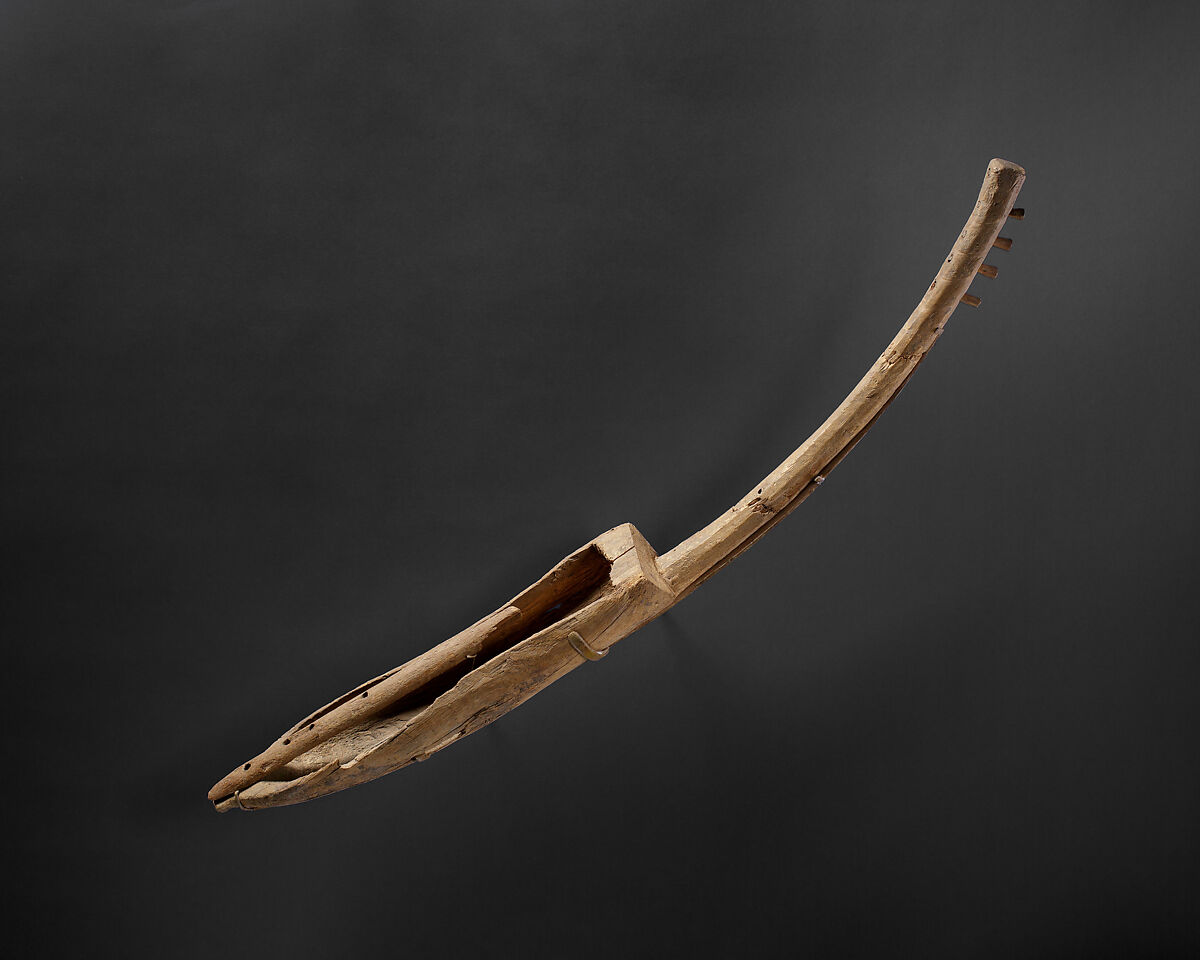
ca. 1580–1295 BCE
Egyptian arched harp from Deir el-Bahri (ca. 1580–1295 BCE, Metropolitan Museum of Art)
Arched harp, ca. 1580–1295 BCE, from Deir el-Bahri, Egypt; earlier than the project period.
It is an Egyptian harp shown for comparison, not a Tamil yāḻ.

1897
Silappathikaram: text page from the 1897 examination edition – A later printed witness to an older work, not an ancient manuscript
Silappathikaram: text page from the 1897 examination edition. A later printed witness to an older work, not an ancient manuscript.

1897
Silappathikaram: title page of the 1897 examination edition – A later printed witness to an older work, not an ancient manuscript
Silappathikaram: title page of the 1897 examination edition. A later printed witness to an older work, not an ancient manuscript.
006Two views
Both views are shown at equal weight; this site does not choose between them.
What the word tivavu names on the yāḻ
- One view
- A modern Tamil Virtual University teaching page explains tivavu as a wooden, screw-like device for tightening strings.
- Another view
- Older lexical and commentary sources define it as a binding that holds the strings, and name the twisting peg separately as māṭakam.
- What would settle it
- The earliest commentary layers describing the hardware, or a surviving string fastener from an excavated instrument.
How many strings the makara-yāḻ had
- One view
- V. R. Ramachandra Dīkshitar's 1939 appendix reports seventeen strings.
- Another view
- Later received summaries commonly give nineteen, within a 21/19/14/7 table for four yāḻ types.
- What would settle it
- An early text or commentary fixing the count; the sources checked for this study do not supply one.
007Where next
All related studies, connected material, books and sources18 · 15
Elsewhere on this site
Classroom Lesson Plans: Module 3 · Poems as Historical Witnesses: Landscapes (Tiṇai), Ethics & Voices
Multi-Script Glossary Terms: akaval (āciriyappā) (அகவல் / ஆசிரியப்பா / അകവൽ) · aṟam (அறம் / അറം / ധർമ്മം) · pāṇar (Bards) & viṟaliyar (Dancers / Vocalists) (பாணர் & விறலியர் / പാണരും വിറലിയരും) · yāḻ (Arched Harp) & muḻavu (Concert Drum) (யாழ் & முழவு / യാഴും മുഴവും)
Connected material
Photographs, drawings, books, videos and other studies linked to this study. A link helps you explore; it does not prove a historical claim.
- Silappathikaram: title page of the 1897 examination edition – A later printed witness to an older work, not an ancient manuscripthistorical printed textBackground
- Silappathikaram: text page from the 1897 examination edition – A later printed witness to an older work, not an ancient manuscripthistorical printed textBackground
- Egyptian arched harp from Deir el-Bahri (ca. 1580–1295 BCE, Metropolitan Museum of Art)photographBackground
008Sources
The study lists the sources it consulted; we have not rechecked them. A working link does not show that a source was read, and a valid identifier does not show that it supports a claim. We do not link to unofficial uploads or copies of publications. Where a study cited one, we show the published citation, or a publisher, DOI or Internet Archive link when we have one. Tracking codes are removed from links, and the sources themselves are not republished here.
Porunararruppatai – Tamil text and explanatory presentation
Poruṇarāṟṟuppaṭai, Sangam Translations by Vaidehi Herbert; web presentation drawing on traditional editions and commentaries.
Print or offline sourceSource recordCirupanarruppatai – Tamil text, meaning and English presentation
Ciṟupāṇāṟṟuppaṭai, Sangam Translations by Vaidehi Herbert.
Print or offline sourceSource recordPerumpanarruppatai – Tamil text/commentary and English presentation
Perumpāṇāṟṟuppaṭai, Sangam Translations by Vaidehi Herbert.
Print or offline sourceSource recordMalaipatukatam – Tamil/English web presentation
Malaipaṭukaṭām, Sangam Translations by Vaidehi Herbert.
Print or offline sourceSource recordIlango Adigal. The Silappadikaram. Translated by V. R. Ramachandra Dikshitar. Oxford University Press/Humphrey Milford, 1939.
Print or offline sourceSource recordயாழ் வருணனை (Yal Varunanai)
Tamil Virtual University, degree-course lesson on yal organology.
Tamil Virtual University commentary page on yal construction and performance
Tamil Virtual University digital traditional-commentary corpus, bookid 50, p. 327.
Tamil Virtual University lexical entry on tivavu
Tamil Virtual University digital lexicographic/commentarial corpus, bookid 166, p. 49.
Government Museum, Chennai. Guide to the Refurbished Amaravati Gallery.
Introduction to Possible Sumerian Survivals in Toda Ritual
Aiyappan, A. Introduction to H.R.H. Prince Peter, Possible Sumerian Survivals in Toda Ritual. Bulletin of the Madras Government Museum, 1951.
Government Museum, Chennai. Excavations in Tamil Nadu – An Archaeological Report.
Grave Goods from Megalithic Burials in the Upland Forests of the Nilgiri Mountains, South India: Analysis and Chronology
De Simone, Daniela. 2021. Asian Perspectives 60(2): 306–344. DOI 10.1353/asi.2021.0003.
How Does Wood Survive Underground For Thousands of Years?
Historic England. Heritage Highlight on archaeological wood survival and waterlogged preservation.
University of Madras. Tamil Lexicon. Madras: University of Madras, 1924–1936. Digital Dictionaries of South Asia edition.
Chelliah, J. V. Pattupattu: Ten Tamil Idylls. Tamil University reprint, 1985.
Print or offline sourceSource record
Researchers and institutions whose work this study uses: Vaidehi Herbert, A. Aiyappan, V. R. Ramachandra Dikshitar
How we know The evidence, claims and dates behind this study
What this study draws on
- Close reading of four Pattuppāṭṭu poems in Vaidehi Herbert's Tamil and English web editions.
- Tamil Virtual University commentary pages on the yāḻ's parts, woods and the word tivavu.
- V. R. Ramachandra Dīkshitar's 1939 Cilappatikāram translation, lines 70–94 and appendix, read as Internet Archive text.
- Government Museum, Chennai catalogues for the Amaravati slab and for the Adichanallur and Nilgiri bells.
Dates in this study
| What is dated | Date | How it was dated |
|---|---|---|
| Adichanallur site-level preliminary thermoluminescence range reported by Government Museum survey | 1500–500 BCE | Laboratory date |
| Amaravati casing slab Acc. No. 221 museum catalogue date | 200–250 CE | How it was dated is not stated |
See these dates on the timeline
The study’s claims
8 claims · 12 source passages · 47 paragraphs
Browse the study paragraph by paragraphThe Pattuppattu textual tradition describes the yal as a composite chordophone with a hollow resonating body, hide covering, wooden curved/stem element, multiple tensioned strings and specialized string-fastening or tension apparatus.
Supported in this study
Evidence derives from transmitted literary texts and later commentary, not an excavated complete instrument. Terminology for individual construction elements is not uniformly equivalent to modern organological terminology.
Tivavu is more securely understood as part of the yal string-binding/tension system than as a fret; whether all occurrences denote a peg-like device is unresolved.
Supported with qualifications
One modern TVU teaching page describes a wooden screw-like mechanism. Traditional TVU lexical/commentarial material defines tivavu as varkkattu and separately identifies matakam as a twisting peg. The exact physical mechanism is not archaeologically preserved. Supplied assessment: supported_with_qualification
The Arangerrukkatai preserves a systematic fourteen-string and seven-note tuning discourse with named palai transformations, establishing deliberate pitch organization beyond generic poetic references to pleasant sound.
Supported in this study
The passage survives through later manuscript and printed transmission. Exact equivalence with modern Carnatic svara, raga or melakarta categories is not established. No absolute frequencies or interval measurements are provided by the consulted passage.
An Amaravati casing slab in the Government Museum, Chennai, catalogued to 200–250 CE is officially described as depicting a harp and drum, providing an early southern-Deccan iconographic comparator for the literary acoustic world.
Supported in this study
Amaravati is outside Tamilakam in present-day Andhra Pradesh. The catalogue identification does not establish that the depicted harp was called yal or used Tamil pan/palai theory.
Older Madras Government Museum scholarship records bronze and iron bells at Adichanallur and in Nilgiri burial collections, materially demonstrating durable sound-producing objects but not bardic ensemble use.
Supported with qualifications
The relevant museum statement is an older publication and does not provide modern stratigraphic documentation for each individual bell. The separate site-level thermoluminescence range reported for Adichanallur is not assigned to any individual bell. Bell function may have been ritual, animal-related or otherwise non-bardic. Supplied assessment: supported_with_qualification
No securely excavated complete pre-600 CE yal from Tamilakam was identified in the consulted excavation and museum literature; ordinary archaeological preservation strongly disfavors survival of a wood-hide-fiber composite instrument.
Supported with qualifications
This is a finding about the consulted source set, not proof that no fragment exists in any museum or unpublished excavation archive. Taphonomic explanation does not validate any particular speculative reconstruction. Supplied assessment: supported_with_qualification
Early Tamil literary evidence places yal playing within itinerant bardic performance combining instrumental skill, named melodic practice, song, dance, travel and patronage involving panar and viraliyar.
Supported in this study
Modern occupational categories such as instrumentalist, vocalist and dancer should not be imposed rigidly on the literary performers. The social picture is literary evidence and should not be treated as a statistical census of performers.
Exact fixed string counts for Periyal, Makara-yal, Cakota-yal and Cenkottu-yal are not uniformly transmitted in the consulted scholarship; the common 21/19/14/7 scheme should be treated as a received taxonomy rather than an uncontested early textual fact.
Debated in the sources
Dikshitar reports a different Makara-yal count from later summaries. The fourteen-string stage instrument in Arangerrukkatai is better anchored than the full four-type numerical taxonomy.
Trace one claim through the study’s records
Explore the evidenceOther source lists
Numbered citation links from the study
The numbered links in the study text point here.
Pathuppāttu – Perumpānātruppadai – Sangam Poems Translated by Vaidehi
:: TVU ::
The Silappadikaram
Pathuppāttu – Malaipadukadām
How Does Wood Survive Underground For Thousands of ...
guid to he refurbisshed amaravati gallery
The Silappadikaram
guid to he refurbisshed amaravati gallery
Sangam literature | Literature and Writing | Research Starters
The Silappadikaram : V R Ramachandra Dikshitar : Free Download, Borrow, and Streaming : Internet Archive
Pathuppāttu – Perumpānātruppadai – Sangam Poems Translated by Vaidehi
Excavations in Tamil Nadu – An Archaeological Report
6.4.3 யாழ் வருணனை
6.4.3 யாழ் வருணனை
:: TVU ::
தமிழ் உரை – சிறுபாணாற்றுப்படை
Pathuppāttu – Perumpānātruppadai – Sangam Poems Translated by Vaidehi
:: TVU ::
Pathuppāttu – Perumpānātruppadai – Sangam Poems Translated by Vaidehi
The Silappadikaram
The Silappadikaram
The Silappadikaram
தமிழ் உரை – சிறுபாணாற்றுப்படை
தமிழ் உரை – சிறுபாணாற்றுப்படை
guid to he refurbisshed amaravati gallery
BULLETIN OF THE MADRAS GOVENMENT MUSEUM POSSIBLE SUMERIAN SURVIVALS IN TODA RITUAL
Grave Goods from Megalithic Burials in the Upland Forests ...
Pathuppāttu – Perumpānātruppadai – Sangam Poems Translated by Vaidehi
6.4.3 யாழ் வருணனை
Pathuppāttu – Perumpānātruppadai – Sangam Poems Translated by Vaidehi
The Silappadikaram
தமிழ் உரை – சிறுபாணாற்றுப்படை
Pathuppāttu – Malaipadukadām
தமிழ் உரை – பொருநராற்றுப்படை
How Does Wood Survive Underground For Thousands of ...
:: TVU ::
BULLETIN OF THE MADRAS GOVENMENT MUSEUM POSSIBLE SUMERIAN SURVIVALS IN TODA RITUAL
guid to he refurbisshed amaravati gallery
தமிழ் உரை – பொருநராற்றுப்படை
தமிழ் உரை – சிறுபாணாற்றுப்படை
தமிழ் உரை – பெரும்பாணாற்றுப்படை
Pathuppāttu – Malaipadukadām
The Silappadikaram : V R Ramachandra Dikshitar : Free Download, Borrow, and Streaming : Internet Archive
6.4.3 யாழ் வருணனை
:: TVU ::
guide to the refurbished amaravati gallery
How Does Wood Survive Underground For Thousands of ...
Tamil Lexicon
Pattupattu Ten Tamil Idylls Chelliah J. V. : Zahira Badami
Online copy not linked · use the published editionThe Silappadikaram
About this study Status, corrections and how it was made
Status
Draft study, revision 5. No historian, archaeologist, or Tamil or Malayalam specialist has reviewed it yet.
The study itself says more research is needed before its question can be settled.
How it was made
Compiled as an editorial synthesis from published scholarship around questions we framed. About this project & workflow
The summary, How sure lines and Two views notes on this page were prepared from this study and cross-checked against its passages. That is an editorial check, not a specialist review.
Technical details
Study code R246. The text fingerprint changes whenever the study text changes.
- The study text is shown as written. Links from its paragraphs to citations help you move around the study; they are not new claims or checked source passages.
See how this study’s records were extracted
Text fingerprint (SHA-256): R246 · 0bbeaa2f85aa0c29ca13f252… · v5
Evidence tables and technical details are on the web page: https://layersofthesouth.org/read/03853dc6fe