Each period has the same width, so spacing is not to scale.
- How we know
- 200 BCE–300 CE
Star lore in early Tamil poems does not give exact dates
Early Tamil poems preserve vivid descriptions of stars and unusual sky events. Purananuru 229 is a striking example, but interpreting its celestial language does not yield a secure exact date. The poem, its later explanations and modern astronomical identifications are different kinds of evidence.
- This page
- 4,531 words · revision 5
Draft study · Awaiting specialist review · Updated
001Dates and places

No mapped place in this study.
1000–500 BCE
Different beginnings
500–200 BCE
Marks & materials
200 BCE–300 CE
Connected worlds
300–600 CE
Change & continuity
- Broad Pugalur-Patirruppattu Irumporai synchronism proposed by Mahadevan
- Period assigned by excavators or scholars
Each date belongs to what was dated (a sample, an object, a layer or a text), which is not always the event the study asks about.
Each period has the same width, so spacing is not to scale.
The full table of dates, with their ranges, is under How we know.
- 1 Well supported
- 2 Likely
- 1 Not known
002How sure
In brief
Early Tamil literature is full of sky imagery: Purananuru 229 describes a star falling at midnight before a Chera king's death (probably a fireball), Paripatal 11 describes the sky before rain swells the Vaigai river, Patirruppattu links Venus with rain, and Cilappatikaram gives a month, fortnight, lunar day and Friday for a prophecy of Madurai's destruction. The same passages have yielded sharply conflicting retrocalculated dates: Somasundaranar's modern commentary on Paripatal 11 reports 161 BCE, whereas earlier calculations by L. D. Swamikannu Pillai (reported in secondary literary history; not read directly here) placed Paripatal 11 in the seventh century CE and Cilappatikaram in the eighth. None of these years appears in the poems; they depend on commentarial identifications and recurring sky patterns, and no inscription or excavated layer fixes these scenes to a day. Pugalur's inscriptions offer an independent comparison for Chera names in Patirruppattu, though individual matches remain disputed.
Key researchers cited in this study: Iravatham Mahadevan (Tamil-Brāhmī Epigraphy) · Tamil Virtual Academy · Full bibliography
How sure
- Well supported
The 161 BCE date for Paripatal 11 is a modern calculation, not a date in the poem
It appears only in Somasundaranar's modern editorial commentary, not in Nallantuvanar's text.
- Likely
Purananuru 229 describes a fireball
A modern Tamil commentary and a 2026 astronomy paper both read the falling star this way.
- Likely
Pugalur’s inscriptions provide an independent comparison with the Chera names in Patirruppattu, though matching individual rulers remains disputed
Mahadevan judges the three-generation comparison cogent, giving a broad first-to-third-century setting while individual identifications remain debated.
- Not known
Exact years for these poems from astronomy software
Variant readings, commentary layers and recurring sky patterns leave many candidate dates.
Why it matters
It gives readers a way to judge popular claims that Sangam poems record star-dated events.
003Key findings
What the study concludes
- Purananuru 229 preserves a structured celestial-omen passage culminating in a falling luminous celestial object and subsequently links the portent with the death of the Cera ruler after a seven-day interval; named nakshatra identifications are partly commentarial rather than all explicit in the base poem.
- Paripatal 11 contains a dense celestial and seasonal sequence associated with the onset of heavy rain and Vaigai flooding, while much of the explicit planet-zodiac-eclipse reconstruction derives from Parimelalakar and modern editorial commentary.
- Cilappatikaram explicitly combines Ati month, dark fortnight, astami and Friday in an astrological prophecy concerning Madurai, while the associated Karttikai identification is supplied by commentary.
In the study’s own words. How sure each point is, is shown above.
The summary above is the short read. The full study is the complete text it was drawn from, with its tables and source notes.
What the full study covers
004The study
Answer in Brief
The surviving evidence does not support converting any of the investigated literary sky-passages into a uniquely certified calendar date merely by matching them to modern ephemeris software (programs that compute past positions of the Sun, Moon and planets). What the texts do preserve is historically valuable but epistemically different: descriptions of a spectacular falling celestial object and omen in Purananuru 229; a densely encoded celestial and seasonal configuration associated with Vaigai rains in Paripatal 11; solar, stellar, Venus, and rainfall imagery in Patirruppattu; and explicit calendrical vocabulary – month, fortnight, lunar day, weekday, and an asterism gloss – in Cilappatikaram. The decisive methodological issue is that modern software computes a sky from specified inputs; it does not determine which philological interpretation of a poem supplies the correct inputs. ↗1
For Purananuru 229, the textual core is remarkably vivid. The poem situates an event in a dark midnight sky among several nāḷ-mīn (“day-star”/asterism) references and then says:
“ஒரு மீன் வீழ்ந்தன்றால், விசும்பினானே” – “a star/celestial light fell from the sky”
The poem subsequently marks the arrival of the seventh day and the Cera ruler’s death. Its colophon identifies the poet as Kūṭalūr Kiḻār and the ruler as Kōccēramān Yāṉaikkaṭcēy Māntarañ Cēral Irumporai. ↗2 A modern Tamil commentary identifies the surrounding asterisms with Kārttikai/Kṛttikā, Uttiram/Uttara Phālgunī, Mūlam, and Mrigashiridam/Mṛgaśīrṣa and interprets the falling object as a fiery meteor-like phenomenon. Those identifications are commentarial interpretation, not all explicit lexical statements of the poem itself. ↗3 A 2026 specialist paper likewise treats the passage as an account of a fireball, illustrating a plausible physical reading without thereby establishing an exact year. ↗4
Paripatal 11 is more complicated. Its surviving text places a celestial configuration immediately before descriptions of rain in the hills and a swelling Vaigai. The poem begins this sequence with the Moon and broad sky and then employs compressed astronomical language that later commentators unpack as positions of Venus, Mars, Mercury, Jupiter, Saturn, the zodiac, lunar mansions, and the lunar node. ↗5 Parimelalakar’s preserved commentary explicitly interprets the “snake” concealing the Moon as Rāhu and a lunar eclipse, and systematizes the passage through zodiacal “streets” or divisions. ↗6 A later editorial commentary then adds a retrocalculated result assigning the configuration to 161 BCE, Avani 12, Thursday, caturdaśī and Avittam. That calculated date is not present in Nallantuvanar’s poem and is not established by an inscription. ↗7
Patirruppattu provides a useful control case. Poem 64 compares royal brilliance to the Sun rising while “many stars” lose their light; poem 69 associates a favorably placed veḷḷi – Venus – with rain and terrestrial prosperity. These are genuine celestial references, but neither supplies a sufficiently constrained observation log for astronomical dating. ↗8 Importantly, this anthology does have an independent epigraphic connection: Iravatham Mahadevan compares the three-generation Irumporai genealogy in the Pugalur Tamil-Brahmi inscriptions with the seventh through ninth decades of Patirruppattu and judges the identification cogent enough to contribute to a broad first-to-third-century CE Cera synchronism. Yet the inscriptions do not timestamp poem 64 or 69 by conjunction, nakshatra (lunar mansion), eclipse, or calendar day. ↗9 This is the key distinction: epigraphy can constrain a historical milieu without certifying an archaeoastronomical day.
Cilappatikaram goes further than the earlier anthology passages in calendrical specificity. Its Indra-festival canto uses Cittirai as month/festival language, while the Madurai catastrophe is preceded by a narrative astrological prediction:
“ஆடித் திங்கள் பேரிருட் பக்கத்து … அட்டமி ஞான்று / வெள்ளி வாரத்து”
That gives Āṭi month, dark fortnight, eighth lunar day, and Friday. ↗10 The displayed commentary additionally construes aḻal as Kārttikai and explicitly cross-references a Purananuru celestial passage. ↗11 But this is astrological speech inside a literary narrative, not an excavated docket or contemporary dated inscription. Moreover, Cilappatikaram belongs to a later compositional horizon than the earliest classical anthologies in much modern scholarship: Mahadevan calls it approximately sixth century CE in Early Tamil Epigraphy, while a Harvard South Asia Institute presentation describes it as a fifth-century epic. ↗12
The best-supported conclusion is therefore methodological. Modern JPL ephemerides can calculate planetary and lunar positions far into antiquity – DE441 extends from astronomical year −13200 to +17191 – but JPL itself distinguishes its dynamical ephemeris and time/reference systems from the historical interpretation imposed by a user. ↗13 For eclipses, ancient terrestrial timing contains an additional Earth-rotation uncertainty: NASA’s historical treatment of ΔT (the correction for Earth’s slowly changing rotation) gives illustrative standard errors of about 265 seconds near year 0 and 139 seconds near 500 CE, corresponding to longitude shifts of about 1.10° and 0.58° for eclipse paths. ↗14 Computational precision therefore cannot repair philological ambiguity, uncertain manuscript readings, commentary strata, calendar-conversion choices, or the basic fact that planetary and lunar configurations recur.
Exact years derived from these poems are therefore best treated as retrocalculated hypotheses, not as direct dates. A date becomes historically strong only if the textual reading is secure, the astronomical semantics are demonstrably contemporary with the poem, the configuration is sufficiently restrictive and reproducible, and an independent archaeological, epigraphic, or otherwise historically dated anchor corroborates it.
Scope & Chronological Control
This study is confined to evidence relevant to Kerala, Tamil Nadu, and their connected early historic cultural sphere between about 1000 BCE and 600 CE, the period this site covers. The principal literary objects are Purananuru, Paripatal, Patirruppattu, and Cilappatikaram; epigraphy is used only where it independently constrains historical setting or textual chronology.
Evidence classes used here
| Epistemic class | What counts in this study | What it does not establish |
|---|---|---|
| Physical / Textual Observation | Wording preserved in read digital editions; manuscript/editorial variant notices; Tamil-Brahmi inscriptional texts and genealogies reported in an epigraphic corpus | That every described event is literal, contemporaneous, or astronomically datable |
| Scholarly Interpretation | Commentarial identifications of star names, planets, zodiac signs and Rāhu; modern fireball interpretation; epigraphic-textual synchronisms | An independently observed calendar day |
| Unresolved / Debated | Composition strata, readings of difficult astronomical vocabulary, date of commentary layers, exact sky-model assumptions and proposed absolute years | A license to select whichever software match best fits a desired chronology |
The epigraphic control is especially important. Mahadevan’s corpus dates the earliest Tamil-Brahmi inscriptions from roughly the end of the third or beginning of the second century BCE on palaeographic grounds and stratigraphic evidence from inscribed pottery. ↗15 At Pugalur, inscriptions assigned approximately to the second century CE record three generations of the Irumporai Ceras; Mahadevan compares these names with the seventh, eighth and ninth Patirruppattu decades and regards the correspondence as historically significant. ↗9 At Edakal in Kerala, his corpus places four short Tamil-Brahmi inscriptions around the third century CE; one of them names a Cēra, and none carries an astronomical date formula. ↗9
This difference matters. A named Cera lineage appearing both in poetry and inscription is an independent historical synchronism. A modern computer search that starts with a poetic description, chooses a particular set of asterism and zodiac equivalences, and then announces the year in which those chosen conditions co-occur is not independent corroboration; the proposed date remains generated from the same literary premise.
Chronological control is also textual. Patirruppattu’s transmission is known through manuscripts accompanied by an old commentary whose author and precise date are uncertain; the modern edition read records manuscript comparison and variant readings. ↗16 Paripatal is still more visibly layered: the Tamil Virtual Academy’s publication history notes the recovery of the work by U. V. Swaminatha Iyer, the survival of Parimelalakar’s commentary in imperfect places, and the incomplete survival of the original anthology. ↗17 The TamilVU presentation itself distinguishes the ancient poem, Parimelalakar’s commentary, and P. V. Somasundaranar’s modern editorial commentary. ↗18 Those layers cannot legitimately be collapsed into a single “Sangam-era astronomical observation.”
Later palm-leaf manuscript of Varahamihira’s Brihat Samhita with Bhattotpala’s commentary in Grantha script
Physical manuscript before 1899; underlying work 5th–6th century CE
For Cilappatikaram, chronological control requires still more caution. The text has explicit weekday and technical calendrical vocabulary, but that very vocabulary belongs to the transmitted epic’s own literary horizon. Mahadevan describes Cilappatikaram as approximately sixth century CE in his discussion of the earlier Arachalur musical inscriptions, while other modern academic presentations use the fifth century. ↗12 Tamil Virtual Academy teaching material likewise treats Cilappatikaram and Manimekalai within a post-Sangam linguistic stage marked by lexical and phonological developments. ↗19 Consequently, an apparent astronomical “date” inside the epic cannot automatically be used to push the composition of the surviving text into the lifetime of an earlier Cera ruler.
Primary Archaeological & Textual Evidence
Celestial inventory
| Work / passage | Physical or textual observation | Commentarial or scholarly interpretation | Dating value |
|---|---|---|---|
| Purananuru 229 | Dark midnight; several nāḷ-mīn references; a luminous “one star” falls; seventh day is subsequently marked; ruler dies. ↗2 | Modern commentary maps terms to Kārttikai, Uttiram, Mūlam and Mrigashiridam and understands the falling body as fiery/meteor-like. ↗3 | Strong evidence for celestial-omen vocabulary; insufficient by itself for an exact year |
| Paripatal 11 | Moon/sky configuration followed by seasonal transition, mountain rain and Vaigai flood. Later portions also use lunar phases and name seasonal/monthly observances. ↗20 | Parimelalakar and modern commentary identify zodiacal divisions, planets, Rāhu/eclipsed Moon and Agastya; modern commentary reports a 161 BCE calculation. ↗21 | Potentially restrictive only after many interpretive choices; exact date remains hypothesis |
| Patirruppattu 64 | “many stars” lose their brilliance as the Sun rises. ↗22 | Transparent royal simile | Essentially no exact dating value |
| Patirruppattu 69 | Venus (veḷḷi) is associated with auspicious atmospheric/rain conditions. ↗8 | Planet-weather omen/prosperity language | Seasonal/cultural evidence, not a timestamp |
| Cilappatikaram, Indra festival | Cittirai month/festival vocabulary; professional time-reckoners and nāḻikai calculators appear in the urban description. ↗24 | Evidence for a literary world familiar with calendrical specialists | Cultural-historical, not an absolute date |
| Cilappatikaram, Madurai prophecy | Āṭi month, dark fortnight, eighth lunar day and Friday are explicitly combined. ↗10 | Commentary glosses aḻal as Kārttikai and treats the statement as astrological prediction. ↗11 | More constrained than a simile but still narrative prophecy, not an inscription |
Purananuru 229
The consulted Tamil Virtual Academy text reads in part:
“பங்குனி உயர் அழுவத்து, / தலை நாள்மீன் நிலை திரிய”
and shortly afterward:
“ஒரு மீன் வீழ்ந்தன்றால், விசும்பினானே”
The surrounding lines describe one asterism changing position, another rising opposite it, a third descending, followed by a great spreading fire-like light. ↗25 The Project Madurai text confirms the overall episode and identifies Kūṭalūr Kiḻār and Māntarañ Cēral Irumporai in the poem metadata; it also connects the portent with the ruler’s death after the feared interval. ↗26
Physical / Textual Observation: the transmitted poem unquestionably contains a structured stellar setting plus a conspicuous falling luminous phenomenon. It is therefore considerably stronger evidence for historical Tamil celestial vocabulary than a generic metaphor.
Scholarly Interpretation: the modern commentary read parses aḻal and the nāḷ-mīn terminology through named nakshatras and reads the phenomenon in meteor/fireball terms. ↗3 T. V. Venkateswaran’s 2026 Journal of Astronomical History and Heritage paper independently foregrounds the “fireball” interpretation in its title and abstract. ↗4
Unresolved / Debated: this study did not obtain a securely separable, directly read premodern commentary witness for poem 229 comparable to the Parimelalakar material available for Paripatal. The accessible Avvai Duraisamy Pillai commentary is a modern scholarly layer. Furthermore, the consulted commentary text contains variant-looking forms such as toṉ nāḷ-mīn and other orthographic/lexical differences relative to the TamilVU base text. ↗3 Those variants matter whenever software dating depends on identifying one difficult word with one specific asterism.
A particularly instructive cross-textual detail appears in the Cilappatikaram commentary on its own Kārttikai-related calendrical line: it cites a Purananuru passage as “Puram 228,” whereas the modern digital witnesses examined here number the Kūṭalūr Kiḻār omen poem 229. ↗27 This need not indicate a substantive ancient variant – it could reflect numbering tradition or editorial transmission – but it demonstrates why verse identifiers themselves must be edition-controlled before feeding supposed astronomical content into a database.
Paripatal 11
The poem’s celestial section opens:
“விரி கதிர் மதியமொடு, வியல் விசும்பு, புணர்ப்ப”
and develops a compact set of celestial relations before moving to seasonal heat, the appearance/motion associated with Agastya in commentary, rainfall in the mountains, and the resulting Vaigai flood. ↗20 The poem’s colophon attributes it to Nallantuvanar and identifies its musical setting, placing the astronomical language inside a deliberately composed musical poem rather than a bureaucratic observing record. ↗20
Here the separation of evidentiary layers is decisive. The modern displayed commentary identifies Venus with Taurus, Mars with Aries, Mercury with Gemini, Jupiter with another zodiacal sector, Saturn with Capricorn, and several stellar markers with Kārttikai, Tiruvātirai and Bharani. ↗28 Parimelalakar’s older commentary, explicitly marked (பரிமே.) in the digital edition, explains the Moon’s apparent relation to nakshatras as a line-of-sight phenomenon, defines zodiacal divisions, and interprets the “snake” covering the Moon as Rāhu in a lunar-eclipse setting. ↗6
The next epistemic layer is later still: Somasundaranar’s editorial material reports a calculated date of 161 BCE, with a named Tamil month-day, weekday, lunar phase and Avittam nakshatra. ↗29 Crucially, secondary literary histories (such as Zvelebil, discussed in “Sangam poems, mostly first centuries CE, survive through later layers”; Swamikannu Pillai's 1922 Indian Ephemeris was not read directly here) report that L. D. Swamikannu Pillai calculated seventh- and eighth-century CE dates from Paripāṭal 11 and Cilappatikāram – nearly eight centuries after the 161 BCE editorial proposal, and rejected by Zvelebil on literary and linguistic grounds. That eight-century spread on the same Paripāṭal passage illustrates directly why retrocalculation cannot substitute for philological and historical chronology.
Patirruppattu and epigraphic control
Poem 64 contains the concise comparison:
“மாயிரு விசும்பிற் பன்மீன் ஒளிகெட / ஞாயிறு தோன்றி”
– the Sun appears and the many stars lose their light. ↗22 Nothing in that simile specifies a unique Sun-star configuration.
Poem 69 is more potentially astronomical because veḷḷi appears in a passage linking its favorable standing with rain and prosperity. ↗22 Avvai Duraisamy Pillai’s commentary likewise reads the passage through Venus and rainfall. ↗16 Yet a statement that Venus occupies an auspicious condition is not equivalent to an angular observation accurate to a degree, nor does rainfall uniquely identify a year.
The independent evidence is instead historical. Pugalur inscriptions record Atan Cel Irumporai, Perunkatunkon and Ilankatunkon across three generations. Mahadevan compares that genealogy with the Irumporai rulers celebrated in Patirruppattu’s seventh through ninth decades and calls the cumulative evidence cogent, using it toward a broad synchronism of contemporary Cera princes and poets between roughly the middle of the first and middle of the third century CE. ↗9 This is exactly the sort of epigraphic constraint a responsible archaeoastronomical argument should welcome – but it supplies a century-scale historical frame, not a single night.
Cilappatikaram
The Indra-festival canto situates ritual in Cittirai and describes both kālak-kaṇitar – time/calculation specialists – and nāḻikai-k-kaṇakkar, time-reckoners. ↗24 The Madurai section is more explicit:
“ஆடித் திங்கள் பேரிருட் பக்கத்து … அட்டமி ஞான்று, / வெள்ளி வாரத்து”
The narration labels this a cōṭiṭa vārttai, an astrological statement predicting destruction of the king and Madurai. ↗10 The commentary glosses the combination as Āṭi, dark fortnight, aṣṭamī, Friday and a Kārttikai condition. ↗11
That is real evidence for calendrical-astrological discourse in the transmitted epic. It is not, however, equivalent to “Madurai archaeologically burned on the one retrocalculated Friday satisfying these conditions.” No stratified burn layer, inscription naming the event, radiometric determination or independently dated document was identified in the consulted evidence as tying this narrative formula to one absolute day.
Analytical Comparison & Competing Interpretations
The central methodological mistake in much popular archaeoastronomical dating is to treat calculation as identification. They are not the same operation.
A modern ephemeris can answer a question such as: Where were the Sun, Moon, Venus, Mars, Jupiter and Saturn, in a specified modern coordinate system, at a specified dynamical time? JPL’s documentation explains that its planetary files are numerical integrations stored in modern reference systems and dynamical time; DE441 was specifically integrated to cover very long chronological intervals. ↗13 The ephemeris does not answer: Does the word “snake” in this Tamil poem mean the lunar node? Does this difficult compound denote Kṛttikā? Which recension is original? Does a poet mean exact conjunction, approximate visual proximity, astrological domicile, or conventional imagery?
That distinction creates several independent sources of non-uniqueness.
First, textual variants alter astronomical constraints. Patirruppattu’s modern editor explicitly discusses manuscript comparison and variants; Paripatal’s publication history acknowledges damaged or corrupt portions of its commentary; and Purananuru 229 appears in accessible witnesses with small but potentially important lexical differences. ↗31 If one variant maps to one nakshatra and another maps differently, an ephemeris search can produce entirely different candidate years while remaining internally “accurate.”
Second, commentarial interpretation adds variables that are absent or less explicit in the base poem. The strongest example is Paripatal 11. Parimelalakar’s Rāhu/eclipsed-Moon reading and zodiacal organization are historical interpretations of the poem. The modern commentary then converts those interpretations into an elaborate planetary chart and a 161 BCE result. ↗21 Each added identification makes the computer query appear more precise, but the apparent precision is conditional on the commentary being historically and astronomically correct.
Third, recurring celestial cycles prevent most configurations from being unique over centuries. The lunar phase cycle itself repeats about every 29.5 days. ↗32 Planetary configurations likewise arise from periodic orbital motion. Thus “Friday + dark fortnight + aṣṭamī + a particular asterism” or “several planets in named signs” may sharply reduce candidate dates but ordinarily does not, without further independent constraints, prove that one surviving candidate is the historical event. The danger increases when tolerances are adjustable: “in Taurus” is far broader than “within one degree of Aldebaran,” and literary texts rarely state modern angular tolerances.
Fourth, a physical ephemeris and a historical zodiac are different layers. JPL DE441 supplies positions in a modern celestial-reference framework and uses TDB as an integration time unit. ↗13 To turn those coordinates into “Kārttikai,” “Makara,” or another historical Tamil/Indic designation, a researcher must define a sidereal framework, boundaries, stellar identifications and an epoch-sensitive mapping. Different choices can move a marginal planet or Moon from one named sector to another. The software may agree perfectly about physical longitude while two historians disagree about the historically appropriate label.
Fifth, ancient eclipse timing is subject to Earth-rotation uncertainty. NASA emphasizes that estimating ΔT before 1600 CE is difficult because historical eclipse evidence and physical models of Earth’s rotation are imperfect. Its published uncertainty table gives roughly 265 seconds around year 0 and 139 seconds around 500 CE, translating into eclipse-path longitude uncertainties of about 1.10° and 0.58°. ↗14 Stephenson, Morrison and Hohenkerk’s modern reconstruction is itself based on historical eclipse and occultation records beginning in 720 BCE, underscoring that ancient Earth rotation is reconstructed from evidence rather than known to modern-clock precision. ↗33 This factor is especially relevant when a proposed identification depends on local eclipse visibility or exact clock time.
Sixth, seasonal statements have low year-specificity. Paripatal 11 moves from heat and celestial description to rains and the flooding Vaigai; Patirruppattu 69 links Venus, rainfall and prosperity. ↗34 These passages are culturally important evidence for conceptual links between sky, season and water, but the recurrence of monsoon conditions makes them poor discriminators among years. “The rains came after the hot season” is climatological/seasonal structure, not a unique chronology.
Seventh, genre matters. Purananuru 229 frames the falling object as a portent; Patirruppattu 64 is a royal simile; Cilappatikaram explicitly frames its dense date formula as astrological prediction; Paripatal is a musical devotional/river poem. ↗35 None should be treated automatically as if it were a Babylonian-style observational diary containing measured longitudes.
The resulting hierarchy of evidential strength is therefore:
Strongest: independently dated inscription or archaeological context + unambiguous astronomical observation + reproducible celestial match.
Intermediate: historical inscription constrains ruler/dynasty while poem supplies celestial imagery; this is the situation best approximated by the Pugalur–Patirruppattu relationship. ↗9
Weak for absolute dating: poem + later commentary + software search, with no independent dated anchor. The reported 161 BCE interpretation of Paripatal 11 belongs here. ↗29
Very weak: solar, lunar or planetary simile used by itself to claim an absolute year.
Evidential Limits & Common Misconceptions
A recurring misconception is that an astronomy program “discovers” the date encoded in a poem. In reality, the program solves the researcher’s chosen mathematical query. If the query assumes that pāmpu means Rāhu, that Rāhu implies a physical eclipse, that each poetic celestial epithet has one fixed planet or nakshatra, that the transmitted reading is original, that zodiacal boundaries are known, and that the poem records one contemporaneous observation, the output can be extremely precise while the historical inference remains uncertain. The Paripatal commentary chain demonstrates almost every one of these transformations. ↗21
A second misconception is that more astronomical details automatically create certainty. They create certainty only if the details themselves are secure independent constraints. A doubtful lexical identification multiplied by another doubtful identification does not become reliable merely because only one software result survives.
A third is to equate asterism language with modern coordinate measurement. Nāḷ-mīn terminology proves knowledge and cultural use of stellar markers; it does not by itself tell us the angular boundary that the poet or commentator intended. Purananuru 229 is therefore powerful evidence for celestial literacy and omen interpretation but not automatically a coordinate dataset. ↗36
A fourth misconception is to treat every “falling star” as an eclipse or comet. The literal dramatic center of Purananuru 229 is a luminous object that spreads fire-like light and falls; both the consulted modern Tamil commentary and recent astronomical scholarship favor a meteor/fireball-type interpretation. ↗37 No consulted evidence requires an eclipse interpretation for that event.
A fifth is to transfer historical dates from one textual layer to another. Pugalur’s Irumporai genealogy gives real epigraphic leverage on Patirruppattu’s Cera milieu, but it does not date every surviving verse or later patikam, still less Cilappatikaram. ↗9 Likewise, using Cilappatikaram’s later narrative about Cenkuttuvan to fix the epic’s date requires separate literary-historical argument; the surviving work is placed around the fifth or sixth century by major modern discussions read here. ↗38
A sixth is to treat a software calendar label as source evidence. “161 BCE,” “Thursday,” “Avani 12,” or a modern Julian/Gregorian rendering is an output convention unless the ancient source itself supplies an equivalent historical era and conversion chain. In Paripatal 11, the 161 BCE package occurs in modern commentary, not in the poem. ↗29 In Cilappatikāram, Friday, Āṭi, dark fortnight and aṣṭamī are textual; conversions of that combination into a BCE/CE year – most famously L. D. Swamikannu Pillai’s 1922 calculation of 756 CE, rejected by Zvelebil on literary and linguistic grounds – remain model-dependent modern calculations. ↗39
No radiocarbon determination, laboratory identifier, excavated astronomical instrument, stratified destruction horizon securely correlated with the Madurai narrative, or inscription furnishing an absolute astronomical date for Purananuru 229 or Paripatal 11 was identified in the sources read for this study. This is a finding about the evidence examined, not a claim that no such evidence could ever be discovered.
In short, the texts document sophisticated celestial, calendrical and seasonal discourse. Proposed exact BCE/CE dates obtained by retrocalculation remain model-dependent historical hypotheses unless independently anchored.
A future reproducible archaeoastronomical test should publish, at minimum, the exact edition and variant reading used; the status and date of every commentary supplying an identification; transliteration and literal translation; planet/star/nakshatra mapping; assumed sidereal boundaries; observer location; date/calendar convention; ΔT model where relevant; angular tolerances; search interval; ephemeris version; and the complete set of candidate dates rather than only the preferred match. JPL’s long-range ephemerides make such testing technically feasible, but they do not remove the need for philology and historical control. ↗40
Bibliography & Source Register
The register below distinguishes what was actually read from what was available only through an abstract or selected digital text.
| Source | Access | Research use / qualification |
|---|---|---|
| Tamil Virtual Academy, Purananuru, poem 229 digital text | Full text | Exact transmitted Tamil lines for the stellar setting and falling celestial object. ↗25 |
| Project Madurai, Purananuru with Avvai Duraisamy Pillai commentary | Full text | Poem metadata, complete passage, variant readings, modern nakshatra/fireball glosses. ↗41 |
| T. V. Venkateswaran, “A Star in Flames: An Account of a Fireball in the Tamil Classic Purananuru 229,” Journal of Astronomical History and Heritage 29 (2026) | abstract | Recent specialist fireball interpretation; full article was not directly retrievable during source retrieval. ↗4 |
| Tamil Virtual Academy, Paripatal 11 | Full text | Primary Tamil poem, rain/Vaigai sequence, lunar/seasonal passages and colophon. ↗20 |
| Tamil Virtual Academy, P. V. Somasundaranar commentary incorporating marked Parimelalakar glosses on Paripatal 11 | Full text | Separates medieval interpretive layer from modern planetary identifications and retrocalculated 161 BCE proposal. ↗21 |
| Tamil Virtual Academy publication/introduction material for Paripatal | Full text | Transmission history, U. V. Swaminatha Iyer recovery/printing, imperfect survival of Parimelalakar commentary. ↗42 |
| Project Madurai, Patirruppattu with Avvai Duraisamy Pillai commentary | Full text | Old-commentary notice, manuscript variants, Venus/rain interpretation. ↗16 |
| Project Madurai digital Patirruppattu, poems 64 and 69 | Selected passages | Exact solar/stars simile and Venus/rain passage. ↗8 |
| Tamil Virtual Academy, Cilappatikaram, Indra-festival canto | Full text | Cittirai, calendrical specialists, festival-season evidence. ↗24 |
| Tamil Virtual Academy, Cilappatikaram, Katturai canto and displayed commentary | Full text | Āṭi + dark fortnight + aṣṭamī + Friday formula; commentary gloss of Kārttikai. ↗39 |
| Iravatham Mahadevan, Early Tamil Epigraphy: From the Earliest Times to the Sixth Century A.D. Chennai/Harvard, 2003 | Selected passages | Tamil-Brahmi chronology; Pugalur–Patirruppattu Irumporai synchronism; Edakal Ceras; approximate later dating of Cilappatikaram. ↗43 |
| JPL Solar System Dynamics, “JPL Planetary and Lunar Ephemerides”; Park et al., DE440/DE441 documentation | Full text | Long-range ephemeris scope, TDB/reference-system context, distinction between computation and historical interpretation. ↗13 |
| Fred Espenak/NASA GSFC, “Uncertainty in Delta T (ΔT)” | Full text | Quantifies ancient Earth-rotation uncertainty relevant to eclipse retrocalculation. ↗14 |
| F. R. Stephenson, L. V. Morrison and C. Y. Hohenkerk, “Measurement of the Earth’s Rotation: 720 BC to AD 2015,” Proceedings of the Royal Society A 472 (2016) | abstract | Modern reconstruction of ancient Earth rotation from eclipse and occultation evidence. ↗33 |
| Harvard South Asia Institute, “Interpreting a 5th Century Tamil Epic and Its Retellings” | Full text | Independent academic-context indication of a fifth-century horizon for Cilappatikaram. ↗44 |
Source-bound conclusions
The strongest directly recoverable astronomical literary observation in this study is Purananuru 229’s falling luminous object; the strongest multi-body celestial scheme is Paripatal 11, but much of its apparent precision comes from commentary; the strongest independent literary-epigraphic synchronism is the Pugalur Irumporai genealogy with Patirruppattu; and the most explicit calendrical formula is the Cilappatikaram Madurai prophecy. ↗45 None of those four evidentiary strengths is interchangeable with an independently certified astronomical calendar day.
The source record consequently supports celestial literacy, nakshatra discourse, planet-weather associations, lunar/ecliptic interpretation, month/fortnight/tithi (lunar day)/weekday reckoning, and omen traditions within early historic and post-Sangam Tamil textual culture. It does not presently support a single exact BCE/CE date for the literary episodes investigated solely by retrocalculation.
005Photographs
Photographs of the places and objects this study discusses. Each item carries its creator’s credit, licence and documented source. See all 412 photographs and source images ↗
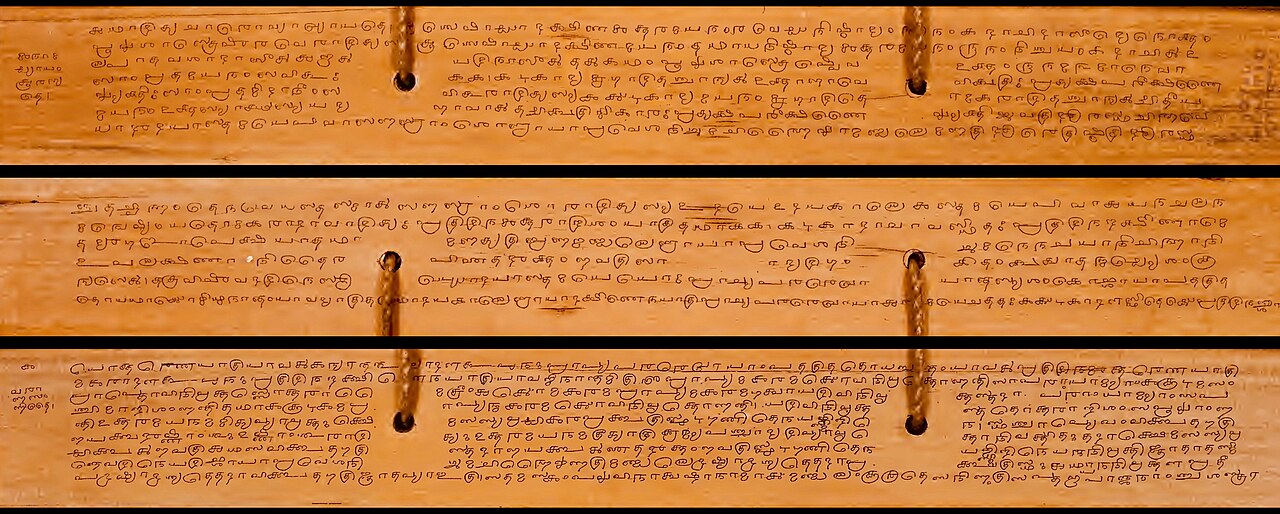
Physical manuscript before 1899; underlying work 5th–6th century CE
Later palm-leaf manuscript of Varahamihira’s Brihat Samhita with Bhattotpala’s commentary in Grantha script
Later palm-leaf manuscript of Varahamihira’s Brihat Samhita with Bhattotpala’s commentary, in Sanskrit written in Grantha script.
006Two views
Both views are shown at equal weight; this site does not choose between them.
Whether the sky in Paripatal 11 can be dated to 161 BCE
- One view
- Somasundaranar's commentary reports scholars' calculation that the planetary scene matches a day in 161 BCE.
- Another view
- The study argues the result rests on commentary identifications and recurring cycles, so it remains a hypothesis.
- What would settle it
- An independent dated anchor, plus a published search listing every candidate date and its assumptions.
007Where next
All related studies, connected material, books and sources20 · 15
Elsewhere on this site
Classroom Lesson Plans: Module 3 · Poems as Historical Witnesses: Landscapes (Tiṇai), Ethics & Voices
Multi-Script Glossary Terms: koṭai (īkai) (கொடை / ஈகை / കൊട / ദാനം) · iṭavappāti & tulāvarṣam (Dual Monsoon Regimes) (தென்மேற்கு & வடகிழக்குப் பருவமழை / ഇടവപ്പാതിയും തുലാവർഷവും) · pāvai nōṉpu & tai-nīrāṭal (Seasonal River-Bathing Vow) (பாவை நோன்பு & தை நீராடல் / പാവൈ നോമ്പും തൈ നീരാടലും)
Connected material
Photographs, drawings, books, videos and other studies linked to this study. A link helps you explore; it does not prove a historical claim.
- Later palm-leaf manuscript of Varahamihira’s Brihat Samhita with Bhattotpala’s commentary in Grantha scriptmanuscript photographBackground
008Sources
The study lists the sources it consulted; we have not rechecked them. A working link does not show that a source was read, and a valid identifier does not show that it supports a claim. We do not link to unofficial uploads or copies of publications. Where a study cited one, we show the published citation, or a publisher, DOI or Internet Archive link when we have one. Tracking codes are removed from links, and the sources themselves are not republished here.
Purananuru, poem 229
Tamil Virtual Academy, digital Purananuru text, poem 229.
Print or offline sourceSource recordPurananuru with Avvai Duraisamy Pillai commentary
Project Madurai electronic text of Purananuru with commentary by Avvai Duraisamy Pillai.
Print or offline sourceSource recordT. V. Venkateswaran, 'A Star in Flames: An Account of a Fireball in the Tamil Classic Purananuru 229,' Journal of Astronomical History and Heritage 29 (2026).
Tamil Virtual Academy, digital Paripatal, poem 11.
Print or offline sourceSource recordParipatal 11 commentary incorporating Parimelalakar glosses
Tamil Virtual Academy digital edition presenting P. V. Somasundaranar's commentary together with explicitly marked Parimelalakar glosses.
Print or offline sourceSource recordParipatal publication and commentary history
Tamil Virtual Academy introductory/publication material for Paripatal.
Print or offline sourceSource recordPatirruppattu with Avvai Duraisamy Pillai commentary
Project Madurai electronic text of Patirruppattu with commentary by Avvai Duraisamy Pillai.
Print or offline sourceSource recordPatirruppattu, poems 64 and 69
Project Madurai digital Patirruppattu text, especially poems 64 and 69.
Print or offline sourceSource recordCilappatikaram, Indra Festival canto
Tamil Virtual Academy, Cilappatikaram, Indiravizhavu Ur Edutta Katai.
Cilappatikaram, Katturai canto and calendrical commentary
Tamil Virtual Academy, Cilappatikaram, Katturai Katai, lines around the astrological prediction concerning Madurai.
Iravatham Mahadevan. Early Tamil Epigraphy: From the Earliest Times to the Sixth Century A.D. Chennai: Cre-A; Department of Sanskrit and Indian Studies, Harvard University, 2003.
NASA Jet Propulsion Laboratory Solar System Dynamics. 'JPL Planetary and Lunar Ephemerides'; includes reference to Park et al., 'The JPL Planetary and Lunar Ephemerides DE440 and DE441' (2021).
Fred Espenak, NASA Goddard Space Flight Center, 'Uncertainty in Delta T (ΔT),' Five Millennium Canon of Solar Eclipses resource.
F. R. Stephenson, L. V. Morrison and C. Y. Hohenkerk. 'Measurement of the Earth's Rotation: 720 BC to AD 2015.' Proceedings of the Royal Society A 472 (2016), article 20160404.
Harvard University, Lakshmi Mittal and Family South Asia Institute, 'Interpreting a 5th Century Tamil Epic and Its Retellings,' 2019.
Researchers and institutions whose work this study uses: Iravatham Mahadevan, Tamil Virtual Academy
How we know The evidence, claims and dates behind this study
What this study draws on
- Tamil texts of Purananuru 229, Paripatal 11, Patirruppattu 64 and 69 and Cilappatikaram from Tamil Virtual Academy and Project Madurai
- Parimelalakar's medieval commentary and Somasundaranar's modern commentary, read as separate layers
- Mahadevan's Early Tamil Epigraphy for the Pugalur–Patirruppattu link
- JPL ephemeris documentation and NASA's ΔT uncertainty table (about 265 seconds near year 0)
Dates in this study
| What is dated | Date | How it was dated |
|---|---|---|
| Broad Pugalur-Patirruppattu Irumporai synchronism proposed by Mahadevan | 50–250 CE | Period assigned by excavators or scholars |
See these dates on the timeline
The study’s claims
6 claims · 10 source passages · 69 paragraphs
Browse the study paragraph by paragraphPurananuru 229 preserves a structured celestial-omen passage culminating in a falling luminous celestial object and subsequently links the portent with the death of the Cera ruler after a seven-day interval; named nakshatra identifications are partly commentarial rather than all explicit in the base poem.
Supported in this study
The physical nature of the object is not named in modern scientific terminology by the ancient poem. The fireball/meteor identification is a scholarly interpretation. No independently dated inscription was identified that fixes this event to one calendar year.
Paripatal 11 contains a dense celestial and seasonal sequence associated with the onset of heavy rain and Vaigai flooding, while much of the explicit planet-zodiac-eclipse reconstruction derives from Parimelalakar and modern editorial commentary.
Supported in this study
The poem, medieval commentary and modern editorial commentary must be treated as separate evidentiary strata. The reported 161 BCE result belongs to the modern retrocalculation layer and is not stated in the poem.
Patirruppattu contains solar/star imagery and a Venus-rain association, while the Pugalur inscriptions independently provide a broad dynastic synchronism for Irumporai rulers celebrated in the anthology without supplying an exact astronomical date for those poems.
Supported in this study
The Pugalur synchronism is historical and genealogical, not a date formula for poems 64 or 69. Mahadevan's identifications are scholarly historical interpretation based on epigraphy and literary comparison.
Cilappatikaram explicitly combines Ati month, dark fortnight, astami and Friday in an astrological prophecy concerning Madurai, while the associated Karttikai identification is supplied by commentary.
Supported in this study
The passage is literary narrative and explicitly framed as astrological speech. No independently dated destruction context tying the narrative to one absolute day was established in the consulted sources. The surviving epic is commonly placed in a later, post-Sangam compositional horizon.
An exact BCE or CE year obtained by matching a literary sky description to software is not independently certified when the astronomical constraints depend on manuscript readings, commentary-derived identifications, adjustable zodiac or nakshatra mappings, and lack an external epigraphic or archaeological date anchor.
Supported in this study
A reproducible astronomical match can still be a useful hypothesis. The evidential problem is historical identification, not the ability of modern celestial mechanics to compute past positions. Multiple candidate dates should be reported rather than suppressing alternatives.
Long-range modern ephemerides are sufficiently capable of computing ancient celestial positions, but their numerical precision does not resolve philological ambiguity; eclipse reconstruction additionally depends on uncertain ancient Earth rotation represented by Delta T.
Supported in this study
JPL DE441 uses modern dynamical models, reference frames and time scales. NASA's ancient Delta T uncertainties are especially relevant to local eclipse-path and timing claims. Historical zodiacal or nakshatra labels remain a separate interpretive mapping from computed physical coordinates.
Trace one claim through the study’s records
Explore the evidenceOther source lists
Numbered citation links from the study
The numbered links in the study text point here.
www.tamilvu.org
www.tamilvu.org
puranAnUru, with auvai turaicAmi piLLai commentary, part 2 (verrses 201 to 270) (in tamil script, unicode format)
An account of a fireball in the Tamil classic Purananuru 229
விரிகதிர் மதியமொடு | தமிழ் இணையக் கல்விக்கழகம் TAMIL VIRTUAL ACADEMY
:: TVU ::
:: TVU ::
பதிற்றுப்பத்து /மூலமும் உரையும் - பாகம்
Iravatham Mahadevan Early Tamil Epigraphy From The Earliest Times To The Sixth Century A. D.
:: TVU ::
www.tamilvu.org
Iravatham Mahadevan Early Tamil Epigraphy From The Earliest Times To The Sixth Century A. D.
JPL Planetary and Lunar Ephemerides
NASA - Uncertainty in Delta T
Full text of "Iravatham Mahadevan Early Tamil Epigraphy ...
patiRRuppattu (with the commentary of Auvai Duraisamy Pillai) part 1 (in tamil script, unicode format)
Paripadal | தமிழ் இணையக் கல்விக்கழகம் TAMIL VIRTUAL ACADEMY
Paripadal | தமிழ் இணையக் கல்விக்கழகம் TAMIL VIRTUAL ACADEMY
6.2.1 மொழி முதல் எழுத்துகள் சகர மெய்
விரிகதிர் மதியமொடு | தமிழ் இணையக் கல்விக்கழகம் TAMIL VIRTUAL ACADEMY
:: TVU ::
பதிற்றுப்பத்து /மூலமும் உரையும் - பாகம்
naccinArkiniyar urai, part 2 poruLaitkAram (in tamil script ...
:: TVU ::
www.tamilvu.org
www.projectmadurai.org
www.tamilvu.org
:: TVU ::
:: TVU ::
naccinArkiniyar urai, part 2 poruLaitkAram (in tamil script ...
patiRRuppattu (with the commentary of Auvai Duraisamy Pillai) part 1 (in tamil script, unicode format)
Moon Phases
Measurement of the Earth's rotation: 720 BC to AD 2015
விரிகதிர் மதியமொடு | தமிழ் இணையக் கல்விக்கழகம் TAMIL VIRTUAL ACADEMY
www.projectmadurai.org
www.tamilvu.org
puranAnUru, with auvai turaicAmi piLLai commentary, part 2 (verrses 201 to 270) (in tamil script, unicode format)
Interpreting a 5th Century Tamil Epic and Its Retellings
:: TVU ::
JPL Planetary and Lunar Ephemerides
www.projectmadurai.org
Paripadal | தமிழ் இணையக் கல்விக்கழகம் TAMIL VIRTUAL ACADEMY
Full text of "Iravatham Mahadevan Early Tamil Epigraphy ...
Interpreting a 5th Century Tamil Epic and Its Retellings
www.tamilvu.org
About this study Status, corrections and how it was made
Status
Draft study, revision 5. No historian, archaeologist, or Tamil or Malayalam specialist has reviewed it yet.
The study itself says more research is needed before its question can be settled.
How it was made
Compiled as an editorial synthesis from published scholarship around questions we framed. About this project & workflow
The summary, How sure lines and Two views notes on this page were prepared from this study and cross-checked against its passages. That is an editorial check, not a specialist review.
Technical details
Study code R247. The text fingerprint changes whenever the study text changes.
- The study text is shown as written. Links from its paragraphs to citations help you move around the study; they are not new claims or checked source passages.
See how this study’s records were extracted
Text fingerprint (SHA-256): R247 · ecd5cf68d883312cf6660585… · v5
Evidence tables and technical details are on the web page: https://layersofthesouth.org/read/cd5fb5d949