Roman, possibly Cypriot, terracotta amphora with painted Greek letters on its shoulder
ca. 3rd century CE
- Across the water
Muziris Papyrus records credit, cargo values and a quarter tax
A damaged second-century papyrus shows India-trade cargo financed, moved across Egypt, taxed at 25 percent and valued; many famous numbers are modern reconstructions.
- This page
- 4,610 words · revision 8
Draft study · Awaiting specialist review · Updated
001Dates and places

No mapped place in this study.
Dates in this study are stated in words only.
- 2 Well supported
- 1 Likely
- 1 Not known
002How sure
In brief
The Muziris Papyrus is a damaged Greek document from about the middle of the second century CE, held by the Austrian National Library. One side sets loan terms: the cargo stays under the lender's control as it crosses Egypt to Alexandria. The other side is a cargo account. Federico Morelli re-examined the original in 2011 and revised its total to 1,151 talents and 5,852 drachmas. The account records sixty containers of Gangetic nard and ivory, and the papyrus documents a 25 percent import tax collected at Alexandria. The famous “seven million sesterces” is a modern conversion, not wording on the papyrus. Pepper is reconstructed from damaged figures, and modern estimates of its weight differ by several hundred tonnes. No edition or study read supports “1,170 bales of pepper.” The papyrus does not preserve its Red Sea port, its interest rate or the exact role of the ship named Hermapollon.
Key researchers cited in this study: Lionel Casson (Periplus Maris Erythraei Philology) · Federico De Romanis (The Indo-Roman Pepper Trade & Muziris Papyrus) · Full bibliography
How sure
- Well supported
The cargo stayed under the lender's control while it crossed Egypt.
The preserved clauses state this directly in Morelli's and Casson's editions.
- Well supported
A 25 percent import tax was collected at Alexandria.
Morelli concludes this from the account; a second export tax rests only on wider reconstruction.
- Likely
Pepper was part of the missing cargo.
It is reconstructed from damaged figures and the Periplus; the word does not survive legibly.
- Not known
How much pepper the cargo held.
Morelli's and De Romanis's reconstructions differ by several hundred tonnes, and the 2023 debate continues.
Why it matters
One sheet links a loan, transport, customs and cargo values, so it shows how the India trade worked inside Egypt.
The summary above is the short read. The full study is the complete text it was drawn from, with its tables and source notes.
What the full study covers
003The study
Question, scope and orientation
Question and scope.
What can the surviving Muziris Papyrus establish about credit, cargo valuation, transport and taxation? The physical object is P.Vindob. G 40822 in the Papyrus Collection of the Austrian National Library, also catalogued as SB XVIII 13167. The text is Greek and is normally dated palaeographically to around the middle of the second century CE. This places the document itself squarely in the Layers of the South core editorial period; first-century comparative texts and the papyrus's South Indian context are also core-period evidence, while scholarship from 1985 onward is later reception and research history. [; ] ↗1 ↗2
Geographical scope: the ancient place-name Muziris and the southwest Indian/Malabar commercial sphere; the Egyptian Red Sea coast; Koptos in the Nile Valley; and Alexandria. The papyrus itself does not identify an excavated Kerala site, and this study does not equate Muziris with Pattanam or any other modern location. The exact Egyptian Red Sea port at which the preserved Egyptian transport sequence begins is also lost from the surviving sheet. [; ] ↗2
Period classification: core-period documentary evidence, approximately mid-second century CE; first-century comparanda such as the Periplus Maris Erythraei belong to core-period context; modern editions, reinterpretations and disputes belong to later reception/research history. This study read a critical re-edition and relevant PDF page images, an earlier scholarly translation and legal/economic analysis, the Austrian National Library's object account, later reassessments and review literature, and current catalogue metadata. This synthesis draws directly on Morelli's 2011 critical re-edition, Casson's 1990 study, the Austrian National Library object account, Ruffing's 2021 review, and Cobb and Wilkinson (2022); De Romanis's 2020 monograph (chs. 8–12), Rathbone (2000), the 1985 editio princeps, and the 2023 Rathbone–De Romanis Topoi exchange were not consulted directly in full for this study. Those limits matter most for disputed readings and reconstructions and are carried through the ledgers below. ↗3 ↗4 ↗5 ↗2
Orientation.
The Muziris Papyrus is unusually valuable because one damaged sheet links four things that are often studied separately: a creditor–debtor arrangement, the physical movement of goods across Egypt, customs processing, and a cargo valuation account. Yet its fame has encouraged numbers to harden into “facts” that the papyrus does not actually preserve. The surviving verso directly records, among other items, sixty containers of Gangetic nard, quantities of ivory, and a total valuation; black pepper is reconstructed from damaged numerical passages, and its quantity changes dramatically depending on the price and weight assumptions used by modern scholars. Likewise, “about seven million sesterces” is a modern conversion of a total written in talents and drachmas, not a Roman sesterce figure written on the papyrus. The most useful reading is therefore not “one ship worth seven million,” but a layered one: what is visible in the text, what an editor restores, what arithmetic follows from those restorations, and what later historians infer. [] ↗6 ↗7 ↗2
Accessible explanation and main investigation
Accessible explanation.
The surviving recto is a commercial document whose beginning and end are missing but whose middle still gives instructions. A merchant returning with valuable goods must put the cargo into the hands of a trustworthy cameleer, move it through the Eastern Desert to Koptos, place it in public customs warehouses, load it onto a safe Nile vessel, and carry it to Alexandria. The goods remain under the authority and seal of the creditor or the creditor's agents, and the merchant bears the transport and related costs through the quarter-tax process. If the debt is not repaid by the deadline referenced in the agreement, the creditor can take control of the pledged goods, deal with the customs obligation, and sell or re-pledge what remains. This is strong evidence for secured long-distance commercial credit and for the way finance continued to shape the cargo after the Indian Ocean crossing. It is not, however, a complete loan contract: the surviving portion does not give us the parties' names, a clearly preserved principal, an interest rate, or a complete sea-risk clause. Calling it a “bottomry loan” is therefore a useful modern analogy only if it is explained, not a label to treat as a verbatim ancient category. [, C018; ] ↗7 ↗8 ↗9
The reverse of the sheet is an account. In Federico Morelli's 2011 re-edition, the best-preserved column records 60 kistai of Gangetic nard, priced at 4,500 drachmas per container, producing 45 money talents. Because 60 × 4,500 = 270,000 drachmas, the arithmetic itself shows that this account uses 6,000 drachmas to the money talent. The same column records “sound” ivory and another ivory category commonly discussed as schidai – ivory trimmings or offcuts in De Romanis's later interpretation – with weights, conversions between fiscal and merchant weight standards, and unit prices. The final surviving total in Morelli's revised reading is 1,151 money talents and 5,852 drachmas for “three parts” of the cargoes associated with the Hermapollon. Older publications, including Casson's 1990 article, printed 1,154 talents and 2,852 drachmas. Any calculation or display must therefore state which reading it uses rather than silently mixing editions. [; ] ↗7 ↗8
Morelli's revised total equals 6,911,852 drachmas. Bernhard Palme's Austrian National Library account explains that, for this period and purpose, the silver drachma may be treated approximately as equivalent in value to a Roman sestertius; that is the basis of the familiar “nearly seven million sesterces.” The papyrus itself does not say “seven million sesterces.” If the 6,911,852-drachma figure represents the merchant's three-quarter share after a quarter-tax, a simple reverse calculation gives about 9,215,802⅔ drachmas for a notional pre-tax whole. That second number is even further removed from a surviving entry: it depends on interpreting “three parts” as exactly 75 percent and ignores the account's awkward weight conversions and additional Arabarch-related adjustments. It should be displayed only as a conditional calculation. [; ] ↗7 ↗2
Roman terracotta jug in Cnidian relief ware, made at Cnidus in southwestern Anatolia
2nd–3rd century CE
The most important correction concerns pepper. The best-preserved surviving column does not give “1,170 bales of Malabar black pepper.” Morelli cautiously reconstructed a damaged earlier section as probably pepper and, using a value of 24 drachmas per mina, estimated an original amount around 4,400 weight talents – roughly 130–140 metric tonnes in modern summaries. De Romanis instead reconstructed a much lower fiscal unit value, 6 drachmas per mina, and therefore a much larger pepper quantity: his reconstruction is summarized as roughly 544 metric tonnes of pepper and more than 625 tonnes for the total cargo. Matthew Adam Cobb and Troy Wilkinson (2022), who prefer De Romanis's larger cargo figures, set Morelli's roughly 180-tonne total-cargo reconstruction against De Romanis's roughly 625–635-tonne reconstruction and explain that the difference turns largely on the pepper-price assumption. These are modern reconstructions, not two competing measurements preserved on the papyrus. No consulted edition or analysis supplied a surviving count of 1,170 pepper bales. [; ] ↗6 ↗7 ↗10
The phrase “60 crates of Gangetic spikenard” also needs refinement. Sixty is genuinely present in the better-preserved account, but the Greek container term is kistai; “containers,” “chests,” or “baskets” is safer than pretending that an English modern crate is exact. More importantly, if the column values the merchant's three-quarter remainder, sixty is the post-quarter quantity: Morelli's tax logic yields an original eighty containers, with twenty making up the quarter. Thus “60 containers” is a surviving entry; “80 before the quarter-tax” is an arithmetic reconstruction from the account's structure. [; ] ↗7
Main investigation.
What is actually preserved. Morelli's re-examination is crucial because he worked from the original papyrus rather than only from the first edition's photograph. He stresses how thin the sheet is and how writing from the reverse can show through, creating deceptive strokes. That physical problem is not trivial: one corrected letter can change whether the final line means “six parts” or “three parts,” and a corrected word on the recto can erase an apparent monetary payment. This study therefore gives precedence, for readings, to Morelli's direct reinspection and later critical discussion, while retaining older readings in the ledger rather than deleting them. [, ] ↗7
Credit and security. The recto begins after a lost column and ends before the agreement is finished. The preserved first-person undertakings place the cargo under the creditor's control or seal while it moves from the Red Sea side of Egypt to Alexandria. The repayment deadline is linked to “loan contracts” associated with Muziris. In default, the creditor is empowered to take possession of the security and realize its value. This establishes secured commercial credit tied to a long-distance trading venture. It does not by itself establish how much was lent, how interest was calculated, whether the lender bore every maritime risk in the classic model of a sea loan, or whether this surviving text was the original maritime loan, a related security instrument, or a supplementary agreement governing the Egyptian return leg. [, C006, C018; ] ↗8 ↗11
That legal characterization has a research history. The first editors treated the recto as the remains of a maritime loan; Gerhard Thür recast it as a security instrument connected with a sea loan; Casson argued in 1990 that it was a supplementary agreement made after safe arrival at the Red Sea, governing the Egyptian leg; De Romanis later argued more strongly for understanding it as a loan contract integrated with an Alexandria–Muziris–Alexandria enterprise. Because the lost columns could have contained decisive terms, the best public wording is “a fragmentary loan/credit agreement connected with the Muziris venture,” followed by an explanation of the dispute. [; ] ↗8 ↗11 ↗12
Transport: a chain of work, storage and risk. The recto is strongest when read as a logistics document. It makes ordinary labor visible: a reliable cameleer and pack animals for the desert crossing, guards or security arrangements, public warehouses at Koptos, seals, loading and unloading, a safe river vessel, river freight, and further expenses before the Alexandria customs process. The exact Red Sea port is missing. Myos Hormos and Berenike are reasonable historical candidates, but the papyrus does not choose between them. This is a useful place to resist a glamorous “Rome-to-India ship” narrative: the surviving clauses are intensely concerned with the difficult, expensive Egyptian work that happened after an Indian Ocean cargo reached the Red Sea. [; ] ↗7 ↗2
A particularly important correction concerns a supposed transport payment. Casson's 1990 translation, following older readings, has the borrower giving “twenty talents” to the creditor's cameleer. Morelli's direct reinspection removes that monetary reading: the clause instead concerns handing the cargo to a trustworthy cameleer for loading/transport. The lesson is methodological as well as economic. We know that the borrower was responsible for transport costs, but no “20 talents camel charge” should enter any calculation. [; ] ↗7 ↗8
Taxation: what one quarter means. The recto explicitly points toward Alexandria's warehouse for the tetarte, the “quarter” duty. A quarter is 25 percent. Morelli argues that the account makes most sense if the goods were assessed and divided with the quarter-tax in mind before final handover, with the tax portion ultimately received at Alexandria; his conclusion is that the papyrus demonstrates an import tetarte collected at Alexandria. It does not demonstrate, positively or negatively, whether a comparable duty was levied on later export from Egypt. De Romanis's 2020 reconstruction of a second 25-percent duty on the remaining 75 percent – yielding a combined nominal burden of 43.75 percent – draws on a wider argument that includes other texts. It should therefore be labelled “De Romanis's broader reconstruction,” not “what the Muziris Papyrus says.” [; ] ↗7 ↗12
The Arabarch adjustment is not a safe extra percentage. The verso contains additional quantities associated with the arabarchs, officials or contractors involved in customs administration. Older interpretations sometimes treated these as an additional regular percentage. Morelli shows that the extra amounts differ sharply between goods and argues that they relate to the practical difficulty of dividing indivisible pieces such as tusks when a tax was taken in kind, with compensating value calculations. De Romanis later treats the Arabarch-related amounts differently, as surcharges associated with the quarter-rates. The key rule is negative: no universal additional “Arabarch tax rate” can be taken from this papyrus. [; ] ↗7 ↗12
Copper-alloy weight, 305 BCE–364 CE
305 BCE–364 CE
Cargo valuation is accounting, not a ship's manifest in modern form. The surviving numbers mix weight talents and minae with money talents and drachmas. For nard, the unit is a container; for ivory, the clerk converts between fiscal and merchant weight standards and adds valuations of extra quantities. The surviving total is therefore an account produced for customs/credit purposes, not a simple list in which every line is “quantity × ordinary retail price.” This is why reconstructing the missing commodities from surviving totals is possible but fragile. The Periplus Maris Erythraei says that ships in the southern Indian emporia carried large quantities of pepper and malabathron and lists pepper, nard, ivory and tortoiseshell among the relevant trade goods; that external text makes certain restorations plausible, but plausibility from a parallel source does not turn a missing word on the papyrus into an observed label. [; ] ↗13 ↗7 ↗14
Weighing pepper: right weight, wrong substance. Pliny the Elder gives distinct prices for long, white and black pepper: fifteen, seven and four denarii a pound. He also alleges that pepper could be adulterated with juniper berries and that its weight could be manipulated. These are Pliny’s reported prices and concerns, not a measured series of Malabar transactions, and his account of pepper forms is problematic botany. Pliny’s first-century Roman prices and the papyrus’s second-century valuation address different ends of the Indian Ocean trade network. No estimate of how common fraud was follows from his allegation. The useful distinction is between testing quantity and identifying the thing being purchased: a scale cannot by itself certify that the material is what the seller calls it, and recognizing genuine pepper does not show that the agreed amount was delivered. []
A price is also not a profit. A profit calculation needs the acquisition cost, transport, charges, losses, finance costs and proceeds actually realized by a specified participant, so a local buying price from one century should not be set against a Roman selling price from another. The same care applies to any ancient number. A count multiplied by a guessed container size produces a number, not new evidence. A gross weight that includes packaging is not the usable contents. The ancient unit should be kept, with any modern conversion placed beside it together with its assumptions. Locating excavated South Indian balance beams, stone weights and coin weights with secure contexts and measured masses remains an open task.
Hermapollon: name secure, voyage role less secure. The revised final line securely associates the valued cargoes with a vessel called the Hermapollon. Morelli's 2011 reconstruction places the verso account after customs calculation and before arrival in Alexandria, possibly at Koptos or aboard the Hermapollon, which allows the vessel to be understood in the Egyptian transport sequence. De Romanis's later synthesis gives the Hermapollon a larger role in reconstructing the South Indian maritime enterprise. Since this study did not fully re-inspect the most recent exchange over these reconstructions, the safe editorial formulation is:** the verso names the Hermapollon in connection with the valued cargo; calling it unequivocally the ocean-going Muziris ship goes beyond the surviving wording.** [; ] ↗15 ↗7 ↗12
Scale without false precision. The papyrus unquestionably documents an exceptionally high-value consignment. But the document cannot tell us how typical the cargo was, how many comparable ships sailed each year, or the Roman state's annual revenue from this trade. Modern attempts to multiply the Hermapollon valuation by Strabo's much earlier figure of 120 ships combine evidence separated by roughly a century and a half and assume that the Hermapollon was representative. Cobb and Wilkinson (2022) explicitly warn against this procedure. The correct significance is narrower but still powerful: one mid-second-century document shows that large-value South Indian goods could be financed, physically controlled, moved through Egyptian infrastructure, assessed for a 25-percent import duty, and converted into a detailed fiscal/accounting valuation. [; ] ↗6
Which figures can be used, and how they must be labelled. The following figures can be used only when each is visibly labelled: Morelli revised total = 1,151 talents + 5,852 drachmas; older Casson-era total = 1,154 talents + 2,852 drachmas; 1 money talent = 6,000 drachmas; modern approximate conversion used by Palme = 1 drachma ≈ 1 sestertius; and, optionally, “three-quarter remainder ÷ 0.75” as a conditional grossing-up operation. Any calculation should not default to 1,170 pepper bales, should not treat 60 nard containers as the whole pre-tax cargo without explanation, should not apply a fixed Arabarch surcharge, should not add a second 25-percent tax as if it were written in this papyrus, and should not turn De Romanis's or Morelli's pepper tonnage into a surviving entry. [] ↗6 ↗7 ↗2
Interpretations, limits, and source register
Interpretations, disagreements and limits.
The largest disagreement is not whether the document concerns India–Egypt trade, but how much can be rebuilt from its damaged arithmetic. Morelli's original-papyrus reinspection sharply improved the text, yet his own pepper reconstruction remains cautious; he explicitly treats multiple solutions as possible and the result as too uncertain to push far beyond the surviving numbers. De Romanis uses the account's factorization, fiscal-price logic, the Periplus, and long-term pepper-trade comparisons to reconstruct a much larger cargo. A 2023 Rathbone article titled “Too much pepper?” challenged De Romanis's synthesis, and De Romanis replied in 2023 with “Overpriced Pepper.” This study verified those publications' metadata but did not obtain a full read text of the exchange; it therefore records the dispute without pretending to adjudicate arguments it did not read. [] ↗3 ↗4 ↗7
The legal disagreement is similarly best represented as a range. Casson rejected the first editors' identification of the surviving recto as simply “the maritime loan” and treated it as a supplementary post-arrival agreement; De Romanis later reads it as a loan contract integrated into the round-trip enterprise. The preserved clauses plainly show borrower obligations, creditor control, repayment/default mechanics and pledged cargo. They do not preserve enough of the document to resolve every category in modern legal vocabulary. The question “Was this exactly bottomry?” should therefore be answered: the evidence supports a maritime-loan/secured-credit setting, but the surviving fragment does not preserve enough terms to map it without qualification onto a modern bottomry contract. ↗8 ↗11 “Voyage loans: who bore a cargo's loss depended on the agreement” sets the papyrus beside the sea loan inserted in Against Lacritus, whose explicit clauses on jettison, payments to enemies and goods saved from a wreck are the kind of terms this fragment does not preserve.
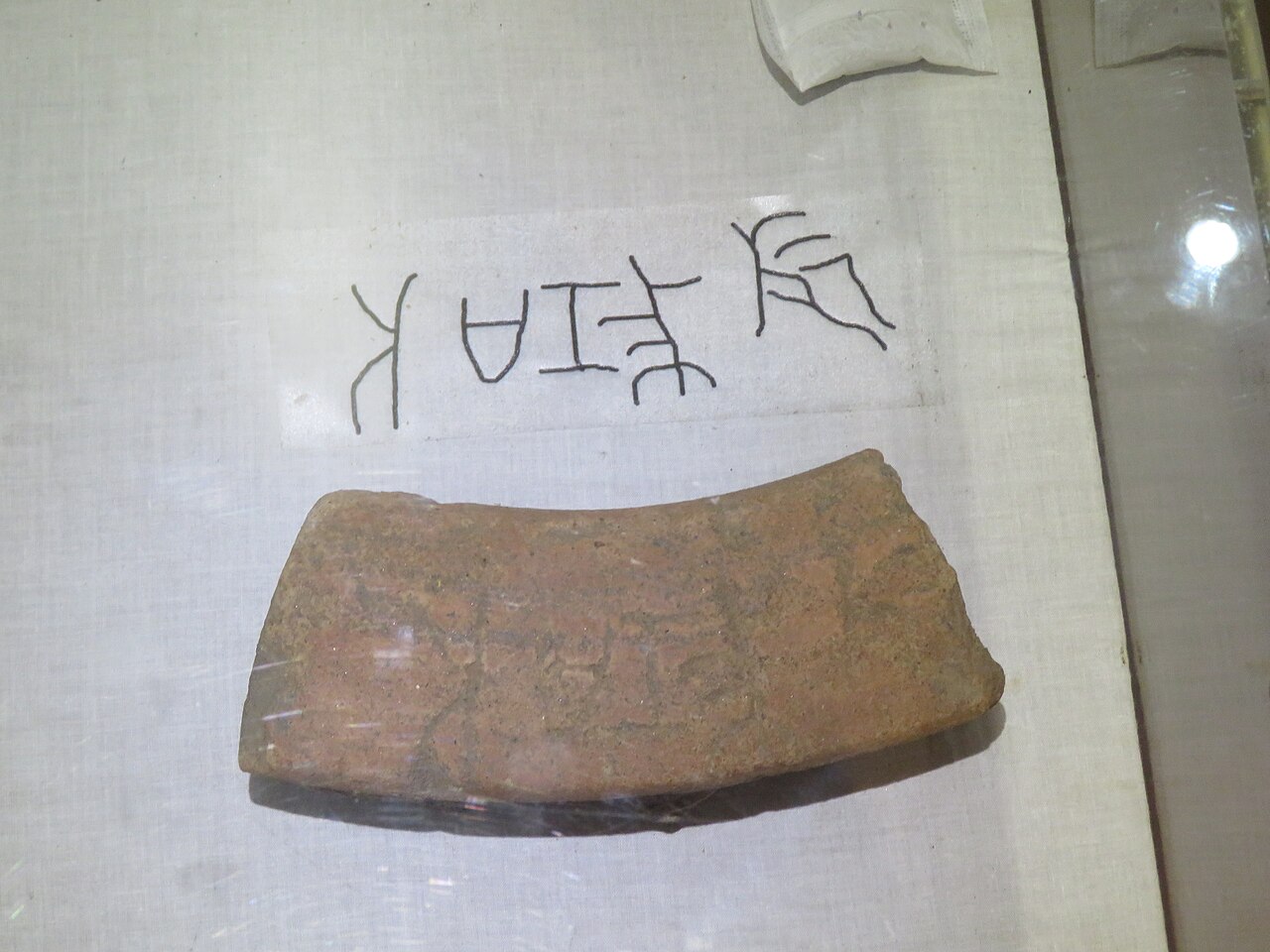
Photograph of the Muziris Papyrus facsimile displayed at the Pattanam Museum, taken by KannanVM in 2019
Original text: mid-2nd century CE; pictured display/facsimile modern
The taxation limit is unusually clear. The papyrus supports one 25-percent import tetarte and an Alexandria customs endpoint. A second quarter-duty on re-export, or a combined 43.75-percent burden, belongs to broader reconstruction. Likewise, the “Arabarch” adjustments are not securely reducible to one percentage. What would resolve these uncertainties? A better papyrus joining the lost columns, a parallel customs account using the same formulae, or full documentary evidence for the exact fiscal weight and price schedules would be decisive. For cargo scale, a new high-resolution or multispectral reading of damaged numerals could potentially matter more than another multiplication of existing restorations. ↗7 ↗12
Source register.
| Recoverable reference and durable URL/DOI | Language / type | Inspection actually performed | Independence, claims and limits |
|---|---|---|---|
Federico Morelli, “Dal Mar Rosso ad Alessandria. Il verso (ma anche il recto) del ‘papiro di Muziris’ (SB XVIII 13167),” Tyche 26 (2011), 199–233. DOI: https://doi.org/10.15661/tyche.2011.026.10 |
Italian + Greek; critical text edition/research article | partial text with PDF page images: relevant pp. 199–202, 210, 218–220, 225, 233 read; screenshots of PDF indices 17, 32, 40 read | Principal textual basis; Morelli reports systematic reinspection of the original. Supports C002, C004, C007–C016, C019. Current journal page states CC BY 4.0; PDF issue carries older copyright wording, so rights remain review-needed. ↗5 ↗7 |
| Lionel Casson, “New Light on Maritime Loans: P. Vindob. G 40822,” Zeitschrift für Papyrologie und Epigraphik 84 (1990), 195–206. | English + Greek; research article | partial text with PDF page images: pp. 195, 198, 201, 204 and relevant parsed passages read | Foundational older reading; dependent on pre-Morelli text in places. Supports/qualifies C004, C006, C011, C016, C018. The frequently cited title “The Periplus and the Vienna Papyrus (1990)” was not verified and appears to conflate this article with Casson's separate Periplus book. ↗8 |
| Dominic Rathbone, English translation of SB 18.13167, reproduced as Select Papyri 1.187A on Attalus; stated to follow Rathbone, “The ‘Muziris’ Papyrus … financing Roman trade with India” (2000), pp. 39–50. | English translation of Greek; ancient-text translation | full web text of the displayed translation read | Useful readable witness to recto/verso; still reflects older readings. Supports C003, C006 and comparison for C011. ↗9 |
Bernhard Palme, “Der Muziris-Papyrus,” Österreichische Nationalbibliothek, 16 Feb. 2018. https://www.onb.ac.at/mehr/blogs/der-muziris-papyrus |
German; institutional catalogue/research outreach | full text web page read | Verifies the reference “Bernhard Palme (2018)” and collection context; synthesizes scholarship rather than replacing the critical edition. Supports C001, C003–C005, C012. ↗2 |
Federico De Romanis, “Structural aspects of a commercial entreprise to Muziris. On SB XVIII 13167 again,” Topoi, Suppl. 15 (2017), 83–100. https://www.persee.fr/doc/topoi_1764-0733_2017_act_15_1_3003 |
English; research article | partial text, p. 83 and metadata read | Direct later interpretive statement on loan-contract and three-quarter cargo. Supports/qualifies C002, C018. ↗11 |
Federico De Romanis, The Indo-Roman Pepper Trade and the Muziris Papyrus. Oxford University Press, 2020. DOI: https://doi.org/10.1093/oso/9780198842347.001.0001 |
English; book | abstract only / chapter-metadata level on OUP; detailed contents also checked through scholarly reviews | Bibliographic reference verified. Not treated as fully read. Context for C008, C019; reconstruction details are supported here through read reviews/other articles rather than the inaccessible full book. ↗15 ↗12 |
Kai Ruffing, review of De Romanis 2020, sehepunkte 21.5 (2021). https://www.sehepunkte.de/2021/05/34566.html |
German; scholarly review | full text web review read | Secondary account of De Romanis's argument; dependent on the book. Supports contextual description of double-duty model, cargo reconstruction and chapter conclusions. ↗12 |
Matthew Adam Cobb and Troy Wilkinson, “The Roman state and Red Sea trade revenue,” in Caroline Durand, Julie Marchand, Bérangère Redon and Pierre Schneider (eds.), Networked Spaces: The Spatiality of Networks in the Red Sea and Western Indian Ocean, Archéologie(s) 8 (Lyon: MOM Éditions, 2022), pp. 213–226. https://books.openedition.org/momeditions/16401?lang=en |
English; scholarly book chapter | Selected paragraphs (paras. 9–16 and notes) consulted | Modern assessment that favours De Romanis's larger cargo figures while comparing Morelli and De Romanis and warning against simple revenue extrapolation. Supports C014–C017. ↗6 |
Papyri.info, current edition metadata for DDbDP 27666 / SB 18 13167, inventory G 40822. https://papyri.info/current/27666 |
Greek-document catalogue/current edition | metadata only; catalogue metadata consulted; full page was not accessible online | Confirms catalogue equivalence; no substantive reading taken beyond catalogue metadata. Supports C001 only. ↗1 |
| Hermann Harrauer and Pieter J. Sijpesteijn, “Ein neues Dokument zu Roms Indienhandel. P.Vindob. G 40822,” Anzeiger der phil.-hist. Klasse der Österreichischen Akademie der Wissenschaften 122 (1985), 124–155. | German + Greek; first edition | citation only, bibliographic details verified through Morelli/Casson | Foundational but uninspected directly; not used alone for claims. ↗7 ↗8 |
| Gerhard Thür, “Hypotheken-Urkunde eines Seedarlehens für eine Reise nach Muziris und Apographe für die Tetarte in Alexandreia (zu P.Vindob. G. 40.822),” Tyche 2 (1987), 229–245. | German + Greek; research article/textual-legal study | citation only | Position represented only through read Casson/Morelli discussion; direct argument requires inspection. ↗7 ↗8 |
Dominic Rathbone, “Too much pepper? Federico De Romanis, The Indo-Roman Pepper Trade and the Muziris Papyrus,” Topoi 24.2, 439–465; KCL repository records publication 1 Feb. 2023. https://kclpure.kcl.ac.uk/portal/en/publications/too-much-pepper-federico-de-romanis-the-indo-roman-pepper-trade-a/ |
English; peer-reviewed article/review essay | metadata only | Establishes existence/date/title of critique; arguments not represented as read. ↗3 |
| Federico De Romanis, “Overpriced Pepper. A Reply to D.W. Rathbone,” Topoi 26 (2023), 191–200. | English; research reply | metadata only on author's publication page | Establishes reply and continuing dispute; full text not read. ↗4 |
Periplus Maris Erythraei, §56; modern English text surfaced in a Warwick-hosted PDF and University of Washington digitization of W.H. Schoff's 1912 translation. https://depts.washington.edu/silkroad/texts/periplus/periplus.html |
Ancient Greek text in English translation; ancient text edition/digital reproduction | partial text, §56 context read | Context only for South Indian commodities. Does not prove restorations in missing papyrus text. ↗13 ↗14 |
| Federico De Romanis, “Playing Sudoku on the Verso of the ‘Muziris Papyrus’: Pepper, Malabathron and Tortoise Shell in the Cargo of the Hermapollon,” Journal of Ancient Indian History 27 (2012), 75–101. | English; research article | partial text from indexed excerpts only; the PDF was too large to open directly and was not available to read | Useful lead for the large-cargo reconstruction, but not used as the sole support for any load-bearing statement; follow-up full inspection required. ↗10 |
Pliny the Elder; translated by H. Rackham, online at Attalus (First century CE; modern English translation). Natural History, Book 12, sections 26–29. Natural History 12.26–29, especially prices in §28 and adulteration in §29. https://www.attalus.org/pliny/hn12a.html |
English translation of a Latin ancient text | Selected English text read for the site’s earlier study of weights and measures; botanical descriptions and monetary statements treated as Pliny’s claims. | The passage mixes commercial observation with problematic botany. The named prices are not a Malabar farm-gate price series or a measured net profit. Context for pepper prices and adulteration only; not a papyrus reading. |
Bibliographic note: a title given as “Lionel Casson's The Periplus and the Vienna Papyrus (1990)” was not found. The evidence points instead to Casson's 1990 ZPE article New Light on Maritime Loans: P. Vindob. G 40822 and his separate 1989 Princeton book The Periplus Maris Erythraei. “Bernhard Palme (2018)” is the Austrian National Library article listed as, and De Romanis 2020 is verified as. ↗15 ↗17 ↗2
Conclusion
Supported by the sources used: the distinction between surviving entries and reconstructed cargo; the revised Morelli total and older alternative; the 60-nard-container entry; the approximate modern 7-million-sestertius conversion; the secured-credit/default mechanics; the Egypt transport sequence; and the single 25-percent import tetarte. Needs further study: the precise Hermapollon vessel role, the full 2023 pepper-price debate, the first-edition chronology, and the exact treatment of the Arabarch adjustments. Not supported as fact: “1,170 bales of pepper,” a fixed pepper tonnage, a universal Arabarch percentage, a second 25-percent tax attributed to this papyrus alone, or an exact modern site identification for Muziris. ↗6 ↗7 ↗2
Research conclusion: The Muziris Papyrus can securely establish a chain of secured commercial credit, creditor control over goods, desert and Nile transport obligations, an Alexandria-centered 25-percent import duty, direct valuation entries for nard and ivory, and a revised aggregate value of 1,151 money talents plus 5,852 drachmas. It cannot securely establish “1,170 pepper bales,” cannot turn modern pepper-tonnage reconstructions into surviving entries, and does not itself prove a second quarter-duty. Its greatest value is not a single spectacular number but the way one fragment joins finance, labor, storage, transport, customs and accounting across the South India–Egypt trading system. [] ↗6 ↗7 ↗2
004Photographs
Photographs of the places and objects this study discusses. Each item carries its creator’s credit, licence and documented source. See all 412 photographs and source images ↗
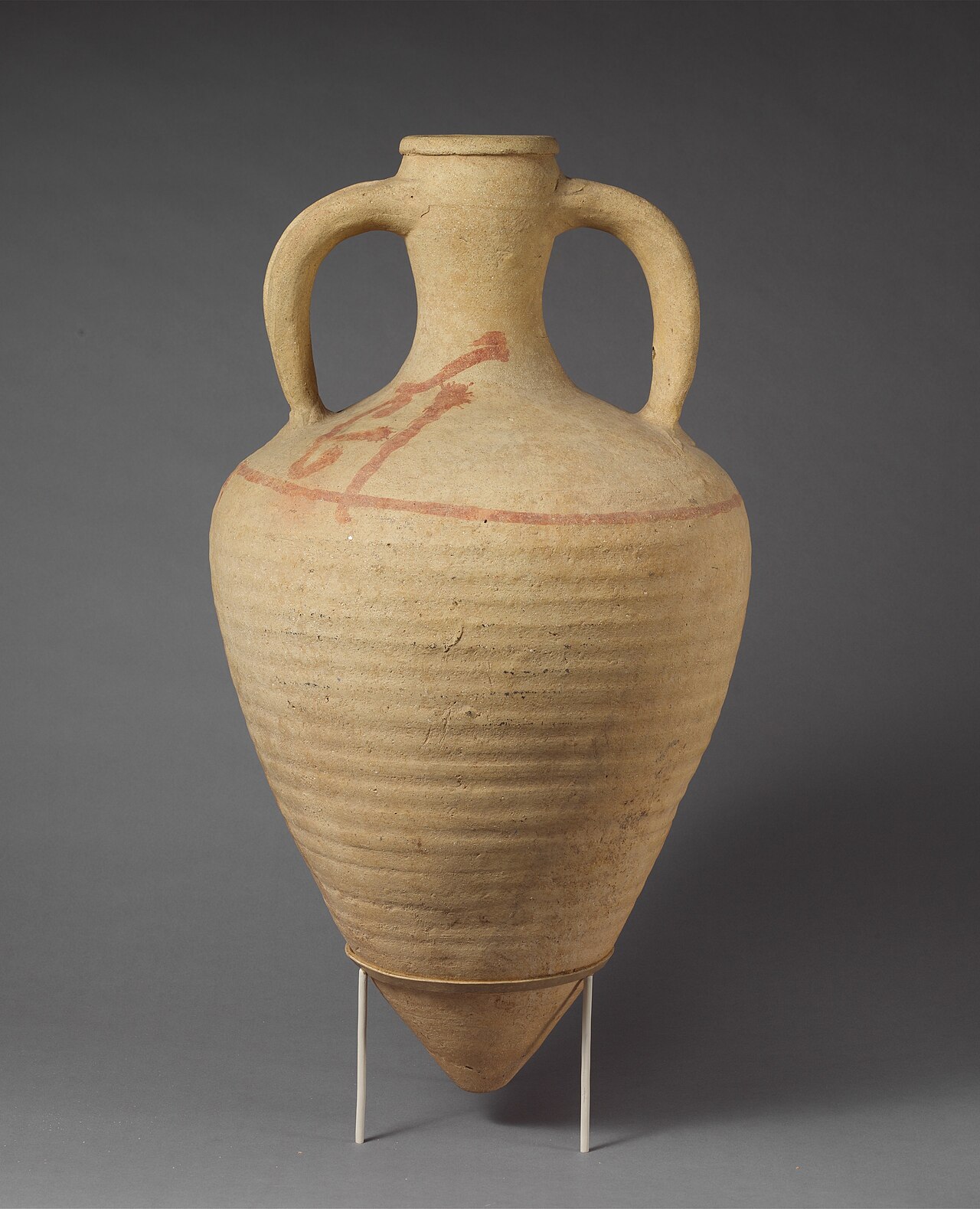
ca. 3rd century CE
Roman, possibly Cypriot, terracotta amphora with painted Greek letters on its shoulder
Roman, possibly Cypriot, terracotta amphora with painted Greek letters on its shoulder. Metropolitan Museum of Art, 74.51.2434.
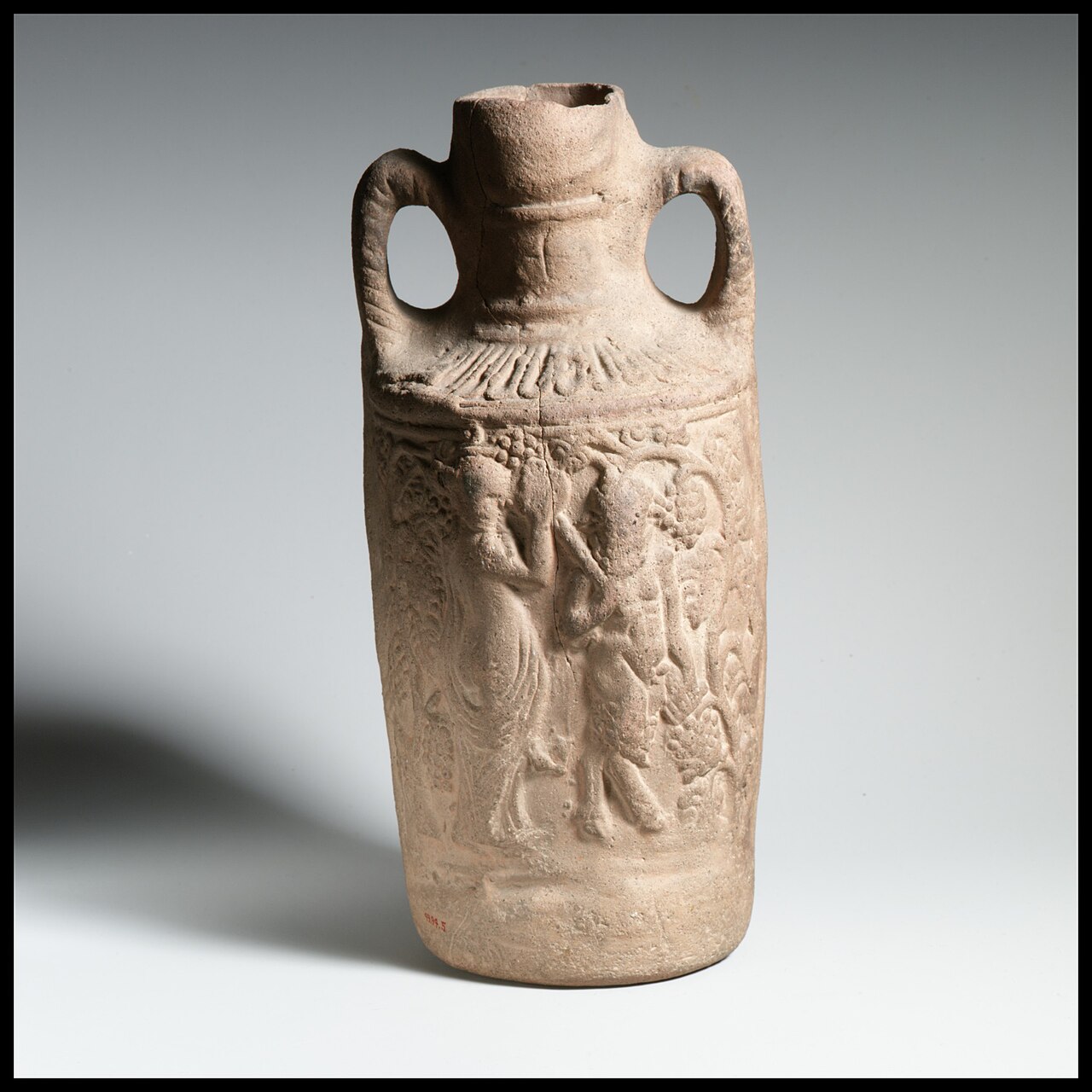
2nd–3rd century CE
Roman terracotta jug in Cnidian relief ware, made at Cnidus in southwestern Anatolia
Roman terracotta jug in Cnidian relief ware, made at Cnidus in southwestern Anatolia. Metropolitan Museum of Art, 49.94.5.
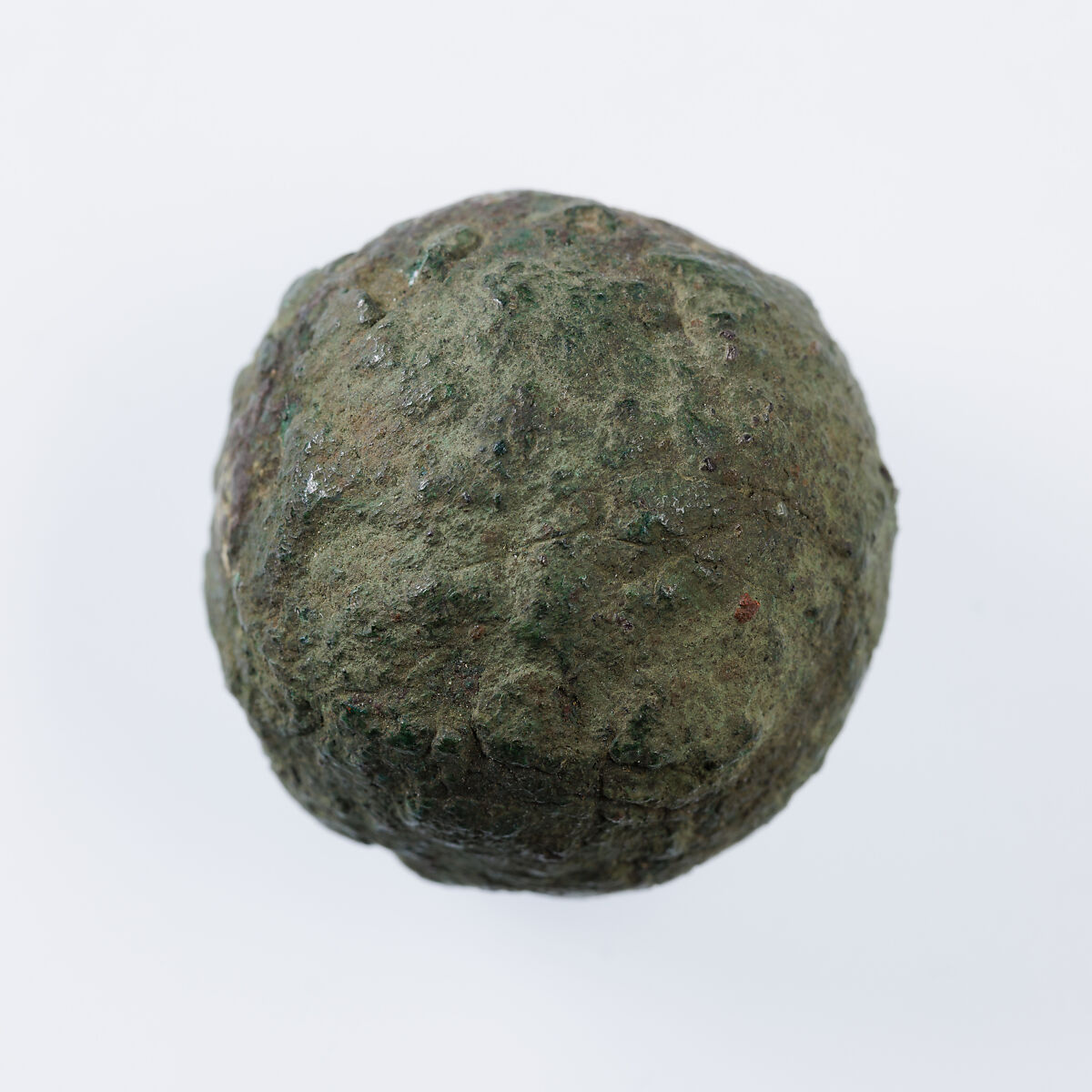
305 BCE–364 CE
Copper-alloy weight, 305 BCE–364 CE
Copper-alloy weight, 305 BCE–364 CE. From Meidum, Egypt, Cardwell excavations 1885–1890. Comparative weight, not a demonstrated Kerala weight standard.
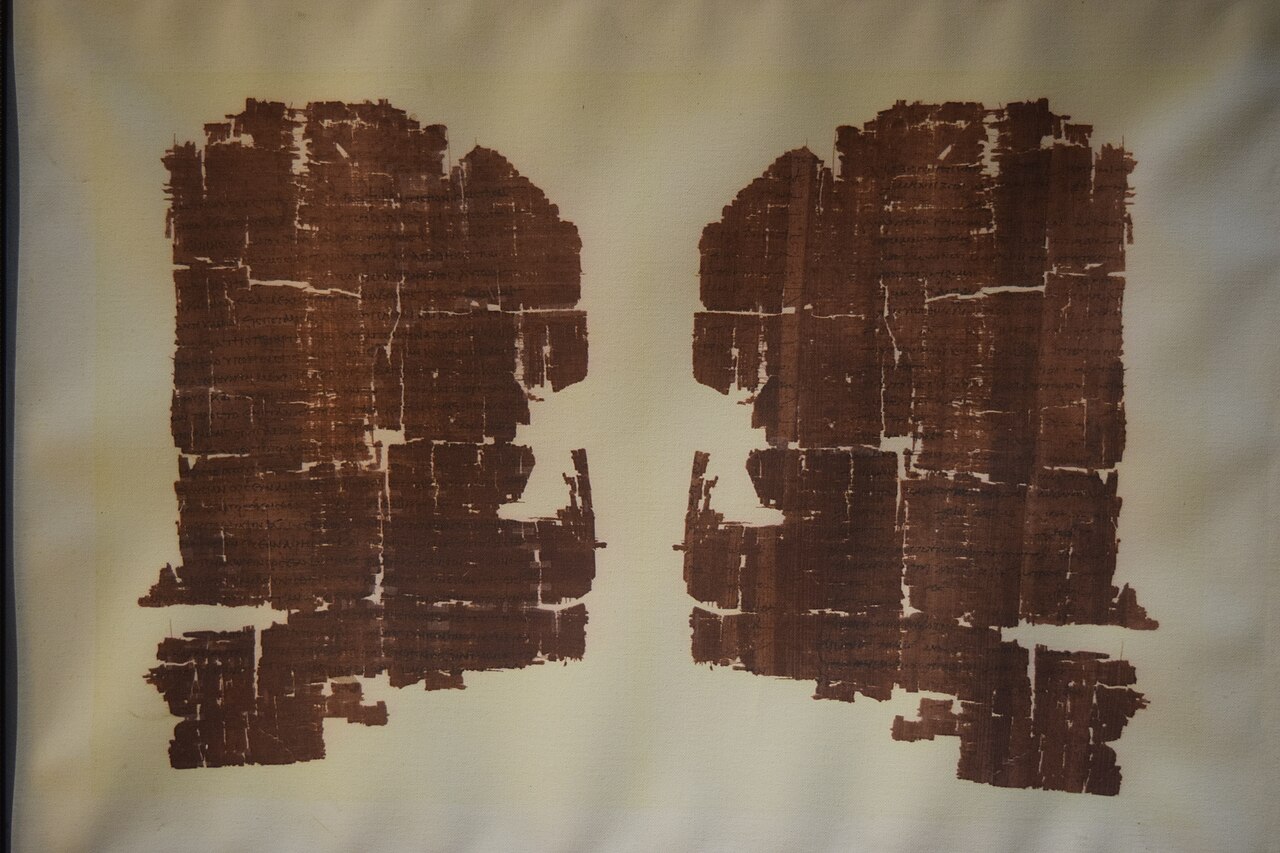
Original text: mid-2nd century CE; pictured display/facsimile modern
Photograph of the Muziris Papyrus facsimile displayed at the Pattanam Museum, taken by KannanVM in 2019
005Two views
Both views are shown at equal weight; this site does not choose between them.
How much pepper the Hermapollon cargo held
- One view
- Morelli (2011): about 4,400 weight talents, roughly 130–140 tonnes, at 24 drachmas a mina; he treats the result as uncertain.
- Another view
- De Romanis (2012 and 2020): a fiscal value of 6 drachmas a mina, giving roughly 544 tonnes of pepper and over 625 tonnes in all.
- What would settle it
- A high-resolution or multispectral reading of the damaged numerals, or a parallel customs account using the same price schedule.
What kind of agreement the surviving recto is
- One view
- Casson (1990): a supplementary agreement made after safe arrival at the Red Sea, governing the Egyptian stage of the journey.
- Another view
- De Romanis: a loan contract built into a single Alexandria–Muziris–Alexandria trading venture.
- What would settle it
- Recovery of the lost columns, which could contain the decisive terms.
006Where next
 Related study
All related studies, connected material, books and sources15 · 17
Elsewhere on this site
Read this study with a guided path: Follow a voyage
Junior Detective Quests: The Damaged Cargo Account: Reading the Muziris Papyrus
Classroom Lesson Plans: Module 2 · The Monsoon Engine: How Winds, Rivers & Boats Connected the Indian Ocean
Multi-Script Glossary Terms: Muciṟi (Muziris) (முசிறி / മുസിരിസ് / മുചിരി) · Yavaṉar (யவனர் / യവനർ) · Muziris Papyrus (SB XVIII 13167 / P.Vindob. G 40822) (முசிறிப் பாப்பிரஸ் ஆவணம் / മുസിരിസ് പാപ്പിറസ് രേഖ) · Berenike & Myos Hormos (Quseir al-Qadim) (பெரெனிகே & மியோஸ் ஹோர்மோஸ் / ബെറനിക്കെയും മയോസ് ഹോർമോസും)
Connected material
Photographs, drawings, books, videos and other studies linked to this study. A link helps you explore; it does not prove a historical claim.
- Roman, possibly Cypriot, terracotta amphora with painted Greek letters on its shoulderphotographBackground
- Photograph of the Muziris Papyrus facsimile displayed at the Pattanam Museum, taken by KannanVM in 2019photograph of museum facsimileBackground
- Roman terracotta jug in Cnidian relief ware, made at Cnidus in southwestern AnatoliaphotographBackground
- Copper-alloy weight, 305 BCE–364 CEphotographBackground
- Across an ocean – and across EgyptdiagramThe papyrus panel and the route across Egypt follow this study of what the Muziris Papyrus records.
Books, videos and websites
Outside reading on this topic. These are not part of the study and we have not checked every claim in them. See all books and videos
- The Indo-Roman Pepper Trade and the Muziris Papyrus Book · Federico De Romanis · 2020 · Exhaustive historical, agronomic, and papyrological study of P.Vindob. G 40822 (the 2nd-century CE Muziris Papyrus, whose surviving Greek lines preserve Gangetic nard, sound ivory tusks, and schidai – interpreted by De Romanis as ivory trimmings/fragments and in older editions as fabric/textiles), proposing scholarly reconstructions for pepper and malabathron tonnages and Red Sea–Alexandria fiscal logistics.
- Conference: Exploring Maritime Heritage Dynamics - Federico De Romanis Video · Federico De Romanis · University of Rome Tor Vergata (2015 event affiliation) · 34:24 · De Romanis considers the rise and decline of South Indian maritime hubs, including Muziris, Mangalore, Calicut and Cochin. Places a specialist historian’s own account beside excavation-based resources. Recorded in 2015 and deliberately spans antiquity to the sixteenth century. The date range, changing evidence and later ports must remain visible. This talk gives only general context for our study of the Muziris papyrus.
- Austrian National Library (ÖNB) – Papyrus Collection & Tabula Peutingeriana Website · Curates both the 2nd-century CE Muziris Papyrus (P.Vindob. G 40822) – recording the Hermapollon cargo from Muziris – and the UNESCO Memory of the World Tabula Peutingeriana showing 'Muziris' and 'Templ’ Augusti'.
007Sources
The study lists the sources it consulted; we have not rechecked them. A working link does not show that a source was read, and a valid identifier does not show that it supports a claim. We do not link to unofficial uploads or copies of publications. Where a study cited one, we show the published citation, or a publisher, DOI or Internet Archive link when we have one. Tracking codes are removed from links, and the sources themselves are not republished here.
Web page (papyri.info)
Der Muziris-Papyrus
kclpure.kcl.ac.uk · too much pepper federico de romanis the indo roman pepper tr
Federico De Romanis, Muziris papyrus and Indian Ocean trade study (source link 4)
Online copy not linked · use the published editionSource recordDal Mar Rosso ad Alessandria. Il verso (ma anche il recto) del ‘papiro di Muziris’ (SB 18, 13167) | TYCHE – Beiträge zur Alten Geschichte, Papyrologie und Epigraphik
Cobb and Wilkinson (2022), 'The Roman state and Red Sea trade revenue', in Networked Spaces (MOM Éditions), pp. 213–226
Matthew Adam Cobb and Troy Wilkinson, 'The Roman state and Red Sea trade revenue', in C. Durand, J. Marchand, B. Redon and P. Schneider (eds.), Networked Spaces: The Spatiality of Networks in the Red Sea and Western Indian Ocean, Archéologie(s) 8 (Lyon: MOM Éditions, 2022), pp. 213–226.
Web page (tyche.univie.ac.at)
Lionel Casson (1990), New Light on Maritime Loans: P. Vindob. G 40822, ZPE 84: 195–206
Lionel Casson, 'New Light on Maritime Loans: P. Vindob. G 40822,' Zeitschrift für Papyrologie und Epigraphik 84 (1990): 195–206 (open PDF mirror; former uni-koeln.de URL retired).
Online copy not linked · use the published editionSource recordattalus.org · p187A.html
Unofficial online copy (link not shown)
Playing Sudoku on the Verso of the Muziris Papyrus (source link 10)
Online copy not linked · use the published editionSource recordpersee.fr · topoi 1764 0733 2017 act 15 1 3003
sehepunkte.de · 34566.html
depts.washington.edu · periplus.html
TEXT AND TRANSLATION
Web page (academic.oup.com)
Web page (dlib.nyu.edu)
The Periplus Maris Erythraei: Text with Introduction, ...
Researchers and institutions whose work this study uses: Lionel Casson, Federico De Romanis
How we know The evidence, claims and dates behind this study
What this study draws on
- Morelli's 2011 critical re-edition, based on re-inspection of the original papyrus, read with its page images.
- Casson's 1990 edition, Rathbone's English translation and the Austrian National Library's 2018 account.
- Later analyses: De Romanis's 2017 article, a review of his 2020 book and an OpenEdition chapter on revenue.
- Arithmetic checks: 60 containers at 4,500 drachmas make 45 talents, so a talent here is 6,000 drachmas.
Dates in this study
This study has no dates recorded in a form we can chart, so there is no date chart. Any dates it gives are in the full study.
The study’s claims
19 claims · 0 source passages · 32 paragraphs
Browse the study paragraph by paragraphP.Vindob. G 40822 = SB XVIII 13167 is a Greek papyrus in the Austrian National Library, palaeographically placed around the mid-second century CE.
Supported in this study
Supports. Date is palaeographic, not an internal regnal/date formula.
The sheet preserves two related texts, a recto concerned with credit/transport and a verso valuation account, but their exact documentary relationship is interpretive.
Supported with qualifications
Supports relationship; qualifies legal characterization.
The surviving fragment does not preserve the parties' names and does not provide a securely preserved loan principal or interest rate.
Supported in this study
Original names are stated by ONB to have stood in lost columns; absence of principal/interest is an observation from the surviving translated passage, not proof they never existed.
The borrower undertakes Egyptian transport from a Red Sea arrival point via desert to Koptos, public warehouses, a safe Nile vessel, and Alexandria, bearing relevant expenses.
Supported in this study
Edition-mediated original-source passage.
The exact Red Sea port is not preserved.
Supported in this study
Myos Hormos and Berenike are contextual candidates, not papyrus readings.
On default, the creditor could take control of the pledged goods, deal with the tax and realize the security by sale or re-pledge.
Supported in this study
Exact legal reconstruction remains dependent on damaged context.
The papyrus documents a tetarte, a quarter/25-percent import duty associated with Alexandria.
Supported in this study
Morelli explicitly concludes import tetarte at Alexandria.
The papyrus alone does not establish a second 25-percent export duty.
Supported in this study
Morelli says the papyrus cannot decide export duties; De Romanis's double-duty model uses wider evidence.
The best-preserved verso records 60 kistai of Gangetic nard at 4,500 drachmas each = 45 money talents; treating 60 as three quarters yields 80 before the quarter-tax.
Supported with qualifications
60 and price are surviving edition entries; 80 is reconstruction.
The surviving column records “sound” ivory and a second ivory category with weight and value calculations.
Supported in this study
Identification of schidai specifically as ivory trimmings is a later scholarly interpretation, not a plain English word on the papyrus.
Morelli's revised final total is 1,151 talents + 5,852 drachmas; older Casson-era reading was 1,154 talents + 2,852 drachmas.
Supported in this study
Alternative readings must be versioned.
1,151 × 6,000 + 5,852 = 6,911,852 drachmas; “nearly seven million sesterces” is a modern approximate conversion, not a papyrus sesterce entry.
Supported with qualifications
Conversion assumes approximately 1 drachma ≈ 1 sestertius, as Palme states.
Dividing 6,911,852 by 0.75 gives a conditional pre-quarter equivalent of 9,215,802⅔ drachmas.
Supported with qualifications
Not a surviving entry; assumes the final total is an exact 75-percent remainder despite adjustments.
Pepper, malabathron and tortoiseshell quantities in the “complete cargo” are reconstructions from damaged figures, arithmetic and external parallels, not fully legible surviving cargo labels in the preserved column.
Supported in this study
External Periplus parallels provide context, not direct observation of missing papyrus words.
Morelli and De Romanis produce radically different pepper/cargo masses; no consulted source supports “1,170 pepper bales” as a surviving papyrus entry.
Supported in this study
Morelli: roughly 130–140 t pepper / roughly 180 t cargo in modern summary; De Romanis: roughly 544 t pepper / roughly 625–635 t cargo. “1,170 bales” was not found in read evidence.
An older reading that appeared to assign 20 talents to a cameleer was superseded by Morelli's direct reinspection; transport cost is required but no such 20-talent charge should be used.
Supported in this study
A concrete example of why edition history matters.
The papyrus cannot establish typical annual ship numbers, annual trade volume or total Roman customs revenue.
Supported in this study
Modern modelling that multiplies this cargo by Strabo's much earlier 120-ship figure rests on additional assumptions.
“Maritime loan” or “secured commercial credit” is safer than treating “bottomry” as a fully demonstrated modern legal equivalent.
Supported with qualifications
Scholars disagree on whether recto is the loan itself, a security instrument, or a related/supplementary agreement.
The Hermapollon is named in the total line, but its exact role as the ocean-going Muziris carrier versus a vessel in the Egyptian transport sequence is reconstructed.
Debated in the sources
Morelli and De Romanis place different weight on the vessel's role; recent debate was not fully read.
About this study Status, corrections and how it was made
Status
Draft study, revision 8. No historian, archaeologist, or Tamil or Malayalam specialist has reviewed it yet.
How it was made
Compiled as an editorial synthesis from published scholarship around questions we framed. About this project & workflow
The summary, How sure lines and Two views notes on this page were prepared from this study and cross-checked against its passages. That is an editorial check, not a specialist review.
Technical details
Study code R121. The text fingerprint changes whenever the study text changes.
- Table headings decide what each column means. Citation links, sample mentions and dates copied as text are kept apart from checked source passages and calibrated measurements.
See how this study’s records were extracted
Text fingerprint (SHA-256): R121 · a93d0fef97a79dd0689543d8… · v8
Evidence tables and technical details are on the web page: https://layersofthesouth.org/read/50f0cddabd