Brickwork and associated deposits exposed at Keezhadi (Keeladi)
Keezhadi
Photographed 2019-09-06
- How we know
- 500–200 BCE
- 200 BCE–300 CE
Evidence has layers: observed, stated, inferred and unknown
Using Keeladi, Mangulam, a Sangam poem and the Muziris Papyrus, this study shows how to keep observation, source statement, interpretation and reconstruction apart.
- This page
- 4,331 words · revision 13
Draft study · Awaiting specialist review · Updated
001Dates and places

No mapped place in this study.
1000–500 BCE
Different beginnings
500–200 BCE
Marks & materials
200 BCE–300 CE
Connected worlds
300–600 CE
Change & continuity
- 580 BCE, reported calendar-year summary for a carbon analysis
- third century BCE
- circa second century BCE
- first to third centuries CE, broad conventional position represented by Hart
- Laboratory date
- Date from writing, coins or texts
Each date belongs to what was dated (a sample, an object, a layer or a text), which is not always the event the study asks about.
Each period has the same width, so spacing is not to scale.
The full table of dates, with their ranges, is under How we know.
- 2 Well supported
- 1 Likely
- 1 Not known
002How sure
In brief
This study sets out a method for reading historical evidence. It sorts claims under five labels: observed, source says, interpreted, reconstructed and unknown. At Keeladi (Keezhadi), a ring well in trench YP5 is a field observation. The Keezhadi study documents the laboratory record behind TNSDA's public 580 BCE figure (Beta-519476, trench YP7/4, 353 cm, charred material, 2530 ± 30 BP), while full stratigraphic tables tying that sample across every inscribed sherd and phase – and K. Amarnath Ramakrishna's 2014–16 ASI report, still unpublished and under review as of late 2026 – remain pending. The Mangulam cave inscriptions were collected in 1906, discussed in 1924 and later deciphered more fully by Mahadevan. Akanāṉūṟu 149 names Yavanar, gold, kari and Musiri, but reading these as Romans, pepper and Pattanam takes separate arguments. The Muziris Papyrus names Muziris directly, yet its exact date and the parties' names are lost. Later traditions and heritage pages are treated as evidence for their own time.
Key researchers cited in this study: Iravatham Mahadevan (Tamil-Brāhmī Epigraphy) · K. Rajan (Kodumanal & Porunthal Excavations / Epigraphy) · R. Sivanantham (TNSDA Keezhadi / Keeladi & Tamil Nadu Excavations) · R. Champakalakshmi (Trade, Ideology & Urbanization) · Full bibliography
How sure
- Well supported
The Muziris Papyrus is a Greek loan document naming Muziris, from about the mid-second century CE.
Austrian National Library account; the date comes from handwriting because the original date is lost.
- Well supported
Akanāṉūṟu 149 places Yavanar, gold, kari and Musiri together in one passage.
Read in the Tamil Virtual Academy text; reading them as Romans, pepper and Muziris needs separate arguments.
- Likely
The core of the Sangam anthologies was composed in the early centuries CE (later strata and the anthologising are later).
The majority dating, as summarised in Hart's reply to Tieken; Zvelebil and Wilden are named there but were not read for this study.
- Not known
How widely the 580 BCE radiocarbon sample (Beta-519476) dates Keezhadi's inscribed pottery and urban phases.
The Keezhadi study records Beta-519476 (YP7/4, 353 cm, 2530 ± 30 BP), but full phase-by-phase stratigraphic tables and the 2014–16 ASI excavation report remain unpublished.
Why it matters
A clear method lets readers see exactly where a historical claim moves from what was found to what is inferred.
003Key findings
What the study concludes
- A setting-level contact claim cannot establish a person-level event.
- Scientific dates, epigraphic readings and literary identifications have different inferential chains.
- Repeated retelling and schema-valid metadata do not create independent evidence.
In the study’s own words. How sure each point is, is shown above.
The summary above is the short read. The full study is the complete text it was drawn from, with its tables and source notes.
What the full study covers
004The study
Overview
How should readers distinguish observations, source statements, historical interpretations, reconstructions and unknowns in this regional corpus?
A good label keeps four things apart: what you can see, what you infer, what stays open and how to check it. The bead is an invented teaching object with no accession number, findspot, date or laboratory result.
The four-part label keeps observation, interpretation and open questions apart, as this study recommends.
Layers of the South editorial illustration
The central methodological point is that a pot, a poem, an inscription and a commercial document do not answer the same historical question. Evidence for a historical setting is not automatically evidence for a particular event; an object does not identify its owner; comparison is not local evidence; and an unanswered question can be a responsible result. This study works through those distinctions with evidence from Keeladi/Keezhadi, the Mangulam inscriptions, Akanāṉūṟu 149, and, as a connected-region documentary control, the Muziris Papyrus.
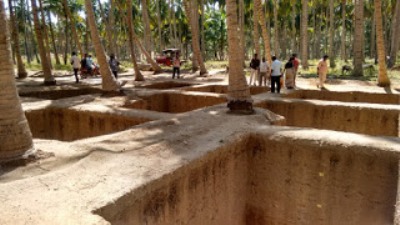
Excavation trenches between coconut palms at Keezhadi in 2016
Keezhadi
Photographed 2016-10-11
The most useful rule is to label the kind of reasoning being performed:
| Label | What it means in this study | What it does not mean |
|---|---|---|
| Observation | A recorded material or textual datum tied to a context, object, measurement, image or consulted passage. | An interpretation-free “fact”: excavation, measurement, imaging and transcription still involve choices. |
| Source statement | What an ancient text, inscription, papyrus, excavation report or catalogue actually says or records. | Automatic truth about the event represented by the source. |
| Interpretation | A reasoned inference from observations or source statements using a stated method. | Something that should be hidden inside apparently factual prose. |
| Reconstruction | A synthesis that connects observations across gaps in place, time or evidential type. | A directly witnessed historical scene. |
| Unknown | A question not resolved by the evidence read, including questions blocked by missing data or source access. | Evidence that the contrary proposition is true. |
These categories are not a ladder from weak to strong evidence. A careful interpretation can be better supported than an erroneous observation; a textual statement may be certain as wording while uncertain as historical description. Their purpose is to make inferential transitions visible.
Four findings follow.
First, dates must be attached to what is actually dated. A carbon sample, an excavated context, a potsherd carrying writing, a palaeographically dated inscription, the composition of a poem, its later anthologization, a surviving manuscript and a modern publication all have different chronologies. Modern radiocarbon calibration work exists precisely because a radiocarbon measurement is not itself a calendar date; calibration and uncertainty are part of the inference. ↗1
Second, a source statement is not the same thing as a historical identification. Akanāṉūṟu 149 visibly contains the Tamil terms conventionally transcribed as Yavanar, kari and Musiri; moving from those words to “Roman merchants,” “black pepper,” “Muziris” and finally a particular archaeological site requires successive lexical, historical and geographical arguments. The Tamil Virtual Academy page supplies the text, not all those identifications. ↗2
Third, independence concerns provenance, not quantity. Ten websites copying one critical edition are one evidential lineage, not ten witnesses. An inherited citation can be perfectly formatted while pointing to an unread or misidentified work. The Mangulam example is especially clear: an online transcription that derives from Mahadevan cannot independently confirm Mahadevan merely by repeating his reading. The modern history of the Mangulam inscriptions itself runs through collection, decipherment and republication. ↗3
Fourth, version history is evidence metadata. A correction should preserve what was previously said, identify the new basis, and state what changed. Two small bibliographic cases below show the rule at work: a book title remembered wrongly, and a modern monograph filed under “primary sources.” ↗4
Scope, chronology and evidential discipline
The period this site covers is 1000 BCE–600 CE, but that is an editorial boundary, not a finding. The principal ancient evidence considered here falls within that window: the proposed early Keeladi chronology, the pre-Common-Era Mangulam inscriptions, the disputed early chronology of Cankam poetry, and the approximately mid-second-century-CE Muziris Papyrus. The history of discovery, excavation, editing, publication and scholarly controversy is necessarily later reception. The study therefore spans a mixed chronology.
The regional core is Tamil Nadu and Kerala, with the Red Sea/Egyptian side of the Muziris Papyrus admitted because it directly bears on an ancient commercial relationship involving a place named Muziris. That geographical connection does not authorize unrestricted use of every Roman-period source as evidence for South India.
Four distinctions follow.
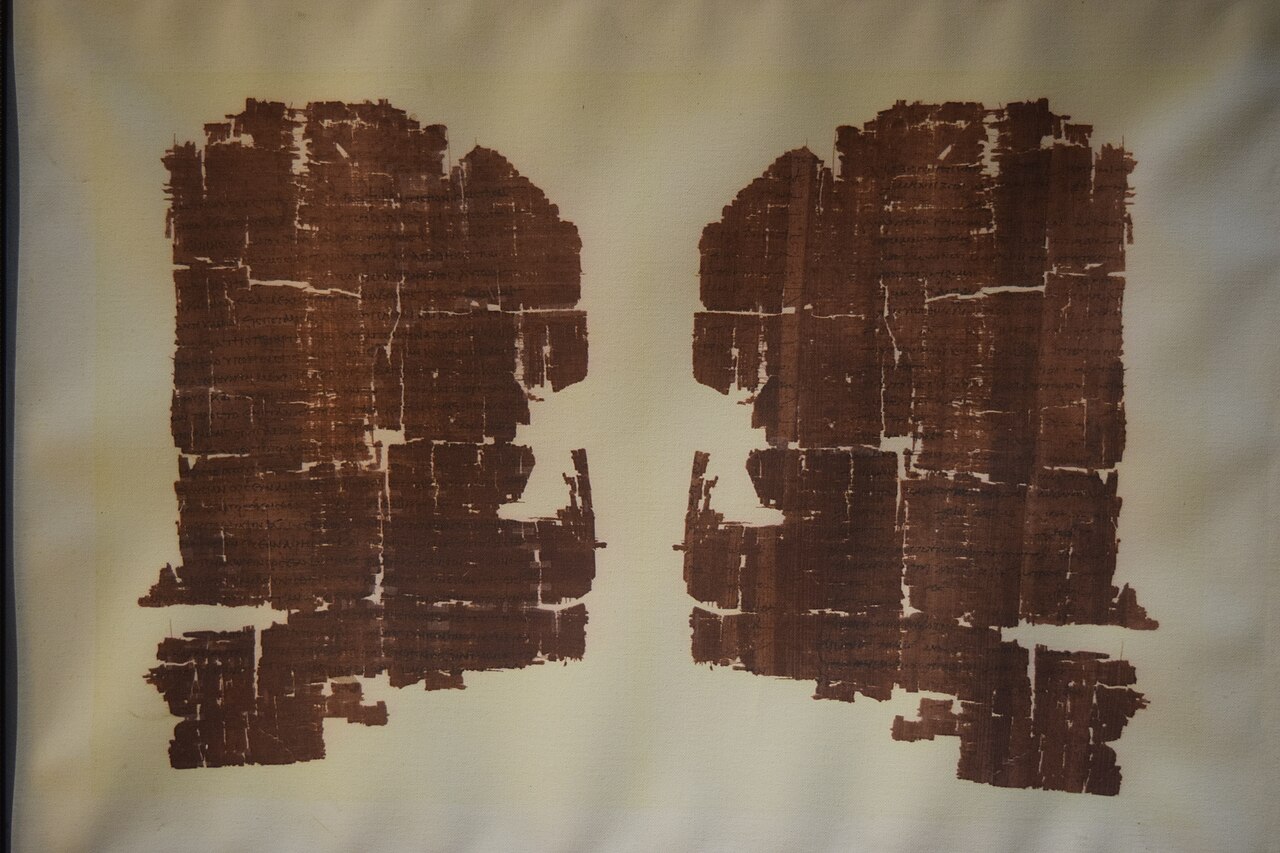
Setting is not event. The Muziris Papyrus can support the proposition that a transaction was framed with reference to Muziris; it cannot identify a particular traveller who visited a particular archaeological layer. Likewise, a poem representing overseas ships does not document every voyage that occurred at the represented port. The Austrian National Library describes P.Vindob. G 40822 / SB XVIII 13167 as a Greek loan document connected with a sea-trade voyage involving Muziris and later transport toward Alexandria. It also states that the original exact date is lost, while palaeography places the document around the middle of the second century CE. ↗5
Object is not owner. An excavated ring well can be assigned to a trench and measured; those observations do not identify the ethnic, occupational or linguistic identity of the person who constructed or used it. An inscribed surface can preserve marks; it does not, without epigraphic analysis, supply its own normalized script, word divisions or translation.
Analogy is not local evidence. A general archaeological method, a botanical distribution database or evidence from another port may constrain what is plausible, but it does not become evidence for Keeladi, Mangulam or Pattanam merely because the comparison is reasonable.
Absence must be typed. “The relevant critical-edition pages were not read for this study” is an access limitation. “The laboratory code was not present in the page read” is a metadata gap. “The archaeological relationship is genuinely disputed” is a scholarly uncertainty. “No evidence exists” is a much stronger historical proposition and should not be substituted for any of those statements.
The same rule applies to preservation. The possibility that palm leaf, wood or textile decayed is relevant to archaeological expectations, but decay is not positive evidence that a particular lost manuscript or object once existed.
A practical evidence record should therefore carry, beside each consequential claim: source and locator; access extent; thing being dated; dating method; direct wording or observation; interpretation; alternatives; evidential lineage; and unresolved information. Those fields are more informative than a single confidence percentage.
Later stories are evidence for their own time
A regional history needs separate timelines for settlement, waterways, political power, language, religious communities and trade. Earlier evidence and later comparisons should be identified as such rather than silently absorbed into 1000 BCE–600 CE. A later tradition can be historically important without documenting the period it describes. A public heritage narrative is a source to examine, not automatic verification: the Kerala Tourism history page for the Muziris Heritage Project is useful evidence for how Muziris is presented today, but it brings together events and traditions from very different periods, so it is a starting point for investigating claims rather than a substitute for the geological, textual and archaeological studies each claim requires. (Kerala Tourism / Muziris Heritage Project (undated). Muziris Heritage Project: History)
A dramatic explanation for a port’s transformation, such as a single catastrophic flood in 1341, has to be taken apart before it can be tested. It may mean a change of river channel, the destruction of buildings, reduced access for shipping, a new political centre or the disappearance of a name. Those are different events and may not share a date, and repeating a precise date from a heritage page does not test any of them. “Kodungallur digs found medieval layers, Pattanam much older ones” examines the 1341 claim against the excavated record, and “Sediment cores cannot yet fix the Periyar mouth of Muziris’s time” and “Vembanad lagoon is far older than 1000 BCE and kept changing” discuss it alongside the sediment and lagoon evidence. (Kerala Tourism / Muziris Heritage Project (undated). Muziris Heritage Project: History)
Origin traditions need the same care. Keep a tradition’s wording and its history of retelling, distinguish the earliest surviving telling from the event it describes, and avoid both credulous acceptance and casual dismissal. A tale can shape ideas of belonging and authority without being a literal account of how land was formed. “Kerala's serpent groves are not shown to date to the Iron Age” works through one such tradition, the Kēraḷōlpatti, which narrates Kerala’s ordering through Paraśurāma.
Captions need dates too. A living craft can make a process intelligible and preserve expertise worth hearing, but it cannot by itself date every present tool or design to the first century. “Living practice filmed today”, “experimental reconstruction” and “evidence for an ancient operation” are different descriptions, and a reader should be able to tell which is being offered before drawing conclusions from a convincing image. In the same way, genetic ancestry, language and modern community identity are separate questions; “Dravidian languages form one family; its homeland is not known” treats them.
Worked archaeological and epigraphic evidence
Keeladi: observation before social reconstruction. A Tamil Nadu Department of Archaeology field note on the seventh excavation season gives the sort of information that can legitimately begin an evidence chain: a ring well in trench YP5, its reported depth, diameter, ring height and additional courses; the same notice describes another ring-well context in YP4/1. These are context-linked field statements rather than general claims about “Sangam civilization.” ↗6
Depth alone is not a date. Cut C slices through floor B, so the pit and its fill D are later than the floor, even where both lie 180 cm down. The coin gives only an earliest possible date for fill D.
A worked example of keeping an observation (where a find lies) apart from an inference (how old it is).
Layers of the South editorial illustration
The Department’s broader Keeladi webpage makes a different kind of move. It reports a carbon-analysis result expressed as 580 BCE, and proceeds from chronology toward statements about sixth-century-BCE Tamil-Brahmi, literacy and a “second urbanization” in Tamil Nadu. ↗7 Those may ultimately be defensible interpretations, but they are not the same proposition as “a dated sample produced a result summarized as 580 BCE.”
For a reproducible chronological argument, the missing bridge matters. A reader needs to know, at minimum, which sample was dated, its archaeological context and association, material, laboratory identifier, conventional radiocarbon measurement and standard error, calibration curve/software, and the resulting probability interval or intervals. IntCal20 is a primary methodological reminder that calibration converts radiocarbon measurements into calendar-age probability distributions; uncertainty cannot responsibly be replaced by a single calendar year without showing how that year was obtained. ↗1
Accordingly, this study records the public “580 BCE” headline alongside the specific laboratory measurement documented in study “Keezhadi's excavations reveal a substantial brick settlement”: Beta Analytic sample Beta 519476, recovered from trench YP7/4 at 353 cm depth on charred material, with a conventional radiocarbon measurement of 2530 ± 30 BP. The familiar 580 BCE is simply that measurement subtracted from 1950; it is not a calibrated date. A 2025 Tamil Nadu State Department of Archaeology table also prints the single year 531 BCE beside it as a calibrated age, and “Keezhadi's excavations reveal a substantial brick settlement” shows that this year falls outside the range of about 792–545 cal BCE that the measurement gives when calibrated with IntCal20 at 95.4 per cent. Even with that sample record identified, a single radiocarbon measurement must not be treated as a zero-uncertainty calendar date or used to date every written potsherd or structural phase at Keeladi.
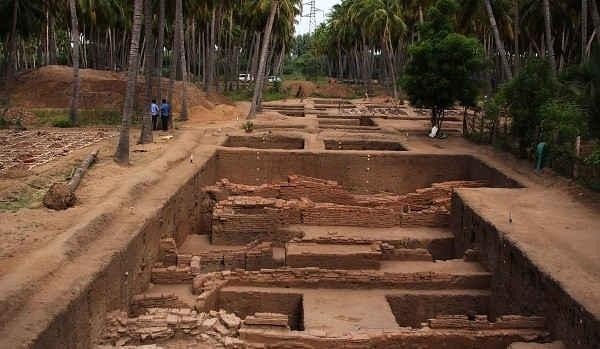
Long view across excavation trenches and exposed brick structures at Keezhadi
Keezhadi
Photographed 2018-05-28
The 2019 Tamil Nadu Department of Archaeology volume Keeladi: An Urban Settlement of Sangam Age on the Banks of River Vaigai, edited by R. Sivanantham and M. Seran, was bibliographically located in the Tamil Digital Library and catalogue records. Its pages were not read for this study. ↗8 That is a limit of this study’s reading, not evidence against the report. “Keezhadi's excavations reveal a substantial brick settlement” covers the Keezhadi excavations and their dating in full.
Mangulam: the stone, the reading and the historical claim. The Tamil Nadu archaeology summary describes caves and stone beds at Mangulam/Ovamalai and assigns the inscriptions broadly to the third century BCE; it reports readings involving names or titles such as Nedunchezhiyan and Valuti. ↗9 A digitized introduction to South Indian Inscriptions, Volume XXII, Part I, gives useful historiography: Mangulam nos. 460–465 were collected in 1906, discussed by K. V. Subrahmanya Ayyar in 1924, and later more completely deciphered and published by Iravatham Mahadevan; the introduction describes the language as Tamil with Prakrit elements and the script as Brahmi. ↗10
That sequence exposes the inferential layers unusually well:
| Layer | Mangulam example |
|---|---|
| Observation | Incised signs occur on a rock/cave surface in an archaeological landscape. |
| Editorial source record | An epigrapher numbers the inscription, draws or photographs signs, identifies graphemes and publishes a transcription. |
| Source statement | Under an adopted reading, the text contains sequences interpreted as names/titles and records an act involving a bed, shelter or donation. |
| Interpretation | Grapheme values, word boundaries, Tamil versus Prakrit forms, semantic meanings, palaeographic date and social titles are argued. |
| Reconstruction | Identifying a named ruler with a particular literary/historical king, defining the patronage network, or reconstructing an institutional religious landscape joins multiple arguments. |
| Unknown | Readings, precise dating and identity remain open wherever the critical apparatus or physical evidence does not discriminate decisively. |
Mahadevan’s Early Tamil Epigraphy: From the Earliest Times to the Sixth Century A.D. was bibliographically identified as the relevant major critical study, but its Mangulam pages were not read for this study. ↗11 An online Mangulam transcription gives an exact, usable locator and presents a reading including Nanta-siri, Neṭuñcaḻiyaṉ, Katalan and Vaḻuti, but because it depends on Mahadevan it is a derivative account, not independent confirmation. ↗12
This matters especially for historical identity. A sequence read as a ruler’s name or title is evidence for that sequence under the adopted reading. It is not automatically evidence that a literary character with a similar name is the same individual. The stronger proposition requires independent chronological, prosopographical and contextual evidence. “Mangulam's inscriptions name a ruler's servant, kin and a guild” is the full study of the Mangulam inscriptions.
Worked literary and documentary evidence
Akanāṉūṟu 149: what the poem actually gives us. The Tamil Virtual Academy’s electronic text presents poem 149 and attributes it to Erukkattur Tayangkannanar. In the relevant passage it reads, in part, “யவனர் தந்த வினை மாண் நன் கலம் / பொன்னொடு வந்து கறியொடு பெயரும்”, followed by reference to prosperous முசிறி – Musiri. ↗2
At the source-statement level, therefore, the defensible result is modest but significant: this transmitted poem juxtaposes Yavanar, a fine ship or vessel, gold, kari, and Musiri. A modern explanatory tradition renders the passage as foreign/Yavana ships arriving with gold and departing with pepper. ↗13
Several familiar historical sentences already go beyond that literal level.
“Kari means black pepper” is a lexical interpretation. “Yavanar here means specifically Roman merchants” is a historical-semantic interpretation; the term’s range cannot be settled simply by replacing it with a modern nationality. “Musiri is the Muziris of Greco-Roman texts” is a cross-linguistic geographical identification. “Muziris was Pattanam” is another archaeological-geographical argument. “This poem describes the same traffic documented by the surviving Muziris Papyrus” is a still stronger reconstruction. None becomes false merely because it is interpretation; the point is that each needs its own evidence.
The chronology of the Cankam corpus further demonstrates why source date and represented event must be separated. The majority scholarly placement, as summarised in George Hart's reply to Herman Tieken (Zvelebil and Wilden are named there but were not read for this study), assigns the core Sangam anthologies to the early centuries CE, with later strata and anthologization following; Tieken proposed a substantially later redating. ↗14 The responsible response is not to average the positions into an invented middle date. The discriminating evidence would include linguistic stratification, relationships with securely dated inscriptions and loanwords, historical references, anthology formation, manuscript transmission and the internal arguments of both dating models.
“Two Tamil poems use Muziris's wealth for different ends” compares Akanāṉūṟu 149 with Puṟanāṉūṟu 343 and treats what the poems can and cannot say about literary Musiri.
The Muziris Papyrus as a documentary control. The papyrus is valuable precisely because it shows a different evidence type. Bernhard Palme’s Austrian National Library account identifies it as P.Vindob. G 40822 / SB XVIII 13167, a Greek loan document tied to transport of Indian imports. The exact date once carried by the papyrus is lost; palaeographical evidence places it around the middle of the second century CE. The recto preserves a contract concerning the Egyptian portion of the goods’ journey and refers to arrangements concluded at Muziris; the verso records goods and values. The papyrus is broken at its margins, so the contracting parties’ names are lost, and the surviving passage does not preserve which Red Sea port first received the Indian cargo. ↗5
That pattern is historiographically instructive. The source itself states Muziris. It supplies documentary evidence for a transaction framed with reference to that named place. Yet identifying the papyrus’s Muziris with the poem’s Musiri and then with an excavated site is not part of the papyrus’s wording. The correspondence may be strongly arguable, but it belongs in an explicit interpretation layer rather than being smuggled into the observation.
The same document also shows why “unknown” is positive scholarly information. We know that the exact date, contracting names and Red Sea arrival-port passage are missing because the document’s state and surviving text delimit them. Those are substantive historical unknowns, unlike the separate modern access gap created when a researcher has not read a particular book. “Muziris Papyrus records credit, cargo values and a quarter tax” examines the Muziris Papyrus in detail.
Disagreement, independence and version control
The strongest disagreements encountered here should be recorded by what evidence could actually discriminate between them.
| Issue | Competing or non-identical claims | What would discriminate | Present outcome |
|---|---|---|---|
| Keeladi early chronology | Public page reports 580 BCE and extends that chronology toward writing/urbanization; later review reporting questions proposed early periodization. | Sample-context table, laboratory results, stratigraphy, associated diagnostic material, complete phase publication. | Early date statement retained; broader inference qualified. |
| Mangulam date/readings | Institutional summaries use a third-century-BCE placement; modern treatments may give approximately second century BCE for particular texts. | Facsimile/photogrammetry, letter-form comparison, critical apparatus, linguistic arguments. | Century-level disagreement retained. |
| Cankam chronology | Conventional early-centuries-CE dating versus Tieken’s substantially later redating. | Full linguistic, epigraphic, historical and transmission arguments. | Contested; no averaged date. |
| Musiri/Muziris/Pattanam | Literary, Greek documentary and archaeological place-identifications may be correlated. | Historical geography, palaeoenvironment, inscriptions, excavation context and independent chronological linkage. | Proposed relationship, not automatic entity merge. |
| Keezhadi report status | In July 2025 the central government said the report had been submitted and vetted; later reporting described continued review and an ordered 2026 re-examination. | Locate the authoritative final public edition and revision record. | Unpublished and under review as of late 2026. |
The last row is a particularly useful correction/versioning example. A Ministry of Culture webpage dated 30 July 2025 carried the press headline “ASI Publishes Keezhadi Excavation Report in Line with Scientific Protocols,” ↗15 whereas the Ministry's contemporaneous answer in Parliament (Rajya Sabha Unstarred Question No. 513, 24 July 2025) stated that K. Amarnath Ramakrishna's 2014–16 report had been submitted and vetted with expert comments returned to the excavator (sansad.in). Subsequent reporting in late 2025 and 2026 confirmed that the 2014–16 report remained unpublished and under review amid objections to its proposed periodization, with the ASI Director General ordering an on-site re-examination committee in June 2026. ↗16 ↗17
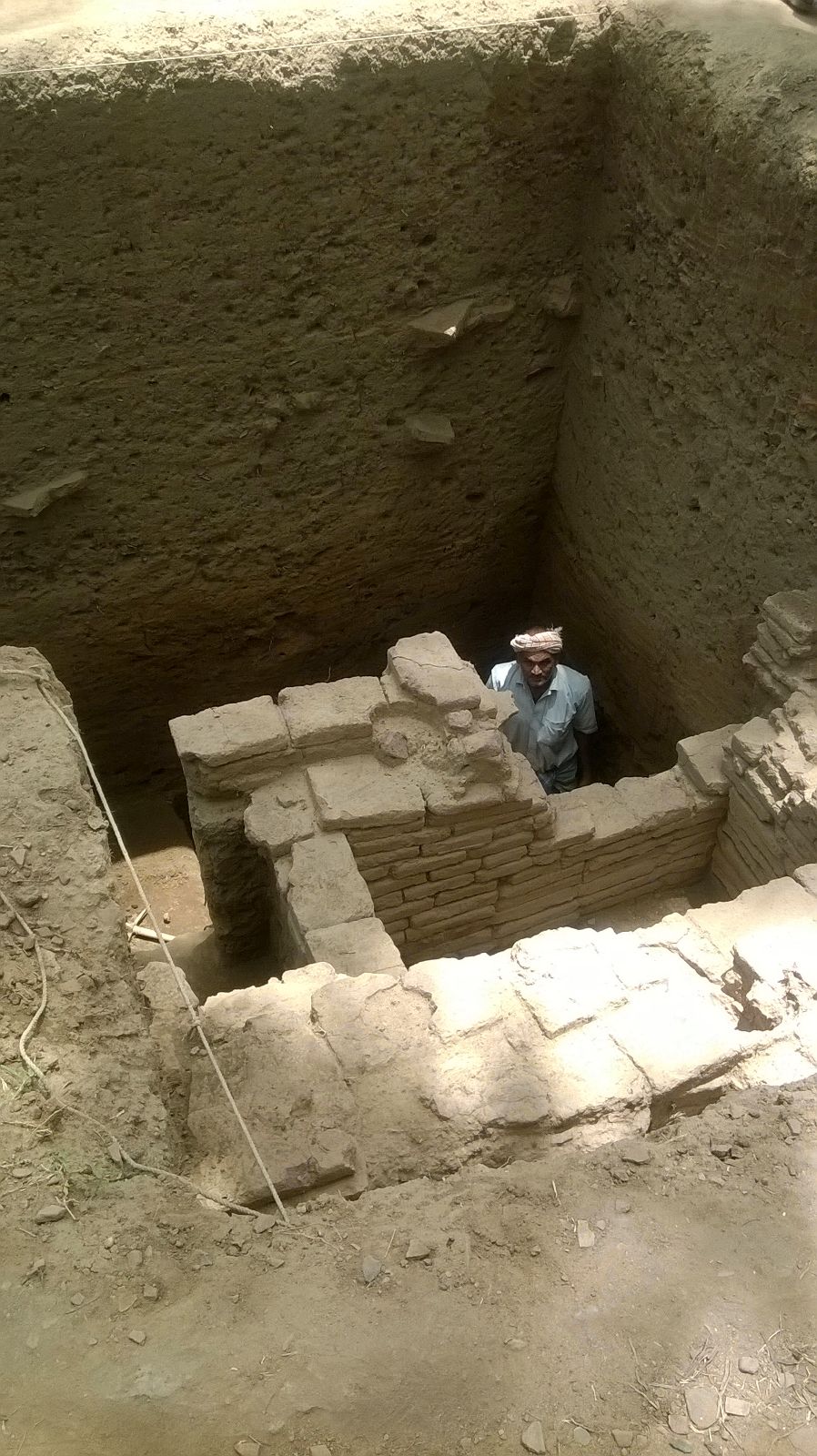
Excavated brickwork within a Keezhadi trench in 2015
Keezhadi
Photographed 2015-09-14
As study “Chank-shell working is attested at Korkai; Keezhadi so far shows only finished bangles” likewise concludes, the 30 July 2025 Ministry webpage therefore reflects a procedural review statement rather than an available published report; K. Amarnath Ramakrishna's report on the 2014–16 ASI seasons remained unpublished and under review as of late 2026.
The same logic applies to bibliography. A reference remembered as “K. Rajan, Archaeological Methodologies” is a lead, not a verified title. The Roja Muthiah Research Library catalogue lists K. Rajan’s Archaeology: Principles and Methods, published at Thanjavur by Manoo Pathippakam in 2002. ↗18 Correcting the title is a bibliographic correction. It does not mean that the book itself was read.
Likewise, R. Champakalakshmi’s Trade, Ideology and Urbanization: South India 300 BC to AD 1300 is a modern historical monograph published by Oxford University Press, not an ancient “primary source,” whatever heading a reading list gives it. ↗19
These examples explain two common false stand-ins for verification:
Inherited citation ≠ verification. A citation proves at most that someone supplied a reference until the work, edition and relevant passage are checked.
Repeated retelling ≠ independence. Two institutional pages may reproduce the same excavation claim, and ten online transcriptions may descend from one critical edition.
Conclusions, open questions and bibliography
The method comes down to one practical rule:
Never let a sentence cross an evidential boundary silently.
A sentence beginning with an excavated measurement should state when it moves to dating or social inference. A transcription should identify the edition and distinguish the visible marks from editorial normalization. A literary quotation should separate its words from translation and historical identification. A reconstruction should name the propositions that must all be true for the reconstruction to hold. An unknown should state whether it arises from missing ancient evidence, scholarly disagreement, unpublished data or the present researcher’s access.
Five compact labels – Observed, Source says, Interpreted, Reconstructed, Unknown – make those transitions legible without burdening readers with the entire research record.
The most useful missing evidence is similarly specific:
| Question | Missing evidence | What stronger conclusion it would enable |
|---|---|---|
| Keeladi dating | While “Keezhadi's excavations reveal a substantial brick settlement” locates the laboratory record behind the 580 BCE headline (Beta 519476, YP7/4, 353 cm, charred material, 2530 ± 30 BP), stratigraphic cross-tables linking that sample across written sherds and structural phases still require complete publication. | Reproducible phase-by-phase assessment of what exactly is dated and whether written/structural contexts are directly associated. |
| Keeladi publication | Relevant pages, tables and figures of the 2019 Tamil Nadu report, plus the definitive public ASI first-two-season report/version after the 2026 re-examination process. | Phase-by-phase rather than webpage-level chronology. |
| Mangulam | Mahadevan’s exact critical-edition entries and apparatus for Mangulam, preferably checked against inspectable photographs/facsimiles. | Publication-grade grapheme readings, segmentation, translation and palaeographic evaluation. |
| Classical Tamil | A scholarly critical Tamil edition and vetted translation of Akanāṉūṟu 149, together with full arguments in the dating debate. | Stronger lexical treatment of Yavanar, kari, Musiri and poem chronology. |
The chief substantive limit is therefore not that “we know nothing.” We know a great deal about what particular records state and about some physical/contextual observations. The limit is that different propositions are justified at different levels. Keeping those levels separate is what makes a source-led corpus correctable.
Selected bibliography and durable source trail
| Work or record | How this source was used | URL |
|---|---|---|
| Bernhard Palme, “Der Muziris-Papyrus,” Austrian National Library, 2018. | Institutional web page read in full; not the papyrus facsimile or a critical edition. | https://webarchiv.onb.ac.at/web/20180701181746/https:/www.onb.ac.at/forschung/forschungsblog/artikel/news/der-muziris-papyrus/ |
| Department of Archaeology, Government of Tamil Nadu, “Keeladi.” | Official summary page; read in part. | https://www.tnarch.gov.in/node/1257 |
| Department of Archaeology, Government of Tamil Nadu, “Ring wells exposed in ongoing archaeological excavation at Keeladi.” | Context-specific excavation statement. | https://www.tnarch.gov.in/ring-wells-exposed-ongoing-archaeological-excavation-keeladi |
| Reimer, Paula J., et al. “The IntCal20 Northern Hemisphere Radiocarbon Age Calibration Curve (0–55 cal kBP).” Radiocarbon 62.4 (2020). DOI 10.1017/RDC.2020.41. | Calibration-method reference; abstract read. | https://doi.org/10.1017/RDC.2020.41 |
| Department of Archaeology, Government of Tamil Nadu, “Ovamalai kalvettu.” | Official Mangulam summary. | https://www.tnarch.gov.in/node/419 |
| Archaeological Survey of India, South Indian Inscriptions, Vol. XXII, Part I, Introduction. | Digitized historical introduction to Mangulam nos. 460–465. | https://www.whatisindia.com/inscriptions/south_indian_inscriptions/volume_22/part_1/introduction.html |
| Iravatham Mahadevan, Early Tamil Epigraphy: From the Earliest Times to the Sixth Century A.D. Cre-A, 2003. ISBN 9780674012271. | Bibliographic description only; the Mangulam pages were not read for this study. | https://books.google.com/books/about/Early_Tamil_Epigraphy_from_the_Earliest.html?id=iMBMPgAACAAJ |
| “Mangulam 1,” derivative interactive transcription. | Exact online locator; not independent of Mahadevan. | https://brahmi.mvbhaskar.com/Mangulam/Mangulam_1_1/Mangulam_video_1_1.html |
| Tamil Virtual Academy, Akanāṉūṟu 149. | Tamil electronic text read. | https://www.tamilvu.org/ta/library-l1270-html-l12703b0-125603 |
| R. Sivanantham and M. Seran, eds., Keeladi: An Urban Settlement of Sangam Age on the Banks of River Vaigai. Tamil Nadu Department of Archaeology, 2019. | Catalogue record only; the report’s pages were not read for this study. | https://tamildigitallibrary.in/Articles/%E0%AE%A8%E0%AF%82%E0%AE%B2%E0%AF%8D-65817-Keeladi-an%20urban%20settlement%20of%20sangam%20age%20on%20the%20banks%20of%20river%20vaigai |
| K. Rajan, Archaeology: Principles and Methods. Thanjavur: Manoo Pathippakam, 2002. | Catalogue record only; book not yet read. | https://rmrl.in/en/onlinecat/76881/archaeology |
| R. Champakalakshmi, Trade, Ideology and Urbanization: South India 300 BC to AD 1300. Oxford University Press, 1996. | Journal review record only; book not yet read. | https://www.cambridge.org/core/journals/journal-of-asian-studies/article/abs/trade-ideology-and-urbanization-south-india-300-bc-to-ad-1300-by-r-champakalakshmi-delhi-oxford-university-press-1996-new-york-oxford-university-press-1998-xiv-485-pp-3995-cloth/B0E7CF3190B20124EA8D9C80CFFF2855 |
005Photographs
Photographs of the places and objects this study discusses. Each item carries its creator’s credit, licence and documented source. See all 412 photographs and source images ↗

Keezhadi · Photographed 2019-09-06
Brickwork and associated deposits exposed at Keezhadi
Original text: mid-2nd century CE; pictured display/facsimile modern
Photograph of the Muziris Papyrus facsimile displayed at the Pattanam Museum, taken by KannanVM in 2019
Keezhadi · Photographed 2016-10-11
Excavation trenches between coconut palms at Keezhadi in 2016
Keezhadi · Photographed 2018-05-28
Long view across excavation trenches and exposed brick structures at Keezhadi
Keezhadi · Photographed 2015-09-14
Excavated brickwork within a Keezhadi trench in 2015

Keezhadi · Photographed 2019-09-06
Stacked ceramic rings exposed in a Keezhadi excavation section

Keezhadi · Photographed 2015-09-14
Stratified trench wall and exposed features at Keezhadi in 2015

Keezhadi · Photographed 2019-09-06
Preserved brick feature within the Keezhadi excavation trenches
Show 3 more photographs and source images ↓

Keezhadi · Photographed 2015-09-14
Trench section and small exposed archaeological features at Keezhadi in 2015
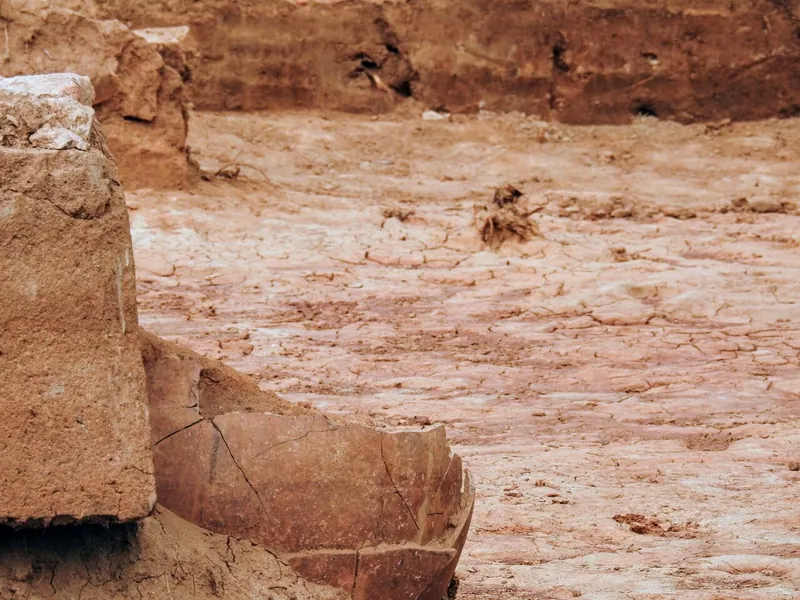
Keezhadi · Photographed 2019-09-06
A pottery vessel exposed within the excavated ground at Keezhadi
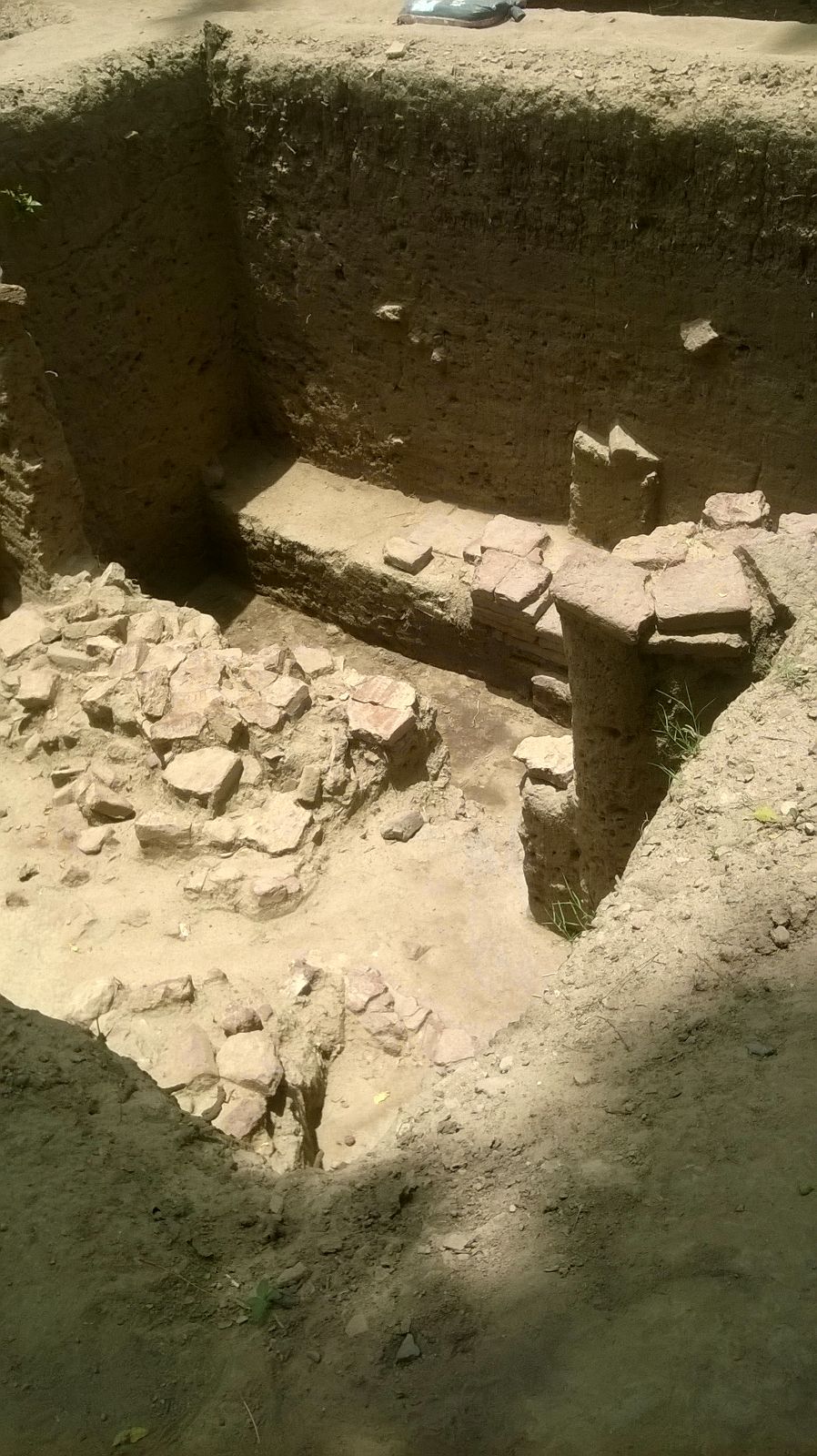
Keezhadi · Photographed 2015-09-14
Brick structural remains exposed in a Keezhadi trench in 2015
006Two views
Both views are shown at equal weight; this site does not choose between them.
How old is the early Keeladi sequence
- One view
- The Tamil Nadu Department of Archaeology reports a 580 BCE carbon result and links it to sixth-century-BCE Tamil-Brahmi writing and urbanization.
- Another view
- Later expert review, as reported in 2025, questioned the proposed early periodization, and a 2026 committee was ordered to re-examine the site.
- What would settle it
- A published sample-context table with laboratory results, stratigraphy and associated finds for each phase.
When were the Sangam (Cankam) poems composed
- One view
- George Hart argues that linguistic, historical and other evidence supports the conventional placement in the early centuries CE.
- Another view
- Herman Tieken proposes a substantially later date for the corpus.
- What would settle it
- Linguistic layering, ties to securely dated inscriptions and loanwords, and the history of anthology formation and manuscripts.
007Where next
Compare the Keezhadi (also spelled Keeladi) excavation evidence with the general method for keeping observation, source statements and interpretation apart.
On the timelineDates in this studySee these dates on the timeline
Explore nextThe Deep-Pit Trap: Depth Alone Is Never a DateAll related studies, connected material, books and sources22 · 22
Elsewhere on this site
Junior Detective Quests: The Deep-Pit Trap: Depth Alone Is Never a Date · Curator for a Day: Three Objects, One Honest Exhibit
Classroom Lesson Plans: Module 1 · Observation vs. Inference: How Do Historians Know?
Connected material
Photographs, drawings, books, videos and other studies linked to this study. A link helps you explore; it does not prove a historical claim.
- Trench section and small exposed archaeological features at Keezhadi in 2015photographShows the subject
- Excavated brickwork within a Keezhadi trench in 2015photographShows the subject
- Stratified trench wall and exposed features at Keezhadi in 2015photographShows the subject
- Brick structural remains exposed in a Keezhadi trench in 2015photographShows the subject
- Excavation trenches between coconut palms at Keezhadi in 2016photographShows the subject
- Long view across excavation trenches and exposed brick structures at KeezhadiphotographShows the subject
- A pottery vessel exposed within the excavated ground at KeezhadiphotographShows the subject
- Preserved brick feature within the Keezhadi excavation trenchesphotographShows the subject
- Stacked ceramic rings exposed in a Keezhadi excavation sectionphotographShows the subject
- Brickwork and associated deposits exposed at KeezhadiphotographShows the subject
- Photograph of the Muziris Papyrus facsimile displayed at the Pattanam Museum, taken by KannanVM in 2019photograph of museum facsimileBackground
- Connections need a meaningdiagramEach link says what kind of evidence joins two things, keeping what was found apart from what is inferred, as this study asks.
- A claim you can follow backdiagramThe evidence record keeps what the source states apart from what it cannot show, as this study asks of every claim.
- Same depth. A different context.diagramA worked example of keeping an observation (where a find lies) apart from an inference (how old it is).
- Write an honest labeldiagramThe four-part label keeps observation, interpretation and open questions apart, as this study recommends.
- The monsoon coast: Kerala and Tamil Nadu between the Arabian Sea and the Bay of BengaldiagramShows the three textual names (Muciṟi · Mouziris · Muziris) beside a shaded search zone rather than a pinpoint, reflecting the study's distinction between textual identification and ground location.
Books, videos and websites
Outside reading on this topic. These are not part of the study and we have not checked every claim in them. See all books and videos
- Rethinking Classical Indo-Roman Trade: Political Economy of Eastern Mediterranean Exchange Relations Book · Rajan Gurukkal · 2016 (see also Social Formation of Early South India, 2010) · Critiques anachronistic 'modern state' models of early Tamilakam, showing how kin-based chiefdoms, forest-forager networks, upland passes, and asymmetric Roman merchant capital operated across the Malabar Coast.
- A History of Ancient and Early Medieval India: From the Stone Age to the 12th Century Book · Upinder Singh · 2008 · Comprehensive subcontinental historical synthesis integrating peninsular Iron Age burials, Asokan edicts, Tamil-Brāhmī epigraphy, archaeobotany, Sangam chiefdoms, and Indian Ocean exchange.
- A History of South India from Prehistoric Times to the Fall of Vijayanagar Book · K. A. Nilakanta Sastri · 1955 (4th ed. 1975) · Classic mid-20th-century political and literary history of peninsular South India, framing early Chera, Chola, and Pandya dynasties before post-1980 stratigraphic and radiometric excavations.
- Histories: Romila Thapar on The Pattanam Excavations Video · Romila Thapar & P. J. Cherian · Sahapedia · 11:23 · A conversation about Indian Ocean connections, specialist collaboration, state and trade, and the limits of identifying Pattanam with Muziris. Especially valuable for evidence literacy: the published transcript explicitly leaves the identification open pending decisive evidence. Edited transcript, not an unedited audiovisual audit. Remarks about cosmopolitanism, maritime conflict and Arikamedu are interpretations; present them as discussion, not universal historical facts. Some comparisons extend after 600 CE.
- Inside Oxford’s radiocarbon laboratory Video · Oxford Radiocarbon Accelerator Unit (laboratory director, technicians, students & videographers) · University of Oxford · 1:26 · An exceptionally short introduction to the journey of a sample through a working radiocarbon laboratory. A clear companion to the website’s explanations of archaeological dating and laboratory work. Laboratory process only. This film does not validate any particular South Indian sample, archaeological association, calibrated date or historical claim.
- PCMA Seminar: "Introduction to the workshop and research in Berenike’s necropolis"// Mariusz Gwiazda Video · Mariusz Gwiazda · Polish Centre of Mediterranean Archaeology, University of Warsaw · 12:04 · A concise introduction to the necropolis research and its 2023–2024 excavation programme. Helps visitors understand what a current field project is investigating and credits the investigator responsible. Use this as an orientation to the separate specialist contributions; it is not a comprehensive account of Berenike or its trade.
- Uncovering 2200 Years Of Submerged History with Rasika Muthucumarana | All About That Reef : EP9 Video · Rasika Muthucumarana, Aindri Morahela (host), Mehak Sangani (host) · Maritime Archaeology Unit, Central Cultural Fund, Sri Lanka; All About That Reef · 52:15 · A Sri Lankan marine archaeologist discusses submerged heritage, his Godawaya work, museum curation and practical field research. Highlights a local investigator doing the long-term work, and gives the audience an approachable introduction to the profession. The channel’s public publish timestamp is 10 May in its displayed US offset, while the producer’s episode listing is 11 May 2025; both are retained. Relative “oldest” claims in promotional wording require geographical and dating qualification. Interview content has not been fully reviewed.
- Nichole Sheldrick: archaeology with satellite imagery Video · Nichole Sheldrick · University of Leicester; St Cross College, University of Oxford event · 59:09 · A research-method lecture on satellite imagery and archaeology. Explains another way that archaeological observations can be collected and interpreted. Methodological background. The lecture is not evidence for a particular Kerala palaeochannel, coastline, settlement or flood event.
Show 4 more
- Ruth Tringham on archaeological uncertainty Video · Ruth Tringham, Sarah Kansa · University of California, Berkeley Archaeological Research Facility; Kansa interviews · 34:45 · An archaeological conversation about uncertainty and interpretation, drawing on research in southeastern Europe and Turkey. A strong companion to the website’s distinction between observations, interpretations and unknowns. Comparative Neolithic examples outside the main regional window. The exact YouTube title calls this Episode 23; the researcher’s page and description call it Episode 24. The video identity is unambiguous, but the numbering conflict is retained.
- P L Udaya Kumar. "Advancing Indian Epigraphy". Oct 5, 2024 Video · P. L. Udaya Kumar · Mythic Society, Bengaluru Inscriptions 3D Digital Conservation Project · 2:17:25 · The project director explains digital recording and study of inscriptions in the Bengaluru region. Makes the practical labour of recording, re-reading and conserving inscriptions visible. Primarily a Kannada-region methods comparison with much later material. Computer-rendered scans document real objects; they are not ancient photographs.
- Tamil Heritage Trust- Iravatham Mahadevan’s contributions" talk by M V Bhaskar Video · M. V. Bhaskar · Tamil-Brahmi documentation project collaborator; AuthorCafe · 1:38:09 · A close collaborator describes Iravatham Mahadevan’s Tamil epigraphy and Indus-sign research and documentation methods. Credits both the pioneering scholar and a participant in the practical work of preserving and organizing inscriptions. Includes Indus-script hypotheses. The organizer explicitly says the Indus signs remain undeciphered; present proposals as proposals. This is Bhaskar speaking about Mahadevan, not Mahadevan himself.
- Monsoons: Wet, Dry, Repeat… (NASA Goddard / SVS 12255) Video · NASA’s Goddard Space Flight Center (producer Ryan Fitzgibbons & SVS team) · 3:28 · NASA Goddard visualization explaining the seasonal circulation reversal between wet summer and dry winter monsoon winds and rainfall across South Asia and the Indian Ocean (modern meteorology context, not evidence of ancient weather). Modern explanatory meteorology, not evidence of ancient weather. Credited third-party footage and music in the video must not be extracted or remixed; no video or audio files are hosted locally on this site.
008Sources
The study lists the sources it consulted; we have not rechecked them. A working link does not show that a source was read, and a valid identifier does not show that it supports a claim. We do not link to unofficial uploads or copies of publications. Where a study cited one, we show the published citation, or a publisher, DOI or Internet Archive link when we have one. Tracking codes are removed from links, and the sources themselves are not republished here.
Bernhard Palme (2018), Der Muziris-Papyrus, Austrian National Library Forschungsblog; P.Vindob. G 40822 / SB XVIII 13167.
Giovanni Ciotti and Sebastian Bosch, The Glory of Vishnu: Tracing the Origins of Palm-Leaf Manuscripts, SUB Hamburg, Cod. Palmbl. III 118.
Royal Botanic Gardens, Kew, Syzygium aromaticum, Plants of the World Online.
Royal Botanic Gardens, Kew, Myristica fragrans, Plants of the World Online.
Royal Botanic Gardens, Kew, Piper nigrum, Plants of the World Online.
ICAR–Indian Institute of Spices Research, Black Pepper – King of Spices.
Department of Archaeology, Government of Tamil Nadu, “Keeladi,” official site page; reports a carbon-analysis date expressed as 580 BCE and broader interpretations concerning Tamil-Brahmi, literacy and urbanization.
Ring wells exposed in ongoing archaeological excavation at Keeladi
Department of Archaeology, Government of Tamil Nadu, official seventh-season Keeladi ring-well field note.
Paula J. Reimer et al. (2020), The IntCal20 Northern Hemisphere Radiocarbon Age Calibration Curve (0–55 cal kBP), Radiocarbon, DOI 10.1017/RDC.2020.41.
Department of Archaeology, Government of Tamil Nadu, “Ovamalai kalvettu,” official summary of the Mangulam cave inscriptions.
South Indian Inscriptions, Volume XXII, Part I – Introduction
Archaeological Survey of India, South Indian Inscriptions, Volume XXII, Part I, digitized introduction; discusses Mangulam nos. 460–465 and their history of collection and decipherment.
Iravatham Mahadevan (2003), Early Tamil Epigraphy: From the Earliest Times to the Sixth Century A.D., Cre-A, 719 pp., ISBN 9780674012271.
Print or offline sourceSource recordMangulam 1 – interactive Tamil-Brahmi transcription and translation
M. V. Bhaskar, derivative interactive Mangulam 1 transcription and translation citing Mahadevan.
Akanāṉūṟu 149
Tamil Virtual Academy electronic text of Akananuru poem 149, containing the Yavanar, gold, kari and Musiri passage.
Review of Kāvya in South India: Old Tamil Cankam Poetry, by Herman Tieken
George L. Hart (2004), review/response to Herman Tieken, Kavya in South India: Old Tamil Cankam Poetry, Journal of the American Oriental Society 124(1).
Print or offline sourceSource recordK. Rajan (2002), Archaeology: Principles and Methods, Thanjavur: Manoo Pathippakam, xi + 279 pp.; library catalogue metadata read.
R. Champakalakshmi (1996), Trade, Ideology and Urbanization: South India 300 BC to AD 1300, Oxford University Press.
Print or offline sourceSource recordR. Sivanantham and M. Seran, editors (2019), Keeladi: An Urban Settlement of Sangam Age on the Banks of River Vaigai, Department of Archaeology, Government of Tamil Nadu, xi + 59 pp.
Ministry of Culture procedural notice on ASI Keezhadi report review (30 July 2025)
Government of India Ministry of Culture procedural communication dated 30 July 2025 concerning submission/review of the ASI Keezhadi excavation report (headline 'ASI Publishes Keezhadi Excavation Report in Line with Scientific Protocols').
Print or offline sourceSource recordReport on ASI review of Keezhadi first-two-season excavation report
The Indian Express, July 2025, report on parliamentary reply and expert review of the ASI Keezhadi first-two-season report.
Print or offline sourceSource recordReport on ASI on-site re-examination of Keezhadi
ThePrint / PTI, 29 June 2026, report that the ASI Director General ordered an on-site re-examination committee for Keezhadi.
Print or offline sourceSource recordMangulam inscription photograph (ARE 465/1906)
Wikimedia Commons metadata page for a photograph identified as Mangulam inscription ARE 465/1906.
Researchers and institutions whose work this study uses: Iravatham Mahadevan, K. Rajan, R. Sivanantham, R. Champakalakshmi, George L. Hart, Archaeological Survey of India, Tamil Virtual Academy
How we know The evidence, claims and dates behind this study
What this study draws on
- Official Tamil Nadu archaeology pages on the Keeladi ring wells, the 580 BCE result and the Mangulam caves.
- The South Indian Inscriptions vol. XXII introduction on Mangulam nos. 460–465; Mahadevan's edition identified but not read in full.
- The Tamil Virtual Academy text of Akanāṉūṟu 149 and George Hart's reply to Herman Tieken.
- Bernhard Palme's Austrian National Library account of the Muziris Papyrus, and IntCal20 on radiocarbon calibration.
Dates in this study
| What is dated | Date | How it was dated |
|---|---|---|
| 580 BCE, reported calendar-year summary for a carbon analysis | 580 BCE | Laboratory date |
| third century BCE | 300–200 BCE | Date from writing, coins or texts |
| circa second century BCE | 200–100 BCE | Date from writing, coins or texts |
| first to third centuries CE, broad conventional position represented by Hart | 1–300 CE | Date from writing, coins or texts |
See these dates on the timeline
The study’s claims
32 claims · 19 source passages · 94 paragraphs
Browse the study paragraph by paragraphEvidence for a historical setting and evidence for a particular event are different kinds of claim.
Supported in this study
Retained unchanged from revision 4; revision 5 supplies worked examples.
Dates, locations and the limits of access belong beside the evidence, not in a distant disclaimer.
Supported in this study
A responsible finding can be that the available evidence does not answer the question.
Supported in this study
Evidence that a port had overseas contacts does not establish that a particular traveller arrived there.
Supported in this study
Retained methodological distinction; no individual-traveller question is investigated here.
The presence of an object does not identify its owner.
Supported in this study
A comparison from another setting is not automatically evidence for the local setting under investigation.
Supported in this study
A consequential claim should point to a specific passage, manuscript, study location or institutional object record; a homepage is not an adequate locator for every claim.
Supported in this study
Revision 5 adds exact identifiers where available.
Reported observation, analytical inference and a reconstruction's added apparatus are distinct steps that should remain visible.
Supported in this study
Retained and operationalized from revision 4.
Conflicting sources should be compared by question, definition, sample and evidential lineage rather than averaged into a confident conclusion.
Supported in this study
Qualified from revision 4 by explicitly adding evidential lineage.
Failure to locate a witness in a limited search is not proof that the witness never existed.
Supported in this study
Generalized from the revision-4 preservation/access discussion.
A preservation explanation such as organic decay is not positive evidence that a specific lost manuscript existed.
Supported in this study
Retained unchanged in substance from revision 4.
Corrections should identify what changed and why rather than silently replacing a previous conclusion.
Supported in this study
Retained and demonstrated by revision-5 change records.
For this corpus, observation, source statement, interpretation, reconstruction and unknown is treated here as distinct epistemic operations rather than collapsed into a single confidence score.
Supported in this study
The labels classify inferential operation, not an absolute rank of reliability.
An inherited citation, a model's confidence, repeated retelling of one source, or a schema-valid metadata record is not independent source verification.
Supported in this study
Independence is a property of provenance and evidential lineage, not repetition or formatting.
The Keeladi ring-well field note supplies context-specific observations such as trench designation, depth and dimensions that are distinct from broader claims about the age or social character of the settlement.
Supported in this study
The Tamil Nadu archaeology Keeladi overview summarizes a 580 BCE carbon-analysis date; study “Keezhadi's excavations reveal a substantial brick settlement” documents the underlying sample record (Beta 519476, trench YP7/4, 353 cm, charred material, 2530 ± 30 BP). 580 BCE is that measurement subtracted from 1950, and the single year 531 BCE printed beside it in a 2025 TNSDA table falls outside the range of about 792–545 cal BCE given by IntCal20 calibration at 95.4 per cent.
Supported with qualifications
Recorded as the webpage's calendar-year summary, not independently recalculated.
The official Keeladi webpage moves from the reported carbon date to claims about sixth-century-BCE Tamil-Brahmi, high literacy and second urbanization; those are interpretations requiring stratigraphic association and convergent evidence beyond the numerical date alone.
Supported with qualifications
The claim identifies an inferential transition; it does not assert that the broader interpretation is false.
A precise radiocarbon chronology cannot be audited from a calendar-year summary alone; the measurement, uncertainty, calibration curve and archaeological association are needed to reproduce or evaluate the dating inference.
Supported in this study
Mangulam's inscriptions have a documented modern history of collection, decipherment and republication, so the physical incisions, editorial reading and historical interpretation require separate provenance.
Supported in this study
The online Mangulam 1 transliteration and translation are a derivative representation of an epigraphic reading, not an independent witness to the stone.
Supported in this study
Full critical-edition inspection is required before drawing final conclusions reliance on disputed grapheme readings or translation.
At Mangulam, palaeographic dating, word segmentation, identification of titles or personal names and inference of religious affiliation are interpretations of different strength and should not be collapsed into the observation that signs are incised in the cave context.
Supported with qualifications
Physical/facsimile examination and critical apparatus remain pending.
Akananuru 149, in the Tamil Virtual Academy electronic text, explicitly juxtaposes Yavanar, a fine ship or vessel, gold, kari and prosperous Musiri.
Supported in this study
Rendering kari as black pepper, equating Yavanar specifically with Greeks or Romans, and identifying literary Musiri with the Muziris of Greek documentary sources are historical or philological interpretations rather than observations supplied by the poem itself.
Supported with qualifications
The correspondences may be well argued but each requires evidence beyond the poem's bare wording.
The chronology of the Cankam corpus is contested: Tieken proposed a substantially later dating, while Hart argued for the conventional placement in the first centuries CE; the disagreement cannot be resolved by averaging the dates.
Debated in the sources
Resolution requires the full linguistic, historical and transmission arguments.
Akananuru 149 is literary testimony, not a shipping ledger: it can support a claim about what the poem represents, but it cannot by itself date a specific voyage or identify an archaeological layer at Pattanam.
Supported in this study
The Austrian National Library states that the Muziris Papyrus's exact date is lost, assigns it palaeographically to about the middle of the second century CE, and describes its recto as a transport or loan arrangement and verso as a cargo/value account.
Supported in this study
The Muziris Papyrus supports a documentary claim that a transaction was framed with reference to Muziris, but it does not by itself prove that literary Musiri, archaeological Pattanam and the papyrus's Muziris are the same place or that they record one event.
Supported with qualifications
No automatic same-as merge is made.
K. Amarnath Ramakrishna's 2014–16 ASI Keezhadi excavation report remained unpublished and under review as of late 2026: despite the 30 July 2025 Ministry webpage headline, parliamentary and press records show the text was under expert vetting, revision, and an ordered June 2026 on-site re-examination.
Debated in the sources
This is a publication-status conclusion, not an archaeological conclusion.
The inherited catalogue lead 'K. Rajan, Archaeological Methodologies' is bibliographically inaccurate; the checked catalogue record gives Archaeology: Principles and Methods (2002).
Supported in this study
R. Champakalakshmi's Trade, Ideology and Urbanization: South India 300 BC to AD 1300 is modern historical scholarship, so the inherited catalogue label 'Primary Sources' should not be applied to it.
Supported in this study
Failure to inspect a full excavation report or critical edition for this study is an access or inspection limitation, not historical evidence that the underlying data or argument do not exist.
Supported in this study
This study has had neither independent specialist review nor human publication approval.
Supported in this study
A statement of this study's review status. Source checking and schema validation are not peer review.
Trace one claim through the study’s records
Explore the evidenceOther source lists
Numbered citation links from the study
The numbered links in the study text point here.
IntCal20 issue
யவனர் | தமிழ் இணையக் கல்விக்கழகம் TAMIL VIRTUAL ACADEMY
What Is India News Service
Archaeology
Artikel - Österreichische Nationalbibliothek
RING-WELLS EXPOSED IN THE ONGOING ARCHAEOLOGICAL EXCAVATION AT KEELADI | Department Of Archaeology
Keeladi | Department Of Archaeology
Keeladi
Ovamalai kalvettu | Department Of Archaeology
What Is India News Service
Early Tamil Epigraphy from the Earliest Times to the Sixth Century A.D. - Iravatham Mahadevan - Google Books
Mangulam 1 Video
Ettuthokai – Akanānūru 121-300 – Sangam Poems Translated by Vaidehi
Some Remarks by George Hart on Herman Tieken's Kavya in South India
Ministry of Culture procedural notice on ASI Keezhadi report review (30 July 2025)
Keezhadi excavation report under review, time bracket not justified: Minister | India News - The Indian Express
ASI to re-examine Keezhadi excavation report on site
Archaeology
Trade, Ideology, and Urbanization: South India 300 B.C. to A.D. 1300. By R. Champakalakshmi. Delhi: Oxford University Press, 1996; New York: Oxford University Press, 1998. xiv, 485 pp. $39.95 (cloth). | The Journal of Asian Studies
About this study Status, corrections and how it was made
Status
Draft study, revision 13. No historian, archaeologist, or Tamil or Malayalam specialist has reviewed it yet.
How it was made
Compiled as an editorial synthesis from published scholarship around questions we framed. About this project & workflow
The summary, How sure lines and Two views notes on this page were prepared from this study and cross-checked against its passages. That is an editorial check, not a specialist review.
Corrections and updates
Technical details
Study code R001. The text fingerprint changes whenever the study text changes.
- The study text is shown as written. Links from its paragraphs to citations help you move around the study; they are not new claims or checked source passages.
See how this study’s records were extracted
Text fingerprint (SHA-256): R001 · 9bd8eade7e2249a2ffcccbf7… · v13
Evidence tables and technical details are on the web page: https://layersofthesouth.org/read/a124871044