The large footed grinding slab
Oc Eo
Comparative evidence from Vietnam; these are not finds from Kerala or Tamil Nadu.
- Land & water
Kerala's spice coast grew from habitats, cultivation and trade
Kerala's spices reflect varied mountain habitats, human cultivation and port trade; even black pepper's original homeland is still disputed.
- This page
- 2,213 words · revision 6
Draft study · Awaiting specialist review · Updated
001Dates and places

No mapped place in this study.
Dates in this study are stated in words only.
- 2 Well supported
- 1 Possible
- 1 Not known
002How sure
In brief
UNESCO's description of the Western Ghats stresses many different habitats, not one uniform wet climate. Climate explains growing conditions, but it does not show who cultivated or traded spices. Black pepper is a climbing vine grown on supports, while cardamom forms leafy clumps in the ginger family. Kew's Plants of the World Online (POWO) lists both southwestern India and Sri Lanka as black pepper's native range, aligning on southwestern India with Ravindran (2000), Sen and colleagues (2019), and the Indian Institute of Spices Research (ICAR–IISR). By contrast, an April 2026 phylogenetic study by Metschina and colleagues (read at abstract level) places cultivated pepper within a Sri Lankan endemic clade rather than an Indian hybrid origin; it does not date cultivation or trade. The first-century Periplus lists pepper among goods at the Malabar ports, marking a trade outlet rather than a botanical origin map. Clove and nutmeg are native to Maluku. The consulted sources do not date when pepper cultivation began in Kerala.
Key researchers cited in this study: Wilfred H. Schoff (Periplus Translation & Commentary) · Full bibliography
How sure
- Well supported
The Western Ghats contain many different habitats, not one wet zone.
UNESCO's heritage description stresses variation within the mountain range.
- Well supported
Pepper was among the goods traded at the Malabar ports in the first century.
The Periplus lists pepper among the exports of these ports.
- Possible
Black pepper's evolutionary origin lay in a Sri Lankan clade rather than a Western Ghats hybrid origin.
Metschina et al. (April 2026 abstract) propose a Sri Lankan endemic clade, whereas Kew POWO (listing both SW. India and Sri Lanka as native), Ravindran (2000), Sen et al. (2019) and ICAR–IISR support a Western Ghats/SW Indian native range.
- Not known
When people began cultivating pepper in Kerala.
No dated pollen, plant-remain or land-use study for the production zones was available.
Why it matters
It keeps a plant's homeland, its cultivation and its trade apart, so Kerala's spice history credits both nature and people.
003Key findings
What the study concludes
- Climate and varied habitats help explain growing conditions, but they do not by themselves establish ancient cultivation, ownership or trade.
- Kew and ICAR–IISR give different native-range accounts. An April 2026 genetics study adds primary evidence for a Sri Lankan connection; it does not date cultivation or trade.
- A modern landscape containing many valuable plants is a history of planting, selection and movement, not a direct picture of ancient cultivation.
In the study’s own words. How sure each point is, is shown above.
The summary above is the short read. The full study is the complete text it was drawn from, with its tables and source notes.
What the full study covers
- Main findings
- Begin with a living plant
- Mountains make differences, not one uniform climate
- Pepper climbs; cardamom forms clumps
- Black pepper’s origin: disagreement and new genetic evidence
- A port receives what a region cannot grow
- Modern gardens are arrangements, not fossils
- A world of spices is not one place of origin
- What remains uncertain
- The next questions
- References and access notes
004The study
Main findings
- Climate and varied habitats help explain growing conditions, but they do not by themselves establish ancient cultivation, ownership or trade.
- Most botanical and crop-science authorities – including Kew's Plants of the World Online (listing southwestern India and Sri Lanka) and Western Ghats studies (such as Ravindran 2000; Sen et al. 2019; ICAR–IISR) – place black pepper's native range in southwestern India/Western Ghats, alongside Sri Lanka; an April 2026 genetic study (read here as an abstract) instead places cultivated pepper closer to Sri Lankan endemics and does not date cultivation or trade.
- A modern landscape containing many valuable plants is a history of planting, selection and movement, not a direct picture of ancient cultivation.
Begin with a living plant
A sack of spice makes its contents look self-contained. A living plant asks for a different kind of attention: where it grows, what supports it, what part is gathered, and how people keep obtaining a useful crop. This study asks why Kerala became associated with so many spices, and separates ecological opportunity from cultivation history and the history of exchange. The answer is not simply that abundant rain produced abundant trade. The evidence has different clocks. A modern botanical record describes a species and distribution; a field survey describes cultivated landscapes; an ancient commercial account names goods moving through ports. Their comparison can improve questions about ancient agriculture but cannot be collapsed into one picture of an ancient plantation.
Mountains make differences, not one uniform climate
UNESCO’s description emphasizes the Western Ghats’ influence on monsoon conditions and their range of forest habitats. Its ecological significance rests partly on variation within the mountain system, not on every slope being the same wet environment. That is a useful first correction to a map shaded uniformly green and labelled spice country. 1 For historical reconstruction, this changes the questions we ask of a producer’s journey. Which part of the landscape supplied a particular material? What lies between that place and a collecting point? Is the commodity a gathered forest product or the result of deliberate planting? UNESCO’s assessment cannot answer those archaeological questions. It does explain why an answer about one crop or elevation should not automatically govern everything sold at the coast. Rainfall also belongs to more than a picturesque description of the journey. The source environment, the condition of produce and access to a settlement are separate matters. We should therefore connect this article with the evidence on transport and storage in “Texts link pepper to inland Cottonara, not a whole route” rather than use climate as a substitute for that work. A landscape capable of supporting a plant is only the beginning of an explanation of its economic importance.
Pepper climbs; cardamom forms clumps
ICAR–IISR describes black pepper as a perennial climbing vine grown with supports, including trees or poles, and commonly propagated through cuttings. Its account makes support part of cultivation, not background scenery. Looking at pepper therefore means looking beyond the fruit to the structure on which a vine grows and the decisions involved in establishing it. 2 Kew’s cardamom profile describes a different plant: a rhizomatous perennial in the ginger family, forming leafy shoots and producing fruits whose chambers contain aromatic seeds. It places its native range in southwestern India and discusses cultivation farther afield. Pepper and cardamom thus require different descriptions even when both appear on a modern spice shelf. 3 Neither description shows the spacing, tools or workforce of an ancient farm; that would need separate evidence. “Malabathrum and cardamom: Kerala hill origins not shown” examines cardamom in early trade in more depth.
Black pepper’s origin: disagreement and new genetic evidence
The origin question requires keeping taxonomic range records, established crop-science literature, and new phylogenomic arguments distinct. Kew’s Plants of the World Online (POWO) record for Piper nigrum (checked October 2026) lists both southwestern India (SW. India) and Sri Lanka as the native range, aligning on southwestern India with standard crop-science and evolutionary literature (including P. N. Ravindran, ed., Black Pepper: Piper nigrum, Harwood Academic Publishers, 2000; S. Sen et al., “Origin and evolution of the genus Piper in Peninsular India,” Molecular Phylogenetics and Evolution, 2019; and ICAR–IISR's Kerala/Western Ghats crop profile). 45 In April 2026, however, Metschina and colleagues (American Journal of Botany 113(4): e70187, DOI 10.1002/ajb2.70187) reported phylogenomic analyses placing cultivated black pepper within a clade of Sri Lankan endemic species rather than deriving from a hybrid origin between two Indian species, describing most cultivated varieties as autotetraploids with duplicated chromosome sets. 6 Only the published abstract and repository metadata of the 2026 study were read here (its full text, figures, and sample-level supplements were not read). Its result should therefore be attributed to the researchers, not presented as our independent reanalysis. It also does not date the beginning of cultivation in Kerala or identify the people who moved plants. Genetic relationships, the earliest historical occurrence of a crop and later commercial importance remain distinct questions. It does not follow that the ancient pepper trade disappears because modern origin assignments differ. The location of a species before human movement and the places associated with commerce in a historical account are different questions. We should resist making a disputed botanical homeland carry the full weight of an otherwise independently documented commercial history.
Modern references relevant to this study
Comparative evidence from Vietnam; these are not finds from Kerala or Tamil Nadu.
A port receives what a region cannot grow
The Periplus lists several exported commodities at the southwestern Indian ports, including pepper and malabathrum. A commercial list names what a traveler might encounter in exchange; it does not establish that every item grew immediately outside the harbor. This article reads the list as evidence of a collecting and exchanging place, not a botanical inventory of its immediate surroundings. 7 That distinction helps answer why a place can become famous for many spices. A productive hinterland and a position within exchange networks can contribute in different ways. Some goods may move through a place without the producing plant ever taking root there. This is our interpretation of the difference between an export list and a plant distribution – not a claim to have reconstructed each shipment’s inland route. The corresponding human questions are substantial. Who recognized usable material, connected a producer with a buyer, or accepted the risk of transporting it? Who could refuse an offered parcel? Those questions belong beside ecology rather than underneath a slogan about natural wealth. Until there is specific evidence, neither a modern plantation owner nor a romantic image of an untouched forest should be substituted for the unknown ancient arrangement. “Texts link pepper to inland Cottonara, not a whole route” follows pepper’s journey from inland Kerala to the ships.
Modern gardens are arrangements, not fossils
A 2024 highland Kerala inventory reports 116 sample plots and 119 tree species across several agroforestry systems, including cardamom-based systems and homegardens. It groups uses such as food, timber and fuel. The consulted abstract supports the presence of varied, managed systems in that study, not the historical age of every planting practice. 8 The lesson is not that this inventory reconstructs Pattanam’s hinterland. It is that a cultivated landscape should be investigated as an arrangement of purposes. Plants can be selected for more than a single export product. The useful historical follow-up would ask for dated evidence of settlement, cultivation and resource use, instead of treating present-day coexistence as proof that the same combination existed two millennia earlier. Nor should the people who maintain such landscapes be made anonymous custodians of an unchanging tradition. The report is a modern research snapshot. Reading it historically requires room for innovation, introductions, altered land use and disagreement. Those changes are worth investigating in their own right rather than being treated as damage to a preferred image of timeless spice country. “Early South Indian farming mixed rain-fed crops and managed water” discusses the pepper found at Pattanam, where the project leaves open whether it came from farmed or semi-wild plants.
A world of spices is not one place of origin
Kew assigns the native ranges of the clove and the nutmeg species examined here to Maluku. That is a different botanical starting point from southwestern Indian cardamom. A present-day association of all these products with Kerala does not establish a shared native origin or a shared date of arrival. Their movement must be studied individually. 91011 “No secure clove or nutmeg find is known yet from early Pattanam” sets out the dated finds of clove and nutmeg. A good spice atlas should carry several fields rather than one colored territory: scientific identification, plant part, current native-range assessment, dated archaeological occurrence, historical name and demonstrated trading context. A blank historical field should remain blank. Mountains and habitats mattered; so did cultivation and connections. The exact balance at a particular date still needs research. What we can already avoid is erasing people’s work by calling it climate, or erasing the wider world by calling every spice local.
What remains uncertain
-
The 2026 genetic study was read at abstract level, not reanalysed. Its reported relationships do not establish when pepper first entered cultivation in Kerala.
-
The agroforestry inventory is modern and abstract-level; it does not date ancient crop mixtures or land tenure.
-
No exact introduction date into Kerala is established here for clove, nutmeg or other later cultivated species.
The next questions
- Examine the primary evidence behind conflicting native-range assignments for Piper nigrum.
- Locate dated pollen, macroremain and land-use studies for particular Western Ghats production zones.
- Research separate histories of introducing and cultivating clove and nutmeg in Kerala.
References and access notes
1 UNESCO World Heritage Centre (Inscribed 2012; current description checked 2026). Western Ghats: World Heritage property description. Description and Outstanding Universal Value: monsoon influence, forest ecosystems and biological diversity. Description and Outstanding Universal Value text read. This is a modern ecological and heritage description, not an ancient agricultural survey or a reconstruction of first-century land use. Open source: whc.unesco.org
2 ICAR–Indian Institute of Spices Research (Undated; checked 2026). Black Pepper – King of Spices. Plant habit, supports and propagation description. Crop description and origin statement read as web text; promotional health claims on this page are not adopted. Open source: spices.res.in
3 Royal Botanic Gardens, Kew (Continuously maintained; checked 2026). Elettaria cardamomum (L.) Maton: taxonomy and plant profile. Plant description, fruit structure and native range (SW. India). Taxonomic record and descriptive profile read. Current native range and cultivation do not date domestication or arrival in a particular ancient port. Historical and medicinal assertions in the profile are not used as independently verified claims. Open source: powo.science.kew.org
Elettaria cardamomum (83242)
Photographed 12 July 2026 (according to Exif data)
It does not show which aromatic an ancient text named.
4 Royal Botanic Gardens, Kew (living database; checked October 2026). Piper nigrum L. Plants of the World Online (POWO). Native range lists southwestern India (SW. India) and Sri Lanka, aligning on southwestern India with Western Ghats crop-science literature (including P. N. Ravindran, ed., Black Pepper: Piper nigrum, Harwood Academic Publishers, 2000; S. Sen et al., Molecular Phylogenetics and Evolution, 2019). Open source: powo.science.kew.org
5 ICAR–Indian Institute of Spices Research (Undated; checked 2026). Black Pepper – King of Spices. Origin statement: Kerala and the Western Ghats; consistent on Western Ghats origin with Ravindran (2000) and Kew's native-range listing of southwestern India. Promotional health claims on this page are not adopted. Open source: spices.res.in
6 Dominik Metschina; Luiz A. Cauz-Santos; Maarten J. M. Christenhusz; Nilni A. Wimalarathna; Tara D. Silva; Andreas Berger; James W. Byng; Harsha Dissanayake; Deepthi Yakandawala; Anushka M. Wickramasuriya; Barbara Turner; Mark W. Chase; Rosabelle Samuel (2026). “Population genetics and phylogenomic insights into the origin of economically important black pepper (Piper nigrum).” American Journal of Botany 113(4): e70187 (published 9 April 2026). DOI: https://doi.org/10.1002/ajb2.70187. Only the abstract and repository metadata were read; no figures, supplementary sample tables, or raw sequence data were read. The abstract reports genetic placement within a Sri Lankan clade rather than a Peninsular Indian two-species hybrid origin, without dating domestication or ancient trade.
7 Anonymous; translated by Wilfred H. Schoff (1912 translation). The Periplus of the Erythraean Sea. Periplus §56: exports associated with Muziris and Nelcynda. Relevant numbered sections read. University of Washington transcription of the 1912 translation, with some later editorial glosses. Ancient composition is usually placed around the middle of the first century CE, not the translation date. Schoff’s translation is public domain in the United States; no complete modern translation is reproduced. Open source: depts.washington.edu
8 S. Joseph; A. George; P. N. Sreejith; M. Mohan; T. K. Kunhamu (2024). “Inventory of Agroforestry systems in the highland regions of Kerala, India.” Indian Journal of Agroforestry 26(2): 35–46 (published 31 December 2024). Abstract and bibliographic record read; full methods and species tables not read. Open source: epubs.icar.org.in
Ripening black pepper berries on spikes (Piper nigrum, modern botanical context)
Photographed 2011-02-20
9 Royal Botanic Gardens, Kew (living database). Syzygium aromaticum. Native range (Maluku). Taxon record read. A living botanical range record does not date ancient trade arrivals. Open source: powo.science.kew.org
10 Royal Botanic Gardens, Kew (living database). Myristica fragrans. Native range (Maluku). Taxon record read. Do not infer an ancient cargo date from a modern distribution map. Open source: powo.science.kew.org
11 Royal Botanic Gardens, Kew (Continuously maintained; checked 2026). Elettaria cardamomum (L.) Maton: taxonomy and plant profile. Native range of Elettaria cardamomum (SW. India). Taxonomic record and descriptive profile read. Current native range and cultivation do not date domestication or arrival in a particular ancient port. Open source: powo.science.kew.org
005Photographs
Photographs of the places and objects this study discusses. Each item carries its creator’s credit, licence and documented source. See all 412 photographs and source images ↗
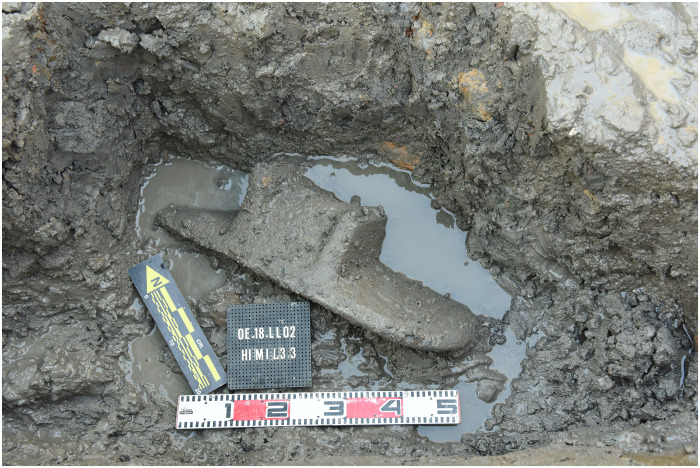
Oc Eo
The large footed grinding slab
A footed sandstone grinding slab, 76 cm long, excavated at Oc Eo in 2018. Starch grains of ginger, cinnamon and nutmeg were identified on its surface.
Comparative evidence from Vietnam; these are not finds from Kerala or Tamil Nadu.
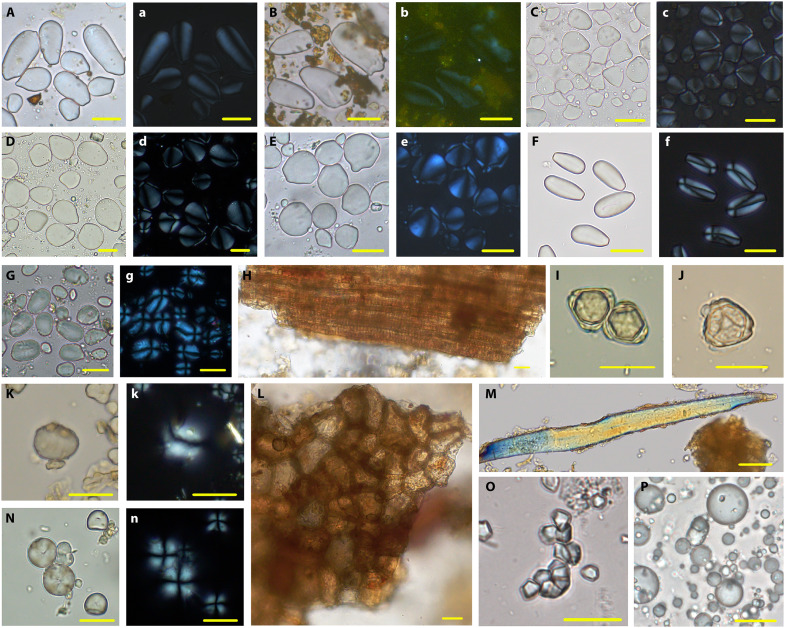
Modern references relevant to this study
Modern reference samples used for comparison in the Oc Eo study: starch grains and other remains of turmeric, ginger, clove, cinnamon, nutmeg and rice.
Comparative evidence from Vietnam; these are not finds from Kerala or Tamil Nadu.
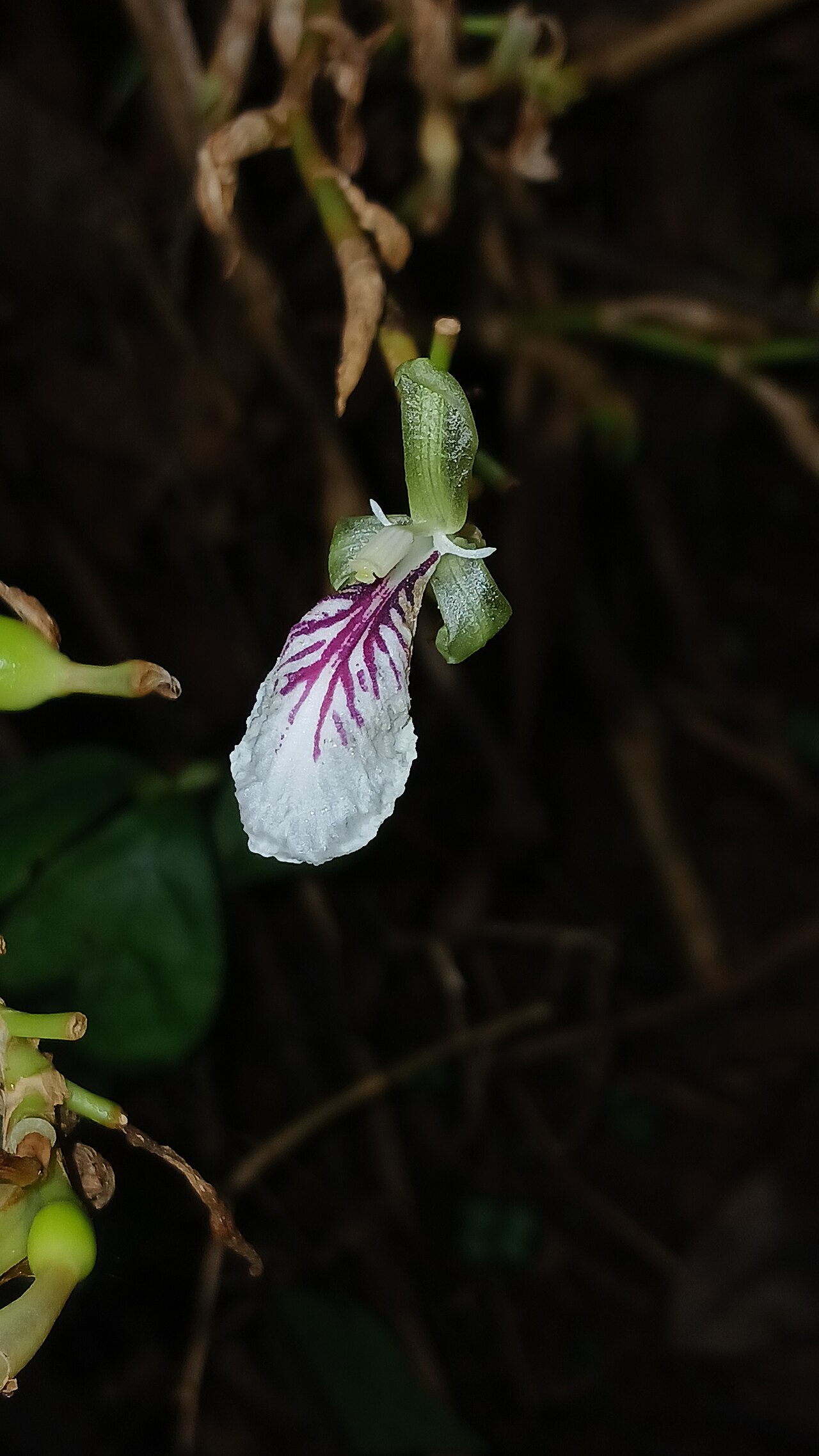
Photographed 12 July 2026 (according to Exif data)
Elettaria cardamomum (83242)
Cardamom (Elettaria cardamomum), a modern botanical photograph.
It does not show which aromatic an ancient text named.

Photographed 2011-02-20 06:17:02
Ripening black pepper berries on spikes (Piper nigrum, modern botanical context)
Whole black pepper berries (drupes) on spikes (Piper nigrum; source file titled 'Piper nigrum -seeds'). Modern botanical photograph for identification and growing context, not archaeological evidence of ancient use.
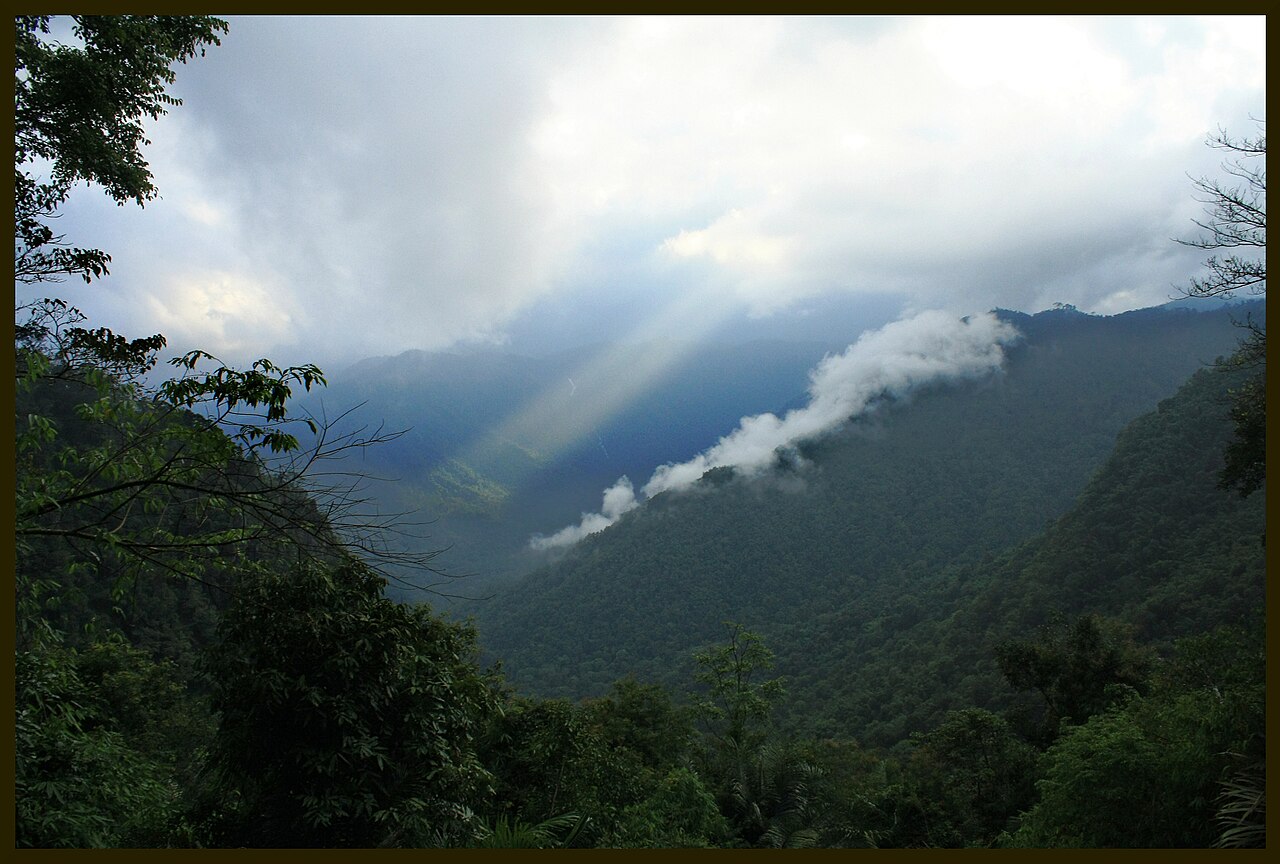
Photographed 2009-10-04 16:58
Kerala Monsoon clouds over Western Ghats India – Modern weather photograph
Kerala Monsoon clouds over Western Ghats India. Modern weather photograph; illustrates monsoon conditions, not a historical sailing timetable.

Photographed 2012-11-13 13:23:23
Black Pepper (Piper nigrum) fruits – Modern botanical photograph of black pepper, for identification and growing context
Black Pepper (Piper nigrum) fruits. Modern botanical photograph of black pepper, for identification and growing context; not archaeological evidence of its ancient use.
Oc Eo
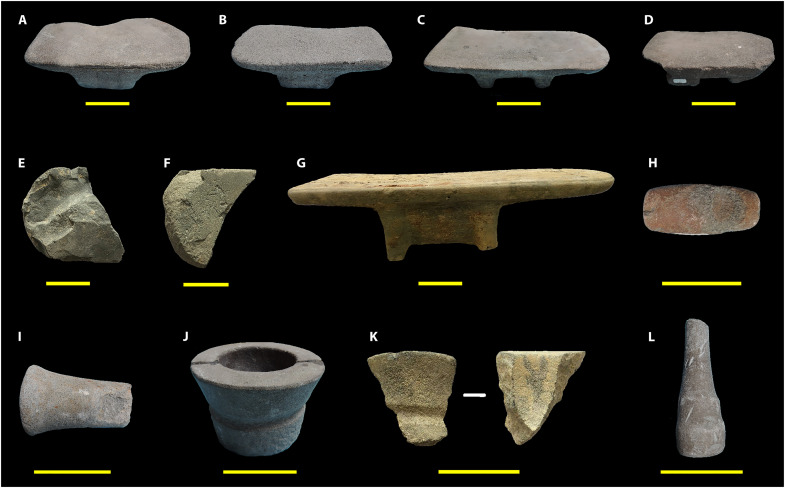
Ancient food-preparation tools from Oc Eo
Food-preparation tools from Oc Eo reported in the published study: footed grinding slabs, mullers or pestles, and mortars. Scale bar 10 cm.
Comparative evidence from Vietnam; these are not finds from Kerala or Tamil Nadu.

Oc Eo
Ancient plant remains recovered from Oc Eo
Starch grains and other plant remains from Oc Eo under the microscope, including turmeric, ginger, galangal, clove, cinnamon, nutmeg and rice.
Comparative evidence from Vietnam; these are not finds from Kerala or Tamil Nadu.
006Two views
Both views are shown at equal weight; this site does not choose between them.
Black pepper's native homeland
- One view
- Metschina et al. (April 2026, abstract read) argue from phylogenetics that cultivated black pepper falls within a Sri Lankan endemic clade rather than an Indian two-species hybrid.
- Another view
- Kew POWO (listing both SW. India and Sri Lanka as native), Ravindran (2000), Sen et al. (2019), and ICAR–IISR place black pepper's native range in the evergreen forests of southwestern India and the Western Ghats.
- What would settle it
- Examining the primary evidence behind each range assignment, including the genetic study's full sample data, which was not inspected.
007Where next

All related studies, connected material, books and sources11 · 11
Elsewhere on this site
Multi-Script Glossary Terms: kuṟiñci (குறிஞ்சி / കുറിഞ്ഞി) · miḷaku (kaṟi) (மிளகு / கறி / മുളക് / കുരുമുളക്)
Connected material
Photographs, drawings, books, videos and other studies linked to this study. A link helps you explore; it does not prove a historical claim.
- Ancient food-preparation tools from Oc EophotographBackground
- The large footed grinding slabphotographBackground
- Ancient plant remains recovered from Oc Eoscientific photomicrographBackground
- Modern references relevant to this studyphotographBackground
- Black Pepper (Piper nigrum) fruits – Modern botanical photograph of black pepper, for identification and growing contextphotographBackground
- Ripening black pepper berries on spikes (Piper nigrum, modern botanical context)photographBackground
- Elettaria cardamomum (83242)photographBackground
- Kerala Monsoon clouds over Western Ghats India – Modern weather photographphotographBackground
008Sources
The study lists the sources it consulted; we have not rechecked them. A working link does not show that a source was read, and a valid identifier does not show that it supports a claim. We do not link to unofficial uploads or copies of publications. Where a study cited one, we show the published citation, or a publisher, DOI or Internet Archive link when we have one. Tracking codes are removed from links, and the sources themselves are not republished here.
UNESCO World Heritage Centre (Inscribed 2012; current description checked 2026). Western Ghats: World Heritage property description. Description and Outstanding Universal Value: monsoon influence, forest ecosystems and biological diversity. Description and Outstanding Universal Value text read. This is a modern ecological and heritage description, not an ancient agricultural survey or a reconstruction of first-century land use.
ICAR–Indian Institute of Spices Research (Undated; checked 2026). Black Pepper – King of Spices. Plant habit, supports and propagation description. Crop description and origin stat
ICAR–Indian Institute of Spices Research (Undated; checked 2026). Black Pepper – King of Spices. Crop description and Western Ghats origin statement, consistent on southwestern India with Kew POWO and Ravindran (2000). Promotional health claims on this page are not adopted.
Royal Botanic Gardens, Kew (Continuously maintained; checked 2026). Elettaria cardamomum (L.) Maton: taxonomy and plant profile. Plant description, fruit structure and native range. Taxonomic record and descriptive profile read. Current native range and cultivation do not date domestication or arrival in a particular ancient port. Historical and medicinal assertions in the profile are not used as independently verified claims.
Royal Botanic Gardens, Kew (living database). Piper nigrum. Native range (SW. India and Sri Lanka), Plants of the World Online.
Royal Botanic Gardens, Kew (living database). Piper nigrum. Native range lists southwestern India (SW. India) and Sri Lanka, consistent on southwestern India with Western Ghats botanical literature (Ravindran 2000; Sen et al. 2019; ICAR–IISR).
ICAR–Indian Institute of Spices Research (Undated; checked 2026). Black Pepper – King of Spices. Origin statement: Kerala and the Western Ghats. Crop…
ICAR–Indian Institute of Spices Research (Undated; checked 2026). Black Pepper – King of Spices. Origin statement: Kerala and the Western Ghats. Crop description and origin statement inspected as web text. The origin statement differs from the current Kew native-range record S14. Neither was silently preferred. Promotional health claims on this page are not adopted. Open source: spices.res.in
Dominik Metschina; Luiz A. Cauz-Santos; Maarten J. M. Christenhusz; Nilni A. Wimalarathna; Tara D. Silva; Andreas Berger; James W. Byng; Harsha Dissanayake; Deepthi Yakandawala; An
Dominik Metschina et al. (2026). 'Population genetics and phylogenomic insights into the origin of economically important black pepper (Piper nigrum).' American Journal of Botany 113(4): e70187. DOI: 10.1002/ajb2.70187. Abstract and bibliographic metadata read only.
Anonymous; translated by Wilfred H. Schoff (1912 translation). The Periplus of the Erythraean Sea. Periplus §56: exports associated with Muziris and Nelcynda. Relevant numbered sections read. University of Washington transcription of the 1912 translation, with some later editorial glosses. Ancient composition is usually placed around the middle of the first century CE, not the translation date. Schoff’s translation is public domain in the United States; no complete modern translation is reproduced.
S. Joseph; A. George; P. N. Sreejith; M. Mohan; T. K. Kunhamu (2024). Inventory of Agroforestry systems in the highland regions of Kerala, India. Abstract: sample, tree diversity,
S. Joseph, A. George, P. N. Sreejith, M. Mohan, T. K. Kunhamu (2024). 'Inventory of Agroforestry systems in the highland regions of Kerala, India.' Indian Journal of Agroforestry 26(2): 35–46. Publisher abstract read.
Royal Botanic Gardens, Kew (living database). Syzygium aromaticum. Native range of Syzygium aromaticum. Taxon record read. A living botanical range record does not date ancient trade arrivals.
Royal Botanic Gardens, Kew (living database). Myristica fragrans. Native range of Myristica fragrans. Taxon record read. Do not infer an ancient cargo date from a modern distribution map.
Royal Botanic Gardens, Kew (Continuously maintained; checked 2026). Elettaria cardamomum (L.) Maton: taxonomy and plant profile. Native range of Elettaria cardamomum. Taxonomic record and descriptive profile read. Current native range and cultivation do not date domestication or arrival in a particular ancient port. Historical and medicinal assertions in the profile are not used as independently verified claims.
Researchers and institutions whose work this study uses: Wilfred H. Schoff
How we know The evidence, claims and dates behind this study
What this study draws on
- Modern botanical records from Kew POWO (listing both SW. India and Sri Lanka as native), Ravindran (2000), Sen et al. (2019), and ICAR–IISR.
- A 2026 population-genetics study by Metschina and colleagues, read at abstract level only.
- UNESCO's Western Ghats description and a 2024 survey of 116 highland agroforestry plots, both modern evidence.
- The Periplus list of goods at the Malabar ports (section 56).
Dates in this study
This study has no dates recorded in a form we can chart, so there is no date chart. Any dates it gives are in the full study.
The study’s claims
0 claims · 0 source passages · 21 paragraphs
Browse the study paragraph by paragraphThis study has no separately listed claims. Its paragraphs can be browsed one by one.
About this study Status, corrections and how it was made
Status
Draft study, revision 6. No historian, archaeologist, or Tamil or Malayalam specialist has reviewed it yet.
How it was made
Compiled as an editorial synthesis from published scholarship around questions we framed. About this project & workflow
The summary, How sure lines and Two views notes on this page were prepared from this study and cross-checked against its passages. That is an editorial check, not a specialist review.
Corrections and updates
- A numbered reference that the study cites was missing from its source list and has been added. Basis for the correction
Technical details
Study code R049. The text fingerprint changes whenever the study text changes.
- The study text is shown as written. Links from its paragraphs to citations help you move around the study; they are not new claims or checked source passages.
See how this study’s records were extracted
Text fingerprint (SHA-256): R049 · f641435aecccd6247cd0d3af… · v6
Evidence tables and technical details are on the web page: https://layersofthesouth.org/read/a4ce2a1771