Places on the atlas that name this study.
- Across the water
- Eyyal
- Valluvally
- Karur
Kerala's Roman coin hoards show inland movement, not motive
Four Kerala hoards show Roman gold and silver reaching the region, some far inland, but poor find records leave counts, burial dates and owners uncertain.
- This page
- 6,199 words · revision 6
Draft study · Awaiting specialist review · Updated
001Dates and places
Places on the atlas that name this study.
Dates in this study are stated in words only.
- 1 Well supported
- 2 Likely
- 1 Not known
002How sure
In brief
Roman gold and silver coins come from four published Kerala hoards: Eyyal in Thrissur, Kottayam near Kannur, Valluvally in Ernakulam and Nedumkandam in Idukki. They were found between 1847 and 1992, and none has a well-recorded find context. Together they show Roman coins reaching inland, which fits movement through the Palakkad Gap toward the Coimbatore region. Their counts are uncertain. Eyyal's 83 Roman coins probably sat within a mixed group of 117 pieces, and Nedumkandam's record gives both 17 and 19 for the coins studied. At Pattanam, excavators found 22 copper coins but no Roman coins in five seasons, beside Mediterranean pottery and glass. Nobody yet knows who buried the hoards or why, or what the cuts tabulated by S. Suresh on seven Eyyal Roman coins were for (as discussed in the companion Roman-coin study).
Key researchers cited in this study: Authors, editors, and translators cited in the Source Register below · Published primary editions, catalogues, and domain scholarship logged for this study · Full bibliography
How sure
- Well supported
Roman gold and silver coins reached several parts of Kerala, including inland Thrissur and Idukki.
Four published hoard records demonstrate arrival and inland movement.
- Likely
The hoards fit coin movement across the Western Ghats through the Palakkad Gap.
Turner's distribution study supports it at regional scale; no single route or carrier is shown.
- Likely
Eyyal's 83 Roman coins formed part of a mixed hoard of 117 pieces.
Later scholarship (including CHRE's 83 Roman coins plus separate punch-marked objects and Radhakrishnan 2020) gives 117; the 1963 and 1965 catalogues were not checked page by page.
- Not known
Who buried the hoards, and why.
Find contexts are poor, so savings, trade capital, ritual and other motives all remain possible.
Why it matters
The hoards are central evidence for Kerala's links with Roman trade, yet they show coins moving inland, not who carried or buried them.
The summary above is the short read. The full study is the complete text it was drawn from, with its tables and source notes.
What the full study covers
003The study
Scope and orientation
COMPARE WITH ANOTHER STUDY
The Kottayam gold hoard has no exact findspot or count
Both studies discuss the large Roman gold hoard found in 1847 or 1850 at Kottayam near Kannur, not the town of Kottayam. They rely on different old reports and coin catalogues. The coins were dispersed to several collections, so the number found, the number that survive and the exact findspot cannot be fixed. Published figures, from 64 to about 8,000, count different things. The name places the hoard in an area, not at a point on a map.
Read the other study: Kottayam's Roman gold hoard came from North Malabar, near Kannur
This study concentrates on four repeatedly published Kerala finds – Eyyal/Iyyal, Kottayam in the Kannur area, Valluvally/Valluvalli and Nedumkandam – and uses Pattanam as a controlled comparison, because substantial hoards elsewhere contrast with a reported absence of Roman coins in Pattanam’s first five excavation seasons. The Roman coins discussed were mostly minted within this site’s period of 1000 BCE–600 CE, while their discovery and publication run from the nineteenth century to 2026. The study does not assume that every Roman coin retained its Roman legal-tender function in Kerala, that every hoard was merchant cash, or that a Roman coin proves that a Roman person lived at or visited its findspot. ↗4 ↗1 ↗2 ↗3 ↗5 ↗6
The recoverable P. L. Gupta title is Roman Coins from Andhra Pradesh, published at Hyderabad by the Government of Andhra Pradesh in 1965, not Roman Coins from Andhra Pradesh and Tamil Nadu. A separate Gupta work, The Early Coins from Kerala (1965), is cited in the modern Eyyal record and is the more directly relevant Kerala lead. ↗7 ↗1
Orientation
Kerala’s famous Roman-coin hoards are unusually strong evidence for movement and accumulation but comparatively weak evidence for depositional motive. Eyyal was found during agricultural work, apparently in a jar; Kottayam’s nineteenth-century gold find was dispersed into royal, museum, learned-society and private holdings; Valluvally was exposed while ground was being broken for farming; and Nedumkandam was reported as a pot of more than fifty silver coins of which only a small fraction entered scholarly study. ↗1 ↗2 ↗3 ↗6
The principal result is therefore a narrowing of the claims tested here rather than confirmation of all their implications. The hoards show repeated movement of Roman precious-metal coinage into Kerala, including inland locations, and their distribution is compatible with trans-Ghat connections toward the Palakkad Gap and Coimbatore region. They do not establish one road, one class of users, a resident Roman population, or a single “bullion economy.” Turner explicitly cautioned that presence of Roman coins does not necessarily demonstrate the physical presence of western traders, just as absence does not prove they never visited. ↗4
The strongest correction concerns modified coins. S. Suresh (2010) tabulates seven slashed Roman coins from Eyyal overall (without separating aurei from denarii in his summary table; an unverified secondary summary cited in older accounts mentions three defaced aurei specifically, so metal-by-metal verification awaits Gupta 1965 and Sathyamurthy's catalogue; see “Eyyal's 1945 hoard held Roman coins and punch-marked silver” and “Roman coins in South India were slashed, pierced and copied”) and regards the purpose of such chisel cuts as unresolved. He discusses countermarks separately and rejects a simple purity-testing interpretation for many elaborate countermarks. Thus the claim that slash or chisel marks are demonstrable assays of bullion purity is not supported by the consulted evidence. ↗8
Explanation and core investigation
Accessible explanation
A Roman aureus was a gold coin and a denarius a silver coin. Once such coins travelled beyond the Roman monetary system, their value did not have to remain identical to their official Roman face value. A coin could be valued for metal, weight, recognised stamp or image, accepted in payment, stored as wealth, cut or marked, pierced or mounted, and eventually deposited. Comparative Indian numismatic research consequently treats “money,” “bullion,” prestige object and ornament as potentially overlapping phases in an object’s history rather than mutually exclusive labels. ↗9
Eyyal is the clearest example of why published totals require reconciliation. CHRE currently gives “Total number of coins: 83” while describing the same discovery as containing Roman aurei and denarii as well as punch-marked coins; it also lists a jar and punch-marked coins among the associated objects. Later scholarship reproducing the foundational Kerala publications gives the entire assemblage as 117 pieces, conventionally 12 aurei, 71 denarii and 34 punch-marked coins. The arithmetic provides a plausible reconciliation: 12 + 71 = 83 Roman pieces, and 83 + 34 = 117 objects in the mixed hoard. Because Unnithan’s 1963 article and Gupta’s 1965 Kerala catalogue were located bibliographically and were not read for this study page-by-page, this study treats that reconciliation as qualified rather than final. ↗1 ↗10 ↗11 “Eyyal's 1945 hoard held Roman coins and punch-marked silver” examines the Eyyal hoard in detail.
Kottayam illustrates the opposite problem: destructive dispersal after discovery. CHRE catalogues 74 pieces but summarises the historical find as “hundreds” of exceptionally well-preserved aurei and records that material passed to the Rajah of Travancore, the Government Museum in Madras, the Asiatic Society of Bengal and private collectors. It also reports a bronze/brass vessel association. The latest ruler represented is Caracalla, whose catalogued range is 211–217 CE, but that supplies only a terminus post quem – a point after which burial must have occurred – not a precise burial date. ↗2 Cobb (2015) doubts that the reported Caracalla coin belonged to the original Kottayam deposit and uses Nero as the working latest coin; the Oxford database's 74 is a record total, not the number of coins that survive (“Kottayam's Roman gold hoard came from North Malabar, near Kannur”). (Matthew Cobb, Journal of the Economic and Social History of the Orient 58 (2015): 362–418)
There is also a geographic problem at Kottayam. The CHRE entry identifies the county as Kannur and gives the alternative spelling Kottacam, but its displayed latitude/longitude is inconsistent with that northern Kerala assignment. This study therefore does not reproduce that coordinate as an archaeological findspot. The record itself rates both context and findspot as poor and the site/context as uncertain. ↗2 “Kottayam's Roman gold hoard came from North Malabar, near Kannur” examines the Kottayam find in detail, including where it was made.
In the Kerala Department of Archaeology’s own account, Valluvally is the state’s largest Roman-gold recovery. The Kerala Department of Archaeology states that the 1983 find in Paravur taluk, Ernakulam district, consisted of 250 gold coins of 36 kinds, discovered while land was being broken for farming. A later Kerala synthesis drawing on T. Sathyamurthy reports 252 coins recovered by police. The secure finding is therefore “roughly 250 recovered/catalogued gold coins”; the 250/252 discrepancy and any larger pre-recovery total require the state catalogue and treasure-trove or police records before an exact figure can be stated. Local stories that the initial discovery numbered in the thousands should not be promoted into an archaeological inventory without such documentation. ↗12 ↗6 Reported Valluvally totals differ: 250 in the Department’s public account, 252 in a later Kerala synthesis, 263 in the Oxford Coin Hoards of the Roman Empire database and 314 in Cobb (2015); “Valluvally's 1983 hoard held Roman gold aurei and imitations” sets them side by side.
Nedumkandam is still less complete. CHRE records an eyewitness account of more than fifty silver coins in a pot. Its summary then says Sathyamurthy recovered seventeen coins from a collector but describes the subset as eight Republican and eleven Augustan coins – an internal arithmetic total of nineteen. CHRE also says coin-level information is unavailable and rates the numismatic record, context and findspot poorly. That contradiction must remain visible until Sathyamurthy’s original 1996 article is directly checked. ↗3
The inland distribution is historically important. Turner’s distribution study identifies Coimbatore as one of the main concentrations of early Roman coins in India and draws attention to its relationship with the Palghat/Palakkad Gap, the major low corridor through the Western Ghats connecting the Kerala side with the Tamil interior. Later Kerala scholarship similarly discusses Eyyal and Nedumkandam in hinterland-route terms. That makes regional trans-Ghat movement a strong interpretation; it does not tell us which individual road a coin travelled, who carried it, or whether movement was always coast-to-interior rather than multidirectional. ↗13 ↗4
Pattanam removes much of the apparent paradox. The 2011 fifth-season field report states that 22 copper coins had been excavated, nine classified as early Chera, while Roman coins remained conspicuously absent across the first five seasons. Yet the excavators simultaneously reported Mediterranean amphora sherds, terra sigillata, Roman glass and numerous local materials associated with bead production, metalworking, pottery and other everyday activities. High-value gold and silver can be recovered, transferred or recycled; broken ceramic vessels are much more likely to remain archaeological debris. The contrast is therefore plausible without supposing that “Roman contact” should always leave Roman coins in a trench. The claim must, however, remain bounded to the excavated sample and reporting date, rather than becoming an assertion that no Roman coin ever occurred anywhere at Pattanam. ↗5
The same field report is useful for another reason: it makes the settlement’s ordinary work visible. Excavators recorded bead raw material and roughouts, iron objects and slag, crucibles, glass, local pottery and other small artefacts alongside imports. Pattanam was therefore a local place of production and daily life participating in several networks, not merely a container for foreign imports. The report also treated identification of the site with ancient Muziris as requiring further evidence rather than as a settled archaeological fact. ↗5
Roman gold coin pierced for suspension, shown in a Polish numismatic video
Photographed 2021-03-31
Finally, the marks on coins do not solve the currency-versus-bullion question. Suresh’s 2010 table gives Eyyal seven slashed Roman pieces across the hoard (with an unverified secondary notice mentioning three defaced aurei specifically; see “Eyyal's 1945 hoard held Roman coins and punch-marked silver”), while his following discussion considers several theories for chisel cuts and finds no convincing general answer. His next section treats countermarks as a distinct phenomenon and lists one each for Nedumkandam and Valluvally. For complex countermarks he argues against interpreting them simply as metal-quality tests. Comparative work by Romanowski also discusses aurei whose weight was deliberately increased with gold plugs, a modification compatible with regulating coins for continued monetary use. The evidence therefore supports plural practices, not the proposition “cut = tested bullion = non-currency.” ↗8 ↗9 “Roman coins in South India were slashed, pierced and copied” examines slashed, countermarked, pierced and imitated Roman coins across early South India.
Main investigation
What is archaeologically knowable from a hoard?
A hoard is not simply a large number of coins from one locality. Its interpretive power depends on whether the pieces were demonstrably deposited together, whether the containing pit, vessel, floor or structure was documented, and whether recovery was complete. Eyyal, Kottayam and Nedumkandam are explicitly rated poorly for archaeological context in CHRE; Valluvally is known through a treasure-trove-style agricultural recovery rather than a controlled excavation. ↗1 ↗2 ↗3 ↗6
This distinction is decisive. “Savings,” “merchant capital,” “bullion reserve,” “jeweller’s stock” and “ritual offering” are hypotheses about why objects were deposited. They cannot be read automatically from the fact that valuable metal was placed in a jar. Without a documented association with a building, burial, shrine, workshop or other archaeological feature, several motives can remain possible. Comparative evidence elsewhere in India demonstrates that Roman coins and Roman-derived objects could occur in exchange, workshop, jewellery and sacred contexts, but that breadth cannot retroactively restore missing Kerala contexts. ↗9
Eyyal/Iyyal: imported and indigenous money in one accumulation
CHRE places Eyyal in Thrissur district, gives the discovery date as 29 October 1945 and says the hoard was found while land on a hill slope was being tilled. It records a jar, 83 coins in its numerical field and a summary explicitly including punch-marked coins; its archaeological context and findspot ratings are “Poor.” ↗1
The mixed character is potentially more important than the impressive Roman component. On the qualified 117-piece reconstruction, one depositional event combined Roman gold, Roman silver and South Asian silver punch-marked coinage. That demonstrates that these categories could enter the same accumulation. It does not show that all were valued through an identical unit of account, nor that they had followed the same prior circulation history. ↗1 ↗11
The presence of broken denarii, noted by CHRE, and published reports of secondary modifications make local handling likely, but neither breakage nor wear automatically dates that handling to Kerala. Damage could precede arrival, occur during local circulation, result from deliberate testing or modification, or happen during later recovery. Any object-level conclusion requires the actual coins, photographs, weights and catalogue records. ↗1 ↗8
Suresh’s seven slashed Eyyal examples are consequently evidence for secondary treatment, not yet for a specific economic mechanism. In his discussion, cancellation and iconoclasm are among the explanations considered; he says the available theories are not convincing enough to establish the purpose of the cuts. ↗8
Kottayam: chronology without a secure burial context
Kottayam preserves an unusually long numismatic span but a damaged archaeological history. CHRE’s modern record has 74 catalogued coins, while its historical summary describes hundreds of aurei, some found in a bronze vessel. The documented dispersal to several institutional and private destinations means that the 74 pieces in the Oxford record cannot safely be equated with the original find. ↗2
The newest listed coins in CHRE belong to Caracalla, though Cobb (2015) doubts that this coin belonged to the original find and treats Nero as the latest secure issue (see “Kottayam Roman gold hoard: big 1847 find, uncertain coin list”). This tells us that burial was later than the minting of the latest represented issue. It does not justify writing “the hoard was buried under Caracalla” or “around 215 CE” unless an independent depositional argument exists. Coins can remain in use or storage for considerable periods after minting. ↗2
Nor does the find identify its owner. The assemblage could represent accumulated wealth held for several possible reasons, but the poor context gives no way to choose securely among elite saving, commercial capital, bullion reserve, gift wealth or another form of storage. The good preservation reported for some pieces may be relevant to handling history, yet preservation alone cannot identify the social identity of the depositor. ↗2
The geolocation problem is serious. CHRE labels the county Kannur but displays coordinates at approximately 9.59° N, 76.52° E; those two fields do not describe the same Kerala locality. This study therefore keeps the textual northern-Kerala identification and gives the hoard no map coordinates until the source is corrected. ↗2
Valluvally/Valluvalli: quantity is clearer than depositional meaning
Kerala State Archaeology calls Valluvally the state’s largest Roman-gold recovery and describes 250 gold coins of 36 varieties found in 1983 during agricultural ground-breaking. This is an official institutional statement and establishes what the Department publicly reports; it is not a substitute for the coin-by-coin Sathyamurthy catalogue. ↗6
The secondary figure of 252 recovered by police is close enough to indicate that both accounts concern the same recovery history, but not close enough to erase the discrepancy. Possible explanations include different counting stages, later accession of two pieces, differing definitions of the “hoard,” or simple reporting error. None can be selected without the underlying catalogue/acquisition records. ↗12 ↗6
Peter Berghaus’s 1994 article, Two Imitations out of the Valluvally Hoard of Roman Aurei (Kerala) 1983, is especially relevant because imitations could illuminate local reception and monetary convention. It was recovered only as a bibliographic lead in this study, however, so this study does not infer the weights, dies, metal composition or precise status of those two pieces from its title. ↗14 ↗15
Nedumkandam: inland evidence with an unstable count
Nedumkandam lies in Idukki district and is therefore important to the inland side of the question. CHRE records the 1992 discovery as a hoard of silver coins and preserves the eyewitness statement that the pot contained more than fifty. The contradiction between “seventeen” recovered for study and the described eight-plus-eleven composition is not trivial, because percentages, closing-date arguments and interpretations of assemblage composition depend on knowing the denominator. ↗3
The responsible finding is consequently modest: Roman silver reached an inland Idukki locality and was deposited in a group, but the published evidence read here does not yet yield a fully reliable inventory. The original Sathyamurthy article is the obvious resolving source, not a modern arithmetic guess.
The find was reported in February 1992 at Nedumkandam, in Udumbanchola taluk of Idukki district; the month comes from a later article by Muhammed Fasalu K. (Fasalu 2021). CHRE labels its coordinate “Centred on village/city”, so the map point marks the town centre, not the findspot. ↗3 Fasalu repeats the pot, the “more than fifty silver coins”, the seventeen recovered coins and the eight-plus-eleven breakdown in wording very close to CHRE’s, so the two records are one reporting tradition, not two independent witnesses. Fasalu’s paragraph also cites “Satyamurthy, 1996”, but its bibliography lists only Sathyamurthy’s separate 1992 Catalogue of Roman Gold Coins.
The missing reference is T. Sathyamurthy, “Nedumkandam hoard of Roman Dinarii,” in A. V. Narasimha Murthy, ed., Studies in South Indian Coins, vol. 6, 31–42 (Madras: New Era Publications / South Indian Numismatic Society, 1996). It is given in the bibliography of the later paper by Hari Sankar B and Dinesh Krishnan, Early Coins from Kerala. ↗12 That bibliography spells the title “Dinarii”, and the spelling is kept as found until the original article can be checked. A Tamil web article reports a paper with a near-identical title, presented at the South Indian Numismatic Society’s fifth annual conference in Tiruchirappalli on 18–19 February 1995 (Keetru). That the 1995 paper was an early version of the 1996 article is an inference. CHRE also cites S. Suresh, Symbols of Trade (2004), p. 171, no. 104, as its secondary entry for the hoard; that page was not checked directly (CHRE reference 5055).
The coins do not date the burial. Augustan coins show when some coins were struck, not when they reached India or were buried, and the Republican coins do not push the event back to the second century BCE. Radhakrishnan allows that at least some silver in South Indian hoards arrived long after it was struck (Radhakrishnan 1999); “Roman coins in South India were slashed, pierced and copied” sets out the general rule that the date a Roman coin was struck is not the date it reached India or was buried. Custody is also unresolved. “Recovered from a collector” could mean acquired for the department, obtained for study, recorded in a private collection or recovered through an official process, and no repository, accession series or inventory number was found.
Nothing in the find record ties the hoard to cardamom or to payments to “forest communities”. The record mentions coins, a pot, a collector and a town; it reports no botanical remains, inscriptions, habitation context or community attribution. ↗3 The later spice geography of the high ranges is not evidence for the ancient find; “Salt was made on the coast and carted inland in early South India” discusses proposals that upper-Periyar forest goods such as pepper and cardamom reached the coast. A fair public summary is: a poorly documented hoard reported from Nedumkandam shows that Roman silver reached or was deposited in the inland Idukki high ranges; the surviving documentation does not tell us who held it, why it was buried, or what commodity, if any, was exchanged for it. Unlike Valluvally (“Valluvally's 1983 hoard held Roman gold aurei and imitations”) and Eyyal (“Eyyal's 1945 hoard held Roman coins and punch-marked silver”), which have coin-level records and their own studies, Nedumkandam has no coin-level record in the accessible sources, so it is covered here rather than in a study of its own. The sources most likely to settle its count and custody are Sathyamurthy 1996, the Kerala State Archaeology files and accession registers of 1992, the 1995 conference programme, and Suresh 2004, p. 171.
Inland connections: a corridor is not an itinerary
Turner’s distribution analysis placed the Coimbatore district among the strongest concentrations of early Roman coin finds and specifically noted the geographical usefulness of the Palghat/Palakkad Gap linking the Kerala coast with the interior. That provides a stronger foundation for an inland-connectivity argument than simply drawing lines between modern map pins. ↗4
Indian imitation of a Roman imperial coin, photographed at the British Museum
Photographed 2007
It is not linked to any specific Kerala hoard.
The Kerala finds fit that larger geography unevenly. Eyyal is inland in Thrissur district; Nedumkandam is in the Idukki highlands; Valluvally lies in central coastal/hinterland Ernakulam; and northern Kottayam adds another zone altogether. Their distribution demonstrates that imported precious-metal coinage was not restricted to a single harbour environment. Later Kerala scholarship has indeed placed Eyyal and Nedumkandam in hinterland-route reconstructions. ↗13 ↗1 ↗3 ↗6
But a map of findspots is a palimpsest, not a photograph of traffic on one day. Different hoards may have been buried decades or centuries apart; old discoveries were reported unevenly; precious metal is disproportionately likely to be recovered and recycled; and modern roads need not duplicate early-historic tracks. The defensible claim is therefore regional inland penetration and trans-Ghat connectivity, not a proven itinerary from a named Kerala port to a named Tamil settlement.
Pattanam and the “missing Roman coin” problem
The claim tested here is that Roman coins are “virtually absent” inside Pattanam trenches. The strongest read primary excavation statement is narrower: the 2011 fifth-season field report says Roman coins had shown a striking absence across the first five seasons while 22 copper coins had been found, nine regarded as early Chera. ↗5
That absence coexists with strong evidence for Mediterranean-connected material. The same report documents Mediterranean amphorae, terra sigillata and glass alongside substantial quantities of local material and craft debris. Thus “Mediterranean goods present” and “Roman precious-metal coins absent from the excavated sample” are not contradictory archaeological propositions. ↗5
A plausible explanation is differential object behaviour: ceramic transport containers become rubbish when broken, while gold and silver are normally worth retrieving. Yet this remains an inference rather than a demonstrated Pattanam process. The excavated sample is also only part of a larger, disturbed site. Accordingly, “reported absent through five seasons” is accurate; “archaeologically absent from Pattanam” is too strong. ↗5
Pattanam also cautions against reducing the site to overseas commerce. Bead roughouts, crucibles, iron slag, local ceramics and other objects record local working lives: people shaped stone, processed metal, used containers, made or repaired things and handled imported and local goods together. This is a better historical setting for the coin question than imagining a “Roman trading station” that ought to contain Roman cash. ↗5
Bullion, currency, ornament and ritual
Bullion is precious metal valued principally by quantity and fineness rather than by the official face value of a struck coin. Currency is something accepted in payment; it can work by count, weight or recognised standard. A coin can therefore be both monetised metal and bullion-like wealth at different stages, rather than having one permanent archaeological identity.
Romanowski’s 2021 Andhra study is useful precisely because it argues for several local functions rather than one: exchange/payment, bullion and prestige are all part of the discussion, and excavated contexts include workshop, jewellery and sacred settings. He also emphasises that Roman coins were only one element of a larger Indo-Roman exchange system. The Andhra evidence is comparative context for Kerala, not direct proof of what the Eyyal or Valluvally depositor intended. ↗9
The evidence for weight regulation is especially important. Romanowski discusses aurei in which gold was added by plugs to bring a coin toward a desired weight and interprets this as compatible with continued monetary use under local conventions. Such modification is difficult to reconcile with a simple universal story in which every Roman gold coin in India was merely destined for melting. No such plug has been established in this study for the four Kerala hoards themselves. ↗9
Ornament should be proposed only where piercing, mounting or jewellery context exists. Ritual use similarly requires shrine, reliquary, burial or patterned votive context. Because the four Kerala hoards studied here lack secure excavated contexts, neither ornament nor ritual is established as their general explanation. The evidence also does not justify ruling those possibilities out absolutely. ↗1 ↗2 ↗3 ↗9
Evidence control and chronology
Interpretation, sources and entities
Interpretations, disagreements and limits
Bullion. The precious-metal content of aurei and denarii plainly made them suitable for storing value, and the later history of Indian hoards shows that gold could readily be melted or redistributed. That supports bullion as one possible use. It does not establish that stamps, weights and recognisability ceased to matter once a Roman coin entered India. Comparative work on regulated weights argues against an automatic bullion-only conclusion. ↗9
Currency or payment. Eyyal’s mixed assemblage is compatible with accumulation of objects participating in exchange, while Romanowski’s comparative study allows limited monetary/payment roles under local conventions. But a hoard itself represents removal from active exchange, not an observed market transaction. The appropriate wording is therefore that Roman coins could participate in local systems of value and payment, not that Roman legal tender simply circulated unchanged in Kerala. ↗1 ↗9
Scales of exchange. Coins were only one scale of exchange. Local early Chera copper coins at Pattanam ↗5, stored Roman precious-metal hoards, household exchange of goods in Sangam poems (Herbert, Ainkurunuru 47–49) and coin imports that the Periplus describes for particular ports (Schoff, Periplus 49 and 56) existed side by side. They do not form a single evolutionary ladder from barter to money. A hoard is also not a shopping basket: a stored group of precious-metal coins cannot show what a household paid for food. “Parathavar poems show fishers with a stake in salt, not pilots” discusses exchange in kind on the coast, such as salt or fish for paddy.
Ornament. A strong ornament interpretation requires object evidence such as piercing, loops, mounts or jewellery association. Such behaviours are documented in the broader Indian corpus, but this study did not recover secure ornament contexts for the four Kerala deposits sufficient to generalise that use. ↗9
Ritual. Comparative Indian evidence demonstrates sacred contexts, so ritual use is a legitimate hypothesis in the wider corpus. No consulted archaeological record places Eyyal, Kottayam, Valluvally or Nedumkandam securely in a shrine, burial or reliquary context. Ritual deposition should therefore be labelled unresolved, not asserted or dismissed. ↗1 ↗2 ↗3 ↗9
Purity testing. The purity-testing claim should be narrowed sharply. Suresh’s slash discussion does not identify the chisel cuts as assays; he leaves their purpose unresolved. His explicit rejection of purity testing applies to many intricate countermarks, which are a separate class of secondary mark. A serious purity-testing argument for Eyyal would need object-level high-resolution imaging, cut morphology, metal analysis and comparison with demonstrable assay cuts. Those object-level data were not examined directly. ↗8
British Museum display: Tiberius silver denarius found in India, Indian imitation, and Kushan coin of Kujula Kadphises
Photographed 2009
This British Museum display is not linked to a specific Kerala hoard.
Resident Roman traders. This is the clearest evidentiary limit. Turner expressly warns against inferring physical western presence directly from coin finds, while Pattanam demonstrates that imported Mediterranean materials need not correlate with Roman coinage in excavated deposits. Coins trace objects and systems of value; without independent textual, epigraphic, osteological or contextual evidence they do not supply the ethnicity or citizenship of their handlers. ↗4 ↗5
The most consequential unresolved checks are direct inspection of Sathyamurthy’s 2011 Kerala catalogue, Unnithan 1963, Gupta’s The Early Coins from Kerala, Sathyamurthy 1996 on Nedumkandam, Valluvally’s official intake records, and modern object-level study of marked coins. These are genuine evidence gaps rather than tasks silently treated as completed.
Source register
| Reference and durable location | Type / language / stated date | Actual inspection level | Dependence and use |
|---|---|---|---|
Coin Hoards of the Roman Empire, “IYYAL,” hoard 18400. https://chre.ashmus.ox.ac.uk/hoard/18400 |
research dataset; English; live record, updated credit 2022 | full webpage | Modern synthesis dependent on Gupta, Turner, Suresh and Sathyamurthy; principal read Eyyal record. ↗1 |
| N. G. Unnithan, “Eyyal Hoard of Silver Punch-Marked and Roman Coins,” Journal of the Numismatic Society of India 25 (1963): 22–28. | research article; English; 1963 | citation only | Foundational Eyyal source; not yet read directly. ↗9 ↗16 |
| P. L. Gupta, The Early Coins from Kerala. Trivandrum: Government of Kerala, 1965. | book/catalogue; English; 1965 | metadata/citation only | Directly relevant foundational Kerala catalogue; cited by CHRE. ↗1 |
Paula J. Turner, Roman Coins from India. London: Royal Numismatic Society, 1989. Preview: https://api.pageplace.de/preview/DT0400.9781315420684_A27018722/preview-9781315420684_A27018722.pdf |
book; English; 1989; ISBN 0905853237 | partial text + relevant facsimile pages | Distribution study and methodological caution; full book not yet checked. ↗4 |
CHRE, “KOTTAYAM 1847,” hoard 18598. https://chre.ashmus.ox.ac.uk/hoard/18598 |
research dataset; English; live record | full webpage | Modern synthesis based on Drury, Turner, Suresh; principal read Kottayam record. ↗2 |
| H. Drury, “Remarks on Some Lately Discovered Roman Gold Coins,” Journal of the Asiatic Society of Bengal 20, 371–387. | antiquarian research article; English; CHRE gives 1851, other bibliographies 1852 | metadata only | Discovery-era source not yet read directly; date discrepancy preserved. ↗2 |
Department of Archaeology, Government of Kerala, “Numismatics: Kerala’s Coin Heritage and History.” https://www.archaeology.kerala.gov.in/pages/numismatics/32 |
institutional summary; English | full webpage | Establishes the Department’s public Valluvally account, not a coin-by-coin catalogue. ↗6 |
| T. Sathyamurthy, Catalogue of Roman Gold Coins (in the Collections of Department of Archaeology, Kerala), 2nd rev. ed. Department of Archaeology, Kerala, 2011. | institutional catalogue; English; 2011 | citation only | Key unresolved source for Valluvally/Eyyal inventory, marks and weights; CHRE cites pages 13–14, 21–22, 26 for Eyyal. ↗1 |
CHRE, “NEDUMKANDAM,” hoard 21152. https://chre.ashmus.ox.ac.uk/hoard/21152 |
research dataset; English | full webpage | Contains the 17/19 internal inconsistency and poor-context ratings. ↗3 |
| T. Sathyamurthy, “Nedumkandam Hoard of Roman Denarii,” Studies in South Indian Coins 6 (1996): 31–42. | research article; English; 1996 | citation only | Required to resolve the modern summary’s arithmetic; not yet checked directly. |
B. Hari Sankar, “Early Coins from Kerala: Situating the Trade Networks with Special Reference to Pattanam.” Indexed PDF: https://apconf-much.org/proceedings/files/original/292b6ac489ef5a56d541f8b989d40fcc.pdf |
proceedings/research paper; English; publication date not securely recovered | indexed text excerpt consulted; full PDF not yet checked | Secondary source for 252 Valluvally figure and route hypotheses. ↗13 ↗12 |
S. Suresh, Roman Coin Finds in South India – An Interpretation from the Viewpoint of Roman Numismatics and Economy. Government Museum Chennai, Tourism Endowment Lecture; foreword dated 23 Dec. 2010. https://govtmuseumchennai.org/uploads/topics/16527871404445.pdf |
institutional research synthesis; English; 2010 | relevant facsimile pages | Pages on slash counts, slash interpretation and countermarks directly read. ↗8 |
Andrzej Romanowski, “Roman Coins in Andhra in the Early Historical Period,” Wiadomości Numizmatyczne 65 (2021), DOI 10.24425/wn.2021.138448. https://journals.pan.pl/Content/122229/PDF/2021-WNUM-02-Romanowski.pdf |
research article; English; 2021 | substantial relevant partial text + facsimiles | Comparative rather than Kerala-specific; supports multiple-use and regulated-weight interpretation. ↗9 |
Emilia Smagur, “Regulated Roman Coins and Their Imitations from India: Did Roman Coins Circulate as Money in the Subcontinent?” Notae Numismaticae 15 (2020); registered Crossref DOI 10.52800/ajst.1.a.11 (printed with extended suffix 10.52800/ajst.1.a.11.2021.05.14, which does not resolve in Crossref). |
research article; English | abstract/metadata only | Comparative lead; bibliographic pagination/index details require recheck. ↗17 |
P. J. Cherian et al., Pattanam Archaeological Research: Fifth Season Field Report. Kerala Council for Historical Research, 2011. https://kchr.ac.in/images/img/ptm2011_field%20Report.pdf |
excavation report; English; 2011 | relevant text + facsimile pages | Primary field-report evidence for the bounded first-five-seasons coin observation and craft/import contexts. ↗5 |
Paula J. Turner, “Updating Roman Coins from India: Ultra posse nemo obligatur,” Proceedings of the XVI International Numismatic Congress, vol. II (2025), 823–827. DOI 10.1484/M.WSA-EB.5.145163. |
proceedings article; English; 2025 | **abstract and metadata only; full text not yet checked | Useful current historiographic update; not used for exact Kerala inventory claims. ↗18 |
| Peter Berghaus, “Two Imitations out of the Valluvally Hoard of Roman Aurei (Kerala) 1983,” Studies in South Indian Coins 4 (1994): 33–42. | research article; 1994 | citation only | Important Valluvally object-level lead; detailed conclusions await direct reading. ↗14 ↗15 |
P. L. Gupta, Roman Coins from Andhra Pradesh. Andhra Pradesh Government Museum Series 10. Hyderabad: Government of Andhra Pradesh, 1965. https://catalog.hathitrust.org/Record/001603960 |
institutional catalogue; English; 1965 | metadata only | Distinguishes Gupta's Andhra Pradesh catalogue from his Kerala catalogue; HathiTrust access is search-only. ↗7 |
Muhammed Fasalu K., “Some Ancient Foreign Coins from Kerala: - A Description,” Journal of Emerging Technologies and Innovative Research 8, no. 5 (May 2021): g222–g226. Publication ID JETIR2105828. https://www.jetir.org/papers/JETIR2105828.pdf |
research article; English; 2021 | parsed full text; parsed text only | Repeats CHRE’s Nedumkandam wording and gives the month, February 1992; not an independent witness; its bibliography omits the 1996 article its text cites. |
P. V. Radhakrishnan, Roman Gold & Silver Coins from India. Nasik/Mumbai: IIRNS Publications, Indian Institute of Research in Numismatic Studies, first published 1999. ISBN 81-86786-06-6. Author-uploaded full text: https://www.researchgate.net/publication/376642690_ROMAN_GOLD_SILVER_COINS_FROM_INDIA |
book; English; 1999 | digital full text consulted | Regional synthesis; places Nedumkandam among Republican denarius finds and allows that some silver arrived long after striking; not used for the Nedumkandam inventory. |
S. Suresh, Symbols of Trade: Roman and Pseudo-Roman Objects Found in India. New Delhi: Manohar Publishers & Distributors, 2004. 206 pp. ISBN 8173045526. CHRE reference record: https://chre.ashmus.ox.ac.uk/reference/5055 |
book; English; 2004 | citation only; p. 171 not yet checked | CHRE cites p. 171, no. 104, as its secondary entry for Nedumkandam. |
“பழந்தமிழர் கடல் வணிகம் - 3.” Keetru, Tamil-language web article. https://keetru.com/index.php/2018-01-12-05-57-50/2014-03-08-04-39-26/2014-03-14-11-17-85/28213-3 |
web article; Tamil | bibliographic reference only | Reports a 1995 South Indian Numismatic Society conference paper on the Nedumkandam hoard. |
R. Krishnamurthy lead: searches recovered relevant Tamil Nadu work on Roman and imitation coins, including Tirukoilur material, but no consulted Krishnamurthy publication that supersedes the Kerala-specific catalogues for Eyyal, Kottayam, Valluvally or Nedumkandam. It therefore remains an unresolved connected-region lead rather than evidence used to settle a Kerala inventory. ↗19 ↗20 ↗21
Learning and open questions
Learning points
Five grounded takeaways follow from the evidence:
- Roman precious-metal coins reached several parts of Kerala, including inland localities, but the best-known hoards mostly have weak archaeological contexts. ↗1 ↗2 ↗3
- Eyyal’s apparently competing totals can be provisionally reconciled: 83 Roman coins within a larger mixed assemblage conventionally reported as 117 pieces including 34 punch-marked coins. Direct foundational-page verification remains necessary. ↗1 ↗11
- Kottayam, Valluvally and Nedumkandam each have different inventory problems: dispersal, a 250/252 count disagreement, and an internal 17/19 inconsistency respectively. ↗2 ↗3 ↗6
- Coin presence does not establish resident Roman traders, and Pattanam shows that strong Mediterranean material connections need not produce Roman coins in the sampled trenches. ↗4 ↗5
- Slash marks do not presently prove purity testing or bullion-only use; comparative Indian evidence points to several possible roles for Roman coins. ↗8 ↗9
Glossary. An aureus is a Roman gold denomination; a denarius is a Roman silver denomination, plural denarii. A hoard is a group of valuables deposited together; the term itself does not specify why. A terminus post quem is the earliest boundary after which an event could have happened – for a hoard, the newest coin can provide such a boundary. A countermark is a secondary stamped mark applied after the original coin strike and should not be conflated with a deep slash. A punch-marked coin is a South Asian coin carrying symbols made by punches.
Useful next questions are: What exact sequence in Sathyamurthy’s 2011 catalogue produces the 250/252 Valluvally disagreement? What do treasure-trove or police intake records record about the vessel, depth and first recovery? Do the surviving Eyyal cuts occupy consistent positions or expose metal in a manner comparable with known assays? Can institutional accession histories reconnect dispersed Kottayam pieces to the 1847 discovery? Do later formal Pattanam field reports report any securely stratified Roman coin?
Evidence challenge: A Roman aureus was found in a Kerala jar. Does that prove a Roman merchant buried it?
Answer: No. The object demonstrates that a coin minted within the Roman monetary system reached that depositional assemblage. The identity, occupation and cultural affiliation of the last holder require independent evidence. Turner’s distribution analysis makes precisely this methodological point. ↗4
A coin’s history runs through these steps: minting → long-distance movement → local handling/modification → deposition → modern discovery → museum/catalogue. The steps have different evidence levels: mint attribution may be relatively secure while route, depositor and motive remain hypotheses.
What remains open
The highest-priority unresolved work is direct inspection of Sathyamurthy 2011 and Sathyamurthy 1996, followed by facsimile recovery of Unnithan 1963 and Gupta’s Kerala catalogue; Valluvally official intake documentation; object-level study of Eyyal modifications; and a later-season Pattanam coin audit. “Not reported in the sources consulted” and “reported absent” must remain separate categories.
Summary and cautions
The central finding is that published Kerala Roman-coin hoards demonstrate repeated arrival, inland movement and accumulation of Roman precious-metal coinage, but their generally weak discovery contexts prevent a single explanation of deposition or use. Regional trans-Ghat connections are a strong interpretation; exact itineraries are not established. Eyyal’s 83/117 discrepancy has a plausible and useful reconciliation, but its foundational pages still require direct inspection. Pattanam is best understood as evidence that different imported object classes have different archaeological visibility, not as a test of whether “Romans were present.” The claim that slash or chisel marks demonstrate purity testing and prove bullion use is not supported in its present form. ↗4 ↗1 ↗8 ↗5
Points that still need targeted follow-up are the Valluvally 250/252 discrepancy; the Nedumkandam 17/19 inconsistency; direct confirmation of Eyyal’s 12 aurei + 71 denarii + 34 punch-marked inventory; the Kottayam geographic mismatch; Berghaus’s Valluvally imitations; and object-level analytical evidence for the Eyyal cuts.
Statements this study does not support include: “Valluvally certainly contained thousands”; “slash marks prove purity testing”; “Roman coins in Kerala functioned exclusively as bullion”; “a Roman merchant buried this hoard”; and any precise Kottayam map pin based on the conflicting CHRE coordinate.
004Photographs
Photographs of the places and objects this study discusses. Each item carries its creator’s credit, licence and documented source. See all 412 photographs and source images ↗
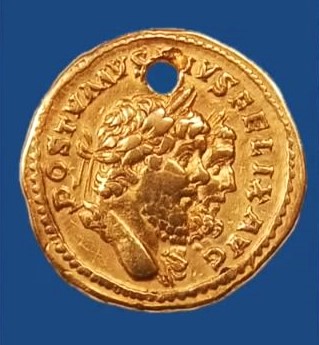
Photographed 2021-03-31
Roman gold coin pierced for suspension, shown in a Polish numismatic video
Roman gold coin pierced for suspension, shown in a Polish numismatic video; comparative evidence for secondary use of coins.

Photographed 2007
Indian imitation of a Roman imperial coin, photographed at the British Museum
Indian imitation of a Roman imperial coin, photographed at the British Museum; the source description identifies the prototype as Tiberius.
It is not linked to any specific Kerala hoard.
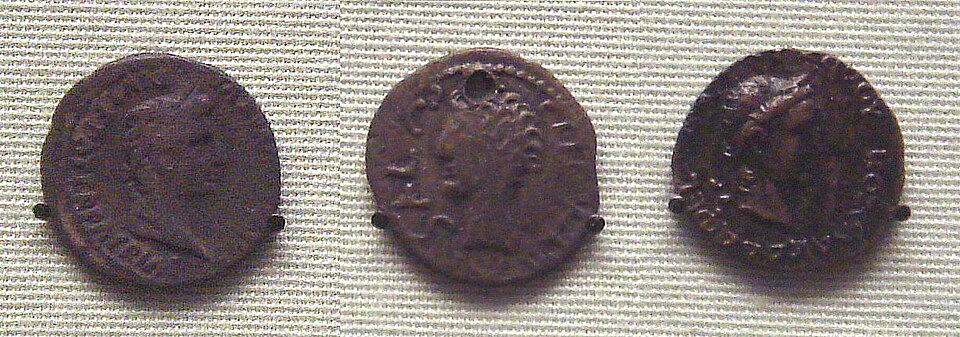
Photographed 2009
British Museum display: Tiberius silver denarius found in India, Indian imitation, and Kushan coin of Kujula Kadphises
British Museum display of a Tiberius denarius found in India, an Indian imitation, and a Kushan coin of Kujula Kadphises copying an Augustan type.
This British Museum display is not linked to a specific Kerala hoard.
005Where next
All related studies, connected material, books and sources24 · 21
Elsewhere on this site
Excavation Atlas Sites: Eyyal (Iyyal) Hoard & Burial Landscape · Kottayam (North Malabar) & Valluvally (Periyar) Roman Gold Hoards · Karur (Amaravathi River Trade Node & Proposed Chera Capital Vanchi)
Multi-Script Glossary Terms: kācu (காசு / കാശ്) · Pālakkāṭṭu Curam / Kaṇavāy (Palakkad / Palghat Gap) (பாலக்காட்டுக் கணவாய் / പാലക്കാട് ചുരം) · kārṣāpaṇa / purāṇa (Silver Punch-Marked Coins) (கார்ஷாபணம் / காசாபணம் / முத்திரை நாணயங்கள் / കാർഷാപണം / പഞ്ച്-മാർക്ക്ഡ് വെള്ളി നാണയങ്ങൾ) · Roman Gold Aurei & Silver Denarii Hoards (உரோமானிய தங்க ஆரியஸ் & வெள்ளி தினாரியஸ் / റോമൻ സ്വർണ്ണ ഔറിയസ്, വെള്ളി ദിനാരിയസ് നാണയശേഖരങ്ങൾ) · kaḻañcu (kaḷañcu) & kāṇam (Gold Weight & Coinage Standards) (கழஞ்சு (களஞ்சு) & காணம் / കഴഞ്ചും കാണവും)
Connected material
Photographs, drawings, books, videos and other studies linked to this study. A link helps you explore; it does not prove a historical claim.
- Indian imitation of a Roman imperial coin, photographed at the British MuseumphotographBackground
- Roman gold coin pierced for suspension, shown in a Polish numismatic videophotographBackground
- British Museum display: Tiberius silver denarius found in India, Indian imitation, and Kushan coin of Kujula KadphisesphotographBackground
- Read the coin, then read its contextdiagramThe chisel-cut coin reflects the seven slashed Eyyal coins this study discusses; why they were cut is unresolved.
Books, videos and websites
Outside reading on this topic. These are not part of the study and we have not checked every claim in them. See all books and videos
- Roman Coins from India Book · Paula J. Turner · 1989 · Hoard-by-hoard catalogue and die-analysis of Roman gold and silver coin finds across peninsular India – including Kottayam, Eyyal, Pudukkottai, Vellalur, and Karur – examining Julio-Claudian issue concentrations, chisel slashes, and countermarks.
- The Early Coins from Kerala Book · Parmeshwari Lal Gupta · 1965 · Primary numismatic monograph on the 1945 Eyyal hoard (Thrissur district) and early punch-marked silver and Roman imperial coins curated by the Kerala State Archaeology Department.
- India's Earliest Coins Video · Shailendra Bhandare (numismatic research & script), Pallavi Pillai (narration) & Sarmaya Arts Foundation production team · 2:10 · A short museum explainer introduces early Indian coins with a script by an identified numismatic specialist. Accessible introduction that gives research credit without implying that the narrator is the researcher. Does not establish findspots, deposition dates or circulation of the named Kerala hoards. Verify every object’s context separately if using it to support a site claim.
- A History of India Through Coins. Dr Sanjay Garg. THT Monthly Heritage Talk. January 1, 2022 Video · Sanjay Garg · Numismatist and historian; formerly National Archives of India · 1:37:05 · A broad research-oriented introduction to the historical questions that coinage can illuminate. A qualified numismatist’s explanation can support the site’s more specific coin studies. The promotional description calls coins unbiased; that wording is too strong. Coins also express authority and require provenance, context and comparison. Not an exact Kerala-hoard lecture.
- American Numismatic Society (MANTIS & OCRE) – Roman Imperial Coinage Database Website · Open-access numismatic database for verifying die varieties, mint marks (such as Lugdunum C L CAESARES issues of Augustus and PONTIF MAXIM issues of Tiberius), and weights of Roman coins found in Kerala and Tamil Nadu hoards.
006Sources
The study lists the sources it consulted; we have not rechecked them. A working link does not show that a source was read, and a valid identifier does not show that it supports a claim. We do not link to unofficial uploads or copies of publications. Where a study cited one, we show the published citation, or a publisher, DOI or Internet Archive link when we have one. Tracking codes are removed from links, and the sources themselves are not republished here.
Hoard Details 18400
Web page (chre.ashmus.ox.ac.uk)
Web page (chre.ashmus.ox.ac.uk)
api.pageplace.de · preview 9781315420684 A27018722.pdf
kchr.ac.in · ptm2011 field Report.pdf
Web page (archaeology.kerala.gov.in)
Catalog Record: Roman coins from Andhra Pradesh | HathiTrust Digital Library
govtmuseumchennai.org · 16527871404445.pdf
Roman Coins in Andhra in the Early Historical Period
Unofficial online copy (link not shown)
4 NOTE ON THE SOLITARY ROMAN GOLD COIN IN SRI VENKATESWARA MUSEUM TIRUPATI COLLECTION (source link 10)
Online copy not linked · use the published editionSource recordSecondary numismatic summary citing Gupta (1965) and Turner (1989) (unidentified chapter; primary catalogues not yet checked)
Print or offline sourceSource recordUnofficial online copy (link not shown)
Early Coins from Kerala Situating the trade networks with special reference to Pattanam (source link 12)
Online copy not linked · use the published editionSource recordapconf-much.org · 292b6ac489ef5a56d541f8b989d40fcc.pdf
ZEITSCHRIFT FÜR ARCHÄOLOGIE ...
researchgate.net · 351634713 Regulated Roman Coins and Their Imitations from In
Unofficial online copy (link not shown)
Notes on Barygaza s Trade Commodities and Coins at an Asian Crossroads (source link 16)
Online copy not linked · use the published editionSource recordEmilia Smagur, 'Regulated Roman Coins and Their Imitations from India: Did Roman Coins Circulate as Money in the Subcontinent?' Notae Numismaticae 15 (2020), DOI 10.52800/ajst.1.a.11.
82. Updating Roman Coins from India
Reference Details 6818
madrasmusings.com · in memoriam dr r krishnamurthy journalist turned numismatist
Unofficial online copy (link not shown)
Indian Imitations of Roman Aurei Reconsidered (source link 21)
Online copy not linked · use the published editionSource record
Researchers and institutions whose work this study uses: Authors, editors, and translators cited in the Source Register below, Published primary editions, catalogues, and domain scholarship logged for this study
How we know The evidence, claims and dates behind this study
What this study draws on
- Coin Hoards of the Roman Empire (Oxford) records for Eyyal, Kottayam and Nedumkandam, and the Kerala Department of Archaeology's account of Valluvally.
- Paula Turner's 1989 distribution study of Roman coins found in India.
- The 2011 Pattanam fifth-season field report on coins and imported finds.
- S. Suresh's tables of slashed and countermarked coins, and Romanowski's 2021 study of Roman coins in Andhra.
Dates in this study
This study has no dates recorded in a form we can chart, so there is no date chart. Any dates it gives are in the full study.
The study’s claims
18 claims · 0 source passages · 65 paragraphs
Browse the study paragraph by paragraphEyyal is best reconciled as a 117-piece mixed assemblage: 83 Roman + 34 punch-marked; later reproductions give 12 aurei + 71 denarii.
Supported with qualifications
Supports reconciliation; exact denomination split still requires Unnithan/Gupta facsimiles.
CHRE’s “83” is consistent with being the Roman subset rather than a rival whole-hoard total.
Supported with qualifications
Editorial synthesis; CHRE itself does not use the phrase “Roman subset.”
Eyyal was a jar find made during agricultural work and has poor archaeological context/findspot documentation.
Supported in this study
Chance find, not controlled excavation.
Kottayam has 74 catalogued coins in CHRE but historical reporting describes hundreds; material was dispersed and some coins were associated with a vessel.
Supported in this study
Original total/integrity cannot be reconstructed from read evidence.
CHRE identifies the Kottayam locality with Kannur but displays a contradictory coordinate.
Supported in this study
Coordinate withheld; original geography still needs checking.
Valluvally was found in 1983; the state page gives 250 gold coins/36 kinds while later reporting gives 252 recovered.
Supported with qualifications
Core discovery supported; exact count unresolved.
Nedumkandam reportedly contained >50 silver coins, but CHRE’s “17” conflicts with its 8 + 11 composition.
Debated in the sources
Original 1996 publication required.
Weak stratigraphic contexts limit conclusions about why the principal Kerala hoards were deposited.
Supported in this study
Valluvally’s underlying treasure records were not checked.
Distribution is compatible with inland/trans-Ghat movement, particularly through corridors such as Palakkad Gap, but does not prove one itinerary.
Supported with qualifications
Findspots cannot identify carrier, direction or precise route.
Roman-coin presence does not by itself prove western/Roman traders were physically present.
Supported in this study
Methodological caution, not denial of long-distance exchange.
KCHR 2011 records 22 copper coins, 9 early Chera, and reports Roman coins absent through five seasons despite Mediterranean material.
Supported in this study
Bounded to the excavated sample/report date.
Suresh lists seven slashed Eyyal coins but leaves slash/chisel purpose unresolved.
Supported in this study
No object-level microscopic reassessment here.
Suresh treats countermarks separately and lists one each for Nedumkandam and Valluvally.
Supported in this study
Coin-level catalogue photographs still desirable.
A blanket claim that Kerala slash/chisel marks were purity tests is unsupported.
Supported in this study
Suresh’s explicit anti-purity argument concerns elaborate countermarks; slash purpose remains open.
Comparative Indian evidence supports several possible functions for Roman coins rather than one universal function.
Supported in this study
Andhra comparison cannot assign a Kerala hoard’s function.
Weight-adjusting gold plugs on some Indian-found aurei are compatible with regulated monetary reuse.
Supported in this study
Not demonstrated for the four Kerala hoards.
Berghaus 1994 on two Valluvally imitations is an unresolved object-level lead.
Unresolved in this study
Article not yet checked directly; its detailed findings are not used.
These hoards do not establish resident Roman communities in Kerala.
Supported in this study
Roman-origin objects demonstrate connections, not handlers’ ethnicity or residence.
About this study Status, corrections and how it was made
Status
Draft study, revision 6. No historian, archaeologist, or Tamil or Malayalam specialist has reviewed it yet.
How it was made
Compiled as an editorial synthesis from published scholarship around questions we framed. About this project & workflow
The summary, How sure lines and Two views notes on this page were prepared from this study and cross-checked against its passages. That is an editorial check, not a specialist review.
Technical details
Study code R122. The text fingerprint changes whenever the study text changes.
- Table headings decide what each column means. Citation links, sample mentions and dates copied as text are kept apart from checked source passages and calibrated measurements.
See how this study’s records were extracted
Text fingerprint (SHA-256): R122 · aced0c3c3c622d1169adb258… · v6
Evidence tables and technical details are on the web page: https://layersofthesouth.org/read/0d94d6c218