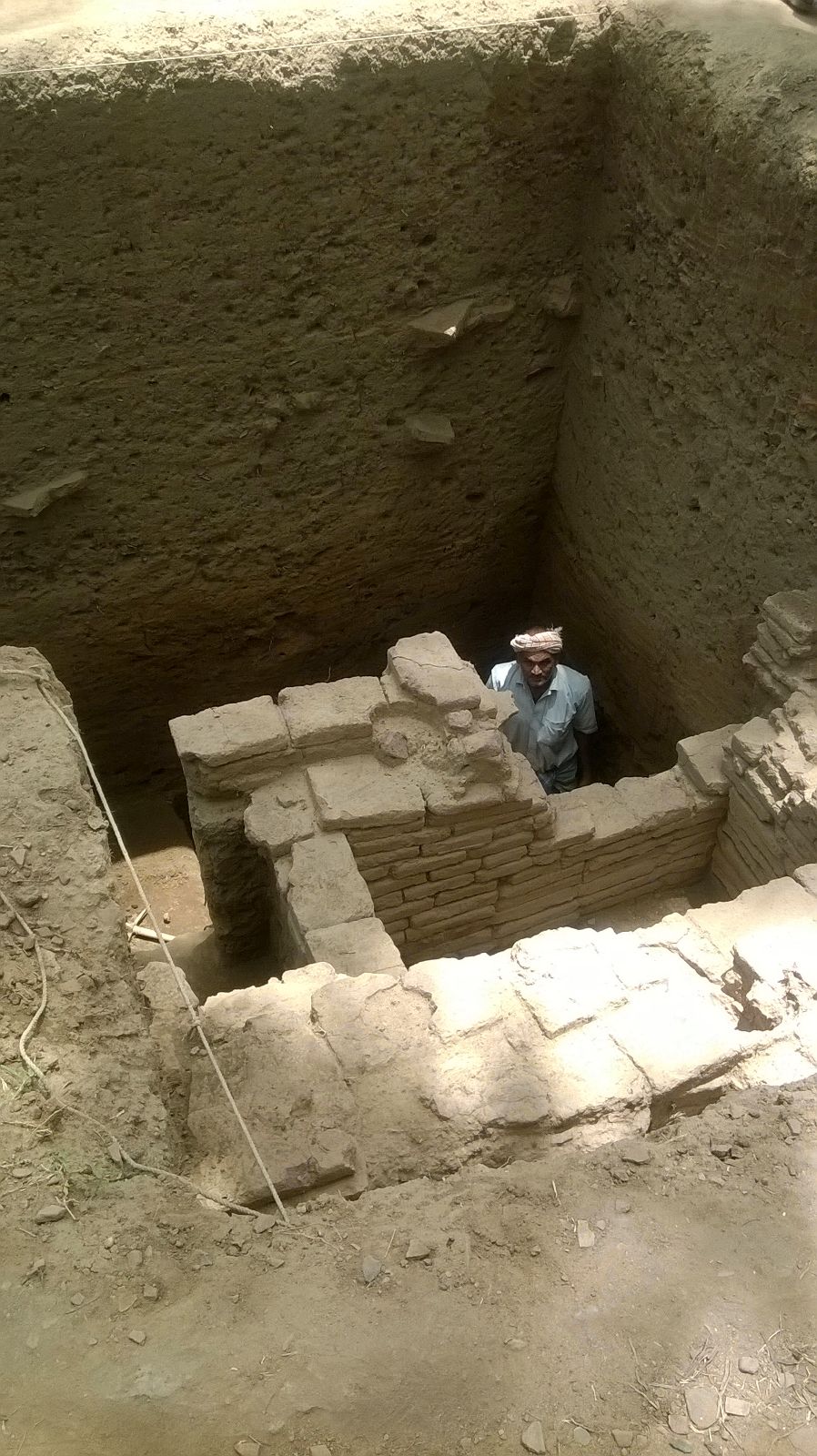
Preserved brick feature within the Keezhadi (Keeladi) excavation trenches
Keezhadi
Photographed 2019-09-06
- Everyday lives
Ring shape alone does not show whether a feature was a well
Terracotta rings at Pattanam, Keeladi and Korkai look alike; only fill, floors and connections can show which were wells or soakage pits.
- This page
- 1,307 words · revision 6
Draft study · Awaiting specialist review · Updated
001Dates and places

No mapped place in this study.
Dates in this study are stated in words only.
- 1 Well supported
- 2 Possible
- 1 Not known
002How sure
In brief
Terracotta ring features are found at several ancient sites in Kerala and Tamil Nadu. This short study compares three public accounts. A Kerala heritage page lists a ring well among the structures excavated at Pattanam. A 2021 Tamil Nadu notice describes a decorated ring at Keeladi, perhaps once visible above ground, and another ring well in a different trench. At Korkai, the state department calls three large rings under a brick structure probably soakage jars. A ring's shape cannot show its use. That depends on its fill, the floor it served and what it connected to. At Pattanam, a photo caption dated 2023 gives the year of digging, not of building. A university page notes drinkable fresh water at the site amid salty marsh. All the sources are public web pages, not full excavation reports.
Key researchers cited in this study: Authors, editors, and translators cited in the Source Register below · Published primary editions, catalogues, and domain scholarship logged for this study · Full bibliography
How sure
- Well supported
Terracotta ring features were excavated at Pattanam, Keeladi and Korkai.
Reported by the excavating and heritage bodies, though only in short public summaries.
- Possible
The decorated Keeladi ring once stood visibly above ground.
A reasoned interpretation by the department, not an observed ancient rim.
- Possible
The Korkai rings were soakage jars.
The department says “probably”; the function remains attributed and provisional.
- Not known
When the Pattanam ring well was built, and who used it.
The public pages give no date or use history; the 2023 caption dates the dig.
Why it matters
It warns against calling every ring-shaped feature a well before its context is known.
003Key findings
What the study concludes
- Stacked terracotta rings do not always serve a single function: excavators distinguish probable soakage jars at Korkai from ring wells at Keeladi and Pattanam.
- Interpreting settlement infrastructure requires attention to trench depth, surrounding floors, and fill deposits rather than isolated feature shapes.
In the study’s own words. How sure each point is, is shown above.
The summary above is the short read. The full study is the complete text it was drawn from, with its tables and source notes.
What the full study covers
004The study
The work after construction
A settlement is not kept habitable by initial construction alone; water supply, runoff, and soakage installations require ongoing placement and maintenance. This study compares archaeological notices of terracotta ring wells and brick structures from Pattanam in Kerala and Keeladi and Korkai in Tamil Nadu. By examining how excavators describe ring designs, trench depths, and probable soakage functions, we see why similar circular terracotta features must be interpreted in their exact stratigraphic context.
Begin with the local feature
KCHR’s Pattanam excavation reports (Cherian, Selvakumar and Shajan in Journal of Indian Ocean Archaeology 4, 2007; Cherian et al., Pattanam Archaeological Research: Fifth Season Field Report, 2011) and the Muziris Heritage Project public overview include terracotta ring wells alongside brick structures and waterfront features. 1 That establishes reported installations to investigate, not the water arrangements of every nearby dwelling, and the summaries do not supply a complete sequence of household supply, runoff, waste disposal, and street drainage. Research would need to establish whether an opening connected to a drain, which floor was in use when the structure was built, what filled it (and whether that fill belongs to abandonment rather than use), and whether access was altered later. These details cannot safely be supplied from a modern example, and a ring’s shape alone cannot settle them.
A Mahatma Gandhi University collection page describes the Pattanam mound amid saline, marshy surroundings while noting fresh water suitable for drinking at the site. This is a modern description, not a reconstruction of ancient water quality. 4 Being beside a river or backwater therefore does not establish where a household obtained usable fresh water; “Vembanad lagoon is far older than 1000 BCE and kept changing” shows that, at Arookutty in the Vembanad wetlands, fresh and marine influence repeatedly changed between the late first millennium BCE and the early first millennium CE. PAMA’s project page includes a ring-well excavation caption dated 2023. That year tells the reader when the pictured work took place, not when the structure was built or used. 5 Four questions stay separate for any ring well: that it existed, what it was used for, when it was built and used, and who was entitled to use it.
A rim at Keeladi
The department’s July 2021 notice describes a decorated terracotta ring found in trench YP5. It records relief bands and proposes that the decorated part originally stood visibly above ground. That is a reasoned interpretation of placement, not a surviving photograph of the ancient rim. A second discovery in YP4/1 is described separately, at another excavation depth; the two records should not be joined into one very tall well. 2 “Keezhadi's excavations reveal a substantial brick settlement” covers the Keeladi (Keezhadi) ring wells, channels and drains from the excavation-team publications, and “Agaram and Manalur: no site dates in the excavation reports so far” the ring wells at nearby Agaram.
Trench section and small exposed archaeological features at Keezhadi in 2015
Keezhadi
Photographed 2015-09-14
An excavation notice also records a moment in the investigation. A depth reached during digging is not automatically the complete depth of an installation, and the date of discovery is not its construction date. The report says further excavation was planned. For a reader, that detail is a reminder to seek subsequent documentation before assigning a finished section drawing to the feature.
A similar outline can mean another function
The Korkai overview reports three large stacked rings beneath a brick structure and calls them probably soakage jars. Its separate references to inscribed sherds and an early charcoal date do not, in the consulted summary, tie those dates directly to this installation. The proposed soakage function therefore remains attributed and provisional. It should not be silently changed into a securely dated potable-water source. 3 The comparison is valuable because it blocks a tempting shortcut. A visitor can recognize a ring-shaped component and still ask how the installation worked. We should not identify every circular feature by the first familiar example encountered. Function depends on context: how a structure was approached, whether water entered or left it, how it was filled, and which other features were demonstrably connected. Those relationships need to be examined, not merely drawn between nearby symbols. “Ancient texts link Korkai with pearls, conch and Pandyan rulers” examines the Korkai charcoal date, which is reported in two incompatible forms, and “Chank-shell working is attested at Korkai; Keezhadi so far shows only finished bangles” describes further soakage jars at the site.
What the comparison shows
Similar terracotta rings at the three sites have been described in different ways: a ring well at Pattanam, ring wells at Keeladi (one with a decorated ring whose upper part may have stood above ground), and probable soakage jars beneath a brick structure at Korkai. Each should be tied to its documented floor level and fill before it is reconstructed. A reader judging any drawing of ancient water use can check five things: where the water came from, how it was obtained, the route it travelled, where it was used, and what happened to it afterwards.
What remains uncertain
- Public excavation notices for Pattanam, Keeladi, and Korkai summarize key finds without providing full cross-sectional hydraulic diagrams for every trench.
- Whether individual terracotta ring installations functioned as potable wells, soakage pits, or drainage shafts depends on fill and floor associations.
The next questions
- Obtain excavation plans, context records, stratigraphic profiles and fill analyses for the ring wells at Pattanam and Keeladi, separating construction, reuse and filling.
- Study vessel capacities and wear only from measured objects with secure contexts.
- Compare brick drain and ring-well construction across coastal ports (Pattanam, Korkai, Arikamedu) and inland river settlements.
References and access notes
1 Muziris Heritage Project / Kerala Tourism (undated). Pattanam. Reported ring well and other excavated structures. Webpage text read. A public overview, not a trench report. Its excavation counts have no stated as-of date; they are not used as current totals. Open source: www.keralatourism.org
A pottery vessel exposed within the excavated ground at Keezhadi
Keezhadi
Photographed 2019-09-06
2 Tamil Nadu Department of Archaeology (2021 excavation notice). Ring-wells exposed in the ongoing archaeological excavation at Keeladi. “Double Roped Design Terracotta Ring” and “Another Ringwell exposed in Keeladi”. Indexed departmental notice consulted; full excavation report not yet checked. The interpretation of a decorated upper ring above ground is separate from the observed decoration. The two trench discoveries and their depths are not one well. Excavation dates are not ancient construction dates. Open source: www.tnarch.gov.in
3 Tamil Nadu Department of Archaeology (Undated excavation overview). Korkai: excavated structure and terracotta rings. Excavated brick structure and three rings; separate pottery and charcoal statements. Indexed departmental summary consulted; full excavation report not yet checked. The department calls the rings probably soakage jars. The separately reported charcoal date is not assigned here to the rings or the building. Open source: www.tnarch.gov.in
4 School of Social Sciences, Mahatma Gandhi University (Undated institutional collection page). Early Historic Age Collection. Early Historic Age Collection; site setting, freshwater and structural remains. Collection description read. A collection overview is useful for orientation but does not replace trench-by-trench stratigraphic records. Undated excavation counts are not used as current totals. Open source: sss.mgu.ac.in
Brick structural remains exposed in a Keezhadi trench in 2015
Keezhadi
Photographed 2015-09-14
5 PAMA Institute for the Advancement of Transdisciplinary Archaeological Sciences (undated, multi-year project page). Pattanam: excavations and archaeobiological research projects. PAMA excavations 2019–2023; ring-well caption and structural-remains account. Relevant project sections and captions read; no source photographs republished. Reports finds and describes proposed analyses together. Future-tense research intentions are not treated as completed results. The year on an excavation photograph is not the ancient date of the feature. Open source: www.pama.org.in
P. J. Cherian, V. Selvakumar, and K. P. Shajan (2007), "The Muziris Heritage Project: Excavations at Pattanam – 2007," Journal of Indian Ocean Archaeology 4; and P. J. Cherian et al. (2011), Pattanam Archaeological Research: Fifth Season Field Report (Thiruvananthapuram: Kerala Council for Historical Research; https://kchr.ac.in/images/img/ptm2011_field%20Report.pdf). Excavation interim reports for Pattanam ring wells and structural contexts.
005Photographs
Photographs of the places and objects this study discusses. Each item carries its creator’s credit, licence and documented source. See all 412 photographs and source images ↗

Keezhadi · Photographed 2019-09-06
Preserved brick feature within the Keezhadi excavation trenches

Keezhadi · Photographed 2015-09-14
Trench section and small exposed archaeological features at Keezhadi in 2015
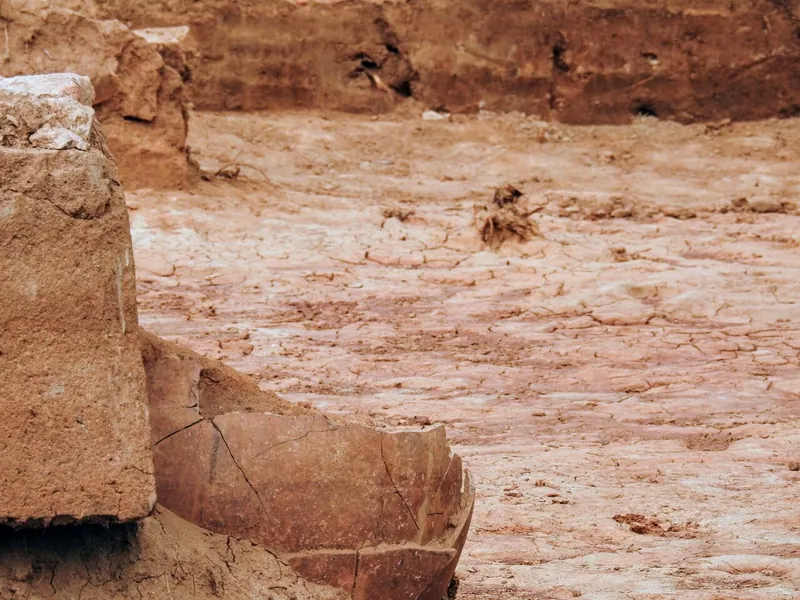
Keezhadi · Photographed 2019-09-06
A pottery vessel exposed within the excavated ground at Keezhadi
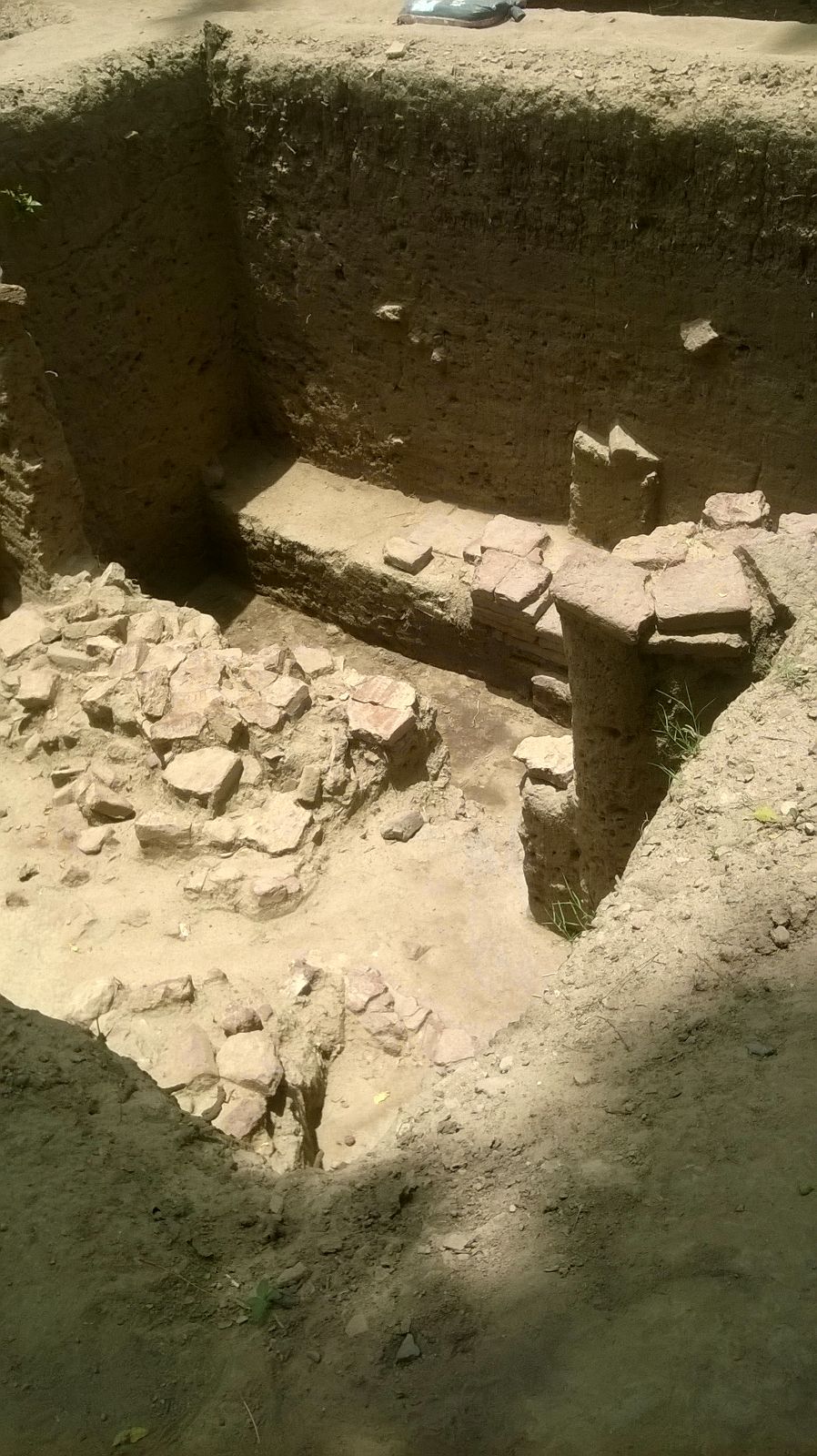
Keezhadi · Photographed 2015-09-14
Brick structural remains exposed in a Keezhadi trench in 2015

Keezhadi · Photographed 2019-09-06
Brickwork and associated deposits exposed at Keezhadi
Keezhadi · Photographed 2016-10-11
Excavation trenches between coconut palms at Keezhadi in 2016
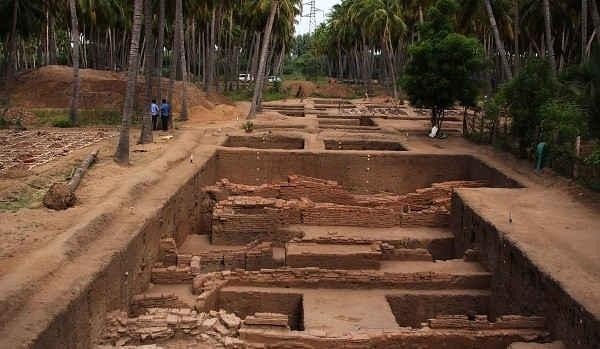
Keezhadi · Photographed 2018-05-28
Long view across excavation trenches and exposed brick structures at Keezhadi
Keezhadi · Photographed 2015-09-14
Excavated brickwork within a Keezhadi trench in 2015
Show 2 more photographs and source images ↓

Keezhadi · Photographed 2019-09-06
Stacked ceramic rings exposed in a Keezhadi excavation section

Keezhadi · Photographed 2015-09-14
Stratified trench wall and exposed features at Keezhadi in 2015
006Where next
All related studies, connected material, books and sources25 · 5
Elsewhere on this site
Multi-Script Glossary Terms: ōlai (tāḷiyōlai) (ஓலை / பனையோலை / ഓല / താളിയോല) · uṟai-kiṇaṟu (உறைகிணறு / ഉറക്കിണർ) · ūr (ஊர் / ഊർ / ഊര്) · maṉṟam / potiyil (மன்றம் / பொதியில் / മന്റം / പൊതിയിൽ)
Connected material
Photographs, drawings, books, videos and other studies linked to this study. A link helps you explore; it does not prove a historical claim.
- Trench section and small exposed archaeological features at Keezhadi in 2015photographShows the subject
- Excavated brickwork within a Keezhadi trench in 2015photographShows the subject
- Stratified trench wall and exposed features at Keezhadi in 2015photographShows the subject
- Brick structural remains exposed in a Keezhadi trench in 2015photographShows the subject
- Excavation trenches between coconut palms at Keezhadi in 2016photographShows the subject
- Long view across excavation trenches and exposed brick structures at KeezhadiphotographShows the subject
- A pottery vessel exposed within the excavated ground at KeezhadiphotographShows the subject
- Preserved brick feature within the Keezhadi excavation trenchesphotographShows the subject
- Stacked ceramic rings exposed in a Keezhadi excavation sectionphotographShows the subject
- Brickwork and associated deposits exposed at KeezhadiphotographShows the subject
007Sources
The study lists the sources it consulted; we have not rechecked them. A working link does not show that a source was read, and a valid identifier does not show that it supports a claim. We do not link to unofficial uploads or copies of publications. Where a study cited one, we show the published citation, or a publisher, DOI or Internet Archive link when we have one. Tracking codes are removed from links, and the sources themselves are not republished here.
Muziris Heritage Project / Kerala Tourism (undated). Pattanam. Reported ring well and other excavated structures. Webpage text read. A public overview, not a trench report. Its excavation counts have no stated as-of date; they are not used as current totals.
Tamil Nadu Department of Archaeology (2021 excavation notice). Ring-wells exposed in the ongoing archaeological excavation at Keeladi. “Double Roped Design Terracotta Ring” and “Another Ringwell exposed in Keeladi”. Indexed notice read; full text not yet checked. The interpretation of a decorated upper ring above ground is separate from the observed decoration. The two trench discoveries and their depths are not one well. Excavation dates are not ancient construction dates.
Tamil Nadu Department of Archaeology (Undated excavation overview). Korkai: excavated structure and terracotta rings. Excavated brick structure and three rings; separate pottery and charcoal statements. Indexed archaeological description read; full text not yet checked. The department calls the rings probably soakage jars. The separately reported charcoal date is not assigned here to the rings or the building.
School of Social Sciences, Mahatma Gandhi University (Undated institutional collection page). Early Historic Age Collection. Early Historic Age Collection; site setting, freshwater and structural remains. Collection description read. A collection overview is useful for orientation but does not replace trench-by-trench stratigraphic records. Undated excavation counts are not used as current totals.
PAMA Institute for the Advancement of Transdisciplinary Archaeological Sciences (undated, multi-year project page). Pattanam: excavations and archaeobiological research projects. PAMA excavations 2019–2023; ring-well caption and structural-remains account. Relevant project sections and captions read; no source photographs republished. Reports finds and describes proposed analyses together. Future-tense research intentions are not treated as completed results. The year on an excavation photograph is not the ancient date of the feature.
Researchers and institutions whose work this study uses: Authors, editors, and translators cited in the Source Register below, Published primary editions, catalogues, and domain scholarship logged for this study
How we know The evidence, claims and dates behind this study
What this study draws on
- Kerala Tourism's Muziris Heritage page on Pattanam and PAMA's Pattanam project page.
- Tamil Nadu Department of Archaeology notices on Keeladi (2021) and Korkai, read through indexed text.
- A Mahatma Gandhi University collection page on the Pattanam site setting.
- Comparing fill, floor and connection evidence rather than ring shape.
Dates in this study
This study has no dates recorded in a form we can chart, so there is no date chart. Any dates it gives are in the full study.
The study’s claims
0 claims · 0 source passages · 15 paragraphs
Browse the study paragraph by paragraphThis study has no separately listed claims. Its paragraphs can be browsed one by one.
About this study Status, corrections and how it was made
Status
Draft study, revision 6. No historian, archaeologist, or Tamil or Malayalam specialist has reviewed it yet.
How it was made
Compiled as an editorial synthesis from published scholarship around questions we framed. About this project & workflow
The summary, How sure lines and Two views notes on this page were prepared from this study and cross-checked against its passages. That is an editorial check, not a specialist review.
Technical details
Study code R082. The text fingerprint changes whenever the study text changes.
- The study text is shown as written. Links from its paragraphs to citations help you move around the study; they are not new claims or checked source passages.
See how this study’s records were extracted
Text fingerprint (SHA-256): R082 · 9b1c6e59a553ef84e9baea09… · v6
Evidence tables and technical details are on the web page: https://layersofthesouth.org/read/ef015a94fb