Purananuru 343 in the 1894 Swaminatha Iyer edition
1894
- Words & worlds
Palm-leaf texts survived because people kept copying them
Palm-leaf texts reach us through prepared leaves, incised letters, later copies, colophons and printed editions, so a copy's date is not the text's date.
- This page
- 1,980 words · revision 6
Draft study · Awaiting specialist review · Updated
001Dates and places

No mapped place in this study.
Dates in this study are stated in words only.
- 1 Well supported
- 1 Possible
- 2 Not known
002How sure
In brief
Early Tamil texts survived because people prepared leaves, copied them, added commentary and edited them. Hamburg researchers Giovanni Ciotti and Sebastian Bosch describe South Indian palm leaves being boiled, polished, cut and stacked between wooden boards. A metal stylus incised the letters, and soot mixed with oil could darken them. Their example, the Tamil manuscript Cod. Palmbl. III 118, was left uninked, and its colophon names Thirunarayanapuram as the place of copying. A laboratory scan of one page found higher iron levels along the incised letters, possibly from the stylus. The commentary it carries is thirteenth-century, but that is not the date of this copy. Eva Wilden's 2014 book follows Sangam poems through manuscripts, commentaries and early prints; only its description and contents were read. A first-pass search found no securely dated first-century palm-leaf writing at Pattanam, and no fixed recopying interval or universal recipe is established.
Key researchers cited in this study: Eva Wilden (Sangam Critical Editions & Manuscriptology) · Full bibliography
How sure
- Well supported
In surviving South Indian manuscripts, palm leaves were prepared, incised with a stylus and usually darkened, in separate steps.
Hamburg researchers describe these steps for identified South Indian manuscripts; one Tamil copy was left uninked.
- Possible
Iron traces along the incised letters came from a metal stylus.
A laboratory caption reports the iron but only suggests a possible link with the stylus.
- Not known
People at first-century Pattanam wrote on palm leaves.
A first-pass search found no securely dated witness; with poor preservation, that absence is not evidence either way.
- Not known
Leaves were recopied at a fixed interval.
The sources used establish no fixed recopying interval, shelf life or universal preparation recipe.
Why it matters
Early Tamil poems reach readers through later copies and editions, so a poem's date, its copy's date and its edition must be kept apart.
003Key findings
What the study concludes
- Preparing the support, making the letters and darkening them can be distinct operations; one surviving Tamil witness was left uninked.
- The composition date of a text, the date of its copy and the history of the object’s collection must remain separate.
- Copying, commentary and editing helped transmit works, but no fixed recopying interval or universal preparation recipe is established.
In the study’s own words. How sure each point is, is shown above.
The summary above is the short read. The full study is the complete text it was drawn from, with its tables and source notes.
What the full study covers
- Main findings
- The book was work before it was words
- The search found no securely dated palm-leaf writing at early Pattanam
- From a leaf to a prepared support
- The copy that was not darkened
- A colophon gives another kind of address
- What an elemental map can – and cannot – say
- Leaf-shaped does not always mean made of a leaf
- A familiar title can conceal an unfamiliar language history
- The path from a copy to a printed poem
- What remains uncertain
- The next questions
- References and access notes
- Further reading
004The study
Main findings
- Preparing the support, making the letters and darkening them can be distinct operations; one surviving Tamil witness was left uninked.
- The composition date of a text, the date of its copy and the history of the object’s collection must remain separate.
- Copying, commentary and editing helped transmit works, but no fixed recopying interval or universal preparation recipe is established.
The book was work before it was words
A text that reaches a reader is also an object that someone prepared, arranged and kept available. The familiar image of a stylus moving across a palm leaf is only one stage. This study asks what happens before and after the act of writing, using identified manuscripts and research descriptions. Its purpose is to make the labor of transmission visible without turning a later craft procedure into an undocumented first-century workshop. It concerns what securely identified later witnesses can teach us about making and transmitting manuscripts; the next section explains why no earlier witness from Pattanam is used. A later object can illuminate a process while remaining a later object.
The search found no securely dated palm-leaf writing at early Pattanam
No direct, securely dated first-century Pattanam palm-leaf witness was found in the sources examined for this study. That search was a first pass, not an exhaustive catalogue of every possible witness. Its result is not proof that nobody in the region used leaves, nor a claim that organic survival would be straightforward. Poor preservation cannot manufacture positive evidence. A perishable medium’s possible existence does not establish its use by a particular person in a particular context. The Hamburg manuscript discussed below can teach the medium, but a later manuscript cannot, on its own, settle an earlier local practice. 2
The comparison of writing surfaces should not assume that all writing serves the same purpose. A short mark on a container, a reusable working note, an account, a long literary composition and a commemorative inscription place different demands on their materials. The research question is which purposes and surfaces are evidenced in the relevant setting. For each proposed medium, compare availability, preparation, tool, length of text, weight, handling, reuse and survival. Those are analytical criteria; they are not a claim that every ancient writer made the same calculation. A sound comparison needs dated examples of leaf, clay, potsherd, papyrus, wood and metal, not a story in which one universally superior medium replaces all the others.
From a leaf to a prepared support
Ciotti and Bosch describe South Indian leaves being boiled, polished and cut into a uniform stack, normally protected by wooden boards. A metal stylus incises the two faces; soot mixed with herbal oil can then darken the incisions. Their example is Cod. Palmbl. III 118, not an excavated Pattanam manuscript. 1 The order matters. The support must be usable before the text can be laid out, and making the mark is distinct from making it easy to read. These observations suggest a chain of skills rather than one instantaneous act. They do not establish how many people shared the tasks, how long a worker took, which fuel heated a vessel, or the proportions of a preparation mixture. Such details need their own evidence. A modern demonstration by a conservator or practitioner shows present-day practice or an experimental reconstruction of a particular tradition, not the exact ancient procedure. Preservation work on a historic object requires expertise and knowledge of its condition.
Muziris and Templum Augusti: detail from Miller’s 1887/1888 Peutinger facsimile
The copy that was not darkened
Cod. Palmbl. III 118 was left uninked. Ciotti and Bosch suggest it was probably commissioned for shipment to Europe and may not have been read in its intended way. Its thirteenth-century commentary is not the copying date of the surviving object. The authors distinguish this case from the usual darkening process. 2 This small exception has large consequences for interpretation. A manuscript can possess letters without having completed every expected stage of use. It may survive because somebody wanted an example to collect rather than a book to read. The authors’ proposed history remains a proposal; we do not turn it into the name of an undocumented commissioner. But the object prevents us from assuming that all surviving copies had identical purposes.
A colophon gives another kind of address
Hamburg’s laboratory description identifies Thirunarayanapuram as the copying place recorded in the colophon of Cod. Palmbl. III 118. It explains a programme of comparing material profiles of manuscripts with known provenance against those without such information. The proposed value lies in connecting material evidence with an independently recorded location. 3 A copying place is not automatically the place where a work was composed, and neither is necessarily the present library. A careful catalogue should allow all three to coexist. The same applies to personal names: a copyist, author, commentator, donor and collector perform different roles. Where a closing note names someone, its wording needs examination before the label author is supplied. Those distinctions keep the people of transmission visible. A person who made a fresh copy did not have to compose the work in order to make a decisive contribution to its survival. Conversely, the survival of a work in a late copy does not erase its earlier history. What it changes is the route by which that history must be investigated.
What an elemental map can – and cannot – say
The laboratory caption for folio 17v reports elevated iron along the incised letters and suggests a possible connection with a metal stylus. That is a material observation with a qualified explanation. It is not a decoded reading, a named metalworker or an exact writing date. 4 A further inference would need further evidence. A chemical pattern must be compared with the support, treatment history, tools and suitable reference material before it can support a provenance argument. The research page describes that comparative programme; it does not mean every unknown leaf can already be assigned to a village. Our report uses the method description, not a claim to have independently reanalysed its scans.
Leaf-shaped does not always mean made of a leaf
San San May’s British Library account identifies an eighteenth-century Pali Kammavaca on gilded, lacquered palm leaf in Burmese square script, Add.15289. It also describes later examples on metal and stiffened cloth made in a leaf-like format. The indexed captions and curatorial text were read, not the original objects. 5 Shape, support and textual purpose are separate properties. A caption should identify whether the photographed object is plant material, metal or cloth. These later Burmese examples are methodological comparisons, not evidence for early South Indian practice.
A familiar title can conceal an unfamiliar language history
Wilden discusses Hamburg Cod. orient. 283, a seventeenth-century paper manuscript associated with Baldaeus. Its title calls its subject Malabaric, but the language described is Tamil; Portuguese provides the explanation. The title page has differing dates, and attribution is also discussed as uncertain. The paper object is not evidence that all texts called Malabaric concern Malayalam. 6 This is where manuscript study changes the way we search. Looking only for a modern language name may miss a relevant witness or misclassify another. We need the historical title, catalogue description, language of the text and language of explanation. The work of a modern library or editor helps make that distinction visible, but its interpretation should remain traceable to the object and edition.
The path from a copy to a printed poem
Wilden’s Manuscript, Print and Memory investigates Sangam transmission through surviving manuscripts, early prints, commentaries and later quotations. Only the institutional description and detailed table of contents were read for this study, not the monograph itself. Its separation of witnesses, traditional colophons, scribal information and editing offers a concrete reading programme for further research. 7 Our practical consequence is to retain more than a clean digital text. A reader validating a translated poem needs to know the edition, the translator, and any significant restored or contested wording. A disagreement between copies does not automatically make the whole tradition unreliable. It creates a problem that an editor must explain. Agreement likewise needs to be considered in light of whether witnesses are independent copies or descend from one another. We have not established a fixed number of years after which every leaf was recopied. Nor do the sources used here supply a universal shelf life, preparation recipe or uninterrupted chain for each early poem. The useful finding is more human: transmission involves decisions about what deserves another copy, which reading to retain, what explanation to add and how to make the result legible. Those decisions deserve a place beside the celebrated moment of composition. A careful specimen label identifies material, text, known or uncertain copy date, colophon, present location and image source. The surviving objects make visible the practical work through which texts continued to be copied, read and transmitted.
Palm leaves bearing Tamil numerals, photographed in 2013
Photographed 2013-07-27
It shows what palm-leaf writing looks like; it is not a Sangam-period manuscript or a copy of a named poem.
What remains uncertain
- No direct first-century Pattanam palm-leaf specimen, universal recipe, shelf life or recopying interval is established.
- The Tamil manuscript case is later than its commentary’s composition; the Burmese and paper examples are explicitly later comparisons.
- The full Wilden monograph and the 2025 edited volume were not read; no independent colophon translation or laboratory reanalysis was done.
The next questions
- Inspect critical manuscript catalogues for well-provenanced specimens.
- Compare documented leaf species, preparation and writing methods without generalizing one procedure to all regions.
- Trace one Sangam poem through a manuscript witness, edition and translation with a philological reviewer.
- Identify the earliest securely dated palm-leaf witnesses and references relevant to southern India.
- Find dated non-leaf writing surfaces that illuminate the same region and purposes.
References and access notes
1 Giovanni Ciotti and Sebastian Bosch. The Glory of Vishnu: Tracing the Origins of Palm-Leaf Manuscripts. Centre for the Study of Manuscript Cultures (CSMC), University of Hamburg (online exhibition article; accessed October 2026). Opening description of leaf preparation, wooden boards, stylus, and darkening. Text composition, physical copying, and the earlier history of the technique remain separate questions. URL: https://www.csmc.uni-hamburg.de/hamburgs-schriftschaetze/english/the-glory-of-vishnu.html
2 Giovanni Ciotti and Sebastian Bosch. The Glory of Vishnu: Tracing the Origins of Palm-Leaf Manuscripts. CSMC, University of Hamburg (accessed October 2026). Discussion of Cod. Palmbl. III 118: uninked leaves, proposed European commission, and thirteenth-century commentary date versus copy date. URL: https://www.csmc.uni-hamburg.de/hamburgs-schriftschaetze/english/the-glory-of-vishnu.html
3 Centre for the Study of Manuscript Cultures (CSMC), University of Hamburg (2026). Provenancing Palm-Leaf Manuscripts. Artefact Lab project page (accessed October 2026): Thirunarayanapuram colophon and provenance-comparison programme. Underlying analytical datasets were not independently reanalysed here. URL: https://www.csmc.uni-hamburg.de/artefact-lab/artefact-lab/mobile/provenance-dating/palm-leaves.html
4 Centre for the Study of Manuscript Cultures (CSMC), University of Hamburg (2026). Provenancing Palm-Leaf Manuscripts (accessed October 2026). XRF elemental-mapping caption for Cod. Palmbl. III 118, folio 17v, reporting elevated iron along incised letters and noting a possible link with a metal stylus. URL: https://www.csmc.uni-hamburg.de/artefact-lab/artefact-lab/mobile/provenance-dating/palm-leaves.html
5 San San May, Curator for Burmese, British Library (2017). Kammavaca: Burmese Buddhist ordination manuscripts. British Library Asian and African studies blog (accessed October 2026): Add.15289, f.1; Or.13896; and Or.12010A. Eighteenth- and nineteenth-century Burmese comparative examples illustrating distinctions among language, script, and physical support. URL: https://www.bl.uk/stories/blogs/posts/kammavaca-burmese-buddhist-ordination-manuscripts
Pliny: Coptos, Berenice and the voyage toward India,1855 edition
1855
6 Eva Wilden (2024). The Palm-Leaf Manuscripts of Tamil Nadu. CSMC, University of Hamburg (accessed October 2026): Cod. orient. 283 section (seventeenth-century paper grammar using Malabaric for Tamil, with Portuguese explanation, attribution, and title-page dating complications). URL: https://www.csmc.uni-hamburg.de/hamburgs-schriftschaetze/english/tamil-nadu.html
7 Eva Maria Wilden (2014). Manuscript, Print and Memory: Relics of the Cankam in Tamilnadu. Studies in Manuscript Cultures 3. Berlin and Boston: De Gruyter. ISBN 978-3-11-034089-1; DOI 10.1515/9783110352764. CSMC volume description and table of contents (https://www.csmc.uni-hamburg.de/publications/smc/smc03.html, accessed October 2026) consulted for sections II–IV; full monograph was not read directly for this study.
Further reading
Emmanuel Francis and Eva Wilden, eds. (2025). South-Indian Manuscripts in Hamburg and Paris: Paratexts and Provenance. Universität Hamburg Research Data Repository (https://www.fdr.uni-hamburg.de). Repository announcement and table of contents consulted as onward reading; full chapters were not read here.
005Photographs
Photographs of the places and objects this study discusses. Each item carries its creator’s credit, licence and documented source. See all 412 photographs and source images ↗

1894
Purananuru 343 in the 1894 Swaminatha Iyer edition
Purananuru 343 in the 1894 Swaminatha Iyer edition. The poem evokes fish exchanged for rice, pepper sacks, gold brought by ships and Musiri before turning to a refused marriage demand.
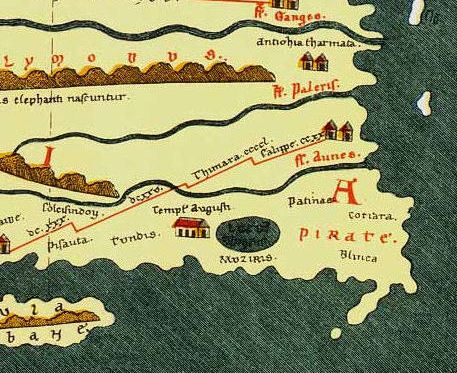
Muziris and Templum Augusti: detail from Miller’s 1887/1888 Peutinger facsimile

Photographed 2013-07-27 10:09:24
Palm leaves bearing Tamil numerals, photographed in 2013
It shows what palm-leaf writing looks like; it is not a Sangam-period manuscript or a copy of a named poem.

1855
Pliny: Coptos, Berenice and the voyage toward India,1855 edition
Book VI, chapter 26, p 64 of the 1855 Bostock–Riley translation of Pliny, describing the desert route to Berenice and the sea voyage toward India.

1847 (catalogue also notes 1848)
Tolkappiyam: text page from the 1847/1848 printed edition – A later printed witness to an older work, not an ancient manuscript
Tolkappiyam: text page from the 1847/1848 printed edition. A later printed witness to an older work, not an ancient manuscript.

1897
Book III, p 119 of McCrindle’s 1897 translation of Cosmas: the passage on Male, pepper and a church, followed by Calliana and Socotra

1894
Title page of the 1894 printed Purananuru edition, naming U. V. Swaminatha Iyer
Title page of the 1894 printed Purananuru edition, naming U. V. Swaminatha Iyer and the Chennai printing house.

1912
Periplus §§58–60: Comari, Colchi, pearl divers and eastern ports,1912 edition
Printed p 46 of Schoff’s 1912 Periplus translation: Comari, Colchi, pearl fisheries, the Pandian kingdom and the ports Camara, Poduca and Sopatma.
Show 8 more photographs and source images ↓

1855
Pliny: Muziris, Barace, Pandion and Cottonara,1855 edition
Book VI, chapter 26, p 65 of the 1855 Bostock–Riley translation of Pliny, naming Muziris, Barace, Pandion, Modiera and Cottonara and discussing voyages and pepper.
Its nineteenth-century footnote identifying Muziris with Mangalore is an outdated proposal, not a present conclusion.

1912
Periplus §§53–56: Muziris, Nelcynda and the Pandian kingdom,1912 edition
Printed p 44 of Schoff’s 1912 translation of the Periplus, describing Muziris, Nelcynda, river distances, kingdoms and ships carrying pepper.

1897
Silappathikaram: text page from the 1897 examination edition – A later printed witness to an older work, not an ancient manuscript
Silappathikaram: text page from the 1897 examination edition. A later printed witness to an older work, not an ancient manuscript.

1898
Manimekalai: opening text in the 1898 Swaminatha Iyer edition – A later printed witness to an older work, not an ancient manuscript
Manimekalai: opening text in the 1898 Swaminatha Iyer edition. A later printed witness to an older work, not an ancient manuscript.

Ptolemaic India: tenth map of Asia, printed by Lienhart Holl in 1482
It is a 1482 printing of Ptolemy’s geography, not a surviving second-century map.

1897
Book XI, p 366 of McCrindle’s 1897 Cosmas translation, describing traded products, Male’s pepper and exchanges among ports

1897
Silappathikaram: title page of the 1897 examination edition – A later printed witness to an older work, not an ancient manuscript
Silappathikaram: title page of the 1897 examination edition. A later printed witness to an older work, not an ancient manuscript.

1912
Periplus §§56–57: pepper, imports and sailing winds,1912 edition
Printed p 45 of Schoff’s 1912 Periplus translation, continuing the list of imports and exports and discussing the ocean crossing and Hippalus wind.
The wording is the 1912 translator’s English, not the Greek original.
006Where next
Palm leaves decay, so the poems survive only because they were copied again and again. The direct manuscript evidence goes back about three hundred years.
On the shelfWords & worldsBrowse studies on this theme.
Explore nextOne Poem, Five Dates: How Copying Saved Ancient PoemsAll related studies, connected material, books and sources15 · 7
Elsewhere on this site
Junior Detective Quests: One Poem, Five Dates: How Copying Saved Ancient Poems
Classroom Lesson Plans: Module 3 · Poems as Historical Witnesses: Landscapes (Tiṇai), Ethics & Voices
Multi-Script Glossary Terms: ōlai (tāḷiyōlai) (ஓலை / பனையோலை / ഓല / താളിയോല) · eḻuttāṇi (எழுத்தாணி / എഴുത്താണി) · Kōleḻuttu (Koleluttu) (கோலெழுத்து / കോലെഴുത്ത്) · Malayāṇma & Ārya-eḻuttu (மலையாண்மை & ஆரிய எழுத்து / മലയാണ്മയും ആര്യയെഴുത്തും) · paṉai (Palmyra Palm) & teṅku (Coconut Palm) (பனை & தெங்கு (தென்னை) / പനയും തെങ്ങും)
Connected material
Photographs, drawings, books, videos and other studies linked to this study. A link helps you explore; it does not prove a historical claim.
- Title page of the 1894 printed Purananuru edition, naming U. V. Swaminatha Iyerhistorical printed pageBackground
- Purananuru 343 in the 1894 Swaminatha Iyer editionhistorical printed pageBackground
- Periplus §§53–56: Muziris, Nelcynda and the Pandian kingdom,1912 editionhistorical printed pageBackground
- Periplus §§56–57: pepper, imports and sailing winds,1912 editionhistorical printed pageBackground
- Periplus §§58–60: Comari, Colchi, pearl divers and eastern ports,1912 editionhistorical printed pageBackground
- Book III, p 119 of McCrindle’s 1897 translation of Cosmas: the passage on Male, pepper and a church, followed by Calliana and Socotrahistorical printed pageBackground
- Book XI, p 366 of McCrindle’s 1897 Cosmas translation, describing traded products, Male’s pepper and exchanges among portshistorical printed pageBackground
- Pliny: Coptos, Berenice and the voyage toward India,1855 editionhistorical printed pageBackground
- Pliny: Muziris, Barace, Pandion and Cottonara,1855 editionhistorical printed pageBackground
- Ptolemaic India: tenth map of Asia, printed by Lienhart Holl in 1482historical map reproductionBackground
- Muziris and Templum Augusti: detail from Miller’s 1887/1888 Peutinger facsimilehistorical map reproductionBackground
- Palm leaves bearing Tamil numerals, photographed in 2013manuscript photographBackground
- Tolkappiyam: text page from the 1847/1848 printed edition – A later printed witness to an older work, not an ancient manuscripthistorical printed textBackground
- Manimekalai: opening text in the 1898 Swaminatha Iyer edition – A later printed witness to an older work, not an ancient manuscripthistorical printed textBackground
- Silappathikaram: title page of the 1897 examination edition – A later printed witness to an older work, not an ancient manuscripthistorical printed textBackground
- Silappathikaram: text page from the 1897 examination edition – A later printed witness to an older work, not an ancient manuscripthistorical printed textBackground
- Three surfaces, three kinds of survivaldiagramThe palm-leaf panel follows this study of how leaves were cut, written, darkened and copied again.
Books, videos and websites
Outside reading on this topic. These are not part of the study and we have not checked every claim in them. See all books and videos
- Tamilex. Establishment of an electronic corpus of Classical Tamil literature Video · Tamilex Research Team (Eva Wilden, project director) · Academy of Sciences and Humanities in Hamburg / Universität Hamburg · 5:49 · A short institutional presentation of the team building an electronic corpus and historical lexicon of classical Tamil literature. Shows and credits the present-day work that makes early texts accessible and checkable. Modern manuscript and editorial work is not direct evidence that a specific ancient site used a given writing material.
- Dominik Wujastyk on Sanskrit manuscripts and the history of science Video · Dominik Wujastyk, Sudha Gopalakrishnan · University of Alberta researcher; India International Centre / SAMHiTA programme; Gopalakrishnan chairs · 1:26:05 · A research conversation about Sanskrit manuscripts, textual history and the history of Indian science and medicine. Foregrounds textual scholarship and the distinction between a surviving copy and the earlier text it transmits. Later manuscript witnesses do not directly date an original composition or establish medical practice at an early Kerala site. An IIC development-page entry gives 28 April; the contemporaneous organizer announcement and upload identify 29 April 2022.
- Webinar: Dr. Rajesh Venkatasubramanian on "Classical Tamil Literature in Colonial India" Video · Rajesh Venkatasubramanian · Indian Institute of Science Education and Research, Mohali · 1:02:46 · A historian discusses how classical Tamil literature was transmitted, recovered and framed in colonial India. Makes the modern work and choices behind apparently straightforward ancient-text editions visible. The main subject is the colonial period; label it later reception and source history, not early-period evidence.
007Sources
The study lists the sources it consulted; we have not rechecked them. A working link does not show that a source was read, and a valid identifier does not show that it supports a claim. We do not link to unofficial uploads or copies of publications. Where a study cited one, we show the published citation, or a publisher, DOI or Internet Archive link when we have one. Tracking codes are removed from links, and the sources themselves are not republished here.
Giovanni Ciotti and Sebastian Bosch (undated). The Glory of Vishnu: Tracing the Origins of Palm-Leaf Manuscripts. Opening description of leaf preparation, boards, stylus and darkening. Webpage text read. The text’s composition, the physical manuscript’s copying, and the technique’s earlier history are different questions. No first- century Pattanam date is inferred. Images are not copied.
Giovanni Ciotti and Sebastian Bosch (undated). The Glory of Vishnu: Tracing the Origins of Palm-Leaf Manuscripts. Cod. Palmbl. III 118: absence of inking, proposed European commission, and date of the commentary. Webpage text read. The text’s composition, the physical manuscript’s copying, and the technique’s earlier history are different questions. No first-century Pattanam date is inferred. Images are not copied.
Centre for the Study of Manuscript Cultures, University of Hamburg (2026). Provenancing Palm-Leaf Manuscripts. Colophon and provenance-comparison paragraphs. Full explanatory text and figure caption read; underlying scans and datasets not independently analysed. An elemental pattern is not a decoded text or a calendar date.
Centre for the Study of Manuscript Cultures, University of Hamburg (2026). Provenancing Palm-Leaf Manuscripts. XRF figure caption: Cod. Palmbl. III 118, folio 17v; possible stylus explanation. Full explanatory text and figure caption read; underlying scans and datasets not independently analysed. An elemental pattern is not a decoded text or a calendar date.
San San May, Curator for Burmese; British Library (2017). Kammavaca: Burmese Buddhist ordination manuscripts. Add.15289, f.1; Or.13896 and Or.12010A; material and script descriptions. Indexed curator text and specimen captions read; indexed curatorial text consulted. Eighteenth-/nineteenth-century Burmese examples. They illustrate distinctions among language, script and support, not an early South Indian production practice.
Eva Wilden; University of Hamburg (2024). The Palm-Leaf Manuscripts of Tamil Nadu. Cod. orient. 283 section: title, described language, Portuguese, dating and attribution. Complete explanatory text and named catalogued witnesses read; manuscripts not independently transcribed. The Rigveda composition date is not the copying date of Cod. Palmbl. I 1. The seventeenth-century grammar uses Malabaric for Tamil; the article records attribution and title-page dating complications.
Eva Maria Wilden (2014). Manuscript, Print and Memory: Relics of the Cankam in Tamilnadu. Institutional description and contents: II Manuscripts; III Transmissional History; IV Editing Process. Institutional description and detailed table of contents read; full monograph not read. Used only to identify the documented research agenda and source types. Page numbers shown in the contents are reading leads, not a claim that those pages were read.
Researchers and institutions whose work this study uses: Eva Wilden
How we know The evidence, claims and dates behind this study
What this study draws on
- Ciotti and Bosch's Hamburg description of leaf preparation and of the Tamil manuscript Cod. Palmbl. III 118.
- Hamburg laboratory notes on the manuscript's colophon and an X-ray fluorescence scan of folio 17v.
- British Library and Hamburg catalogue notes on later Burmese and paper manuscripts, used only as comparisons.
- A University of Hamburg description and the contents list of Eva Wilden's 2014 book; the full book was not read.
Dates in this study
This study has no dates recorded in a form we can chart, so there is no date chart. Any dates it gives are in the full study.
The study’s claims
0 claims · 0 source passages · 21 paragraphs
Browse the study paragraph by paragraphThis study has no separately listed claims. Its paragraphs can be browsed one by one.
About this study Status, corrections and how it was made
Status
Draft study, revision 6. No historian, archaeologist, or Tamil or Malayalam specialist has reviewed it yet.
How it was made
Compiled as an editorial synthesis from published scholarship around questions we framed. About this project & workflow
The summary, How sure lines and Two views notes on this page were prepared from this study and cross-checked against its passages. That is an editorial check, not a specialist review.
Technical details
Study code R048. The text fingerprint changes whenever the study text changes.
- The study text is shown as written. Links from its paragraphs to citations help you move around the study; they are not new claims or checked source passages.
See how this study’s records were extracted
Text fingerprint (SHA-256): R048 · 3f5478fd4e8923abcfe4d36e… · v6
Evidence tables and technical details are on the web page: https://layersofthesouth.org/read/5a9c98c48d