Excavated cist burial at Enadimangalam, Figure 1, published page 568
Enadimangalam
- Land & water
- 500–200 BCE
- Anakkara
Bharathappuzha basin: many burials, little dated settlement
Iron Age burials are well recorded across Kerala's Bharathappuzha basin, but dated settlement, ironworking and trade routes remain unproven.
- This page
- 3,572 words · revision 7
Draft study · Awaiting specialist review · Updated
001Dates and places
Places on the atlas that name this study.
- Anakkara & Bharathappuzha Megalithic Complexes
Coarse river-basin orientation · Palakkad District
1000–500 BCE
Different beginnings
500–200 BCE
Marks & materials
200 BCE–300 CE
Connected worlds
300–600 CE
Change & continuity
- The Anakkara authors state that the RCP-bearing burials cannot be dated before the 3rd or 2nd century BCE and perhaps belong to the early centuries of the Christian era.
- Period assigned by excavators or scholars
Each date belongs to what was dated (a sample, an object, a layer or a text), which is not always the event the study asks about.
Each period has the same width, so spacing is not to scale.
The full table of dates, with their ranges, is under How we know.
- 2 Well supported
- 1 Possible
- 1 Not known
002How sure
In brief
The Bharathappuzha, or Nila, basin in central Kerala holds many Iron Age and Early Historic burial monuments. A 2022 review lists seventeen burial localities, most dated only by the type of monument. In 1970–71 the Archaeological Survey of India recorded a laterite-cut cave in Ponnani taluk with russet-coated painted ware. It linked that pottery to the early centuries CE. In 2025 the Survey announced more than 110 megaliths near Malampuzha Dam, without dates. Anakkara, the best excavated site, has a small trial trench with pottery, one slag fragment and no published laboratory dates. Burials are therefore secure, but settlement is only hinted at and iron production is not shown. No ancient port at Ponnani is needed to explain the inland sites.
Key researchers cited in this study: V. Selvakumar (Maritime & Prehistoric Archaeology) · K. P. Shajan (Geoarchaeology & Periyar Palaeochannels) · Abhayan G. S. (University of Kerala Archaeology) · Rajesh S. V. (University of Kerala Archaeology) · Full bibliography
How sure
- Well supported
Iron Age–Early Historic burials are spread across the basin.
Survey notices, the Anakkara excavation and recent surveys record many burial forms.
- Well supported
People in the basin used iron.
Iron objects were found in Anakkara graves, the Ponnani-taluk cave and at Vellinezhi.
- Possible
Iron was worked near Anakkara.
One slag fragment; no furnace, tuyère or laboratory analysis is published.
- Not known
Whether the river formed a trade or migration corridor, with a port at Ponnani.
No provenance, isotope or port evidence; the excavators call Ponnani a medieval and modern port.
Why it matters
Kerala has far more recognized burials than settlement sites, so this basin shows why graves cannot simply be mapped as villages or routes.
003Key findings
What the study concludes
- Burial density is much better documented than settlement density.
- Anakkara provides the clearest habitation signal, but only from a very small trial trench and without an absolute date.
- A single reported slag fragment at Anakkara makes local ironworking plausible, not proven.
- Ponnani and the Palakkad Gap should be treated as hypotheses about connectivity, not explanatory premises.
In the study’s own words. How sure each point is, is shown above.
The summary above is the short read. The full study is the complete text it was drawn from, with its tables and source notes.
What the full study covers
004The study
Synthesis & Core Assessment
This study asks what dated evidence establishes about settlement and production in the Bharathappuzha (Nila) basin. It keeps burial evidence apart from settlement, geographic proximity apart from demonstrated movement, and modern Ponnani apart from any unproven ancient-port identification.
The answer is more limited, and more defensible, than a broad reading of the question might suggest. The basin has a substantial Iron Age–Early Historic funerary record but a much smaller body of evidence that can establish settlement or production. Anakkara in Palakkad district is the most informative excavated basin site; “Anakkara: excavated burials in Kerala's Bharathapuzha valley” describes its 2008 burials, finds and small trial trench in detail. Its excavators placed the burials with russet-coated painted ware (RCP) no earlier than roughly the third or second century BCE, possibly in the early centuries CE, by ceramic comparison rather than by any laboratory date. ↗1
Anakkara also supplies the basin's clearest ironworking indicator: one fragment identified as iron slag beside burial ANK 08-I. With no furnace, tuyère, slag dump or laboratory analysis published, it makes local ironworking possible, not demonstrated; “Palakkad graves show early iron use, not yet local smelting” sets out this argument in full. The many iron grave goods prove iron use and deposition, not where the metal was smelted or forged. ↗2
A second date-bearing basin-side context comes from Indian Archaeology 1970–71: A Review. In Ponnani taluk, a laterite-cut cave accidentally exposed at Vattakulam/Kutteppalam contained pottery, an RCP wavy-line bowl and iron objects. The ASI report associated this ceramic tradition with the early centuries CE. The same annual review records urn burials, umbrella stones, cists and menhirs at several Malappuram and Palghat localities, but those survey notices do not themselves provide precise dates. ↗3
Recent discoveries enlarge the funerary landscape, not the dated settlement record. In March 2025 the Archaeological Survey of India announced more than 110 megaliths over about 45 hectares near Malampuzha Dam – principally cists, with stone circles, urns, dolmens and dolmenoid cists – but its public announcement supplied neither excavated stratigraphy nor absolute dates. A 2023 Kerala State Archaeology salvage excavation at Nagaparamba near Tirunavaya likewise revealed an unusually dense group of megalithic hat stones and other burial remains, with reporting referring to urns and iron implements, but no technical dating publication was located. ↗4 “Mamankam at Thirunavaya is not attested before 600 CE” discusses Nagaparamba and nearby Tirunavaya more fully.
The resulting answer is therefore asymmetric. Funerary occupation of the basin during the later Iron Age/Early Historic transition is well supported; settlement is locally indicated but weakly characterized; local ironworking is possible at Anakkara but not yet demonstrated as an organized production site; and a basin-wide production corridor is not established. The site's position within the Bharathappuzha drainage and proximity to the Palakkad Gap make connectivity hypotheses reasonable, but neither distribution nor topography demonstrates a particular migration, trade route, or population movement. Shinu Anna Abraham's Palghat Gap dissertation, at the level accessible here, actually emphasizes localized subregional communities rather than supplying evidence for a single migration corridor. ↗5
Finally, an ancient Ponnani port does not need to be assumed to explain any of this evidence. The Anakkara excavators themselves describe Ponnani specifically as a port town in the medieval and modern periods when discussing later connectivity through the Palakkad Gap. The core-period inland archaeology therefore stands independently of any proposed identification of modern Ponnani with an ancient port. ↗6 “Tyndis was a real Malabar market, but its site is still unknown” examines the proposed identifications of ancient ports on this coast, including Ponnani.
Scope, chronology and source resolution
This study keeps four chronological layers distinct. The earlier background contains Anakkara's aceramic microlithic horizon: quartz microliths and charcoal occurred approximately 1.0–2.3 m down in red loam beneath the pottery-bearing level, and the excavators tentatively regarded this as Early–Mid Holocene/Mesolithic evidence while explicitly calling for radiocarbon dating. It is therefore kept outside the 1000 BCE–600 CE period these studies cover. The core period contains the RCP-bearing megalithic burial and habitation evidence that can reasonably be discussed between the later first millennium BCE and early centuries CE. The later period includes Ponnani's securely described medieval/modern port role. The study as a whole therefore covers mixed chronology. ↗6
A relevant unread University of Calicut PhD thesis is Sujatha K. S., Formation of material culture in the bharathapuzha basin during the Pre-historic and early historic period – a study of megalithic burials (Department of History, University of Calicut, 2018, 288 pp.; adviser K. N. Ganesh). Its full text was not read directly for this study, so no unverified tables, site lists, or dates are attributed to it here. ↗7
For official survey reporting, the National Mission on Monuments and Antiquities indexes the Archaeological Survey of India's annual Indian Archaeology – A Review volumes (including 1970–71, 1978–79, and 2002–03). The 1970–71 Kerala entry was consulted from searchable text, while the 2002–03 Kerala pages were not read directly for this study. ↗8
The Anakkara preliminary report is unusually useful because searchable text preserves trench designations, depths, stratigraphic observations and the excavators' own qualifications. The investigation used that indexed text and author-upload metadata, rather than claiming facsimile inspection of the article's plans or photographs. The paper concerns the 2008 season; it expressly says that the 2009 excavation of a stone circle with a rock-cut cave is not included. That unpublished/uninspected season is consequential because it could alter the site's spatial and chronological interpretation. ↗9
A broader methodological warning comes from Kerala scholarship itself. Das, Joglekar and Mohanty characterized the scarcity of securely recognized megalithic habitation sites as a major problem, while a recent Enadimangalam excavation likewise emphasizes how limited habitation evidence remains relative to burial archaeology. These studies are not themselves Bharathappuzha-basin proof, but they explain why graves cannot automatically be mapped as settlements. ↗10
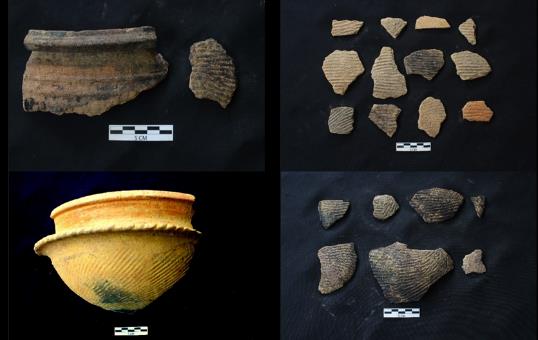
Ceramics from the Enadimangalam study area, Figure 3, published page 569
Enadimangalam
Evidence inventory and chronological strength
The inventory below separates the existence of a monument from the basis for dating it. Exact coordinates are deliberately omitted, especially for unprotected or vulnerable remains. The seventeen-site core inventory follows Ramya C. P. and Mohammad Nazrul Bari's 2022 basin review, checked where possible against earlier ASI material; newer Malampuzha and Nagaparamba discoveries are added separately. The review itself relies substantially on monument typology and earlier survey literature, so an entry in this table must not be read as an independently dated occupation. ↗11
| Locality | Archaeological record reported | Actual chronological basis available in read sources | Evidential status for this question |
|---|---|---|---|
| Anakkara | Kudakkal, multiple hoodstone, urns, stone circles, rock-cut cave; 2008 excavated burials; trial trench | RCP ceramic cross-dating: excavators say not before c. third/second century BCE and possibly early centuries CE; no absolute result published in read report | Strongest core basin case, but relatively dated ↗12 |
| Vattakulam/Kutteppalam, Ponnani taluk | Laterite-cut cave; RCP bowl, other pottery and iron objects | ASI relative ceramic association with early centuries CE | Date-bearing funerary context, not a settlement or port installation ↗3 |
| Alathur | Urn burial; reported as damaged/destroyed | Typological identification; no direct date recovered | Funerary inventory only ↗13 |
| Kappur/Kapur | Kudakkal/umbrella stone and cist burials | ASI survey/monument typology; no laboratory date | Funerary inventory only ↗14 |
| Kadambazhipuram | Cist burial, heavily disturbed | Typology only in accessible review | Funerary inventory only ↗13 |
| Kolapulli | Cist | Typology only | Funerary inventory only ↗13 |
| Kulukkaloor | Porthole cist | Typology only | Funerary inventory only ↗13 |
| Malampuzha/Kava | Cists in earlier inventory; much larger cluster reported in 2025 | Earlier typology plus current ASI attribution to megalithic/early Iron Age context; no published direct date located | Major funerary landscape, chronology unresolved at sample level ↗15 |
| Muppuzha/Kuthanoor | Porthole cist/dolmen-type monument | Typology only | Funerary inventory only ↗13 |
| Nagalassery | Urn burial | ASI survey designation, without direct date in read notice | Funerary inventory only ↗16 |
| Ongallur | Kudakkal | Typology only; site reported disturbed by vegetation | Funerary inventory only ↗13 |
| Pattambi | Urn burial | Monument typology; no direct date in the reviewed description | Funerary inventory only ↗13 |
| Pudussery | Dolmenoid cist | Typology; substantially disturbed | Funerary inventory only ↗13 |
| Pookottukavu | Hoodstone monuments | Typology/surface observation | Funerary inventory only ↗13 |
| Thaneercode/Parappuram | Umbrella stone | Typology | Funerary inventory only ↗13 |
| Thonipadam | Urn burial | Typology | Funerary inventory only ↗13 |
| Vaniyamkulam/Ottupara | Multi-benched rock-cut cave | Architectural attribution, without a direct date recovered here | Funerary inventory only ↗13 |
| Vellinezhi | Rock-cut cave; red/black pottery and an iron object reported | Typology/material association; no laboratory date | Funerary evidence and iron use, not production ↗17 |
| Nagaparamba, Tirunavaya/Kuttippuram vicinity | Dense hat-stone burial locality; urns and iron implements reported in salvage work | Public reporting gives a broad antiquity estimate, not a published scientific date | Important new funerary locality; technical chronology pending ↗18 |
The older ASI record is particularly valuable because it shows what the survey actually established. In 1970–71 K. Chandrasekharan of the Survey's Southern Circle reported umbrella stones at several Malappuram localities, menhirs including Tirunavaya, urn burial at Alancode, and a laterite-cut cave yielding an RCP vessel. In Palghat district the same campaign recorded urn burials at Nagalassery, umbrella stones at Angadi and Kapur, and cists at Kapur. These observations establish the geographic spread of monument types, but their annual-review notices are not equivalent to stratigraphically excavated, absolutely dated occupations. ↗16
The Ponnani-taluka cave is different because the report attempts a chronological inference from the RCP ceramic. That makes it useful within the core period, but it remains a ceramic association. The same limitation applies at Anakkara: the excavators explicitly wrote that they lacked sufficient evidence to date the cultural phase before proposing an RCP-based lower chronological limit. It would therefore overstate the evidence to convert “Iron Age–Early Historic” in a site catalogue into, for example, “500 BCE” unless a site-specific method actually supports that date. ↗19
Malampuzha demonstrates the same distinction at much larger spatial scale. ASI's 2025 survey announcement reports more than 110 megaliths over roughly 45 hectares, mostly single- and multiple-chambered cists together with stone circles, urns, dolmens and dolmenoid cists. This is very strong evidence for a large mortuary landscape. It is not yet strong evidence for when every monument was constructed, whether all were contemporary, where the associated habitation lay, or how that population produced its iron. ↗20
Settlement, river geography and movement
The best direct settlement signal is Anakkara's Trial Trench 1: one square metre beside burial ANK 08-I, whose pottery the excavators read as habitation near the burials. That is too small to define a settlement's area, architecture, duration or population. ↗21 Posthole-like pits on the plateau have no demonstrated function, so they cannot simply be added to the habitation evidence. ↗6 Quartz microliths and charcoal lower in the same trench, without pottery, belong to what the excavators regarded as an earlier phase that still needs radiocarbon dating; they show longer use of the landscape, not continuity of one population. ↗1 “Anakkara: excavated burials in Kerala's Bharathapuzha valley” describes the trench, the postholes and the microliths in detail.
Nor does the linear appearance of a river basin prove that its monuments constituted a riverine settlement corridor. The basin's archaeological localities occur in different physiographic settings, including lateritic uplands and tributary zones. Modern river courses and the Palakkad Gap make east–west connectivity geographically plausible, but demonstrating an ancient movement process requires more: securely dated sequences, material provenance, isotopic mobility signatures, technological transmission, inscriptions, transport installations, or another discriminating line of evidence. None of the basin sources read here supplies that chain. ↗22
Abraham's Palghat Gap research points the same way. Her dissertation, at abstract level, argues for localized subregional communities and heterarchical organization in early Tamilakam; it does not supply evidence for a single migration corridor. ↗5 “Anakkara: excavated burials in Kerala's Bharathapuzha valley” discusses her later chapter, which treats east–west transport along northern river routes as a regional hypothesis, not as evidence that any particular community migrated.
The same discipline applies at the western end of the basin. The Anakkara preliminary report says that Bharathappuzha reaches the Arabian Sea at Ponnani and describes Ponnani as a medieval and modern port town and later nodal point in exchanges through the Palakkad Gap. That wording is important: the paper does not use archaeological remains at Ponnani to establish an Iron Age/Early Historic harbour. The RCP-bearing cave in Ponnani taluk establishes an Early Historic-period material context somewhere in the taluk, not a wharf, anchorage, warehouse or maritime trading quarter at modern Ponnani. ↗23
Accordingly, proposed equations of Ponnani with an ancient named port are unnecessary to this study. They may be researched independently, but they cannot serve as a premise from which the inland burials are explained. The inland evidence should stand or fall on its own stratigraphy, artefacts and dates.
Ironworking and production
The production question turns on a distinction often blurred in broad descriptions of “Iron Age” sites: iron objects, ironworking waste and iron-smelting installations are not interchangeable evidence.
At Anakkara, the burials held many finished iron objects, which show access to worked iron but not where it was made. A fragment identified as iron slag, found at about 85 cm beside the outer stone packing of burial ANK 08-I, is the one read basin context that moves toward production evidence. It is a single, unanalysed fragment from a monument-construction context, with no furnace, tuyère or slag heap reported, so it supports possible nearby ironworking, not an iron-smelting centre. ↗2 The ancient laterite quarry traces at Anakkara show stone extraction for monuments, not, without analysis, the use of laterite as iron ore. ↗24 “Palakkad graves show early iron use, not yet local smelting” sets out the slag evidence and the laboratory tests that could settle it.
Elsewhere in the basin inventory, reported iron objects at Vellinezhi and in the Ponnani-taluka cave likewise document iron material in archaeological contexts but do not demonstrate production. The 2023 Nagaparamba reporting refers to iron implements, with the same limitation. The 2025 Malampuzha announcement does not supply a metallurgical assemblage at all. ↗25
The negative result limited to the sources read is therefore precise: this study located one published production-adjacent indicator – Anakkara's slag fragment – but no securely demonstrated Bharathappuzha-basin smelting installation, furnace complex or analytically characterized production assemblage. This does not establish that no such evidence exists; it identifies exactly what the accessible evidence reviewed here can support.
Disagreements, conclusions and evidential limits
The most consequential disagreements are not about whether the basin contains megalithic archaeology – it plainly does – but about what that archaeology permits us to infer.
| Question | Stronger interpretation | More conservative interpretation supported here | Evidence that would discriminate |
|---|---|---|---|
| Anakkara chronology | Broadly “Iron Age,” perhaps extending far back into first millennium BCE | RCP makes the excavated burials more plausibly later Iron Age/Early Historic; excavators themselves say precise dating is unavailable | Direct AMS dates on secure human bone/charcoal/residue; better RCP seriation |
| Anakkara settlement | Burial and postholes represent a settlement complex | A tiny pottery-bearing trial trench indicates habitation nearby; posthole function remains unresolved | Wider horizontal excavation, floors/hearths/features, matching stratigraphy and dates |
| Iron production | Slag means local iron manufacture | One slag fragment makes local working plausible but does not demonstrate a production installation | Slag analysis, furnaces/tuyères, ore and charcoal contexts, technological spatial pattern |
| Basin route | Monuments along Bharathappuzha and Palakkad Gap demonstrate a migration/trade corridor | Geography permits connectivity but does not identify a movement process | Provenance, isotopes, high-resolution chronological sequences, networked artefact distributions |
| Ponnani | Inland archaeology should be explained via an ancient Ponnani port | No ancient-port premise is necessary or established in the consulted basin evidence | Excavated port infrastructure, palaeochannel/harbour study, imports in secure local stratigraphy |
The strongest conclusions are consequently these.
First, the archaeological reality of an Iron Age–Early Historic mortuary landscape is secure. ASI survey records, the Anakkara excavation, the 2022 basin inventory, Nagaparamba salvage work and the large Malampuzha survey collectively document numerous burial forms across the basin. What is not secure is that all those monuments are contemporary or that their distribution directly maps residential settlement. ↗26
Second, Anakkara supplies the best current bridge from burial archaeology to settlement archaeology. Its pottery-bearing trial trench is genuinely important, but the spatial sample is extremely small and its core-period occupation has no published absolute date in the consulted report. The nearby postholes remain functionally ambiguous. ↗12
Third, available basin chronology is still dominated by relative dating. RCP is the key chronological discriminator at both Anakkara and the Ponnani-taluka cave. The Anakkara excavators explicitly acknowledged the inadequacy of the dating evidence, while wider Kerala scholarship continues to identify limited absolute chronology as a major constraint. ↗27
Fourth, iron use is well demonstrated; production is not. Anakkara's slag keeps the production question open, but it is not enough to call the site a smelting centre: it is candidate ironworking evidence that needs technological confirmation. ↗2
Fifth, neither a migration route nor an ancient Ponnani port is established by this evidence. Those are possible higher-order historical hypotheses, not observations. Treating them as starting assumptions would reverse the required direction of inference. ↗28
In short, the Bharathappuzha basin preserves a dense but unevenly dated mortuary record, with emerging evidence for nearby habitation and an unconfirmed signal of ironworking at Anakkara. The present record is much stronger for burial practice and iron use than for settlement organization, production scale, population movement or port-mediated exchange.
Sources still needed, and bibliography
The most valuable next acquisition is the complete 288-page Sujatha K. S. thesis, particularly its site catalogue, maps, chronological tables and any discussion of slag, furnaces, ores or settlement contexts. Repository metadata is secure, but its uninspected body may contain evidence capable of changing several conclusions. ↗7
Equally important are the Anakkara 2009 season records – the preliminary article expressly excludes that season – and the original plans/sections for both seasons. The next methodological priority is sample-level dating: laboratory codes, materials, context descriptions, raw ages, calibration curves and full calibrated probability ranges from securely associated burial or habitation contexts. For production, the exact Anakkara slag specimen and any unpublished archaeometallurgical work should be sought. ↗29
For regional coverage, the precise Kerala entries in IAR 1978–79 and 2002–03, together with any Thrissur Circle survey registers behind them, should be read rather than relying on the 2022 review's citations. Recent work requires the technical field documentation behind the 2025 Malampuzha survey and 2023 Nagaparamba salvage excavation.↗30
Bibliography
Shajan, K. P., V. Selvakumar, P. Radhika, K. P. Rajesh and Sreelatha Damodaran. “Archaeological Excavation at the Megalithic Site of Anakkara, Palakkad Dt, Kerala, South India: A Preliminary Report of 2008 Season.” Tamil Civilization 25, issues 1–4 (Apr. 2013–Jan. 2014), pp. 25–51. Author-upload/indexed access was used; no DOI was located. https://www.researchgate.net/publication/401020357_ARCHAEOLOGICAL_EXCAVATION_AT_THE_MEGALITHIC_SITE_OF_ANAKKARA_PALAKKAD_DT_KERALA_SOUTH_INDIA_A_PRELIMINARY_REPORT_OF_2008_SEASON ↗31
Bharathappuzha kuttippuram vijayanrajapuram – Present-day Bharathappuzha river landscape
Photographed 2021-02-21
Deshpande, M. N., ed. Indian Archaeology 1970–71: A Review. New Delhi: Archaeological Survey of India, 1974. Relevant Kerala notices are on pp. 17–19. Official ASI/NMMA series index: https://nmma.nic.in/nmma/IAReview.do. ↗32
Sujatha, K. S. Formation of material culture in the bharathapuzha basin during the Pre-historic and early historic period – a study of megalithic burials. PhD thesis, Department of History, University of Calicut, 2018. Adviser: K. N. Ganesh. 288 pp. Handle: https://hdl.handle.net/20.500.12818/645. ↗7
Ramya, C. P., and Mohammad Nazrul Bari. “A Review of Megalithic Sites in Nila (Bharathapuzha) River Basin, Central Kerala.” International Journal of History and Research 12, no. 1 (June 2022): 89–98. Consulted via text copy; journal PDF was not verified directly. ↗11
Das, N. Nikhil, P. P. Joglekar and R. K. Mohanty. “New Light on the Unresolved Problem of Megalithic Habitation Sites in Kerala.” Artha Journal of Social Sciences 12, no. 3 (2013): 1–18. https://journals.christuniversity.in/index.php/artha/article/view/724 (note: the printed string 10.12724/ajss.26.1 is misregistered in Crossref to an unrelated paper and is omitted as an active DOI). ↗33
Abraham, Shinu Anna. Social complexity in early Tamilakam: sites and ceramics from the Palghat Gap, Kerala, India. PhD dissertation, University of Pennsylvania, 2002; UMI, 2003, order no. 3072968, xx + 338 pp. Bibliographic record: https://ci.nii.ac.jp/ncid/BB21444728. ↗5
Abhayan, G. S., S. V. Rajesh, Akinori Uesugi, Preeta Nayar, B. S. Mohammed Muhaseen, N. L. Sulal, K. G. Archana, R. Harinarayanan, Ananthu V. Dev, K. Muhammed Fasalu, P. Soorya, K. S. Arun Kumar, R. Haseen Raja, S. Kumbodharan, M. S. Sujanpal and M. S. Sandra. “Megalithic cist burial excavation at Enadimangalam in Kerala and its implications in cist burial architecture and burial practices.” Archaeological Research in Asia 27 (2021): 100293. DOI: 10.1016/j.ara.2021.100293. https://doi.org/10.1016/j.ara.2021.100293. This is comparative Kerala evidence, not a Bharathappuzha-basin site. ↗34
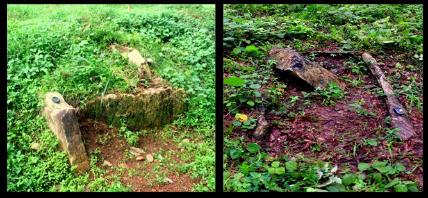
Unexcavated cist burials in the Enadimangalam study area, Figure 2, published page 568
Enadimangalam
Archaeological Survey of India, reported by Akashvani News. “Over 110 megalithic structures discovered in Kerala.” 23 March 2025. https://newsonair.gov.in/over-110-megalithic-structures-discovered-in-kerala/. This is an announcement-level source, not a technical report. ↗35
Staff Reporter, The Hindu. “Pipeline work leads to vast megalithic site in Kerala.” 19 August 2023; accessible mirror at https://architexturez.net/pst/az-cf-234702-1690447103. ↗36
Archaeological Survey of India. Indian Archaeology 2002–03: A Review. New Delhi: Director General, Archaeological Survey of India, 2009, 608 pp. Bibliographic record: https://books.google.com/books/about/Indian_Archaeology_2002_03.html?id=AbpkcgAACAAJ. Relevant Kerala text was not read for this study. ↗37
005Photographs
Photographs of the places and objects this study discusses. Each item carries its creator’s credit, licence and documented source. See all 412 photographs and source images ↗
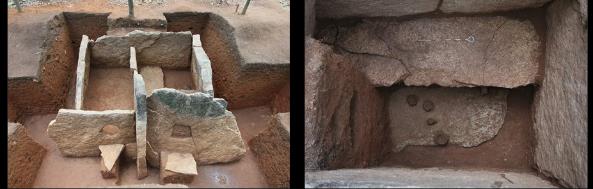
Enadimangalam
Excavated cist burial at Enadimangalam, Figure 1, published page 568

Photographed 2021-02-21 11:50:31
Bharathappuzha kuttippuram vijayanrajapuram – Present-day Bharathappuzha river landscape
Bharathappuzha kuttippuram vijayanrajapuram. Present-day Bharathappuzha river landscape; not a palaeochannel reconstruction.
Enadimangalam
Ceramics from the Enadimangalam study area, Figure 3, published page 569
Enadimangalam
Unexcavated cist burials in the Enadimangalam study area, Figure 2, published page 568
006Where next

The study lists this as related reading.
On the atlasAnakkara & Bharathappuzha Megalithic ComplexesCoarse river-basin orientation · Palakkad District
Explore nextPālakkāṭṭu Curam / Kaṇavāy (Palakkad / Palghat Gap) (பாலக்காட்டுக் கணவாய் / പാലക്കാട് ചുരം)All related studies, connected material, books and sources15 · 10
Elsewhere on this site
Excavation Atlas Sites: Anakkara & Bharathappuzha Megalithic Complexes
Multi-Script Glossary Terms: Pālakkāṭṭu Curam / Kaṇavāy (Palakkad / Palghat Gap) (பாலக்காட்டுக் கணவாய் / പാലക്കാട് ചുരം)
Connected material
Photographs, drawings, books, videos and other studies linked to this study. A link helps you explore; it does not prove a historical claim.
- Excavated cist burial at Enadimangalam, Figure 1, published page 568photographic figureShows the subject
- Unexcavated cist burials in the Enadimangalam study area, Figure 2, published page 568photographic figureShows the subject
- Ceramics from the Enadimangalam study area, Figure 3, published page 569photographic figureShows the subject
- Bharathappuzha kuttippuram vijayanrajapuram – Present-day Bharathappuzha river landscapephotographBackground
007Sources
The study lists the sources it consulted; we have not rechecked them. A working link does not show that a source was read, and a valid identifier does not show that it supports a claim. We do not link to unofficial uploads or copies of publications. Where a study cited one, we show the published citation, or a publisher, DOI or Internet Archive link when we have one. Tracking codes are removed from links, and the sources themselves are not republished here.
Sujatha K. S. Formation of material culture in the Bharathapuzha basin during the Pre-historic and early historic period – a study of megalithic burials. PhD thesis, Department of History, University of Calicut, 2018. Adviser K. N. Ganesh.
K. P. Shajan, V. Selvakumar, P. Radhika, K. P. Rajesh and Sreelatha Damodaran. Archaeological Excavation at the Megalithic Site of Anakkara, Palakkad Dt, Kerala, South India: A Preliminary Report of 2008 Season. Tamil Civilization 25(1-4), Apr 2013-Jan 2014, pp. 26-51.
M. N. Deshpande (ed.). Indian Archaeology 1970-71: A Review. New Delhi: Archaeological Survey of India, 1974.
Ramya C. P. and Mohammad Nazrul Bari. A Review of Megalithic Sites in Nila (Bharathapuzha) River Basin, Central Kerala. International Journal of History and Research 12(1), June 2022, 89-98.
Print or offline sourceSource recordN. Nikhil Das, P. P. Joglekar and R. K. Mohanty. New Light on the Unresolved Problem of Megalithic Habitation Sites in Kerala. Artha Journal of Social Sciences 12(3), 2013, 1-18. DOI 10.12724/ajss.26.1.
Shinu Anna Abraham. Social complexity in early Tamilakam: sites and ceramics from the Palghat Gap, Kerala, India. PhD dissertation, University of Pennsylvania, 2002; UMI 2003, order no. 3072968.
G.S. Abhayan, S.V. Rajesh, Akinori Uesugi, Preeta Nayar, B.S. Mohammed Muhaseen, N.L. Sulal, K.G. Archana, R. Harinarayanan, Ananthu V. Dev, K. Muhammed Fasalu, P. Soorya, K.S. Arun Kumar, R. Haseen Raja, S. Kumbodharan, M.S. Sujanpal and M.S. Sandra. Megalithic cist burial excavation at Enadimangalam in Kerala and its implications in cist burial architecture and burial practices. Archaeological Research in Asia 27 (2021), 100293.
Akashvani News. Over 110 megalithic structures discovered in Kerala. 23 March 2025, reporting Archaeological Survey of India survey near Malampuzha Dam.
Staff Reporter, The Hindu. Pipeline work leads to vast megalithic site in Kerala. 19 August 2023. Accessible via Architexturez mirror.
Indian Archaeology 2002-03: A Review. Director General, Archaeological Survey of India, 2009. 608 pp.
Researchers and institutions whose work this study uses: V. Selvakumar, K. P. Shajan, Abhayan G. S., Rajesh S. V., K. N. Ganesh, Preeta Nayar, Archaeological Survey of India
How we know The evidence, claims and dates behind this study
What this study draws on
- A table of nineteen basin localities that states what each is actually dated by, mostly monument type.
- The 2008 Anakkara excavation report and the Indian Archaeology 1970–71 survey notices.
- Announcements of the 2025 Malampuzha survey and news reports of the 2023 Nagaparamba salvage dig.
- Records of the 2018 Sujatha thesis on the basin, which has not yet been read in full.
Dates in this study
| What is dated | Date | How it was dated |
|---|---|---|
| The Anakkara authors state that the RCP-bearing burials cannot be dated before the 3rd or 2nd century BCE and perhaps belong to the early centuries of the Christian era. | 300 BCE | Period assigned by excavators or scholars |
See these dates on the timeline
The study’s claims
15 claims · 14 source passages · 48 paragraphs
Browse the study paragraph by paragraphFor the basin-specific core evidence read here, chronology is predominantly relative (ceramic/typological) rather than based on published absolute dates.
Supported with qualifications
This is a bounded result for sources read in this study, not a claim that no unpublished or inaccessible absolute dates exist.
The 2008 Anakkara excavation exposed a kudakkal and a multiple-hoodstone burial with ceramics, finished iron objects and fragmentary human remains; the 2009 stone-circle/rock-cut-cave season was not included in that preliminary report.
Supported in this study
The Anakkara excavators considered the RCP-bearing burials unlikely to predate the 3rd/2nd century BCE and possibly Early Historic, but explicitly said the phase could not yet be dated precisely.
Supported with qualifications
Ceramic cross-dating, not an absolute date.
A 1 x 1 m trial trench adjacent to ANK 08-I yielded pottery interpreted by the excavators as nearby habitation evidence; a deeper aceramic red-loam horizon contained microliths and charcoal and was assigned tentatively to an earlier Mesolithic phase.
Supported with qualifications
No dwelling floor, hearth or securely dated structural complex is reported in the consulted text. The Mesolithic assignment lacks a published radiocarbon result.
Undated postholes on the Anakkara laterite plateau do not establish a domestic settlement because the excavators themselves considered multiple possible functions and lacked clinching evidence.
Supported with qualifications
Possible functions discussed include temporary hut/occupation and mortuary-platform uses.
An iron-slag fragment at about 85 cm near the stone arrangement/packing of ANK 08-I is a genuine ironworking indicator and prompted a suggestion of local manufacture, but it is not sufficient by itself to establish an iron-production site.
Supported with qualifications
No slag chemistry, microstructure, furnace, tuyère, ore-beneficiation feature or production dump was reported in the consulted source. Its depositional relation to monument packing requires caution.
Finished iron implements in Anakkara burials demonstrate use and funerary deposition of iron, but not the place where the iron was smelted or forged.
Supported in this study
Production requires independent technological/contextual evidence.
The 1970-71 ASI review records a Ponnani-taluka laterite-cut cave with russet-coated wavy-line pottery and iron objects, providing a second basin-side Early Historic chronological indicator, again by ceramic association rather than absolute dating.
Supported with qualifications
The consulted source gives no laboratory date.
ASI's 1970-71 Kerala survey recorded multiple megalithic monument types in Malappuram and Palghat localities, but the survey notices themselves are inventory evidence rather than precise site chronologies.
Supported with qualifications
The 2022 basin review is useful for inventorying at least seventeen named megalithic localities, but most listed sites rely on monument/pottery typology and many are disturbed or destroyed, so they cannot be treated as seventeen independently dated settlements.
Supported in this study
The review is secondary and compiles older surveys/theses.
The 2025 ASI survey near Malampuzha Dam substantially enlarges the known funerary landscape, reporting more than 110 megaliths across about 45 hectares, but the public announcement supplies no excavation contexts or absolute dates.
Supported with qualifications
Survey announcement, not a technical excavation publication.
The 2023 Nagaparamba salvage excavation documents a dense megalithic burial locality with hat stones and reported urns/iron implements, but the accessible reporting does not provide a scientific date or full context publication.
Supported with qualifications
The distribution of sites within the basin and the physical accessibility of the Palakkad Gap do not, by themselves, demonstrate a specific migration or river-route process.
Supported in this study
A demonstrated movement process would require dated sequences plus provenance, isotopic, technological, epigraphic or similarly discriminating evidence.
No ancient Ponnani-port identification is required to explain the inland archaeology reviewed here; the Anakkara excavation report itself describes Ponnani specifically as a medieval and modern port.
Supported in this study
This does not prove that no earlier maritime activity existed; it rejects using an unproven ancient-port identity as a premise.
The inherited catalogue lead 'K.N. Ganesh, Cultural Land Economics of River Nila' could not be resolved as a bibliographic work in the sources consulted; repository metadata instead identifies K.N. Ganesh as adviser to Sujatha K.S.'s 2018 Bharathappuzha-basin thesis.
Supported with qualifications
Failure to locate the earlier title is not proof that no such unpublished work exists.
Trace one claim through the study’s records
Explore the evidenceOther source lists
Numbered citation links from the study
The numbered links in the study text point here.
Shajan et al. (2013–14), Preliminary Report on the Anakkara Excavation, Tamil Civilization 25
K. P. Shajan, V. Selvakumar, P. Radhika, K. P. Rajesh, and Sreelatha Damodaran, 'Preliminary Report on the Anakkara Excavation,' Tamil Civilization 25 (2013–14).
Print or offline sourceShajan et al. (2013–14), Preliminary Report on the Anakkara Excavation, Tamil Civilization 25
K. P. Shajan, V. Selvakumar, P. Radhika, K. P. Rajesh, and Sreelatha Damodaran, 'Preliminary Report on the Anakkara Excavation,' Tamil Civilization 25 (2013–14).
Print or offline sourceM. N. Deshpande (ed.), Indian Archaeology 1970–71: A Review (ASI, 1974)
M. N. Deshpande (ed.), Indian Archaeology 1970–71: A Review (New Delhi: Archaeological Survey of India, 1974), pp. 17–19; official ASI/NMMA index.
Over 110 megalithic structures discovered in Kerala | Akashvani News
CiNii Books - Social complexity in early Tamilakam : sites and ceramics from the Palghat Gap, Kerala, India
Shajan et al. (2013–14), Preliminary Report on the Anakkara Excavation, Tamil Civilization 25
K. P. Shajan, V. Selvakumar, P. Radhika, K. P. Rajesh, and Sreelatha Damodaran, 'Preliminary Report on the Anakkara Excavation,' Tamil Civilization 25 (2013–14).
Print or offline sourceFormation of material culture in the bharathapuzha basin during the Pre-historic and early historic period – a study of megalithic burials
National Mission on Monuments and Antiquities
Shajan et al. (2013–14), Preliminary Report on the Anakkara Excavation, Tamil Civilization 25
K. P. Shajan, V. Selvakumar, P. Radhika, K. P. Rajesh, and Sreelatha Damodaran, 'Preliminary Report on the Anakkara Excavation,' Tamil Civilization 25 (2013–14).
Print or offline sourceNew Light on the Unresolved Problem of Megalithic Habitation Sites in Kerala | Artha Journal of Social Sciences
Ramya & Bari (2022), Megalithic Sites in Nila (Bharathapuzha) River Basin, IJHR 12(1): 89–98
C. P. Ramya and Mohammad Nazrul Bari, 'A Review of Megalithic Sites in Nila (Bharathapuzha) River Basin, Central Kerala,' International Journal of History and Research 12(1) (June 2022): 89–98.
Print or offline sourceShajan et al. (2013–14), Preliminary Report on the Anakkara Excavation, Tamil Civilization 25
K. P. Shajan, V. Selvakumar, P. Radhika, K. P. Rajesh, and Sreelatha Damodaran, 'Preliminary Report on the Anakkara Excavation,' Tamil Civilization 25 (2013–14).
Print or offline sourceRamya & Bari (2022), Megalithic Sites in Nila (Bharathapuzha) River Basin, IJHR 12(1): 89–98
C. P. Ramya and Mohammad Nazrul Bari, 'A Review of Megalithic Sites in Nila (Bharathapuzha) River Basin, Central Kerala,' International Journal of History and Research 12(1) (June 2022): 89–98.
Print or offline sourceM. N. Deshpande (ed.), Indian Archaeology 1970–71: A Review (ASI, 1974)
M. N. Deshpande (ed.), Indian Archaeology 1970–71: A Review (New Delhi: Archaeological Survey of India, 1974), pp. 17–19; official ASI/NMMA index.
Over 110 megalithic structures discovered in Kerala | Akashvani News
M. N. Deshpande (ed.), Indian Archaeology 1970–71: A Review (ASI, 1974)
M. N. Deshpande (ed.), Indian Archaeology 1970–71: A Review (New Delhi: Archaeological Survey of India, 1974), pp. 17–19; official ASI/NMMA index.
Ramya & Bari (2022), Megalithic Sites in Nila (Bharathapuzha) River Basin, IJHR 12(1): 89–98
C. P. Ramya and Mohammad Nazrul Bari, 'A Review of Megalithic Sites in Nila (Bharathapuzha) River Basin, Central Kerala,' International Journal of History and Research 12(1) (June 2022): 89–98.
Print or offline sourcePipeline work leads to vast megalithic site in Kerala | Aζ South Asia
M. N. Deshpande (ed.), Indian Archaeology 1970–71: A Review (ASI, 1974)
M. N. Deshpande (ed.), Indian Archaeology 1970–71: A Review (New Delhi: Archaeological Survey of India, 1974), pp. 17–19; official ASI/NMMA index.
Young Intach Explorer
Shajan et al. (2013–14), Preliminary Report on the Anakkara Excavation, Tamil Civilization 25
K. P. Shajan, V. Selvakumar, P. Radhika, K. P. Rajesh, and Sreelatha Damodaran, 'Preliminary Report on the Anakkara Excavation,' Tamil Civilization 25 (2013–14).
Print or offline sourceSocial complexity in early Tamilakam: Sites and ceramics from the Palghat Gap, Kerala, India
Shajan et al. (2013–14), Preliminary Report on the Anakkara Excavation, Tamil Civilization 25
K. P. Shajan, V. Selvakumar, P. Radhika, K. P. Rajesh, and Sreelatha Damodaran, 'Preliminary Report on the Anakkara Excavation,' Tamil Civilization 25 (2013–14).
Print or offline sourceShajan et al. (2013–14), Preliminary Report on the Anakkara Excavation, Tamil Civilization 25
K. P. Shajan, V. Selvakumar, P. Radhika, K. P. Rajesh, and Sreelatha Damodaran, 'Preliminary Report on the Anakkara Excavation,' Tamil Civilization 25 (2013–14).
Print or offline sourceRamya & Bari (2022), Megalithic Sites in Nila (Bharathapuzha) River Basin, IJHR 12(1): 89–98
C. P. Ramya and Mohammad Nazrul Bari, 'A Review of Megalithic Sites in Nila (Bharathapuzha) River Basin, Central Kerala,' International Journal of History and Research 12(1) (June 2022): 89–98.
Print or offline sourceM. N. Deshpande (ed.), Indian Archaeology 1970–71: A Review (ASI, 1974)
M. N. Deshpande (ed.), Indian Archaeology 1970–71: A Review (New Delhi: Archaeological Survey of India, 1974), pp. 17–19; official ASI/NMMA index.
Shajan et al. (2013–14), Preliminary Report on the Anakkara Excavation, Tamil Civilization 25
K. P. Shajan, V. Selvakumar, P. Radhika, K. P. Rajesh, and Sreelatha Damodaran, 'Preliminary Report on the Anakkara Excavation,' Tamil Civilization 25 (2013–14).
Print or offline sourceSocial complexity in early Tamilakam: Sites and ceramics from the Palghat Gap, Kerala, India
Shajan et al. (2013–14), Preliminary Report on the Anakkara Excavation, Tamil Civilization 25
K. P. Shajan, V. Selvakumar, P. Radhika, K. P. Rajesh, and Sreelatha Damodaran, 'Preliminary Report on the Anakkara Excavation,' Tamil Civilization 25 (2013–14).
Print or offline sourceNational Mission on Monuments and Antiquities
ARCHAEOLOGICAL EXCAVATION AT THE MEGALITHIC SITE OF ANAKKARA, PALAKKAD DT, KERALA, SOUTH INDIA: A PRELIMINARY REPORT OF 2008 SEASON
National Mission on Monuments and Antiquities
New Light on the Unresolved Problem of Megalithic Habitation Sites in Kerala | Artha Journal of Social Sciences
Megalithic cist burial excavation at Enadimangalam in Kerala and its implications in cist burial architecture and burial practices - ScienceDirect
Over 110 megalithic structures discovered in Kerala | Akashvani News
Pipeline work leads to vast megalithic site in Kerala | Aζ South Asia
Indian Archaeology 2002-03: A Review - Google Books
About this study Status, corrections and how it was made
Status
Draft study, revision 7. No historian, archaeologist, or Tamil or Malayalam specialist has reviewed it yet.
The study itself says more research is needed before its question can be settled.
How it was made
Compiled as an editorial synthesis from published scholarship around questions we framed. About this project & workflow
The summary, How sure lines and Two views notes on this page were prepared from this study and cross-checked against its passages. That is an editorial check, not a specialist review.
Technical details
Study code R146. The text fingerprint changes whenever the study text changes.
- The study text is shown as written. Links from its paragraphs to citations help you move around the study; they are not new claims or checked source passages.
See how this study’s records were extracted
Text fingerprint (SHA-256): R146 · c852ed59a723ba70ba329c09… · v7
Evidence tables and technical details are on the web page: https://layersofthesouth.org/read/5c09f63f32