Rock-cut beds at the Jambai Jain shelter
Jambai
Photographed 2011-12-25
- Words & worlds
- Vizhinjam
Early Tamil poems name Ay rulers but do not map an Ay kingdom
Early Tamil poems tie Ay Andiran to Pothiyil and remember Ay Eyinan's death, and secondary scholarship links them with Ptolemy's Aioi on the southern coast; none of this proves a continuous Ay dynasty.
- This page
- 4,294 words · revision 7
Draft study · Awaiting specialist review · Updated
001Dates and places
Places on the atlas that name this study.
- Vizhinjam Coastal Fort & Harbour Terrace
Protected rock-cut cave monument & harbour terrace
1000–500 BCE
Different beginnings
500–200 BCE
Marks & materials
200 BCE–300 CE
Connected worlds
300–600 CE
Change & continuity
After 600 CE
- first to third centuries CE
- early-medieval, principally ninth-century Ay inscriptional horizon discussed in modern scholarship
- Date from writing, coins or texts
- How it was dated is not stated
Each date belongs to what was dated (a sample, an object, a layer or a text), which is not always the event the study asks about.
Each period has the same width, so spacing is not to scale.
The full table of dates, with their ranges, is under How we know.
- 1 Well supported
- 1 Likely
- 2 Not known
002How sure
In brief
Early Tamil poems name Ay rulers of the far south. In the Purananuru, poems 127–136 praise Ay Andiran as a generous mountain patron, and poems 240–241 mourn his death. Poem 128 links him directly with Pothiyil, and poem 130 has him drive the Kongar toward the western sea. Four Akananuru poems attributed to Paranar recall Ay Eyinan dying in battle with Mignili; two place the battle at Pazhi. These poems do not make Eyinan a relative of Andiran, and four poems by one poet are not four independent witnesses. The poems themselves give no fixed capital, mapped border or control of spice, passes or pearls, nor do they support "pastoral sovereignty". Secondary scholarship also cites Ptolemy's Geography (7.1.9, not checked in an edition for this study) for a coastal people called the Aioi north of Cape Comorin, though Ptolemy does not name Andiran, Eyinan or Pothiyil. Inscriptions of later Ay rulers date mainly from about the ninth century, centuries after the poems, and continuity remains unproven.
Key researchers cited in this study: Vaidehi Herbert (Sangam Poetry Translations & Commentaries) · Eva Wilden (Sangam Critical Editions & Manuscriptology) · George L. Hart (Classical Tamil Literature) · M. G. S. Narayanan (Perumals of Kerala & Chera Epigraphy) · Full bibliography
How sure
- Well supported
Poems link Ay Andiran with the Pothiyil hills
Purananuru 128 says so directly; it is literary geography, not a mapped territory.
- Likely
Ay Eyinan fell fighting Mignili
Four poems remember it, two at Pazhi, but all are by one poet in one anthology.
- Not known
Andiran and Eyinan belonged to one family line
No consulted poem names a relationship between them.
- Not known
Later Ay kings continued the early poetic rulers' line
Several centuries separate the poems from the inscriptions, with no bridging evidence.
Why it matters
The Ay belong to the early history of Kerala's far south, and this study separates what the poems say from later reconstructions.
003Key findings
What the study concludes
- Ay Andiran is directly associated with Pothiyil in the consulted Purananuru material.
- The poems do not identify a secure fixed early capital or administrative frontier.
- Ay Eyinan belongs to a recurrent Pazhi-Mignili-Nannan conflict tradition but is not genealogically linked to Andiran by the consulted passages.
- Later Ay inscriptions are historically important but too late to prove uninterrupted continuity by themselves.
In the study’s own words. How sure each point is, is shown above.
The summary above is the short read. The full study is the complete text it was drawn from, with its tables and source notes.
What the full study covers
- Executive summary and research questions
- Scope, chronology, and methodology
- Ay Andiran and Pothiyil in the Purananuru
- Ay Eyinan, Titiyan, and the limits of dynastic reconstruction
- External classical testimony: Ptolemy’s Aioi
- Later inscriptions and the continuity problem
- Comparative findings, disagreements, risks, and conclusions
- What was not checked and bibliography
004The study
Executive summary and research questions
What can early sources establish about Ay rulers, places and political relationships?
This study tests the idea of an “Ay dynasty” built on “pastoral sovereignty” and centred on Podiyil Malai, rather than assuming it. It compares poem groups, names, inscriptions and later Ay chronology; it separates literary geography from mapped territory or a fixed capital; and it does not infer control of spice, pass or pearl routes merely from strategic proximity.
The resulting picture is more conservative, but historically more defensible. Early Tamil poems establish named political actors, patronage relationships, mountain associations, conflict memories, and a recognizable southern political geography substantially better than they establish a continuous “Ay dynasty,” fixed capitals, durable territorial borders, commodity-route monopolies, or “pastoral sovereignty.”
For Ay Andiran, the strongest evidence is the Purananuru group 127–136 and the death-laments 240–241. Within it, poem 128 directly associates Ay with Pothiyil/Podiyil; adjacent poems repeatedly construct his political persona through mountains, difficult routes, elephants, hill communities, warfare, bards, performers, and conspicuous redistribution. Poem 130 says that Ay drove the Kongar toward the western sea. These statements are politically meaningful, but praise poetry does not thereby become a boundary inscription: neither Pothiyil nor the westward campaign supplies a fixed capital, an administrative polygon, or proof of continuous sovereignty between highland and coast. ↗1
For Ay Eyinan, a separate Akananuru dossier is unusually coherent. Poems 148, 181, 208 and 396, all attributed to Paranar in the consulted access edition, repeatedly remember his fatal conflict with Mignili. Poems 208 and 396 add Pazhi and Nannan to the political network; 396 also makes Eyinan's intervention on behalf of people connected with Punnadu part of the episode. Yet none of those consulted passages links Eyinan to Pothiyil or supplies a genealogy making him a predecessor, successor, or kinsman of Andiran. The defensible position is therefore to keep the two figures distinct unless a bridging source is recovered. ↗2
Later inscriptional material associated with rulers such as Kokkarunandadakkar/Karunandadakkan and Vikramaditya Varaguna belongs to a different chronological horizon, conventionally treated within early-medieval southern Kerala. T. A. Gopinatha Rao's Travancore Archaeological Series is a major early publication vehicle for this material, while later scholars such as M. G. S. Narayanan and Kesavan Veluthat place it within early-medieval Kerala and South Indian history. That material is important for testing continuity, but it lies centuries after the broad early-common-era literary horizon conventionally assigned to the Purananuru and cannot simply be projected backward into Andiran's political world. ↗3
| Research question | Outcome |
|---|---|
| Do the poems establish Ay Andiran as a ruler associated with Pothiyil? | Yes, as literary-political geography. Poem 128 is the strongest direct association; surrounding poems reinforce a mountain setting. ↗4 |
| Do they establish a fixed capital or continuous mapped territory? | No, not in the consulted group. Mountain country, journeys, land-giving, and a military pursuit to the western sea do not constitute an administrative map. ↗5 |
| Are Ay Andiran and Ay Eyinan securely members of one documented genealogy? | Unresolved. Shared Ay/Vel language is suggestive, but the consulted passages do not bridge them genealogically. ↗6 |
| Do early sources prove Ay control of spice forests, passes, or pearl approaches? | No. The consulted poems contain ecological and route imagery but no direct evidence for those specific economic-control propositions. ↗7 |
| Does later Ay epigraphy prove continuity from the early poetic figures? | No by itself. It establishes a later evidentiary horizon whose relationship to the earlier one requires independent demonstration. ↗8 |
| Are Pathitrupathu and K. A. Nilakanta Sastri primary evidence for these claims? | Not as stated. No specific Andiran or Eyinan passage appeared on the accessible Pathitrupathu page, while Sastri is a twentieth-century historian and therefore a secondary source. ↗9 |
Scope, chronology, and methodology
The project's 1000 BCE–600 CE range is treated here as an editorial window rather than a dating command. Three chronological lanes are kept separate. The core period consists of early Tamil poetic evidence; the transmission consists of the much later manuscripts, commentaries, print editions, and translations through which that poetry survives; and the later period consists of early-medieval inscriptions associated by scholarship with Ay rulers. Poetic composition, anthology formation, manuscript copying, represented event, inscription production, discovery, and modern publication are not interchangeable dates.
Columbia University Press describes Hart and Heifetz's complete English Purananuru edition as an anthology of poems by more than 150 poets broadly associated with the first to third centuries CE. That is useful as a broad corpus-level chronological orientation; it is not a warrant to assign an exact reign year to Ay Andiran or to any individual event mentioned by the anthology. ↗10
Research was source-led rather than “dynasty”-led. Searches used Tamil and English forms including ஆய் அண்டிரன் / Āy Aṇṭiraṉ, ஆஅய் எயினன் / Āy Eyiṉaṉ, பொதியில் / Pothiyil, மிஞிலி / Mignili, பாழி / Pazhi, திதியன் / Titiyan, பதிற்றுப்பத்து / Pathitrupathu, Karunandadakkan, Vikramaditya Varaguna, and Travancore Archaeological Series. Institutional or primary-publication records were preferred where available. Tamil Virtual Academy was particularly useful for checking Tamil names and passages; accessible bilingual editions were used to follow whole poems while avoiding long reproduction of copyrighted English translations. ↗11
An important control is textual transmission. Eva Wilden's 2018 critical edition of the first 120 Akananuru poems reports use of eight surviving manuscripts, including five relatively old palm-leaf witnesses, and presents a critical reconstruction with annotated translation. Crucially, its published scope stops at poem 120, so it does not directly provide a critical apparatus for the Eyinan passages 148, 181, 208, and 396 used here. Wilden's broader research on Cankam manuscript and print transmission reinforces the need to distinguish early poetic composition from surviving manuscript witnesses and modern editions. ↗12
Inclusion required a directly relevant poem or coherent passage, an institutional textual record, an original epigraphic publication identity, or serious modern scholarship useful for source criticism and chronology. Derivative popular summaries were not allowed to carry the principal conclusions. No historical proposition below depends on reading letters from an inscription photograph: later epigraphic claims are deliberately limited while full primary transcriptions and subsequent corrections were not checked directly.
Ay Andiran and Pothiyil in the Purananuru
The Andiran evidence is significant precisely because it consists of a cluster rather than a single stray name. Poems 127–136 develop a recognizable praise-poetic persona, and poems 240–241 return to Ay in death. Their recurring concerns are generosity, bardic and performer access, mountain travel, elephants and chariots, warfare, and the moral distinction between an exceptional giver and lesser rulers. Tamil Virtual Academy independently indexes the Ay Andiran material, while the consulted poem pages permit the individual arguments to be compared. ↗13 “Velir chiefs were named local rulers, not one hill-chief system” also examines Ay Andiran alongside other Velir leaders.
Pothiyil is the strongest place claim. Poem 128 explicitly connects Ay's land with Pothiyil. Poem 129 strengthens the mountain setting through hill inhabitants, jackfruit, dance, drink, and elephants. Poems 131 and 133 again use mountain landscape to structure access to the patron, while poem 135 makes difficult mountain routes part of the journey toward Ay. The cumulative evidence is substantial enough to speak of an Ay–Pothiyil association. It is better understood as literary-political geography, however, than as a surveyed territorial description. ↗14
Modern railway through the Shenkottah/Aryankavu pass
Photographed 2007-10
The distinction prevents several common overextensions. None of the consulted poems functions like an inscriptional boundary clause naming a capital, neighboring jurisdictions, tax districts, or frontiers. Poem 132's rhetorical juxtaposition of the Ay lineage in the south with the Himalaya in the north is praise, not a territorial coordinate system. Poem 136 narrates access to a patron through the predicament of a poet, not an administrative circuit. Poem 240 remembers Ay as a giver of valuable things including land or settlements, but that evidence supports the representation of redistributive authority more directly than it supports reconstruction of cadastral institutions. ↗15
Poem 130 provides the clearest military-political statement. Ay is represented as defeating or driving the Kongar toward the western sea. Dismissing the passage as “only poetry” would lose politically meaningful information: the allusion presupposes an audience for whom Ay's martial success against the Kongar was a recognizable token of prestige. The opposite error is to convert the campaign automatically into permanent coast-to-mountain sovereignty. A successful pursuit, even one ending at the western sea, does not by itself demonstrate taxation, occupation, administration, or continuous control over every intervening place. ↗16
Claims that Ay rulers controlled spice forests, passes, and pearl approaches are not directly substantiated by this poem group. The texts certainly evoke ecologically rich uplands – jackfruit, honey, elephants, forests, hill populations, and mountain routes. Those landscapes matter to the wider economic history of South India. But the consulted Andiran poems do not identify pepper or another spice as an Ay royal monopoly, do not describe a named pass under an Ay administrative regime, and do not attribute a pearl fishery or its approaches to Ay control. Strategic proximity is therefore insufficient to make those propositions findings. ↗17
The death poems require similar restraint. Poem 240 remembers Ay's generosity, his death and cremation, and the loss suffered by poets who must seek other patrons. In the consulted Tamil context and translation, it does not explicitly establish that Ay's wives entered his funeral pyre. Such a claim would need a closer philological demonstration rather than inference from elegiac language about women, death, or the other world. Poem 241 imagines Ay's reception by Indra and celestial drumming; that is evidence about praise, mortuary imagination, and poetic religious language, not documentary evidence for heavenly events or royal institutions. ↗18
Nor does this corpus presently support the phrase “pastoral sovereignty.” Andiran's persona is constructed through mountains, martial reputation, elephants, redistribution, and relationships with bards and performers. The consulted passages do not establish a pastoral corporation, a cattle-centered fiscal system, a politically organized pastoral population, or a ruler's self-definition corresponding to a modern analytical category of “pastoral polity.” A resemblance between Ay and pastoral vocabulary, even were it philologically demonstrated, would not itself prove a pastoral state.
Ay Eyinan, Titiyan, and the limits of dynastic reconstruction
Ay Eyinan appears through a different literary mechanism. Akananuru is an akam anthology, so public persons and events can be recalled within poems whose principal rhetorical setting concerns interior or love situations. Historical allusions can therefore be valuable without functioning as chronicles.
Four poems attributed to Paranar – 148, 181, 208, and 396 – form a particularly coherent Eyinan complex. ↗2
| Passage | Political memory embedded in the poem | Evidentiary assessment |
|---|---|---|
| Akananuru 148 | Ay Eyinan, associated with fast horses, falls fighting Mignili. | Establishes the Eyinan–Mignili conflict tradition; it supplies no consulted Pothiyil link. ↗19 |
| Akananuru 181 | Eyinan again falls fighting Mignili; birds shelter the body from the sun. | Reinforces the conflict memory, while the avian mortuary scene remains poetic imagery. ↗20 |
| Akananuru 208 | “Veliyan Venman Ay Eyinan” is a generous patron; he dies at Pazhi fighting Mignili; Nannan does not appear at the battlefield. | The richest naming and political-network passage, but its name formula requires philological care. ↗21 |
| Akananuru 396 | Eyinan intervenes for people associated with Punnadu, confronts Nannan's warrior Mignili at Pazhi, and dies. | Adds inter-chiefly political context to the conflict. ↗22 |
The recurrence of Eyinan, Mignili, combat, and death makes the episode more substantial than an isolated comparison. Nevertheless, the four poems cannot be counted as four fully independent documentary witnesses: they survive in the same anthology and are attributed to the same poet. Their proper evidentiary characterization is a recurrent literary memory complex. The variations within it still matter. Poems 208 and 396 connect the death more tightly with Nannan and Pazhi; 396 gives the encounter a political context involving Punnadu. ↗23 “Poems tie Nannan to Eḻil, but naval power at Ezhimala is unproven” examines the Nannan traditions, including this poem.
The formula in poem 208 is an instructive test case. The Tamil text includes “Veliyan Venman Ay Eyinan.” The accessible commentary preserves ambiguity over how “Veliyan” should be parsed, including whether it represents a father's name or belongs to Eyinan's own designation. That is precisely the kind of uncertainty that should remain visible rather than being normalized prematurely into a neat pedigree. ↗21
Most importantly, the consulted Eyinan poems do not say that Eyinan is Andiran's ancestor, descendant, predecessor, successor, or kinsman. They also do not place him at Pothiyil. Shared Ay terminology and Vel/Velir language provide a reasonable research hypothesis, but not a demonstrated genealogy. At least three models remain admissible: Andiran and Eyinan may belong to one lineage; they may represent related or parallel chiefly networks in which Ay terminology had broader application; or later historiography may have compressed distinct early political figures into a single dynastic sequence. The consulted evidence does not decisively select among those models. ↗6
Titiyan reinforces the warning against reasoning from place to dynasty. A Tamil Virtual Academy Akananuru passage associates Titiyan with difficult, wooded Pothiyil and mountain honey. Yet the relevant read lines call him Titiyan rather than “Ay Titiyan.” Another institutional text places Titiyan among Velir figures in a separate conflict context. This supports a Pothiyil-linked political figure; it does not permit Pothiyil itself to become an automatic test of Ay dynastic membership. ↗24
The same principle applies to social or ethnic continuity. Particular early rulers can be studied from particular poems. What those poems do not establish is an unchanged identity linking every ancient use of Ay, later dynastic names, pastoral vocabulary, and present-day communities. Such an argument would need independent linguistic, genealogical, epigraphic, and social-historical evidence.
External classical testimony: Ptolemy’s Aioi
Secondary scholarship on early South Indian historical geography also cites Ptolemy's Geography (7.1.9, c. 150 CE; the Greek text was not checked in an edition for this study) as placing a people called the Aioi along the coast north of Cape Comorin, with a town Kottiara. Even on that reported testimony, the coastal towns are not securely located archaeologically, and Ptolemy does not name Andiran, Eyinan, or Pothiyil or establish a continuous dynasty down to ninth-century inscriptions.
Later inscriptions and the continuity problem
The later Ay evidence is important precisely because it belongs to a separate evidentiary horizon. T. A. Gopinatha Rao's Travancore Archaeological Series, published under the Government of Travancore beginning in 1910, is a major publication vehicle for inscriptions from the region. Bibliographic records identify material devoted to Kokkarunandadakkar/Karunandadakkan and the Huzur Office plate of Vikramaditya Varaguna. A digitized image catalogue also preserves a Thirunandikkarai inscription image associated with Vikramaditya Varaguna and attributed to the Travancore Archaeological Series. ↗25
Later historical scholarship treats these materials within early-medieval Kerala. M. G. S. Narayanan's Cultural Symbiosis in Kerala is explicitly inscription-oriented and its contents include Vikramaditya Varaguna; Kesavan Veluthat's The Early Medieval in South India places Kerala within wider epigraphic and institutional debates about the early-medieval South. This study consulted bibliographic records, descriptions, and selected contents rather than every underlying epigraphic transcription, so exact medieval title formulae, boundaries, synchronisms, and genealogies are deliberately not made load-bearing. ↗26
Chronological separation is therefore essential. A broad first-to-third-century-CE orientation for much of the Purananuru and a principally ninth-century setting for major later Ay epigraphic material leave several centuries in which political centers, titles, institutions, territorial configurations, and genealogical claims could change. Recurrence of an Ay name is evidence worth explaining; it is not by itself proof of uninterrupted corporate dynastic continuity. ↗27
A strong continuity case would ideally require intermediate inscriptional evidence, explicit genealogical statements, demonstrably continuous titulature, securely matched place histories, or another chain of evidence capable of bridging those centuries. Until that bridge is established, medieval centers should not be projected backward as Andiran's capital, and early poetic geography should not be colored on a map using medieval territorial boundaries.
The source list for this topic also needs correction. K. A. Nilakanta Sastri is a modern historian, not a primary source. One likely relevant bibliographic lead is The Pāṇḍyan Kingdom from the Earliest Times to the Sixteenth Century, published by Luzac in 1929. Because the lead gave only Sastri's name rather than a title and page, the exact intended work remains unresolved. Sastri is potentially useful for historiography and for tracing older inscriptional publications, but historical propositions attributed to him still need to be followed back to the poems, inscriptions, or archaeological evidence on which they depend. ↗28
Entrance and floor of the Jain rock shelter at Jambaimalai
Jambai
Photographed 2011-12-25
The generic Pathitrupathu lead likewise remains non-load-bearing. A check of the accessible text did not identify a specific Andiran or Eyinan passage that substantiates these propositions. That is a negative result limited to the sources read, not a claim that the anthology contains no relevant political context. The correct next step is to identify an exact poem, colophon, or commentary – or stop citing Pathitrupathu generically as if its relevance had already been demonstrated. ↗29
Comparative findings, disagreements, risks, and conclusions
The principal propositions can be ranked according to the evidence actually required to establish them.
| Proposition | Strongest read evidence | Assessment | Discriminating evidence still needed |
|---|---|---|---|
| Ay Andiran was associated with Pothiyil | Purananuru 128 and surrounding mountain poems | Supported, genre-qualified | Critical-apparatus confirmation plus independent localization would strengthen it. ↗4 |
| Andiran ruled from a fixed named capital | None in the consulted poem group | Not established | Contemporary or near-contemporary source explicitly identifying a political seat. |
| Andiran campaigned against the Kongar toward the western sea | Purananuru 130 | Supported as a literary military claim | Independent evidence needed before converting campaign range into durable territorial sovereignty. ↗16 |
| Ay controlled spice forests, passes, or pearl approaches | Ecological and geographic proximity only | Not established | Commodity, toll, tribute, port, fishery, merchant, warehouse, or route-administration evidence explicitly tied to an Ay ruler. |
| Eyinan fought Mignili and died in the Pazhi conflict complex | Akananuru 148, 181, 208, 396 | Supported as recurrent literary memory | Critical variants and independent evidence could improve date and identification. ↗2 |
| Eyinan and Andiran belong to one proved genealogy | Shared Ay/Vel terminology; no consulted bridge | Unresolved | Explicit genealogy or secure intermediate sequence. |
| Titiyan was necessarily an Ay because he was linked to Pothiyil | Titiyan–Pothiyil passage | Not demonstrated | A text actually applying Ay to Titiyan or an explicit genealogical chain. ↗30 |
| Medieval Ay rulers represent the same polity unchanged | Much later epigraphic dossier | Too strong | Intermediate evidence and explicit continuity markers. ↗8 |
The major interpretive disagreement is not whether named Ay figures occur: they plainly do. It is how much political structure may legitimately be reconstructed around those names. A maximalist reconstruction can combine Pothiyil, Andiran's Kongar campaign, highland resources, later coastal centers, and medieval inscriptions into a long-lived territorial monarchy. A hyper-minimalist reconstruction can dismiss the poems as literary convention and recover almost no political history. The evidence supports a more discriminating middle position: the poems preserve meaningful names, patronage relations, enemies, remembered campaigns, and places, while administrative territory, genealogy, capitals, economic monopolies, and long-term continuity each require additional evidence of their own. ↗31
Literary geography presents a second interpretive issue. Pothiyil does not become fictitious because it appears in poetry; repeated landscapes may encode real political and social geography. But those landscapes are rhetorically active. Mountains, elephants, routes, honey, performers, and generous patrons help an audience understand what sort of ruler Ay is. The best future discriminator would be independent archaeological or epigraphic material linking a named Ay figure to a datable center in the same landscape. Until then, a responsible historical map should mark Pothiyil as a textually attested place association with uncertainty rather than shade a large polygon labelled “Ay kingdom.”
Textual transmission is a third risk. Classical Tamil poetry reaches modern readers through later manuscripts, learned commentary, editions, and translations. The surviving textual record therefore does not permit composition, transmitted wording, traditional attribution, and modern editorial heading to be collapsed into one evidential layer. The problem is particularly important for the Eyinan poems because Wilden's 2018 critical Akananuru installment ends at poem 120 rather than covering 148, 181, 208, or 396. ↗32
The principal interpretive risks are consequently: turning praise into administrative documentation; counting poems by the same poet and anthology as independent witnesses; making genealogies from similar names; projecting ninth-century political geography backward by many centuries; mistaking commentary or editorial headings for the original poetic utterance; and deriving economic control from modern map proximity.
There is also a social-visibility problem. These poems foreground rulers, warriors, bards, performers, elephants, and spectacular gifts because those are central to their genres. Mountain inhabitants, women, food producers, and other workers often appear as stylized components of the scene rather than as people whose institutions are independently documented. The Kuravar scene associated with the mountain world in poem 129 is socially informative, but it cannot sustain an unchanged modern ethnic genealogy. Likewise, poem 240's remembered transfers of wealth and land do not tell us the legal tenure, labor relations, tax structure, or administrative procedures behind such gifts. ↗33
Overall conclusion: the early sources support an Ay political world, but not yet a fully territorialized “Ay Dynasty” narrative. They support Ay Andiran as a southern mountain patron directly associated with Pothiyil and remembered as an opponent of the Kongar; Ay Eyinan as a distinct Ay/Vel figure embedded in a Pazhi–Mignili–Nannan conflict tradition; and Titiyan as another Pothiyil-linked figure whose Ay identity cannot be assumed merely from geography. They do not presently establish an early fixed capital, continuous territorial boundaries, monopoly control over spice forests or pearl approaches, “pastoral sovereignty,” or a demonstrated genealogy running seamlessly from the early poetic figures to early-medieval inscriptional Ay rulers. ↗34
What was not checked and bibliography
The highest-priority textual check is a critical Purananuru apparatus for poems 127–136 and 240–241, followed by a manuscript-based critical edition or equivalent apparatus covering Akananuru 148, 181, 208, and 396. Wilden's published Akananuru installment demonstrates the value of such an apparatus but stops at poem 120. ↗32
The highest-priority epigraphic check is the full primary text, translation, dating argument, and later scholarly correction history for the Parthivapuram/Huzur, Paliyam, Thirunandikkarai, Tirupparappu, and related Ay inscriptions. Fine-grained medieval genealogy, territorial boundaries, titulature, or a Vizhinjam-centered reconstruction should wait until those sources rather than bibliographic metadata are fully checked. ↗8 “Vizhinjam's earliest phase: sea foods and West Asian jars” examines the archaeology of early Vizhinjam.
For Pothiyil, Pazhi, Punnadu and any proposed early capital, the ancient textual name, proposed modern identification, literary contexts, earliest inscriptional evidence, archaeological data and spatial uncertainty need to be kept apart. Modern coordinates should not be assigned to contested ancient places simply because a similar place-name survives.
Selected bibliography and source register
Tamil Virtual Academy, “ஆய் அண்டிரன்”, Purananuru indexed material: https://www.tamilvu.org/ta/library-l1280-html-l1280314-126886. Institutional Tamil text and indexing were used for name and passage control. ↗35
Tamil Virtual Academy, “ஆஅய் எயினன்”, Akananuru indexed material: https://www.tamilvu.org/ta/library-l1270-html-l1270310-125503. ↗36
Tamil Virtual Academy, Akananuru commentary material concerning Titiyan and Pothiyil: https://www.tamilvu.org/ta/library-l1270-html-l1270c23-126214?format=simple. ↗30
Jambai Tamil-Brahmi inscription on the rock surface, with modern highlighting visible
Jambai
Photographed 2011-12-25
Vaidehi Herbert, trans., Akananuru and Purananuru, Learn Sangam Tamil. Relevant complete poems were used as an access aid; the modern English translation is copyrighted, so this study paraphrases rather than reproduces it extensively. ↗37
George L. Hart and Hank Heifetz, trans. and eds., The Four Hundred Songs of War and Wisdom: An Anthology of Poems from Classical Tamil, the Purananuru. New York: Columbia University Press, hardcover 1999; paperback 2002. ISBN 9780231115636. https://cup.columbia.edu/book/the-four-hundred-songs-of-war-and-wisdom/9780231115636/. Publisher metadata consulted; full printed volume not yet checked directly. ↗10
Eva Wilden, A Critical Edition and an Annotated Translation of the Akanāṉūṟu (Part 1 – Kaḷiṟṟiyāṉainirai), 3 vols., Collection Indologie 134. EFEO / Institut français de Pondichéry, 2018. ISBN 9782855392257. https://publications.efeo.fr/en/livres/908_a-critical-edition-and-an-annotated-translation-of-the-akan-u-part-1-ka-i-iy-ainirai. Its scope is poems 1–120, not the Eyinan poems used here. ↗32
Eva Wilden, Manuscript, Print and Memory: Relics of the Cankam in Tamilnadu. De Gruyter, 2014. DOI 10.1515/9783110352764. https://doi.org/10.1515/9783110352764. Used for transmission-history caution rather than precise dating of an Ay ruler. ↗38
T. A. Gopinatha Rao, Travancore Archaeological Series, vol. 1 and related fascicles, Government of Travancore, from 1910. Open Library record: https://openlibrary.org/books/OL45060866M/Travancore_archaeological_series. Full epigraphic transcriptions were not checked directly. ↗39
M. G. S. Narayanan, Cultural Symbiosis in Kerala. Trivandrum: Kerala Historical Society, 1972. LCCN 72908464; OCLC 668327. https://books.google.com/books/about/Cultural_Symbiosis_in_Kerala.html?id=2vp0SW6Gj3IC. Bibliographic and contents information consulted; relevant chapter not yet read in full. ↗40
Kesavan Veluthat, The Early Medieval in South India. New Delhi: Oxford University Press, 2009. ISBN 9780195696639. https://india.oup.com/product/the-early-medieval-in-south-india-9780198069140/. Used as a later-period historiographic frame; its full argument was not read directly for this study. ↗41
K. A. Nilakanta Sastri, The Pāṇḍyan Kingdom from the Earliest Times to the Sixteenth Century. London: Luzac & Co., 1929. https://openlibrary.org/works/OL349073W/The_Pa%CC%84n%CC%A3d%CC%A3yan_kingdom_from_the_earliest_times_to_the_sixteenth_century. This is a likely relevant resolution of the bare “K.A. Nilakanta Sastri” lead, not proof that it was the exact intended work. ↗42
Candidate illustration: Wikimedia Commons, “Thirunandikkarai Inscription (Vikramaditya Varaguna),” sourced to Travancore Archaeological Series I: https://commons.wikimedia.org/wiki/File%3AThirunandikkarai_Inscription_%28Vikramaditya_Varaguna%29.png. The file page indicates U.S. public-domain status while warning that source-country copyright conditions may also matter; public reuse should therefore remain rights-pending. The image was not used for palaeographic reading here. ↗43
Open questions and remaining data needs: the exact critical readings and variants of the Andiran and Eyinan poem groups; the exact Pathitrupathu passage, if any, that bears on these figures; the exact Nilakanta Sastri title and page relevant to them; complete primary texts and later corrections for medieval Ay inscriptions; secure ancient-to-modern identifications for Pothiyil, Pazhi, and other places; and any independent evidence capable of bridging the centuries between early poetic Ay figures and the early-medieval inscriptional horizon.
005Photographs
Photographs of the places and objects this study discusses. Each item carries its creator’s credit, licence and documented source. See all 412 photographs and source images ↗

Jambai · Photographed 2011-12-25
Rock-cut beds at the Jambai Jain shelter

Photographed 2007-10
Modern railway through the Shenkottah/Aryankavu pass
Modern railway through the Shenkottah/Aryankavu pass. Landscape and present transport context; this does not establish a pre-600 CE route or date the railway to antiquity.

Jambai · Photographed 2011-12-25
Entrance and floor of the Jain rock shelter at Jambaimalai
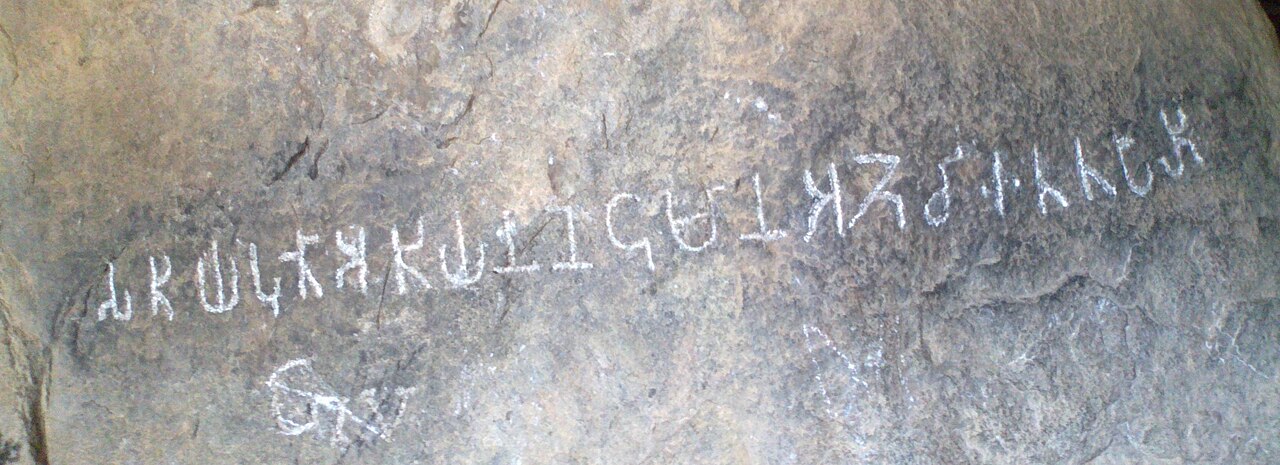
Jambai · Photographed 2011-12-25
Jambai Tamil-Brahmi inscription on the rock surface, with modern highlighting visible
006Where next
All related studies, connected material, books and sources19 · 12
Elsewhere on this site
Excavation Atlas Sites: Vizhinjam Coastal Fort & Harbour Terrace
Multi-Script Glossary Terms: Vēḷir (வேளிர் / വേളിർ)
Connected material
Photographs, drawings, books, videos and other studies linked to this study. A link helps you explore; it does not prove a historical claim.
- Jambai Tamil-Brahmi inscription on the rock surface, with modern highlighting visiblephotographBackground
- Rock-cut beds at the Jambai Jain shelterphotographBackground
- Entrance and floor of the Jain rock shelter at JambaimalaiphotographBackground
- Modern railway through the Shenkottah/Aryankavu passphotographBackground
007Sources
The study lists the sources it consulted; we have not rechecked them. A working link does not show that a source was read, and a valid identifier does not show that it supports a claim. We do not link to unofficial uploads or copies of publications. Where a study cited one, we show the published citation, or a publisher, DOI or Internet Archive link when we have one. Tracking codes are removed from links, and the sources themselves are not republished here.
ஆய் அண்டிரன்
Tamil Virtual Academy, Ay Andiran Purananuru indexed material.
Vaidehi Herbert, trans., Purananuru, Learn Sangam Tamil.
Print or offline sourceSource recordஆஅய் எயினன் / Akananuru Ay Eyinan passages
Tamil Virtual Academy and Vaidehi Herbert access texts for Ay Eyinan passages in Akananuru.
Akananuru commentary: Titiyan and Pothiyil
Tamil Virtual Academy, Akananuru commentary passage associating Titiyan with Pothiyil.
George L. Hart and Hank Heifetz, The Four Hundred Songs of War and Wisdom.
A Critical Edition and an Annotated Translation of the Akanāṉūṟu (Part 1 - Kaḷiṟṟiyāṉainirai)
Eva Wilden, A Critical Edition and an Annotated Translation of the Akananuru, Part 1.
Eva Wilden, Manuscript, Print and Memory: Relics of the Cankam in Tamilnadu.
T. A. Gopinatha Rao, Travancore Archaeological Series.
M. G. S. Narayanan, Cultural Symbiosis in Kerala.
The Pāṇḍyan Kingdom from the Earliest Times to the Sixteenth Century
K. A. Nilakanta Sastri, The Pandyan Kingdom from the Earliest Times to the Sixteenth Century.
எட்டுத்தொகை – பதிற்றுப்பத்து
Vaidehi Herbert, trans., Pathitrupathu, Learn Sangam Tamil.
Wikimedia Commons, Thirunandikkarai Inscription (Vikramaditya Varaguna), sourced to Travancore Archaeological Series I.
Researchers and institutions whose work this study uses: Vaidehi Herbert, Eva Wilden, George L. Hart, M. G. S. Narayanan, K. A. Nilakanta Sastri, T. A. Gopinatha Rao, Tamil Virtual Academy
How we know The evidence, claims and dates behind this study
What this study draws on
- Purananuru 127–136 and 240–241, read in Tamil with an online English translation
- Akananuru 148, 181, 208 and 396, checked against Tamil Virtual Academy texts
- Eva Wilden's studies of how the poems were copied and edited
- Library records of the Travancore Archaeological Series for later Ay inscriptions, not read in full
Dates in this study
| What is dated | Date | How it was dated |
|---|---|---|
| first to third centuries CE | 1–300 CE | How it was dated is not stated |
| early-medieval, principally ninth-century Ay inscriptional horizon discussed in modern scholarship | 800–900 CE | Date from writing, coins or texts |
See these dates on the timeline
The study’s claims
14 claims · 13 source passages · 58 paragraphs
Browse the study paragraph by paragraphThe consulted Purananuru group supports an association between Ay Andiran and Pothiyil/Podiyil.
Supported in this study
Association is stronger than any claim of fixed capital or defined frontier.
The consulted Andiran poems do not establish a fixed capital, surveyed territorial frontier, or documented administrative apparatus.
Supported with qualifications
This does not prove that Andiran had no political center; it means the consulted texts do not identify one securely.
Purananuru 130 represents Ay Andiran as defeating or driving the Kongar toward the western sea, but the episode alone does not establish continuous Ay sovereignty to the coast.
Supported with qualifications
The poem is panegyric and must be interpreted as such.
The specified early Ay poems do not directly attest Ay monopoly or administrative control over spice commerce, mountain passes, or pearl-trade approaches.
Supported with qualifications
The common claim specifically asks that nothing be inferred from strategic proximity.
Akananuru 148, 181, 208 and 396 form a recurrent literary memory complex in which Ay Eyinan fights Mignili and dies; later poems in the group connect the episode with Pazhi, Nannan and Punnadu.
Supported in this study
These are political memories embedded in akam poetry, not a continuous chronicle.
The consulted sources do not establish a genealogy connecting Ay Eyinan to Ay Andiran.
Unresolved in this study
Lineage remains a research hypothesis rather than a demonstrated relation.
The expression 'Veliyan Venman Ay Eyinan' in Akananuru 208 has a commentarial parsing ambiguity and should not be normalized automatically into a certain paternal genealogy.
Supported with qualifications
The consulted Titiyan passage associates him with Pothiyil but does not itself identify him as Ay.
Supported with qualifications
Pothiyil association alone cannot function as a dynastic identifier.
A broad first-to-third-century-CE orientation for the Purananuru corpus does not securely date individual Ay reigns or represented events.
Supported with qualifications
Composition, transmission, represented event and surviving witness dates remain distinct.
Later inscriptional evidence associated with Ay rulers belongs to an early-medieval horizon and cannot by itself demonstrate uninterrupted continuity from the early poetic figures.
Supported with qualifications
An intermediate evidence chain would be required for a strong continuity claim.
K. A. Nilakanta Sastri's The Pāṇḍyan Kingdom from the Earliest Times to the Sixteenth Century (1929) is modern secondary scholarship, not an ancient primary source for early Ay rulers.
Supported in this study
The catalogue's intended Sastri work/page is still unresolved.
The consulted wording of Purananuru 240 supports Ay's death and cremation but does not explicitly establish widow self-immolation.
Supported with qualifications
The phrase 'pastoral sovereignty' is not established by the consulted early Ay poem group.
Supported with qualifications
This is not a finding that pastoral activity was absent.
A consulted sources did not recover a specific Pathitrupathu passage directly supporting the catalogue's Andiran/Eyinan claims.
Unresolved in this study
Not found here does not mean no relevant passage exists.
Trace one claim through the study’s records
Explore the evidenceOther source lists
Numbered citation links from the study
The numbered links in the study text point here.
எட்டுத்தொகை – புறநானூறு 1-200 | Learn Sangam Tamil
எட்டுத்தொகை – அகநானூறு 121-300 | Learn Sangam Tamil
Travancore archaeological series by T. A. Gopinatha Rao | Open Library
எட்டுத்தொகை – புறநானூறு 1-200 | Learn Sangam Tamil
எட்டுத்தொகை – புறநானூறு 1-200 | Learn Sangam Tamil
எட்டுத்தொகை – புறநானூறு 1-200 | Learn Sangam Tamil
எட்டுத்தொகை – புறநானூறு 1-200 | Learn Sangam Tamil
Travancore archaeological series by T. A. Gopinatha Rao | Open Library
எட்டுத்தொகை – பதிற்றுப்பத்து – Learn Sangam Tamil
The Four Hundred Songs of War and Wisdom | Columbia University Press
Purananaru | தமிழ் இணையக் கல்விக்கழகம் TAMIL VIRTUAL ACADEMY
A Critical Edition and an Annotated Translation of the Akanāṉūṟu (Part 1 - Kaḷiṟṟiyāṉainirai) - École française d'Extrême-Orient
ஆய் அண்டிரன் | தமிழ் இணையக் கல்விக்கழகம் TAMIL VIRTUAL ACADEMY
எட்டுத்தொகை – புறநானூறு 1-200 | Learn Sangam Tamil
எட்டுத்தொகை – புறநானூறு 1-200 | Learn Sangam Tamil
எட்டுத்தொகை – புறநானூறு 1-200 | Learn Sangam Tamil
எட்டுத்தொகை – புறநானூறு 1-200 | Learn Sangam Tamil
எட்டுத்தொகை – புறநானூறு 201-400 | Learn Sangam Tamil
எட்டுத்தொகை – அகநானூறு 121-300 | Learn Sangam Tamil
எட்டுத்தொகை – அகநானூறு 121-300 | Learn Sangam Tamil
எட்டுத்தொகை – அகநானூறு 121-300 | Learn Sangam Tamil
எட்டுத்தொகை – அகநானூறு 301-400 | Learn Sangam Tamil
எட்டுத்தொகை – அகநானூறு 121-300 | Learn Sangam Tamil
தமிழ் இணையக் கல்விக்கழகம் TAMIL VIRTUAL ACADEMY | தேமதுரத் தமிழோசை உலகமெலாம் பரவும் வகை செய்தல் வேண்டும்
Travancore archaeological series by T. A. Gopinatha Rao | Open Library
Cultural symbiosis in Kerala by M. G. S. Narayanan | Open Library
The Four Hundred Songs of War and Wisdom | Columbia University Press
The Pāṇḍyan kingdom from the earliest times to the sixteenth century. by K. A. Nilakanta Sastri | Open Library
எட்டுத்தொகை – பதிற்றுப்பத்து – Learn Sangam Tamil
தமிழ் இணையக் கல்விக்கழகம் TAMIL VIRTUAL ACADEMY | தேமதுரத் தமிழோசை உலகமெலாம் பரவும் வகை செய்தல் வேண்டும்
எட்டுத்தொகை – புறநானூறு 1-200 | Learn Sangam Tamil
A Critical Edition and an Annotated Translation of the Akanāṉūṟu (Part 1 - Kaḷiṟṟiyāṉainirai) - École française d'Extrême-Orient
எட்டுத்தொகை – புறநானூறு 1-200 | Learn Sangam Tamil
எட்டுத்தொகை – புறநானூறு 1-200 | Learn Sangam Tamil
ஆய் அண்டிரன் | தமிழ் இணையக் கல்விக்கழகம் TAMIL VIRTUAL ACADEMY
ஆஅய் எயினன் | தமிழ் இணையக் கல்விக்கழகம் TAMIL VIRTUAL ACADEMY
எட்டுத்தொகை – அகநானூறு 121-300 | Learn Sangam Tamil
SMC 3 : CSMC : University of Hamburg
Travancore archaeological series by T. A. Gopinatha Rao | Open Library
Cultural symbiosis in Kerala by M. G. S. Narayanan | Open Library
The Early Medieval in South India - OUP India
The Pāṇḍyan kingdom from the earliest times to the sixteenth century. by K. A. Nilakanta Sastri | Open Library
Thirunandikkarai Inscription (Vikramaditya Varaguna).png
About this study Status, corrections and how it was made
Status
Draft study, revision 7. No historian, archaeologist, or Tamil or Malayalam specialist has reviewed it yet.
How it was made
Compiled as an editorial synthesis from published scholarship around questions we framed. About this project & workflow
The summary, How sure lines and Two views notes on this page were prepared from this study and cross-checked against its passages. That is an editorial check, not a specialist review.
Technical details
Study code R166. The text fingerprint changes whenever the study text changes.
- The study text is shown as written. Links from its paragraphs to citations help you move around the study; they are not new claims or checked source passages.
See how this study’s records were extracted
Text fingerprint (SHA-256): R166 · b82e9b874122cb29d987822e… · v7
Evidence tables and technical details are on the web page: https://layersofthesouth.org/read/a570e7f944