Rock-cut beds at the Jambai Jain shelter
Jambai
Photographed 2011-12-25
- Words & worlds
- Jambai, Mangulam & Pugalur Rock Inscription Sites
Early Chera rulers seen through stone, edict, poem and coin
A rock inscription, Asoka's edict, a merchant's guide, a praise poem and a museum coin each show early Chera power in a different way.
- How sure
- 2 Well supported
- 1 Possible
- This page
- 1,955 words · revision 5
Draft study · Awaiting specialist review · Updated
001Dates and places
Places on the atlas that name this study.
- Jambai, Mangulam & Pugalur Rock Inscription Sites
Protected ASI / TNSDA rock-shelter monuments
Dates in this study are stated in words only.
- 2 Well supported
- 1 Possible
002How sure
In brief
Two Tamil-Brahmi inscriptions at Pugalur in Tamil Nadu name three generations of one ruling family. They link a rock shelter for a Jaina monk with the youngest man becoming heir apparent. One epigraphist dates the writing to about the second century CE; older catalogues place it later. Asoka's Rock Edict II, from the third century BCE, names the Keralaputras among peoples beyond his borders. The Periplus, a first-century merchant's guide, links the ports of Tyndis and Muziris to a kingdom it calls Cerobothra. A praise poem, Pathitruppathu 13, admires protection, abundance and the ruin of enemies. A British Museum coin labelled Chera has no secure excavated context, mint or reign. Each record answers a different question. Together they give no reign list, capital or border, and matching inscribed names to poem kings remains unsettled.
Key researchers cited in this study: Iravatham Mahadevan (Tamil-Brāhmī Epigraphy) · Vaidehi Herbert (Sangam Poetry Translations & Commentaries) · Wilfred H. Schoff (Periplus Translation & Commentary) · Full bibliography
How sure
- Well supported
The Pugalur inscriptions name three generations of one family.
Read in Mahadevan's corpus edition by a related study; the second inscription restores part of one name from the first.
- Well supported
Asoka's Rock Edict II names the Keralaputras among peoples beyond his borders.
Stated in the edict's text; naming a people is not evidence of Mauryan rule over them.
- Possible
The Pugalur rulers are the kings praised in the Pathitruppathu poems.
Mahadevan matches the three generations to the Irumporai kings of Pathitruppathu decades 7 to 9; the names are close rather than identical, and the match is disputed.
Why it matters
Reading each kind of record for what it can show keeps a plausible royal story from being mistaken for a documented list of reigns.
003Key findings
What the study concludes
- Pugalur supplies a named intergenerational relationship and a religious gift; its dating and identification must be kept distinct from literary biographies.
- A royal name, a dynastic label, a title and a regnal date are not interchangeable pieces of evidence.
- Praise poetry makes political values visible, but it does not furnish a complete administrative map or a securely synchronized reign list.
In the study’s own words. How sure each point is, is shown above.
The summary above is the short read. The full study is the complete text it was drawn from, with its tables and source notes.
What the full study covers
- Main findings
- A ruler enters the record in a particular way
- Pugalur: a relationship and a gift
- A date for letters is not a calendar of reigns
- An earlier emperor names southern neighbors
- The merchant’s coastline is a different political view
- What praise asks a king to be
- A coin label cannot supply the missing reign
- A political world without false precision
- What remains uncertain
- The next questions
- References and access notes
- Further reading
004The study
Main findings
- Pugalur supplies a named intergenerational relationship and a religious gift; its dating and identification must be kept distinct from literary biographies.
- A royal name, a dynastic label, a title and a regnal date are not interchangeable pieces of evidence.
- Praise poetry makes political values visible, but it does not furnish a complete administrative map or a securely synchronized reign list.
A ruler enters the record in a particular way
A name cut into a rock has a place, surface and letters, but it still answers only certain questions. A ruler may become visible through a gift, genealogy, outsider’s account, museum classification or poem of praise. These are different records of action, not defective versions of one complete royal biography. This study brings those forms of evidence together without using one to fill every silence in another. It is a guide to early Chera political evidence, not a newly certified list of reigns. Its main finding is positive as well as limiting: named relationships, patronage, coastal affiliations and ideals of protection can be studied closely even when an exact year-by-year political narrative cannot be supplied. The differences between the sources are part of what makes the subject worth exploring.
Pugalur: a relationship and a gift
Two Tamil-Brahmi inscriptions at Pugalur, numbered 61 and 62 in Iravatham Mahadevan’s corpus, name three generations: Kō Ātaṉ Cel Irumpoṟai, his son Peruṅkaṭuṅkōṉ and his grandson Iḷaṅkaṭuṅkō. They describe a rock shelter as the abode of the Jaina monk Ceṅkāyapaṉ of Yāṟṟūr and link its carving to the grandson becoming heir apparent. “Pugalur inscriptions record a three-generation royal genealogy” reads both inscriptions closely. It shows that inscription 62 restores part of the first name from inscription 61, and that naming the grandson as the donor is a plausible scholarly reading, not a formula stated plainly in both texts. In the usual scholarly proposal, made by Iravatham Mahadevan (as reported in “Pugalur inscriptions record a three-generation royal genealogy”), these three Pugalur generations are matched with the Irumpoṟai-line Cēra kings of Patiṟṟuppattu decades 7–9, while other scholars reject the match; the personal names are close rather than identical, and the anthology's colophons are later than the poems. (The Tamil Nadu archaeology department’s Karur museum summary spells the names Ko Athan Chellirumporai, Perunkkadungo, and Elangkadungo and calls the monk Chenkayappan of Attur; this study follows “Pugalur inscriptions record a three-generation royal genealogy”’s corpus spellings.) 1
Modern line tracing of a Pugalur Tamil-Brahmi inscription, credited to Rajesh of Raigad in the 2018 Commons record
Pugalur
Ancient inscription assigned by source to circa 1st–2nd century CE; this tracing was created/uploaded in 2018
A donation is a political action in a narrow, intelligible sense: it associates a giver with a beneficiary and a remembered provision. Our interpretation is that such a record also invites questions about recognition. Who was expected to encounter the name? What mattered about recording the family relationship? Would the gift have been remembered differently without it? Those questions concern the purpose of commemoration. They do not license us to invent an amount paid, an official witnessing the gift, or the daily workings of the recipient’s community. The names are useful precisely because they belong to a particular statement. Turning the sequence into an illustrated family tree is possible, but each connecting line should be explained. A line meaning “the inscription presents these people as related” is stronger than one meaning “these independently dated reigns followed without interruption.” The former does not automatically establish the latter. Likewise, a grandson named in a donor’s record need not already have completed the reign that a modern chart gives him.
A date for letters is not a calendar of reigns
In a published excerpt from his epigraphic work, Iravatham Mahadevan captions the Pugalur inscription of Atan Cel Irumporai as second century CE. The official monument summary uses a broader period range for the inscriptional setting. Neither treatment ties the inscription to an exact year of any reign. The complete critical edition and apparatus were not consulted for this study; the differing levels of precision are kept rather than averaged into a convenient date. 23 “Pugalur inscriptions record a three-generation royal genealogy” adds that older catalogues place the royal record in the third–fourth centuries CE, and that the records it read attach no laboratory date to the carving. This distinction matters for readers as much as for writers. A palaeographic attribution concerns the inscription’s writing and its comparison with other dated forms. A reign table asks when a particular person exercised authority. A literary identification asks whether two descriptions refer to that same person. Agreement among these propositions must be demonstrated; it is not produced merely by putting them in adjacent columns. Where the chain remains incomplete, a date range and a note are more informative than an exact year with no stated basis.
An earlier emperor names southern neighbors
Rock Edict II of Aśoka (read here in S. Dhammika's online Girnar translation; E. Hultzsch's 1925 Corpus Inscriptionum Indicarum I edition was not collated here) names the Cholas, Pandyas, Satiyaputras, and Keralaputras among peoples beyond the king’s borders. The declaration describes provision for people and animals. As a third-century BCE text, it is an earlier witness to political names, not a register of the rulers living centuries afterward. It also records what the issuer claims to have done, rather than independently proving implementation in every named place. 4 The phrase about borders is consequential. A reference in an emperor’s inscription need not mean that the people named were governed as one of his provinces. Recognition, aspiration, contact and jurisdiction are different relationships. Our reading therefore uses this witness to widen the chronology of political naming, while declining to draw a Mauryan administrative boundary across every southern place mentioned. Nor does similarity between a group designation and a later dynastic name, by itself, identify a particular individual. “Pandya and Chola power is well attested, but not as a king list” reads the same edict for the Cholas and Pandyas.
The merchant’s coastline is a different political view
The Periplus Maris Erythraei (§§53–55, read here in the University of Washington online transcription of W. H. Schoff's 1912 translation; Lionel Casson's 1989 critical edition was not used for this study) associates Tyndis and Muziris with the kingdom rendered “Cerobothra” (Keprobotos) and assigns Nelcynda to a different ruler (the Pandian). These are affiliations in a first-century commercial description, not the coordinates of a surveyed frontier, and the passage names no Pugalur donor. 5 “The Periplus describes linked ports on the southwest Indian coast” discusses these port affiliations in detail, and “No customs rate or procedure is known for ancient Muziris” asks what can be said about tolls and customs at Muziris.
What praise asks a king to be
Pathitruppathu 13 contrasts a devastated hostile landscape with security and prosperity associated with the praised ruler. In the consulted translation, merchants and their families belong within that desirable order. The poem makes protection, abundance and the suffering of opponents part of its royal portrait. It does not measure their extent statistically or supply a neutral report from each settlement. 6 The interpretive gain is not to throw out praise as “unreliable,” but to change the question asked of it. What kind of achievement is the speaker making admirable? Whose well-being is visible? Whose devastation is celebrated? A passage can preserve a forceful political imagination without proving every event in the sequence that later readers build around it. The ordinary people mentioned in praise are significant, even when they are not speaking in their own recorded voices. A ruler’s profile should therefore keep a poem’s situation beside its historical discussion. The reader deserves to know whether a statement is made by a praising speaker, attached in a heading, supplied in prefatory material, or developed by a modern editor. A prose retelling that erases those layers may sound more fluent, but it becomes harder to validate. A linked passage and a brief explanation of its voice allow both literary enjoyment and historical inquiry. “The Patiṟṟuppattu is layered Chera praise poetry, not an archive” discusses how the Pathitruppathu collection can be used as historical evidence.
A coin label cannot supply the missing reign
British Museum object 1886,0505.64 is catalogued as a Chera copper-alloy coin. The indexed record gives a weight and registration details but no secure excavated context, mint or reign. 7 Acquisition is an event in the modern collection’s history, not the date the coin was issued, and a catalogue label does not give a reign. “Chera silver portrait coins carry Tamil-Brahmi names and titles” and “The early Chera seat of Vanchi fits Karur better than Kodungallur” discuss early Chera coins and their dating in detail.
A political world without false precision
Taken together, these witnesses give us several kinds of connection: a family relationship commemorated in a gift, an earlier imperial naming of southern peoples, a merchant’s allocation of ports to rulers, and a poet’s presentation of desirable rule. This is a meaningful political world. It is not a single synchronized administrative file. Our synthesis treats it as overlapping evidence whose boundaries remain visible. Closer study of epigraphic editions, variants and individual poem histories should determine how a ruler’s profile develops. A gap in a timeline is not evidence. Readers should be able to distinguish named people from later interpretations of their power.
What remains uncertain
- This study’s own Pugalur sources are an epigraphist’s excerpt and institutional summaries, not a fresh reading of the rock or the full critical apparatus; “Pugalur inscriptions record a three-generation royal genealogy” reads the corpus edition.
- Matching the three Pugalur generations to the Irumpoṟai kings of Patiṟṟuppattu decades 7–9 (Mahadevan's proposal, as reported in the companion Pugalur study) remains an inference whose names are close rather than identical.
- No exact early Chera reign, boundary, tax code or capital reconstruction is established.
- The coin was read through indexed metadata, not through a new image or metallurgical analysis.
The next questions
- Collate the Pugalur readings and palaeographic arguments in the complete critical editions.
- Examine poem headings and prefatory layers separately before constructing ruler biographies.
- Locate a stratified and fully published coin series before connecting issues to a particular reign.
References and access notes
1 Tamil Nadu Department of Archaeology, Chera Site Museum, Karur (https://www.tnarch.gov.in/chera-site-museum-karur, web page read here); for the corpus readings see Mahadevan 2003, nos. 61–62, as examined in “Pugalur inscriptions record a three-generation royal genealogy”.
Entrance and floor of the Jain rock shelter at Jambaimalai
Jambai
Photographed 2011-12-25
2 Iravatham Mahadevan (2003). “Orality to literacy: Transition in Early Tamil Society.” Frontline 20(7), Pugalur caption (https://www.tamilheritage.org/old/monument/oodu/mahadev.html), assigning Atan Cel Irumporai’s Pugalur inscription to the second century CE. Excerpt consulted alongside the corpus synthesis in “Pugalur inscriptions record a three-generation royal genealogy”.
3 Tamil Nadu Department of Archaeology, Pugalur (Arunattar Malai) protected-monument entry (https://www.tnarch.gov.in/node/118), providing a broader institutional period range alongside Mahadevan's palaeographic dating in nos. 61–62.
4 S. Dhammika, The Edicts of King Asoka (1993), Rock Edict II (Girnar), online (https://accesstoinsight.org/lib/authors/dhammika/wheel386.html). Standard edition: E. Hultzsch, Corpus Inscriptionum Indicarum I (1925), not collated here.
5 W. H. Schoff, The Periplus of the Erythraean Sea (1912), §§53–55, Silk Road Seattle transcription (https://depts.washington.edu/silkroad/texts/periplus/periplus.html). Standard edition: Lionel Casson (1989), not used for this study.
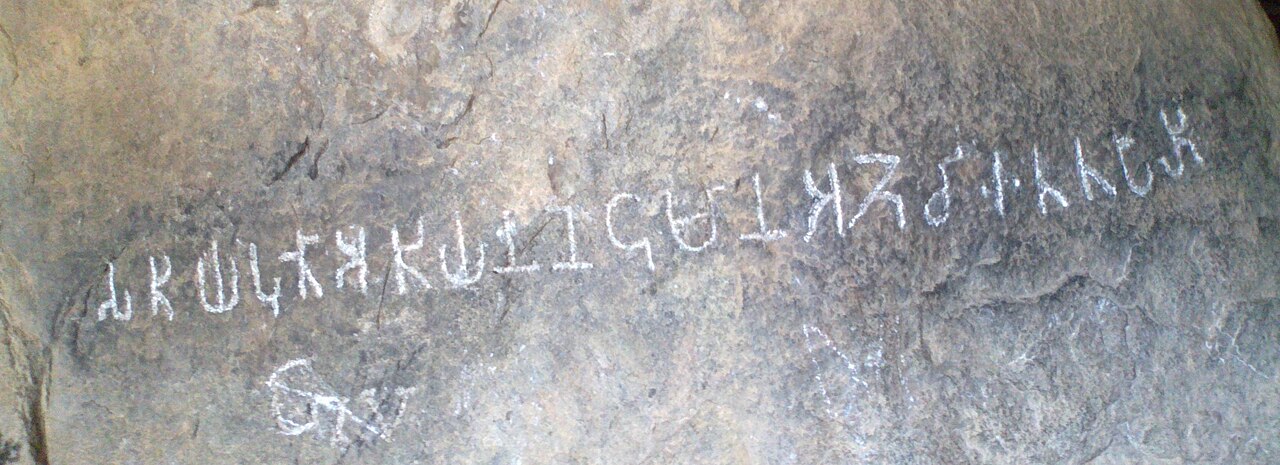
Jambai Tamil-Brahmi inscription on the rock surface, with modern highlighting visible
Jambai
Photographed 2011-12-25
6 Vaidehi Herbert, Pathitruppathu (online translation at https://sangamtranslationsbyvaidehi.com/pathitruppathu/), poems 13 and 67 read here; printed Tamil critical editions were not collated for this study.
7 British Museum, copper-alloy coin attributed as Chera, museum number 1886,0505.64 (https://www.britishmuseum.org/collection/object/C_1886-0505-64). Indexed catalogue metadata consulted: gives weight and 1886 registration details but no excavated context, mint, or reign.
Further reading
Iravatham Mahadevan, Early Tamil Epigraphy: From the Earliest Times to the Sixth Century A.D. (Harvard Oriental Series 62, 2003; 2nd rev. ed., vol. 1, CICT, 2014), corpus nos. 61–62; see “Pugalur inscriptions record a three-generation royal genealogy” for the full Pugalur epigraphic study and “The Patiṟṟuppattu is layered Chera praise poetry, not an archive” for Patiṟṟuppattu as historical evidence.
005Photographs
Photographs of the places and objects this study discusses. Each item carries its creator’s credit, licence and documented source. See all 412 photographs and source images ↗

Jambai · Photographed 2011-12-25
Rock-cut beds at the Jambai Jain shelter
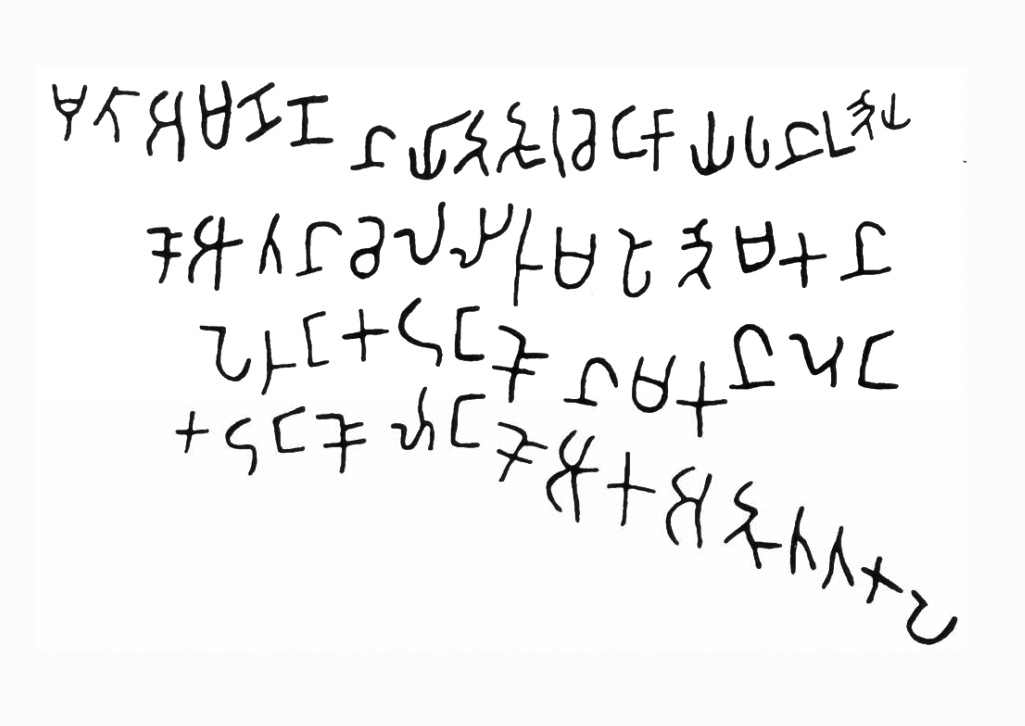
Pugalur · Ancient inscription assigned by source to circa 1st–2nd century CE; this tracing was created/uploaded in 2018
Modern line tracing of a Pugalur Tamil-Brahmi inscription, credited to Rajesh of Raigad in the 2018 Commons record
Modern line tracing of a Pugalur Tamil-Brahmi inscription, credited to Rajesh of Raigad in the 2018 Commons record. This is an epigraphic representation, not a photograph of the inscribed rock.

Jambai · Photographed 2011-12-25
Entrance and floor of the Jain rock shelter at Jambaimalai
Jambai · Photographed 2011-12-25
Jambai Tamil-Brahmi inscription on the rock surface, with modern highlighting visible
006Where next
All related studies, connected material, books and sources17 · 7
Elsewhere on this site
Excavation Atlas Sites: Jambai, Mangulam & Pugalur Rock Inscription Sites
Multi-Script Glossary Terms: patikam (பதிகம் / പതികം) · Mūvēntar (மூவேந்தர் / മൂവേന്തർ) · Cēral / Kēraḷaputra (சேரல் / சேரர் / ചേരൻ / കേരളപുത്ര) · Vēḷir (வேளிர் / വേളിർ)
Connected material
Photographs, drawings, books, videos and other studies linked to this study. A link helps you explore; it does not prove a historical claim.
- Jambai Tamil-Brahmi inscription on the rock surface, with modern highlighting visiblephotographBackground
- Rock-cut beds at the Jambai Jain shelterphotographBackground
- Entrance and floor of the Jain rock shelter at JambaimalaiphotographBackground
- Modern line tracing of a Pugalur Tamil-Brahmi inscription, credited to Rajesh of Raigad in the 2018 Commons recordmodern epigraphic tracingBackground
007Sources
The study lists the sources it consulted; we have not rechecked them. A working link does not show that a source was read, and a valid identifier does not show that it supports a claim. We do not link to unofficial uploads or copies of publications. Where a study cited one, we show the published citation, or a publisher, DOI or Internet Archive link when we have one. Tracking codes are removed from links, and the sources themselves are not republished here.
Tamil Nadu Department of Archaeology (Undated institutional webpage). Chera Site Museum, Karur. Karur museum overview, paragraph on Pugalur and its three named generations. Indexed institutional text read; indexed overview consulted. No gallery visit, object photography review, or excavation-volume inspection. The page’s transliterations differ from Mahadevan’s. A museum display spanning many centuries is not one archaeological deposit. Its capital identification and gift terminology are attributed, not independently settled here.
Iravatham Mahadevan (2003). Orality to literacy: Transition in Early Tamil Society. Frontline 20(7), 2003, Pugalur caption. Public HTML excerpt and its Pugalur caption read. This is not inspection of the complete critical edition or an independent reading of the rock. The caption assigns Atan Cel Irumporai’s Pugalur inscription to the second century CE. Broad statements about literacy elsewhere in the excerpt are not used as demographic measurements.
Tamil Nadu Department of Archaeology (Undated institutional webpage). Pugalur (Arunattar Malai) protected monument entry. Protected-monument indexed description and broad chronological attribution. Indexed official monument description read; the retrieved transcription contains typographic/encoding problems. No autopsy of the inscription. Retained as an institutional comparison and further-reading lead. Its broad date range is not a precise regnal chronology, and garbled wording is not silently emended into a critical text.
S. Dhammika, translator; ancient edict of Asoka (Translation 1993; edict third century BCE). The Edicts of King Asoka: Rock Edict II. Rock Edict II and notes on the Girnar version. Translation of Rock Edict II and its associated notes read in HTML. No original-script autopsy or comparison of all recensions. An imperial declaration records how the issuer presents his reach and concern. It is not independent confirmation of every action claimed, and is earlier than the early first century CE.
Anonymous; translated by Wilfred H. Schoff (1912 translation). The Periplus of the Erythraean Sea. Periplus §§53–55; port affiliations in §54. Relevant numbered sections read. University of Washington transcription of the 1912 translation, with some later editorial glosses. Ancient composition is usually placed around the middle of the first century CE, not the translation date. Schoff’s translation is public domain in the United States; no complete modern translation is reproduced.
Vaidehi Herbert, translator; attributed ancient Tamil poems (Ancient poems; modern undated web translation). Pathitruppathu: poems 13 and 67, with editorial introduction. Poem 13, contrast between hostile devastation and the praised country. Selected translations, poem headings, notes and collection introduction read. No full critical-edition comparison or certified original translation. The anthology’s poems, headings, prefatory material and modern notes are distinct layers. The introduction’s precise chronological reconstructions are not adopted as established reign dates. No complete modern translation is reproduced.
British Museum (Undated ancient object in read record; acquisition 1886). Coin, museum number 1886,0505.64. Object 1886,0505.64; indexed culture/period, material and registration fields. Indexed collection metadata read; indexed metadata consulted. No image-based identification performed. The consulted metadata does not provide a secure mint, reign, excavation context or first-century date. Acquisition year is not manufacture date.
Researchers and institutions whose work this study uses: Iravatham Mahadevan, Vaidehi Herbert, Wilfred H. Schoff
How we know The evidence, claims and dates behind this study
What this study draws on
- Pugalur: a Tamil Nadu museum web page and an epigraphist's published excerpt, set beside the corpus reading of the two inscriptions.
- Asoka's Rock Edict II in S. Dhammika's English translation of the Girnar version.
- Periplus sections 53–55 in Schoff's 1912 translation, and Pathitruppathu 13 in Vaidehi Herbert's translation.
- British Museum collection record 1886,0505.64, seen only as indexed catalogue data.
Dates in this study
This study has no dates recorded in a form we can chart, so there is no date chart. Any dates it gives are in the full study.
The study’s claims
0 claims · 0 source passages · 20 paragraphs
Browse the study paragraph by paragraphThis study has no separately listed claims. Its paragraphs can be browsed one by one.
About this study Status, corrections and how it was made
Status
Draft study, revision 5. No historian, archaeologist, or Tamil or Malayalam specialist has reviewed it yet.
How it was made
Compiled as an editorial synthesis from published scholarship around questions we framed. About this project & workflow
The summary, How sure lines and Two views notes on this page were prepared from this study and cross-checked against its passages. That is an editorial check, not a specialist review.
Technical details
Study code R037. The text fingerprint changes whenever the study text changes.
- The study text is shown as written. Links from its paragraphs to citations help you move around the study; they are not new claims or checked source passages.
See how this study’s records were extracted
Text fingerprint (SHA-256): R037 · a9b9fccaab8206773ec59c9b… · v5
Evidence tables and technical details are on the web page: https://layersofthesouth.org/read/61502371db