Each period has the same width, so spacing is not to scale.
- Across the water
Kodungallur's arrival stories were written down centuries later
The earliest writings we found that give the arrival dates of 52, 70 and 629 CE were made many centuries afterwards.
- This page
- 7,094 words · revision 4
Draft study · Awaiting specialist review · Updated
001Dates and places

No mapped place in this study.
1000–500 BCE
Different beginnings
500–200 BCE
Marks & materials
200 BCE–300 CE
Connected worlds
300–600 CE
Change & continuity
After 600 CE
- 51 CE (Song of Thomas, as summarised)
- 21 November 52 CE (tradition)
- soon after the destruction of Jerusalem in 70 (Cochin Jewish tradition)
- 189-190
- early third century
- not much later than A.D. 250
- 345 (arrival of the merchant Thomas of Jerusalem in the Syriac account)
- 379 (traditional date of the Joseph Rabban grant)
- 547-549
- 580/594
- 629 CE (traditional mosque date)
- c. AD 800-1124
- How it was dated is not stated
Each date belongs to what was dated (a sample, an object, a layer or a text), which is not always the event the study asks about.
Each period has the same width, so spacing is not to scale.
The full table of dates, with their ranges, is under How we know.
- 1 Well supported
- 1 Likely
- 2 Not known
002How sure
In brief
This page dates historical records, not living faith. Three Kerala communities trace their beginnings to the port country around Kodungallur: Christians remember the apostle Thomas landing in 52 CE, Jewish tradition recalls settlers arriving after 70 CE, and a widely told tradition dates India's first mosque at Kodungallur to 629 CE. Pre-600 texts attest a belief that Thomas worked in 'India', while on the Malabar coast itself Cosmas (c. 550 CE) reports a church in Malê (the pepper country). A Kollam church grant dated 849 CE carries witness signatures in Arabic, Pahlavi and Hebrew scripts. Between 600 and 1600, Kodungallur's June 1301 Syriac lectionary colophon (Vat. Syr. 22) and East Syrian and Portuguese records (1504–c. 1518, including Duarte Barbosa c. 1516–18) attest a Malabar Thomas association, while travellers from the 1290s (John of Monte Corvino and Marco Polo) report the Thomas tomb on the east coast (Coromandel/Mylapore). The seventeenth- and eighteenth-century dates apply specifically to the earliest read Kerala texts giving the year 51/52 CE and the Maliankara landing, alongside later writings for the Shingly and 629 CE traditions.
Key researchers cited in this study: B. B. Lal (Early Historic & Megalithic Archaeology) · M. G. S. Narayanan (Perumals of Kerala & Chera Epigraphy) · Archaeological Survey of India (ASI) · Full bibliography
How sure
- Likely
A church stood in Malê, the pepper country, by about 550 CE.
Cosmas reports it in a work of the 540s, but he may not have visited the coast himself.
- Well supported
A royal grant at Kollam dated 849 CE carries witness signatures in Arabic, Pahlavi and Hebrew scripts.
The plates survive and are published. Perczel suggests the signatures were added to a witnessed copy, so they may be later than 849.
- Not known
The apostle Thomas landed at Kodungallur in 52 CE.
No text before 600 CE that we read links Thomas with Kerala. Kodungallur (1301) and East Syrian/Portuguese records (1504–c. 1518) attest a Malabar Thomas association, while travellers from the 1290s report the Thomas tomb on the east coast; the specific year 51/52 CE and the Maliankara landing are first found, in what we read, in Kerala texts of the seventeenth and eighteenth centuries.
- Not known
A mosque stood at Kodungallur in 629 CE.
The earliest full Muslim account we read, from about 1583, rejected the Prophet-era date; Friedmann (1975), Prange (2018 ch. 2) and Shokoohy (2003) were not read in full for this study, and no early record or scientific date supports 629 CE.
Why it matters
These are the origin stories of three Kerala communities, set in this collection's core landscape. Sorting their witnesses by date shows what the records can and cannot say.
003Key findings
What the study concludes
- Cosmas reports a church in Malê, the pepper country, about 550 CE: the only pre-600 witness for any of the three communities on this coast.
- The Kollam grant of 849 CE is the first dated document for Christians, Jews and Muslims together on the Kerala coast.
- The Joseph Rabban grant dates to 1000 CE, not 379 CE, and Gamliel traces the Shingly origin story to Hebrew writings of 1503 and 1525.
- The earliest Muslim account we read, from about 1583, rejected the Prophet-era date for the Chera king's conversion.
In the study’s own words. How sure each point is, is shown above.
The summary above is the short read. The full study is the complete text it was drawn from, with its tables and source notes.
What the full study covers
- About this study
- Main findings
- How the evidence is sorted here
- The Thomas tradition is old, but its Kerala setting is recorded late
- The Jewish arrival stories have no witness before 849 CE
- The earliest Cheraman Perumal accounts we found are sixteenth-century
- What the evidence before 600 CE does show
- What remains uncertain
- Related studies in this collection
- Sources
004The study
About this study
Three of Kerala's religious communities trace their beginnings to the old port country around Kodungallur, on the lower Periyar. Many Christians remember the apostle Thomas landing there in 52 CE. Jewish tradition tells of settlers who came after Jerusalem's Temple fell in 70 CE. A widely told tradition dates India's first mosque, at Kodungallur, to 629 CE.
This page dates historical records, not living faith. It sets each story beside the dated evidence, sorts every witness into three groups – written before 600 CE, written between 600 and about 1100 CE, and written later – and asks what each group can show. It does not test matters of faith. A tradition can matter deeply to a community without being something a historian can date.
The study complements other work in this collection. Study “Cosmas names five pepper marts of Malê and a church there” reads Cosmas's sixth-century notice of a church in Malê. Study “Pahlavi crosses show Persian Christian links but no sure date” examines the stone crosses with Middle Persian inscriptions. Study “Kerala 300–600 CE: sea links changed rather than collapsed” surveys Kerala between 300 and 600 CE. Study “Kodungallur digs found medieval layers, Pattanam much older ones” reviews the excavations at Kodungallur, and study “Pattanam is a candidate for ancient Muziris” weighs where ancient Muziris lay. Study “Pattanam's radiocarbon dates give no single date for its wharf” examines the Pattanam excavations, and study “The Periplus describes linked ports on the southwest Indian coast” reads the Periplus on the south-western ports.
Main findings
- A belief that the apostle Thomas preached and died in "India" is recorded by the early third century. The Acts of Thomas, written in Syriac, probably at Edessa, tells it as a story. Later writers before 600 CE repeat it. How sure: Established.
- No text from before 600 CE that we read connects Thomas with Kerala, Muziris or Kodungallur, though medieval witnesses link the Malabar church to Thomas centuries before 1600. The Acts of Thomas sets his mission at the court of King Gundaphorus, whose name matches a king of the far north-west. A Syriac lectionary copied at Kodungallur (Shengala) in June 1301 (Vat. Syr. 22) and East Syrian and Portuguese records of 1504–c. 1518 attest a Malabar Thomas association, while travellers from the 1290s (John of Monte Corvino and Marco Polo) report the Thomas tomb on the east coast (Coromandel/Mylapore). The seventeenth- and eighteenth-century date applies specifically to the earliest Kerala texts read here that give the year 51 or 52 CE and the Maliankara landing. How sure: Not known whether Thomas reached Kerala.
- A church existed in Malê, the pepper country, by about 550 CE. Cosmas reports it in a work written in the 540s. This is the only witness before 600 CE that we found placing any of the three communities on this coast. How sure: Likely.
- The first dated document for Christians, Jews and Muslims together on this coast is a royal grant made at Kollam in 849 CE. The grant, to a church, carries witness signatures in Arabic, Middle Persian and Hebrew scripts. One scholar suggests the signatures belong to a later witnessed copy. How sure: Established for the grant and its signatures.
- The Jewish arrival stories have no witness before 849 CE. The grant to Joseph Rabban, long dated by tradition to 379 CE, belongs to about 1000 CE. The place-name Shingly appears in medieval Arabic geography. Ophira Gamliel traces the story of a Jewish kingdom there to Hebrew writings of 1503 and 1525. How sure: Not known when Jews first settled.
- The earliest accounts read directly here of the Chera king's conversion date from the sixteenth century (though an anonymous Arabic text, Qiṣṣat Shakarwatī Farmāḍ, studied by Yohanan Friedmann in 1975 and Sebastian Prange in 2018 – both remaining to be read in full – may preserve an earlier written version). The earliest Muslim narrator we read, Zayn al-Din, writing about 1583, rejected the Prophet-era date. He thought the event happened about two centuries after the Hijra. The Chera Perumal kingdom with its capital at Kodungallur is documented only from about 800 CE. How sure: Not known that a mosque stood at Kodungallur in 629.
How the evidence is sorted here
Each tradition makes a claim about a date in the distant past. The test applied here is simple. For each claim, the study asks when the claim itself was first written down, and what independent evidence existed at the time named.
Three groups result:
- Recorded before 600 CE. These texts were written within the principal period of this collection, 1000 BCE to 600 CE. They are the only witnesses that could, in principle, confirm an arrival before 600 CE.
- Recorded between 600 and about 1100 CE. These are mostly copper-plate grants of the Chera Perumal period. They are firm evidence for communities that existed when the plates were cut. They do not by themselves date those communities' beginnings.
- Recorded after about 1100 CE. These include chronicles, songs, travellers' accounts and modern publications. They show what people came to believe and when. They may preserve older memory, but that has to be argued case by case.
A claim is labelled recorded before 600 CE only if a text of that age makes it. A claim first found later is labelled recorded only later, however old the event it describes. A claim that fits the known conditions but lacks direct evidence is called possible.
The Thomas tradition is old, but its Kerala setting is recorded late
What the Kerala tradition says
The Government of Kerala's tourism pages for the Muziris Heritage Project give the tradition in its familiar form. One states that the apostle "arrived first in Kerala at Kodungallur on 21 November, 52 CE." ↗1 Another describes the church at Kottakkavu as one of eight churches founded by Thomas in 52 CE. ↗2 A third page is more cautious. It says the visit "is still a matter of dispute among historians," names Azhikode in Kodungallur as the landing place, and records that he was killed at Mylapore, near Chennai. ↗3
The tradition is carried in Malayalam songs. One is the Song of Thomas (Thoma Ramban Pattu). It claims to have been written down in 1601 by Thoma Ramban. In the e-Clavis summary of its narrative, Thomas lands at Malyankara in 51 CE and founds seven churches and a "half-church." ↗4 A Syriac account translated by Alphonse Mingana gives the year 52. In that version Thomas reaches Mylapore first and only then comes to Malabar and Malykara. Mingana judged it to have been written in the early eighteenth century. ↗5
Writings from before 600 CE
Five kinds of witness from before 600 CE bear on the question. None of them mentions Kerala by any name we can recognise in connection with Thomas.
The Acts of Thomas. This is the fullest early narrative. The surviving Greek is generally held to be a version of a Syriac original. ↗6 A standard reference work describes it as written in Syria, probably at Edessa, early in the third century. ↗7 In the story, the apostles divide the world by lot and India falls to Thomas. A merchant, Abbanes, buys him as a carpenter for King Gundaphorus. They sail to a royal city called Andrapolis, where a flute-girl at a wedding feast is described as a Hebrew. Thomas is later killed with spears on a mountain on the orders of King Misdaeus. One of the believers then secretly carries his body to Mesopotamia. ↗6
The Acts is a work of devotion and wonder, not a travel record. It names no place that can be located on the Kerala coast. Its one securely historical anchor, King Gundaphorus, points to the north-west of the subcontinent.
A real king in the story. Gundaphorus corresponds to Gondophares, a king recorded in the far north-west of the subcontinent. An inscription bearing his regnal year 26 and year 103 of an unstated era is known as the Takht-i-Bahi inscription, after a Buddhist site in Gandhara, in the Peshawar basin. Wannaporn Rienjang notes that it was in fact found at nearby Shahbazgarhi. She also records the proposal that the era is the Azes era. ↗8 The encyclopedia entry calls Gundaphorus "a historical figure of the 1st cent." ↗7
An exposed floor and surrounding masonry at Kottappuram Fort during the 2011 excavation
Kottappuram Fort
Photographed 2011-02-04
Shown to compare dates, not as a photograph of a known pre-600 CE Muziris building.
The match shows that a third-century author knew the name of a genuine first-century king of the north-west. It does not carry the story to Kerala, because the inscription naming Gondophares comes from Gandhara, far from the south-western coast.
Early Syriac and Greek notices. Mingana collected the early Syriac evidence in 1926. He observed that the Book of the Laws of Bardaisan of Edessa, of about 196 CE, names Christians among several eastern peoples but not among the Indians. He then quoted the Syriac Doctrine of the Apostles, which he placed not much later than 250 CE: India and its neighbouring lands "received the Apostles' hand of priesthood from Judas Thomas." Mingana argued that this implies a Christian church in some "India" known to the author at least by hearsay. ↗5 He also noted that the hymns of Ephrem, who died in 373, praise Thomas's work in India but were written under the direct influence of the Acts. He allowed that they might imply Christians in India in Ephrem's day. ↗5
Pantaenus. Eusebius's Church History reports that the Alexandrian teacher Pantaenus "is said to have gone to India." There he found the Gospel of Matthew in Hebrew, left by the apostle Bartholomew. ↗9 Jerome's catalogue of Christian writers adds that Bishop Demetrius of Alexandria sent him. ↗10 Neither writer mentions Thomas in this connection. In another passage, Eusebius reports a tradition that Thomas was allotted Parthia. ↗9
The meaning of "India" here is disputed. Mingana argued that the India of the Pantaenus story is "without doubt Arabia Felix," that is, southern Arabia, and said that even Medlycott accepted this. He noted that two historians of the Indian church writing in Britain, Milne Rae and G. Smith, had accepted it as India proper. ↗5 The wider point holds whichever reading is preferred. As Mingana showed, early writers used "India" loosely, often confusing it with the lands of the Ethiopians and Himyarites on both shores of the Red Sea. ↗5 A late-antique mention of "India" cannot be placed on the Kerala coast without further evidence.
Gregory of Tours. Writing in Gaul between 580 and 594, Gregory reports that Thomas was martyred in India and that his body was later taken to Edessa. Where he was first buried, Gregory says, there stood a monastery and a large church. A lamp burned there day and night. Gregory had this from a man named Theodorus who had visited the place. ↗12 This is the earliest report we found of a cult site of Thomas in India itself. It gives no location. Kerala tradition places his death at Mylapore, on the east coast, not in Kerala. ↗3
Cosmas. The Christian Topography, conventionally dated to 547–549, contains the earliest notice of Christians on the south-western coast. In J. W. McCrindle's 1897 translation, it reads: "In the country called Malê, where the pepper grows, there is also a church." ↗11 The next clause places a bishop "appointed from Persia" at another place, Calliana. The same passage reports clergy ordained in Persia on the island of Dioscorides (Socotra). ↗11 Mingana glosses Malê as Malabar, and Narayanan identifies it with Kerala. ↗5 ↗13 The collection's study of Cosmas shows that he may not have visited Malê himself. It also shows that the Persian bishop belongs to Calliana, not Malê. Cosmas says nothing about how or when the church in Malê was founded, and he does not mention Thomas.
What these early witnesses establish
Taken together, the witnesses before 600 CE establish two things. First, by the early third century, Syriac-speaking Christians believed that Thomas had preached in a land they called India and that his remains had been carried to Mesopotamia. By the late sixth century that belief had reached Gaul. Second, by about 550 a church stood somewhere in the pepper country of Malê. Cosmas does not say who served it. He describes Persian-appointed clergy at Calliana and on Socotra, and the collection's study of Cosmas cautions against transferring that detail to Malê.
They do not establish that Thomas came to Kerala. The early texts that name a royal patron point to the north-west. The early texts that place a church on the pepper coast do not name a founder. Between 600 and 1600 CE, the Malabar church's connection with Thomas appears directly in medieval Kodungallur and Indian Ocean records (detailed below), whereas the specific arrival year 51 or 52 CE and the Maliankara landing are first found, in the Kerala texts we read, in works of the seventeenth and eighteenth centuries.
What the ninth century adds
The first local document of the Kerala Christians is a royal grant of 849 CE, issued at Kollam in the fifth regnal year of the Chera king Sthanu Ravi. It confers land and privileges on the church called Tarisappalli, built by a merchant leader named Maruvan Sapir Iso. ↗18 ↗13 István Perczel calls it the first local document of the community. He also suggests that the surviving plates may be a witnessed copy, so that 849 dates the original grant rather than the copy. ↗16 M. G. S. Narayanan concluded that by this time the Christians were well integrated in Kerala's social and political order. ↗13
A second tradition is the origin account of a living community: the Knanaya (Southist) Christians of Kerala trace their ancestry to a migration led by the merchant Thomas of Cana (Knāyi Tōmmaṉ), dated in community tradition to 345 CE. Secondary historians (such as M. G. S. Narayanan, citing lost copper plates reported by sixteenth- and seventeenth-century Portuguese-period writers that were not read directly here) place the historical Thomas of Cana grant in the Makotai Chera period after about 800 CE, while an eighteenth-century Syriac account translated by Alphonse Mingana (1926) tells of “Thomas of Jerusalem” reaching Maliomkara in 345 CE, a date Mingana judged unhistorical. ↗5 ↗13 The same Syriac account records that Mar Sapor and Mar Parut came to Kollam in 823 and built a church there, which Narayanan links with the Mar Sapir named in the 849 Kollam grant. ↗5 ↗13
The granite crosses with Middle Persian inscriptions belong to the same world of Persian-linked Christianity. The collection's study of these crosses finds that none of them has a secure production date before 600 CE.
Between 600 and 1600
The gap between Gregory of Tours (c. 590) and seventeenth-century Malayalam songs does not mean that the link between Thomas and the Malabar church first appeared after 1600. Several dated witnesses between 600 and 1600 attest both the local Malabar Thomas link and wider South Indian veneration:
- June 1301 – Syriac Pauline Lectionary colophon (MS Vat. Syr. 22): Copied by the fourteen-year-old deacon Zakarya at the church of Mar Quriaqos in the “royal, famous, and celebrated city” of Shengala (Cranganore / Kodungallur), the colophon names the local metropolitan Mar Yaʿqob of India and calls his see the holy throne of Mar Thomas the Apostle under Patriarch Yahballaha III (cited in Alphonse Mingana 1926, Bulletin of the John Rylands Library 10(2), Source 5 below). This places an explicit written Thomas-apostle affiliation in Kodungallur itself three centuries before 1601. ↗5
- 1292–93 – John of Monte Corvino: The Franciscan missionary spent roughly thirteen months in South India en route to China and visited the shrine/church of St Thomas on the Coromandel coast.
- c. 1298 – Marco Polo: His account describes the South Indian tomb of St Thomas and Christian/local pilgrimage there (placing the shrine in Maabar/Mylapore, east coast).
- 1504 – East Syrian bishops' letter (MS Vat. Syr. 204): Dispatched to the Catholicos by East Syrian bishops in Malabar (including Mar Jaballaha, Mar Denha, and Mar Jacob), reporting on the Malabar Christian communities and hierarchy at the start of Portuguese contact.
- c. 1516–18 – Duarte Barbosa: His Portuguese survey of the Malabar coast records the Thomas Christians and local traditions encountered at the ports.
Taken together, Kodungallur (1301) and East Syrian and Portuguese records (1504–c. 1518) attest a Malabar Thomas association, while travellers from the 1290s (John of Monte Corvino and Marco Polo) report the Thomas tomb on the east coast (Coromandel/Mylapore); what belongs specifically to seventeenth- and eighteenth-century Kerala texts read here is the 51 or 52 CE landing date at Maliankara and the seven-churches narrative.
Two readings of the same evidence
Scholars have read this evidence in two main ways.
The tradition preserves a genuine first-century mission. In 1927 J. N. Farquhar wrote that "the balance of probability is distinctly on the side of its historicity" (quoted by Narayanan). ↗13 A. E. Medlycott had defended the historicity of Thomas's mission to India in 1905. ↗5 The churches of the Thomas Christian tradition hold the apostolic foundation as part of their identity, and the Kerala government's heritage pages present it. ↗1 Evidence that fits this view includes the early date of the Edessa tradition, the real king named in the Acts, and the regular Roman-era sea trade with the Malabar coast. That trade made a first-century voyage practicable (see the collection's studies of Pattanam and of the Periplus). Mingana took a middle position: he found it hard to overturn "the constant tradition of the Church," but he set the question of the apostle aside. ↗5
The Kerala setting is not shown by early evidence. Narayanan concluded that apart from possibility and faith "there is no contemporary or near-contemporary evidence in support of the legend." He suggested that immigrant Christians brought the Thomas tradition with them from Syria and gave it a local setting, as Brahmin settlers did with Parasurama. He also argued that stories of Thomas converting Brahmin families are anachronistic, because Brahmin settlement in Kerala came later. ↗13 Jarl Charpentier gave the Song of Thomas "no weight whatsoever" as evidence. He noted only the suggestion that it drew on older material partly destroyed at the Synod of Diamper in 1599. ↗14 In the same year a contributor to the Indian Antiquary signing T.K.J., most probably T. K. Joseph, called the 1601 song "a pious fraud." ↗15 Narayanan records that Joseph later rejected the view that tradition and circumstantial evidence put the apostolic origin beyond doubt. ↗13 More recently, Perczel has said that it "was not difficult to get there," but that there is "no direct evidence about an apostolic preaching in India." He adds that the first direct evidence is ambiguous and comes from the west. ↗16 His survey of Syriac Christianity in India discusses an early Persian mission, ninth-century Persian merchant arrivals, and intermarriage between West Asian merchants and local women. ↗17
Book III, p 119 of McCrindle’s 1897 translation of Cosmas: the passage on Male, pepper and a church, followed by Calliana and Socotra
1897
What would settle it is a dated document or inscription from the Kerala coast, written before about 300 CE, that names Christians or the apostle. A securely dated early Christian building or burial would also help. The collection's studies of the Pattanam and Kodungallur excavations report nothing of this kind.
The Jewish arrival stories have no witness before 849 CE
What the tradition says
Kerala's Jewish communities have told several stories of origin. Narayanan summarised them. The Jews of Cochin claimed to have come to Kodungallur soon after Rome destroyed Jerusalem in 70 CE. Other writers proposed 136, 370 or 490 CE for early settlements. Some have suggested that the coast was known to the Hebrews in Solomon's time, a claim about trade knowledge rather than settlement. ↗13 A translator's note of 1942 gives 68 CE. ↗21 The Muslim scholar Zayn al-Din, writing about 1583, records that Jews and Christians came by ship to Kodungallur and received land from its king before the first Muslims arrived. ↗21
The Kerala government's heritage page is careful. It says that "it is difficult to identify with certainty when exactly the Jews arrived." It also lists Shingly among the names of Muziris. ↗19
Before 600 CE
No text written before 600 CE that we found names Jews on the Kerala coast. Narayanan thought that Jews, and probably Christians, must have shared in the Roman-era sea trade. But he noted that "Jews or Christians are not directly mentioned in any of the sources." ↗13 The Hebrew flute-girl at Andrapolis in the Acts of Thomas is a literary figure in an unlocated city. ↗6 That Jewish merchants sailed to this coast in Roman times is possible. No source we read records it.
The documents
The first firm evidence for Jews in Kerala is the Kollam grant of 849 CE. Its witnesses signed in three scripts: Arabic in Kufic letters, Middle Persian in Pahlavi letters, and Hebrew letters. Ophira Gamliel reads the signatures as showing Arab and Persian Christians, Muslims, Zoroastrians and Jews present at the grant. ↗18 Narayanan gives the Hebrew-script names, following F. C. Burkitt, as including Hasan Ali, Isaac and Abraham. ↗13
The second document is the grant known as the Jewish copper plates of Cochin. The Chera king Bhaskara Ravi issued it to Joseph Rabban (Issuppu Irappan) at Muyirikkode, believed to be near Kodungallur. It made him head of the merchant body called Anjuvannam, with hereditary honours. Narayanan dates it to the king's thirty-eighth regnal year, 1000 CE. ↗13 Community tradition had assigned the grant to 379 CE, which Narayanan calls about six centuries too early. ↗13 The collection's survey of Kerala between 300 and 600 CE gives the same warning. Gamliel adds that the grant records no land given to Joseph Rabban. Its witnesses are Hindu military men, not foreign merchants. She reads the hereditary clause as passing the honours to Joseph Rabban's nephews rather than his sons, perhaps reflecting a matrilineal household. ↗18 Narayanan read the same clause more broadly, to include sons, daughters, nephews and sons-in-law. ↗13 Joseph Rabban's Jewish identity is inferred from the fact that Kerala Jews preserved the plates. ↗18
Later evidence shows Jews spread along the coast rather than concentrated in one place. The twelfth-century itinerary of Benjamin of Tudela describes Jews at Kollam. Letters of Jewish traders preserved in the Cairo Geniza name many Malabar ports, though they are silent about Jewish communities in the Malayalam-speaking region. Arabic geographers of the thirteenth and fourteenth centuries place Jews at Shinkli and at Fandarina (Pantalayani Kollam). ↗18 A Hebrew tombstone at Chendamangalam, for "Sarah, daughter of Israel," is dated by its inscription to 1269 CE. ↗20
The Shingly legend has an early modern history
Gamliel's study of 2018 tests the idea that Kodungallur, called Shingly, was the original Jewish settlement in Kerala. She traces the Hebrew form of the name to two early modern texts. The first is the messianic writing of Yohanan Alemano of Florence in 1503. The second is the account of David Reubeni, who heard of "Singoli" at the Portuguese court in 1525. ↗18 Alemano's report, presented as told by the Shingly Jews, has priests arriving in Malabar after the destruction of the Second Temple. It also places a Jewish king called Joseph at Shingly. Gamliel calls this narration "fanciful and a-historical." She argues that it reflects the rivalries of Cochin, Calicut and the Portuguese around 1500, not events of the first century. ↗18
She further shows that the leaders of the Paradesi Jews of Cochin, a community formed around the mid-sixteenth century, introduced the Joseph Rabban plates to a Jewish visitor from Amsterdam, Mosseh Pereyra de Paiva, in 1686. They presented the plates as evidence of a lost kingdom at Kodungallur. ↗18 Her conclusion is careful. Jews "must have inhabited Kodungallur sometime in the past." But nothing shows that it was the oldest or most important Jewish centre in Kerala. ↗18
Two readings
An early settlement remembered by the community. Community tradition, and much earlier historical writing, holds that Jews reached Kodungallur in antiquity, often after 70 CE. Narayanan, while rejecting the 379 date for the plates, wrote of "strong possibilities" of early Jewish and Christian participation in Roman-era trade. He added that in place of evidence there are only unconfirmed traditions. ↗13
A later, dispersed history. Gamliel argues that the premodern sources point to Jews spread across several ports and in steady contact with Jews of the Arab world. In her reading, the Shingly origin story took shape through contact with European Jews in the age of Portuguese expansion. ↗18
What would settle it is a Jewish inscription, document or burial from the Kerala coast securely dated before 849 CE. Equally useful would be a premodern Malayalam or Hebrew text that locates a founding Jewish settlement at Kodungallur.
The earliest Cheraman Perumal accounts we found are sixteenth-century
What the tradition says
The Kerala government's Muziris pages state that the Cheraman Juma Masjid was founded "in 629 CE" by Malik bin Dinar and call it "the oldest mosque in India." In the version given there, a Chera king converted after a vision and later died at Salalah, in Oman. ↗24 In the fuller versions, a king of Kodungallur learns of the splitting of the moon, accepts Islam and sails for Arabia, dying before he can return. His companions then bring his letter to Kerala and found mosques along the coast. ↗21 Malayalam tradition adds that he divided his kingdom before he left. ↗13
Two stone crosses displayed at Kottayam Valiyapally, photographed in 2020
Kottayam Valiyapally
8th–10th century, as described in the source record; outside the principal 1000 BCE–600 CE window
Zayn al-Din's own doubts
The earliest full account we read is in the Tuhfat al-Mujahidin of Zayn al-Din al-Ma'bari. He was a Malabar Muslim scholar, and his history runs to 1583. ↗21 He tells how Muslim pilgrims bound for Adam's Peak in Sri Lanka told the king of Kodungallur of the Prophet and of the splitting of the moon. The king secretly sailed with them to Shuhr (Shihr), on the Arabian coast. He fell ill on the voyage home and died. Zayn al-Din places his grave at Shuhr and notes a popular belief that it is at Zafar. His companions, among them Malik ibn Dinar, later brought his letter to Kodungallur, received land, and built a mosque. They then founded mosques at Kollam and other ports. ↗21
Zayn al-Din then states plainly that he has "no certain information" about the date. He thinks it most probably took place about two hundred years after the Hijra. The 1942 translator glosses that as 822 CE. Zayn al-Din reports that Malabar Muslims generally placed the conversion in the Prophet's lifetime. Of that view, he writes: "There is but little truth in this." ↗21 The Prophet-era timing behind the 629 date is therefore not the earliest written Muslim view we found. In the earliest work we read that sets out the story at length, it is a popular belief that the author rejects.
The translator, S. Muhammad Husayn Nainar, added in 1942 that early visitors to South India, such as Sulayman, Marco Polo and Ibn Battuta, do not mention the conversion. He also noted that Tamil Saiva works describe a Cheraman Perumal who remained a devotee of Siva. ↗21 Narayanan observed that the name Cheraman Perumal is attached to so many foundations – temples, churches, mosques, the Kollam era, Onam – that it is hard to say whether it denotes one person or many. He judged that the first writer to record the story seems to be the Portuguese Duarte Barbosa (whose book was written c. 1516–18; dated “about 1510” by Narayanan), followed by Zayn al-Din about 1583. Later the Malayalam chronicle Keralolpatti took it up. ↗13
The Chera Perumal kingdom begins around 800
The story's king rules from Kodungallur. The Chera Perumal kingdom with its capital at Makotai (Mahodayapuram, modern Kodungallur) is documented from about 800 CE. Narayanan places its first known king, Rama Rajasekhara, at about 800–844 and Sthanu Ravi from 844. ↗13 The sources we read document no Chera king ruling from Kodungallur in 629.
Narayanan offered a historical reading of the legend. A Chola inscription of 1122 says that the Cheras "took to the sea." The last Perumal, Rama Kulasekhara, disappears from the record in that year. Narayanan therefore proposed that the tradition of the last king's conversion and voyage reflects events of 1122–24, not the popularly accepted 825. He held that this agrees with the Brahmin chronicle Keralolpatti and with the Muslim tradition recorded by Zayn al-Din, and he accepted the core of the tradition as genuine. ↗13 Sebastian Prange reads the legend in another way. His chapter on the mosques of Malabar treats it as evidence for the rise of a Muslim religious elite on the coast. ↗22 A later lecture of his presents it as a way to negotiate new religious practice by invoking a mythical past. ↗23
The first documented Muslims
The earliest firm evidence we found for Muslims in Kerala is again the Kollam grant of 849 CE. Narayanan, following Burkitt, lists eleven signatures in Kufic Arabic, including Maimun son of Ibrahim and Muhammad son of Mani. ↗13 Gamliel reads the signatures as attesting Muslims alongside Christians, Zoroastrians and Jews. ↗18 Earlier visits by Arab Muslim merchants are possible. But the documents we read give no Muslim presence in Kerala before 849.
The building
The Kerala tourism page records renovations believed to date from the eleventh and eighteenth centuries. It also records a refurbishment in 1974 that replaced the façade while leaving the inner sanctuary untouched. ↗24 The project page of the conservation architects writes that, although the mosque is said to date from 629, "historians attribute it to the 11th century." It adds that concrete additions of 1984 had hidden the older structure. ↗25 The two pages give different years for the modern additions. The consulted sources report no laboratory date, excavation, or dated inscription for the mosque's fabric; Mehrdad Shokoohy's architectural survey (Muslim Architecture of South India, 2003) was not read directly for this study for the standing fabric. Archaeological work elsewhere in Kodungallur has reached mainly medieval levels. A 1968–69 trial trench at Cheraman Parambu went down five metres. It found occupation only in the upper 1.5 metres, dated to the thirteenth to sixteenth centuries. ↗26 The collection's study of the Kodungallur excavations reviews them in full.
What the evidence before 600 CE does show
When the later documents are set aside, the record before 600 CE for this coast is narrow but real. Other studies in this collection show a regular pepper trade linking the Malabar coast with the Roman world in the early centuries CE (see the collection's studies of the Periplus and of Pattanam). Syriac Christians believed by the early third century that their apostle Thomas had worked in "India." By about 550 a church stood in Malê, the pepper country, and Persian-appointed clergy served Christians at other points on the Indian Ocean routes. ↗11
That is the full list we found. No witness before 600 CE that we read names Jews on this coast. No mosque could have existed before Islam began in the early seventh century. Of the three arrival stories, only the Christian one has any foothold inside the principal period of this collection, through the church in Malê. Even that foothold dates the church's existence, not its foundation.
None of this rules out the traditions. Few local documents of any kind survive from this coast before the ninth century, so silence is weak evidence either way. ↗16 But the dated record allows only a limited statement. The Christian presence on this coast is attested from about 550. The Christian, Jewish and Muslim presence together is attested from the Kollam grant dated 849. The precise first-century and seventh-century dates attached to the arrivals are recorded only later.
What remains uncertain
- Whether Thomas, or any first-century Christian, reached Kerala. The early tradition is real but points elsewhere or nowhere precise. The question stays open unless a dated early document or site is found.
- Exact Portuguese-period development of the 52 CE landing story. While Vat. Syr. 22 (1301 at Shengala/Kodungallur), the 1504 East Syrian bishops' letter, and Duarte Barbosa (c. 1516–18) attest the medieval Malabar church's Thomas identity well before 1600, we did not audit every sixteenth-century Portuguese missionary letter to trace when the specific year 52 CE and Maliankara landing first appear in European accounts.
- When the church in Malê was founded, and where it stood. Cosmas does not say. His exact wording should be checked in the Greek critical edition, as the collection's study of Cosmas recommends.
- The original text and date of the lost Thomas of Cana plates. Only later translations survive.
- The earliest Jewish settlement. No document before 849 is known to us. Gamliel's case that Shingly is a late legend has not, so far as we found, been answered with earlier evidence.
- When and where the Cheraman conversion story first took shape. Yohanan Friedmann's 1975 study (Israel Oriental Studies 5) of the anonymous Arabic Qiṣṣat Shakarwatī Farmāḍ and the full text of Sebastian Prange's Monsoon Islam, ch. 2 (2018), were not read directly for this study; the Arabic text may preserve a written form older than the sixteenth-century accounts read here.
- The building history of the Cheraman Juma Masjid. Mehrdad Shokoohy's architectural survey (Muslim Architecture of South India, 2003) was not read directly for this study, and no published scientific dating of the mosque's timber or masonry appears in the consulted sources.
- Malayalam, Syriac, Hebrew and Arabic sources. This study relied on English translations and English-language scholarship. Specialists in each language may know evidence that changes these conclusions.
Related studies in this collection
- “Cosmas names five pepper marts of Malê and a church there” – Cosmas on Malê, its five pepper marts and its church.
- “Pahlavi crosses show Persian Christian links but no sure date” – The stone crosses with Middle Persian inscriptions.
- “Kerala 300–600 CE: sea links changed rather than collapsed” – Kerala between 300 and 600 CE.
- “Kodungallur digs found medieval layers, Pattanam much older ones” – The Kodungallur excavations and their medieval layers.
- “Pattanam is a candidate for ancient Muziris” – Where Muziris lay: Pattanam and Kodungallur compared.
- “Manigramam and Ayyavole merchant guilds appear only after 600 CE” – Merchant associations, including Anjuvannam and Manigramam.
- “Vattezhuthu (Vaṭṭeḻuttu / Vatteluttu) grew gradually and unevenly from late Tamil-Brahmi” – The Vatteluttu script, including the Kollam plates.
- “Pantalayani Kollam's dated port history is medieval, not ancient” – Pantalayani Kollam and its later Muslim history.
- “The Periplus describes linked ports on the southwest Indian coast” – The Periplus on the south-western ports and their trade.
- “Pattanam's radiocarbon dates give no single date for its wharf” – The Pattanam excavations and their dated contexts.
Sources
- Government of Kerala, Department of Tourism (n.d.). "Marthoma Pontifical Shrine." Muziris Heritage Project pages. https://www.keralatourism.org/muziris/religious-sites/marthoma-pointfical-shrine – Supports the official statement of the tradition: arrival at Kodungallur on 21 November 52 CE; relic acquired in 1954.
- Government of Kerala, Department of Tourism (n.d.). "The Kottakkavu Church." Muziris Heritage Project pages. https://www.keralatourism.org/muziris/religious-sites/kottakavu-church – Supports the tradition of churches founded by Thomas in 52 CE (eight in this version).
- Government of Kerala, Department of Tourism (n.d.). "The arrival of St. Thomas." Christianity in Kerala pages. https://www.keralatourism.org/christianity/arrival-stthomas/6 – Supports that the visit is described as disputed; Azhikode as landing place; death at Mylapore; use of the Ramban Pattu.
- Burke, Tony (2024). "Song of Thomas." e-Clavis: Christian Apocrypha, North American Society for the Study of Christian Apocryphal Literature. https://www.nasscal.com/e-clavis-christian-apocrypha/song-of-thomas/ – Supports the claimed 1601 date, the attribution to Thoma Ramban, and the narrative of landing at Malyankara in 51 CE with seven churches and a half-church.
- Mingana, Alphonse (1926). The Early Spread of Christianity in India. Reprinted from Bulletin of the John Rylands Library 10 (2). Manchester University Press. https://archive.org/details/earlyspreadofchr00ming_0 – Supports Bardaisan's silence; the Doctrine of the Apostles (c. 250); Ephrem's dependence on the Acts; the "Arabia Felix" reading of Pantaenus; the gloss of Malê as Malabar; the eighteenth-century Syriac account giving 52 CE, 345 CE (Thomas of Jerusalem) and 823 CE; Mingana's separation of that merchant from Thomas Cana; Medlycott's position.
- The Acts of Thomas. Translated by M. R. James in The Apocryphal New Testament (Oxford: Clarendon Press, 1924). Online text: https://www.earlychristianwritings.com/text/actsthomas.html – Supports the narrative details: India allotted to Thomas, Abbanes and Gundaphorus, Andrapolis and the Hebrew flute-girl, death under Misdaeus, removal of the body to Mesopotamia; Greek as a version of a Syriac original.
- Encyclopedia of the Bible (Zondervan), "Acts of Thomas." Bible Gateway. https://search.biblegateway.com/resources/encyclopedia-of-the-bible/Acts-Thomas – Supports the usual dating (Syria, probably Edessa, early third century, Syriac) and Gundaphorus as a historical first-century figure.
- Rienjang, Wannaporn (2018). "Takht-i-Bāhī." Version 1, 13 October 2018. Gandhara Connections, Classical Art Research Centre, University of Oxford. https://www.carc.ox.ac.uk/PublicFiles/media/Essay_Takht_i_Bahi.pdf – Supports the inscription with Gondophares's regnal year 26 and year 103, its findspot at Shahbazgarhi, and the Azes-era proposal.
- Eusebius of Caesarea. Church History, Book V, chapter 10, and Book III, chapter 1. Translated by A. C. McGiffert, Nicene and Post-Nicene Fathers, 2nd series, vol. 1 (1890). New Advent. https://www.newadvent.org/fathers/250105.htm and https://www.newadvent.org/fathers/250103.htm – Supports Pantaenus "said to have gone to India" and the Gospel of Matthew left by Bartholomew; Parthia allotted to Thomas.
- Jerome. De viris illustribus (On Illustrious Men), chapter 36. Translated by E. C. Richardson, Nicene and Post-Nicene Fathers, 2nd series, vol. 3 (1892). New Advent. https://www.newadvent.org/fathers/2708.htm – Supports Pantaenus sent to India by Demetrius of Alexandria and the Gospel of Matthew in Hebrew characters.
- Cosmas Indicopleustes. Christian Topography, Book III. Translated by J. W. McCrindle (Hakluyt Society, 1897); transcription by Roger Pearse, Christian Classics Ethereal Library. https://www.ccel.org/ccel/pearse/morefathers/files/cosmas_03_book3.htm – Supports the church in Malê, the Persian-appointed bishop at Calliana, and Persian-ordained clergy on Dioscorides.
- Nowakowski, Paweł (2015); summary by Bryan Ward-Perkins. "E00515: Gregory of Tours, in his Glory of the Martyrs (31 and 32) …" The Cult of Saints in Late Antiquity database, University of Oxford. https://doi.org/10.25446/oxford.13798907.v1 – Supports Gregory's report (written 580/594) of a monastery and church in India where Thomas was first buried, the translation to Edessa, and his informant Theodorus.
- Narayanan, M. G. S. (2013). Perumals of Kerala: Brahmin Oligarchy and Ritual Monarchy. Thrissur: CosmoBooks. Consulted through an Internet Archive scan – Supports the Perumal chronology (c. 800–1124), the identification of Malê with Kerala, the 849 Kollam grant and its signatories, the lost Thomas of Cana plates, the Joseph Rabban grant of 1000 CE and the 379 tradition, the absence of early evidence for Jewish and Christian origins, the 1122–24 reading of the last Perumal, Farquhar's 1927 statement, and T. K. Joseph's later rejection of the claim that the tradition is beyond doubt.
- Charpentier, Jarl (1927). "St. Thomas the Apostle and India." Kyrkohistorisk Årsskrift 27 (1927). Project Runeberg scan page 0041. https://runeberg.org/kyrkohist/1927/0041.html – Supports the judgement that the 1601 song carries no weight as evidence, and the suggestion that it drew on older material partly destroyed at Diamper.
- "T.K.J." (most probably T. K. Joseph) (1927). Note on the 1601 Thomas song, signed T.K.J. The Indian Antiquary 56 (October 1927), p. 180. – Supports the view that the 1601 song is unfounded, "a pious fraud," and later in style than a song of 1732. The article's title and full byline were not visible on the page read.
- Perczel, István, interviewed by Sidney Castillo (2021). "When Christians Meet Each Other: The Saint Thomas Christians of Southwest India in the Early Modern Period" (transcript). The Religious Studies Project, 8 November 2021. https://www.religiousstudiesproject.com/?p=26247 – Supports "no direct evidence" for apostolic preaching in India, the western origin of the first evidence, and the Kollam grant of 849 as the first local document.
- Perczel, István (2018). "Syriac Christianity in India." In Daniel King (ed.), The Syriac World, pp. 653–697. London: Routledge. Record and abstract: https://research.ceu.edu/en/publications/syriac-christianity-in-india – Supports the scope of current scholarship: Thomas traditions, early Persian mission, ninth-century merchant arrivals, intermarriage of West Asian merchants with local women. Abstract only was read.
- Gamliel, Ophira (2018). "Back from Shingly: Revisiting the Premodern History of Jews in Kerala." Indian Economic and Social History Review 55 (1): 53–76. https://doi.org/10.1177/0019464617745926 (accepted manuscript: https://eprints.gla.ac.uk/157659/) – Supports the 849 grant as the earliest evidence for Jews, the reading of the 1000 CE grant, the medieval Arabic and Hebrew evidence, the early modern origin of the Shingly name and legend, and the 1686 presentation of the plates.
- Government of Kerala, Department of Tourism (n.d.). "Muziris and Jews." https://www.keralatourism.org/judaism/muziris-jews – Supports the official caution that the date of Jewish arrival cannot be identified with certainty, and the listing of Shingly among the names of Muziris.
- "A Hebrew Inscription of 1269 A.D. from Chennamangalam" (1930). The Indian Antiquary 59 (July 1930). No author shown on the pages read. – Supports the tombstone of Sarah, daughter of Israel, dated 1581 of the Seleucid era (1269 CE).
- Zayn al-Din al-Ma'bari. Tuhfat al-Mujahidin (history to 1583). Translated by S. Muhammad Husayn Nainar (University of Madras, 1942). https://archive.org/details/in.ernet.dli.2015.505177 – Supports the earliest full Muslim account of the conversion story; Zayn al-Din's dating "about two hundred years after the hijra"; his rejection of the Prophet-era timing; the prior arrival of Jews and Christians at Kodungallur in his account; the translator's notes.
- Prange, Sebastian R. (2018). "The Mosque." Chapter 2 in Monsoon Islam: Trade and Faith on the Medieval Malabar Coast, pp. 92–157. Cambridge University Press. https://doi.org/10.1017/9781108334860.003 – Supports Prange's reading of the Cheraman Perumal legend as evidence for a rising Muslim religious elite. Abstract only was read.
- Prange, Sebastian R. (2023). "Legends of the Convert King." Guest lecture abstract, University of Bayreuth, 1 February 2023. https://www.religion.uni-bayreuth.de/en/dates/20230201_Guest-lecture-Prange/index.html – Supports the interpretation of the legend as a way of negotiating new religious practice through a mythical past.
- Government of Kerala, Department of Tourism (n.d.). "Cheraman Juma Masjid." Muziris Heritage Project pages. https://www.keralatourism.org/muziris/religious-sites/cheraman-juma-masjid – Supports the official statement of the 629 CE founding by Malik bin Dinar, "the oldest mosque in India," and the recorded renovation history.
- Benny Kuriakose & Associates (n.d.). "Cheraman Juma Masjid." Muziris Heritage Project conservation page. https://www.bennykuriakose.com/muziris-heritage-project/cheraman-juma-masjid – Supports the conservation architect's statement that historians attribute the building to the eleventh century, and the 1984 concrete additions.
- Lal, B. B. (ed.) (1971). Indian Archaeology 1968–69: A Review, item 26, "Excavation at Cheraman Parambu (Cranganur)," p. 10. New Delhi: Archaeological Survey of India. https://assets.ctfassets.net/l47hkrce4wip/4Q3b4wS4hdaNQYGffR9TWu/bb26633a9b97d7f4535bbe1f8611f9d5/013_Indian_Archaeology_A_Review_1968-69.pdf – Supports the 3 m trial trench to 5 m depth with occupation only in the upper 1.5 m, dated thirteenth to sixteenth century.
005Photographs
Photographs of the places and objects this study discusses. Each item carries its creator’s credit, licence and documented source. See all 412 photographs and source images ↗

Kottappuram Fort · Photographed 2011-02-04 11:00:39
An exposed floor and surrounding masonry at Kottappuram Fort during the 2011 excavation
Shown to compare dates, not as a photograph of a known pre-600 CE Muziris building.

1897
Book III, p 119 of McCrindle’s 1897 translation of Cosmas: the passage on Male, pepper and a church, followed by Calliana and Socotra

Kottayam Valiyapally · 8th–10th century, as described in the source record; outside the principal 1000 BCE–600 CE window
Two stone crosses displayed at Kottayam Valiyapally, photographed in 2020
Two stone crosses displayed at Kottayam Valiyapally, photographed in 2020. The source associates the crosses with Pahlavi and Syriac inscriptions and an eighth- to tenth-century date; this is later Christian heritage context, not evidence of a first-century church.

1897
Book XI, p 366 of McCrindle’s 1897 Cosmas translation, describing traded products, Male’s pepper and exchanges among ports
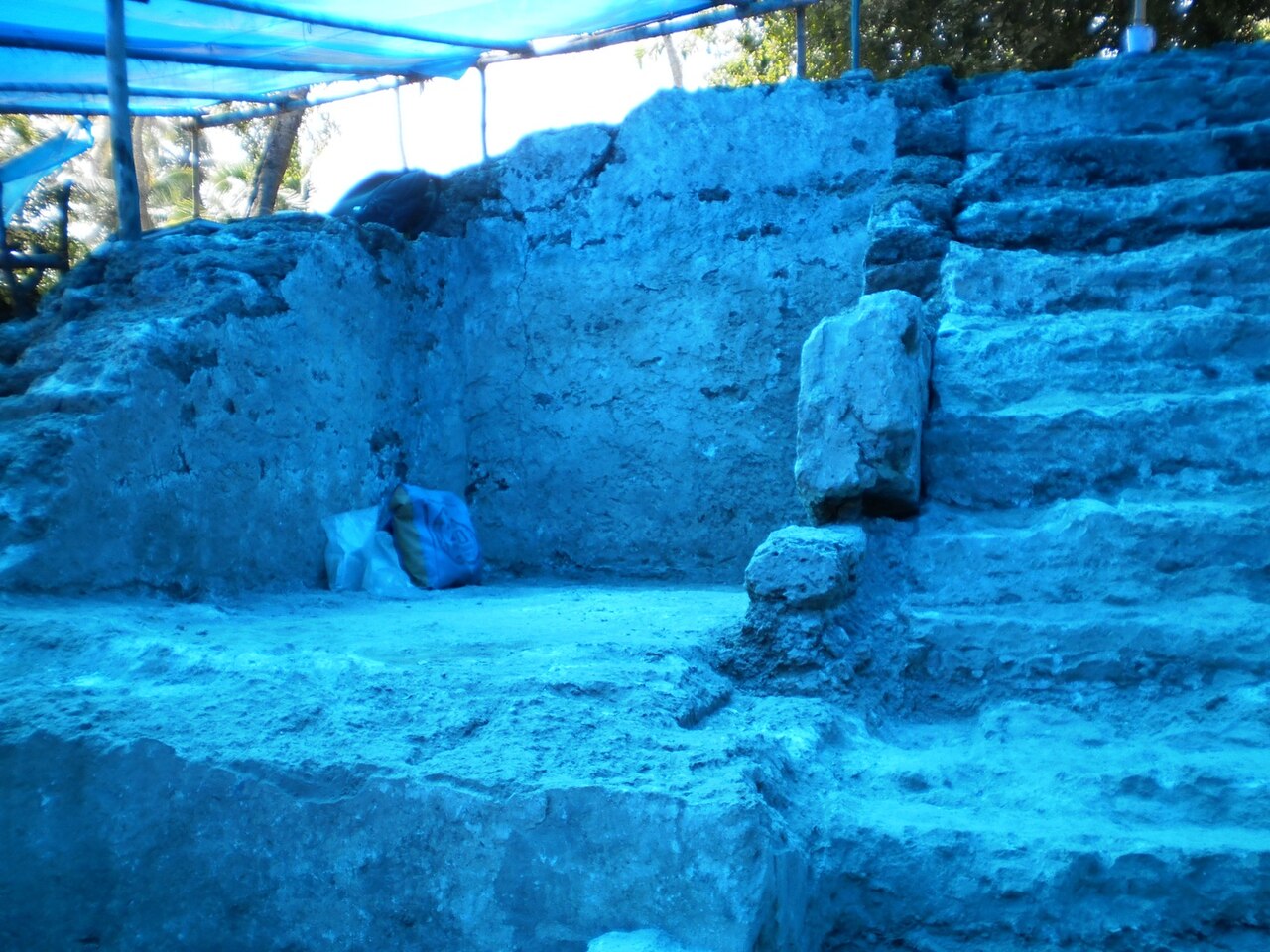
Kottappuram Fort · Photographed 2010-11-30
Steps exposed during excavations at Kottappuram Fort
Steps exposed during excavations at Kottappuram Fort; the blue cast comes from the protective cover.
Shown to compare dates, not as a photograph of a known pre-600 CE Muziris building.
006Two views
Both views are shown at equal weight; this site does not choose between them.
Whether the apostle Thomas reached Kerala
- One view
- Yes, as the churches of the Thomas Christian tradition hold. J. N. Farquhar (1927) and A. E. Medlycott (1905) defended the historicity of Thomas's mission to India. The early Edessa tradition and Roman-era sea trade fit this view.
- Another view
- Not shown. M. G. S. Narayanan held that immigrant Christians brought the tradition from Syria and gave it a Kerala setting. Jarl Charpentier and T. K. Joseph rejected the 1601 song as evidence. István Perczel finds no direct evidence of apostolic preaching in India.
- What would settle it
- A dated inscription or document from the Kerala coast, older than about 300 CE, that names Christians or the apostle.
Whether Kodungallur, called Shingly, was the first Jewish settlement in Kerala
- One view
- Community tradition and much earlier historical writing hold that Jews settled at Kodungallur in antiquity, often dated after 70 CE.
- Another view
- Ophira Gamliel (2018) argues that the Shingly story took shape in the early sixteenth century and that premodern evidence shows Jews spread across several ports.
- What would settle it
- A Jewish inscription, document or burial from Kodungallur securely dated before 849 CE.
When the Chera king's conversion happened, if it did
- One view
- Popular tradition and official heritage pages place it in the Prophet's lifetime, with the Cheraman Juma Masjid founded in 629 CE.
- Another view
- Zayn al-Din (about 1583) estimated about two centuries after the Hijra. M. G. S. Narayanan linked it to the last Perumal's departure in 1122-24. Sebastian Prange reads it as a legend about religious authority.
- What would settle it
- A dated early Arabic or Malayalam record of the conversion, or scientific dating of the oldest fabric of the mosque.
007Where next
Kerala between 300 and 600 CE is surveyed there. Cosmas's church in Malê, around 550 CE, falls within that span.
On the timelineDates in this studySee these dates on the timeline
Explore nextSteps exposed during excavations at Kottappuram FortAll related studies, connected material, books and sources19 · 26
Elsewhere on this site
Connected material
Photographs, drawings, books, videos and other studies linked to this study. A link helps you explore; it does not prove a historical claim.
- Steps exposed during excavations at Kottappuram FortphotographBackground
- An exposed floor and surrounding masonry at Kottappuram Fort during the 2011 excavationphotographBackground
- Book III, p 119 of McCrindle’s 1897 translation of Cosmas: the passage on Male, pepper and a church, followed by Calliana and Socotrahistorical printed pageBackground
- Book XI, p 366 of McCrindle’s 1897 Cosmas translation, describing traded products, Male’s pepper and exchanges among portshistorical printed pageBackground
- Two stone crosses displayed at Kottayam Valiyapally, photographed in 2020photographBackground
008Sources
The study lists the sources it consulted; we have not rechecked them. A working link does not show that a source was read, and a valid identifier does not show that it supports a claim. We do not link to unofficial uploads or copies of publications. Where a study cited one, we show the published citation, or a publisher, DOI or Internet Archive link when we have one. Tracking codes are removed from links, and the sources themselves are not republished here.
Government of Kerala, Department of Tourism (n.d.). Marthoma Pontifical Shrine. Kerala Tourism, Muziris Heritage Project pages. https://www.keralatourism.org/muziris/religious-sites/marthoma-pointfical-shrine
Government of Kerala, Department of Tourism (n.d.). The Kottakkavu Church. Kerala Tourism, Muziris Heritage Project pages. https://www.keralatourism.org/muziris/religious-sites/kottakavu-church
Government of Kerala, Department of Tourism (n.d.). The arrival of St. Thomas. Kerala Tourism, Christianity in Kerala pages. https://www.keralatourism.org/christianity/arrival-stthomas/6
Burke, Tony (2024). Song of Thomas. e-Clavis: Christian Apocrypha (North American Society for the Study of Christian Apocryphal Literature). https://www.nasscal.com/e-clavis-christian-apocrypha/song-of-thomas/
Mingana, Alphonse (1926). The Early Spread of Christianity in India. Bulletin of the John Rylands Library 10 (2) (offprint, Manchester University Press). https://archive.org/details/earlyspreadofchr00ming_0
James, M. R. (translator) (1924). The Acts of Thomas. The Apocryphal New Testament (Oxford: Clarendon Press). https://www.earlychristianwritings.com/text/actsthomas.html
Encyclopedia of the Bible (Zondervan) (n.d.). Acts of Thomas. Encyclopedia of the Bible, via Bible Gateway. https://search.biblegateway.com/resources/encyclopedia-of-the-bible/Acts-Thomas
Rienjang, Wannaporn (2018). Takht-i-Bahi (version 1, 13 October 2018). Gandhara Connections, Classical Art Research Centre, University of Oxford. https://www.carc.ox.ac.uk/PublicFiles/media/Essay_Takht_i_Bahi.pdf
Eusebius of Caesarea; McGiffert, Arthur Cushman (translator) (1890). Church History, Book V ch. 10 and Book III ch. 1. Nicene and Post-Nicene Fathers, 2nd series, vol. 1 (New Advent transcription). https://www.newadvent.org/fathers/250105.htm
Jerome; Richardson, Ernest Cushing (translator) (1892). De viris illustribus (On Illustrious Men), chapter 36. Nicene and Post-Nicene Fathers, 2nd series, vol. 3 (New Advent transcription). https://www.newadvent.org/fathers/2708.htm
Cosmas Indicopleustes; McCrindle, J. W. (translator); Pearse, Roger (transcriber) (1897). Christian Topography, Book III. Christian Classics Ethereal Library (transcription of the Hakluyt Society edition). https://www.ccel.org/ccel/pearse/morefathers/files/cosmas_03_book3.htm
Nowakowski, Paweł; summary by Bryan Ward-Perkins (2015). E00515: Gregory of Tours, Glory of the Martyrs 31 and 32 (Thomas the Apostle). The Cult of Saints in Late Antiquity database, University of Oxford. https://doi.org/10.25446/oxford.13798907.v1
Narayanan, M. G. S. (2013). Perumals of Kerala: Brahmin Oligarchy and Ritual Monarchy. Thrissur: CosmoBooks.
Online copy not linked · use the published editionSource recordCharpentier, Jarl (1927). St. Thomas the Apostle and India. Kyrkohistorisk Årsskrift 27 (1927) (Project Runeberg transcription, scan page 0041). https://runeberg.org/kyrkohist/1927/0041.html
T.K.J. (most probably T. K. Joseph) (1927). Note on the 1601 Thomas song, signed T.K.J.. The Indian Antiquary 56 (October 1927), p. 180.
Online copy not linked · use the published editionSource recordPerczel, István; interviewed by Sidney Castillo (2021). When Christians Meet Each Other: The Saint Thomas Christians of Southwest India in the Early Modern Period (transcript). The Religious Studies Project, 8 November 2021. https://www.religiousstudiesproject.com/?p=26247
Perczel, István (2018). Syriac Christianity in India. Daniel King (ed.), The Syriac World, pp. 653-697 (London: Routledge). https://research.ceu.edu/en/publications/syriac-christianity-in-india
Gamliel, Ophira (2018). Back from Shingly: Revisiting the Premodern History of Jews in Kerala. Indian Economic and Social History Review 55 (1): 53-76. https://doi.org/10.1177/0019464617745926
Government of Kerala, Department of Tourism (n.d.). Muziris and Jews. Kerala Tourism, Judaism in Kerala pages. https://www.keralatourism.org/judaism/muziris-jews
Unattributed note (1930). A Hebrew Inscription of 1269 A.D. from Chennamangalam. The Indian Antiquary 59 (July 1930).
Online copy not linked · use the published editionSource recordZayn al-Din al-Ma'bari; Nainar, S. Muhammad Husayn (translator) (1942). Tuhfat al-Mujahidin: An Historical Work in the Arabic Language. Madras: University of Madras. https://archive.org/details/in.ernet.dli.2015.505177
Prange, Sebastian R. (2018). The Mosque (chapter 2). Monsoon Islam: Trade and Faith on the Medieval Malabar Coast, pp. 92-157 (Cambridge University Press). https://doi.org/10.1017/9781108334860.003
Prange, Sebastian R. (2023). Legends of the Convert King (guest lecture abstract). University of Bayreuth, Religious Studies, 1 February 2023. https://www.religion.uni-bayreuth.de/en/dates/20230201_Guest-lecture-Prange/index.html
Government of Kerala, Department of Tourism (n.d.). Cheraman Juma Masjid. Kerala Tourism, Muziris Heritage Project pages. https://www.keralatourism.org/muziris/religious-sites/cheraman-juma-masjid
Benny Kuriakose & Associates (n.d.). Cheraman Juma Masjid. Muziris Heritage Project conservation page. https://www.bennykuriakose.com/muziris-heritage-project/cheraman-juma-masjid
Lal, B. B. (editor) (1971). Indian Archaeology 1968-69: A Review, item 26: Excavation at Cheraman Parambu (Cranganur). New Delhi: Archaeological Survey of India. https://assets.ctfassets.net/l47hkrce4wip/4Q3b4wS4hdaNQYGffR9TWu/bb26633a9b97d7f4535bbe1f8611f9d5/013_Indian_Archaeology_A_Review_1968-69.pdf
Researchers and institutions whose work this study uses: B. B. Lal, M. G. S. Narayanan, Archaeological Survey of India
How we know The evidence, claims and dates behind this study
What this study draws on
- Each witness is sorted by the date it was written: before 600 CE, 600 to about 1100 CE, or later. Only the first group can confirm an arrival before 600 CE.
- Primary texts were read in English translation: the Acts of Thomas, Eusebius, Jerome, Gregory of Tours, Cosmas and Zayn al-Din's Tuhfat al-Mujahidin. Copper-plate dates follow M. G. S. Narayanan and Ophira Gamliel.
- Medieval Malabar witnesses between 600 and 1600: the June 1301 Kodungallur Syriac colophon (Vat. Syr. 22, Mingana 1926), John of Monte Corvino (1292–93), Marco Polo (c. 1298), the 1504 East Syrian bishops' letter (Vat. Syr. 204), and Duarte Barbosa (c. 1516–18).
- Twenty-six sources were opened and read on 1 November 2026, some only as abstracts. The study was prepared with AI-assisted drafting and checked against the cited sources – see /about/#how-we-used-ai – and has not yet been reviewed by an independent specialist.
- Not consulted: the Greek critical edition of Cosmas, Klijn's commentary on the Acts of Thomas, Shokoohy's survey of the mosque, Friedmann's study of the Arabic Qissat Shakarwati Farmad, and sixteenth-century Portuguese reports of the Thomas Christians.
Dates in this study
| What is dated | Date | How it was dated |
|---|---|---|
| 51 CE (Song of Thomas, as summarised) | 51 CE | How it was dated is not stated |
| 21 November 52 CE (tradition) | 52 CE | How it was dated is not stated |
| soon after the destruction of Jerusalem in 70 (Cochin Jewish tradition) | 70 CE | How it was dated is not stated |
| 189-190 | 189–190 CE | How it was dated is not stated |
| early third century | 200–250 CE | How it was dated is not stated |
| not much later than A.D. 250 | 250 CE | How it was dated is not stated |
| 345 (arrival of the merchant Thomas of Jerusalem in the Syriac account) | 345 CE | How it was dated is not stated |
| 379 (traditional date of the Joseph Rabban grant) | 379 CE | How it was dated is not stated |
| 547-549 | 547–549 CE | How it was dated is not stated |
| 580/594 | 580–594 CE | How it was dated is not stated |
| 629 CE (traditional mosque date) | 629 CE | How it was dated is not stated |
| c. AD 800-1124 | 800–1124 CE | How it was dated is not stated |
| about two hundred years after the hijra (translator: 822 A.D.) | 822 CE | Period assigned by excavators or scholars |
| fifth regnal year of Sthanu Ravi, 849 | 849 CE | Date from writing, coins or texts |
| thirty-eighth regnal year of Bhaskara Ravi, 1000 CE | 1000 CE | Date from writing, coins or texts |
| 1122-24 | 1122–1124 CE | How it was dated is not stated |
| thirteenth to sixteenth century A.D. | 1200–1599 CE | Period assigned by excavators or scholars |
| year 1581 of the era of contracts (1269 CE) | 1269 CE | Date from writing, coins or texts |
| 1503 | 1503 CE | How it was dated is not stated |
| 1525 | 1525 CE | How it was dated is not stated |
| c. 1583 | 1583 CE | How it was dated is not stated |
See these dates on the timeline
The study’s claims
21 claims · 47 source passages · 57 paragraphs
Browse the study paragraph by paragraphA belief that the apostle Thomas preached and died in 'India' is recorded by the early third century, in the Syriac Acts of Thomas.
Supported in this study
Dates the belief, not the events it describes. Ancient 'India' is a loose term.
The Acts of Thomas names King Gundaphorus, who corresponds to Gondophares, a king whose regnal year 26 appears on an inscription found at Shahbazgarhi, near Takht-i-Bahi in Gandhara.
Supported in this study
The match places the story's royal patron in the far north-west, not in Kerala.
No text written before 600 CE that this study consulted connects Thomas with Kerala, Muziris or Kodungallur.
Supported with qualifications
Limited to the texts consulted; Syriac and Greek critical editions were not checked directly.
The 'India' of Pantaenus's reported mission is disputed: Mingana read it as southern Arabia (Arabia Felix), while Milne Rae and G. Smith had taken it as India proper.
Debated in the sources
Neither Eusebius nor Jerome connects Pantaenus with Thomas.
Gregory of Tours, writing between 580 and 594, reports a monastery and a large church in India at the place where Thomas was first buried, without locating it.
Supported in this study
Hearsay from one informant, Theodorus.
Cosmas, in a work conventionally dated 547-549, reports a church in Malê, the pepper country; the bishop appointed from Persia is placed at Calliana.
Supported in this study
Cosmas may not have visited Malê (study “Cosmas names five pepper marts of Malê and a church there”). Dates the church's existence, not its foundation. Malê is identified with Malabar or Kerala by Mingana and Narayanan; Cosmas gives no single place.
The association of the Malabar church with the apostle Thomas is attested in writing at Kodungallur (Shengala) by June 1301 (Vat. Syr. 22, Mingana 1926), in travel accounts from the 1290s (John of Monte Corvino 1292–93; Marco Polo c. 1298), and in 1504–c. 1518 East Syrian and Portuguese notices, while the specific 51/52 CE Maliankara landing date and seven-churches narrative appear first in the seventeenth- and eighteenth-century Kerala writings read here.
Supported with qualifications
The Song of Thomas (claimed 1601) may draw on older oral material (Charpentier notes the suggestion), and fuller survey of 16th-century Portuguese letters could refine when the 52 CE Maliankara specifics first appear. Vat. Syr. 22 (June 1301, Shengala/Kodungallur) establishes medieval Malabar Thomas-see affiliation 300 years before 1601.
Whether the apostle Thomas reached Kerala is not settled: Farquhar and Medlycott defended the historicity of a mission to India; Narayanan found no contemporary evidence for the Kerala legend; Charpentier and T. K. Joseph rejected the 1601 song as evidence; Perczel finds no direct evidence.
Unresolved in this study
A matter of faith for many readers; this study grades only the documentary record.
A royal grant of 849 CE at Kollam to the Tarisappalli church carries witness signatures in Kufic Arabic, Middle Persian (Pahlavi) and Hebrew scripts, the first dated document for Christians, Jews and Muslims together on this coast.
Supported in this study
The surviving plates may be a witnessed copy of the 849 original (Perczel).
The arrival of the merchant Thomas of Jerusalem at Maliomkara in 345 CE is found in an early-eighteenth-century Syriac account; Mingana judged the story unhistorical and kept this merchant distinct from Thomas Cana.
Supported with qualifications
Kerala community tradition may identify the two figures; this study did not yet checked directly a source that does so.
No source written before 600 CE that this study found names Jews on the Kerala coast.
Supported with qualifications
Silence is weak evidence for a coast with few surviving early documents.
The grant to Joseph Rabban by Bhaskara Ravi belongs to 1000 CE, not to the traditional 379 CE.
Supported in this study
Joseph Rabban's Jewish identity is inferred from the plates' custody.
The place-name Shingly appears in medieval Arabic geography; Gamliel traces the story of a Jewish kingdom there to Hebrew writings of 1503 and 1525 and argues that its identification as the first Jewish settlement at Kodungallur is an early modern legend.
Debated in the sources
Community tradition holds Kodungallur to be the first settlement.
Zayn al-Din, writing about 1583, dated the Chera king's conversion to about two hundred years after the Hijra and rejected the Prophet-era date held by Malabar Muslims.
Supported in this study
Read in an English translation of 1942.
The 629 CE founding date for the Cheraman Juma Masjid is stated by official heritage pages but no source before the sixteenth century, laboratory date or excavation supporting it was found.
Unresolved in this study
Shokoohy's architectural survey and Friedmann's study of the Qissat Shakarwati Farmad was not checked directly.
The Chera Perumal kingdom with its capital at Makotai (Kodungallur) is documented from about 800 CE; Narayanan linked the conversion legend to the last Perumal's departure in 1122-24.
Supported with qualifications
Narayanan's reading; Prange treats the legend as a narrative about religious authority.
The earliest firm evidence for Muslims in Kerala that this study found is the set of Kufic Arabic signatures on the Kollam grant of 849 CE.
Supported in this study
Earlier visits by Arab merchants are possible but undocumented in the sources consulted.
The 1968-69 trial trench at Cheraman Parambu in Kodungallur found occupation only in its upper 1.5 m, dated to the thirteenth to sixteenth centuries.
Supported in this study
One small trench; see study “Kodungallur digs found medieval layers, Pattanam much older ones” for the wider Kodungallur record.
Prange interprets the Cheraman Perumal legend as evidence for the rise of a Muslim religious elite and as a way of negotiating new religious practice through a mythical past.
Supported in this study
Read from abstracts only.
Narayanan held that the Thomas legend was transferred from Syria to Malabar by immigrant Christians and given a local setting, and that the conversion of Brahmins by Thomas is anachronistic.
Debated in the sources
Opposed by those who hold the apostolic foundation.
Narayanan placed the lost copper plates granted to Thomas of Cana, who settled at Kodungallur, in the Chera Perumal period that began about 800 CE, on the basis of imperfect surviving translations.
Supported with qualifications
The plates are lost; only later translations survive.
Trace one claim through the study’s records
Explore the evidenceOther source lists
Numbered citation links from the study
The numbered links in the study text point here.
Government of Kerala, Department of Tourism (n.d.). Marthoma Pontifical Shrine. Kerala Tourism, Muziris Heritage Project pages. https://www.keralatourism.org/muziris/religious-sites/marthoma-pointfical-shrine
Government of Kerala, Department of Tourism (n.d.). The Kottakkavu Church. Kerala Tourism, Muziris Heritage Project pages. https://www.keralatourism.org/muziris/religious-sites/kottakavu-church
Government of Kerala, Department of Tourism (n.d.). The arrival of St. Thomas. Kerala Tourism, Christianity in Kerala pages. https://www.keralatourism.org/christianity/arrival-stthomas/6
Burke, Tony (2024). Song of Thomas. e-Clavis: Christian Apocrypha (North American Society for the Study of Christian Apocryphal Literature). https://www.nasscal.com/e-clavis-christian-apocrypha/song-of-thomas/
Mingana, Alphonse (1926). The Early Spread of Christianity in India. Bulletin of the John Rylands Library 10 (2) (offprint, Manchester University Press). https://archive.org/details/earlyspreadofchr00ming_0
James, M. R. (translator) (1924). The Acts of Thomas. The Apocryphal New Testament (Oxford: Clarendon Press). https://www.earlychristianwritings.com/text/actsthomas.html
Encyclopedia of the Bible (Zondervan) (n.d.). Acts of Thomas. Encyclopedia of the Bible, via Bible Gateway. https://search.biblegateway.com/resources/encyclopedia-of-the-bible/Acts-Thomas
Rienjang, Wannaporn (2018). Takht-i-Bahi (version 1, 13 October 2018). Gandhara Connections, Classical Art Research Centre, University of Oxford. https://www.carc.ox.ac.uk/PublicFiles/media/Essay_Takht_i_Bahi.pdf
Eusebius of Caesarea; McGiffert, Arthur Cushman (translator) (1890). Church History, Book V ch. 10 and Book III ch. 1. Nicene and Post-Nicene Fathers, 2nd series, vol. 1 (New Advent transcription). https://www.newadvent.org/fathers/250105.htm
Jerome; Richardson, Ernest Cushing (translator) (1892). De viris illustribus (On Illustrious Men), chapter 36. Nicene and Post-Nicene Fathers, 2nd series, vol. 3 (New Advent transcription). https://www.newadvent.org/fathers/2708.htm
Cosmas Indicopleustes; McCrindle, J. W. (translator); Pearse, Roger (transcriber) (1897). Christian Topography, Book III. Christian Classics Ethereal Library (transcription of the Hakluyt Society edition). https://www.ccel.org/ccel/pearse/morefathers/files/cosmas_03_book3.htm
Nowakowski, Paweł; summary by Bryan Ward-Perkins (2015). E00515: Gregory of Tours, Glory of the Martyrs 31 and 32 (Thomas the Apostle). The Cult of Saints in Late Antiquity database, University of Oxford. https://doi.org/10.25446/oxford.13798907.v1
Narayanan, M. G. S. (2013). Perumals of Kerala: Brahmin Oligarchy and Ritual Monarchy. Thrissur: CosmoBooks.
Online copy not linked · use the published editionSource recordCharpentier, Jarl (1927). St. Thomas the Apostle and India. Kyrkohistorisk Årsskrift 27 (1927) (Project Runeberg transcription, scan page 0041). https://runeberg.org/kyrkohist/1927/0041.html
T.K.J. (most probably T. K. Joseph) (1927). Note on the 1601 Thomas song, signed T.K.J.. The Indian Antiquary 56 (October 1927), p. 180.
Online copy not linked · use the published editionSource recordPerczel, István; interviewed by Sidney Castillo (2021). When Christians Meet Each Other: The Saint Thomas Christians of Southwest India in the Early Modern Period (transcript). The Religious Studies Project, 8 November 2021. https://www.religiousstudiesproject.com/?p=26247
Perczel, István (2018). Syriac Christianity in India. Daniel King (ed.), The Syriac World, pp. 653-697 (London: Routledge). https://research.ceu.edu/en/publications/syriac-christianity-in-india
Gamliel, Ophira (2018). Back from Shingly: Revisiting the Premodern History of Jews in Kerala. Indian Economic and Social History Review 55 (1): 53-76. https://doi.org/10.1177/0019464617745926
Government of Kerala, Department of Tourism (n.d.). Muziris and Jews. Kerala Tourism, Judaism in Kerala pages. https://www.keralatourism.org/judaism/muziris-jews
Unattributed note (1930). A Hebrew Inscription of 1269 A.D. from Chennamangalam. The Indian Antiquary 59 (July 1930).
Online copy not linked · use the published editionSource recordZayn al-Din al-Ma'bari; Nainar, S. Muhammad Husayn (translator) (1942). Tuhfat al-Mujahidin: An Historical Work in the Arabic Language. Madras: University of Madras. https://archive.org/details/in.ernet.dli.2015.505177
Prange, Sebastian R. (2018). The Mosque (chapter 2). Monsoon Islam: Trade and Faith on the Medieval Malabar Coast, pp. 92-157 (Cambridge University Press). https://doi.org/10.1017/9781108334860.003
Prange, Sebastian R. (2023). Legends of the Convert King (guest lecture abstract). University of Bayreuth, Religious Studies, 1 February 2023. https://www.religion.uni-bayreuth.de/en/dates/20230201_Guest-lecture-Prange/index.html
Government of Kerala, Department of Tourism (n.d.). Cheraman Juma Masjid. Kerala Tourism, Muziris Heritage Project pages. https://www.keralatourism.org/muziris/religious-sites/cheraman-juma-masjid
Benny Kuriakose & Associates (n.d.). Cheraman Juma Masjid. Muziris Heritage Project conservation page. https://www.bennykuriakose.com/muziris-heritage-project/cheraman-juma-masjid
Lal, B. B. (editor) (1971). Indian Archaeology 1968-69: A Review, item 26: Excavation at Cheraman Parambu (Cranganur). New Delhi: Archaeological Survey of India. https://assets.ctfassets.net/l47hkrce4wip/4Q3b4wS4hdaNQYGffR9TWu/bb26633a9b97d7f4535bbe1f8611f9d5/013_Indian_Archaeology_A_Review_1968-69.pdf
About this study Status, corrections and how it was made
Status
Draft study, revision 4. No historian, archaeologist, or Tamil or Malayalam specialist has reviewed it yet.
How it was made
Compiled as an editorial synthesis from published scholarship around questions we framed. About this project & workflow
The summary, How sure lines and Two views notes on this page were prepared from this study and cross-checked against its passages. That is an editorial check, not a specialist review.
Technical details
Study code R257. The text fingerprint changes whenever the study text changes.
- The study text is shown as written. Links from its paragraphs to citations help you move around the study; they are not new claims or checked source passages.
See how this study’s records were extracted
Text fingerprint (SHA-256): R257 · 3daf922eae43d3442d7aa03e… · v4
Evidence tables and technical details are on the web page: https://layersofthesouth.org/read/fcd00acfef