CHRONOLOGY & DATED EVIDENCE · KERALA AND TAMIL NADU · 1000 BCE–600 CE
Burials, workshops, writing and ports overlap across 1,600 years
This timeline follows Kerala and Tamil Nadu from Iron Age urn burials to craft towns, writing, sea trade and poetry. Each entry gives a plain date and says what that date measures, so you can check how each date was obtained.
The dig
The whole timeline as one dig
Every entry on this page drawn as a find in one section: the youngest nearest the top, each kind of evidence in its own lane, and the fill of each mark saying how sure the record is.
- 300–600 CE Change & continuity
- 200 BCE–300 CE Connected worlds
- 500–200 BCE Marks & materials
- 1000–500 BCE Different beginnings
wood age, not date of use
- Silappadikaram and the Minor Classics Often placed in the 5th–6th century CE; dates debated Possible
- Vatteluttu Early Vatteluttu about the 5th–6th century CE Likely
- Alagankulam and Vizhinjam Finds discussed here date about 1–600 CE Likely
- Edakkal Inscriptions about the 3rd–5th century CE; the carvings are undated Likely
- Periplus and Muziris Papyrus About 40–70 CE (Periplus) and the mid-2nd century CE (papyrus) Well supported
- Berenike About the 1st century CE Well supported
- Khor Rori and Quseir About the 1st century CE Likely
- Pattanam About 100 BCE–300 CE for the main trading phase Likely
- Sangam poems Poems: probably 1st century BCE–3rd century CE · Anthologies: possibly 6th–9th century · Print: from the 1880s Likely
- Roman coin hoards Coins minted from the 2nd century BCE to the 2nd century CE; buried later Well supported
- Karur and Pugalur Pugalur inscriptions about the 2nd century CE; Karur occupied earlier and later Well supported
- Arikamedu and Puhar About 300 BCE–500 CE across the two sites Well supported
- Kuttanad and Vembanad About 500 BCE–400 CE (a dated wetland core) Likely
- Marayoor dolmens About 300 BCE–200 CE for one excavated dolmen (an estimate) Possible
- Anakkara Probably the 3rd–2nd century BCE or later (pottery style); no laboratory date Possible
- Mangulam and Jambai About the 2nd century BCE (Mangulam) and 1st century CE (Jambai), from letter shapes Likely
- Kodumanal About the 5th century BCE to the 3rd century CE (older reports: 300 BCE–300 CE; some summaries extend into the 4th century CE) Well supported
- Keezhadi From the 6th century BCE into the early centuries CE Likely
- Porunthal graves Rice: preferred 1σ interval 540–410 BCE; older alternatives Well supported
- Pattanam waterfront Wood ages: canoe 1300–100 BCE; not dates of use Not known
- Korkai One early wood sample of 2680 ± 90 BP (printed 730 BC; 785 / 805 ± 95 BCE in state summaries); most finds Early Historic Likely
- Laterite monuments Roughly 800 BCE–200 CE, mostly from comparisons; few laboratory dates Likely
- Sivagalai urn burial About 1155 BCE (rice in an urn) and 685 BCE (a separate living area) Likely
- Mangadu urn burials About 1300–820 BCE (two charcoal dates) Likely
- Adichanallur cemetery About 1400–200 BCE (dated burial samples) Well supported
- Ground and stratigraphy
- Laboratory dates
- Inscriptions
- Tamil poems
- Greek and Latin texts
The fill of a mark says how sure the record is:
- Well supported
- Likely
- Possible
- Not known
Scroll on to dig down, drag the drawing, or use the arrow keys.
Drag the drawing, use the arrow keys or the buttons to move through the records.
How to read the drawing
- 300–600 CE Change & continuity
- 200 BCE–300 CE Connected worlds
- 500–200 BCE Marks & materials
- 1000–500 BCE Different beginnings
A diagram, not a drawing of a real trench, and not to scale. Each entry has a row of the same depth. The four bands are the timeline's browsing periods, each holding the entries recorded in it, so a band is as deep as its number of entries; within a band the rows run by the start of each entry's dates, the youngest at the top. Marks side by side are separate dates the entry records. A thin line from a mark runs into each other period the entry's own dates reach: it shows which periods, not how far, and an arrow means the dates run on before the oldest period. The ranging rod marks the periods, not years.
002 · The timeline to scale
Every entry and date record on one true scale
Looking for raw radiocarbon measurements and published calendar ranges? Open the Dating Bench
Spread out from the ordinal dig onto a single linear ruler: the 25 curated entries drawn at their stated spans in their How-sure fills, the date records below split by what each date measures, and a second clock for when archaeologists dug and published them.
Scroll sideways on narrow screens to read the full beam; the jaw inputs and readout below work at every width.
- Well supported
- Likely
- Possible
- Not known
- Calibrated radiocarbon
- Uncalibrated radiocarbon
- Letter shape & style
- Text, inscription & edition
- Luminescence
- Method not recorded here
Shapes in the lower lanes show how a date was obtained, not likelihood; a single year is always a tick.
- Entry spans are editorial summaries; 13 of 61 linked date records lie outside their entry's summary span.
- How many dates the studies report, not how much happened.
- A record worded 'first century CE' is drawn across the whole century.
- Bars without end caps mark approximate spans; bars with end caps mark stated endpoints.
- The readout prints each record's own wording only. Your jaw labels are your chosen years, not a record's date.
Touching your jaws · 25 of 25 entries touching your jaws
Often placed in the 5th–6th century CE; dates debated
- Likely Vattezhuthu (Vaṭṭeḻuttu / Vatteluttu): a rounded script grew slowly from Tamil-Brahmi Long activity
Early Vatteluttu about the 5th–6th century CE
Finds discussed here date about 1–600 CE
Inscriptions about the 3rd–5th century CE; the carvings are undated
About 40–70 CE (Periplus) and the mid-2nd century CE (papyrus)
About the 1st century CE
About the 1st century CE
About 100 BCE–300 CE for the main trading phase
Poems: probably 1st century BCE–3rd century CE · Anthologies: possibly 6th–9th century · Print: from the 1880s
Coins minted from the 2nd century BCE to the 2nd century CE; buried later
Pugalur inscriptions about the 2nd century CE; Karur occupied earlier and later
About 300 BCE–500 CE across the two sites
About 500 BCE–400 CE (a dated wetland core)
About 300 BCE–200 CE for one excavated dolmen (an estimate)
Probably the 3rd–2nd century BCE or later (pottery style); no laboratory date
About the 2nd century BCE (Mangulam) and 1st century CE (Jambai), from letter shapes
About the 5th century BCE to the 3rd century CE (older reports: 300 BCE–300 CE; some summaries extend into the 4th century CE)
From the 6th century BCE into the early centuries CE
Rice: preferred 1σ interval 540–410 BCE; older alternatives
- Not known Pattanam waterfront: a canoe and posts with very broad wood dates Sample date Runs beyond your jaws
Wood ages: canoe 1300–100 BCE; not dates of use
One early wood sample of 2680 ± 90 BP (printed 730 BC; 785 / 805 ± 95 BCE in state summaries); most finds Early Historic
Roughly 800 BCE–200 CE, mostly from comparisons; few laboratory dates
About 1155 BCE (rice in an urn) and 685 BCE (a separate living area)
About 1300–820 BCE (two charcoal dates)
- Well supported Adichanallur cemetery: bronze, gold and iron in varied burials Long activity Runs beyond your jaws
About 1400–200 BCE (dated burial samples)
Date records by lane · 643 numeric records
88 date records state no numbers and stay in the full wording register below; 13 state one end only.
Not stated (open-ended records)
These records state only one end of their date window, so whether they fall inside your jaws is not stated.
YEAR-ZERO LENS & INTERVAL RELATION
Why there is no year zero, and how two windows relate
How historians count (no year zero)
- 3 BCE
- 2 BCE
- 1 BCE
- 1 CE
- 2 CE
- 3 CE
How the data counts (astronomical years)
- -2
- -1
- 0
- 1
- 2
- 3
There is no year zero between 1 BCE and 1 CE. In astronomical numbering, 1 BCE is stored as 0, 2 BCE as -1 and 500 BCE as -499, so 100 BCE and 100 CE stand 199 years apart. On this site, 238 dated records begin at or before 1 BCE and 89 cross the seam.
Compare two timeline windows
About: Pattanam contains Periplus and Muziris Papyrus contains
- Pattanam
- About 100 BCE–300 CE for the main trading phase (-99 to 300 · approximate)
- Periplus and Muziris Papyrus
- About 40–70 CE (Periplus) and the mid-2nd century CE (papyrus) (40 to 160)
This compares the windows the timeline states, not events.
Keep what is inside your jaws
- Asked
- Touching your jaws (1000 BCE to 600 CE)
- Rows
- 25
- Edition
- 2.1.2
- Address
- /timeline/#from=-999&to=600
AI-assisted research drafts; independent specialist review: none. Entry spans are editorial summaries; each record is quoted in its own wording.
All 25 curated entries as a table (verbatim date wording, How sure and stored range)
| Entry | Recorded date wording | How sure | What the date measures | Stored count | Study |
|---|---|---|---|---|---|
| Silappadikaram and the Minor Classics: later Tamil works, dates debated | Often placed in the 5th–6th century CE; dates debated | Possible | Text layers | 400 to 600 | R130 |
| Vatteluttu: a rounded script grew slowly from Tamil-Brahmi | Early Vatteluttu about the 5th–6th century CE | Likely | Long activity | 400 to 600 | R126 |
| Alagankulam and Vizhinjam: sea links after the first century CE | Finds discussed here date about 1–600 CE | Likely | Long activity | 1 to 600 | R118 |
| Edakkal: carved figures and later inscriptions in one rock shelter | Inscriptions about the 3rd–5th century CE; the carvings are undated | Likely | Broad window | 201 to 500 | R107 |
| Periplus and Muziris Papyrus: two Greek texts on the Kerala trade | About 40–70 CE (Periplus) and the mid-2nd century CE (papyrus) | Well supported | Text layers | 40 to 160 | R121 |
| Berenike: Indian pepper and Tamil writing at a Red Sea port | About the 1st century CE | Well supported | Made ≠ buried | 1 to 100 | R119 |
| Khor Rori and Quseir: Tamil names on pots overseas | About the 1st century CE | Likely | Made ≠ buried | 1 to 100 | R119 |
| Pattanam: a river port with long-distance trade | About 100 BCE–300 CE for the main trading phase | Likely | Long activity | -99 to 300 | R013 |
| Sangam poems: early verse that survives in later anthologies | Poems: probably 1st century BCE–3rd century CE · Anthologies: possibly 6th–9th century · Print: from the 1880s | Likely | Text layers | -99 to 300 | R226 |
| Roman coin hoards: Eyyal, Kottayam and Valluvally in Kerala | Coins minted from the 2nd century BCE to the 2nd century CE; buried later | Well supported | Made ≠ buried | -122 to 161 | R164 |
| Karur and Pugalur: an Irumpoṟai royal line carved in stone | Pugalur inscriptions about the 2nd century CE; Karur occupied earlier and later | Well supported | Broad window | -199 to 300 | R123 |
| Arikamedu and Puhar: east-coast ports with brick works and imports | About 300 BCE–500 CE across the two sites | Well supported | Long activity | -299 to 500 | R116 |
| Kuttanad and Vembanad: a wetland that kept changing | About 500 BCE–400 CE (a dated wetland core) | Likely | Long activity | -499 to 400 | R149 |
| Marayoor dolmens: stone grave chambers in a high valley | About 300 BCE–200 CE for one excavated dolmen (an estimate) | Possible | Broad window | -299 to 200 | R106 |
| Anakkara: excavated burials in the Bharathappuzha valley | Probably the 3rd–2nd century BCE or later (pottery style); no laboratory date | Possible | Long activity | -299 to 200 | R141 |
| Mangulam and Jambai: Tamil-Brahmi gifts carved above stone beds | About the 2nd century BCE (Mangulam) and 1st century CE (Jambai), from letter shapes | Likely | Broad window | -299 to 100 | R124 |
| Kodumanal: bead workshops and iron smelting on the Noyyal | About the 5th century BCE to the 3rd century CE (older reports: 300 BCE–300 CE; some summaries extend into the 4th century CE) | Well supported | Long activity | -479 to 300 | R111 |
| Keezhadi: a brick settlement with wells, drains and furnaces | From the 6th century BCE into the early centuries CE | Likely | Long activity | -562 to 200 | R108 |
| Porunthal graves: dated rice and a disputed inscribed ring stand | Rice: preferred 1σ interval 540–410 BCE; older alternatives | Well supported | Sample date | -749 to -396 | R110 |
| Pattanam waterfront: a canoe and posts with very broad wood dates | Wood ages: canoe 1300–100 BCE; not dates of use | Not known | Sample date | -1299 to 1300 | R013 |
| Korkai: a pearl and conch-shell town, now inland | One early wood sample of 2680 ± 90 BP (printed 730 BC; 785 / 805 ± 95 BCE in state summaries); most finds Early Historic | Likely | Sample date | -784 to 300 | R113 |
| Laterite monuments: umbrella stones and rock-cut tombs of Kerala | Roughly 800 BCE–200 CE, mostly from comparisons; few laboratory dates | Likely | Long activity | -799 to 200 | R105 |
| Sivagalai urn burial: a rice grain dated inside a grave | About 1155 BCE (rice in an urn) and 685 BCE (a separate living area) | Likely | Sample date | -1154 to -684 | R104 |
| Mangadu urn burials: iron tools in early Kerala graves | About 1300–820 BCE (two charcoal dates) | Likely | Sample date | -1298 to -820 | R140 |
| Adichanallur cemetery: bronze, gold and iron in varied burials | About 1400–200 BCE (dated burial samples) | Well supported | Long activity | -1383 to -200 | R103 |
003 · CURATED ENTRIES & COMPLETE REGISTER
Curated entries and every recorded date
BCE and CE: BCE years count down towards 1 BCE, then CE years count up from 1 CE with no year zero. How sure: each entry states Well supported, Likely, Possible or Not known. Radiocarbon dates: raw measurements and published calendar ranges live on the Dating Bench.
How to read ancient dates: why a radiocarbon sample, a coin hoard and a poem are dated differently
How to read ancient dates
Broad window
An event within a broad window
The event happened at some point in this window; it did not necessarily last the whole time.
Long activity
Activity over many years
The range covers repeated use or several phases of activity over generations.
Made ≠ buried
Made, used and buried at different times
An object can be made, used and finally buried or hoarded decades or centuries apart.
Text layers
Written, collected and copied
A poem's composition, its collection into an anthology and its surviving copies belong to different times.
Sample date
A dated laboratory sample
A radiocarbon date belongs to the sampled charcoal, wood or grain, not automatically to every structure or object nearby.
Why this matters: a radiocarbon date, the date an object was made, the date a hoard was buried and the date a poem was composed answer different questions. Each entry says which kind of date it gives, and its How we know panel shows how the date was obtained. Try the Dating Bench
All 25 curated entries in full · plain dates, How sure, How we know and photos
Mangadu, Kollam · Southern KeralaSample date
Mangadu urn burials: iron tools in early Kerala graves
When: About 1300–820 BCE (two charcoal dates)
Near Ashtamudi Lake in Kollam, people buried burnt bone in handmade clay urns under laterite stone circles. Kerala's State Department of Archaeology excavated twelve urns here in 1991. The graves held black-and-red pottery, iron wedges, knives, a sickle and blades, and 30 carnelian beads, 20 of them etched. No spears, tridents or horse bits were found. Charcoal from two urns gave radiocarbon dates of roughly 1300–820 BCE.
Why it matters: It is one of the few Kerala burial sites with early radiocarbon dates, so it anchors southern Kerala's early history.
How sure: Likely. Two dates from one cemetery. The laboratory sheets also raise a half-life question that could make them read slightly too old.
Closer look: The graves held iron tools such as wedges and a sickle but no weapons, so cutting and harvesting work is visible in what people buried.
How we know
- Dates
- 2σ calibrated radiocarbon ranges in G. S. Abhayan's 2018 Table 1 (calibration curve unspecified): BS-958, 1299–902 cal BCE; BS-957, 1269–821 cal BCE (99.63%), with a minor interval at 1289–1282 cal BCE (0.37%).
BS-958 (2890 ± 70 BP) came from charcoal inside Urn 6 of Megalith II and BS-957 (2850 ± 90 BP) from Urn 10 of Megalith I, both at 95 cm. The Birbal Sahni Institute sheets cite a 5,730-year half-life; if the ages were not converted to the conventional 5,568-year basis, they read about 3 percent too old. The dates belong to these two urns, not to every urn field in Kerala. - Who found or studied it
- Excavated by the Kerala State Department of Archaeology in 1991; report by T. Satyamurthy (1992). Calibrated ranges from Abhayan G. S.'s 2018 table.
- Still uncertain
- T. Satyamurthy's proposal that cemetery use continued toward the first century CE rests on relative comparisons – etched carnelian beads compared with Porkalam, grey-ware sprinkler fragments in sealing layer 2, and the Jar 4-A / Urn 4 stratigraphic overlap – rather than radiocarbon dates on the upper phase.
- Where
- Mangadu, Kollam District, Southern Kerala (See on the map ↗)
Related studies:
Sivagalai, Thoothukudi · Tamiraparani valley, Tamil NaduSample dateApproximate
Sivagalai urn burial: a rice grain dated inside a grave
When: About 1155 BCE (rice in an urn) and 685 BCE (a separate living area)
At Sivagalai in the Tamiraparani valley, Tamil Nadu's state archaeology department excavated an intact, lidded urn in Trench A2. It held human bones, iron objects and grains of paddy, or unhusked rice. A radiocarbon test on the paddy was published as 1155 BCE. Charcoal from a separate living area was published as 685 BCE. These are two dates from two places on the site, not one span.
Why it matters: Sivagalai's rice date is widely quoted for an ancient Porunai river civilisation, so it matters exactly what the sample dates.
How sure: Likely. The grain dates to about 1155 BCE, but no laboratory certificate or full calibration range is published. The date belongs to the grain, not directly to the iron.
Closer look: A rice grain grew in one season, so its date sits close to the harvest; charcoal can be older than its burial.
How we know
- Dates
- Paddy inside urn A2–Urn 3: Beta-600726, 2950 ± 30 BP, published as 1155 BCE. Habitation charcoal: Beta-600727, published as 685 BCE.
Two dates from two contexts, a sealed burial urn and a separate living area, shown as two marks. Charcoal from other Sivagalai urns, announced in 2025 as evidence of iron by 3345 BCE, dates the charcoal, not the iron found with it. - Who found or studied it
- Tamil Nadu State Department of Archaeology excavations, with AMS radiocarbon measurements by Beta Analytic.
- Still uncertain
- Whether the paddy was a funeral offering, and whether Sivagalai's rice was irrigated, rainfed or a staple food, is not known.
- Where
- Sivagalai, Tamiraparani Basin, Thoothukudi District, Tamil Nadu (See on the map ↗)
Related studies:

Adichanallur, Thoothukudi · Tamiraparani valley, Tamil NaduLong activitySpans several periodsApproximate
Adichanallur cemetery: bronze, gold and iron in varied burials
When: About 1400–200 BCE (dated burial samples)
Adichanallur is a large cemetery beside the Tamiraparani river. Fedor Jagor collected there in 1876, Alexander Rea excavated from 1899, and the Archaeological Survey of India dug in 2003–05 and 2021–23. The burials vary: urns at different depths, pit burials, and objects inside and outside urns. Finds include thin gold forehead plates, bronze vessels with animal fittings, iron tools and weapons, and paddy and millet husks.
Why it matters: Laboratory tests show that some of its bronze bowls were high-tin bronze, hot-worked and quenched, a demanding metalworking skill.
How sure: Well supported. Burial samples date from before 1000 BCE into the Early Historic period; each date covers only its own sample.
Closer look: High-tin bronze is brittle when simply cast, so smiths shaped these bowls hot and then cooled them rapidly.
How we know
- Dates
- Radiocarbon dates summarised for the recent excavations run from about 1384 to 201 BCE. One analysed bowl held about 23 percent tin; other vessels measured about 21, 24 and 25 percent.
A cemetery used over a long time: each laboratory date belongs to its own sample, not to the whole site. - Who found or studied it
- Fedor Jagor (1876), Alexander Rea (from 1899), the Archaeological Survey of India (2003–05 and 2021–23), and metallurgical studies of the bronze vessels. The 2003–05 excavation report was not available in full.
- Still uncertain
- Whether graves with gold and bronze mark a ranked elite has not been tested across the cemetery.
- Where
- Adichanallur, Tamiraparani Valley, Thoothukudi District, Tamil Nadu (See on the map ↗)
Related studies:

Korkai, Thoothukudi · Tamiraparani delta, Tamil NaduSample dateSpans several periodsApproximate
Korkai: a pearl and conch-shell town, now inland
When: One early wood sample of 2680 ± 90 BP (printed 730 BC; 785 / 805 ± 95 BCE in state summaries); most finds Early Historic
Korkai lies on the lower Tamiraparani delta, about six kilometres from the sea today. Early Tamil poems name it with pearls, conch shells and a Pandyan ruler. Excavators reported a brick structure, stacked clay ring wells and pottery inscribed in Tamil-Brahmi. Later reviews report sawn conch shells and pieces of shell bangles, so conch was worked here.
Why it matters: Greek writers describe a pearl fishery at Colchi in the Pandyan kingdom, and Korkai is the usual match for that name.
How sure: Likely. Name, region and pearl fishery match Colchi, though no inscription confirms it; the early TIFR wood date (TF-987) dates one sample at 3.17 m rather than harbour structures or inscribed sherds.
Closer look: A study of old river channels suggests how the delta grew, leaving a coastal town about six kilometres inland.
How we know
- Dates
- One wood sample (TF-987, trench KRK-1, layer 5, depth 3.17 m) was published by the Tata Institute of Fundamental Research in Radiocarbon 13(2) (1971, p. 447) as 2680 ± 90 BP ('730 BC' on the 5,568-year half-life; 2755 ± 95 BP on the 5,730-year half-life); later state summaries describe it without the lab code as charcoal at 785 BCE and 805 ± 95 BCE.
The single wood determination (TF-987) belongs to its sampled timber fragment at 3.17 m. It does not date every Tamil-Brāhmī sherd or later brick structure at Korkai. - Who found or studied it
- Tamil Nadu State Department of Archaeology excavations (1968–69 and from 2021); TIFR radiocarbon date list (Agrawal, Gupta and Kusumgar 1971, Radiocarbon 13(2): 447, TF-987).
- Still uncertain
- The sources checked describe no quay or harbour works, and none calls Korkai a capital.
- Where
- Korkai, Tamiraparani Delta, Thoothukudi District, Tamil Nadu (See on the map ↗)
Related studies:
Kasaragod and Thrissur · KeralaLong activitySpans several periodsApproximate
Laterite monuments: umbrella stones and rock-cut tombs of Kerala
When: Roughly 800 BCE–200 CE, mostly from comparisons; few laboratory dates
Across central Kerala, people cut local laterite into umbrella stones on four shaped supports, domed hood stones and chambers dug into the rock. At Cheramanangad, the Archaeological Survey of India opened five monument types in 1990–91; two held no burial. At Porkalam in 1948, B. K. Thapar opened one urn burial with pots, three iron objects and etched carnelian beads.
Why it matters: These monuments are the main evidence for the people who lived in Kerala before and alongside the port of Pattanam.
How sure: Likely. The monuments are well recorded; their dates rest mostly on comparisons, and no umbrella stone has a laboratory date.
Closer look: The stone on the surface does not predict the grave below: at Cheramanangad, a classic umbrella stone covered no burial at all.
How we know
- Dates
- Thapar dated the Porkalam burial to about the third century BCE–first century CE by comparing finds. At Kuttikol in Kasaragod, radiocarbon samples gave both eighth–sixth century BCE and fifteenth–seventeenth century CE results. Most graves dated by laboratory or by comparison fall between the fifth century BCE and the second century CE.
A broad span built mostly from comparisons of pottery and beads, with very few laboratory dates. - Who found or studied it
- Archaeological Survey of India excavations at Porkalam (B. K. Thapar, 1948) and Cheramanangad (1990–91); surveys at Ariyannur and Kattakampal; Jenee Peter's 2015 distribution survey.
- Still uncertain
- The old idea that laterite is soft when cut and hardens in air is not a safe rule; a field geology study found blocks already hard when cut.
- Where
- North and Central Kerala (Kuttikol in Kasaragod; Cheramanangad, Ariyannur, Porkalam and Kattakampal in Thrissur) (See on the map ↗)
Related studies:

Marayoor and the Anjunad valley, Idukki · Kerala high rangesBroad windowSpans several periodsApproximate
Marayoor dolmens: stone grave chambers in a high valley
When: About 300 BCE–200 CE for one excavated dolmen (an estimate)
Marayoor and the Anjunad valley lie in a gap between the Anaimalai and Palani hills in Idukki. Dolmens, chambers of upright stone slabs under a capstone, are common here; a 2024 survey counted 129 at 58 locations. In 2012, a Deccan College-led team excavated Dolmen No. 42 at Muruganpara. It held red ware, a little black-and-red ware and charcoal.
Why it matters: Marayoor is one of Kerala's densest burial landscapes, with dolmens, cists, urn burials and standing stones.
How sure: Possible. The excavators' date of about 300 BCE–200 CE comes from pottery and building style; there is no laboratory date.
Closer look: A line of graves on a map is not a road: no source checked shows these dolmens marking a route.
How we know
- Dates
- Dolmen No. 42 at Muruganpara: tentatively 300 BCE–200 CE from pottery and architecture. A trial trench at Nachivayal, with pottery, iron fragments and a glass bead: tentatively around the start of the Common Era.
Estimates from pottery and building style, not laboratory dates. - Who found or studied it
- Kerala State Archaeology records, field surveys, and the 2012 Deccan College-led excavation.
- Still uncertain
- Whether the hill gap was an ancient migration or trade corridor marked by these graves has not been tested.
- Where
- Marayoor & Kovilkadavu (Anjunad Valley, Idukki District), Kerala (See on the map ↗)
Related studies:

Keezhadi (Keeladi), Sivaganga · Vaigai valley, Tamil NaduLong activitySpans several periodsApproximate
Keezhadi: a brick settlement with wells, drains and furnaces
When: From the 6th century BCE into the early centuries CE
Keezhadi is a large settlement mound in the Vaigai basin. The Archaeological Survey of India began digging in 2015 (2014–15 field season), and the state archaeology department led later seasons. Trenches exposed brick walls and floors, roof tiles, ring wells of stacked clay rings, brick drains, terracotta pipes and furnaces. Spindle whorls, bone points and a copper needle point to spinning and weaving. Many pots carry short names scratched in Tamil-Brahmi.
Why it matters: Names scratched on everyday pots show that writing was part of daily life in the settlement.
How sure: Likely. Several radiocarbon dates support activity in the sixth century BCE; the often-quoted 580 BCE is a conventional age printed by TNSDA alongside 531 BCE.
Closer look: A radiocarbon date belongs to its charred sample, so the 580 BCE figure does not date any one inscribed sherd.
How we know
- Dates
- Beta 519476 (Trench YP7/4, 353 cm): 2530 ± 30 BP, printed by TNSDA as 580 BCE conventional and 531 BCE intercept. The earliest printed value in the state table is 563 BCE (Beta 583579, YS8/4, 350 cm). Thirty-five AMS dates run from the sixth century BCE into the Common Era.
Each date belongs to its charred sample. Linking a date to a wall, pipe or inscription needs a recorded layer relationship. - Who found or studied it
- Archaeological Survey of India seasons from 2015 (2014–15 field season) and Tamil Nadu State Department of Archaeology seasons, with Beta Analytic AMS dates. The ASI's first two seasons counted about 70 inscribed sherds; the state's 2019 report counted 56 from its own digs.
- Still uncertain
- Whether particular brick tanks were dye vats is untested, and the 580 BCE sample has not been shown to share a layer with inscribed sherds.
- Where
- Keezhadi (Keeladi), Vaigai River Valley, Sivaganga District, Tamil Nadu (See on the map ↗)
Related studies:
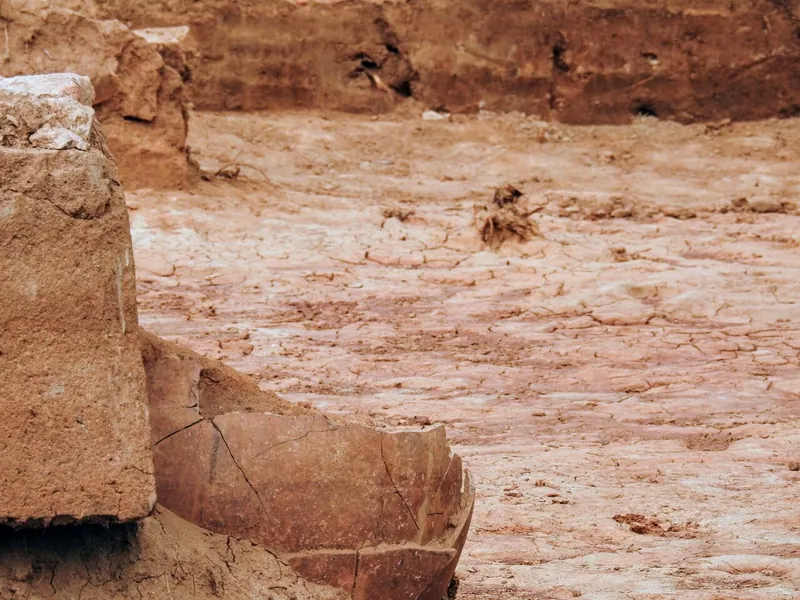
Kodumanal, Erode · Noyyal river, Tamil NaduLong activitySpans several periodsApproximate
Kodumanal: bead workshops and iron smelting on the Noyyal
When: About the 5th century BCE to the 3rd century CE (older reports: 300 BCE–300 CE; some summaries extend into the 4th century CE)
Kodumanal lies on the Noyyal river in Erode district and was dug in several campaigns between 1985 and 2021. Stone chips, rough-outs, bead blanks and half-drilled pieces show that stone beads, especially quartz, were made here. A bowl-furnace base, slag and furnace air nozzles show that iron was smelted on the site. A dagger has a hard, carbon-rich edge on a softer core.
Why it matters: Its workshop waste shows local craft more clearly than finished luxury objects can.
How sure: Well supported. Bead making and iron smelting are well supported; crucible-steel production and named export destinations are not.
Closer look: Finished beads can be traded far away, but chips and half-drilled blanks are left where the work was done.
How we know
- Dates
- Direct dates reach securely into the fifth century BCE. A start in the mid-sixth century BCE rests on extrapolating below the deepest dated layer, which K. Rajan called hypothetical.
Dates from several trenches and layers; each covers its own sample. - Who found or studied it
- Excavations by Tamil University, Pondicherry University (K. Rajan) and the Tamil Nadu State Department of Archaeology; metallography of a dagger (1999); Gwendolyn Kelly's small microscope study of bead drilling.
- Still uncertain
- Specialists disagree whether one furnace complex made crucible steel. The carnelian beads Kelly examined were not made locally.
- Where
- Kodumanal, Noyyal River (east of the Palakkad Gap), Erode District, Tamil Nadu (See on the map ↗)
Related studies:

Porunthal, Dindigul · Palani foothills, Tamil NaduSample date
Porunthal graves: dated rice and a disputed inscribed ring stand
When: Rice: preferred 1σ interval 540–410 BCE; older alternatives
Porunthal, in Dindigul district, was excavated in 2009–2010. Four graves built of stone slabs held pots, iron weapons, beads and human remains, and three held paddy. One grave also held a clay ring stand with marks the excavators read as Tamil-Brahmi letters, va-y-ra. Nearby, a habitation mound had a glass furnace and 2,275 glass beads.
Why it matters: Porunthal is widely quoted as dating Tamil writing to about 490 BCE, so what the rice date measures matters.
How sure: Well supported. The rice has secure AMS measurements with disjoint calibrated ranges. Whether the ring-stand marks are writing is disputed, so the rice does not by itself date the marks.
Closer look: Rice in a grave dates the rice; marks on a pot in the same grave need their own proof of being writing.
How we know
- Dates
- Beta-302854 (grave MEG I): 2440 ± 30 BP; disjoint 2σ intervals 750–680, 670–610, 592–576 and 571–404 cal BCE. Beta-305904 (MEG IV): 2400 ± 30 BP; disjoint 2σ intervals 731–691, 660–651 and 544–397 cal BCE. Preferred 1σ components: 540–410 cal BCE (MEG I) and 510–435 cal BCE (MEG IV), not the full distributions (CALIB 7.0, IntCal13). Older shorthand: 490 and 450 BCE.
The dates belong to paddy grains in jars inside the graves, not to the marks on the ring stand. - Who found or studied it
- Excavations by Pondicherry University (K. Rajan, 2009–2010); AMS dates by Beta Analytic on paddy grains.
- Still uncertain
- K. Rajan's team reads the marks as Tamil-Brahmi; Harry Falk argues they are megalithic signs, not Brahmi letters.
- Where
- Porunthal, Palani Foothills, Dindigul District, Tamil Nadu (See on the map ↗)
Related studies:

Mangulam, Madurai · Jambai, Kallakurichi · Tamil NaduBroad windowSpans several periodsApproximate
Mangulam and Jambai: Tamil-Brahmi gifts carved above stone beds
When: About the 2nd century BCE (Mangulam) and 1st century CE (Jambai), from letter shapes
At Mangulam, a hill of inscribed caves near Madurai, six early Tamil-Brahmi inscriptions record shelters and a drip ledge made for a monk. The givers were a servant of the ruler Netunceliyan, a family tied to the ruler by marriage, and a merchant guild. At Jambai, one carved line names Atiyan Netuman Anci, called satiyaputo, who gave a cave shelter.
Why it matters: Jambai sets the word satiyaputo beside an Atiyan ruler's name, strong evidence for who Aśoka's Satiyaputo were.
How sure: Likely. The dates come from letter shapes only; scholars place Mangulam in the second or the third century BCE.
Closer look: Mangulam names the ruler Netunceliyan, but his servant made the gift, so the inscription is not a royal grant.
How we know
- Dates
- Mangulam: about the second century BCE (Mahadevan); the third century BCE in the South Indian Inscriptions introduction. Jambai: about the first century CE. No laboratory dates.
Rock inscriptions are dated by their letter shapes; no laboratory date applies. - Who found or studied it
- Edited by Iravatham Mahadevan (2003); the Jambai line was photographed by a Central Institute of Classical Tamil survey.
- Still uncertain
- Matching the Jambai donor with the Atiyaman of Sangam poems is likely, but it is still an inference.
- Where
- Mangulam (Madurai District) & Jambai (Kallakurichi District), Tamil Nadu (See on the map ↗)
Related studies:

Pattanam, Ernakulam · Periyar delta, KeralaSample dateSpans several periodsApproximate
Pattanam waterfront: a canoe and posts with very broad wood dates
When: Wood ages: canoe 1300–100 BCE; not dates of use
In 2007 the Kerala Council for Historical Research recorded a waterlogged waterfront at Pattanam. It held a wharf-like structure with a brick lining, teak posts and the surviving six metres of a dugout canoe of Artocarpus hirsutus (anjili) wood. Beneath the canoe lay a pottery-rich layer with amphorae and rouletted ware, so the canoe came to rest after that layer formed.
Why it matters: These are the main published dates for Pattanam's waterfront, so knowing what they measure stops broad wood ages becoming a false building date.
How sure: Not known. The wood dates measure when the trees grew. When the canoe and the wharf were made or used is not known.
Closer look: A radiocarbon test on a canoe dates when its tree grew, not when the boat was carved or used.
How we know
- Dates
- Institute of Physics, Bhubaneswar, reported in 2008 (95% ranges): canoe 1300–100 BCE; teak post A 800–200 BCE; teak post B 1100 BCE–1300 CE. A pooled average of 500 ± 80 BCE is not a wharf date.
Wood ages, not dates of use: the three marks show when the trees grew. - Who found or studied it
- Kerala Council for Historical Research excavations (P. J. Cherian and colleagues, from 2007); the canoe wood was identified by the Kerala Forest Research Institute.
- Still uncertain
- The original 2009 sample table and its laboratory codes could not be checked.
- Where
- Pattanam (Periyar River Delta, Ernakulam District), Central Kerala (See on the map ↗)
Related studies:

Anakkara, Palakkad · Bharathappuzha valley, KeralaLong activitySpans several periodsApproximate
Anakkara: excavated burials in the Bharathappuzha valley
When: Probably the 3rd–2nd century BCE or later (pottery style); no laboratory date
Anakkara is a village near Pattambi, close to the Bharathappuzha river. In 2008, a Mahatma Gandhi University team excavated an umbrella-stone burial and a three-chamber hood-stone monument. Each chamber held an urn with pottery, iron objects and fragments of human bone. In 2009 the team excavated a stone circle around a three-chambered rock-cut cave. Quartz microliths deeper down point to a much earlier phase.
Why it matters: Anakkara gives a rare close look at burials, everyday objects and older stone tools within one small Kerala landscape.
How sure: Possible. In the inspected excavation report, the burials are dated by pottery style to the third or second century BCE or later; a later review mentions radiocarbon dating without a published lab record.
Closer look: One slag fragment hints at ironworking nearby, but without a furnace or ore it cannot show that iron was made here.
How we know
- Dates
- In K. P. Shajan and colleagues' preliminary excavation report, the burials are estimated by pottery comparison to no earlier than the third or second century BCE while calling for radiocarbon dating; Jenee Peter (2018, p. 523) later lists Anakkara/Nazranikunnu among radiocarbon-dated sites while citing that report, without publishing a laboratory code, material or BP determination.
An estimate from pottery style. - Who found or studied it
- Excavations by Mahatma Gandhi University in 2008 and 2009 (K. P. Shajan and colleagues).
- Still uncertain
- Nothing yet shows that the people buried here came through the Palakkad Gap; no isotope, ancient-DNA or provenance study exists.
- Where
- Anakkara & Bharathappuzha Basin, Palakkad District, Kerala (See on the map ↗)
Related studies:

Pattanam, Ernakulam · Periyar delta, KeralaLong activitySpans several periodsApproximate
Pattanam: a river port with long-distance trade
When: About 100 BCE–300 CE for the main trading phase
Pattanam lies in the lower Periyar delta of central Kerala. Excavations from 2004 found Italian tableware and Roman amphorae of the late first century BCE and first century CE beside Indian wares. Later layers held West Asian jars lined with bitumen. Greek and Latin writers describe Muziris as a river port where small boats moved cargo, and Tamil poems link Muciri with ships, gold and pepper.
Why it matters: Pattanam is the best excavated candidate for Muziris, the port named in Greek, Latin and Tamil texts.
How sure: Likely. Pattanam was probably a major part of the Muziris port landscape; no inscription naming the port has been found.
Closer look: No inscription found at Pattanam names the port, so its link to Muziris rests on finds and texts.
How we know
- Dates
- Dated by imported pottery types, such as amphorae and Italian tableware, and by radiocarbon results; exact phase boundaries await full trench-by-trench publication.
An interpreted span for the busiest phase, built from datable imports and layers. - Who found or studied it
- Kerala Council for Historical Research excavations from 2007, after trial trenches by V. Selvakumar and K. P. Shajan in 2004.
- Still uncertain
- A 2024 coastal study places the main port near Kodungallur, with Pattanam as a satellite.
- Where
- Pattanam (North Paravur, Periyar Delta, Ernakulam District), Kerala (See on the map ↗)
Related studies:

Berenike · Red Sea coast, EgyptMade ≠ buried
Berenike: Indian pepper and Tamil writing at a Red Sea port
When: About the 1st century CE
Berenike was a Roman-period port on Egypt's Red Sea coast. Excavators found an Indian-made jar holding more than 7.5 kg of black pepper, and teak timbers reused from ships. A sherd of a Mediterranean transport jar, from a layer dated c. 60–70 CE, carries Tamil-Brahmi letters read by Iravatham Mahadevan as korra-puman (diacritics not checked against the published edition), while R. Nagaswamy disputes that reading.
Why it matters: These are among the strongest direct traces of Indian goods and the Tamil language in the Roman Red Sea trade.
How sure: Well supported. Indian goods and Tamil writing reached the port. Who carried them, and whether Tamil merchants lived there, is less clear.
Closer look: Dry desert sand preserved whole peppercorns, which is why an Egyptian port holds such direct evidence of the pepper trade.
How we know
- Dates
- The Tamil-Brahmi sherd comes from a layer dated c. 60–70 CE; the pepper jar is reported from first-century CE contexts.
Each find is dated by the layer it came from at Berenike, not by where it was made. - Who found or studied it
- Berenike Project excavations (Steven Sidebotham and colleagues); readings by Iravatham Mahadevan.
- Still uncertain
- The pepper jar's find area is linked to the temple only conditionally, and the sherd's reading is disputed.
- Where
- Berenike (Red Sea Coast, Egypt – Connected Indian Ocean Port) (See on the map ↗)
Related studies:
Khor Rori (Sumhuram), Oman · Quseir al-Qadim, EgyptMade ≠ buried
Khor Rori and Quseir: Tamil names on pots overseas
When: About the 1st century CE
At Quseir al-Qadim on Egypt's Red Sea coast, Iravatham Mahadevan read two sherds from the University of Chicago excavations as the Tamil names kaṇaṉ and cātaṉ. He dated them to about the first century CE. A later jar from the University of Southampton excavations at Quseir has two published readings (paṉai oṟi, or a man's name). At Sumhuram (Khor Rori) in Oman, a reused jar fragment from a first-century CE setting carries the Tamil name nantai kiran.
Why it matters: They show Tamil being written on pots that travelled the sea routes to Arabia and Egypt.
How sure: Likely. Tamil-speaking people at these ports are likely; a mark may have been scratched before the pot sailed.
Closer look: A name scratched on a pot travels with the pot, so it shows a Tamil writer somewhere on the route, not necessarily at the port.
How we know
- Dates
- Quseir sherds: about the first century CE, from letter shapes. Sumhuram fragment: from a first-century CE setting.
Dated by the harbour layers where the sherds were found and by letter shapes. - Who found or studied it
- University of Chicago excavations (Whitcomb and Johnson, 1978–82) and University of Southampton excavations (1999–2003) at Quseir al-Qadim; the Italian Mission to Oman at Sumhuram; readings by Iravatham Mahadevan.
- Still uncertain
- The sherds do not show who wrote them, where each text was written, or whether Tamil merchants lived at the ports.
- Where
- Khor Rori / Sumhuram (Oman) & Quseir al-Qadim (Red Sea, Egypt) (See on the map ↗)
Related studies:

Muziris, Kerala coast · Alexandria and the Red SeaText layers
Periplus and Muziris Papyrus: two Greek texts on the Kerala trade
When: About 40–70 CE (Periplus) and the mid-2nd century CE (papyrus)
The Periplus of the Erythraean Sea, a Greek merchant's guide of about 40–70 CE, names Naura, Tyndis, Muziris and Nelkynda on India's south-west coast. The Muziris Papyrus, about a century later, is a damaged Greek loan and cargo document. It keeps the cargo under the lender's control across Egypt and records a 25 percent import tax collected at Alexandria.
Why it matters: One papyrus sheet links a loan, transport, customs and cargo values, showing how the India trade worked inside Egypt.
How sure: Well supported. The texts themselves are secure. The papyrus's pepper weight and the modern sites of Tyndis and Nelkynda are not known.
Closer look: The famous 'seven million sesterces' is a modern conversion; the papyrus gives its total in talents and drachmas.
How we know
- Dates
- Periplus: dated by Lionel Casson to about 40–70 CE. Muziris Papyrus (Austrian National Library): about the middle of the second century CE; Federico Morelli revised its total in 2011 to 1,151 talents and 5,852 drachmas.
Two documents of different dates, shown as two marks. - Who found or studied it
- The papyrus edited by Harrauer and Sijpesteijn (1985) and re-examined by Morelli (2011); the Periplus in Casson's 1989 edition.
- Still uncertain
- Pepper is reconstructed from damaged figures, and estimates of its weight differ by several hundred tonnes.
- Where
- Kerala Coast (Muciri / Nelkynda) ↔ Alexandria & Red Sea (Listed with Pattanam on the map, not placed there)
Related studies:

Eyyal, Thrissur · Kottayam, Kannur · Valluvally, ErnakulamMade ≠ buried
Roman coin hoards: Eyyal, Kottayam and Valluvally in Kerala
When: Coins minted from the 2nd century BCE to the 2nd century CE; buried later
In 1945 a planter at Eyyal in Thrissur found a jar of coins. Later accounts list 12 Roman gold aurei, 71 Roman silver denarii and 34 punch-marked silver coins. Its latest Roman coin dates to 98–99 CE. In 1847 or 1850, a huge hoard of Roman gold was found at Kottayam near Kannur. In 1983, a pot of Roman gold coins turned up at Valluvally near North Paravur.
Why it matters: Roman gold and silver reached inland central Kerala and were buried together with Indian punch-marked silver in a single jar.
How sure: Well supported. The hoards are well recorded; their exact counts and burial dates are not known.
Closer look: A hoard cannot be buried before its latest coin was made, so the Eyyal jar went into the ground in or after 98–99 CE.
How we know
- Dates
- Eyyal: latest Roman coin Trajan, 98–99 CE, not 117 CE; the earliest Roman coin is dated 88 or 123 BCE. Kottayam: identified coins mainly Augustus to Nero. Valluvally: latest coins Antoninus Pius, 145–161 CE, possibly Marcus Aurelius.
A coin's issue date is the earliest possible date for burying the hoard, not the burial date. - Who found or studied it
- The Oxford Coin Hoards of the Roman Empire database; Robert Sewell's 1904 survey; the Kerala Department of Archaeology catalogue; Matthew Cobb's 2015 study.
- Still uncertain
- Reported Valluvally totals range from 250 to 314 coins, and nothing links the Eyyal jar to the nearby burial cave.
- Where
- Eyyal (Thrissur) & Valluvally (Ernakulam) in Central Kerala, and Kottayam in North Malabar (Kannur District) (See on the map ↗)
Related studies:

Karur and Pugalur · Amaravathi valley, Tamil NaduBroad window
Karur and Pugalur: an Irumpoṟai royal line carved in stone
When: Pugalur inscriptions about the 2nd century CE; Karur occupied earlier and later
At Pugalur hill near Karur, two Tamil-Brahmi inscriptions on a rock shelter name three generations. Ko Atan Cel Irumporai's son was Perunkatunkon, whose son Ilankatunko became heir. The rock was carved then as the abode of a Jaina monk. Excavations at Karur found brick floors, a drain, inscribed pottery, Mediterranean amphorae and a Roman coin.
Why it matters: These are the clearest inscribed record of an early royal line that scholars classify as Chera.
How sure: Well supported. The three-generation Irumpoṟai line near Karur is well supported; scholars classify it as Chera, while matching it to kings in the Patiṟṟuppattu is disputed.
Closer look: The stone names three generations of a ruling line but no kingdom or capital; calling them Chera is the scholars' classification.
How we know
- Dates
- Pugalur inscriptions 61 and 62: about the second century CE in Mahadevan's revised corpus; the third–fourth centuries CE in older catalogues. Karur's layers are dated by pottery and coins.
The inscriptions are dated by letter shapes; Karur's layers by datable finds. - Who found or studied it
- Epigraphic editions of the Pugalur inscriptions, including Mahadevan's revised corpus; excavation reports from Karur.
- Still uncertain
- Vanchi, the early Chera royal city, fits Karur better than Kodungallur, but no early inscription names Vanchi at either place.
- Where
- Karur & Pugalur (Amaravathi River Valley, Karur District), Tamil Nadu (See on the map ↗)
Related studies:

Edakkal, Wayanad · Northern KeralaBroad windowApproximate
Edakkal: carved figures and later inscriptions in one rock shelter
When: Inscriptions about the 3rd–5th century CE; the carvings are undated
Edakkal is a natural rock shelter among huge boulders in Wayanad. Its walls carry carved human figures, animals, plants and patterns, and short inscriptions. Iravatham Mahadevan placed four Tamil-Brahmi inscriptions around the third century CE and two Early Vatteluttu labels around the fifth. In one inscription, a carved groove is older than the letters written across it.
Why it matters: Ages of 6,000 or 7,000 years are claimed for Edakkal's carvings, but its writing and its carvings need separate dates.
How sure: Likely. The inscription dates come from letter shapes. When the carvings were made is not known.
Closer look: Where a carved groove runs under a letter, the carving came first, but that shows the order, not how many years apart.
How we know
- Dates
- Four Tamil-Brāhmī inscriptions: about the third century CE (for entry 82, kō-[v]=ātaṉ, S. Dhiraj 2018 cites pp. 122 and 435 of Mahadevan's 2003 printed edition for the third century CE, whereas the online photographic corpus header prints '3rd century BCE' – an apparent cataloguing discrepancy rather than an archaeological redating). Entry 96 (i paḻama): late fourth to early fifth century CE; two Early Vaṭṭeḻuttu labels: about the fifth century CE; Viṣṇuvarman Sanskrit label: often linked to a later fifth-century Kadamba ruler.
The inscriptions are dated by letter shapes; the engravings have no direct scientific date. - Who found or studied it
- Documentation by F. Fawcett (1901) and E. Hultzsch; editions by Iravatham Mahadevan.
- Still uncertain
- Fawcett linked the carvings to the Neolithic; Ajit Kumar argued in 2013 for the megalithic or early historic period.
- Where
- Edakkal Caves (Ambukuthi Mala, Wayanad District), Northern Kerala (See on the map ↗)
Related studies:

Arikamedu, Puducherry · Poompuhar, Kaveri mouthLong activitySpans several periods
Arikamedu and Puhar: east-coast ports with brick works and imports
When: About 300 BCE–500 CE across the two sites
Arikamedu is an estuary site on India's east coast. People lived there before Mediterranean imports arrived, probably by the second century BCE. Later came transport jars from Kos, Rhodes, Italy and Spain, and Italian tableware of about 10 BCE–50 CE. Beads were made on site. At Poompuhar, at the Kaveri mouth, excavators found a brick structure with wooden posts, read as a wharf, and a Buddhist monastery.
Why it matters: Arikamedu's imported pottery became a dating yardstick for South Indian archaeology.
How sure: Well supported. Arikamedu was a South Indian settlement before the imports came. Whether Mediterranean merchants lived there is not known.
Closer look: Italian tableware with a known production date gives the local pottery in the same layer a 'no earlier than' date.
How we know
- Dates
- Arikamedu: imported Italian tableware dates one phase to about 10 BCE–50 CE. Poompuhar: wood from an earlier phase of posts at Kilaiyur dates to about 300–200 BCE (figures not recalibrated); the Pallavaneswaram monastery is placed in the fourth–fifth centuries CE.
Dated by imported pottery, layers and a few laboratory figures; each date covers its own phase. - Who found or studied it
- Arikamedu: Wheeler (1945), Casal (1947–50), Begley's team (1989–92). Poompuhar: excavations from the 1960s and later marine surveys.
- Still uncertain
- At Poompuhar, a feature at about 23 m depth remains unidentified and undated.
- Where
- Arikamedu (Puducherry) & Puhar / Kaveripoompattinam (Tamil Nadu) (See on the map ↗)
Related studies:

Early Tamil poetry · Kerala and Tamil NaduText layersSpans several periodsApproximate
Sangam poems: early verse that survives in later anthologies
When: Poems: probably 1st century BCE–3rd century CE · Anthologies: possibly 6th–9th century · Print: from the 1880s
Sangam literature is the modern name for eighteen works of early Tamil poetry, the Eight Anthologies and the Ten Songs. The poems speak of love, war, kings, gifts and ports, including Chera rulers and Musiri. Each poem reaches us inside later layers: a note naming its poet, an anthology, often a commentary, a palm-leaf copy and a printed edition.
Why it matters: Many studies here quote these poems, so readers need to know how they survived and how far their dates hold.
How sure: Likely. Most specialists date the older poems to about the first century BCE–third century CE; Herman Tieken argues for the eighth or ninth century.
Closer look: A poem, the anthology that holds it and the palm leaf that copies it each have their own date.
How we know
- Dates
- Older poems: about the first century BCE to the third century CE (most specialists). Anthologies collected and first written down: possibly about the sixth to ninth centuries. Printed editions: from the 1880s.
Three layers with three dates: composition, collection and copying. The bar shows only the likely composition of the older poems. - Who found or studied it
- Dated by language, inscriptions such as Pugalur, trade evidence and the history of the manuscripts.
- Still uncertain
- No poem is dated directly. Radiocarbon dates from Keezhadi date layers of a settlement, not the writing of any poem.
- Where
- Tamilakam (Kerala & Tamil Nadu – Chera, Chola, Pandya & Velir Landscapes) (Listed with Pattanam on the map, not placed there)
Related studies:

Kuttanad and Vembanad, Alappuzha · Nilambur, MalappuramLong activitySpans several periodsApproximate
Kuttanad and Vembanad: a wetland that kept changing
When: About 500 BCE–400 CE (a dated wetland core)
Kuttanad, the low wetland beside Vembanad lagoon, holds buried peat, logs and layered sediments, many of them far older than 1000 BCE. A core at Arookutty, dated to about 500 BCE–400 CE, shows fresh and salt water alternating. It also shows signs of human impact from about 450 BCE. Far to the north, on the Chaliyar at Nilambur, gold occurs naturally in the river gravels.
Why it matters: Today's backwaters and shoreline cannot be drawn back onto the ancient map unchanged.
How sure: Likely. Human impact from about 450 BCE is a reading of indirect signals; no rice remains or field banks were found.
Closer look: Buried peat and logs date the old lagoons and forests, not the start of rice farming.
How we know
- Dates
- Arookutty core: about 500 BCE–400 CE (Pooja Tiwari and colleagues, 2025). Kuttoor core: rivers built up the land after about 2,550 years ago. Vembanad barrier samples: about 10,600–4,000 radiocarbon years ago.
Dates on sediments, peat and wood record changes in the landscape, not human events. - Who found or studied it
- Dated cores and boreholes by Padmalal and colleagues (2014) and Tiwari and colleagues (2025); state geological surveys of Nilambur gold.
- Still uncertain
- No dated rice remains, field banks or drainage works have been found here; below-sea-level rice farming in Kuttanad is documented for roughly the last two centuries. Alluvial gold washing at Nilambur is documented from Collector W. Sheffield's 10 January 1831 report (printed 1847) and an 1879 lease, with no dated pre-600 CE mining or panning site.
- Where
- Kuttanad / Vembanad Basin (Alappuzha–Kottayam) & Nilambur (Malappuram), Kerala (See on the map ↗)
Related studies:

Alagankulam, Ramanathapuram · Vizhinjam, ThiruvananthapuramLong activitySpans several periods
Alagankulam and Vizhinjam: sea links after the first century CE
When: Finds discussed here date about 1–600 CE
At Alagankulam, on the Vaigai in Tamil Nadu, excavators found transport jars made in Roman Egypt between the mid-first and third centuries CE. A bronze coin of Valentinian II there was struck in 378–383 CE. At Vizhinjam, on the Kerala coast, a settlement from the first centuries CE held rouletted ware, West Asian torpedo jars, beads and many fish bones.
Why it matters: Finds of the fourth century CE and later show that sea links continued after the busiest Roman trade.
How sure: Likely. Vizhinjam's settlement from the first centuries CE rests on seven radiocarbon dates, and some layers are mixed.
Closer look: A coin's issue date is only the earliest date it could be lost, so the Valentinian II coin reached Alagankulam in or after 378 CE.
How we know
- Dates
- Alagankulam: Valentinian II bronze coin, Antioch mint, 378–383 CE; Egyptian Dressel 2–4 amphorae, mid-first to third century CE. Vizhinjam: first phase about 1–800 CE from seven radiocarbon results and the finds; torpedo jars dated broadly to the fourth to seventh centuries CE.
Dated by coins, imported jar types and radiocarbon results; coins give only the earliest possible date. - Who found or studied it
- Tamil Nadu State Department of Archaeology excavations at Alagankulam (1986–97); University of Kerala excavations at Vizhinjam (2011–13).
- Still uncertain
- Vizhinjam may be the Periplus port of Balita, but no inscription confirms it; clear evidence linking Ay rulers to Vizhinjam comes after 600 CE.
- Where
- Alagankulam (Ramanathapuram, Tamil Nadu) & Vizhinjam (Thiruvananthapuram, Kerala) (See on the map ↗)
Related studies:

Early Tamil literature · Puhar, Madurai and VanchiText layersApproximate
Silappadikaram and the Minor Classics: later Tamil works, dates debated
When: Often placed in the 5th–6th century CE; dates debated
Silappadikaram is a Tamil epic about Kannaki and her husband Kovalan, who comes from a merchant family. Its three books move from Puhar to Madurai to Vanchi, the Chera seat. Its city passages list merchants, sailors, goldsmiths, potters, weavers and food sellers. A separate group of eighteen mostly moral works, the Eighteen Minor Classics, which include the Tirukkural, was gathered around the time of the Sangam anthologies.
Why it matters: Kannaki's story matters in Tamil and Kerala memory, so separating the epic, archaeology and later worship is essential.
How sure: Possible. A fifth-century date for the epic is a scholarly estimate, and its dating has long been debated.
Closer look: Excavations at Poompuhar found a real port but nothing tied to Kannaki's story, so the epic's city is literature, not an excavation record.
How we know
- Dates
- Silappadikaram: fifth-century placements appear in recent scholarship; no date is scientifically fixed. Eighteen Minor Classics: Eva Wilden places the start of their collection at about the same time as, or slightly before, the gathering of the Sangam anthologies.
Composition dates are scholarly estimates; surviving manuscripts are much later copies. - Who found or studied it
- The epic read in Dikshitar's 1939 translation; dating discussions by Kamil Zvelebil and Eva Wilden.
- Still uncertain
- Kodungallur's Kannaki traditions are later reception; no evidence examined shows unbroken worship since the epic.
- Where
- Tamilakam (Kerala & Tamil Nadu Literary Centres, including Vanchi, Madurai & Puhar) (Listed with Karur on the map, not placed there)
Related studies:

Rock inscriptions and hero stones · Kerala and Tamil NaduLong activityApproximate
Vatteluttu: a rounded script grew slowly from Tamil-Brahmi
When: Early Vatteluttu about the 5th–6th century CE
Vatteluttu is a script, a way of writing Tamil and, later, Old Malayalam. Its early history comes from comparing letter shapes in inscriptions from Tamil Nadu and Kerala. At Pulankurichi, rock texts of probably the fifth century mix old and new letter forms, so letters did not all change at once. Hero stones linked to Pallava rulers give firmer dates from about the sixth century.
Why it matters: It shows why letter shapes give only approximate dates, and why a script alone does not identify the language it records.
How sure: Likely. Most of these dates rest on letter shapes, not laboratory measurements.
Closer look: At Pulankurichi, old and new letter forms sit side by side, so the change happened letter by letter.
How we know
- Dates
- Late Tamil-Brahmi: about the second to fourth centuries CE; Early Vatteluttu: the fifth and sixth centuries (Mahadevan 2003). Pulankurichi: about the fifth century CE from letter forms; 270 CE and the mid-fourth century have also been proposed.
A gradual change dated by letter shapes, not one event. - Who found or studied it
- Iravatham Mahadevan's 2003 synthesis; the Pulankurichi edition by Y. Subbarayalu and M. R. Raghava Varier (1991).
- Still uncertain
- Why the letters became round, and why Vatteluttu lasted so long in Kerala, is not known.
- Where
- Kerala & Tamil Nadu (Pulankurichi, Arachchalur, Chengam/Thandarampattu, Edakkal & Upland Passes) (See on the map ↗)
Related studies:

All 731 date records, as worded in the studies
- Tamil Nadu: no single Iron Age to Early Historic boundary shown
380 BCE, legacy conventional expression for Paiyampalli TF-350 1769–1615 BCE for Kilnamandi MEG-3 as reported in institutional summary Representative Kodumanal scientific-date table ages approximately 480 BCE to 99 BCE Keeladi Table 9 (35 AMS entries): earliest Beta-519476 (2530±30 BP; ~792–545 cal BCE IntCal20 on Hallstatt plateau) through Beta-620260 (1750±30 BP; 4th c. CE) Selected Adichanallur core-period representative ages approximately 908–618 BCE 685 BCE representative calibrated age for Sivagalai Beta-600727 habitation sample 1155 BCE representative calibrated age for Sivagalai Beta-600726 from A2/Urn 3 TF-987 wood: 2680 ± 90 BP (5568-yr half-life, '730 BC') / ~2755 ± 95 BP (5730-yr half-life), ~1055–545 cal BCE; summarized as 785 BCE charcoal in TNSDA Korkai summary 1438–1261 cal BCE for AMS date on carbon extracted from the Thelunganur steel sword in Rajan 2014 (3089±40 BP) 2763 BCE representative calibrated age reported for Thelunganur AA-104832 in the 2025 compilation
- Kerala 300–600 CE: sea links changed rather than collapsed
late first century BCE/early first century CE through second century CE for the principal diagnostic early Mediterranean categories discussed Sasanian AD 224–651 fifth to seventh centuries closing reign Theodosius II, AD 408–450 completed around 547 terminal date AD 98–99 closing reign Caracalla, AD 211–217 Early Medieval AD 500–1000 around 1000 CE in the modern scholarly dating reported by the inspected secondary synthesis
- Evidence has layers: observed, stated, inferred and unknown
approximately the middle of the second century CE 580 BCE, reported calendar-year summary for a carbon analysis third century BCE circa second century BCE first to third centuries CE, broad conventional position represented by Hart
- Pattanam is a candidate for ancient Muziris
around the middle of the first century CE mid-first century CE late first century BCE to early first century CE late first century BCE into the first centuries CE late first millennium BCE to early first millennium CE
- Pattanam's radiocarbon dates give no single date for its wharf
late first century BCE or early first century CE 1300 BC to 200 BC 2500 BC to 100 AD 1300 BCE to 100 BCE 800 BC to 200 BC 1100 BCE to 1300 CE 200–45 BCE 395–35 BCE 540–395 BCE
- Mayiladumparai's early iron dates come from charcoal, not iron
1615 BCE, reported as a mid-range calibrated date 2172 BCE, reported as a mid-range calibrated date 2239–2127 BCE 2003 2021 2022 2023 2025
- Sivagalai's dated rice grain came from inside a burial urn
2950 ± 30 BP; TNSDA 'conventional age' 1000 BCE; TNSDA 'calibrated age' 1155 BCE 2560 ± 30 BP; TNSDA 'conventional age' 610 BCE; TNSDA 'calibrated age' 685 BCE 3304 BP; error 561; 1284 BCE 2019–20, 2020–21 and 2021–22 excavation seasons 2021 official repository publication year for Porunai : river civilization; later 2022 citation form unresolved 2025 Beta 583594: 4300 ± 30 BP; published 2953 BCE Beta 583592: 4540 ± 30 BP; published 3259 BCE Beta 583593: 4670 ± 30 BP; published 3345 BCE
- Marayoor has dense dolmens, but their link to a route is untested
300 BCE–200 CE comparative estimate proposed for Muruganpara Dolmen 42 in the Marayoor landscape Tentative Early Historic attribution for the Nachivayal trial trench in Das, Joglekar and Mohanty (2013)
- Edakkal's inscriptions are dated more securely than its rock art
c. 3rd century CE palaeographic assignment for the main Edakkal Tamil-Brahmi label group (noting '3rd century BCE' header on online corpus entry 82 vs Dhiraj 2018 citing Mahadevan 2003, pp. 122, 435 as 3rd c. CE) c. late 4th to 5th century CE palaeographic horizon for Edakkal i paḻama and Early Vaṭṭeḻuttu labels
- Ancient texts link Korkai with pearls, conch and Pandyan rulers
TF-987 wood: 2680 ± 90 BP (5568-yr half-life, comment '730 BC') / 2755 ± 95 BP (5730-yr half-life, ≈ 805 ± 95 BCE); 785 BCE in TNSDA summaries
- Alagankulam's pots and coins show changing sea links
c. 1st to 8th century CE broad Phase I span reported for Vizhinjam across Early Historic/West Asian trade ceramics and seven summarized radiocarbon determinations
- Arikamedu was a South Indian craft port, not a Roman colony
1945 Wheeler-led excavation 1946 publication of Ancient India 2 report Casal excavations, 1947–1950 “middle of the third century B.C.” in Begley’s 1983 reassessment “late second century B.C.” first Mediterranean contacts in the 1983 reassessment “first quarter of the first century A.D.” Arretine phase in the 1983 reassessment Rouletted Ware approximately second century BCE to late first century CE in Begley 1988 Renewed excavations 1989–1992 Volume One published 1996 Volume Two and Begley chronology paper published 2004 Phase A: third to first centuries BCE, most likely second century BCE Phase C generally in the first century BCE Phase D: end of first century BCE to middle of first century CE Phases E/F: second half of first century CE to third century, possibly later
- Vizhinjam's earliest phase: sea foods and West Asian jars
378–383 CE minting span of a bronze issue of Valentinian II (Antioch mint) reported from Alagankulam Broad mid-first to third century CE horizon reported for Egyptian Dressel 2–4 amphora sherds at Alagankulam
- Tamil writing found on pots at Egypt's Red Sea ports
60–70 CE stratigraphic context for the 1995 Berenike Tamil-Brahmi amphora fragment First-century CE Roman-period context for the Indian-made storage jar containing >7.5 kg of black peppercorns at Berenike
- A Tamil-inscribed stone links a Thai bead site to South India
Approximate first-century CE palaeographic date assigned by Mahadevan (2003) to two Tamil-Brahmi sherds (Kannan, cattan) at Quseir al-Qadim First-century CE stratigraphic context reported for the Khor Rori (Sumhuram) Tamil-Brahmi sherd read nantai kīraṉ
- Mangulam's inscriptions name a ruler's servant, kin and a guild
ca. 2nd century B.C.E. for the Mangulam inscriptions 3rd century B.C. for Mangulam ARE 460–465 in the SII introduction 2014 revised and enlarged second edition
- Aryankavu pass offered a crossing, but no ancient road is shown
5120 ± 120 B.P. (BS-525) around circa 1000 BC early Tamil/Sangam poetic corpus; exact composition date of the cited Ay poems not fixed in the inspected web edition c. 300 B.C. to A.D. 300 modern road connectivity
- Wayanad pass roads are documented from the late 1700s
Colonel Dow ascended Tamarasseri in 1796 and again in the beginning of March 1797. 18th March 1797 First published: Madras, 1887 no earlier than the mid-third century BCE
- Mamankam at Thirunavaya is not attested before 600 CE
more than 2,000 years ago eighth to ninth-century; ninth century c. 800 A.D.–1124 A.D. 1683
- Lower Periyar sites show early trade; early farming is unproven
Early Historic period (300 BC-AD 500) at Pattanam in the 2008 article late first century BC or early first century AD between the third century BCE and third century CE, preliminary Anappara attribution 1934-35 trial diggings at Trikkakara Early Historic period (200 BCE-400 CE) used to align the Pattanam lead-enriched horizon
- Tyndis was a real Malabar market, but its site is still unknown
First century CE, broad working chronology for the Periplus. Late first century CE context for Pliny's Natural History. Early Historic/Sangam-period Patiṟṟuppattu tradition; exact poem, patikam, compilation and commentary dates not fixed in this study. 2001 publication of Gurukkal and Whittaker, In search of Muziris. 2008 publication of the Pattanam ceramic-evidence article.
- Nelkynda and Bakare were a linked river port and anchorage
first century CE Natural History completed/published in the later first century CE second century CE
- Kottayam's Roman gold hoard came from North Malabar, near Kannur
15-13 BCE, corresponding to CHRE's earliest issue range Caracalla 211-217 CE Nero as latest coin of the coherent main assemblage 1847 discovery date used by CHRE and Cobb 1850 discovery date used by Sewell and Brown Drury article conventionally cited as 1851 Sewell publication 1904
- Valluvally's 1983 hoard held Roman gold aurei and imitations
145-161 CE after the terminal issue; exact deposition unknown September 1983
- Chera silver portrait coins carry Tamil-Brahmi names and titles
2nd–1st century B.C. (Krishnamurthy's Makkotai dating as reported and criticized by Nagaswamy) first century A.D. (Nagaswamy's placement of Makkotai in his later summary) first century B.C. (Krishnamurthy's Kuttuvan Kotai dating as reported by Nagaswamy) towards the end of 3rd century A.D.; beginning of 4th century A.D. may not be wrong (Nagaswamy)
- Kerala's punch-marked silver shows exchange, not Mauryan rule
300–150 BCE terminal coin 98–99 CE; burial no earlier than this 29 October 1945 1987 1965
- Eyyal's 1945 hoard held Roman coins and punch-marked silver
29 October 1945 Trajan; terminal year 98–99 CE CHRE opening year field: -88 (treated here as historical 88 BCE; astronomical normalization -87) Republican denarii reported as 123–86 BCE in older derivative literature 123 BCE–117 CE, a range repeated in older secondary literature 1965 1992
- Pantalayani Kollam's dated port history is medieval, not ancient
first century CE 10th century AD 1988 trial pits 13th–14th centuries CE year 166 of the Hijra, as reported by Logan 14th century, Ibn Battuta 1498 1988
- Inland lake and peat cores show climate more clearly than people
743-3 BC AD 553-867 40 BC-AD 234 (2 sigma) AD 74-377 (2 sigma) approximately 3150-1640 cal BP transition approximately 800-2000 yr BP approximately 2.5-0.9 ka cal BP approximately 2500-1000 cal BP
- After the dig: custody and slow publication shape the evidence
Attention from 1876; Rea's investigations 1899–1905, with other collecting episodes in the intervening history. 2004–05 excavation season 791–701 BCE (27.7%) 696–540 BCE (67.7%) 905–806 BCE (95.4%) Published 2020 about the middle of the third century BCE 1989–1992 excavations most active Early Historic phase: third century BCE to fifth century CE 2007 and 2008 excavation seasons
- Machad’s 1974 excavation found a granite-capped urn and a cist
1972 and 1973 18th April to 12th May 1974 31 March 1975 1978 1979 circa second century BC to second century AD
- Northern Kerala's rock-cut burial caves vary widely in form
around the middle of the first millennium B.C. through the middle of the first millennium A.D. between 4th–3rd century B.C. and 1st century A.D.
- Bharathappuzha basin: many burials, little dated settlement
The Anakkara authors state that the RCP-bearing burials cannot be dated before the 3rd or 2nd century BCE and perhaps belong to the early centuries of the Christian era. IAR 1970-71 says russet-coated wavy-line painted ware in the Ponnani-taluka cave overlaps with megalithic black-and-red ware in the early centuries of the Christian era.
- Sediment cores cannot yet fix the Periyar mouth of Muziris’s time
1.1–8.1 cal kyr BP 31.5–37.9 cal kyr BP 200 BCE–400 CE late first millennium BCE to early first millennium CE 1341 CE Periyar flood
- Kuttanad's buried peat and wood do not date ancient rice fields
40,000 yrs BP around 43,000-40,000 14C yr BP; 10,760-4540 14C yr BP; Late Holocene <4000 14C yr BP 13.0-10.0 k yrs BP approximately 8.0 to 5.3 k yrs BP 9.69-7.56 ka 7.56-3.51 ka stratigraphic break/hiatus 3.51-2.55 ka after 2.55 ka ARD-6: 2 Sigma 754 BCE-390 BCE ARD-3: 2 Sigma 751 BCE-110 BCE ARD-1: 2 Sigma 24 CE-402 CE ca. 500 BCE to ca. 400 CE since the past 2 centuries; mastered over 150 years ago
- Vembanad lagoon is far older than 1000 BCE and kept changing
10,620±160 to 3,990±150 radiocarbon years BP about 9.69-7.56 ka after about 2.55 ka ca. 500 BCE-400 CE ca. 500-450 BCE ca. 450-350 BCE ca. 350 BCE-50 CE ca. 50-400 CE Pliny's Natural History conventionally completed around 77 CE first century CE (broad conventional dating for the Periplus) Early historic/Sangam-era Purananuru; poem 343 not assigned an exact composition year here 1341 CE flood/harbour tradition
- Ashtamudi before 600 CE: early burials, but no proven port
cal BC 1299-902 (100%) (BS-958) cal BC 1289-1282 (0.37%) (BS-957) cal BC 1269-821 (99.63%) (BS-957)
- Early Tamil poems name Ay rulers but do not map an Ay kingdom
first to third centuries CE early-medieval, principally ninth-century Ay inscriptional horizon discussed in modern scholarship 1929
- Poems tie Nannan to Eḻil, but naval power at Ezhimala is unproven
The individual Nannan poems belong to the early Tamil/Caṅkam corpus, but no secure absolute date for the specific Nannan actors was established in this study. The Periplus Maris Erythraei is conventionally placed in the first century CE. The Patiṟṟuppattu pathikams are later than the body poems; the inspected edition describes them as written many centuries later.
- Early poems name Kuda as a place, Puzhi and Kutta as peoples
Early Tamil/Sangam corpus; exact absolute dates of the individual cited poems are unresolved in this study. Periplus commonly dated around the middle of the first century CE; the University of Washington introduction reports Casson's range of approximately CE 40-70. ninth to twelfth centuries Later medieval grammatical/commentarial regional tradition; exact witness chronology unresolved. 1937 2022
- Poems praise a Chera king's sea victory but name no fleet
Patiṟṟuppattu patikams were written many centuries later. Cilappatikāram composition/redaction chronology remains disputed and was not resolved to an absolute interval here. First edition January 1950.
- Chera poems show bards and dancers travelling for royal gifts
first through third centuries CE many centuries later
- Early Kerala rice labour: no proven link to Pulayar or Cherumar
Early Historic period (3rd century BCE to 5th century CE) ca. 500 BCE to ca. 400 CE ca. 450 BCE to ca. 350 BCE ca. 350 BCE to ca. 50 CE 430-230 BC 260 to 557 AD
- Parathavar poems show fishers with a stake in salt, not pilots
Selected early/Classical Tamil poems; individual poem-level chronology unresolved in this study. Conventionally mid-first century CE for the Periplus. Official Pattanam project pages describe occupation from the 2nd century BCE to the 10th century CE. Tamil-Brahmi material broadly 300 BCE–200 CE in the official Korkai summary. TF-987 wood: 2680 ± 90 BP (5568-yr half-life, '730 BC') / 2755 ± 95 BP (5730-yr half-life); summarized on the official Korkai page as a 785 BCE charcoal result.
- Western Ghats uplands were settled; forest producers are unnamed
1200–300 BCE Early Tamil/Caṅkam corpus; exact composition and redaction chronology unresolved in this study mid-first century CE Broad Early Historic Pattanam phase within approximately the final centuries BCE through the early centuries CE 1909–1937 colonial and early twentieth-century ethnographic publications/fieldwork Present legal-administrative Scheduled Tribe classification as represented on the current Kerala government page
- Peruñcōṟu, royal food-giving in Tamil poems, had several meanings
Columbia University Press describes the Purananuru anthology's poets as between the first and third centuries CE. Purananuru with Auvai Duraisamy Pillai commentary: first edition March 1947; inspected digital source derives from a 1960 reprint. Patirruppattu with Auvai Duraisamy Pillai commentary: first edition January 1950. Akananuru commentary edition inspected as a 1965 reprint.
- Tradition credits a woman poet with ten Chera royal praise poems
Wilden describes the corpus as going back to oral predecessors probably dating to the beginning of the first millennium and traces a long subsequent transmission. CICT describes the Patiṟṟuppattu patikams as having been written many centuries later.
- Teak in Indian Ocean trade: no proven Western Ghats source
later first century CE 301–600 CE 1846
- Malabathrum and cardamom: Kerala hill origins not shown
Around the middle of the first century CE; working range c. 40-70 CE. First century CE; conventional working interval c. 50-70 CE for Dioscorides. Natural History published in the later 70s CE. Pattanam Early Historic phase broadly third century BCE to fifth century CE in the institutional presentation. Preliminary Anappara reporting suggested approximately third century BCE to third century CE.
- Colonial records alone document Nilambur gold washing
Lease dated 14 August 1879 for 36 years, expiring 14 August 1915. Malabar Manual first published in 1887. Epigraphia Indica, Volume VIII (1905–06). 10 January 1831 Collector W. Sheffield report (printed 1847) and 1843 T. J. Newbold JRAS account of Nilambur gold washing
- Palakkad graves show early iron use, not yet local smelting
between mid-first millennium BCE and mid-first millennium CE cannot be dated before 3rd or 2nd century BCE and perhaps ... early centuries of the Christian era around 2,000 years old 670+/-80 BP; reported calibrated ranges AD 1270-1326 and AD 1217-1422
- Betel leaf and lime appear in poems; early finds unverified
4,080–3,850 cal BP 4,410–3,070 cal BP approximately 25,000–16,000 years ago composition/redaction date of Caraka Sūtrasthāna 5.77 unresolved for this study 878 CE 19th–early 20th century
- Russet-coated ware occurs in Kerala; its source and age are open
Iron Age/Early Historic association; exact RCPW beginning and end remain insufficiently constrained. twelfth to fourteenth centuries AD Kuttikol burial-floor determination with calibrated probability distributed across 792-744 BCE, 686-665 BCE, and 644-551 BCE ranges. 360-170 cal BCE late Megalithic to Early Historic attribution for the Bison Valley archaeological landscape 1819 excavation at Chathanparamba 1823 publication of the early Chathanparamba investigation
- Theyyam's present form is placed in the late medieval period
the first centuries of the current era 13th/14th centuries late medieval period in northern Malabar William Logan, Malabar, 1887 Government Press, Madras, 1909 Tamil Nadu [memorial stones] to the later 5th [century]
- Kerala's serpent groves are not shown to date to the Iron Age
early/classical Tamil; exact date of Puranānūru 23 not fixed in this study Iron Age–Early Historic approximately the 1600s for Early Modern Malayalam features in some Kēraḷōlpatti manuscripts approximately 1506–1522 CE for inscriptions discussed in the Nagercoil study October 2018 survey modern ecological and conservation documentation from 1998 through 2023
- Korravai resembles Kerala's Bhadrakali; no dated line joins them
Tolkāppiyam composition/redaction is disputed; no precise production interval is adopted in this study. fifth century CE sixteenth century 10th century CE Travancore-Cochin Hindu Religious Institutions Act, 1950 1943 1990s to the period represented by the 2020 article
- Kerala's early Jain sites are not dated before 600 CE
fifth–sixth centuries CE (reported proposal for Kallil) ninth–tenth centuries CE about the tenth century CE believed thirteenth century CE c. 1684 CE
- Kerala's Buddha statues are usually placed after 600 CE
8th century CE 9th century CE believed 8th century 11th century 9th–14th century 9th to 10th century CE 6th to 7th century CE or earlier 9th to 10th century CE September 2026
- Pahlavi crosses show Persian Christian links but no sure date
seventh or eighth century sixth-century proposal ninth-century Kollam/Quilon charter context 1009 CE 1021 CE reported discovery in 1547 placed on high altar by 1551
- Pliny's forty days run from Ocelis to Muziris, not from Egypt
Natural History conventionally dated to c. 77 CE, with possible revision activity before Pliny's death in 79 CE. Earlier background: reports attributed to Alexander's fleet, Onesicritus and Nearchus, derive from the late fourth century BCE tradition. Periplus Maris Erythraei is a first-century CE comparison witness; exact dating remains debated in scholarship.
- The Periplus describes linked ports on the southwest Indian coast
40–70 CE beginning of the tenth century
- A medieval map copy labels a Temple of Augustus near Muziris
1200–1220 c. A.D. 300 around 200 BCE around AD 435 1887/1888 mid-second century AD 2nd century BCE to 10th century CE Early Historic period (200 BCE–400 CE)
- Cosmas names five pepper marts of Malê and a church there
547–549
- Early South Indian farming mixed rain-fed crops and managed water
430–230 BC 260–557 AD 540–410 cal BCE c. 300 BC–300 AD approximately 300 BCE–300 CE peak phase
- Animal bones show livestock and wild game, not working animals
Iron Age–Early Historic, approximately 500 BCE–500 CE in the study's analytical frame PRL-1965: 2040 ± 150 b.p. Tamil-Brahmi sherds assignable to 300 BCE–200 CE charcoal samples assigned to 785 BCE Early Historic activity approximately third century BCE to fifth century CE
- Human remains give site-level findings, not a regional history
905-806 BCE, 95.4% 791-701 BCE, 27.7% 696-540 BCE, 67.7% 400 BCE-100 CE 100-300 CE Cal BC 200-45, 95% Cal BC 395-35, 95% Cal BC 540-395, 95% Iron Age (c. 4010 BP) Early Historic (c. 2600 BP)
- Early Tamil records show rank, not the later caste order
ca. 2nd century BCE ca. 1st century BCE 1st century BCE ca. 2nd century CE first through third centuries CE eighth or ninth century CE multi-stage oral, anthology, manuscript and print transmission over roughly two millennia
- Pandya and Chola power is well attested, but not as a king list
third century BCE third century BCE first century CE around the middle of the first century CE 785 BCE 300 BCE-200 CE first century BCE fourth century CE
- Northern Tamil Nadu's firmest Deccan link is the Pallava charters
Jambai: dedicated state page says 1st century CE; Tamil-Brahmi taxonomy caption says 1st century BCE. Vasavasamudram institutional interpretation: 1st-2nd century CE. Kanchipuram occupation/material discussed as first centuries BCE and CE; late Satavahana finds assigned to second century CE in synthesis. Mañchikallu inscription: palaeographically second half of third century CE; linguistic comparison suggests near end of third century. Mayidavolu and Hirahadagalli: internal regnal years 10 and 8; broadly late third/early fourth century in relative early-Pallava chronology. Talagunda pillar inscription: broad fifth- to early-sixth-century scholarly placement; inscription itself not explicitly dated. Panayakulam official summary: occupation from 3rd century CE to 13th century CE. Pallavamedu official summary: Pallava-related occupation from 6th to 9th century CE.
- Ordinary settlements beyond the ports are known but hard to count
from the 1st century BCE till the 12th century CE 2nd century BCE 300 BCE to 1300 CE Iron Age habitation succeeded/overlain by Early Historic vestiges pre-Christian era Early Historic period (300 BC-AD 500)
- Amulet and goddess labels on early objects go beyond the evidence
approximately 1600-1400 BCE first to second century CE 4th century CE 17th-19th century 19th century 2004-2005 excavation recovered in 2020
- Pattanam finds: wide trade links, unevenly dated and sourced
Early Historic period (3rd century BCE to 5th century CE) late first century BC or early first century AD late first century BC to first three-quarters of the first century AD Sasanian (AD 224-651) to Early Islamic period Early historic period (2nd Century BC to 4th Century AD), 1.70 m-2.5 m in the sampled trench
- Salt was made on the coast and carted inland in early South India
ca. 1st century B.C.E. Early Historic period (3rd century BCE to 5th century CE) seems to be the most active phase of the site. oral predecessors probably dating back to the beginning of the first millennium 2018
- Sastha and the Buddha share a title, not a shown line of descent
Cilappatikāram dating is disputed; consulted overview material includes both early datings and fifth-/sixth-century positions. Seventeenth regnal year of Rājarāja I; Chola period and securely later than 600 CE. 1899 publication of the relevant Hultzsch SII edition. 1916 publication of South-Indian Images of Gods and Goddesses. 1909–1912 publication span of The Cochin Tribes and Castes. 1954 date of Srinivas's A Brief Note on Ayyappa, the South Indian Deity. 1939 publication of Narayana Pillai's Śāsta Cult in Travancore article. 1967 publication of Adiceam's Contribution à l'étude d'Aiyanār-Śāstā. 2001 publication of Younger's Sabarimala chapter.
- Ptolemy's Malabar coast coordinates are not modern map positions
composed shortly after 150 CE earliest surviving manuscripts date to the end of the 13th century; Vaticanus graecus 191 about 1295 Pattanam trade-phase evidence broadly first century BCE through second century CE
- Pattanam's torpedo jars show trade links, not Persian settlers
Sasanian (AD 224–651) Early Historic period (3rd century BCE to 5th century CE) span the Sasanian (AD 224–651) to Early Islamic period at least the 3rd to 9th c. CE second century BCE–third century CE 1st–2nd AD mid-3rd–mid-6th c. CE (Fulayj Phase 2a) early 5th–mid-6th c. CE (Fulayj Phase 2c) mid-6th–late 7th c. CE (Fulayj Phase 3) late first century BC/early first century AD to at least the fourth century
- Mangudi: stone tools, later occupation and one inscribed sherd
2001-2002 2003 4000 BCE 2nd century BCE microlithic deposit below sterile layer below later megalithic/Iron Age phase
- Uraiyur was a substantial, long-lived settlement on the Kaveri
circa first century B.C. to fourth century A.D. first century B.C. approximately second century B.C. to late first century A.D. comparator chronology discussed for Arikamedu Rouletted Ware 1965-1969 in final report title; 1965-1968 on current University of Madras excavation list
- Karur excavations show trade; most coin finds lack context
first two centuries of the Christian era 1806 About 1856 / 1856 1904 1990 1992 AD 161–180 opening 143/144; terminal 150/151 CE 1991
- Perur yielded glass beads but no sign that they were made there
first to third centuries CE third to sixth centuries CE sixth to ninth centuries CE third century BCE to 900 CE fifth–sixth centuries CE July–October 2002 reign of Aditya I, 871–909 CE 260–557 CE
- Boluvampatti: many beads, but bead making there is not shown
1979-1980 1979-1980, 1980-1981 5th-6th centuries CE 7th century CE 4th century CE 11th-12th centuries CE
- Sulur grave coin, later gold aurei, and Vellalur denarii
AD 138–161, reign/issue range of Antoninus Pius represented by the Sulur aurei Augustus to Nero; terminal coin AD 54 for Vellalur 1841 Augustus to Nero; terminal coin AD 55 for Vellalur 1891 Probably Gaius/Lucius Caesares denarii of Augustus, approximately 2 BCE–AD 4 around the early first millennium BCE 1930
- Modur: a Neolithic settlement beneath later Iron Age layers
2004-2005 2005 historical period 10th century CE Chola inscription
- Alagarai: an Early Historic Kaveri pottery settlement
Alagarai – Trichy District – 1964 University of Madras, 1970 3rd-4th century B.C. A.D. 1st century broad later-first-millennium-BCE NBPW chronological background Alagankulam sample strata broadly second century BCE to first century CE in the comparative study
- Adiyamankottai: an early settlement, a twelfth-century rampart
Period I (c. 100 BC – AD 300) Period II (c. AD 300-1000) Period III (c. 1000 onwards) some time during the twelfth century AD Period I (circa 100 BC to AD 200) A.D. 12th century 1980-81 and 1981-82 excavation seasons; University list gives 1981, 1982
- Kallanai: an old Kaveri weir whose building date is unknown
first or second century CE in differing modern attributional sources roughly seventh century for the Mālepādu inscription in updated modern discussion sixth regnal year of Rajendra Chola I, approximately 1018 CE 1804 Caldwell survey; ICID also attributes a crest repair to this year Cotton's major Cauvery-Coleroon engineering works beginning in 1836 and associated Upper Anicut construction period
- High-tin bronze bowls show real skill but no single recipe
about 1000–500 BCE / early first millennium BCE; old museum objects not securely dated 5th century BCE 10th–6th centuries BCE / first half of the first millennium BCE modern Kerala craft reported from 1991 and observed in the 1990s
- Korkai shows chank-shell working; Keezhadi has finished bangles
discoveries made in 1912 1968–69 TF-987 wood: 2680 ± 90 BP (5568-yr half-life, '730 BC') / 2755 ± 95 BP (5730-yr half-life); summarized as 785 BCE on TNSDA page 2021 excavation 2026 excavation/reporting
- Chengam hero stones: no simple sequence of weapons or scripts
seventh year of the victorious king Naraiciṅkaparumaṉ characters of about the eighth century A.D. characters are assignable to the 9th century A.D. 6th cen. to 9th cen. CE 5th to 15th centuries 1972
- The Jambai inscription ties Aśoka's Satiyaputo to the Atiyan line
ca. first century CE third century BCE 1981 discovery and early publication
- Tirupparankunram inscriptions name donors but no merchant guild
ca. 1st century B.C.E. ca. 1st century B.C.E. ca. 1st century C.E.
- Arittapatti's cave inscriptions name two early donors
ca. 2nd century B.C.E. 2nd–1st centuries B.C. third century B.C. A.D. 9th century characters
- Pugalur inscriptions record a three-generation royal genealogy
ca. 2nd century C.E. 3rd-4th century A.D.
- Sittanavasal's rock beds and cave temple come from different eras
ca. 1st century B.C.E. about 2nd century B.C. to 2nd century A.D. circa 8th century A.D. 5th-6th century A.D. architectural style of the 7th century A.D. during the reign of Śrīmāra Śrīvallabha, ninth century A.D. Mahendravarman I, c. 600-625 A.D.
- Kunnakkudi's inscriptions come from widely separated centuries
about the 2nd century B.C. c. 3rd century CE (ETE 74–75) / 3rd–4th centuries CE (1987 catalogue) 7th–8th centuries about the 8th century A.D.
- Tirunatharkunru stone remembers a Jain teacher's 57-day fast
6th century A.D. 10th century A.D. 4th century A.D. 5th–6th centuries CE
- The Patiṟṟuppattu is layered Chera praise poetry, not an archive
Zvelebil's relative table places middle Patiṟṟuppattu strata in the 2nd–4th centuries CE and later strata in the 3rd–5th centuries CE. CICT describes the patikams as written many centuries later than the poems. 1904 first listed U. V. Swaminatha Iyer Patiṟṟuppattu text with old commentary.
- Two Tamil poems use Muziris's wealth for different ends
eighth or ninth century CE (Tieken's late-dating argument in the 2003 article)
- The Nedunalvadai pictures palace and camp, not a building record
Early-classical/Caṅkam composition; exact absolute date not established from the inspected critical apparatus for this study. U. V. Swaminatha Iyer first published Pattuppāṭṭu in 1889 according to CICT. Third edition / Kesari Press Neṭunalvāṭai with Nacciṉārkkiṉiyar commentary, 1931.
- Malaipadukadam: mountain travel, sound and welcome in Tamil verse
Poem-specific absolute composition date unresolved in the sources inspected; classical/Cankam corpus relevance retained without forcing a narrow date. Zvelebil reports publication in 1889. CICT lists a 1912 U. V. Swaminatha Iyer edition with Nacciṉārkkiṉiyar commentary. Project Madurai commentary transcription identifies its source as U. V. Swaminatha Iyer's 1931 third edition. Tamil University edition of J. V. Chelliah's Pattupattu, Ten Tamil Idylls. Tamil Nadu Department of Archaeology interprets Andipatti as showing occupation from about the first century BCE to the twelfth century CE. Publication year of Eva Wilden's Manuscript, Print and Memory. Recent research context: Mariselvi's sound article appeared in 2024 and the inspected Tamilex profile updated in 2024 lists a critical edition project.
- Tolkappiyam grammar: what it shows about marriage, war and rank
Nuclear portions roughly in the second or first century BCE, but hardly before 150 BCE, in Zvelebil's proposal. Final editing/redaction in the fifth century CE or later in Zvelebil's proposal. Ilampuranar probably in the eleventh or twelfth century. 1963 publication of Singaravel Ilakkuvanar's Tholkappiyam in English: with critical studies. 2011 publication of K. N. Ganesh's historicising study.
- Samanar Malai: an early inscription and later Jain reliefs
about the 2nd century B.C.E. A.D. 9th century characters 29th regnal year of Pandya Parantaka Viranarayana (reign given in the source as 860–905 A.D.) A.D. 10th century characters A.D. 12th century characters between the 8th and 10th centuries A.D.
- Velvikkudi plates: an eighth-century memory of the Kalabhras
third year of the reign of Neṭuñcaṭaiyaṉ; eighth-century charter formerly, under Palyāgamudukudumi Peruvaluti after long enjoyment, a Kali king named Kalabhran resumed the village afterward Kaṭuṅkōṉ recovered Pāṇḍya rule Epigraphia Indica Vol. XVII, 1923–24 late fifth or early sixth century
- South India around 600 CE: change in stages, not one break
fourth through sixth centuries late sixth / early seventh-century boundary context AD 500–1000 Early Medieval phase Sasanian period AD 224–651 eighth-century Vēḷvikuṭi charter context
- Written Malayalam is clearly documented from the 800s
Old Tamil is first attested around 254 BCE and its period extends roughly to the seventh century CE. Edakkal-5 has been assigned in public scholarly discussion to approximately the fourth century CE or late fourth/early fifth century CE. About the ninth century CE for the earliest broadly recognized Malayalam inscriptions and literary texts in the inspected synthesis. c. 882/83 CE for the Vazhappally copper plate in the consulted institutional catalogue. Malayalam divergence prior truncated to 800-1200 years before the study's year-2000 present, centered on 1000 years before present.
- Manimekalai: Tamil Buddhist poem on hunger, argument and voyages
Sixth-century narrative, attributed to Monius's publisher abstract Project description updated 15 September 2026 1923 retelling and historical foreword
- Kodungallur digs found medieval layers, Pattanam much older ones
Cheraman Parambu ASI occupation horizon Principal 1969–70 Kodungallur-area medieval horizons Pattanam Iron Age horizon in KCHR working cultural sequence Pattanam principal Early Historic phase Kottappuram Portuguese-Dutch fortification horizon
- Konthagai's urn graves beside Keezhadi await direct dates and DNA
Keezhadi Early Historic radiocarbon-supported occupation envelope summarized by TNSDA Konthagai chronological placement inferred from Keezhadi cluster association
- Three Tamil Nadu digs: shell workshop, inscribed pots, coffins
Vembakottai technical Iron Age phase Vembakottai technical Early Historic phase Thulukkarpatti broad tentative cultural range in proceedings paper Thulukkarpatti Tamil-Brahmi / Early Historic phase Kilnamandi Meg.3 Beta-666752 principal 95.4-percent calibration component Kilnamandi Meg.3 Beta-666752 minor 95.4-percent calibration component
- Four northern Kerala Iron Age burials differ in form and finds
Kinalur urn-burial material-cultural range
- Poompuhar's drowned remains show coastal change, not a lost land
Published contextual assignment for Vanagiri hydraulic structure Chinnavanagiri ring-well typological assignment Stamped years on lead cargo from Poompuhar wreck
- Hoq cave names western Indian sailors; Sumhuram has a Tamil name
Hoq Indian Brahmi corpus palaeographic range Hoq inscription 10:2 conditional Saka-era date Palmyrene De Geest tablet textual date Sumhuram Tamil-Brahmi nantai kiran context Qana phase with limited Indian and southeast-Iranian imports Early Khor Rori Indian ceramic traffic antecedent
- Sri Lanka and the Tamil coast shared pottery, beads and writing
Tissamaharama early Rouletted Ware horizon Anuradhapura Salgaha Watta early Brahmi horizon Korkai Tamil-Brahmi potsherd range reported by Tamil Nadu excavation synthesis Alagankulam analyzed pottery contexts Rajan proposed early Tamil-Brahmi horizon at Porunthal/Kodumanal
- Deccan cities and Konkan ports fed linked trade toward Muziris
Periplus first-century-CE textual horizon Main Early Roman amphora horizon reported at Pattanam, with later continuation Broad Tamil-Brahmi epigraphic horizon discussed for the Kongu field-visit landscape
- Kerala mudbanks calm monsoon seas; their ancient use is unproven
Broad first-century CE textual evidence window for Periplus and Pliny comparison
- India-trade cargo crossed Egypt by camel, warehouse and Nile boat
Nicanor dossier in Kruse's 95-ostracon definition Broader Nicanor/O.Petr.Mus. 112–206 chronological grouping reported by Ast Vespasianic Berenike-road praesidium construction inscriptions Koptos Tariff inscription Muziris Papyrus, palaeographically dated to the middle of the second century CE; encoded conservatively as the second century rather than assigning invented narrower endpoints
- Pulankurichi rock texts record land rights, officers and temples
Preferred specialist palaeographic working interval for Pulankurichi Nagaswamy Saka-192 conversion Sethuraman fourth-century alternative Inscriptional Year 192, era unidentified
- The yāḻ harp is known from poems, not from excavated finds
Amaravati casing slab Acc. No. 221 museum catalogue date Adichanallur site-level preliminary thermoluminescence range reported by Government Museum survey
- Star lore in early Tamil poems does not give exact dates
Broad Pugalur-Patirruppattu Irumporai synchronism proposed by Mahadevan
- Iron weapons predate 600 CE, but Kalaripayattu came much later
Kodumanal dated cultural deposit discussed by K. Rajan Adichanallur Urn 105 paddy sample reported calibrated interval Historically documented Kalarippayattu comparator
- Crops at six sites: millets and pulses persist as rice spreads
Kodumanal directly dated rice, published range Porunthal paddy, principal published one-sigma synthesis Porunthal paddy, broader published two-sigma aggregate
- Black-and-red ware owes its colours to carbon, iron and firing
Keezhadi occupation range reported in Odelli et al. 2020 Alagankulam occupation range reported in Odelli et al. 2020 Adichanallur megalithic period range used by Velraj et al. 2012
- Roman coins in South India were slashed, pierced and copied
Pudukkottai latest reported coin issue Eyyal latest Roman issue Kottayam latest documented Caracallan issues Proposed principal period of plugged/weight-regulated Roman gold in India Neronian reform reference point
- South India made early high-carbon steel; early wootz is unproven
Kadebakele ring associated charcoal interval Kadebakele projectile associated later Iron Age charcoal context Kodumanal Early Historic crucible-steel horizon Pattanam Early Historic high-carbon nail context Ghattihosahalli documented crucible-steel industry Konasamudram historically documented production and Persian purchasing Sivagalai multi-laboratory AMS 14C and OSL iron-bearing urn-burial horizon Mayiladumparai, Kilnamandi, and Mangadu AMS 14C Iron Age horizon
- Sangam poems: early verse in later anthologies, dates debated
c. 100 BC – AD 250: Zvelebil's range for the earliest corpus (bulk 100–250) 1st–3rd centuries CE: Hart's accepted date; Columbia University Press framing of the Puṟanāṉūṟu late 8th and 9th centuries: Tieken's proposed creation of the corpus at the Pandya court around the 6th or early 7th century: Wilden's hypothesis for collection and first writing-down c. 650–750, possibly 8th–9th century: commentary on Iṟaiyaṉār Akapporuḷ carrying the academy legend 1887 Kalittokai, 1889 Pattuppāṭṭu, 1894 Puṟanāṉūṟu: early printed editions 6th century BCE to 1st century CE: TNSDA dating of the Keezhadi cultural deposit 580 BCE: TNSDA wording for the sample from 353 cm at Keezhadi 171–193 or 174–195 CE: dates for Gajabāhu I cited by Zvelebil 1903 Aiṅkuṟunūṟu, 1904 Patiṟṟuppattu, 1914 Naṟṟiṇai, 1915 Kuṟuntokai, 1918 Paripāṭal, 1920 Akanāṉūṟu: first printed editions of the other anthologies
- Tamil Nadu iron: the 5,300-year date measures charcoal, not metal
3519-3371 cal BC (95.4%), Beta-583593 3368-3102 cal BC (combined 95.4% span), Beta-583592 3011-2881 cal BC (combined 95.4% span), Beta-583594 1155 BCE (single published value), Beta-600726, 2950 +/- 30 BP 2459 +/- 358 BCE (BSIP OSL, A2-Urn-1 pottery) 2427 +/- 402 BCE (PRL OSL, A2-Urn-1 pottery) 2580-2465 cal BC (93.9%), Beta-709374 1769-1615 cal BC (93.3%), Beta-666752 1634-1504 cal BC (93.9%), Beta-620258 1604-1416 cal BCE (95.4%), AA104114 1435-1233 cal BCE (95.4%), AA99857 1800 to 1000 BC (Uttar Pradesh iron-bearing layers) ca. 1200 cal BC (Neolithic to Iron Age transition, Tungabhadra and Krishna basins) 23 January 2025 (announcement and publication) 22 February 2021 (Beta Analytic reports on the Sivagalai charcoal)
- Kerala's Iron Age graves are many; only a handful are dated
c. 1000 B.C.-100 B.C. (excavator general chronology for Mangadu) BS-958 1299-902 cal BCE (two standard deviations) BS-957 1269-821 cal BCE (99.63%) IP-724 1300-200 BC (95.4%) IP-741 2500 BC-AD 100 (95.4%) Iron Age period (5th c BCE to 10th c BCE), Pattanam 2011 sequence Early Historic-Iron Age transition (2nd c BCE to 4th c BCE), Pattanam 2011 sequence Kuttikol KTL-4 792-551 BCE in three intervals Kuttikol Burial 1 samples, 15th-17th centuries CE Niramakulam Beta-377787 360-170 BCE circa third century B.C. to first century A.D. (Porkalam) 2nd century BCE to 2nd century CE (Machad and Pazhayannur) circa 5th century BCE to 5th century CE (broad span of the practice) 900 BCE and 300 CE (broad Kerala Iron Age range) Nannangadikkunnu early date, 4th to 5th century BCE Oliyani 11th-12th century CE Pattanam bone carbonate, cal BC 540-35 across three samples first century BCE - first century CE (authors summary of Pattanam bone dates) Tiruvilvamala red ware with yellow wavy lines, just before the Christian era to 1st or 2nd century AD Mangadu excavation, 1991 Pattanam excavation season yielding the Iron Age charcoal, 2007
- Early Tamil poems name many gods; dated shrines come later
first and second centuries A.D. (Hart's date for the anthologies) eighth or ninth century (Tieken's date for Caṅkam poetry) between the second century BC and the first century AD (2005 press report) Phase I: Early Pallava period - pre-6th century CE Phase II: Pallava period c. 6th - 8th century CE Phase III: Chola period c. 10th - 13th century CE A.D. 321-427 (charcoal, sand layer S2, Trench 1) A.D. 405-564 (charcoal, corresponding deposit in nearby trench) middle of the eighth century (inscriptions on Kārttikai festival gifts) Krishna III (939 - 967 CE) Kulottunga III (1178 - 1218 CE) Mahendravarman I (c 600 - 630 CE) Written in the 6th or 7th century (Karaikkal Ammaiyar) between the sixth and eighth centuries A.D. (Tēvāram poets) sixth to the tenth century ce (Vaishnava Prabandham) Between the years 650 and 940 (twelve Āḻvārs) r. c. 152 - 192 CE (Huvishka) excavations 2005-07 Memoir 107 published 2015 Roman coin of Arcadius (395 - 400 CE) Kampavarman, 17th regnal year (888 CE): temple of Subrahmanya at Tiruvilichil
- Kodungallur's arrival stories were written down centuries later
early third century regnal year 26; year 103 of an unspecified era not much later than A.D. 250 before Ephrem's death in 373 189-190 547-549 580/594 fifth regnal year of Sthanu Ravi, 849 thirty-eighth regnal year of Bhaskara Ravi, 1000 CE c. AD 800-1124 1122-24 c. 1583 about two hundred years after the hijra (translator: 822 A.D.) 21 November 52 CE (tradition) 51 CE (Song of Thomas, as summarised) 1601 (claimed date of writing down) beginning of the eighteenth century 345 (arrival of the merchant Thomas of Jerusalem in the Syriac account) soon after the destruction of Jerusalem in 70 (Cochin Jewish tradition) 379 (traditional date of the Joseph Rabban grant) 629 CE (traditional mosque date) 1503 1525 November 1686 year 1581 of the era of contracts (1269 CE) thirteenth to sixteenth century A.D. 1968-69 season
- Genetic ancestry in South India: old mixing, few ancient samples
c. 3300-2000 BCE: Indus Periphery Cline individuals at Shahr-i-Sokhta and Gonur 107 +/- 11 generations since admixture in one present-day southern Indian group; 95% interval about 1700-400 BCE about 1900-1500 BCE (95% interval): steppe-related admixture into Late Bronze and Iron Age Swat individuals 2800-2300 BCE: habitation-area dates cited for the Rakhigarhi cemetery context 64-144 generations ago, about 1,856-4,176 years before present at 29 years per generation about 70 generations (about 1,575 years) ago at 22.5 years per generation, placed probably during the reign (319-550 CE) of the Gupta rulers cal BC 540-35 across three printed 2-sigma ranges (PT3, PT4, PT5); the authors summarize the span as 540 to 45 BCE November 2022: Madurai Kamaraj University ancient DNA laboratory opened August 2026: marker counts from Konthagai, Adichanallur and Sivagalai announced to the press