A sherd displayed as bearing Tamil-Brahmi writing at Pattanam Museum
Pattanam
Photographed 2018-01-21
The tracing is not a facsimile or an independent reading of the inscription.
- Words & worlds
Written Malayalam is clearly documented from the 800s
Around 600 CE the evidence fits western varieties of late Old Tamil; clearly written Malayalam appears only from the ninth century.
- This page
- 4,158 words · revision 8
Draft study · Awaiting specialist review · Updated
001Dates and places

No mapped place in this study.
1000–500 BCE
Different beginnings
500–200 BCE
Marks & materials
200 BCE–300 CE
Connected worlds
300–600 CE
Change & continuity
After 600 CE
- Old Tamil is first attested around 254 BCE and its period extends roughly to the seventh century CE.
- About the ninth century CE for the earliest broadly recognized Malayalam inscriptions and literary texts in the inspected synthesis.
- Malayalam divergence prior truncated to 800-1200 years before the study's year-2000 present, centered on 1000 years before present.
- c. 882/83 CE for the Vazhappally copper plate in the consulted institutional catalogue.
- Laboratory date
- Date from writing, coins or texts
- Period assigned by excavators or scholars
Each date belongs to what was dated (a sample, an object, a layer or a text), which is not always the event the study asks about.
Each period has the same width, so spacing is not to scale.
The full table of dates, with their ranges, is under How we know.
- 1 Well supported
- 1 Likely
- 1 Possible
- 1 Not known
002How sure
In brief
Malayalam and Tamil are closely related, but the date and pathway of their separation are debated. Most accounts read here derive Malayalam from western varieties of late Old and early Middle Tamil; another view treats Tamil and Malayalam as sister branches of a common Proto-Tamil–Malayalam stage. Around 600 CE, the evidence does not show an uncontested, distinct written Malayalam language. A short inscription at Edakkal, dated by its letters to the fourth or fifth century, is disputed: Iravatham Mahadevan later called it Malayalam, while M. R. Raghava Varier read it differently and warned against overreading it. None of the three proposed causes – lost verb endings, nasal sound changes and Western Ghats geography – can be dated before 600. Clearly written Malayalam appears from the ninth century, as on the Vazhappally copper plate, issued in year 12 of Rāma Rājaśēkhara (about 830 CE in older chronologies; about 882/83 CE in the revised Cēra chronology). A 2018 phylogenetic study confirms the close kinship, though its split date partly reflects its calibration priors.
Key researchers cited in this study: Kamil Zvelebil (Classical Tamil Philology) · Iravatham Mahadevan (Tamil-Brāhmī Epigraphy) · Y. Subbarayalu (Historical Geography & Epigraphy) · M. G. S. Narayanan (Perumals of Kerala & Chera Epigraphy) · Full bibliography
How sure
- Well supported
Tamil and Malayalam are very closely related sister languages.
Comparative Dravidian grammar and a 2018 phylogenetic study agree closely on their close kinship inside South Dravidian.
- Not known
A separate Malayalam language existed by 600 CE.
No uncontested pre-600 western inscription shows the defining Malayalam features.
- Possible
The Edakkal label is the earliest Malayalam inscription.
Mahadevan's reading is contested by Varier and others; the study used reports, not images.
- Likely
Clearly written Malayalam appears from the ninth century.
Govindankutty (1990) and the Vazhappally plate (year 12 of Rāma Rājaśēkhara: about 830 in older chronologies, about 882/83 in the revised one) support it; scholars label such texts differently.
Why it matters
It gives a careful answer to a question many Kerala readers ask: how old Malayalam is as a separate language.
The summary above is the short read. The full study is the complete text it was drawn from, with its tables and source notes.
What the full study covers
003The study
Overview
What can linguistic evidence establish about western Old Tamil varieties near 600 CE and later Malayalam differentiation?
Malayalam and Tamil are closely related languages. This study asks how early the western speech that became Malayalam can be told apart from Tamil. It tests, rather than assumes, the claim that a western koṭuntamiḻ variety had already begun to become “early Malayalam” by 600 CE through “loss of personal endings, nasalization, and Ghat isolation.”
The strongest defensible conclusion is narrower than that claim. Around 600 CE, the evidence is consistent with geographically differentiated western varieties within the late Old Tamil/Tamil–Malayalam continuum, but it does not securely demonstrate that a distinct Malayalam language, defined by the proposed bundle of innovations, had already emerged. Sanford Steever's historical synopsis places Old Tamil from its first attestations in the third century BCE to roughly the seventh century CE and describes Malayalam as developing from western dialects of late Old/early medieval Tamil. A competing model, associated with the title of A. Govindankutty's 1972 paper (not read for this study), holds that west-coast dialects descend from a common Proto-Tamil–Malayalam stage; Govindankutty's own 1990 paper describes pre-Malayalam as a western dialect of a shared late Old/early Middle Tamil and notes that the oldest generally recognized Malayalam inscriptions and literary materials are no earlier than about the ninth century. ↗1
The direct pre-600 west-coast written record is too thin and, at its most provocative point, contested. An Edakkal inscription assigned in public reports to the fourth or early fifth century CE became the basis of competing readings; that attributed dating is not settled here. In the first public report, Iravatham Mahadevan called its language Tamil and read paḻama provisionally; a later note attributed to him promoted a reading i paḻama and identified it as Malayalam. Kerala historians and linguists publicly disputed that inference, with M. R. Raghava Varier warning against overinterpreting the short inscription. The object is therefore important precisely because it shows how much turns on a few graphemes: it is not a secure datum from which to date the “birth of Malayalam.” ↗2
The three proposed mechanisms also fare differently under scrutiny. Loss of finite-verb personal agreement (verb endings that mark the subject's person, number and gender) is a real later Malayalam characteristic, but it has not been demonstrated here as complete by 600. “Nasalization” is too vague a label for the historically complex developments involving dental/alveolar nasals, assimilation, and clusters such as *ṉt (a reconstructed alveolar n followed by t). The Western Ghats are relevant to dialect geography, but “Ghat isolation” is a retrospective causal theory, not an independently dated linguistic event. Rajaraja Varma's Kēraḷapāṇinīyam itself presents the mountain barrier as part of an explanation for differentiation while also describing interregional political and cultural interaction; its phonological discussion lists nasal assimilation (a nasal and the following consonant becoming more alike) among several structural differentiators without supplying a pre-600 absolute date. ↗31
The most useful summary is therefore: by 600 CE, western regional differentiation is plausible and some antecedents of later Malayalam may already have existed in speech, but the directly attested evidence does not let us identify a securely bounded Malayalam language or date the defining Malayalam innovations to 600 CE. The clearer documentary transition lies in the early medieval centuries, especially from the ninth century onward. ↗4
Scope, assumptions, chronology, and method
The chronology is mixed. This site's principal period ends at 600 CE. Earlier evidence includes Tamil-Brāhmī and Old Tamil; Y. Subbarayalu's reference article characterizes Tamil-Brāhmī as the earliest writing adapted specifically for Tamil and places its advent no earlier than about the middle of the third century BCE. The core question concerns western forms observable before or around 600. Later evidence – from ninth-century Kerala inscriptions through medieval literature and modern comparative grammar – is admissible only as a comparator or for relative reconstruction, not as proof that a feature was already present before 600. ↗5
Four assumptions were separated before testing. First, “Proto-Tamil-Malayalam” might mean a reconstructed genealogical node, a common spoken continuum, or a historically attested language; only the first two uses are defensible without direct textual evidence. Second, a western dialect need not already constitute a separate language. Third, a feature visible in medieval or modern Malayalam cannot be backdated merely because it is typologically distinctive. Fourth, geography can create friction in communication without creating a clean barrier or furnishing a date for linguistic divergence. Govindankutty's study is particularly useful because it describes late Old/early Middle Tamil as broadly one language while interpreting pre-Malayalam as a diverging western dialect. ↗6
This study privileges linguistic and epigraphic evidence over language-origin storytelling, consulting accessible text or extracts from Steever, Govindankutty (1990), Rajaraja Varma, Shanmugam, Kolipakam and colleagues, and published reports on the Edakkal controversy and Vazhappally chronology. Bibliographic identities were also recovered for L. V. Ramaswami Aiyar's 1936 The Evolution of Malayalam Morphology, P. S. Subrahmanyam's 1971 Dravidian Verb Morphology, Govindankutty's 1972 From Proto-Tamil-Malayalam to West Coast Dialects, and the more precise Zvelebil works relevant to the vague citation “Dravidian Linguistics.” Govindankutty's 1990 bibliography identifies Zvelebil's Comparative Dravidian Phonology (1970) and “From Proto-South Dravidian to Old Tamil and Malayalam” (1971), which are more precise references than that generic citation. ↗7
Access quality matters. The 1936 Aiyar book is digitally available as Internet Archive OCR, but the OCR consulted for this study is badly degraded and would not support reliable quotation or feature-by-feature extraction. The accessible Kēraḷapāṇinīyam electronic text is substantially readable, including the historical introduction and phonological section, but this study's English renderings of consequential Malayalam passages are analytical paraphrases rather than specialist-certified translations. Govindankutty 1990 and Shanmugam 1972 were available in publisher extracts rather than complete articles. P. S. Subrahmanyam's 1971 monograph (Dravidian Verb Morphology: A Comparative Study, Annamalai University) was bibliographically verified through Google Books; page-level consultation of a library print copy remains desirable. These limitations prevent false precision while still allowing the main proposition to be tested. ↗8
The materials examined here were HTML editions, publisher extracts, metadata pages, and text renderings rather than original inscription facsimiles. Consequently, no claim below depends on an uninspected palaeographic image. That is particularly important for Edakkal: a conclusive treatment would require side-by-side inspection of estampages or high-resolution images together with the competing epigraphic readings, not merely newspaper transcriptions. ↗9
What is actually attested near 600 CE
The broad linguistic frame is comparatively secure. Tamil is directly attested centuries before 600, and Old Tamil is conventionally extended into approximately the seventh century CE. Steever explicitly treats Old Tamil as the predecessor of both Medieval Tamil and Malayalam and locates the antecedent western dialects in the region including modern Kerala. Such a periodization should not be mistaken for the assertion that every inhabitant spoke a uniform standard: literary Old Tamil, inscriptional varieties, and regional speech are different evidential categories. ↗10
The difficulty is finding securely localized western vernacular forms that demonstrate Malayalam-specific innovation before 600. Literary works associated with Chera country can establish the circulation and cultivation of Tamil, but literary affiliation does not automatically preserve local everyday speech. Rajaraja Varma, writing many centuries later, himself cites Kerala-associated Tamil poets and literary works before turning to an argument that western koṭuntamiḻ subsequently differentiated; that retrospective argument confirms the historiographical tradition, not the date of a sound change. ↗31
Edakkal is therefore disproportionately important. A February 2012 report of a newly noticed inscription records Mahadevan's reading paḻama, identifies the language as Tamil because of the Tamil-Brāhmī ḻ character, and dates the writing palaeographically to approximately the fourth century CE; the reading was explicitly provisional. A later text circulated as Mahadevan's “earliest inscription in Malayalam” argument instead read i paḻama, contrasted it with literary Tamil, and assigned it to the late fourth or early fifth century. The competing interpretation was not quietly accepted: Varier and others challenged both the reading and the leap to an independent Malayalam language. ↗2 “Edakkal's inscriptions are dated more securely than its rock art” reports Varier's own alternative reading, Sree Vazhumi, and notes that Mahadevan's 2014 revised corpus lists the label as no. 96, with the i paḻama reading and a fourth–fifth-century date.
Tolkappiyam: text page from the 1847/1848 printed edition – A later printed witness to an older work, not an ancient manuscript
1847 (catalogue also notes 1848)
That dispute prevents Edakkal-5 from carrying the historical weight sometimes assigned to it. Even granting a reading containing a proximal element i and paḻama, the inferential chain must still distinguish graphic reading → lexical/morphological interpretation → dialect classification → language-status claim → regional generalization. A two-word or similarly short label cannot by itself establish that the whole western region spoke an already separate Malayalam language. The fact that specialists offered incompatible readings is an evidential fact, not a nuisance to be averaged away. ↗12
This leaves a negative result limited to the sources read for 600 CE: in the accessible evidence reviewed here, no uncontested pre-600 western inscription was found that simultaneously supplies secure localization, a secure reading, and a demonstrably Malayalam-specific bundle of phonological or morphological innovations. This is not a claim that no such evidence exists anywhere; it is a statement about what is securely attested in the reviewed record. The much firmer epigraphic horizon identified by Govindankutty lies around the ninth century. ↗6
| Evidence | Approximate period | What it supports | What it does not support |
|---|---|---|---|
| Tamil-Brāhmī and Old Tamil corpus | Earlier background through core period | Long written history of Tamil and regional variation | A separately bounded Malayalam by 600 |
| Edakkal disputed inscription | Core period | Written southern language material in Kerala; possible local linguistic evidence | Secure language identification as Malayalam |
| Comparative Tamil–Malayalam correspondences | Mixed chronology | Close genetic relationship and relative developments | An absolute split date by themselves |
| Ninth-century Kerala inscriptions | Later comparison | Directly observable early medieval west-coast written differentiation | Automatic back-projection to 600 |
| Modern/colonial grammars | Later reception | Explicit descriptions and hypotheses about differentiation | Contemporary testimony to ancient speech |
The table synthesizes the source distinctions made by Steever, Govindankutty, Subbarayalu, the Edakkal reports, and the later Vazhappally record. ↗13
Testing the proposed linguistic features
Personal endings
Modern Malayalam's finite verb system differs conspicuously from Tamil in lacking ordinary person-gender-number agreement, a contrast noted in linguistic descriptions such as Steever's. This makes loss of personal endings relevant to differentiation, but relevance is not chronology. Steever's historical synopsis does not date the completion of that loss to the sixth century or earlier. ↗14
P. S. Subrahmanyam's Dravidian Verb Morphology: A Comparative Study (Annamalai University, 1971) is particularly important. In passages read in an unofficial online scan of the book, Subrahmanyam argues that personal-ending forms in Old Malayalam literature reflect archaising or literary usage, whereas inscriptional and negative constructions lack personal agreement alongside a later extension of invariant -um forms. Because the 1971 print volume was not verified page by page in a library copy, those points are treated here as provisional support rather than a final primary citation. What they do strongly suggest is that the history was register-sensitive and continued well into the medieval period – exactly the opposite of a simple “personal endings vanished before 600” story. ↗15
The outcome of the test is therefore not established by 600. To upgrade the chronology, the required evidence is a securely edited sequence of western inscriptional verb forms spanning late Old Tamil and early Malayalam, with person/number/gender morphology tabulated by date and register.
Nasals, assimilation, and the *ṉt cluster
The label “nasalization” is too imprecise to serve as a historical diagnostic. S. V. Shanmugam's 1972 study begins from the unresolved history of Tamil and Malayalam dental and alveolar nasal phonemes and explicitly notes limitations in the comparative distributional data. Govindankutty's 1990 paper then takes a much more specific diagnostic – the differential realizations of reconstructed *ṉt – and uses it to illuminate Tamil–Malayalam subgroup history. These are histories of particular phonemes, clusters, and assimilation processes, not one event called “nasalization.” ↗16
Rajaraja Varma's accessible Malayalam text is revealing historiographically. In the section asking how koṭuntamiḻ became Malayalam, he enumerates six differentiating processes; the first is a nasal-assimilation process, with examples showing interaction between nasals and following consonants. This establishes that nasal behavior was a major feature in the traditional grammatical account. It does not establish that the process originated or had completed by 600 CE. The work is a late nineteenth-/early twentieth-century grammar reconstructing linguistic history from later evidence. ↗31
Govindankutty's broader point is more defensible: Tamil and Malayalam share retentions and innovations, while their later differential treatment of particular clusters can illuminate branching and dialect history. His article also emphasizes that west-coast inscriptions showing notable innovations belong to the ninth and tenth centuries and relate to tendencies in colloquial Tamil. The safest relative chronology is therefore “western spoken tendencies precede or accompany the medieval written differentiation,” not “the diagnostic changes are demonstrably complete by 600.” ↗6
The Western Ghats and “isolation”
Rajaraja Varma explicitly invokes the long mountain range on Kerala's eastern side as one cause by which the western region became somewhat separated from other Tamil areas. That is the clear historical source behind the “Ghat isolation” idea. Yet the adjacent historical discussion also describes wars, dynastic shifts, political connections, migration, and continuing interactions among the southern regions. The source itself therefore supports relative geographic separation, not hermetic isolation. ↗31
Modern contact linguistics further cautions against a one-factor model. P. Sreekumar's 2020 Oxford Handbook chapter argues that language contact was a major factor in Malayalam's development and discusses phonological, grammatical, and lexical effects of contact. Whether every proposed contact mechanism in that chapter applies to the earliest period is a separate question, but it reinforces a methodological point: inheritance, regional differentiation, and contact need to be modeled together. ↗19
The test outcome is therefore qualified: the Ghats are a plausible contributor to dialect geography, but “Ghat isolation” cannot be treated as a dated linguistic innovation or as a sufficient cause of Malayalam.
Later differentiation and what can safely be back-projected
The ninth century is materially better documented. Govindankutty's survey states that the earliest Malayalam inscriptions and literary documents are not earlier than approximately that period. The Vazhappally copper plate, issued in regnal year 12 of the Cēra ruler Rāma Rājaśēkhara, is placed at about 830 CE in older chronologies and about 882/83 CE in the revised Cēra chronology (as reported in secondary accounts; neither chronological monograph was read here). Written in Vattezhuthu (Vaṭṭeḻuttu / Vatteluttu) with Grantha characters and classed as Old/early Malayalam, it falls more than two centuries after 600 CE and serves strictly as later comparison.
The Vazhappally record matters because it demonstrates a stage at which scholars can examine extended, localized west-coast text rather than infer a linguistic system from a few characters. Even here, labels such as “Old Malayalam,” “early Malayalam,” and “Middle Tamil” differ among scholarly traditions, so the safer formulation is to describe the attested features of a dated Kerala record first and apply a language label second. Because a critical facsimile-and-transcription edition of Vazhappally was not read directly here, its verb endings and phonology are not tabulated from secondary metadata.
Quantitative phylogenetics supplies an instructive check on the temptation to extract an absolute split date from modern language similarity. Kolipakam and colleagues' 2018 Bayesian study finds Tamil and Malayalam as sisters with very strong support in its posterior tree sample. That independently reinforces their close genealogical relationship. But the same study calibrated the Malayalam divergence with a prior centered 1,000 years before its year-2000 reference point and truncated to 800–1,200 years before that reference point – in calendar terms, broadly 800–1200 CE. Consequently, its resulting chronology cannot be cited as independent proof that Tamil and Malayalam had already split before 600; the model's date is partly conditioned by a historical calibration supplied to it. ↗21
This is an important distinction between topology and dating. The phylogenetic analysis provides strong support for Tamil–Malayalam sisterhood, but the date assigned to the Malayalam divergence is not a blind discovery from lexical change alone. The authors also stress contact and conflicting phylogenetic signal elsewhere in the Dravidian dataset. Thus computational phylogenetics strengthens the genetic relationship while leaving the documentary chronology dependent on historical attestations and the assumptions built into the model. ↗21
The term Proto-Tamil-Malayalam should accordingly be retained with an explicit definition. In Govindankutty's influential 1972 paper (From Proto-Tamil-Malayalam to West Coast Dialects, which was not read in full for this study), it anchors the competing sister-branch model – that west-coast dialects descend directly from a common Proto-Tamil–Malayalam stage and preserve archaisms older than literary Old Tamil, rather than branching off later from western Middle Tamil. It should not be written as though an inscription of c. 600 identifies its own language that way, and it should not erase the possibility of a dialect continuum with changes diffusing at different rates. Govindankutty's later paper is especially compatible with the continuum model: a western dialect of a still broadly common late Old/early Middle Tamil language develops toward Malayalam, while innovations visible in medieval inscriptions reflect tendencies that can have earlier spoken histories without being exactly datable. ↗22
A new script is likewise not a language's birthday. Tamil-Brāhmī, Vattezhuttu, Grantha supplementation, and later Malayalam writing conventions belong to the history of writing systems. A script transition can make linguistic innovations newly visible without causing them, and the same script may write more than one linguistic variety. Subbarayalu's account of Tamil-Brāhmī and the ninth-century Vazhappally plate illustrate why script history and spoken-language divergence must remain analytically separate. ↗23
Disagreements and conclusions
The strongest disagreement concerns how early a western variety should be called Malayalam. A maximalist reading treats Edakkal-5 as direct fourth-/fifth-century Malayalam and thus moves the attested language far earlier than the conventional medieval horizon. A conservative reading regards the disputed form as Tamil or as insufficiently diagnostic of a separate language. What would discriminate between these positions is not another general history but a full critical publication of Edakkal-5: high-resolution image and estampage, grapheme-by-grapheme readings by the competing epigraphists, palaeographic comparanda, morphological analysis of i/ī and paḻama, and explicit testing of whether the proposed forms are uniquely innovative in Malayalam rather than archaisms or regional Tamil. The accessible public record currently preserves disagreement, not resolution. ↗24
A sherd displayed as bearing Brahmi writing at Pattanam Museum
Pattanam
Photographed 2019-01-13
A second disagreement concerns rupture versus continuum. Older grammatical narratives can make the Ghats, social separation, and Sanskrit contact sound like discrete causes producing Malayalam. Current linguistic evidence is better represented as layered change: inherited Tamil–Malayalam structure; regional speech differentiation; feature-specific sound and morphology changes; literary versus colloquial divergence; and prolonged language contact. Rajaraja Varma's grammar is historically important because it explicitly formulates the mountain-separation and sound-change account, while Sreekumar gives much greater weight to contact. Govindankutty supplies a bridge between them by treating pre-Malayalam as a western dialect differentiating out of a shared late Old/early Middle Tamil stage. ↗31
The third disagreement is fundamentally about chronological inference. Comparative correspondences can establish ancestry and relative innovation; they are much weaker at telling us whether a change occurred in, for example, 500 rather than 800 CE. Kolipakam et al.'s explicit Malayalam calibration demonstrates the problem cleanly: computational trees can formalize uncertainty, but their absolute dates inherit assumptions from their calibration evidence. ↗21
Supported conclusions
Near 600 CE: The defensible default remains late Old Tamil with regional western differentiation. A distinct Malayalam may have antecedents in speech, but no securely attested pre-600 evidence reviewed here establishes the later Malayalam-defining bundle as complete. ↗1
Personal endings: Their eventual loss from ordinary Malayalam finite verbs is significant, but completion by 600 is unproved. Medieval register variation makes a single abrupt date especially implausible on present evidence. ↗26
Nasals: Replace the broad word “nasalization” with feature-specific descriptions – nasal assimilation, dental/alveolar contrasts, and cluster outcomes. The accessible scholarship does not supply a secure pre-600 absolute date for the relevant Malayalam differentiations. ↗27
Geography: The Western Ghats are relevant to regional differentiation, but “isolation” is an overstatement. The historical grammatical source proposing the barrier also acknowledges extensive interaction. ↗31
Later evidence: Ninth-century Kerala records provide a substantially firmer documentary basis for early Malayalam differentiation than the pre-600 record. Those records must remain labelled as later evidence rather than silently projected backwards. ↗4
Overall: “Western dialect divergence by 600 CE” has not been demonstrated. The best-supported model is gradual, feature-by-feature western differentiation within a Tamil–Malayalam continuum, with decisive written evidence becoming clearer only in the early medieval period. ↗28
Still open
The most needed evidence is a critical Edakkal publication or full epigraphic record containing images or estampages and the competing readings. Next is a reliable full copy of Govindankutty's 1972 “From Proto-Tamil-Malayalam to West Coast Dialects,” followed by Zvelebil's 1971 “From Proto-South Dravidian to Old Tamil and Malayalam.” A publisher or library copy of P. S. Subrahmanyam's Dravidian Verb Morphology, especially the Old Malayalam finite and negative-verb sections, is needed before its detailed chronology can be relied on. A critical edition or authoritative transcription of Vazhappally and a larger sample of ninth–tenth-century Kerala inscriptions are required for an actual form-by-form comparison of agreement morphology and phonological spellings. Finally, the relevant historical passages of Kēraḷapāṇinīyam need review by a Malayalam specialist; the source-language analysis here is not a substitute for specialist philology.
Bibliography and access record
Govindankutty, A. “Some observations on the sub-group Tamil-Malayalam: differential realizations of the cluster *ṉt.” Bulletin of the School of Oriental and African Studies 53.1 (1990): 87–99. DOI: 10.1017/S0041977X00021285. Publisher extract read. URL: https://doi.org/10.1017/S0041977X00021285. ↗29
Govindankutty, A. “From Proto-Tamil-Malayalam to West Coast dialects.” Indo-Iranian Journal 14.1–2 (1972): 52–60. Key statement of the common Proto-Tamil–Malayalam sister-branch thesis; full article was not consulted directly for this study. ↗7
Kolipakam, Vishnupriya, et al. “A Bayesian phylogenetic study of the Dravidian language family.” Royal Society Open Science 5 (2018): 171504. DOI: 10.1098/rsos.171504; PMCID: PMC5882685. Full HTML text read. URL: https://pmc.ncbi.nlm.nih.gov/articles/PMC5882685/. ↗30
Rajaraja Varma, A. R. Kēraḷapāṇinīyam. Originally published 1896; revised 1917 edition. Read in the Sayahna Foundation electronic text (2017, after the 1917 edition), in a mirrored online copy; the 1996 centenary edition was not consulted. ↗31
Ramaswami Aiyar, L. V. The Evolution of Malayalam Morphology. Rama Varma Research Studies 1. Ernakulam: Cochin Government Press for the Rama Varma Research Institute, 1936. Internet Archive OCR read but too degraded for precise passage citation. URL: https://archive.org/details/TheEvolutionOfMalayalamMorphology1936. ↗32
Shanmugam, S. V. “Dental and Alveolar Nasals in Dravidian.” Bulletin of the School of Oriental and African Studies 35.1 (1972): 74–84. DOI: 10.1017/S0041977X00107372. Publisher extract read. URL: https://doi.org/10.1017/S0041977X00107372. ↗33
Sreekumar, P. “Contact and the Development of Malayalam.” In The Oxford Handbook of Language Contact, ed. Anthony P. Grant, pp. 519–539. Oxford University Press, 2020. DOI: 10.1093/oxfordhb/9780199945092.013.23. Abstract read. URL: https://doi.org/10.1093/oxfordhb/9780199945092.013.23. ↗19
Steever, Sanford B. “Old Tamil.” In Roger D. Woodard, ed., The Ancient Languages of Asia and the Americas. Cambridge University Press, 2008, pp. 50–75. DOI: 10.1017/CBO9780511486838.007. Publisher summary read. URL: https://doi.org/10.1017/CBO9780511486838.007. ↗14
Subbarayalu, Y. “Tamil-Brāhmī.” The Encyclopedia of Ancient History. Wiley, online reference entry. DOI: 10.1002/9781119399919.eahaa00516. Abstract and bibliography read. URL: https://doi.org/10.1002/9781119399919.eahaa00516. ↗5
Subrahmanyam, P. S. Dravidian Verb Morphology: A Comparative Study. Annamalainagar: Annamalai University, 1971, 548 pp. Bibliographic record verified through Google Books (https://books.google.com/books?id=rihIAAAAMAAJ); read only in an unofficial online scan; not checked against a library copy. ↗15
Subramanian, T. S. “Edakal cave yields one more Tamil-Brahmi inscription.” 2012 report preserving statements by M. R. Raghava Varier and Iravatham Mahadevan; accessible derivative/republication read. URL: https://archaeologyonline.net/artifacts/tamil-brahmi-inscription. ↗34
Sasibhooshan, Gayathri. “Historians contest antiquity of Edakkal inscriptions.” Times of India, 10 July 2012. Public controversy report read. URL: https://timesofindia.indiatimes.com/city/kochi/historians-contest-antiquity-of-edakkal-inscriptions/articleshow/14789313.cms. ↗35
Narayanan, M. G. S., Perumāḷs of Kerala (1996/2013), and Manu V. Devadevan, The ‘Early Medieval’ Origins of India (Cambridge University Press, 2020): chronological works on the Cēra Perumāḷs, neither read for this study.
Zvelebil, Kamil V. Comparative Dravidian Phonology. The Hague: Mouton, 1970. Bibliographic lead recovered through Govindankutty's references; not read directly. Zvelebil, Kamil V. “From Proto-South Dravidian to Old Tamil and Malayalam.” Proceedings of the Second International Conference-Seminar of Tamil Studies, vol. I, Madras, 1971, pp. 54–72. Bibliographic lead recovered; not read directly. ↗7
Source clarification: the Edakkal-5 inscription
Edakkal-5 is a particular disputed inscribed surface, distinct from the Edakkal Caves site. The attributed fourth-/early-fifth-century dating remains contested. The broad wording of the cited reports does not justify precise endpoints such as 350–425 CE, and this study assigns no such range.
Sudalaimuthu Palaniappan’s first-person field note supplies documentary image leads and identifies a need to establish the marks before adjudicating the reading. It supports caution about the evidence, without resolving the inscription’s interpretation. See “Visit to Edakkal,” INDOLOGY, 9 October 2012. This is a field note, not a critical edition, and this study draws no new reading from it.
Additional bibliography and access record
Palaniappan, Sudalaimuthu. “Visit to Edakkal.” INDOLOGY, 9 October 2012. Complete post read on 18 October 2026. Permanent archive record. The linked records remain distinct: Varier’s estampage, a CICT-enhanced image, Mahadevan’s reconstruction, and Palaniappan’s field photographs. Image reuse status and philological adjudication of the competing readings remain open.
004Photographs
Photographs of the places and objects this study discusses. Each item carries its creator’s credit, licence and documented source. See all 412 photographs and source images ↗
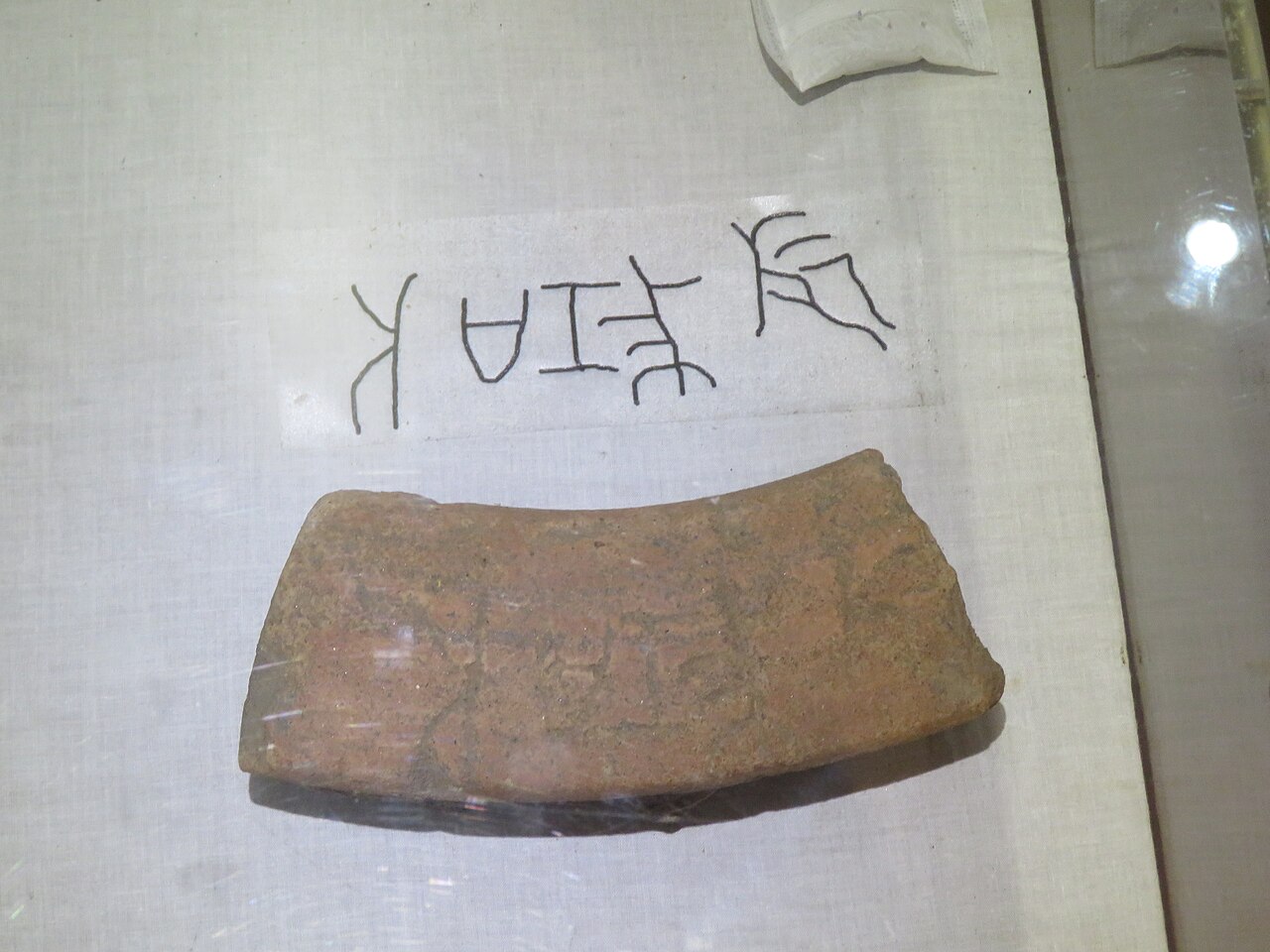
Pattanam · Photographed 2018-01-21 00:16
A sherd displayed as bearing Tamil-Brahmi writing at Pattanam Museum
A sherd displayed as bearing Tamil-Brahmi writing at Pattanam Museum; the exhibition includes a modern tracing above it.
The tracing is not a facsimile or an independent reading of the inscription.

1847 (catalogue also notes 1848)
Tolkappiyam: text page from the 1847/1848 printed edition – A later printed witness to an older work, not an ancient manuscript
Tolkappiyam: text page from the 1847/1848 printed edition. A later printed witness to an older work, not an ancient manuscript.
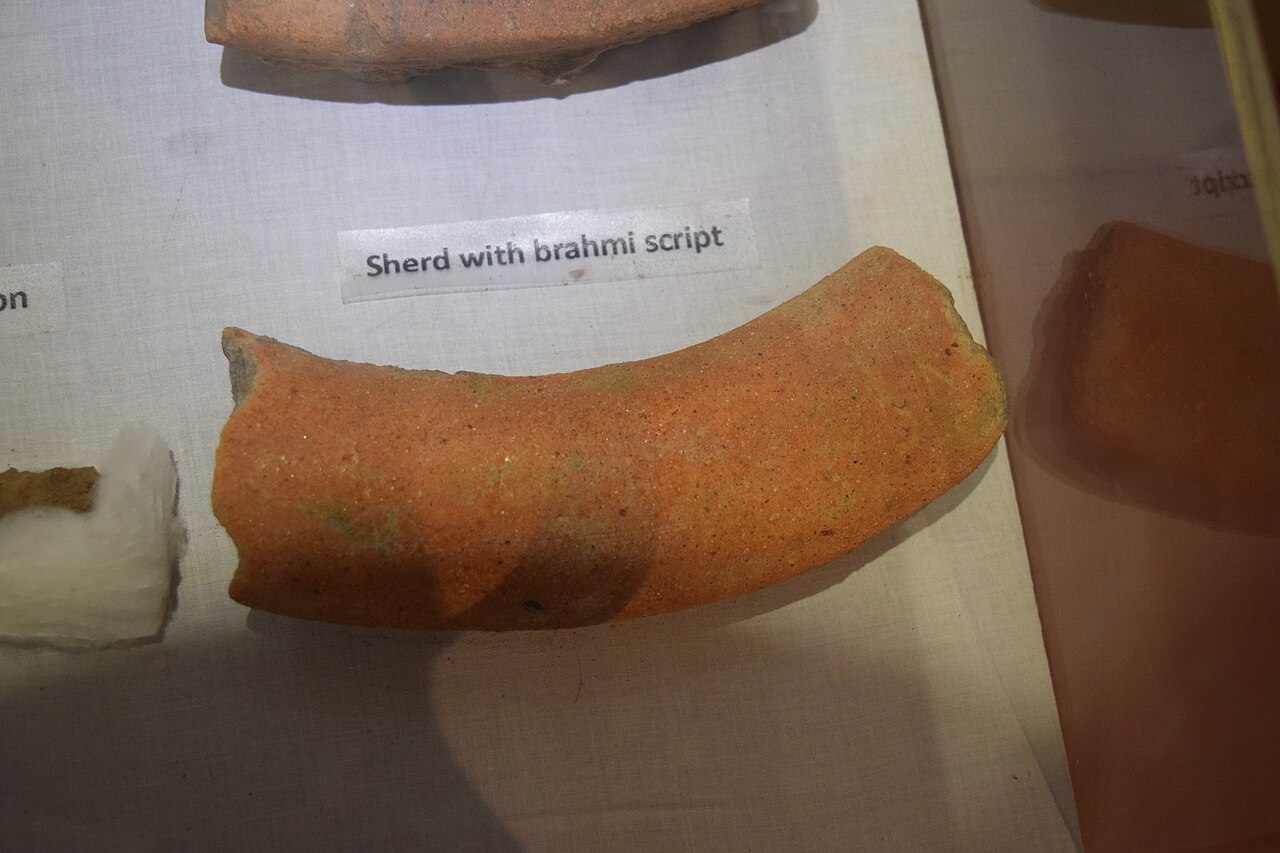
Pattanam · Photographed 2019-01-13 15:37
A sherd displayed as bearing Brahmi writing at Pattanam Museum
005Two views
Both views are shown at equal weight; this site does not choose between them.
Whether the Edakkal label is written in Malayalam
- One view
- Iravatham Mahadevan read it as i paḻama and called it the earliest Malayalam inscription, of the fourth or fifth century.
- Another view
- M. R. Raghava Varier and others disputed the reading and the leap to a separate Malayalam language.
- What would settle it
- A full critical publication with images, estampages and letter-by-letter readings by the competing epigraphists.
What drove Malayalam's separation from Tamil
- One view
- Rajaraja Varma's grammar stresses separation by the Western Ghats and a set of sound changes.
- Another view
- P. Sreekumar gives much more weight to contact with other languages.
- What would settle it
- Dated western inscriptions showing when each sound and verb change appeared.
006Where next
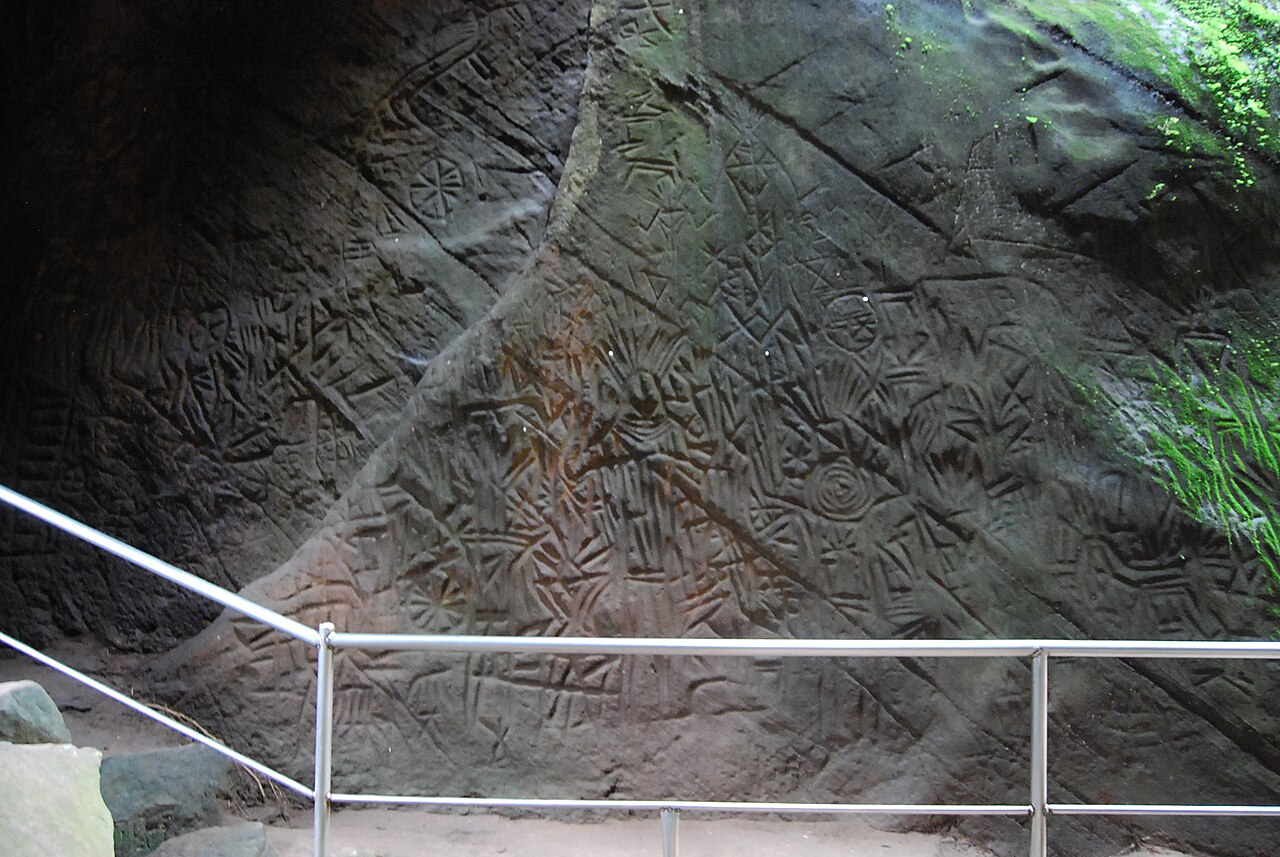 Related studyEdakkal's inscriptions are dated more securely than its rock art
Compare the Edakkal rock-shelter inscriptions with the study of how western Old Tamil became Malayalam, keeping rock surface, script, reading and language stage apart.
On the timelineDates in this studySee these dates on the timeline
Explore nextVaṭṭeḻuttu (வட்டெழுத்து / വട്ടെഴുത്ത്)All related studies, connected material, books and sources15 · 16
Elsewhere on this site
Classroom Lesson Plans: Module 4 · From Cave Drip-Ledges to Potsherds: Scripts & Literacy in the Deep South
Multi-Script Glossary Terms: Vaṭṭeḻuttu (வட்டெழுத்து / വട്ടെഴുത്ത്) · Grantha (கிரந்தம் / ഗ്രന്ഥലിപി) · ḻa (Retroflex Approximant ழ / ഴ) (ழ / ഴ) · Kōleḻuttu (Koleluttu) (கோலெழுத்து / കോലെഴുത്ത്) · Malayāṇma & Ārya-eḻuttu (மலையாண்மை & ஆரிய எழுத்து / മലയാണ്മയും ആര്യയെഴുത്തും)
Connected material
Photographs, drawings, books, videos and other studies linked to this study. A link helps you explore; it does not prove a historical claim.
- A sherd displayed as bearing Tamil-Brahmi writing at Pattanam MuseumphotographBackground
- A sherd displayed as bearing Brahmi writing at Pattanam MuseumphotographBackground
- Tolkappiyam: text page from the 1847/1848 printed edition – A later printed witness to an older work, not an ancient manuscripthistorical printed textBackground
007Sources
The study lists the sources it consulted; we have not rechecked them. A working link does not show that a source was read, and a valid identifier does not show that it supports a claim. We do not link to unofficial uploads or copies of publications. Where a study cited one, we show the published citation, or a publisher, DOI or Internet Archive link when we have one. Tracking codes are removed from links, and the sources themselves are not republished here.
Sanford B. Steever, 'Old Tamil,' in Roger D. Woodard (ed.), The Ancient Languages of Asia and the Americas, Cambridge University Press, 2008, pp. 50-75.
A. Govindankutty Menon, 'Some observations on the sub-group Tamil-Malayalam: differential realizations of the cluster *ṉt,' Bulletin of the School of Oriental and African Studies 53(1), 1990, 87-99.
A. Govindankutty, 'From Proto-Tamil-Malayalam to West Coast dialects,' Indo-Iranian Journal XIV, 1/2 (1972), 52-60.
L. V. Ramaswami Aiyar, The Evolution of Malayalam Morphology, Rama Varma Research Studies 1, Ernakulam: Cochin Government Press for the Rama Varma Research Institute, 1936.
A. R. Rajaraja Varma, Kēraḷapāṇinīyam (revised 1917 ed.; digital text edition by Sayahna Foundation, 2017; 1996 centenary ed. with Scaria Zacharia).
S. V. Shanmugam, 'Dental and Alveolar Nasals in Dravidian,' Bulletin of the School of Oriental and African Studies 35(1), 1972, 74-84.
P. S. Subrahmanyam, Dravidian Verb Morphology: A Comparative Study, Annamalai University, 1971.
T. S. Subramanian, 'Edakal cave yields one more Tamil-Brahmi inscription,' 2012; accessible republication preserving statements by M. R. Raghava Varier and Iravatham Mahadevan.
Gayathri Sasibhooshan, 'Historians contest antiquity of Edakkal inscriptions,' Times of India, 10 July 2012.
Y. Subbarayalu, 'Tamil-Brāhmī,' The Encyclopedia of Ancient History, Wiley.
Vishnupriya Kolipakam et al., 'A Bayesian phylogenetic study of the Dravidian language family,' Royal Society Open Science 5 (2018), 171504.
P. Sreekumar, 'Contact and the Development of Malayalam,' in Anthony P. Grant (ed.), The Oxford Handbook of Language Contact, Oxford University Press, 2020, 519-539.
Inscription: 41 Vazhappally copper plate: വാഴപ്പള്ളി ശാസനം
Vazhappally copper plate (year 12 of Rāma Rājaśēkhara): c. 832 CE in M. G. S. Narayanan, Perumāḷs of Kerala, Index A.1; c. 882/83 CE in Manu V. Devadevan (2020).
Print or offline sourceSource recordK. V. Zvelebil, 'From Proto-South Dravidian to Old Tamil and Malayalam,' Proceedings of the Second International Conference-Seminar of Tamil Studies, vol. I, Madras, 1971, pp. 54-72.
Print or offline sourceSource recordK. V. Zvelebil, Comparative Dravidian Phonology, The Hague: Mouton, 1970.
Print or offline sourceSource recordSudalaimuthu Palaniappan. “Visit to Edakkal.” INDOLOGY, 9 October 2012. First-person field note following the author’s 24 August 2012 visit.
Researchers and institutions whose work this study uses: Kamil Zvelebil, Iravatham Mahadevan, Y. Subbarayalu, M. G. S. Narayanan, M. R. Raghava Varier
How we know The evidence, claims and dates behind this study
What this study draws on
- Linguistic studies by Steever, Govindankutty and Shanmugam, mostly read as publisher extracts.
- Rajaraja Varma's Kēraḷapāṇinīyam grammar, read in its Malayalam electronic text.
- News reports and a 2012 field note on the Edakkal inscription dispute.
- Kolipakam and colleagues' 2018 Bayesian study of the Dravidian language family, read in full.
Dates in this study
| What is dated | Date | How it was dated |
|---|---|---|
| Old Tamil is first attested around 254 BCE and its period extends roughly to the seventh century CE. | 254 BCE – 700 CE | Period assigned by excavators or scholars |
| About the ninth century CE for the earliest broadly recognized Malayalam inscriptions and literary texts in the inspected synthesis. | 800–899 CE | Period assigned by excavators or scholars |
| Malayalam divergence prior truncated to 800-1200 years before the study's year-2000 present, centered on 1000 years before present. | 800–1200 CE | Laboratory date |
| c. 882/83 CE for the Vazhappally copper plate in the consulted institutional catalogue. | 882–883 CE | Date from writing, coins or texts |
See these dates on the timeline
The study’s claims
16 claims · 17 source passages · 60 paragraphs
Browse the study paragraph by paragraphAround 600 CE, the safest periodization is still late Old Tamil with western regional differentiation rather than a securely attested separate Malayalam language.
Supported with qualifications
Spoken differentiation may predate written evidence. Language-stage labels are scholarly periodizations rather than contemporaneous self-identifications.
The accessible pre-600 western written record does not provide an uncontested, localized inscription showing a securely Malayalam-specific bundle of innovations.
Supported with qualifications
This is a negative result limited to the sources read for the sources accessed in this study, not a universal absence claim.
The earliest broadly recognized Malayalam inscriptional and literary evidence is placed around the ninth century in the scholarship read here.
Supported in this study
Language labels for ninth-century records can vary among scholars.
Edakkal-5 cannot presently serve as secure proof of a distinct Malayalam language in the fourth or fifth century because both its reading and linguistic classification have been publicly contested.
Debated in the sources
A critical epigraphic dossier could alter this assessment.
Tamil and Malayalam have a very close genealogical relationship; modern Bayesian lexical analysis strongly recovers them as sisters.
Supported in this study
Genealogical relatedness and absolute divergence date are separate questions.
The 2018 Bayesian study's Malayalam divergence chronology is not independent evidence for a pre-600 split because the analysis includes an explicit Malayalam divergence prior centered near 1000 CE and constrained broadly to 800-1200 CE.
Supported in this study
The study remains valuable for subgroup topology and comparative methodology.
Differential outcomes of reconstructed *ṉt and related sound patterns are useful relative evidence for Tamil-Malayalam differentiation but do not supply a secure absolute pre-600 date.
Supported with qualifications
Earlier spoken stages can be inferred only relatively unless independently dated attestations exist.
The catalogue term 'nasalization' collapses several distinct historical questions and should be replaced by feature-specific analysis of nasal phonemes, assimilation, and cluster developments.
Supported in this study
No secure date before 600 was found for completion of the relevant Malayalam-specific processes.
Loss of ordinary finite-verb person/gender/number endings is relevant to Malayalam differentiation, but the evidence read does not establish that this loss had been completed by 600 CE.
Supported with qualifications
A dated inscriptional paradigm sequence is needed for firmer chronology.
The Western Ghats as a cause of Malayalam differentiation is a retrospective historical-linguistic hypothesis, not direct evidence that linguistic isolation occurred at a particular date.
Supported with qualifications
Geography can contribute to dialect differentiation without implying complete isolation.
The same historical tradition that invokes geographic separation also records substantial cross-regional political and cultural interaction, so an absolute-isolation model is internally inadequate.
Supported in this study
Script history must be separated from spoken-language divergence; a change of script does not establish the birth of a language.
Supported in this study
Writing-system change can alter what linguistic distinctions become visible.
The Vazhappally copper plate, dated approximately 882/83 CE in the institutional catalogue consulted, is a useful later comparator but lies well outside the 600 CE cutoff.
Supported in this study
Used only in the later period.
Language contact should be considered alongside inheritance and geographic differentiation in explanations of Malayalam development.
Supported with qualifications
Specific contact mechanisms require individual dating.
Proto-Tamil-Malayalam is safest as a comparative or reconstructed label for shared ancestry, not as the name of a directly attested language at 600 CE.
Supported in this study
Different scholars may use the term with somewhat different reconstructed boundaries.
Demonstrated Malayalam divergence by 600 CE is a stronger claim than the accessible evidence warrants.
Supported in this study
This does not deny pre-600 spoken western differentiation.
Trace one claim through the study’s records
Explore the evidenceOther source lists
Numbered citation links from the study
The numbered links in the study text point here.
Old Tamil (Chapter 4) - The Ancient Languages of Asia and the Americas
Edakal cave yields one more Tamil-Brahmi inscription
A. R. Rajaraja Varma, Kēraḷapāṇinīyam (Sayahna Foundation digital edition / 1996 centenary ed.)
Some observations on the sub-group Tamil-Malayalam: differential realizations of the cluster *ṉt | Bulletin of SOAS
Tamil‐Brāhmī - Subbarayalu - Major Reference Works - Wiley Online Library
Some observations on the sub-group Tamil-Malayalam: differential realizations of the cluster *ṉt | Bulletin of SOAS
Some observations on the sub-group Tamil-Malayalam: differential realizations of the cluster *ṉt | Bulletin of SOAS
The Evolution Of Malayalam Morphology
Visit to Edakkal
Old Tamil (Chapter 4) - The Ancient Languages of Asia and the Americas
A. R. Rajaraja Varma, Kēraḷapāṇinīyam (Sayahna Foundation digital edition / 1996 centenary ed.)
Historians contest antiquity of Edakkal inscriptions | Kochi News - Times of India
Old Tamil (Chapter 4) - The Ancient Languages of Asia and the Americas
Old Tamil (Chapter 4) - The Ancient Languages of Asia and the Americas
P. S. Subrahmanyam, Dravidian Verb Morphology: A Comparative Study (Annamalai University, 1971)
Dental and Alveolar Nasals in Dravidian1 | Bulletin of SOAS
A. R. Rajaraja Varma, Kēraḷapāṇinīyam (Sayahna Foundation digital edition / 1996 centenary ed.)
A. R. Rajaraja Varma, Kēraḷapāṇinīyam (Sayahna Foundation digital edition / 1996 centenary ed.)
Contact and the Development of Malayalam | The Oxford Handbook of Language Contact
Vazhappally copper plate (year 12 of Rāma Rājaśēkhara; Narayanan Index A.1 / Devadevan 2020)
Print or offline sourceA Bayesian phylogenetic study of the Dravidian language family - PMC
Some observations on the sub-group Tamil-Malayalam: differential realizations of the cluster *ṉt | Bulletin of SOAS
Tamil‐Brāhmī - Subbarayalu - Major Reference Works - Wiley Online Library
Edakal cave yields one more Tamil-Brahmi inscription
A. R. Rajaraja Varma, Kēraḷapāṇinīyam (Sayahna Foundation digital edition / 1996 centenary ed.)
Old Tamil (Chapter 4) - The Ancient Languages of Asia and the Americas
Dental and Alveolar Nasals in Dravidian1 | Bulletin of SOAS
Some observations on the sub-group Tamil-Malayalam: differential realizations of the cluster *ṉt | Bulletin of SOAS
Some observations on the sub-group Tamil-Malayalam: differential realizations of the cluster *ṉt | Bulletin of SOAS
A Bayesian phylogenetic study of the Dravidian language family - PubMed
1996 - കേരളപാണിനീയം (ശതാബ്ദിപ്പതിപ്പ്) - ഏ.ആർ. രാജരാജവർമ്മ – ഗ്രന്ഥപ്പുര (Granthappura)
The Evolution Of Malayalam Morphology
Dental and Alveolar Nasals in Dravidian1 | Bulletin of SOAS
Edakal cave yields one more Tamil-Brahmi inscription
Historians contest antiquity of Edakkal inscriptions | Kochi News - Times of India
About this study Status, corrections and how it was made
Status
Draft study, revision 8. No historian, archaeologist, or Tamil or Malayalam specialist has reviewed it yet.
The study itself says more research is needed before its question can be settled.
How it was made
Compiled as an editorial synthesis from published scholarship around questions we framed. About this project & workflow
The summary, How sure lines and Two views notes on this page were prepared from this study and cross-checked against its passages. That is an editorial check, not a specialist review.
Corrections and updates
Technical details
Study code R234. The text fingerprint changes whenever the study text changes.
- The study text is shown as written. Links from its paragraphs to citations help you move around the study; they are not new claims or checked source passages.
See how this study’s records were extracted
Text fingerprint (SHA-256): R234 · 9725af90dc4e51138533c52d… · v8
Evidence tables and technical details are on the web page: https://layersofthesouth.org/read/8a67317ac7