Places on the atlas that name this study.
- Words & worlds
- Karur
The early Chera seat of Vanchi fits Karur better than Kodungallur
Inscriptions near Karur record an early Chera lineage, and archaeology shows a substantial settlement there. Together with literary evidence, they favour Karur for the early Chera seat called Vanchi. No single inscription directly makes that identification; coastal traditions and later political centres belong to different periods and arguments.
- This page
- 4,594 words · revision 7
Draft study · Awaiting specialist review · Updated
001Dates and places
002How sure
In brief
The early Chera royal city of Vanchi has been placed at inland Karur, in Tamil Nadu, or at coastal Kodungallur, in Kerala. Two Tamil-Brahmi inscriptions at Pugalur, near Karur, name three generations of an Irumporai Chera line (dated by letter shapes to c. 2nd century CE). Two early sources outside the commentary tradition are cited in scholarship as pointing the same way – Ptolemy's Geography (7.1.86, an inland Karoura, 'royal seat of Kerobothros', usually identified with Karur) and Akanāṉūṟu 93 (naming a Karuvūr of the Chera Kōtai on the Āṉporunai; neither passage checked in a printed edition here) – while Puṟanāṉūṟu 36 names the Āṉporunai river in verse line 5 with Karuvūr supplied in its colophon. Excavations at Karur found brick floors, a drain, inscribed pottery, Mediterranean amphorae, rouletted ware and a Roman coin. Medieval commentaries and a thirteenth-century inscription equate Vanchi with Karur, though no early inscription examined names Vanchi directly at either place. On the Kerala coast, Pattanam yielded nine early Chera copper coins, and K. G. Sesha Aiyar argued in 1937 for a coastal Vanchi near Kodungallur. The study finds Karur better supported for the early seat, within a network of inland and coastal Chera centres.
Key researchers cited in this study: Iravatham Mahadevan (Tamil-Brāhmī Epigraphy) · R. Nagaswamy (Tamil Epigraphy & Numismatics) · Full bibliography
How sure
- Well supported
An Irumporai Chera line was active near Karur
Pugalur inscriptions 61 and 62 name three generations of the line close to Karur.
- Well supported
Karur was an inhabited early historic centre with imported goods
Excavations report brick floors, a drain, Tamil-Brahmi sherds, amphorae, rouletted ware and a Roman coin.
- Likely
Vanchi was at Karur in the early historic period
Better supported than Kodungallur, but the explicit equation appears only in later commentary and inscription.
- Not known
Karur was the single capital of all early Cheras
Early Chera coins also occur at coastal Pattanam, and the relations between centres and ruling branches remain unresolved.
Why it matters
The answer shapes whether early Chera history is centred on the Kerala coast or on inland Tamil Nadu.
003Key findings
What the study concludes
- The Pugalur inscriptions are the strongest direct political evidence in this study: they name an Irumporai Chera genealogy near Karur, but they do not themselves call Karur “Vanchi.”
- Karur’s archaeology demonstrates a lived early historic center – houses, drains, written pottery, local and imported ceramics – not merely a literary royal name.
- The equation Vanchi=Karur is strengthened by literary commentary and later epigraphy, but those layers must not be silently dated back to the second century CE.
- Coastal Kerala had a major early historic port zone; Pattanam is a serious Muziris candidate, but that is a separate question from whether Vanchi was coastal.
- Bow-and-arrow coins map Chera-associated monetary circulation more safely than they map a capital or mint.
- A network of inland and coastal centers is more consistent with the mixed evidence than a modern expectation that one dynasty must always have had one fixed capital.
In the study’s own words. How sure each point is, is shown above.
The summary above is the short read. The full study is the complete text it was drawn from, with its tables and source notes.
What the full study covers
004The study
Question, scope and orientation
Question and scope.
What evidence supports different reconstructions of early Chera political geography around Karur and coastal Vanchi identifications?
Region: principally the Karur–Pugalur–Amaravati/Kaveri zone of western Tamil Nadu and the Kodungallur–Pattanam–Periyar-coast zone of central Kerala, with connected literary and numismatic evidence.
Period classification: mixed chronology. The evidentiary core lies in the early centuries CE, inside the 1000 BCE–600 CE period this study covers; later medieval commentaries and inscriptions are used only as reception/history-of-identification evidence.
Scope choice: “Vanchi” is treated as an ancient/historical place-name whose identification must be tested, not as a synonym pre-assigned to either Karur or Kodungallur. “Muziris/Muciri,” “Kodungallur,” “Thiruvanchikulam,” “Pattanam,” and “Karur” are kept distinct unless a particular source proposes a relationship. No single “capital” is assumed in advance.
Modern line tracing of a Pugalur Tamil-Brahmi inscription, credited to Rajesh of Raigad in the 2018 Commons record
Pugalur
Ancient inscription assigned by source to circa 1st–2nd century CE; this tracing was created/uploaded in 2018
Orientation.
The strongest hard evidence in this debate does not state as an explicit equation, “Vanchi is Karur,” still less “Vanchi is Kodungallur” – though two important early witnesses do name Karur itself as a Chera royal city. Two near-duplicate Tamil-Brahmi inscriptions at Pugalur, close to Karur, record three generations of an Irumporai Chera line and the investiture of a young prince; Mahadevan dated them palaeographically to about the second century CE. That is unusually direct evidence for Chera dynastic activity in the Karur region, but the inscriptional text itself does not name Vanchi as the capital. ↗1 Two early sources outside the commentary tradition are reported in scholarship to point the same way (neither passage was checked against a printed critical edition for this study): Ptolemy (Geography 7.1.86) lists an inland Karoura, “royal seat of Kerobothros”, usually identified with Karur, and Akanāṉūṟu 93 places a Karuvūr of the Chera Kōtai on the Āṉporunai. Neither uses the name Vañci, and supporters of a coastal Vañci have questioned whether Ptolemy's Karoura is this Karur. Archaeology at Karur independently demonstrates an early historic settlement with brick structures, Tamil-Brahmi potsherds, Mediterranean amphorae, rouletted ware, and a Roman coin, while early Chera-symbol coins are also reported at coastal Pattanam. ↗2 ↗3 The location of Vanchi therefore turns on how inscriptions, coins, poems, later commentaries, archaeology, and changing political centers are combined – not on one decisive object. The older coastal reconstruction and the now-common Karur reconstruction each rest on evidence of different dates and different kinds.
Accessible explanation and main investigation
Accessible explanation.
Locating an ancient political center is hard when the surviving evidence comes from several different “languages”: words cut into rock, coins found in riverbeds or excavations, poems copied and commented on for centuries, and buried houses and imported pots. Each can answer a different question. A rock inscription can name people with unusual precision but may say little about the surrounding city. A coin can show authority and circulation but may have traveled. A poem can preserve place-names and landscapes but is not a survey map. A medieval commentator can tell us how later learned readers understood an older name, but that later explanation is not automatically proof of what the poet originally meant.
At Pugalur, north-west of Karur, Mahadevan’s Corpus No. 61 reads a four-line Tamil-Brahmi record that associates a rock shelter with a senior Jaina monk, Cenkayapan of Yarrur. It names “King Atan Cel Irumporai,” his son Perunkatunkon, and the latter’s son Ilankatunkon, at the time the youngest became heir apparent. Mahadevan gives the inscription a palaeographic date of about the second century CE. A second inscription, Corpus No. 62, substantially repeats the record with some orthographic variation. ↗1 “Pugalur inscriptions record a three-generation royal genealogy” examines both inscriptions in detail, including what is restored and who the donor was. This is the most important reason the Karur region cannot be treated as merely a trading waypoint: a named Chera/Irumporai genealogy appears in a religious context only a short distance from Karur. Yet the original lines do not contain a sentence equating Karur with Vanchi. Mahadevan’s prose description that the Irumporais were “ruling from Karur” is a historical reconstruction placed around the inscription, not wording in the inscription itself. ↗1
Mahadevan then compares the three inscriptional names with rulers in the seventh, eighth and ninth patikams – introductory or colophon-like sections – of Patiṟṟuppattu, proposing that Ko Atan Cel Irumporai corresponds to Celvakkadunko Valiyatan, Perunkatunkon to Perunceral Irumporai, and Ilankatunkon to Ilanceral Irumporai. He explicitly presents the match as an interpretation based on repeated dynastic names and the parallel peru- (“great/elder”) and ila- (“young”) elements; he regards the resulting synchronism as cogent. ↗1 This is valuable, but it is a second evidentiary step: inscriptional genealogy first, literary identification second. The two should not be merged into a single “fact.” “Pugalur inscriptions record a three-generation royal genealogy” notes that Herman Tieken rejected this identification, and “The Patiṟṟuppattu is layered Chera praise poetry, not an archive” discusses how Patiṟṟuppattu can be used for Chera history.
Karur’s excavated material adds a different kind of weight. A Government Museum/Tamil Nadu archaeology synthesis reports a house-site with brick flooring and a drain, Tamil-Brahmi-inscribed potsherds assigned to the beginning of the Common Era, Roman amphorae, rouletted ware, and a Roman coin. The report says these finds throw valuable light on identifying Karur with Vanchi; the finds themselves, however, demonstrate occupation, literacy, built space, and exchange rather than spelling the name Vanchi. ↗2 For ordinary life, this matters: the site was not just an emblem on a dynastic map. People lived among brick-built spaces, used pottery, handled imported containers and local wares, and moved goods through a riverine interior center.
Coins are similarly useful but easy to overstate. Nagaswamy’s Roman Karur assembles Chera-attributed coins from the Karur region, including issues interpreted through bow-and-arrow and related symbols and inscribed names such as Kollippurai; he also cautions that, in the absence of an authenticated hoard of punch-marked coins from Karur, it is difficult to decide whether a regional punch-marked class was actually issued by Cheras from Karur. ↗4 ↗5 That warning matters for a common claim: “Chera punch-marked coins bearing the bow and arrow” is too broad as a single proven class with a secure Karur mint. The early coin corpus includes several technologies and designs – punch-marked, die-struck or symbolic, and inscribed portrait or named issues – and many important specimens have riverbed or collector provenances rather than sealed excavation contexts. “Chera silver portrait coins carry Tamil-Brahmi names and titles” covers the Makotai and Kuttuvan Kotai silver portrait coins, and “Karur excavations show trade; most coin finds lack context” covers Karur’s excavated and river-recovered finds.
The coastal evidence complicates any claim that Chera power was simply inland. KCHR’s 2011 Pattanam report records nine “early Chera” copper coins among twenty-two copper coins excavated that season, recognized by elephant, bow and arrow symbols. The same report documents a very large imported ceramic assemblage and a maritime settlement whose first-century BCE/CE material is consistent with a major Indian Ocean port. ↗3 But the report is also admirably explicit that Pattanam’s identification with ancient Muziris was a hypothesis requiring further evidence; one contribution says the site “could have been part” of Muziris and that more research was necessary before the identification could be stated firmly. ↗3 Nothing in the consulted Pattanam passages labels the settlement Vanchi or calls it the Chera capital. Thus Pattanam strengthens the picture of a powerful Chera-connected maritime zone while not directly proving “coastal Vanchi.”
The literary evidence is where the place-name Vanchi itself becomes central. Purananuru 11 places “victorious Vanchi” in a passage with the cool Porunai. In the consulted Project Madurai edition with Auvai Duraisamy Pillai’s commentary, the commentary glosses that Porunai as Aan Poruntham and Vanchi as Karur. ↗6 Akanāṉūṟu 93 (attributed to Nakkīrar, lines 20–23) goes even further inside the verse itself: it speaks directly of “neṭuntērk Kōtai tiru mā viyaṉ nakark Karuvūr muṉtuṟai … taṇ Āṉporunai maṇaliṉum palavē” – naming Karuvūr, the wealthy great city of (the Chera) Kōtai, on the cool Āṉporunai. Purananuru 36 is also important: its fifth verse line explicitly names Āṉporunai (“taṇ āṉporunai veṇ maṇal citaiya”) in the poem itself (not merely in an explanatory layer), while the transmitted colophon/paratext specifies a Chola besieging Karuvūr; thus, unlike Akanāṉūṟu 93, the city name Karur in Purananuru 36 stands in the colophon/paratext rather than inside the stanza. ↗6 Patiṟṟuppattu also preserves “Vanci mutur” (“old Vanchi”) in the ninth-decade material read in the Project Madurai text, but that phrase by itself does not supply modern coordinates.
Later learned tradition strengthens the Karur equation but must be dated later. Mahadevan notes that old commentary on several Purananuru poems identifies Vanchi as Karuvur, that Cilappatikaram commentary and lexicons make the same equation, and that a thirteenth-century inscription explicitly describes Vanchi as the great city that is Karuvur. ↗1 This is excellent evidence that the equation was established in medieval scholarly and epigraphic memory. It is not, by itself, a second-century inscription saying the same thing.
Main investigation.
The Pugalur anchor: what the rock actually says.
The Pugalur record is the firmest political datum because it names a dynastic sequence in situ. Mahadevan’s Corpus No. 61 gives a direct translation: the rock shelter was carved for the senior Jaina monk Cenkayapan, and the event is tied to Ilankatunkon becoming heir apparent; his father Perunkatunkon and grandfather King Atan Cel Irumporai are named. Mahadevan records the locus as the western cave on Arunattarmalai and gives “ca. 2nd century A.D.” as the date. ↗1 “Pugalur inscriptions record a three-generation royal genealogy” notes that two older catalogues date the record to the third–fourth centuries CE. No. 62 is a near-duplicate, but “Pugalur inscriptions record a three-generation royal genealogy” shows that the damaged letters of the first king’s name in No. 62 are restored from No. 61, so No. 62 cannot confirm them independently. “Pugalur inscriptions record a three-generation royal genealogy” also notes that reading the young prince as the shelter’s donor is a scholarly interpretation. The inscription is therefore not merely a king list: it links Chera dynastic succession, a named religious specialist, and the carving of a rock shelter.
What follows from that? It strongly supports an Irumporai dynastic presence in the Karur-Pugalur corridor. What does not follow automatically? It does not prove that every Chera ruler resided at Karur, that Karur was the sole or permanent capital, or that the ancient place-name Vanchi must denote only this settlement. The word “capital” belongs to historical synthesis, not the surviving inscriptional sentence. Mahadevan himself moves from the inscription to a wider reconstruction when he describes the line as ruling from Karur and when he identifies the names with Patiṟṟuppattu. ↗1
Karur as inhabited political economy, not just a royal dot.
Archaeology makes Karur more than a name in a poem. The official 2011 archaeological synthesis reports domestic architecture, drainage, inscribed sherds, Mediterranean amphorae, rouletted ware, and a Roman coin. ↗2 Champakalakshmi’s broader reconstruction treats Vanci/Karur as an inland political-commercial center paired with Muciri as a coastal commercial center – one of several “dual centre” patterns she sees in early historic Tamilakam. ↗7 This model is analytically useful because it avoids forcing a maritime port and an inland court center to be the same place. It also makes sense of why a polity tied to west-coast exchange could leave important dynastic evidence east of the Western Ghats. Still, “dual centres” is a historian’s model, not a phrase in the ancient sources.
Champakalakshmi goes further and identifies ancient Vanci/Karuvur with modern Karur, rejecting the earlier Tiruvanchikkalam/Kodungallur equation. Her case combines texts, inland archaeological finds, foreign-geographical references, and later inscriptions. She also notes the later early-medieval importance of Tiruvanchikkalam/Mahodayapuram. ↗7 This is a strong integrated reconstruction, but part of its force comes from combining evidence separated by centuries. In this study, those chronological layers are kept visible instead of being compressed into one continuous “capital tradition.”
Why the coastal Vanchi hypothesis arose.
K. G. Sesha Aiyar’s 1937 study is a clear representative of the coastal school. In his chapter “Vanci-mutur,” he argues that literary Vanchi should be distinguished from inland Karur and identifies the Chera capital with Tiruvanchikkalam/Kodungallur. His argument draws heavily on literary geography and on the apparent distinctness of names and poetic settings; he treats Karur as connected with an Irumporai branch rather than as the same city as Vanchi. ↗8 Somasundara Bharatiyar’s Tamil-language discussion likewise reviews multiple views and challenges M. Raghava Iyengar’s Karur identification through river names, literary passages, and the geography of the Chera “mountain country.” ↗9 These works matter because they show that the coastal reconstruction was not merely a modern tourist tradition: it was a reasoned philological position.
Yet its archaeological base has changed. Early twentieth-century writers lacked the later Karur/Pugalur evidence in its current form and, of course, the modern Pattanam excavations. Pattanam now supplies strong evidence for a major early historic port in the Kodungallur–North Paravur region, with imported pottery, a wharf-related maritime landscape, craft evidence, and Chera-symbol coins. ↗3 But this new coastal archaeology does not recover the missing step: an early inscription or securely contextualized text saying that this port settlement was Vanchi. It therefore makes a coastal Chera center materially much easier to imagine without directly validating the old identification of Vanchi with Kodungallur/Thiruvanchikulam. “Kodungallur digs found medieval layers, Pattanam much older ones” discusses Kodungallur and the Periyar mouth in more detail.
Coins: distribution is political evidence, but not a capital label.
A common description singles out “Chera punch-marked coins bearing the bow-and-arrow emblem.” That wording needs correction. Nagaswamy’s numismatic discussion includes multiple types and explicitly recognizes uncertainty about whether a class of regional punch-marked coins can be assigned to a Chera issue from Karur. ↗5 The consulted KCHR report, meanwhile, records Chera-symbol copper coins at Pattanam. ↗3 A bow-and-arrow type can therefore help identify a political/numismatic tradition and its circulation, but finding such a coin at a place does not by itself make that place a mint, royal residence, or capital. This is especially important for riverbed finds, where the original depositional context has been lost.
Much primary numismatic work remains. R. Krishnamurthy’s Sangam Age Tamil Coins was verified bibliographically as an important specialist monograph, but its relevant catalogue entries were not checked entry by entry. ↗10 This study therefore does not use exact weights, dies, hoard compositions, or specimen-level findspots from that work, and makes no claims that depend on those details.
The literary name Vanchi and the danger of collapsing commentaries into poems.
Separating early verses from colophons, Greco-Roman geography, and medieval commentaries clarifies how Karur and Vanchi connect. Two early sources outside the commentary tradition are cited in scholarship as pointing the same way (neither checked in a printed edition here): Ptolemy (Geography 7.1.86) lists an inland Karoura, “royal seat of Kerobothros”, usually identified with Karur, and Akanāṉūṟu 93 places a Karuvūr of the Chera Kōtai on the Āṉporunai; neither uses the name Vañci, and supporters of a coastal Vañci have questioned whether Ptolemy's Karoura is this Karur. Meanwhile, in Purananuru 11, the Vanchi–Porunai pairing belongs to the verse while identifying Porunai as Aan Poruntham and Vanchi as Karur belongs to the commentary; and in Purananuru 36, Āṉporunai stands inside verse line 5 itself while Karuvūr appears in the transmitted colophon. ↗6 The explicit equation “Vanchi = Karuvūr” enters through later commentary, lexicons, and medieval epigraphy.
The same caution applies in the other direction. Coastal interpreters use passages that seem to situate Chera courtly geography closer to the western mountains, Periyar-system rivers, and sea. Somasundara Bharatiyar’s Tamil essay is valuable for laying out that philological objection, but it remains an interpretation of the literary corpus, not a newly discovered core-period inscription. ↗9 Close translations of these debated river and place-name passages still need review by a Tamil specialist.
Finding: a layered, multi-centre reconstruction fits the evidence best.
On the consulted evidence, Karur has the strongest direct claim to being an early Chera inland political center, especially for the Irumporai line: the Pugalur genealogy, nearby Tamil-Brahmi milieu, excavated settlement, and later Vanchi=Karur tradition converge there. ↗1 ↗2 The further statement “Karur was the single primary capital of all early Cheras” is stronger than the evidence warrants. The west coast simultaneously possessed major Chera-connected port infrastructure and exchange networks, most vividly at Pattanam; the literature also preserves coastal and mountain-facing Chera geographies. ↗3 The old coastal Vanchi=Kodungallur/Tiruvanchikkalam equation remains historically important but, in the material read here, lacks a core-period epigraphic equation comparable even to the indirect Karur cluster.
The most defensible reconstruction is therefore not a winner-takes-all “Karur versus Kodungallur” capital contest. It is a political landscape with at least an inland Karur/Irumporai node and one or more west-coast maritime nodes, whose names, ruling branches, and relative prominence changed through time. The equation Vanchi=Karur is better supported than Vanchi=Kodungallur for the early historic period, but it remains a reconstruction assembled from several layers rather than a single self-identifying inscription.
Interpretations, limits and source register
Interpretations, disagreements and limits.
The disagreement is best understood as a difference in evidence architecture, not merely a choice between two map pins. The Karur reconstruction gains force from proximity of the Pugalur dynastic inscriptions, excavated early historic urban material, coin finds, textual/commentarial associations, and explicit later equations. Champakalakshmi’s influential synthesis treats Karur/Vanci and Muciri as inland and coastal Chera centers rather than requiring Vanchi itself to be the port. ↗7 Sesha Aiyar and Somasundara Bharatiyar instead give greater weight to literary landscape, river-name distinctions, west-coast geography, and the separate appearance of Karur and Vanchi in the textual tradition. ↗8 ↗9
Three common claims should therefore be narrowed. First, replace “Pugalur proves Karur was the Chera capital” with “Pugalur securely places an Irumporai Chera dynastic line in the Karur region.” Second, replace “Chera punch-marked coins from Karur prove a mint/capital” with “a varied Chera-attributed coin corpus is concentrated in and around Karur, but provenance, mint attribution, and typological dating differ by specimen.” Third, replace “Kodungallur was the rival early Chera capital Vanchi” with “older scholarship identified Vanchi with Tiruvanchikkalam/Kodungallur; modern coastal archaeology confirms a major early historic port zone nearby, but the consulted evidence does not directly label that site Vanchi.” ↗1 ↗3 ↗5
What would most improve the case? For Karur, a fully read dedicated excavation report with trench/layer tables and specimen-level coin provenance would separate excavated evidence from riverbed collecting. For Vanchi, a core-period inscription from a secure archaeological context explicitly naming Vanchi and a locative relationship would be transformative. For the literary problem, a specialist comparison of the oldest recoverable manuscripts, colophons, commentaries, and river-name traditions is needed. For the coastal hypothesis, an early inscription or seal from the Kodungallur–Pattanam region naming Vanchi, a Chera ruler, or an administrative institution would move the argument beyond geographic congruence. None of these missing items should be reported as archaeologically absent merely because they were not found in this study’s searches.
Source register.
| Full recoverable reference / durable URL | Language; source type | Inspection level | Independence / use |
|---|---|---|---|
Iravatham Mahadevan, Early Tamil Epigraphy: From the Earliest Times to the Sixth Century A.D., Harvard Oriental Series 62, 2003, 719 pp., ISBN 9780674012271. https://search.worldcat.org/title/52720601 |
English with Tamil/Tamil-Brahmi; inscription edition/book | relevant digital text consulted; print facsimile not yet checked | Foundational epigraphic edition and analysis; claims C001–C004, C009, C016. Bibliographic metadata independently confirmed. ↗11 ↗12 |
T. S. Sridhar, Excavations in Tamil Nadu: An Archaeological Report, Government Museum, Chennai, 2011. https://govtmuseumchennai.org/uploads/topics/16567467016803.pdf |
English; official archaeological synthesis | selected facsimile pages + parsed text read | Government synthesis of departmental excavations; claims C005, C015. Title/publication and Karur pages read as images. ↗2 |
R. Champakalakshmi, Trade, Ideology and Urbanization: South India 300 BC to AD 1300, Oxford University Press, 1996. https://archive.org/details/in.ernet.dli.2015.532800 |
English; scholarly book | partial text, relevant passages | Independent modern synthesis; claims C006, C017. Consulted in digital text; printed pages not yet checked. ↗7 |
| K. G. Sesha Aiyar, Chera Kings of the Sangam Period, London: Luzac & Co., 1937. | English; scholarly book/historiography | selected facsimile pp. 80–82 read | Primary historiographic witness for coastal Vanchi argument; C010. Bibliographic year/publisher corroborated independently. ↗8 ↗13 |
Purananuru, verses 1–60, with commentary of Auvai Duraisamy Pillai, Project Madurai Unicode e-text. https://www.projectmadurai.org/pm_etexts/utf8/pmuni0494_01.html |
Tamil; ancient text + later commentary e-edition | partial text, relevant poems/commentary | Directly read Tamil text/commentary for C007–C008; electronic edition should be checked against a critical print edition before publication. ↗6 |
| Patiṟṟuppattu, Project Madurai Tamil Unicode e-text. | Tamil; ancient text e-edition | partial text, ninth-decade material searched | Context for Vanchi and Mahadevan comparison; exact edition genealogy and line numbering need follow-up. |
Kerala Council for Historical Research, Report of the Fifth Season Excavation at Pattanam, 2011. https://kchr.ac.in/images/img/ptm2011_field%20Report.pdf |
English; excavation/field report | partial text of relevant sections | Direct excavation-team reporting for Pattanam material and explicit caution over Muziris identification; C012–C013. ↗3 |
| R. Nagaswamy, Roman Karur: A Peep into Tamils’ Past. Madras: Brahad Prakashan, 1995, 158 pp. + plates. | English; archaeological/numismatic book | partial text; catalogue metadata checked | Important participant scholarship and coin discussion; C013–C014. Full printed edition not yet checked; exact specimen claims therefore restricted. ↗14 ↗5 |
Navalar Somasundara Bharatiyar, Arāycci Nūlkaḷ, part 2, Project Madurai e-text. https://www.projectmadurai.org/pm_etexts/utf8/pmuni0446_02.html |
Tamil; historical/philological scholarship | partial text, Vanchi section | Independent early Tamil-language historiography challenging Karur identification; C011. ↗9 |
| Iravatham Mahadevan, Early Tamil Epigraphy… Revised & Enlarged Second Edition, Volume I: Tamil-Brāhmī Inscriptions, Central Institute of Classical Tamil, Chennai, 2014, xliv + 727 pp., ISBN 978-93-81744-14-7. | English; inscription edition | partial text/metadata | Later revision lead; introductory material consulted; Pugalur pages not yet checked in the revised edition. ↗15 ↗16 |
| Iravatham Mahadevan, Early Tamil Epigraphy, fourth edition, CICT Publication No. 30, 2025, ISBN 9789381744147. | English; inscription edition | metadata only | Latest edition noted for reference; relevant pages not yet checked. ↗17 |
| R. Krishnamurthy, Sangam Age Tamil Coins, Garnet Publications, Chennai, 1997. | English; numismatic monograph | metadata only | Specialist coin catalogue noted for reference; specimen entries not yet checked. ↗10 |
Further sources to check: the dedicated 2011 Tamil Nadu State Department of Archaeology volume containing the Karur excavation report; Krishnamurthy’s specimen catalogue; Mahadevan’s 2025 fourth-edition Pugalur pages; the 2004 Journal of Roman Archaeology study by Shajan, Tomber, Selvakumar and Cherian concerning Muziris; and older print/critical editions of Purananuru and Patiṟṟuppattu. These are prioritized as gaps rather than silently treated as read.
Entities and claims checked
Meaningful proposed connections are carried by claims rather than by silent entity merging: Pugalur → Irumporai genealogy (C001); Vanchi → Karur as a scholarly identification (C006/C009/C015); Vanchi → Tiruvanchikkalam/Kodungallur as an older scholarly identification (C010/C011); Pattanam → Muziris as a qualified archaeological hypothesis (C012); and Karur/Pattanam coin finds → Chera-attributed numismatic circulation (C013).
Common claims checked.
| Claim or check | Status | Result |
|---|---|---|
| “Primary Chera capital: inland Karur vs coastal Kodungallur/Thiruvanchikulam” | qualified/contested framing | Evidence supports Karur as a strong inland Irumporai political center; a single exclusive capital for all early Cheras is not demonstrated. Coastal Vanchi remains a historiographic reconstruction with weaker direct core-period epigraphic support in the consulted corpus. |
| Pugalur names Ko Atan Cel Irumporai, Perunkatunkon and Ilankatunkon | supported | Supported in Mahadevan Corpus No. 61/62. |
| Pugalur rulers equal Patiṟṟuppattu rulers | qualified | Mahadevan’s argued identification/synchronism, not literal inscription wording. |
| “Chera punch-marked coins bearing bow-and-arrow emblem” | qualified | Chera-attributed coinage is varied; mint/provenance and punch-mark classification require specimen-level checking. |
| Karur archaeology supports major early historic importance | supported | Official synthesis reports domestic architecture, Tamil-Brahmi sherds and imported wares/coin. |
| Vanchi=Karur in ancient sources themselves | qualified | Puṟam 36.5 names the Āṉporunai with Karuvūr in its colophon, and secondary scholarship cites Akanāṉūṟu 93 and Ptolemy Geography 7.1.86 (Karoura, usually identified with Karur; not checked in printed editions here), while the explicit verbal equation Vañci = Karuvūr enters in commentary, lexicons, and medieval epigraphy. |
| Kodungallur/Pattanam early archaeology proves coastal Vanchi | unsupported as stated | Pattanam strongly supports a major port and a Muziris hypothesis; no consulted passage directly names it Vanchi. |
“Not reported” in this study means a consulted source did not provide the item; “reported absent” is used only when a source explicitly states absence – for example, KCHR’s statement concerning Roman coins in its early Pattanam seasons, not as a claim of universal site absence. ↗3
Takeaways
Grounded takeaways.
- The Pugalur inscriptions are the strongest direct political evidence in this study: they name an Irumporai Chera genealogy near Karur, but they do not themselves call Karur “Vanchi.”
- Karur’s archaeology demonstrates a lived early historic center – houses, drains, written pottery, local and imported ceramics – not merely a literary royal name.
- The equation Vanchi=Karur is strengthened by literary commentary and later epigraphy, but those layers must not be silently dated back to the second century CE.
- Coastal Kerala had a major early historic port zone; Pattanam is a serious Muziris candidate, but that is a separate question from whether Vanchi was coastal.
- Bow-and-arrow coins map Chera-associated monetary circulation more safely than they map a capital or mint.
- A network of inland and coastal centers is more consistent with the mixed evidence than a modern expectation that one dynasty must always have had one fixed capital.
Small glossary.
Vañci/Vanchi (வஞ்சி): historical Tamil place-name associated with Chera political geography; its location is the question, not a settled translation.
Karuvūr/Karur (கருவூர்): place-name identified with modern Karur in the consulted scholarship.
Irumporai (இரும்பொறை, spelling varies in transliteration): Chera dynastic/title element in inscriptions and literature; exact transliteration should follow the chosen edition.
iḷaṅkō / ilanko: “young prince/heir apparent” in Mahadevan’s interpretation of the Pugalur wording; the translation should be checked by a Tamil epigraphist.
patikam: introductory/colophon-like section attached to a decade of Patiṟṟuppattu; it should not automatically be assumed to have exactly the same date as the poems it frames.
mūtūr: conventionally “old/ancient town”; the compound Vañci mūtūr requires context-sensitive Tamil review.
Muciri/Muziris: ancient port-name represented in Tamil and Greco-Roman traditions; it is not a synonym for Vanchi unless a source argues that relationship.
Still open.
Whether any Pugalur readings changed in Mahadevan’s 2014 and 2025 editions; the precise archaeological contexts of the inscribed Chera coins attributed to Kollippurai, Makkotai and Kuttuvan Kotai; which Vanchi references occur in poem bodies, which in colophons, and which only in medieval commentary; whether the river names Porunai, Aan Porunai and the western river systems can be reconstructed from early usage without later glosses; what the dedicated Karur excavation report says about stratigraphic phasing, craft production, food remains and local wares; and whether any early inscription from the Kodungallur–Pattanam region is explicit enough to identify a Chera ruler or administrative center.
Evidence challenge.
Challenge: “A Chera bow-and-arrow coin is excavated at Pattanam. Does that prove Pattanam was Vanchi or a Chera capital?”
Answer: No. It directly supports circulation or presence at that site of a coin type attributed by excavators to the Cheras. To infer a mint, capital, or identity with Vanchi, one would need additional evidence such as dies, production debris, a secure inscription naming the place, administrative documents, or a much stronger contextual pattern. The same caution applies to riverbed coins at Karur.
The most useful further work would be to inspect the dedicated Karur excavation volume and its plans/tables; inspect Krishnamurthy’s primary coin catalogue and museum accession records; compare Pugalur Nos. 61–62 in Mahadevan’s 2014 and 2025 editions; obtain critical print editions and manuscript-history scholarship for the Vanchi passages in Purananuru and Patiṟṟuppattu; search Kerala epigraphic corpora specifically for pre-600 CE political inscriptions in the Kodungallur–Pattanam zone; and obtain specialist review of the Tamil readings.
005Photographs
Photographs of the places and objects this study discusses. Each item carries its creator’s credit, licence and documented source. See all 412 photographs and source images ↗
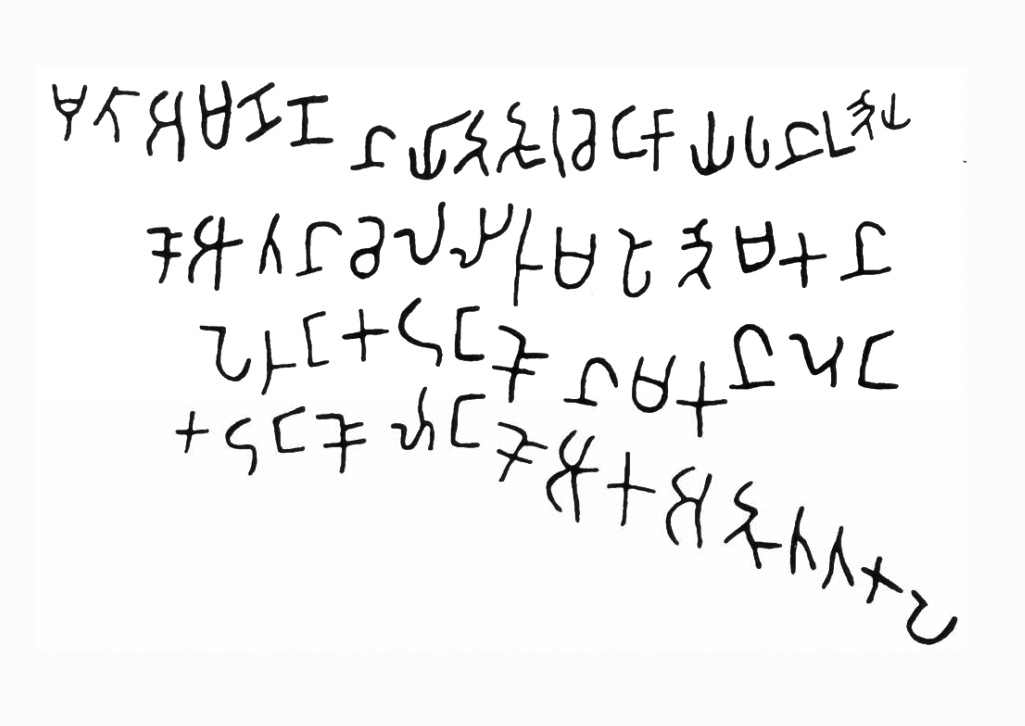
Pugalur · Ancient inscription assigned by source to circa 1st–2nd century CE; this tracing was created/uploaded in 2018
Modern line tracing of a Pugalur Tamil-Brahmi inscription, credited to Rajesh of Raigad in the 2018 Commons record
Modern line tracing of a Pugalur Tamil-Brahmi inscription, credited to Rajesh of Raigad in the 2018 Commons record. This is an epigraphic representation, not a photograph of the inscribed rock.
006Two views
Both views are shown at equal weight; this site does not choose between them.
Where the early Chera royal city of Vanchi stood
- One view
- Champakalakshmi (1996) and the 2011 Government Museum report place Vanchi at Karur, from texts, excavations and later commentary. Mahadevan describes the Pugalur line as ruling from Karur.
- Another view
- K. G. Sesha Aiyar (1937) and Somasundara Bharatiyar place it on the coast near Kodungallur, from literary geography and river names.
- What would settle it
- An early inscription from a secure context naming Vanchi, especially one from the Kodungallur–Pattanam region.
007Where next
All related studies, connected material, books and sources31 · 17
Elsewhere on this site
Excavation Atlas Sites: Karur (Amaravathi River Trade Node & Proposed Chera Capital Vanchi)
Junior Detective Quests: One Poem, Five Dates: How Copying Saved Ancient Poems
Multi-Script Glossary Terms: Vañci (Karūr / Kodungallur Debate) (வஞ்சி / கரூர் / വഞ്ചി / കരൂർ) · Mūvēntar (மூவேந்தர் / മൂവേന്തർ) · Cēral / Kēraḷaputra (சேரல் / சேரர் / ചേരൻ / കേരളപുത്ര) · Mākkōtai & Kuṭṭuvaṉ Kōtai Chera Portrait Coins (மாக்கோதை & குட்டுவன் கோதை சேர நாணயங்கள் / മാക്കോതൈ, കുട്ടുവൻ കോതൈ ചേര നാണയങ്ങൾ)
Connected material
Photographs, drawings, books, videos and other studies linked to this study. A link helps you explore; it does not prove a historical claim.
- Modern line tracing of a Pugalur Tamil-Brahmi inscription, credited to Rajesh of Raigad in the 2018 Commons recordmodern epigraphic tracingBackground
- Coins have more than one historyillustrationThe early Chera copper coin with a bow and arrow follows this study’s report of nine such coins found at Pattanam in 2011.
Books, videos and websites
Outside reading on this topic. These are not part of the study and we have not checked every claim in them. See all books and videos
- Trade, Ideology and Urbanization: South India 300 BC to AD 1300 Book · R. Champakalakshmi · 1996 · Foundational analysis of Early Historic 'dual urban centers' – pairing inland political capitals with coastal maritime entrepôts (Karur & Muciri for the Cheras; Madurai & Korkai/Alagankulam for the Pandyas; Uraiyur & Puhar for the Cholas).
- TNSDA – Tamil Nadu State Department of Archaeology Website · Official repository of excavation monographs, radiocarbon date tables, and epigraphic reports for Keeladi (Keezhadi), Sivagalai, Adichanallur, Korkai, Kodumanal, Mayiladumparai, Alagankulam, and Karur.
008Sources
The study lists the sources it consulted; we have not rechecked them. A working link does not show that a source was read, and a valid identifier does not show that it supports a claim. We do not link to unofficial uploads or copies of publications. Where a study cited one, we show the published citation, or a publisher, DOI or Internet Archive link when we have one. Tracking codes are removed from links, and the sources themselves are not republished here.
Iravatham Mahadevan Early Tamil Epigraphy From The Earliest Times To The Sixth Century A. D.
govtmuseumchennai.org · 16567467016803.pdf
kchr.ac.in · ptm2011 field Report.pdf
Unofficial online copy (link not shown)
forum.spark (source link 4)
Online copy not linked · use the published editionSource recordNagaswamy, R. Roman Karur: A Peep into Tamils' Past (Brahad Prakashan, 1995)
Roman Influence on Karur's History | PDF | Tamils
Online copy not linked · use the published editionSource recordpuRanAnURu (with the commentary of Auvai Duraisamy Pillai) part 1 -verses 1 to 60 (in tamil script, unicode format)
Trade, Ideology And Urbanization
ia801505.us.archive.org · 2015.277483.1097 W O text.pdf
ArAicci nUlkaL - part 2 of nAvalar cOmacuntara pAratiyAr In ...
Tamil Coins - Sangam Age
books.google.com · Early Tamil Epigraphy from the Earliest.html
Early Tamil Epigraphy from the Earliest Times to the Sixth ...
Historical Insights of Sangam Literature | PDF | Poetry
Print or offline sourceSource recordRoman Karur
list.indology.info · 048900.html
Early Tamil Epigraphy: From the Earliest Times to the Sixth ...
Online copy not linked · use the published editionSource recordEarly Tamil Epigraphy: From The Earliest Times To ...
Researchers and institutions whose work this study uses: Iravatham Mahadevan, R. Nagaswamy
How we know The evidence, claims and dates behind this study
What this study draws on
- Mahadevan’s 2003 edition of Pugalur inscriptions 61 and 62, dated from letter shapes.
- Sridhar’s 2011 Government Museum report on Karur and the Kerala Council for Historical Research’s 2011 Pattanam field report.
- Ptolemy Geography 7.1.86 (Karoura), Akanāṉūṟu 93 (Karuvūr on the Āṉporunai), and Puṟanāṉūṟu 11 and 36 (distinguishing verse from colophon and commentary).
- Older and recent scholarship: Sesha Aiyar 1937, Somasundara Bharatiyar, Champakalakshmi 1996 and Nagaswamy 1995 on coins.
Dates in this study
This study has no dates recorded in a form we can chart, so there is no date chart. Any dates it gives are in the full study.
The study’s claims
17 claims · 0 source passages · 40 paragraphs
Browse the study paragraph by paragraphPugalur No. 61 records three generations – Ko Atan Cel Irumporai, Perunkatunkon, Ilankatunkon – and ties the youngest to investiture as heir apparent in a Jaina rock-shelter donation.
Supported in this study
Reading depends on epigraphic restoration of damaged letters; No. 62 provides a near-duplicate control.
The Pugalur inscriptions provide strong direct evidence of Irumporai Chera dynastic activity in the Karur region around the second century CE.
Supported in this study
“Region” is safer than “capital”; the inscription does not give a boundary.
The Pugalur inscriptions do not themselves state “Karur is Vanchi” or “Karur is the capital.”
Supported with qualifications
Negative claim is limited to read text/edition; it is not a claim that no such wording exists anywhere.
Mahadevan identifies the three Pugalur names with rulers of Patiṟṟuppattu decades 7–9; this is an argued synchronism, not wording in the inscription.
Supported with qualifications
Depends on matching names/titles and literary genealogical tradition.
Excavated Karur was an early historic inhabited and exchange center with brick architecture, drainage, Tamil-Brahmi sherds, amphorae, rouletted ware and a Roman coin.
Supported in this study
The synthesis page does not provide trench/layer numbers for each item; dedicated Karur excavation volume remains uninspected.
Champakalakshmi reconstructs Vanci/Karur as an inland Chera political-commercial center paired with Muciri as a coastal center.
Supported in this study
This is a modern synthetic model combining literary, archaeological and later evidence.
In the consulted Purananuru 11 tradition, the verse associates Vanchi with the cool Porunai; Auvai Duraisamy Pillai’s commentary identifies the river as Aan Poruntham and Vanchi as Karur.
Supported with qualifications
Commentary and poem are different chronological layers; exact commentary date not established here.
Purananuru 36 names the cool Āṉporunai in verse line 5 ('taṇ āṉporunai veṇ maṇal citaiya') and Karur in its transmitted colophon, while Akanāṉūṟu 93 and Ptolemy Geography 7.1.86 directly name Karuvūr/Karoura as a Chera royal city (neither using the name Vañci).
Supported with qualifications
Āṉporunai is in Puṟam 36's verse itself (line 5), and Karuvūr is in Akam 93's verse itself; only Puṟam 36's naming of Karur is in the colophon/paratext, and neither Akam 93 nor Ptolemy uses the name Vañci.
Medieval learned and epigraphic reception explicitly equated Vanchi with Karuvur, including a thirteenth-century inscription cited by Mahadevan.
Supported in this study
Centuries later than the core early historic question; cannot be back-projected without qualification.
Sesha Aiyar argued in 1937 for coastal Tiruvanchikkalam/Kodungallur as Vanchi and distinguished it from inland Karur.
Supported in this study
Early twentieth-century scholarship predates much later archaeological and epigraphic work.
Somasundara Bharatiyar’s Tamil discussion presents a philological-geographical case against Raghava Iyengar’s Karur identification.
Supported in this study
Language-sensitive reasoning requires specialist Tamil review before close translation.
Pattanam provides strong evidence for an early historic maritime center in the Kodungallur–North Paravur region, while the consulted KCHR report presents the Muziris identification as an open proposal needing further evidence and does not identify the site as Vanchi.
Supported with qualifications
Pattanam=Muziris and Vanchi are separate identification questions.
Chera-symbol copper coins are reported at Pattanam as well as in the Karur-centered numismatic literature; therefore symbol distribution alone cannot uniquely identify a capital.
Supported with qualifications
Attribution of uninscribed symbol coins is typological; circulation ≠ mint location.
The proposal’s phrase “Chera punch-marked coins from Karur” must be narrowed because Nagaswamy explicitly notes the lack of an authenticated Karur hoard for a relevant punch-marked class.
Supported in this study
Specialist catalogue entries and specimen-level provenances were not checked.
Karur is the best-supported early historic inland Chera/Irumporai political node in the consulted evidence, but “sole primary capital of all Cheras” is not established.
Supported with qualifications
“Political node” is deliberately narrower than a unitary modern capital.
No consulted core-period inscription directly equates Vanchi with either Karur or Kodungallur; the Karur equation becomes explicit in later interpretive/epigraphic layers.
Supported with qualifications
This is a statement about the consulted corpus, not proof of universal archaeological absence.
A multi-centre reconstruction – an inland Karur/Irumporai node plus west-coast maritime node(s) – fits the currently read evidence better than a binary single-capital contest.
Supported with qualifications
Exact political hierarchy among centers and branches remains unresolved.
About this study Status, corrections and how it was made
Status
Draft study, revision 7. No historian, archaeologist, or Tamil or Malayalam specialist has reviewed it yet.
How it was made
Compiled as an editorial synthesis from published scholarship around questions we framed. About this project & workflow
The summary, How sure lines and Two views notes on this page were prepared from this study and cross-checked against its passages. That is an editorial check, not a specialist review.
Technical details
Study code R123. The text fingerprint changes whenever the study text changes.
- Table headings decide what each column means. Citation links, sample mentions and dates copied as text are kept apart from checked source passages and calibrated measurements.
See how this study’s records were extracted
Text fingerprint (SHA-256): R123 · b67b140bfe2ece248eb2750c… · v7
Evidence tables and technical details are on the web page: https://layersofthesouth.org/read/f8004e87f9