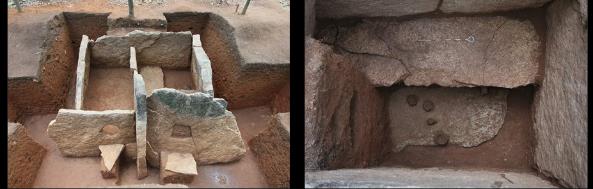
Excavated cist burial at Enadimangalam, Figure 1, published page 568
Enadimangalam
- Belief & memory
Kerala's serpent groves are not shown to date to the Iron Age
Early Tamil poetry knows protected groves and Iron Age Kerala had ritual burials, but nothing found before 600 CE joins grove and serpent cult.
- This page
- 3,345 words · revision 8
Draft study · Awaiting specialist review · Updated
001Dates and places

No mapped place in this study.
1000–500 BCE
Different beginnings
500–200 BCE
Marks & materials
200 BCE–300 CE
Connected worlds
300–600 CE
Change & continuity
After 600 CE
- approximately 1506–1522 CE for inscriptions discussed in the Nagercoil study
- approximately the 1600s for Early Modern Malayalam features in some Kēraḷōlpatti manuscripts
- Date from writing, coins or texts
- How it was dated is not stated
Each date belongs to what was dated (a sample, an object, a layer or a text), which is not always the event the study asks about.
Each period has the same width, so spacing is not to scale.
The full table of dates, with their ranges, is under How we know.
- 1 Well supported
- 2 Likely
- 1 Not known
002How sure
In brief
A sarpa kavu is a Kerala sacred grove where serpent deities are worshipped, and it is often traced to Iron Age animism. This study found no dated evidence before 600 CE that joins a protected grove with serpent worship. Puranānūru 23, an early Tamil poem, mentions guarded trees in groves but no serpent cult. Kerala's Iron Age megalithic burials, such as the Enadimangalam cist, document ritual offerings, and none of the excavation reports read for this study mentions serpent images or a grove shrine. Serpents and sacred spaces are joined clearly in the Kēraḷōlpatti, some of whose manuscripts show language of about the seventeenth century. Modern groves do matter for nature: in a 2018 questionnaire survey of 300 people at 30 groves in north Kerala and neighbouring Kodagu (Karnataka), 18 groves had serpent gods, and of those who recalled meeting a snake inside a grove, 96% said they had not harmed it. These findings describe today, not the Iron Age.
Key researchers cited in this study: Abhayan G. S. (University of Kerala Archaeology) · Vaidehi Herbert (Sangam Poetry Translations & Commentaries) · M. G. S. Narayanan (Perumals of Kerala & Chera Epigraphy) · Full bibliography
How sure
- Likely
Early Tamil poetry valued protected trees in groves.
Puranānūru 23 describes guarded trees, though the poem's date is debated and it was read in translation.
- Well supported
Iron Age and Early Historic Kerala practised ritual burial.
The Enadimangalam cist excavation (read in its published abstract) documents burial architecture and offerings.
- Not known
A serpent-grove institution existed in Kerala before 600 CE.
No witness from before 600 CE in the published record joins grove, serpent deity and ritual together.
- Likely
People report treating snakes more gently inside sacred groves.
One 2018 questionnaire survey of 300 people at 30 groves in north Kerala and Kodagu (Karnataka); self-reported responses in a single study.
Why it matters
It shows that a modern conservation practice and an ancient-sounding origin story need separate evidence.
003Key findings
What the study concludes
- A grove is not automatically a serpent grove.
- Iron Age ritual evidence is not direct evidence of 'animism' or nāga worship.
- Kēraḷōlpatti is important later reception evidence, not a primary Iron Age witness.
- Modern sacred groves can have measurable biodiversity and human–snake effects without thereby proving their ancient date.
- The strongest current historical model is layered development rather than demonstrated unchanged continuity.
In the study’s own words. How sure each point is, is shown above.
The summary above is the short read. The full study is the complete text it was drawn from, with its tables and source notes.
What the full study covers
004The study
Orientation and answer
What evidence dates sacred-grove and serpent-veneration practices relevant to early Kerala?
This page dates historical records, not living faith.
The evidence currently supports a cautious answer: the consulted sources do not identify a securely dated pre-600 CE Kerala witness that combines the defining elements of the modern sarpa kavu – a protected grove or grove-like space together with explicit serpent-deity veneration – as one demonstrable institution. What can be documented is a sequence of separate evidence layers: early Tamil evidence for groves and protected trees; Iron Age–Early Historic Kerala evidence for mortuary and ritual activity without an identified serpent-grove cult in the consulted publication record; much later Kerala narratives explicitly associating serpents, ritual order, and kāvu; later medieval/early-modern southern temple evidence involving serpent imagery; and modern ecological and ethnographic evidence showing that sacred groves, including serpent-associated groves, can preserve vegetation and affect human–snake relations. ↗1
That distinction matters because it is often said that sacred groves represent Iron Age animism and ancient biodiversity preservation in Kerala homesteads. This study tests that proposition rather than assuming it, and it does not project modern nāga terminology, iconography, or ecological management unchanged into antiquity. On the evidence read here, “Iron Age animism” should therefore not be presented as an archaeological finding. Archaeological deposits can establish burial, offering, production, settlement, or other material practices; a broad category such as “animism” requires an additional interpretive argument and cannot be read directly from grave goods or architecture.
The strongest defensible formulation is consequently:
Early South Indian evidence establishes some components that later occur in sacred-grove traditions, but the specifically serpent-dedicated Kerala sarpa kavu is not securely dated to the Iron Age or to the period before 600 CE by the sources consulted here. Later textual and iconographic witnesses demonstrate that serpent cults and sacred spaces became deeply embedded in regional religious landscapes, while modern ecological studies demonstrate conservation effects; neither class of evidence by itself proves unchanged continuity from the Iron Age.
Confidence is high in the separation of the source classes and moderate in the limited negative conclusion about pre-600 sarpa kavu: the latter reflects the primary and near-primary evidence located and consulted for this study, not a claim that every archaeological report, unpublished find, Malayalam or Tamil publication, or inscription corpus has been exhaustively searched.
Historical Scope & Methodological Framework
The period in view is 1000 BCE–600 CE, but chronology is treated as an evidentiary variable rather than a requirement to force the subject into that window. This study therefore separates four chronological layers: earlier/background evidence, core or near-core-period evidence, later reception/comparison, and modern documentation. Later evidence can show that an institution or interpretation existed later; it cannot, without an independent bridge, date that institution to the Iron Age.
Four working assumptions were used. First, evidence from Tamil Nadu or the wider Tamil-speaking south is admissible only when it illuminates a connected cultural vocabulary or provides a clearly labelled comparison; it is not automatically evidence for Kerala. Second, “sacred grove” here means a culturally protected or ritually significant vegetated place, while “sarpa kavu” requires the additional element of explicit serpent veneration. Third, serpent imagery, a serpent name, a grove, and biodiversity value are analytically distinct observations: their co-occurrence in modern practice cannot be projected into an earlier period unless the earlier source actually joins them. Fourth, every negative conclusion below is limited to the sources and access levels read.
The search prioritized, in descending evidentiary value for the dating question: archaeological reports and analytical studies; early literary witnesses and lexical resources; inscriptions and object-centred studies; scholarship on later Kerala historical narratives; modern ecological fieldwork; and government conservation documentation. Modern ecological fieldwork and conservation studies explain what sacred groves do today, but do not furnish a dating method for religious origins; critical historical scholarship – notably J. R. Freeman, “Gods, Groves and the Culture of Nature in Kerala,” Modern Asian Studies 33, no. 2 (1999): 257–302 (not yet read in full) – similarly cautions against projecting modern conservation categories back onto premodern kāvu shrines. ↗2
Access was uneven. The open-access People and Nature study was read at full-text level. The Kerala Forest Department page and the 2026 study of the Kēraḷōlpatti were also available in substantial text. The Enadimangalam archaeological article and Chandrashekara–Sankar ecological article were available here primarily through abstracts/metadata, which restricts finds-level and methods-level checking. The online Puranānūru witness was sufficient to inspect poem 23 but is a modern translation rather than a critical edition. The Nagercoil study was available through an archival record and checked excerpts, not through a newly read facsimile of the primary inscriptions. Those distinctions materially affect the confidence assigned below. ↗3
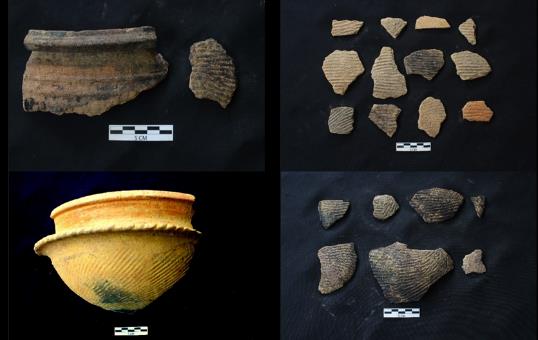
Ceramics from the Enadimangalam study area, Figure 3, published page 569
Enadimangalam
Ancient and early-historic evidence
Groves in early Tamil evidence
A useful early witness is Puranānūru 23, attributed in the received corpus to Kallādanār. The consulted Tamil/English presentation describes destructive warfare affecting guarded or protected trees in groves. The lexical evidence is consistent with Tamil கா (kā) denoting a forest, grove, or garden. This establishes that grove vocabulary and the idea of socially meaningful or protected trees belong to the early Tamil literary environment represented by the poem. ↗4
It does not, however, establish a sarpa kavu. The consulted passage contains no serpent deity, snake rite, Nāgarāja, Nāgayakṣi, serpent icon, or statement that the grove is protected because it is a serpent sanctuary. It is therefore evidence for one component – grove/protected-tree space – rather than evidence for the later conjunction of grove and serpent cult. ↗5
Dating must also remain conservative. The chronology of early Tamil literary corpora is contested, and individual poems cannot simply be assigned an exact calendar year from conventional “Sangam age” labels. Scholarship on early Tamil writing emphasizes persistent dating difficulties. ↗6 For the present question, this means Puranānūru 23 can contribute to a broad early/classical Tamil cultural horizon without carrying the heavier claim that a precisely dated pre-600 Kerala serpent-grove institution is attested.
Iron Age–Early Historic Kerala archaeology
The 2021 Enadimangalam cist-burial excavation, read here in its published abstract, reports burial architecture, ritual offerings, ceramics and iron implements but no serpent image or grove shrine. ↗7 No Kerala megalithic report read for this study mentions serpent imagery; regional syntheses (for example Gurukkal and Varier 1999) were not checked, so this reflects the sources read here rather than proving serpent veneration was absent.
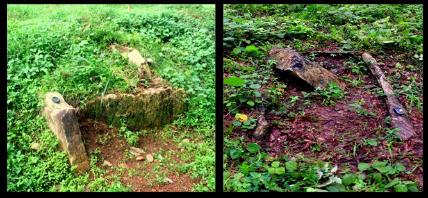
Unexcavated cist burials in the Enadimangalam study area, Figure 2, published page 568
Enadimangalam
The distinction can be summarized as follows:
| Witness | Period | Directly supports | Does not directly support | Evidentiary weight for pre-600 sarpa kavu |
|---|---|---|---|---|
| Puranānūru 23 | Early/classical Tamil; exact dating debated | Grove vocabulary; guarded/protected trees | Serpent deity or serpent rite | Moderate for the grove component; none for the conjunction |
| Kerala megalithic record (incl. Enadimangalam cist burial) | Iron Age–Early Historic Kerala | Burial architecture, offerings, ceramics, iron objects | No published Kerala megalithic assemblage reports serpent images or a grove shrine | Grounded in regional syntheses; full Enadimangalam finds catalogue was not checked directly |
| Modern sarpa kavu practice | Modern | Actual conjunction of grove, serpent deity, ritual, conservation effects in surveyed places | Antiquity of that conjunction | Strong modern evidence; no direct dating power for antiquity |
Accordingly, the phrase “Iron Age animism” is too strong for the evidence read. The archaeology documents material practices. To infer a particular cosmology from them would require diagnostic objects, texts, spatial patterning, or a carefully argued comparative model; even then, the interpretation should be attributed rather than treated as a directly observed archaeological category. ↗7
Later witnesses and modern ecology
Kēraḷōlpatti: explicit serpent traditions, but much later evidence
The Kēraḷōlpatti is substantially closer to the later serpent-and-sacred-space configuration. Ophira Gamliel's 2026 study discusses versions of this Malayalam historical tradition in which Kerala's ordering is narrated through Paraśurāma, Brahmin settlement and ritual authority, serpent populations, deities, and allocated kāvu-type sacred spaces. This makes the tradition highly important for the history of how Kerala communities narrated serpent cult and sacred landscape. ↗8
Its chronological use must nevertheless be tightly controlled. Gamliel identifies Early Modern Malayalam features in some manuscripts, approximately around the seventeenth century, and emphasizes that the textual tradition has a complex manuscript history for which a simple original date should not be asserted prematurely. ↗8 Therefore, even when the narrative describes events as primordial or foundational, the surviving textual witness is evidence for a later discourse about origins, not direct documentation that the narrated social or ritual order existed in the first millennium BCE.
This is one of the most consequential distinctions in this study. A later tradition may preserve older motifs, names, institutions, or memories; but proving that any particular element is genuinely ancient requires an independent chronological bridge. The Kēraḷōlpatti cannot supply that bridge by narrating antiquity itself.
Nagercoil: serpent iconography and the danger of ahistorical identification
A connected southern comparison comes from the Nagaraja temple at Nagercoil in present-day Tamil Nadu. S. Padmanabhan (“Jain Origin of a Hindu Temple,” Jain Journal 27, no. 2 [October 1992]: 79–82; primary inscriptions published in Travancore Archaeological Series, vol. VI – both original print pages were not checked directly) discusses sixteenth-century inscriptions (roughly Kollam Era 681–697, c. 1506–1522 CE) alongside Jain terminology and serpent-related iconography, interpreting the site as having Jain religious associations before later Hindu transformation.
This evidence is nearly a millennium later than 600 CE, and the primary inscription editions were not checked directly. Its value is methodological: a hooded serpent figure or serpent-associated deity is not culturally self-explanatory, since serpent symbolism can function within Jain, Brahmanical, local, and other religious configurations.
That makes modern-backward projection particularly hazardous. Even a secure ancient serpent image would still require contextual work before it could be called evidence for the later Kerala homestead sarpa kavu institution.
Modern sacred groves: strong ecological evidence, weak chronological evidence
The modern ecological record is much firmer. Chandrashekara and Sankar's 1998 study explicitly investigates the ecology and management of sacred groves in Kerala, treating them as present or historically recent managed/protected landscapes. ↗10 The Kerala Forest Department's contemporary Sacred Grove Conservation program likewise documents biodiversity assessment, field visits, engagement with local custodians, threats, and conservation intervention. ↗11 These sources establish that Kerala sacred groves are meaningful contemporary conservation units embedded in social and religious management.
The most informative modern study for the serpent question is Landry Yuan and colleagues' research on sacred groves and human–snake relations. In October 2018 the researchers surveyed 30 sacred groves – 10 each in Kannur, Kasaragod, and Kodagu – and 300 participants; 18 of the 30 groves had serpent gods among their associated deities. ↗12
Their questionnaire findings are striking – with the important caveats that they come from a single self-reported survey covering both north Kerala (Kannur and Kasaragod) and neighbouring Kodagu in Karnataka, measuring recalled and stated responses rather than directly observed causation. Among 139 respondents who recalled encountering a snake inside a sacred grove, 96% said they had not harmed it and about 1% reported a harmful response. For encounters outside sacred groves, approximately 23% of the full 300-person sample reported a harmful response, while about 60% reported non-harmful responses. ↗13 The article also deposited its dataset on Dryad. ↗14
Those results support a modern behavioural association – people in the surveyed districts report treating snakes more gently inside sacred groves – and illustrate contemporary conservation engagement. They do not establish that the same social mechanism, deity system, boundaries, household tenure form, or management rule existed in 500 BCE or 500 CE. Ecological efficacy today is not a clock for religious antiquity.
Synthesis, chronology, and competing interpretations
The evidence is best explained by a layered model rather than an unbroken-continuity model. The layered model says that several relevant phenomena – grove terminology, protected trees, regional serpent symbolism, mortuary ritual, later serpent-origin narratives, temple cults, household sacred spaces, and modern conservation practices – can each have substantial histories without being the same institution from their earliest appearance onward.
This layered chronology is a synthesis of separate evidence classes, not a claimed genealogical chain. ↗15
Three competing interpretations deserve explicit treatment.
The continuity interpretation would regard modern sarpa kavu as a surviving form of an Iron Age religious institution. This is possible in the weak sense that some constituent ideas could be old, but it is not demonstrated by the sources read. Neither early grove vocabulary nor generic Iron Age ritual evidence establishes the requisite conjunction of serpent deity, grove sanctuary, and institutional continuity.
The memory interpretation gives greater historical weight to the Kēraḷōlpatti, proposing that its serpent-and-land narratives preserve substantially older social memories. Such preservation cannot be ruled out, but it remains a hypothesis unless particular elements can be independently traced backward. The manuscript/language evidence instead establishes the texts as much later witnesses to the stories in their surviving form. ↗8
The cumulative or recombinatory interpretation, which best fits the current evidence, treats sarpa kavu as an institution whose recognizable later form could have assembled older components over time. Grove sanctity, serpent symbolism, local deity cult, Brahmanical ritual ordering, household land tenure, temple practice, and conservation consequences need not have begun at the same moment. The Nagercoil comparison reinforces this caution because serpent iconography can function within a specifically Jain as well as later Hindu setting.
Evidence capable of discriminating among these models would be unusually specific. A securely pre-600 inscription naming a serpent deity together with a grove/kāvu-type sanctuary in Kerala would materially alter the conclusion. So would a stratified, scientifically dated shrine context in Kerala containing diagnostic serpent-cult objects whose cultic function was archaeologically defensible, or an early Tamil/Malayalam-related textual passage that clearly joined serpent divinity to a protected grove institution. By contrast, another modern biodiversity survey, however valuable ecologically, would not solve the chronological question.
The principal result can therefore be stated as an evidentiary hierarchy:
| Proposition | Present assessment | Why |
|---|---|---|
| Groves/protected trees were culturally meaningful in early South India | Supported with qualifications | Early Tamil literary and lexical evidence supports the component, though precise poem dating remains debated. ↗16 |
| Iron Age–Early Historic Kerala had ritualized mortuary practices | Supported | Archaeological evidence such as Enadimangalam directly supports this. ↗7 |
| Those practices were specifically serpent worship | Unresolved / unsupported by read evidence | The consulted archaeological record does not make that identification. ↗7 |
| A recognizable sarpa kavu institution existed in Kerala before 600 CE | Not established | No consulted core-period witness joins the defining components securely. |
| Later Kerala tradition explicitly links serpents, sacred space, and social order | Supported as later reception | Kēraḷōlpatti does so, but surviving linguistic/manuscript evidence is much later. ↗8 |
| Serpent imagery can shift religious context | Supported by later comparison | The Nagercoil study associates serpent imagery and cult with a Jain history before later transformation. |
| People report treating snakes more gently inside sacred groves | Likely (single self-reported questionnaire study) | 2018 survey of 300 people at 30 groves in north Kerala and Kodagu (Karnataka), alongside ecological management literature. ↗17 |
Conclusions, limitations, and remaining work
Sacred groves (sarpa kavu), serpent veneration and homestead biodiversity are well supported as subjects of modern and later-historical Kerala; “Iron Age animism” is not established by the evidence reviewed here.
The key conclusions are:
-
Early grove evidence and early serpent-grove evidence are not the same thing. Puranānūru supports early grove/protected-tree vocabulary but does not provide the missing serpent-cult link. ↗5
-
Iron Age–Early Historic archaeology must be read materially. Enadimangalam supports ritualized burial practices, but the consulted evidence does not identify them as serpent worship. ↗7
-
The clearest textual joining of serpent narratives and kāvu-type sacred ordering found here is later. The Kēraḷōlpatti is valuable for reception history but cannot by itself date the institution to antiquity. ↗8
-
Serpent iconography cannot be back-projected as a stable ethnic or religious marker. Nagercoil's Jain associations illustrate the problem.
-
Modern biodiversity and behavioural effects are real findings but chronologically separate. The 2018 survey demonstrates a strong association between sacred-grove context and non-harmful responses to snakes among respondents who encountered snakes there. ↗18
The most important remaining source work is specific. The full Enadimangalam article should be read and its finds catalogue, plans, photographs, and dating discussion checked for any serpent-associated object or shrine interpretation not exposed in the abstract. The primary edition and plates for the Nagercoil inscriptions should be examined rather than relying on a later interpretive article alone. Regional syntheses (such as Gurukkal and Varier 1999) and J. R. Freeman's 1999 study of Kerala sacred groves were not read for this study. Relevant early Tamil passages should ultimately be checked against critical editions and current philological dating scholarship rather than depending on a single online translation.
There is also a genuine corpus limitation: this was a limited source-led search, not an exhaustive survey of every Malayalam- and Tamil-language archaeological bulletin, local temple inscription publication, unpublished excavation archive, or district-level sacred-grove inventory. “Not established here” is therefore deliberately narrower than “never existed.”
Source register and annotated reading path
Félix Landry Yuan, U. Prashanth Ballullaya, Ramesh Roshnath, Timothy C. Bonebrake, and Palatty Allesh Sinu, “Sacred groves and serpent-gods moderate human–snake relations,” People and Nature 2 (2020): 111–122. DOI: https://doi.org/10.1002/pan3.10059. Full publisher text was read. This is the strongest source in this study for quantified modern relations among sacred groves, serpent deities, and snake-directed behaviour; it must not be used as an ancient-dating source. ↗19
U. M. Chandrashekara and S. Sankar, “Ecology and management of sacred groves in Kerala, India,” Forest Ecology and Management 112 (1998): 165–177. DOI: https://doi.org/10.1016/S0378-1127(98)00326-0. Abstract-level access only. Important for modern Kerala sacred-grove ecology and management; reading the full article would improve detail but would not, by itself, date the religious institution to antiquity. ↗10
Sacred grove Thiruvancheri kavu (5)
Photographed 2024-06-16
Kerala Forest and Wildlife Department, “Sacred Grove Conservation.” https://forest.kerala.gov.in/en/sacred-grove-conservation/. Official modern institutional documentation of conservation work, including field assessment and community engagement. It is authoritative for the programme it describes, not for ancient origins. ↗11
G. S. Abhayan et al., “Megalithic cist burial excavation at Enadimangalam in Kerala and its implications in cist burial architecture and burial practices,” Archaeological Research in Asia 27 (2021): 100293. DOI: https://doi.org/10.1016/j.ara.2021.100293. Abstract-level access. A priority for full reading because it directly tests the proposed Iron Age lane; the accessible record establishes funerary/ritual archaeology but did not identify a serpent-grove cult. ↗7
Puranānūru 23, attributed to Kallādanār; modern English rendering by Vaidehi Herbert, https://sangamtranslationsbyvaidehi.com/ettuthokai-purananuru-1-200/. The poem was read for grove/protected-tree content. This is a useful access text, but firm claims should also rest on a critical Tamil edition and appropriate philological commentary. ↗5
University of Madras, Tamil Lexicon. Digital Dictionaries of South Asia access: https://dsal.uchicago.edu/dictionaries/tamil-lex/index.html. Used for the lexical range of Tamil kā (கா), including forest/grove/garden senses; it supplies lexical context, not proof of cultic function. ↗20
Ophira Gamliel, “Conversion and Translation in the Kēraḷōlpatti,” Higher Education for the Future 13, no. 2 (2026): 165–180. DOI: https://doi.org/10.1177/23476311261449318. Full accessible article read. Essential for distinguishing the later serpent-and-land origin narrative from ancient evidence and for the manuscript/language dating problem. ↗8
S. Padmanabhan, “Jain Origin of a Hindu Temple,” Jain Journal 27, no. 2 (October 1992): 79–82, alongside the Nagercoil inscriptions in Travancore Archaeological Series, vol. VI (original journal and TAS pages were not checked directly).
J. R. Freeman, “Gods, Groves and the Culture of Nature in Kerala,” Modern Asian Studies 33, no. 2 (1999): 257–302 (key critical study arguing against reading kāvu shrines as ancient ecological conservation; was not read in full for this study).
Rajan Gurukkal and M. R. Raghava Varier, Cultural History of Kerala, vol. I (1999) (not read for this study).
The study is therefore framed not as “an Iron Age serpent-grove institution surviving unchanged,” but as a history of evidence layers: early groves, archaeologically documented ritual landscapes, later serpent-sacred-space narratives, and modern biodiversity consequences. That formulation preserves what the sources actually establish while leaving open the possibility that future epigraphic or archaeological evidence could move the conjunction further back in time.
005Photographs
Photographs of the places and objects this study discusses. Each item carries its creator’s credit, licence and documented source. See all 412 photographs and source images ↗
Enadimangalam
Excavated cist burial at Enadimangalam, Figure 1, published page 568

Photographed 2024-06-16
Sacred grove Thiruvancheri kavu (5)
Sacred grove Thiruvancheri kavu (5). Present-day sacred grove; photograph does not establish pre-600 CE origin.
Enadimangalam
Ceramics from the Enadimangalam study area, Figure 3, published page 569
Enadimangalam
Unexcavated cist burials in the Enadimangalam study area, Figure 2, published page 568
006Two views
Both views are shown at equal weight; this site does not choose between them.
Whether later serpent-and-land stories keep ancient memories
- One view
- A memory reading gives the Kēraḷōlpatti weight as a carrier of much older social memories.
- Another view
- A cautious reading treats it as a much later witness unless particular elements can be traced back independently.
- What would settle it
- A securely pre-600 inscription or dated shrine context in Kerala joining a serpent deity with a grove sanctuary.
007Where next
All related studies, connected material, books and sources15 · 9
Elsewhere on this site
Multi-Script Glossary Terms: kāvu (காவு / பொழில் / കാവ്) · kantu (Sacred Pillar) & kantaḻi (கந்து & கந்தழி / കന്തും കന്തഴിയും) · Pattiṉi / Kaṇṇaki Cult & Vañci Stone Tradition (பத்தினி (கண்ணகி) வழிபாடு / പത്തിനി / കണ്ണകി ആരാധന)
Connected material
Photographs, drawings, books, videos and other studies linked to this study. A link helps you explore; it does not prove a historical claim.
- Excavated cist burial at Enadimangalam, Figure 1, published page 568photographic figureShows the subject
- Unexcavated cist burials in the Enadimangalam study area, Figure 2, published page 568photographic figureShows the subject
- Ceramics from the Enadimangalam study area, Figure 3, published page 569photographic figureShows the subject
- Sacred grove Thiruvancheri kavu (5)photographBackground
008Sources
The study lists the sources it consulted; we have not rechecked them. A working link does not show that a source was read, and a valid identifier does not show that it supports a claim. We do not link to unofficial uploads or copies of publications. Where a study cited one, we show the published citation, or a publisher, DOI or Internet Archive link when we have one. Tracking codes are removed from links, and the sources themselves are not republished here.
Félix Landry Yuan, U. Prashanth Ballullaya, Ramesh Roshnath, Timothy C. Bonebrake, and Palatty Allesh Sinu, 'Sacred groves and serpent-gods moderate human–snake relations,' People and Nature 2(1), 111–122.
U. M. Chandrashekara and S. Sankar, 'Ecology and management of sacred groves in Kerala, India,' Forest Ecology and Management 112 (1998): 165–177.
Kerala Forest Department, 'Sacred Grove Conservation,' 21 November 2023.
G. S. Abhayan et al., 'Megalithic cist burial excavation at Enadimangalam in Kerala and its implications in cist burial architecture and burial practices,' Archaeological Research in Asia 27 (2021): 100293.
Puranānūru 23, attributed to Kallādanār, Tamil text with English translation by Vaidehi Herbert, 'Ettuthokai – Purananūru 1–200.'
University of Madras, Tamil Lexicon (1924–1936), online Digital Dictionaries of South Asia entry for கா (kā).
Ophira Gamliel, 'Conversion and Translation in the Kēraḷōlpatti,' Higher Education for the Future 13(2) (2026): 165–180.
S. Padmanabhan, 'Jain Origin of a Hindu Temple,' Jain Journal 27, no. 2 (October 1992): 79–82 (database index record at aryanculture.org/records/1048).
M. G. S. Narayanan, Perumals of Kerala.
Print or offline sourceSource record
Researchers and institutions whose work this study uses: Abhayan G. S., Vaidehi Herbert, M. G. S. Narayanan
How we know The evidence, claims and dates behind this study
What this study draws on
- Puranānūru 23 in a modern English translation, with the Tamil Lexicon for the word kā.
- The Enadimangalam cist excavation report, read at abstract level.
- Gamliel's 2026 study of the Kēraḷōlpatti, read in full.
- Landry Yuan and colleagues' 2020 survey of sacred groves and human–snake relations, read in full.
Dates in this study
| What is dated | Date | How it was dated |
|---|---|---|
| approximately 1506–1522 CE for inscriptions discussed in the Nagercoil study | 1506–1522 CE | Date from writing, coins or texts |
| approximately the 1600s for Early Modern Malayalam features in some Kēraḷōlpatti manuscripts | 1600–1699 CE | How it was dated is not stated |
See these dates on the timeline
The study’s claims
10 claims · 10 source passages · 53 paragraphs
Browse the study paragraph by paragraphNo consulted source securely establishes a pre-600 CE Kerala institution that combines a protected grove with explicit serpent-deity veneration in the recognizable form of a modern sarpa kavu.
Supported with qualifications
This is a negative result limited to the sources read, not proof that no pre-600 evidence exists anywhere. Unpublished archaeology and uninspected regional publications remain outside the evidentiary base.
Puranānūru 23 supports early Tamil evidence for culturally significant groves and guarded or protected trees, but the consulted passage does not attest serpent worship.
Supported in this study
The passage establishes a grove component, not a sarpa-kavu institution.
The consulted Enadimangalam publication documents Iron Age–Early Historic mortuary and ritual evidence but does not identify a serpent cult or sacred-grove sanctuary in the accessible abstract.
Supported with qualifications
Absence from the consulted abstract is not proof of regional absence.
Calling Iron Age Kerala evidence 'animism' would exceed the material observations available in the consulted archaeological source.
Supported in this study
The claim regulates evidentiary vocabulary rather than denying that Iron Age people held religious or cosmological beliefs.
The Kēraḷōlpatti tradition explicitly links serpents, ritual-social ordering, deities and kāvu-type sacred spaces, but the consulted manuscript-language scholarship places relevant witnesses in a much later historical context.
Supported in this study
Later narrative memory cannot independently date its narrated institutions to the Iron Age.
The Nagercoil comparison shows that serpent imagery and serpent-deity settings can participate in a Jain historical context, cautioning against treating modern nāga iconography as timeless or religiously self-identifying.
Supported with qualifications
The comparison demonstrates semantic variability, not a direct genealogy for Kerala sarpa kavu.
A 2018 survey investigated 30 sacred groves and 300 participants across Kannur, Kasaragod and Kodagu; 18 surveyed groves had serpent gods among associated deities.
Supported in this study
Among 139 surveyed respondents who had encountered a snake inside a sacred grove, approximately 96 percent reported a non-harmful response and about 1 percent a harmful response.
Supported in this study
The result supports a modern behavioural association, not historical continuity.
Modern ecological and government sources support the conservation significance and active management of Kerala sacred groves.
Supported in this study
Modern ecological function must be separated from origin dating.
The best-supported historical model from the consulted evidence is layered or recombinatory rather than demonstrated unbroken continuity from an Iron Age sarpa-kavu institution.
Supported with qualifications
A future securely dated pre-600 inscriptional or archaeological conjunction could revise this model.
Trace one claim through the study’s records
Explore the evidenceOther source lists
Numbered citation links from the study
The numbered links in the study text point here.
Ettuthokai – Purananūru 1-200 – Sangam Poems Translated by Vaidehi
Ecology and management of sacred groves in Kerala, India - ScienceDirect
Sacred groves and serpent‐gods moderate human–snake relations - Landry Yuan - 2020 - People and Nature - Wiley Online Library
Ettuthokai – Purananūru 1-200 – Sangam Poems Translated by Vaidehi
Ettuthokai – Purananūru 1-200 – Sangam Poems Translated by Vaidehi
Kamil Zvelebil, The Smile of Murugan: On Tamil Literature of South India (Brill, 1973)
Megalithic cist burial excavation at Enadimangalam in Kerala and its implications in cist burial architecture and burial practices - ScienceDirect
Conversion and Translation in the Kēraḷōlpatti - Ophira Gamliel, 2026
Padmanabhan 1992, Jain Journal 27(2): 79–82 (aryanculture.org index)
S. Padmanabhan, 'Jain Origin of a Hindu Temple,' Jain Journal 27(2) (October 1992): 79–82 (indexed at aryanculture.org).
Ecology and management of sacred groves in Kerala, India - ScienceDirect
Sacred Grove Conservation – Kerala Forest Department
Sacred groves and serpent‐gods moderate human–snake relations - Landry Yuan - 2020 - People and Nature - Wiley Online Library
Sacred groves and serpent‐gods moderate human–snake relations - Landry Yuan - 2020 - People and Nature - Wiley Online Library
Sacred groves and serpent‐gods moderate human–snake relations - Landry Yuan - 2020 - People and Nature - Wiley Online Library
Ettuthokai – Purananūru 1-200 – Sangam Poems Translated by Vaidehi
Ettuthokai – Purananūru 1-200 – Sangam Poems Translated by Vaidehi
Ecology and management of sacred groves in Kerala, India - ScienceDirect
Sacred groves and serpent‐gods moderate human–snake relations - Landry Yuan - 2020 - People and Nature - Wiley Online Library
Sacred groves and serpent‐gods moderate human–snake relations - Landry Yuan - 2020 - People and Nature - Wiley Online Library
Tamil Lexicon
M. G. S. Narayanan, Perumals of Kerala (2013; Internet Archive)
M. G. S. Narayanan, Perumals of Kerala: Brahmin Oligarchy and Ritual Monarchy (Thrissur: CosmoBooks, 2013)
Online copy not linked · use the published edition
About this study Status, corrections and how it was made
Status
Draft study, revision 8. No historian, archaeologist, or Tamil or Malayalam specialist has reviewed it yet.
How it was made
Compiled as an editorial synthesis from published scholarship around questions we framed. About this project & workflow
The summary, How sure lines and Two views notes on this page were prepared from this study and cross-checked against its passages. That is an editorial check, not a specialist review.
Technical details
Study code R187. The text fingerprint changes whenever the study text changes.
- The study text is shown as written. Links from its paragraphs to citations help you move around the study; they are not new claims or checked source passages.
See how this study’s records were extracted
Text fingerprint (SHA-256): R187 · eba69e5e935beb1bd693352b… · v8
Evidence tables and technical details are on the web page: https://layersofthesouth.org/read/b4eaed675d