A sherd displayed as bearing Tamil-Brahmi writing at Pattanam Museum
Pattanam
Photographed 2018-01-21
The tracing is not a facsimile or an independent reading of the inscription.
- How we know
- Kodumanal
- Keezhadi (Keeladi)
- Porunthal
Tamil-Brahmi comes from Brahmi; when it began is still disputed
Tamil-Brahmi clearly adapts the Brahmi script, but early radiocarbon dates from Porunthal, Kodumanal and Keezhadi do not yet fix when it began.
- This page
- 5,690 words · revision 5
Draft study · Awaiting specialist review · Updated
001Dates and places
Places on the atlas that name this study.
- Kodumanal
Excavated site zone · Noyyal River, Erode District
- Keezhadi
Public on-site museum & open-air excavated brick gallery
- Porunthal Habitation & Megalithic Grave Site
Coarse village orientation · Palani foothills, Dindigul
Dates in this study are stated in words only.
- 1 Well supported
- 1 Possible
- 2 Not known
002How sure
In brief
Tamil-Brahmi is the early script used to write Tamil, adapted from the wider Brahmi script. Iravatham Mahadevan's letter comparisons show this family link strongly. He placed most early inscriptions between the second century BCE and the first century CE. Excavations at Porunthal, Kodumanal and Keezhadi (also spelled Keeladi) have since produced radiocarbon dates used to argue for writing centuries earlier. But radiocarbon dates rice or charcoal, not letters. At Porunthal the key marks are disputed. At Kodumanal a sixth-century BCE start rests partly on extrapolating below the deepest dated layer, which K. Rajan himself called hypothetical. At Keezhadi the booklet examined does not publish the details needed to tie the 580 BCE date to any one inscribed sherd. Official 2025 statements report that ASI's report on the first two seasons had been submitted and returned for corrections; it remains unpublished and was not seen for this study. TNSDA has issued further season reports; none seen for this study ties the 580 BCE sample to a specific inscribed sherd. Nothing shown so far establishes that Tamil-Brahmi was invented separately or came before Aśokan Brahmi.
Key researchers cited in this study: Iravatham Mahadevan (Tamil-Brāhmī Epigraphy) · K. Rajan (Kodumanal & Porunthal Excavations / Epigraphy) · Full bibliography
How sure
- Well supported
Tamil-Brahmi was adapted from the Brahmi script family.
Letter forms and sound values match closely.
- Possible
Surviving Tamil-Brahmi may begin earlier than the second century BCE.
Porunthal and Kodumanal make this a serious question, but the key links are contested or incomplete.
- Not known
Tamil-Brahmi was in use by the sixth century BCE.
Rests on an extrapolation, an under-published Keezhadi sample and disputed Porunthal marks.
- Not known
Tamil-Brahmi was the ancestor of Aśokan Brahmi.
Even an early date would show only early use, not the direction of borrowing.
Why it matters
Early dates for Tamil writing are widely repeated, so readers need to know what each date actually measures.
The summary above is the short read. The full study is the complete text it was drawn from, with its tables and source notes.
What the full study covers
003The study
Question and orientation
Question and scope. This study asks how scholars date and explain Tamil-Brahmi, and what evidence supports the competing chronologies. It looks mainly at Tamil Nadu, with comparisons to connected South Indian and Sri Lankan evidence; Kerala did not furnish one of the principal absolute-dating cases examined here. The evidence chiefly concerns the first millennium BCE and the first centuries CE, inside the 1000 BCE–600 CE period covered by Layers of the South; nineteenth- to twenty-first-century excavation, laboratory analysis, publication and reception are modern evidence-history, not ancient dates. “Tamil-Brahmi” is used as a modern scholarly label for the early Brahmi-derived writing adapted to Tamil. The variants “Tamili / Damili” are not treated here as verified ancient self-designations; that terminology still needs review by Tamil and Prakrit specialists.
These drawn profiles illustrate possible edges in soft and fired clay; they are not a diagnostic key. Marks cut after firing were added after the pot was fired and do not identify their writer. The Keezhadi report (2019) and Kodumanal field notes (2012) describe the name inscriptions they discuss as cut after firing. Teaching model, not microscopy.
This study separates a radiocarbon date from the moment letters were cut, the timing question this drawing teaches.
Layers of the South editorial illustration
Orientation. Tamil-Brahmi is securely understandable as a member of the Brahmi writing tradition adapted to the phonology of Tamil: its ordinary letter inventory, vowel notation and graphic correspondences make that relationship much stronger than a loose visual resemblance. What is substantially less secure is the calendar date at which that adaptation first occurred. Iravatham Mahadevan’s influential palaeographic reconstruction tied its formative stages to Mauryan/Aśokan Brahmi and placed the securely surviving Early Tamil-Brahmi corpus mainly around the second century BCE to first century CE. Excavations at Porunthal, Kodumanal and Keezhadi have since supplied radiocarbon measurements or institutional claims that have been used to argue for writing several centuries earlier. Those results matter, but they are not evidentially equivalent: radiocarbon dates organic material, not letter forms, and every argument depends on how tightly the dated sample is associated with an inscribed object or stratigraphic horizon. ↗1 ↗2 ↗3 ↗4
The central conclusion is therefore deliberately narrower than either pole of the popular debate. The derivation/adaptation of Tamil-Brahmi from the wider Brahmi system is strongly supported; a uniquely post-Aśokan starting date is less securely demonstrated. Porunthal and Kodumanal provide genuinely important early contextual dates, but their implications depend on contested sign identification and stratigraphic association; the consulted Keezhadi booklet does not publish enough sample-to-inscription metadata to make 580 BCE a direct date for a particular inscription. None of these dates by itself demonstrates that Tamil-Brahmi was an independently invented script or the ancestor of Aśokan Brahmi. ↗1 ↗2 ↗3 ↗5
Explanation and investigation
Accessible explanation.
Tamil-Brahmi is not simply “Tamil written in northern Brahmi,” but neither is it a wholly separate writing system. Mahadevan’s comparison found that most signs in his twenty-six-letter working inventory were identical or very close to Brahmi signs with corresponding sound values. The ordinary medial-vowel signs also follow the Brahmi system. What changed was the fit between script and language: sounds unnecessary for Tamil could be omitted, while signs were supplied or adapted for distinctively Tamil consonants. That combination – deep structural inheritance plus deliberate local adjustment – is why “adaptation” is a more accurate starting word than either “copy” or “independent invention.” ↗1
Dating that adaptation is a different problem. Palaeography dates writing by comparing letter shapes and their development. Mahadevan observed that the earliest Tamil-Brahmi forms resemble Aśokan/Mauryan Brahmi more closely than later post-Mauryan forms and therefore argued that the borrowing and adaptation belonged no later than the closing Mauryan period. In his mature reconstruction Southern Brahmi and Tamil-Brahmi were not a simple chronological sequence in which one necessarily developed out of the other locally; he instead treated them as related developments from Mauryan Brahmi. His Early Tamil-Brahmi epigraphic corpus was broadly placed around the second century BCE to first century CE, followed by later developments. ↗1
Scientific dating can alter such a model because a radiocarbon measurement is independent of letter-style comparison. But it measures the death or formation age of organic material – paddy, charcoal or another carbon-bearing sample – not the moment somebody scratched letters onto pottery. Archaeologists must therefore demonstrate the archaeological link: Was the carbon in the same sealed deposit? Was the inscribed pot deposited at the same time? Could either item have been residual, intrusive or redeposited? How broad is the calibrated radiocarbon probability? Those questions are not technical evasions; they determine what is actually being dated.
Porunthal shows the problem clearly. Two AMS dates on paddy from megalithic burials, 2440±30 BP and 2400±30 BP, are real as reported. The excavators read signs on a ring stand as Brahmi va-y-ra, but Harry Falk disputes that they are Brahmi letters at all. No consulted source shows that the dated grain and any inscribed object form one closed deposit, and a second pot read Campa-Sumana cannot stand in for the ring stand. “Porunthal's graves hold dated rice; the writing claim is disputed” gives the full calibration, the grave-by-grave context and the depositional argument. ↗2 ↗4 ↗5
Kodumanal presents a somewhat different case. It has a deep occupational sequence and abundant inscribed pottery alongside evidence for bead manufacture, iron and steel working, spindle whorls and textile activity. Rajan’s publications report several radiocarbon measurements at different depths. The deepest listed sample, AA99855 at 120 cm, yielded 2358±40 BP, with a reported two-sigma calibration divided among 731–691, 661–651 and 545–368 BCE. Inscribed pottery occurs through the site’s cultural deposit. But the often-repeated extension to a sixth-century BCE beginning for writing comes partly from extrapolating downward from the deepest dated sample to a still deeper inscription-bearing deposit. Rajan himself labeled this reasoning hypothetical. It is therefore evidence for an early stratified horizon, not a direct sixth-century laboratory date on an inscription. ↗2 ↗4
Keezhadi supplies a third kind of evidence. The Tamil Nadu Department of Archaeology’s 2019 English booklet states that six carbon samples from the fourth season were sent to Beta Analytic and that a sample at a depth of 353 cm “goes back to 580 BCE.” The same publication reports fifty-six Tamil-Brahmi-bearing sherds from excavation and uses the scientific result to argue that Tamil-Brahmi could reach the sixth century BCE. But in the consulted booklet pages the 580 BCE specimen is not supplied with a laboratory code, raw radiocarbon age, uncertainty, calibrated probability ranges, material identification or a direct sealed-context relationship to a named inscribed sherd. The publication establishes what the excavation department claimed; it does not, by itself, provide the documentation needed to describe a particular inscription as directly radiocarbon-dated to 580 BCE. ↗3 Official 2025 statements (discussed in “Keezhadi had brick buildings and drains; activity began by the sixth century BCE”) report that ASI's final report on the first two seasons had been submitted and returned for corrections; it remains unpublished and was not seen here. TNSDA has issued further season reports; none seen for this study ties the 580 BCE sample to a specific inscribed sherd.
The final complication is orthography. The familiar puḷḷi – a dot used in later Tamil writing to distinguish a consonant without its following vowel – cannot be projected unchanged into the earliest Tamil-Brahmi phase. Mahadevan treated its regular use as a later solution within the development of Tamil-Brahmi, with the earliest examples around the end of the first century CE. The special handling of short e/o and consonant values likewise belongs to a history of orthographic experimentation. A description that makes the puḷḷi one of the diagnostic inventions already present at the birth of Tamil-Brahmi would therefore compress several centuries of development into one moment. ↗1
Main investigation.
Rock-cut beds at the Jambai Jain shelter
Jambai
Photographed 2011-12-25
Palaeography: relationship is stronger than chronology. Mahadevan’s argument for derivation is cumulative. Most basic characters have close Brahmi correspondences with the same phonetic values; vowel signs correspond; Tamil-specific needs were met by adaptation and supplementation rather than by constructing an unrelated graphic system. This evidence strongly supports a Brahmi-family relationship. It does not, however, by itself produce an absolute calendar year for the first act of adaptation. A letter may preserve an older formal model after that model arose, while a newly discovered stratified inscription can force a palaeographic chronology to be revised. ↗1
Mahadevan’s chronological case is nonetheless more sophisticated than the proposition “Aśoka invented Brahmi, therefore Tamil-Brahmi must be later.” His comparison identifies early Tamil-Brahmi letter forms as close to Mauryan/Aśokan forms and argues that post-Mauryan northern forms are already too developed to be the relevant direct model. That yields a historical inference about the period of transmission/adaptation. It remains an inference from form and development, not a radiometric measurement of the first Tamil inscription. ↗1
Orthographic development. Mahadevan’s later analysis revised aspects of his own earlier model. He distinguished systems in which the unmarked consonant sign could be ambiguous and a later phase in which puḷḷi explicitly marked the consonantal value; the dot also participated in distinguishing e/o values. He located the earliest puḷḷi evidence approximately around the end of the first century CE. He also abandoned a strictly sequential notion that every one of his earlier Tamil-Brahmi systems had simply replaced its predecessor, preferring parallel development from a Brahmi base where stratigraphy and structure required it. This is a useful reminder that palaeographic chronologies are hypotheses that can themselves change with archaeological evidence. ↗1
The linguistic adaptation had practical consequences. Writing personal names or short ownership/dedication formulae in Tamil required representing contrasts that the imported inventory did not encode conveniently. But an inscribed potsherd does not tell us that literacy was socially universal. At settlements such as Kodumanal and Keezhadi, inscriptions belong beside very ordinary material activities – making and using ceramic vessels, spinning, working metals, producing beads, storing or consuming food – not only beside kings and formal monuments. The archaeological importance of writing is partly that it enters these mundane assemblages. ↗3 ↗4
Porunthal: scientifically early material with a contested inscription association. The case is summarised in the explanation above and studied in full in “Porunthal's graves hold dated rice; the writing claim is disputed”. For the wider debate the point is this: a secure fifth-century date for non-alphabetic marks would not be a fifth-century date for Tamil-Brahmi, while Falk’s objection cannot make the laboratory age of the paddy disappear. What must be resolved is the object identification and archaeological association, ideally through full context documentation, photographs/drawings, section records and independent epigraphic examination. ↗5
Kodumanal: stratified evidence, with a distinction between measurement and extrapolation. Kodumanal is especially valuable because its writing is embedded in a settlement and industrial landscape rather than represented by one isolated object. Excavations report hundreds of inscribed sherds, bead-working debris and stages of manufacture, iron/steel production installations, spindle whorls and evidence connected with textiles. Such material makes the discussion of literacy inseparable from craft, containers, exchange and everyday work. ↗4
The published radiocarbon series includes samples at approximately 15, 60, 65, 80/85–90 and 120 cm. There is a small reporting discrepancy worth preserving: the 2013 text places Beta-330303 at 85–90 cm, while Rajan’s 2014 table gives 80 cm. The dates themselves provide genuine chronological control for portions of the sequence, but their value for inscriptions depends on the stratigraphic relationship of each potsherd to those dated layers. ↗2 ↗4
The key step toward a sixth-century BCE claim is not another measurement. Rajan notes that an inscription-bearing deposit continues approximately 65 cm below the deepest dated level and then proposes a rate-based backward extrapolation; in the 2014 lecture he explicitly characterizes the exercise as hypothetical. This reasoning is potentially suggestive, but sediment accumulation is not automatically linear. A sixth-century start inferred by “centimetres × average years” must therefore be distinguished from the measured radiocarbon results. A direct, well-published dated context from the lower inscription horizon would be substantially stronger evidence. ↗2 ↗4
Keezhadi: an early site date is not automatically an inscription date. The 2019 departmental publication reports six fourth-season carbon samples sent to Beta Analytic and assigns the deepest highlighted sample, at 353 cm, to 580 BCE. It separately reports fifty-six sherds bearing Tamil-Brahmi and illustrates examples with readings including kuviraṉ-ātaṉ and ātaṉ. Some marks were made after firing, indicating writing or marking of vessels during their use-life rather than during ceramic manufacture. ↗3
For the focused dating question, however, the accessible short publication is under-documented. No laboratory number, conventional radiocarbon age, error term, calibration curve/software, multi-interval calibration or identified 580 BCE sample material was recovered from the consulted pages. Most importantly, the booklet’s argument moves from an early carbon sample and the presence of inscriptions in the archaeological sequence to an early date for Tamil-Brahmi without, in the consulted text, publishing a sample-to-specific-inscribed-object association sufficiently precise to audit that inference. The appropriate wording is therefore: Keezhadi has a reported sixth-century BCE scientific date within its occupation sequence and Tamil-Brahmi-bearing pottery; the consulted publication does not directly radiocarbon-date an individual Tamil-Brahmi inscription to 580 BCE. ↗3 Later developments reinforce that caution: official 2025 statements report that ASI's report on the first two seasons was returned for corrections and remains unpublished, while none of the further TNSDA season reports seen for this study ties the 580 BCE sample to a specific inscribed sherd.
Graffiti marks and claims of a pre-Brahmi genealogy. Both the Keezhadi booklet and some archaeological literature discuss South Indian graffiti marks as possible antecedents in a development toward writing. Mahadevan was substantially more cautious: he regarded megalithic graffiti as possible mnemonic or representational forerunners but not, on the available evidence, a demonstrated phonetic writing system. Falk’s Porunthal criticism similarly demonstrates why a sign’s presence on pottery cannot be converted into a Brahmi letter merely through resemblance. The evidence read here does not establish a continuous chain from Indus signs to South Indian graffiti to Tamil-Brahmi, nor does it demonstrate linguistic continuity across those sign traditions. ↗1 ↗3 ↗5
What the debate now amounts to. Three propositions should be separated.
First, Tamil-Brahmi belongs to and adapts the Brahmi graphic tradition. The structural and phonetic evidence for this is strong. Second, the surviving Tamil-Brahmi record may begin earlier than the securely dated second-century BCE corpus on which older palaeographic models were built. Porunthal and especially Kodumanal make that a serious archaeological question rather than a speculative one. Third, a sixth-century BCE origin for Tamil-Brahmi is not yet demonstrated by the consulted evidence at the same evidential strength as the script-family relationship. At Kodumanal that date depends partly on explicit extrapolation; at Keezhadi it depends on an under-published sample-to-inscription association; at Porunthal a crucial sign identification is contested. ↗1 ↗2 ↗3 ↗5
A 2025 Oxford Handbook introduction shows that the earlier chronology has entered substantial later scholarship, describing recent scientific evidence as taking Tamil-Brahmi back to the sixth century BCE. That is significant as later scholarly reception, but the handbook summary does not transform the underlying archaeological associations into additional independent radiocarbon measurements. Likewise, repeated newspaper or institutional references to “580 BCE Tamil-Brahmi” are dependent on the same Keezhadi excavation claim unless they publish new primary data. ↗6 ↗3
Evidence and chronology
Evidence and passage ledger. “Support” here means that the cited passage supports the carefully worded claim, not that every broader inference made by the source has been accepted.
Interior of the boulder shelter and stone beds at Kundrakudi (Kunnakkudi)
Kunnakkudi
Photographed 2025-08-06
| Independently assessable claim | Evidence basis and assessment | Passage / source and precise locator | Stance, attribution and limitation |
|---|---|---|---|
| Tamil-Brahmi is structurally derived/adapted from the Brahmi writing tradition. | Palaeographic/phonological comparison; supported. | / , Mahadevan 2003, §5.4 “Origin”. ↗1 | Supports; Mahadevan. Establishes script relationship much more strongly than absolute first-use date. |
| Most of Mahadevan’s basic Tamil-Brahmi inventory closely corresponds in form and value to Brahmi, while Tamil-specific requirements produced modifications/additions. | Observation plus interpretation; supported. | / , §5.4. ↗1 | Supports; source’s comparative analysis. |
| Mahadevan argued from early letter shapes that Tamil-Brahmi borrowing/adaptation belonged no later than the end of the Mauryan period. | Palaeographic interpretation; qualified. | / , §5.6.1. ↗1 | Supports that Mahadevan proposed this date; does not independently prove the date. |
| Mahadevan’s Early Tamil-Brahmi corpus was broadly assigned to c. second century BCE–first century CE. | Palaeographic/historical synthesis; qualified by later archaeological claims. | / . ↗1 | Supports older chronology. |
| Puḷḷi is a later orthographic development and should not be projected into the script’s earliest stage. | Epigraphic sequence; supported within Mahadevan’s corpus. | / , §§6.7–6.10. ↗1 | Supports; earliest examples placed around end first century CE. |
| Porunthal Beta-302854 produced a conventional radiocarbon age of 2440±30 BP from paddy, with broad two-sigma calibrated intervals. | Scientific analysis; supported as reported. | P011 / , S005, Rajan table pp.45–46. ↗2 ↗4 | Supports the sample date, not by itself an inscription date. |
| Porunthal Beta-305904 produced 2400±30 BP from paddy, again with a broad calibrated range. | Scientific analysis; supported as reported. | P011 / , S005. ↗2 ↗4 | Same limitation. |
| Rajan’s interpretation of the Porunthal va-y-ra ring-stand marks as Brahmi is disputed. | Competing epigraphic interpretation; contested. | / S003 versus / S006. ↗5 ↗4 | Rajan/Yatheeskumar support; Falk challenges. The dispute concerns sign identification rather than the AMS age of the paddy. |
| Kodumanal has multiple radiocarbon determinations from a stratified settlement containing abundant inscribed pottery. | Scientific analysis plus archaeological context; supported/qualified. | / S003, S005. ↗2 ↗4 | Supports early occupation horizons; individual inscription associations require context-specific checking. |
| A sixth-century BCE starting point at Kodumanal is partly based on downward extrapolation beyond the deepest dated sample. | Interpretation; qualified. | / S003, S005. ↗2 ↗4 | Rajan explicitly calls the calculation hypothetical. |
| Keezhadi’s 2019 publication reports a carbon sample at 353 cm assigned to 580 BCE. | Institutional scientific-date report; supported as a reported claim. | / S004, opening pages. ↗3 | The accessible booklet omits core laboratory metadata. |
| The same Keezhadi publication reports 56 Tamil-Brahmi-bearing potsherds. | Excavation-report statement; supported as reported. | / S004, printed p.6 and following discussion. ↗3 | Does not establish that an illustrated sherd is directly associated with the 580 BCE sample. |
| The consulted Keezhadi booklet does not provide a direct auditable 580 BCE date for a named inscription. | Source-document assessment; supported/qualified. | / S004. ↗3 | Absence from the consulted short publication is not proof that fuller field/lab documentation does not exist elsewhere. |
| Megalithic graffiti cannot presently be treated as a demonstrated phonetic ancestor of Tamil-Brahmi. | Interpretation of evidential limits; qualified. | P014, P015 / S001, S004, S006. ↗1 ↗3 ↗5 | Competing interpretations exist; resemblance alone does not establish genealogy or language. |
| Later scholarship has adopted the sixth-century BCE chronology more confidently than the primary contextual documentation read here warrants. | Modern reception comparison; qualified. | / S009 compared with S003–S005. ↗6 ↗2 ↗3 | Describes reception, not a new independent dating result. |
Chronology and scientific-sample ledger. The ranges below are reproduced from read publications. They have not been silently recalibrated or averaged. Where a field is blank, it means not documented in the consulted source or not recovered for this study, not archaeologically absent.
| Sample / date ID | Site, context and date role | Original measurement / wording | Reported calibrated result | Method / metadata and limitation |
|---|---|---|---|---|
| ** / ** | Kodumanal, KDL-ZD20, c.15 cm; sampled occupation material | Beta-351053, 2150±30 BP; table summary “200 BCE” | Two sigma:** 350–290, 230–220, 210–110 BCE** | Radiocarbon/AMS table. Sample material, curve/software and numerical probability not recovered from read table. ↗2 |
| ** / ** | Kodumanal, KDL-ZE10, 60 cm | AA99856, charcoal, 2225±41 BP; summary 275 BCE | “calibrated 380 BCE”; two sigma 389–199 BCE | Calibration curve/software not given in read table. ↗2 ↗4 |
| ** / ** | Kodumanal, KDL-ZD20, 65 cm | Beta-349958, 2250±30 BP; summary 300 BCE | “calibrated 370 BCE”; two sigma 390–350 and 320–210 BCE | Material not recovered from read table. ↗2 |
| ** / ** | Kodumanal, KDL-ZD10; depth given as 80 cm in 2014 table, 85–90 cm in 2013 text | Beta-330303, charcoal, 2280±30 BP; summary 330 BCE | “calibrated 380 BCE”; two sigma 400–350 and 290–230 BCE | Depth discrepancy retained rather than harmonized. ↗2 ↗4 |
| ** / ** | Kodumanal, KDL-ZE9, 120 cm; deepest listed Kodumanal sample in the consulted table | AA99855, charcoal, 2358±40 BP; summary 408 BCE | “calibrated 480 BCE”; two sigma 731–691, 661–651, 545–368 BCE | Broad multimodal range. A still deeper inscription-bearing deposit is not itself dated by this sample. ↗2 ↗4 |
| ** / ** | Porunthal MEG-I burial; paddy | Beta-302854; measured 2430±30 BP; conventional 2440±30 BP; δ13C −24.3‰ | Source shorthand 490 BCE / “cal. 520 BCE”; two sigma 750–680, 670–610, 600–410 BCE | AMS on paddy. The date belongs to the organic sample; epigraphic implications depend on association and sign identification. ↗2 ↗4 |
| ** / ** | Porunthal MEG-IV burial; paddy | Beta-305904; measured 2390±30 BP; conventional 2400±30 BP; δ13C −24.6‰ | Source shorthand 450 BCE / “cal. 410 BCE”; two sigma 720–700 and 540–400 BCE | Same sample-versus-inscription distinction. ↗2 ↗4 |
| Keezhadi fourth-season cultural deposit, reported depth 353 cm | Departmental booklet: sample “goes back to 580 BCE” | No calibrated interval recovered in read booklet | Six samples reportedly sent to Beta Analytic. For this highlighted sample, laboratory code, raw age, error, material, curve, software and object-specific inscription association were not recovered. ↗3 |
The table itself exposes why headline dates can mislead. Beta-302854 is often summarized as 490 or 520 BCE, yet its printed two-sigma probability spans several disjoint intervals from the eighth through fifth centuries BCE. AA99855 at Kodumanal likewise has multiple possible intervals. The Porunthal ranges above are those printed in Rajan’s 2014 table; the 2017 analytical paper’s IntCal13 calibration, given in full in “Porunthal's graves hold dated rice; the writing claim is disputed”, differs slightly (for Beta-305904, 731–691, 660–651 and 544–397 cal BCE). The right practice is to preserve the publication’s full ranges rather than choose whichever single year best suits an origin narrative. ↗2
Disagreements and sources
Interpretations, disagreements and limits.
Mahadevan and proponents of the substantially earlier archaeological chronology disagree most sharply over absolute chronology, not over whether Tamil-Brahmi belongs within the Brahmi family. Mahadevan’s comparative letter history makes a Mauryan-period derivation plausible and his surviving corpus begins substantially later; Rajan argues that scientific dates from archaeological contexts require pushing the history of writing back into the first half of the first millennium BCE. ↗1 ↗2
The evidence cannot presently reduce this to a simple contest between “palaeography” and “science.” At Porunthal the radiocarbon measurement is scientific but the identification of the crucial marks is epigraphic and contested. At Kodumanal multiple scientific dates strengthen the archaeological sequence, while the sixth-century endpoint depends on an explicit sediment-depth extrapolation. At Keezhadi the early carbon result is institutional and scientific in origin, but the accessible publication does not expose the laboratory/context chain required to date a particular inscribed object. ↗2 ↗3 ↗5
The claim that the early scientific dates prove Tamil-Brahmi predates or generated Aśokan Brahmi is therefore not supported by the evidence. Even a securely inscribed fifth- or sixth-century BCE context would first establish early attestation. Further comparative evidence would be required to establish direction of script transmission. Structural relatedness, chronological priority and cultural transmission are three distinct propositions.
Similarly, a sequence “Indus script → South Indian graffiti → Tamil-Brahmi” is not established by the consulted evidence. The proposed resemblance and chronological succession may justify investigation, but neither establishes phonetic continuity, language identity, migration or direct cultural transmission. Mahadevan himself stopped short of treating megalithic graffiti as an established phonetic script. ↗1
The evidence most capable of reducing the current uncertainty would be: full primary field documentation for the Porunthal inscribed objects and their relationship to the dated paddy; independently inspectable Kodumanal stratigraphic matrices tying specific inscriptions to dated horizons, especially below 120 cm; complete Keezhadi Beta laboratory records and context registers connecting individual samples with inscribed sherd loci; and independent specialist re-examination of the disputed early signs. A new radiocarbon measurement is valuable only when its contextual relationship is documented equally well.
Source register.
| Recoverable reference, language and type | Inspection / independence | Claims |
|---|---|---|
Iravatham Mahadevan, Early Tamil Epigraphy: From the Earliest Times to the Sixth Century A.D. (2003). English. Book/epigraphic corpus. WorldCat catalogue record: https://search.worldcat.org/title/52720601 |
Full-text OCR available, selectively read, especially §§5.4, 5.6.1 and 6.7–6.10. No claim is made that every page was read or that the OCR substitutes for facsimile inspection of every sign. | C001–C005, C014. ↗1 |
Iravatham Mahadevan, Early Tamil Epigraphy … Revised & Enlarged Second Edition, Volume I: Tamil-Brāhmī Inscriptions (Central Institute of Classical Tamil, Chennai, 2014; ISBN 978-93-81744-14-7). English. Inscription edition. Bibliographic record: https://openlibrary.org/books/OL44265878M/Early_Tamil_epigraphy |
Partial text read: bibliographic/front matter and edition description. The relevant chronology chapters were not recovered in sufficient full text to replace S001. | Edition/reception context only. ↗7 |
| K. Rajan and V. P. Yatheeskumar, “New Evidences on Scientific Dates for Brāhmī Script as Revealed from Porunthal and Kodumanal Excavations,” Prāgdhārā (2013). English. Research article/excavation synthesis. | Rendered full article read selectively but substantially, including Porunthal contexts, AMS records, Kodumanal sequence and postscript. Primary for authors’ reported archaeological interpretation; laboratory measurements are reproduced rather than independently regenerated here. | C006–C010, C014. ↗4 |
Tamil Nadu Department of Archaeology, Keezhadi/Keeladi English excavation booklet (2019). English. Official institutional archaeological publication. Mirror read: https://cdn.thewire.in/wp-content/uploads/2019/09/20102444/%E0%AE%95%E0%AF%80%E0%AE%B4%E0%AE%9F%E0%AE%BF-English-08.08.19-1776Words.pdf |
Facsimile read at relevant PDF pages, including opening scientific-date discussion and inscribed-pottery pages. Official status establishes what the department reported, not independent validation of every inference. | C011–C014. ↗3 |
| K. Rajan, Iron Age – Early Historic Transition in South India: An Appraisal, Padmashri Amalananda Ghosh Memorial Lecture, Institute of Archaeology, Archaeological Survey of India, 25 August 2014. English. | PDF text and facsimile read, notably printed p.17 and AMS table pp.45–46. Important later synthesis by the same excavator; not independent corroboration of S003. | C006–C010. ↗2 |
| Harry Falk, “Owners’ Graffiti on Pottery from Tissamaharama,” Zeitschrift für Archäologie Außereuropäischer Kulturen 6 (2014), pp.45–94. English. | Partial rendered text read, including pp.45–47 and the Porunthal criticism. Independent epigraphic counterargument; not treated here as an archaeological re-excavation of Porunthal. | C008, C014. ↗5 |
| K. Rajan, Early Writing System: A Journey from Graffiti to Brāhmī (Pandya Nadu Centre for Historical Research, Madurai, 2015), 439 pp. English. Book. | Bibliographic metadata only; full text not read. It remains an important unread monograph and is not used to support a passage-level factual claim. | None directly. |
| K. Rajan et al., “Recent Radiometric Dates and Their Implications in Understanding the Early Writing System and Early Historic Archaeology of Tamil Nadu,” Man and Environment XLVI(1) (2021), pp.57–86. English. Research article. | Metadata only; full text not consulted. Potentially important later reassessment and a priority access gap. | None directly. |
The Oxford Handbook of Dravidian Languages, online Oxford Academic material (2025), introduction/summary relevant to Tamil-Brahmi chronology. https://academic.oup.com/edited-volume/45220/chapter/521090763 |
Abstract/online summary only; fuller content paywalled. Used solely as evidence of later scholarly reception, not as primary scientific dating evidence. | C015. ↗6 |
| Coningham and colleagues’ Anuradhapura excavation publication, 1996, cited in later debate concerning early South Asian Brahmi. English. | Citation only; direct publication not consulted. No claim about its precise chronology is made here. | Context lead only. |
Two key works were therefore treated differently. Mahadevan 2003 was directly read at the relevant passages. Rajan 2015 was confirmed as a real and relevant work but was not used as evidence without access to its text. The 2014 revised Mahadevan edition was likewise only partially read. This reflects how much of each source could be read, not a judgement of its scholarly importance.
No Malayalam-language scholarly edition could be read closely enough for this study to support a key claim, and no Tamil scholarly text suitable for independent passage-level citation was obtained. Native terminology still needs review by a language specialist; English secondary wording has not been presented as an original-language reading.
Key points and common claims
Small glossary.
Rock-cut beds beneath the overhang at Ezhadippattam, Sittanavasal
Sittanavasal
Photographed 2018-08-10
Not every bed and inscription visible here dates from the time of the early Tamil-Brāhmī inscription.
| Term | Working explanation |
|---|---|
| Tamil-Brahmi | Modern scholarly name for early Brahmi writing adapted to Tamil phonology. |
| Brahmi | Major early South Asian script tradition from which many later scripts developed; “Brahmi” here is a script-family/comparative term, not a claim that every regional variety was identical. |
| Palaeography | Dating and studying writing through letter forms, writing practices and their change over time. |
| AMS radiocarbon dating | Accelerator Mass Spectrometry measurement of radioactive carbon in organic material; archaeological interpretation still depends on context. |
| Puḷḷi | Dot/diacritic used in later Tamil-Brahmi development to make consonantal or vowel distinctions; it should not be projected unchanged into the earliest phase. ↗1 |
| Stratigraphy | The archaeological ordering and relationships of deposits. A deeper item is not necessarily older by a constant number of years per centimetre. |
| Graffiti mark | An incised sign whose function may be symbolic, mnemonic, ownership-related or otherwise; the term does not itself mean a phonetic letter. |
Key points.
Five grounded takeaways:
- A script’s family and its first date are different questions. Tamil-Brahmi’s adaptation from Brahmi is strongly supported even though the first date of that adaptation remains debated.
- Radiocarbon dates carbon, not letters. The strength of a script date depends on the relationship between sample, layer and inscribed object.
- Porunthal is a real disagreement about evidence, not a choice between “science” and “old scholarship.” Its early paddy dates stand, while the identity/context of crucial signs remains debated.
- Kodumanal provides a valuable sequence, but its sixth-century extension must be labelled an extrapolation.
- Keezhadi’s 580 BCE date is a site-context claim in the consulted publication, not a published direct laboratory date for a named Tamil-Brahmi sherd.
Useful next questions are: Which exact Porunthal inscribed objects came from sealed contexts containing the dated paddy? Can full Beta/Arizona laboratory reports and excavation loci be published or consulted for all early Kodumanal and Keezhadi samples? What do independent epigraphists make of the disputed Porunthal signs from high-resolution photographs or the objects themselves? Do newly published lower Kodumanal levels provide a direct date rather than extrapolation?
Evidence challenge: “Archaeologists found carbon dated to 580 BCE at Keezhadi and Tamil-Brahmi potsherds there. Does that prove someone wrote Tamil-Brahmi in 580 BCE?”
Answer: No. It establishes an early dated component of the site and an excavated corpus of Tamil-Brahmi pottery. To date a particular inscription to about 580 BCE, the publication must establish the stratigraphic relationship between the dated sample and that specific inscribed object or tightly defined depositional horizon, together with the laboratory result and its uncertainty. The read 2019 booklet does not supply that full chain. ↗3
Common claims checked.
| Common claim | Status | Research result |
|---|---|---|
| Tamil-Brahmi derived/adapted from Mauryan/Aśokan Brahmi | Qualified but strongly supported at the Brahmi-family level | Structural and phonetic evidence strongly supports Brahmi derivation/adaptation; an exact one-time transmission event is not demonstrated. |
| Traditional chronology places the script after Aśoka, around third–second century BCE onward | Qualified | Mahadevan’s comparison links adaptation to Mauryan Brahmi and places the securely surviving Early Tamil-Brahmi corpus mainly c. second century BCE–first century CE. His argument is more nuanced than “nothing existed before Aśoka.” ↗1 |
| Porunthal proves Tamil-Brahmi in the fifth/sixth century BCE | Contested | Early paddy AMS dates are real as reported, but a key va-y-ra reading is challenged; the exact relationship of separately illustrated inscriptional material to the dated sample needs fuller context documentation. |
| Kodumanal pushes Tamil-Brahmi to sixth–fifth century BCE | Qualified | Multiple early radiocarbon dates make the sequence important; the sixth-century extension is partly explicit extrapolation below the deepest dated level. |
| Keezhadi directly dates Tamil-Brahmi to 580 BCE | Not supported in that strong form by the consulted booklet | A 580 BCE carbon result and Tamil-Brahmi sherds are reported, but the consulted source does not provide a direct sample-to-named-inscription chain. |
| Puḷḷi is an original defining modification of the earliest Tamil-Brahmi | Contested / should be narrowed | Mahadevan treats explicit puḷḷi use as a later orthographic development, with earliest examples around the end of the first century CE. |
| Tamil-specific consonant notation distinguishes Tamil-Brahmi | Supported | Adaptation to Tamil phonology is a central structural feature. |
| Graffiti symbols demonstrate a precursor script and/or Indus continuity | Unresolved and unsuitable as fact | Read evidence does not establish phonetic continuity, language continuity or direct transmission. |
| Early radiocarbon dates prove Tamil-Brahmi was independently invented before Aśokan Brahmi | Unsupported | Earlier attestation, if confirmed, would alter chronology; it would not by itself establish independent invention or direction of transmission. |
“Porunthal's graves hold dated rice; the writing claim is disputed” is the full study of the Porunthal burials and their dates, “Keezhadi's inscribed pots show writing in everyday life” of the Keezhadi inscribed pottery, and “Kodumanal made stone beads and smelted iron on site” of production at Kodumanal; this study sets the dating evidence from the three sites side by side. Its distinctive contribution is the explicit separation of script-family derivation, palaeographic dating, radiocarbon sample dating, archaeological association, sign identification and later reception.
Still unresolved are the primary context records and laboratory metadata behind Keezhadi’s 580 BCE claim; full Porunthal context documentation for the disputed/other inscribed objects; direct inspection of Rajan et al. 2021; full chronology sections of Mahadevan 2014; full Rajan 2015; and specialist Tamil/Malayalam terminology review. A missing field in those areas means not recovered or not documented in the consulted source, not “absent in antiquity.”
Summary
Four propositions must be kept apart:
Tamil-Brahmi’s Brahmi-family derivation is well supported; the calendar date of its earliest surviving attestation is less settled; early radiocarbon samples must be evaluated through archaeological association; and no consulted evidence establishes that early Tamil-Brahmi was the ancestor of Aśokan Brahmi.
Claims the consulted evidence does not support as unqualified statements include “Tamil-Brahmi is directly dated to 580 BCE at Keezhadi,” “Porunthal conclusively proves sixth-century BCE Brahmi,” “Kodumanal has a laboratory date for its deepest sixth-century inscription horizon,” “megalithic graffiti is a deciphered precursor script,” and “Tamil-Brahmi is demonstrated to be the ancestor of Aśokan Brahmi.”
004Photographs
Photographs of the places and objects this study discusses. Each item carries its creator’s credit, licence and documented source. See all 412 photographs and source images ↗
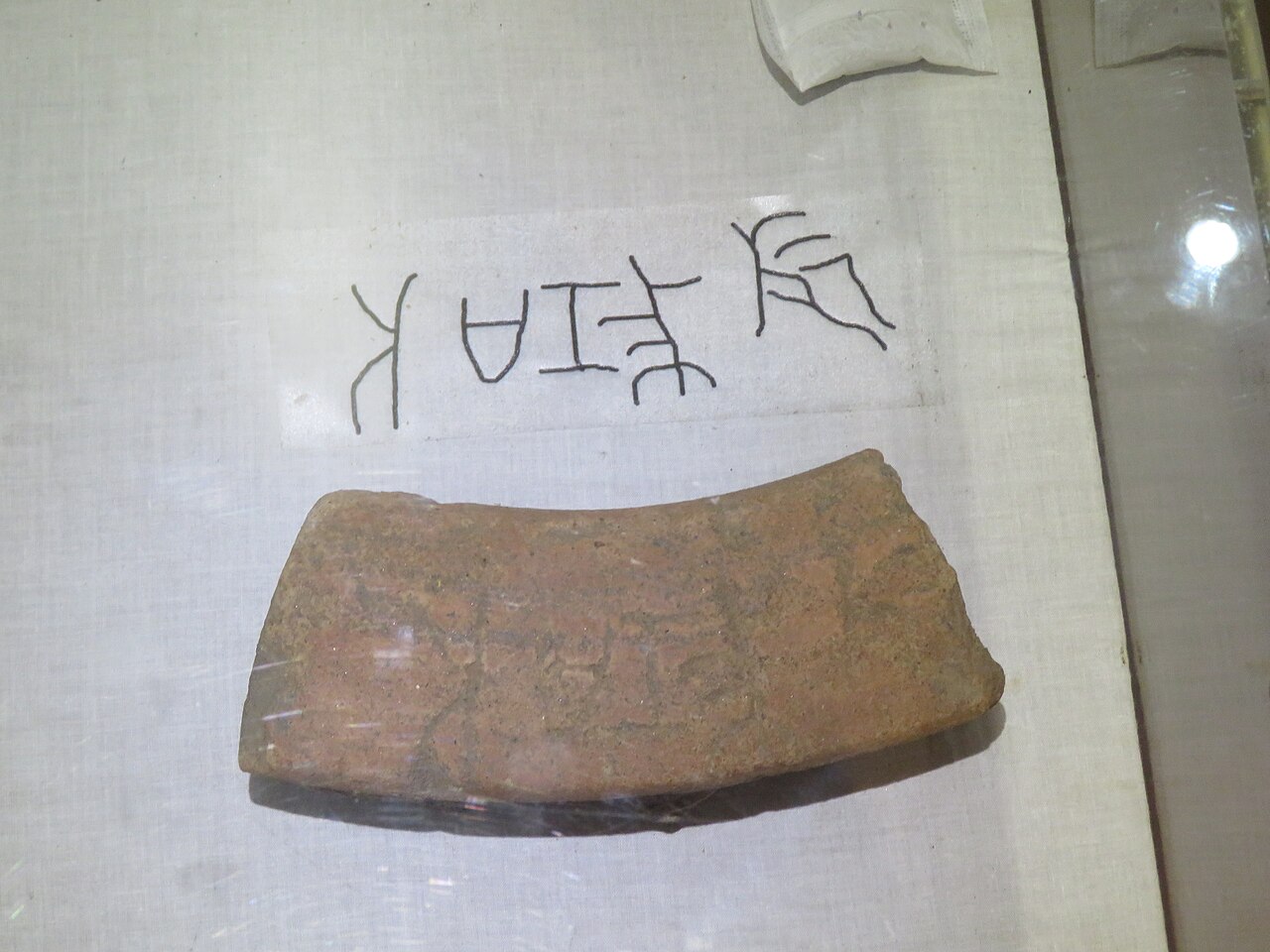
Pattanam · Photographed 2018-01-21 00:16
A sherd displayed as bearing Tamil-Brahmi writing at Pattanam Museum
A sherd displayed as bearing Tamil-Brahmi writing at Pattanam Museum; the exhibition includes a modern tracing above it.
The tracing is not a facsimile or an independent reading of the inscription.

Jambai · Photographed 2011-12-25
Rock-cut beds at the Jambai Jain shelter

Kunnakkudi · Photographed 2025-08-06 16:57:27
Interior of the boulder shelter and stone beds at Kundrakudi (Kunnakkudi)

Sittanavasal · Photographed 2018-08-10 12:53:36
Rock-cut beds beneath the overhang at Ezhadippattam, Sittanavasal
Not every bed and inscription visible here dates from the time of the early Tamil-Brāhmī inscription.

Arittapatti · Photographed 2017-01-09 11:41:18
Tamil-Brahmi inscription on the rock face at Arittapatti
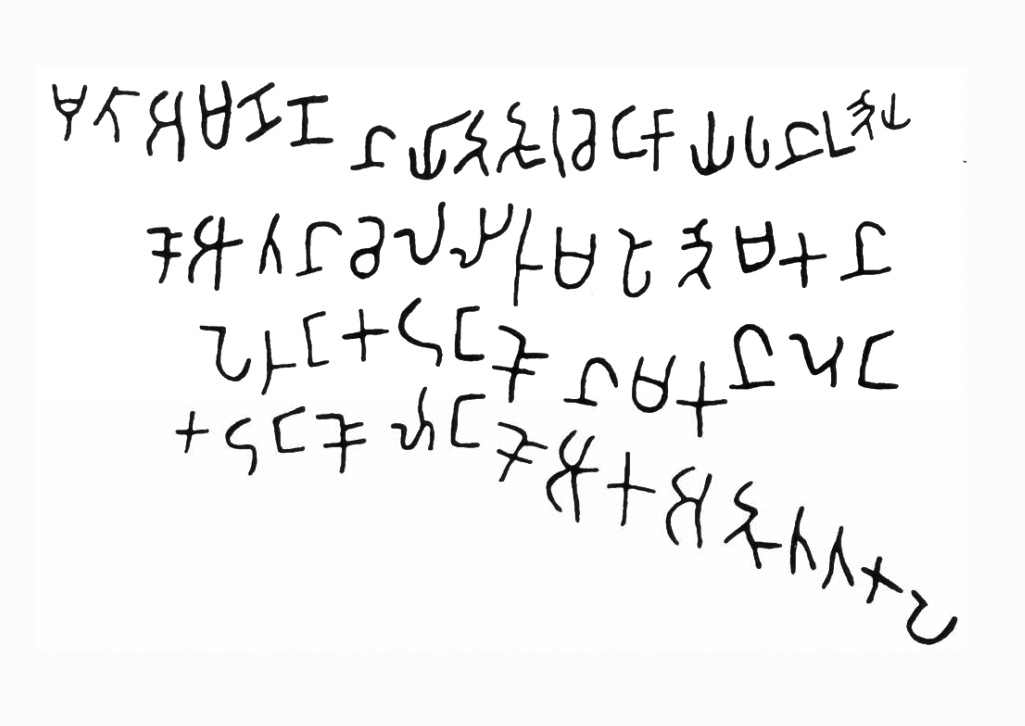
Pugalur · Ancient inscription assigned by source to circa 1st–2nd century CE; this tracing was created/uploaded in 2018
Modern line tracing of a Pugalur Tamil-Brahmi inscription, credited to Rajesh of Raigad in the 2018 Commons record
Modern line tracing of a Pugalur Tamil-Brahmi inscription, credited to Rajesh of Raigad in the 2018 Commons record. This is an epigraphic representation, not a photograph of the inscribed rock.
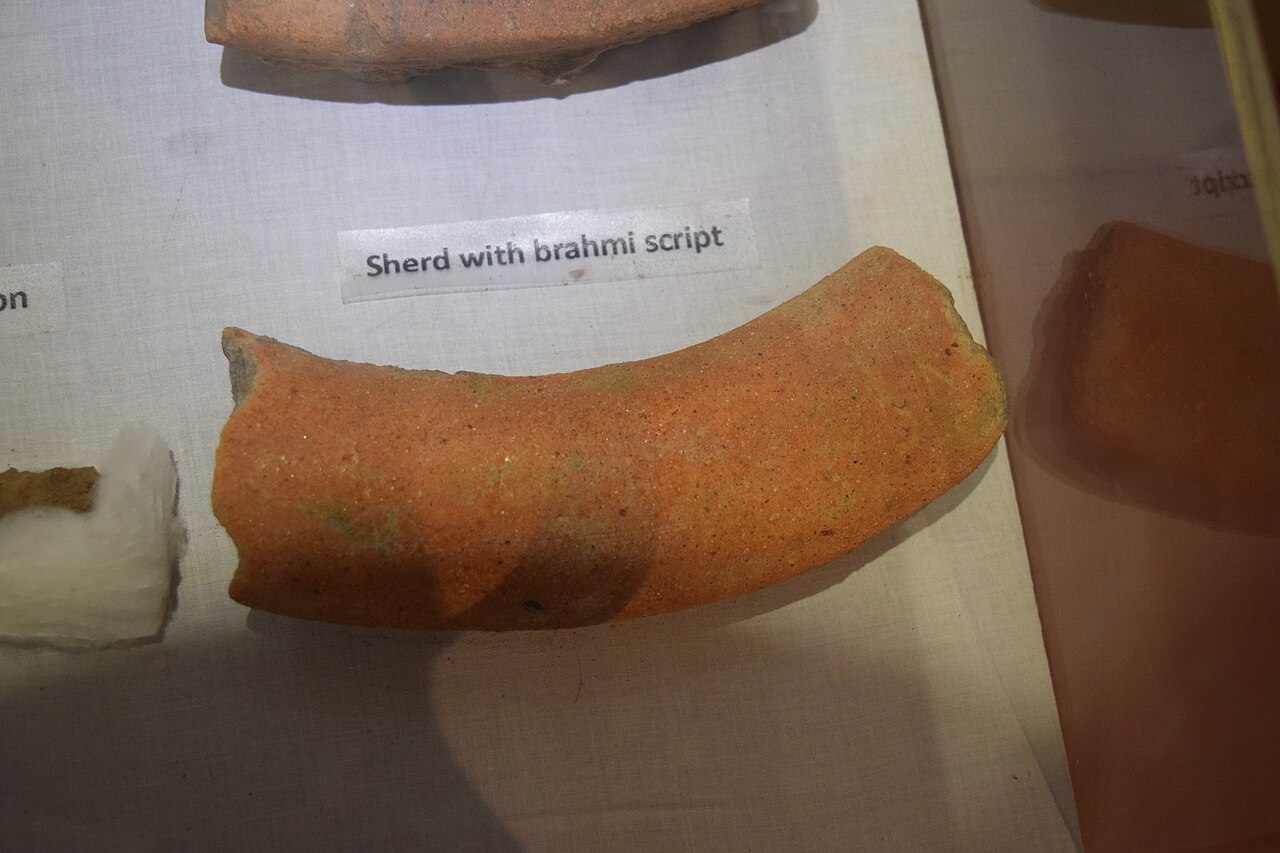
Pattanam · Photographed 2019-01-13 15:37
A sherd displayed as bearing Brahmi writing at Pattanam Museum

Jambai · Photographed 2011-12-25
Entrance and floor of the Jain rock shelter at Jambaimalai
Show 9 more photographs and source images ↓

Kunnakkudi · Photographed 2025-08-06 16:55:45
Closer view of the inscribed rock face at Kundrakudi (Kunnakkudi)

Sittanavasal · Photographed Taken on 16 May 2012, 18:03:51
Rock-cut bed and inscription at Ezhadippattam, Sittanavasal
Not every bed and inscription visible here dates from the time of the early Tamil-Brāhmī inscription.
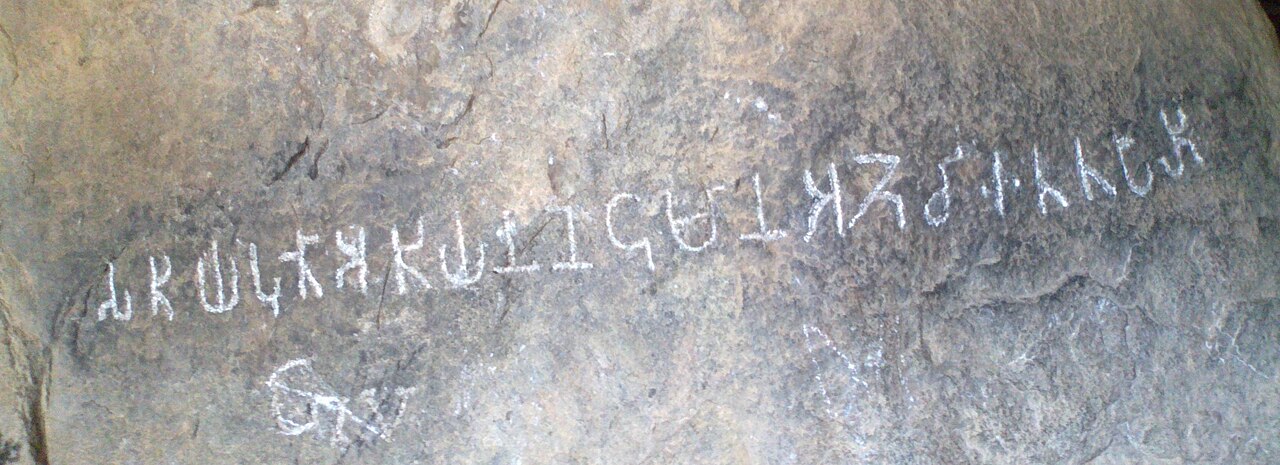
Jambai · Photographed 2011-12-25
Jambai Tamil-Brahmi inscription on the rock surface, with modern highlighting visible

Kunnakkudi · Photographed 2025-08-06 16:54:30
Boulder overhang sheltering the beds and inscriptions at Kundrakudi (Kunnakkudi)

Sittanavasal · Photographed 2018-08-10 12:53:31
Close view of a rock-cut bed and surrounding inscriptions at Ezhadippattam, Sittanavasal
Not every bed and inscription visible here dates from the time of the early Tamil-Brāhmī inscription.

Kunnakkudi · Photographed 2025-08-06 16:54:03
Rock surface above the bed shelter at Kundrakudi (Kunnakkudi)

Sittanavasal · Photographed 2023-01-20
Inscribed raised edge of a rock-cut bed at Ezhadippattam, Sittanavasal
Not every bed and inscription visible here dates from the time of the early Tamil-Brāhmī inscription.

Kunnakkudi · Photographed 2025-08-06 16:56:51
Rock-cut beds beneath the low boulder overhang at Kundrakudi (Kunnakkudi)

Sittanavasal · Photographed Taken on 24 January 2012, 10:24:46
Protected rock-shelter ledge at Ezhadippattam, Sittanavasal
Not every bed and inscription visible here dates from the time of the early Tamil-Brāhmī inscription.
005Two views
Both views are shown at equal weight; this site does not choose between them.
When people first wrote Tamil in Brahmi letters
- One view
- Iravatham Mahadevan, from letter shapes, linked the adaptation to Mauryan Brahmi; his surviving corpus begins around the second century BCE.
- Another view
- K. Rajan argues that radiocarbon dates from excavated sites push writing back into the first half of the first millennium BCE.
- What would settle it
- Published records tying specific inscribed sherds to sealed, dated layers, with full laboratory reports for each sample.
006Where next
All related studies, connected material, books and sources37 · 7
Elsewhere on this site
Excavation Atlas Sites: Kodumanal (Noyyal River Craft & Trade Town) · Keezhadi (Vaigai River Brick Settlement) · Porunthal Habitation & Megalithic Grave Site
Junior Detective Quests: Writing on a Broken Pot: What Scratched Letters Show
Classroom Lesson Plans: Module 4 · From Cave Drip-Ledges to Potsherds: Scripts & Literacy in the Deep South
Multi-Script Glossary Terms: Tamiḻi (Tamil-Brāhmī) (தமிழி (தமிழ் பிராமி) / തമിഴി (തമിഴ് ബ്രാഹ്മി)) · puḷḷi (புள்ளி / പുള്ളി / ചന്ദ്രക്കല) · ḻa (Retroflex Approximant ழ / ഴ) (ழ / ഴ) · Pulimāṉkōmpai & Tāttāppaṭṭi Hero-Stone Epigraphs (புலிமான்கோம்பை & தாத்தாப்பட்டி நடுகல் கல்வெட்டுகள் / പുലിമാൻകോമ്പൈ, താത്താപ്പട്ടി വീരക്കൽ ലിഖിതങ്ങൾ) · nikamam (Merchant Guild / Market Town in Tamil-Brāhmī) (நிகமம் (வணிகர் குழு) / നിഗമം (വ്യാപാര സംഘം))
Connected material
Photographs, drawings, books, videos and other studies linked to this study. A link helps you explore; it does not prove a historical claim.
- A sherd displayed as bearing Tamil-Brahmi writing at Pattanam MuseumphotographBackground
- A sherd displayed as bearing Brahmi writing at Pattanam MuseumphotographBackground
- Jambai Tamil-Brahmi inscription on the rock surface, with modern highlighting visiblephotographBackground
- Rock-cut beds at the Jambai Jain shelterphotographBackground
- Entrance and floor of the Jain rock shelter at JambaimalaiphotographBackground
- Tamil-Brahmi inscription on the rock face at ArittapattiphotographBackground
- Rock-cut bed and inscription at Ezhadippattam, SittanavasalphotographBackground
- Protected rock-shelter ledge at Ezhadippattam, SittanavasalphotographBackground
- Rock-cut beds beneath the overhang at Ezhadippattam, SittanavasalphotographBackground
- Close view of a rock-cut bed and surrounding inscriptions at Ezhadippattam, SittanavasalphotographBackground
- Inscribed raised edge of a rock-cut bed at Ezhadippattam, SittanavasalphotographBackground
- Boulder overhang sheltering the beds and inscriptions at Kundrakudi (Kunnakkudi)photographBackground
- Rock surface above the bed shelter at Kundrakudi (Kunnakkudi)photographBackground
- Closer view of the inscribed rock face at Kundrakudi (Kunnakkudi)photographBackground
- Rock-cut beds beneath the low boulder overhang at Kundrakudi (Kunnakkudi)photographBackground
- Interior of the boulder shelter and stone beds at Kundrakudi (Kunnakkudi)photographBackground
- Modern line tracing of a Pugalur Tamil-Brahmi inscription, credited to Rajesh of Raigad in the 2018 Commons recordmodern epigraphic tracingBackground
- A groove has a historydiagramThis study separates a radiocarbon date from the moment letters were cut, the timing question this drawing teaches.
Books, videos and websites
Outside reading on this topic. These are not part of the study and we have not checked every claim in them. See all books and videos
- Early Writing System: A Journey from Graffiti to Brahmi Book · K. Rajan · 2015 · Synthesizes decades of stratigraphic excavations at Kodumanal, Porunthal, and Mayiladumparai, cataloguing over 1,000 post-firing graffiti marks and Tamil-Brāhmī potsherds recovered from habitation and burial contexts.
- Emma Brownlee: seventy years of radiocarbon archaeology Video · Emma Brownlee · Historic England; St Cross College, University of Oxford event · 47:21 · A longer lecture about radiocarbon dating and its effects on archaeological research. A deeper companion to the 86-second Oxford laboratory introduction. General history and method. This recording does not independently verify Tamil-Brahmi chronology or specific early iron-use dates.
- 17 | Dr. V. Selvakumar | Early Tamil Society literature, epigraphy and archaeology |11 April 2017 Video · V. Selvakumar · Tamil University, Thanjavur · 2:02:22 · The second session covers early scripts, inscriptions on different media, religious and mercantile connections, and archaeological reconstruction. A useful bridge from individual inscriptions to the evidence and reasoning used by archaeologists. The description explicitly presents earlier starting dates as research proposals. Preserve that uncertainty; the recording is from 2017.
- Tamil Heritage Trust- Iravatham Mahadevan’s contributions" talk by M V Bhaskar Video · M. V. Bhaskar · Tamil-Brahmi documentation project collaborator; AuthorCafe · 1:38:09 · A close collaborator describes Iravatham Mahadevan’s Tamil epigraphy and Indus-sign research and documentation methods. Credits both the pioneering scholar and a participant in the practical work of preserving and organizing inscriptions. Includes Indus-script hypotheses. The organizer explicitly says the Indus signs remain undeciphered; present proposals as proposals. This is Bhaskar speaking about Mahadevan, not Mahadevan himself.
007Sources
The study lists the sources it consulted; we have not rechecked them. A working link does not show that a source was read, and a valid identifier does not show that it supports a claim. We do not link to unofficial uploads or copies of publications. Where a study cited one, we show the published citation, or a publisher, DOI or Internet Archive link when we have one. Tracking codes are removed from links, and the sources themselves are not republished here.
Iravatham Mahadevan Early Tamil Epigraphy From The Earliest Times To The Sixth Century A. D.
K. Rajan (2014), Early Historic Transition in South India (source link 2)
Online copy not linked · use the published editionSource recordcdn.thewire.in · கீழடி English 08.08.19 1776Words.pdf
K. Rajan and V. P. Yatheeskumar, 'New Evidences on Scientific Dates for Brāhmī Script as Revealed from Porunthal and Kodumanal Excavations,' Prāgdhārā (2013)
Print or offline sourceSource recordUnofficial online copy (link not shown)
Owners graffiti on pottery from Tissamaharama (source link 5)
Online copy not linked · use the published editionSource recordIntroduction to The Oxford Handbook of Dravidian Languages
Iravatham Mahadevan, Early Tamil Epigraphy, Vol. I: Tamil-Brāhmī Inscriptions (2nd rev. ed., CICT, 2014)
Researchers and institutions whose work this study uses: Iravatham Mahadevan, K. Rajan
How we know The evidence, claims and dates behind this study
What this study draws on
- Mahadevan's 2003 corpus: comparison of letters with Brahmi and the history of the puḷḷi dot.
- K. Rajan's 2013 article and 2014 lecture, with the radiocarbon table for Porunthal and Kodumanal.
- The Tamil Nadu archaeology department's 2019 Keezhadi booklet.
- Harry Falk's 2014 challenge to the Porunthal reading, and a 2025 Oxford Handbook summary as later reception.
Dates in this study
This study has no dates recorded in a form we can chart, so there is no date chart. Any dates it gives are in the full study.
The study’s claims
15 claims · 0 source passages · 54 paragraphs
Browse the study paragraph by paragraphTamil-Brahmi is structurally derived/adapted from the Brahmi writing tradition.
Supported in this study
Supports; Mahadevan. Establishes script relationship much more strongly than absolute first-use date.
Most of Mahadevan’s basic Tamil-Brahmi inventory closely corresponds in form and value to Brahmi, while Tamil-specific requirements produced modifications/additions.
Supported in this study
Supports; source’s comparative analysis.
Mahadevan argued from early letter shapes that Tamil-Brahmi borrowing/adaptation belonged no later than the end of the Mauryan period.
Supported with qualifications
Supports that Mahadevan proposed this date; does not independently prove the date.
Mahadevan’s Early Tamil-Brahmi corpus was broadly assigned to c. second century BCE–first century CE.
Supported with qualifications
Supports older chronology.
Puḷḷi is a later orthographic development and should not be projected into the script’s earliest stage.
Supported in this study
Supports; earliest examples placed around end first century CE.
Porunthal Beta-302854 produced a conventional radiocarbon age of 2440±30 BP from paddy, with broad two-sigma calibrated intervals.
Supported in this study
Supports the sample date, not by itself an inscription date.
Porunthal Beta-305904 produced 2400±30 BP from paddy, again with a broad calibrated range.
Supported in this study
Same limitation.
Rajan’s interpretation of the Porunthal va-y-ra ring-stand marks as Brahmi is disputed.
Debated in the sources
Rajan/Yatheeskumar support; Falk challenges. The dispute concerns sign identification rather than the AMS age of the paddy.
Kodumanal has multiple radiocarbon determinations from a stratified settlement containing abundant inscribed pottery.
Supported with qualifications
Supports early occupation horizons; individual inscription associations require context-specific checking.
A sixth-century BCE starting point at Kodumanal is partly based on downward extrapolation beyond the deepest dated sample.
Supported with qualifications
Rajan explicitly calls the calculation hypothetical.
Keezhadi’s 2019 publication reports a carbon sample at 353 cm assigned to 580 BCE.
Supported in this study
The accessible booklet omits core laboratory metadata.
The same Keezhadi publication reports 56 Tamil-Brahmi-bearing potsherds.
Supported in this study
Does not establish that an illustrated sherd is directly associated with the 580 BCE sample.
The consulted Keezhadi booklet does not provide a direct auditable 580 BCE date for a named inscription.
Supported with qualifications
Absence from the consulted short publication is not proof that fuller field/lab documentation does not exist elsewhere.
Megalithic graffiti cannot presently be treated as a demonstrated phonetic ancestor of Tamil-Brahmi.
Supported with qualifications
Competing interpretations exist; resemblance alone does not establish genealogy or language.
Later scholarship has adopted the sixth-century BCE chronology more confidently than the primary contextual documentation read here warrants.
Supported with qualifications
Describes reception, not a new independent dating result.
About this study Status, corrections and how it was made
Status
Draft study, revision 5. No historian, archaeologist, or Tamil or Malayalam specialist has reviewed it yet.
How it was made
Compiled as an editorial synthesis from published scholarship around questions we framed. About this project & workflow
The summary, How sure lines and Two views notes on this page were prepared from this study and cross-checked against its passages. That is an editorial check, not a specialist review.
Corrections and updates
Technical details
Study code R112. The text fingerprint changes whenever the study text changes.
- Table headings decide what each column means. Citation links, sample mentions and dates copied as text are kept apart from checked source passages and calibrated measurements.
See how this study’s records were extracted
Text fingerprint (SHA-256): R112 · 642350e6dc12eb0d8ab4d724… · v5
Evidence tables and technical details are on the web page: https://layersofthesouth.org/read/6c4c888dab