Brickwork and associated deposits exposed at Keezhadi (Keeladi)
Keezhadi
Photographed 2019-09-06
- How we know
- Sivagalai
- Mayiladumparai
Tamil Nadu: no single Iron Age to Early Historic boundary shown
Laboratory dates across Tamil Nadu show that burial, iron, writing and town life must each be dated separately, region by region.
- This page
- 4,084 words · revision 8
Draft study · Awaiting specialist review · Updated
001Dates and places
Places on the atlas that name this study.
- Sivagalai Urn Burial & Habitation Complex
Excavated site zone · Thoothukudi District
- Mayiladumparai Iron Age & Microlithic-to-Early Historic Site
Excavated upland zone · Krishnagiri District
Before 1000 BCE
1000–500 BCE
Different beginnings
500–200 BCE
Marks & materials
200 BCE–300 CE
Connected worlds
300–600 CE
Change & continuity
- 2763 BCE representative calibrated age reported for Thelunganur AA-104832 in the 2025 compilation
- 1769–1615 BCE for Kilnamandi MEG-3 as reported in institutional summary
- 1438–1261 cal BCE for AMS date on carbon extracted from the Thelunganur steel sword in Rajan 2014 (3089±40 BP)
- 1155 BCE representative calibrated age for Sivagalai Beta-600726 from A2/Urn 3
- Selected Adichanallur core-period representative ages approximately 908–618 BCE
- TF-987 wood: 2680 ± 90 BP (5568-yr half-life, '730 BC') / ~2755 ± 95 BP (5730-yr half-life), ~1055–545 cal BCE; summarized as 785 BCE charcoal in TNSDA Korkai summary
- 685 BCE representative calibrated age for Sivagalai Beta-600727 habitation sample
- Keeladi Table 9 (35 AMS entries): earliest Beta-519476 (2530±30 BP; ~792–545 cal BCE IntCal20 on Hallstatt plateau) through Beta-620260 (1750±30 BP; 4th c. CE)
- Representative Kodumanal scientific-date table ages approximately 480 BCE to 99 BCE
- 380 BCE, legacy conventional expression for Paiyampalli TF-350
- Laboratory date
Each date belongs to what was dated (a sample, an object, a layer or a text), which is not always the event the study asks about.
Each period has the same width, so spacing is not to scale.
The full table of dates, with their ranges, is under How we know.
- 1 Well supported
- 1 Likely
- 1 Possible
- 1 Not known
002How sure
In brief
This overview compares dated sequences across five parts of Tamil Nadu: the north, west, Kaveri corridor, Vaigai and Thamirabarani, drawing on K. Rajan's 2014 synthesis and 2025 state compilations of scientific dates. Kodumanal in the west has 2012–13 AMS dates reaching into the fifth century BCE (on the Hallstatt calibration plateau). Keeladi on the Vaigai has 35 AMS dates running from the Hallstatt plateau (including Beta-519476 at 2530 ± 30 BP, ~792–545 cal BCE, rather than a point date of 580 or 531 BCE) into the Common Era. State department monographs also publish pre-1000 BCE dates for iron-associated burials such as Kilnamandi and Sivagalai, though those rest on department publications rather than peer-reviewed journals and disputed fourth-millennium Sivagalai claims are excluded here. The Kaveri corridor has no comparable dated series in the sources consulted. Burial, iron, writing and urbanism each require separate dating, and no single statewide Iron Age–Early Historic boundary is demonstrated.
Key researchers cited in this study: K. Rajan (Kodumanal & Porunthal Excavations / Epigraphy) · R. Sivanantham (TNSDA Keezhadi / Keeladi & Tamil Nadu Excavations) · K. Amarnath Ramakrishna (ASI Keezhadi / Keeladi Excavations, Seasons I–II) · K. V. Raman (Uraiyur, Kanchipuram & Alagankulam Excavations) · Full bibliography
How sure
- Well supported
Keeladi has dated habitation deposits from the eighth–fifth centuries BCE (Hallstatt plateau) into the Common Era.
Shown by a series of 35 AMS dates in the state's 2025 compilation; individual early ages on the c. 800–400 BCE plateau calibrate to multi-century spans rather than single years.
- Likely
Iron-associated burials in Tamil Nadu predate 1000 BCE.
Most early dates are on associated organic material rather than the iron itself, while Thelunganur (3089 ± 40 BP) was measured on carbon extracted from the sword steel itself, dating the charcoal fuel rather than the forging. Several second-millennium dates rest on state department monographs rather than peer-reviewed journals; disputed fourth-millennium Sivagalai claims are excluded.
- Possible
Kodumanal's occupation began in the mid-sixth century BCE.
Rajan's own wording calls the extension below the dated levels hypothetical.
- Not known
The sixth century BCE marks the Early Historic start across Tamil Nadu.
Defensible for some western and Vaigai sites, but not a demonstrated universal boundary.
Why it matters
It shows why the earliest date for one thing, such as iron, cannot date writing or towns.
003Key findings
What the study concludes
- No single Tamil Nadu-wide Iron Age/Early Historic boundary is demonstrated by the consulted evidence.
- The sixth century BCE is important in some western and Vaigai arguments but is not a universal phase boundary.
- Early iron-associated radiocarbon dates normally date associated organic material and context, not iron metal directly.
- Tamil-Brahmi must be dated through secure sherd-context-sample relationships, not site-level co-occurrence alone.
In the study’s own words. How sure each point is, is shown above.
The summary above is the short read. The full study is the complete text it was drawn from, with its tables and source notes.
What the full study covers
004The study
Question, scope and chronology
Question: How do the independently dated regional sequences across Tamil Nadu compare, and where are the major gaps or incompatible periodizations?
This study compares northern, western, central/Kaveri, Vaigai, and Thamirabarani sequences, while explicitly separating occupation, burial, iron use, writing, and urbanization rather than transferring the earliest date for one process to all the others. The window of 1000 BCE–600 CE is the period this site covers, not a claim that every relevant development began or ended at those boundaries.
The resulting chronological scope is mixed. Several increasingly important radiometric results for iron-associated burials and habitation fall before 1000 BCE and therefore belong here only as earlier background, which gives context but is not part of the main period. Most of the comparative archaeological problem lies within the core period. Modern arguments about whether particular sites should be called “urban,” whether Tamil-Brahmi writing should be moved earlier, and whether a statewide Iron Age/Early Historic boundary can be placed in the sixth century BCE are later interpretations of core-period evidence, not independent ancient events.
The principal conclusion is negative in a productive sense: there is no defensible single phase boundary that can presently synchronize the whole of Tamil Nadu. K. Rajan's methodological discussion is especially important because it warns that “megalithic” describes mortuary practice rather than a single uniform culture and notes that outwardly similar cairn circles at different sites can conceal different burial structures and chronologies. He also stresses that mortuary and habitation sequences need not have the same boundaries. ↗1
Orientation
Tamil Nadu's chronology is better represented as a matrix of partly independent regional and behavioural sequences than as a ladder running from “Iron Age” to “Early Historic” everywhere at once. The strongest recent absolute-date sets are unevenly distributed: Kodumanal supplies a substantial western sequence (with 2012–13 AMS dates reaching the fifth century BCE; see also “Kodumanal made stone beads and smelted iron on site”); Keeladi supplies the densest read Vaigai AMS series; Adichanallur and Sivagalai supply unusually important southern burial/habitation evidence; while the central Kaveri corridor, despite major excavated sites such as Karur and Uraiyur, is much less well represented in the accessible absolute-date corpus. ↗2
The major distinction is between what was dated and what historians want to infer from it. A radiocarbon date is a laboratory measurement of the age of organic material such as charcoal or grain. It is reported in years BP (“before present”) and then calibrated into calendar ranges, which can be wide or split into several parts. A charcoal or grain date from an occupation deposit dates the sampled organic material and its archaeological association; it does not, without a demonstrated contextual chain, directly date every wall, potsherd, inscription, iron object, burial rite, political formation, or claim of urbanization at the site. The same caution applies to recently publicized “early iron” dates: the radiocarbon measurement is normally on associated organic matter, not on metallic iron itself. The archaeological association can be strong and historically consequential without becoming a direct metallurgical date. ↗3
The following comparison therefore records observed coverage in the sources read, not an interpolated civilization-wide chronology:
| Region | Strongest observed chronological evidence | What it dates most securely | Main limitation |
|---|---|---|---|
| Northern / north-eastern | Paiyampalli legacy radiocarbon; Kilnamandi burial-context dates | Particular occupation/burial contexts | Long chronological and publication gaps separate important observations |
| Western / north-western interior | Kodumanal AMS series, with Porunthal as comparison | Stratified occupation/craft-related deposits and selected contexts | Proposed extension into the mid-sixth century BCE partly rests on extrapolation below directly dated Kodumanal levels |
| Central / Kaveri corridor | Karur and Uraiyur excavation records and artefact sequences | Occupation/artefact associations | No comparably dense modern absolute-date series was located in the consulted corpus |
| Vaigai | Keeladi multi-sample AMS series | Successive sampled habitation deposits | Earliest dates do not automatically date writing, every structure, or “urbanization”; first ASI seasons remain publication-contested |
| Thamirabarani | Adichanallur and Sivagalai burial/habitation series; Korkai | Burials, habitation contexts, and selected dated deposits | Many dates fall in earlier background; internal period labels are inconsistent and CE coverage is thinner |
This unevenness is itself one of the findings. Rajan's 2014 review already described the south Indian Iron Age/Early Historic boundary as difficult to define because region-specific chronological control was inadequate, and his concluding discussion characterized evidence for technology, resources, settlement and trade routes as sporadic across regions. ↗4
Evidence architecture and dating cautions
The most useful recent consolidation is K. Rajan, R. Sivanantham and V. P. Yathees Kumar's 2025 Recent Scientific Dates: Archaeological Sites of Tamil Nadu (First edition, viii + 94 pp., ISBN 9788197784279), an official Department of Archaeology publication catalogued by the Tamil Virtual Academy. Its tables bring together radiocarbon and other determinations from multiple Tamil Nadu sites, though full calibration probability curves and laboratory certificates must still be checked behind summary tables. ↗5
Where a conclusion depends on the shape of a calibration result, a single “calibrated age” printed in a compilation is insufficient. Rajan's 2014 radiocarbon table is particularly instructive. For Porunthal sample Beta-302854 the printed table preserves multiple calibrated ranges – approximately 750–680, 670–610 and 600–410 BCE – rather than one midpoint; Beta-305904 likewise gives separated ranges around 720–700 and 540–400 BCE. The table was visually read in the PDF. These examples demonstrate why a representative year should not silently replace a disjoint probability distribution. ↗6
COMPARE WITH ANOTHER STUDY
A Thelunganur sword grave has two published dates far apart
This study finds two published radiocarbon dates linked to the sword burial at Thelunganur in Tamil Nadu. K. Rajan’s 2014 paper gives 1438–1261 BCE. A 2025 Tamil Nadu list of dates gives about 2763 BCE. The gap is too large to average or explain away, so the study keeps both until the laboratory certificate and burial records are found. It does not show that both figures describe the same sample.
There is also evidence of record-level inconsistency that must be resolved before very early dates are used as fixed chronological anchors. Rajan's 2014 discussion reports an AMS determination measured directly on carbon extracted from the steel of the Thelunganur sword itself as 3089 ± 40 BP (1438–1261 cal BCE), so the primary chronological caveat is old charcoal fuel used during smelting rather than an unrelated surrounding deposit. The 2025 compilation instead lists a Thelunganur grave/sword sample with laboratory identifier AA-104832 at 4208±35 BP and a representative calibrated age of 2763 BCE. That is too large a discrepancy to harmonize editorially. Until the laboratory certificate, sample register, burial documentation and any correction history are recovered, the two records should remain separate and explicitly unresolved. ↗7
A second kind of inconsistency concerns archaeological period labels rather than laboratory measurements. The 2025 Adichanallur table prints Beta-519500 from Urn 105 twice at approximately 2700±30/31 BP, but one row is represented around 850 BCE and called “Early Historic” while another is represented around 855 BCE and called “Iron Age.” Other Adichanallur rows are labelled “Iron Age–Early Historic transition.” The radiometric evidence can therefore be retained while the phase terminology is treated as unstable metadata rather than an objective date boundary. ↗8
This distinction is central to the present comparison: a radiometric measurement, a stratigraphic association, an excavator's cultural-period label, and an historian's regional periodization are four different inferential steps.
Regional comparison
Northern and north-eastern Tamil Nadu
Paiyampalli remains a useful legacy anchor because its excavation history explicitly separated a Neolithic Period I from a later “Megalithic” Period II. S. R. Rao's report summarized radiocarbon determinations for these phases, while the ASI's 1965–66 radiocarbon listing recorded TF-350, charred grain from a post-Megalithic pit, as 2330±105 BP and expressed it conventionally as 380 BCE. These are legacy determinations; the printed BCE conversion should not be mistaken for a modern calibrated interval using a current calibration curve. ↗9
Kilnamandi substantially changes the northern background but does not create a continuous sequence from Paiyampalli. The 2025 iron-antiquity programme reports a burial-associated sample from MEG-3, associated with a sarcophagus and iron objects, at 3400±30 BP; the institutional summary gives a calibrated range of 1769–1615 BCE, while the later compilation uses 1692 BCE as a representative age. This is important earlier background for iron-associated mortuary activity, not a date for all later northern occupation, writing, or social organization. ↗10
The chronological problem in the north is therefore discontinuity: important early burial evidence exists, and later Early Historic evidence exists, but the present source set does not supply a densely sampled, region-wide bridge across the intervening centuries.
Western and north-western interior
Kodumanal provides the strongest worked sequence in the western comparison. The 2025 table includes samples represented at about 480 BCE (AA-99855, 2358±40 BP), about 380/370 BCE, about 200 BCE and into the later second/first centuries BCE; Beta-583599, 2090±30 BP, is printed with a calibrated range approximately 190 BCE–8 BCE and a representative age around 99 BCE. ↗11
Rajan's earlier argument proposed pushing Kodumanal's lower occupation toward the middle of the sixth century BCE by extrapolating from the dated portion into an additional c. 65 cm of lower cultural deposit. Crucially, his own wording identifies this as hypothetical. The appropriate regional conclusion is therefore that direct radiometric support reaches securely into the fifth century BCE in the consulted data, while a mid-sixth-century beginning remains an argued stratigraphic extrapolation rather than another measured sample. ↗12
Porunthal is valuable as a western/southern-interior comparator precisely because its calibration ranges illustrate chronological uncertainty rather than an exact founding date. It should not be reduced to one headline year when the consulted table preserves several possible calibrated ranges. ↗13 “Porunthal's graves hold dated rice; the writing claim is disputed” reports the analytical paper's own calibrated ranges for Porunthal samples Beta-302854 and Beta-305904, calculated with CALIB 7.0 and IntCal13; they differ in detail from the ranges printed in Rajan's 2014 table, and the reason has not been established here.
Central and Kaveri corridor
The central region exposes a different problem: archaeological importance is not the same as absolute chronological density. The Tamil Nadu Department of Archaeology's Karur account documents Tamil-Brahmi potsherds, amphora fragments, rouletted ware and other Early Historic material, while K. V. Raman's edited Excavations at Uraiyur (Tiruchirappalli), 1965–1969 is a major excavation report. In the corpus checked here, however, the Uraiyur volume was traced only at bibliographic level, and neither Karur nor Uraiyur appeared in the read 2025 tables as a multi-sample absolute sequence comparable to Keeladi or Kodumanal. ↗14
That result is an observed publication/access gap, not a claim that central Tamil Nadu was empty or historically unimportant. It means that a comparative chronology should not fill the Kaveri corridor with dates imported from better-sampled regions. Full Uraiyur stratigraphic tables, Karur scientific appendices and later Kaveri-site laboratory series are priority acquisitions.
Vaigai basin
Keeladi is quantitatively the strongest accessible Vaigai sequence. Table 9 of the 2025 scientific-date compilation contains 35 AMS entries, and Beta-620260 (1750 ± 30 BP) extends into the fourth century CE (tabled around 357 CE). For the earliest charred sample, Beta-519476 (2530 ± 30 BP), TNSDA's tables print 580 BCE (= 2530 − 1950) and a single year 531 BCE, whereas standard IntCal20 (95.4%) calibrates 2530 ± 30 BP to approximately 792–545 cal BCE on the Hallstatt calibration plateau (c. 800–400 BCE) (leaving 531 BCE outside the standard 95.4% interval); Beta-583579 (2490 ± 30 BP, single table year 563 BCE) similarly calibrates across ~774–486 cal BCE. Taken together, the series demonstrates dated habitation deposits by at least the sixth century BCE (calibrating from the eighth–fifth centuries BCE on the plateau) into the early centuries CE. ↗15 “Keezhadi's excavations reveal a substantial brick settlement” examines the Keeladi excavations and their calibration limits in detail.
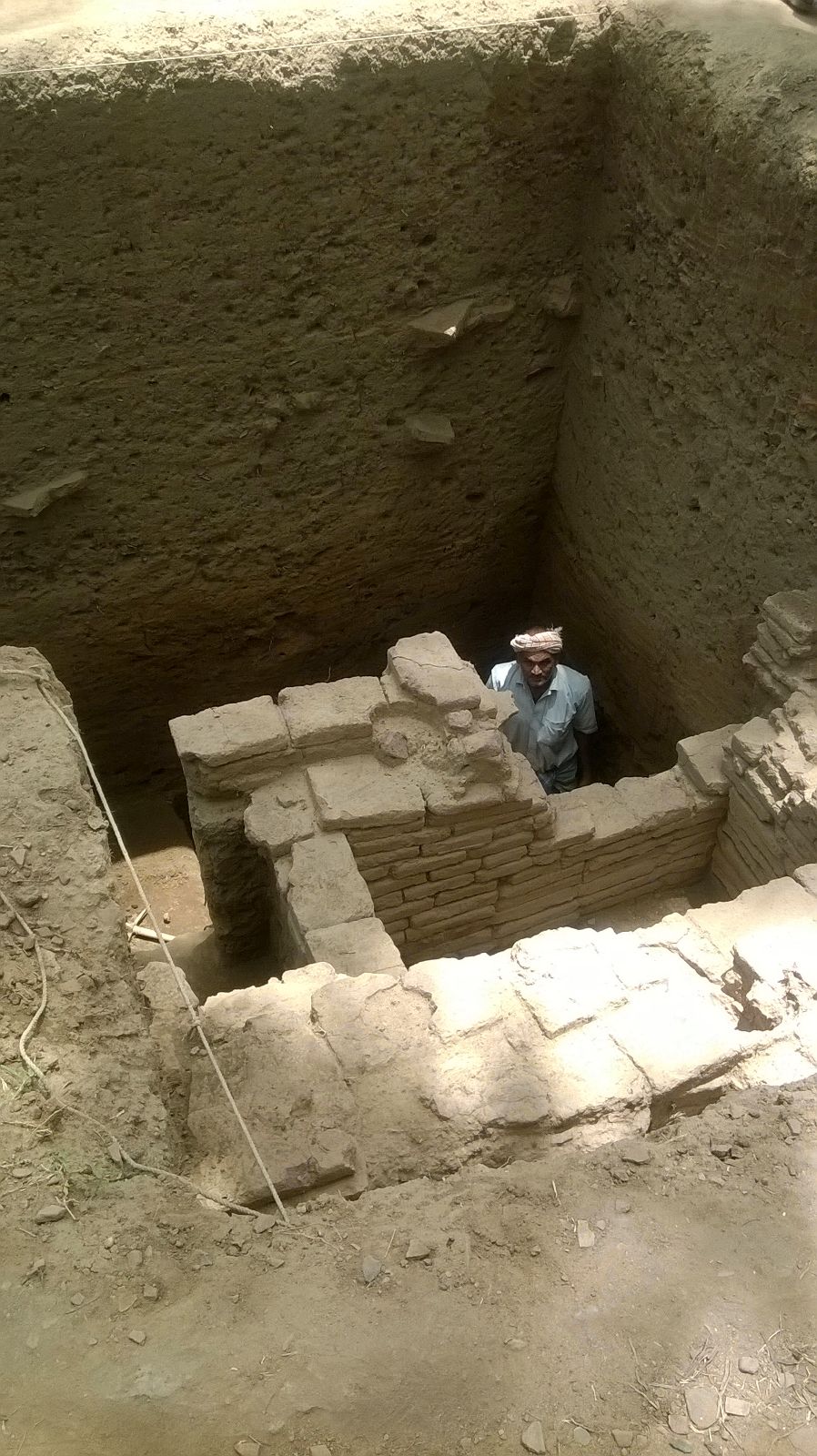
Excavated brickwork within a Keezhadi trench in 2015
Keezhadi
Photographed 2015-09-14
The table does not, by itself, prove that every Keeladi structure, Tamil-Brahmi sherd, craft activity or proposed urban characteristic existed in 563 BCE. Samples come from multiple trenches and depths rather than one simple vertical sequence. The Tamil Nadu Department of Archaeology interprets the early dates as supporting a sixth-century-BCE horizon and associates Keeladi with substantial brick architecture, ring wells, craft production and Tamil-Brahmi finds, but those are attributed institutional interpretations whose contextual chains must be tested object by object. ↗16
The publication status of the first ASI seasons is a consequential access problem. A July 2025 Government of India parliamentary response described the report as submitted and evaluated by experts, while February and mid-2026 accounts document continuing disagreement between excavator K. Amarnath Ramakrishna and ASI reviewers and an announced re-examination. The complete report was therefore not treated here as a consulted published primary source. ↗17
Thamirabarani basin
Adichanallur and Sivagalai contain the strongest evidence that “Iron Age,” burial chronology and Early Historic chronology cannot be made synonymous. The 2025 compilation includes Adichanallur determinations extending well before 1000 BCE, including very early habitation/burial-associated results, but it also contains core-period determinations around 1052, 908, 855/850, and the later eighth–seventh/sixth centuries BCE. One paddy-husk sample, IUACD23C5694, is reported at 2759±33 BP with a representative age of about 908 BCE; another selected sample is represented around 618 BCE. ↗18
At Sivagalai, Beta-600726 from A2/Urn 3 is listed at 2950±30 BP and represented around 1155 BCE, whereas Beta-600727 is identified as a habitation sample at 2560±30 BP and represented around 685 BCE. Other Sivagalai determinations reach substantially further back and therefore belong to earlier background for this study. The difference between burial and habitation contexts is more informative than forcing both under one phase boundary. ↗8 “Sivagalai's dated rice grain came from inside a burial urn” analyses the Sivagalai samples in depth.
Korkai adds a coastal sequence but again with different kinds of evidence. The state archaeology webpage summarizes a charcoal determination assigned to about 785 BCE alongside Tamil-Brahmi sherds and later material, whereas the primary Tata Institute date list (Agrawal, Gupta and Kusumgar 1971, “Tata Institute Radiocarbon Date List IX,” Radiocarbon 13(2): 442–449, at p. 447, DOI 10.1017/S0033822200008559) records TF-987 as wood from location 0-1, layer 5, depth 3.17 m (field no. KRK-1) at 2680 ± 90 BP on the 5568-year half-life (comment “730 B.C.”). Converted to the 5730-year half-life in later reporting, that measurement is approximately 2755 ± 95 BP (the source of the ~805 BCE figure), and calibrated it spans roughly 1055–545 cal BCE before any old-wood allowance. The 2025 table of sites yielding Tamil-Brahmi also notes later Korkai dates tabled around 241 and 191 BCE (with a 2020–21 state season also noted in “Ancient texts link Korkai with pearls, conch and Pandyan rulers”). A site-level table headed “sites yielding inscribed potsherds” does not establish that every listed radiocarbon sample directly dated an inscribed sherd. ↗19
Occupation, burial, iron, writing, and urbanization do not synchronize
The evidence supports five distinct chronological questions.
Occupation is the process most directly served by multi-sample habitation sequences such as Keeladi. Even there, samples from separate trenches must be modeled through their own stratigraphy before they become a unified settlement chronology. An old or redeposited organic sample can also pre-date the deposit or activity under interpretation; laboratory age and occupational event are not automatically identical.
Burial has an exceptionally long and internally variable history. Rajan's comparison of Kodumanal, Porunthal and Thandikudi shows why visually similar “megalithic” surface monuments should not be treated as one phase. Burial monuments and practices can continue into periods independently classified as Early Historic on settlement, inscriptional or exchange evidence. ↗20
Iron use has acquired dramatically earlier contextual dates from sites including Mayiladumparai, Kilnamandi and Sivagalai. The IIT Gandhinagar institutional summary of Rajan's iron-antiquity work reports Mayiladumparai Iron Age levels associated with dates represented at 1615 and 2172 BCE and Kilnamandi's much earlier burial association. These results matter for the antiquity of iron-associated archaeological contexts, though most radiocarbon measurements derive from associated organic materials (whereas the Thelunganur sword determination comes from carbon extracted from the steel itself, dating the charcoal fuel used in smelting rather than directly measuring forging). Crucially, the Mayiladumparai (2172 BCE), Kilnamandi (1692 BCE), and Sivagalai (to 3345 BCE) claims appear in Tamil Nadu State Department monographs (Antiquity of Iron, Publication No. 356, and Recent Scientific Dates, 2025) and institutional lecture summaries rather than peer-reviewed archaeological journals; while second-millennium BCE iron dates have broader comparative support, the fourth-millennium BCE dates announced for Sivagalai in 2025 remain openly disputed and are not used as settled anchors here. ↗10 “Mayiladumparai's early iron dates come from charcoal, not iron” and “Sivagalai's dated rice grain came from inside a burial urn” examine the Mayiladumparai and Sivagalai evidence in detail.
Writing requires the tightest contextual discipline. The 2025 scientific-date compilation usefully lists sites that have both scientific dates and Tamil-Brahmi-inscribed pottery – including Keeladi, Kilnamandi, Adichanallur, Kodumanal, Korkai, Thulukkarpatti and Porunthal – but a site-level co-occurrence is not a direct date of the inscription. To date a particular sherd closely, the required chain is inscription → object → sealed/secure context → stratigraphic relationship → dated sample, with intrusion and redeposition addressed. ↗21
Urbanization is still more synthetic. It cannot be established by the oldest carbon sample at a site. A defensible claim requires settlement extent and density, architecture and infrastructure, production organization, exchange, possibly administrative or written practices, and a chronology demonstrating that relevant features were contemporaneous. The Department of Archaeology is entitled to interpret Keeladi's bricks, ring wells, craft materials and inscriptions as evidence of an urbanized settlement, but the sixth-century-BCE carbon determinations alone are not the proof of that entire proposition. ↗16
Accordingly, there is no evidence-based reason to expect the five processes to begin on one statewide date. A region can possess iron-associated burials centuries before a dense settlement sequence; burial traditions can continue after writing appears; and a writing-bearing site can contain much older uninscribed deposits.
Disagreements, coverage gaps, and evidence that would discriminate
The strongest periodization disagreement is between a broad sixth-century-BCE Early Historic horizon and a more disaggregated model in which the transition differs by region and process. Rajan's 2014 synthesis argues for an Early Historic beginning around the sixth century BCE while simultaneously acknowledging weak region-specific control and warning against treating black-and-red ware, iron and megalithic burials as a synchronized package. The new radiometric tables strengthen the case for sixth-century-BCE occupation at sites such as Keeladi and for still earlier iron/burial contexts, but they also make a single phase boundary harder – not easier – to defend statewide. ↗22
What would discriminate between the models is not another headline “earliest date,” but more linked sequences: several stratified dates above and below key cultural changes in each region; laboratory certificates and full calibration distributions; secure associations between dated samples and particular inscriptions or structures; and publication of complete trench/locus sequences.
A century-scale reading of the consulted evidence shows the unevenness clearly:
| Century band | Northern | Western | Central/Kaveri | Vaigai | Thamirabarani |
|---|---|---|---|---|---|
| 1000–801 BCE | Limited core-period control; important earlier burial background | Sparse in read absolute series | Sparse in read absolute series | No dense read sequence yet | Strong burial/habitation evidence at Adichanallur; Sivagalai boundary/background |
| 800–601 BCE | Sparse | Transition toward later dated occupations | Sparse absolute control | Emerging by sixth century BCE | Strongest southern coverage, including Adichanallur/Sivagalai and Korkai evidence |
| 600–401 BCE | Discontinuous | Stronger Kodumanal/Porunthal evidence | Limited absolute control | Strong Keeladi representation | Continued southern evidence |
| 400–201 BCE | Paiyampalli legacy result and later northern evidence | Strong Kodumanal sequence | Important material sequences, weaker read scientific control | Strong | Korkai and other sites represented |
| 200 BCE–1 BCE | Site-specific evidence | Strong | Early Historic material well attested, absolute corpus incomplete here | Strong | Writing-bearing sites and coastal sequence |
| 1–200 CE | Uneven | Later occupational continuation | Historically important but scientifically under-sampled in this comparison | Strong | Less dense in selected radiometric tables |
| 200–400 CE | Thin | Thin in selected series | Incomplete | Keeladi extends into this interval | Thin |
| 400–600 CE | Thin | Thin | Incomplete | Thin in selected radiometric series | Thin |
“Thin” means thin in the consulted independently dated corpus, not “no settlement existed.”
Three evidence gaps stand out.
First, central/Kaveri absolute chronology is underrepresented relative to the archaeological importance of Karur and Uraiyur. The needed acquisition is not another general history but full excavation stratigraphy and scientific-dating appendices for those sites and comparable Kaveri settlements. ↗23
Second, sample-level documentation remains indispensable. The Thelunganur discrepancy and Adichanallur duplicate/conflicting labels show that even authoritative compilations require checking against laboratory certificates and excavation registers before extreme dates or exact period boundaries are repeated. ↗24
Third, the fourth to sixth centuries CE are much less densely represented in the focal sequences read here than the first millennium BCE and opening centuries CE. This is a coverage problem in this study, not grounds for interpolating continuity or collapse.
Conclusions, priorities and bibliography
The study's four questions can be answered as follows.
Regional sequences: answered. Northern, western, central/Kaveri, Vaigai and Thamirabarani Tamil Nadu cannot be synchronized through one empirically demonstrated phase boundary. Western and Vaigai sequences have comparatively dense core-period radiometric control; Thamirabarani has exceptional burial/habitation evidence, including substantial earlier background; the northern record is discontinuous in the consulted corpus; and central/Kaveri absolute chronology is a major comparative gap. ↗25
Processes: answered. Occupation, burial, iron use, writing and urbanization must be dated independently. The archaeological record actively contradicts the assumption that the earliest occurrence of any one of them can date the other four. ↗1
Coverage rather than interpolation: answered with limits. The evidence is densest from roughly the later first millennium BCE into the first centuries CE at selected sites, while region/century coverage is markedly uneven. The right picture is a matrix with empty or uncertain cells, not a smooth Tamil Nadu-wide civilization curve.
Periodization: qualified. A sixth-century-BCE horizon is a defensible interpretive proposal for some habitation/Early Historic developments, especially in the western and Vaigai discussions, but it is not a demonstrated universal boundary. The expanding corpus of earlier iron-associated and burial dates makes process-specific terminology more necessary.
Priorities for further work
The most valuable sources still to obtain are the complete published/authenticated first-season Keeladi/ASI report and appendices; original laboratory certificates and calibration outputs for extreme or disputed samples, especially Thelunganur; complete scientific/context documentation behind Adichanallur, Sivagalai, Kilnamandi and Mayiladumparai; full Uraiyur excavation tables; and scientific-dating documentation for Karur and other Kaveri sites. For writing, the decisive evidence is object-by-object context documentation linking inscribed sherds to dated strata. For urbanization, plans, sections and feature-level phasing are more important than another isolated early radiocarbon determination.
Bibliography
Rajan, K. 2014. Iron Age – Early Historic Transition in South India: An Appraisal. Padmashri Amalananda Ghosh Memorial Lecture, Institute of Archaeology, Archaeological Survey of India. Full-text PDF read, including the radiocarbon table. https://iks.iitgn.ac.in/wp-content/uploads/2017/01/Iron-Age%E2%80%93Early-Historical-transition-in-South-India-K-Rajan.pdf ↗26
Rajan, K., R. Sivanantham and V. P. Yathees Kumar. 2025. Recent Scientific Dates: Archaeological Sites of Tamil Nadu. Chennai: Department of Archaeology, Government of Tamil Nadu. First edition, viii + 94 pp. ISBN 9788197784279. Official catalogue metadata and tables consulted (department monograph; not peer-reviewed). https://tamildigitallibrary.in/Articles/%E0%AE%A8%E0%AF%82%E0%AE%B2%E0%AF%8D-109500-Recent%20Scientific%20Dates-archaeological%20sites%20of%20Tamil%20Nadu ↗27
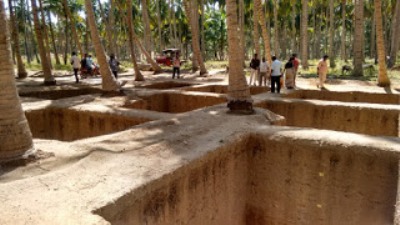
Excavation trenches between coconut palms at Keezhadi in 2016
Keezhadi
Photographed 2016-10-11
Rajan, K. and R. Sivanantham. 2025. Antiquity of Iron: Recent Radiometric Dates from Tamil Nadu. Chennai: Department of Archaeology, Government of Tamil Nadu, Publication No. 356. ISBN 978-81-977842-0-0. Department monograph; IIT Gandhinagar institutional author summary consulted at Antiquity of Iron.
Indian Institute of Technology Gandhinagar. Institutional summary of K. Rajan's “Antiquity of Iron” presentation. Used to check the reported Kilnamandi and Mayiladumparai context dates. https://events.iitgn.ac.in/hstic/imm/Antiquity-of-Iron.html ↗10
Rao, S. R. 1968. “Excavation at Paiyampalli, District North Arcot.” Indian Archaeology 1967–68 – A Review, pp. 26–30. Official ASI IAR series portal: Indian Archaeology Review.
Archaeological Survey of India. 1965–66. Indian Archaeology 1965–66 – A Review. Radiocarbon determination entry TF-350 for Paiyampalli. Official ASI IAR series portal: Indian Archaeology Review.
Agrawal, D. P., S. K. Gupta, and Sheela Kusumgar. 1971. “Tata Institute Radiocarbon Date List IX.” Radiocarbon 13, no. 2 (1971): 442–449 (Korkai TF-987 at p. 447). DOI 10.1017/S0033822200008559. DOI record
Department of Archaeology, Government of Tamil Nadu. Archaeological Excavations inventory. Used for campaign-history checking. https://www.tnarch.gov.in/archaeology-excavation ↗31
Department of Archaeology, Government of Tamil Nadu. Keeladi. Institutional site interpretation and excavation summary. https://www.tnarch.gov.in/keeladi ↗16
Department of Archaeology, Government of Tamil Nadu. Korkai. Institutional excavation summary. https://www.tnarch.gov.in/korkai ↗32
Department of Archaeology, Government of Tamil Nadu. Karur. Institutional excavation summary. https://www.tnarch.gov.in/karur ↗33
Raman, K. V., ed. 1988. Excavations at Uraiyur (Tiruchirappalli), 1965–1969. University of Madras. Bibliographic metadata read; full report not yet read. https://search.worldcat.org/title/Excavations-at-Uraiyur-%28Tiruchirappalli%29-1965-1969/oclc/1509155282 ↗34
Press Information Bureau, Ministry of Culture, Government of India. 24 July 2025. Parliamentary response concerning the Keezhadi excavation report and review process. https://www.pib.gov.in/PressReleasePage.aspx?PRID=2147792
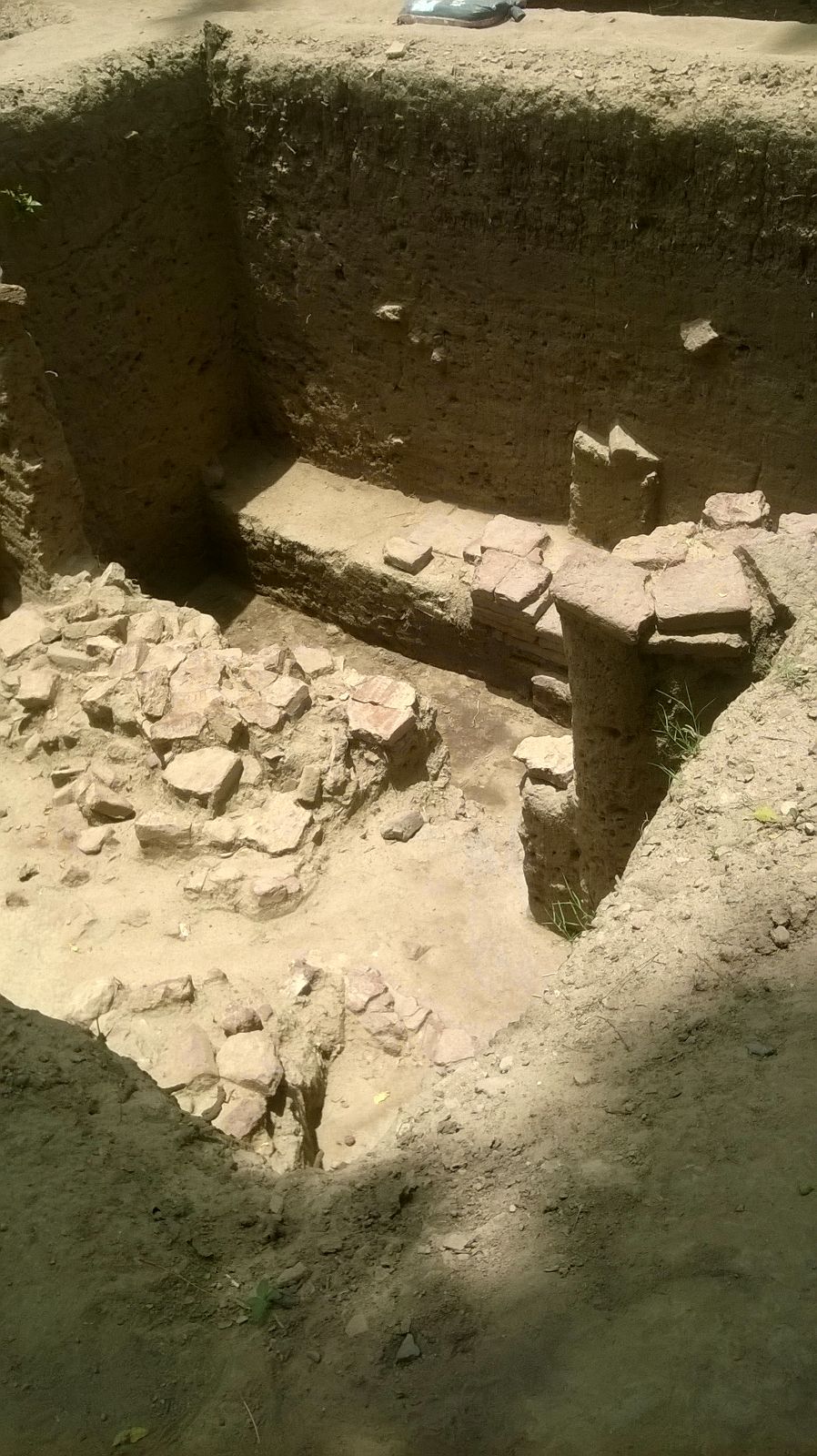
Brick structural remains exposed in a Keezhadi trench in 2015
Keezhadi
Photographed 2015-09-14
Current-status cross-checks on the disputed Keezhadi report included February 2026 reporting on the excavator's rejection of the internal review and subsequent 2026 reporting that the ASI Director-General proposed another committee re-examination. These were used only to establish the access/publication dispute, not as archaeological evidence. ↗36
005Photographs
Photographs of the places and objects this study discusses. Each item carries its creator’s credit, licence and documented source. See all 412 photographs and source images ↗

Keezhadi · Photographed 2019-09-06
Brickwork and associated deposits exposed at Keezhadi
Keezhadi · Photographed 2015-09-14
Excavated brickwork within a Keezhadi trench in 2015
Keezhadi · Photographed 2015-09-14
Brick structural remains exposed in a Keezhadi trench in 2015
Keezhadi · Photographed 2016-10-11
Excavation trenches between coconut palms at Keezhadi in 2016

Keezhadi · Photographed 2019-09-06
Stacked ceramic rings exposed in a Keezhadi excavation section

Keezhadi · Photographed 2015-09-14
Trench section and small exposed archaeological features at Keezhadi in 2015

Keezhadi · Photographed 2019-09-06
Preserved brick feature within the Keezhadi excavation trenches

Keezhadi · Photographed 2015-09-14
Stratified trench wall and exposed features at Keezhadi in 2015
Show 2 more photographs and source images ↓
Keezhadi · Photographed 2018-05-28
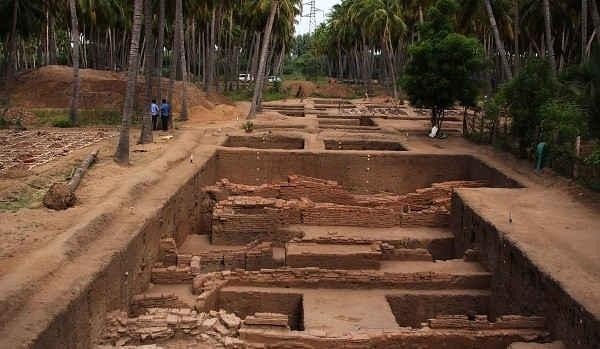
Long view across excavation trenches and exposed brick structures at Keezhadi
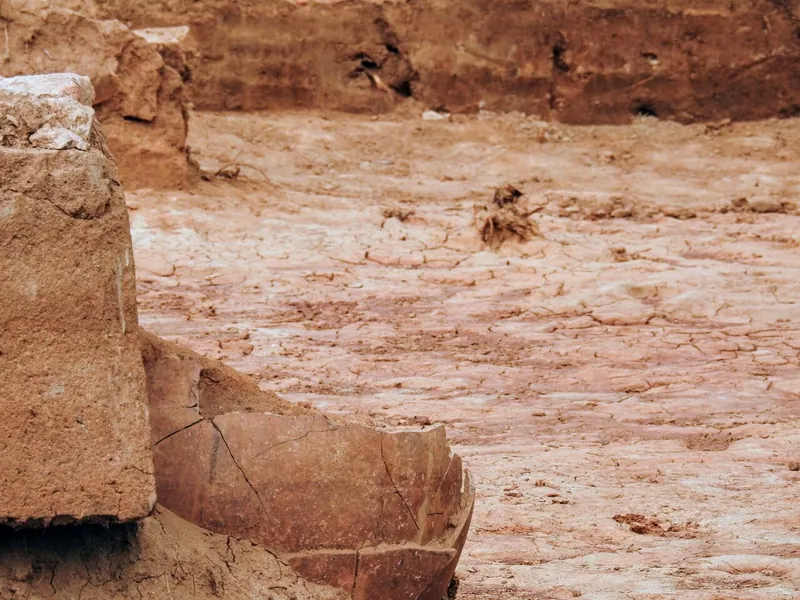
Keezhadi · Photographed 2019-09-06
A pottery vessel exposed within the excavated ground at Keezhadi
006Two views
Both views are shown at equal weight; this site does not choose between them.
When the Early Historic period began in Tamil Nadu
- One view
- Rajan's 2014 synthesis argues for an Early Historic beginning around the sixth century BCE.
- Another view
- A region-by-region model, which this study favours, lets the change differ by place and process. New early iron and burial dates make one statewide boundary harder to defend.
- What would settle it
- Several stratified dates above and below key cultural changes in each region, with full calibration and secure links to inscriptions or structures.
007Where next

Both studies compare dated sites across Tamil Nadu. One tests the earliest iron dates; the other sets out the region's chronologies from 1000 BCE to 600 CE.
On the atlasSivagalai Urn Burial & Habitation ComplexExcavated site zone · Thoothukudi District
Explore nextīmattoṭṭi (Legged Terracotta Sarcophagus) (ஈமத்தொட்டி / ഈമത്തൊട്ടി (കളിമൺ ശവമഞ്ചം))All related studies, connected material, books and sources36 · 15
Elsewhere on this site
Excavation Atlas Sites: Sivagalai Urn Burial & Habitation Complex · Mayiladumparai Iron Age & Microlithic-to-Early Historic Site
Multi-Script Glossary Terms: īmattoṭṭi (Legged Terracotta Sarcophagus) (ஈமத்தொட்டி / ഈമത്തൊട്ടി (കളിമൺ ശവമഞ്ചം)) · Stratigraphic Superposition & AMS ¹⁴C Calibration (மண்ணடுக்கு ஆய்வியல் & கதிரியக்கக் கரிமக் காலக்கணிப்பு / സ്ട്രാറ്റിഗ്രാഫിയും എ.എം.എസ്. റേഡിയോകാർബൺ കാലനിർണ്ണയവും)
Connected material
Photographs, drawings, books, videos and other studies linked to this study. A link helps you explore; it does not prove a historical claim.
- Trench section and small exposed archaeological features at Keezhadi in 2015photographShows the subject
- Excavated brickwork within a Keezhadi trench in 2015photographShows the subject
- Stratified trench wall and exposed features at Keezhadi in 2015photographShows the subject
- Brick structural remains exposed in a Keezhadi trench in 2015photographShows the subject
- Excavation trenches between coconut palms at Keezhadi in 2016photographShows the subject
- Long view across excavation trenches and exposed brick structures at KeezhadiphotographShows the subject
- A pottery vessel exposed within the excavated ground at KeezhadiphotographShows the subject
- Preserved brick feature within the Keezhadi excavation trenchesphotographShows the subject
- Stacked ceramic rings exposed in a Keezhadi excavation sectionphotographShows the subject
- Brickwork and associated deposits exposed at KeezhadiphotographShows the subject
- How radiometric claims are audited before entering a site timelinediagramIllustrates the source-audit workflow separating published radiometric tables from unverified claims.
Books, videos and websites
Outside reading on this topic. These are not part of the study and we have not checked every claim in them. See all books and videos
- Inside Oxford’s radiocarbon laboratory Video · Oxford Radiocarbon Accelerator Unit (laboratory director, technicians, students & videographers) · University of Oxford · 1:26 · An exceptionally short introduction to the journey of a sample through a working radiocarbon laboratory. A clear companion to the website’s explanations of archaeological dating and laboratory work. Laboratory process only. This film does not validate any particular South Indian sample, archaeological association, calibrated date or historical claim.
- Emma Brownlee: seventy years of radiocarbon archaeology Video · Emma Brownlee · Historic England; St Cross College, University of Oxford event · 47:21 · A longer lecture about radiocarbon dating and its effects on archaeological research. A deeper companion to the 86-second Oxford laboratory introduction. General history and method. This recording does not independently verify Tamil-Brahmi chronology or specific early iron-use dates.
- 16 | Dr. V. Selvakumar | Early Tamil Society literature, epigraphy and archaeology |10 April 2017 Video · V. Selvakumar · Tamil University, Thanjavur; formerly Centre for Heritage Studies, Kerala · 1:48:26 · The first of two recorded sessions combines South Indian geography and historical overview with early society through Sangam literature. Introduces the connections and limits between archaeological and literary approaches. The four course abstracts are distributed across two recordings. Later medieval material is context, outside the main website period.
- Dr Oishi Roy. Understanding Early Iron Age: Zonal Differences in Indian Subcontinent. Nov 1, 2025 Video · Oishi Roy · IISER Mohali, Palaeo-Arch Lab, postdoctoral fellow at event · 1:50:15 · Research lecture comparing regional Iron Age developments and metal technologies across the Indian subcontinent. Offers a specialist framework for distinguishing regional evidence instead of assuming a single uniform Iron Age. Do not advertise this as confirming the earliest dates claimed for Sivagalai or Mayiladumparai; no such segment was verified.
- Megalithic Cultures of South India | Prof V Selvakumar | ASC IITGN Video · V. Selvakumar · Tamil University, Thanjavur · 1:41:57 · A survey of South Indian megalithic burials and monuments and their archaeological contexts. Provides a trained regional archaeologist’s framework for understanding the many burial-site studies. A shared monument label does not give every site the same date or social meaning; no exact-site coverage is inferred.
- Monsoons: Wet, Dry, Repeat… (NASA Goddard / SVS 12255) Video · NASA’s Goddard Space Flight Center (producer Ryan Fitzgibbons & SVS team) · 3:28 · NASA Goddard visualization explaining the seasonal circulation reversal between wet summer and dry winter monsoon winds and rainfall across South Asia and the Indian Ocean (modern meteorology context, not evidence of ancient weather). Modern explanatory meteorology, not evidence of ancient weather. Credited third-party footage and music in the video must not be extracted or remixed; no video or audio files are hosted locally on this site.
008Sources
The study lists the sources it consulted; we have not rechecked them. A working link does not show that a source was read, and a valid identifier does not show that it supports a claim. We do not link to unofficial uploads or copies of publications. Where a study cited one, we show the published citation, or a publisher, DOI or Internet Archive link when we have one. Tracking codes are removed from links, and the sources themselves are not republished here.
K. Rajan, R. Sivanantham, V. P. Yathees Kumar, Recent Scientific Dates: Archaeological Sites of Tamil Nadu, first edition, Chennai: Department of Archaeology, Government of Tamil Nadu, 2025, ISBN 9788197784279.
K. Rajan and R. Sivanantham, Antiquity of Iron: Recent Radiometric Dates from Tamil Nadu, Chennai: Department of Archaeology, Government of Tamil Nadu, Publication No. 356, 2025, ISBN 978-81-977842-0-0.
Print or offline sourceSource recordK. Rajan, Iron Age – Early Historic Transition in South India: An Appraisal, Padmashri Amalananda Ghosh Memorial Lecture, Institute of Archaeology, Archaeological Survey of India, 25 August 2014.
S. R. Rao, Excavation at Paiyampalli, District North Arcot, Indian Archaeology 1967–68 – A Review, 1968, pp. 26–30.
Print or offline sourceSource recordDepartment of Archaeology, Government of Tamil Nadu, Archaeological Excavations inventory.
Department of Archaeology, Government of Tamil Nadu, Keeladi institutional excavation page.
Department of Archaeology, Government of Tamil Nadu, Korkai institutional excavation page.
Department of Archaeology, Government of Tamil Nadu, Karur institutional excavation page.
K. V. Raman, ed., Excavations at Uraiyur (Tiruchirappalli), 1965–1969, University of Madras, 1988.
Parliamentary response concerning Keezhadi excavation report
Press Information Bureau, Ministry of Culture, Government of India, parliamentary response concerning the Keezhadi excavation report, 24 July 2025.
Standoff over Keezhadi findings: Archaeologist says ASI review not scholarly, seems to be AI-assisted
The Indian Express, February 2026 report on K. Amarnath Ramakrishna's rejection of the ASI internal evaluation of his Keezhadi report.
ASI DG writes to TN MP on Keeladi excavation report, says internal committee will re-examine report on site
Times of India, 2026 report that the ASI Director-General said an internal committee would re-examine the Keezhadi report.
Archaeological Survey of India, Indian Archaeology 1965–66 – A Review, radiocarbon determinations including Paiyampalli TF-350.
Print or offline sourceSource recordIndian Institute of Technology Gandhinagar institutional event summary of K. Rajan's Antiquity of Iron presentation.
Tata Institute Radiocarbon Date List IX (TF-987)
D. P. Agrawal, S. K. Gupta and Sheela Kusumgar, 'Tata Institute Radiocarbon Date List IX,' Radiocarbon 13, no. 2 (1971): 442–449, at p. 447 (Korkai sample TF-987).
Researchers and institutions whose work this study uses: K. Rajan, R. Sivanantham, K. Amarnath Ramakrishna, K. V. Raman, S. R. Rao, Archaeological Survey of India
How we know The evidence, claims and dates behind this study
What this study draws on
- K. Rajan's 2014 review (Iron Age – Early Historic Transition in South India), read in full
- The 2025 Tamil Nadu Preliminary Report (Pub. No. 362) and Recent Scientific Dates compilation, alongside the 24 July 2025 PIB English release (PRID 2147792)
- Tata Institute Radiocarbon Date List IX for Korkai (TF-987, 2680 ± 90 BP), Paiyampalli records and regional excavation summaries
- Region-by-century cross-comparison separating burial, metalworking, script and settlement dates
Dates in this study
| What is dated | Date | How it was dated |
|---|---|---|
| 2763 BCE representative calibrated age reported for Thelunganur AA-104832 in the 2025 compilation | 2763 BCE | Laboratory date |
| 1769–1615 BCE for Kilnamandi MEG-3 as reported in institutional summary | 1769–1615 BCE | Laboratory date |
| 1438–1261 cal BCE for AMS date on carbon extracted from the Thelunganur steel sword in Rajan 2014 (3089±40 BP) | 1438–1261 BCE | Laboratory date |
| 1155 BCE representative calibrated age for Sivagalai Beta-600726 from A2/Urn 3 | 1155 BCE | Laboratory date |
| Selected Adichanallur core-period representative ages approximately 908–618 BCE | 908–618 BCE | Laboratory date |
| TF-987 wood: 2680 ± 90 BP (5568-yr half-life, '730 BC') / ~2755 ± 95 BP (5730-yr half-life), ~1055–545 cal BCE; summarized as 785 BCE charcoal in TNSDA Korkai summary | 785 BCE | Laboratory date |
| 685 BCE representative calibrated age for Sivagalai Beta-600727 habitation sample | 685 BCE | Laboratory date |
| Keeladi Table 9 (35 AMS entries): earliest Beta-519476 (2530±30 BP; ~792–545 cal BCE IntCal20 on Hallstatt plateau) through Beta-620260 (1750±30 BP; 4th c. CE) | 563 BCE – 357 CE | Laboratory date |
| Representative Kodumanal scientific-date table ages approximately 480 BCE to 99 BCE | 480–99 BCE | Laboratory date |
| 380 BCE, legacy conventional expression for Paiyampalli TF-350 | 380 BCE | Laboratory date |
See these dates on the timeline
The study’s claims
20 claims · 21 source passages · 64 paragraphs
Browse the study paragraph by paragraphThe independently dated evidence read does not establish one synchronous Iron Age/Early Historic phase boundary across all of Tamil Nadu.
Supported in this study
A sixth-century-BCE horizon remains a defensible proposal for some regions/processes.
Burial traditions, iron-associated contexts, pottery classes and Early Historic settlement phases are analytically separable and cannot safely be treated as one chronological package.
Supported in this study
The northern sequence represented here is discontinuous: Paiyampalli supplies legacy core-period control while Kilnamandi supplies substantially earlier burial/iron-associated background, without a densely sampled regional bridge between them.
Supported with qualifications
This is a coverage statement about the consulted source set, not proof that intervening archaeological evidence does not exist.
Paiyampalli TF-350 is reported as charred grain from a post-Megalithic pit at 2330±105 BP, with the legacy conventional expression 380 BCE.
Supported in this study
Modern calibration curve and probability distribution absent from the sources consulted.
Kilnamandi MEG-3 has an iron-associated burial sample reported at 3400±30 BP with a calibrated range of 1769–1615 BCE, making it earlier background rather than a core-period northern phase boundary.
Supported with qualifications
Outside the 1000 BCE–600 CE core window. Context association is not direct metal dating.
The consulted Kodumanal table contains a substantial directly measured sequence represented approximately from 480 BCE into the late second/first centuries BCE.
Supported in this study
A mid-sixth-century-BCE beginning for Kodumanal based on approximately 65 cm of lower undated cultural deposit is an explicit extrapolative hypothesis, not another directly measured radiocarbon result.
Supported in this study
Should not be represented graphically as a measured sample.
In the consulted corpus, the central/Kaveri corridor lacks a comparably dense modern absolute-dating sequence to those available for Kodumanal or Keeladi.
Supported with qualifications
This is explicitly a source-coverage result, not a claim of historical absence.
Keeladi Table 9 contains 35 AMS rows extending into the fourth century CE (Beta-620260, 1750±30 BP), with the earliest entry Beta-519476 (2530±30 BP; 580 BCE = 2530−1950) calibrating under IntCal20 (95.4%) across ~792–545 cal BCE on the Hallstatt plateau rather than to TNSDA's printed single year 531 BCE.
Supported in this study
Keeladi's earliest dated organic samples do not by themselves directly date every Tamil-Brahmi inscription, brick structure, craft activity or the onset of urbanization at the site.
Supported in this study
Specific features or objects may be dateable more tightly where their individual stratigraphic associations are published.
The complete first-two-season ASI Keezhadi report remained unpublished as of late 2026 amid ongoing review and re-examination.
Supported with qualifications
This is an access/publication-status finding, not an archaeological conclusion.
The 2025 Adichanallur table contains an internal period-label conflict for Beta-519500 from Urn 105, so the radiometric measurement should be separated from its printed cultural-period label.
Supported in this study
Does not invalidate the laboratory measurement; it weakens automatic use of the phase label.
At Sivagalai, a burial-context sample is represented around 1155 BCE while a separately identified habitation sample is represented around 685 BCE, illustrating why burial and habitation should not be forced into one boundary.
Supported in this study
The 1155 BCE result is earlier background to the project's core period.
Korkai combines wood sample TF-987 (location 0-1, layer 5, depth 3.17 m, field no. KRK-1; 2680 ± 90 BP in TIFR Date List IX, 1971; summarized on the TNSDA webpage as charcoal assigned to about 785 BCE) with later dates at a site yielding Tamil-Brahmi, none directly dating every inscribed sherd.
Supported in this study
A scientific date from a site that also yields Tamil-Brahmi pottery is not automatically a direct date of the inscription; object-to-context-to-sample association must be demonstrated.
Supported in this study
Very early iron-associated dates (Mayiladumparai, Kilnamandi, and disputed 2025 Sivagalai claims) come from department monographs rather than peer-reviewed journals and date associated organics (or, at Thelunganur, charcoal-fuel carbon in the sword steel) rather than direct forging.
Supported in this study
The Thelunganur sword-context chronology is unresolved because the read 2014 and 2025 records report materially incompatible conventional ages.
Unresolved in this study
Do not choose one date merely because it is earlier or newer. Laboratory certificate and burial register are required.
Regional and century-level chronological coverage is uneven; gaps should remain visible rather than being filled by dates transferred from better-sampled sites.
Supported in this study
Coverage assessment is bounded to sources actually read.
No single earliest date can presently date occupation, burial, iron use, writing and urbanization across Tamil Nadu.
Supported in this study
A sixth-century-BCE Early Historic boundary is best treated as a regional interpretive hypothesis rather than a universal Tamil Nadu-wide boundary.
Supported with qualifications
May be useful for particular settlement and exchange developments when explicitly defined.
Trace one claim through the study’s records
Explore the evidenceOther source lists
Numbered citation links from the study
The numbered links in the study text point here.
K. Rajan (2014), Early Historic Transition in South India
K. Rajan (2014), Early Historic Transition in South India
K. Rajan (2014), Early Historic Transition in South India
K. Rajan (2014), Early Historic Transition in South India
K. Rajan (2014), Early Historic Transition in South India
K. Rajan (2014), Early Historic Transition in South India
K. Rajan (2014), Early Historic Transition in South India
K. Rajan (2014), Early Historic Transition in South India
K. Rajan (2014), Early Historic Transition in South India
K. Rajan, R. Sivanantham & V. P. Yathees Kumar (2025), Recent Scientific Dates: Archaeological Sites of Tamil Nadu (TNSDA)
K. Rajan, R. Sivanantham, and V. P. Yathees Kumar, Recent Scientific Dates: Archaeological Sites of Tamil Nadu (Chennai: Department of Archaeology, Government of Tamil Nadu, 2025), ISBN 9788197784279.
Antiquity of Iron in Tamil Nadu
Antiquity of Iron in Tamil Nadu
Recent Scientific Dates - நூல்
Recent Scientific Dates - நூல்
Excavation at Paiyampalli, district North Arcot – Rhino Resource Center
Excavation at Paiyampalli, district North Arcot – Rhino Resource Center
Karur | Department Of Archaeology
Karur | Department Of Archaeology
Karur | Department Of Archaeology
Keeladi | Department Of Archaeology
Press Release Page | Press Information Bureau
Press Release Page | Press Information Bureau
Korkai | Department Of Archaeology
Korkai | Department Of Archaeology
K. Rajan & R. Sivanantham (2025), Antiquity of Iron: Recent Radiometric Dates from Tamil Nadu (TNSDA Pub. No. 356)
K. Rajan and R. Sivanantham, Antiquity of Iron: Recent Radiometric Dates from Tamil Nadu, Publication No. 356 (Chennai: Department of Archaeology, Government of Tamil Nadu, 2025).
Print or offline sourceASI (1973), Indian Archaeology 1965–66 – A Review
Archaeological Survey of India, Indian Archaeology 1965–66 – A Review (New Delhi: ASI, 1973).
Print or offline sourceArchaeological Excavations conducted by the Department of Archaeology | Department Of Archaeology
Excavations at Uraiyur (Tiruchirappalli), 1965-1969 | NDL Search | National Diet Library
Archaeologist dismisses ASI’s objections on Keeladi report | India News
About this study Status, corrections and how it was made
Status
Draft study, revision 8. No historian, archaeologist, or Tamil or Malayalam specialist has reviewed it yet.
How it was made
Compiled as an editorial synthesis from published scholarship around questions we framed. About this project & workflow
The summary, How sure lines and Two views notes on this page were prepared from this study and cross-checked against its passages. That is an editorial check, not a specialist review.
Technical details
Study code LTS-SUP01. The text fingerprint changes whenever the study text changes.
- The study text is shown as written. Links from its paragraphs to citations help you move around the study; they are not new claims or checked source passages.
See how this study’s records were extracted
Text fingerprint (SHA-256): LTS-SUP01 · 4248eec8adb1f188a05afcb8… · v8
Evidence tables and technical details are on the web page: https://layersofthesouth.org/read/7e1454bda8