Places on the atlas that name this study.
- Words & worlds
- 500–200 BCE
- 200 BCE–300 CE
- Korkai
Pandya and Chola power is well attested, but not as a king list
Ashoka's edicts name the Cholas and Pandyas; Mangulam and the Periplus add Pandya detail, but the evidence supports no exact king list.
- This page
- 5,642 words · revision 5
Draft study · Awaiting specialist review · Updated
001Dates and places
Places on the atlas that name this study.
- Korkai
Protected TNSDA site museum & excavation zone
1000–500 BCE
Different beginnings
500–200 BCE
Marks & materials
200 BCE–300 CE
Connected worlds
300–600 CE
Change & continuity
- 785 BCE
- third century BCE
- 300 BCE-200 CE
- first century BCE
- first century CE
- around the middle of the first century CE
- fourth century CE
- Date from writing, coins or texts
- How it was dated is not stated
Each date belongs to what was dated (a sample, an object, a layer or a text), which is not always the event the study asks about.
Each period has the same width, so spacing is not to scale.
The full table of dates, with their ranges, is under How we know.
- 2 Well supported
- 1 Possible
- 1 Not known
002How sure
In brief
By the third century BCE, Ashoka's Rock Edict II names the Cholas and Pandyas at or beyond the edge of his empire. For the Pandyas, Tamil-Brahmi cave inscriptions at Mangulam name a Nedunchezhiyan. The mid-first-century CE Periplus, a merchant's guide to sea trade, describes a Pandian kingdom with a pearl fishery. For the Cholas, the strongest evidence is Ashoka's mention and poems such as Paṭṭiṉappālai, about Karikālaṉ and the port of Puhar. Korkai, Alagankulam and Poompuhar show ports, writing and long-distance trade. Together these show real regional power, especially for the Pandyas. They do not give an exact list of kings or a bureaucracy; Greek and Roman writers (cited here from secondary accounts) name Modoura (Madurai) as a royal seat, and Ptolemy names a Chola seat, Orthoura, usually identified with Uraiyur. Mahadevan's corpus, the Uraiyur excavation report and the main coin catalogues were not examined in full.
Key researchers cited in this study: Iravatham Mahadevan (Tamil-Brāhmī Epigraphy) · K. V. Raman (Uraiyur, Kanchipuram & Alagankulam Excavations) · Full bibliography
How sure
- Well supported
Chola and Pandya were recognised southern political names by the third century BCE.
Ashoka's Rock Edict II names them directly.
- Well supported
A first-century CE trade guide describes a Pandian kingdom with a pearl fishery.
The Periplus says so directly; it gives no borders, ruler or administration.
- Possible
Mangulam's Nedunchezhiyan is the king praised in Maturaikkāñci.
The names match, but exact readings and identity remain unsettled.
- Not known
An exact, continuous list of early Pandya and Chola kings.
No reviewed source links the rulers in sequence; poems are not reign tables.
Why it matters
It separates what inscriptions, coins and sites can show from the king lists often assumed for early Tamil kingdoms.
003Key findings
What the study concludes
- Ashoka securely places Chola and Pandya names in third-century-BCE southern political geography.
- Mangulam and the Periplus make early Pandya political visibility especially strong, while exact ruler identities remain less secure.
- Poems reveal political culture and remembered rulers but should not be converted directly into reign tables.
- Ports, imports, coins and writing demonstrate connectivity and complexity, not administration by themselves.
- No precise continuous early Pandya or Chola regnal chronology is supported by the reviewed evidence.
In the study’s own words. How sure each point is, is shown above.
The summary above is the short read. The full study is the complete text it was drawn from, with its tables and source notes.
What the full study covers
004The study
Overview
What do independently assessed inscriptions, coins, settlement evidence and poems establish about early Pandya and Chola power?
This study works within the period 1000 BCE–600 CE, treating that window as a scope boundary rather than a presumption that Pandya or Chola states existed continuously throughout it. The result is a mixed-chronology study: the strongest directly relevant political evidence begins in the third century BCE; earlier settlement dates provide background rather than polity dates; some modern editions and later comparative material concern reception and source history rather than the ancient events themselves.
The central conclusion is that the combined record supports the existence of recognizable supra-local Pandya and Chola political formations in the Early Historic period, but at very different levels of evidentiary resolution. By the third century BCE, Ashoka's Rock Edict II places Chola/Choda and Pandya names in a southern political geography beyond or at the frontier of the Mauryan realm; the wording does not establish Mauryan administration over them. ↗1 For the Pandya side, the evidence becomes more specific: Tamil-Brahmi inscriptions at Mangulam are officially interpreted as naming a Nedunchezhiyan associated with the Pandyas, and the mid-first-century CE Periplus Maris Erythraei explicitly speaks of a “Pandian” kingdom and associates the Colchi pearl-fishery zone with it. ↗2 ↗3 These witnesses make a regional Pandya political formation considerably more than a retrospective literary construct.
For early Chola power, the reviewed evidence is less epigraphically explicit. The Chola name is externally attested by the Ashokan edicts, while Paṭṭiṉappālai and other early Tamil poetic traditions furnish rich representations of Chola kingship, warfare, patronage and Kāvirippūmpaṭṭiṉam. ↗4 ↗1 Poompuhar's excavated remains support substantial port activity, but the Tamil Nadu Department of Archaeology's description of the site as a Chola “second capital” is an interpretation, not an excavated administrative institution. ↗5 The primary Uraiyur excavation report was bibliographically identified but not read at trench and plate level, so this study makes no stronger archaeological claims about an early Chola capital there. ↗6 ↗7
The evidence therefore supports power without permitting a falsely precise state history. It shows political names, rulers or ruler-like figures, warfare, prestige competition, patronage, port and resource connections, literacy, and – in the Pandya case – an external description of a kingdom. It does not currently demonstrate a continuously centralized bureaucracy, a fixed administrative hierarchy, or a secure year-by-year succession of Pandya and Chola rulers throughout the period. This distinction matters because imported amphorae, Roman coins, rouletted ceramics, prosperous ports, praise poems and dynastic emblems are all compatible with political complexity without individually proving a state apparatus. The archaeological caution is consistent with Shinu Abraham's methodological warning that textual and material datasets construct and reflect identities differently and should not be collapsed into one undifferentiated narrative. ↗8
Findings at a glance
| Evidence family | What the reviewed evidence securely or defensibly establishes | What it does not establish | Assessment |
|---|---|---|---|
| Ashokan inscriptions | Chola/Choda and Pandya names belonged to southern political geography by the third century BCE. ↗1 | Mauryan rule over them; capitals; named Pandya/Chola rulers; dynastic continuity | High confidence |
| Mangulam inscriptions | Early Tamil-Brahmi inscriptions include a Nedunchezhiyan name interpreted by Tamil Nadu Archaeology in a Pandya context. ↗3 | Identity with any particular literary Neṭuñceḻiyaṉ; a complete reign or succession | Moderate confidence pending direct corpus/facsimile review |
| Periplus | Around the mid-first century CE, an external merchant-geographic text describes a Pandian kingdom and associates it with Nelcynda/Colchi and pearl resources. ↗2 | Internal bureaucracy, exact borders, or a named ruler | High confidence for the textual statement |
| Early Tamil poems | Political cultures of kings/chiefs, warfare, generosity, cities, ports and patronage; received traditions connect Karikālaṉ with Chola material and Neṭuñceḻiyaṉ with Pandya material. ↗9 ↗4 ↗10 | An automatically reliable regnal list or exact event chronology | Moderate to high as literary evidence; lower for reconstructed chronology |
| Coins | Numismatic corpora exist and Pandya/Chola attribution is an important research avenue; an accessible British Museum Pandya-attributed specimen illustrates object-level attribution. ↗11 | A secure early Chola ruler sequence from the material read here | Evidence-limited |
| Korkai | Early occupation and Tamil-Brahmi-bearing pottery; a reported charcoal determination assigned to 785 BCE. ↗12 | A Pandya kingdom or capital in 785 BCE | Strong site evidence; political inference rejected |
| Alagankulam | Long-distance exchange, local writing and Early Historic occupation. ↗13 | A bureaucracy simply because imported objects occur | Strong for connectivity, weak for administration |
| Poompuhar | Material consistent with substantial port activity; excavated structures interpreted as a wharf. ↗5 | Independent proof that “second capital” was an administrative status | Qualified |
Evidentiary method and source control
This study begins by separating propositions that are too often conflated: polity name, personal ruler name, title, capital identification, territorial reach, economic extraction, state formation, and regnal chronology. Evidence sufficient for one is not automatically sufficient for the others. An Ashokan reference to “Pandyas,” for example, is powerful evidence that a politically meaningful Pandya label was intelligible to the inscription's producers; it is not evidence for the name of the reigning king, the location of his court, or an unbroken dynasty. Likewise, a port with Mediterranean ceramics demonstrates exchange connections but not a tax office or territorial bureaucracy. ↗1 ↗13
The source hierarchy prioritized inscriptions and archaeological publications; official archaeological site summaries where primary reports were not accessible; ancient textual editions or institutional digital-library records; specimen-level museum catalogues; and then scholarly synthesis for framing disputes. Repeated modern retellings are deliberately not treated as independent witnesses. The Tamil Nadu Department of Archaeology pages are useful because they identify campaigns, finds and institutional interpretations, but statements such as “second capital” remain attributed government interpretations until the underlying archaeological evidence independently demonstrates the administrative proposition. ↗14 ↗5
The search also distinguished source access from source existence. K. V. Raman's Excavations at Uraiyur (Tiruchirappalli), 1965–1969 was bibliographically recovered as a University of Madras excavation report, but its trench descriptions, strata, object tables and plates were not read here. ↗6 ↗7 Iravatham Mahadevan's Early Tamil Epigraphy (2003; revised and enlarged 2nd ed., vol. 1, CICT, 2014; examined directly in “Mangulam's inscriptions name a ruler's servant, kin and a guild”) supplies the critical edition for Mangulam inscription numbers, readings, translations, and palaeographic arguments, though the full print volume was not read directly for this overview. ↗15 The distinction means that dependent claims are marked pending primary verification, rather than being falsely presented as absence of evidence.
Full volumes of Indian Archaeology – A Review and D. C. Sircar's Select Inscriptions were not consulted directly here and are not cited as read. No claim below rests on pretending that an inaccessible PDF or an abstract was fully read. Abraham's 2003 article, for instance, was accessible here at publisher metadata/abstract level rather than full article level, so its use is methodological and limited to what the abstract itself supports. ↗8
Chronology receives the same separation. A radiocarbon or charcoal determination concerns the sampled material and its archaeological context. A palaeographic date concerns the writing. A poem has composition, transmission, manuscript and editorial histories. An ancient geographical text has its own date of composition and describes conditions through a particular genre. These temporal layers cannot be merged into a single “Sangam age” date without losing the very distinctions necessary to test political history.
The practical consequence is conservative but not sceptical for its own sake: convergence strengthens a political inference; mismatched evidence limits its scope rather than being forced into harmony.
Inscriptions and external political naming
The earliest especially consequential evidence is Aśoka's Major Rock Edict II (edited in E. Hultzsch, Corpus Inscriptionum Indicarum, Vol. I, 1925; see also Major Rock Edict XIII). Its southern list names Choda/Chola and Pandya alongside Satiyaputra and Keralaputra among regions at or beyond the Mauryan frontier – consistently distinguishing those southern polities from the emperor's directly governed dominion. ↗1 The defensible conclusion is therefore recognition of named southern political formations by the third century BCE, not Mauryan annexation.
That evidence is strong for names and geopolitical recognition but thin for internal organization. “Chola” and “Pandya” could denote kingdoms, ruling formations, territories, peoples, or combinations of these in the political geography understood by Ashoka's scribal apparatus. Rock Edict II supplies no Chola or Pandya personal ruler, no capital, no succession, no offices and no local administrative archive. A claim that the historical Chola and Pandya states known from much later centuries already existed in institutionally continuous form would therefore exceed this witness. ↗1
One other pre-Common-Era epigraph outside Tamil Nadu is often cited in secondary scholarship alongside Aśoka: Khāravela's Hāthīgumphā inscription at Udayagiri in Odisha (variously dated to the second or first century BCE). Secondary accounts report that its damaged Prakrit text mentions breaking a league of Tamil (tramira) countries and receiving pearls and gems from a Pāṇḍya king; the Epigraphia Indica edition was not read for this study, and both the readings and the date remain debated.
Mangulam provides a different type of evidence. The Tamil Nadu Department of Archaeology reports five Tamil-Brahmi cave inscriptions and dates them palaeographically to about the third century BCE; Mahadevan's corpus places the same group around the second century BCE, as “Mangulam's inscriptions name a ruler's servant, kin and a guild” explains. The department's overview identifies a name rendered Nedunchezhiyan and connects it with a Pandya king; the same page reports other names or titles including Valuti and occupational or donor terminology. ↗3 This is potentially crucial because it moves from a collective political name toward a named person embedded in a local inscriptional context. “Mangulam's inscriptions name a ruler's servant, kin and a guild” and “Arittapatti's cave inscriptions name two early donors” treat the Mangulam inscriptions in detail.
The safe inference, however, stops before identifying this Nedunchezhiyan with one particular king known from the poems. The exact inscription numbers, estampages, letter forms, segmentation, translation, title structure and Mahadevan's critical argument were not read for this study in the principal epigraphic corpus. ↗15 Even a perfect match in modern transliteration would not itself prove identity: repeated dynastic or prestigious names are possible, and literary texts may have complex composition and transmission histories. The inscription therefore supports an early Pandya-associated personal-name claim, while the proposition “this is the same Neṭuñceḻiyaṉ celebrated by Maturaikkāñci” remains unproved.
Jambai supplies a useful comparative control. Tamil Nadu Archaeology gives the Tamil-Brahmi reading conventionally rendered “Satiyaputo Atiyan Netuman Anci itta Pali,” dated palaeographically to around the first century CE. ↗16 The inscription matters here not because Atiyaman is Pandya or Chola – he is not – but because it demonstrates what stronger cross-source identification can look like: an inscription explicitly contains a personal name that is also prominent in early Tamil literary tradition, together with a term linked to Ashoka's Satiyaputra. Even then, interpretation requires philology and context; but it is a more direct bridge than anything established here for a named early Chola ruler.
Modern line tracing of a Pugalur Tamil-Brahmi inscription, credited to Rajesh of Raigad in the 2018 Commons record
Pugalur
Ancient inscription assigned by source to circa 1st–2nd century CE; this tracing was created/uploaded in 2018
A second independent witness to Pandya political naming comes from the Periplus Maris Erythraei. The consulted University of Washington version is based on Wilfred Schoff's 1912 English translation, with some variants noted from Lionel Casson's later work; the ancient text is generally placed around the middle of the first century CE. ↗2 In the relevant sections, Nelcynda is described as belonging to another kingdom, “the Pandian,” and the account later associates the Colchi pearl-fishery region with that kingdom. ↗2 This is unusually useful because it comes from an external maritime-commercial geography rather than a Tamil court poem.
The Periplus strengthens three propositions: a “Pandian” political formation was meaningful to an external observer; maritime or riverine nodes were mapped in relation to it; and a valuable pearl-producing zone was represented as belonging to it. It does not reveal how that claimed control was enforced, whether extraction was continuous, what local intermediaries did, how borders worked, or whether the writer's political geography was perfectly accurate. “Belongs to the Pandian kingdom” is therefore evidence for an externally perceived territorial/resource relationship, not an excavation of Pandya administration. ↗2
Greco-Roman writers of the first and second centuries CE, as reported in secondary classical-geography accounts (the Greek and Latin editions were not checked directly for this study), add royal-seat names: Pliny the Elder (Natural History 6.105) places King Pandion inland at Modura (Madurai); Ptolemy (Geography 7.1.89 and 7.1.91) names Modoura as the royal seat (basileion) of Pandion and Orthoura as the royal seat of Sornax (Modoura is Madurai, and Orthoura is usually identified with Uṟaiyūr); and Strabo (Geography 15.1.4) reports gifts and an embassy to Augustus from an Indian king “Pandion, or, according to others, Porus” – whether this Pandion is the southern Pāṇḍya is debated. They supply no king list or administrative chart, but they support Madurai as a Pāṇḍya royal seat and Uṟaiyūr as a probable Cōḻa seat.
Together, Aśoka, Mangulam, the Periplus, and the reported notices in Pliny and Ptolemy point in the same direction for the Pāṇḍyas – external political naming, a locally inscribed Pandya-associated personal name, kingdom and pearl-fishery affiliation, and Madurai named as a royal seat. They do not produce a continuous king list. For the Cholas, Ashoka establishes the collective name early, but the current reviewed inscriptional sample did not establish an equivalently strong early named-ruler sequence.
Coins, settlements, and material indicators
The numismatic evidence is promising but not yet secure enough for a king list
Numismatics potentially supplies exactly the evidence that literary chronology lacks: discrete objects, dies, symbols, legends, weights, metal compositions, archaeological contexts and distributions. The relevant bibliography is real. R. Krishnamurthy's Sangam Age Tamil Coins was published in 1997, and a later catalogue by R. Krishnamurthy and Senarath Wickramasinghe, A Catalogue of the Sangam Age Pandya and Chola Coins, was published by the Department of National Museums, Sri Lanka, in 2005. ↗17 ↗18 Yet neither corpus was read here specimen by specimen, and the repository record for the 2005 catalogue did not provide a freely digitized copy. Consequently, reported dynastic symbols or Tamil-Brahmi ruler-name readings cannot be promoted here into independently checked object claims.
This is particularly important for coins attributed to Pandya rulers through fish symbols or readings such as Peruvaluti. Those attributions may be well founded, but a defensible political use requires the actual specimen: legend, palaeography, die orientation, metal, metrology, provenance or findspot, archaeological association, and the argument that dates it. A royal-looking emblem without context may identify an issuer tradition more readily than it identifies a particular reigning person or exact decade.
The British Museum record for object 1959,1020.234 illustrates the limitation neatly. The museum catalogues it as an alloy coin, attributes its authority to “Pandya,” gives South India as the minting region and records a weight of 1.910 g; the accessible record does not provide a secure Early Historic production date or a named ruler in a legend. ↗11 The object is therefore evidence that a major collection maintains a Pandya numismatic attribution, not by itself proof of a particular early reign.
The same restraint is especially necessary on the Chola side. This review did not establish an early Chola coin securely naming a ruler from directly read specimen evidence. Later named issues of imperial Cholas are chronologically irrelevant as proof of political institutions before 600 CE: later monetary sophistication cannot be retrojected hundreds of years. The current result is a negative result limited to the sources read – no such early named Chola ruler coin was established in the material actually read – not a claim that early Chola coinage did not exist.
Korkai: early occupation is not an eighth-century-BCE Pandya state
Tamil Nadu Archaeology's Korkai page reports substantial archaeological remains, including a brick structure, large rings or soakage jars, Tamil-Brahmi-inscribed sherds assigned broadly to approximately 300 BCE–200 CE, and a charcoal sample for which the page reports an assignment of 785 BCE by the Tata Institute of Fundamental Research. ↗12 The early date is important for Korkai's settlement history, but it is easily abused politically.
Without the sample's laboratory code, raw determination, uncertainty, calibration details, sampled locus and demonstrated relationship to a political feature, 785 BCE is not a date for the Pandya kingdom. It dates – or is reported as dating – a piece of charcoal in an archaeological sequence. Even if the determination and context prove impeccable, occupation at Korkai centuries before Ashoka would establish early settlement, not automatically a capital, monarchy or dynasty. The political conclusion must therefore remain much later and more modest. “Ancient texts link Korkai with pearls, conch and Pandyan rulers” covers the Korkai evidence in more detail.
Alagankulam: connectivity is not bureaucracy
At Alagankulam, the official excavation overview reports large quantities of imported or Mediterranean-connected ceramics, including amphora fragments and rouletted ware, Tamil-Brahmi-bearing local pottery, beads, brick remains and Roman coins; the page assigns some Tamil-Brahmi sherd material to around the first century BCE. ↗13 These finds make the site highly important for exchange, craft and literacy networks across the Indian Ocean.
They do not demonstrate a Pandya administrative system. Imported wine or transport jars can arrive through merchants; coins can circulate, be curated or be deposited long after minting; writing on pottery can mark ownership, commerce, gifting or other social practices. A state-level inference would require additional evidence – administrative sealing systems, institutional storage, standardized fiscal records, recurring official titles, controlled infrastructure, or some other securely contextualized administrative assemblage. The present evidence supports long-distance connectivity embedded in a literate local society, which is historically substantial without being a bureaucracy claim. “Alagankulam's pots and coins show changing sea links” covers the Alagankulam finds in more detail.
Poompuhar and Uraiyur: settlement importance versus capital status
The Tamil Nadu Archaeology overview for Poompuhar, at the mouth of the Kaveri, describes excavated brick walls and wooden poles interpreted as part of a wharf and assigns the structure to approximately the fourth century CE. The excavation memoir (K. V. Soundara Rajan 1994, used in this site's Poompuhar studies) instead places the wooden poles before the brick wharf, dates the poles by one radiocarbon sample (TF-207, 2200 ± 100 BP) and assigns the brick wharf broadly to the first century BCE–first century CE; the department page gives no basis for its later date. The same institutional page characterizes Poompuhar as a Chola “second capital” in the Sangam period. ↗5 These are two different propositions. The first is archaeological observation plus functional interpretation; the second is a historical-political identification. A working harbor can support a royal center, but a harbor is not itself a palace, archive, tax bureaucracy or capital.
For Uraiyur, the evidentiary problem is access rather than proof of absence. K. V. Raman's excavation report, Excavations at Uraiyur (Tiruchirappalli), 1965–1969, was identified as a University of Madras publication from 1988, but its excavation contexts and plates were not read for this study. ↗6 ↗7 It would be methodologically inconsistent to demand trench-level control from Korkai and Alagankulam but then repeat uninspected Uraiyur claims because they fit the expected Chola narrative. Uraiyur therefore remains a high-priority missing source, not a blank area in the archaeological record. “Uraiyur was a substantial, long-lived settlement on the Kaveri” covers what the Uraiyur excavations show.
Across these sites, the strongest material conclusion is one of dense Early Historic social and economic capacity: settlements, literacy, craft and exchange networks existed at strategically important locations. Tamil-Brahmi itself is widespread in caves and on portable objects across the region, conventionally placed by the departmental overview from roughly the third century BCE into the early centuries CE. ↗19 That background is compatible with increasingly complex political organization, but literacy and trade must not be made to carry the whole burden of proving state institutions.
Poems, rulers, and the chronology problem
The early Tamil poetic corpus is indispensable precisely because inscriptions are sparse. It is also dangerous when read as if it were a royal chronicle.
The Central Institute of Classical Tamil describes Puṟanāṉūṟu as a corpus of roughly four hundred puram poems concerned with heroic deeds, kings and chieftains, and its digital record identifies a long editorial history beginning with U. V. Swaminatha Iyer's 1894 printed edition and continuing through later editions. ↗10 The political information is rich: warfare, gift-giving, status competition, bardic relationships, death, territorial imagery, allies and opponents all belong to its world. But genre matters. Praise, lament and exhortation are not bureaucratic annals, and a poem's subject, later colophon, commentator's gloss and modern historical identification are not necessarily the same evidentiary layer.
A modern English translation of the collection by George L. Hart and Hank Heifetz appeared from Columbia University Press in 1999 (paperback 2002), while CICT has also issued a recent text/transliteration/English translation volume edited by P. Marudanayagam. ↗20 ↗21 Before any individual poem is used to date a battle or ruler, the Tamil text, attribution, colophon, relevant commentary, translation choices and critical apparatus should be checked together.
For the Chola case, Paṭṭiṉappālai is especially consequential. CICT describes the poem as the work of Kaṭiyalūr Uruttiraṅkaṇṇaṉār and presents Karikālaṉ and Kāvirippūmpaṭṭiṉam as its central royal and urban subjects; its institutional record notes that the poem is 301 lines long and that only part is directly devoted to the ruler. ↗4 The poem is therefore good evidence for the received literary representation of Chola kingship and a prosperous Kaveri-mouth urban-port world. It is not, simply by naming Karikālaṉ, an independently dated inscription recording a reign.
Maturaikkāñci presents the analogous Pandya problem. CICT's record identifies Māṅkuṭi Marutaṉār as poet, a Pandya Neṭuñceḻiyaṉ as protagonist, and Madurai as the city elaborately represented in the work. ↗9 That makes the text fundamental to understanding how Pandya royal and urban power was imagined or represented. But the resemblance between the literary ruler's name and the Nedunchezhiyan reported at Mangulam is not yet a prosopographic proof of identity. ↗9 ↗3
The same rule applies to “capitals.” Madurai is central to Maturaikkāñci; Kāvirippūmpaṭṭiṉam is central to Paṭṭiṉappālai. Those are strong literary place-ruler associations. Archaeological statements that Madurai, Puhar or Uraiyur functioned as political capitals require different evidence: settlement scale, central-place functions, elite or institutional architecture, administrative materials, production and redistribution systems, routes, or comparable indicators. Literary centrality can guide archaeological questions; it cannot substitute for their answers.
The outcome is therefore not that poetry is “unreliable.” That would misunderstand the evidence. Poetry is highly valuable evidence for political language, values, relationships, remembered rulers, warfare, redistribution through gifts, prestige, cities and landscapes. What it cannot safely supply on its own is a modern dynastic spreadsheet with exact reign years. The most defensible chronology is consequently layered rather than linear: external names in the third century BCE; locally dated inscriptions over the following centuries; ancient maritime testimony around the first century CE; poems whose individual chronological positions require philological work; and archaeological occupations with their own stratigraphic dates.
English translation page from H. Krishna Sastri’s 1923 edition of the Velvikkudi grant (Epigraphia Indica XVII)
Velvikkudi grant: 8th century CE; outside the principal editorial period
Comparative synthesis, disagreements, and limits
What kind of political power is actually visible?
The combined record is most consistent with regional or supra-local ruling formations whose power was real but unevenly documented. Ashoka's terminology implies that Chola and Pandya were intelligible geopolitical names. ↗1 Mangulam makes Pandya-associated naming local and inscriptional. ↗3 The Periplus later speaks explicitly of a Pandian kingdom and links it to commercially valuable territory. ↗2 Tamil poetry portrays rulers and chiefs waging war, giving wealth, cultivating fame and being situated in named cities and landscapes. ↗9 ↗4 ↗10 Archaeology provides ports, settlements, literacy and exchange networks capable of sustaining larger political structures. ↗13 ↗12 ↗5
That constellation is difficult to reconcile with a picture of purely isolated village chiefs lacking broader political identities. Yet it also falls short of demonstrating an invariant territorial bureaucracy analogous to much later imperial states. What is directly visible is a spectrum: named polities → rulers and elite patrons → warfare and alliance → control or claims over resources and strategic places → redistribution and exchange → possible processes of state formation. The last step must be demonstrated rather than assumed.
Rajan Gurukkal's broader state-formation work is useful here because its stated program concerns transformations from agro-pastoral toward agrarian formations, writing and literacy, and the historical antecedents of state formation rather than assuming the fully developed later state at the beginning of the sequence. ↗22 Abraham's archaeological critique similarly cautions against letting literary kingdom labels determine the identity of archaeological assemblages in advance. ↗8
The principal disagreements and the evidence that could resolve them
| Disagreement | More expansive reading | More cautious reading supported here | What would discriminate |
|---|---|---|---|
| Ashoka's Chola/Pandya list | Fully developed kingdoms comparable to later dynasties | Recognizable frontier political formations, internal institutions unspecified | Critical epigraphic terminology plus independent local institutional evidence |
| Mangulam Nedunchezhiyan | The same king as a named literary Neṭuñceḻiyaṉ | Similar/name-linked Pandya evidence; personal identity unresolved | Mahadevan's exact readings and plates; title analysis; independent synchronisms and prosopography |
| Korkai 785 BCE | Early Pandya capital/state by eighth century BCE | Early occupation date only | Laboratory record, sampled locus, calibrated result, stratigraphy, and independent evidence tying context to political institutions |
| Madurai/Puhar/Uraiyur as capitals | Literary tradition directly identifies historical capitals | Pliny and Ptolemy (reported in secondary accounts) name Madurai as a royal seat, and Ptolemy's Orthoura is usually identified with Uṟaiyūr; Puhar's “second capital” status remains literary/interpretive rather than an excavated administrative institution | Settlement hierarchy, institutional architecture, seals/records, controlled storage, and Uraiyur/Poompuhar excavation reports |
| Coin emblems and legends | Symbols/names yield a dynastic ruler sequence | Attribution may be plausible but requires specimen, context and palaeography | Controlled finds, corpus plates, die studies, metrology, metal analysis, legend readings and stratigraphic dating |
| Trade and imported goods | Major ports imply centralized royal administration | Ports and exchange can operate under several political arrangements | Direct fiscal, administrative or institutional evidence |
| “Sangam dynasties” | A coherent list of kings with fixed reigns | Multiple source layers preserve genuine political memories but cannot yet be synchronized precisely | Critical poem chronology plus inscriptions, dated coins and external synchronisms |
The most important unresolved issue is therefore not whether Pandya and Chola political power existed, for the convergence is too substantial for that question to remain wholly open. It is how that power was organized, how far it extended at particular moments, and how much continuity should be inferred between named Early Historic formations and later dynastic states.
The reviewed sample is also asymmetric. Pandya power is unusually visible through the combination of Mangulam, the Periplus, Korkai, pearl-fishery geography and numismatic leads, whereas the Chola side is visible primarily through Aśoka, Ptolemy's naming of Orthoura (Uṟaiyūr), and the literary representation surrounding Karikālaṉ and Kāvirippūmpaṭṭiṉam. That asymmetry must not be converted into a league table of political strength. Survival, discovery, publication, corpus access and the sources available to this study all bias what can be seen.
A precise early Pandya/Chola regnal list is consequently not warranted. The responsible alternative is to keep persons separate until evidence connects them. “Pandya,” “Nedunchezhiyan,” “Neṭuñceḻiyaṉ of Maturaikkāñci,” and “Peruvaluti” are not interchangeable labels. Likewise “Chola,” literary Karikālaṉ, the political community implied by Ashoka's Chola name and later imperial Chola rulers belong to different claim layers until independently synchronized.
Chronology lanes
Earlier background: Korkai's reported 785 BCE charcoal determination concerns occupation history; it is not a Pandya polity date. ↗12
Core period: The strongest political evidence runs from the third century BCE through the early centuries CE: Ashokan polity names; Tamil-Brahmi inscriptional activity; Mangulam; Jambai as comparison; Periplus geography; early Tamil poetic political traditions; and Early Historic settlement/trade evidence. ↗2 ↗1 ↗16 ↗3 ↗19
Later reception and source history: Printed poem editions from the nineteenth and twentieth centuries, modern excavation publications, museum cataloguing and later imperial Chola coinage are evidence about the transmission, excavation or interpretation of the earlier past, not direct evidence that later institutions existed before 600 CE. ↗10 ↗11
Bottom line
The best-supported formulation is:
By the third century BCE, Chola and Pandya were recognizable southern political names. Over the following centuries, inscriptional, maritime, literary and archaeological evidence shows rulers or ruling identities, warfare, patronage, strategic settlements and claims over valuable resources. The evidence supports regional political formations, and especially strong early evidence for Pandya political visibility, but it does not justify a precise continuous dynastic chronology or an assumption of uniformly centralized bureaucratic states.
That wording keeps the evidence positive without making trade goods into institutions, poetic rulers into automatically dated monarchs, or early settlement into proof of a kingdom.
Sources still needed and source register
The central historical answer is reasonably well supported, but greater precision depends on a small set of identifiable sources rather than an indefinite demand for “more research.”
| Priority | Exact target | Why it matters | Present status |
|---|---|---|---|
| Critical | Iravatham Mahadevan, Early Tamil Epigraphy, Harvard Oriental Series 62 (2003) / revised 2nd ed., Vol. I: Tamil-Brāhmī Inscriptions, CICT (2014) | Exact Mangulam inscription numbers, readings, translation, palaeography, plates/estampages | Metadata recovered; full apparatus not read. ↗15 |
| Critical | K. V. Raman ed., Excavations at Uraiyur (Tiruchirappalli), 1965–1969, University of Madras, 1988 | Test Chola/Uraiyur settlement and “capital” claims at trench and assemblage level | Bibliography recovered; full report not read. ↗6 ↗7 |
| Critical | R. Krishnamurthy, Sangam Age Tamil Coins, 1997 | Inspect claimed legends, symbols, dates, metrology and provenance | Metadata only. ↗17 |
| Critical | R. Krishnamurthy & S. Wickramasinghe, A Catalogue of the Sangam Age Pandya and Chola Coins, Department of National Museums, Sri Lanka, 2005 | Specimen-level test of Pandya/Chola attribution | Catalogue identity recovered; read repository lacked digitized full text. ↗18 |
| High | Full Korkai excavation reports and scientific-dating appendix | Recover laboratory code, raw age/error, calibration and sample locus behind “785 BCE” | Official summary only. ↗12 |
| High | Full Alagankulam season reports, including A. Abdul Majeed, D. Thulasi Raman & S. Vasanthi's 1992 preliminary report and T. S. Sridhar's 2005 report | Separate imported objects and inscribed pottery by stratigraphic context | Departmental summary and publication leads identified. ↗13 ↗23 |
| High | Full Poompuhar excavation plans, sections and wharf-context publication | Test port-function and capital claims independently | Official overview read. ↗5 |
| High | Critical Tamil text + colophons/commentary for any specific Puṟanāṉūṟu, Paṭṭiṉappālai or Maturaikkāñci passage used publicly | Prevent poem, colophon and later commentary from being collapsed | Institutional edition metadata read. ↗9 ↗4 ↗10 |
| Useful | Lionel Casson, The Periplus Maris Erythraei, Princeton University Press, 1989 | Replace dependence on older Schoff translation for philological work | Digital Schoff-based text read; Casson critical edition not read. ↗2 |
Selected bibliography and durable URLs
Abraham, Shinu Anna. “Chera, Chola, Pandya: Using Archaeological Evidence to Identify the Tamil Kingdoms of Early Historic South India.” Asian Perspectives 42, no. 2 (2003): 207–223. DOI: 10.1353/asi.2003.0031. Publisher/index record read at Project MUSE. ↗8
Central Institute of Classical Tamil. Puṟanāṉūṟu digital library record and edition history.
https://library.cict.in/ebooks/purananuru ↗10
Central Institute of Classical Tamil. Paṭṭiṉappālai digital library record and edition history.
https://library.cict.in/ebooks/pattinappalai ↗4
Central Institute of Classical Tamil. Maturaikkāñci digital library record and edition.
https://library.cict.in/ebooks/maturaikkanci ↗9
Hart, George L., and Hank Heifetz, trans. The Four Hundred Songs of War and Wisdom: An Anthology of Poems from Classical Tamil, the Purananuru. New York: Columbia University Press, 1999 (paperback 2002). Edition metadata was recovered during the source search. ↗21
Krishnamurthy, Ramasubbu. Sangam Age Tamil Coins. Garnet, 1997. Bibliographic record:
https://books.google.com/books/about/Sangam_Age_Tamil_Coins.html?id=OSB1PgAACAAJ ↗17
Krishnamurthy, Ramasubbu, and Senarath Wickramasinghe. A Catalogue of the Sangam Age Pandya and Chola Coins. Department of National Museums, Sri Lanka, 2005. ISBN 955-578-017-X. Repository record:
https://www.noolaham.org/wiki/index.php/A_Catalogue_of_the_Sangam_Age_Pandya_and_Chola_Coins ↗18
Published plate reproducing the Velvikkudi copper-plate grant, from Epigraphia Indica XVII (source date 1923)
Velvikkudi grant: 8th century CE; outside the principal editorial period
Hultzsch, Eugen, ed. Corpus Inscriptionum Indicarum, Vol. I: Inscriptions of Asoka. New ed. Oxford: Clarendon Press, 1925 (Major Rock Edicts II and XIII). https://archive.org/details/InscriptionsOfAsoka.NewEditionByE.Hultzsch ↗1
Mahadevan, Iravatham. Early Tamil Epigraphy: From the Earliest Times to the Sixth Century A.D. Harvard Oriental Series 62, 2003; revised and enlarged 2nd ed., Volume I: Tamil-Brāhmī Inscriptions, Chennai: Central Institute of Classical Tamil, 2014, ISBN 978-93-81744-14-7 (Mangulam corpus entries examined in “Mangulam's inscriptions name a ruler's servant, kin and a guild”). ↗15
Printed reports not read for this study: R. Nagaswamy, report on the Korkai excavations (1970); A. Abdul Majeed, D. Thulasi Raman, and S. Vasanthi, Alagankulam: A Preliminary Report (Chennai: TNSDA, 1992); T. S. Sridhar, ed., Alagankulam: An Ancient Roman Port City of Tamil Nadu (Chennai: TNSDA, 2005); and K. V. Soundara Rajan, Kaveripattinam Excavations 1963–73 (A Port City on the Tamilnadu Coast), Memoirs of the Archaeological Survey of India No. 90 (New Delhi: ASI, 1994).
Raman, K. V., ed. Excavations at Uraiyur (Tiruchirappalli), 1965–1969. University of Madras, 1988. Bibliographic identity recovered from library/catalogue records; primary report not read. ↗6 ↗7
Anonymous. Periplus Maris Erythraei, digital text based on Wilfred H. Schoff's 1912 translation with editorial references to Lionel Casson. University of Washington, Silk Road Seattle:
https://depts.washington.edu/silkroad/texts/periplus/periplus.html ↗2
Department of Archaeology, Government of Tamil Nadu. Mangulam Tamil-Brahmi inscriptions:
https://www.tnarch.gov.in/node/419 ↗3
Department of Archaeology, Government of Tamil Nadu. Jambai inscription:
https://www.tnarch.gov.in/brahmi-inscription-0 ↗16
Department of Archaeology, Government of Tamil Nadu. Korkai excavation overview:
https://www.tnarch.gov.in/korkai ↗12
Department of Archaeology, Government of Tamil Nadu. Alagankulam excavation overview:
https://www.tnarch.gov.in/alagankulam ↗13
Department of Archaeology, Government of Tamil Nadu. Poompuhar excavation overview:
https://www.tnarch.gov.in/poompuhar ↗5
Department of Archaeology, Government of Tamil Nadu. Tamil-Brahmi overview:
https://www.tnarch.gov.in/tamil-brahmi-script ↗19
British Museum. Coin, museum number 1959,1020.234, authority catalogued as Pandya:
https://www.britishmuseum.org/collection/object/C_1959-1020-234 ↗11
The major unresolved questions are thus precise rather than open-ended: the exact Mangulam readings and their prosopographic implications; the stratigraphic case for Uraiyur as an early Chola center; laboratory/context documentation for the earliest Korkai sample; specimen-level chronology and provenance of early Pandya and Chola coins; and the critical textual apparatus behind any poem used to synchronize rulers. Until those items are read, this study should not be read as a dynastic chronology.
005Photographs
Photographs of the places and objects this study discusses. Each item carries its creator’s credit, licence and documented source. See all 412 photographs and source images ↗
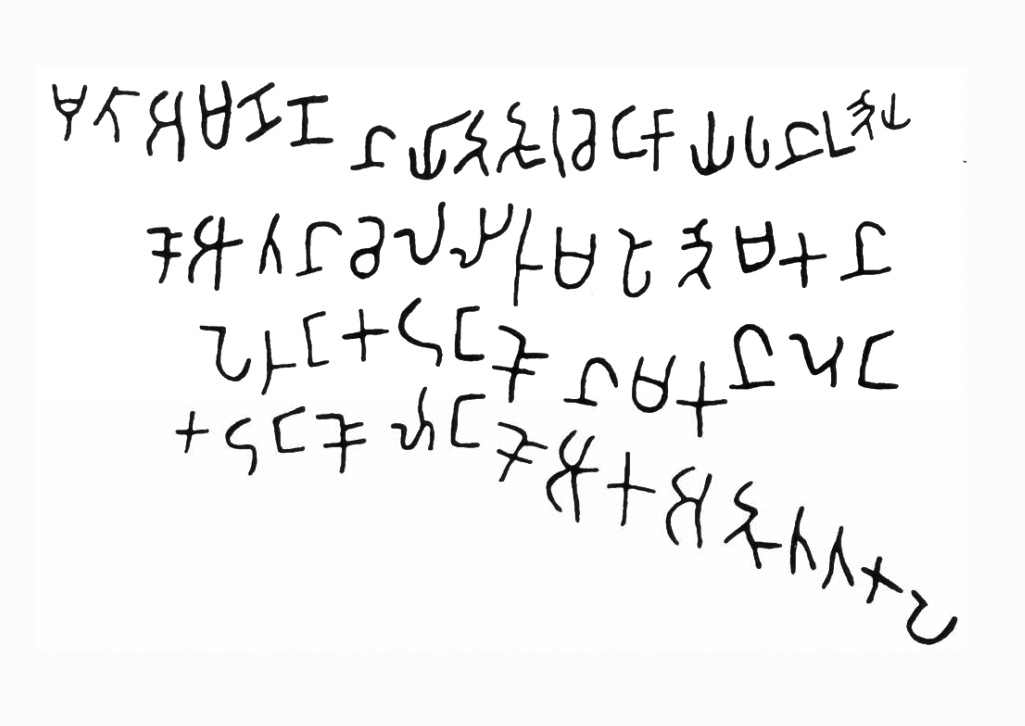
Pugalur · Ancient inscription assigned by source to circa 1st–2nd century CE; this tracing was created/uploaded in 2018
Modern line tracing of a Pugalur Tamil-Brahmi inscription, credited to Rajesh of Raigad in the 2018 Commons record
Modern line tracing of a Pugalur Tamil-Brahmi inscription, credited to Rajesh of Raigad in the 2018 Commons record. This is an epigraphic representation, not a photograph of the inscribed rock.

Velvikkudi grant: 8th century CE; outside the principal editorial period
English translation page from H. Krishna Sastri’s 1923 edition of the Velvikkudi grant (Epigraphia Indica XVII)
English translation page from H. Krishna Sastri’s published treatment of the Velvikkudi grant in Epigraphia Indica XVII (source date 1923). A historical scholarly edition, not a photograph of the original copper plates.

Velvikkudi grant: 8th century CE; outside the principal editorial period
Published plate reproducing the Velvikkudi copper-plate grant, from Epigraphia Indica XVII (source date 1923)
Published plate reproducing the Velvikkudi copper-plate grant, from Epigraphia Indica XVII (source date 1923). The grant is a later, eighth-century witness used to discuss claims about earlier history.
006Two views
Both views are shown at equal weight; this site does not choose between them.
Whether the Mangulam Nedunchezhiyan is the king of the poems
- One view
- Tamil Nadu's archaeology department links the Mangulam name with a Pandya king, and the name matches the poems' Neṭuñceḻiyaṉ.
- Another view
- This study: a shared name does not show they were the same person.
- What would settle it
- Mahadevan's exact readings and plates, analysis of the titles, and independent cross-dating.
Whether Poompuhar was a Chola capital
- One view
- Tamil Nadu's archaeology department calls Poompuhar a Chola 'second capital'.
- Another view
- This study: the excavated wharf shows a working port, not a capital's administration.
- What would settle it
- Plans, sections and finds showing administrative buildings, seals, records or controlled storage.
007Where next
All related studies, connected material, books and sources27 · 15
Elsewhere on this site
Excavation Atlas Sites: Korkai (Ancient Pearl-Fishery Port)
Multi-Script Glossary Terms: Koṟkai (Colchi) (கொற்கை / കൊർക്കൈ) · Mūvēntar (மூவேந்தர் / മൂവേന്തർ)
Connected material
Photographs, drawings, books, videos and other studies linked to this study. A link helps you explore; it does not prove a historical claim.
- Modern line tracing of a Pugalur Tamil-Brahmi inscription, credited to Rajesh of Raigad in the 2018 Commons recordmodern epigraphic tracingBackground
- Published plate reproducing the Velvikkudi copper-plate grant, from Epigraphia Indica XVII (source date 1923)historical printed plateBackground
- English translation page from H. Krishna Sastri’s 1923 edition of the Velvikkudi grant (Epigraphia Indica XVII)historical printed textBackground
008Sources
The study lists the sources it consulted; we have not rechecked them. A working link does not show that a source was read, and a valid identifier does not show that it supports a claim. We do not link to unofficial uploads or copies of publications. Where a study cited one, we show the published citation, or a publisher, DOI or Internet Archive link when we have one. Tracking codes are removed from links, and the sources themselves are not republished here.
Edicts of Ashoka – Rock Edict II
Mangulam (Mankulam) Tamil-Brahmi cave inscriptions
Mangulam Tamil-Brahmi cave inscriptions
Brahmi inscription: Jambai
Jambai Tamil-Brahmi inscription
The Voyage around the Erythraean Sea
Periplus Maris Erythraei, Schoff-based University of Washington digital text
Puṟanāṉūṟu digital library record and editions
Puṟanāṉūṟu CICT digital library record
Paṭṭiṉappālai digital library record and editions
Paṭṭiṉappālai CICT digital library record
Maturaikkāñci digital library record and edition
Maturaikkāñci CICT digital library record
Korkai excavation overview
Alagankulam excavation overview
Poompuhar excavation overview
K. V. Raman ed., Excavations at Uraiyur (Tiruchirappalli), 1965–1969
Print or offline sourceSource recordRamasubbu Krishnamurthy and Senarath Wickramasinghe, A Catalogue of the Sangam Age Pandya and Chola Coins
Coin, museum number 1959,1020.234
British Museum coin 1959,1020.234
Chera, Chola, Pandya: Using Archaeological Evidence to Identify the Tamil Kingdoms of Early Historic South India
Shinu Anna Abraham, Chera, Chola, Pandya
Early Tamil Epigraphy (from the Earliest Times to the Sixth Century C.E.), Volume I: Tamil-Brāhmī Inscriptions
Iravatham Mahadevan, Early Tamil Epigraphy, Volume I, 3rd edition
Print or offline sourceSource record
Researchers and institutions whose work this study uses: Iravatham Mahadevan, K. V. Raman
How we know The evidence, claims and dates behind this study
What this study draws on
- Translations of Ashoka's Rock Edict II, and the Periplus in Schoff's 1912 translation.
- Tamil Nadu archaeology department pages for Mangulam, Jambai, Korkai, Alagankulam and Poompuhar.
- Central Institute of Classical Tamil records for Puṟanāṉūṟu, Paṭṭiṉappālai and Maturaikkāñci.
- A British Museum Pandya coin record; the coin catalogues and Uraiyur report were identified but not read.
Dates in this study
| What is dated | Date | How it was dated |
|---|---|---|
| 785 BCE | 785 BCE | How it was dated is not stated |
| third century BCE | 300–200 BCE | Date from writing, coins or texts |
| 300 BCE-200 CE | 300 BCE – 200 CE | Date from writing, coins or texts |
| first century BCE | 100–1 BCE | How it was dated is not stated |
| first century CE | 1–100 CE | Date from writing, coins or texts |
| around the middle of the first century CE | 40–70 CE | How it was dated is not stated |
| fourth century CE | 301–400 CE | How it was dated is not stated |
See these dates on the timeline
The study’s claims
14 claims · 12 source passages · 74 paragraphs
Browse the study paragraph by paragraphBy the third century BCE, Chola/Choda and Pandya names were part of Ashokan frontier political geography.
Supported in this study
Political naming is not a regnal chronology.
Rock Edict II does not by itself establish Mauryan administration over the Cholas or Pandyas.
Supported with qualifications
The edict alone does not specify local institutions or precise borders.
Mangulam provides early inscriptional evidence for a Nedunchezhiyan name in a context officially interpreted as Pandya, but identity with a particular literary king is unresolved.
Supported with qualifications
Similarity of names does not establish prosopographic identity.
Jambai is a comparative control because an early inscription explicitly names Atiyan Netuman Anci and uses Satiyaputo.
Supported in this study
Around the middle of the first century CE, the Periplus describes a Pandian kingdom associated with Nelcynda and the Colchi pearl-fishery region.
Supported in this study
Territorial wording does not reveal the mechanism or continuity of control.
Puṟanāṉūṟu is strong evidence for a political vocabulary of rulers, chieftains, warfare, praise and patronage, but is not by itself a reliable regnal table.
Supported with qualifications
Poem text, colophon, commentary and modern reconstruction must be kept separate.
Paṭṭiṉappālai's received tradition associates Karikālaṉ and Kāvirippūmpaṭṭiṉam with Chola kingship and urban-port imagery, but is not an independently dated administrative record.
Supported with qualifications
The poem does not supply secure reign years.
Maturaikkāñci's received tradition celebrates a Pandya Neṭuñceḻiyaṉ and Madurai, but this does not prove identity with the Nedunchezhiyan reported at Mangulam.
Supported with qualifications
Literary and inscriptional persons remain separate candidate identities.
No precise early Pandya or Chola regnal chronology can responsibly be generated from the reviewed inscriptions, poems and coins.
Supported in this study
This is a bounded conclusion from the reviewed evidence, not proof that chronology can never be improved.
Korkai has evidence for early occupation and literacy, but the reported 785 BCE charcoal determination is site/sample chronology, not a date for a Pandya state or capital.
Supported with qualifications
A sampled occupation layer does not itself identify a polity.
Alagankulam demonstrates Early Historic long-distance exchange and local writing, but imported goods and Roman coins do not establish a Pandya administrative apparatus.
Supported in this study
Exchange connectivity and political centralization are separate propositions.
At Poompuhar, structural evidence is compatible with port activity, but the label 'Chola second capital' is an interpretation requiring independent corroboration.
Supported with qualifications
Port function is not identical with administrative-capital status.
Uraiyur is important to early Chola claims, but the primary 1988 excavation report was not read and trench-level assertions are withheld.
Supported with qualifications
This is an access-gap finding, not evidence that Uraiyur lacks Early Historic occupation.
The combined evidence supports supra-local Pandya and Chola political formations capable of external recognition and internal representation through kingship, warfare, patronage and claims over valued places or resources, but does not demonstrate a continuously centralized bureaucracy throughout the period.
Supported in this study
Organization, territorial reach and continuity probably varied through time. Evidence survival and current access are asymmetric between Pandya and Chola.
Trace one claim through the study’s records
Explore the evidenceOther source lists
Numbered citation links from the study
The numbered links in the study text point here.
E. Hultzsch, ed., Corpus Inscriptionum Indicarum, Vol. I: Inscriptions of Asoka (1925), Major Rock Edicts II & XIII
The Voyage around the Erythraean Sea
Ovamalai kalvettu | Department Of Archaeology
CICT Library | CICT – AI-Powered Digital Library
Poompuhar | Department Of Archaeology
Excavations at Uraiyur (Tiruchirappalli), 1965-1969 | NDL Search | National Diet Library
Excavations at Uraiyur (Tiruchirappalli), 1965-1969 | WorldCat.org
Chera, Chola, Pandya: Using Archaeological Evidence to Identify the Tamil Kingdoms of Early Historic South India | Aζ South Asia
CICT Library | CICT – AI-Powered Digital Library
CICT Library | CICT – AI-Powered Digital Library
coin | British Museum
Korkai | Department Of Archaeology
Alagankulam | Department Of Archaeology
Archaeological Excavations conducted by the Department of Archaeology | Department Of Archaeology
CICT Publications Details | Classical Tamil Digital Library | CICT Chennai
Print or offline sourceBrahmi Inscription | Department Of Archaeology
Sangam Age Tamil Coins - Ramasubbu Krishnamurthy - Google Books
A Catalogue of the Sangam Age Pandya and Chola Coins - நூலகம்
Tamil - Brahmi Script | Department Of Archaeology
CICT Publications Details | Classical Tamil Digital Library | CICT Chennai
Print or offline sourceIndividual Book Details
Print or offline sourceSocial Formations of Early South India - OUP India
E-Publication | Department Of Archaeology
About this study Status, corrections and how it was made
Status
Draft study, revision 5. No historian, archaeologist, or Tamil or Malayalam specialist has reviewed it yet.
The study itself says more research is needed before its question can be settled.
How it was made
Compiled as an editorial synthesis from published scholarship around questions we framed. About this project & workflow
The summary, How sure lines and Two views notes on this page were prepared from this study and cross-checked against its passages. That is an editorial check, not a specialist review.
Corrections and updates
Technical details
Study code LTS-SUP07. The text fingerprint changes whenever the study text changes.
- The study text is shown as written. Links from its paragraphs to citations help you move around the study; they are not new claims or checked source passages.
See how this study’s records were extracted
Text fingerprint (SHA-256): LTS-SUP07 · cd8fcce6360e55b0577b6bad… · v5
Evidence tables and technical details are on the web page: https://layersofthesouth.org/read/40b23b7b58