Places on the atlas that name this study.
- Everyday lives
- Kuttanad
Early Kerala rice labour: no proven link to Pulayar or Cherumar
Rice is attested in early Kerala and social ranks in Tamil poems, but no reviewed source links ancient rice work to the Pulayar or Cherumar.
- How sure
- 2 Well supported
- 2 Not known
- This page
- 3,690 words · revision 6
Draft study · Awaiting specialist review · Updated
001Dates and places
Places on the atlas that name this study.
- Kuttanad and Vembanad Wetland Cores
Regional wetland zone · Alappuzha and Kottayam
1000–500 BCE
Different beginnings
500–200 BCE
Marks & materials
200 BCE–300 CE
Connected worlds
300–600 CE
Change & continuity
- ca. 500 BCE to ca. 400 CE
- ca. 450 BCE to ca. 350 BCE
- 430-230 BC
- ca. 350 BCE to ca. 50 CE
- Early Historic period (3rd century BCE to 5th century CE)
- 260 to 557 AD
- Laboratory date
- Period assigned by excavators or scholars
- How it was dated is not stated
Each date belongs to what was dated (a sample, an object, a layer or a text), which is not always the event the study asks about.
Each period has the same width, so spacing is not to scale.
The full table of dates, with their ranges, is under How we know.
- 2 Well supported
- 2 Not known
002How sure
In brief
Rice is reported among plant remains at Pattanam, a Kerala port most active from the third century BCE to the fifth century CE. A 2025 sediment core from the Vembanad wetland suggests growing human influence between about 450 BCE and 50 CE, but does not identify rice fields. Early Tamil poems in the Puṟanāṉūṟu describe managed water, rice fields and ranked social groups. The word pulaiyaṉ appears there for a drummer and in a funeral scene, not for farm work. George Hart reads such terms as early evidence of caste; Sudalaimuthu Palaniappan argues later meanings were read back into them. K. Saradamoni's work documents the Pulayar and Cherumar as agricultural slaves in nineteenth-century Kerala. No source reviewed shows who built or worked Kerala's rice fields before 600 CE.
Key researchers cited in this study: George L. Hart (Classical Tamil Literature) · P. J. Cherian (KCHR Pattanam Excavations) · Rajan Gurukkal (Early South Indian Social & Economic History) · Kerala Council for Historical Research (KCHR) · Full bibliography
How sure
- Well supported
Rice is among the plant remains excavated at Pattanam.
Reported by the university collection and a 2020 peat study; neither gives a direct date for the rice.
- Well supported
Early Tamil poems recognise ranked social groups.
Puṟanāṉūṟu 183 contrasts upper and lower groups directly; only their link to later castes is disputed.
- Not known
The early pulaiyaṉ were the ancestors of the later Pulayar.
The word is early, but continuity of the group is unproven and disputed.
- Not known
Who built or worked Kerala's rice fields before 600 CE.
No Kerala site links a field system to a named group of workers.
Why it matters
It stops the later history of caste-based agricultural slavery in Kerala from being read back into antiquity without evidence.
003Key findings
What the study concludes
- Pattanam establishes reported rice presence but not yet the exact cultivation regime or labour identity.
- Vembanad sediment proxies indicate core-period human influence without identifying paddy cultivation.
- Comparative phytolith evidence shows that Early Historic South Indian rice did not necessarily require deep-water irrigation.
- Purananuru contains hierarchy, occupational vocabulary and the term pulaiyan, but the consulted pulaiyan passages are drummer/funerary contexts rather than wet-rice labour.
- Pulayar and Cherumar are securely important to later Kerala agrarian-servitude history, but unchanged continuity into antiquity is not established.
In the study’s own words. How sure each point is, is shown above.
The summary above is the short read. The full study is the complete text it was drawn from, with its tables and source notes.
What the full study covers
- Orientation, question, and scope
- Evidence architecture and chronology
- Rice, water management, and the limits of “agrarian engineering”
- Labour, hierarchy, and the problem of Pulayar and Cherumar continuity
- Disagreements, conclusions, and what would discriminate between them
- What is still needed and sources
004The study
Orientation, question, and scope
What evidence establishes wet-rice labour and social differentiation in early Kerala?
This study examines a claim that links the historically documented Pulayar and Cherumar directly to “indigenous agrarian engineering” in early Kerala, and treats wetland reclamation, sowing, transplanting and labour organization as one historical package. The claim presupposes more than the evidence warrants, so each proposition is tested separately, without projecting colonial or present-day caste identities unchanged into antiquity.
The principal finding is therefore deliberately narrower than that claim. There is evidence for rice in Early Historic Kerala, evidence for human interaction with Kerala wetlands, literary evidence from wider early historic Tamilakam for irrigated agrarian landscapes and social differentiation, and evidence that a term pulaiyaṉ occurs in differentiated ritual/occupational contexts. The reviewed evidence does not, however, establish that people identifiable as the later Pulayar or Cherumar constituted Kerala’s wet-rice engineering or agricultural labour force in 1000 BCE–600 CE. Nor does rice presence by itself demonstrate reclamation, transplantation, large-scale irrigation, or centrally organized labour. ↗1
The chronology is mixed. Pattanam and the Arookutty/Vembanad sediment record fall squarely within the study's main period of 1000 BCE–600 CE. The Puṟanāṉūṟu is relevant as Early Historic Tamil literary evidence but has composition, compilation, geography, and transmission problems that prevent its individual poems from functioning like dated Kerala inscriptions. Saradamoni’s Pulayar/Cherumar scholarship and the engineered Kuttanad system belong overwhelmingly to much later comparative lanes. ↗2
Plain-language summary
Rice was certainly part of the world of early South India, and rice remains are reported from Pattanam in Kerala. Early Tamil poems also describe water management, rice fields, ponds, differentiated occupations, and unequal social categories. But these pieces cannot simply be joined into a story in which the later Pulayar and Cherumar are assumed to have been the named engineers and labourers of ancient Kerala’s wetlands. At Pattanam, the accessible institutional record confirms rice among botanical remains but does not provide the sample-level context needed here to establish how, where, or by whom it was grown. At Vembanad, a dated sediment core indicates human influence on the wetland but does not identify rice cultivation or labour organization. Comparative archaeobotany from Tamil Nadu, discussed below and in “Early South Indian farming mixed rain-fed crops and managed water”, shows why caution is necessary. ↗3
Evidence architecture and chronology
The evidence becomes substantially clearer once four questions are separated: Was rice present? How was water managed? Who performed agricultural work? What social categories can actually be named? The sources answer these at very different strengths.
| Evidence class | Place and chronology | What it establishes | What it does not establish |
|---|---|---|---|
| Archaeobotanical remains | Pattanam, Kerala; strongest activity c. 3rd century BCE–5th century CE | Rice is reported among excavated botanical remains | Cultivation location, irrigation regime, transplanting, labour identity, or direct dating of the rice in the accessible summary |
| Wetland sediment proxies | Arookutty, Vembanad; c. 500 BCE–400 CE | Environmental change and proxy evidence interpreted as human influence | Rice cultivation, reclamation, named labourers, or caste organization |
| Direct rice-grain dates and phytoliths | Kodumanal and Perur, Tamil Nadu | Rice within the main period; cultivation apparently compatible with lower-water/rainfed regimes | A universal South Indian model of irrigated paddy |
| Early Tamil poetry | Wider Tamilakam; Early Historic literary corpus with difficult internal chronology | Agrarian imagery, water bodies, rice, political extraction, occupation/status vocabulary | Direct archaeological proof, precise Kerala locality in every poem, or automatic continuity into later castes |
| Colonial/modern social history | Kerala, especially nineteenth century | Pulayar/Cherumar identities as major agrestic-labour/slave populations are securely documented | Their unchanged existence or occupational role in 1000 BCE–600 CE |
| Modern heritage agriculture | Kuttanad | Reclaimed delta-swamp, below-sea-level wet-rice engineering | An ancient date for those engineering methods |
At Pattanam, the Mahatma Gandhi University School of Social Sciences collection page describes a roughly 70-hectare settlement in the Periyar delta, with less than one percent excavated after the first eight KCHR seasons. It dates the most active Early Historic phase to the third century BCE through fifth century CE and lists rice among the botanical remains alongside pepper, cardamom, pulses, wood, charcoal, and other plant material. This is direct evidence that rice is present in the excavated archaeological record, but the public page does not supply the rice specimens’ trench, layer, feature, identification protocol, direct dates, or relationship to any cultivation installation. Those missing variables matter: rice brought to a port or consumed in a settlement is not by itself proof of local wet-paddy production. ↗4 A 2020 study of a peat deposit at Pattanam also reports a rice grain, with coconut and probable pepper, but says the peat's age was still under investigation (Varghese et al. 2020, Proceedings of the Indian National Science Academy 86.2: 1097–1106); “Crops at six sites: millets and pulses persist as rice spreads” sets out those identifications.
The 2025 Arookutty core study supplies a different kind of Kerala evidence. Its authors reconstruct approximately 500 BCE–400 CE from a 100 cm Vembanad wetland sediment core. They interpret phases around 450–350 BCE and 350 BCE–50 CE as showing increasing human influence based on sedimentological, diatom, palynofacies, and stress-indicator evidence. That is significant because it places human activity in an alluvial/backwater setting within the main period. Yet the reported proxies are nonspecific: they do not identify a rice field, paddy bund, transplantation event, field drain, or labouring population. “Anthropogenic influence” must therefore remain one inferential step removed from agriculture and several steps removed from named caste labour. “Kuttanad's buried peat and wood do not date ancient rice fields” discusses the Arookutty core and the other dated Kuttanad and Vembanad records in detail. ↗5
Comparative evidence from Tamil Nadu shows why those steps should not be collapsed. Eleanor Kingwell-Banham’s open-access archaeobotanical analysis reports direct rice-grain dates of 430–230 BCE at Kodumanal and 260–557 CE at Perur. Phytolith assemblages from both were interpreted as indicating lower water availability compatible with groundwater/lowland rainfed cultivation, rather than deep-water irrigation. Her broader methodological warning is especially consequential here: archaeological reasoning that moves automatically from “rice” to “irrigation,” then to agricultural intensification, centrally controlled labour, and complex political organization is too simple. ↗6
This does not prove Kerala rice was rainfed. Pattanam, Vembanad, coastal Kerala, Kodumanal, and Perur occupy different hydrological regimes. It shows instead that the cultivation regime has to be demonstrated rather than inferred from the crop name. The same evidential rule applies to labour.
Rice, water management, and the limits of “agrarian engineering”
The Puṟanāṉūṟu does provide important textual evidence that water, food production, and political power could be conceptually linked in early Tamil poetry. Poem 18 treats land and water together as the basis of food and urges the ruler to enlarge water bodies in low-lying terrain. The poem therefore supports the existence of a cultural and political vocabulary in which managed water was regarded as productive infrastructure. It is not, however, a measured account of a Kerala reclamation project, nor does it name the workers who created or maintained such works. “Early South Indian farming mixed rain-fed crops and managed water” reads the poem through the Auvai Duraisamy Pillai edition and discusses its text history. ↗7
Other Puṟanāṉūṟu passages demonstrate agrarian abundance without resolving the engineering method. Poem 184 uses a ripe rice field in an analogy about taxation and destructive royal extraction; poem 186 juxtaposes rice, water, and kingship; poem 287 evokes deep ponds, fish, rice stores, and fertile marutam settlements. These are valuable social and environmental representations, but literary landscape conventions, praise-poetry, political advice, and metaphor cannot be treated as if they were excavation plans. ↗8
Sureshkumar Muthukumaran’s 2022 study is useful precisely because it gathers the scattered early Tamil evidence for rice and water. Its notes identify numerous Puṟanāṉūṟu passages relevant to water, fields, reservoirs, rice, aquatic ecologies, and water management, including poems 15, 18, 33, 70, 98, 287, 352, and 354. But the article’s remit is South India and Sri Lanka, not proof that every textual hydraulic scene describes Kerala. Its evidentiary value for this study is therefore regional and comparative: early Tamil literature makes substantial hydraulic agriculture thinkable and documentable, while archaeology remains necessary to locate and date the actual works. ↗9
The four techniques bundled into the claim therefore receive separate verdicts:
Oryza sativa - Kerala 3 – Modern rice plant or grain
Photographed 2014-09-15
Wetland reclamation: not established for early Kerala by the consulted evidence. The Vembanad core establishes environmental change and inferred human influence, but no excavated core-period field embankment or reclaimed paddy plot is documented in the sources consulted. ↗5
Irrigation or deliberate water control: textually plausible and regionally attested as an idea/practice in early Tamil literature, but no consulted Kerala field installation can yet be linked to the Pattanam rice. Comparative phytolith evidence cautions against making irrigation automatic wherever rice occurs. ↗10
Broadcast sowing versus transplantation: unresolved for early Kerala. None of the consulted Kerala archaeological evidence distinguishes these cultivation methods.
Centralized or caste-specific labour organization: unresolved for the core period. No consulted Kerala archaeological context links a field system to a named labour category.
This distinction is reinforced by Kuttanad. The FAO’s heritage-system documentation describes Kuttanad’s below-sea-level rice fields as largely reclaimed delta swamps and says the characteristic technique was developed and mastered roughly 150 years ago, while below-sea-level cultivation there is described as a practice of approximately the last two centuries. It is excellent evidence for Kerala wetland engineering and cooperative bund maintenance in the historical/modern period, but precisely for that reason it is unsafe to use Kuttanad’s current landscape as an unchanged survival from the Early Historic era. “Kuttanad's buried peat and wood do not date ancient rice fields” examines the dated evidence for early Kuttanad landscapes. ↗11
Labour, hierarchy, and the problem of Pulayar and Cherumar continuity
The strongest correction concerns the named communities. Saradamoni’s important research is modern historical scholarship, not an ancient primary source. Her 1973 article is explicitly about agrestic slavery in nineteenth-century Kerala. In its accessible notes, she explains Cheruman/Cherumar and Pulayan/Pulayar as Malayalam forms associated with the major bodies of agrestic slaves in different parts of colonial Kerala and notes their agricultural-labour position in her own historical frame. That makes Saradamoni indispensable for the later history of agrarian servitude, but it cannot by itself establish the same communities, boundaries, names, or occupational relations fifteen to twenty centuries earlier. ↗12
The word pulaiyaṉ does occur in early Tamil literature. That fact deserves neither erasure nor automatic identification with the later Pulayar.
In Puṟanāṉūṟu 287, the poem directly addresses a pulaiya associated with beating a tuṭi drum. The same poem then evokes an affluent wet-rice landscape of deep ponds, fish, rice stores, and marutam settlements. The juxtaposition is historically interesting – but it does not say that the pulaiya cultivated, reclaimed, irrigated, or engineered those rice fields. Converting spatial or poetic co-occurrence into an occupational statement would add information not present in the verse. ↗13
In poem 360, pulaiyaṉ occurs in a funerary context involving food laid on grass near cremation. Here again, the text associates the term with ritual work rather than agrarian engineering. ↗14
Poem 183 is stronger evidence for social differentiation at the conceptual level. It contrasts “lower” and “upper” divisions while arguing that learning can reverse expected deference. This means it would be equally mistaken to reconstruct early Tamil society as demonstrably egalitarian merely because later caste institutions cannot be projected backward. The poem presents ranked social difference as intelligible to its audience. What it does not resolve is whether those divisions map cleanly onto later jāti identities, whether the wording belongs to the same chronological layer as every other poem, or how directly the categories apply to western-coast Kerala. ↗15
Poem 335 names tuṭiyaṉ, pāṇaṉ, paṟaiyaṉ, and kaṭampaṉ as kuṭi in a stylized list; its food list emphasizes millet, varagu, pulses, and beans, while rice appears in ritual language at the poem’s close. It demonstrates named social group vocabulary, but it does not name Cherumar and does not convert those groups into a wet-rice labour caste. ↗16
There is also a genuine philological disagreement over how terms such as pulaiyaṉ, iḻiciṉaṉ, and related vocabulary should be historicized. George L. Hart has argued that Sangam literature contains significant evidence for status hierarchy and caste-like exclusion; in a documented scholarly exchange he maintained that the texts make caste difficult to dismiss if their conventional semantic reading is accepted. Sudalaimuthu Palaniappan instead argues that later understandings of pollution and untouchability have been projected onto earlier vocabulary; his 2008 International Journal of Jaina Studies article explicitly proposes a different etymological and religious history for pulaiyaṉ. This disagreement is consequential: the term itself is secure, but the leap from ancient lexical form to an unchanged later caste identity is precisely what remains disputed. ↗17
Accordingly, the defensible formulation is:
Early Tamil literature provides evidence for differentiated occupations, ranked social language, ritual specialists, and a term pulaiyaṉ. It does not, on the evidence read here, establish an unbroken identity between those textual referents and the colonial/modern Pulayar, nor does it identify them as early Kerala’s wet-rice engineers.
For Cherumar, the result is even more restrictive. No core-period occurrence securely identifiable as the later Kerala Cherumar appears in the textual and archaeological sources consulted. Saradamoni’s accessible discussion places Cherumar securely in the later Kerala social history she studies, but that is not an ancient attestation. This is a negative result limited to the sources read, not a claim that no earlier evidence can exist. ↗18
The reviewed evidence therefore permits recognition of inequality without inventing continuity. Early Tamil texts can encode status difference and potentially stigmatized occupations; later Kerala unquestionably developed severe hereditary agrarian servitude in which Pulayar and Cherumar were central populations. The missing link is evidence that demonstrates the identity, institution, and agricultural function across the intervening chronology rather than presuming it. ↗19
Disagreements, conclusions, and what would discriminate between them
Strongest disagreements
The first disagreement is methodological: does rice imply irrigated paddy? Older or synthetic narratives can readily treat rice, tanks, intensified agriculture, labour mobilization, and political centralization as one development. Kingwell-Banham’s crop-based phytolith work, summarized above, directly challenges that chain. A Kerala case therefore requires Kerala field ecology, not a generalized rice model. ↗6
The second disagreement is philological and social: do terms such as pulaiyaṉ already denote caste/untouchability in essentially later senses? Hart represents the stronger-continuity reading; Palaniappan rejects that reading and argues for semantic transformation. The poems themselves securely document a named term in drummer/funerary contexts and securely document ranked vocabulary elsewhere. To discriminate between the larger historical interpretations requires full comparison of manuscript readings, early commentaries, cognate Dravidian evidence, inscriptional attestations, and the chronology of semantic change – not a retrospective identification from modern caste names alone. ↗20
The third disagreement concerns chronology. Strong agrarian hierarchy and attached labour are much better documented in later Kerala sources than in the first millennium BCE/early first millennium CE material reviewed here. The 849 CE Tarisappalli copper plates (standard editions: T. A. Gopinatha Rao, Travancore Archaeological Series, vol. II; M. R. Raghava Varier and Kesavan Veluthat, Tarisāppaḷḷi Paṭṭayam, 2013) are sometimes cited as early evidence for attached labour in Kerala; that reading, including any levy on bonded servants, was not checked against the editions for this study and belongs to the ninth century, well after 600 CE.
Low-lying paddy fields in the Kuttanad wetland, Kerala (modern landscape context)
Photographed Taken on 28 December 2011
Conclusions by test
Crop presence – supported. Rice occurs in the Pattanam botanical assemblage reported by the institutional archaeological collection, within a site whose most active Early Historic phase falls inside the main period. Exact sample provenience and direct dating remain unresolved in the accessible material. ↗4
Wetland human activity – supported, but nonspecific. The Arookutty/Vembanad core supplies proxy evidence interpreted as anthropogenic influence during portions of c. 500 BCE–400 CE. It does not identify paddy agriculture or reclamation. ↗5
Large-scale wet-rice irrigation/reclamation in early Kerala – not established by the consulted evidence. Early Tamil poetry supports knowledge and valuation of water management; comparative South Indian archaeobotany shows that rice does not itself prove deep-water irrigation. ↗10
Broadcast sowing or transplantation – unresolved. No consulted core-period Kerala source distinguishes them.
Labour organization – only indirectly evidenced. Literature reveals rulers, cultivable lands, extraction, occupational differentiation, and status language, but the accessible archaeological evidence does not identify who built or worked Kerala’s rice fields. ↗8
Early social differentiation – supported in a bounded literary sense. The Puṟanāṉūṟu contains explicit upper/lower language, named kuṭi, and occupational/ritual terms. Translating that evidence directly into the mature later caste order remains contested. ↗22
Pulayar continuity – unresolved and should not be presumed. Pulaiyaṉ is an early textual term; later Pulayar are securely documented in agrarian-servitude history. The identity relation across the centuries has not been demonstrated here. ↗23
Cherumar continuity – not established in the reviewed core-period evidence. The secure material found for this study is later. ↗18
The overall result is consequently neither “there was no hierarchy” nor “later agrarian caste slavery already existed unchanged.” It is a layered conclusion: early rice and differentiated social worlds are evidenced; early Kerala wetland engineering is incompletely documented; named labour organization is missing; and continuity to later Pulayar/Cherumar identities remains unproven.
What is still needed and sources
What is still needed
The most consequential missing item is the Pattanam botanical primary record: the relevant KCHR excavation season report, botanical specialist chapter, trench/context table, identification method, and any direct dates for rice. The institutional collection establishes presence but cannot carry the stronger cultivation claim. ↗4
Second, the literary evidence needs a critical-text pass. The digital Tamil text read here is sufficient to establish that the relevant lexical forms and passages exist, but publication-grade argument should compare Puṟanāṉūṟu 18, 183, 287, 335, and 360 in a recognized critical/annotated edition, Hart and Heifetz’s translation where relevant, Tamil commentary traditions, and consequential variants. Muthukumaran’s bibliography identifies Ve. Pālacuppiramaṇiyaṉ’s 2004 edition and Hart–Heifetz as key editions to collate. ↗24
Third, a dedicated epigraphic search should establish the earliest securely dated Kerala attestations of Pulayar/Pulaiyar, Cherumar/Cheruman, aṭimai, and related labour/land categories, with the ninth-century copper-plate corpus as a chronological comparator rather than assumed continuation.
Fourth, the full Arookutty paper should be recovered with its age-depth model and sample table. The accessible abstract and conclusion establish the authors’ anthropogenic interpretation, while its complete age model and sample table were not read directly for this study. ↗5
Fifth, field evidence capable of discriminating cultivation methods would include excavated bunds, canals, sluices, palaeosols, weed ecology, rice phytolith water indices, field geometry, or securely contextualized agricultural implements from Kerala’s river valleys/backwaters. Without that evidence, transplantation, reclamation technology, and labour scale should remain open questions.
Sources
Kingwell-Banham, Eleanor. “Dry, rainfed or irrigated? Reevaluating the role and development of rice agriculture in Iron Age-Early Historic South India using archaeobotanical approaches.” Archaeological and Anthropological Sciences 11 (2019): 6485–6500. DOI: 10.1007/s12520-019-00795-7. Full open-access HTML read; CC BY 4.0. The most important methodological comparator because it directly tests rice cultivation water regimes rather than assuming them. https://doi.org/10.1007/s12520-019-00795-7 ↗25
Muthukumaran, Sureshkumar. “Rice and Water in Early Historic South India and Sri Lanka.” South Asian Studies 38.2 (2022): 101–115. DOI: 10.1080/02666030.2022.2111084. Read in abstract and notes only; full article not yet checked. Important synthesis of early Tamil rice/hydraulic references. https://doi.org/10.1080/02666030.2022.2111084 ↗26
Oryza sativa - Kerala 2 – Modern rice plant or grain
Photographed 2014-09-15
Puṟanāṉūṟu digital Tamil text and line-by-line commentary. Sangampedia/Tamil Heritage Foundation environment. Relevant passages read: 18, 183, 184, 186, 287, 335, 360. Useful for direct lexical checking but not treated here as a substitute for a formal critical edition. https://sangampedia.net/%E0%AE%AA%E0%AF%81%E0%AE%B1%E0%AE%A8%E0%AE%BE%E0%AE%A9%E0%AF%82%E0%AE%B1%E0%AF%81/ ↗27
Hart, George L., and Hank Heifetz, trans. The Four Hundred Songs of War and Wisdom: An Anthology of Poems from Classical Tamil, the Purananuru. New York: Columbia University Press, 1999. ISBN 978-0-231-11562-9. Bibliographic record verified; full book not yet checked. Required for translation comparison and Hart’s interpretive apparatus.
Tiwari, Pooja, et al. “Paleolimnology and Natural Versus Anthropogenic Influx During the Late Holocene from Vembanad Wetland, Ramsar Site, Kerala, India.” Quaternary 8.1 (2025): article 3. DOI: 10.3390/quat8010003. Read in abstract and conclusion only; full article not yet checked. Direct Kerala environmental evidence for c. 500 BCE–400 CE. https://doi.org/10.3390/quat8010003 ↗5
Mahatma Gandhi University, School of Social Sciences. “Early Historic Age Collection – Pattanam.” Institutional archaeological collection page. Reports the site chronology and rice among botanical remains; sample-level archaeological publication still needed. https://sss.mgu.ac.in/early-historic-age-collection/ ↗4
Cherian, P. J., ed. Pattanam Excavations: Interim Report of the Eighth Season – 2014. Vol. 1. Kerala Council for Historical Research, 2014. ISBN 9788185499550. Bibliographic record verified; full report not yet checked for archaeological context.
Saradamoni, K. “Agrestic Slavery in Kerala in the Nineteenth Century.” The Indian Economic & Social History Review 10.4 (1973): 371–385. DOI: 10.1177/001946467301000403. Restricted-access publisher page and notes read. Essential later comparison; explicitly nineteenth-century rather than evidence for antiquity. https://doi.org/10.1177/001946467301000403 ↗18
Saradamoni, K. Emergence of a Slave Caste: Pulayas of Kerala. New Delhi: People’s Publishing House, 1980. xiii + 259 pp. Bibliographic record verified; full book not yet checked. Modern historical scholarship, not an ancient primary source.
Palaniappan, Sudalaimuthu. “On the Unintended Influence of Jainism on the Development of Caste in Post-Classical Tamil Society.” International Journal of Jaina Studies (Online) 4.2 (2008): 1–65. Abstract read through SOAS. Important counterargument to a straightforward caste/untouchability reading of pulaiyaṉ. https://www.soas.ac.uk/international-journal-jaina-studies ↗29
Hart, George L. “Early Evidence for Caste in South India.” In Paul Hockings, ed., Dimensions of Social Life: Essays in Honor of David G. Mandelbaum, 467–491. Berlin/New York: Mouton de Gruyter, 1987. Bibliographic record verified; full chapter not yet checked. Represents the stronger hierarchy/caste-continuity side of the philological debate.
Food and Agriculture Organization of the United Nations. “Kuttanad Below Sea Level Farming System.” GIAHS/family-farming case documentation, 2012–2013. Describes reclaimed delta-swamp fields and the historical development of the characteristic below-sea-level technique; used here only as later comparison. https://www.fao.org/giahs/giahs-around-the-world/india-kuttanad-farming-system/en ↗11
Varier, M. R. Raghava, and Kesavan Veluthat. Tarisāppaḷḷi Paṭṭayam (National Book Stall / Sahitya Pravarthaka Co-operative Society, 2013); and T. A. Gopinatha Rao, Travancore Archaeological Series, vol. II (Government of Travancore, 1916–20). Standard epigraphic editions for the 849 CE Tarisappalli copper plates; ninth-century comparative horizon, primary edition pages not yet checked directly.
005Photographs
Photographs of the places and objects this study discusses. Each item carries its creator’s credit, licence and documented source. See all 412 photographs and source images ↗
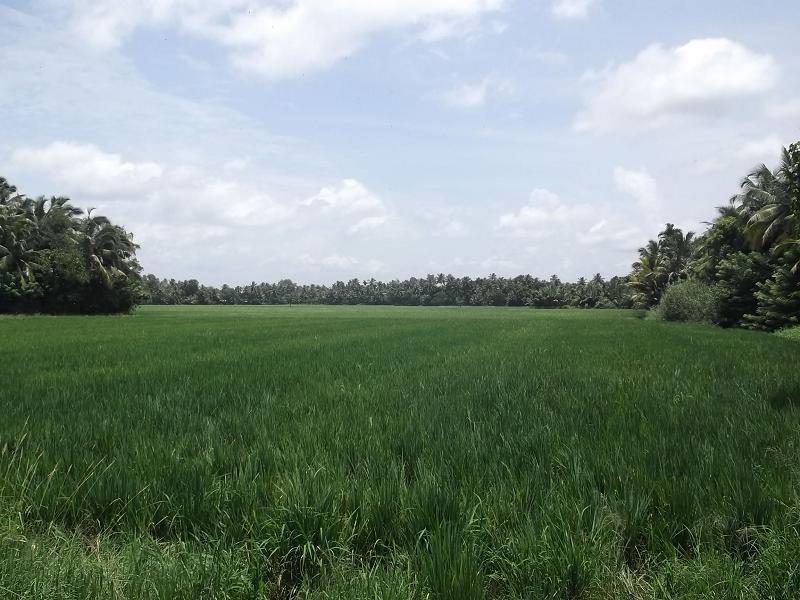
Photographed 2014-09-15
Oryza sativa - Kerala 3 – Modern rice plant or grain
Oryza sativa - Kerala 3. Modern rice plant or grain; ancient cultivation must be established by dated archaeobotanical evidence.
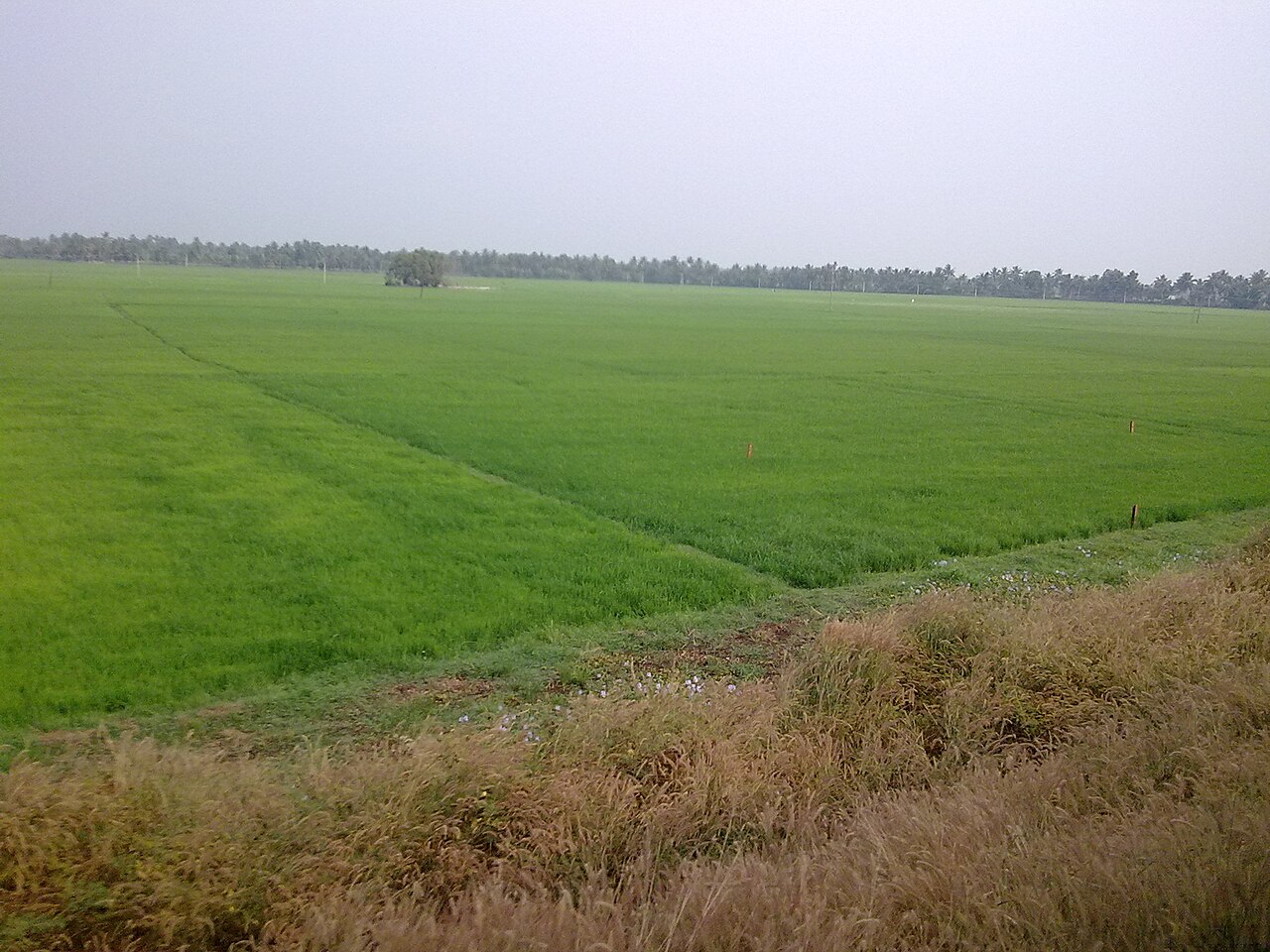
Photographed Taken on 28 December 2011
Low-lying paddy fields in the Kuttanad wetland, Kerala (modern landscape context)
Low-lying paddy fields in the Kuttanad wetland, Kerala.
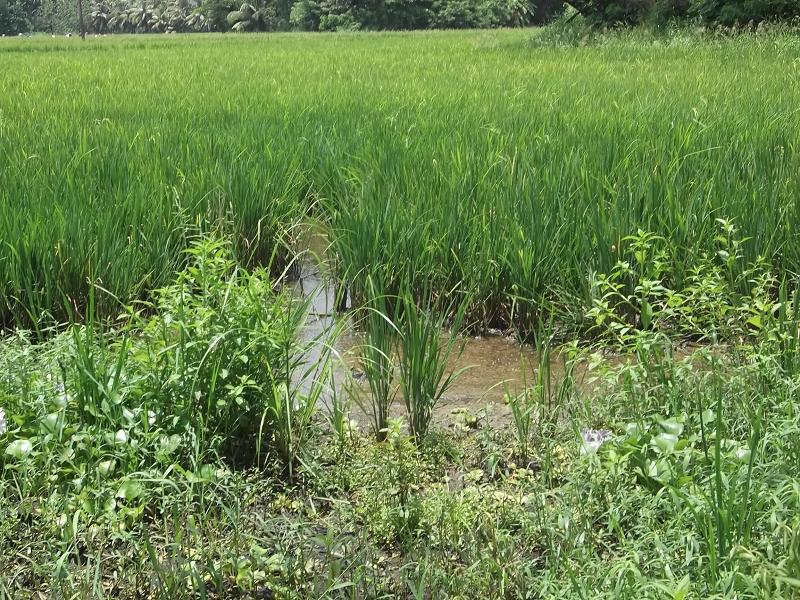
Photographed 2014-09-15
Oryza sativa - Kerala 2 – Modern rice plant or grain
Oryza sativa - Kerala 2. Modern rice plant or grain; ancient cultivation must be established by dated archaeobotanical evidence.
006Two views
Both views are shown at equal weight; this site does not choose between them.
What the early word pulaiyaṉ meant
- One view
- George L. Hart argues Sangam poems show status hierarchy and caste-like exclusion if their usual reading is accepted.
- Another view
- Sudalaimuthu Palaniappan (2008) argues later ideas of pollution and untouchability were projected back onto the word.
- What would settle it
- Comparing manuscript readings, early commentaries, related Dravidian words and dated inscriptions to trace when its meaning changed.
007Where next
All related studies, connected material, books and sources21 · 13
Elsewhere on this site
Excavation Atlas Sites: Kuttanad and Vembanad Wetland Cores
Multi-Script Glossary Terms: marutam (மருதம் / മരുതം) · nel (arici) (நெல் / அரிசி / നെല്ല് / അരി) · uḻavar (உழவர் / ഉഴവർ) · varaku, cāmai, kēḻvaraku / keḷvaraku & koḷḷu (Dryland Millets & Pulses) (வரகு, சாமை, கேள்வரகு & கொள்ளு / വരക്, ചാമ, റാഗി (പഞ്ഞപ്പുല്ല്), മുതിര)
Connected material
Photographs, drawings, books, videos and other studies linked to this study. A link helps you explore; it does not prove a historical claim.
- Oryza sativa - Kerala 2 – Modern rice plant or grainphotographBackground
- Oryza sativa - Kerala 3 – Modern rice plant or grainphotographBackground
- Low-lying paddy fields in the Kuttanad wetland, Kerala (modern landscape context)photographBackground
008Sources
The study lists the sources it consulted; we have not rechecked them. A working link does not show that a source was read, and a valid identifier does not show that it supports a claim. We do not link to unofficial uploads or copies of publications. Where a study cited one, we show the published citation, or a publisher, DOI or Internet Archive link when we have one. Tracking codes are removed from links, and the sources themselves are not republished here.
புறநானூறு / Puṟanāṉūṟu
Puṟanāṉūṟu digital Tamil text with line-by-line commentary, Sangampedia/Tamil Heritage Foundation environment.
George L. Hart and Hank Heifetz, trans., The Four Hundred Songs of War and Wisdom: An Anthology of Poems from Classical Tamil, the Purananuru, Columbia University Press, 1999.
Print or offline sourceSource recordSureshkumar Muthukumaran, Rice and Water in Early Historic South India and Sri Lanka, South Asian Studies 38.2 (2022), 101-115.
Eleanor Kingwell-Banham, Dry, rainfed or irrigated? Reevaluating the role and development of rice agriculture in Iron Age-Early Historic South India using archaeobotanical approaches, Archaeological and Anthropological Sciences 11 (2019), 6485-6500.
Mahatma Gandhi University School of Social Sciences, Early Historic Age Collection - Pattanam.
P. J. Cherian (ed.), Pattanam Excavations: Interim Report of the Eighth Season-2014, Vol. 1, Kerala Council for Historical Research, 2014.
Print or offline sourceSource recordPooja Tiwari et al., Paleolimnology and Natural Versus Anthropogenic Influx During the Late Holocene from Vembanad Wetland, Ramsar Site, Kerala, India, Quaternary 8.1 (2025), article 3.
K. Saradamoni, Agrestic Slavery in Kerala in the Nineteenth Century, The Indian Economic & Social History Review 10.4 (1973), 371-385.
K. Saradamoni, Emergence of a Slave Caste: Pulayas of Kerala, People's Publishing House, New Delhi, 1980.
Print or offline sourceSource recordFood and Agriculture Organization of the United Nations, Kuttanad Below Sea Level Farming System, GIAHS documentation.
Rajan Gurukkal, The Making and Proliferation of Jāti: A Historical Inquiry, Studies in History 31.1 (2015), 30-50.
Sudalaimuthu Palaniappan, On The Unintended Influence Of Jainism On The Development Of Caste In Post-Classical Tamil Society, International Journal of Jaina Studies (Online) 4.2 (2008), 1-65.
George L. Hart, Early Evidence for Caste in South India, in Paul Hockings (ed.), Dimensions of Social Life, 1987, pp. 467-491.
Print or offline sourceSource record
Researchers and institutions whose work this study uses: George L. Hart, P. J. Cherian, Rajan Gurukkal, Kerala Council for Historical Research
How we know The evidence, claims and dates behind this study
What this study draws on
- Puṟanāṉūṟu poems 18, 183, 287, 335 and 360, checked in a digital Tamil text.
- The Pattanam collection record of Mahatma Gandhi University and a 2020 study of Pattanam peat.
- The 2025 Arookutty sediment core from Vembanad (about 500 BCE–400 CE), read at abstract level.
- Saradamoni's 1973 article on nineteenth-century agrestic slavery, used as later history.
Dates in this study
| What is dated | Date | How it was dated |
|---|---|---|
| ca. 500 BCE to ca. 400 CE | 500 BCE – 400 CE | Period assigned by excavators or scholars |
| ca. 450 BCE to ca. 350 BCE | 450–350 BCE | Period assigned by excavators or scholars |
| 430-230 BC | 430–230 BCE | Laboratory date |
| ca. 350 BCE to ca. 50 CE | 350 BCE – 50 CE | Period assigned by excavators or scholars |
| Early Historic period (3rd century BCE to 5th century CE) | 300 BCE – 500 CE | How it was dated is not stated |
| 260 to 557 AD | 260–557 CE | Laboratory date |
See these dates on the timeline
The study’s claims
17 claims · 13 source passages · 61 paragraphs
Browse the study paragraph by paragraphRice is reported among botanical remains excavated at Pattanam, whose strongest Early Historic activity is dated by the institutional collection to the third century BCE through fifth century CE.
Supported in this study
Rice presence at a settlement does not by itself prove local cultivation. The public institutional summary is not a substitute for the excavation's botanical specialist publication.
The Arookutty core provides proxy evidence interpreted as human influence in the Vembanad wetland during portions of approximately 500 BCE-400 CE, but the reported proxies do not identify rice cultivation or agricultural labour.
Supported with qualifications
Human influence cannot be equated automatically with paddy cultivation, reclamation or caste-specific labour.
Purananuru 18 represents managed water and the conjunction of land and water as fundamental to food production, but it does not identify the labourers who built or maintained water works.
Supported in this study
The poem cannot be assigned automatically to a specific Kerala hydraulic installation.
Purananuru 287 uses the term pulaiya in connection with drumming and also depicts an affluent wet-rice landscape, but it does not state that the pulaiya cultivated, reclaimed or engineered the rice fields.
Supported in this study
Co-occurrence in one poem is not evidence that the drummer performed the agricultural work described elsewhere in the poem.
Purananuru 360 places a pulaiyan in a funerary context rather than a wet-rice agricultural one.
Supported in this study
Purananuru 183 demonstrates that ranked upper and lower social divisions were intelligible in the literary world of the poem.
Supported with qualifications
Evidence for hierarchy is not equivalent to proof of continuity with later jāti identities.
Purananuru 335 contains named social-group vocabulary but does not identify Pulayar or Cherumar as a wet-rice labour caste.
Supported in this study
Directly dated rice at Kodumanal and Perur falls within or overlaps the editorial period, while phytolith evidence is interpreted as lower-water or lowland rainfed cultivation rather than deep-water irrigation.
Supported in this study
The finding cannot be transferred mechanically to wetter coastal Kerala.
Rice presence alone is insufficient evidence for irrigation, reclamation, agricultural intensification, centralized labour or political control.
Supported in this study
No consulted core-period Kerala source in this bounded investigation directly links a named Pulayar or Cherumar population to wet-rice field labour, reclamation, transplantation or hydraulic engineering.
Supported with qualifications
This conclusion is restricted to the sources and access achieved for this study. Systematic epigraphic and unpublished excavation searches could change it.
Saradamoni's work is later historical scholarship on agrestic slavery and cannot function as a primary source for Pulayar or Cherumar identity in 1000 BCE-600 CE.
Supported in this study
The work remains valuable for later social history and retrospective historiography.
Early Tamil literary evidence supports social differentiation without establishing an unchanged line from those categories to colonial-era Kerala caste and agrarian-slavery institutions.
Supported with qualifications
Neither a casteless reconstruction nor a claim of unchanged caste continuity is justified by the reviewed evidence.
the common description overstates the evidence by treating Pulayar/Cherumar identity, wet-rice labour and agrarian engineering as already demonstrated components of one ancient system.
Supported in this study
The historical meaning of pulaiyan and its relevance to caste or untouchability in the earliest Tamil material is a genuine scholarly dispute, so identity continuity cannot be treated as lexically self-evident.
Debated in the sources
Hart's contrary interpretation was identified bibliographically and in a scholarly discussion, but his 1987 chapter was not checked directly.
Muthukumaran's synthesis confirms that Sangam literature contains a broad set of rice and hydraulic references, but those references operate at the scale of early historic South India and cannot all be localized to Kerala.
Supported with qualifications
No core-period attestation securely identifiable as the later Kerala Cherumar was located in the consulted sources performed for this study.
Supported with qualifications
A systematic Old Tamil, early Malayalam and inscriptional lexical search remains an explicit open task.
The reviewed core-period Kerala archaeological evidence does not directly identify the social organization of wet-rice labour.
Unresolved in this study
Textual social categories and archaeological crop evidence remain separate evidential domains unless a source explicitly connects them.
Trace one claim through the study’s records
Explore the evidenceOther source lists
Numbered citation links from the study
The numbered links in the study text point here.
Early Historic Age Collection - MG School of Social Sciences : MG School of Social Sciences
Rice and Water in Early Historic South India and Sri Lanka: South Asian Studies: Vol 38, No 2
Early Historic Age Collection - MG School of Social Sciences : MG School of Social Sciences
Early Historic Age Collection - MG School of Social Sciences : MG School of Social Sciences
Paleolimnology and Natural Versus Anthropogenic Influx During the Late Holocene from Vembanad Wetland, Ramsar Site, Kerala, India | MDPI
Dry, rainfed or irrigated? Reevaluating the role and development of rice agriculture in Iron Age-Early Historic South India using archaeobotanical approaches | Archaeological and Anthropological Sciences
புறநானூறு | சங்கம்பீடியா
புறநானூறு | சங்கம்பீடியா
Rice and Water in Early Historic South India and Sri Lanka: South Asian Studies: Vol 38, No 2
புறநானூறு | சங்கம்பீடியா
Kuttanad Below Sea Level Farming System | FAO
Agrestic Slavery in Kerala in the Nineteenth Century - K. Saradamoni, 1973
புறநானூறு | சங்கம்பீடியா
புறநானூறு | சங்கம்பீடியா
புறநானூறு | சங்கம்பீடியா
புறநானூறு | சங்கம்பீடியா
[INDOLOGY] query: 18 ;"sre.nii jaatis
Agrestic Slavery in Kerala in the Nineteenth Century - K. Saradamoni, 1973
Agrestic Slavery in Kerala in the Nineteenth Century - K. Saradamoni, 1973
புறநானூறு | சங்கம்பீடியா
புறநானூறு | சங்கம்பீடியா
புறநானூறு | சங்கம்பீடியா
Rice and Water in Early Historic South India and Sri Lanka: South Asian Studies: Vol 38, No 2
Dry, rainfed or irrigated? Reevaluating the role and development of rice agriculture in Iron Age-Early Historic South India using archaeobotanical approaches | Archaeological and Anthropological Sciences
Rice and Water in Early Historic South India and Sri Lanka: South Asian Studies: Vol 38, No 2
புறநானூறு | சங்கம்பீடியா
International Journal of Jaina Studies | SOAS
About this study Status, corrections and how it was made
Status
Draft study, revision 6. No historian, archaeologist, or Tamil or Malayalam specialist has reviewed it yet.
The study itself says more research is needed before its question can be settled.
How it was made
Compiled as an editorial synthesis from published scholarship around questions we framed. About this project & workflow
The summary, How sure lines and Two views notes on this page were prepared from this study and cross-checked against its passages. That is an editorial check, not a specialist review.
Technical details
Study code R171. The text fingerprint changes whenever the study text changes.
- The study text is shown as written. Links from its paragraphs to citations help you move around the study; they are not new claims or checked source passages.
See how this study’s records were extracted
Text fingerprint (SHA-256): R171 · 022f997e2f9f77ae3f655bbb… · v6
Evidence tables and technical details are on the web page: https://layersofthesouth.org/read/e844b1a1e4