Petroglyphs on the rock walls at Edakkal
Edakkal
Photographed 2016-08-25
- Words & worlds
- 200 BCE–300 CE
- 300–600 CE
- Edakkal
Edakkal's inscriptions are dated more securely than its rock art
Edakkal's carved figures cannot yet be dated directly, but its Tamil-Brahmi and Vattezhuthu (Vaṭṭeḻuttu / Vatteluttu) inscriptions date to about the third and fifth centuries CE.
- How sure
- 2 Likely
- 1 Possible
- 1 Not known
- This page
- 3,505 words · revision 6
Draft study · Awaiting specialist review · Updated
001Dates and places
Places on the atlas that name this study.
- Edakkal Caves
Protected monument · Regulated uphill trail access
1000–500 BCE
Different beginnings
500–200 BCE
Marks & materials
200 BCE–300 CE
Connected worlds
300–600 CE
Change & continuity
- c. 3rd century CE palaeographic assignment for the main Edakkal Tamil-Brahmi label group (noting '3rd century BCE' header on online corpus entry 82 vs Dhiraj 2018 citing Mahadevan 2003, pp. 122, 435 as 3rd c. CE)
- c. late 4th to 5th century CE palaeographic horizon for Edakkal i paḻama and Early Vaṭṭeḻuttu labels
- Date from writing, coins or texts
Each date belongs to what was dated (a sample, an object, a layer or a text), which is not always the event the study asks about.
Each period has the same width, so spacing is not to scale.
The full table of dates, with their ranges, is under How we know.
- 2 Likely
- 1 Possible
- 1 Not known
002How sure
In brief
Edakkal, a natural rock shelter among huge boulders in Wayanad, Kerala, has walls carved with human figures, animals, plants, patterns and short inscriptions. The inscriptions can be dated from their letter forms: Iravatham Mahadevan placed four Tamil-Brahmi inscriptions around the third century CE. He dated two Early Vatteluttu labels, in a later script, to around the fifth century CE. In one inscription he noted a carved groove that appears to belong to the earlier rock carvings around the letters, though no microscopic sequencing has been published. The sources checked give no direct scientific date for the engravings, so their age remains an argument. F. Fawcett linked them to the Neolithic, while Ajit Kumar argued in 2013 for the megalithic or early historic period. A reading of one label as the earliest Malayalam inscription is disputed, and a proposed Indus link rests on resemblance alone.
Key researchers cited in this study: Iravatham Mahadevan (Tamil-Brāhmī Epigraphy) · Full bibliography
How sure
- Likely
One engraved groove appears to be older than the Tamil-Brahmi inscription beside it
Mahadevan judged the groove to belong to the earlier carvings; no microscopic sequencing has been published.
- Likely
The Tamil-Brahmi inscriptions date to about the third century CE and two later labels to the fifth
Mahadevan dated them from letter forms, an indirect but standard method.
- Possible
A short label publicized in 2012 is the earliest Malayalam inscription
Mahadevan proposed it; other scholars publicly disputed the reading's language and called for fuller study.
- Not known
When the rock engravings were made
No direct scientific date was found in the sources checked; Neolithic and megalithic dates are both inferences.
Why it matters
Single ages of 6,000 or 7,000 years are claimed for Edakkal's rock art, but its carvings and its writing need separate dates.
The summary above is the short read. The full study is the complete text it was drawn from, with its tables and source notes.
What the full study covers
003The study
Question, scope, and orientation
Question and scope
What evidence distinguishes the rock-art and inscription phases at Edakkal?
Region: Edakkal rock shelter on Ambukuthimala/Edakkalmala, near Ambalavayal and Sultan Bathery in Wayanad district, Kerala, with comparison to evidence from the Tamil-Brahmi and Kadamba epigraphic spheres only where it bears directly on Edakkal. The Kerala Department of Archaeology describes the monument as a naturally formed cleft or shelter among large boulders rather than a human-cut cave. ↗1 ↗2
Period classification: mixed chronology. Proposed dates for the petroglyphs extend into earlier prehistoric or late first-millennium-BCE horizons; several inscriptions fall inside the 1000 BCE–600 CE core period; discovery, damage, conservation, and interpretive controversies belong to later reception.
Petroglyphs on the rock walls at Edakkal
Edakkal
Photographed 2012-12-18
Two scope corrections are necessary. First, the conventional name “Edakkal Caves” should not obscure the shelter’s natural formation. Second, the phrase “multi-millennium stratigraphy” is too strong if “stratigraphy” means an excavated succession of datable deposits. The consulted record establishes a densely marked rock surface, multiple inscriptional episodes, regional archaeological finds, and some relative sequencing, but it does not supply a continuous excavated sequence that absolutely dates each rock-art phase. Gurukkal explicitly emphasizes the lack of direct archaeological clues for dating the engraved figure-work, while Kumar’s alternative chronology is likewise inferential rather than a direct laboratory date. ↗3 ↗4
Orientation
Edakkal matters because several fundamentally different sorts of evidence occupy the same shelter: non-textual petroglyphs, Tamil-Brahmi inscriptions, Early Vaṭṭeḻuttu inscriptions, and another historical inscription naming Vishnuvarman. Their dates are not equally secure. The strongest chronological evidence does not provide a single absolute age for the petroglyphs. It separates phases through carving type, script, palaeography, documentary history, and one especially useful piece of relative evidence: in Edakal-A2, Iravatham Mahadevan identified a tall vertical groove among the letters as belonging to the earlier rock carvings on the wall. ↗5
Petroglyphs on the rock walls at Edakkal
Edakkal
Photographed 2012-12-18
The rock art is substantially harder to date. Fawcett’s Neolithic association was inferential; Gurukkal stresses the shortage of direct archaeological dating evidence; and Ajit Kumar has argued instead for a megalithic or early-historic placement. ↗3 ↗4 The best-supported presentation is consequently not a smooth “Stone Age art becomes historical writing” story, but a long-used rock surface whose inscriptional episodes are much more securely dated than its petroglyphs.
Accessible explanation and main investigation
Accessible explanation
A useful way to understand Edakkal is to think of three clocks running independently.
Petroglyphs on the rock walls at Edakkal
Edakkal
Photographed 2017-08-31
The first is the shelter clock. Edakkal is a natural rock cleft formed by the disposition of very large boulders. Its geological formation therefore preceded human carving, but none of the consulted sources supplied a scientific age for formation of the shelter. More importantly, a geological age would not date a figure engraved on the wall much later. ↗1
The second is the petroglyph clock. A petroglyph is an image or mark produced by working the rock surface, for example by pecking, cutting, or incising it. Edakkal’s walls contain human-like figures, animals, plant forms and geometric motifs; published descriptions have also identified vehicle or wheeled-cart forms, though interpretations of individual forms are not automatically secure. ↗1 ↗4
Their calendar age is disputed. Fawcett’s early Neolithic interpretation became influential, in part through comparison with polished stone celts known from Wayanad and the possibility that such tools could make the grooves. Gurukkal later emphasized that this was not a direct archaeological date for the figure-work. ↗4 A Kerala archaeology survey in 2010 also reported a polished stone axe in Edakkal’s vicinity and interpreted it as strengthening a Neolithic association. But a nearby tool does not date a particular engraving unless a demonstrable archaeological relationship joins the two; the accessible official summary does not report such a sealed association. ↗6
Ajit Kumar made the counter-case in 2013. He noted that the celt associated with Fawcett’s reasoning was reportedly found some distance away, pointed to the regional megalithic record, questioned the expected Neolithic material package, and argued that the depth and finish of the engravings were compatible with iron tools. He therefore preferred a megalithic or early-historic horizon and entertained a fifth–sixth-century BCE estimate. That is a scholarly inference, not an absolute scientific determination. ↗3
The third clock is the writing clock. Writing can frequently be dated more closely because letter forms change through time. Mahadevan’s corpus separates four Edakal-A Tamil-Brahmi inscriptions, assigned by him to approximately the third century CE, from two Edakal-B Early Vaṭṭeḻuttu inscriptions assigned to approximately the fifth century CE. ↗5 These are palaeographic dates – dates inferred from script forms – not radiocarbon dates.
Edakal-A2 is especially important. Mahadevan read its text as katummiputa cera and translated it as referring to “Katumiputta, the Cēra.” More securely for the present question, his note says that a tall vertical line interrupting the letter sequence apparently belongs to the earlier rock carvings filling the cave walls. That gives a genuine relative sequence: at least that groove predates the inscription. It does not prove that every petroglyph at Edakkal is of one age. ↗5
A later inscriptional phase consists of two Early Vaṭṭeḻuttu labels on the south wall. Mahadevan dated both to around the fifth century CE. Their precise readings remain open to scholarly disagreement: historian Manu V. Devadevan later proposed alternative segmentations and interpretations. ↗5 ↗7
Another inscription names Vishnuvarman. Later scholarship reproduces Hultzsch’s reading and associates this Vishnuvarman with a Kadamba ruler of the later fifth century. The safe evidential distinction is important:** the name in the inscription and the identification of that person with a particular Kadamba king are separate propositions**. The latter depends on comparison with external dynastic and epigraphic evidence. ↗8
A short label publicized in 2012 illustrates another kind of uncertainty. M. R. Raghava Varier publicly read it as Sree Vazhumi; Mahadevan’s revised edition instead read i paḻama, dated the inscription to the fourth or fifth century CE, and described it as the earliest known Malayalam inscription. Contemporary scholars publicly disputed that language-historical conclusion and called for fuller study. ↗9 ↗10 ↗11
Finally, comparisons with the Indus system require the greatest restraint. Varier compared a figure described as a “man with jar” with Indus imagery and was reported making broader claims about Harappan presence. The consulted material establishes that a resemblance was proposed. It does not supply a dated chain of transmission, Harappan archaeological assemblage, or independent evidence of migration or political presence at Edakkal. ↗12 ↗6
Main investigation
The evidence separates the phases more successfully by kind and relative order than by assigning the whole wall a calendar date.
The secure physical starting point is that Edakkal is a natural shelter. The age of that landform, ancient occupation of the shelter, production of a rock engraving, and carving of a text are therefore distinct chronological questions. No consulted scientific study directly tied a laboratory sample – such as dated mineral accretion, rock varnish, or a stratified associated deposit – to a specific Edakkal petroglyph. This study records that as “absent from the sources consulted in the consulted evidence,” not “proven never to have existed.” ↗3 ↗4
The rock-art corpus itself is visually heterogeneous. Gurukkal discusses simpler and more elaborate figure-making conventions and tentatively treats them as a developmental sequence. At the same time, he cautions against confidently assigning the whole assemblage to one cultural horizon. His proposed late-first-millennium-BCE framing is therefore useful as an interpretation, not a scientific date. ↗4
Kumar’s reassessment is significant precisely because it demonstrates how dependent the chronology is on archaeological inference. His argument moves from the location of Fawcett’s celt, the material expected at a Neolithic site, the presence of megalithic monuments in the region, probable tool technology, and the fact that the engravings appear older than historical inscriptions. None of those independently gives an absolute year to the wall art. ↗3
By contrast, the inscriptional record is considerably firmer. Mahadevan reconstructed the history of the Edakkal epigraphs from Hultzsch’s nineteenth-century estampages, early published documentation, and his own 1995–96 visits. Some inscriptions visible in the older record could no longer be recovered intact because later names had damaged the relevant surface, making old paper impressions and photographs unusually important documentary evidence. ↗5
The four Edakal-A inscriptions belong in Mahadevan’s Tamil-Brahmi corpus and were assigned to approximately the third century CE. The two Edakal-B labels were classified as Early Vaṭṭeḻuttu and dated approximately to the fifth century CE. Those assignments make the shelter demonstrably a place of repeated inscriptional activity across several centuries, but they do not demonstrate uninterrupted occupation between episodes. ↗5
Edakal-A2 supplies the most important direct answer to this study’s question. The earlier-looking vertical groove crossing or entering the written field was explicitly distinguished from the Tamil-Brahmi letters by Mahadevan. That is effectively a small piece of wall-surface stratigraphy: on Mahadevan's reading, the groove was there before the inscription, though no microscopic sequencing has been published. It provides excellent evidence for sequence but almost no absolute information about how long before the inscription the groove was made. ↗5
The Vishnuvarman inscription requires a similarly layered reading. A historical inscription naming Vishnuvarman is well established in the epigraphic publication tradition, and a 1901 published image survives. Later historians connect its Vishnuvarman with the Kadamba line and place the relevant ruler around 485–497 CE. That identification is plausible within the later epigraphic reconstruction but should not be compressed into the claim that “the Edakkal text itself says this was King Vishnuvarman of the Kadambas.” ↗13 ↗8
The 2012 label likewise separates physical inscription, reading, date, and language classification. Mahadevan’s i paḻama reading and fourth–fifth-century date are published epigraphic interpretations; Varier’s Sree Vazhumi is another proposed reading; “earliest Malayalam” is a still stronger historical-linguistic claim that was challenged almost immediately. ↗9 ↗10 ↗11
The “Indus-like signs” claim does not survive as evidence for long-distance contact. Similarity may justify putting two images side by side for analytical purposes, but it cannot by itself establish transmission, residence, migration, trade, or shared language. ↗12
The route claim also needs narrowing. Gurukkal situates Edakkal in relation to routes between the Mysore highlands and Malabar, but in the same discussion emphasizes that detailed plotting of sites, pathways, and historical significance remains incomplete. The evidence supports a repeatedly visited shelter within a potentially important route landscape; it does not yet demonstrate a caravan station, formal trade node, market, or travelers’ lodging place. ↗4
The focused question can therefore be answered plainly: petroglyph and inscription phases at Edakkal are distinguished by mark type, palaeography, historical documentation, and one probable relative superposition judged by Mahadevan; they are not separated by direct scientific dates. Tamil-Brahmi, Early Vaṭṭeḻuttu, and later historical inscriptional episodes can be placed with much greater chronological confidence than the non-textual petroglyph corpus. ↗5 ↗3
Interpretations, disagreements, and source register
Interpretations, disagreements and limits
The principal chronological disagreement concerns the rock art, not the existence of distinct inscriptional phases. A Neolithic association has a long scholarly history, and the regional polished axe provides relevant context. Yet the evidentiary bridge from “Neolithic activity occurred in Wayanad” to “this wall groove was made in the Neolithic” is missing. Gurukkal consequently treats the chronology with caution, while Kumar argues for a later megalithic/early-historic attribution. ↗3 ↗4
A stronger solution would require evidence that works directly on the rock surface: microscopic sequencing where grooves intersect, securely characterized mineral accretions that bracket carving events, replicable tool-mark analysis, or a published panel-by-panel sequence. None of those methods can simply be assumed to be feasible at Edakkal; this is a statement of what kind of evidence could resolve the present problem, not a claim that such work has already succeeded.
The inscriptional chronology is firmer, but its translations and historical identifications are still revisable. Mahadevan’s script classification provides the chronological framework; Devadevan’s proposed alternative readings show that a palaeographically datable inscription can still have contested segmentation or semantics. ↗5 ↗7 “Early Jain-related shelters: strong in Tamil Nadu, thin in Kerala” discusses why these early Edakkal inscriptions should not be read as Jain cave records.
The Vishnuvarman proposition should therefore be split into two separate statements: “An inscription at Edakkal names Vishnuvarman” and “later epigraphic scholarship associates him with a late-fifth-century Kadamba ruler.” The second requires explicit attribution until Hultzsch’s original treatment, the Kadamba corpus, and relevant external inscriptions are directly cross-checked. ↗8
The 2012 no. 96 inscription should likewise be published as a disputed reading. Varier and Mahadevan did not read the text in the same way, and the additional assertion that the text constitutes the earliest Malayalam inscription was contested. Script date and language identification are related but non-identical questions. ↗9 ↗10 ↗11 “Written Malayalam is clearly documented from the 800s” places the no. 96 dispute within the history of western Old Tamil and Malayalam.
The Indus comparison should not be presented as a contact conclusion. It is valid to document that a visual comparison was proposed. It is not valid to infer Harappan migration, settlement, influence, or trade from visual similarity alone. ↗12
The route hypothesis can remain as landscape context: Edakkal may have been accessible to people moving through Wayanad between interior highlands and western routes. But a route corridor is not itself evidence for a caravan station or trade installation. ↗4 “Wayanad pass roads are documented from the late 1700s” discusses Edakkal as a possible anchor for routes through Wayanad.
Source register
Inspection levels below describe what was actually read for this study, not the maximum access theoretically available.
| Reference and durable location | Language / type / inspection | Research status |
|---|---|---|
Fawcett, F. 1901. “Notes on the Rock Carvings in the Edakkal Cave, Wynaad.” Indian Antiquary 30: 409–421 (with E. Hultzsch's notes on the inscriptions). https://archive.org/details/indianantiquary1901vol.30_559_A |
English; foundational early report; bibliographic record | Primary article and Hultzsch's inscription notes were not consulted directly for this study; claims about Fawcett's reasoning currently rely on Gurukkal (Sahapedia) and Ajit Kumar (2013). |
Iravatham Mahadevan. 2003. Early Tamil Epigraphy: From the Earliest Times to the Sixth Century A.D. Cre-A / Harvard Oriental Series 62. https://search.worldcat.org/title/52720601 |
English with inscriptional transliterations; inscription edition; partial text | Core source for Edakal-A/B chronology, discovery history, and no. 80. ↗5 |
| Mahadevan. 2014. Early Tamil Epigraphy … Revised & Enlarged Second Edition, Volume I: Tamil-Brāhmī Inscriptions. Central Institute of Classical Tamil. | English; inscription edition; partial text | Relevant introduction/no. 96 notice read. ↗11 |
Ajit Kumar. 2013. “Decoding the meaning and beliefs associated with petroglyphs in Edakkal rock shelter, Kerala, India.” XXV Valcamonica Symposium, 337–342. https://www.ccsp.it/web/SITOVCS2013/programma%20e%20pdf%20vari/PDF%20x%20sito%20web/Kumar.pdf |
English; research article; facsimile for relevant pp. 340–342 plus text | Independent later chronological reassessment. PDF page images were read. ↗3 |
Kerala State Department of Archaeology. “Edakkal Cave in Wayanad.” https://www.archaeology.kerala.gov.in/pages/edakkal-cave/179 |
English; official site record; partial text | Reliable for official physical description and inventory; not independent proof of prehistoric dating. ↗1 |
| Kerala State Department of Archaeology. “Explorations and Excavations,” Edakkal entries for 2008 and 2010. | English; institutional fieldwork summary; partial text | No stable direct page URL was found. Useful for what the department announced, but not a replacement for the technical field report. ↗6 |
Rajan Gurukkal. “The Edakkal Rock Engravings: Morphology and Meanings.” Sahapedia. https://www.sahapedia.org/the-edakkal-rock-engravings-morphology-and-meanings |
English; scholarly public essay; partial text | Important for methodological caution, morphology, tentative chronology, and route context. ↗4 |
PTI. 29 Sept 2009. “Symbols akin to Indus valley culture discovered in Kerala.” Times of India. https://timesofindia.indiatimes.com/science/symbols-akin-to-indus-valley-culture-discovered-in-kerala/articleshow/5067025.cms |
English; news; partial text | Evidence that a public Harappan/Indus claim was made, not corroboration of the claim. ↗12 |
T. Ramavarman. 9 Feb 2012. “Brahmi script found at Edakkal.” Times of India. https://timesofindia.indiatimes.com/city/kochi/brahmi-script-found-at-edakkal/articleshow/11816450.cms |
English; news; partial text | Documents Varier’s Sree Vazhumi reading and interpretation. ↗9 |
Gayathri Sasibhooshan. 10 Jul 2012. “Historians contest antiquity of Edakkal inscriptions.” Times of India. https://timesofindia.indiatimes.com/city/kochi/historians-contest-antiquity-of-edakkal-inscriptions/articleshow/14789313.cms |
English; news; partial text | Documents contemporary criticism of the Malayalam claim. ↗10 |
Manu V. Devadevan. “The Legacy of Iravatham Mahadevan.” The Wire. https://m.thewire.in/article/books/the-legacy-of-iravatham-mahadevan |
English; scholarly retrospective; partial text | Gives explicit alternative readings for Edakkal’s Early Vaṭṭeḻuttu labels. ↗7 |
| M. S. Dhiraj. 2020. “Political and Cultural Dynamics of a Supra-Region: Punnada Country in the History of Jainism in Kerala.” Heritage: Journal of Multidisciplinary Studies in Archaeology 8.2: 421–449. | English; research article; partial text | Later synthesis dependent on earlier epigraphy for the Edakkal text; useful for the Vishnuvarman identification chain. ↗8 |
Wikimedia Commons, “Kadamba inscription from Kerala.jpg,” reproducing E. Hultzsch and W. Griggs's plate from Indian Antiquary XXX (1901). https://commons.wikimedia.org/wiki/File:Kadamba_inscription_from_Kerala.jpg |
Image / finding aid only | Historical plate reference only (not a primary epigraphic edition; Hultzsch's 1901 text was not consulted directly for this study). ↗13 |
Tamil Wiki, “எடக்கல் (தமிழ்-பிராமி கல்வெட்டுகள்).” https://tamil.wiki/wiki/%E0%AE%8E%E0%AE%9F%E0%AE%95%E0%AF%8D%E0%AE%95%E0%AE%B2%E0%AF%8D_%28%E0%AE%A4%E0%AE%AE%E0%AE%BF%E0%AE%B4%E0%AF%8D-%E0%AE%AA%E0%AE%BF%E0%AE%B0%E0%AE%BE%E0%AE%AE%E0%AE%BF_%E0%AE%95%E0%AE%B2%E0%AF%8D%E0%AE%B5%E0%AF%86%E0%AE%9F%E0%AF%8D%E0%AE%9F%E0%AF%81%E0%AE%95%E0%AE%B3%E0%AF%8D%29 |
Finding aid only (Tamil tertiary summary) | Used only as a Tamil-language finding aid; no load-bearing epigraphic claim depends on it. |
Primary sources remaining to be consulted directly include Fawcett’s complete 1901 article (Indian Antiquary 30: 409–421) with Hultzsch’s 1897/1901 inscription transcripts; Mahadevan's 2014 second edition of Early Tamil Epigraphy (including no. 96); Corpus of the Kadamba Inscriptions no. 50; a full technical report for the 2008/2010 archaeological work; and Raghava Varier’s own scholarly publication of the 2008/2012 material. These are deliberately not represented as read primary evidence.
Targeted Malayalam and Tamil searches were conducted. Tamil public-reference material was accessible, but no Malayalam-language critical epigraphic edition or peer-reviewed specialist treatment was deeply read for this study. That is an access limitation, not evidence that such scholarship does not exist.
Claims tested and open questions
Claims tested
| Claim tested | Status | Research finding |
|---|---|---|
| Ambukuthi Hills/Wayanad rock shelter | Supported | Site and natural-shelter identification are well documented. ↗1 |
| “Multi-millennium stratigraphy” | Qualified | Multiple phases are evident; a continuous excavated sequence dating the rock art is absent from the sources consulted. |
| Petroglyphs are Neolithic | Contested | Long-standing attribution exists, but Kumar argues for a megalithic/early-historic horizon; no direct wall-art date recovered. ↗3 ↗4 |
| Anthropomorphic figures | Supported | Repeatedly documented in site descriptions and published photographs. ↗1 ↗3 |
| “Indus-like signs” | Qualified | A modern comparison is documented; contact or diffusion is not established. ↗12 |
| Wheeled carts | Qualified | A vehicle interpretation appears in published inventories, but motif identification itself is interpretive. ↗1 ↗4 |
| “Transition” into Tamil-Brahmi | Supported only as relative sequence | Some rock marking predates the Tamil-Brahmi phase; “transition” must not imply a demonstrated continuous community or cultural evolution. ↗5 |
| Tamil-Brahmi phase | Supported | Four Edakal-A inscriptions, ca. third century CE in Mahadevan’s palaeography. ↗5 |
| Fifth-century Early Vaṭṭeḻuttu phase | Supported | Two Edakal-B labels; semantic readings are not wholly uncontested. ↗5 ↗7 |
| “5th-century CE Kadamba inscription (King Vishnuvarman)” | Qualified | Vishnuvarman inscription supported; exact Kadamba royal identification relies on external comparison. ↗8 |
| 2012 “earliest Malayalam” label | Contested | Mahadevan published that interpretation; contemporary scholars disputed it. ↗10 ↗11 |
| Trans-Ghat travelers’ node | Unresolved / qualified | Route setting plausible; nodal function not archaeologically demonstrated in read evidence. ↗4 |
| Fawcett 1901 survey | Bibliographically verified, incompletely read | Foundational publication located, but its relevant original page facsimile was not consulted directly for this study. |
| Mahadevan’s epigraphic readings | Substantively read | Relevant corpus passages for Edakal-A and Edakal-B were read. ↗5 |
| Raghava Varier’s interpretations | Partly recovered through institutional/news reporting | Direct scholarly publication of several claims remains a follow-up need. ↗9 ↗6 |
The main missing evidence is Fawcett’s 1901 pages and Hultzsch’s material in facsimile; the Archaeological Survey records and the Kadamba corpus entry; technical records for the 2008/2010 Edakkal work; Varier’s own scholarly publication of the newly identified motifs and inscription; an independent epigraphic review of nos. 80, 96, 118, and 119; and Malayalam-language specialist scholarship in journals and university repositories.
Four gaps matter most before any of these claims is treated as fact: full Fawcett/Hultzsch inspection, technical archaeological reporting, Kadamba/Vishnuvarman primary-corpus cross-checking, and specialist review of no. 96.
“Not found,” “not reported,” “not investigated,” and “reported absent” are not treated as synonyms here. In particular, direct petroglyph dating is not documented in the sources read; this study does not claim that no direct study could exist.
What is secure and what is not
The principal finding is the evidential asymmetry at Edakkal: petroglyph chronology remains weakly anchored and disputed, while the historical inscriptions can be separated more securely through palaeography and documentary evidence. The most important single observation for the focused question is Mahadevan’s identification of an earlier rock-carving groove within the field of Edakal-A2. ↗5
Points that need further evidence include the full Fawcett/Hultzsch evidence, the technical 2008/2010 archaeological documentation, the precise Vishnuvarman/Kadamba identification, and the reading and language classification of no. 96.
Statements that should not be presented as established fact include: a single “6,000-” or “7,000-year-old” age for Edakkal’s rock art; Harappan presence at Edakkal; continuous occupation throughout all proposed phases; a demonstrated trans-Ghat caravan/trade station; or an uncontested “earliest Malayalam inscription.”
004Photographs
Photographs of the places and objects this study discusses. Each item carries its creator’s credit, licence and documented source. See all 412 photographs and source images ↗
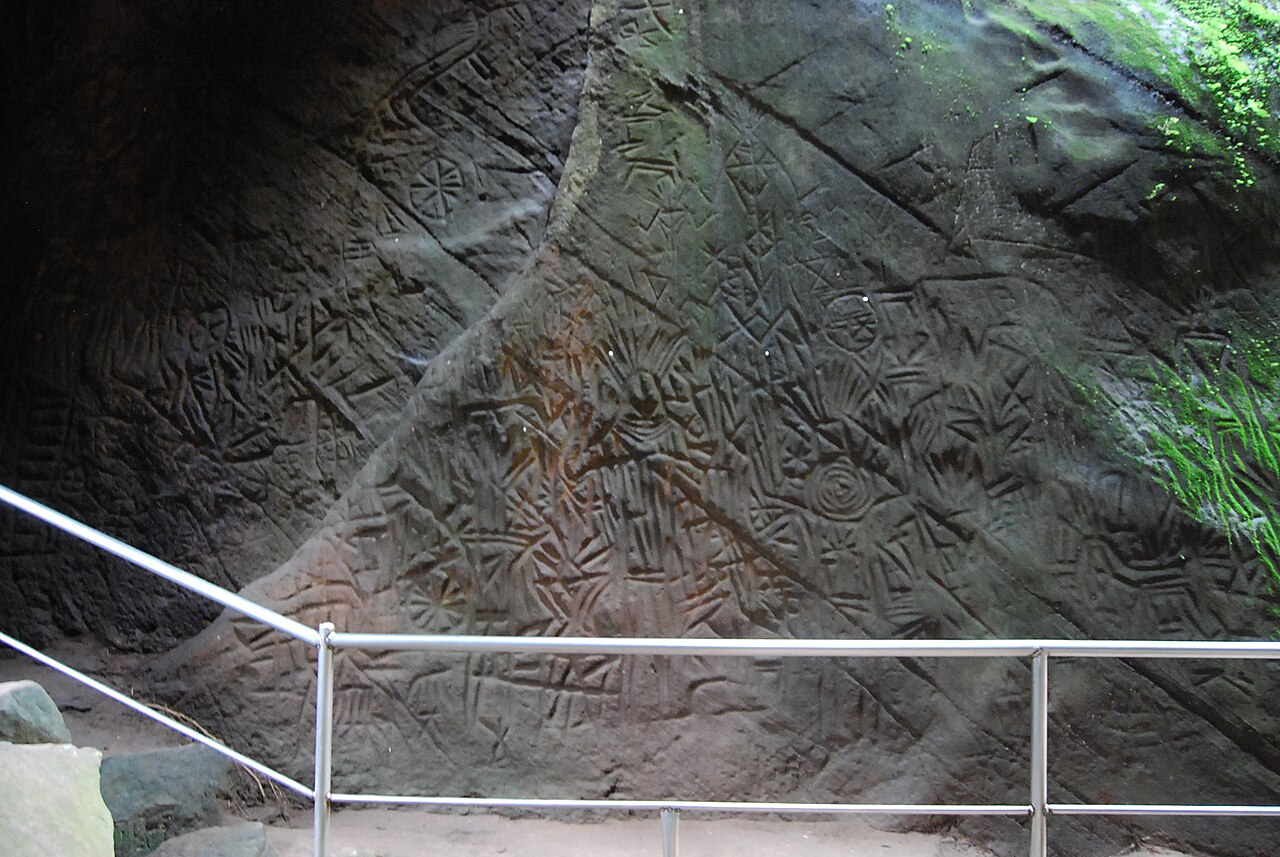
Edakkal · Photographed 2016-08-25
Petroglyphs on the rock walls at Edakkal
Petroglyphs on the rock walls at Edakkal. Individual markings belong to different phases; this photograph does not establish their dates.

Edakkal · Photographed 2012-12-18 09:27:17
Petroglyphs on the rock walls at Edakkal
Petroglyphs on the rock walls at Edakkal. Individual markings belong to different phases; this photograph does not establish their dates.

Edakkal · Photographed 2012-12-18 09:27:17
Petroglyphs on the rock walls at Edakkal
Petroglyphs on the rock walls at Edakkal. Individual markings belong to different phases; this photograph does not establish their dates.

Edakkal · Photographed 2017-08-31 23:24:14
Petroglyphs on the rock walls at Edakkal
Petroglyphs on the rock walls at Edakkal. Individual markings belong to different phases; this photograph does not establish their dates.

Edakkal · Photographed 2012-12-18 09:27:17
Petroglyphs on the rock walls at Edakkal
Petroglyphs on the rock walls at Edakkal. Individual markings belong to different phases; this photograph does not establish their dates.

Edakkal · Photographed 2012-12-18 09:27:17
Petroglyphs on the rock walls at Edakkal
Petroglyphs on the rock walls at Edakkal. Individual markings belong to different phases; this photograph does not establish their dates.

Edakkal · Photographed 2017-08-31 23:23:25
Petroglyphs on the rock walls at Edakkal
Petroglyphs on the rock walls at Edakkal. Individual markings belong to different phases; this photograph does not establish their dates.
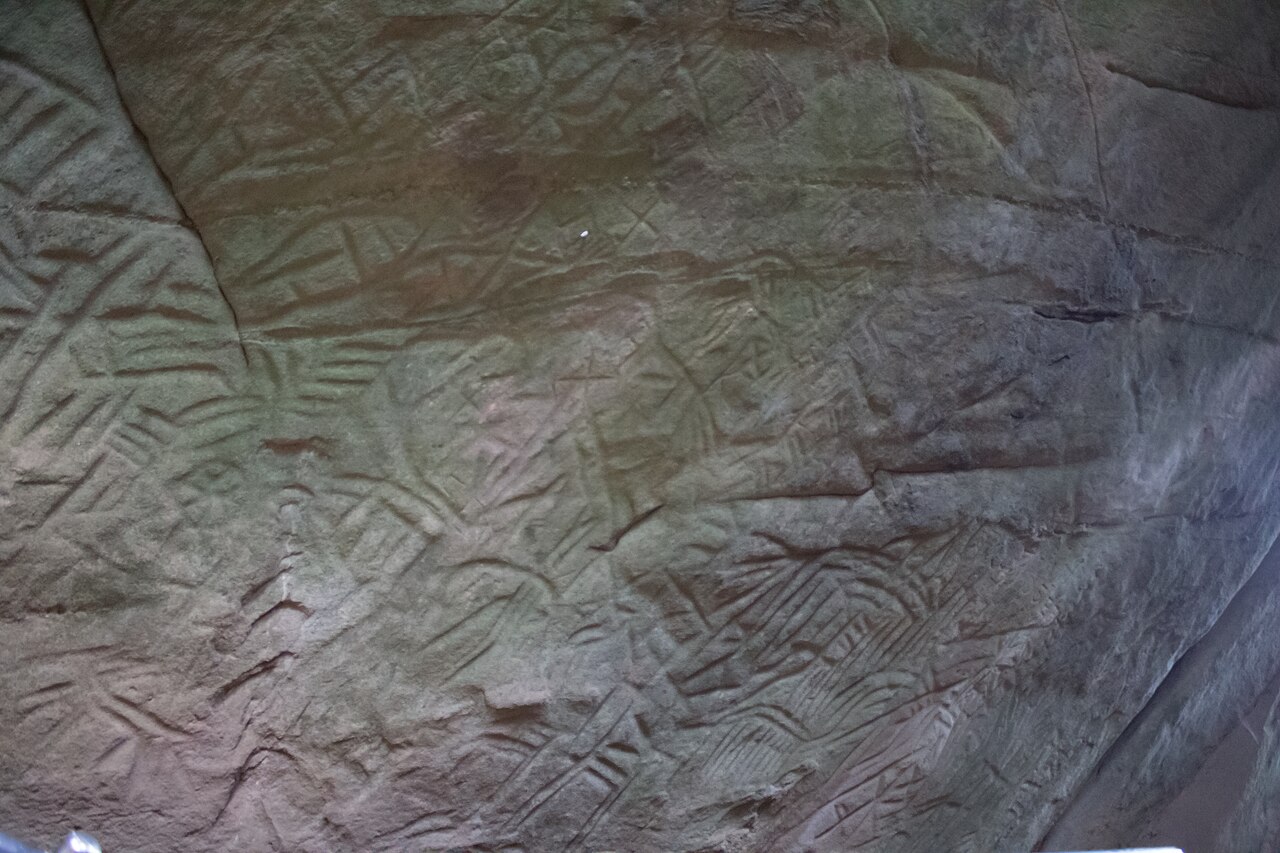
Edakkal · Photographed 2012-12-18 09:27:17
Petroglyphs on the rock walls at Edakkal
Petroglyphs on the rock walls at Edakkal. Individual markings belong to different phases; this photograph does not establish their dates.
Show 3 more photographs and source images ↓
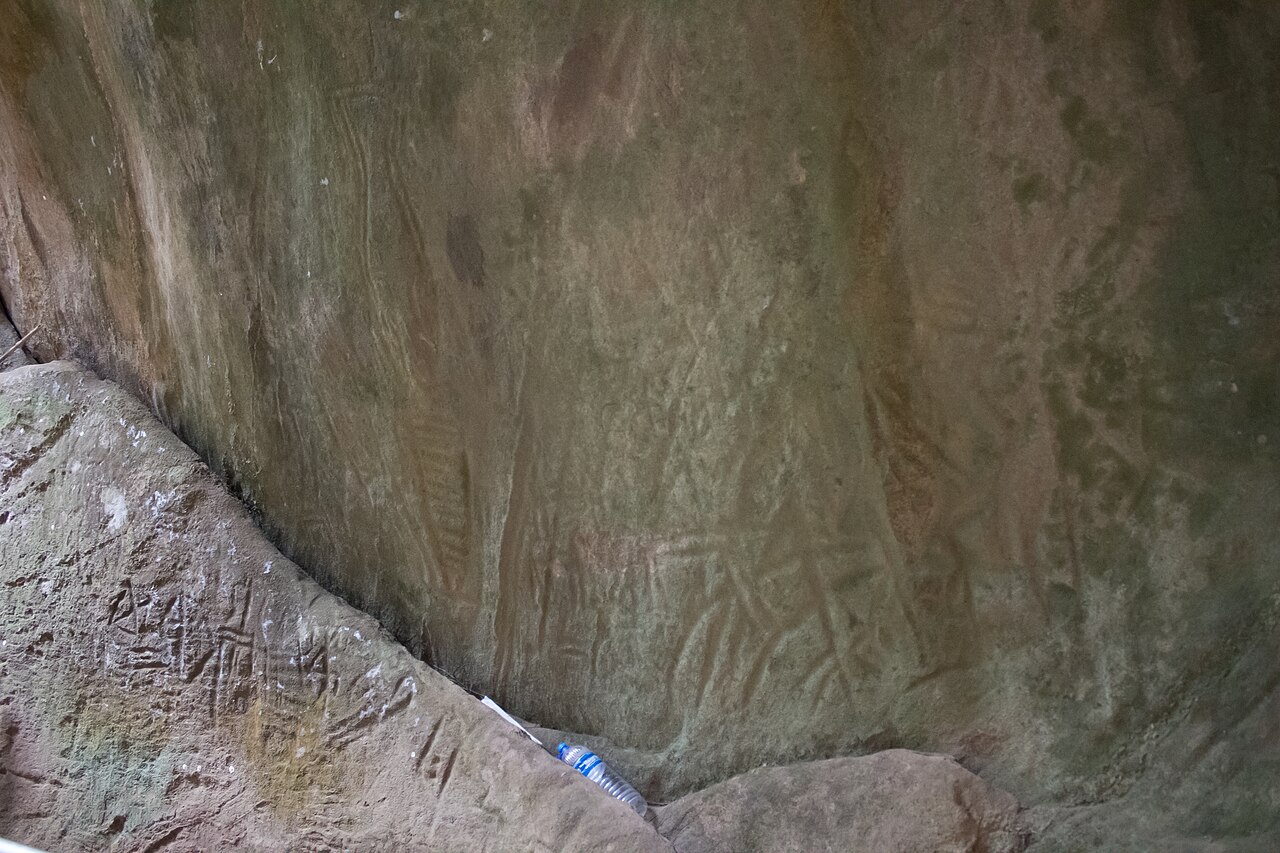
Edakkal · Photographed 2012-12-18 09:27:17
Petroglyphs on the rock walls at Edakkal
Petroglyphs on the rock walls at Edakkal. Individual markings belong to different phases; this photograph does not establish their dates.

Edakkal · Photographed Taken on 16 September 2012, 11:50:43
The natural rock opening at Edakkal, photographed from inside the cave

Edakkal · Photographed 2011-04-04
The natural cleft at Edakkal, viewed upward between the rocks
005Two views
Both views are shown at equal weight; this site does not choose between them.
When Edakkal's rock engravings were made
- One view
- F. Fawcett, writing in 1901, linked them to the Neolithic, partly by comparison with polished stone axes known from Wayanad.
- Another view
- Ajit Kumar argued in 2013 for the megalithic or early historic period, citing the depth of the grooves and the region's megalithic monuments.
- What would settle it
- Dated mineral crusts over the grooves, or microscopic sequencing where marks cross, studied panel by panel.
Whether the short label publicized in 2012 is the earliest Malayalam inscription
- One view
- Iravatham Mahadevan read it as i paḻama, dated it to the fourth or fifth century CE and called it the earliest known Malayalam inscription.
- Another view
- M. R. Raghava Varier read it differently, as Sree Vazhumi, and other historians publicly disputed the Malayalam claim in 2012.
- What would settle it
- A full study of the label by independent Tamil and Malayalam epigraphy specialists.
006Where next
Compare the Edakkal rock-shelter inscriptions with the study of how western Old Tamil became Malayalam, keeping rock surface, script, reading and language stage apart.
On the atlasEdakkal CavesProtected monument · Regulated uphill trail access
Explore nextEdakkal Cave Tamil-Brāhmī & Sanskrit/Prakrit Epigraphs (எடக்கல் குகைத் தமிழி & பிராகிருதக் கல்வெட்டுகள் / എടക്കൽ ഗുഹാ തമിഴ്-ബ്രാഹ്മി, സംസ്കൃത/പ്രാകൃത ലിഖിതങ്ങൾ)All related studies, connected material, books and sources20 · 13
Elsewhere on this site
Excavation Atlas Sites: Edakkal Caves (Ambukuthi Mala)
Multi-Script Glossary Terms: Edakkal Cave Tamil-Brāhmī & Sanskrit/Prakrit Epigraphs (எடக்கல் குகைத் தமிழி & பிராகிருதக் கல்வெட்டுகள் / എടക്കൽ ഗുഹാ തമിഴ്-ബ്രാഹ്മി, സംസ്കൃത/പ്രാകൃത ലിഖിതങ്ങൾ)
Connected material
Photographs, drawings, books, videos and other studies linked to this study. A link helps you explore; it does not prove a historical claim.
- The natural cleft at Edakkal, viewed upward between the rocksphotographBackground
- Petroglyphs on the rock walls at EdakkalphotographShows the subject
- Petroglyphs on the rock walls at EdakkalphotographShows the subject
- Petroglyphs on the rock walls at EdakkalphotographShows the subject
- Petroglyphs on the rock walls at EdakkalphotographShows the subject
- Petroglyphs on the rock walls at EdakkalphotographShows the subject
- Petroglyphs on the rock walls at EdakkalphotographShows the subject
- Petroglyphs on the rock walls at EdakkalphotographShows the subject
- Petroglyphs on the rock walls at EdakkalphotographShows the subject
- Petroglyphs on the rock walls at EdakkalphotographShows the subject
- The natural rock opening at Edakkal, photographed from inside the cavephotographBackground
Books, videos and websites
Outside reading on this topic. These are not part of the study and we have not checked every claim in them. See all books and videos
- Edakkal Caves: In conversation with Dr Selvakumar V Video · V. Selvakumar · Tamil University, Thanjavur; interview published by Sahapedia. · 3:55 · A brief scholar interview about interpreting Edakkal’s rock engravings within South Indian rock art. Short enough for an article-side link while keeping a named archaeologist at the centre. The publisher’s description connects engravings with literature and Theyyam. These are interpretive comparisons, not proof of direct continuity. Separate rock-art and inscription phases; audio language and all spoken claims need checking.
- Edakkal Caves: In conversation with Dr M.R. Raghava Warrier Video · M. R. Raghava Warrier, Azeez Tharuvana · M. R. Raghava Warrier, historian/epigraphist; interview published by Sahapedia. · 10:20 · A scholar interview comparing the etchings and engravings of Edakkal with sites in Kerala and Karnataka. A complementary specialist voice alongside Selvakumar and Narayanan. No full transcript retrieved. Comparative motifs are not, by themselves, proof of migration, language or exact date; any such statements need checking against our studies before they are given prominence.
- Edakkal Caves: In conversation with Prof. M.G.S. Narayanan Video · M. G. S. Narayanan, Azeez Tharuvana · M. G. S. Narayanan, historian; Azeez Tharuvana, Farook College at the time of the module. · 18:18 · An interview on visits to Edakkal, the engravings and the historical setting of Wayanad. Preserves the voice and recollections of an important regional historian and names a participant in earlier scholarship. Recorded recollections and rock-art interpretations require comparison with published studies. Do not treat all carvings as one dated horizon; this interview is not independent dating evidence.
007Sources
The study lists the sources it consulted; we have not rechecked them. A working link does not show that a source was read, and a valid identifier does not show that it supports a claim. We do not link to unofficial uploads or copies of publications. Where a study cited one, we show the published citation, or a publisher, DOI or Internet Archive link when we have one. Tracking codes are removed from links, and the sources themselves are not republished here.
Edakkal Cave in Wayanad | Megalithic Monuments protected by Department of Archaeology | Protected Monuments
Web page (archaeology.kerala.gov.in)
ccsp.it · Kumar.pdf
The Edakkal Rock Engravings: Morphology and Meanings | Sahapedia
Iravatham Mahadevan Early Tamil Epigraphy From The Earliest Times To The Sixth Century A. D.
Explorations and Excavations | Department of Archaeology | Govt of Kerala
m.thewire.in · the legacy of iravatham mahadevan
Political and Cultural Dynamics of a Supra-Region: Punnada Country in the History of Jainism in Kerala | Academia
Online copy not linked · use the published editionSource recordBrahmi script found at Edakkal | Kochi News - Times of India
timesofindia.indiatimes.com · 14789313.cms
Unofficial online copy (link not shown)
Early Tamil Epigraphy From the Earliest Times to the Sixth Century A D (source link 11)
Online copy not linked · use the published editionSource recordSymbols akin to Indus valley culture discovered in Kerala - Times of India
commons.wikimedia.org · File:Kadamba inscription from Kerala.jpg
Researchers and institutions whose work this study uses: Iravatham Mahadevan
How we know The evidence, claims and dates behind this study
What this study draws on
- Iravatham Mahadevan's Early Tamil Epigraphy (2003, revised 2014), including his note on the older groove
- Ajit Kumar's 2013 reassessment of the petroglyphs, checked against its page images
- Rajan Gurukkal's essay on the engravings and Manu V. Devadevan's alternative readings
- Kerala State Archaeology records and news reports from 2009 and 2012 on new readings and claims
Dates in this study
| What is dated | Date | How it was dated |
|---|---|---|
| c. 3rd century CE palaeographic assignment for the main Edakkal Tamil-Brahmi label group (noting '3rd century BCE' header on online corpus entry 82 vs Dhiraj 2018 citing Mahadevan 2003, pp. 122, 435 as 3rd c. CE) | 201–300 CE | Date from writing, coins or texts |
| c. late 4th to 5th century CE palaeographic horizon for Edakkal i paḻama and Early Vaṭṭeḻuttu labels | 370–500 CE | Date from writing, coins or texts |
See these dates on the timeline
The study’s claims
22 claims · 0 source passages · 52 paragraphs
Browse the study paragraph by paragraphEdakkal is a naturally formed rock shelter or cleft, not a human-cut cave.
Supported in this study
Supports; no geological formation date supplied.
The wall assemblage includes anthropomorphic, animal, plant and geometric motifs; a wheeled-cart motif is one published identification.
Supported in this study
Supports inventory; individual identifications remain interpretive.
No consulted source supplied a direct absolute scientific date tied to a specific Edakkal petroglyph.
Supported with qualifications
Evidential limitation; means “absent from the sources consulted,” not “archaeologically absent.”
Fawcett’s Neolithic attribution was inferential and connected with stone-tool comparisons.
Supported in this study
Secondary account of Fawcett; original 1901 prose not yet read in full.
The polished axe reported near Edakkal in 2010 is regional Neolithic context, not a direct date for wall art.
Supported with qualifications
Official summary reports the find but no sealed wall-art association.
Kumar argues for a megalithic/early-historic rather than secure Neolithic petroglyph horizon.
Supported in this study
Interpretation, not laboratory chronology.
Gurukkal proposes stylistic phases and a tentative late-first-millennium-BCE framework.
Supported with qualifications
Same discussion acknowledges major uncertainty.
Edakkal inscriptions were copied in 1897 and re-examined in 1995–96.
Supported in this study
Modern documentary history.
Mahadevan places the four Edakal-A Tamil-Brahmi inscriptions around the third century CE.
Supported in this study
Palaeographic, not laboratory dating.
Mahadevan reads Edakal-A2 as katummiputa cera.
Supported in this study
Specialist language review remains desirable.
A vertical line in Edakal-A2 is identified by Mahadevan as belonging to earlier rock carving.
Supported in this study
Strong local sequence; cannot date the whole petroglyph corpus.
Older documentation preserves two Tamil-Brahmi inscriptions later damaged on the wall.
Supported in this study
Demonstrates value of estampages and early photographs.
Mahadevan places two Edakal-B Early Vaṭṭeḻuttu inscriptions around the fifth century CE.
Supported in this study
Palaeographic date.
Devadevan proposes alternative readings of both Edakal-B labels.
Debated in the sources
Challenges semantic interpretation, not the existence of the inscriptions.
An Edakkal inscription names Vishnuvarman; Hultzsch’s reading as later reproduced also names the Kutumbiya family.
Supported with qualifications
Original Hultzsch passage still needs direct reinspection.
Identifying that Vishnuvarman with a late-fifth-century Kadamba ruler is a cross-inscriptional reconstruction.
Supported with qualifications
Requires external genealogy and inscriptions.
Mahadevan’s i paḻama / “earliest known Malayalam” interpretation is contested.
Debated in the sources
Reading, dating, and language classification must be kept separate.
An Indus comparison has been proposed, but it does not establish Harappan presence or contact.
Supported with qualifications
Similarity alone is insufficient evidence of transmission.
A Mysore–Malabar route setting has been proposed, but a trans-Ghat nodal function is unproven.
Supported with qualifications
Landscape hypothesis; detailed route archaeology still required.
“Multi-millennium stratigraphy” is not demonstrated in the strict archaeological sense by the consulted sources.
Supported with qualifications
Multiple phases are real; continuous stratified dating is absent from the sources consulted.
Mahadevan describes the 2012 label as attached to an anthropomorphic figure belonging to older rock art.
Supported with qualifications
Spatial association does not make inscription and figure contemporary.
The inscriptions demonstrate repeated historical inscriptional activity at Edakkal.
Supported in this study
Does not establish continuous residence or occupation.
About this study Status, corrections and how it was made
Status
Draft study, revision 6. No historian, archaeologist, or Tamil or Malayalam specialist has reviewed it yet.
How it was made
Compiled as an editorial synthesis from published scholarship around questions we framed. About this project & workflow
The summary, How sure lines and Two views notes on this page were prepared from this study and cross-checked against its passages. That is an editorial check, not a specialist review.
Corrections and updates
Technical details
Study code R107. The text fingerprint changes whenever the study text changes.
- Table headings decide what each column means. Citation links, sample mentions and dates copied as text are kept apart from checked source passages and calibrated measurements.
See how this study’s records were extracted
Text fingerprint (SHA-256): R107 · 1f085423e5ec4fb5bf33bf36… · v6
Evidence tables and technical details are on the web page: https://layersofthesouth.org/read/f7c8c358d5