Coconut palms with fruit (modern botanical context)
Photographed 2007-03-24
Modern photograph of coconut palms and fruit; it does not show extracted coir fibres or a dated archaeological specimen.
- Across the water
Ancient ship rope and seam coatings: what each trace can show
Cord from Berenike and coatings from Mediterranean wrecks show what rope and residues can reveal about ships, and what they cannot.
- This page
- 2,165 words · revision 5
Draft study · Awaiting specialist review · Updated
001Dates and places

No mapped place in this study.
Dates in this study are stated in words only.
- 1 Well supported
- 2 Possible
- 1 Not known
002How sure
In brief
This study asks what rope and dark seam coatings can reveal about how ancient ships were held together and kept watertight. At Berenike, an Egyptian Red Sea port, André Veldmeijer recorded 784 pieces of cordage from the 2001 season. Most came from a first-century CE dump, and the materials include grass, palm, soft fibers and hair. His report on the 1994–2000 seasons notes a little coconut cord, which he reads as arriving tied around goods. A 2025 study of the Hjortspring boat in northern Europe shows how cord impressions in caulking can mislead. Chemical studies of the Ma'agan Mikhael and Ilovik wrecks identified heated conifer products and a pitch-and-beeswax mixture. None of these cases shows how ships in South India were joined or sealed.
Key researchers cited in this study: Authors, editors, and translators cited in the Source Register below · Published primary editions, catalogues, and domain scholarship logged for this study · Full bibliography
How sure
- Well supported
Berenike's 2001 season produced 784 pieces of cordage, mostly from a first-century CE dump.
Reported directly in Veldmeijer's 2006 report on that season.
- Possible
Coconut cord reached Berenike tied around traded goods.
Veldmeijer's interpretation of a small coir component; the study treats it as a supply reading and names no shipment or source town.
- Possible
Different coating groups on the Ilovik wreck reflect repairs.
The authors also consider varied material used in building; one repair port per group is not shown.
- Not known
How ships in South India joined and sealed their seams.
No securely dated Indian Ocean seam with its cord and coating was examined.
Why it matters
Rope and residues are among the few traces of ship maintenance that survive. But a cord found at a port is not automatically a ship's gear.
003Key findings
What the study concludes
- Fastening a structure and excluding water are related but different problems. A surviving coating is not automatically an identified caulking recipe.
- Berenike’s cordage includes multiple materials and contexts. Neither every fragment’s use nor the origin of its maker follows from its findspot.
- New molecular and cordage studies can test older interpretations without establishing a universal first-century Indian Ocean maintenance practice.
In the study’s own words. How sure each point is, is shown above.
The summary above is the short read. The full study is the complete text it was drawn from, with its tables and source notes.
What the full study covers
- Main findings
- Two tasks hidden beneath one surface
- Berenike’s fragments had different dates
- The port did not use only coir
- An impression is not always the original cord
- A dark coating needs an analysis, not a familiar label
- A 2026 study distinguishes materials and possible interventions
- Keeping water out was not one isolated decision
- A drawing should separate the found from the proposed
- What remains uncertain
- The next questions
- References and access notes
004The study
Main findings
- Fastening a structure and excluding water are related but different problems. A surviving coating is not automatically an identified caulking recipe.
- Berenike’s cordage includes multiple materials and contexts. Neither every fragment’s use nor the origin of its maker follows from its findspot.
- New molecular and cordage studies can test older interpretations without establishing a universal first-century Indian Ocean maintenance practice.
Two tasks hidden beneath one surface
A seam draws together several kinds of work. Pieces have to remain connected, gaps have to be managed, and the finished arrangement has to tolerate use. Looking only at the outer surface can conceal those different problems. This study starts with cordage and then turns to coatings, asking what each kind of trace can establish. The distinction goes beyond technical vocabulary. A line may belong to a structure, working rig, parcel or repair. A dark substance may retain traces of ingredients and preparation. These are material histories to investigate rather than a single timeless craft procedure. “Ancient ship hulls and sails: what wrecks and Red Sea finds show” covers how hulls were joined and sewn and how sails were rigged; this study follows the cord, seams and coatings.
Berenike’s fragments had different dates
Veldmeijer’s 2001-season report records 784 pieces of cordage. Most came from BE01-48 in a first- century CE dump; other trenches include fifth-/sixth-century contexts, and some cleaning material remained undated. The dated examples come from different centuries. The excavation year is not the date of every object. 1 The report describes grass, palm, soft fibers and hair, while retaining unidentified material where deterioration prevented an answer. Its string-and-rope discussion also distinguishes thickness categories. A loose fragment should not become a ship’s main rope merely because it was recovered at a harbor. 2 The find context therefore belongs beside the attractive material name. Otherwise a photograph of ancient cordage can become an illustration of almost any imagined task. The responsible caption states the recorded context and leaves the proposed use open when it is not established.
The port did not use only coir
Veldmeijer’s larger 1994–2000 publication makes the range of uses visible. It discusses soft fibers associated with textiles and fishing nets as well as a small coconut-cordage component. He interprets the latter as arriving with tied goods rather than as raw material imported for local rope manufacture. That is a supply interpretation, not a named shipment from a particular South Indian town. 3 The publication also explains that deteriorating yarns were too prone to fragmentation for consistent piece-by-piece counting, prompting changes in registration. Thus a count of surviving pieces is not a count of original ropes. Nor should a difference between assemblages immediately become a story about increased trade. 4 The larger lesson is practical. Before comparing quantities, ask what was counted and how. A long cord that breaks into many fragments can be represented more often than an intact one. An apparent abundance in a database is not automatically an abundance aboard a vessel. This reasoning does not require us to distrust the excavation; it requires us to read its categories.
An impression is not always the original cord
A 2025 Hjortspring study examined surviving cord fragments alongside impressions in caulking. The authors identify two-stranded material and explain how drying and degradation altered its appearance. Their reconstruction shows how two-stranded cord can leave a four-stranded-looking impression where it is doubled or joined. The visual identification of lime bast remains qualified as strongly suggested. 5 This northern European, pre-Roman example does not demonstrate a South Indian method. Its value here is methodological: the impression, the surviving fiber and the experimental arrangement need not answer exactly the same question. An apparent difference in strand count can be investigated rather than immediately assigned to a different rope-maker or tradition. 6 The comparison also encourages careful attention to repair. A small change in the surviving trace might result from extending an existing piece, not replacing the whole arrangement. The observed trace should be kept distinct from the experiment proposed to explain it.
A dark coating needs an analysis, not a familiar label
Connan and Nissenbaum identify a thermally altered conifer product on the fifth-century BCE Ma’agan Mikhael ship’s keel and hull planking. Their study compares the residue with natural products and boatbuilding materials. This is a more precise question than calling everything dark tar or resin by appearance. 7 A tree product altered by heat is not identical to untreated resin. The consulted abstract does not provide a universal mixture or workshop procedure. The ship remains a Mediterranean comparison, not a direct witness for a Malabar harbour. Readers do not need a chemical formula to appreciate the difference. We need to know what was sampled, which identification the analysis supports, and whether the authors can distinguish ingredients from later contamination or change. That keeps the finished surface connected to evidence rather than to a romantic recipe.
Making coir rope in Kerala – Modern documented coir work, as process context only
A 2026 study distinguishes materials and possible interventions
At Ilovik–Paržine 1, a Republican-period wreck in Croatia, Charrie-Duhaut and colleagues examined ten coating samples through pollen analysis and seven through molecular analysis. Their PA101 sample supports a pitch-and-beeswax mixture; other sampled material is identified more cautiously as a heated conifer product. The distinction between heated resin and pitch is retained. 8 Differences among coating groups may reflect repairs, but the authors also consider varied material used during construction or refurbishment. They do not establish one repair port for each group. Production, transport and application of a substance can occur in different places, complicating a route inferred from pollen alone. 9 This is a strong example of new analysis improving a question without supplying a complete voyage. We should report the distinction it actually establishes, not decorate the ship with a sequence of precisely located repairs that the investigators did not recover.
Keeping water out was not one isolated decision
Our synthesis separates three functions: joining parts, addressing seams, and treating surfaces. Depending on the construction, their materials and operations can interact, but one surviving residue does not establish all three. The cordage cases and coating analyses above are valuable precisely because they permit us to ask different questions of different traces. 1011 A repair inquiry should ask what failed, what can be reached, whether an intervention is temporary and what evidence supports continued use. These questions do not recover a particular foreman’s decision. A consulted surface can conceal weakness and a repair can reveal an earlier intervention. These are possibilities to test against the object, not evidence that every skilled worker used the same material or never misjudged a repair.
A drawing should separate the found from the proposed
“Ancient ship hulls and sails: what wrecks and Red Sea finds show” sets out the rule these studies follow for drawings: show which parts were found and which were reconstructed. For seams, that also means labelling each material by how securely it has been identified.
What remains uncertain
- The Berenike cordage reports were read as parsed text; their knot diagrams and numerical tables were not checked against the printed figures.
- Cordage at a port is not necessarily rigging; neither every palm fiber nor every brown rope is coconut coir.
- Chemical and pollen distinctions do not automatically locate construction or every repair. Northern European and Mediterranean comparisons remain geographically separate.
The next questions
- Obtain verified images and full context records for selected early Berenike cordage specimens.
- Inspect securely dated Indian Ocean seams together with their surviving cord and coating, rather than borrowing each from a different vessel.
References and access notes
1 André J. Veldmeijer (2006). The cordage from the 2001-season of the excavations at Berenike (Egyptian Red Sea Coast): preliminary results. pp. 120–121, sections 1, 2.1 and 2.2. Parsed PDF text read, especially pp. 119–125. Numerical tables and knot diagrams were not checked visually. The 784 pieces are the 2001 season’s recovered assemblage. Most came from a first-century dump trench; other trenches include fifth-/sixth- century material. Not all cordage is rigging. Open source: repositorio.uca.edu.ar
2 André J. Veldmeijer (2006). The cordage from the 2001-season of the excavations at Berenike (Egyptian Red Sea Coast): preliminary results. pp. 122–125: materials, preservation and String and rope. Parsed PDF text read, especially pp. 119–125. Numerical tables and knot diagrams were not checked visually. The 784 pieces are the 2001 season’s recovered assemblage. Most came from a first-century dump trench; other trenches include fifth-/sixth-century material. Not all cordage is rigging. Open source: repositorio.uca.edu.ar
3 André J. Veldmeijer (2008). The Cordage from Berenike (1994–2000 Seasons): The Statistics. pp. 40–42, Material: fibers, fishing nets and coconut cordage. Parsed PDF prose read, particularly pp. 39–44. Tables were not independently recalculated or checked visually. Companion publication in the same excavation research program, not an unrelated corroborating excavation. Identification, proposed uses and supply interpretations have different strengths. Open source: repositorio.uca.edu.ar
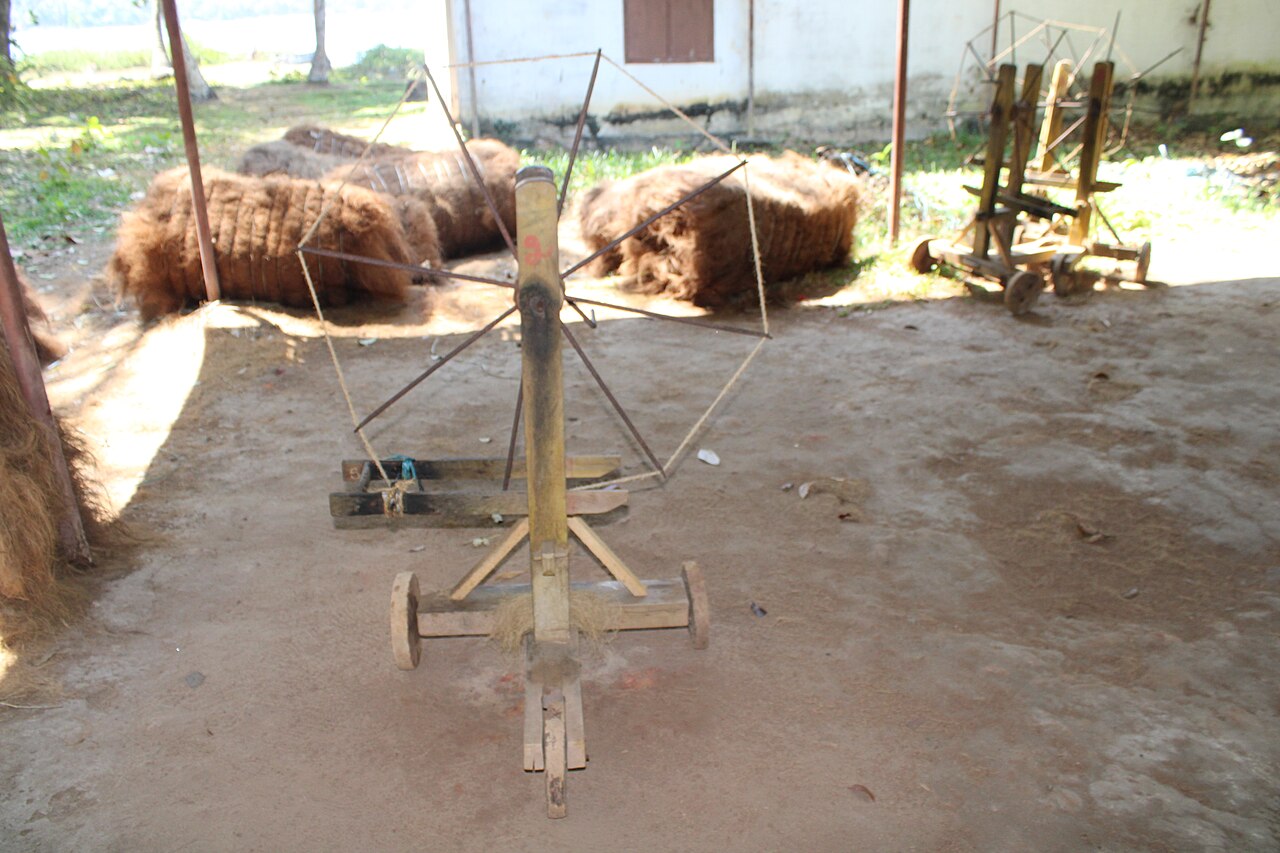
Coir making spinning machine – Modern documented coir work, as process context only
Photographed 2019-02-10
4 André J. Veldmeijer (2008). The Cordage from Berenike (1994–2000 Seasons): The Statistics. pp. 40–44; registration caveat, note 11 and discussion of small differences between periods. Parsed PDF prose read, particularly pp. 39–44. Tables were not independently recalculated or checked visually. Companion publication in the same excavation research program, not an unrelated corroborating excavation. Identification, proposed uses and supply interpretations have different strengths. Open source: repositorio.uca.edu.ar
5 Mikael Fauvelle, Boel Bengtsson, Olof Pipping, Mikkel Hollmann, Martin Nordvig Mortensen, Peter Toft and colleagues (2025). New investigations of the Hjortspring boat: Dating and analysis of the cordage and caulking materials used in a pre-Roman iron age plank boat. Materials and analysis: Cordage – Scanning and dating; Technical analysis and experimental reconstruction. Full HTML text read selectively, especially Cordage: Scanning and dating and Technical analysis and experimental reconstruction. No new CT or chemical analysis. Northern European pre-Roman comparison. Visual identification strongly suggests lime bast; reconstruction and ancient observations remain distinct. A CE label in figure 5’s caption conflicts with the BCE results text; no new calendar range is asserted here. Open source: journals.plos.org
6 Mikael Fauvelle, Boel Bengtsson, Olof Pipping, Mikkel Hollmann, Martin Nordvig Mortensen, Peter Toft and colleagues (2025). New investigations of the Hjortspring boat: Dating and analysis of the cordage and caulking materials used in a pre-Roman iron age plank boat. Cordage discussion: two- and four-strand impressions and experimental reconstruction. Full HTML text read selectively, especially Cordage: Scanning and dating and Technical analysis and experimental reconstruction. No new CT or chemical analysis. Northern European pre-Roman comparison. Visual identification strongly suggests lime bast; reconstruction and ancient observations remain distinct. A CE label in figure 5’s caption conflicts with the BCE results text; no new calendar range is asserted here. Open source: journals.plos.org
7 Jacques Connan and Arie Nissenbaum (2003). Conifer tar on the keel and hull planking of the Ma’agan Mikhael Ship (Israel, 5th century BC): Identification and comparison with natural products and artefacts employed in boat construction. Abstract: identification and comparison of the keel and planking coating. Institutional abstract and publication metadata read; spectra and complete paper not read. An earlier Mediterranean comparison about altered conifer products; not a caulking recipe for South India. Open source: weizmann.elsevierpure.com
8 Armelle Charrie-Duhaut, Quentin Couillebault, Igor Miholjek and Giulia Boetto (2026). Adhesive coatings in naval archaeology: molecular and palynological investigations on materials from the Roman Republican wreck Ilovik– Paržine 1 (Croatia). Sections 4 and 5.1: analytical sample sets and PA101 interpretation. Full HTML text read selectively: materials, PA101 interpretation and coating-group discussion. No new chromatographic or pollen analysis. Ten samples received pollen analysis and seven molecular analysis. Several clusters need not mean an equal number of separate repair ports. Heated resin and pitch are distinguished. Open source: www.frontiersin.org
9 Armelle Charrie-Duhaut, Quentin Couillebault, Igor Miholjek and Giulia Boetto (2026). Adhesive coatings in naval archaeology: molecular and palynological investigations on materials from the Roman Republican wreck Ilovik– Paržine 1 (Croatia). Section 5.3 and Conclusion: group distribution and competing explanations. Full HTML text read selectively: materials, PA101 interpretation and coating-group discussion. No new chromatographic or pollen analysis. Ten samples received pollen analysis and seven molecular analysis. Several clusters need not mean an equal number of separate repair ports. Heated resin and pitch are distinguished. Open source: www.frontiersin.org
10 André J. Veldmeijer (2006). The cordage from the 2001-season of the excavations at Berenike (Egyptian Red Sea Coast): preliminary results. pp. 120–125: classified cordage finds. Parsed PDF text read, especially pp. 119–125. Numerical tables and knot diagrams were not checked visually. The 784 pieces are the 2001 season’s recovered assemblage. Most came from a first-century dump trench; other trenches include fifth-/sixth- century material. Not all cordage is rigging. Open source: repositorio.uca.edu.ar
11 Jacques Connan and Arie Nissenbaum (2003). Conifer tar on the keel and hull planking of the Ma’agan Mikhael Ship (Israel, 5th century BC): Identification and comparison with natural products and artefacts employed in boat construction. Abstract: coating on keel and planking. Institutional abstract and publication metadata read; spectra and complete paper not read. An earlier Mediterranean comparison about altered conifer products; not a caulking recipe for South India. Open source: weizmann.elsevierpure.com
005Photographs
Photographs of the places and objects this study discusses. Each item carries its creator’s credit, licence and documented source. See all 412 photographs and source images ↗

Photographed 2007-03-24 15:42
Coconut palms with fruit (modern botanical context)
Coconut palms (Cocos nucifera) with visible fruit, shown as modern botanical context.
Modern photograph of coconut palms and fruit; it does not show extracted coir fibres or a dated archaeological specimen.

Making coir rope in Kerala – Modern documented coir work, as process context only
Making coir rope in Kerala. Modern documented coir work, as process context only; no unchanged continuity claim.
Photographed 2019-02-10 23:48:22
Coir making spinning machine – Modern documented coir work, as process context only
Coir making spinning machine. Modern documented coir work, as process context only; no unchanged continuity claim.
006Where next
All related studies, connected material, books and sources9 · 11
Elsewhere on this site
Multi-Script Glossary Terms: kayaṟu-k-kaṭṭu (Coir-Sewn Plank Hull / Madarata) (கயிறு பிணைத்த மரக்கலம் / കയറുകൊണ്ട് തുന്നിയ മരക്കപ്പൽ) · paṉai (Palmyra Palm) & teṅku (Coconut Palm) (பனை & தெங்கு (தென்னை) / പനയും തെങ്ങും)
Connected material
Photographs, drawings, books, videos and other studies linked to this study. A link helps you explore; it does not prove a historical claim.
- Coconut palms with fruit (modern botanical context)photographBackground
- Making coir rope in Kerala – Modern documented coir work, as process context onlyphotographBackground
- Coir making spinning machine – Modern documented coir work, as process context onlyphotographBackground
Books, videos and websites
Outside reading on this topic. These are not part of the study and we have not checked every claim in them. See all books and videos
- The Sewn Boats of Kerala Video · Patrice Pomey (researcher & writer), Raymond Collet (director) & documented Kerala boatbuilders · Centre d'Études Alexandrines (CEAlex) · 26:00 · A research film follows Kerala carpenters building and maintaining sewn boats in the backwaters, with archaeological comparison in mind. One of the strongest visual resources for acknowledging skilled workers as well as archaeologists. Its research purpose and production credits are documented by CNRS-associated CEAlex. Filmed modern craft practice is comparative evidence rather than a photograph or reconstruction of a first-century vessel, and does not prove an unchanged 2,000-year tradition. The writer and director are verified; the English narrator and individual craftsperson names were not independently recovered.
- IJNA Webinar 3: Sewn Sailing Hypotheses. Video · Lucy Blue, Patrice Pomey, Eric Staples · University of Southampton / Honor Frost Foundation; CNRS / Centre Camille Jullian; Zayed University (2019 event affiliations) · 1:04:26 · A research panel considers what experimental sewn-boat reconstructions can and cannot tell us about archaeological vessels. Useful for showing how reconstructed ships are hypotheses tested by researchers, with acknowledged differences in period and region. Examples include a sixth-century-BCE Greek boat and much later Indian Ocean vessels, including a reconstruction based on the ninth-century Belitung wreck. Identify these dates plainly. Speaker list records confirmed participants and may not exhaust every voice in the recording.
007Sources
The study lists the sources it consulted; we have not rechecked them. A working link does not show that a source was read, and a valid identifier does not show that it supports a claim. We do not link to unofficial uploads or copies of publications. Where a study cited one, we show the published citation, or a publisher, DOI or Internet Archive link when we have one. Tracking codes are removed from links, and the sources themselves are not republished here.
André J. Veldmeijer (2006). The cordage from the 2001-season of the excavations at Berenike (Egyptian Red Sea Coast): preliminary results. pp. 120–121, sections 1, 2.1 and 2.2. Parsed PDF text read, especially pp. 119–125. Numerical tables and knot diagrams were not checked visually. The 784 pieces are the 2001 season’s recovered assemblage. Most came from a first-century dump trench; other trenches include fifth-/sixth- century material. Not all cordage is rigging.
André J. Veldmeijer (2006). The cordage from the 2001-season of the excavations at Berenike (Egyptian Red Sea Coast): preliminary results. pp. 122–125: materials, preservation and String and rope. Parsed PDF text read, especially pp. 119–125. Numerical tables and knot diagrams were not checked visually. The 784 pieces are the 2001 season’s recovered assemblage. Most came from a first-century dump trench; other trenches include fifth-/sixth-century material. Not all cordage is rigging.
André J. Veldmeijer (2008). The Cordage from Berenike (1994–2000 Seasons): The Statistics. pp. 40–42, Material: fibers, fishing nets and coconut cordage. Parsed PDF prose read, particularly pp. 39–44. Tables were not independently recalculated or checked visually. Companion publication in the same excavation research program, not an unrelated corroborating excavation. Identification, proposed uses and supply interpretations have different strengths.
André J. Veldmeijer (2008). The Cordage from Berenike (1994–2000 Seasons): The Statistics. pp. 40–44; registration caveat, note 11 and discussion of small differences between periods. Parsed PDF prose read, particularly pp. 39–44. Tables were not independently recalculated or checked visually. Companion publication in the same excavation research program, not an unrelated corroborating excavation. Identification, proposed uses and supply interpretations have different strengths.
Mikael Fauvelle, Boel Bengtsson, Olof Pipping, Mikkel Hollmann, Martin Nordvig Mortensen, Peter Toft and colleagues (2025). New investigations of the Hjortspring boat: Dating and analysis of the cordage and caulking materials used in a pre-Roman iron age plank boat. Materials and analysis: Cordage – Scanning and dating; Technical analysis and experimental reconstruction. Full HTML text read selectively, especially Cordage: Scanning and dating and Technical analysis and experimental reconstruction. No new CT or chemical analysis. Northern European pre-Roman comparison. Visual identification strongly suggests lime bast; reconstruction and ancient observations remain distinct. A CE label in figure 5’s caption conflicts with the BCE results text; no new calendar range is asserted here.
Mikael Fauvelle, Boel Bengtsson, Olof Pipping, Mikkel Hollmann, Martin Nordvig Mortensen, Peter Toft and colleagues (2025). New investigations of the Hjortspring boat: Dating and analysis of the cordage and caulking materials used in a pre-Roman iron age plank boat. Cordage discussion: two- and four-strand impressions and experimental reconstruction. Full HTML text read selectively, especially Cordage: Scanning and dating and Technical analysis and experimental reconstruction. No new CT or chemical analysis. Northern European pre-Roman comparison. Visual identification strongly suggests lime bast; reconstruction and ancient observations remain distinct. A CE label in figure 5’s caption conflicts with the BCE results text; no new calendar range is asserted here.
Jacques Connan and Arie Nissenbaum (2003). Conifer tar on the keel and hull planking of the Ma’agan Mikhael Ship (Israel, 5th century BC): Identification and comparison with natural products and artefacts employed in boat construction. Abstract: identification and comparison of the keel and planking coating. Institutional abstract and publication metadata read; spectra and complete paper not read. An earlier Mediterranean comparison about altered conifer products; not a caulking recipe for South India.
Armelle Charrie-Duhaut, Quentin Couillebault, Igor Miholjek and Giulia Boetto (2026). Adhesive coatings in naval archaeology: molecular and palynological investigations on materials from the Roman Republican wreck Ilovik– Paržine 1 (Croatia). Sections 4 and 5.1: analytical sample sets and PA101 interpretation. Full HTML text read selectively: materials, PA101 interpretation and coating-group discussion. No new chromatographic or pollen analysis. Ten samples received pollen analysis and seven molecular analysis. Several clusters need not mean an equal number of separate repair ports. Heated resin and pitch are distinguished.
Armelle Charrie-Duhaut, Quentin Couillebault, Igor Miholjek and Giulia Boetto (2026). Adhesive coatings in naval archaeology: molecular and palynological investigations on materials from the Roman Republican wreck Ilovik– Paržine 1 (Croatia). Section 5.3 and Conclusion: group distribution and competing explanations. Full HTML text read selectively: materials, PA101 interpretation and coating-group discussion. No new chromatographic or pollen analysis. Ten samples received pollen analysis and seven molecular analysis. Several clusters need not mean an equal number of separate repair ports. Heated resin and pitch are distinguished.
André J. Veldmeijer (2006). The cordage from the 2001-season of the excavations at Berenike (Egyptian Red Sea Coast): preliminary results. pp. 120–125: classified cordage finds. Parsed PDF text read, especially pp. 119–125. Numerical tables and knot diagrams were not checked visually. The 784 pieces are the 2001 season’s recovered assemblage. Most came from a first-century dump trench; other trenches include fifth-/sixth- century material. Not all cordage is rigging.
Jacques Connan and Arie Nissenbaum (2003). Conifer tar on the keel and hull planking of the Ma’agan Mikhael Ship (Israel, 5th century BC): Identification and comparison with natural products and artefacts employed in boat construction. Abstract: coating on keel and planking. Institutional abstract and publication metadata read; spectra and complete paper not read. An earlier Mediterranean comparison about altered conifer products; not a caulking recipe for South India.
Researchers and institutions whose work this study uses: Authors, editors, and translators cited in the Source Register below, Published primary editions, catalogues, and domain scholarship logged for this study
How we know The evidence, claims and dates behind this study
What this study draws on
- Veldmeijer's Berenike cordage reports (2006 and 2008), read as text; knot diagrams and tables were not checked.
- A 2025 study of the cord and caulking of the Hjortspring boat.
- Chemical analyses of coatings from the Ma'agan Mikhael ship (2003, abstract only) and the Ilovik–Paržine 1 wreck (2026).
Dates in this study
This study has no dates recorded in a form we can chart, so there is no date chart. Any dates it gives are in the full study.
The study’s claims
0 claims · 0 source passages · 22 paragraphs
Browse the study paragraph by paragraphThis study has no separately listed claims. Its paragraphs can be browsed one by one.
About this study Status, corrections and how it was made
Status
Draft study, revision 5. No historian, archaeologist, or Tamil or Malayalam specialist has reviewed it yet.
How it was made
Compiled as an editorial synthesis from published scholarship around questions we framed. About this project & workflow
The summary, How sure lines and Two views notes on this page were prepared from this study and cross-checked against its passages. That is an editorial check, not a specialist review.
Technical details
Study code R059. The text fingerprint changes whenever the study text changes.
- The study text is shown as written. Links from its paragraphs to citations help you move around the study; they are not new claims or checked source passages.
See how this study’s records were extracted
Text fingerprint (SHA-256): R059 · 94fa3bac1bce7a6f5bdb8c28… · v5
Evidence tables and technical details are on the web page: https://layersofthesouth.org/read/d82116bbd1