Places on the atlas that name this study.
- Everyday lives
- Keezhadi (Keeladi)
- Sivagalai
- Porunthal
Crops at six sites: millets and pulses persist as rice spreads
Plant remains from six sites show lasting use of millets and pulses, growing use of rice, and no secure banana or areca.
- This page
- 5,350 words · revision 8
Draft study · Awaiting specialist review · Updated
001Dates and places
Places on the atlas that name this study.
- Keezhadi
Public on-site museum & open-air excavated brick gallery
- Sivagalai Urn Burial & Habitation Complex
Excavated site zone · Thoothukudi District
- Porunthal Habitation & Megalithic Grave Site
Coarse village orientation · Palani foothills, Dindigul
- Alagankulam
Excavated port mound · Vaigai mouth, Ramanathapuram
1000–500 BCE
Different beginnings
500–200 BCE
Marks & materials
200 BCE–300 CE
Connected worlds
300–600 CE
Change & continuity
- Porunthal paddy, broader published two-sigma aggregate
- Porunthal paddy, principal published one-sigma synthesis
- Kodumanal directly dated rice, published range
- Laboratory date
Each date belongs to what was dated (a sample, an object, a layer or a text), which is not always the event the study asks about.
Each period has the same width, so spacing is not to scale.
The full table of dates, with their ranges, is under How we know.
- 2 Well supported
- 1 Likely
- 1 Not known
002How sure
In brief
This study compares plant remains from Pattanam, Keezhadi (also spelled Keeladi), Sivagalai, Porunthal, Kodumanal and Adichanallur. At Kodumanal, Miriam Cooke, Dorian Fuller and K. Rajan found mostly pulses, with browntop millet, rice and cotton; rice there is directly dated to 430–230 BCE. At Porunthal, two paddy samples from graves yielded disjoint calibrated intervals extending from the eighth to the fourth centuries BCE; the often quoted 540–410 BCE is one younger 1σ interval, not the complete calibrated range. The 2025 Antiquity of Iron report prints 1155 BCE (Beta-600726) for Sivagalai Trench A2 Urn 3 paddy alongside a provisional BSIP OSL ceramic age of 1284 BCE (±561 years), while Urn 1 in the same trench gave charcoal at 3368–3102 cal BCE and OSL dates of 2459 and 2427 BCE – a two-millennium spread across the trench (see the companion Sivagalai dating study). For Adichanallur paddy, its tables disagree (Table 4: 1257 BCE, Locality C; Table 5: 1149 BCE, Locality B). Pattanam's peat held coconut, a rice grain and probable black pepper, but the 2020 study gave no date for the peat; its “cliff banana” is Ensete and its “cotton tree” is Bombax. The 2025 Keezhadi report gives no species-level crop list, and no consulted publication shows domesticated banana or areca at the six sites.
Key researchers cited in this study: K. Rajan (Kodumanal & Porunthal Excavations / Epigraphy) · R. Sivanantham (TNSDA Keezhadi / Keeladi & Tamil Nadu Excavations) · Dorian Q. Fuller (South Indian Archaeobotany & Crop Origins) · Archaeological Survey of India (ASI) · Full bibliography
How sure
- Well supported
Kodumanal's people used millets, pulses, rice and cotton.
Taxon-level flotation results were published, and the rice was directly dated.
- Well supported
Two Porunthal grave-paddy samples have direct radiocarbon measurements.
The published calibrated results are split across several intervals. The often quoted 540–410 BCE is only one younger 1σ interval; it is not the complete date range.
- Likely
Coconut and black pepper were present at early Pattanam.
Coconut is identified and pepper probable, but the 2020 study gave no date for the peat.
- Not known
Domesticated banana or areca was grown at the six sites.
No consulted publication identifies them; the reported cliff banana is Ensete.
Why it matters
It shows which ancient crops are securely identified, so labels like cliff banana or a palm signal do not become false history.
003Key findings
What the study concludes
- Kodumanal has a directly published diversified archaeobotanical assemblage of small millets, pulses, rice and cotton, with Vigna radiata especially prominent and Brachiaria ramosa a major small millet.
- Rice from Kodumanal was directly dated to 430–230 BCE, and the analysed rice phytolith ecology was interpreted as inconsistent with an assumption of deep-water irrigated paddy cultivation.
- Porunthal contains directly dated paddy in mortuary contexts plus phytoliths broadly comparable with domesticated rice and common/broomcorn millet.
- Pattanam preserves coconut, rice and probable black pepper in archaeobotanical contexts, but the key peat assemblage was not supplied with a secure direct plant-sample chronology in the read 2020 publication.
In the study’s own words. How sure each point is, is shown above.
The summary above is the short read. The full study is the complete text it was drawn from, with its tables and source notes.
What the full study covers
004The study
Answer in Brief
The six-site record does not support a simple chronological story in which an indigenous cereal economy was followed by the arrival of a coherent package of exotic “orchard” or maritime plants. The strongest archaeobotanical pattern is instead one of continuity in drought-tolerant small millets and pulses, the incorporation and increasing social importance of rice, and highly uneven evidence for perennial fruits and spices. At Kodumanal, systematic flotation undertaken by Miriam Cooke, Dorian Fuller, and K. Rajan recovered a diversified crop assemblage dominated by pulses – especially mung bean (Vigna radiata) – with black gram (V. mungo), horsegram (Macrotyloma uniflorum), lablab, browntop millet (Brachiaria ramosa), other small millets, rice, and cotton. Subsequent work directly dated Kodumanal rice to 430–230 BCE and found its phytolith ecology more compatible with relatively dry/rainfed cultivation than deep-water irrigated paddy. ↗1
Flotation lets charred seeds float off as the light fraction while stone, bone and sherds sink as the heavy fraction. Flotation at Kodumanal found pulses, millets and rice; Pattanam has reported rice and pulses. A cooking pot, animal bone and a poem such as Kuruntokai 167 are different sources; none supplies a recipe.
This study reports the Kodumanal flotation results (pulses, millets, rice) that the identification tray draws on.
Layers of the South editorial illustration
Porunthal provides the best controlled combination of macro-remains, direct radiocarbon dating, phytoliths, and palynology among the six sites. Paddy grains intentionally placed in megalithic graves supplied two AMS determinations; the 2017 specialist publication uses 540–410 cal BCE as its preferred one-sigma working interval. Its calibration table also lists older probability components: 571–397 cal BCE covers only selected younger portions of the two-sigma distributions, not their full extent. Rice husk and leaf phytolith morphologies are broadly comparable with domesticated Oryza sativa. Millet phytoliths are described more cautiously as broadly comparable with common/broomcorn millet (Panicum miliaceum), while the habitation pollen/phytolith sequence records an open, herb- and grass-rich landscape including Cyperaceae and a few woody/palm taxa. Crucially, “Palmae” or Borassus is not evidence for coconut. ↗2
The newer Sivagalai and Adichanallur dating evidence places cereal deposition before this study’s core period of 1000 BCE–600 CE. The 2025 Antiquity of Iron report (Rajan & Sivanantham, TNSDA Publication No. 356, pp. 34–36) prints an AMS age of 1155 BCE (Beta-600726, 2950 ± 30 BP) for paddy grains from intact lidded Urn 3 in Sivagalai Trench A2 alongside a provisional BSIP ceramic OSL determination from the same urn of 3304 ± 561 years before 2020 CE (printed 1284 BCE, carrying a ±561-year error and flagged by BSIP as provisional pending dose-rate work). Elsewhere in the very same Trench A2, however, Urn 1 yielded charcoal at 4540 ± 30 BP (Beta-583592, laboratory range 3368–3102 cal BCE, printed 3259 BCE) and ceramic OSL ages of 2459 BCE (BSIP) and 2427 BCE (PRL), while Trench B3 Urn 10 gave charcoal at 4670 ± 30 BP (Beta-583593, 3519–3371 cal BCE, printed 3345 BCE; see “Tamil Nadu iron: the 5,300-year date measures charcoal, not metal”). Because determinations across Trench A2 span two millennia and the Urn 3 OSL age is provisional with a wide uncertainty, the Sivagalai paddy does not sit inside an agreed, tightly constrained context chronology. Its Adichanallur tables disagree for the same specimens: paddy sample IUACD#23C5692 appears as 1257 BCE in Table 4 and 1149 BCE in Table 5, with its locality changing from C to B; millet sample IUACD#23C5689 appears as 1384 BCE and 1441 BCE respectively. These discrepancies remain unresolved. All these printed values precede the study’s main window. Cereal deposition does not, by itself, establish species-level millet taxonomy, field systems, staple proportions, or continuous local cultivation. ↗3
Pattanam supplies the clearest evidence among these sites for plants commonly discussed in an Indian Ocean context, but it also demonstrates why chronology must be handled cautiously. The 2015 KCHR trench yielded peat containing coconut kernel fragments, a rice grain, and mineralized/carbonized specimens morphologically resembling black pepper. The investigators explicitly stated that the peat chronology remained under investigation. Earlier KCHR seasons also reported waterlogged rice, pepper, cardamom, coconut shell, mango and other organics, and KCHR documented an Oxford archaeobotanical sampling programme associated with Dorian Fuller. Consequently, Pattanam establishes physical presence, but its peat assemblage must not be converted into a fictitious species-by-species radiocarbon chronology. ↗4
Two important negative findings change the answer substantially. First, the Pattanam plant called “cliff banana” is Ensete superbum, not a domesticated Musa banana; the same paper’s “Indian cotton tree” is Bombax ceiba, not Gossypium. No securely read publication in this source corpus establishes domesticated Musa or areca nut (Areca catechu) from the six target sites. Second, the read 2025 Keezhadi report provides environmental botanical evidence for palms, grasses and sedges, notably Cyperus, but its searchable full text returned no “seed” occurrence and did not furnish a species-level crop inventory comparable to Kodumanal or Porunthal. This is a negative result limited to the sources read, not proof that rice, millets or pulses were absent from ancient Keezhadi. ↗5
Accordingly, the safest chronological synthesis is:
Physical / textual observation: dryland millets and pulses are directly present at Early Historic Kodumanal; rice is directly present and directly dated at Porunthal and Kodumanal; antecedent paddy is directly dated at Sivagalai and Adichanallur; cotton seed is present at Kodumanal; Pattanam preserves coconut and probable black pepper alongside rice. ↗6
Scholarly interpretation: the Kodumanal assemblage is best understood as continuation of a southern dry-crop tradition into an urban/craft-producing Early Historic setting, with rice and cotton as more water-demanding additions. Porunthal demonstrates a socially important rice economy but its mortuary assemblage cannot straightforwardly measure everyday staple proportions. Pattanam’s pepper and coconut belong naturally in discussion of its port environment, but they do not prove that either plant was newly introduced there by maritime trade. ↗7
Unresolved: there is no secure six-site sequence for Musa banana or areca; no consulted starch-grain study supplied species-level results from these target sites; Pattanam’s key peat botanicals lack direct sample chronology in the consulted publication; Adichanallur’s and Sivagalai’s “millet” evidence requires more taxonomic resolution; and Keezhadi still lacks, in the consulted published corpus, the sort of quantified flotation/phytolith crop inventory available for Kodumanal and Porunthal. ↗8
Scope & Chronological Control
The study's main window is 1000 BCE–600 CE. Dates earlier than 1000 BCE are included below only when they directly constrain the history of a crop later encountered within the window. This matters especially for Sivagalai and Adichanallur: their newly published cereal dates are not evidence within the formal target interval, but they make it untenable to describe rice or millet as appearing for the first time in southern Tamil Nadu only in the mid-first millennium BCE. ↗3
Chronological control varies sharply by site. Porunthal offers direct AMS dates on the actual paddy grains used in burial deposits. Kingwell-Banham’s Kodumanal study likewise states that its radiocarbon determinations were made directly on rice grains included in the analysed material, yielding 430–230 BCE. By contrast, the Pattanam peat study states that chronological investigation of the peat/site-formation sequence was still in progress; an archaeological stratum labelled “Iron Age” is therefore not equivalent to a direct date on a coconut fragment or pepper berry. ↗9
Porunthal requires another distinction. The 2017 authors give the two dated paddy samples separately and discuss probability distributions rather than a single magical “Porunthal date.” MEG I (Beta-302854) yielded 2440±30 BP and MEG IV (Beta-305904) 2400±30 BP; their preferred one-sigma components are 540–410 and 510–435 cal BCE. Table 2 also lists the one-sigma components 730–690 BCE for MEG I and 427–404 BCE for MEG IV. The complete two-sigma ranges are disjoint: 750–680, 670–610, 592–576 and 571–404 cal BCE for MEG I; 731–691, 660–651 and 544–397 cal BCE for MEG IV. The authors’ summarized 571–397 BCE span combines only the younger two-sigma portions. This study retains 540–410 BCE as their preferred working interval while preserving the older alternatives; neither summary is the complete calibrated distribution. ↗10
Sivagalai illustrates why laboratory roles and trench-wide contradictions must be read together. In the 2025 official PDF (pp. 34–36), paddy from intact lidded Urn 3 in Trench A2 was AMS dated by Beta Analytic (Beta-600726, 2950 ± 30 BP, printed 1155 BCE; certificate not reproduced), while BSIP measured ceramic from Urn 3 by OSL at 3304 ± 561 years before 2020 CE (printed 1284 BCE) – explicitly marking its OSL results as provisional pending dose-rate measurements and carrying an uncertainty of ±561 years. Meanwhile, Urn 1 in the same Trench A2 yielded charcoal at 4540 ± 30 BP (Beta-583592, lab calibrated 3368–3102 cal BCE) and BSIP/PRL ceramic OSL dates of 2459 BCE and 2427 BCE (see “Tamil Nadu iron: the 5,300-year date measures charcoal, not metal”). Because Trench A2 dates diverge by roughly two millennia and the Urn 3 OSL measurement is provisional with a broad margin, BSIP’s OSL figure cannot be treated as a settled independent confirmation of a single urn-trench chronology. ↗11
The 2025 report’s Adichanallur tables must be read together. Table 5 gives paddy sample IUACD#23C5692 from Locality B, Urn 38 as 2947±46 BP and 1149 BCE, and generic millet sample IUACD#23C5689 from Locality C, Urn 7 as 3155±40 BP and 1441 BCE. Table 4 gives the same laboratory numbers and conventional measurements but different calibrated values: 1257 BCE for the paddy, now assigned to Locality C, and 1384 BCE for the millet. The report therefore contains unresolved date and context discrepancies; neither table is silently preferred here. These are printed single calendar values, not complete calibrated probability intervals. ↗12
The evidence base also differs by analytical method:
The large footed grinding slab
Oc Eo
Comparative evidence from Vietnam; these are not finds from Kerala or Tamil Nadu.
| Site | Macro-botanical evidence | Phytolith / pollen evidence | Starch-grain evidence in read corpus | Dating strength relevant to plants |
|---|---|---|---|---|
| Pattanam | Strong: rice, coconut; probable pepper; other waterlogged/charred plant remains | Not a principal crop-identification dataset in the consulted paper | None located | Weak-to-moderate for key peat assemblage: stratified, but peat chronology explicitly under study. ↗13 |
| Keezhadi | No comparable species-level crop list in the read 2025 publication | Environmental botanical indicators include palms, grasses, sedges/Cyperus | None located | Archaeological occupation chronology exists, but no direct crop date read here. ↗14 |
| Sivagalai | Paddy grains | None required for the direct paddy claim | None located | Very strong for the sampled paddy: direct AMS; 1155 BCE is before the 1000 BCE start of the window. ↗11 |
| Porunthal | Abundant paddy in funerary vessels | Strong: rice, cf. common millet; habitat pollen/phytoliths | None located | Very strong: direct AMS on paddy; c. sixth–fifth centuries BCE. ↗10 |
| Kodumanal | Strong quantified flotation assemblage: rice, millets, pulses, cotton | Later rice phytolith study | None located | Strong: rice directly dated 430–230 BCE. ↗15 |
| Adichanallur | Paddy and generic millet directly dated; additional crops reported secondarily in later literature but not yet checked against the primary ASI report | No target-site specialist microbotanical dataset read | None located | Strong for dated cereal specimens; printed dates precede the 1000 BCE start of the window. ↗16 |
This method-by-method comparison is important because absence of a taxon from a publication can mean many things: true ancient absence, unsuitable preservation, lack of flotation, failure to sample the relevant context, insufficient taxonomic resolution, or simply that the specialist report has not yet appeared. Kingwell-Banham explicitly notes the unusually sparse post-Neolithic archaeobotanical record in South India and the preservation/recovery biases that affect small seeds and weed flora. ↗17
Primary Archaeological & Textual Evidence
The following matrix uses Direct only where the consulted publication itself supplies the identification. Qualified means that the specialist uses cautious morphology such as “cf.” or “resembles,” or that the taxonomic level is broader than the species named in the row. Secondary only means an occurrence is reported by another scholarly work but the underlying specialist description was not successfully read. A dash means “not documented in the sources read,” not “proved absent.”
| Taxon or category | Pattanam | Keezhadi | Sivagalai | Porunthal | Kodumanal | Adichanallur |
|---|---|---|---|---|---|---|
| Oryza sativa / paddy | Direct: one whole grain; impressions/husk also reported | Direct: paddy grains, directly dated | Direct: abundant paddy; rice phytoliths broadly comparable with domesticated O. sativa | Direct: rice; directly dated 430–230 BCE | Direct: paddy, directly dated in 2025 report | |
| Browntop millet, Brachiaria ramosa | Direct: prominent small millet | |||||
| Little millet, Panicum sumatrense | Direct but sparse in published Kodumanal table/assemblage | |||||
| Foxtail-type millet | cf. Panicum miliaceum, not foxtail millet | Cooke et al. discuss rare Setaria verticillata; this must not be silently rewritten as S. italica | ||||
| Generic millet | Direct/qualified phytolith evidence | Direct, multiple small-millet taxa | Direct, taxon reported only as “millet” in dated table | |||
| Horsegram, Macrotyloma uniflorum | Direct, low frequency | Secondary claims elsewhere not promoted here | ||||
| Mung, Vigna radiata | Direct, especially important | Secondary claims elsewhere not promoted here | ||||
| Black gram, Vigna mungo | Direct | |||||
| Cotton, Gossypium | No: “Indian cotton tree” in the Pattanam paper is Bombax ceiba | Direct: cotton seeds/fragments; earlier excavation cache also reported | in read primary evidence | |||
| Black pepper, Piper nigrum | Qualified direct: mineralized/carbonized specimens and fragments resembling black pepper | |||||
| Coconut, Cocos nucifera | Direct: kernel fragments, some carbonized; earlier reports also mention shell | No species-level coconut: only Palmae/Borassus evidence | ||||
| Areca, Areca catechu | ||||||
| Domesticated banana, Musa spp. | No: reported “cliff banana” is Ensete superbum, a different genus |
The Pattanam row follows the 2020 INSA paper’s morphology rather than later popular simplification. The peat produced coconut kernel fragments, including carbonized examples; a single whole rice grain was recorded, while cultural-layer bricks preserve additional rice impressions/husk; and pepper finds consisted of two mineralized specimens, one carbonized specimen, and fragments said to resemble black pepper. This is good archaeobotanical evidence for plant presence, but the authors’ own chronology section says the peat’s age was still being investigated. ↗18
Pattanam also preserves an instructive historiography of research. Varghese and colleagues say M. D. Kajale undertook preliminary palaeoethnobotanical sampling in the 2007–2009 seasons and that Kajale and P. J. Cherian presented preliminary results in 2010. KCHR’s 2011 field report separately records that Andrew Blair collected 176 sediment samples plus wet samples for an Oxford programme to be studied with Nicole Boivin and Dorian Fuller. That establishes sampling programmes, not a license to attribute every plant subsequently named at Pattanam to Fuller or Kajale. ↗19
At Kodumanal, in contrast, Cooke, Fuller and Rajan published taxon-level flotation results. Pulses dominate, with Vigna radiata particularly abundant; V. mungo, Lablab, and Macrotyloma also occur. Brachiaria ramosa is a major small millet, with additional minor small-millet taxa; rice and probable rice-associated weeds occur, and cotton seed/fragments are present. The authors also note pearl millet grains from previous excavations identified by M. D. Kajale. The assemblage therefore represents a genuinely mixed agricultural economy rather than a rice monoculture. ↗20
The Kodumanal evidence is strengthened by Kingwell-Banham’s later reanalysis. Rice from the analysed material was directly dated to 430–230 BCE. Rice phytolith ecology from Kodumanal and Perur plotted relatively dry, leading the author to reject the automatic equation “rice = deep-water irrigation” for these samples and to argue that rainfall or seasonally wet land could have supported cultivation. The paper further stresses that rice presence need not imply that rice was the most abundant everyday food; published Kodumanal macro-remains continue to emphasize pulses and millets. ↗21
Porunthal supplies a different social context. Its rice is overwhelmingly associated with mortuary deposition. The specialist phytolith publication records paddy-filled jars, directly dated paddy, domesticated-rice-like husk and leaf phytoliths, and phytoliths broadly comparable with Panicum miliaceum. It also explicitly warns that the phytolith sample is restricted to burials, limiting reconstruction of crop proportions across the surrounding agricultural system. The habitation sequence adds grasses and herbs, Borassus and Drypetes, but some common elongate phytolith forms cannot distinguish rice from millet. ↗22
This distinction matters for the question of “indigenous” versus “introduced.” Cooke and Fuller’s southern model treats browntop millet, mung and horsegram as members of a long-established southern crop tradition; Kingwell-Banham likewise describes drought-tolerant millets and pulses as the base of Neolithic South Indian agriculture before 1000 BCE. Rice is different: the wider archaeobotanical model treats domestic rice as spreading southward into drier peninsular regions after its earlier development farther north, although the newer Sivagalai and Adichanallur dates now require older southern presence than many pre-2025 syntheses assumed. ↗23
Cotton likewise should not be filed automatically under “maritime introduction.” Whatever the larger history of Gossypium, the relevant archaeological observation here is that Kodumanal itself has cotton seeds/fragments and earlier excavations produced a cache of charred cotton seeds, alongside textile and craft-production evidence. It therefore belongs to the local production economy documented at the site. Conversely, Pattanam’s Bombax ceiba is a tree whose English vernacular name contains “cotton”; it is not evidence of Gossypium. ↗24
For Sivagalai, the source-bound claim is narrower than popular summaries often suggest: paddy is directly dated; a species-resolved millet assemblage was not established in the consulted report passages. The paddy’s reported 1155 BCE age lies 155 years before the study's 1000 BCE starting point. It is nevertheless chronologically consequential because it demonstrates cereal use/deposition before the beginning of the main period. ↗11
Adichanallur is similarly important but must be kept taxonomically conservative. The 2025 government table provides a direct paddy determination and a separate specimen called simply “millet.” It does not, in the consulted passage, identify that millet as browntop, little, foxtail or any other species. A later peer-reviewed study has summarized earlier Adichanallur archaeobotanical work as including rice, mung/Vigna, nutshell and other plant remains, because the underlying primary ASI excavation report was not read directly for this study, those secondary identifications are not entered into the firm species matrix. ↗16
Keezhadi is the other major evidential gap. The 2025 Tamil Nadu Department of Archaeology chapter is a substantial excavation report, but the retrieved botanical passage concerns reconstruction of the local environment, identifying palms, grasses, sedges and abundant Cyperus. A full-text search for “seed” produced no match. Accordingly, this study does not populate Keezhadi with rice, millet, pulses, banana, coconut or cotton merely because such plants occur in neighbouring Vaigai-region sites or in Sangam literature. ↗14
The textual crosswalk is strongest for Perumpanarruppatai. A modern synthesis of Pattuppattu food culture describes its travellers receiving foxtail-millet food with milk and a combination of bean/lentil with millet; the poem’s landscape-based hospitality also encompasses rice and other cultivated foods. Cooke and Fuller independently emphasize that Sangam ecological descriptions associate pastoral/woodland zones with varagu, samai, horsegram, lablab and other pulses. The striking archaeological-textual overlap is therefore not “rice alone,” but a rice–millet–pulse culinary spectrum. ↗25
The comparison must not be pushed too far. Botanical names in modern literary translations do not automatically map one-for-one onto archaeological species identifications: thinai, varagu and samai are cultural/lexical categories whose equation with modern Setaria, Paspalum or Panicum taxa requires philological and botanical argument. Nor can a literary reference date the first appearance of a crop. It documents a food concept in the transmitted text, not a charred seed in a radiocarbon-dated context. ↗26
For Maturaikkanci, which “Maduraikkanchi shows a city of markets, crafts and night guards” discusses as evidence for markets, crafts and civic life, a critical edition or translation with crop-by-crop locators for Maturaikkāñci was not collated to support a species-level comparison. General modern studies of Sangam food routinely list rice, millets, pulses, fruits and spices, but using such generic lists as though they were direct quotations from Maturaikkanci would add claims the poem has not been shown to make. That comparison remains open until a critical edition or reliable translation is checked line by line.
Analytical Comparison & Competing Interpretations
The most defensible ecological model is a layered crop economy rather than crop replacement. Kodumanal’s flotation assemblage preserves the older dryland logic very clearly: browntop and other millets, mung, black gram, horsegram and lablab occur alongside rice and cotton. Kingwell-Banham’s ecological analysis then suggests that even rice did not necessarily require the fully irrigated paddy system often projected backward from later historic agriculture. In her reconstruction, Early Historic communities could expand rice by using seasonal rainfall, flood-prone land and other comparatively low-investment hydrological opportunities while continuing to rely heavily on drought-resistant crops. ↗27
That model competes with a familiar intensification narrative in which rice dispersal, reservoir construction, urbanization and state formation form a single package. Kingwell-Banham argues that the Kodumanal and Perur phytoliths cast doubt on deep-water irrigated rice before 500 CE, without claiming that irrigation was absent from South India. “Early South Indian farming mixed rain-fed crops and managed water” sets out her water test and the wider question of how farming and water worked; this study asks which plants are securely identified at each site. ↗28
Porunthal poses a second interpretive problem: abundance in a grave is not abundance in the diet. Large volumes of paddy were deliberately deposited in funerary vessels, and the phytolith study interprets rice and millet remains as part of burial ritual. Kingwell-Banham consequently raises the possibility that rice was, at least in some Iron Age/Early Historic contexts, a socially valued or “boutique” crop rather than an everyday caloric majority. This interpretation coheres with the contrast between rice-rich burials at Porunthal and pulse/millet-rich habitation debris at Kodumanal, but it remains a hypothesis rather than a universal rule. ↗29
The 2025 cereal dates complicate older dispersal models still further. Kingwell-Banham’s 2019 synthesis noted that strong archaeobotanical evidence for rice as a major crop in southern India becomes visible mainly in the second half of the first millennium BCE. The government report’s 1155 BCE value for Sivagalai paddy and both conflicting values for Adichanallur paddy (1257 BCE in Table 4; 1149 BCE in Table 5) place the sampled cereal deposition earlier. The Adichanallur date and locality discrepancy remains unresolved. Early mortuary deposition and later expansion into routine agriculture are different propositions; these specimens do not independently establish staple proportions or continuous local cultivation. ↗30 2025 government report, Tables 4 and 5
Coconut palms with fruit (modern botanical context)
Photographed 2007-03-24
Modern photograph of coconut palms and fruit; it does not show extracted coir fibres or a dated archaeological specimen.
The status of millet is even more resistant to a single label. At Kodumanal, Brachiaria ramosa and several associated dryland taxa connect Early Historic agriculture to older peninsular traditions. At Porunthal, however, the phytolith comparison is to Panicum miliaceum, common/broomcorn millet, and the authors deliberately use cautious language – “very broadly comparable.” Those phytoliths therefore should not be collapsed into either Panicum sumatrense (little millet) or Setaria italica (foxtail millet). Adichanallur’s directly dated specimen is less resolved still: the government table says only “millet.” ↗31
The orchard/maritime side of the question produces a surprisingly weak chronological series. Pattanam’s coconut is physically convincing but not independently dated in the 2020 publication; probable pepper is likewise securely observed but chronologically tied to a peat horizon whose formation history was still being studied. Neither fact demonstrates a moment of “introduction.” Pepper’s occurrence can equally represent a locally available west-coast commodity entering long-distance commerce, while coconut can be a food, fibre/resource plant, or maritime commodity without the archaeological specimen itself telling us where or when its lineage first reached Kerala. ↗13
The evidence for banana is weaker than the study's title might imply. Pattanam’s Ensete superbum is botanically distinct from domesticated Musa. Kingwell-Banham discusses banana in broader South Indian models of water-demanding “boutique” crops, but that regional argument cannot be converted into a Musa identification at Pattanam, Porunthal, Kodumanal, Keezhadi, Sivagalai or Adichanallur. No consulted target-site starch-grain or diagnostic banana-phytolith study fills that gap. ↗32
Areca produces the same caution. Nothing in the consulted target-site publications securely identifies Areca catechu. Porunthal’s palms are identified at Palmae level and include Borassus in the habitation sequence; that evidence cannot be rewritten as areca or coconut. In other words, a palm phytolith or palm pollen signal is not a species identification unless the morphology supports that resolution. ↗33
Black pepper and cotton also expose the weakness of a binary “indigenous crops versus maritime species.” Pepper may be important to maritime exchange, but an item’s role in oceanic commerce does not make the plant biologically foreign to the production region. Cotton at Kodumanal is directly embedded in an inland craft and agricultural economy and therefore cannot be treated merely as an imported luxury because finished textiles later circulated commercially. The archaeobotanical question is provenance and cultivation; the economic question is circulation. They are related but not interchangeable. ↗24
The literary evidence works best as an ecological and culinary cross-check rather than a dating mechanism. Perumpanarruppatai’s combinations of millet, milk, beans and rice fit the kind of diversified food economy visible in Kodumanal’s charred assemblage far better than a model of universal rice dependence. The same agreement also cautions against treating “Sangam cuisine” as a single menu: foods vary by landscape, livelihood, hospitality setting and social context. ↗25
A source-attribution point is also necessary. In the consulted record, Fuller is directly tied to Kodumanal publication and to the later Pattanam Oxford sampling programme; Kajale is explicitly tied to early Pattanam archaeobotany and earlier Kodumanal pearl-millet work; Premathilake is a principal author of Porunthal’s phytolith study; KCHR conducted and published Pattanam fieldwork; and BSIP supplied chronological analysis for Sivagalai material. Pokharia is cited in the comparative South Asian archaeobotanical literature read here, including Kingwell-Banham’s methodological tables, but no primary target-site species list by Pokharia appears among the sources consulted. It would therefore be inappropriate to attach target-site identifications to him. ↗34
Evidential Limits & Common Misconceptions
“Iron Age layer” is not a radiocarbon date on a seed. This is especially important at Pattanam. The 2020 paper gives a stratigraphic position for the peat but simultaneously states that peat chronology and site formation were under investigation. Assigning every coconut or pepper specimen an exact century from the overlying archaeological sequence would exceed the evidence. ↗35
A directly dated cereal in a burial proves presence and deposition, not automatically staple cultivation. Porunthal, Sivagalai and Adichanallur are especially vulnerable to this mistake. Mortuary deposits can deliberately concentrate socially valued foods. Porunthal’s authors themselves interpret crop deposition ritualistically, while Kingwell-Banham cautions against deriving staple proportions from such finds. ↗29
Paddy is not synonymous with irrigated paddy-field agriculture. Direct Kodumanal phytolith analysis points away from deep-water cultivation in the analysed samples. Rice can therefore document crop adoption without independently documenting tanks, canals, centralized water management or agricultural “intensification.” ↗28
“Millet” is not one taxon. Kodumanal’s Brachiaria ramosa, Panicum sumatrense and Setaria-type evidence, Porunthal’s cf. Panicum miliaceum phytoliths, and Adichanallur’s generic dated “millet” are not interchangeable observations. Species-level historical narratives must preserve those differences. ↗31
A palm signal is not coconut or areca. Porunthal’s Palmae/Borassus data establish palms in the landscape, not Cocos nucifera or Areca catechu. Pattanam, by contrast, has actual coconut kernel fragments and shell reports. ↗36
“Cliff banana” is not domesticated banana. Pattanam’s identification is Ensete superbum. Likewise, “Indian cotton tree” is Bombax ceiba, not a Gossypium cotton crop. Both English names are easy to misread, so the scientific names should be used. ↗13
Absence from Keezhadi’s published crop inventory is not ancient absence. The appropriate statement is that the read 2025 report does not furnish a comparable species-level seed list; its botanical passage instead records environmental vegetation. Archaeobotanical sampling, specialist publication and archaeological reality are different things. ↗14
The pre-1000 BCE cereal values should not be silently moved inside the main period. The 2025 report’s 1155 BCE value for Sivagalai paddy precedes the study’s 1000 BCE starting point. Its conflicting Adichanallur paddy values (1257/1149 BCE) and millet values (1384/1441 BCE) also precede that boundary. The disagreement between Tables 4 and 5, including the paddy sample’s Locality C/B attribution, remains unresolved. ↗3
Sangam verse cannot supply archaeobotanical first-occurrence dates. Literary descriptions are powerful evidence for known foods, culinary combinations and culturally meaningful ecological categories, but composition, compilation and manuscript transmission pose different chronological problems from AMS-dated grains. The secure crosswalk is one of foodways – rice, millets, legumes, dairy and landscape-specific hospitality – not direct equivalence between a poem and an excavated sample. ↗25
Foxtail millet grains (Setaria italica subsp. italica, modern botanical specimen)
Photographed 2020-11-01
Finally, the source record itself remains incomplete. The ASI Excavation Report of Adichchanallur and a critical line-level edition of Maturaikkāñci were not checked directly. No consulted publication supplied a target-site starch-grain dataset for any of the six sites. These remain open gaps; they should not be filled from popular summaries or regional analogy. ↗37
Bibliography & Source Register
Cooke, Miriam, Dorian Q. Fuller, and K. Rajan. “Early Historic Agriculture in Southern Tamil Nadu: Archaeobotanical Research at Mangudi, Kodumanal and Perur.” In U. Franke-Vogt and H.-J. Weisshaar, eds., South Asian Archaeology 2003: Proceedings of the Seventeenth International Conference of the European Association of South Asian Archaeologists, pp. 341–350. Aachen: Linden Soft, 2005. Access: full text, DAI digital edition; text and taxon tables read. This is the principal source for Kodumanal macro-botany. ↗38
Kingwell-Banham, Eleanor. “Dry, rainfed or irrigated? Reevaluating the role and development of rice agriculture in Iron Age–Early Historic South India using archaeobotanical approaches.” Archaeological and Anthropological Sciences 11 (2019): 6485–6500. DOI 10.1007/s12520-019-00795-7. Access: full open-access HTML; methods, chronological table, Kodumanal/Perur results and interpretation read. It directly dates Kodumanal rice to 430–230 BCE and analyzes crop phytolith ecology. ↗39
Varghese, C. Rithin, K. Mary Mathew, Y. S. Rao, Swapna Sasidharan, and A. B. Remashree. “Evidences for Plant Utilization, Spice Trade and Paleo-environment from Peat Formation of Pattanam Archaeological Site.” Proceedings of the Indian National Science Academy 86.2 (2020): 1097–1106. DOI 10.16943/ptinsa/2019/49715. Access: full-text PDF; relevant pages and photographic plate visually read. Principal evidence for Pattanam rice, coconut, probable pepper, Ensete, and peat chronology. ↗40
Kerala Council for Historical Research. Report of the Fifth Season Excavation at Pattanam. 2011. Access: full-text field-report PDF; sampling, cultural sequence and embedded ecofact discussion read. It records the Oxford archaeobotanical sampling programme and earlier waterlogged plant finds. ↗41
Premathilake, Rathnasiri, K. Anupama, K. Rajan, S. Prasad, G. Orukaimani, and V. P. Yathees Kumar. “Implications of phytolith records from an Early Historic megalithic burial site at Porunthal in Southern India.” Journal of Archaeological Science: Reports 11 (2017): 491–506. Access: author-uploaded full text/selected HTML transcription read. Principal source for direct paddy dates, domesticated-rice-comparable phytoliths, common-millet-comparable phytoliths and burial interpretation. ↗42
Anupama, K., R. Premathilake, S. Prasad, and K. Rajan. “Phytoliths and palynological studies at Porunthal.” In K. Rajan and V. P. Yatheeskumar, eds., Archaeology of Amaravathi River Valley, Porunthal Excavation, vol. II, pp. 557–564. Delhi: Sharada Publishing House, 2014. Access: selected/full author-uploaded material and its republication/citation context read. Principal source for the habitation pollen/phytolith sequence. ↗43
Rajan, K., and R. Sivanantham. Antiquity of Iron: Recent Radiometric Dates from Tamil Nadu. Publication No. 356. Chennai: Department of Archaeology, Government of Tamil Nadu, 2025 (official Tamil Digital Library PDF: https://tamildigitallibrary.in/assets/docs/uploads/catalogue_article_file/BOK/upload/2025/08/TVA_BOK_0065866_Antiquity_of_iron.pdf). Principal evidence for the Sivagalai and Adichanallur cereal dates and laboratory attributions (pp. 34–39; see also “Tamil Nadu iron: the 5,300-year date measures charcoal, not metal”). ↗44
Sivanantham, R., M. Ramesh, and R. Ajay Kumar. “Excavations at Keeladi.” In Archaeological Excavations in Tamil Nadu: A Preliminary Report, pp. 163–218. Department of Archaeology, Government of Tamil Nadu, 2025. Access: author-uploaded full text read via ResearchGate. Its environmental-botanical passage, rather than an inferred crop list, is used here. ↗45
Archaeological Survey of India. “Excavation Reports of Archaeological Survey of India (MASI).” Official publications catalogue, including Excavation Report of Adichchanallur. Catalogue entry verified; full report not yet checked directly. ↗46
Kerala Museum. “Food Culture in Sangam Age: Through Pathupattu.” Access: full webpage/selected text. Used only as a modern secondary guide to Perumpanarruppatai food references, including millet-and-milk and millet-and-legume combinations; not treated as a substitute for a critical Tamil edition. ↗47
The resulting hierarchy of confidence is therefore: highest for directly dated cereal macro-remains at Porunthal, Sivagalai, Adichanallur and Kodumanal; high for Kodumanal’s quantified flotation assemblage; high but chronologically qualified for Pattanam’s morphologically identified coconut/rice/pepper assemblage; moderate for taxon assignments based chiefly on diagnostic-comparison phytoliths at Porunthal; and insufficient for species-level crop history at Keezhadi or for target-site Musa and Areca in the consulted record. ↗48
005Photographs
Photographs of the places and objects this study discusses. Each item carries its creator’s credit, licence and documented source. See all 412 photographs and source images ↗
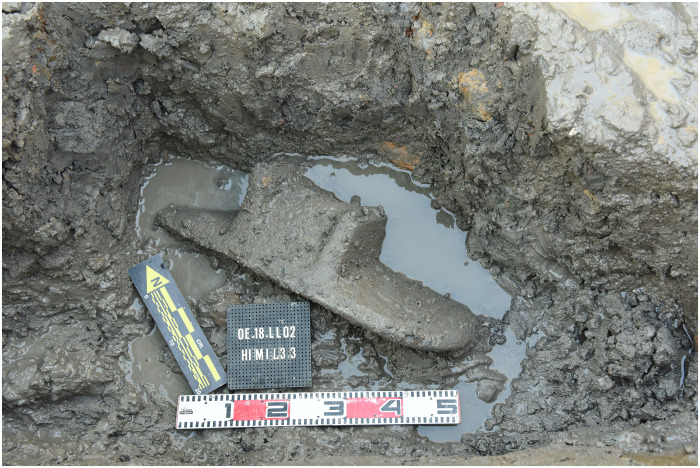
Oc Eo
The large footed grinding slab
A footed sandstone grinding slab, 76 cm long, excavated at Oc Eo in 2018. Starch grains of ginger, cinnamon and nutmeg were identified on its surface.
Comparative evidence from Vietnam; these are not finds from Kerala or Tamil Nadu.

Photographed 2007-03-24 15:42
Coconut palms with fruit (modern botanical context)
Coconut palms (Cocos nucifera) with visible fruit, shown as modern botanical context.
Modern photograph of coconut palms and fruit; it does not show extracted coir fibres or a dated archaeological specimen.

Photographed 2020-11-01 18:05:45
Foxtail millet grains (Setaria italica subsp. italica, modern botanical specimen)
Setaria italica subsp. italica (foxtail millet) grains, shown as a modern botanical reference specimen.

Photographed 2022-03-02 09:33:43
Banana inflorescence photographed at Cheruthoni, Kerala (modern botanical context)
Banana inflorescence photographed at Cheruthoni, Kerala.
Modern references relevant to this study
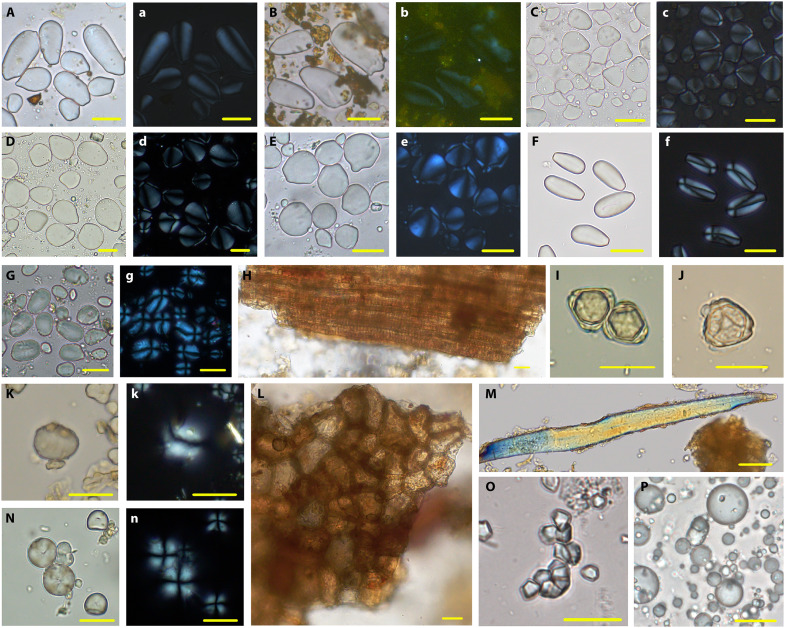
Modern reference samples used for comparison in the Oc Eo study: starch grains and other remains of turmeric, ginger, clove, cinnamon, nutmeg and rice.
Comparative evidence from Vietnam; these are not finds from Kerala or Tamil Nadu.
Photographed 2014-09-15
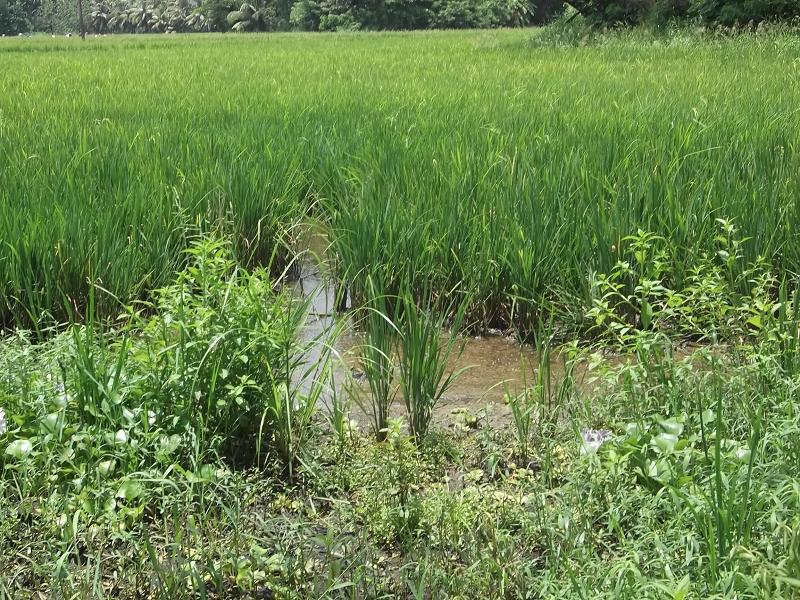
Oryza sativa - Kerala 2 – Modern rice plant or grain
Oryza sativa - Kerala 2. Modern rice plant or grain; ancient cultivation must be established by dated archaeobotanical evidence.
Photographed 16 December 2013
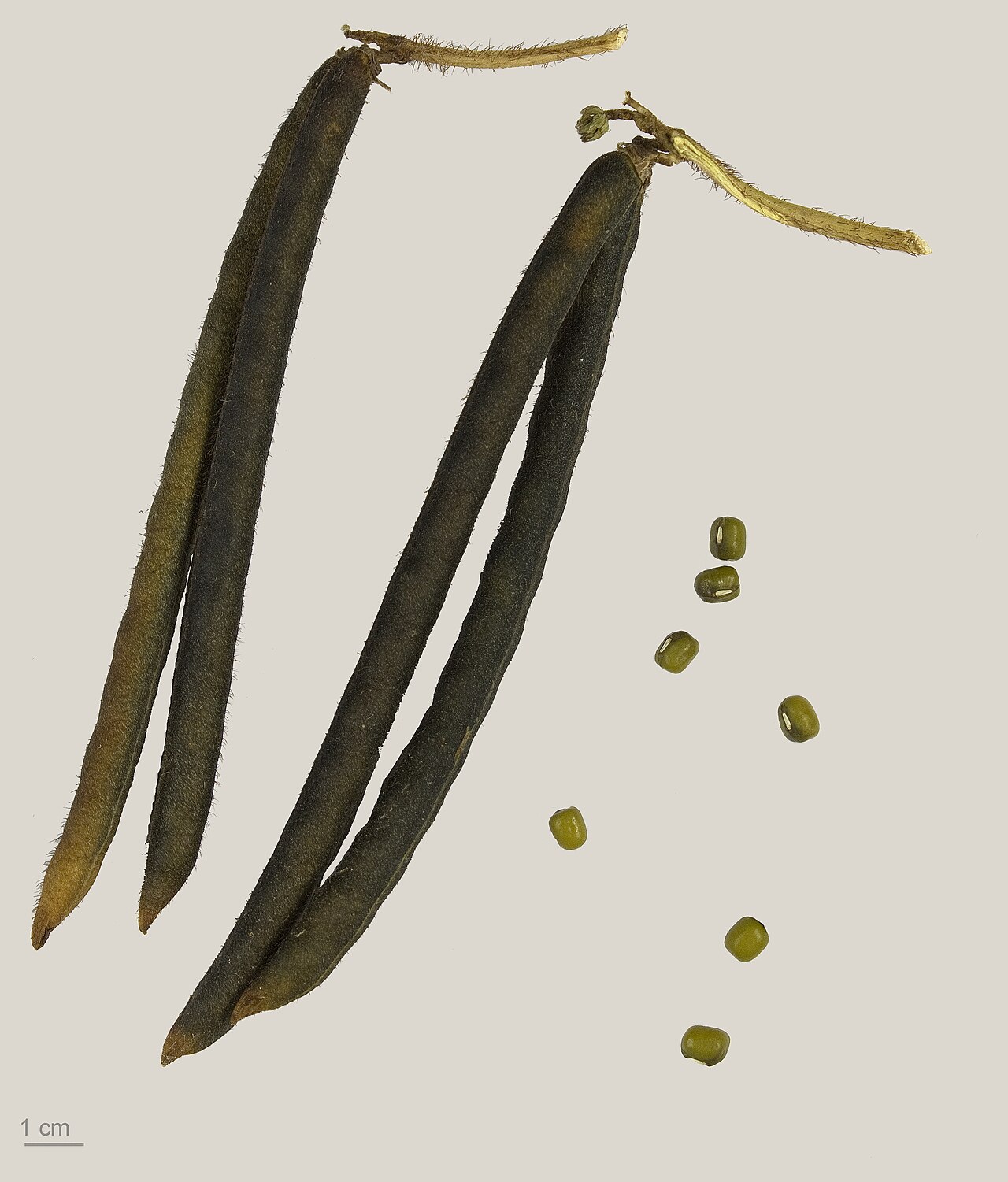
Vigna radiata MHNT.BOT.2009.17.4 – Modern mung bean identification
Vigna radiata MHNT.BOT.2009.17.4. Modern mung bean identification; not archaeological seeds.
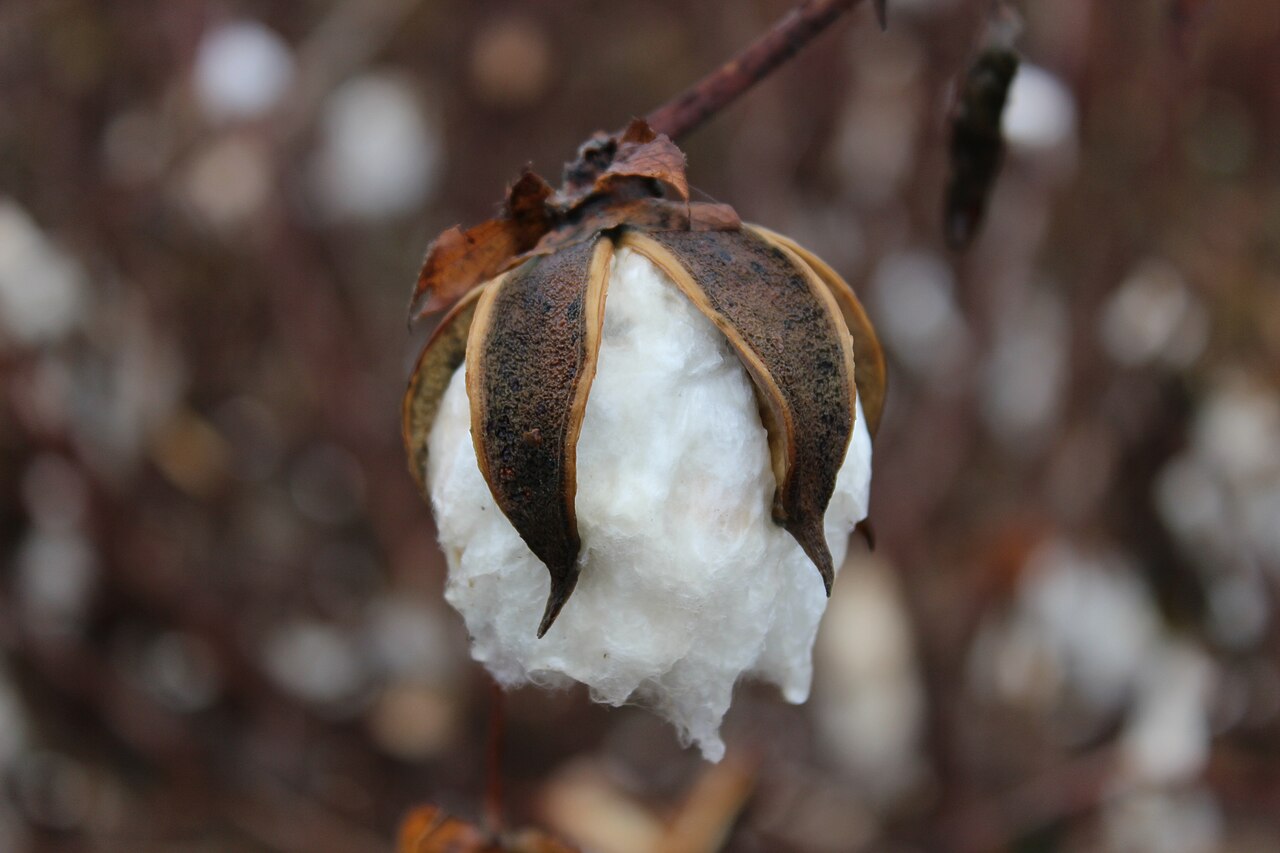
Photographed 25 November 2014, 11:01
Cotton boll nearly ready for harvest – Modern cotton botanical reference
Cotton boll nearly ready for harvest. Modern cotton botanical reference; not an excavated textile or evidence of an ancient cotton species.
Show 6 more photographs and source images ↓
Photographed 2014-09-15
Oryza sativa - Kerala 3 – Modern rice plant or grain
Oryza sativa - Kerala 3. Modern rice plant or grain; ancient cultivation must be established by dated archaeobotanical evidence.
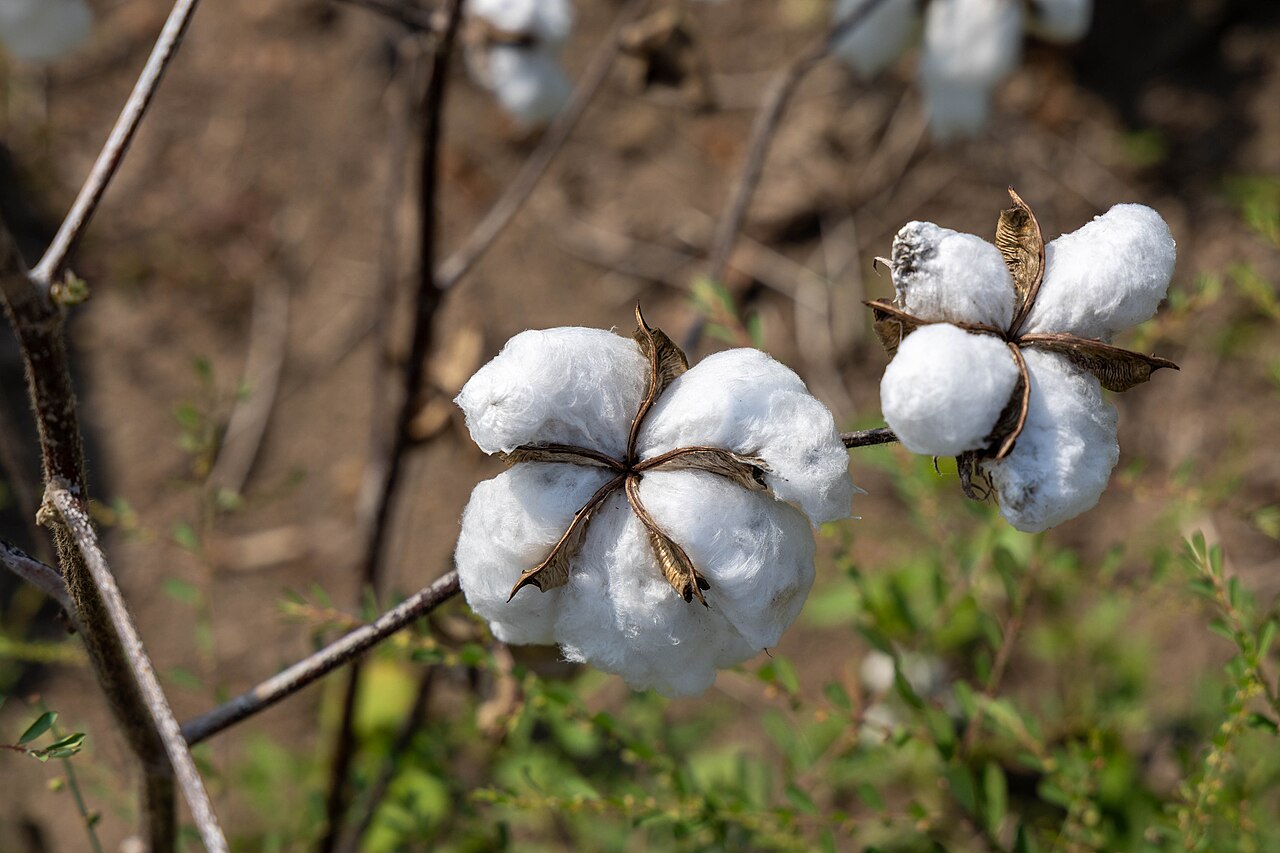
Photographed 2025-11-17 12:01:40
Mature cotton boll in Raichur, Karnataka – Modern cotton botanical reference
Mature cotton boll in Raichur, Karnataka. Modern cotton botanical reference; not an excavated textile or evidence of an ancient cotton species.

Photographed 2020-11-01 18:00:54
Foxtail millet panicle (Setaria italica subsp. italica, modern botanical specimen)
Setaria italica subsp. italica (foxtail millet) panicle, shown as a modern botanical reference specimen.

Photographed 2012-02-05
Banana in Kerala – Modern banana photograph
Banana in Kerala. Modern banana photograph; domestication and arrival dates remain research questions.
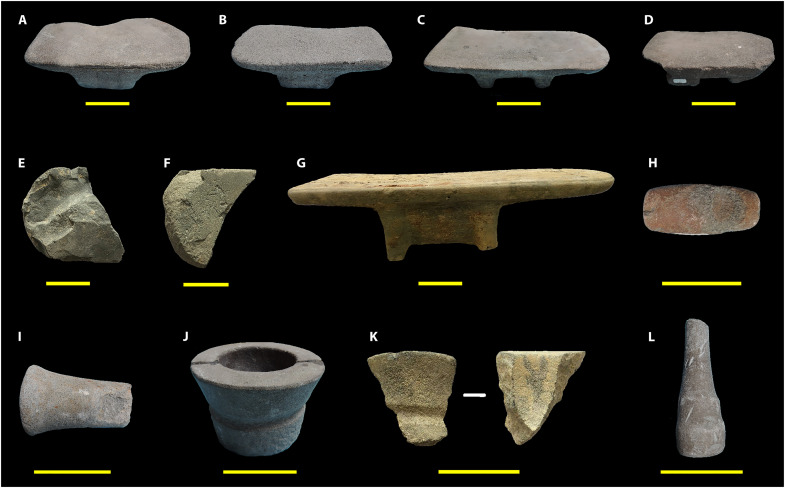
Oc Eo
Ancient food-preparation tools from Oc Eo
Food-preparation tools from Oc Eo reported in the published study: footed grinding slabs, mullers or pestles, and mortars. Scale bar 10 cm.
Comparative evidence from Vietnam; these are not finds from Kerala or Tamil Nadu.

Oc Eo
Ancient plant remains recovered from Oc Eo
Starch grains and other plant remains from Oc Eo under the microscope, including turmeric, ginger, galangal, clove, cinnamon, nutmeg and rice.
Comparative evidence from Vietnam; these are not finds from Kerala or Tamil Nadu.
006Where next
All related studies, connected material, books and sources25 · 10
Elsewhere on this site
Excavation Atlas Sites: Keezhadi (Vaigai River Brick Settlement) · Sivagalai Urn Burial & Habitation Complex · Porunthal Habitation & Megalithic Grave Site · Alagankulam (Vaigai Mouth Maritime Entrepôt)
Junior Detective Quests: Dinner 2,000 Years Ago: Hearths, Urns and Poems · The Salt Road: Coast, Carts and Inland Grain
Classroom Lesson Plans: Module 5 · Iron, Stone Monuments & Everyday Craft: Technology in Early South India
Multi-Script Glossary Terms: karuppu-civappu pāṉai (Black-and-Red Ware) (கருப்பு சிவப்பு பானை / കറുപ്പും ചുവപ്പും മൺപാത്രങ്ങൾ) · Russet-Coated Painted Ware (Āndhra/Kongu Ware) (வண்ணம் தீட்டிய பானை / ചായം പൂശിയ മൺപാത്രങ്ങൾ)
Connected material
Photographs, drawings, books, videos and other studies linked to this study. A link helps you explore; it does not prove a historical claim.
- Ancient food-preparation tools from Oc EophotographBackground
- The large footed grinding slabphotographBackground
- Ancient plant remains recovered from Oc Eoscientific photomicrographBackground
- Modern references relevant to this studyphotographBackground
- Oryza sativa - Kerala 2 – Modern rice plant or grainphotographBackground
- Oryza sativa - Kerala 3 – Modern rice plant or grainphotographBackground
- Foxtail millet panicle (Setaria italica subsp. italica, modern botanical specimen)photographBackground
- Foxtail millet grains (Setaria italica subsp. italica, modern botanical specimen)photographBackground
- Vigna radiata MHNT.BOT.2009.17.4 – Modern mung bean identificationphotographBackground
- Coconut palms with fruit (modern botanical context)photographBackground
- Banana inflorescence photographed at Cheruthoni, Kerala (modern botanical context)photographBackground
- Banana in Kerala – Modern banana photographphotographBackground
- Cotton boll nearly ready for harvest – Modern cotton botanical referencephotographBackground
- Mature cotton boll in Raichur, Karnataka – Modern cotton botanical referencephotographBackground
- Follow the evidence before the recipediagramThis study reports the Kodumanal flotation results (pulses, millets, rice) that the identification tray draws on.
Books, videos and websites
Outside reading on this topic. These are not part of the study and we have not checked every claim in them. See all books and videos
- Dorian Fuller’s bucket flotation film Video · Dorian Q. Fuller (author & publisher of the archaeobotany methods resource) · UCL · 3:36 · A short practical demonstration of bucket flotation for recovering archaeological plant material. A practical teaching resource authored by an active archaeobotanical researcher. A 2007 methods demonstration. It does not establish a date or crop identification for any Kerala or Tamil Nadu sample.
- Christina Warinner: Exploring Ancient Diets Video · Christina Warinner · Leakey Foundation lecture at the California Academy of Sciences · 32:12 · A longer account of how archaeology and biomolecular evidence can investigate changes in human food and diet. Offers greater depth after the short dental-calculus introduction. Recorded in 2013, although uploaded in 2021. Broad global and prehistoric scope; not a reconstruction of a meal at a named regional site.
- Christina Warinner: what ancient dental calculus can preserve Video · Christina Warinner · University of Zurich, Centre for Evolutionary Medicine at the time of the 2012 talk; TED publisher · 5:31 · A concise research talk explaining how calcified dental plaque can preserve information about ancient diet, microbes and health. An especially strong short introduction with a fully reviewed publisher transcript and an identifiable research team. Foundational 2012 talk, not a current review of the whole field or a study of Kerala or Tamil Nadu remains. The closing tooth-brushing joke is not health advice.
- Dorian Fuller on archaeobotanical research Video · Dorian Q. Fuller · University College London; lecture hosted by LINXS · 1:04:48 · A research lecture on archaeological plant remains, domestication and analytical methods including imaging. Places the work of identifying and interpreting seeds and crops in the hands of an active researcher. Multi-regional research and methods. Do not present it as a report of Kerala or Tamil Nadu crop assemblages unless a specific passage and its evidence are checked.
- Dorian Fuller: preparing a comparative plant collection Video · Dorian Q. Fuller & UCL Archaeobotany Laboratory · 8:37 · A practical demonstration of pressing plants for a comparative collection. Shows the reference work that helps researchers identify recovered plant remains. Modern reference specimens and methods. The plants shown must not be presented as ancient regional finds.
007Sources
The study lists the sources it consulted; we have not rechecked them. A working link does not show that a source was read, and a valid identifier does not show that it supports a claim. We do not link to unofficial uploads or copies of publications. Where a study cited one, we show the published citation, or a publisher, DOI or Internet Archive link when we have one. Tracking codes are removed from links, and the sources themselves are not republished here.
Cooke, Miriam, Dorian Q. Fuller, and K. Rajan. 2005. 'Early Historic Agriculture in Southern Tamil Nadu: Archaeobotanical Research at Mangudi, Kodumanal and Perur.' In U. Franke-Vogt and H.-J. Weisshaar, eds., South Asian Archaeology 2003, pp. 341–350. Aachen: Linden Soft.
Print or offline sourceSource recordDry, rainfed or irrigated? Reevaluating the role and development of rice agriculture in Iron Age-Early Historic South India using archaeobotanical approaches
Kingwell-Banham, Eleanor. 2019. Archaeological and Anthropological Sciences 11: 6485–6500. DOI: 10.1007/s12520-019-00795-7.
Evidences for Plant Utilization, Spice Trade and Paleo-environment from Peat Formation of Pattanam Archaeological Site
Varghese, C. Rithin, K. Mary Mathew, Y. S. Rao, Swapna Sasidharan, and A. B. Remashree. 2020. Proceedings of the Indian National Science Academy 86(2): 1097–1106. DOI: 10.16943/ptinsa/2019/49715.
Kerala Council for Historical Research. 2011. Report of the Fifth Season Excavation at Pattanam.
Print or offline sourceSource recordImplications of phytolith records from an Early Historic megalithic burial site at Porunthal in Southern India
Premathilake, Rathnasiri, K. Anupama, K. Rajan, S. Prasad, G. Orukaimani, and V. P. Yathees Kumar. 2017. Journal of Archaeological Science: Reports 11: 491–506.
Phytoliths and palynological studies at Porunthal
Anupama, K., R. Premathilake, S. Prasad, and K. Rajan. 2014. In K. Rajan and V. P. Yatheeskumar, eds., Archaeology of Amaravathi River Valley, Porunthal Excavation, vol. II, pp. 557–564. Delhi: Sharada Publishing House.
Rajan, K., and R. Sivanantham. 2025. Antiquity of Iron: Recent Radiometric Dates from Tamil Nadu. Chennai: Department of Archaeology, Government of Tamil Nadu.
Sivanantham, R., M. Ramesh, and R. Ajay Kumar. 2025. 'Excavations at Keeladi.' In Archaeological Excavations in Tamil Nadu: A Preliminary Report, pp. 163–218. Department of Archaeology, Government of Tamil Nadu.
Excavation Reports of Archaeological Survey of India (MASI)
Archaeological Survey of India. Official excavation-report catalogue, entry 45: Excavation Report of Adichchanallur.
Kerala Museum. 'Food Culture in Sangam Age: Through Pathupattu.'
Researchers and institutions whose work this study uses: K. Rajan, R. Sivanantham, Dorian Q. Fuller, Archaeological Survey of India, Kerala Council for Historical Research
How we know The evidence, claims and dates behind this study
What this study draws on
- Flotation results from Kodumanal (Cooke, Fuller and Rajan 2005), read in full with their taxon tables.
- Direct radiocarbon dates on grains from Kodumanal, Porunthal, Sivagalai and Adichanallur.
- A 2020 study of Pattanam peat, with photographs of the coconut and pepper specimens.
- Phytolith and pollen studies at Porunthal, and the 2025 Keezhadi excavation report.
Dates in this study
| What is dated | Date | How it was dated |
|---|---|---|
| Porunthal paddy, broader published two-sigma aggregate | 571–397 BCE | Laboratory date |
| Porunthal paddy, principal published one-sigma synthesis | 540–410 BCE | Laboratory date |
| Kodumanal directly dated rice, published range | 430–230 BCE | Laboratory date |
See these dates on the timeline
The study’s claims
3 claims · 12 source passages · 64 paragraphs
Browse the study paragraph by paragraphKodumanal has a directly published diversified archaeobotanical assemblage of small millets, pulses, rice and cotton, with Vigna radiata especially prominent and Brachiaria ramosa a major small millet.
Supported in this study
Taxon abundance varies by flotation sample. Minor millet identifications should not be generalized into a single millet species.
No securely read target-site publication corpus establishes domesticated Musa banana or Areca catechu at the six named sites.
Supported with qualifications
This is a negative result limited to the sources read, not a claim of archaeological absence across Kerala or Tamil Nadu. Ensete superbum at Pattanam is not Musa. Palmae or Borassus at Porunthal is not Areca or Cocos. Supplied assessment: supported_with_qualification
Across the six-site source corpus, the evidence favors continuity of a diversified dryland crop economy, incorporation and increasing social importance of rice, and patchy evidence for maritime-associated perennials rather than a single chronological replacement of indigenous crops by introduced orchard species.
Supported with qualifications
Pattanam's key perennial/spice assemblage lacks direct botanical-sample chronology in the consulted publication. Sivagalai and Adichanallur cereal dates are antecedent to the formal this study window. Mortuary cereal deposits cannot independently measure everyday staple proportions. No secure target-site Musa or Areca record was established. No target-site starch-grain species dataset was located in the consulted literature. Supplied assessment: supported_with_qualification Antiquity of Iron (2025), Tables 4 and 5, gives conflicting calendar values for the same Adichanallur paddy and millet samples and conflicting paddy locality labels; those discrepancies remain unresolved.
Trace one claim through the study’s records
Explore the evidenceOther source lists
Numbered citation links from the study
The numbered links in the study text point here.
publications.dainst.org
Phytolith and pollen studies at Porunthal, Appendix F.
Rajan, K., and R. Sivanantham (eds.). Antiquity of Iron: Recent Radiometric Dates from Tamil Nadu (TNSDA, 2025)
D:\PINSA 2020\JUNE-2020\8-1097-
D:\PINSA 2020\JUNE-2020\8-1097-
publications.dainst.org
Dry, rainfed or irrigated? Reevaluating the role and development of rice agriculture in Iron Age-Early Historic South India using archaeobotanical approaches | Archaeological and Anthropological Sciences
D:\PINSA 2020\JUNE-2020\8-1097-
Dry, rainfed or irrigated? Reevaluating the role and development of rice agriculture in Iron Age-Early Historic South India using archaeobotanical approaches | Archaeological and Anthropological Sciences
Phytolith and pollen studies at Porunthal, Appendix F.
Rajan, K., and R. Sivanantham (eds.). Antiquity of Iron: Recent Radiometric Dates from Tamil Nadu (TNSDA, 2025)
Rajan, K., and R. Sivanantham (eds.). Antiquity of Iron: Recent Radiometric Dates from Tamil Nadu (TNSDA, 2025)
D:\PINSA 2020\JUNE-2020\8-1097-
Excavations at Keeladi - 2025
publications.dainst.org
Rajan, K., and R. Sivanantham (eds.). Antiquity of Iron: Recent Radiometric Dates from Tamil Nadu (TNSDA, 2025)
Dry, rainfed or irrigated? Reevaluating the role and development of rice agriculture in Iron Age-Early Historic South India using archaeobotanical approaches | Archaeological and Anthropological Sciences
D:\PINSA 2020\JUNE-2020\8-1097-
D:\PINSA 2020\JUNE-2020\8-1097-
publications.dainst.org
Dry, rainfed or irrigated? Reevaluating the role and development of rice agriculture in Iron Age-Early Historic South India using archaeobotanical approaches | Archaeological and Anthropological Sciences
Phytolith and pollen studies at Porunthal, Appendix F.
publications.dainst.org
publications.dainst.org
Food Culture in Sangam Age: Through Pathupattu
publications.dainst.org
publications.dainst.org
Dry, rainfed or irrigated? Reevaluating the role and development of rice agriculture in Iron Age-Early Historic South India using archaeobotanical approaches | Archaeological and Anthropological Sciences
Phytolith and pollen studies at Porunthal, Appendix F.
Dry, rainfed or irrigated? Reevaluating the role and development of rice agriculture in Iron Age-Early Historic South India using archaeobotanical approaches | Archaeological and Anthropological Sciences
publications.dainst.org
D:\PINSA 2020\JUNE-2020\8-1097-
Phytolith and pollen studies at Porunthal, Appendix F.
D:\PINSA 2020\JUNE-2020\8-1097-
D:\PINSA 2020\JUNE-2020\8-1097-
Phytolith and pollen studies at Porunthal, Appendix F.
Excavation Reports of Archaeological Survey of India (MASI)
publications.dainst.org
Dry, rainfed or irrigated? Reevaluating the role and development of rice agriculture in Iron Age-Early Historic South India using archaeobotanical approaches | Archaeological and Anthropological Sciences
Evidences for Plant Utilization, Spice Trade and Paleo ...
kchr.ac.in
Phytolith and pollen studies at Porunthal, Appendix F.
Phytolith and pollen studies at Porunthal, Appendix F.
Rajan, K., and R. Sivanantham (eds.). Antiquity of Iron: Recent Radiometric Dates from Tamil Nadu (TNSDA, 2025)
Excavations at Keeladi - 2025
Excavation Reports of Archaeological Survey of India (MASI)
Food Culture in Sangam Age: Through Pathupattu
Phytolith and pollen studies at Porunthal, Appendix F.
About this study Status, corrections and how it was made
Status
Draft study, revision 8. No historian, archaeologist, or Tamil or Malayalam specialist has reviewed it yet.
The study itself says more research is needed before its question can be settled.
How it was made
Compiled as an editorial synthesis from published scholarship around questions we framed. About this project & workflow
The summary, How sure lines and Two views notes on this page were prepared from this study and cross-checked against its passages. That is an editorial check, not a specialist review.
Technical details
Study code R249. The text fingerprint changes whenever the study text changes.
- The study text is shown as written. Links from its paragraphs to citations help you move around the study; they are not new claims or checked source passages.
See how this study’s records were extracted
Text fingerprint (SHA-256): R249 · 01976058f2da652d7978d577… · v8
Evidence tables and technical details are on the web page: https://layersofthesouth.org/read/b07531086a