Side view of an umbrella-stone monument at Kudakkallu Parambu, Cheramanangad
Cheramanangad
Photographed 2016-09-18
- Belief & memory
- Porkalam
- Cheramanangad
- Ariyannur
Umbrella stones and rock-cut tombs: distinctive but not unique
Kerala's umbrella stones, cap stones and rock-cut chambers are regionally concentrated rather than unique, and laboratory dates for them are few.
- This page
- 4,333 words · revision 6
Draft study · Awaiting specialist review · Updated
001Dates and places
Places on the atlas that name this study.
- Porkalam Megalithic Urn & Cist Site
Protected ASI monument · Kunnamkulam area, Thrissur
- Cheramanangad
Protected ASI monument park · Thrissur District
- Ariyannur Umbrella Stones
Protected ASI monument enclosure · Thrissur District
- Kattakampal Multi-Chambered Rock-Cut Cave
Protected ASI monument · Pazhanji / Kunnamkulam area
- Mangadu Iron Age Urn Burial Site
Coarse locality orientation · Kollam District
- Marayoor & Kovilkadavu Dolmen Fields
Protected heritage zone · Marayoor / Kovilkadavu, Idukki
Dates in this study are stated in words only.
- 2 Well supported
- 1 Likely
- 1 Not known
002How sure
In brief
Kerala's laterite burial monuments include umbrella stones, ground-resting cap or hood stones, and chambers cut into rock. V. D. Krishnaswami's 1949 terms do not map neatly onto later names such as kudakkallu and topikkallu. Jenee Peter's 2015 survey finds umbrella stones concentrated in Malappuram, Palakkad and Thrissur, with a northern group. That makes them distinctive and regional, though not shown to be unique to Kerala. Some excavated umbrella stones had no urn beneath them. A field study by Ollier and Rajaguru undercuts the idea that laterite is soft when cut and hardens in air. Dating is uneven: Thapar's Porkalam range, third century BCE to first century CE, rests on comparing finds. At Kuttikol, radiocarbon samples gave both eighth to sixth century BCE and fifteenth to seventeenth century CE results. For Ariyannur, a protected umbrella-stone group, the sources used include no excavation report, quarry study or laboratory date.
Key researchers cited in this study: B. K. Thapar (Porkalam & Maski Megalithic Excavations) · Full bibliography
How sure
- Well supported
Umbrella stones cluster in central and northern Kerala.
Documented in Peter's 2015 distribution survey; a full survey outside Kerala was not completed.
- Likely
Laterite is not reliably soft when cut and hard only after exposure.
A field geology study found blocks already hard when cut; it covers one quarry area.
- Well supported
Kuttikol's burials hold both early-BCE and much later-CE sampled material.
Published AMS results with laboratory codes; they date sampled carbon, not the cutting of chambers.
- Not known
When Ariyannur's umbrella stones were built.
No Ariyannur excavation report or laboratory date was recovered; only a broad Iron Age attribution exists.
Why it matters
It shows that a monument's shape, the burial beneath it and its date are separate questions.
The summary above is the short read. The full study is the complete text it was drawn from, with its tables and source notes.
What the full study covers
003The study
Question, scope and orientation
Question and scope.
How are Kerala's umbrella stones, capstones and rock-cut burial monuments classified, dated and interpreted? The study also tests the claim that these monuments are unique to Kerala. Region: Kerala, with Tamil Nadu, coastal Karnataka and other South Indian comparisons used only where they test typology, distribution, chronology or the claim of uniqueness. Period classification: mixed chronology. Some relevant regional radiocarbon evidence is earlier than 1000 BCE, while some material sampled from a rock-cut burial is medieval or early modern; that later material is discussed as later use or formation history rather than folded into the core period.
Orientation.
Kerala's umbrella-shaped laterite monuments are unusually memorable, but their archaeology is less tidy than their modern labels suggest. V. D. Krishnaswami's 1949 terminology does not map perfectly onto later distinctions among kudakkallu, topikkallu, “hat stones,” “hood stones” and capstones; Jenee Peter's later review likewise stresses typological and terminological difficulty. Rock-cut burial chambers form another architectural family because their chambers were hollowed from laterite bedrock rather than assembled wholly from slabs, yet different forms can occur in the same mortuary landscapes. Dating is equally uneven: B. K. Thapar's influential Porkalam range was explicitly a provisional artifact-based estimate, whereas AMS work at Kuttikol produced both an eighth–sixth-century-BCE signal and fifteenth–seventeenth-century-CE sampled material. The strongest conclusion is therefore regional distinctiveness combined with technological adaptation – not a single timeless “Kerala type,” one cultural population, or a one-factor geological explanation. ↗1 ↗2 ↗3
The four-slab umbrella stone, a monument that clusters in central and northern Kerala. A model for a paper cut-out, not a drawing of one monument.
The umbrella stone form this study describes: a laterite cap supported on slabs.
Layers of the South editorial illustration
Historical Narrative & Main Investigation
Accessible explanation.
A useful first distinction is between monuments that were assembled above or near the ground surface and chambers that were cut into the ground itself. In Peter's terminology, the umbrella stone or kudakkallu is a dressed-laterite monument in which roughly four shaped uprights or side elements carry a domed cap, producing the familiar umbrella or mushroom profile. Her survey places important concentrations in Malappuram and adjoining Palakkad and Thrissur, with another northern grouping in Kozhikode, Kannur and Kasaragod. This supports describing the form as strongly associated with Kerala, especially its central and northern lateritic zones, while stopping short of an absolute claim that nothing comparable exists outside the state. [; P003] ↗1
Schematic sections of five monument forms, drawn from the descriptions in the studies. Not to scale. Not one real monument. What is drawn under each form is one thing that has been found under such forms, not a rule.
Schematic sections comparing Kerala laterite monument forms and upland slab cists.
Layers of the South editorial illustration
A cap-, hat- or hood-stone is not simply the same monument under a different English translation. Krishnaswami in 1949 treated topi-kal and kudai-kal as local terms within what he called the umbrella-stone series, while separately describing a “hood-stone” as a domed, dressed laterite block resting directly on the ground. Later literature often distinguishes the supported umbrella form from a ground-resting cap or hood form, sometimes using topikkallu for the latter. Because the vocabulary changed, a catalogue entry that says “topi-kal,” “hat stone,” “hood stone” or “capstone” must be interpreted according to that author's definition rather than mechanically translated into a single modern category. [, C003; P016] ↗4 ↗3
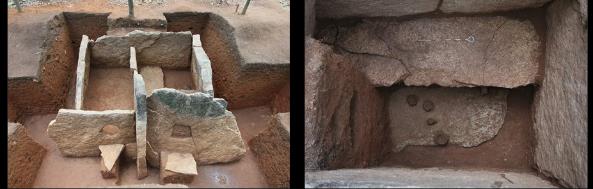
Rock-cut burial chambers differ at the level of construction. Archaeological descriptions include an approach or forecourt cut into laterite, a relatively small entrance and one or more hollowed chambers; individual examples can have domed, conical, rectangular or vaulted interiors, benches, central pillars or ceiling openings. At Kuttikol, the investigators recorded cutting traces on the laterite itself. These structures are strongly represented in Kerala's lateritic regions, particularly from Thrissur northward, but scholarship also records relevant parallels immediately beyond Kerala, including coastal Karnataka. “Unique to Kerala” is therefore too strong for rock-cut burial architecture as a whole. [; P009, P011–P012] ↗5 ↗2 ↗3 “Northern Kerala's rock-cut burial caves vary widely in form” compares the documented rock-cut burial forms of northern Kerala.
The geology matters, but it does not supply a complete cultural explanation. Laterite can be grooved, detached and dressed with hand tools. A geological field study by Cliff Ollier and Sharad Rajaguru is especially useful because it challenges a familiar simplification: in the Kerala quarry they studied, laterite blocks were already comparatively hard and dry when separated, with only limited additional hardening after exposure. The formula “soft underground like cheese, hard only after being exposed to air” should therefore not be presented as a universal physical explanation for ancient Kerala architecture. [; ] ↗6
Porkalam makes the deterministic geological story even harder to maintain. Thapar's excavation describes a burial in which dressed laterite and a pit cut in laterite were used together with a granite capstone; granite was therefore not automatically abandoned wherever laterite was workable. Geological availability constrained what builders could conveniently do, but it cannot by itself tell us why one burial received an umbrella marker, another a ground-resting cap, another an urn beneath a stone circle, and another a hollowed chamber. [; ] ↗7 “Porkalam 1948: one urn burial that became a reference point” examines Thapar's Porkalam excavation in detail.
Dating is not uniform across monument types. Thapar placed the Porkalam burial approximately between the third century BCE and first century CE using comparisons of ceramics, beads and other finds; he treated the result as provisional rather than as a laboratory measurement. Modern radiocarbon evidence demonstrates why that span should not simply be projected onto every Kerala “megalith.” At Kuttikol, a wood sample from Burial 2 produced calibrated probability ranges in the eighth–sixth centuries BCE, while three samples from Burial 1 produced fifteenth–seventeenth-century-CE ranges. The investigators also warned that wood lacking final growth rings can predate tree felling, and they discuss disturbance and secondary deposition. A radiocarbon determination dates the sampled carbon and archaeological context first; connecting it to the original cutting of a chamber requires an additional contextual argument. [; P012–P014] ↗2 ↗7
The claim that terracotta sarcophagi accompany these monuments likewise requires narrowing. A modern synthesis reports bovine-shaped sarcophagi at Perungulam and Kattakambal and small-legged examples at Chevayur, generally in association with rock-cut chambers. In the sources read for this study, comparable sarcophagi were not verified for Ariyannur, Cheramangad or Porkalam. That is a statement about this study's evidence coverage, not an assertion of archaeological absence. For Porkalam, “Porkalam 1948: one urn burial that became a reference point” goes further: the four-legged pieces in Thapar's catalogue are red-ware vases, not sarcophagi. “Kattakampal's burial cave: four chambers and no central pillar” examines the Kattakampal report. Similarly, Padakkallu did not emerge from the consulted specialist typologies as a securely defined independent burial-architecture class. It should be withheld as such until a stronger archaeological source establishes what the term denotes and where. [; ] ↗4
Umbrella stones and exposed supports at Ariyannur
Ariyannur
Photographed 2012-10-22
Main investigation – names, forms and classification.
The classification problem is not modern editorial fussiness; it has a history within South Indian archaeology. Krishnaswami's 1949 paper explicitly tried to bring order to morphology-based terminology. His descriptions show that local monument names could overlap, while “hood-stone” marked a distinguishable structural form. Peter's 2015 reassessment organizes Kerala burials into broad classes including cists/dolmenoid cists, rock-cut caves, umbrella stones, hat/hood stones, urn burials and menhirs, but she also emphasizes composite arrangements. A useful modern catalogue should therefore record several variables separately: surface marker, support structure, subsurface cut/chamber, ceramic or sarcophagus container, human remains, associated artifacts and enclosing stone circle. That prevents a visually dominant surface form from swallowing the rest of the archaeological context. [, C003, C006] ↗1 ↗3
This is particularly important at Cheramangad/Cherumangad and Ariyannur. Peter notes that excavated umbrella stones did not uniformly contain burial urns, which weakens any simple definition of kudakkallu as an “urn lid” writ large. Conversely, a hat/cap-like marker can occur with an urn in a pit. The assemblage must therefore be described rather than inferred from the silhouette visible above ground. [; ] ↗1 “Cheramanangad’s stone markers do not predict what lies beneath” describes the 1990–91 ASI excavation at Cheramanangad, where the four-support umbrella stone (Megalith III) held no burial.
Main investigation – regional distribution without converting style into ethnicity.
Peter's survey gives the strongest case for a specifically Kerala-centered umbrella-stone distribution: substantial concentrations occur in Malappuram and the adjoining Palakkad–Thrissur area, with another northern group in Kozhikode, Kannur and Kasaragod. The Archaeological Survey of India's current protected-monument list independently preserves several relevant names in Thrissur district, including the Ariyannur Umbrellas, Kudakkalluparambu at Cheramangad and burial caves at Chovannur, Eyyal, Kandanassery, Kattakampal and Kakkad. ASI protection establishes administrative recognition of those monuments, not their chronology. [, C016; P019] ↗8 ↗1 “Kattakampal's burial cave: four chambers and no central pillar” and “Eyyal's burial cave: two chambers, studied apart from its coins” examine the Kattakampal and Eyyal caves.
Close view of an Ariyannur umbrella-stone capstone and supports
Ariyannur
Photographed 2016-09-18
Rock-cut chambers have a wider comparative horizon. Abhayan's review places their main Kerala distribution broadly from Thrissur north to Kasaragod and notes an example beyond the state in the Udupi area of Karnataka. Other South Indian mortuary traditions, including those in Tamil Nadu, also include cists, dolmens, urn burials, sarcophagi, menhirs and stone circles. The research conducted here did not establish an equivalent concentration of the supported Kerala-style umbrella form in Tamil Nadu. The defensible formulation is thus that umbrella stones are a strongly regional and distinctive expression within a broader South Indian mortuary world. Formal resemblance alone cannot identify language, ethnicity, migration or direct cultural transmission. [, C017–C018; P009] ↗1 ↗5
Main investigation – laterite, granite and construction choices.
The most convincing geological interpretation is a constraint-and-opportunity model, not environmental determinism. Lateritic bedrock permits a subtractive technique: builders can excavate passages and chambers rather than assemble every wall from quarried slabs. Kuttikol provides direct archaeological examples cut into exposed laterite, while modern quarry observation confirms that laterite can be grooved, detached and trimmed using hand tools. The modern analogy does not tell us the exact Iron Age tool kit or labor organization, but it demonstrates the material possibilities without needing the exaggerated “soft-to-hard transformation” story. [, C007–C008] ↗2 ↗6 Krishnaswami's 1949 survey had already tied form to material in Cochin State, placing umbrella stones on the lateritic plains, dolmens in the eastern granite country and urn burials toward the alluvial coast. That regional pattern describes how materials were used; it does not identify the source of any particular block. ↗3
At the same time, Porkalam's combination of laterite and granite demonstrates that available materials could be combined. Kerala also contains slab-built forms in harder stone. Geology therefore helps explain why particular construction techniques were feasible in particular landscapes, but the consulted evidence cannot isolate geology as the reason for selecting one mortuary form over another. Ritual practice, visibility, labor, craft knowledge, local tradition, chronology and social signaling are all plausible variables; none was demonstrated by the consulted evidence as a single master cause. [, C009] ↗6 ↗7
Main investigation – monuments, deposits and samples are different clocks.
Thapar's Porkalam range of approximately the third century BCE to first century CE is historically important but is relative dating based on artifact comparison, not a radiometric determination. Broader Kerala mortuary chronology has subsequently become deeper: Abhayan reproduces a Mangadu charcoal determination of 2890±70 BP (BS-958), with a published two-sigma calibrated span of 1299–902 BCE (see “Mangadu's urn burials give southern Kerala early dated charcoal” and “Kerala's Iron Age graves are many; only a handful are dated”; note that Indian radiocarbon laboratories of that era ordinarily calculated ages on the 5,730-year half-life, which would make the conventional Libby age roughly 3 percent younger – about 2,810 BP – and shift calibrated calendar ranges slightly later). That result is relevant background for the antiquity of Kerala's Iron Age mortuary record, but it is not a direct date for an umbrella stone or rock-cut chamber. [; P010] ↗5 ↗7
Kuttikol is the most informative laboratory case read for this study precisely because its results are awkward. The excavation team reports AMS measurements from Paleo-Labo, calibrated using OxCal 4.2 and IntCal13. KTL-4 from Burial 2 produced disjoint calibrated intervals in the eighth–sixth centuries BCE. KTL-1, KTL-2 and KTL-3 from Burial 1 produced substantially later fifteenth–seventeenth-century-CE probabilities. The authors also discuss wood-sample “old wood” issues where the final annual rings were absent. These measurements show that first construction, burial deposition, reopening, infilling and the age of carbonized material need not be synchronous. They do not prove an uninterrupted Kerala rock-cut tradition lasting two millennia, and they do not permit the earliest probability range to be assigned automatically to every chamber. [; ] ↗2
Ariyannur umbrella stones: what the records show
The Archaeological Survey of India's protected-monuments list names “Ariyannur Umbrellas, a Prehistoric Site” in Thrissur district and describes it as “seven of more Kudakals or Umbrella Stones.” The “of” is probably a typing error for “or.” The wording is an administrative description of the protected group, not a current count of intact monuments; that would need a monument-by-monument condition survey. The name is also spelled Ariyannoor (Malayalam: അരിയന്നൂർ കുടക്കല്ല്). ↗8
Krishnaswami's 1949 survey, based on fieldwork in Cochin State in February 1946, names Ariyannur and Cheramanangad as the two principal Cochin-state sites of the umbrella-stone form. He describes four quadrant-shaped supports, set at a slope, that close into a square at the base. Their edges are bevelled so that they meet along the diagonals, and their outer faces are finely dressed. The body is cut flat near the top to carry a separate capstone: a low cone with a broad circular base and an edge chamfered inward. This describes the monument type, not a measured plan of any Ariyannur stone; no Ariyannur dimensions, support angles or block weights are published there. ↗3
A low rounded stone arrangement at Kudakkallu Parambu, Cheramanangad
Cheramanangad
Photographed 2016-09-18
Krishnaswami also reports that each of the four supports faces a cardinal direction, and his next sentence names Ariyannur and Cheramanangad as the chief sites. He publishes no monument numbers, bearings, plans or error ranges, so this is a reported observation, not a measured alignment. It is worth testing. A new survey would first define what “faces” means: the line square to a support's outer face, the axis of a support, or the diagonal of the base. It would then record the true bearing and its uncertainty for every surviving support, and publish all the readings. ↗3
The record also has clear limits. The sources read identify no quarry or extraction sequence for the Ariyannur stones. A dressed surface shows that stone was deliberately worked, but it does not show that iron chisels, or any other particular tool, were used; that would need a study of the marks themselves, able to rule out weathering, later repair and conservation damage. Nothing read links the stones' position or orientation to groundwater or a monsoon water table. The idea that laterite is soft when cut and hardens in the air is also unsafe as a general rule, as Ollier and Rajaguru's field study shows. ↗3 ↗6
Evidence from excavation is indirect. Peter lists Ariyannur among excavated umbrella-stone sites and reports that a few excavated umbrella stones there and at Cherumangad had no urn beneath them. She also states (2015, p. 291) that detailed reports of umbrella-stone excavations by the Kerala State Department of Archaeology, the ASI and Mahatma Gandhi University were unavailable. The original Ariyannur excavation record is absent from the sources consulted for this study, and no Ariyannur laboratory date was found. The site's age rests on the broad late Iron Age attribution that Peter gives to most umbrella-stone sites. ↗1
A modern map places Ariyannur within a dense cluster. Uesugi's Figure 17 in the 2018 volume Iron Age in South Asia maps it with Kandanassery, Kudakallu Parambu, Eyyal, Chowanur and other megalithic localities around Thrissur, crediting the Kerala Megalithic Gazetteer Project of the University of Kerala. The map shows spatial concentration; it does not show that these monuments were built at the same time or by one community. The most useful next sources are the original Ariyannur excavation archive and K. R. Srinivasan and N. R. Banerjee's “Survey of South Indian Megaliths,” Ancient India 9 (1953): 103–115, which was not consulted directly for this study. ↗5
Interpretations, disagreements and limits; Source register
Interpretations, disagreements and limits.
The first significant disagreement concerns terminology. Krishnaswami's 1949 relationship among topi-kal, kudai-kal and hood-stones is not identical to some later kudakkallu/topikkallu distinctions. The safest approach is to state whether a cap is supported or ground-resting and to say which author's vocabulary is being followed. Treating every English or Malayalam-looking label as a timeless taxonomic equivalent would conceal the history of archaeological classification itself. [, C003] ↗1 ↗3
The second issue is geological determinism. Laterite distribution plainly matters because a rock-cut chamber requires workable bedrock, yet “builders made caves instead of granite monuments because laterite was soft” is too strong. The modern geology study challenges the softness premise in its simple form, Porkalam demonstrates deliberate mixing of laterite and granite, and multiple mortuary architectures occur in broadly similar geological zones. Stronger explanation would require source-to-monument petrography, quarry studies, tool-mark analysis and secure construction sequences, not merely a laterite map. [] ↗6 ↗7
The third issue is chronology and continuity. Kuttikol's early and late sampled material cannot be turned into evidence for two millennia of continuous, unchanged use. Equally, the late results should not simply be discarded as “contamination” because they are archaeological observations whose formation process requires explanation. Better stratigraphic archives, micromorphology, direct dating of short-lived material and study of reopening or infilling could distinguish first construction from later use much more securely. [] ↗2
The idea of a single “megalith-builder” population should therefore be withheld. Similar burial forms, overlapping distributions and shared artifact classes can document common practices or interaction, but they do not independently establish a bounded ethnicity, language, migration or biological population. In this study, “South Indian megalithic mortuary tradition” is an analytical archaeological label, not an ethnic name. [] ↗1 ↗5 For the same reasons, the evidence does not support stating as fact that every monument class is unique to Kerala, that soft laterite made people build caves instead of granite monuments, that terracotta sarcophagi occur at every site named in such claims, or that Padakkallu is an independent monument class.
Source register.
| Full recoverable reference and durable URL | Language / source type | Actual inspection level | Independence, use and access limitation |
|---|---|---|---|
Jenee Peter, “A Study of the Umbrella Stones in Kerala,” Heritage: Journal of Multidisciplinary Studies in Archaeology 3 (2015): 283–294. https://heritageuniversityofkerala.com/JournalPDF/Volume3/15.pdf |
English; research article | Partial text plus read page facsimiles, pp.283, 289, 292 | Later synthesis with detailed typological/site discussion. Supports C001–C003, C005–C006, C013, C018. ↗1 |
V. D. Krishnaswami, “Megalithic Types of South India,” Ancient India 5 (1949): 35–45. https://www.lkouniv.ac.in/site/writereaddata/siteContent/202004080628301734anil_kumar_Megalithic_Types_of_South_India.pdf |
English; foundational research article | Partial text plus selected facsimile pages/plate | Early independent typological documentation. Supports C001, C003–C004. ↗3 |
B. K. Thapar, “Porkalam 1948: Excavation of a Megalithic Urn-burial,” Ancient India 8 (1952): 3–16. https://ia600607.us.archive.org/15/items/in.ernet.dli.2015.462056/2015.462056.Ancient-India.pdf |
English; excavation report | Consulted | Original excavation publication (pp. 5–6; see also “Porkalam 1948: one urn burial that became a reference point” for full Porkalam analysis). Supports C009–C010. ↗7 |
Y. D. Sharma, “Rock-cut Caves in Cochin,” Ancient India 12 (1956): 93–115. https://asi.nic.in/Ancient_India/Ancient_India_Volume_12/article_6.pdf |
English; archaeological research/report | Bibliographic record | Foundational rock-cut-cave report (examined directly for Kattakampal in “Kattakampal's burial cave: four chambers and no central pillar”; full Cochin comparisons remain to be integrated here). |
| Abhayan G. S., “Iron Age Culture in Kerala, South India: An Appraisal,” in Akinori Uesugi, ed., Iron Age in South Asia, South Asian Archaeology Series 2 (2018), 145–188. | English; book chapter | Partial text | Later synthesis; useful for distribution and reproduced radiocarbon table. Supports C005, C011, C017. ↗5 |
| Akinori Uesugi, Ajit Kumar, Abhayan G. S., Rajesh S. V. and Yasuji Shimizu, “Excavations of Rock Cut Burials at Kuttikol, Kerala,” in The Archaeology of Burials: Examples from Indian Subcontinent, Vol. II (New Delhi, 2020), 396–418. | English; excavation/analytical report | Extensive partial text, including dating tables and conclusions | Main original excavation and AMS source for Kuttikol. Supports C004, C006, C011–C012, C017. ↗2 |
Vinod V. and A. R. Pillai, “Iron Age in Kerala: A Short Summary” (2016), Archaeological Sciences Centre, IIT Gandhinagar. https://asc.iitgn.ac.in/assets/publications/research_papers/Iron_Age_in_Kerala_Vinod_V_AR_Pillai_2016.pdf |
English; research synthesis | Consulted (text) | Secondary source for rock-cut architecture and sarcophagus reporting; the underlying sarcophagus publication was not consulted directly for this study. Supports C003–C004, C007, C014. ↗4 |
Cliff Ollier and Sharad N. Rajaguru, “Laterite of Kerala (India),” Geografia Fisica e Dinamica Quaternaria 12 (1989): 27–33. https://www.gfdq.glaciologia.it/index.php/GFDQ/article/download/821/862/2061 |
English; geological research article | Partial text plus facsimile pp.27 and 30 | Independent geological study; supports C007–C008. ↗6 |
Archaeological Survey of India, List of Centrally Protected Monuments/Sites, PDF accessed 13 October 2026. https://asi.nic.in/pdf/CPM_List.pdf |
English; institutional catalogue | Relevant text and page facsimile read | Current protection/listing evidence only. Supports C016. ↗8 |
Kerala State Department of Archaeology, “Porkalam Megalithic Site.” https://www.archaeology.kerala.gov.in/pages/porkalam-megalithic-site/228 |
English; institutional catalogue/page | Partial text | Modern institutional summary dependent on earlier archaeology; contextual only for C009. ↗9 |
Tamil Virtual Academy, “குடைக்கல் [Kudaikkal].” https://www.tamilvu.org/tdb/titles_cont/inscription/html/kutai_kal.htm |
Tamil; institutional terminology page | Partial text | Useful for Tamil terminology, not primary archaeological evidence or independent dating. ↗10 |
Sources still to consult. No specialist study of laterite tomb quarrying by K. S. Mathew was located in the catalogues checked. “Cheramanangad’s stone markers do not predict what lies beneath” examines Cheramangad separately, “Kattakampal's burial cave: four chambers and no central pillar” examines Sharma's 1956 report for Kattakampal, and “Mangadu's urn burials give southern Kerala early dated charcoal” and “Kerala's Iron Age graves are many; only a handful are dated” examine T. Satyamurthy's 1992 Mangadu monograph directly. The Gurukkal/Varier source behind the sarcophagus synthesis was not consulted directly for this study.
Learning points and claims tested
Learning points.
The most important learner takeaways are these:
- A monument's visible shape, its subsurface burial structure, and its burial container are separate descriptive layers. One cap does not reveal the whole grave. ↗1
- Kudakkallu is best used in this study for the supported umbrella-stone form, but older publications can use related local names differently. ↗1 ↗3
- Rock-cut chambers were hollowed from laterite bedrock and vary considerably in plan and internal features. ↗2 ↗3
- Local geology helped shape what builders could do, but it does not mechanically explain funerary choice. ↗6 ↗7
- A radiocarbon date belongs first to the sampled material and context, not automatically to an entire monument type. ↗2
- Similar monuments do not, by themselves, identify a language, ethnicity, migration or single population. ↗5 ↗2
Small glossary. Kudakkallu is the Malayalam-derived transliteration used in the consulted English archaeological literature for the umbrella-stone form. Topikkallu is commonly used in later writing for a hat/cap form, but exact equivalence with Krishnaswami's topi-kal and English “hood-stone” should be checked publication by publication. Tamil Virtual Academy uses குடைக்கல் (kudaikkal) for the umbrella-stone concept. ↗1 ↗3 ↗10 The sources used include Malayalam popular and reference material but no Malayalam-language specialist excavation publication strong enough to carry key claims.
Useful next questions. Which excavated umbrella stones have short-lived organic samples in secure construction or primary burial contexts? Do cap/hood-stone burials have systematically different grave assemblages from supported umbrella stones, or does the apparent difference result from uneven excavation and publication? Can petrographic or geochemical sourcing identify monument quarries? What exact formation process produced the much later carbon in Kuttikol Burial 1? How closely do Kerala monument morphologies – not simply their translated names – compare with neighboring Karnataka and Tamil Nadu?
Evidence challenge. A rock-cut chamber is carved into laterite, and umbrella stones stand nearby. Does that demonstrate that the same community made both at the same time? No. Spatial overlap is evidence that multiple monument forms belonged to related archaeological landscapes, but simultaneity requires stratigraphic linkage, direct dating or another secure contextual connection. Kuttikol is a useful teaching example because the excavators themselves leave the chronological relationship of nearby forms open. ↗2
Claims tested.
| Claim tested | Status | Evidence-based result |
|---|---|---|
| Kudakkallu/umbrella stones are a distinctive Kerala monument form. | Supported with qualification | Strong Kerala concentration and distinctive supported morphology are documented; absolute uniqueness was not demonstrated. ↗1 |
| Toppikkallu is a straightforward separate “hat-stone” category. | Qualified | Later usage often distinguishes a cap/hat form, but Krishnaswami's historical terminology does not map cleanly onto that equation. ↗3 |
| Padakkallu is an established relevant burial-architecture class. | Unresolved | No sufficiently strong read specialist source established it as a separate formal class. Withhold pending source recovery. |
| Rock-cut caves/chambers are laterite burial monuments. | Supported | Archaeological descriptions and excavation evidence securely establish carved laterite burial chambers with architectural variation. ↗2 ↗3 |
| Multi-legged terracotta sarcophagi occur in these mortuary traditions. | Qualified | Secondary support was recovered for examples at Kattakambal/Perungulam and Chevayur; not for every site named in the claim. ↗4 |
| Cheramangad, Ariyannur, Porkalam and Kattakampal all represent the same architectural package. | Contested / over-broad | They participate in related mortuary landscapes, but monument architecture and assemblages differ, and the sarcophagus association is not verified for all of them. ↗4 ↗1 ↗7 |
| Builders chose vaulted laterite chambers instead of granite cairns because of geology. | Contested as a causal claim | Laterite made carving practicable, but Porkalam deliberately combines laterite and granite and the geological study weakens the simplistic “soft stone” explanation. ↗6 ↗7 |
| B. K. Thapar's Porkalam report is a key source. | Supported | Consulted for pp. 5–6 (and examined in full in “Porkalam 1948: one urn burial that became a reference point”). ↗7 |
| ASI protects relevant Thrissur monuments. | Supported | The current ASI list includes Ariyannur Umbrellas, Kudakkalluparambu and named burial caves. ↗8 |
The highest-priority unresolved archaeological task is obtaining direct and contextually secure dates for umbrella and cap/hood monuments themselves. Next come substantive inspection of Sharma 1956, verification of the sarcophagus associations from their underlying publications, clarification of Padakkallu, and recovery of specialist Malayalam/Tamil archaeological discussions. “Not found” in this study means a targeted discovery attempt did not recover the item; “not reported” means a consulted source did not state it; “not investigated” means the necessary comparison was not available; “reported absent” would be reserved for an excavator's explicit observation of absence.
004Photographs
Photographs of the places and objects this study discusses. Each item carries its creator’s credit, licence and documented source. See all 412 photographs and source images ↗

Cheramanangad · Photographed 2016-09-18 11:26:26
Side view of an umbrella-stone monument at Kudakkallu Parambu, Cheramanangad

Ariyannur · Photographed 2012-10-22 00:51:35
Umbrella stones and exposed supports at Ariyannur

Kakkad · Photographed 2018-09-30 15:54:58
Chamber doorway below ground level at Kakkad burial cave

Pilicode · Photographed 2018-09-27 09:46:59
Pilicode rock-cut burial cave in its present roadside setting

Kandanassery · Photographed 2012-10-22 01:16:09
Ground-level view of the openings at Kandanassery burial cave
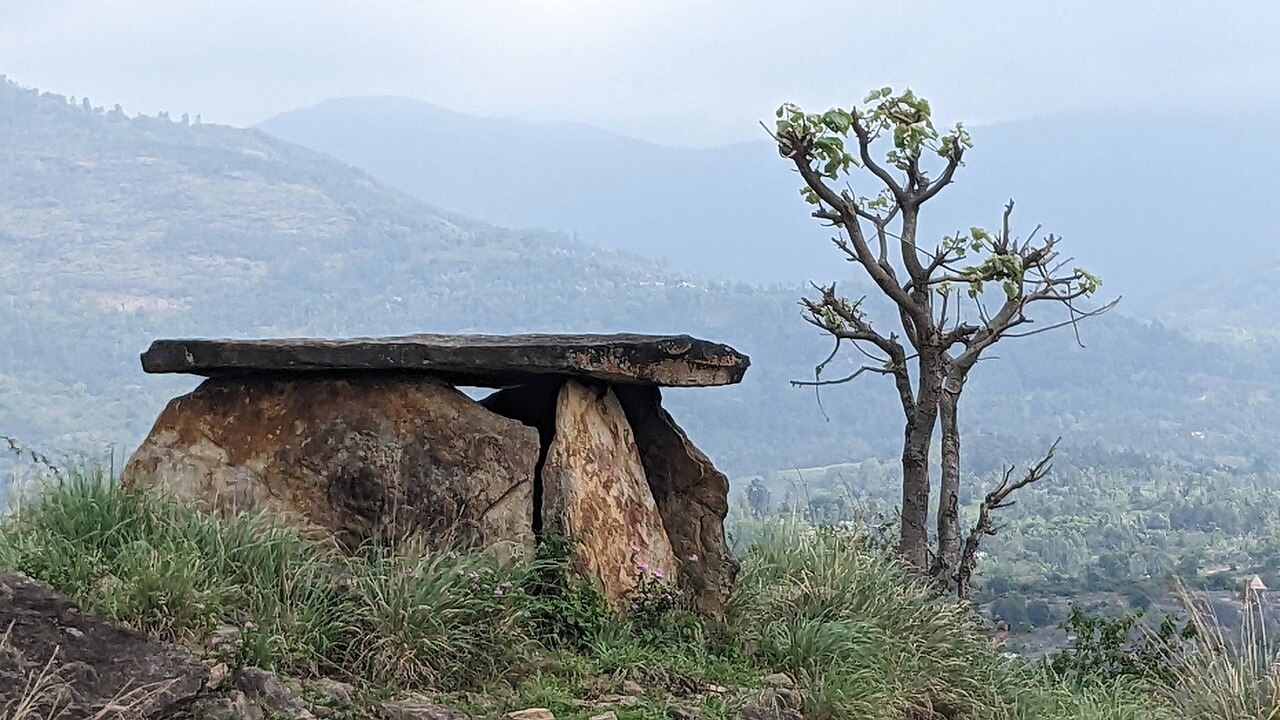
Marayoor · Photographed 2023-04-07 14:59:52
A Marayoor dolmen seen against the surrounding hills

Kattakampal · Photographed 2018-09-30 16:31:58
Steps cut into laterite at the Kattakampal burial cave

Eyyal · Photographed 2019-04-19 16:49:44
Interior of Eyyal’s burial cave, showing its central support and standing water
Show 12 more photographs and source images ↓

Chowannur · Photographed 2016-09-18 13:09:39
The side and floor of the sunken approach at Chowannur burial cave

Photographed 2008-05-07
Laterite quarry, Malappuram, Kerala
Laterite quarry, Malappuram, Kerala. Modern geological and material context; not an ancient quarry or excavation photograph.

Photographed created 1969
Laterite quarry, Angadipuram, photographed in 1969
Laterite quarry, Angadipuram, photographed in 1969. Modern geological and material context; not an ancient quarry or excavation photograph.

Cheramanangad · Photographed 2016-09-18 11:27:07
A low rounded stone arrangement at Kudakkallu Parambu, Cheramanangad

Ariyannur · Photographed 2016-09-18 13:33:48
Close view of an Ariyannur umbrella-stone capstone and supports

Kakkad · Photographed 2018-09-30 15:54:58
The sunken approach and circular opening at Kakkad burial cave

Pilicode · Photographed 2018-09-27 09:46:39
The entrance to Pilicode rock-cut burial cave

Kandanassery · Photographed 2012-10-22 01:18:05
Kandanassery burial cave, showing the approach and small chamber doorway

Marayoor · Photographed 2023-04-07 14:59:52
Side view of a dolmen’s capstone and supporting slabs at Marayoor

Kattakampal · Photographed 2018-09-30 16:31:58
The sunken approach to Kattakampal’s rock-cut burial cave, photographed in 2018

Eyyal · Photographed 2018-09-30 12:08:23
A chamber entrance and floor recess at the Eyyal burial cave

Chowannur · Photographed 2016-09-18 13:09:21
Detail of the chamber doorway at Chowannur burial cave
005Two views
Both views are shown at equal weight; this site does not choose between them.
How far geology explains the choice of monument form
- One view
- Krishnaswami (1949) linked form to available stone: umbrella stones on Cochin's laterite plains, dolmens on granite, urn burials toward the coast.
- Another view
- This study, citing Ollier and Rajaguru's field geology and Porkalam's granite capstone, holds that geology made techniques possible but did not decide form.
- What would settle it
- Source-to-monument stone analysis, quarry studies, tool-mark analysis and secure construction sequences.
006Where next
 Related studyKerala's Iron Age graves are many; only a handful are dated
Umbrella stones, hood stones and rock-cut caves are classified there, with the Kuttikol cave dates and the Ariyannur monuments.
On the atlasPorkalam Megalithic Urn & Cist SiteProtected ASI monument · Kunnamkulam area, Thrissur
Explore nextStones Have Different Stories: Shape Alone Cannot Date a MonumentAll related studies, connected material, books and sources16 · 10
Elsewhere on this site
Excavation Atlas Sites: Porkalam Megalithic Urn & Cist Site · Cheramanangad (Kudakkallu Parambu) · Ariyannur Umbrella Stones · Kattakampal Multi-Chambered Rock-Cut Cave · Mangadu Iron Age Urn Burial Site · Marayoor & Kovilkadavu Dolmen Fields
Junior Detective Quests: Stones Have Different Stories: Shape Alone Cannot Date a Monument
Classroom Lesson Plans: Module 5 · Iron, Stone Monuments & Everyday Craft: Technology in Early South India
Multi-Script Glossary Terms: kuṭakkallu (குடைக்கல் / കുടക്കല്ല്) · toppikkallu (தொப்பிக்கல் / തൊപ്പിക്കല്ല്) · muṉiyaṟa / muṉiyaṟai (kaṟpatukkai) (முனியறை / கற்பதுக்கை / മുനിയറ / കൽപ്പടുക്കൈ) · kuṭaivarai-p-patukkai (TA) / ceṅkal guha (ML, laterite rock-cut burial cave) (குடைவரைப் பதுக்கை / ചെങ്കൽ ഗുഹ) · kal-vaṭṭam (Stone Circle & Cist) (கல்வட்டம் / കൽവട്ടം) · neṭuṅkal / kuttukkal (குத்துக்கல் / நெடுங்கல் / നാട്ടുകല്ല് / കുത്തുകല്ല്)
Connected material
Photographs, drawings, books, videos and other studies linked to this study. A link helps you explore; it does not prove a historical claim.
- An umbrella-stone monument at Kudakkallu Parambu, CheramanangadphotographShows the subject
- A low capstone at Kudakkallu Parambu, CheramanangadphotographShows the subject
- Exposed upright stones at Kudakkallu Parambu, CheramanangadphotographShows the subject
- Side view of an umbrella-stone monument at Kudakkallu Parambu, CheramanangadphotographShows the subject
- A tilted capstone and its supports at Kudakkallu Parambu, CheramanangadphotographShows the subject
- Uncovered stone supports at Kudakkallu Parambu, CheramanangadphotographShows the subject
- A low rounded stone arrangement at Kudakkallu Parambu, CheramanangadphotographShows the subject
- A cluster of low monuments at Kudakkallu Parambu, CheramanangadphotographShows the subject
- The sunken approach to Kattakampal’s rock-cut burial cave, photographed in 2018photographShows the subject
- Two chamber openings at the Kattakampal burial cavephotographShows the subject
- View down into the multi-chambered Kattakampal burial cavephotographShows the subject
- Steps cut into laterite at the Kattakampal burial cavephotographShows the subject
- A chamber entrance at the Kattakampal burial cavephotographShows the subject
- A rock-cut bench inside a Kattakampal chamberphotographShows the subject
- Umbrella stones and exposed supports at AriyannurphotographShows the subject
- An umbrella stone at Ariyannur, viewed from the frontphotographShows the subject
- Close view of an Ariyannur umbrella-stone capstone and supportsphotographShows the subject
- The upright supports of an uncovered Ariyannur monumentphotographShows the subject
- Ariyannur’s monuments in their present tree-covered settingphotographShows the subject
- Overview of umbrella stones and an open monument at AriyannurphotographShows the subject
- The present entrance and grounds of the Ariyannur monument enclosurephotographBackground
- The cut approach to Eyyal’s burial cavephotographShows the subject
- Two openings beside the rock pillar at the Eyyal burial cavephotographShows the subject
- Oblique view of the Eyyal burial-cave entrancephotographShows the subject
- A chamber entrance and floor recess at the Eyyal burial cavephotographShows the subject
- A raised bench inside the Eyyal burial cavephotographShows the subject
- The pillar and floor inside the Eyyal burial cavephotographShows the subject
- Interior of Eyyal’s burial cave, showing its central support and standing waterphotographShows the subject
- A dolmen with a front opening in the Marayoor landscapephotographBackground
- A Marayoor dolmen seen against the surrounding hillsphotographBackground
- A low dolmen partly obscured by grass at MarayoorphotographBackground
- Side view of a dolmen’s capstone and supporting slabs at MarayoorphotographBackground
- Exposed upright slabs in the Marayoor dolmen landscapephotographBackground
- The present dolmen setting at Marayoor, with mountains beyondphotographBackground
- Side view of the sunken approach and circular opening at Kandanassery burial cavephotographShows the subject
- Kandanassery burial cave, showing the approach and small chamber doorwayphotographShows the subject
- Steps and the chamber doorway at Kandanassery burial cavephotographShows the subject
- Ground-level view of the openings at Kandanassery burial cavephotographShows the subject
- Kandanassery burial cave viewed from the circular-opening sidephotographShows the subject
- The circular opening of Kandanassery burial cave, viewed from abovephotographShows the subject
- The rock-cut burial cave at Kakkad, seen from one cornerphotographShows the subject
- Overview of the exposed laterite outcrop containing Kakkad burial cavephotographShows the subject
- Chamber doorway below ground level at Kakkad burial cavephotographShows the subject
- The sunken approach and circular opening at Kakkad burial cavephotographShows the subject
- The floor and raised edge inside Kakkad burial cavephotographShows the subject
- Circular opening in the roof of Kakkad burial cavephotographShows the subject
- Steps descending into the rock-cut burial cave at ChowannurphotographBackground
- Chowannur burial cave, showing the approach and chamber entrancephotographBackground
- Detail of the chamber doorway at Chowannur burial cavephotographBackground
- The side and floor of the sunken approach at Chowannur burial cavephotographBackground
- Pilicode rock-cut burial cave in its present roadside settingphotographBackground
- The entrance to Pilicode rock-cut burial cavephotographBackground
- Circular roof opening at Pilicode rock-cut burial cavephotographBackground
- Pilicode burial-cave entrance and the protected area above itphotographBackground
- Oblique view of Pilicode burial cave and its roof openingphotographBackground
- Laterite quarry, Angadipuram, photographed in 1969photographBackground
- Laterite quarry, Malappuram, KeralaphotographBackground
- Four ways of making a burial placediagramThe umbrella stone, the rock-cut chamber and their varied interiors follow this study of Kerala burial monuments.
- Stone, cut and builtillustrationThe umbrella stone on four dressed supports and the hood stone follow this study. It separates umbrella stones, hood stones and rock-cut chambers, as the comparison row does.
- An umbrella stonediagramThe umbrella stone form this study describes: a laterite cap supported on slabs.
- Five ways the dead were markeddiagramSchematic sections comparing Kerala laterite monument forms and upland slab cists.
Books, videos and websites
Outside reading on this topic. These are not part of the study and we have not checked every claim in them. See all books and videos
- Unearthing Pattanam: Histories, Cultures, Crossings Book · P. J. Cherian & Jaya Menon · 2014 · Illustrated exhibition volume and multi-disciplinary synthesis of the 2007–2014 Pattanam excavations in the Periyar delta, covering the brick wharf, Anjili dugout canoe, Mediterranean amphorae, torpedo jars, and local bead/iron craft.
- Porkalam 1948: Excavation of a Megalithic Urn-Burial (Ancient India No. 8) Book · B. K. Thapar (Archaeological Survey of India) · 1952 · The classic stratigraphic report on the excavation of a laterite-circle pyriform urn burial at Porkalam (Thrissur district, Kerala), documenting 48 etched carnelian beads, iron implements, and four-legged Black-and-Red Ware bowls.
- Iron Age in Kerala: An Overview and Recent Research | Dr Abhayan GS | ASC IITGN Video · G. S. Abhayan · Department of Archaeology, University of Kerala; host: Archaeological Sciences Centre, IIT Gandhinagar. · 55:53 · A research lecture on the varied burial monuments and recent investigations of Kerala’s Iron Age. A particularly strong match to the request to credit the people who carried out the research. Regional overview. It discusses Kerala burial types in general, so it does not fully cover any single site. Chronologies and grave interpretations still require the cited excavation reports.
- Megalithic Cultures of South India | Prof V Selvakumar | ASC IITGN Video · V. Selvakumar · Tamil University, Thanjavur · 1:41:57 · A survey of South Indian megalithic burials and monuments and their archaeological contexts. Provides a trained regional archaeologist’s framework for understanding the many burial-site studies. A shared monument label does not give every site the same date or social meaning; no exact-site coverage is inferred.
- KCHR – Kerala Council for Historical Research (Pattanam & Muziris Archive) Website · Official institutional portal hosting interim excavation reports, trench summaries, archaeobotanical/ceramic bulletins, and public heritage documentation for the 2007–2015 Pattanam excavations and Kerala regional surveys.
- ASI – Archaeological Survey of India (Thrissur & Chennai Circles / IAR Archive) Website · National heritage authority responsible for protected monuments across Kerala (Ariyannur, Cheramanangad, Porkalam, Kattakampal, Bekal, Vizhinjam) and Tamil Nadu/Puducherry (Arikamedu, Adichanallur, Sittanavasal, Puhar) and publisher of Indian Archaeology: A Review.
- Internet Archive – Ancient India Bulletins (Archaeological Survey of India) Website · Full-text open-access scans of the historic ASI bulletin Ancient India, including Mortimer Wheeler's 'Arikamedu: An Indo-Roman Trading-Station' (No. 2, 1946), B. K. Thapar's 'Porkalam 1948' (No. 8, 1952), and V. D. Krishnaswami's megalithic typologies.
007Sources
The study lists the sources it consulted; we have not rechecked them. A working link does not show that a source was read, and a valid identifier does not show that it supports a claim. We do not link to unofficial uploads or copies of publications. Where a study cited one, we show the published citation, or a publisher, DOI or Internet Archive link when we have one. Tracking codes are removed from links, and the sources themselves are not republished here.
heritageuniversityofkerala.com · 15.pdf
Unofficial online copy (link not shown)
Excavations of Rock Cut Burials at Kuttikol Kerala (source link 2)
Online copy not linked · use the published editionSource recordlkouniv.ac.in · 202004080628301734anil kumar Megalithic Types of South India
asc.iitgn.ac.in · Iron Age in Kerala Vinod V AR Pillai 2016.pdf
Unofficial online copy (link not shown)
Iron Age in South Asia (source link 5)
Online copy not linked · use the published editionSource recordgfdq.glaciologia.it
B. K. Thapar (1952), Porkalam 1948: Excavation of a Megalithic Urn-burial, Ancient India 8: 3–16
B. K. Thapar, 'Porkalam 1948: Excavation of a Megalithic Urn-burial,' Ancient India 8 (1952): 3–16.
asi.nic.in · CPM List.pdf
Web page (archaeology.kerala.gov.in)
குடைக்கல்
Researchers and institutions whose work this study uses: B. K. Thapar
How we know The evidence, claims and dates behind this study
What this study draws on
- Excavation and AMS dating at Kuttikol (Uesugi and colleagues, 2020), with laboratory codes
- Krishnaswami's 1949 survey of monument types and Thapar's 1952 Porkalam report
- Peter's 2015 umbrella-stone survey and the ASI list of protected monuments
- Ollier and Rajaguru's 1989 field study of Kerala laterite
Dates in this study
This study has no dates recorded in a form we can chart, so there is no date chart. Any dates it gives are in the full study.
The study’s claims
18 claims · 0 source passages · 38 paragraphs
Browse the study paragraph by paragraphMonument names have shifted across scholarship.
Supported in this study
Krishnaswami and later Kerala typologies do not map one-to-one; not every local usage was surveyed.
Peter's kudakkallu is a supported laterite cap form with central/northern Kerala clusters.
Supported in this study
Supports morphology and reported distribution; not a complete 2026 field census.
Supported umbrella stones should be distinguished from ground-resting cap/hood forms, but labels vary.
Supported with qualifications
Older and newer classifications are not fully commensurable.
Rock-cut burials were carved into laterite and vary in plan and fittings.
Supported in this study
Direct architectural observations; no universal chamber plan.
Regional concentration is better demonstrated than absolute uniqueness.
Supported with qualifications
A comprehensive absence survey outside Kerala was not completed.
Mixed monument forms do not prove one ethnic group or one depositional episode.
Supported with qualifications
Co-occurrence supports a shared landscape, not automatically contemporaneity or identity.
Geology enabled certain techniques but did not determine monument form.
Supported with qualifications
Archaeological-geological synthesis; no surviving ancient causal statement.
“Soft when quarried, hardens in air” is not a safe general rule for Kerala laterite.
Supported in this study
Modern/type-area geology, not direct petrology of each archaeological monument.
Porkalam combined laterite construction with a granite capstone.
Supported in this study
Original scan failed; substantive Thapar text was read through searchable mirror material.
Thapar's Porkalam date is provisional relative dating rather than laboratory dating.
Supported in this study
Subject to revision as artifact chronologies improve.
Kuttikol contains both early-BCE and much later-CE radiocarbon signals.
Supported in this study
Dates sampled material and its context, not architecture automatically.
Old-wood and depositional cautions prevent simple construction dating at Kuttikol.
Supported in this study
KTL-1's herbaceous material differs from the wood samples.
Umbrella stones cannot all be classified merely as urn covers.
Supported in this study
Individual preservation and disturbance still matter.
The sarcophagus premise is only partly verified.
Supported with qualifications
Secondary support for Kattakambal/Perungulam and Chevayur; underlying cited source was not consulted directly for this study.
Padakkallu remains unverified as a formal architectural class.
Unresolved in this study
No suitable positive specialist passage was recovered; absence is not claimed.
ASI currently lists key umbrella-stone and burial-cave sites as centrally protected.
Supported in this study
Administrative status does not establish age.
A single ethnic “megalith builder” population is not established by these monument forms.
Supported with qualifications
Mortuary similarity can reflect many kinds of interaction without fixing identity.
“Unique” should be narrowed to “distinctive” or “regionally concentrated.”
Supported with qualifications
Stronger exclusivity needs a wider comparative survey.
About this study Status, corrections and how it was made
Status
Draft study, revision 6. No historian, archaeologist, or Tamil or Malayalam specialist has reviewed it yet.
How it was made
Compiled as an editorial synthesis from published scholarship around questions we framed. About this project & workflow
The summary, How sure lines and Two views notes on this page were prepared from this study and cross-checked against its passages. That is an editorial check, not a specialist review.
Corrections and updates
COMPARE WITH ANOTHER STUDY
Two studies print one Kuttikol date one year apart
Both studies cite the radiocarbon date (a lab measurement of age) on charred wood from Burial 2, a rock-cut burial at Kuttikol in Kerala. The study of umbrella stones and rock-cut tombs gives the measured age as 2526 ± 20 radiocarbon years; the Porkalam study gives 2525 ± 20. Both give the same three calendar ranges, between 792 and 551 BCE. The laboratory number is PLD-31833. Only the original table or laboratory report can show which figure is right; this note does not choose one.
Read the other study: Porkalam 1948: one urn burial that became a reference point
Technical details
Study code R105. The text fingerprint changes whenever the study text changes.
- Table headings decide what each column means. Citation links, sample mentions and dates copied as text are kept apart from checked source passages and calibrated measurements.
See how this study’s records were extracted
Text fingerprint (SHA-256): R105 · e581a06b8eef7c4642b1b574… · v6
Evidence tables and technical details are on the web page: https://layersofthesouth.org/read/0838931081