Rock-cut beds at the Jambai Jain shelter
Jambai
Photographed 2011-12-25
- Words & worlds
Velir chiefs were named local rulers, not one hill-chief system
Poems and one inscription show Pari, Ay Andiran and Atiyaman as powerful local rulers; no source examined shows they controlled Ghat passes or mines.
- This page
- 4,902 words · revision 6
Draft study · Awaiting specialist review · Updated
001Dates and places

No mapped place in this study.
Dates in this study are stated in words only.
- 1 Well supported
- 1 Likely
- 1 Possible
- 1 Not known
002How sure
In brief
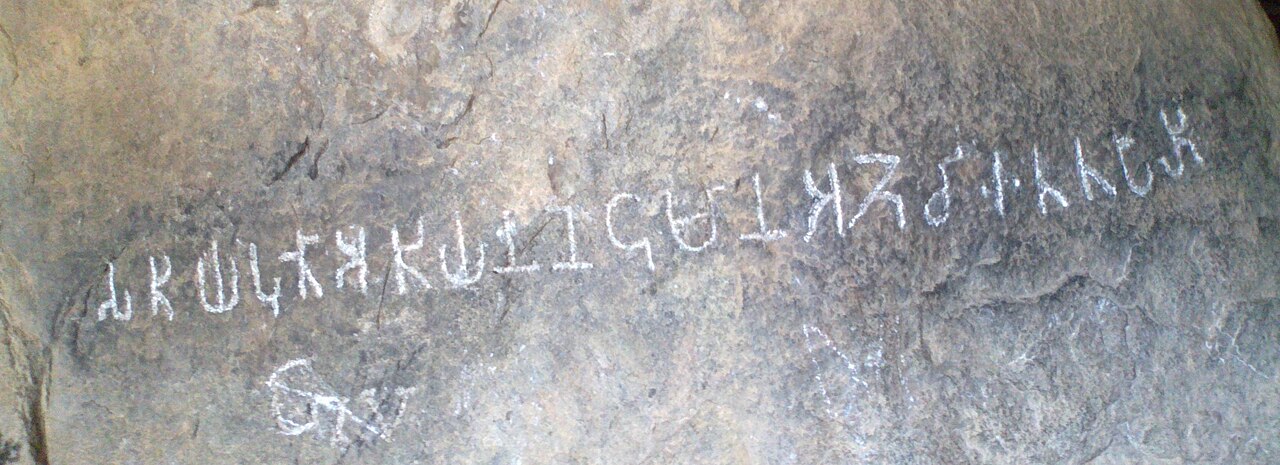
Early Tamil praise poems in the Purananuru celebrate three local rulers often called Velir: Pari, Ay Andiran and Atiyaman Neduman Anci. The poems tie Pari to the mountain country of Parampu, besieged by three kings, and Ay Andiran to the Pothiyil hills. They dwell on gifts, feasts, elephants and poets far more than on borders. A cave inscription at Jambai names a donor, satiyaputo atiyan netuman anci, whom Mahadevan identifies with the Atiyaman of the poems. Mahadevan dates the inscription from its letter shapes to about the first century CE. Its title echoes the Satiyaputa named in Ashoka’s third-century BCE edict, but no unbroken family line is shown. Parampu is often placed at modern Piranmalai, though only much later inscriptions support that. The sources examined show no control of Ghat passes, mines or trade routes by these rulers.
Key researchers cited in this study: Iravatham Mahadevan (Tamil-Brāhmī Epigraphy) · K. A. Nilakanta Sastri (History of South India) · U. V. Swaminatha Iyer (Classical Tamil Manuscript Editions) · Full bibliography
How sure
- Well supported
The poems tie Pari to Parampu and Ay Andiran to Pothiyil
Several Purananuru poems make these links directly; they are literary representations, not maps.
- Likely
The Jambai donor is the Atiyaman of the poems
Mahadevan’s identification is strong, but the inscription itself does not name Takatur.
- Possible
Parampu was at modern Piranmalai
Only much later inscriptions link Parambu-nadu with Pari’s country.
- Not known
These rulers controlled Ghat passes or mineral-rich tracts
No poem or inscription examined names a pass, mine or toll under their control.
Why it matters
It tests a popular story about hill chiefs controlling trade routes against what the poems and inscriptions say.
The summary above is the short read. The full study is the complete text it was drawn from, with its tables and source notes.
What the full study covers
003The study
Question, scope and orientation
Question and scope
How are Velir leaders, their territories and their relationships with larger polities represented in surviving evidence?
Region: chiefly early historic Tamil-speaking South India, with evidence-relevant connections to present-day Tamil Nadu and Kerala. Modern state boundaries are not projected backward as ancient political frontiers.
Period classification: mixed chronology. The principal literary and epigraphic evidence falls within the 1000 BCE–600 CE period this study covers, but this study also uses Aśoka’s third-century-BCE Second Rock Edict as earlier background, medieval inscriptions as later reception/toponymic evidence, and modern editions and scholarship as research history. ↗1 ↗2 ↗3
Scope: this study examines three named leaders – Vēl Pāri, Āy Andiran, and Atiyamān Neṭumāṉ Añci – without assuming in advance that they formed a single constitutional class of “semi-independent hill chieftains.” It separately tests common claims about mountain strongholds, passes, minerals, trade routes, poets and “imperial hegemony.”
Orientation
The surviving evidence does support a picture of powerful named local rulers operating beside, against and within the political worlds of the Cēra, Cōḻa and Pāṇḍya kings. It does not, on the evidence read here, establish the stronger popular claim of a single Velir system of strategically placed hill chiefs controlling Ghat passes and mineral belts. For Pāri and Āy Andiran, the richest evidence is praise poetry whose landscapes, gifts and conflicts are historically significant but cannot be converted directly into political boundary maps. For Atiyamān Neṭumāṉ Añci the evidentiary situation is stronger because the Jambai Tamil-Brahmi inscription names a ruler whom Mahadevan identifies with the famous literary Atiyamān. ↗3 ↗4
Entrance and floor of the Jain rock shelter at Jambaimalai
Jambai
Photographed 2011-12-25
The most defensible conclusion is therefore not that “the Velir balanced an empire.” The evidence instead reveals a layered and competitive political environment in which rulers acquired standing through control of named places, warfare, hospitality, gift-giving and relationships with poets and performers, while the exact geometry of their territories remains much harder to reconstruct. Sastri’s older picture of three principal monarchies alongside numerous smaller warrior principalities is useful as historiographic context, but his analogy between Vēḷs and “feudal barons” should not be treated as an ancient constitutional description. ↗5
Accessible explanation and main investigation
Accessible explanation
The word Vēḷ/Vēḷir is often rendered in English as “chieftain” or used for local ruling families in early Tamil history. That wording is convenient, but it can smuggle in a hierarchy: “chieftain” may sound as though every Vēḷ necessarily stood beneath a superior king in a fixed political system. The available evidence does not establish such a uniform arrangement. Pāri, Āy Andiran and Atiyamān Añci are better examined individually, because each survives through a different combination of texts, places and later scholarship. ↗5 ↗3
Pāri is inseparable in a cluster of Puṟanāṉūṟu poems from Parampu, a mountain country represented through water, bamboo, jackfruit, yams, honey and cultivation. In poem 109, attributed to Kapilar in the transmitted colophon and standard editions, three royal opponents surround Parampu, yet the poem declares that elephants, chariots and swords cannot simply win the mountain. Poem 110 continues the conceit and says that Pāri has already given away three hundred villages to petitioners. These are not neutral military or cadastral records: the seemingly inexhaustible mountain and the seemingly inexhaustible giver magnify each other. Nevertheless, beneath the rhetoric lies a historically important representation of Pāri’s status as bound to a named upland country, to generosity, and to resistance against larger royal opponents. ↗4
Poem 112 changes the tone. Its speakers remember an earlier moonlit month when they still had their father and their hill; now victorious kings have taken the hill and the father is gone. The poem's colophon, as given in the Tamil Virtual Academy lesson and in Vaidehi Herbert's online edition, attributes poem 112 to Pāri’s daughters (Pāri makaḷir); standard editions are reported to give the same attribution (not collated directly here). (One popular 2022 English selection mislabels it “Kapilar.”) ↗7 ↗4
The modern identification of Parampu with Piranmalai needs similar caution. Later South Indian Inscriptions material records a historical division called Ten-Parambu-nadu and separately catalogues a substantial group of inscriptions at Piranmalai. Its editorial introduction links Parambu-nadu with Pāri’s country. That gives useful evidence for later regional memory and place-name geography, but it is centuries later than the poems and does not itself prove that the exact hill in Pāri’s poems is the modern Piranmalai summit, much less draw an early historic boundary. ↗2
Āy Andiran’s poems connect him strongly with the Pothiyil mountain world. The poetry includes clouded uplands, jackfruit, mountain settlements, liquor kept in bamboo, communal dancing, elephants and spectacular gifts. Poem 130 represents Āy as having driven Kongars toward the western sea. This is important evidence for how his power and military reach were imagined, but it is not a survey of a Ghat corridor: no specific pass, customs point, mine or ore-producing tract is identified in the consulted poems. The popular “strategic pass” and “mineral-rich tract” explanation therefore remains unverified. ↗4
Atiyamān Neṭumāṉ Añci differs because literature and inscription meet. Mahadevan’s treatment of the Jambai Tamil-Brahmi inscription records the donor as satiyaputo atiyan netuman anci, assigns the inscription approximately to the first century CE on palaeographic grounds, and connects its donor with the celebrated Atiyamān of Takatur, identified with modern Dharmapuri. The inscription gives this ruler a much firmer historical anchor than is presently available for Pāri or Āy Andiran. ↗3
Jambai Tamil-Brahmi inscription on the rock surface, with modern highlighting visible
Jambai
Photographed 2011-12-25
The title satiyaputo is especially consequential. Aśoka’s Second Rock Edict, centuries earlier, names the Satiyaputa among southern border peoples or polities together with the Chodas, Pandyas and Keralaputras. Jambai therefore makes the connection between an Atiyamān ruler and the Satiyaputa title-form compelling. It does not demonstrate an uninterrupted genealogy from Aśoka’s third century BCE to Añci around the first century CE. The secure conclusion concerns the title and historical name-form, not a continuous family tree. ↗1 ↗3
The poems also make ordinary political work and materials visible. Pāri’s poetry mentions liquor, sheep, rice, fatty food, elephants and chariots; Āy’s poems invoke jackfruit, bamboo containers, performers and elephant gifts; an Avvaiyār poem about Atiyamān contrasts his battle-worn weapons with polished weapons and brings the blacksmith’s workshop into the image of kingship; another poem remembers him in a memorial or hero-stone setting. These should not be inflated into invented scenes, but they show that political reputation was built from provisioning, craft, animals, weapons, travel and performance as well as warfare. ↗6 ↗9 ↗4
Finally, the Mūvēntar should not be converted into one centralized imperial government. The poems distinguish major kings from other rulers, and Pāri’s sequence imagines three kings acting together, but the relationships represented elsewhere are variable: coalition, attack, comparison, westward fighting and conflict with Cēra power. The safer historical model is overlapping and changing centers of authority, not an automatic hierarchy of emperor and feudatory. ↗5 ↗3 ↗4
Main investigation
What “Velir” can and cannot do as a category
A common account begins with a classification – “semi-independent hill chieftains (Velir)” – and then asks how they balanced the Cēra, Cōḻa and Pāṇḍya kingdoms. That formulation needs narrowing before any political map is attempted. K. A. Nilakanta Sastri’s 1929 reconstruction already described the Sangam political landscape as containing three principal monarchies alongside numerous smaller warrior principalities. Elsewhere, however, his comparison of Vēḷs with “feudal barons” illustrates the danger of importing European constitutional vocabulary into early Tamil evidence. The documents read here do not provide a charter defining Vēḷir rank, a standardized tribute system or a uniform subordinate relationship to one of the three major dynasties. ↗5
The three case studies themselves undermine uniformity. Pāri’s identity in the poems is tied to Parampu and confrontation with three kings. Āy Andiran is tied to Pothiyil, mountain gift-giving and a martial boast concerning the Kongars. Atiyamān, uniquely among the three rulers considered here, is named in an early inscription carrying the title satiyaputo. Treating all three simply as equivalent “hill strongholds” would flatten the most important evidentiary difference: direct inscriptional corroboration was recovered for Añci, but not for Pāri or Andiran. ↗3 ↗4
“Independent” is also not a stable binary. A ruler can appear as an opponent of great kings in one poem and later be remembered inside very different political structures. This study therefore uses local ruler, leader or chief descriptively, while reserving stronger constitutional labels such as “subordinate,” “vassal” or “independent” for evidence that actually demonstrates such a relationship.
Pāri and Parampu: abundance, gift and siege
The Pāri sequence is unusually rich because several poems cluster around one ruler and place. In Puṟanāṉūṟu 105, Kapilar directs a performer toward Pāri through an inhabited, productive mountain landscape. Waterfalls descend through hills; bamboo, fields, water channels, horse gram, springs and water lilies enter the poem. Even without treating every image as an eyewitness inventory, the poem’s political effect depends on the association between Pāri and a fertile, watered upland. ↗4
Poem 109 sharpens this relationship. It addresses the three royal opponents around Parampu and says that four resources can flourish without ploughing: bamboo grain, jackfruit, yams and honey. It imagines elephants at trees and chariots across the country only to insist that the mountain cannot be obtained by force. The rhetoric turns ecological plenty into military resilience and Pāri’s generosity into a superior way of “winning” the country. This supports the historical statement that a poetic tradition represented three major rulers as confronting Pāri at Parampu. It does not establish troop numbers, siege duration, agricultural productivity or exact geography. ↗4
Poem 110 repeats the structure and intensifies the gift motif. Even three rulers acting together cannot easily take Parampu, while its “three hundred villages” have supposedly already been given to petitioners. The number is important evidence for the scale of generosity the poet wished to imagine; it is weak evidence for an actual administrative census. A map showing precisely 300 Pāri-controlled settlements would therefore confuse praise poetry with territorial documentation. ↗4
Poem 112 supplies the aftermath: an earlier moonlit month had father and hill intact; in the present, victorious rulers possess the hill and the father is gone. The colophon in the Tamil Virtual Academy lesson and Vaidehi Herbert's online text attributes poem 112 to Pāri’s daughters (Pāri makaḷir), though an informal modern selection mislabels it Kapilar. ↗7 ↗4
Poems 113–114 also remind us that elite generosity was material. Their recollections invoke opened liquor jars, slaughtered sheep, rice, fatty food, courtyard residues and elephant provisioning. These images should not be dramatized into an invented “day in Pāri’s palace,” but they document the kinds of goods through which hospitality and reputation were imagined. ↗4
Where was Parampu?
“Parampu = Piranmalai” is common in modern retellings, but the evidentiary chain must be stated honestly. The Puṟanāṉūṟu poems establish Parampu as Pāri’s named mountain or country; they do not supply a modern latitude and longitude. Much later epigraphy in South Indian Inscriptions VIII records Ten-Parambu-nadu and separately a substantial inscriptional corpus at Piranmalai. The editorial introduction associates Parambu-nadu with Pāri’s former country. ↗2
This is enough to make Piranmalai a serious candidate identification for public interpretation. It is not enough to treat “Piranmalai” and the literary “Parampu” as an identity proven by a contemporary document. Nor does it justify shading an exact “kingdom of Pāri” polygon on a modern map. On maps, the literary name and the proposed modern identification should be shown as different things.
The common wording “Sivaganga/Dindigul border” was not independently established as the precise ancient territorial situation in the sources read. It remains a geographical lead rather than a finding.
Āy Andiran and Pothiyil: mountain power without a mapped pass
The Āy poems offer another strong landscape association. In Puṟanāṉūṟu 128, Āy Andiran is embedded in the clouded Pothiyil world, while the poem plays on the relative accessibility of the ruler to performers and to powerful kings. Poem 129 develops the environment through jackfruit, upland settlements, aged liquor kept in bamboo, kuravai dancing, elephants and gifts. Such imagery gives historians useful evidence about the literary ecology and political economy in which Āy’s prestige was represented. ↗4
Poem 130 introduces a geopolitical boast: Āy’s many elephant gifts are compared with spears left behind by Kongars when he drove them toward the western sea. At minimum, the poem preserves a tradition of fighting that poets imagined reaching westward. It does not identify a named mountain pass or show that Āy maintained a customs station, controlled a permanent road corridor or extracted toll revenue. ↗4
Nor do the consulted poems document ore deposits, mines, furnaces or mineral revenue under Andiran’s authority. The “mineral-rich tracts” explanation therefore remains a hypothesis awaiting archaeological and analytical evidence.
Later history should not be silently projected backward. Sastri discusses later Āy chiefs in a southern mountain context and their interactions with Pāṇḍya expansion, but those episodes belong centuries after the poems concerning Andiran. They may be relevant to the later reception or claimed continuity of the Āy name, not to precise reconstruction of Andiran’s territory. ↗5 “Early Tamil poems name Ay rulers but do not map an Ay kingdom” examines the Āy rulers, their places and their relationships in more depth.
This distinction matters especially for readers in Kerala and Tamil Nadu. Pothigai/Pothiyil is today understood through modern state borders, roads and ecological zones. Those are useful locators for visitors, but they must not be mistaken for ancient political frontiers.
Atiyamān Neṭumāṉ Añci: the epigraphic anchor
At Jambai, a cave inscription changes the evidentiary balance. Mahadevan records a short Tamil-Brahmi inscription whose donor is satiyaputo atiyan netuman anci. He places it approximately in the first century CE on palaeographic grounds and recounts the identification of the donor with the famous Atiyamān Neṭumāṉ Añci of Takatur, modern Dharmapuri, known from Puṟanāṉūṟu. ↗3
This is significantly different from later genealogical memory. The inscription itself names an early ruler in an early script. But the layers still need separation: Jambai names Añci; Mahadevan/Nagaswamy identify him with the literary Takatur ruler; Jambai itself does not contain the word Takatur. The connection is strong, but its evidentiary steps should remain visible. ↗3
The satiyaputo title creates the connection to Aśoka. Hultzsch’s edition of the Second Rock Edict contains the southern names Choda, Pandya, Satiyaputa and Keralaputa in the relevant passage. This edict belongs to the third century BCE, considerably earlier than Mahadevan’s palaeographic dating of Jambai. The comparison therefore supports the persistence or recurrence of a politically meaningful name/title form, but not a continuously documented Atiyamān genealogy across the interval. ↗1 ↗3 “The Jambai inscription ties Aśoka's Satiyaputo to the Atiyan line” examines the Jambai inscription and the Satiyaputo title in detail.
The literary material around Atiyamān and Avvaiyār adds a different sort of evidence. In Puṟanāṉūṟu 95, attributed to Avvaiyār, Atiyamān’s frequently used weapons are contrasted with an opponent’s polished ones, with the blacksmith’s workplace becoming part of the ruler’s martial reputation. In Puṟanāṉūṟu 232, Avvaiyār laments in a memorial or hero-stone context and imagines an offering of liquor to the dead ruler. These poem citations follow standard Puṟanāṉūṟu numbering (Swaminatha Iyer; Hart and Heifetz 1999); direct collation of the printed critical text and translation was not checked for verbatim quotation. They are poetic representations, not excavated assemblages, but they make weapon repair, smithing and commemorative practice visible within political memory. ↗6 ↗9
Mahadevan also discusses the literary tradition in which the Cēra ruler Perumcēral Irumporai is famed for victory over Atiyamān at Takatur. This again undermines the image of a timeless isolated “independent hill stronghold”: Atiyamān appears in traditions of violent competition with a larger neighboring polity. ↗3
Poets, performers and the work of political prestige
Kapilar and Avvaiyār are rightly central to this story, but “patronage” should not be reduced to something like modern literary sponsorship. The poems repeatedly set bards, musicians, dancers and petitioners in motion toward rulers. Gifts can be elephants or chariots; hospitality appears as rice, meat and liquor; weapons move through workshops; successful generosity produces a reputation that can circulate beyond the ruler’s immediate territory. ↗4
That movement can make the corpus look like a map. Kapilar addresses kings and Pāri; performers travel through mountain country; Avvaiyār’s poems locate Atiyamān inside circuits of warfare, diplomacy and remembrance. Yet a poetic itinerary is not a boundary survey. It reveals relationship geography – who is imagined as reachable, hostile, generous or prestigious – not territorial geometry with surveyed borders.
The transmission history reinforces this caution. The University of Hamburg’s Classical Tamil project reports that an old commentary survives for the first 266 poems of Puṟanāṉūṟu and that fifteen manuscripts survive, all but one on palm leaf, with a thinner manuscript basis for the later portion of the collection. This means that poem text, commentary, colophon, modern edition and translation are distinct evidentiary layers and should not be conflated. ↗8
Larger polities: coalition and conflict rather than “imperial hegemony”
Pāri’s poems provide the clearest case here of interaction with the “three kings”: poems 109–110 imagine three rulers acting collectively against Parampu. That is meaningful evidence for a remembered coalition or combined opposition within the poetic tradition. It is not evidence that a single Mūvēntar government exercised continuous sovereignty over all smaller rulers. ↗4
Āy’s poetry instead foregrounds Kongar conflict and comparison with mighty kings, without defining a constitutional subordination to one of the three dynasties. Atiyamān’s tradition includes Cēra conflict, while the Jambai record presents him as donor under his own name and title rather than as an official of another king. Taken together, these sources fit a political environment in which differently scaled rulers could fight, cooperate, compete for prestige and lose or absorb territory at different moments. ↗3 ↗4
Accordingly, the phrase “balance the imperial hegemony of the Mūvēntar” should not be used unless substantially rewritten. A defensible formulation asks how named local rulers negotiated prestige and coercive power in a landscape that also contained the Cēra, Cōḻa and Pāṇḍya kings.
Trade routes, passes and minerals: a proposed explanation that remains unproven
This is the most important negative finding. The read Pāri poems describe abundant mountain resources but no named long-distance toll road, pass station, mine or mineral revenue. Āy’s poems describe mountain country and a westward campaign, but no securely identified Ghat pass under administrative control. Jambai names Atiyamān Añci, but the inscription is a cave donation rather than a customs, mining or commercial record. ↗3 ↗4
None of this proves that the rulers had no role in exchange routes or resource zones. That would be an argument from silence. It means only that the popular causal model – strategic passes plus mineral tracts producing political leverage over the Mūvēntar – has not been demonstrated by the sources examined here. Establishing it would require securely dated archaeological survey, production evidence, distribution patterns or infrastructure tied to specific routes and, crucially, an independent argument connecting those sites to political control rather than mere geographical proximity.
Interpretations, limits and source register
Interpretations, disagreements and limits
The first interpretive problem concerns political vocabulary. Older scholarship could translate early Tamil differences of scale into terms such as “petty king,” “feudatory” or “feudal baron.” Such language may help a modern reader initially, but it risks turning analogy into evidence. The present source set demonstrates rulers of different apparent scales and relationships; it does not provide a universal Velir constitution. ↗5
The second problem is how literally to read panegyric. The Pāri poems’ four effortless resources, three hundred villages and military invulnerability matter because they encode what greatness meant within the poem: fertile land, generosity and resistance. They should therefore be used as evidence for political values and remembered confrontation, not copied into settlement counts or military statistics. ↗4
A third problem is transmission. While the transmitted colophon and standard editions settle poem 112’s attribution to Pāri’s daughters (a popular 2022 selection mislabels it Kapilar), the Hamburg project’s description of the Puṟanāṉūṟu manuscript and commentary history reinforces the broader need to distinguish inherited poem text, old commentary, colophon, critical edition and translation. ↗6 ↗8 ↗9
The Jambai/Aśoka comparison likewise needs chronological discipline. The resemblance between Aśoka’s Satiyaputa and Jambai’s satiyaputo is historically important and becomes much more concrete because Jambai associates the latter with an Atiyamān ruler. But several centuries separate the inscriptions. No consulted source supplies the generations needed to turn that connection into continuous genealogy. ↗1 ↗3
Three common claims should accordingly be narrowed:
“Velir were semi-independent hill chieftains” becomes: some named local rulers were strongly associated with upland landscapes, but their political status varied and remains incompletely known.
“They controlled strategic Ghat passes and mineral-rich tracts” is not accepted as a finding because no directly supporting archaeological or inscriptional evidence was read.
“They balanced the imperial hegemony of the Mūvēntar” becomes: the sources preserve coalition, conflict, competition and prestige relations among rulers of different scales; they do not establish one centralized imperial hierarchy.
The uncertainties are resolvable in principle. A critical Tamil edition could settle poem-text and colophon issues; early inscriptions naming Pāri/Parampu or Āy/Pothiyil would transform those cases; securely dated archaeological survey could test candidate centers, pass corridors and production areas; and provenance studies could distinguish mere geographical adjacency to mineral or exchange zones from actual political control.
Source register
Ettuthokai – Purananūru 1–200, “Sangam Translations by Vaidehi” (Vaidehi Herbert), Tamil text with English translation and notes. Language: Tamil/English. Type: online working reference. How it was read: partial text, especially poems 105–135. URL: https://sangamtranslationsbyvaidehi.com/ettuthokai-purananuru-1-200/. Retained as a convenience online link only; poem numbering and colophon attribution follow Swaminatha Iyer (S003) and Hart & Heifetz (S006). ↗4
Tamil Virtual Academy, Purananooru, lesson 2.2, including poem 112. Language: Tamil. Institutional educational source. How it was read: full text of the short lesson page. URL: https://www.tamilvu.org/courses/degree/d011/d0114/html/d0114210.htm. Supports the modern attribution of poem 112 to Pāri’s daughters. ↗7
U. V. Swaminatha Iyer, ed., Puṟanāṉūṟu mūlamum paḻaiya uraiyum (first published Madras, 1894; standard critical Tamil edition with old commentary and colophons). Language: Tamil. Standard authority for Puṟanāṉūṟu poem numbering and transmitted colophons (including Pāri makaḷir for poem 112). How it was read: bibliographic authority; the printed edition was not directly collated page by page here, and verbatim quotations were not checked against it. ↗6
Iravatham Mahadevan, Early Tamil Epigraphy: From the Earliest Times to the Sixth Century A.D., Harvard Oriental Series 62, 2003. Language: English with epigraphic Tamil/Prakrit material. Book/inscription edition. How it was read: partial searchable full text, focused on Jambai §1.6.1, §4.5.1 and inscription no. 59. URL: https://search.worldcat.org/title/52720601. ↗3
E. Hultzsch, ed., Corpus Inscriptionum Indicarum, Vol. I: Inscriptions of Asoka, new edition, Government of India, 1925. Inscription edition. How it was read: partial text, focused on the Second Rock Edict/Girnar. URL: https://archive.org/details/InscriptionsOfAsoka.NewEditionByE.Hultzsch. ↗1
George L. Hart and Hank Heifetz, trans. and eds., The Four Hundred Songs of War and Wisdom: An Anthology of Poems from Classical Tamil, the Purananuru, Columbia University Press, hardcover 1999, paperback 2002. Standard scholarly English translation (matching the poem numbering of Swaminatha Iyer’s edition, including poems 95, 105, 109–114, 128–135, and 232). How it was read: publisher metadata verified; the printed translation itself was not consulted directly for this study for verbatim quotations. URL: https://cup.columbia.edu/book/the-four-hundred-songs-of-war-and-wisdom/9780231115629/. ↗9
University of Hamburg, Historical Dictionary of Classical Tamil, Puṟanāṉūṟu project page. Institutional research page. How it was read: full web page. URL: https://www.tamilex.uni-hamburg.de/research/purananuru.html. Used for manuscript/commentary context, not to establish a political event. ↗8
K. A. Nilakanta Sastri, The Pandyan Kingdom: From the Earliest Times to the Sixteenth Century. London: Luzac & Co., 1929. How it was read: partial searchable OCR. URL: https://archive.org/details/dli.csl.5955. Used as foundational historiography, with its older constitutional vocabulary treated critically. ↗10 ↗5
South Indian Inscriptions: Texts, vol. VIII. Government/Archaeological Survey epigraphic series; exact editor and publication year were not verified from the OCR front matter. How it was read: partial text, especially the Parambu-nadu introductory passage and Piranmalai nos. 425–442. URL: https://archive.org/details/in.ernet.dli.2015.106957. Used only as later toponymic/epigraphic evidence. ↗2
Shinu A. Abraham, “Chera, Chola, Pandya: Using Archaeological Evidence to Identify the Tamil Kingdoms of Early Historic South India,” Asian Perspectives 42.2 (2003): 207–223. DOI 10.1353/asi.2003.0031. How it was read: metadata only. Full article text was not consulted and was not used for load-bearing claims. DOI: https://doi.org/10.1353/asi.2003.0031. ↗11
Rajan Gurukkal, “Did State Exist in the Pre-Pallavan Tamil Region?”, Proceedings of the Indian History Congress 63 (2002): 138–150, JSTOR 44158082. How it was read: citation only; full article text was not consulted. URL: https://www.jstor.org/stable/44158082. It remains an important follow-up for reassessing “state,” “chief” and Velir categories but is not counted as evidence for the conclusions above. ↗12
Unresolved leads, not evidence used: a critical Tamil edition of Puṟanāṉūṟu with colophons and old commentary; dedicated excavation or survey reports for Adhiyamankottai/Dharmapuri; dedicated historical-geography work on Parampu/Piranmalai; and full text of Gurukkal 2002 and Abraham 2003. Search snippets were not promoted to proof.
Takeaways and claims checked
Takeaways
Six grounded takeaways follow from the evidence:
- The three case studies do not establish a single standardized Velir constitutional institution; different rulers have different evidentiary profiles.
- Pāri’s Parampu poems are exceptionally rich environmental and political sources but poor cadastral records.
- Āy Andiran is strongly associated with Pothiyil in poetry, yet specific pass and mineral control remain unproven.
- Jambai provides the strongest bridge from literature to epigraphy because it names Atiyamān Neṭumāṉ Añci and uses
satiyaputo. ↗3 - Food, liquor, animals, weapons, smithing and performance are not background decoration: they are among the materials through which political reputation is represented. ↗6 ↗9 ↗4
- The evidence is better described as showing coalition, conflict and changing political relations than “Velir resistance to a Mūvēntar empire.”
Glossary
Vēḷ / Vēḷir: an Old Tamil political/social label associated with certain rulers or ruling lineages. “Chieftain” is a convenient English approximation but can imply a subordinate rank that must not be assumed.
vēntar / Mūvēntar: “kings” and conventionally “the three kings,” associated with Cēra, Cōḻa and Pāṇḍya traditions. “Emperor” should not be used automatically.
puṟam: a public-facing poetic domain concerned with subjects such as warfare, death, praise, generosity and political action. It should not be treated as synonymous with factual chronicle.
Paṟampu / Parampu: the literary mountain/country associated with Pāri. Piranmalai is a candidate modern identification, not an assumed identity.
Pothiyil / Potiyil / Pothigai: mountain name/forms associated with Āy. Transliteration and the relation among ancient and modern forms require competent Tamil/geographical review.
satiyaputo / Satiyaputa: inscriptional forms central to the Jambai–Aśoka comparison. Their normalization and interpretation should follow epigraphic editions.
Still open
Whether Puṟanāṉūṟu colophons in a critical Tamil edition explicitly call Pāri, Āy or Atiyamān Vēḷ/Vēḷir; whether early inscriptions tie Pothiyil or Parampu to named rulers; whether archaeological surveys of the Dharmapuri–Jambai–Takatur region reveal exchange or production infrastructure contemporary with Añci, and whether a named ruler actually controlled it; and when Parambu-nadu is first securely dated, and how strong the chain is from that later name to Piranmalai and the literary Parampu.
Evidence challenge
Does Pāri 109 prove that Parampu possessed four staple resources, was surrounded by exactly three royal armies and was militarily impregnable?
No. It establishes that the poem represents Parampu through four celebrated resources and addresses three royal opponents while insisting that force is inadequate. The resources are genuine evidence for the poem’s environmental imagination and the three-ruler address is politically meaningful. The total abundance and invulnerability are nevertheless part of praise rhetoric. Archaeological, environmental and settlement evidence would be required to turn those images into a literal economic or military reconstruction. ↗4
Common claims checked
| Claim | Status | Evidence-based disposition |
|---|---|---|
| “Velir = semi-independent hill chieftains” | Qualified | Some named rulers are strongly associated with mountains; no uniform constitutional class or fixed degree of independence was established. |
| Pāri ruled Parampu Malai | Supported as literary representation | Repeated poems tie Pāri to Parampu. ↗4 |
| Parampu = modern Piranmalai | Qualified / unresolved | Later Parambu-nadu and Piranmalai epigraphy makes the identification plausible but not contemporaneously proven. ↗2 |
| Āy Andiran ruled Pothigai/Pothiyil hills | Supported as literary representation | Poems 128–130 strongly associate Āy with Pothiyil/high mountain country; exact extent is unresolved. ↗4 |
| Atiyamān Añci ruled at Takatur | Supported/qualified | Mahadevan’s identification is strong; Jambai names Añci but does not itself name Takatur. ↗3 |
| Kapilar–Pāri patronage | Supported in literary tradition | Major Pāri poems are attributed to Kapilar; poem 112 is attributed to Pāri’s daughters. ↗6 ↗9 ↗7 |
| Avvaiyār–Atiyamān relationship | Supported in literary tradition | Avvaiyār-attributed Atiyamān poems (including Puṟanāṉūṟu 95 and 232) preserve this tradition. ↗6 ↗9 |
| Velir controlled strategic Ghat passes | Unresolved | No direct read source established a named pass under one of these rulers. |
| Velir controlled mineral-rich tracts | Unresolved | No consulted archaeological or analytical source tied mineral extraction or revenue to these rulers. |
| Trade-route control balanced Mūvēntar power | Unresolved / causal claim rejected for now | Geography may motivate the hypothesis; the consulted evidence does not demonstrate it. |
| Mūvēntar exercised “imperial hegemony” over Velir | Contested framing | Sources show coalition and conflict, not one stable centralized hierarchy. |
| Pāri’s country literally contained exactly 300 villages | Qualified literary claim | Poem 110 says “three hundred” within an extreme-generosity trope; it is not treated as a census. ↗4 |
Further work needed: critical Tamil text/colophon inspection for poems 105–135, 95 and 232; full inspection of Gurukkal 2002 and Abraham 2003; dedicated excavation/survey reports for Adhiyamankottai/Dharmapuri; specialist historical geography of Parampu/Piranmalai; full bibliographic and dating recovery for relevant SII VIII records; and a high-resolution Jambai image. These questions remain open.
004Photographs
Photographs of the places and objects this study discusses. Each item carries its creator’s credit, licence and documented source. See all 412 photographs and source images ↗

Jambai · Photographed 2011-12-25
Rock-cut beds at the Jambai Jain shelter

Jambai · Photographed 2011-12-25
Entrance and floor of the Jain rock shelter at Jambaimalai
Jambai · Photographed 2011-12-25
Jambai Tamil-Brahmi inscription on the rock surface, with modern highlighting visible
005Two views
Both views are shown at equal weight; this site does not choose between them.
Who composed Purananuru poem 112, the lament for Pari’s lost hill
- One view
- The Tamil Virtual Academy and the Vaidehi translation attribute it to Pari’s daughters, the speakers of the poem.
- Another view
- C. Rajeswari’s 2022 English selection labels it as a poem by Kapilar.
- What would settle it
- A critical Tamil edition with the poem’s colophon and old commentary.
006Where next
All related studies, connected material, books and sources26 · 12
Elsewhere on this site
Read this study with a guided path: Read a Tamil poem
Multi-Script Glossary Terms: Vēḷir (வேளிர் / വേളിർ)
Connected material
Photographs, drawings, books, videos and other studies linked to this study. A link helps you explore; it does not prove a historical claim.
- Jambai Tamil-Brahmi inscription on the rock surface, with modern highlighting visiblephotographShows the subject
- Rock-cut beds at the Jambai Jain shelterphotographShows the subject
- Entrance and floor of the Jain rock shelter at JambaimalaiphotographShows the subject
007Sources
The study lists the sources it consulted; we have not rechecked them. A working link does not show that a source was read, and a valid identifier does not show that it supports a claim. We do not link to unofficial uploads or copies of publications. Where a study cited one, we show the published citation, or a publisher, DOI or Internet Archive link when we have one. Tracking codes are removed from links, and the sources themselves are not republished here.
archive.org · InscriptionsOfAsoka.NewEditionByE.Hultzsch
archive.org · in.ernet.dli.2015.106957
Iravatham Mahadevan Early Tamil Epigraphy From The Earliest Times To The Sixth Century A. D.
Ettuthokai – Purananūru 1-200 – Sangam Poems Translated by Vaidehi
The Pandyan kingdom : from the earliest to the sixteenth century
U. V. Swaminatha Iyer, ed., Puṟanāṉūṟu mūlamum paḻaiya uraiyum (Madras, 1894)
Print or offline sourceSource recordtamilvu.org · d0114210.htm
Puṟanāṉūṟu : Historical dictionary of Classical Tamil : University of Hamburg
The Four Hundred Songs of War and Wisdom
The Pandyan kingdom : from the earliest to the sixteenth century : Nilakanta Sastri, K.A. : Free Download, Borrow, and Streaming : Internet Archive
Chera, Chola, Pandya: Using Archaeological Evidence to ...
DID STATE EXIST IN THE PRE-PALLAVAN TAMIL REGION
Researchers and institutions whose work this study uses: Iravatham Mahadevan, K. A. Nilakanta Sastri, U. V. Swaminatha Iyer
How we know The evidence, claims and dates behind this study
What this study draws on
- Close reading of Purananuru poems 105–135, 95 and 232 in modern editions and translations.
- Mahadevan’s 2003 edition of the Jambai Tamil-Brahmi inscription (no. 59), dated from letter shapes.
- Hultzsch’s 1925 edition of Ashoka’s Second Rock Edict for the Satiyaputa name.
- South Indian Inscriptions volume VIII for later Parambu-nadu and Piranmalai records.
Dates in this study
This study has no dates recorded in a form we can chart, so there is no date chart. Any dates it gives are in the full study.
The study’s claims
17 claims · 0 source passages · 86 paragraphs
Browse the study paragraph by paragraphThe three rulers should not be treated as a proven uniform class of “semi-independent hill chiefs.”
Supported with qualifications
No complete Vēḷir prosopography; Gurukkal 2002 remained citation-only.
Pāri is represented in Puṟanāṉūṟu as associated with Parampu.
Supported in this study
Literary representation, not an inscriptional title.
Poems 109–110 represent three kings acting together against Parampu while insisting that force cannot easily take it.
Supported with qualifications
Panegyric, not a military log or troop count.
Poem 112 represents loss of hill and father from the daughters’ viewpoint; working attribution is Pāri’s daughters.
Supported with qualifications
Critical Tamil edition required.
Parampu = Piranmalai is plausible but not contemporaneously proven.
Supported with qualifications
Later evidence cannot fix Pāri’s early historic borders.
Āy is represented in the Pothiyil mountain landscape with food, drink, elephants, dancers and gifts.
Supported in this study
No territorial polygon.
Poem 130 represents Āy driving Kongars toward the western sea.
Supported in this study
No permanent frontier or route monopoly follows.
No specific Ghat pass or mineral tract under Āy’s control was established by the consulted evidence.
Unresolved in this study
“Not established” is not “archaeologically absent.”
Jambai names satiyaputo atiyan netuman anci and is dated by Mahadevan to about the first century CE.
Supported in this study
Palaeographic, not laboratory dating.
Mahadevan identifies the Jambai donor with the famous Atiyamān of Takatur/Dharmapuri.
Supported with qualifications
Jambai itself does not say Takatur.
Aśoka’s Satiyaputa and Jambai’s satiyaputo support a title connection across centuries.
Supported with qualifications
No unbroken genealogy.
Avvaiyār-attributed Atiyamān poems use blacksmithing, weapon wear and memorial offering to represent martial reputation and remembrance.
Supported in this study
Modern selected translation; critical edition needed for final quotation.
Relations with larger polities appear as coalition and conflict rather than a single stable hierarchy.
Supported with qualifications
Selective praise corpus; subordination at other moments cannot be excluded.
Control of trade routes and mineral tracts as the basis of these rulers’ power is not demonstrated.
Unresolved in this study
Requires archaeological/economic evidence.
Gifts, food, drink, animals, chariots, weapons and performers repeatedly mediate political prestige.
Supported in this study
Quantities may be rhetorical, not fiscal.
Exact boundaries for Parampu, Āy country or Takatur’s political reach cannot be recovered from the consulted poems.
Supported in this study
Map associations, not sharp frontiers.
Poet attributions and readings require edition-level checking.
Supported in this study
No manuscript collation was undertaken.
About this study Status, corrections and how it was made
Status
Draft study, revision 6. No historian, archaeologist, or Tamil or Malayalam specialist has reviewed it yet.
How it was made
Compiled as an editorial synthesis from published scholarship around questions we framed. About this project & workflow
The summary, How sure lines and Two views notes on this page were prepared from this study and cross-checked against its passages. That is an editorial check, not a specialist review.
Technical details
Study code R125. The text fingerprint changes whenever the study text changes.
- Table headings decide what each column means. Citation links, sample mentions and dates copied as text are kept apart from checked source passages and calibrated measurements.
See how this study’s records were extracted
Text fingerprint (SHA-256): R125 · cba11b28b68fb64cecc0d323… · v6
Evidence tables and technical details are on the web page: https://layersofthesouth.org/read/ad6cb88d51