Places on the atlas that name this study.
- Words & worlds
- 200 BCE–300 CE
- 300–600 CE
- Jambai, Mangulam & Pugalur Rock Inscription Sites
- Karur
Pugalur inscriptions record a three-generation royal genealogy
Two cave inscriptions at Pugalur name a king, his son and grandson, and link a Jaina monk's shelter to the grandson becoming heir.
- How sure
- 2 Well supported
- 2 Possible
- This page
- 3,302 words · revision 6
Draft study · Awaiting specialist review · Updated
001Dates and places
Places on the atlas that name this study.
- Jambai, Mangulam & Pugalur Rock Inscription Sites
Protected ASI / TNSDA rock-shelter monuments
- Karur
Urban archaeological zone & Government Museum · Karur
1000–500 BCE
Different beginnings
500–200 BCE
Marks & materials
200 BCE–300 CE
Connected worlds
300–600 CE
Change & continuity
- ca. 2nd century C.E.
- 3rd-4th century A.D.
- Date from writing, coins or texts
Each date belongs to what was dated (a sample, an object, a layer or a text), which is not always the event the study asks about.
Each period has the same width, so spacing is not to scale.
The full table of dates, with their ranges, is under How we know.
- 2 Well supported
- 2 Possible
002How sure
In brief
At Pugalur, on Āṟunāṭṭārmalai hill, two Tamil-Brahmi inscriptions on a rock shelter's brow name three generations. Kō Ātaṉ Cel Irumpoṟai's son was Peruṅkaṭuṅkōṉ, and his son Iḷaṅkaṭuṅkō became heir apparent. The rock was carved then, as the abode of the Jaina monk Ceṅkāyapaṉ of Yāṟṟūr. In inscription 62, the edition restores part of the first king's name from inscription 61, so the two are not fully independent. Mahadevan's revised corpus dates both to about the second century CE; older catalogues say the third–fourth centuries. Scholars call the line Chera, but the stone gives no kingdom, capital or borders. Whether these men are kings praised in the Patiṟṟuppattu poems is disputed. Other Pugalur beds record clearer gifts, such as a seat from Natti, a gold merchant.
Key researchers cited in this study: Iravatham Mahadevan (Tamil-Brāhmī Epigraphy) · R. Nagaswamy (Tamil Epigraphy & Numismatics) · Kamil Zvelebil (Classical Tamil Philology) · K. R. Srinivasan (Porkalam, Sanur & Megalithic Typology) · Full bibliography
How sure
- Well supported
Inscription 61 names three generations linked by the word makaṉ, 'son'.
Substantially preserved in the edited text; inscription 62 repeats it with restored letters.
- Well supported
The shelter is named as the abode of the Jaina monk Ceṅkāyapaṉ.
Ceṅkāyapaṉ's abode is named explicitly in the edited inscriptions.
- Possible
The grandson, Iḷaṅkaṭuṅkō, had the shelter cut.
A traditional, plausible reading; the inscriptions say the rock was carved when he became heir.
- Possible
The three men are the kings of Patiṟṟuppattu tens seven to nine.
Mahadevan proposed the match and Zvelebil accepted it; Tieken rejected it because the names are close rather than identical. Plausible but contested.
Why it matters
These are the clearest inscribed record of an early royal line that scholars classify as Chera.
003Key findings
What the study concludes
- Corpus nos. 61 and 62 are the decisive genealogical inscriptions.
- Inscription 62 is not independent evidence for every damaged letter because [ātaṉ ce] is restored from 61.
- Ceṅkāyapaṉ's association with the uṟai is explicit; royal donor agency is a qualified interpretation.
- The Patiṟṟuppattu equations are contested and are not required for the genealogy.
- The inscriptions do not by themselves yield exact reign years, a capital or kingdom borders.
In the study’s own words. How sure each point is, is shown above.
The summary above is the short read. The full study is the complete text it was drawn from, with its tables and source notes.
What the full study covers
004The study
Executive summary and scope
What do the Pugalur/Pugazhimalai inscriptions establish about donors and Chera genealogical claims?
The relevant evidence is the Tamil-Brahmi group at Pugalur, especially corpus inscriptions 61 and 62 on the brow of a rock shelter at Āṟunāṭṭārmalai. The CICT photographic-survey site presents Pugalur inscriptions 61–72 and explains that its online textual content derives from Iravatham Mahadevan’s Early Tamil Epigraphy while the imagery was renewed through a CICT-supported in-situ photographic survey; Pugalur was photographed and trace-painted in 2009. ↗1 ↗2
Modern line tracing of a Pugalur Tamil-Brahmi inscription, credited to Rajesh of Raigad in the 2018 Commons record
Pugalur
Ancient inscription assigned by source to circa 1st–2nd century CE; this tracing was created/uploaded in 2018
Core finding. Inscription 61 directly preserves a three-generation makaṉ (“son”) chain: Kō Ātaṉ Cel Irumpoṟai → Peruṅkaṭuṅkōṉ → (I)ḷaṅkaṭuṅkō. It also identifies the shelter as the uṟai (abode) of the senior Jaina monk Ceṅkāyapaṉ of Yāṟṟūr and connects the carving with the moment when the youngest named man became iḷaṅkō, translated by Mahadevan’s edition as “heir apparent.” Inscription 62 repeats essentially the same genealogy and event, but the crucial letters [ātaṉ ce] in the first ancestor’s name are lost and restored from inscription 61; its spelling irumpuṟai is treated as a variant of 61’s irumpoṟai. The two inscriptions therefore give strong evidence for a locally asserted three-generation genealogy, but they are not two wholly independent witnesses to every name in that genealogy. ↗3 ↗4
Donor finding. Ceṅkāyapaṉ is the explicit beneficiary/occupant of the uṟai. A royal sponsorship reading is traditional and plausible: 1974, 1975, and 1987 scholarly summaries say the youngest royal caused the shelter to be cut. Yet the revised presentation of 61 translates only that the rock “was carved when” he became heir apparent, while 62 says it “was caused to be carved when” he did so. The safest editorial formulation is therefore that the inscriptions associate the shelter-making event with the youngest man’s investiture and Ceṅkāyapaṉ’s abode; direct donor agency is less explicit in 61 than later paraphrases imply. By contrast, inscription 69 expressly translates a seat as the gift of Natti, a gold merchant from Karu(v)ūr, and 67 similarly translates a forecourt as the gift of Koṟṟantai (I)ḷavaṉ. ↗5 ↗6 ↗7 ↗8 ↗9
Chronology: core period. The current Mahadevan/CICT-derived pages date 61 and 62 to approximately the second century CE, but two accessible older compilations assign the Pugalur royal record to the third–fourth centuries CE. No radiometric, stratified deposit, or independently dated sample is attached to the carving in the consulted records; the date is an epigraphic/palaeographic attribution and must remain approximate. Both candidate ranges fall within the Layers of the South principal period, 1000 BCE–600 CE. ↗3 ↗4 ↗8 ↗9
The inscriptional genealogy does not by itself establish fixed reign years, a capital at Karur, or Chera territorial boundaries. “Chera/Irumporai” is a scholarly historical classification of the named lineage; the rock text itself gives personal names/titles and kinship, not a political map. Identifying these men with kings celebrated in Patiṟṟuppattu is a separate interpretive step: Kamil Zvelebil accepted the correlation as chronological evidence, while Herman Tieken explicitly rejected the claimed similarity of the three sets of names. ↗10 ↗11
Method, source trail, and access limits
Because this is an epigraphic identification problem, a “last ten years only” literature window would exclude the editions and debates on which the modern reading depends. Searches therefore covered the foundational record from the 1920s onward and checked current web-accessible resources through October 16, 2026. Search terms included Pugalur/Pukalur/Pugaḻūr/Pugazhimalai, Āṟunāṭṭārmalai, Irumporai/Irumpuṟai, Peruṅkaṭuṅkōṉ, Iḷaṅkaṭuṅkō, Ceṅkāyapaṉ, ARE references, Patiṟṟuppattu, Panneerselvam, K. G. Krishnan, Mahadevan, Zvelebil, and Tieken. The investigation followed backward citations from later Jaina epigraphic catalogues to the Annual Report on South Indian Epigraphy, Mahadevan’s 1968 corpus article, and K. G. Krishnan’s 1970–71 article, and forward to the CICT photographic survey and revised online presentation. ↗1 ↗9 ↗12
The evidence hierarchy used here is: the inscribed text and documented physical condition first; an epigraphic edition with explicit restorations second; government/CICT documentation third; and historical/literary identification as a separate interpretive layer. The CICT survey is especially useful for provenance of the modern documentation: M. V. Bhaskar states that all known Tamil-Brahmi cave sites in the project were recorded with high-resolution stills and HD video, that the Pugalur “Irumporai” inscriptions were trace-painted in March 2009, and that uncertain readings were rechecked in situ during the editing process with Mahadevan. ↗1
| Source layer | What was actually accessible for this study | Evidential use | Important limitation |
|---|---|---|---|
| CICT/Mahadevan-derived Pugalur pages 61, 62, 67, 69, 72 | Full web text: segmented and normalized readings, translations, locus, dates, notes; page advertises photograph/tracing | Primary working edition for readings and restoration flags | The interface did not successfully expose the high-resolution image pixels for independent stroke-by-stroke inspection. ↗5 ↗6 ↗13 ↗3 ↗4 |
| CICT photographic-survey report | Full web text | Documentation history, 2007–2010 survey method, Pugalur 2009 imaging | It describes the archive and methods, not a new independent translation of 61/62. ↗1 |
| Chakravarti & K. V. Ramesh, 1974; Ekambarnathan & Sivaprakasham, 1987 | Searchable page text from digitized books | Earlier readings, date attribution, ARE cross-reference, donor interpretation | These are compilations dependent on earlier epigraphic publications, not independent autopsy of every letter. ↗8 ↗9 |
| Zvelebil, 1973; Tieken, 2008 | Zvelebil chapter text online; Tieken’s author-posted quotation from his 2008 journal article plus journal metadata | Competing literary-identification arguments | The Patiṟṟuppattu identification is historical interpretation, not part of the inscription’s visible text. ↗14 ↗10 ↗11 |
| ARE 1927–28/1963–64; Mahadevan 1968; K. G. Krishnan 1970–71 | Bibliographic/citation trail, not complete original volumes/articles | Foundational citations and provenance | Earlier reports were not checked directly; dependent details are attributed to later editions rather than treated as directly checked. ↗9 ↗12 |
No archaeological trench, stratigraphic locus, associated datable sample, or laboratory determination is reported for the inscription dates in the consulted Pugalur edition pages. Accordingly, this study records no dating sample and does not convert the approximate epigraphic dates into fixed reign dates. The lack of a full high-resolution image inspection matters most for damaged/restored letters in 62; it does not erase the edition’s explicit disclosure that those letters are restored from 61. ↗1 ↗4
What inscriptions 61 and 62 actually say
The decisive distinction is between visible/edited text, restoration, and historical identification. In the normalized edition, inscription 61 reads in its genealogically relevant portion kō ātaṉ cel-l=irumpoṟai makaṉ / peruṅkaṭuṅkōṉ makaṉ [i*]ḷaṅ- / kaṭuṅkō [i*]ḷaṅkō āka aṟutta kal. The edition supplies the initial i of iḷaṅ- from context; otherwise the three personal-name sequence is substantially preserved. Its first line names yāṟṟūr ceṅkāyapaṉ and calls the place his uṟai. ↗3
Inscription 62 is near-identical but materially more dependent on restoration at a critical point. Its normalized second line is kō ā[taṉ ce]l-l=irumpuṟai makaṉ...; the edition explicitly states that the three lost letters are restored from the adjacent inscription 61. It also records yāṟṟu rather than 61’s yāṟṟūr, irumpuṟai rather than irumpoṟai, and aṟupita (explained as aṟuppitta, “caused to be cut”) rather than 61’s aṟutta. These differences are small enough for the edition to treat the texts as the same historical notice, but large enough that they should be preserved rather than silently harmonized. ↗4
| Corpus inscription | Physical/context note | Genealogical reading | What is restored or uncertain | What the edition translates |
|---|---|---|---|---|
| 61 (Pugalur-1) | Lower inscription on the brow of the western cave, southern face of Āṟunāṭṭārmalai; weather-worn, too faint for a legible estampage but reported visible in situ | Kō Ātaṉ Cel Irumpoṟai → son Peruṅkaṭuṅkōṉ → son (I)ḷaṅkaṭuṅkō | [i*] in iḷaṅ-/iḷaṅkō supplied from context; first mu recognized during 1991 fieldwork |
Ceṅkāyapaṉ’s abode; rock carved when the youngest became iḷaṅkō/heir apparent; ca. 2nd c. CE. ↗3 |
| 62 (Pugalur-2) | Upper inscription on cave brow; line 1 worn thin, line 2 flaked; edition judges it later than 61 after drip-ledge height was increased | Kō Ā[taṉ Ce]l Irumpuṟai → son Peruṅkaṭuṅkōṉ → son Kaṭuṅkōṉ (I)ḷaṅkaṭuṅkō | [ātaṉ ce] restored specifically from 61; [i*] supplied from context |
Yāṟṟu Ceṅkāyapaṉ’s abode; rock caused to be carved when the youngest became heir apparent; ca. 2nd c. CE. ↗4 |
The secure genealogical proposition can therefore be expressed without importing a literary king list:
Kō Ātaṉ Cel Irumpoṟai → makaṉ (son) → Peruṅkaṭuṅkōṉ → makaṉ (son) → (I)ḷaṅkaṭuṅkō / Kaṭuṅkōṉ (I)ḷaṅkaṭuṅkō, who becomes iḷaṅkō → the shelter-carving event, which is linked to the uṟai (abode) of Ceṅkāyapaṉ of Yāṟṟūr/Yāṟṟu.
The arrows marked makaṉ are textual kinship assertions, not reign succession dates. The second inscription is corroborative at the level of the overall genealogy and event, but it cannot independently authenticate the lost [ātaṉ ce] letters because its editor restores them from 61. This is the most important correction to any presentation that describes 61 and 62 as two independent verbatim attestations of all three names. ↗3 ↗4
The label “Chera” also needs an inferential boundary. Accessible scholarly catalogues classify the lineage as Chēra/Irumporai, and Zvelebil explicitly calls it the Cēral Irumporai dynasty. But the inscription’s evidence is the title kō, the name complex, and the father-son chain; it does not append a territorial definition or a statement such as “king of the Chera kingdom.” Calling it a Chera genealogy is a well-established historical interpretation, not a reason to read later political geography back into the four lines. ↗9 ↗11
Donors, beneficiaries, and the wider Pugalur inscription set
The traditional description of Pugalur as “royal Jain patronage” is stronger than the most cautious reading of 61 alone. The inscription explicitly identifies Ceṅkāyapaṉ’s abode and dates/frames its carving by the youngest man’s accession to iḷaṅkō status. Inscription 62 uses the causative aṟupita, but Mahadevan’s English still avoids inserting an explicit “by him,” translating that the shelter “was caused to be carved when” the prince became heir apparent. In contrast, Chakravarti and Ramesh (1974), Jaina Art and Architecture (1975), and Ekambarnathan and Sivaprakasham (1987) all paraphrase the grandson as the person who caused the abode to be cut. The evidence therefore supports royal-event association strongly and royal donor agency plausibly, but the latter should be attributed to the scholarly construal rather than presented as an unambiguous donor formula in both texts. ↗3 ↗4 ↗7 ↗8 ↗9
The broader Pugalur corpus is useful because it shows what more explicit donation language looks like in the same site complex. The online corpus enumerates inscriptions 61–72. Inscription 67, on a stone bed outside the western cave, is translated as the forecourt being “the gift” of Koṟṟantai (I)ḷavaṉ, though part of line 1 is lost. Inscription 69, on another stone bed, is translated as the seat being the gift of Natti, a poṉ-vāṇikaṉ (gold merchant) from Karu(v)ūr. Inscription 72, by contrast, simply records “Peruṅkīraṉ, son of Ṇākaṉ” on a stone bed; the edition does not translate that short label itself as an explicit gift. ↗2 ↗5 ↗6 ↗13 Inscriptions 65 and 66, discussed in “Early Tamil records show rank, not the later caste order”, name a young woman, Kīraṉ Koṟṟi, daughter of Piṭṭaṉ of Nalliyūr (Piṭṭantai in no. 66), who caused a hermitage to be made and gave a stone seat; “Early Tamil records show rank, not the later caste order” treats the two adjacent records as one woman, not two patrons.
| Inscription | Named person(s) | Object/space | How strong is donor identification? | Caution |
|---|---|---|---|---|
| 61 | Ceṅkāyapaṉ; royal three-generation chain | uṟai / rock shelter |
Qualified: beneficiary is explicit; royal sponsorship is inferred from event/syntax and later scholarly construal | Do not rewrite “carved when” as an unqualified “gift by” without attribution. ↗3 |
| 62 | Yāṟṟu Ceṅkāyapaṉ; same royal chain | rock shelter | Moderately strong but qualified: causative verb strengthens agency reading | First ancestor’s damaged name is partly restored from 61. ↗4 |
| 67 | Koṟṟantai (I)ḷavaṉ | forecourt / first outside bed area | Explicit in editor’s translation | Part of line 1 lost; [i] supplied. ↗5 |
| 69 | Natti, gold merchant from Karu(v)ūr | atiṭṭāṉam / seat |
Explicit in editor’s translation | Identification of Karu(v)ūr with modern Karur and as a Chera capital is commentary beyond the donation formula. ↗6 |
| 72 | Peruṅkīraṉ son of Ṇākaṉ | stone bed | Not explicit in the short text as translated | A name on a bed is not automatically equivalent to a formal donor statement. ↗13 |
This comparison matters for the operative question: Pugalur documents several kinds of relationships to monastic rock spaces – beneficiary/occupant, commemorated name, and explicit gift. It would be methodologically unsafe to collapse all of them into a single category of “donor.” It is equally unsafe to infer that all persons at the site belonged to the royal lineage. The site-level evidence instead shows a mixed named social field that includes a monk, royal names, a merchant, and other individuals. ↗5 ↗6 ↗13
From genealogy to dynastic history: literary identifications and dating
The three-generation interpretation is epigraphically stronger than any specific identification with literary kings. The inscriptions themselves provide the father-son chain. A later historical argument maps those three men onto the rulers praised in Patiṟṟuppattu decades 7–9. Zvelebil wrote that Kō Ātaṉ Cellirumporai of Pugalur could be identified with Celvakkaṭuṅkō Vāliyātaṉ of the seventh decade and treated Pugalur as a chronological “sheet-anchor” for early Tamil literature; the same chapter invokes broader correlations with Akanāṉūṟu and Puṟanāṉūṟu. ↗11
That identification is not uncontested. In a 2008 rejoinder published in Asiatische Studien/Études Asiatiques and quoted by the author on the INDOLOGY list, Herman Tieken set out the conventional pairs as: Kō Ātaṉ Cel Irumpoṟai ↔ Celva-k-kaṭuṅkō Vāliy Ātaṉ (decade 7); Peruṅkaṭuṅkōṉ ↔ Peruñcēral Irumpoṟai (decade 8); and Kaṭuṅkōṉ Iḷaṅkaṭuṅkō ↔ Iḷañcēral Irumpoṟai (decade 9). He argued that the names are not actually similar enough to sustain the equation and, separately, that even identical names would not automatically date the composition of the poems to the inscription’s time. The article’s bibliographic identity is independently confirmed on Tieken’s publication list as Asiatische Studien/Études Asiatiques 62/2 (2008), pp. 575–605. ↗14 ↗10
For this study, that disagreement has a clear resolution rule: the genealogy remains supported even if every literary equation is rejected. Conversely, accepting the literary equations would still not turn the Pugalur record into a source for exact reign lengths, fixed accession years, or territorial borders. Those require separate chronological and geopolitical evidence. This separation also handles the claim of “Purananuru correlations”: accessible scholarship uses Puṟanāṉūṟu as part of broader early-Tamil cross-correlation, but the consulted evidence does not show a Puṟanāṉūṟu passage independently reproducing the same Pugalur three-generation chain. ↗10 ↗11
Dating remains a second, independent uncertainty. The revised CICT/Mahadevan-derived entries assign both 61 and 62 to about the second century CE. Jaina Art and Architecture (1975) likewise calls the two Pugalur Chera inscriptions about second century CE. But Chakravarti and Ramesh’s 1974 appendix and Ekambarnathan and Sivaprakasham’s 1987 topographical catalogue date the royal record to the third–fourth centuries CE. The 1987 catalogue also labels its No. 510 as Pugalur No. 2, cites ARE 297/1963–64, and calls it a copy of the preceding inscription. ↗3 ↗4 ↗7 ↗8 ↗9
Nothing read here justifies resolving that century-scale discrepancy by inventing a precise year. The current edition gives only ca. 2nd century C.E. and its local notes describe weathering, flaking, orthographic variants, restorations, and a relative sequence between 61 and 62; they do not provide a laboratory date. The prudent outcome is to use “approximately second century CE in Mahadevan’s revised corpus; older catalogues have proposed third–fourth centuries CE” until the full palaeographic argument in Early Tamil Epigraphy’s commentary and the earlier original reports can be compared directly. ↗3 ↗4
What would discriminate the strongest disagreements is therefore specific rather than generic: (a) high-resolution inspection of the unpainted and trace-painted 61/62 surfaces to test damaged letters and the relation of strokes to flaking; (b) the full revised Early Tamil Epigraphy Commentary 61.7/62.7, which the web edition explicitly cites for royal identification; (c) K. G. Krishnan’s “Cera kings of the Pugalur inscriptions” (1970–71), pp. 137–143; (d) the exact R. Panneerselvam 1968 publication cited by Mahadevan; and (e) the relevant ARE entries/facsimiles that establish discovery history and government numbering. ↗3 ↗9 ↗12
Conclusions, remaining work, and source register
The main findings are as follows. Precise inscription numbers: the decisive Mahadevan/CICT corpus records are 61 and 62; 61 substantially preserves the three-generation chain, while 62 repeats it with [ātaṉ ce] restored from 61 and irumpuṟai as a spelling variant. Genealogy versus literature: the father-son chain is inscriptional; the equations with Patiṟṟuppattu decades 7–9 are later historical hypotheses and remain contested. Limits on political reconstruction: the genealogy supplies neither fixed reign years nor a capital nor kingdom boundaries. Donors: Ceṅkāyapaṉ’s abode and the investiture-linked carving are secure; identifying Iḷaṅkaṭuṅkō as donor/causer is a defensible traditional interpretation but should be attributed and qualified, while inscriptions 67 and 69 offer clearer donation formulae for other named individuals. ↗5 ↗6 ↗3 ↗4 ↗10
In short: “Two Tamil-Brahmi inscriptions at Pugalur preserve a three-generation royal genealogy – Kō Ātaṉ Cel Irumpoṟai, his son Peruṅkaṭuṅkōṉ, and his grandson Iḷaṅkaṭuṅkō – and associate a rock shelter for the Jaina monk Ceṅkāyapaṉ with the grandson’s becoming iḷaṅkō (heir apparent). The second inscription partly restores the first king’s damaged name from the first inscription. Scholars commonly identify this as a Chera/Irumporai lineage, but proposed equations with Patiṟṟuppattu kings are interpretive and contested.” This wording preserves what the inscriptions establish while keeping dynasty, literary synchronism, and political geography at their proper evidential levels. ↗3 ↗4 ↗10 ↗11
Sources not yet read. The most valuable unread source is the revised Early Tamil Epigraphy commentary for 61.7/62.7 and its full plate set; next are the original ARE entries/facsimiles, K. G. Krishnan’s 1970–71 article, and the exact Panneerselvam 1968 item. No independent Tamil epigrapher has reviewed this study. ↗1 ↗3 ↗12
Human-readable bibliography and access URLs. Iravatham Mahadevan, Early Tamil Epigraphy: From the Earliest Times to the Sixth Century A.D., Harvard Oriental Series 62 / Cre-A, 2003; revised edition associated with the CICT photographic survey (the survey page describes the revision and Mahadevan’s role): https://brahmi.mvbhaskar.com/About/About.html. The accessible Pugalur working-edition pages are inscription 61, https://brahmi.mvbhaskar.com/Pugalur/Pugalur_20_61/Pugalur_interactive_20_61.html; inscription 62, https://brahmi.mvbhaskar.com/Pugalur/Pugalur_20_62/Pugalur_video_20_62.html; inscription 67, https://brahmi.mvbhaskar.com/Pugalur/Pugalur_20_67/Pugalur_interactive_20_67.html; inscription 69, https://brahmi.mvbhaskar.com/Pugalur/Pugalur_20_69/Pugalur_interactive_20_69.html; and inscription 72, https://brahmi.mvbhaskar.com/Pugalur/Pugalur_20_72/Pugalur_interactive_20_72.html. ↗1 ↗5 ↗6 ↗13 ↗3 ↗4
A. Chakravarti and K. V. Ramesh, Jaina Literature in Tamil, Bharatiya Jnanpith, 1974, Appendix No. 4, p. 142 in the printed pagination. ↗8 A. Ekambarnathan and C. K. Sivaprakasham, Jaina Inscriptions in Tamilnadu: A Topographical List, Research Foundation for Jainology, Madras, 1987, No. 510 at printed p. 436. ↗9 K. R. Srinivasan, chapter “South India” in Jaina Art and Architecture, vol. II, 1975, p. 230, with references to ARE 1927–28, Mahadevan 1968, and K. G. Krishnan 1970–71. ↗12
Kamil V. Zvelebil, The Smile of Murugan: On Tamil Literature of South India (Leiden: E. J. Brill, 1973; ISBN 978-90-04-03591-1), ch. 3 “Problems of Dating, Relative and Absolute Chronology,” pp. 29 ff. (publisher catalogue: https://brill.com/display/title/712). ↗11 Herman Tieken, “A Propos Three Recent Publications on the Question of the Dating of Old Tamil Caṅkam Poetry,” Asiatische Studien/Études Asiatiques 62/2 (2008), 575–605; journal archive: https://www.e-periodica.ch/digbib/volumes?UID=ast-002; author publication list: https://hermantieken.com/publications/published/ ; author’s contemporaneous post reproducing the relevant passage: https://list.indology.info/pipermail/indology/2008-July/031872.html. ↗14 ↗10 ↗15
Foundational earlier reports not yet checked directly are: Annual Report on South Indian Epigraphy, 1927–28 (Madras, 1929), nos. 341–49 and p. 50; Annual Report on Indian Epigraphy, 1963–64; Iravatham Mahadevan, “Corpus of the Tamil Brāhmī Inscriptions,” in R. Nagaswamy (ed.), Seminar on Inscriptions, 1966 (Madras, 1968), article pp. 57–73 with Pugalur discussion cited at pp. 65–67; and K. G. Krishnan, “Cera kings of the Pugalur inscriptions,” Journal of Ancient Indian History IV (1970–71), 137–143. These foundational references were not checked directly rather than being treated as already read in full. ↗12
005Photographs
Photographs of the places and objects this study discusses. Each item carries its creator’s credit, licence and documented source. See all 412 photographs and source images ↗
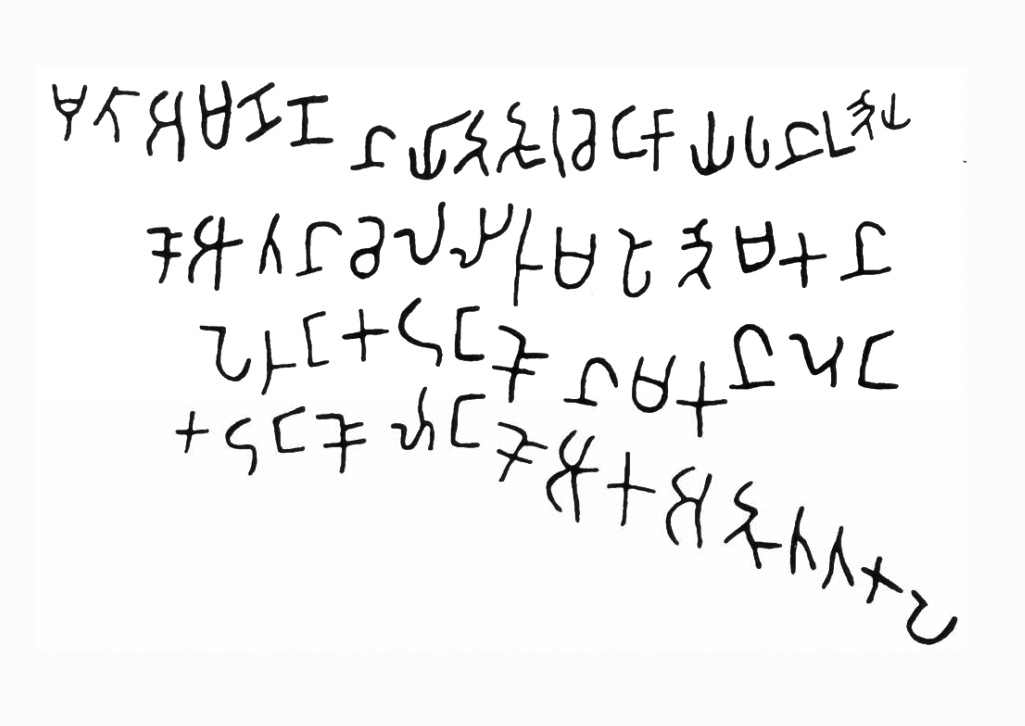
Pugalur · Ancient inscription assigned by source to circa 1st–2nd century CE; this tracing was created/uploaded in 2018
Modern line tracing of a Pugalur Tamil-Brahmi inscription, credited to Rajesh of Raigad in the 2018 Commons record
Modern line tracing of a Pugalur Tamil-Brahmi inscription, credited to Rajesh of Raigad in the 2018 Commons record. This is an epigraphic representation, not a photograph of the inscribed rock.
006Two views
Both views are shown at equal weight; this site does not choose between them.
Whether the Pugalur kings are the rulers praised in Patiṟṟuppattu
- One view
- Kamil Zvelebil (1973) identified Kō Ātaṉ Cellirumporai with the seventh-ten king and used Pugalur to anchor early Tamil chronology.
- Another view
- Herman Tieken (2008) argued the names are not similar enough, and that even matching names would not date the poems.
- What would settle it
- Mahadevan's full commentary on inscriptions 61 and 62, which addresses the royal identification, and K. G. Krishnan's 1970–71 article.
When inscriptions 61 and 62 were carved
- One view
- Mahadevan's revised corpus and the 1975 Jaina Art and Architecture survey: about the second century CE.
- Another view
- Chakravarti and Ramesh (1974) and Ekambarnathan and Sivaprakasham (1987): the third–fourth centuries CE.
- What would settle it
- The full palaeographic argument in the revised commentary, read with high-resolution images of the damaged letters.
007Where next
The 61/62 comparison qualifies genealogical and patronage claims. Restored text is not a second independent full witness.
On the atlasJambai, Mangulam & Pugalur Rock Inscription SitesProtected ASI / TNSDA rock-shelter monuments
Explore nextOne Poem, Five Dates: How Copying Saved Ancient PoemsAll related studies, connected material, books and sources17 · 18
Elsewhere on this site
Excavation Atlas Sites: Jambai, Mangulam & Pugalur Rock Inscription Sites · Karur (Amaravathi River Trade Node & Proposed Chera Capital Vanchi)
Junior Detective Quests: One Poem, Five Dates: How Copying Saved Ancient Poems
Multi-Script Glossary Terms: Cēral / Kēraḷaputra (சேரல் / சேரர் / ചേരൻ / കേരളപുത്ര) · Pukaḷūr (Āṟunāṭṭārmalai) Chera Irumpoṟai Inscription (புகளூர் சேரல் இரும்பொறை தமிழி கல்வெட்டு / പുകളൂർ ചേര ഇരുമ്പൊറൈ തമിഴ്-ബ്രാഹ്മി ലിഖിതം)
Connected material
Photographs, drawings, books, videos and other studies linked to this study. A link helps you explore; it does not prove a historical claim.
- Modern line tracing of a Pugalur Tamil-Brahmi inscription, credited to Rajesh of Raigad in the 2018 Commons recordmodern epigraphic tracingBackground
008Sources
The study lists the sources it consulted; we have not rechecked them. A working link does not show that a source was read, and a valid identifier does not show that it supports a claim. We do not link to unofficial uploads or copies of publications. Where a study cited one, we show the published citation, or a publisher, DOI or Internet Archive link when we have one. Tracking codes are removed from links, and the sources themselves are not republished here.
Iravatham Mahadevan, Early Tamil Epigraphy: From the Earliest Times to the Sixth Century A.D., Harvard Oriental Series 62 / Cre-A, 2003.
M. V. Bhaskar / CICT photographic survey, About the Project.
CICT/Mahadevan-derived online edition, Pugalur inscription 61 (Pugalur-1).
CICT/Mahadevan-derived online edition, Pugalur inscription 62 (Pugalur-2).
CICT/Mahadevan-derived online edition, Pugalur inscription 67.
CICT/Mahadevan-derived online edition, Pugalur inscription 69.
CICT/Mahadevan-derived online edition, Pugalur inscription 72.
A. Chakravarti and K. V. Ramesh, Jaina Literature in Tamil, Bharatiya Jnanpith, 1974, Appendix No. 4.
Online copy not linked · use the published editionSource recordA. Ekambarnathan and C. K. Sivaprakasham, Jaina Inscriptions in Tamilnadu: A Topographical List, 1987, No. 510.
Online copy not linked · use the published editionSource recordK. R. Srinivasan, 'South India', in Jaina Art and Architecture, vol. II, 1975.
Online copy not linked · use the published editionSource recordKamil V. Zvelebil, The Smile of Murugan: On Tamil Literature of South India, Brill, 1973.
A Propos Three Recent Publications on the Question of the Dating of Old Tamil Caṅkam Poetry
Herman Tieken, 'A Propos Three Recent Publications on the Question of the Dating of Old Tamil Cankam Poetry', Asiatische Studien 62/2, 2008, 575-605.
INDOLOGY list post on dating of Old Tamil Caṅkam poetry
Herman Tieken, INDOLOGY list post, July 2008, reproducing the relevant argument concerning Pugalur identifications.
Iravatham Mahadevan, 'Corpus of the Tamil Brāhmī Inscriptions', in R. Nagaswamy ed., Seminar on Inscriptions, 1966, Madras, 1968, pp. 57-73.
Print or offline sourceSource recordK. G. Krishnan, 'Cera kings of the Pugalur inscriptions', Journal of Ancient Indian History IV, 1970-71, pp. 137-143.
Print or offline sourceSource recordAnnual Report on South Indian Epigraphy, 1927-28, Madras, 1929, nos. 341-49 and p. 50.
Print or offline sourceSource recordAnnual Report on Indian Epigraphy, 1963-64, including reference ARE 297/1963-64.
Print or offline sourceSource recordCICT/Mahadevan-derived Pugalur corpus index.
Researchers and institutions whose work this study uses: Iravatham Mahadevan, R. Nagaswamy, Kamil Zvelebil, K. R. Srinivasan
How we know The evidence, claims and dates behind this study
What this study draws on
- Edited texts of Pugalur inscriptions 61, 62, 67, 69 and 72 in the CICT/Mahadevan online corpus.
- The CICT photographic survey, which trace-painted the Pugalur inscriptions in 2009.
- Jaina catalogues of 1974 and 1987 and the 1975 Jaina Art and Architecture survey.
- Zvelebil (1973) and Tieken (2008) on the literary identifications; the consulted records give no laboratory date.
Dates in this study
| What is dated | Date | How it was dated |
|---|---|---|
| ca. 2nd century C.E. | 100–199 CE | Date from writing, coins or texts |
| 3rd-4th century A.D. | 200–399 CE | Date from writing, coins or texts |
See these dates on the timeline
The study’s claims
12 claims · 15 source passages · 34 paragraphs
Browse the study paragraph by paragraphThe accessible CICT/Mahadevan Pugalur index contains corpus inscriptions 61 through 72.
Supported in this study
Inscription 61 preserves a three-generation father-son chain from Kō Ātaṉ Cel Irumpoṟai to Peruṅkaṭuṅkōṉ to (I)ḷaṅkaṭuṅkō.
Supported in this study
Kinship does not itself supply reign dates or political geography.
The current edition regards inscription 62 as physically later than 61, after modification of the drip ledge.
Supported with qualifications
Relative sequence is an editorial/field interpretation, not an absolute date.
Royal donor agency for the Pugalur shelter is plausible and traditional but less explicit in inscription 61 than later scholarly paraphrases suggest.
Supported with qualifications
Prefer 'associated with' or an attributed sponsorship interpretation in public prose.
Other Pugalur inscriptions provide clearer donation language: 67 attributes a forecourt as a gift of Koṟṟantai (I)ḷavaṉ and 69 a seat as a gift of Natti, a gold merchant from Karu(v)ūr.
Supported in this study
The site contains multiple kinds of relationships to monastic space; not every inscribed name is necessarily a donor.
The current Mahadevan/CICT-derived edition dates inscriptions 61 and 62 approximately to the second century CE, while accessible 1974 and 1987 catalogues assign the royal record to the third-fourth centuries CE.
Debated in the sources
No precise accession or reign date should be calculated from these broad attributions.
The proposed identifications of the three Pugalur royals with rulers in Patiṟṟuppattu decades 7-9 are scholarly hypotheses and are contested.
Debated in the sources
The genealogy does not depend on accepting any literary equation.
The three-generation genealogical claim is inscriptional and remains supported even if the proposed Patiṟṟuppattu identifications are rejected.
Supported in this study
The Pugalur genealogy alone does not establish fixed reign years, a capital at Karur, or Chera kingdom boundaries.
Supported in this study
Separate archaeological, textual or numismatic evidence could address these questions independently.
Calling the Pugalur lineage 'Chera/Irumporai' is an established scholarly historical classification rather than a territorial statement written explicitly in the inscription.
Supported with qualifications
Do not convert dynastic classification into a mapped kingdom without separate evidence.
The CICT-supported photographic project documented Pugalur in 2009 as part of a 2007-2010 field survey using high-resolution stills and HD video.
Supported in this study
No radiometric or laboratory dating sample tied to inscriptions 61 or 62 was identified in the consulted edition pages or accessible supporting records.
Supported with qualifications
Not found in this study is not equivalent to universal absence.
Trace one claim through the study’s records
Explore the evidenceOther source lists
Numbered citation links from the study
The numbered links in the study text point here.
About the CICT Tamil-Brahmi Photographic Survey
Pugalur Home
Pugalur 61 Video
Pugalur 62 Video
Pugalur 67 interactive
Pugalur 69 interactive
Jaina Art and Architecture Vol 02 - Jain Quantum
Online copy not linked · use the published editionJaina Literature in Tamil - Jain Quantum
Online copy not linked · use the published editionJaina Inscriptions in Tamilnadu - Jain Quantum
Online copy not linked · use the published editionDating Old Tamil Cankam poetry
3 Problems Of Dating, Relative And Absolute Chronology – The Smile of Murugan
Jaina Art and Architecture Vol 02
Online copy not linked · use the published editionPugalur 72 interactive
Articles – Herman Tieken
E-Periodica - Asiatische Studien : Zeitschrift der Schweizerischen Asiengesellschaft = Études asiatiques : revue de la Société Suisse-Asie (1947-ff.)
About this study Status, corrections and how it was made
Status
Draft study, revision 6. No historian, archaeologist, or Tamil or Malayalam specialist has reviewed it yet.
How it was made
Compiled as an editorial synthesis from published scholarship around questions we framed. About this project & workflow
The summary, How sure lines and Two views notes on this page were prepared from this study and cross-checked against its passages. That is an editorial check, not a specialist review.
Corrections and updates
Technical details
Study code R221. The text fingerprint changes whenever the study text changes.
- The study text is shown as written. Links from its paragraphs to citations help you move around the study; they are not new claims or checked source passages.
See how this study’s records were extracted
Text fingerprint (SHA-256): R221 · d0679439faaeac92244ed2e0… · v6
Evidence tables and technical details are on the web page: https://layersofthesouth.org/read/54acfc22d7