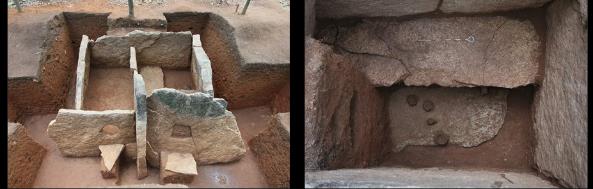
Excavated cist burial at Enadimangalam, Figure 1, published page 568
Enadimangalam
- Belief & memory
Kerala's Iron Age graves are many; only a handful are dated
Kerala's Iron Age survives as more than a thousand burial sites, yet only about a dozen laboratory dates from a handful of graves anchor it.
- This page
- 6,723 words · revision 6
Draft study · Awaiting specialist review · Updated
001Dates and places

No mapped place in this study.
Before 1000 BCE
1000–500 BCE
Different beginnings
500–200 BCE
Marks & materials
200 BCE–300 CE
Connected worlds
300–600 CE
Change & continuity
- IP-741 2500 BC-AD 100 (95.4%)
- IP-724 1300-200 BC (95.4%)
- BS-958 1299-902 cal BCE (two standard deviations)
- BS-957 1269-821 cal BCE (99.63%)
- Iron Age period (5th c BCE to 10th c BCE), Pattanam 2011 sequence
- c. 1000 B.C.-100 B.C. (excavator general chronology for Mangadu)
- 900 BCE and 300 CE (broad Kerala Iron Age range)
- Kuttikol KTL-4 792-551 BCE in three intervals
- Pattanam bone carbonate, cal BC 540-35 across three samples
- Nannangadikkunnu early date, 4th to 5th century BCE
- circa 5th century BCE to 5th century CE (broad span of the practice)
- Early Historic-Iron Age transition (2nd c BCE to 4th c BCE), Pattanam 2011 sequence
- Laboratory date
- Period assigned by excavators or scholars
Each date belongs to what was dated (a sample, an object, a layer or a text), which is not always the event the study asks about.
Each period has the same width, so spacing is not to scale.
The full table of dates, with their ranges, is under How we know.
- 1 Well supported
- 2 Likely
- 1 Not known
002How sure
In brief
By the first half of the first millennium BCE, people in Kerala were burying selected, often burnt, remains of their dead. They used laterite caves, umbrella stones, domed caps, urns and stone cists. More than a thousand sites are known, but few are excavated, and only about a dozen laboratory results come from burials. The oldest are two charcoal dates from urns at Mangadu, near Kollam, in the late second or early first millennium BCE. Most graves dated by laboratory or by comparison fall between the fifth century BCE and the second century CE. That span reaches into Pattanam's centuries of overseas trade. Several sites also gave medieval dates, which excavators mostly explain as disturbance or reuse. No umbrella stone has a laboratory date in the sources we read. Graves and port share pottery, iron and carnelian beads; whether Pattanam's lowest layer housed the monument builders is disputed.
Key researchers cited in this study: P. J. Cherian (KCHR Pattanam Excavations) · K. Rajan (Kodumanal & Porunthal Excavations / Epigraphy) · V. Selvakumar (Maritime & Prehistoric Archaeology) · K. P. Shajan (Geoarchaeology & Periyar Palaeochannels) · Full bibliography
How sure
- Well supported
Kerala's Iron Age is known mainly from burial monuments of many forms, holding pottery, iron objects and stone beads.
More than a thousand sites are recorded, and excavations since the nineteenth century describe their forms and contents; excavated settlements remain rare.
- Likely
Monument burial in Kerala had begun by the first half of the first millennium BCE.
Two Mangadu charcoal dates and one Kuttikol wood date support it. They are few, the wood may be older than its use, and the Mangadu sheets raise a half-life question.
- Likely
Burial monuments were still being made or used when Pattanam traded with the Mediterranean.
The one laboratory-dated cist in this span, at Niramakulam (about 360-170 BCE), falls just before the main trading centuries. The overlap rests on comparative dates for Porkalam and Machad and on specialists' broad frames, and few graves are dated.
- Not known
The age of Kerala's umbrella stones and hood stones.
None has a laboratory date in the published sources we read, and excavated umbrella stones lack the beads used for comparative dating.
Why it matters
Kerala's burial monuments are the main evidence for the people who lived here before and alongside Pattanam. Their dates frame Kerala's early history.
003Key findings
What the study concludes
- Kerala's Iron Age is known mainly from burial monuments; excavated settlements of the period are very few.
- The oldest laboratory results from a Kerala burial are two charcoal dates from Mangadu urns, 2890 +/- 70 and 2850 +/- 90 BP; a half-life note on the laboratory sheets needs checking.
- Several sites, Kuttikol, Niramakulam and Nannangadikkunnu, also gave much later dates, explained as disturbance, reuse or later activity.
- Burial monuments were probably still in use when Pattanam traded overseas, and the graves and the port share pottery, iron and beads; whether Pattanam's lowest layer was home to the monument builders is disputed.
In the study’s own words. How sure each point is, is shown above.
The summary above is the short read. The full study is the complete text it was drawn from, with its tables and source notes.
What the full study covers
- Main findings
- Scope and terms
- Kerala's burial monuments take many forms, loosely sorted by rock
- The dated sites, sample by sample
- Kerala's dates beside Tamil Nadu and the Deccan
- Three popular claims tested
- From burial grounds to Pattanam
- Where specialists disagree
- What remains uncertain
- Related studies in this collection
- Sources
004The study
By the first half of the first millennium BCE, people in Kerala had begun placing selected remains of their dead in monuments of stone and pottery. They cut chambers into laterite, raised umbrella-shaped stones, set domed caps over buried urns and ringed graves with stone circles. Many graves held iron tools, pottery and stone beads brought from far away.
More than a thousand such sites are known. Fewer than twenty-five had been systematically excavated by 2015. The published reports we used give laboratory dates for samples from about seven burial sites and from the lowest layer at Pattanam.
This study gathers those dates sample by sample and explains what each one can and cannot date. It then follows the threads that run from these burial grounds to the port at Pattanam, whose busiest centuries fell around the turn of the Common Era.
Main findings
- The record is mostly graves. Kerala's Iron Age is known chiefly from burial monuments and memorials. Excavated places where the same people lived remain very few. ↗6 ↗7 ↗10
- Monument forms follow the rock, loosely. Dolmens are commonest in the granite uplands, and slab cists occur in the uplands and midlands. Rock-cut caves, umbrella stones and hood stones belong to the laterite midlands. Urn burials occur almost everywhere. ↗5 ↗11
- The oldest burial dates come from Mangadu. Charcoal from two urns near Ashtamudi Lake measured 2890 ± 70 and 2850 ± 90 radiocarbon years. Published calibrations place them in the late second or early first millennium BCE. The laboratory sheets raise a technical question that needs checking. ↗1
- Several sites give both early and much later dates. Kuttikol, Nannangadikkunnu and Niramakulam each produced one result in the first millennium BCE and others in the first or second millennium CE. Excavators explain the late results as disturbance, reuse or later activity. ↗8
- No umbrella stone or hood stone has its own laboratory date in the sources we read. We found no published dating evidence behind popular statements that these monuments are 4,000 years old. ↗6 ↗16
- The burial custom probably continued into the centuries of overseas trade. Several graves dated by laboratory or by comparison fall between the fourth century BCE and the second century CE. The comparative dates overlap the centuries when Pattanam traded with the Mediterranean. ↗5 ↗8 ↗15
- Pattanam's lowest layer is disputed. Its excavators read a sandy deposit with coarse pottery and a little iron as Kerala's first excavated Iron Age settlement. Other archaeologists say its link to the monument builders has not yet been shown. ↗2 ↗4 ↗7
Scope and terms
This study covers present-day Kerala from about 1000 BCE to 600 CE. Tamil Nadu and the Deccan appear only where they help to judge Kerala's dates. It points to the collection's existing site studies rather than retelling them. It adds what they lack: one Kerala-wide set of dates, an overview of the monument forms and an account of how this burial world relates to Pattanam.
Megalith means "large stone", but several Kerala grave types have no large stone, such as urns sealed by earth or rock-cut chambers entered from a pit. Rachel Varghese therefore prefers "Iron Age–Early Historic (IA-EH) monuments", which names the period rather than the stones. ↗7 Iron Age here means the period in which these monuments were built and iron objects placed in them. K. Rajan warns that black-and-red pottery, iron and burial monuments are often treated as one package, so that one is taken to imply the others. He lists Mangadu among excavations called "Iron Age" on the strength of black-and-red ware alone. ↗12 Iron objects were, however, found with the Mangadu urns. ↗1 Early Historic refers to the centuries when writing becomes visible in the archaeological record, from about 300 BCE in South Asia. ↗10
A radiocarbon date (a laboratory measurement of the age of once-living material) dates the sampled charcoal, wood or bone. It dates a grave or a layer only when the link between sample and context is secure.
Kerala's burial monuments take many forms, loosely sorted by rock
In 1949 V. D. Krishnaswami described the old Cochin State as three parallel strips, each with its own monuments. Dolmens stood in the eastern granite hills. Rock-cut caves, menhirs and the "umbrella series" occupied the laterite plains. Urn burials with some menhirs lay on the alluvial coast. He judged that the available material largely determined the form. ↗5 Later surveys support the broad pattern for the whole state. V. Vinod and Athira Pillai group the northern districts, from Kasaragod to Thrissur, around rock-cut caves, urns, umbrella stones, dolmens and menhirs, and the southern districts around dolmens, cists, urns and menhirs. Thrissur has the most recorded monuments and coastal Alappuzha the fewest. ↗11
The pattern is a tendency, not a rule. At Porkalam an urn under a granite capstone was ringed by laterite stones. ↗6 Cheramangad holds umbrella stones, hat stones, hood stones and stone circles side by side. ↗7 “Umbrella stones and rock-cut tombs: distinctive but not unique” discusses why geology made some forms practical without dictating the choice.
The record is large, but the excavated sample is small. Jenee Peter counted more than 1,000 megalithic sites in Kerala and fewer than 25 systematically excavated, mostly after 1950. ↗6 In the Pamba basin alone, Ambily C. S. lists sixty-five sites, eighteen of them with reported finds. ↗8 In March 2025 the Archaeological Survey of India announced more than 110 megaliths, mostly cists, across about 45 hectares near the Malampuzha dam in Palakkad. Only survey, not excavation or dating, was reported. ↗18
Rock-cut caves
Builders sank a stepped pit into laterite, cut a small entrance in one face and hollowed out a chamber behind it. Krishnaswami gives the entrance as about 1.5 feet square, barely large enough to crawl through. The domed vault sometimes had a central pillar or a circular opening, and rock-cut benches ran along some walls. ↗5 Some caves had several chambers opening from one pit, as at Eyyal and Kattakampal. ↗13 Two protected caves near Kunnamkulam, Chovvanur and Eyyal, lie a few kilometres apart yet differ in plan and fittings. ↗7
Joanna Sudyka calls the form peculiar to the Kochi and Malabar regions, but she also records a laterite rock-cut chamber in Uttara Kannada, Karnataka. ↗13 Northern variants are surveyed in “Northern Kerala's rock-cut burial caves vary widely in form” and “Four northern Kerala Iron Age burials differ in form and finds”, individual caves in “Kattakampal's burial cave: four chambers and no central pillar” and “Eyyal's burial cave: two chambers, studied apart from its coins”, and Kuttikol, the only rock-cut cave with laboratory dates in the sources we read, in “Umbrella stones and rock-cut tombs: distinctive but not unique”.
Umbrella stones
The umbrella stone, kudakkallu in Malayalam, is a dressed laterite dome resting on four inward-leaning supports. Krishnaswami recorded the local names topi-kal and kudai-kal for this "umbrella series" and named Ariyannur and Cheramanangad as its main sites. ↗5 Peter lists 55 major sites from Kasaragod to Thrissur, densest in Malappuram, and notes that umbrella stones had so far been reported only from Kerala. ↗6
Umbrella stones and exposed supports at Ariyannur
Ariyannur
Photographed 2012-10-22
Umbrella stones are not simply lids over urns. Excavated examples at Cheramangad and Ariyannur had no urn beneath them, while one at Perambra held rich grave goods. ↗6 No interment was found under the umbrella stone excavated at Cheramangad. ↗13 Some may have been memorials rather than graves. ↗7 Peter adds that no stone beads have been found in any excavated umbrella stone. Since etched carnelian beads are a main tool for dating Kerala graves by comparison, she calls for a separate study of umbrella-stone chronology. ↗6 “Umbrella stones and rock-cut tombs: distinctive but not unique” examines Ariyannur and “Cheramanangad’s stone markers do not predict what lies beneath” Cheramangad.
Hood stones, hat stones and multiple hood stones
Krishnaswami's "hood-stone" is a dome of dressed laterite resting directly on the ground, with Porkalam and Cheramanangad as its main sites. His "multiple hood-stone" is a ring of 5 to 12 dressed laterite slabs leaning inward without meeting, with two examples at Cheramanangad. ↗5 Later writers often call the ground-resting form topikkallu, "hat stone", although Krishnaswami used topi-kal for the umbrella series. Peter traces the confusion to John Babington's account of 1823, which translated a local name for the umbrella stone as "hat stone". ↗6 Labels must be read by each author's definition, as “Umbrella stones and rock-cut tombs: distinctive but not unique” explains.
The excavated hood stone at Cheramangad covered an urn in a pit about 1.05 metres deep. ↗13 “Cheramanangad’s stone markers do not predict what lies beneath” lists its contents: a red-ware urn, black-and-red ware and a russet-coated painted bowl. In Sudyka's summary of the excavation report, only the hat stones there were proper graves; the multiple hood stones and umbrella stones were symbolic. ↗13
Urn burials and stone circles
Large pottery jars buried in pits are found across almost the whole state. Many are sealed by a granite or laterite capstone, and some are ringed by stone circles. ↗11 At Mangadu, three stone circles held twelve urns in all, which did not follow the line of the circles; most lay in Megalith II, set on the laterite bed without capstones. The excavator concluded that the place was used for burials over a long period. ↗1 On the central Kerala coast, the Pattanam team's geoarchaeologists reported numerous urn burials "of megalithic nature" on inland beach ridges and sand dunes. ↗3
Cists, dolmens and menhirs
Cists are box-like chambers of stone slabs, usually below ground and often pierced by a porthole; dolmens are similar boxes above ground. Dolmens are reported mainly from the highlands, and slab cists from the granite highlands and laterite midlands. ↗11 At Enadimangalam in Pathanamthitta, a 2019 University of Kerala excavation exposed a two-chambered cist with stone benches and two portholes. Its scattered pottery suggested repeated use for several burials. ↗10 Menhirs are mostly granite, but the one at Anakkara is laterite. ↗9 The dolmens of Marayoor are examined in “Marayoor has dense dolmens, but their link to a route is untested”.
Side view of a dolmen’s capstone and supporting slabs at Marayoor
Marayoor
Photographed 2023-04-07
What the graves held
Kerala's graves are mostly secondary burials. Whole skeletons have not been found, and bone is usually burnt or fragmentary. Varghese suggests that many monuments may have been intended as memorials. ↗7 At Mangadu the urns held burnt bone fragments and charcoal, and the excavator concluded that bones were buried after cremation. ↗1
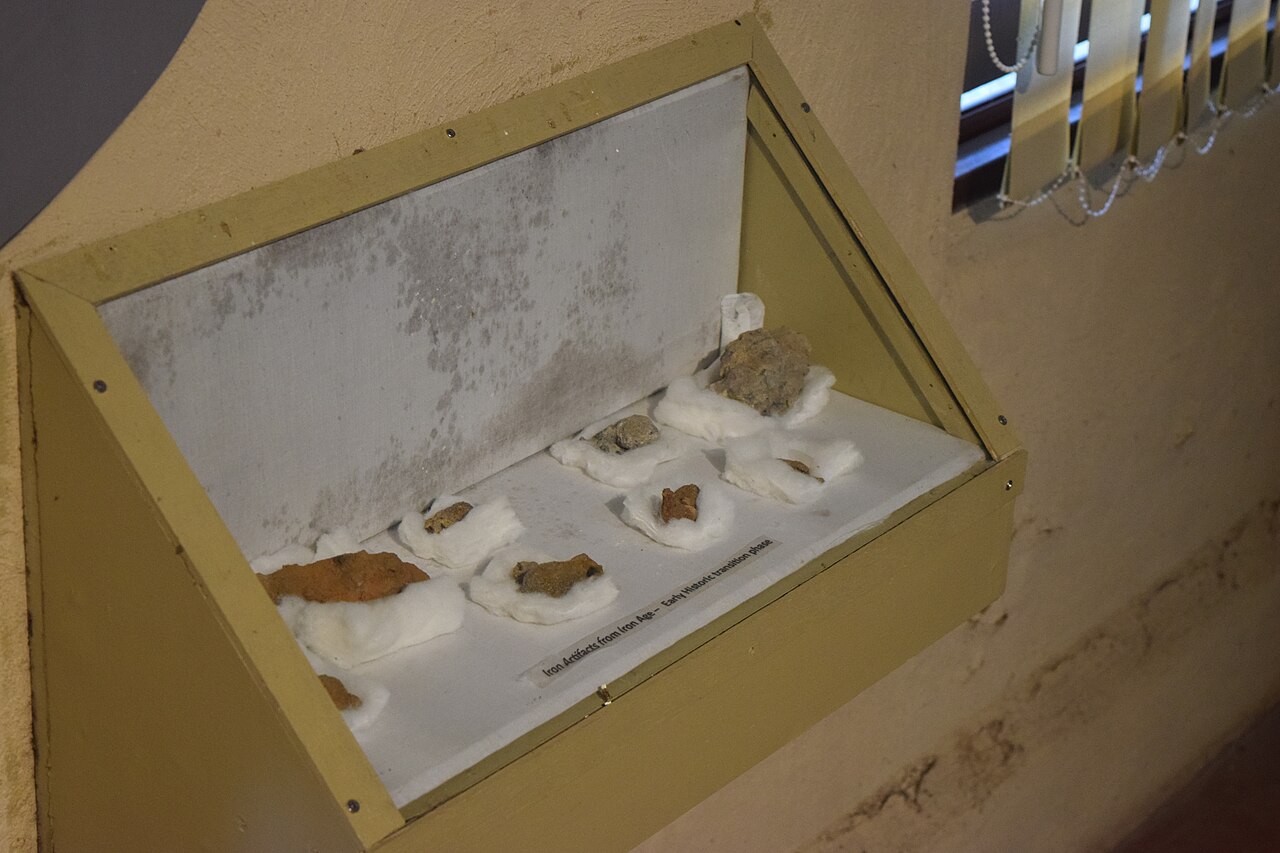
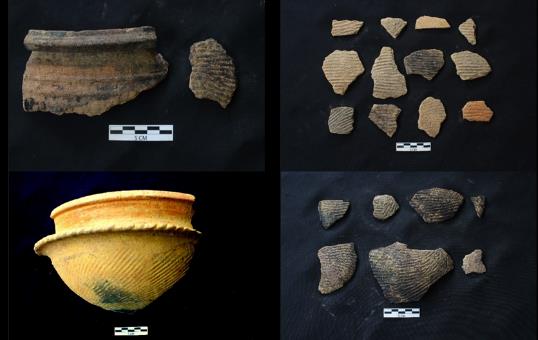
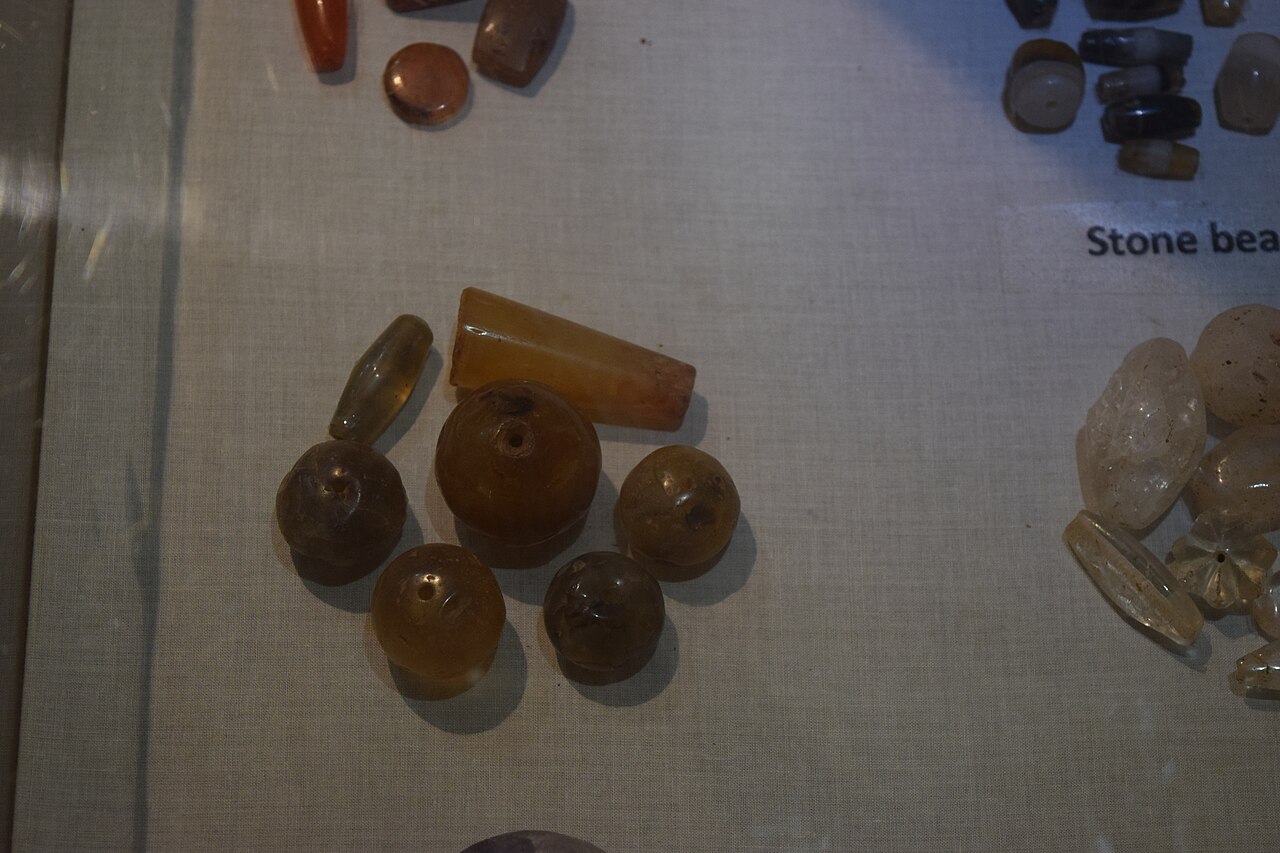
Grave goods fall into three main groups: pottery, iron objects and semi-precious stone beads. ↗7 The pottery includes black-and-red ware, red-slipped ware, black ware and russet-coated painted ware. ↗14 Iron objects include sickles, knives, blades, wedges, daggers and ploughshares. ↗1 ↗14 About 120 pieces of iron slag came from the burial pit at Mangadu, with 18.8 to 66.5 percent iron in the analysed samples. Satyamurthy read them as evidence of local iron-working. ↗1 “Palakkad graves show early iron use, not yet local smelting” assesses early ironworking in Malappuram and Palakkad. Varghese identifies western India as the nearest known carnelian source and reports no known South Indian source of agate, interpreting these beads as evidence of long-distance exchange. ↗9 ↗10
The dated sites, sample by sample
Ledger of laboratory dates
The table lists every laboratory result from a Kerala Iron Age burial context, and from Pattanam's lowest layer, that we could trace in the sources we read. "BP" means radiocarbon years before 1950. Calendar ranges are given as each source publishes them; none has been recalculated here. Where a detail comes from an existing study in this collection, the row names that study.
| Site (district) | What was sampled | Laboratory number | Reported age | Calendar range as published | Main caution | Source |
|---|---|---|---|---|---|---|
| Mangadu (Kollam) | Charcoal inside Urn 6, Megalith II, 95 cm | BS-958, Birbal Sahni Institute | 2890 ± 70 BP | 1299–902 BCE (Abhayan 2018, via “Mangadu's urn burials give southern Kerala early dated charcoal”) | Sheet cites a 5,730-year half-life | ↗1 |
| Mangadu (Kollam) | Charcoal inside Urn 10, Megalith I, 95 cm | BS-957, Birbal Sahni Institute | 2850 ± 90 BP | 1269–821 BCE, main interval (via “Mangadu's urn burials give southern Kerala early dated charcoal”) | Same | ↗1 |
| Pattanam (Ernakulam) | Charcoal, pit fill, Trench PT07-I, 275–285 cm | IP-724, Institute of Physics, Bhubaneswar | 2623 ± 180 BP | 1300–200 BCE (text); 945–510 BC (table) | Wide error | ↗2 |
| Pattanam (Ernakulam) | Charcoal, Trench PT07-II, 250–260 cm | IP-741, Institute of Physics, Bhubaneswar | 2918 ± 488 BP | 2500 BCE–100 CE (text); 1693–509 BC (table) | Error too wide for close dating | ↗2 |
| Kuttikol (Kasaragod) | Charred wood, rock-cut Burial 2 | PLD-31833 (KTL-4) | 2526 ± 20 BP | 792–551 BCE in three intervals (via “Umbrella stones and rock-cut tombs: distinctive but not unique”) | Outer rings absent; wood may be older than its use | ↗8; “Umbrella stones and rock-cut tombs: distinctive but not unique” |
| Kuttikol (Kasaragod) | Plant charcoal and wood, rock-cut Burial 1 | PLD-31830 to 31832 (KTL-1 to 3) | 328 ± 19, 430 ± 19, 385 ± 18 BP | 15th–17th centuries CE (via “Umbrella stones and rock-cut tombs: distinctive but not unique”) | Disturbance or reuse | ↗8; “Umbrella stones and rock-cut tombs: distinctive but not unique” |
| Niramakulam (Pathanamthitta) | Charcoal inside cist, 164–185 cm | Beta-377787 | 2190 ± 30 BP | 360–170 BCE (via “Porkalam 1948: one urn burial that became a reference point”) | Dates charcoal, not each object | ↗8; “Porkalam 1948: one urn burial that became a reference point” |
| Niramakulam (Pathanamthitta) | Charcoal outside cist, 96–105 cm | Beta-377788 | 1790 ± 30 BP | Not given separately; the pair spans to the 4th century CE | Outside the chamber; error printed differently in two versions (“Porkalam 1948: one urn burial that became a reference point”) | ↗8; “Porkalam 1948: one urn burial that became a reference point” |
| Nannangadikkunnu (Palakkad) | Salvaged urn burial | Not given | 2350 ± 30 and 490 ± 30 BP | About 5th–4th centuries BCE; about 15th century CE | Late sample from disturbed deposit | ↗8 |
| Oliyani (Kottayam) | Cist burial | Not given | 810 ± 80 BP | 11th–12th centuries CE | Summary only | ↗8 |
| Poredam (Kollam) | Urn burial (thermoluminescence) | Not given | 1375 ± 15 years | Not converted | Original not seen | ↗8 |
| Kunnoni (Kottayam) | Not stated | Not given | Not given | "c. 1000 A.D." | Summary only; may be the Oliyani result | ↗11 |
| Pattanam (Ernakulam) | Cremated human bone, three specimens | Beta Analytic | 2080 ± 30, 1990 ± 30, 2130 ± 30 BP | 540–35 BCE across the three; authors: 1st century BCE–1st century CE | Contexts not described; ranges need checking | ↗15 |
Mangadu: the oldest results and a laboratory question
The Kerala State Department of Archaeology excavated Mangadu, near Ashtamudi Lake in Kollam district, in 1991. T. Satyamurthy published the report in 1992. ↗1 Its laboratory sheets and carbon chart agree on the contexts: BS-958 came from charcoal inside Urn 6 of Megalith II, and BS-957 from charcoal inside Urn 10 of Megalith I, both at 95 cm. ↗1 See “Mangadu's urn burials give southern Kerala early dated charcoal” for the detailed Mangadu assemblage discussion.
Satyamurthy dated most urns to about 900 BCE. He pushed the earliest burial, Urn 12, back another century to about 1000 BCE, because it lay at the lowest level and held simpler iron tools. He gave the cemetery a general span of about 1000–100 BCE. The upper limit rested on etched carnelian beads in a later urn that resembled beads from Porkalam, with grey-ware sprinklers in the layer sealing the burials as support. ↗1 The 1000 BCE figure is therefore an excavator's interpretation built on two measurements, not a measurement.
The BS-957 laboratory sheet gives the age as "based on the value: of half life (5730 40 yrs)", evidently 5,730 ± 40 years. The BS-958 sheet begins the same wording but breaks off. ↗1 Laboratories report conventional radiocarbon ages with the Libby half-life of 5,568 years, although the physical half-life is closer to 5,730 (Stuiver & Polach 1977). ↗19 If those printed ages were calculated on the 5,730-year half-life rather than the 5,568-year Libby convention, conventional ages on the Libby half-life would be about 3 percent younger; they have not been formally recalibrated from the laboratory records here.
Even at face value, the Mangadu dates come from two samples in one cemetery. They date charcoal in two urns, not the first iron in Kerala or the start of the Iron Age across the state.
Kuttikol, Niramakulam and Nannangadikkunnu: early and late dates at the same sites
Three recently excavated sites each produced one result in the first millennium BCE and one or more far later results. At Kuttikol in Kasaragod, four samples measured 2526 ± 20 BP and between 328 and 430 BP. ↗8 “Umbrella stones and rock-cut tombs: distinctive but not unique”, drawing on the excavation report, places the early sample, charred wood, in rock-cut Burial 2 and the three late ones in Burial 1. It gives their calibrated ranges, in the eighth to sixth centuries BCE and the fifteenth to seventeenth centuries CE. It also records the excavators' warning that wood lacking its outer rings can be older than its use.
At Niramakulam in the Pamba basin, a sample from inside a cist, 164–185 cm deep, measured 2190 ± 30 BP. A sample from outside the cist, at 96–105 cm, measured 1790 ± 30 BP. Ambily, one of the excavators, reads the pair as the earliest burial activity in the Pamba hills and as human activity in two different periods. ↗8 “Porkalam 1948: one urn burial that became a reference point” identifies both as charcoal and gives the earlier sample's calibrated range as 360–170 BCE.
At Nannangadikkunnu in Palakkad, a salvaged urn burial gave 2350 ± 30 and 490 ± 30 BP. Citing G. S. Abhayan's 2018 review and a personal communication from him, Ambily reports that the excavators attributed the late results at Kuttikol and Nannangadikkunnu to disturbance, and that those samples came from disturbed deposits. Accepted at face value, she notes, the late dates would extend the tradition into the fifteenth century CE; more dates are needed to fix its end. ↗8 Her text gives the start of the Kuttikol range as the "7th to 6th century CE", apparently a slip for BCE, since it cites the raw age of 2526 BP. ↗8
Oliyani, Poredam and Kunnoni: late results reported only in summaries
Three more results reach us only through short summaries. Citing P. Rajendran, Ambily reports a radiocarbon age of 810 ± 80 BP, in the eleventh to twelfth centuries CE, from a cist at Oliyani in Kottayam district. She also reports a thermoluminescence age (a measurement of when pottery was last heated) of 1375 ± 15 years from an urn burial at Poredam in Kollam district. ↗8 Vinod and Pillai mention a radiocarbon date of about 1000 CE from Kunnoni. They cite a 2001 paper by Rajendran whose title links Kunnoni to the Oliyani cist excavation in Kottayam district. ↗11 Ambily also writes "Oliyani/Kunnoni" when listing finds, so the two names may describe one result. ↗8 Without the original reports we cannot tell whether these results date first use, later reuse or intrusive material.
Dates by comparison: Porkalam, Machad and Tiruvilvamala
Before laboratory dating, graves were dated by comparing their finds with dated sites elsewhere. B. K. Thapar placed the urn burial he excavated at Porkalam in 1948 between about the third century BCE and the first century CE, chiefly from its etched carnelian beads. ↗1 ↗8 “Porkalam 1948: one urn burial that became a reference point” shows that he treated this range as provisional. K. M. George and R. N. Mehta assigned burials at Machad and Pazhayannur to the second century BCE to the second century CE from beads, pottery and iron tools. ↗8 Krishnaswami dated a porthole cist at Tiruvilvamala, with red ware painted in yellow wavy lines, to just before the Common Era or the first or second century CE. ↗5 Such dates inherit the uncertainties of the sites used for comparison.
What the dates show together
The dated contexts support four careful statements.
First, monument burial was probably under way in Kerala by the first half of the first millennium BCE. The evidence is Mangadu, where iron objects lay with the urns, and the Kuttikol wood; Pattanam's charcoal points the same way more loosely. Two old samples from one cemetery and two imprecise samples from a habitation layer cannot fix a statewide beginning.
Second, most graves dated by laboratory or by comparison fall between the fifth century BCE and the second century CE. Varghese gives the practice a broad span from about the fifth century BCE to the fifth century CE, while noting earlier and later dates. ↗7 Peter states that most known sites belong to the late Iron Age. ↗6
Third, several graves were reused or disturbed long after they were made. Repeated use is recorded at Mangadu and Enadimangalam, and Niramakulam shows activity in two periods. ↗1 ↗8 ↗10 The medieval dates may reflect reuse, disturbance or contamination. They do not show an unbroken tradition lasting two thousand years.
Ceramics from the Enadimangalam study area, Figure 3, published page 569
Enadimangalam
Fourth, the dates are thin and uneven. None comes from an umbrella stone or hood stone, only one dated site is a rock-cut cave, and none of the dated sites whose district we know lies in Thrissur. Authors give broad frames: about 900 BCE to 300 CE for Abhayan and S. V. Rajesh, and about 1000 BCE to 500 CE for Ambily. ↗8 ↗10
Kerala's dates beside Tamil Nadu and the Deccan
Kerala's earliest laboratory dates are not older than those from neighbouring regions. K. Rajan cites thermoluminescence dates of about 1440–1130 BCE from Kumaranahalli and Tadahanahalli and the long-standing figure of about 1100 BCE for iron at Hallur. He also cites a radiocarbon date of 1438–1261 BCE for a high-carbon steel sword from Thelunganur in Tamil Nadu. He places the South Indian Iron Age broadly between the fifteenth and sixth centuries BCE, with the Early Historic starting around the sixth century BCE and varying by region. ↗12 Sudyka concluded in 2010 that the culture most likely arose around 1000 BCE in northern Karnataka and Andhra Pradesh. She noted that early iron is better dated than the graves themselves; her South Indian date table includes only one Kerala site, Mangadu. ↗13
Kerala has so few dates that the absence of older results may reflect how little has been sampled, not a late start. Tamil Nadu's chronologies, including recent claims for much earlier iron, are examined in “Tamil Nadu: no single Iron Age to Early Historic boundary shown”, “Mayiladumparai's early iron dates come from charcoal, not iron”, “Sivagalai's dated rice grain came from inside a burial urn” and “Tamil Nadu iron: the 5,300-year date measures charcoal, not metal”.
Three popular claims tested
"The umbrella stones are over 4,000 years old." Kerala Tourism describes the monuments at Kudakkallu Parambu, Cheramangad, as "estimated to be over 4,000 years old". ↗16 Popular summaries claim they were built around 2000 BCE and attribute that date to the Archaeological Survey of India, whereas an archived 2015 copy of the Survey's Thrissur Circle page describes the site without giving any date. ↗20 No laboratory date from any umbrella stone or hood stone appeared in the sources we read, and Peter calls for a dedicated chronology of umbrella stones. ↗6 The excavated hood-stone burial at Cheramangad held black-and-red ware and russet-coated painted pottery (“Cheramanangad’s stone markers do not predict what lies beneath”); “Russet-coated ware occurs in Kerala; its source and age are open” discusses the uncertain dating of that painted ware. The oldest burial dates in Kerala, from Mangadu, fall in the late second or early first millennium BCE. ↗1 A 4,000-year age has no support in the published dating evidence we found.
"Iron reached South India first through the Kerala coast." Satyamurthy argued in 1992 that Mangadu's early dates made coastal Kerala the "first arrival" zone of megalithic burial, and possibly of iron-working, in South India. ↗1 Later syntheses place earlier dated iron inland and the culture's origin in the Deccan. ↗12 ↗13 Two samples from one cemetery cannot carry the claim.
"One people built all the megaliths." Similar graves do not show a single population, language or migration. Varghese warns against treating monuments grouped as megaliths as "a single culture" or as products of diffusion. She also notes that graves with and without bone lie close together, so one community may have used several burial practices. ↗9 In her 2020 review she argues that the habit of explaining Kerala's monuments as imports from outside has drawn attention away from regional variation. ↗7 “Umbrella stones and rock-cut tombs: distinctive but not unique” reaches the same conclusion for the laterite monuments.
From burial grounds to Pattanam
The burial custom probably lasted into the centuries of overseas trade
The monuments were probably still in use when Pattanam's overseas trade began. Charcoal inside the Niramakulam cist dates to about 360–170 BCE (“Porkalam 1948: one urn burial that became a reference point”), shortly before the port's main trading centuries. ↗8 Dates by comparison carry the custom later. Porkalam is dated to the third century BCE to the first century CE, and Machad and Pazhayannur to the second century BCE to the second century CE. The Tiruvilvamala cist falls around the turn of the era. ↗1 ↗5 ↗8 Satyamurthy placed Mangadu's latest burials in the same window. ↗1 Across South India, Sudyka notes Tamil-Brahmi inscribed sherds, punch-marked coins and Roman coins in megalithic graves, so the custom survived into the historical period in places. ↗13 Rajan observes that monument-building rituals seem to have continued long with little change while everyday life changed around them. ↗12
The comparatively dated graves overlap in time with Pattanam's busiest centuries. A 2023 study co-written by the excavation director places the main Early Historic activity from about the third century BCE to the fourth century CE, with a commercial peak from the first century BCE to the third century CE. ↗15 “Pattanam's radiocarbon dates give no single date for its wharf” and “Pattanam finds: wide trade links, unevenly dated and sourced” examine Pattanam's sequence and finds.
Shared materials link the graves and the port
Several kinds of evidence connect the two worlds without showing that the same people made both. Black-and-red ware and coarse red ware occur in the graves and in Pattanam's lowest layer. ↗2 ↗4 ↗14 Iron occurs in both, and the Mangadu slag points to iron-working near a burial ground. ↗1 ↗2
Beads give the clearest thread. Preeta Nayar and P. J. Cherian note that before Pattanam, no Kerala bead of this period came from a place of living or trade; all came from burials. Pattanam produced beads of carnelian, chalcedony, agate, amethyst, beryl, garnet, quartz and glass across its layers, with large quantities of stone-bead debris. ↗3 Citing the excavation reports, Arya Nair gives about 1,062 pieces of semi-precious stone debris from the 2007–2014 seasons. ↗14 The same kinds of stone placed in Kerala's graves were also worked at the port.
The two shared a landscape. The Pattanam team's geoarchaeologists reported urn burials of megalithic type on beach ridges and dunes of the central Kerala coast. ↗3 Burial practice offers a further parallel. Kerala's monuments generally held secondary burials. ↗7 A 2023 genetic study of human remains from Pattanam likewise inferred secondary burial after cremation and dated three bone samples. It does not describe the burial contexts. Its results also give the youngest raw age (1990 ± 30 BP) a range of 395–35 BCE, reaching earlier than the 200–45 BCE given for a 2080 ± 30 BP sample, so the dates need checking. ↗15 The resemblance is suggestive but does not show continuity between the monument builders and the port's people.
Pattanam's lowest layer: the excavators' reading and its critics
In 2009 P. J. Cherian and colleagues reported that the earliest settlement at Pattanam began on an old beach ridge or dune. A sandy deposit over 60 cm thick, reaching about 3 metres below the surface, held scanty iron objects, coarse red ware and other typical "megalithic" pottery. They read it as sparse occupation, with imported Roman pottery and rouletted ware in the layer above. ↗2 Because the average ages of the two charcoal samples fell before 500 BCE, they placed the start of the Iron Age at the site in the first half of the first millennium BCE. They called these "the first-ever Iron Age habitation remains of Kerala". ↗2
The 2011 field report described 30 to 50 cm of sandy layers below the Early Historic deposits. It assigned them to an Iron Age period from the tenth to the fifth century BCE and a transition from the fourth to the second century BCE. It said the season's layers and finds broadly validated the earlier sequence "with some question marks". ↗3 The same report mentions Indian rouletted ware "at the lowest layers of occupation", without saying whether this means the Iron Age sands. ↗3
Other archaeologists are more cautious. N. Nikhil Das, P. P. Joglekar and R. K. Mohanty argued in 2013 that Pattanam "has thrown light more on the nature of Early Historic than the Megalithic". They said the scarcity of other material, and the direct succession by an Early Historic layer, still needed checking. ↗4 Varghese wrote in 2020 that Pattanam matters for the later phase of monument-building but "has no direct association with the monuments". ↗7 Abhayan and Rajesh wrote in 2021 that no Iron Age settlement had yet been found in Kerala, while Pattanam gives "some hints" of the overlap with the Early Historic. ↗10
The dispute turns on a sandy deposit 30 to 60 cm thick and two charcoal dates with very wide errors; one spans more than two thousand years at 95 percent probability. The paper's table and text also give different calendar ranges for the same samples. ↗2 The lowest layer shows that people used the ridge before the Roman-period port, with pottery like that in the graves. It does not yet show when they arrived, how long they stayed or whether they built monuments.
Settlement beyond Pattanam remains thin
Elsewhere, the search for Iron Age homes has produced only surface finds and small trenches. Scholars have blamed dense modern settlement, acidic soils, erosion and too little survey. ↗4 In the Marayoor region of Idukki, Nikhil Das and colleagues found two scatters of domestic pottery within 300 to 500 metres of burial grounds. They recorded a landowner's pit at one and dug a one-metre trial trench at the other. One scatter was dated by comparison to before the Common Era, the other to the Early Historic period or later; neither has a laboratory date. ↗4 At Anakkara a small trench beside the burials produced pottery read as habitation debris (“Anakkara: excavated burials in Kerala's Bharathapuzha valley”). “Ordinary settlements beyond the ports are known but hard to count” and “Bharathappuzha basin: many burials, little dated settlement” review settlement evidence more widely.
Where specialists disagree
When monument-building began. Satyamurthy placed the first Mangadu burials around 1000 BCE, and Cherian and colleagues place Pattanam's first occupation in the first half of the first millennium BCE. ↗1 ↗2 Abhayan and Rajesh give about 900 BCE on the basis of radiocarbon dates, and Varghese's Sahapedia article frames the Iron Age as about 1000 BCE to 500 CE. ↗9 ↗10 Against this, Peter judges most sites late Iron Age, and Varghese's 2020 review gives the practice a span from about the fifth century BCE to the fifth century CE. ↗6 ↗7 Historians following Rajan Gurukkal and M. R. Raghava Varier treat the Iron Age and Early Historic together, from about 500 BCE to 500 CE. ↗14 The positions differ less than they seem: one concerns when the custom began, the other when most monuments were made. Short-lived samples, such as charred seeds, from sealed contexts in several monument types and districts would settle it.
Whether Pattanam's lowest layer is a settlement of the monument builders. Cherian and colleagues say yes. ↗2 Nikhil Das, Joglekar and Mohanty, Varghese, and Abhayan and Rajesh say the evidence is not yet enough. ↗4 ↗7 ↗10 A wider exposure of the lower sands, full publication of their contexts and new short-lived samples would settle it, as would a dated burial ground clearly linked to that occupation.
Whether iron and megalithic burial reached South India first through Kerala. Satyamurthy proposed it. ↗1 Rajan and Sudyka point to earlier dated iron inland. ↗12 ↗13 Securely dated coastal iron contexts older than the inland ones would support Satyamurthy; none appears in the sources we read.
What remains uncertain
- The start of Kerala's Iron Age. The Mangadu results are the oldest burial dates, but they are legacy measurements with a half-life question. The Pattanam results are too imprecise to narrow the start. ↗1 ↗2
- The age of umbrella stones and hood stones. The sources we read give no laboratory date for either form. ↗6
- The meaning of the medieval dates. Late results at Kuttikol, Nannangadikkunnu, Niramakulam, Oliyani and Poredam may reflect reuse, disturbance or intrusive material. ↗8
- Where the monument builders lived. Pattanam's lowest layer and a few surface scatters are the only candidates, and none is securely linked to a dated cemetery. ↗4 ↗7
- The detail behind several dates. Laboratory numbers, calibration methods and exact contexts for Nannangadikkunnu, Oliyani, Poredam and Kunnoni were not available to us. ↗8 ↗11
- Unpublished excavations. Peter noted in 2015 that several umbrella-stone excavations lacked detailed reports, and Varghese wrote in 2020 that the Anakkara report was forthcoming. ↗6 ↗7
- Further studies to consult directly. Akinori Uesugi and colleagues' 2019 ceramic sequence, Abhayan's 2018 review, the 2020 Kuttikol report, and K. P. Rajesh's 2024 critique were not consulted directly for this study for this overview; where “Umbrella stones and rock-cut tombs: distinctive but not unique”, “Cheramanangad’s stone markers do not predict what lies beneath”, “Porkalam 1948: one urn burial that became a reference point”, and “Mangadu's urn burials give southern Kerala early dated charcoal” draw on them, this study cites those sister studies.
Related studies in this collection
This is the Kerala counterpart to “Tamil Nadu: no single Iron Age to Early Historic boundary shown” on Tamil Nadu's chronologies. Monument types, with Ariyannur: “Umbrella stones and rock-cut tombs: distinctive but not unique”. Sites: “Mangadu's urn burials give southern Kerala early dated charcoal” (Mangadu), “Porkalam 1948: one urn burial that became a reference point” (Porkalam), “Cheramanangad’s stone markers do not predict what lies beneath” (Cheramangad), “Eyyal's burial cave: two chambers, studied apart from its coins” (Eyyal), “Kattakampal's burial cave: four chambers and no central pillar” (Kattakampal), “Machad’s 1974 excavation found a granite-capped urn and a cist” (Machad), “Anakkara: excavated burials in Kerala's Bharathapuzha valley” (Anakkara), “Marayoor has dense dolmens, but their link to a route is untested” (Marayoor), “Ashtamudi before 600 CE: early burials, but no proven port” (Ashtamudi). Rock-cut forms: “Northern Kerala's rock-cut burial caves vary widely in form”, “Four northern Kerala Iron Age burials differ in form and finds”. Iron: “Palakkad graves show early iron use, not yet local smelting”. Pottery: “Russet-coated ware occurs in Kerala; its source and age are open”. Pattanam: “Pattanam's radiocarbon dates give no single date for its wharf”, “Pattanam finds: wide trade links, unevenly dated and sourced”. Settlement: “Ordinary settlements beyond the ports are known but hard to count”, “Bharathappuzha basin: many burials, little dated settlement”. Early iron in Tamil Nadu: “Mayiladumparai's early iron dates come from charcoal, not iron”, “Sivagalai's dated rice grain came from inside a burial urn”.
Sources
- T. Satyamurthy, 1992. The Iron Age in Kerala: A Report on Mangadu Excavation. Thiruvananthapuram: Department of Archaeology, Government of Kerala. Supports the Mangadu excavation, sample contexts, laboratory sheets, slag analysis and the excavator's interpretations.
- P. J. Cherian, G. V. Ravi Prasad, Koushik Dutta, Dinesh Kr. Ray, V. Selvakumar and K. P. Shajan, 2009. "Chronology of Pattanam: a multi-cultural port site on the Malabar coast." Current Science 97(2): 236–240. https://www.currentscience.ac.in/Volumes/97/02/0236.pdf. Supports Pattanam's lowest layer, its finds and the IP-724 and IP-741 dates.
- P. J. Cherian and contributors, 2011. Pattanam Excavations 2011: Fifth Season Field Report. Kerala Council for Historical Research. https://kchr.ac.in/images/img/ptm2011_field%20Report.pdf. Supports the 2011 sequence, the bead evidence and coastal urn burials.
- N. Nikhil Das, P. P. Joglekar and R. K. Mohanty, 2013. "New Light on the Unresolved Problem of Megalithic Habitation Sites in Kerala." Artha Journal of Social Sciences 12(3): 1–18. (Note: the printed DOI string
10.12724/ajss.26.1is misregistered in Crossref to an unrelated paper; use the direct journal URL.) https://journals.christuniversity.in/index.php/artha/article/view/724. Supports the habitation problem, the critique of Pattanam's Iron Age layer and the Marayoor finds. - V. D. Krishnaswami, 1949. "Megalithic Types of South India." Ancient India 5: 35–45. https://www.lkouniv.ac.in/site/writereaddata/siteContent/202004080628301734anil_kumar_Megalithic_Types_of_South_India.pdf. Supports the Cochin State distribution and type descriptions (pp. 38–40).
- Jenee Peter, 2015. "A Study of the Umbrella Stones in Kerala." Heritage: Journal of Multidisciplinary Studies in Archaeology 3: 283–294. https://heritageuniversityofkerala.com/JournalPDF/Volume3/15.pdf. Supports site counts and the umbrella-stone evidence.
- Rachel A. Varghese, 2020. "Iron Age Early Historic Monuments of Kerala Region: Rethinking Analytical Gaps." Social Orbit 6: 61–82. https://farookcollege.ac.in/imgserver/uploads/attachments/social-orbit-2020_8eeb2f65-311e-4178-a0e4-2fae8a7aa901_0.pdf. Supports terminology, secondary burial, the broad chronology and Pattanam's relation to the monuments.
- Ambily C. S., 2020. "Funerary goods in the Iron Age/Megalithic Burials of Pamba River Basin, South Kerala: A Discussion." Social Orbit 6: 103–129. Same URL as source 7. Supports the Kerala-wide list of dated burials and the comparative dates.
- Rachel A. Varghese, n.d. "Megaliths of Kerala: Commemorating Death through Monuments in Stone." Sahapedia. http://www.sahapedia.org/megaliths-kerala-commemorating-death-through-monuments-stone. Supports monument forms, bead sources and the caution against a single culture.
- Abhayan G. S. and Rajesh S. V., 2021. "Kerala during the 'Age of Iron': Findings from a Recent Excavation." Ala 36. https://alablog.in/issues/36/kerala-iron-age-burial/. Supports the Enadimangalam cist, the 900 BCE–300 CE frame and the lack of settlement finds.
- V. Vinod and Athira R. Pillai, 2016. "Iron Age in Kerala: A Short Summary." ICON: Journal of Archaeology and Culture. https://asc.iitgn.ac.in/assets/publications/research_papers/Iron_Age_in_Kerala_Vinod_V_AR_Pillai_2016.pdf. Supports regional distribution and the Kunnoni date.
- K. Rajan, 2014. Iron Age–Early Historic Transition in South India: An Appraisal. Amalananda Ghosh Memorial Lecture, Institute of Archaeology, Archaeological Survey of India. https://iks.iitgn.ac.in/wp-content/uploads/2017/01/Iron-Age%E2%80%93Early-Historical-transition-in-South-India-K-Rajan.pdf. Supports the critique of single-trait labels and South Indian early iron dates.
- Joanna Sudyka, 2010. "The 'Megalithic' Iron Age Culture in South India: Some General Remarks." Analecta Archaeologica Ressoviensia 5 (2010, published 2011): 359–401. https://repozytorium.ur.edu.pl/bitstreams/d62a6607-3b02-446e-aee6-f7cd2bd89cfe/download. Supports the South Indian chronology and the Kerala type descriptions.
- Arya Nair V. S., 2021–22. "Historical Archaeology of Iron Age and Early Historic Society of Kerala." Heritage: Journal of Multidisciplinary Studies in Archaeology 9: 507–540. https://www.heritageuniversityofkerala.com/JournalPDF/Volume9/33.pdf. Supports grave goods, the historians' combined frame and Pattanam bead debris.
- Bhavna Ahlawat, Lomous Kumar, Parayil John Cherian, Jagmahender Singh Sehrawat, Niraj Rai and Kumarasamy Thangaraj, 2023. "Deciphering the West Eurasian Genetic Footprints in Ancient South India." Genes 14(5): 963. https://doi.org/10.3390/genes14050963. Supports the Pattanam bone dates, secondary burial and site chronology.
- Kerala Tourism, 2023. "Kudakkallu Parambu, Thrissur." Newsletter 356. https://keralatourism.org/kerala-article/2023/kudakkallu-parambu-thrissur/1287. Records the popular "over 4,000 years" claim.
- (Tertiary encyclopedia citation removed; see the Kerala Tourism notice at no. 16 and the archived ASI Thrissur Circle monument description at no. 20 below.)
- Outlook Traveller, 2025. "Over 100 Megalithic Structures Discovered Near The Malampuzha Dam In Kerala." 24 March 2025. https://www.outlooktraveller.com/News/megalithic-structures-discovered-near-the-malampuzha-dam-kerala. Supports the 2025 survey announcement.
- Minze Stuiver and Henry A. Polach, 1977. "Discussion: Reporting of 14C Data." Radiocarbon 19(3): 355–363. https://doi.org/10.1017/S0033822200003672. Defines the 5,568-year Libby conventional radiocarbon half-life convention versus the 5,730-year physical half-life.
- Archaeological Survey of India, Thrissur Circle, n.d. "Monuments." Archived copy of 24 February 2015. http://web.archive.org/web/20150224232941/http://asithrissurcircle.in/Monuments.html. Shows that the Survey page commonly invoked in popular "around 2000 BCE" claims describes Kudakkallu Parambu without giving a date.
005Photographs
Photographs of the places and objects this study discusses. Each item carries its creator’s credit, licence and documented source. See all 412 photographs and source images ↗
Enadimangalam
Excavated cist burial at Enadimangalam, Figure 1, published page 568

Ariyannur · Photographed 2012-10-22 00:51:35
Umbrella stones and exposed supports at Ariyannur

Marayoor · Photographed 2023-04-07 14:59:52
Side view of a dolmen’s capstone and supporting slabs at Marayoor
Pattanam · Photographed 2019-01-05 16:27:39
Iron artifacts displayed in the Iron Age to Early Historic section of Pattanam Museum

Eyyal · Photographed 2016-09-18 11:50:14
The cut approach to Eyyal’s burial cave

Cheramanangad · Photographed 2016-09-18 11:23:43
A low capstone at Kudakkallu Parambu, Cheramanangad

Kattakampal · Photographed 2018-09-30 16:31:58
Steps cut into laterite at the Kattakampal burial cave
Enadimangalam
Ceramics from the Enadimangalam study area, Figure 3, published page 569
Show 11 more photographs and source images ↓

Ariyannur · Photographed 2016-09-18 13:36:41
Overview of umbrella stones and an open monument at Ariyannur

Marayoor · Photographed 2023-04-07 14:59:52
A dolmen with a front opening in the Marayoor landscape
Pattanam · Photographed 2019-01-13 15:32:55
Stone beads on display at Pattanam Museum

Eyyal · Photographed 2018-09-30 12:08:23
A raised bench inside the Eyyal burial cave

Cheramanangad · Photographed 2016-09-18 11:26:26
Side view of an umbrella-stone monument at Kudakkallu Parambu, Cheramanangad

Kattakampal · Photographed 2018-09-30 16:31:58
A rock-cut bench inside a Kattakampal chamber
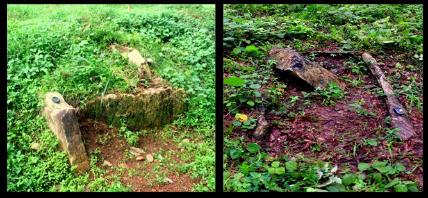
Enadimangalam
Unexcavated cist burials in the Enadimangalam study area, Figure 2, published page 568

Ariyannur · Photographed 2016-09-18 13:33:37
An umbrella stone at Ariyannur, viewed from the front

Cheramanangad · Photographed 2016-09-18 11:27:20
A cluster of low monuments at Kudakkallu Parambu, Cheramanangad

Kattakampal · Photographed 2018-09-30 16:31:58
Two chamber openings at the Kattakampal burial cave

Cheramanangad · Photographed 2016-09-18 11:23:01
An umbrella-stone monument at Kudakkallu Parambu, Cheramanangad
006Two views
Both views are shown at equal weight; this site does not choose between them.
When monument-building began in Kerala
- One view
- Around 1000-900 BCE: T. Satyamurthy (1992), P. J. Cherian and colleagues (2009, for Pattanam) and Abhayan G. S. and Rajesh S. V. (2021). They rely mainly on the early Mangadu, Kuttikol and Pattanam radiocarbon results.
- Another view
- Most monuments belong to the later Iron Age. Jenee Peter (2015) judges most sites late Iron Age. Rachel Varghese (2020) gives the practice a span of about the fifth century BCE to the fifth century CE. Historians following Rajan Gurukkal and M. R. Raghava Varier treat c. 500 BCE-500 CE as one period.
- What would settle it
- Short-lived samples, such as charred seeds, from sealed primary contexts in several monument types and districts, including umbrella stones.
Whether Pattanam's lowest layer was a settlement of the monument builders
- One view
- Yes. Cherian and colleagues (2009) call it the first Iron Age habitation remains found in Kerala. It held coarse red ware, megalithic-type pottery and a little iron.
- Another view
- Not yet shown. N. Nikhil Das, P. P. Joglekar and R. K. Mohanty (2013) say the scarcity of other material needs checking. So does the direct succession by Early Historic layers. Varghese (2020) finds no direct association with the monuments. Abhayan and Rajesh (2021) say no Iron Age settlement has yet been found in Kerala.
- What would settle it
- A wider exposure and full publication of the lower sands, new short-lived dates, or a dated burial ground clearly tied to that occupation.
Whether iron and megalithic burial reached South India first through the Kerala coast
- One view
- Yes: T. Satyamurthy (1992), from the early Mangadu dates.
- Another view
- No: K. Rajan (2014) and Joanna Sudyka (2010) cite earlier dated iron in Karnataka and Tamil Nadu. Sudyka places the culture's origin in the Deccan.
- What would settle it
- Securely dated iron-bearing contexts on the Kerala coast that are older than the inland ones.
007Where next
The survey of Kerala's dated graves is the counterpart to the survey of dated sites in Tamil Nadu between 1000 BCE and 600 CE.
On the timelineDates in this studySee these dates on the timeline
Explore nextIron artifacts displayed in the Iron Age to Early Historic section of Pattanam MuseumAll related studies, connected material, books and sources38 · 19
Elsewhere on this site
Connected material
Photographs, drawings, books, videos and other studies linked to this study. A link helps you explore; it does not prove a historical claim.
- Iron artifacts displayed in the Iron Age to Early Historic section of Pattanam MuseumphotographBackground
- Stone beads on display at Pattanam MuseumphotographBackground
- An umbrella-stone monument at Kudakkallu Parambu, CheramanangadphotographShows the subject
- A low capstone at Kudakkallu Parambu, CheramanangadphotographShows the subject
- Side view of an umbrella-stone monument at Kudakkallu Parambu, CheramanangadphotographShows the subject
- A cluster of low monuments at Kudakkallu Parambu, CheramanangadphotographShows the subject
- Two chamber openings at the Kattakampal burial cavephotographShows the subject
- Steps cut into laterite at the Kattakampal burial cavephotographShows the subject
- A rock-cut bench inside a Kattakampal chamberphotographShows the subject
- Umbrella stones and exposed supports at AriyannurphotographShows the subject
- An umbrella stone at Ariyannur, viewed from the frontphotographShows the subject
- Overview of umbrella stones and an open monument at AriyannurphotographShows the subject
- The cut approach to Eyyal’s burial cavephotographShows the subject
- A raised bench inside the Eyyal burial cavephotographShows the subject
- A dolmen with a front opening in the Marayoor landscapephotographShows the subject
- Side view of a dolmen’s capstone and supporting slabs at MarayoorphotographShows the subject
- Excavated cist burial at Enadimangalam, Figure 1, published page 568photographic figureShows the subject
- Unexcavated cist burials in the Enadimangalam study area, Figure 2, published page 568photographic figureShows the subject
- Ceramics from the Enadimangalam study area, Figure 3, published page 569photographic figureShows the subject
008Sources
The study lists the sources it consulted; we have not rechecked them. A working link does not show that a source was read, and a valid identifier does not show that it supports a claim. We do not link to unofficial uploads or copies of publications. Where a study cited one, we show the published citation, or a publisher, DOI or Internet Archive link when we have one. Tracking codes are removed from links, and the sources themselves are not republished here.
T. Satyamurthy, 1992. The Iron Age in Kerala: A Report on Mangadu Excavation. Thiruvananthapuram: Department of Archaeology, Government of Kerala.
Print or offline sourceSource recordP. J. Cherian, G. V. Ravi Prasad, Koushik Dutta, Dinesh Kr. Ray, V. Selvakumar and K. P. Shajan. 2009. Chronology of Pattanam: a multi-cultural port site on the Malabar coast. Current Science 97(2): 236-240.
P. J. Cherian (and contributors). 2011. Pattanam Excavations 2011: Fifth Season Field Report. Thiruvananthapuram: Kerala Council for Historical Research.
N. Nikhil Das, P. P. Joglekar and R. K. Mohanty. 2013. New Light on the Unresolved Problem of Megalithic Habitation Sites in Kerala. Artha Journal of Social Sciences 12(3): 1-18. doi:10.12724/ajss.26.1.
V. D. Krishnaswami. 1949. Megalithic Types of South India. Ancient India 5: 35-45.
Jenee Peter. 2015. A Study of the Umbrella Stones in Kerala. Heritage: Journal of Multidisciplinary Studies in Archaeology 3: 283-294.
Rachel A. Varghese. 2020. Iron Age Early Historic Monuments of Kerala Region: Rethinking Analytical Gaps. Social Orbit 6: 61-82.
Ambily C. S. 2020. Funerary goods in the Iron Age/Megalithic Burials of Pamba River Basin, South Kerala: A Discussion. Social Orbit 6: 103-129.
Rachel A. Varghese. n.d. Megaliths of Kerala: Commemorating Death through Monuments in Stone. Sahapedia.
Kerala during the 'Age of Iron': Findings from a Recent Excavation
Abhayan G. S. and Rajesh S. V. 2021. Kerala during the Age of Iron: Findings from a Recent Excavation. Ala, issue 36 (31 August 2021).
V. Vinod and Athira R. Pillai. 2016. Iron Age in Kerala: A Short Summary. ICON: Journal of Archaeology and Culture.
K. Rajan. 2014. Iron Age-Early Historic Transition in South India: An Appraisal. Padmashri Amalananda Ghosh Memorial Lecture, 25 August 2014. New Delhi: Institute of Archaeology, Archaeological Survey of India.
Joanna Sudyka. 2010. The 'Megalithic' Iron Age Culture in South India: Some General Remarks. Analecta Archaeologica Ressoviensia 5: 359-401.
Arya Nair V. S. 2021-22. Historical Archaeology of Iron Age and Early Historic Society of Kerala. Heritage: Journal of Multidisciplinary Studies in Archaeology 9: 507-540.
Bhavna Ahlawat, Lomous Kumar, Parayil John Cherian, Jagmahender Singh Sehrawat, Niraj Rai and Kumarasamy Thangaraj. 2023. Deciphering the West Eurasian Genetic Footprints in Ancient South India. Genes 14(5): 963.
Kerala Tourism. 2023. Kudakkallu Parambu, Thrissur. Newsletter issue 356, April 2023.
Outlook Traveller (OT Staff). 2025. Over 100 Megalithic Structures Discovered Near The Malampuzha Dam In Kerala. Updated 24 March 2025.
Minze Stuiver and Henry A. Polach, 1977. 'Discussion: Reporting of 14C Data.' Radiocarbon 19(3): 355–363.
Archaeological Survey of India, Thrissur Circle. n.d. Monuments. Archived copy of 24 February 2015, Internet Archive.
Researchers and institutions whose work this study uses: P. J. Cherian, K. Rajan, V. Selvakumar, K. P. Shajan, T. Satyamurthy, V. D. Krishnaswami, Jenee Peter, Archaeological Survey of India
How we know The evidence, claims and dates behind this study
What this study draws on
- We read the 1992 Mangadu excavation report, including its laboratory sheets and carbon chart, which tie each date to its urn.
- We read the 2009 Pattanam chronology paper, with its table of five dates, and the 2011 field report on Pattanam's lowest layers.
- We compared reviews by Ambily C. S., Rachel Varghese, Jenee Peter, Joanna Sudyka and K. Rajan, and the existing studies in this collection, for the other dates and the monument forms.
- Four specialist works were not read directly for this study, and no external historian or archaeologist has yet reviewed this study.
Dates in this study
| What is dated | Date | How it was dated |
|---|---|---|
| IP-741 2500 BC-AD 100 (95.4%) | 2500 BCE – 100 CE | Laboratory date |
| IP-724 1300-200 BC (95.4%) | 1300–200 BCE | Laboratory date |
| BS-958 1299-902 cal BCE (two standard deviations) | 1299–902 BCE | Laboratory date |
| BS-957 1269-821 cal BCE (99.63%) | 1269–821 BCE | Laboratory date |
| Iron Age period (5th c BCE to 10th c BCE), Pattanam 2011 sequence | 1000–400 BCE | Period assigned by excavators or scholars |
| c. 1000 B.C.-100 B.C. (excavator general chronology for Mangadu) | 1000–100 BCE | Laboratory date |
| 900 BCE and 300 CE (broad Kerala Iron Age range) | 900 BCE – 300 CE | Period assigned by excavators or scholars |
| Kuttikol KTL-4 792-551 BCE in three intervals | 792–550 BCE | Laboratory date |
| Pattanam bone carbonate, cal BC 540-35 across three samples | 540–35 BCE | Laboratory date |
| Nannangadikkunnu early date, 4th to 5th century BCE | 500–300 BCE | Laboratory date |
| circa 5th century BCE to 5th century CE (broad span of the practice) | 500 BCE – 500 CE | Period assigned by excavators or scholars |
| Early Historic-Iron Age transition (2nd c BCE to 4th c BCE), Pattanam 2011 sequence | 400–100 BCE | Period assigned by excavators or scholars |
| Niramakulam Beta-377787 360-170 BCE | 360–170 BCE | Laboratory date |
| circa third century B.C. to first century A.D. (Porkalam) | 300 BCE – 100 CE | Period assigned by excavators or scholars |
| 2nd century BCE to 2nd century CE (Machad and Pazhayannur) | 200 BCE – 200 CE | Period assigned by excavators or scholars |
| first century BCE - first century CE (authors summary of Pattanam bone dates) | 100 BCE – 100 CE | Period assigned by excavators or scholars |
| Tiruvilvamala red ware with yellow wavy lines, just before the Christian era to 1st or 2nd century AD | 100 BCE – 200 CE | Period assigned by excavators or scholars |
| Oliyani 11th-12th century CE | 1001–1200 CE | Laboratory date |
| Kuttikol Burial 1 samples, 15th-17th centuries CE | 1431–1641 CE | Laboratory date |
See these dates on the timeline
The study’s claims
18 claims · 47 source passages · 57 paragraphs
Browse the study paragraph by paragraphKerala's Iron Age is known chiefly from burial monuments and memorials: more than 1,000 sites are recorded, fewer than 25 had been systematically excavated by 2015, and excavated habitation evidence is very limited.
Supported in this study
Counts are those given by Peter 2015; later surveys add sites.
Kerala's monument forms broadly follow geology: dolmens in the granite uplands, slab cists in the uplands and midlands, rock-cut caves and umbrella and hood stones in the laterite midlands, urns almost everywhere; forms also combine in single graves and sites.
Supported with qualifications
A tendency, not a rule: Porkalam combines granite and laterite; Cheramangad holds several forms.
Some excavated umbrella stones, at Cheramangad and Ariyannur, had no urn or interment beneath them, and no stone beads have been found in any excavated umbrella stone.
Supported in this study
Based on few excavations, several without detailed published reports.
The terms umbrella stone, hat stone, hood stone, topikkallu and kudakkallu are used inconsistently across authors, beginning with Babington in 1823.
Supported in this study
Read each label by its author's definition (see “Umbrella stones and rock-cut tombs: distinctive but not unique”).
At Mangadu, BS-958 (2890 +/- 70 BP) dates charcoal inside Urn 6 of Megalith II and BS-957 (2850 +/- 90 BP) charcoal inside Urn 10 of Megalith I, both at 95 cm.
Supported in this study
Dates the sampled charcoal, not every urn or the cemetery as a whole.
The BS-957 laboratory sheet from Mangadu states that its age is based on a 5,730-year half-life, and the BS-958 sheet begins the same wording; if the ages were not converted to the 5,568-year Libby convention, they read about 3 percent older and published calibrations would be somewhat too early.
Unresolved in this study
A question for the laboratory records, not a correction.
Satyamurthy's start of about 1000 BCE and span of about 1000-100 BCE for Mangadu are excavator interpretations built on two radiocarbon results, the stratigraphic position of Urn 12, its iron tools, and comparative bead and pottery dating.
Supported with qualifications
Not a measured date for the start of Kerala's Iron Age.
Kuttikol, Niramakulam and Nannangadikkunnu each produced one radiocarbon result in the first millennium BCE and one or more far later results; the excavators attribute the late Kuttikol and Nannangadikkunnu results to disturbance, and read the later Niramakulam sample, from outside the cist, as activity in a second period.
Supported with qualifications
Calibrated ranges for Kuttikol and Niramakulam taken from studies “Umbrella stones and rock-cut tombs: distinctive but not unique” and “Porkalam 1948: one urn burial that became a reference point”.
Results from Oliyani (810 +/- 80 BP), Poredam (thermoluminescence 1375 +/- 15 years) and Kunnoni (about 1000 CE) are known only from secondary summaries.
Unresolved in this study
Whether these date first use, reuse or intrusive material is not known.
Before laboratory dating, Porkalam (c. 3rd century BCE-1st century CE), Machad and Pazhayannur (2nd century BCE-2nd century CE) and Tiruvilvamala (around the turn of the era) were dated by comparison of beads and pottery.
Supported with qualifications
Comparative dates inherit the uncertainties of the reference sites.
No laboratory date from an umbrella stone or hood stone appears in the sources read; popular statements that Kudakkallu Parambu is over 4,000 years old or was built around 2000 BC have no published dating support.
Supported in this study
A statement about the consulted literature, not proof that no date exists anywhere. An archived 2015 copy of the ASI Thrissur Circle page describes Kudakkallu Parambu without giving a date.
Kerala's earliest laboratory dates are not older than early iron dates from Karnataka and Tamil Nadu, so the proposal that iron and megalithic burial reached South India first through the Kerala coast is not supported by present evidence.
Debated in the sources
Kerala has few dates; absence of older results may reflect sampling.
The burial custom probably continued into the centuries of Pattanam's overseas trade: several Kerala graves date, by laboratory or comparison, between the fourth century BCE and the second century CE.
Supported with qualifications
Rests on few dated graves. The one laboratory-dated cist in this span (Niramakulam, 360-170 BCE) predates the main trading centuries; the overlap rests mainly on comparative dates.
Pattanam's lowest sandy layer (60+ cm, to about 3 m depth) yielded scanty iron, coarse red ware and megalithic-type pottery and two charcoal dates (2623 +/- 180 and 2918 +/- 488 BP), which the excavators use to place the start of occupation in the first half of the first millennium BCE.
Supported in this study
The dates have very wide errors, and table and text ranges differ.
Whether Pattanam's lowest layer is a settlement of the people who built Kerala's burial monuments is contested.
Debated in the sources
Cherian and colleagues: yes; Nikhil Das, Joglekar and Mohanty; Varghese; Abhayan and Rajesh: not yet shown.
Shared materials link the graves and Pattanam: black-and-red and coarse red wares, iron, and semi-precious stones that were placed in graves and worked at the port.
Supported with qualifications
Shared materials do not show that the same people made both.
The 2023 Pattanam bone dates come from contexts the study does not describe, and its results give the youngest raw age a calendar range reaching earlier than that of an older raw age, so they need checking.
Unresolved in this study
No recalculation performed.
Outside Pattanam, Iron Age habitation evidence in Kerala consists of surface scatters and very small trenches near burial grounds, without laboratory dates.
Supported in this study
See also studies “Anakkara: excavated burials in Kerala's Bharathapuzha valley”, “Ordinary settlements beyond the ports are known but hard to count” and “Bharathappuzha basin: many burials, little dated settlement”.
Trace one claim through the study’s records
Explore the evidenceOther source lists
Numbered citation links from the study
The numbered links in the study text point here.
T. Satyamurthy, 1992. The Iron Age in Kerala: A Report on Mangadu Excavation. Thiruvananthapuram: Department of Archaeology, Government of Kerala.
Print or offline sourceSource recordP. J. Cherian, G. V. Ravi Prasad, Koushik Dutta, Dinesh Kr. Ray, V. Selvakumar and K. P. Shajan. 2009. Chronology of Pattanam: a multi-cultural port site on the Malabar coast. Current Science 97(2): 236-240.
P. J. Cherian (and contributors). 2011. Pattanam Excavations 2011: Fifth Season Field Report. Thiruvananthapuram: Kerala Council for Historical Research.
N. Nikhil Das, P. P. Joglekar and R. K. Mohanty. 2013. New Light on the Unresolved Problem of Megalithic Habitation Sites in Kerala. Artha Journal of Social Sciences 12(3): 1-18. doi:10.12724/ajss.26.1.
V. D. Krishnaswami. 1949. Megalithic Types of South India. Ancient India 5: 35-45.
Jenee Peter. 2015. A Study of the Umbrella Stones in Kerala. Heritage: Journal of Multidisciplinary Studies in Archaeology 3: 283-294.
Rachel A. Varghese. 2020. Iron Age Early Historic Monuments of Kerala Region: Rethinking Analytical Gaps. Social Orbit 6: 61-82.
Ambily C. S. 2020. Funerary goods in the Iron Age/Megalithic Burials of Pamba River Basin, South Kerala: A Discussion. Social Orbit 6: 103-129.
Rachel A. Varghese. n.d. Megaliths of Kerala: Commemorating Death through Monuments in Stone. Sahapedia.
Kerala during the 'Age of Iron': Findings from a Recent Excavation
Abhayan G. S. and Rajesh S. V. 2021. Kerala during the Age of Iron: Findings from a Recent Excavation. Ala, issue 36 (31 August 2021).
V. Vinod and Athira R. Pillai. 2016. Iron Age in Kerala: A Short Summary. ICON: Journal of Archaeology and Culture.
K. Rajan. 2014. Iron Age-Early Historic Transition in South India: An Appraisal. Padmashri Amalananda Ghosh Memorial Lecture, 25 August 2014. New Delhi: Institute of Archaeology, Archaeological Survey of India.
Joanna Sudyka. 2010. The 'Megalithic' Iron Age Culture in South India: Some General Remarks. Analecta Archaeologica Ressoviensia 5: 359-401.
Arya Nair V. S. 2021-22. Historical Archaeology of Iron Age and Early Historic Society of Kerala. Heritage: Journal of Multidisciplinary Studies in Archaeology 9: 507-540.
Bhavna Ahlawat, Lomous Kumar, Parayil John Cherian, Jagmahender Singh Sehrawat, Niraj Rai and Kumarasamy Thangaraj. 2023. Deciphering the West Eurasian Genetic Footprints in Ancient South India. Genes 14(5): 963.
Kerala Tourism. 2023. Kudakkallu Parambu, Thrissur. Newsletter issue 356, April 2023.
Outlook Traveller (OT Staff). 2025. Over 100 Megalithic Structures Discovered Near The Malampuzha Dam In Kerala. Updated 24 March 2025.
Minze Stuiver and Henry A. Polach, 1977. 'Discussion: Reporting of 14C Data.' Radiocarbon 19(3): 355–363.
Archaeological Survey of India, Thrissur Circle. n.d. Monuments. Archived copy of 24 February 2015, Internet Archive.
Citation numbers without a matching source
This citation number has no matching entry in the study’s source list.
About this study Status, corrections and how it was made
Status
Draft study, revision 6. No historian, archaeologist, or Tamil or Malayalam specialist has reviewed it yet.
How it was made
Compiled as an editorial synthesis from published scholarship around questions we framed. About this project & workflow
The summary, How sure lines and Two views notes on this page were prepared from this study and cross-checked against its passages. That is an editorial check, not a specialist review.
Technical details
Study code R255. The text fingerprint changes whenever the study text changes.
- The study text is shown as written. Links from its paragraphs to citations help you move around the study; they are not new claims or checked source passages.
See how this study’s records were extracted
Text fingerprint (SHA-256): R255 · b0b35335f16e36104dfd034e… · v6
Evidence tables and technical details are on the web page: https://layersofthesouth.org/read/e17dbed59b