Stone moulds and small seal-like objects in a Pattanam Museum display
Pattanam
Photographed 2019-01-05
- Belief & memory
- 200 BCE–300 CE
Amulet and goddess labels on early objects go beyond the evidence
Testing objects from Pattanam, Molapalayam, Modur and Kodumanal, and an early Tamil poem, finds no object of the period securely shown to be protective.
- How sure
- 1 Likely
- 1 Possible
- 2 Not known
- This page
- 3,684 words · revision 6
Draft study · Awaiting specialist review · Updated
001Dates and places

No mapped place in this study.
Before 1000 BCE
1000–500 BCE
Different beginnings
500–200 BCE
Marks & materials
200 BCE–300 CE
Connected worlds
300–600 CE
Change & continuity
- approximately 1600-1400 BCE
- first to second century CE
- 4th century CE
- Laboratory date
- Period assigned by excavators or scholars
- How it was dated is not stated
Each date belongs to what was dated (a sample, an object, a layer or a text), which is not always the event the study asks about.
Each period has the same width, so spacing is not to scale.
The full table of dates, with their ranges, is under How we know.
- 1 Likely
- 1 Possible
- 2 Not known
002How sure
In brief
This study tests whether any early object from Kerala or Tamil Nadu can be shown to ward off harm. Several early Tamil poems are reported in secondary accounts to describe protective acts – guarding the wounded, the newborn, and doorways with neem leaves, white mustard, and ghee (Puṟanāṉūṟu 281, 296; Neṭunalvāṭai 86; Naṟṟiṇai 40; not checked in an edition here) – but those perishable substances leave no recognisable artefact. Among wearable or excavated items, Kuruntokai 161 shows a child wearing a tiger-tooth pendant (tāli), and Puṟanāṉūṟu 77 is cited for a boy-king's tāli, neither stating a protective purpose; Pattanam's engraved agate sphinx ring has a conflicting findspot record and may be a seal or workshop product; Molapalayam's 'owl-shaped amulet' comes from a site dated to about 1600–1400 BCE; and Modur's 'Mother Goddess' figurine lacks published context. None of the tested excavated objects from 1000 BCE–600 CE is securely shown to be protective.
Key researchers cited in this study: V. Selvakumar (Maritime & Prehistoric Archaeology) · Full bibliography
How sure
- Likely
Early Tamil poems are reported to describe protective acts with neem leaves, white mustard and ghee, while Kuruntokai 161 shows a child wearing a tiger-tooth pendant.
Several early poems are reported to describe protective acts with neem leaves, white mustard and ghee (Puṟanāṉūṟu 281, 296; Neṭunalvāṭai 86; Naṟṟiṇai 40; not checked against an edition here), while Kuruntokai 161 depicts wearing a tāli without stating protection.
- Possible
The tiger-tooth pendant was meant to protect the child.
A Sangam lexical resource glosses such items as amulets, though the verse itself does not state protection.
- Not known
What the Pattanam sphinx ring was used for.
Seal, ornament, traded gem or workshop product all fit; the findspot record conflicts.
- Not known
Whether Modur's 'Mother Goddess' figurine depicts a goddess.
The public page gives no layer, object number or argument for divine identity.
Why it matters
It shows why labels such as 'amulet' and 'Mother Goddess' need context or texts, not just an object's look.
003Key findings
What the study concludes
- No high-confidence core-period protective object was established in the bounded corpus.
- The Molapalayam amulet label should remain attributed until its primary catalogue and context are read.
- Mother Goddess, eye-protection and votive labels require evidence beyond visual resemblance.
- Later apotropaic South Indian objects are useful comparators but do not prove continuity.
In the study’s own words. How sure each point is, is shown above.
The summary above is the short read. The full study is the complete text it was drawn from, with its tables and source notes.
What the full study covers
- Question, scope, and public-facing orientation
- Method, admissible inference, and search boundaries
- Archaeological corpus and object-by-object findings
- Textual evidence and the four functional-label tests
- Chronology, later comparisons, and discriminating disagreements
- Conclusions, limitations, and source priorities
004The study
Question, scope, and public-facing orientation
Which regional objects, if any, can be identified as protective or apotropaic on contextual or textual evidence?
This study tests the label “protective objects” rather than treating it as a finding. The geographical center is Kerala and Tamil Nadu, with connected-region or later material admitted only where it helps discriminate interpretations. The period covered is 1000 BCE–600 CE, but the investigated evidence falls into several chronological lanes: the Molapalayam shell object is earlier background; Pattanam, Tirukkovilur and much of the relevant early historic material fall within the target period; the Modur public presentation spans mixed Neolithic/Megalithic contexts whose exact object chronology is not recoverable from the web record read here; and museum objects from seventeenth- to nineteenth-century southern India are used only as later comparisons. ↗1 ↗2 ↗3 ↗4 ↗5
Two carnelian intaglios displayed at Pattanam Museum, photographed through the case
Pattanam
Photographed 2019-01-13
Orientation
The result is deliberately conservative. No individual excavated archaeological object in the corpus examined here can presently be identified with high confidence as protective or apotropaic (meant to ward off harm) in 1000 BCE–600 CE solely from a secure excavated context combined with a contemporary text explaining its protective purpose. (Early Tamil poems do explicitly describe protective acts – such as guarding the wounded, the newborn, and doorways with neem leaves, white mustard, and ghee – but those perishable substances leave no recognisable artefact.) That is not evidence that protective objects did not exist. It means that the particular labels tested here – amulet, goddess, eye-protection, and votive – often outrun what surviving context demonstrates.
Three cases are especially instructive.
At Pattanam, an engraved banded-agate seal ring with a sphinx motif is a real and unusually specific object, but the available sources support its identification as an engraved ring/intaglio and its relevance to gem working and exchange more securely than they support an apotropaic function. PAMA describes a sphinx seal ring from the site and places it within evidence for lapidary and other craft activity; Alfred Bosch Surís's 2025 article develops a workshop interpretation. A newspaper account quoting excavator P. J. Cherian supplies further object details and a first–second-century CE stylistic date, but the accessible sources conflict over the object's trench identifier. ↗6 ↗7 ↗3
At Molapalayam, recent reporting attributes the label “owl-shaped amulet” to a marine-shell object, but the site is substantially earlier than the 1000 BCE–600 CE period covered here – approximately the second millennium BCE – and the primary object catalogue, locus, accession number, wear study, and figure were not checked directly. The functional word amulet therefore remains an attributed interpretation, not an independently established protective use. ↗1 ↗8 ↗2
Old Tamil poetry supplies a different kind of evidence. Kuruntokai 161 depicts a child wearing a tiger-tooth tāli (pulippal tāli), making bodily suspension considerably more secure than it is for many excavated ornaments. But the accessible verse does not itself state that the object wards off danger or supernatural harm. A modern Sangam lexical resource calls such items ornaments/amulets and assembles additional literary occurrences, while also entertaining social or emblematic readings. The strongest defensible formulation is therefore “a child-worn tiger-tooth pendant/object class whose protective significance is possible but not demonstrated by the consulted verse.” ↗9 ↗10
This study is evidence-limited: several potentially decisive primary catalogues and reports were not read directly for this study. The negative conclusions below therefore concern what can currently be demonstrated, not what once existed.
Method, admissible inference, and search boundaries
The test used here separated five inferential steps that are frequently collapsed in archaeological writing:
| Evidentiary step | What would strengthen a protective identification | What does not suffice by itself |
|---|---|---|
| Object form | Suspension hole, mounting, wear, repeated standardized form | Zoomorphic, female, eye-like or “mystical” appearance |
| Context | Secure body placement, doorway placement, curated household deposit, shrine or structured ritual deposit | Presence in a settlement, burial or “religious-looking” assemblage without finer context |
| Contemporary text | Text explicitly describes wearing/placing the object to avert danger, disease, spirits, the evil eye, etc. | A text merely mentions wearing an ornament |
| Inscription/dedication | Inscribed purpose, recipient, deity or protective formula securely associated with the object | Modern museum or excavation label |
| Comparative evidence | Closely contextualized parallels can make a hypothesis more plausible | Similar-looking objects centuries later treated as proof of continuity |
That hierarchy matters because apotropaic function is behavioral, not morphological. An object can have a sphinx, female figure, animal tooth, eye-like circle, mask or unusual material without its ancient user having treated it as a protective device. Conversely, a visually ordinary bead or pendant could have carried such a function without leaving an archaeologically recoverable marker.
The search therefore prioritized site or government archaeology pages, excavation-report records, recent analytical work, text witnesses/translations, and museum catalogues with explicit functional interpretation. Secondary news reporting was used where it preserved statements attributed to excavators or disclosed a newly published find, but it was not elevated to primary archaeological documentation. The search also deliberately retained contradictory object identifiers and inaccessible primary reports instead of harmonizing them.
For the Pattanam sphinx, the site's current project page reports a Greek she-sphinx seal ring under the identifier PT21 LXV; the page's excavation sequence also refers to trench PT20 LXV. The Federal's 2023 account gives PT 20 XLV and says the small banded-agate object was recovered while sieving soil in 2020. Those strings may represent a typographical or transcriptional discrepancy, but the primary field register is necessary to resolve it. ↗7 ↗3 The discrepancy is consequential because the exact findspot is needed to judge the object's context.
For Molapalayam, bibliographic discovery located V. Selvakumar and colleagues' 2026 scientific-investigations paper, while independent contemporary reporting describes 2021 and 2024 excavations and second-millennium-BCE radiocarbon results. The full 2026 paper was not read directly for this study, so no laboratory code, raw determination, or calibrated interval is tabulated here. ↗1 ↗2
For Modur, the Tamil Nadu Department of Archaeology's public page supplies excavation history and the label “Mother Goddess,” while bibliographic records identify the 2005 Government of Tamil Nadu excavation publication. Its full text was not checked directly. ↗11 ↗12 ↗4 “Modur: a Neolithic settlement beneath later Iron Age layers” covers what is known of Modur's site sequence.
The search was bounded rather than systematic: it was designed to test several promising object classes and inherited labels, not to certify that every excavated pendant, bead, figurine or inscribed object in Kerala and Tamil Nadu has been screened. Consequently, “no secure eye-protection object was identified” reflects the corpus consulted here, not proof that none existed.
Archaeological corpus and object-by-object findings
A small corpus can be assembled, but it is better described as a test corpus of claimed or potentially relevant objects than as a corpus of demonstrated amulets.
| Object / assemblage | Site and chronology | Identifier/context available in read source | Historical identification history | Protective assessment |
|---|---|---|---|---|
| Banded-agate sphinx seal ring/intaglio | Pattanam, Kerala; stylistically reported first–second c. CE | Conflicting PT21 LXV / PT20 LXV / PT20 XLV; exact locus unresolved |
Seal ring; sphinx; later workshop hypothesis | Unproven |
| “Owl-shaped” marine-shell object | Molapalayam, Tamil Nadu; roughly 1600–1400 BCE in available site chronology | No accession/locus recovered here | Called an “amulet” in report quoting excavator | Unresolved; attributed label only |
| Terracotta female figurine | Modur, Tamil Nadu; mixed Neolithic/Megalithic site presentation | Public site page gives no object number/layer | Official page calls it “Mother Goddess” | Goddess and protective functions unproven here |
| Red-ware sherd with female figure | Tirukkovilur, Tamil Nadu; fourth c. CE | Public excavation-page description | Female figure, not identified there as goddess | No protective evidence found |
| Urn-associated 782 carnelian beads | Kodumanal, Tamil Nadu; early historic/megalithic context | Assemblage described by state archaeology page | Beads in funerary assemblage | No protective/eye function demonstrated |
Pattanam sphinx ring
PAMA's current-project account identifies the object as a sphinx seal ring and situates the excavations within a much larger assemblage that has produced evidence of craft activity. Bosch Surís's 2025 article, available here at abstract/landing-page level, proposes that the broader find pattern points toward a local gem-craft workshop. ↗6 ↗3 The Federal reports that the approximately 1.2 cm oval object is carved in banded agate and was recovered by sieving excavated soil; it relays a first–second-century CE stylistic attribution. ↗7
A sphinx can carry symbolically charged meanings in Mediterranean visual traditions, but iconographic charge is not equivalent to demonstrated apotropaic function in this particular South Indian archaeological context. Plausible alternatives include a personal seal, prestige ornament, traded gem, workshop product, ownership marker, or object whose imagery had several simultaneous meanings. The current evidence does not discriminate decisively among those possibilities.
The object is therefore significant to this study mostly because it exposes the danger of shortcut reasoning: “mythic creature → protective emblem → wearer shared a particular religion” would require several unsupported transitions. Neither religious identity nor continuity of a sphinx belief can be read from the motif alone.
Molapalayam shell object
Recent reporting describes marine-shell manufacturing evidence from the wider Tamil region and quotes excavator V. Selvakumar regarding shell beads and an “owl-shaped amulet” from Molapalayam. ↗8 The site's reported AMS chronology centers around approximately 1600–1400 BCE, putting it in earlier background, before the 1000 BCE start of the period covered here. ↗1 ↗2
Here the word amulet is precisely what needs testing. To upgrade it from descriptive label to functional identification would require the primary catalogue entry or figure, exact context, dimensions, perforation and use-wear, and preferably the excavators' explicit argument for why “amulet” is better than pendant, bead, emblem or decorative blank. None of those decisive details was established from the material read here. It should therefore be catalogued provisionally as an owl-shaped shell object, interpreted by the excavator/reporting source as an amulet.
Modur female figurine
The Tamil Nadu Department of Archaeology states that Modur, excavated in 2004–05, produced terracotta figurines including a ram/goat and what the public page calls a “Mother Goddess.” ↗4 But the public page does not supply enough object-specific stratigraphy to establish whether the female figurine belongs to a particular Neolithic or Megalithic phase, nor does it present evidence that the ancient users identified the figure as a goddess or used it protectively.
That distinction follows a wider archaeological methodological problem: modern “Mother Goddess” labels have often rested on circular interpretation of female figurines rather than on inscriptions or contextual demonstration. Ratnagar's critique of such reasoning at Mohenjo-daro is not direct evidence about Modur, but it is a relevant warning against converting sexed morphology into divine identity without local proof. ↗13
Accordingly, “female terracotta figurine; officially labelled Mother Goddess” is preferable to adopting Mother Goddess as the object's demonstrated ancient identity.
Tirukkovilur and Kodumanal as controls
The Tamil Nadu archaeology page for Tirukkovilur reports a red-ware sherd with an embedded female figure and dates it to the fourth century CE. It does not, in the accessible description, turn that figure into a goddess or protective object. ↗5 It is a useful control because it demonstrates why “female image” should not automatically become “goddess figurine.”
At Kodumanal, the state archaeology account reports an urn associated with 782 carnelian beads. ↗14 The quantity and funerary association are archaeologically important, but neither abundance nor burial placement establishes eye protection or amuletic function. Beads can be ornaments, wealth, status signals, gifts, curated possessions, ritual deposits, or carry additional meanings that survive archaeologically only when contextual or textual evidence permits them to be recovered.
Textual evidence and the four functional-label tests
Protective acts in the poems
Several early Tamil poems are reported in secondary scholarship to describe protective acts with perishable materials – fixing neem leaves to a house, scattering or burning white mustard with ghee, and smearing door-posts (Puṟanāṉūṟu 281 and 296, Neṭunalvāṭai 86, and Naṟṟiṇai 40; those passages were not checked against a critical Tamil edition for this study). Even where such rites are described, perishable leaves, seeds, and ghee leave no recognisable excavated object.
Wearable objects: the tiger-tooth tāli
One local textual lead concerns a wearable object class rather than a named excavated find: Kuruntokai 161 shows a child wearing a tiger-tooth pendant (pulippal tāli), and secondary discussions also cite Puṟanāṉūṟu 77 for a boy-king's tāli (not checked in an edition here), neither stating a protective purpose. ↗9 A Sangam lexical compilation cross-references further occurrences in Purananuru and Akananuru, glosses the term as a child-worn ornament or amulet, and also discusses emblematic or clan-marker possibilities. ↗10
Even here, the inference stops one step earlier than “demonstrated protective amulet”: Kuruntokai 161 shows how the object class was worn on a child's body, without itself stating a protective purpose.
The four labels tested here can therefore be resolved as follows:
| Label | Result | Why |
|---|---|---|
| Amulet | Qualified / unresolved | Molapalayam has an excavator-attributed “amulet” label, whose functional basis was not checked in the full 2026 paper. Tiger-tooth tāli is bodily worn, but explicit protective purpose was not found in the consulted verse. |
| Goddess | Not demonstrated for protective use | Modur's state page uses “Mother Goddess,” but publicly accessible object context does not establish divine identity or apotropaic function. |
| Eye-protection | negative result limited to the sources read | No exact core-period Kerala/Tamil Nadu object in the investigated corpus was securely tied to protection from the eye by contextual or contemporary textual evidence. |
| Votive | Not established in this corpus | No investigated object was shown to combine secure dedicatory context or inscription with a demonstrable offering act. |
The eye-protection issue deserves special caution because visual analogy can be particularly seductive. A Metropolitan Museum catalogue entry for an eighth- to tenth-century Egyptian spindle whorl notes that a dot-in-circle motif may function as an abstract protective eye while explicitly leaving decoration or unknown meaning possible. ↗15 That nonregional example is useful not as evidence for Tamil or Kerala practice but because it models the correct epistemic form: even where an eye interpretation is plausible, alternatives remain active until context discriminates among them.
Likewise, “votive” should refer to an offering relationship, not merely to an object whose shape seems religious. A shrine context, dedicatory text, patterned deposition, or comparably specific practice would materially strengthen the designation. None was established for the objects above.
The critical distinction is between the existence of a later securely interpreted protective form and the historical transmission of that function backward through time.
Chronology, later comparisons, and discriminating disagreements
The chronology makes direct continuity claims especially hazardous.
Later South Indian museum objects show that protective interpretations are entirely plausible in the region in much later historical settings. The Metropolitan Museum describes a seventeenth- to nineteenth-century marriage pendant (thali), attributed to Chennai, in terms that include protection and fertility; it describes a nineteenth-century southern Indian Nagar hair ornament as incorporating well-known apotropaic kirtimukha motifs. ↗16 ↗17 These records establish later attributed protective functions. They do not demonstrate that a first-century gem, a much earlier shell object, or an Old Tamil tiger-tooth pendant participated in an unchanged tradition.
The strongest disagreements are therefore not over whether protection was conceptually possible, but over how much evidence is needed to assign it to a specific object.
For Pattanam, a protection reading would become materially stronger if the ring's primary locus showed deliberate placement connected with the body, threshold, burial or ritual feature; if microscopic wear established long-term mounted use; or if close contextual parallels carried explicit protective inscriptions. Conversely, documentation that it was unfinished workshop stock, an ordinary seal, or redeposited craft debris would shift the balance away from a personal amulet interpretation. PAMA and Bosch Surís currently make the site's lapidary/workshop context a serious alternative that must be tested rather than bypassed. ↗6 ↗3
For Molapalayam, the disagreement can be made empirical: obtain the complete 2026 scientific publication and original object record, establish locus and stratigraphy, inspect the shell object's perforation and wear, determine whether “owl” describes an intentional image rather than a modern visual resemblance, and identify the argument by which the excavators chose amulet. Until then, “protective” is unresolved rather than false. ↗1 ↗8
For the tiger-tooth tāli, the decisive next step is philological rather than archaeological: inspect critical editions and commentaries for the relevant Kuruntokai, Akananuru and Purananuru passages and distinguish what the poems say from what commentators or modern lexicographers infer. The available Kuruntokai witness securely supports bodily wearing, while the protective function remains an interpretive step. ↗9 ↗10
For Modur, the missing discriminator is the primary excavation report's catalogue and context documentation. If a figurine came from a structured deposit alongside repeated ritual features, that could strengthen a ritual interpretation; even then, “goddess” and “protective goddess” would remain separate propositions unless supported independently. ↗11 ↗4
Thus the later comparanda belong in a later comparison, not a genealogy.
Conclusions, limitations, and source priorities
The most defensible answer to the question is:
Regional protective practice is plausible and later South Indian comparanda explicitly preserve apotropaic interpretations, but the small early corpus investigated here does not yet contain a core-period object whose protective function can be demonstrated at high confidence from object-specific archaeological context plus contemporary explanatory evidence.
Several narrower findings are stronger.
The Pattanam sphinx is securely important as an engraved seal-ring/intaglio associated with a site that has substantial lapidary evidence, but “protective sphinx amulet” is not established. ↗6 ↗7 ↗3
Molapalayam supplies a real lead explicitly called an “owl-shaped amulet” in recent reporting, but it is earlier than the period covered here and the primary object documentation required to evaluate the word amulet was not checked directly. ↗1 ↗8 ↗2
Old Tamil pulippal tāli evidence establishes a body-worn tiger-tooth object class more securely than it establishes an apotropaic purpose. ↗9 ↗10
Modur demonstrates why official archaeological terminology must remain attributed: “Mother Goddess” is the state archaeology page's label, but neither goddess identity nor protective function follows automatically from a female terracotta form. ↗13 ↗4
Tirukkovilur and Kodumanal are valuable negative controls: female imagery need not become “goddess,” and a large bead assemblage need not become “protective beads” without further evidence. ↗14 ↗5
The appropriate naming is therefore descriptive first: “sphinx seal ring,” “owl-shaped shell object, interpreted as an amulet,” “female terracotta figurine, officially labelled Mother Goddess,” “female-figure sherd,” “carnelian-bead assemblage,” and “tiger-tooth tāli/pendant.” Protective, divine or votive functions should be added only as explicitly attributed interpretations unless stronger documentation is recovered.
Sources still needed
The most consequential unresolved work is narrowly identifiable rather than an undifferentiated call for “more research”:
| Priority | Missing source | What it could resolve |
|---|---|---|
| Highest | Selvakumar et al., 2026 Molapalayam scientific-investigations paper, including figures/tables | Shell-object context, identifier, dating samples and grounds for “amulet” |
| Highest | Government of Tamil Nadu, Excavations … Modur (2004–2005), complete catalogue/plates | Figurine locus, phase, object number and whether “Mother Goddess” is argued or simply labelled |
| Highest | Pattanam field/object register for sphinx ring plus full Bosch Surís article | PT21 LXV / PT20 LXV / PT20 XLV discrepancy; object context and workshop argument |
| High | Critical editions/commentaries for cited Kuruntokai, Akananuru and Purananuru passages | Whether protection is explicit, commentarial or modern inference |
| High | Regional museum/excavation accession searches for securely provenanced pendants and eye motifs | Tests whether the negative result on eye protection changes |
No sample-level dates are given here, because raw laboratory determinations, sample materials, curve information and calibrated probability ranges were not available in enough detail. This keeps site chronology separate from sample-level evidence.
Prioritized source register
Primary and institutional sources
-
PAMA, “Pattanam,” current-project page. Object and campaign descriptions; read as web text. URL:
https://www.pama.org.in/currentprojects/Pattanam↗3 -
Tamil Nadu Department of Archaeology, “Modur.” Public excavation summary; read as web text. URL:
https://www.tnarch.gov.in/modur↗4 -
Tamil Nadu Department of Archaeology, “Tirukkovilur.” Public excavation summary. URL:
https://www.tnarch.gov.in/tirukkovilur↗5 -
Tamil Nadu Department of Archaeology, “Kodumanal.” Public excavation summary. URL:
https://www.tnarch.gov.in/kodumanal↗14 -
Ti. Śrī Śrītar and colleagues, Excavations of Archaeological Sites in Tamilnadu, Modur (2004–2005), Government of Tamil Nadu, 2005. Bibliographic record verified; full report was not read directly for this study. URL:
https://openlibrary.org/books/OL31701917M/Excavations_of_archaeological_sites_in_Tamilnadu_Modur_%282004-2005%29↗11 ↗12
Analytical and scholarly sources
-
Alfred Bosch Surís, “The Sphinx of Pattanam. A Game-Changing Workshop in India,” Acta Asiatica Varsoviensia 38 (2025): 5–29. DOI
10.60018/AcAsVa.tmnx3233. Abstract consulted; full article was not read directly for this study. URL:https://aav.iksio.pan.pl/en/numer/2025-38/529/↗6 -
V. Selvakumar et al., “Scientific investigations at the Neolithic site of Molapalayam, Coimbatore District, Tamil Nadu, India,” Proceedings of International Symposium on Recent Scientific Studies in Archaeology of Tamil Nadu 1 (2026): 185–216. Bibliographic metadata verified; full paper was not read directly for this study. URL:
https://rhinoresourcecenter.com/library/references/115843-2/↗1 -
Shereen Ratnagar, “A critical view of Marshall’s Mother Goddess at Mohenjo-Daro,” Studies in People’s History 3, no. 2 (2016): 113–127. DOI
10.1177/2348448916665714. Used strictly as a methodological comparator, not evidence about Modur. ↗13
Textual and lexical witnesses
-
“Kuruntokai 1–200,” Learn Sangam Tamil, including poem 161 in Tamil and English. This is an accessible presentation, not here claimed to be a critical edition. URL:
https://learnsangamtamil.com/%E0%AE%95%E0%AF%81%E0%AE%B1%E0%AF%81%E0%AE%A8%E0%AF%8D%E0%AE%A4%E0%AF%8A%E0%AE%95%E0%AF%88-1-200/↗9 -
Sangampedia, lexical entry for புலிப்பல்தாலி (pulippal tāli), used to identify additional textual leads and alternative interpretations; not treated as a substitute for critical editions. ↗10
Later comparative museum records
-
Metropolitan Museum of Art, “Marriage Pendant (Thali),” accession 91.1.1146, attributed to Chennai, seventeenth–nineteenth century. Used only as later comparison. URL:
https://www.metmuseum.org/art/collection/search/444681↗16 -
Metropolitan Museum of Art, “Hair Ornament (Nagar),” accession 15.95.124, southern India, nineteenth century. Used only as later comparison. URL:
https://www.metmuseum.org/art/collection/search/454097↗17 -
Metropolitan Museum of Art, Egyptian spindle whorl, accession 21.6.100, eighth–tenth century. Nonregional methodological comparison showing that even an apparent eye motif can retain decorative/unknown alternatives. URL:
https://www.metmuseum.org/art/collection/search/447348↗15
Overall judgement: the conclusion is intentionally bounded: the present corpus supports objects interpreted as amulets, objects labelled as goddesses, body-worn object classes, and later demonstrably apotropaic comparanda, but it does not justify converting those categories into an uninterrupted regional history of protective objects.
005Photographs
Photographs of the places and objects this study discusses. Each item carries its creator’s credit, licence and documented source. See all 412 photographs and source images ↗
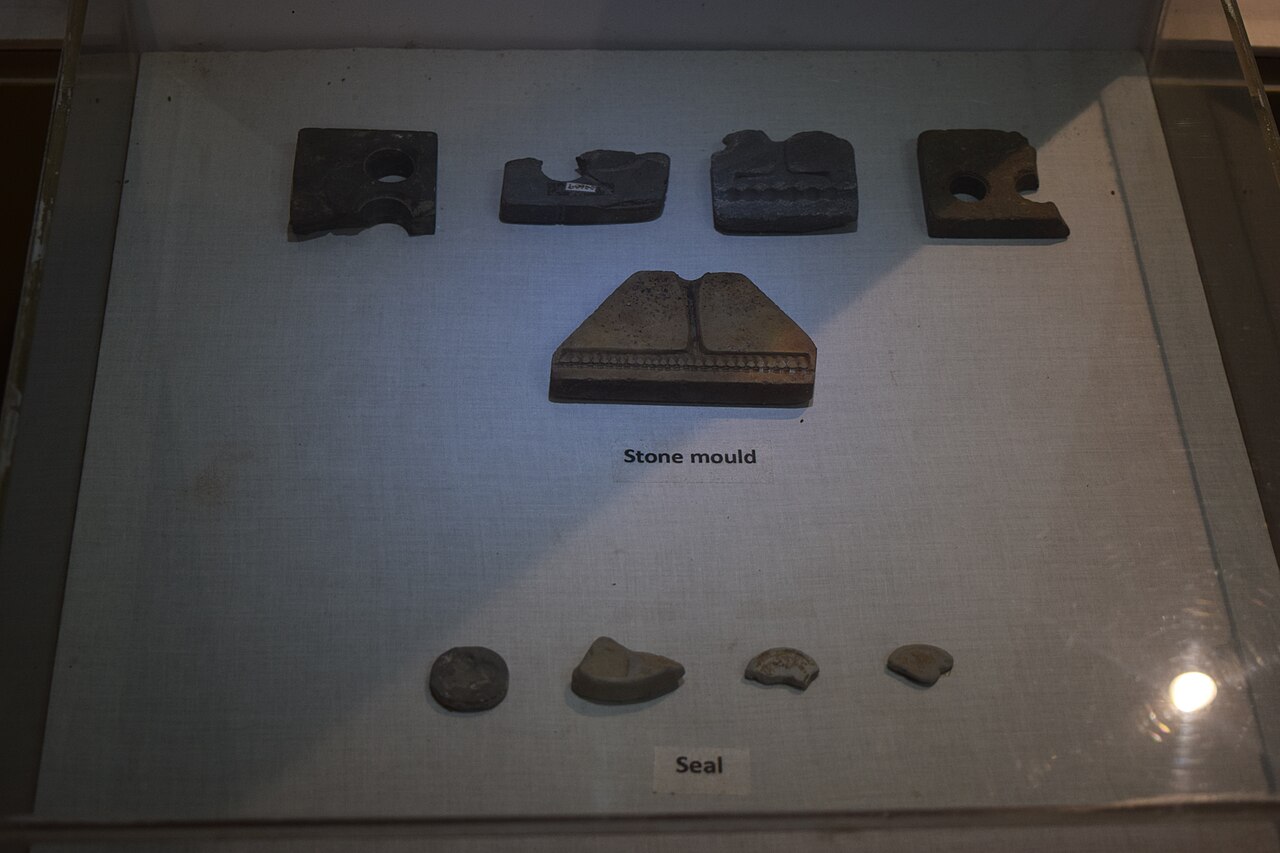
Pattanam · Photographed 2019-01-05 16:28:00
Stone moulds and small seal-like objects in a Pattanam Museum display
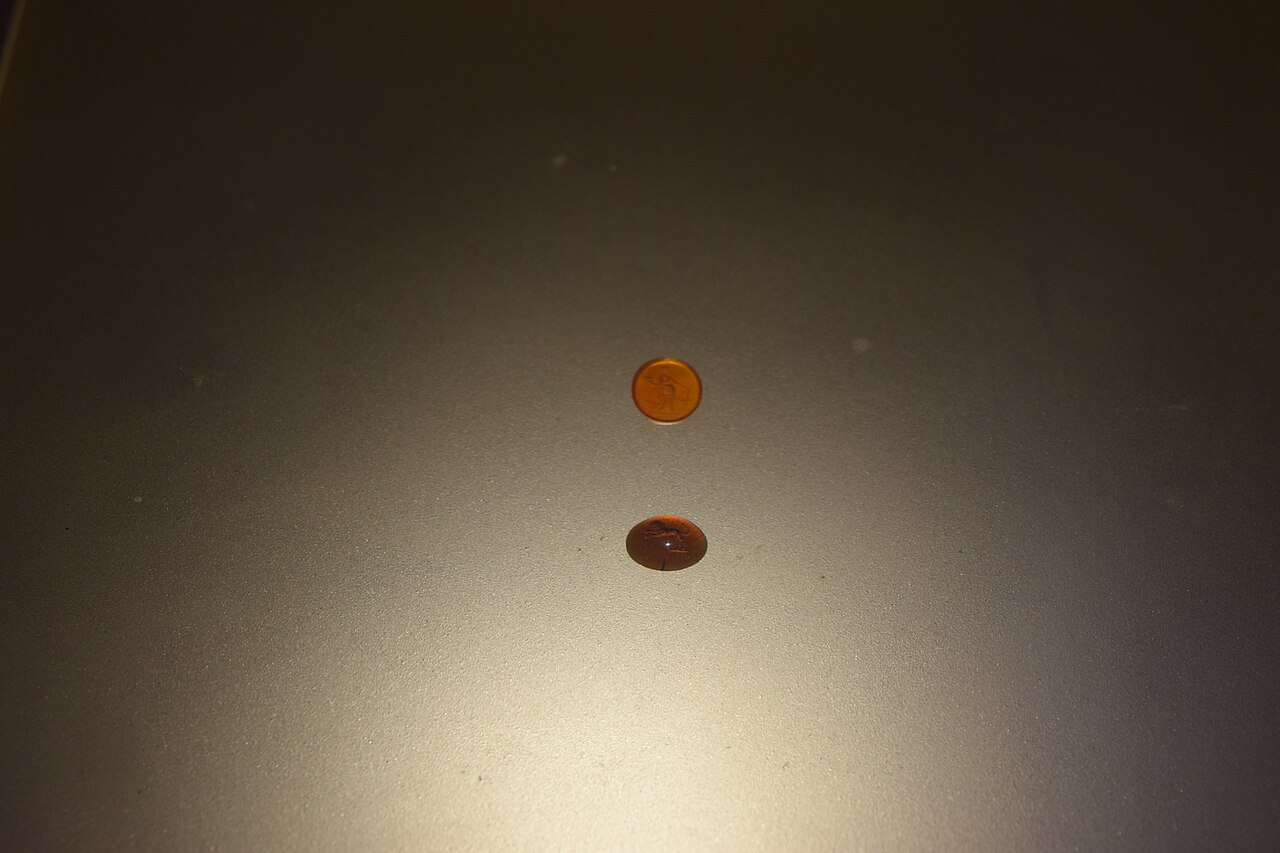
Pattanam · Photographed 2019-01-13 15:33:34
Two carnelian intaglios displayed at Pattanam Museum, photographed through the case
006Two views
Both views are shown at equal weight; this site does not choose between them.
Whether Modur's female figurine is a 'Mother Goddess'
- One view
- Tamil Nadu's archaeology department labels the Modur female figurine a 'Mother Goddess'.
- Another view
- Following critiques such as Ratnagar's, this study calls it a female figurine until context shows more.
- What would settle it
- The 2005 Modur excavation report's catalogue: layer, object number and associated finds.
007Where next
 Related study
All related studies, connected material, books and sources20 · 16
Elsewhere on this site
Connected material
Photographs, drawings, books, videos and other studies linked to this study. A link helps you explore; it does not prove a historical claim.
- Stone moulds and small seal-like objects in a Pattanam Museum displayphotographShows the subject
- Two carnelian intaglios displayed at Pattanam Museum, photographed through the casephotographShows the subject
- Two carnelian intaglios (standing figure and leaping lion) displayed at Pattanam MuseumphotographShows the subject
008Sources
The study lists the sources it consulted; we have not rechecked them. A working link does not show that a source was read, and a valid identifier does not show that it supports a claim. We do not link to unofficial uploads or copies of publications. Where a study cited one, we show the published citation, or a publisher, DOI or Internet Archive link when we have one. Tracking codes are removed from links, and the sources themselves are not republished here.
PAMA. Pattanam. Current Projects.
Alfred Bosch Surís, The Sphinx of Pattanam. A Game-Changing Workshop in India, Acta Asiatica Varsoviensia 38 (2025): 5-29.
M. T. Saju, The man who led to the Sphinx intaglio in Kerala's Pattanam, The Federal.
V. Selvakumar et al., Scientific investigations at the Neolithic site of Molapalayam, Coimbatore District, Tamil Nadu, India, Proceedings of International Symposium on Recent Scientific Studies in Archaeology of Tamil Nadu 1 (2026): 185-216.
Tamil Nadu excavators unearth ancient shell industry off Gulf of Mannar
Times of India report quoting excavator V. Selvakumar concerning marine-shell objects including an owl-shaped amulet.
After 3,500-year-old rhino bones, remains of nilgai, black bucks found in Western Ghats
New Indian Express, 11 February 2026, report on Molapalayam excavations and radiocarbon chronology.
Kuruntokai 1–200
Learn Sangam Tamil, Kuruntokai 1-200, including poem 161 with Tamil text and English translation.
Sangampedia lexical entry புலிப்பல்தாலி (pulippal tali).
Tamil Nadu Department of Archaeology, Modur.
Ti. Śrī Śrītar et al., Excavations of archaeological sites in Tamilnadu, Modur (2004-2005), Government of Tamil Nadu, 2005.
A critical view of Marshall’s Mother Goddess at Mohenjo-Daro
Shereen Ratnagar, A critical view of Marshall's Mother Goddess at Mohenjo-Daro, Studies in People's History 3(2), 2016, 113-127.
Tamil Nadu Department of Archaeology, Tirukkovilur.
Tamil Nadu Department of Archaeology, Kodumanal.
Metropolitan Museum of Art, Marriage Pendant (Thali), accession 91.1.1146.
Metropolitan Museum of Art, Hair Ornament (Nagar), accession 15.95.124.
Metropolitan Museum of Art, Egyptian Spindle Whorl, accession 21.6.100.
Researchers and institutions whose work this study uses: V. Selvakumar
How we know The evidence, claims and dates behind this study
What this study draws on
- A five-step test of each object: its form, context, contemporary texts, inscriptions and later comparisons.
- Site pages from PAMA and Tamil Nadu's archaeology department, plus a 2023 newspaper report on the sphinx ring.
- Kuruntokai 161 in Tamil and English, and a Sangam word-list entry for pulippal tāli.
- Metropolitan Museum records for a later South Indian pendant and hair ornament, used only for comparison.
Dates in this study
| What is dated | Date | How it was dated |
|---|---|---|
| approximately 1600-1400 BCE | 1600–1400 BCE | Laboratory date |
| first to second century CE | 1–200 CE | Period assigned by excavators or scholars |
| 4th century CE | 301–400 CE | How it was dated is not stated |
See these dates on the timeline
The study’s claims
9 claims · 16 source passages · 65 paragraphs
Browse the study paragraph by paragraphWithin the bounded corpus read here, no core-period regional object can be identified at high confidence as protective or apotropaic through object-specific archaeological context combined with contemporary explanatory evidence.
Supported with qualifications
This is a negative result limited to the sources read conclusion, not proof that protective objects did not exist. Several primary catalogues remain priority source to check.
Accessible Pattanam sources conflict over the sphinx object's identifier, reporting forms including PT21 LXV, PT20 LXV and PT 20 XLV.
Debated in the sources
The discrepancy should not be silently normalized.
The official Modur page uses the label Mother Goddess for a terracotta figurine, but the accessible object context does not independently establish goddess identity or protective function.
Supported with qualifications
Female morphology, deity identity and protective function are three separate propositions.
No exact core-period Kerala or Tamil Nadu object in the bounded corpus was securely linked to eye protection by both contextual and contemporary textual evidence.
Supported with qualifications
This is a negative result limited to the sources read, not a claim that eye-protection practices were absent.
No investigated object was shown to have a secure votive identification based on an explicit dedication, unambiguous shrine deposition or equivalent object-specific evidence.
Supported with qualifications
A religious-looking form is not equivalent to a votive act.
Later southern Indian museum objects have explicit catalogue-level apotropaic or protective interpretations, but these cannot establish uninterrupted continuity back into the early historic or prehistoric corpus.
Supported in this study
Comparison is not genealogy. No unchanged belief or transmission is inferred.
Decorative resemblance alone is insufficient to infer ancient religious identity, protective purpose or historical transmission.
Supported in this study
Context, wear, inscriptions, explicit texts or patterned deposition can change the assessment.
Descriptive object nomenclature should be retained where functional interpretation is underdetermined: sphinx seal ring, owl-shaped shell object interpreted as an amulet, female figurine officially labelled Mother Goddess, female-figure sherd, carnelian-bead assemblage, and tiger-tooth tali.
Supported in this study
Functional claims can be upgraded if primary context or textual evidence warrants it.
All four tested functional labels – amulet, goddess, eye-protection and votive – fail at least one necessary evidentiary step in the bounded early corpus.
Supported in this study
Failure of the present test is not proof of historical absence.
Trace one claim through the study’s records
Explore the evidenceOther source lists
Numbered citation links from the study
The numbered links in the study text point here.
Scientific investigations at the Neolithic site of Molapalayam, Coimbatore District, Tamil Nadu, India – Rhino Resource Center
After 3,500-year-old rhino bones, remains of nilgai, black bucks found in Western Ghats
PAMA - Bridging the Past, Present and Future.
Modur | Department Of Archaeology
Tirukkovilur | Department Of Archaeology
The Sphinx of Pattanam. A Game-Changing Workshop in India | Acta Asiatica Varsoviensia (AAV) 38 | Acta Asiatica Varsoviensia (AAV)
The man who led to the Sphinx Intaglio in Kerala’s Pattanam | The man who led to the Sphinx Intaglio in Kerala’s Pattanam
Tamil Nadu excavators unearth ancient shell industry off Gulf of Mannar | Chennai News - The Times of India
எட்டுத்தொகை – குறுந்தொகை 1-200 – Learn Sangam Tamil
பு – முதல் சொற்கள் | சங்கம்பீடியா
Excavations of archaeological sites in Tamilnadu, Modur (2004-2005) by Ti. Śrī Śrītar | Open Library
Excavations of archaeological sites in Tamilnadu, Modur (2004-2005) | WorldCat.org
A critical view of Marshall’s Mother Goddess at Mohenjo-Daro - Shereen Ratnagar, 2016
Kodumanal | Department Of Archaeology
Spindle Whorl - The Metropolitan Museum of Art
Marriage Pendant (Thali) - The Metropolitan Museum of Art
Hair Ornament (Nagar) - The Metropolitan Museum of Art
About this study Status, corrections and how it was made
Status
Draft study, revision 6. No historian, archaeologist, or Tamil or Malayalam specialist has reviewed it yet.
The study itself says more research is needed before its question can be settled.
How it was made
Compiled as an editorial synthesis from published scholarship around questions we framed. About this project & workflow
The summary, How sure lines and Two views notes on this page were prepared from this study and cross-checked against its passages. That is an editorial check, not a specialist review.
Technical details
Study code LTS-SUP10. The text fingerprint changes whenever the study text changes.
- The study text is shown as written. Links from its paragraphs to citations help you move around the study; they are not new claims or checked source passages.
See how this study’s records were extracted
Text fingerprint (SHA-256): LTS-SUP10 · c0b4c1598db990924d0d87a5… · v6
Evidence tables and technical details are on the web page: https://layersofthesouth.org/read/d6e6000341