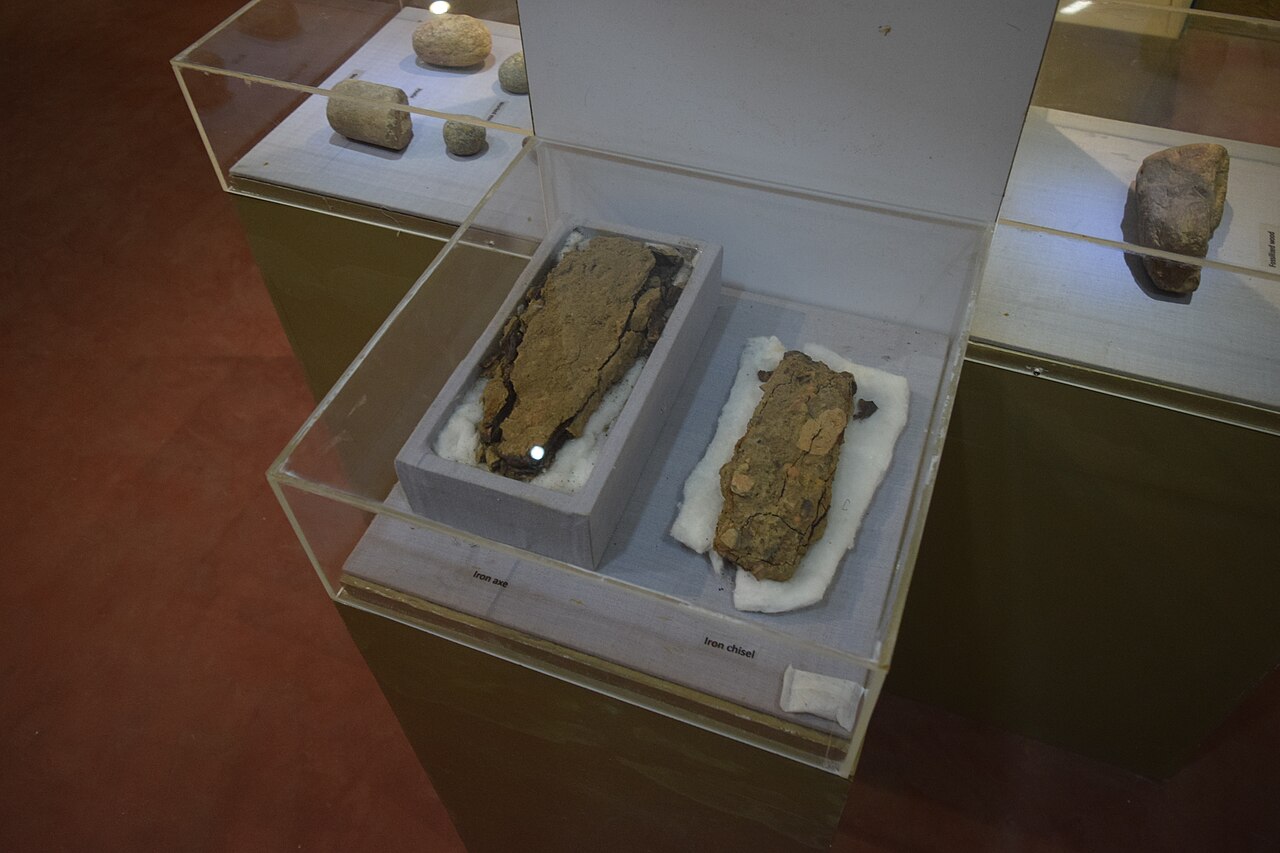
Iron artifacts displayed in the Iron Age to Early Historic section of Pattanam Museum
Pattanam
Photographed 2019-01-05
- Across the water
- Pattanam
Pattanam finds: wide trade links, unevenly dated and sourced
Pattanam's pottery, beads and other finds show regional and overseas trade, but each type has a different strength of date and source.
- This page
- 4,737 words · revision 6
Draft study · Awaiting specialist review · Updated
001Dates and places
Places on the atlas that name this study.
- Pattanam
Excavated area · Coarse district orientation shown (~1–5 km)
1000–500 BCE
Different beginnings
500–200 BCE
Marks & materials
200 BCE–300 CE
Connected worlds
300–600 CE
Change & continuity
After 600 CE
- Early Historic period (3rd century BCE to 5th century CE)
- Early historic period (2nd Century BC to 4th Century AD), 1.70 m-2.5 m in the sampled trench
- late first century BC to first three-quarters of the first century AD
- Sasanian (AD 224-651) to Early Islamic period
- Period assigned by excavators or scholars
- How it was dated is not stated
Each date belongs to what was dated (a sample, an object, a layer or a text), which is not always the event the study asks about.
Each period has the same width, so spacing is not to scale.
The full table of dates, with their ranges, is under How we know.
- 1 Well supported
- 1 Likely
- 1 Possible
- 1 Not known
002How sure
In brief
Pattanam, in central Kerala, was excavated by the Kerala Council for Historical Research in 2007–2015 and by the PAMA institute in 2019–2023. Its finds include Italian tableware of around the turn of the era, amphorae from Campania and the Rhodes area, and hundreds of Indian rouletted-ware sherds. West Asian glazed wares and torpedo jars form a separate, partly later group. More than 100,000 glass beads were found, and Shinu Anna Abraham studied about 8,100 of them. Up to 75% are Indo-Pacific drawn beads, but she had no chemical data to show where they were made. Stone-bead waste studied by Gwen Kelly is stronger evidence of bead-making on site. A lead peak of 426 ppm points to human-caused enrichment but does not identify a Roman workshop. Most finds still lack published trench-by-trench records, so a complete dated inventory is not yet possible.
Key researchers cited in this study: P. J. Cherian (KCHR Pattanam Excavations) · V. Selvakumar (Maritime & Prehistoric Archaeology) · K. P. Shajan (Geoarchaeology & Periyar Palaeochannels) · Roberta Tomber (Indo-Roman Ceramic Analysis) · Full bibliography
How sure
- Well supported
Imported Mediterranean pottery reached Pattanam around the turn of the era.
A published specialist study identified the sigillata and amphora fabrics, with thin-section work.
- Likely
Stone beads were made at Pattanam.
Kelly's 2024 abstract reports stone-bead waste flakes and raw material of agate, carnelian and chalcedony from the 2007–2008 seasons; the full article was not read for this study.
- Possible
Lead in Pattanam's soils came from metalworking.
Lead enrichment is measured, but its source and any link to workshops are untested.
- Not known
Where Pattanam's glass beads were made.
No chemical data yet; bead shapes alone cannot identify a workshop.
Why it matters
Sorting finds by type and date stops objects from different centuries being merged into one imagined Roman port.
The summary above is the short read. The full study is the complete text it was drawn from, with its tables and source notes.
What the full study covers
003The study
Overview and scope
What can be assembled into a phase-sensitive inventory of Pattanam finds from published evidence?
What a bead is made of, where it was worked and where it was found are separate questions. At Kodumanal quartz was worked on site; the carnelian Kelly examined was made elsewhere.
The plate’s Pattanam figures, 108 bead pieces with 37 finished and 71 unfinished or worked, come from Kelly’s study of these finds.
Layers of the South editorial illustration
This study is the finds inventory for Pattanam: what has been found, grouped by type, with how securely each type is dated and sourced. It is one of three Pattanam studies: “Pattanam is a candidate for ancient Muziris” asks whether Pattanam was the ancient port of Muziris, and “Pattanam's radiocarbon dates give no single date for its wharf” examines the dated sequence and the waterfront. The main window is 1000 BCE–600 CE, but earlier background, later material and mixed chronologies are identified rather than forced into that window.
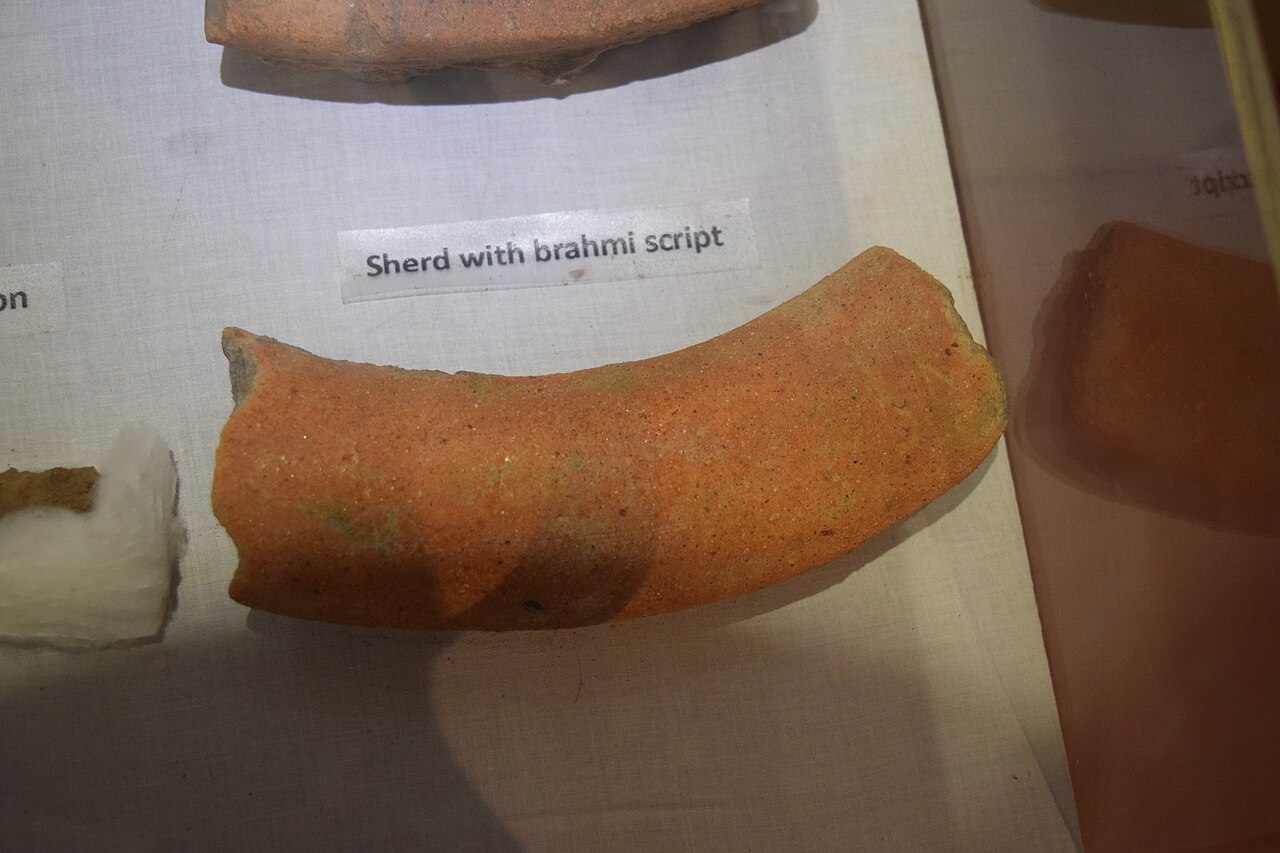
A sherd displayed as bearing Tamil-Brahmi writing at Pattanam Museum
Pattanam
Photographed 2018-01-21
The tracing is not a facsimile or an independent reading of the inscription.
Synthesis & Core Assessment
A substantial but not campaign-complete inventory can be assembled. The recoverable literature is strongest for selected classes: Mediterranean and West Asian ceramics, glass beads, stone-bead manufacture, a small body of published chronological evidence, and a recent geochemical study. It is much weaker for a unified trench-by-trench catalogue covering all KCHR excavations from 2007–2015 and the later PAMA campaigns. Institutional pages demonstrate that the excavated corpus is far larger than the material individually documented in the specialist publications reviewed here, but those aggregate totals cannot safely substitute for locus-level records. ↗1 ↗2
The most defensible phase model is therefore mixed chronology rather than “Roman Pattanam.” Accessible sources distinguish activity beginning in the first millennium BCE, a particularly visible Early Historic occupation extending through the centuries around the turn of the era, Sasanian and Early Islamic material that crosses or post-dates the 600 CE end of the main window, and medieval/modern occupation. The 2009 chronology abstract places Iron Age activity in the first half of the first millennium BCE; “Pattanam's radiocarbon dates give no single date for its wharf” examines the radiocarbon dates for that early occupation and for the waterfront timbers. A 2026 study uses a trench-specific division of 2nd century BCE–4th century CE for its Early Historic band, with later deposits above it. ↗3 ↗4
Within the core period, the strongest evidence for genuinely distant imports comes from diagnostic ceramic fabrics and typology. An excavated Italian sigillata fragment was dated typologically to the late 1st century BCE or early 1st century CE; approximately 50 or more Roman amphora sherds known to the 2008 authors included Campanian/Bay of Naples fabric and Rhodian material, with thin-section study used to characterize otherwise non-diagnostic fabrics. Hundreds of Indian rouletted-ware fragments document substantial interregional circulation within South Asia rather than a specifically “Roman” assemblage. ↗5
West Asian material requires its own period. Turquoise-glazed wares and bitumen-lined torpedo jars in the early ceramic publication span the Sasanian into Early Islamic period; proposed South Arabian organic-tempered pottery also carried a stated Gulf alternative. These categories therefore cannot simply be folded into a first-century-CE “Indo-Roman” phase. ↗5 A specifically relevant specialist contribution has now been bibliographically recovered – V. Buffa's “Report on pottery of South Arabian origin at Pattanam site,” published on pp. 47–51 of the 2014 eighth-season report – but its text was not read for this study. ↗6 ↗7
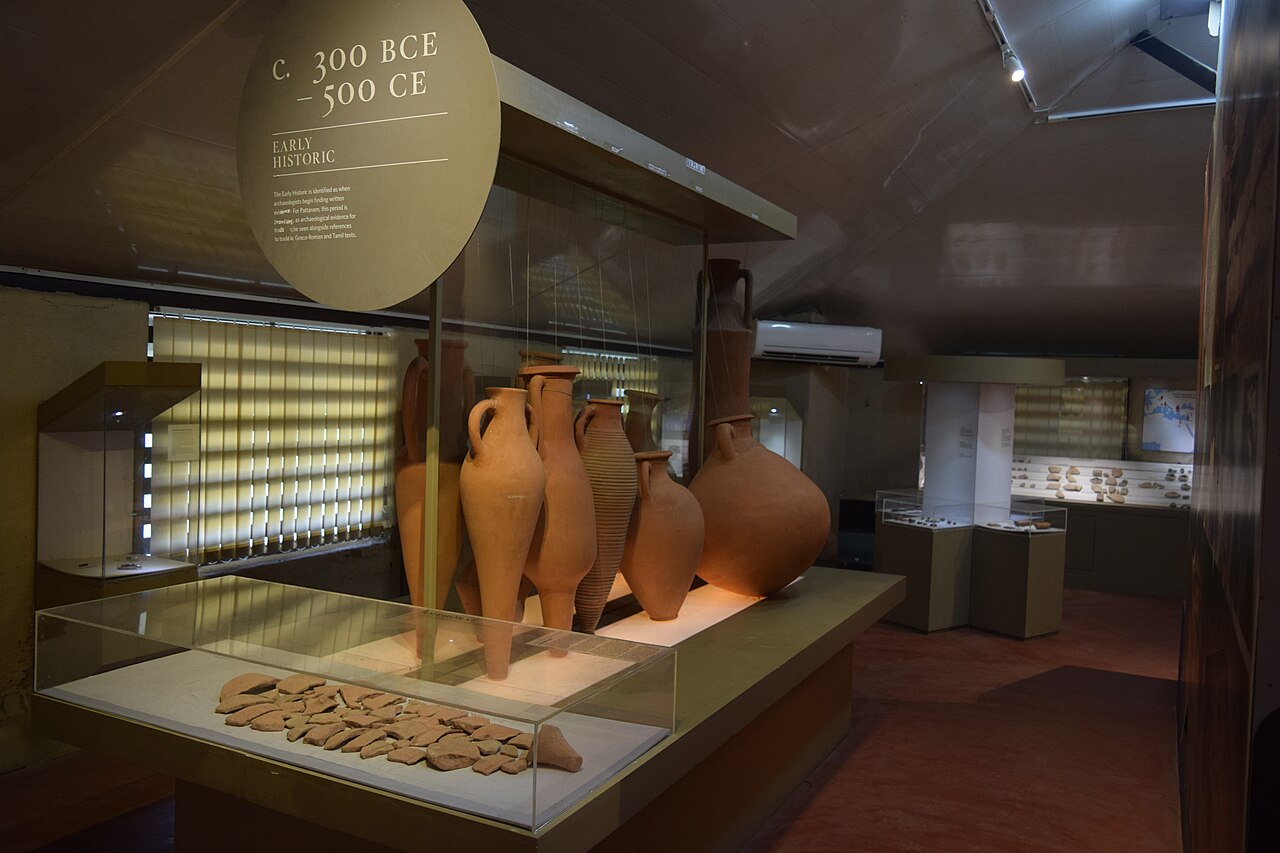
An amphora profile assembled from pottery sherds at Pattanam Museum
Pattanam
Photographed 2019-01-13
COMPARE WITH ANOTHER STUDY
Two studies read one Pattanam bead report to different depths
Both studies use Kelly’s 2024 report on stone beads from Pattanam. One cites specific pages; the other read only its published summary. Reading more of the report in one study does not confirm a statement in the other. Before saying that beads were made at Pattanam in a given period, check the pages, phases and limits Kelly gives.
Read the other study: Pattanam's stone beads show pecking; their drilling is unresolved
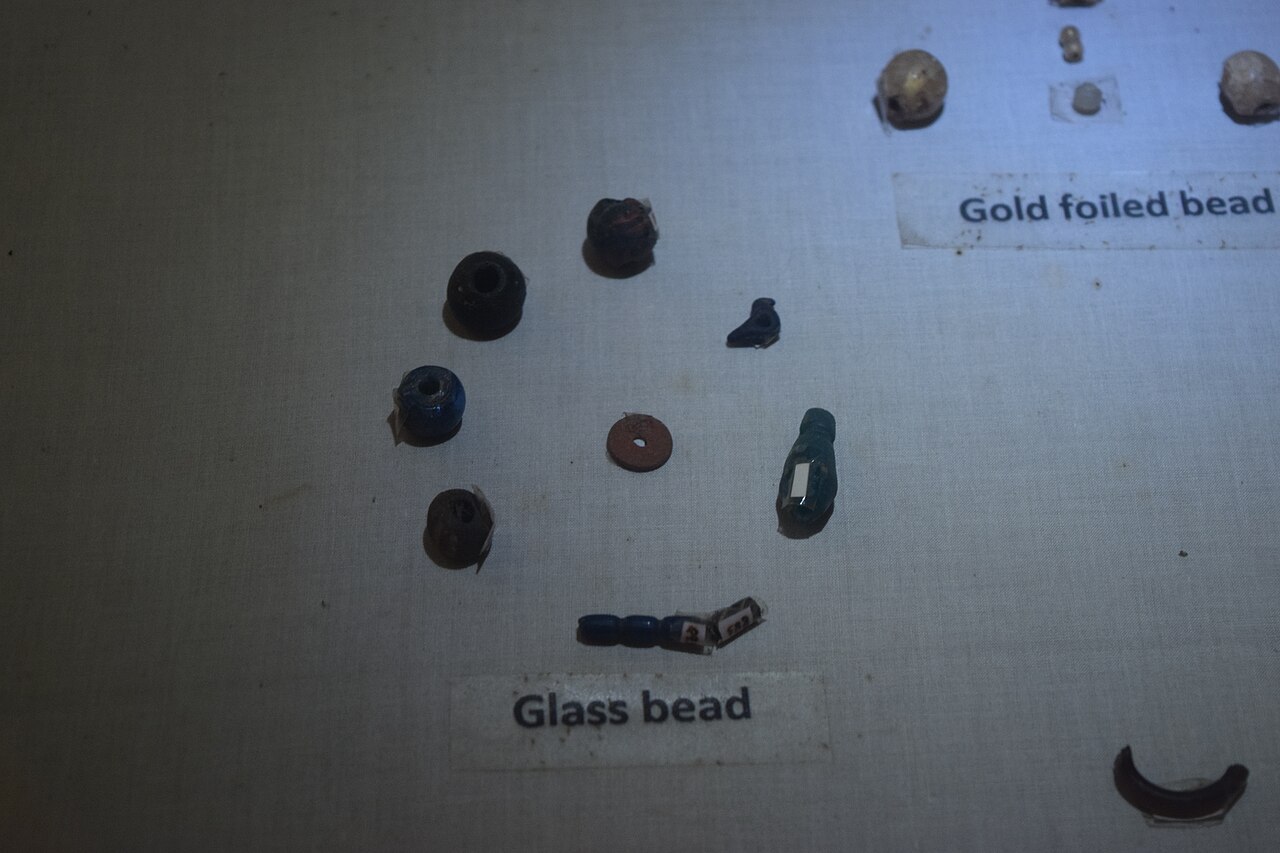
The bead evidence sharply demonstrates why presence, production and provenance must be separated. Shinu Anna Abraham's 2021 study states that Pattanam's glass-bead assemblage exceeded 100,000 pieces, but only a little over 8,100 from the 2007, 2008 and part of the 2009 seasons had then been catalogued for her study. Up to about 75% were Indo-Pacific drawn beads, yet Abraham explicitly states that chemical data for Pattanam beads were lacking; therefore morphology and inter-site parallels cannot establish a particular workshop of origin. ↗8 In contrast, stone-bead debitage and raw material from 2007–2008 provide considerably stronger evidence for local manufacture: Gwen O. Kelly's 2024 journal abstract identifies working of agate, carnelian and chalcedony and a “pecking” manufacturing method. Kelly also rejects a simple one-to-one mapping between technological tradition and ethnic group. ↗9
The 2026 geochemical paper adds a valuable observation but illustrates another inferential boundary. Its XRF measurements found Pb reaching 426 ppm at 2.6 m, with strong enrichment over part of the sampled profile. That supports anthropogenic lead enrichment. It does not, by itself, identify the lead as Roman, demonstrate recycling of Roman metal, or identify a “Roman” workshop: those stronger propositions require provenance-sensitive chemistry such as lead-isotope analysis and tighter archaeological association with metallurgical installations, slag, crucibles or securely contextualized metal objects. ↗3
Finally, the equation Pattanam = Muziris should remain a qualified historical identification, not a premise of the assemblage inventory. The 2008 ceramic team said that there was a strong argument for the equation while explicitly presenting continuing excavation as necessary to determine it. The material evidence for an important maritime settlement stands whether or not the ancient toponym is ultimately settled; “Pattanam is a candidate for ancient Muziris” weighs that identification in full. ↗5
Two carnelian intaglios displayed at Pattanam Museum, photographed through the case
Pattanam
Photographed 2019-01-13
Overall result: this study supports a selective, source-traceable phase inventory and rejects a homogeneous “Roman port assemblage.” It does not yet support a complete object inventory across all excavated seasons, because several foundational excavation reports, radiocarbon tables, archaeobotanical records, accession data and later campaign contexts remain inaccessible or absent from the sources consulted.
Evidence base, access and method
This study prioritizes excavator and specialist publications alongside institutional records, using later syntheses chiefly to trace bibliographic details. Searches were made for Pattanam excavation reports, ceramic analyses, radiocarbon chronology, glass and stone beads, archaeobotany, West Asian pottery, institutional object records and recent analytical studies. The search was deliberately source-led rather than claimed as systematic or exhaustive.
The most important directly read evidence comprised the publisher-hosted 2008 Antiquity ceramic article; an author-uploaded full-text version of Abraham's 2021 glass-bead chapter; the official abstract of Kelly's 2024 stone-bead paper; publisher HTML and extracted PDF text for the 2026 geochemistry paper; and current institutional pages from PAMA and Mahatma Gandhi University. ↗9 ↗3 ↗1 ↗5 ↗2 ↗8
Important access limits were encountered. The 2009 Current Science chronology article could be identified precisely – P. J. Cherian et al., vol. 97(2), pp. 236–240 – but only its abstract was readable; “Pattanam's radiocarbon dates give no single date for its wharf” recovers the early sample-level dates from other reports. ↗4 The 2014 eighth-season report was recovered bibliographically as a 685-page KCHR volume edited by P. J. Cherian, ISBN 9788185499550, but its contents were not accessible through the consulted Google Books record. ↗6 Kelly's 2024 journal page was readable through the abstract, but its full text was not read for this study. ↗9
The 2026 geochemical paper was text-accessible through the publisher and as PDF-extracted text. Because the archaeological interpretation depends in part on a trench section and depth profile, the figures matter, but they were unavailable for direct viewing for this study. This study therefore does not claim visual inspection of Figure 2, Figure 3 or the table layout. The numerical statements retained below are those exposed in publisher text. ↗3
The evidence was evaluated through five separate steps: observation → identification method → dating basis → interpretation → qualification. Thus, for example, “Pb = 426 ppm at 2.6 m” is an analytical observation; “anthropogenic enrichment” is an inference from enrichment indices; and “recycled Roman material” is a further historical interpretation. Likewise, “Campanian black-sand fabric” rests on ceramic/petrographic comparison, while “Roman resident merchant” would be a social inference that the ceramic fragment alone cannot establish. This distinction is especially necessary because the MGU museum page itself mixes object description with interpretive suggestions about consumers and glass-bead origins. ↗3 ↗1 ↗5
A further chronological control is essential: excavation year is not object date. A seal ring or statuette excavated in a 2021 campaign does not become a twenty-first-century artefact; conversely, a class described as “Greco-Roman” on an institutional page is not securely first-century CE until its stratigraphic position, typology and preferably a specialist publication establish that chronology. PAMA identifies an intaglio seal ring and miniature head from PT21 LXV by Greco-Roman stylistic comparison, but the accessible project page does not expose a complete locus/depth publication sufficient to enter those pieces as securely phased core-period objects. ↗2
Phase-sensitive inventory
The following inventory deliberately records only the degree of resolution recoverable in the consulted evidence.
| Period | Assemblage / find class | Campaign and context recoverable here | Dating / provenance basis | Custody or publication status | Assessment |
|---|---|---|---|---|---|
| Earlier background into core period | Iron Age occupation; charcoal; wharf posts/bollards; dugout canoe | KCHR 2007 waterfront context | Radiocarbon dates on charcoal and wood; “Pattanam's radiocarbon dates give no single date for its wharf” gives the five early calibrated ranges and their laboratory | Published in 2009 Current Science; sample-level dates recovered in “Pattanam's radiocarbon dates give no single date for its wharf” from other reports | Dated broadly; see “Pattanam's radiocarbon dates give no single date for its wharf”. The timber dates do not give a construction date for the wharf. ↗4 |
| Core period | Italian sigillata | Excavated Early Historic level; read 2008 paper does not expose a sufficiently precise trench/locus for this inventory | Ceramic form/fabric; late 1st c BCE or early 1st c CE | Published specialist ceramic study | Strong import identification, weak precise context recovery. Presence does not establish resident Roman ethnicity. ↗5 |
| Core period | Roman amphorae | Surface finds plus Early Historic excavation phases; approximately 50+ sherds by 2008 | Fabric/type study, including Campanian/Bay of Naples volcanic fabric, probable other Italian fabrics and Rhodian Peraea; thin-section work for some fabrics | Specialist ceramic publication | Strong evidence for imported transport ceramics. Count is an early publication count, not the total from all later seasons. ↗5 |
| Core period | Indian rouletted ware | Surface/excavated Pattanam assemblage; specific object register absent from the sources consulted | Typological comparison; hundreds reported; distribution compared especially with east-coast sites | Specialist ceramic publication | Strong evidence for interregional circulation. It is Indian/regional evidence, not “Roman” evidence and not proof of a producer ethnicity. ↗5 |
| Core-to-later mixed | Turquoise-glazed ware, bitumen-lined torpedo jars and organic-tempered imports | Excavated and surface material; exact later season distribution requires excavation reports | Typology and stratigraphic position; Sasanian-to-Early-Islamic for some classes; possible Hadramawt source with Gulf alternative for organic-tempered fabric | 2008 specialist synthesis; exact Buffa 2014 South Arabian chapter recovered but not yet read | West Asian material must remain distinct. Some evidence lies after 600 CE. ↗7 ↗5 |
| Core and medieval mixed | Glass beads, especially Indo-Pacific drawn beads | Abraham studied 2007, 2008 and part of 2009; >8,100 catalogued in that subset from a total corpus >100,000 | Morphology, manufacturing method and contextual phase; no Pattanam chemical provenance data in the 2021 chapter | Full specialist chapter read | Large and important corpus, but production source unresolved chemically. Bulk of Indo-Pacific beads came from layers labelled Early Historic or Medieval. ↗8 |
| Core/mixed | Gold-glass and “false beryl” glass beads | 2007, 2008 and part of 2009 | Morphology and broad inter-site chronology; 28 gold-glass pieces/fragments and 57 false-beryl pieces/fragments in reviewed subset | Specialist chapter | Presence securely reported; origin less secure. Gold-glass objects occurred through trench depths, and comparable types have long chronological lives. ↗8 |
| Mainly core-period craft evidence, exact phasing still to recover | Stone beads, debitage and raw materials | 2007–2008 seasons | Finished objects plus production debris/raw material; agate, carnelian and chalcedony emphasized; pecking manufacture | 2024 BEADS abstract read; full paper inaccessible | Best present evidence for local bead production, stronger than stylistic provenance alone. Context/count details were not read for this study. ↗9 |
| Trench-specific Iron Age/Early Historic analytical sequence | Heavy-metal sediment profile | One 7 × 4 m, 3 m-deep trench sampled at 10 cm intervals; the original excavation campaign identifier is not given in the method text read | XRF; Pb reaches 426 ppm at 2.6 m and EF >20 there; study assigns Early Historic/Iron Age bands by depth | Open publisher text; figures not viewed for this study | Lead enrichment is measured. “Roman metallurgy” is not directly proven by XRF. ↗3 |
| Unphased/mixed pending analytical documentation | Pepper, cardamom, frankincense, rice, pulses and other botanical material | Institutional pages aggregate finds across excavation history; sample IDs/loci not supplied | PAMA/MGU institutional identification; PAMA describes characterization and archaeomolecular work as prospective | Institutional statement; no specialist archaeobotanical report was found | Inventory as reported material only. Do not yet use as sample-level proof of export, cultivation or origin. ↗1 ↗2 |
| Campaign date 2019–2023; archaeological dates unresolved here | Pottery, beads, metals, worked stones, bricks, roof tiles, ring wells; PT21 LXV intaglio and miniature head | PAMA trenches 62–67; official page identifies PT21 LXV for two unusual objects | Institutional descriptions/style comparisons; detailed stratigraphic publication absent from the sources consulted | PAMA says these later-campaign finds are stored between its Pattanam facility and a local bank locker | Campaign inventory only, not securely phased object inventory. “Possible minting workshop” and Greco-Roman identifications remain attributed interpretations. ↗2 |
This table demonstrates a recurrent asymmetry in the evidence. Ceramic studies often provide diagnostic fabric, type and chronological reasoning, whereas institutional summaries more often provide impressive aggregate counts without the underlying per-context ledger. MGU, for example, currently states that eight KCHR seasons produced 129,083 artefacts, 516,676 diagnostic potsherds, 140,165 non-Indian pottery sherds and 4.5 million local body sherds. Those numbers are valuable evidence of collection scale, but the webpage does not expose the counting rules, full season distribution, locus matrix or object-by-object publication required to turn them into a phase-sensitive database. ↗1
The same MGU page says that its displayed Pattanam section includes amphorae, glass beads, torpedo-jar fragments, roof tiles, ring-well material, stone objects and bead-making chips. That makes the museum an important custody/catalogue lead, but the webpage does not establish that every excavated class is presently held there or provide accession identifiers that reconcile the display with KCHR's larger collection. ↗1
Provenance, production and what the assemblages actually establish
Mediterranean evidence
The clearest “Roman” component is ceramic rather than ethnic. The Italian sigillata and some amphora fabrics have geographically diagnostic technological and petrographic characteristics, allowing source regions to be proposed with materially grounded methods. The 2008 authors identify the commonest amphora as a wine-amphora fabric from Campania/Bay of Naples and describe additional Italian and Rhodian material. That supports movement of vessels – or fragments of them – over long distances. ↗5
It does not tell us directly who personally transported, sold, opened or consumed the contents, whether a vessel was reused, or whether a resident community from the Mediterranean lived beside the find. The MGU museum page goes further and suggests western merchants and local elites as likely consumers of amphora contents; that can be retained as an institutional interpretation, not converted into a demonstrated social identity. ↗1
The rouletted ware is analytically important because it prevents the assemblage from being narrated solely along a Rome–Kerala axis. The 2008 paper reports hundreds of fragments of a class especially concentrated on India's east coast, making movement between Indian regions part of the same archaeological picture. ↗5 The appropriate starting point is therefore multi-directional exchange, not a binary “Roman trade” model.
West Asian evidence
The West Asian pottery is chronologically and geographically different from the Mediterranean assemblage. Turquoise-glazed ware and bitumen-lined torpedo jars span Sasanian and Early Islamic horizons in the 2008 treatment. Organic-tempered fabrics were compared with South Arabian material from Hadramawt, but the authors expressly retained a Gulf alternative. ↗5 This uncertainty is productive: petrography, chemistry and better stratigraphic publication could discriminate between candidate source zones without using broad visual resemblance as proof.
The source trail improves with the recovery of Buffa's exact 2014 chapter, “Report on pottery of South Arabian origin at Pattanam site,” pp. 47–51 in the eighth-season KCHR report. A later peer-reviewed study cites that contribution explicitly. ↗7 Because the chapter itself was not consulted directly for this study, however, this study does not import its conclusions second-hand. Obtaining those five pages is a high-value, low-volume source still to consult. “Pattanam's torpedo jars show trade links, not Persian settlers” examines the torpedo jars and related West Asian ceramics at Pattanam.
Regional manufacture and beads
Glass and stone beads demonstrate two very different levels of provenance confidence. Abraham's 2021 chapter says up to 75% of Pattanam's glass beads are Indo-Pacific drawn beads and notes that the technique is associated broadly with South India and/or Sri Lanka. Yet she explicitly says the Pattanam corpus still lacked chemical data and uses morphology as the basis for comparison. ↗8 This means neither “made at Pattanam” nor “made at Arikamedu” is established by the Pattanam glass morphology alone.
This is worth stressing because the MGU museum page says there is a strong likelihood that Pattanam's glass beads came from Arikamedu. ↗1 That is a useful hypothesis, but Abraham's later specialist treatment gives the reason for caution: without Pattanam compositional data, an Arikamedu origin is not chemically demonstrated. The evidence that would change the conclusion is straightforward – LA-ICP-MS or another appropriate compositional dataset on securely contextualized Pattanam beads compared against well-defined workshop compositional groups and production waste from candidate centres.
Stone beads are different. Kelly's 2024 study is explicitly about beads, debitage and raw materials from the 2007–2008 excavations. Its abstract identifies agate, carnelian and chalcedony working and argues for use of a pecking method. ↗9 Debitage and manufacturing debris are archaeological evidence of a production sequence at the site; this is materially stronger for local production than merely finding finished beads. Kelly's further rejection of Peter Francis Jr.'s ethnicized technological dichotomy is methodologically important: technological choice does not translate automatically into group ethnicity. ↗9
Metals and geochemistry
The 2026 sediment study sampled a 3 m profile every 10 cm and measured major and trace elements by XRF. Its Pb peak of 426 ppm at 2.6 m and enrichment-factor pattern are empirical observations. ↗3 The authors connect the enrichment with ancient anthropogenic activity and discuss Roman material recycling/metallurgy. Yet XRF elemental concentrations do not determine the geographic source of Pb, and depth correlation alone cannot identify the ethnicity of metallurgists or prove that particular imported objects were recycled.
Three observations would materially strengthen the stronger interpretation: isotopic provenance linking metal to plausible ore/source groups; direct spatial association between the enriched sediments and securely excavated furnaces, crucibles, slag or metallurgical waste; and a stratigraphic publication demonstrating that these associations are primary rather than redeposited. Until then, the proper inventory entry is “anthropogenic Pb enrichment in an archaeological trench, possible metallurgical association,” not “Roman metal workshop.”
Chronology, disagreements and discriminating tests
Pattanam and Muziris
The Pattanam–Muziris equation matters historically but should not control the finds inventory, and “Pattanam is a candidate for ancient Muziris” weighs it in full. The early ceramic team described the case as strong while saying that further KCHR excavation would help determine whether the equation was correct. ↗5 The earlier article on the identification is K. P. Shajan, R. Tomber, V. Selvakumar and P. J. Cherian, Journal of Roman Archaeology 17 (2004), pp. 312–320, DOI 10.1017/S1047759400008278. Cambridge's publisher record is preferable to older secondary bibliographies that sometimes give 351–359. ↗10 ↗11
Site phases and disturbance
Chronological ranges in the literature are not identical and need to be attached to their evidential scale. MGU summarizes a three-millennia sequence beginning around 1000 BCE and calls the 3rd century BCE–5th century CE Early Historic phase particularly active. ↗1 The 2026 sediment paper instead uses, for its sampled trench, 1.70–2.5 m = 2nd century BCE–4th century CE and 2.5–3 m = an Iron Age/Early Historic transition from the 10th–3rd centuries BCE. It also identifies a 5th–10th-century early-medieval band and disturbed modern deposits above. ↗3 These are not necessarily contradictory: one is an institutional site-wide summary, the other a depth model for a particular profile. They become problematic only if one trench's depths are generalized across the whole mound without stratigraphic correlation.
Abraham independently emphasizes the site's disturbed stratigraphy and the chronological persistence of tiny beads, noting that the bulk of Indo-Pacific beads in the studied material came from layers labelled Early Historic or Medieval. ↗8 This is precisely the kind of artefact for which typology by itself can be a poor high-resolution dating device.
Strongest open disagreements
| Issue | Best current evidence | Admissible alternative | What would discriminate |
|---|---|---|---|
| Pattanam and Muziris | Port-scale settlement and imported assemblage make the identification plausible; early investigators called the case strong. ↗5 | Pattanam could be one component of a broader port landscape. | “Pattanam is a candidate for ancient Muziris” sets out the evidence that would decide it. |
| “Roman metallurgy” at Pattanam | XRF shows marked Pb enrichment, including 426 ppm at 2.6 m. ↗3 | Other local anthropogenic metal-working/recycling sources or mixed/redeposited material could produce enrichment. | Pb-isotope provenance plus primary workshop features, slag/crucibles, object chemistry and secure stratigraphic association. |
| Where Pattanam's glass beads were made | Very large assemblage; up to 75% Indo-Pacific; regional production traditions are known. ↗8 | Pattanam, Arikamedu, another South Indian centre, Sri Lanka or multiple production sources. | Pattanam bead chemistry compared with compositional groups from securely documented production centres and waste. |
| Whether reported plant remains show a pepper-export economy | PAMA/MGU list pepper and other plant remains. ↗1 ↗2 | Some identifications could belong to different phases, derive from mixed contexts, or document consumption/storage rather than export. | Sample IDs, flotation/recovery strategy, taxonomic criteria, direct dates, loci and specialist archaeobotanical publication. |
| Whether the 2026 trench depths apply site-wide | The paper publishes a coherent depth/phase model for its sampled profile. ↗3 | Disturbance, local depositional variation and reused architecture may cause different depth–date relations elsewhere. | Trench-to-trench stratigraphic correlation and original KCHR matrices/sections, rather than depth alone. |
The most important methodological conclusion from these disagreements is that foreignness has several evidential grades. Ceramic petrology may support a production-region attribution. A motif may support an iconographic comparison. A bead's morphology may define a technological family. A trace-element peak may indicate anthropogenic activity. None of those observations independently supplies ethnicity, language, institutional identity or a named ancient community.
Conclusions, limits and sources still to consult
A defensible inventory now exists for several major Pattanam find families. The site contains clear evidence for regional and transoceanic connections across a long chronology. Imported Mediterranean ceramics are securely represented; West Asian ceramics form a distinct and partly later horizon; Indian rouletted ware demonstrates substantial regional movement; the bead assemblages are exceptionally large but unevenly published; stone-bead debris provides unusually direct evidence for manufacture; maritime wooden features provide an important first-millennium-BCE/CE chronological axis; and modern geochemistry adds measurable evidence of metal enrichment. ↗9 ↗3 ↗5 ↗4 ↗8
What is not justified is equally important. The consulted evidence does not support converting every Mediterranean-looking object into a “Roman resident,” every glass bead into an Arikamedu import, every elevated Pb value into a Roman metallurgical workshop, or every reported pepper find into direct proof of a particular export shipment. Nor does this study establish Pattanam's equation with Muziris as a closed question. ↗3 ↗1 ↗5 ↗2 ↗8
The inventory is incomplete chiefly because the publication trail is fragmented, not because nothing further is known archaeologically. MGU's enormous aggregate collection figures and PAMA's later excavation page make the scale of unpublished or not-yet-reviewed contextual information obvious. ↗1 ↗2 These sources would change the picture most:
| Priority source to consult | Why it matters |
|---|---|
| KCHR season reports and trench/locus registers, 2007–2015, especially P. J. Cherian (ed.), Pattanam Excavations: Interim Report of the Eighth Season-2014, vol. 1 | Converts selected specialist assemblages into a campaign-wide phase inventory; the recovered volume alone is 685 pages and contains specialist sub-reports. ↗6 |
| V. Buffa, “Report on pottery of South Arabian origin at Pattanam site,” 2014, pp. 47–51 | Exact primary source still to consult for the South Arabian pottery question rather than relying on the 2008 preliminary treatment or later citations. ↗7 |
| Full Cherian et al. 2009 chronology article and its dating table | Needed for laboratory codes, raw ages, contexts and calibration parameters; “Pattanam's radiocarbon dates give no single date for its wharf” has recovered the five calibrated ranges and the laboratory from other reports. ↗4 |
| Kelly 2024 full article, tables and figures | Needed for individual stone-bead counts, debitage categories, loci and phase associations; only the abstract was successfully read here. ↗9 |
| Archaeobotanical specialist report/sample register | Needed to verify pepper, cardamom, frankincense and other identifications by context and method; PAMA presently describes further characterization as prospective. ↗2 |
| PAMA 2019–2023 trench reports for 62–67, especially PT21 LXV | Needed to move the sphinx intaglio, miniature head, metals, lapidary remains and “possible minting” evidence from institutional announcement to stratified inventory. ↗2 |
| Object-level custody/accession concordance among KCHR, MGU and PAMA holdings | Needed to state present custodian and accession number for older excavated objects rather than infer ownership from exhibition pages. ↗1 ↗2 |
| Post-2021 Pattanam glass-composition search and datasets | Needed before assigning the huge glass-bead corpus to specific production centres; Abraham explicitly lacked Pattanam chemical data. ↗8 |
Classes and seasons not fully reviewed for this study include detailed numismatics, inscriptional finds, full architectural feature catalogues, faunal remains, metal-object catalogues, all KCHR seasons after the selected 2007–2009 specialist studies, the detailed 2011–2015 ceramic sequence, and the complete 2019–2023 PAMA contextual corpus. This is an unfinished breadth problem, distinct from substantive scholarly uncertainty.
Bibliography and sources
Abraham, Shinu Anna. 2021. “A Review of Selected Glass Bead Types from the 2007–2009 Seasons of Excavation at Pattanam, India.” In Ancient Glass of South Asia: Archaeology, Ethnography and Global Connections, pp. 345–359. Springer Nature Singapore. DOI: 10.1007/978-981-16-3656-1_14. URL: https://doi.org/10.1007/978-981-16-3656-1_14. Author-uploaded full text read. ↗8
Buffa, V. 2014. “Report on pottery of South Arabian origin at Pattanam site.” In P. J. Cherian (ed.), Pattanam Excavations: Interim Report of the Eighth Season, pp. 47–51. Kerala Council for Historical Research. Bibliographic record noted; chapter was not consulted directly for this study. ↗7
Cherian, P. J., G. V. Ravi Prasad, Koushik Dutta, Dinesh Kumar Ray, V. Selvakumar and K. P. Shajan. 2009. “Chronology of Pattanam: A multi-cultural port site on the Malabar coast.” Current Science 97(2): 236–240. Stable record: https://www.jstor.org/stable/24111922. Abstract consulted; full dating table was not read directly for this study (see “Pattanam's radiocarbon dates give no single date for its wharf” and “Kerala's Iron Age graves are many; only a handful are dated”). ↗4
Cherian, P. J., ed. 2014. Pattanam Excavations: Interim Report of the Eighth Season-2014, vol. 1. Kerala Council for Historical Research. 685 pp. ISBN 9788185499550. Google Books record: https://books.google.com/books/about/Pattanam_Excavations.html?id=Dkn-jwEACAAJ. Metadata only. ↗6
John, Arun J., Indu G. K. and Arunima M. Lal. 2026. “Roman metallurgy and early Anthropocene footprints in Kerala, South India: geochemical reflections from Muziris sediments.” Anthropocene Coasts 9:10. DOI: 10.1007/s44218-025-00115-8. URL: https://doi.org/10.1007/s44218-025-00115-8. Publisher HTML and PDF text consulted; figures were not checked. ↗12 ↗3
Kelly, Gwen O. 2024. “Report on the Stone Beads, Debitage and Raw Materials from the 2007 and 2008 Excavation Seasons at Pattanam, Kerala.” BEADS: Journal of the Society of Bead Researchers 36. DOI: 10.7264/x0p2vy06. URL: https://doi.org/10.7264/x0p2vy06. Abstract consulted; full PDF was not consulted directly for this study. ↗9
Mahatma Gandhi University, School of Social Sciences. “Early Historic Age Collection – Pattanam.” Institutional museum catalogue page. URL: https://sss.mgu.ac.in/early-historic-age-collection/. Accessed 2026-10-15. ↗1
PAMA – Institute for the Advancement of Transdisciplinary Archaeological Sciences. “Pattanam – Current Project.” Institutional project page. URL: https://www.pama.org.in/currentprojects/Pattanam. Accessed 2026-10-15. ↗2
Selvakumar, V., K. P. Shajan and R. Tomber. 2009. “Archaeological investigations at Pattanam, Kerala: New evidence for the location of ancient Muziris.” In R. Tomber, L. Blue and S. Abraham (eds.), Migration, Trade and Peoples, Part 1: Indian Ocean Commerce and the Archaeology of Western India, pp. 29–41. British Association for South Asian Studies/The British Academy. Bibliographic record noted; chapter was not consulted directly for this study. ↗13 ↗14
Shajan, K. P., R. Tomber, V. Selvakumar and P. J. Cherian. 2004. “Locating the ancient port of Muziris: fresh findings from Pattanam.” Journal of Roman Archaeology 17: 312–320. DOI: 10.1017/S1047759400008278. URL: https://doi.org/10.1017/S1047759400008278. Publisher metadata consulted; full article was not read directly for this study. ↗10
Shajan, K. P., P. J. Cherian, R. Tomber and V. Selvakumar. 2008. “The external connections of Early Historic Pattanam, India: the ceramic evidence.” Antiquity Project Gallery 82(315). DOI: 10.15184/S2978855200904645. URL: https://doi.org/10.15184/S2978855200904645. Publisher-hosted article text read. ↗5 ↗15
004Photographs
Photographs of the places and objects this study discusses. Each item carries its creator’s credit, licence and documented source. See all 412 photographs and source images ↗
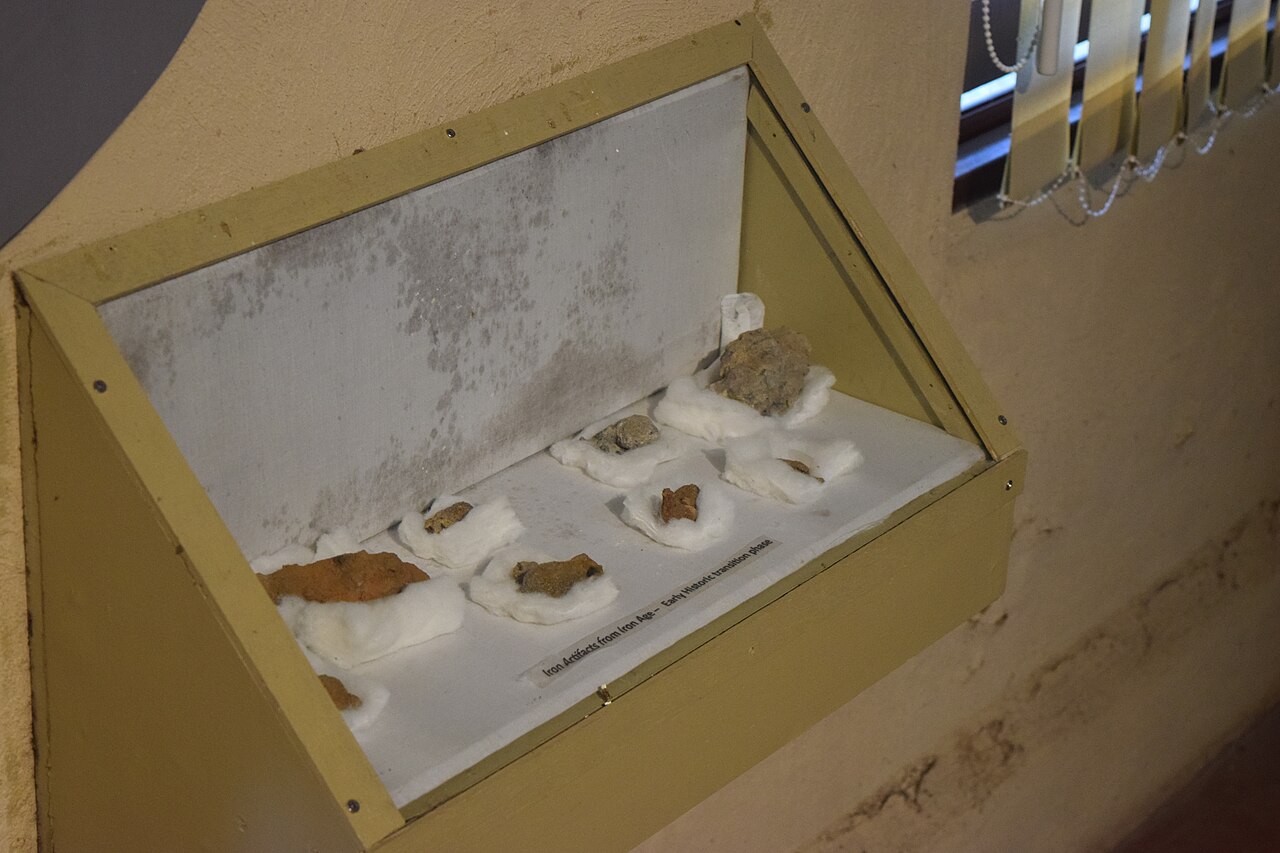
Pattanam · Photographed 2019-01-05 16:27:39
Iron artifacts displayed in the Iron Age to Early Historic section of Pattanam Museum
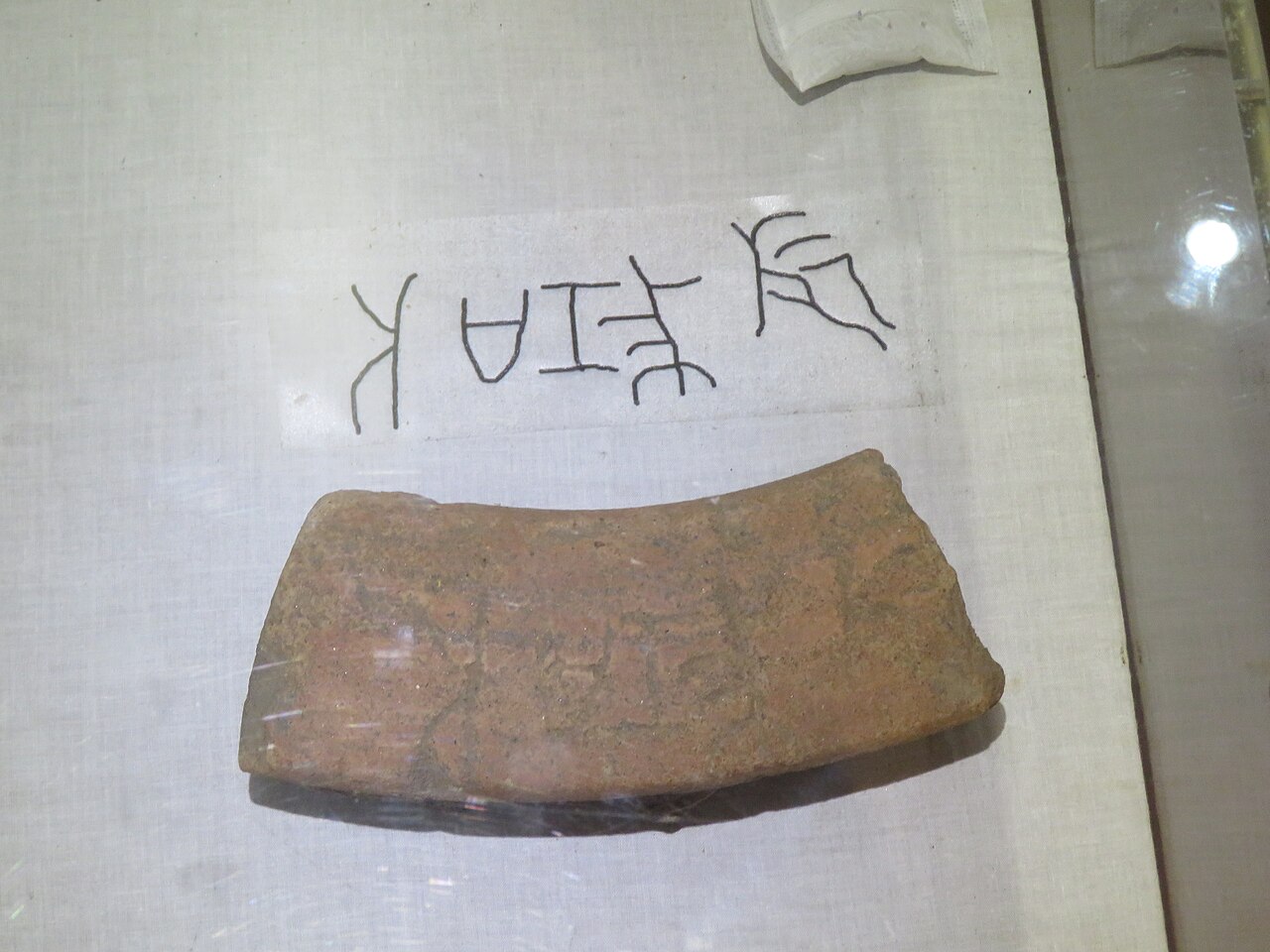
Pattanam · Photographed 2018-01-21 00:16
A sherd displayed as bearing Tamil-Brahmi writing at Pattanam Museum
A sherd displayed as bearing Tamil-Brahmi writing at Pattanam Museum; the exhibition includes a modern tracing above it.
The tracing is not a facsimile or an independent reading of the inscription.

Pattanam · Photographed 2019-01-13 15:34:36
An amphora profile assembled from pottery sherds at Pattanam Museum
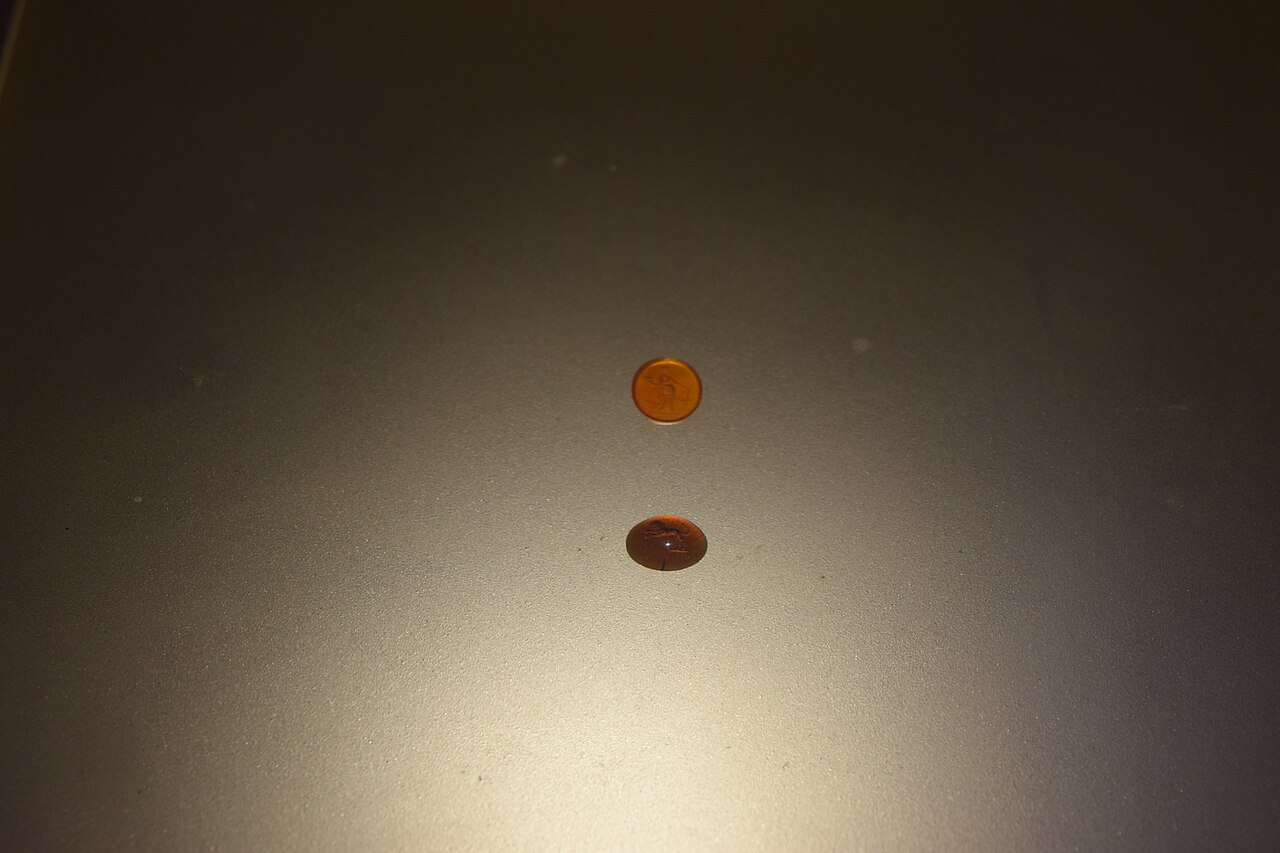
Pattanam · Photographed 2019-01-13 15:33:34
Two carnelian intaglios displayed at Pattanam Museum, photographed through the case
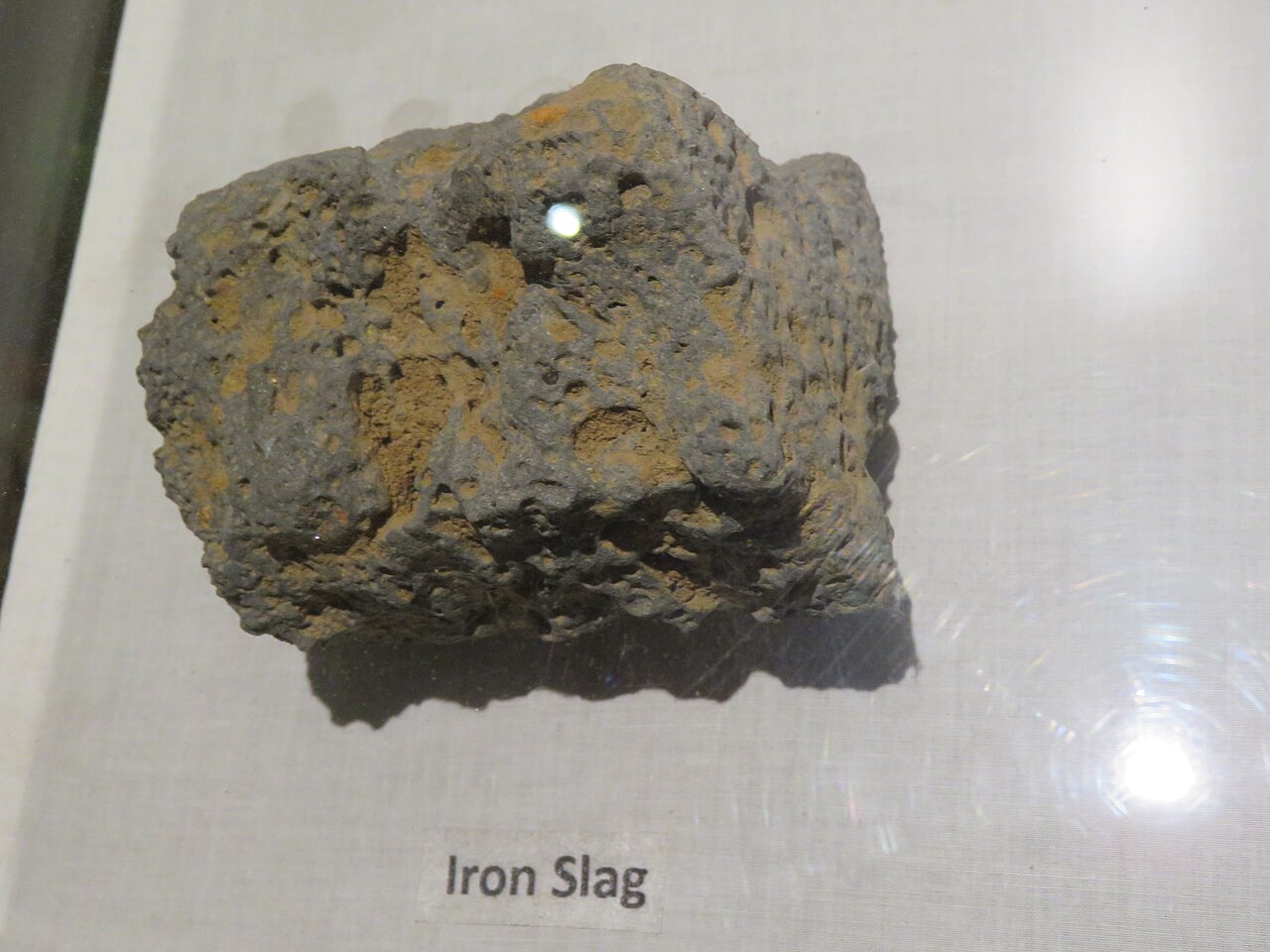
Pattanam · Photographed 2018-01-21 00:42
A piece of iron slag displayed at Pattanam Museum
Pattanam · Photographed 2019-01-13 15:35:26
Glass beads and gold-foiled beads displayed at Pattanam Museum
Pattanam · Photographed 2019-01-13 15:37
A sherd displayed as bearing Brahmi writing at Pattanam Museum
Pattanam · Photographed 2019-01-05 16:40:33
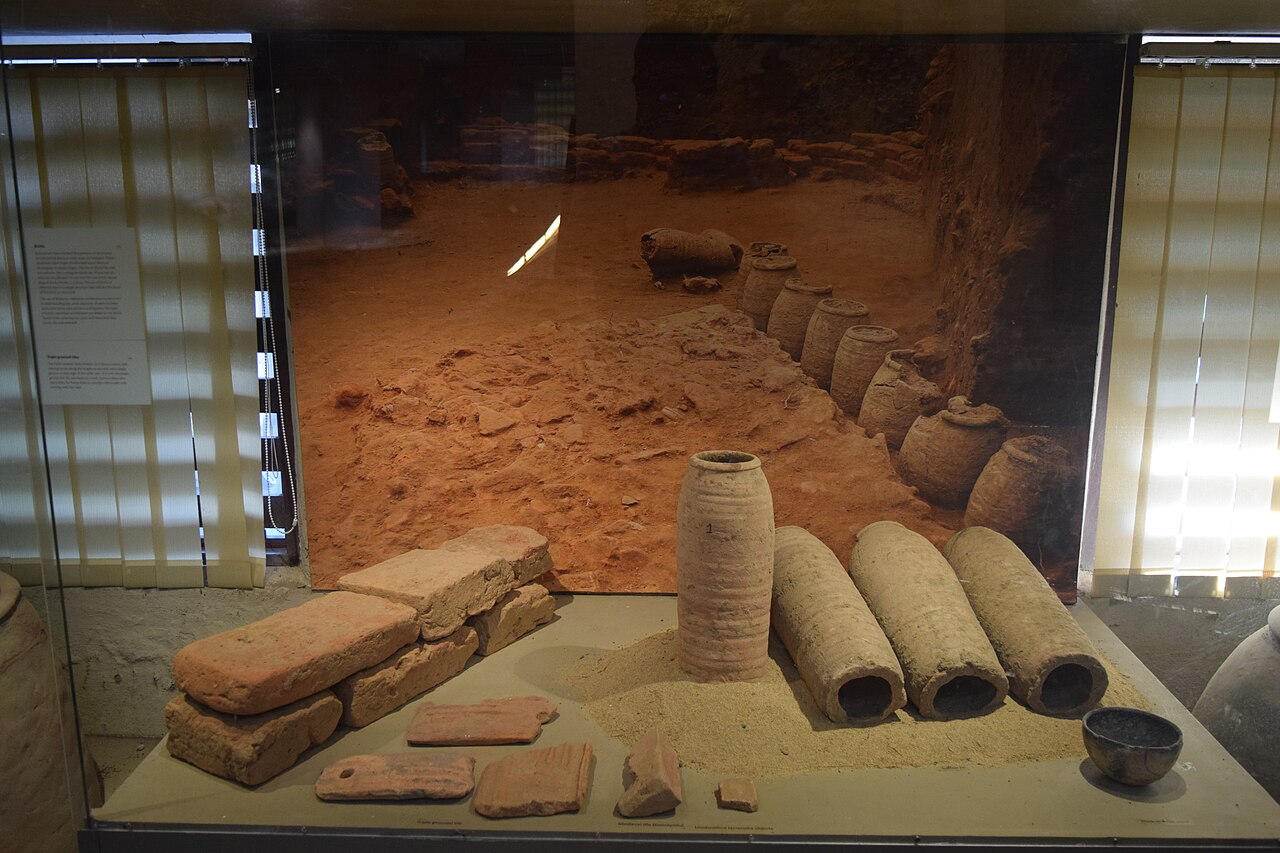
Tubular vessels, brick pieces and pottery displayed at Pattanam Museum
Tubular vessels, brick pieces and pottery displayed at Pattanam Museum; an excavation photograph forms the exhibition backdrop.
Show 7 more photographs and source images ↓
Pattanam · Photographed 2019-01-13 15:35:30
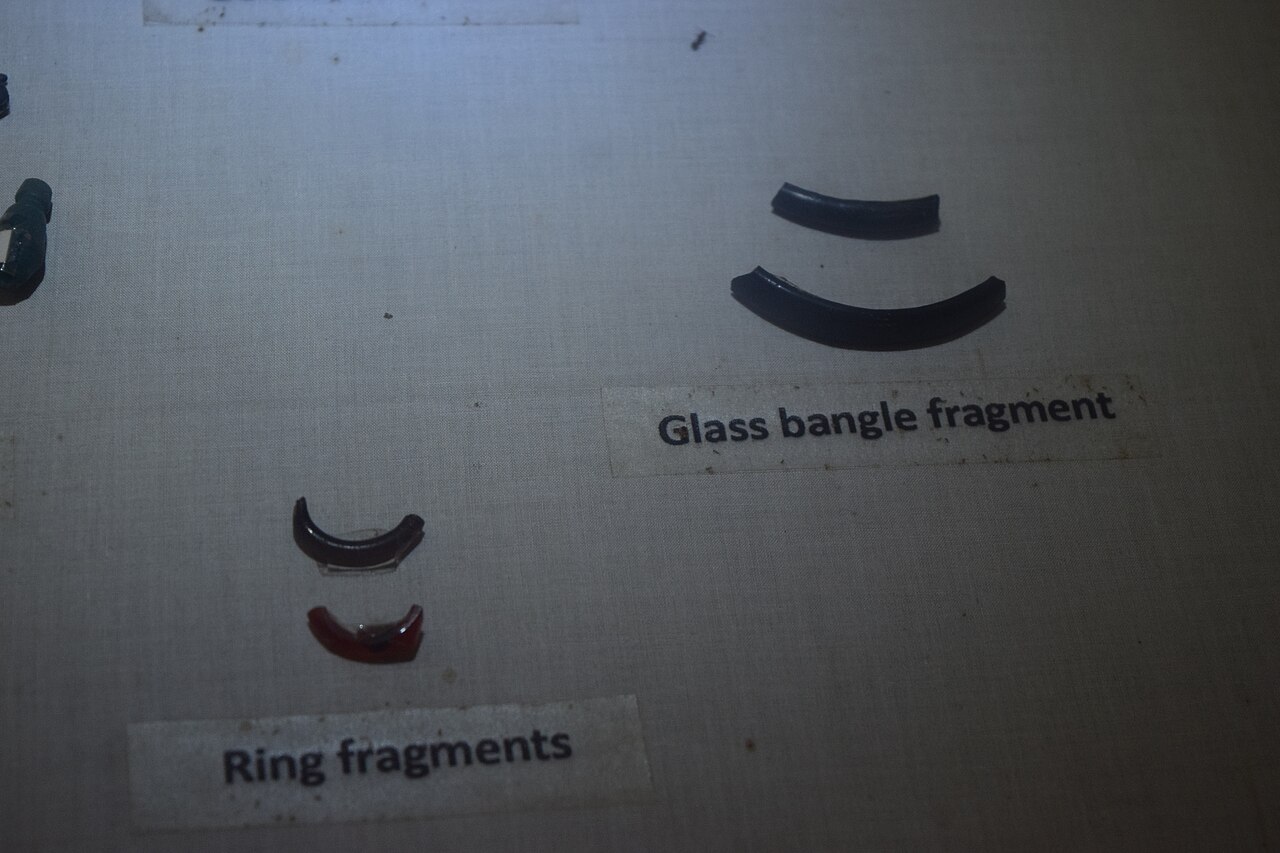
Ring fragments and glass-bangle fragments displayed at Pattanam Museum
Pattanam · Photographed 2019-01-05 16:28:00
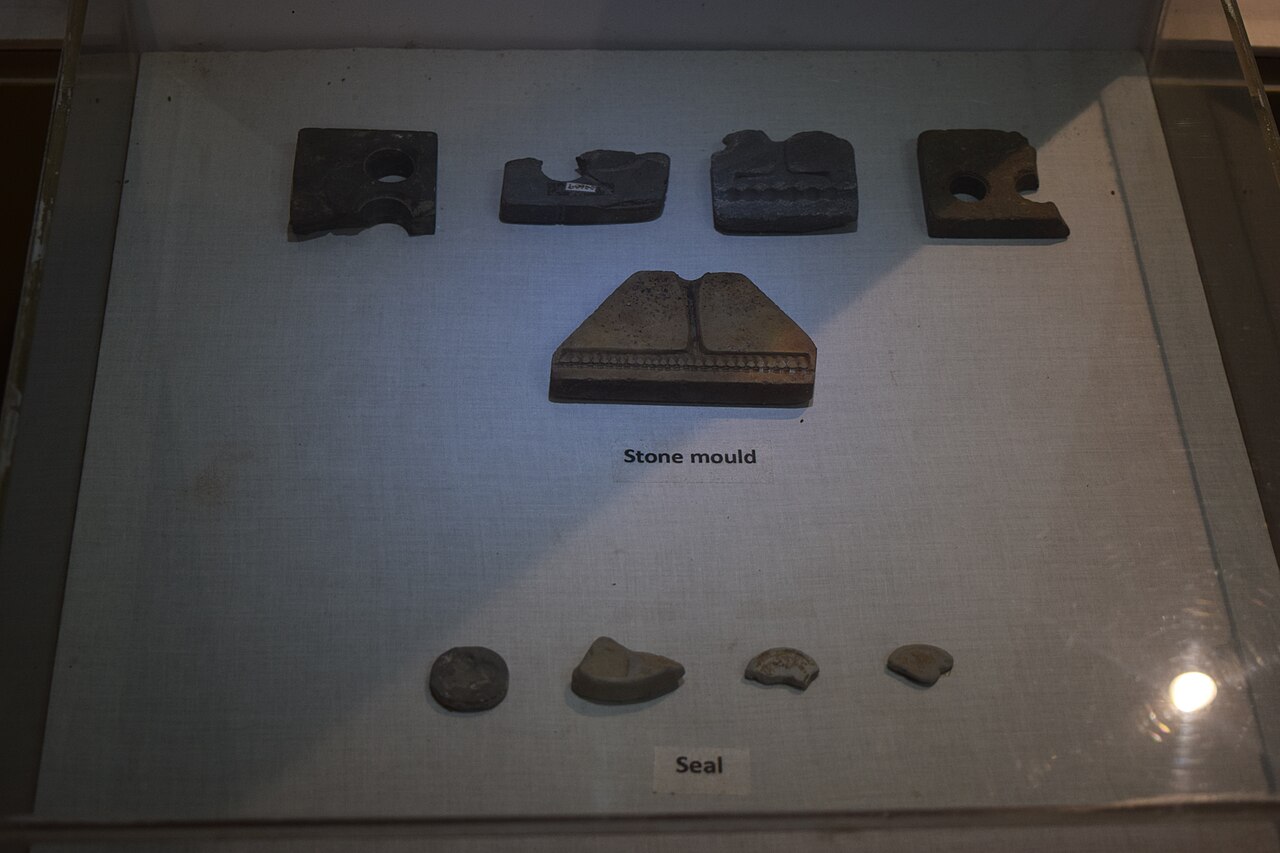
Stone moulds and small seal-like objects in a Pattanam Museum display
Pattanam · Photographed 2019-01-05 16:42:23
Iron axe and chisel displayed at Pattanam Museum
Pattanam · Photographed 2019-01-05 16:34:39
Amphora sherds displayed with modern amphora reconstructions at Pattanam Museum

Pattanam · Photographed 2018-01-20 23:50
Pattanam Excavation Museum building, photographed in 2018
Pattanam · Photographed 2019-01-13 15:32:55
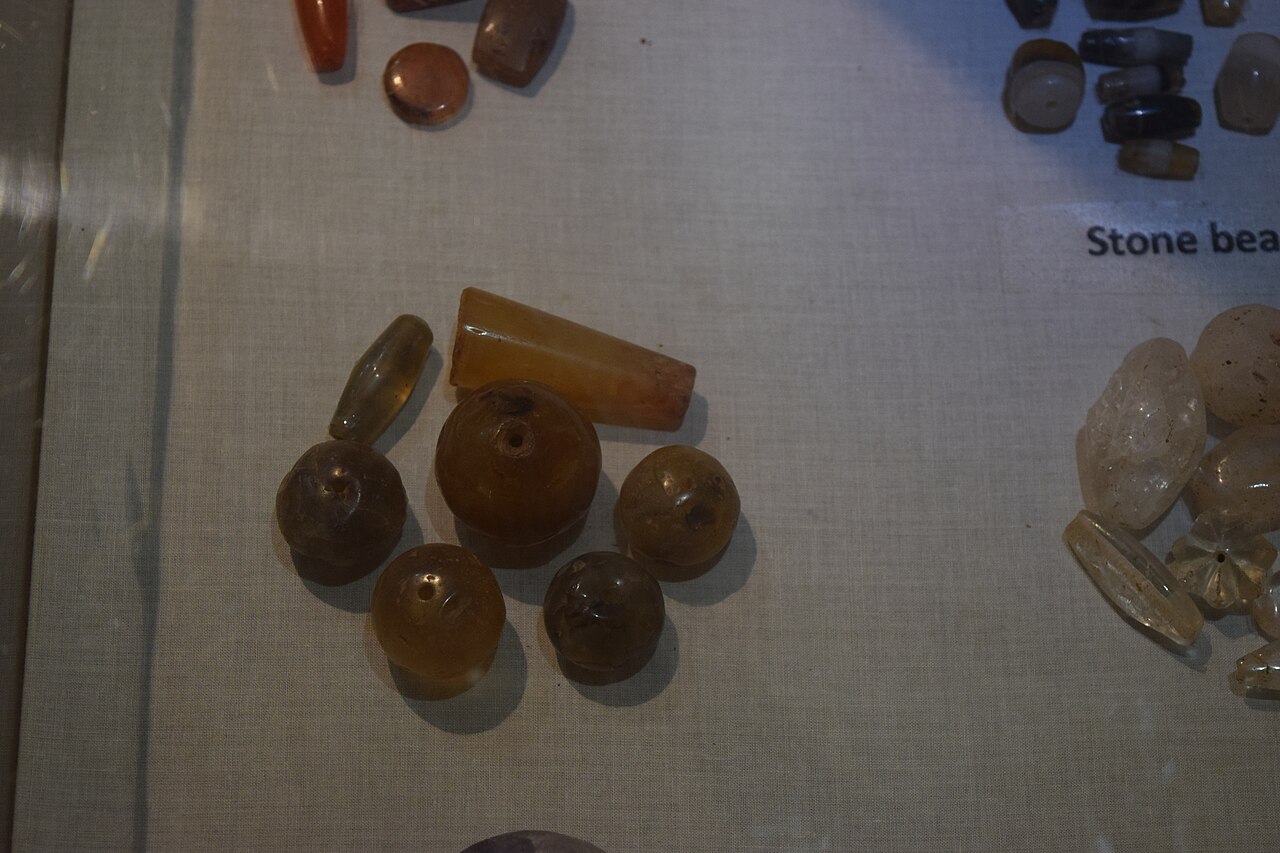
Stone beads on display at Pattanam Museum
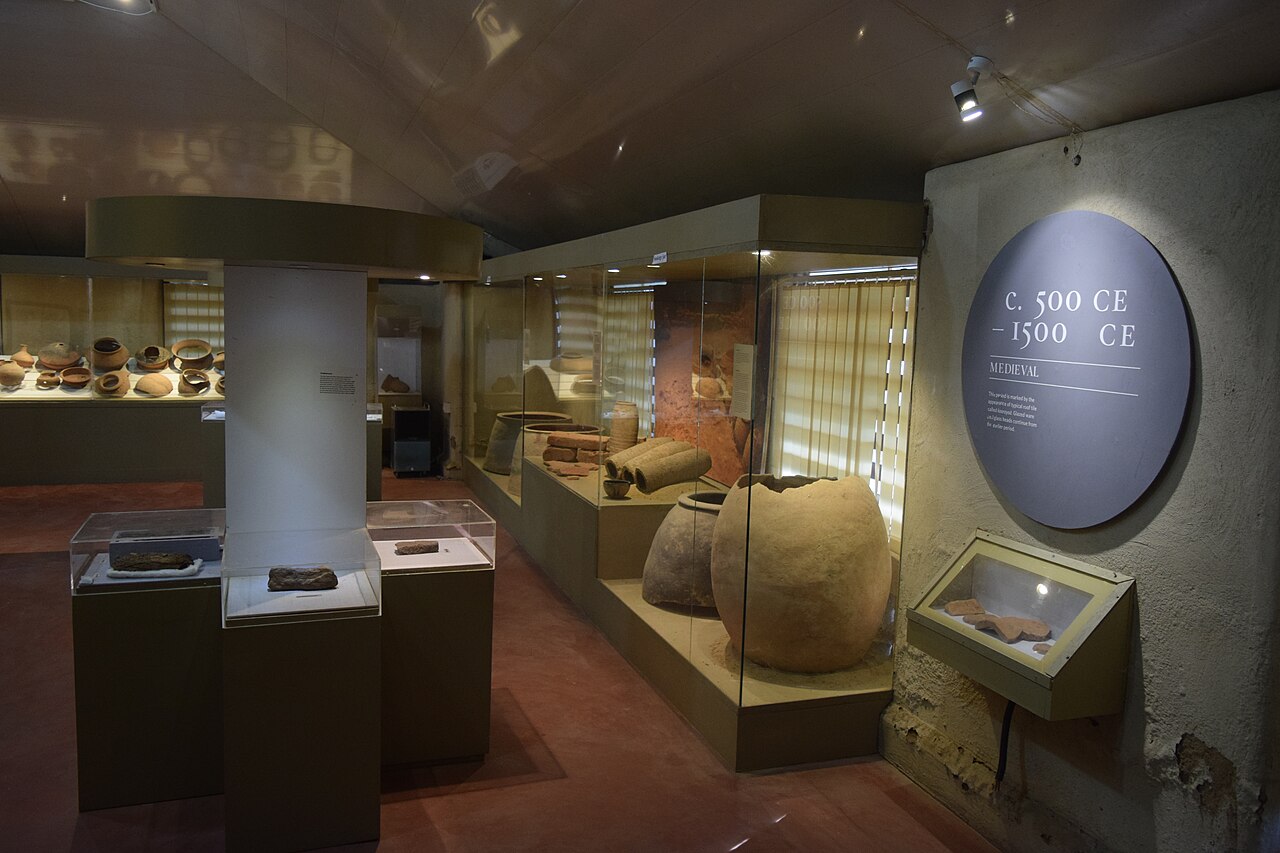
Pattanam · Photographed 2019-01-05 16:16:53
Interior of Pattanam Museum, showing display cases and the museum’s period labels
005Two views
Both views are shown at equal weight; this site does not choose between them.
Where Pattanam's glass beads were made
- One view
- The Mahatma Gandhi University museum page says Pattanam's glass beads very likely came from Arikamedu.
- Another view
- Shinu Anna Abraham (2021), who studied about 8,100 of the beads, says they lack chemical data, so no workshop can yet be named.
- What would settle it
- Chemical analysis such as LA-ICP-MS of well-dated Pattanam beads, compared with workshop groups and production waste.
006Where next
Compare Pattanam’s beads and stone-working finds with how Kerala’s sea links changed between 300 and 600 CE.
On the atlasPattanamExcavated area · Coarse district orientation shown (~1–5 km)
Explore nextIron axe and chisel displayed at Pattanam MuseumAll related studies, connected material, books and sources30 · 11
Elsewhere on this site
Excavation Atlas Sites: Pattanam (North Paravur, Periyar Delta)
Connected material
Photographs, drawings, books, videos and other studies linked to this study. A link helps you explore; it does not prove a historical claim.
- Iron axe and chisel displayed at Pattanam MuseumphotographShows the subject
- Tubular vessels, brick pieces and pottery displayed at Pattanam MuseumphotographShows the subject
- Stone moulds and small seal-like objects in a Pattanam Museum displayphotographShows the subject
- Amphora sherds displayed with modern amphora reconstructions at Pattanam MuseumphotographBackground
- Iron artifacts displayed in the Iron Age to Early Historic section of Pattanam MuseumphotographShows the subject
- Interior of Pattanam Museum, showing display cases and the museum’s period labelsphotographBackground
- Stone beads on display at Pattanam MuseumphotographBackground
- Two carnelian intaglios displayed at Pattanam Museum, photographed through the casephotographShows the subject
- Two carnelian intaglios (standing figure and leaping lion) displayed at Pattanam MuseumphotographShows the subject
- An amphora profile assembled from pottery sherds at Pattanam MuseumphotographShows the subject
- Glass beads and gold-foiled beads displayed at Pattanam MuseumphotographShows the subject
- Ring fragments and glass-bangle fragments displayed at Pattanam MuseumphotographShows the subject
- A piece of iron slag displayed at Pattanam MuseumphotographShows the subject
- Pattanam Excavation Museum building, photographed in 2018photographBackground
- A sherd displayed as bearing Tamil-Brahmi writing at Pattanam MuseumphotographShows the subject
- A sherd displayed as bearing Brahmi writing at Pattanam MuseumphotographShows the subject
- One bead, three questions: stone, workshop, findspotdiagramThe plate’s Pattanam figures, 108 bead pieces with 37 finished and 71 unfinished or worked, come from Kelly’s study of these finds.
Books, videos and websites
Outside reading on this topic. These are not part of the study and we have not checked every claim in them. See all books and videos
- Histories: A Glimpse into Pattanam Excavation Methodology Video · Kerala Council for Historical Research (KCHR, film producer); Sahapedia (publisher) · 8:48 · A short introduction to the methods used in the Pattanam excavations. One of the strongest introductory links: it directs attention to fieldwork and archaeological context, and credits the excavation institution. A 2015 upload, not a current excavation report. Use for method and fieldwork; do not infer that Pattanam and Muziris are conclusively identical. Full film not watched.
007Sources
The study lists the sources it consulted; we have not rechecked them. A working link does not show that a source was read, and a valid identifier does not show that it supports a claim. We do not link to unofficial uploads or copies of publications. Where a study cited one, we show the published citation, or a publisher, DOI or Internet Archive link when we have one. Tracking codes are removed from links, and the sources themselves are not republished here.
K. P. Shajan; P. J. Cherian; R. Tomber; V. Selvakumar. The external connections of Early Historic Pattanam, India: the ceramic evidence. Antiquity Project Gallery 82(315). 2008.
P. J. Cherian; G. V. Ravi Prasad; Koushik Dutta; Dinesh Kumar Ray; V. Selvakumar; K. P. Shajan. Chronology of Pattanam: A multi-cultural port site on the Malabar coast. Current Science 97(2):236–240. 2009.
Shinu Anna Abraham. A Review of Selected Glass Bead Types from the 2007–2009 Seasons of Excavation at Pattanam, India. Ancient Glass of South Asia, pp. 345–359. 2021.
Gwen O. Kelly. Report on the Stone Beads, Debitage and Raw Materials from the 2007 and 2008 Excavation Seasons at Pattanam, Kerala. BEADS 36. 2024.
Arun J. John; Indu G. K.; Arunima M. Lal. Roman metallurgy and early Anthropocene footprints in Kerala, South India: geochemical reflections from Muziris sediments. Anthropocene Coasts 9:10. 2026.
PAMA – Institute for the Advancement of Transdisciplinary Archaeological Sciences. Pattanam – current project and excavations.
School of Social Sciences, Mahatma Gandhi University. Early Historic Age Collection – Pattanam.
V. Selvakumar; K. P. Shajan; R. Tomber. Archaeological investigations at Pattanam, Kerala: New evidence for the location of ancient Muziris. In Migration, Trade and Peoples, Part 1, pp. 29–41. 2009.
Print or offline sourceSource recordP. J. Cherian (ed.). Pattanam Excavations: Interim Report of the Eighth Season-2014, Volume 1. Kerala Council for Historical Research. 2014.
K. P. Shajan; R. Tomber; V. Selvakumar; P. J. Cherian. Locating the ancient port of Muziris: fresh findings from Pattanam. Journal of Roman Archaeology 17:312–320. 2004.
V. Buffa. Report on pottery of South Arabian origin at Pattanam site. In P. J. Cherian (ed.), Pattanam Excavations: Interim Report of the Eighth Season, pp. 47–51. 2014.
Print or offline sourceSource record
Researchers and institutions whose work this study uses: P. J. Cherian, V. Selvakumar, K. P. Shajan, Roberta Tomber, Kerala Council for Historical Research
How we know The evidence, claims and dates behind this study
What this study draws on
- The 2008 Antiquity ceramic study, with fabric and thin-section identifications.
- Abraham's 2021 glass-bead chapter, read in full, and the abstract of Kelly's 2024 stone-bead report.
- XRF readings taken every 10 cm through one 3 m trench profile, published in 2026.
- Collection totals from university and project pages, which do not publish their counting rules.
Dates in this study
| What is dated | Date | How it was dated |
|---|---|---|
| Early Historic period (3rd century BCE to 5th century CE) | 300 BCE – 500 CE | Period assigned by excavators or scholars |
| Early historic period (2nd Century BC to 4th Century AD), 1.70 m-2.5 m in the sampled trench | 200 BCE – 400 CE | Period assigned by excavators or scholars |
| late first century BC to first three-quarters of the first century AD | 100 BCE – 75 CE | How it was dated is not stated |
| Sasanian (AD 224-651) to Early Islamic period | 224–651 CE | Period assigned by excavators or scholars |
See these dates on the timeline
The study’s claims
15 claims · 16 source passages · 51 paragraphs
Browse the study paragraph by paragraphPattanam preserves a multi-period archaeological sequence; the Early Historic phase is well represented, but material from Iron Age, Early Medieval and later periods must not be collapsed into a single 'Roman' horizon.
Supported in this study
Phase labels differ slightly among publications and may be trench-specific.
An Italian sigillata sherd from an Early Historic level was identified and typologically dated to the late first century BCE or early first century CE.
Supported in this study
One imported sherd does not establish resident ethnicity or site-wide function.
By 2008 about 50+ Roman amphora sherds had been identified from surface and Early Historic excavation contexts, including Campanian/Bay of Naples and Rhodian Peraea fabrics; thin-section study strengthened fabric characterization.
Supported in this study
Count pertains to the state of the assemblage reported in 2008.
The ceramic study identifies West Asian/Sasanian-to-Early-Islamic material, including turquoise-glazed ware and bitumen-lined torpedo jars; proposed Arabian organic-tempered sources retain a Hadramawt-versus-Gulf uncertainty.
Supported with qualifications
These wares cross the 600 CE editorial boundary and cannot all be treated as core-period evidence.
Hundreds of Indian rouletted-ware sherds were reported at Pattanam and used to argue for interregional connections within South Asia; their presence does not by itself establish a producer community or ethnicity at Pattanam.
Supported with qualifications
Regional circulation is a safer inference than ethnicity.
Accessible chronology evidence supports activity by the first half of the first millennium BCE and maritime wooden features broadly spanning the late first millennium BCE to early first millennium CE, but individual radiocarbon sample metadata and calibrated ranges were not reconstructed from the inaccessible full table.
Supported with qualifications
Exact sample records remain pending full article inspection.
The glass-bead corpus exceeded 100,000 pieces, while only a little over 8,100 from 2007–2008 and part of 2009 had been catalogued in the 2021 study; up to about 75% were Indo-Pacific drawn beads and chemical provenance data were explicitly lacking.
Supported in this study
The reviewed subset is not the full season-by-season site corpus.
The reviewed 2007–2009 glass subset included 28 gold-glass beads or fragments and 57 false-beryl beads or fragments; typological parallels are useful for comparison but do not securely locate production.
Supported with qualifications
Bead-type chronology is broad and persistent.
Stone beads, debitage and raw materials from the 2007–2008 seasons provide direct evidence of on-site stone-bead working focused on agate, carnelian and chalcedony, including a pecking method; this evidence weakens ethnicized one-to-one mappings between technology and group identity.
Supported in this study
The earlier abstract-level reading is superseded by the selected full-PDF and visual inspection recorded in V10.3. The 108-piece assemblage is composite. Ten tentatively earlier pieces are a subset, not additional objects. Much may be second–fifth century CE or later; exact object-to-context dates remain unresolved.
A 2026 XRF study measured a Pb peak of 426 ppm at 2.6 m and strong enrichment across part of the sampled trench; this establishes anomalous lead concentration, not a Roman origin of the lead or a Roman-operated metallurgical workshop.
Supported with qualifications
Lead-isotope provenance and direct primary workshop contexts would be needed to discriminate Roman-material recycling from other anthropogenic sources.
PAMA reports that trenches 62–67 were excavated in 2019–2023 and yielded pottery, beads, metal remains, worked stones and architectural features; the official page provides campaign-level rather than locus-level context and states that these materials are held between the PAMA facility and a local bank locker.
Supported in this study
Campaign year must not be confused with archaeological object date.
PAMA and MGU list archaeobotanical materials including pepper, cardamom and rice, but the accessible PAMA page frames detailed morphological and characterization work as prospective; therefore these botanical claims remain unphased and methodologically under-documented in this study.
Supported with qualifications
No recoverable object-level archaeobotanical study with flotation strategy, contexts and identification criteria was found for this study.
Pattanam is a strong candidate in the Muziris identification debate, but the 2008 ceramic authors themselves framed the equation as an argument for continuing excavation rather than a closed identification; the assemblage inventory does not require the ancient name to be settled.
Supported with qualifications
Documenting excavated material does not depend on settling the toponym.
In this study, provenance labels are evidence-tiered: ceramic fabrics with petrographic or typological grounds are stronger than visual-style parallels; presence is not treated as evidence of local production, resident ethnicity or a specific consumer/use without separate contextual support.
Supported in this study
Methodological synthesis rather than a claim that all source attributions are equally secure.
Institutional aggregate totals and museum labels demonstrate the scale and diversity of the curated Pattanam material, but they cannot substitute for season-, trench-, locus- and object-level publication when constructing a phase-sensitive inventory.
Supported in this study
Aggregate totals may reflect curation and counting conventions not exposed on the museum page.
Trace one claim through the study’s records
Explore the evidenceOther source lists
Numbered citation links from the study
The numbered links in the study text point here.
Early Historic Age Collection - MG School of Social Sciences : MG School of Social Sciences
PAMA - Bridging the Past, Present and Future.
Roman metallurgy and early Anthropocene footprints in Kerala, South India: geochemical reflections from Muziris sediments | Anthropocene Coasts
Chronology of Pattanam: A multi-cultural port site on the Malabar coast | Request PDF
The external connections of Early Historic Pattanam, India: the ceramic evidence | Antiquity Journal
Pattanam Excavations: Interim Report of the Eighth Season-2014 - Google Books
From ‘ovoid jars’ to ‘torpedo jars’: Investigations into bitumen‐lined transport containers in the Gulf and the Indian Ocean in antiquity (second century BCE–third century CE) - Durand - 2021 - Arabian Archaeology and Epigraphy - Wiley Online Library
A Review of Selected Glass Bead Types from the 2007–2009 Seasons of Excavation at Pattanam, India
| BEADS: Journal of the Society of Bead Researchers
Locating the ancient port of Muziris: fresh findings from Pattanam | Journal of Roman Archaeology
Journal of Roman Archaeology: Volume 17 -
Roman metallurgy and early Anthropocene footprints in Kerala, South India: geochemical reflections from Muziris sediments
Archaeology of Trade in the Western Indian Ocean, 300 BC–AD 700 | Journal of Archaeological Research
Archaeology of Trade in the Western Indian Ocean, 300 BC–AD 700
The external connections of Early Historic Pattanam, India: the ceramic evidence | Antiquity Project Gallery, 2002-2016
About this study Status, corrections and how it was made
Status
Draft study, revision 6. No historian, archaeologist, or Tamil or Malayalam specialist has reviewed it yet.
The study itself says more research is needed before its question can be settled.
How it was made
Compiled as an editorial synthesis from published scholarship around questions we framed. About this project & workflow
The summary, How sure lines and Two views notes on this page were prepared from this study and cross-checked against its passages. That is an editorial check, not a specialist review.
Corrections and updates
Technical details
Study code LTS-SUP13. The text fingerprint changes whenever the study text changes.
- The study text is shown as written. Links from its paragraphs to citations help you move around the study; they are not new claims or checked source passages.
See how this study’s records were extracted
Text fingerprint (SHA-256): LTS-SUP13 · 859fdff068e2d110d7d9d85c… · v6
Evidence tables and technical details are on the web page: https://layersofthesouth.org/read/f88a9d1c4f