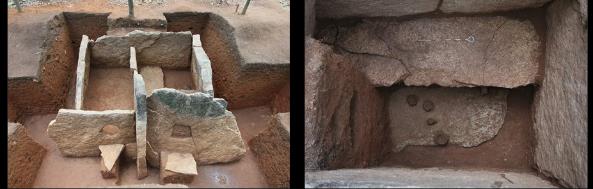
Excavated cist burial at Enadimangalam, Figure 1, published page 568
Enadimangalam
- Everyday lives
Ordinary settlements beyond the ports are known but hard to count
Excavations show people lived well away from the famous ports and royal centres, but the map of known sites depends heavily on where archaeologists looked.
- This page
- 4,364 words · revision 6
Draft study · Awaiting specialist review · Updated
001Dates and places

No mapped place in this study.
1000–500 BCE
Different beginnings
500–200 BCE
Marks & materials
200 BCE–300 CE
Connected worlds
300–600 CE
Change & continuity
After 600 CE
- Early Historic period (300 BC-AD 500)
- 300 BCE to 1300 CE
- 2nd century BCE
- from the 1st century BCE till the 12th century CE
- Date from writing, coins or texts
- Period assigned by excavators or scholars
- How it was dated is not stated
Each date belongs to what was dated (a sample, an object, a layer or a text), which is not always the event the study asks about.
Each period has the same width, so spacing is not to scale.
The full table of dates, with their ranges, is under How we know.
- 2 Well supported
- 1 Possible
- 1 Not known
002How sure
In brief
This study asks what is known about ordinary settlement beyond the major excavated ports and royal centres of Kerala and Tamil Nadu. In Tamil Nadu, the state Department of Archaeology has excavated habitation at Pattaraiperumbudur, Andipatti, Mangudi and Maligaimedu. Pattaraiperumbudur was found by a village-to-village survey in 2002 and excavated in 2016. In Kerala, a 2013 survey near Marayoor found habitation at Nachivayal, in a small trial trench, and at Alampetti, from surface finds and a pit. The excavators said they could not yet date either site. At Enadimangalam only a burial was excavated, so nearby small settlements remain a hypothesis. Tamil Nadu's record is richer, but survey, preservation and publication differ between the two states. The evidence therefore cannot measure population, settlement density or empty landscapes.
Key researchers cited in this study: K. Rajan (Kodumanal & Porunthal Excavations / Epigraphy) · P. J. Cherian (KCHR Pattanam Excavations) · V. Selvakumar (Maritime & Prehistoric Archaeology) · K. P. Shajan (Geoarchaeology & Periyar Palaeochannels) · Full bibliography
How sure
- Well supported
People lived in excavated settlements away from the famous ports and royal centres.
The Tamil Nadu department reports directly excavated habitation at several inland sites.
- Well supported
Nachivayal in Kerala held a real buried habitation deposit.
A 1 × 1 m trial trench found three layers with pottery, iron fragments and a bead.
- Possible
The scattered burials at Enadimangalam mark nearby small settlements.
The authors propose it, but no habitation was excavated and burials may have been reused.
- Not known
Whether Tamil Nadu was more densely settled than Kerala.
No comparable survey covers both states; the records reflect different research histories.
Why it matters
It explains why blank areas on a map of known sites may reflect where research looked, not where people lived.
003Key findings
What the study concludes
- Directly excavated habitation exists outside famous ports and royal centres, with Pattaraiperumbudur a particularly useful Tamil Nadu case.
- Kerala's apparent habitation gap has been reduced by targeted survey, but Nachivayal and Alampetti remain small-scale and chronologically insecure examples.
- Burial-only excavations such as Enadimangalam should not be counted as settlements; nearby smaller settlements are a hypothesis to test.
- No defensible regional population total, settlement hierarchy or empty-landscape claim follows from the reviewed evidence.
In the study’s own words. How sure each point is, is shown above.
The summary above is the short read. The full study is the complete text it was drawn from, with its tables and source notes.
What the full study covers
- Scope and orientation
- Evidence classes, survey history, and recovery bias
- Tamil Nadu: direct habitation beyond ports and royal centres
- Kerala: from a supposed habitation gap to uneven positive evidence
- Disagreements, alternatives, and tests that would discriminate between them
- Conclusions, limits, and sources still to consult
- Bibliography and source notes
004The study
Scope and orientation
What is known about ordinary settlement beyond the major excavated ports and royal centres?
Kerala and Tamil Nadu are the principal regions. The period 1000 BCE–600 CE is the site's main window, not a date imposed on every find. Excavated habitation, surface survey, burial-only sites and inferred settlements are kept distinct, and incomplete inventories are not turned into population totals, settlement hierarchies or claims of empty landscapes.
Overview
The answer is more positive than a port-centred archaeological map might suggest, but much less quantifiable than a settlement-history narrative might imply. In Tamil Nadu, several non-port and non-royal localities preserve directly excavated habitation. Pattaraiperumbudur is particularly informative because it was first identified through village-to-village survey and subsequently excavated with stratified prehistoric, Iron Age, and Early Historic deposits. Andipatti, Mangudi, and Maligaimedu add further excavated habitation cases, although the accessible official summaries often compress long chronological sequences and provide less trench-level detail than is needed for fine regional comparison. ↗1 ↗2 ↗3 ↗4 ↗5
Kerala presents a different evidential profile. A 2013 problem-oriented survey in the Marayoor region reported habitation evidence at Nachivayal and Alampetti after explicitly targeting a long-recognized gap between abundant mortuary archaeology and scarce habitation evidence. Nachivayal has a small subsurface trial trench; Alampetti rests on surface material and material exposed in a landowner's pit. Crucially, the excavators themselves said their chronology was preliminary and could not be fixed securely. Thus these discoveries weaken an older proposition that habitation was simply absent, but they do not establish a dense or well-dated Iron Age settlement system. ↗6
Enadimangalam illustrates a further distinction. Its 2019 excavation concerned a cist burial. The authors proposed that the scattered burial distribution may reflect smaller settlements, but also discussed possible repeated use of individual burials and emphasized poor databases, unavailable reports, inadequate early geolocation, and few absolute dates in Kerala. That makes "smaller settlements" a landscape hypothesis to test, not a set of excavated settlements that can be counted. ↗7 ↗8
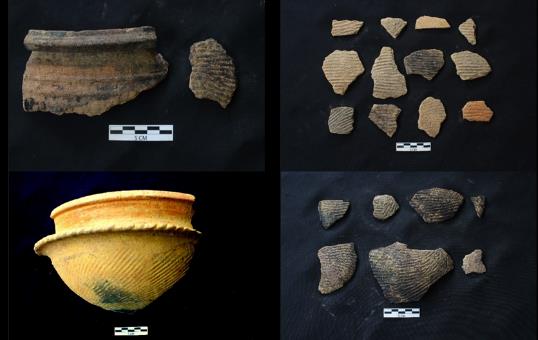
Ceramics from the Enadimangalam study area, Figure 3, published page 569
Enadimangalam
The defensible regional conclusion is therefore asymmetric but not demographic: Tamil Nadu presently offers more directly excavated and more readily accessible examples of non-monumental habitation in the reviewed source set; Kerala's habitation record is thinner and methodologically harder to date. That difference cannot be converted into a claim that ancient Tamil Nadu was more densely populated or that parts of Kerala were empty. The state records have different histories of survey, discovery, preservation, excavation, and publication. ↗6 ↗8 ↗9
Chronologically, the dossier is mixed. Pattaraiperumbudur, Mangudi, the earlier component of Andipatti, Maligaimedu, and Pattanam intersect the project's 1000 BCE–600 CE window. Some sites have earlier prehistoric components; Andipatti and Maligaimedu continue substantially later; Nachivayal may extend into the later first millennium CE according to its excavators' tentative ceramic comparisons. Those later components are comparison or continuity evidence, not grounds for moving them backward into the core period. ↗6 ↗1 ↗2 ↗3 ↗5
Evidence classes, survey history, and recovery bias
"Ordinary settlement" is used here as an editorial shorthand for habitation outside the dossier's famous-port and royal-centre emphasis. It does not mean that archaeology has demonstrated that the inhabitants were uniformly poor, rural, low-status, of one occupation, or socially homogeneous. Pottery, grinding equipment, domestic objects, production debris, house-related material, or small-site contexts can demonstrate activities and habitation; they do not by themselves identify caste, ethnicity, gender roles, household wealth, or a fixed settlement rank.
The evidence needs a hierarchy of directness, not a hierarchy of presumed social importance:
| Evidence class | What was actually observed | What it can support | What it cannot support by itself |
|---|---|---|---|
| Excavated habitation | Stratified cultural deposits, features, artefacts or occupational layers in controlled excavation | Presence and, where stratigraphy permits, sequence of occupation | Regional density or population without a survey denominator |
| Trial-trench habitation | A small controlled subsurface test through a suspected habitation deposit | Existence of a subsurface deposit at the tested point | Site extent, duration, or settlement size without wider testing |
| Surface/pit habitation evidence | Artefact scatters or material exposed by cultivation, erosion, building, or informal digging | A probable activity/habitation locality worth testing | Secure stratigraphic association or fine chronology |
| Burial-only site | Excavated or recorded funerary monument/context | Mortuary activity and its material/architectural context | Location or size of the associated habitation |
| Inferred settlement | Settlement existence or scale inferred from burial distribution or landscape reasoning | A testable model for future survey | A counted archaeological settlement |
This distinction changes the result. Nachivayal is not equivalent to Alampetti: the former has a 1 × 1 m trial trench with three reported layers, whereas the latter was documented through a cleared plantation plot, a landowner-dug pit, and surface material. Neither is equivalent to Enadimangalam, where the excavated context was a burial. ↗6 ↗8
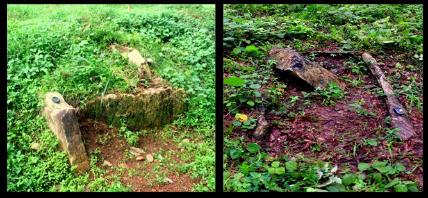
Unexcavated cist burials in the Enadimangalam study area, Figure 2, published page 568
Enadimangalam
The history of discovery also matters. Das, Joglekar, and Mohanty described the Kerala habitation problem as one for which several explanations had been proposed: dense modern occupation, soil and preservation conditions, erosion or wash-off, and especially a lack of systematic archaeological exploration. Their own response combined village-to-village reconnaissance, use of topographic and geological information, attention to water channels and resource areas, spatial recording of mortuary sites, GPS mapping, and a trial trench. This is direct evidence that search strategy itself altered what became archaeologically visible. ↗6
Modern land use can simultaneously destroy and expose deposits. At Nachivayal, the investigators recovered material from surfaces, agricultural terraces, pits, ditches, and rainwater channels and described substantial damage from continuing cultivation. At Pattanam, the 2008 project report likewise noted that modern occupation both impeded investigation and created opportunities to see subsurface material. These are not minor taphonomic footnotes: they affect whether a locality enters an archaeological gazetteer at all. ↗6 ↗10
Institutional inventories introduce a second bias. The Tamil Nadu Department of Archaeology publishes an extensive list of excavations across different periods and site types, but an excavation inventory is a record of places selected for excavation, not a controlled sample of all ancient habitation. Its e-publication catalogue confirms that formal reports exist for several relevant campaigns, including Andipatti and Mangudi, but the existence of a publication series does not supply the denominator required for settlement density. ↗9 ↗11
Similarly, Kerala's statutory protected-monument framework is designed to identify and preserve legally defined monuments and archaeological remains, including burial mounds, caves, constructions, and other durable features. Such a protection register has an entirely different sampling logic from a pedestrian settlement survey; it therefore cannot be read as a map of where ancient people did or did not live. ↗12
K. Rajan's Archaeological Gazetteer of Tamil Nadu is an obvious source still to consult for a fuller denominator: the bibliographic record identifies it as a 359-page English gazetteer with maps, bibliography, and index. But only its catalogue record, not its individual site entries or survey methodology, was accessible for this study, so its inventory has not been screened here. ↗13
Tamil Nadu: direct habitation beyond ports and royal centres
Pattaraiperumbudur
Pattaraiperumbudur gives the clearest reviewed example of why the answer cannot be restricted to major ports. The Tamil Nadu Department states that the locality was identified in 2002 during a village-to-village survey in Tiruvallur District; subsequent work recognized archaeological mounds at several parts of the village. The official excavation account reports a 2016 campaign and describes trench A1 at PPR-II as preserving five layers, with Iron Age and Early Historic remains above older prehistoric deposits. The wider excavation produced pottery, bricks, iron objects, roofing tiles, beads, shell and glass ornaments, terracotta objects, Tamil-Brahmi-inscribed sherds, ring-well material, and other household or production-related objects. ↗1 ↗4
Its evidential strength lies less in any single spectacular artefact than in the sequence of survey → identified mound → controlled excavation → relative stratigraphy. It is therefore a much stronger basis for asserting habitation than an isolated black-and-red-ware scatter. Even here, however, the accessible web account does not provide the absolute dates or full context-by-context tables required to translate the relative Iron Age/Early Historic sequence into a precise regional settlement chronology. ↗1
Andipatti
At Andipatti, the Department reports systematic excavation in 2004–05 at Nattamedu and Sambalkadu. Megalithic- and Historic-period pottery was recovered, and the Department interprets the overall occupation as continuing from the first century BCE to the twelfth century CE, divided into two cultural periods. ↗3
That makes Andipatti useful evidence for habitation, but the long span is also a warning. A statement that a site was "continuously inhabited" across more than a millennium is not equivalent to a high-resolution sequence showing exactly which domestic contexts fall before 600 CE. The full excavation report is therefore necessary before Andipatti can carry finer arguments about settlement persistence, hiatus, or changing site scale. The Department's publication pages confirm an Andipatti excavation report exists, but its page-level contents were not consulted directly for this study. ↗14 ↗15
Mangudi
Mangudi is another directly excavated case, but it shows site-selection bias: the Department's summary says Roman pottery had already been collected on the surface, so unusual finds helped prompt the excavation. The site is legitimate evidence for habitation, but it cannot stand for the many less conspicuous villages. ↗2 “Mangudi: stone tools, later occupation and one inscribed sherd” covers Mangudi in detail, including the ten trenches of 2001–02, the two excavated localities named in the 2003 report (Nayakkarpunchai and Lingathidal), a sterile layer that makes a gap in occupation possible, differing two- and three-phase accounts of the sequence, and a Tamil-Brahmi-inscribed sherd that the Department assigns to the second century BCE.
Maligaimedu
The Tamil-language Department page for மாளிகைமேடு (Maligaimedu) states that excavation was conducted in 1999–2000, that three cultural phases were represented, and that recovered material included black-and-red ware, red ware, rouletted ware, inscribed sherds, and a copper coin with an Ujjain symbol. The Department gives the habitation span as roughly 300 BCE–1300 CE. ↗5
This is direct evidence that habitation outside the most famous port sites can have a long archaeological sequence. It is not, however, a finely dated measure of "ordinary rural settlement" throughout that span. The chronology crosses the project's 600 CE boundary by many centuries, and the accessible page does not provide the full stratigraphic partition needed to isolate each phase.
Taken together, the Tamil Nadu cases establish the proposition that substantial habitation archaeology exists away from the canonical ports and royal capitals. What they do not establish is how common such sites were. The departmental excavation list records archaeological attention, not surveyed hectares, non-site transects, negative observations, surface visibility, collection intensity, or a uniform discovery threshold. Consequently, counting departmental excavation entries and dividing by modern area would produce a false precision rather than a settlement density. ↗9
Kerala: from a supposed habitation gap to uneven positive evidence
Kerala's historiography shows especially clearly why an archaeological "absence" must be dated to the state of research. A 2008 Antiquity project report on Pattanam stated that Early Historic settlement evidence in Kerala had previously been lacking and described Pattanam as located through a concentration of surface artefacts during geoarchaeological survey. It also observed that modern settlement both obstructed research and revealed buried deposits. ↗10
By 2013, Das, Joglekar, and Mohanty were able to report two additional habitation candidates in the eastern fringes of Kerala. Their paper began from the same perceived lacuna but explicitly asked whether failure to find habitation reflected research practice rather than ancient reality. Their regional strategy was therefore designed around finding habitation in landscapes already known for mortuary monuments. ↗6 ↗16
Nachivayal
At Nachivayal, initial exploration recovered pottery, beads, terracotta, stone objects, and iron fragments. The subsequent surface survey collected material from cultivated surfaces and erosion/artificial exposures, while the authors noted that agricultural modification had badly disturbed the deposit. ↗6
They then opened NVL-1, a 1 × 1 m trial trench. Three layers were reported to a depth of about one metre. The upper layer yielded roughly 900 g of pottery; the second, around 4.5 kg plus iron fragments, a glass bead, a gamesman, and terracotta; the third contained a similar ceramic assemblage but fewer associated artefacts. This converts Nachivayal from a mere surface scatter into evidence for a real subsurface archaeological deposit. ↗6
But the same publication blocks an overconfident Iron Age label. In its conclusions, the authors state that the investigation was preliminary and that they were not in a position to establish a particular chronology for the newly reported habitation sites. They tentatively compare Nachivayal's ceramics with Early Historic or Historic assemblages and allow for a date in the later first millennium. That possibility matters because it may put some or all of the deposit after the Layers of the South 600 CE editorial boundary. ↗6
The right outcome is thus not "Iron Age village discovered." It is: a habitation deposit was demonstrated at Nachivayal; its extent and exact chronology remain unresolved. “Marayoor has dense dolmens, but their link to a route is untested” discusses Nachivayal as habitation beside the Marayoor dolmens.
Alampetti
Alampetti is a weaker but still important class of evidence. The locality came to attention on a roughly 2.5 ha plot cleared for coffee cultivation. Pottery was recorded from a pit dug by the landowner and from the surface, with additional beads and grinding stones in the surrounding survey. The authors describe the investigation itself as limited. ↗6
In the discussion they tentatively assign some ceramic types to a "pre-Christian" horizon by comparison with assemblages elsewhere. Yet no controlled habitation trench comparable to NVL-1 is reported for Alampetti, and no absolute date is supplied. Accordingly, Alampetti belongs in the category surface/pit habitation evidence with provisional typological dating, not securely excavated Iron Age settlement. ↗6
Enadimangalam and the temptation to turn burials into villages
The 2021 Enadimangalam study is especially valuable as a methodological counterweight because the excavation itself was of a cist burial. The authors report a double-chambered cist, discuss possible later modification and multiple use, and suggest that the scattered burial distribution reflects the presence of smaller settlements. They also argue that landscape should guide the search for habitation. ↗8
The settlement inference is plausible as a research hypothesis, but it is not the same evidence as excavating houses, occupation layers, hearths, middens, production areas, or a stratified domestic assemblage. Repeated use of burial structures further weakens any simple equation such as "one burial cluster = one contemporary settlement." The discriminating evidence would be independently located habitation around the burial landscape and dates demonstrating contemporaneity between the relevant occupation and mortuary phases. ↗7 ↗8
The same article's introduction explains why this distinction matters regionally: it describes many older Kerala records as unavailable, unpublished, inadequately documented, or difficult to relocate, and identifies a shortage of absolute dates and integrated site databases. One earlier government excavation in the Enadimangalam area is specifically noted as lacking an available published report. This is an evidence-management problem, not evidence that no further archaeology exists. ↗7 ↗8
The Kerala result is therefore a layered one. Pattanam demonstrates that settlement could escape recognition until targeted survey; Nachivayal demonstrates a subsurface habitation deposit; Alampetti identifies a probable habitation locality requiring controlled excavation; and Enadimangalam shows how mortuary landscapes may generate settlement hypotheses. These four evidential states should not be collapsed into one dot-symbol on a "settlement map." ↗6 ↗10 ↗8 Two other studies trace the same pattern: “Anakkara: excavated burials in Kerala's Bharathapuzha valley” describes a 1 × 1 m trial trench beside a burial at Anakkara that yielded pottery the excavators read as habitation remains, and “Bharathappuzha basin: many burials, little dated settlement” finds that recent discoveries in the Bharathappuzha basin enlarge the burial landscape rather than the dated settlement record.
Disagreements, alternatives, and tests that would discriminate between them
Was Kerala genuinely deficient in settlement, or is habitation archaeologically hard to see?
The older formulation was close to substantive absence: Early Historic or Iron Age habitation was repeatedly described as missing or nearly missing from Kerala. The discovery history itself weakens that strong reading. Pattanam emerged from geoarchaeological survey; the Marayoor project found new habitation evidence after intentionally changing its survey questions; and later scholarship continues to identify reporting, geolocation, dating, and database limitations. ↗6 ↗10 ↗8
The present evidence therefore favors visibility/documentation as a major component of the problem. It does not establish the stronger alternative that Kerala actually possessed a dense network of surviving settlements comparable to any particular Tamil Nadu landscape. A visibility correction changes "we have not found it" into "the inventory is not a reliable measure of absence"; it does not supply the missing denominator.
What would discriminate the alternatives is a bounded survey in which searched area, landform, surface visibility, collection intervals, modern disturbance, negative transects, diagnostic artefacts, subsurface tests, and chronological controls are all reported. Only then can "few sites found" become a meaningful frequency rather than an artefact of how research was conducted.
Do burial clusters reveal small settlements?
Enadimangalam's authors suggest that dispersed mortuary structures reflect smaller settlements, while simultaneously allowing that individual burials may have been used or modified more than once. ↗8
Both propositions can coexist: burial landscapes may indeed be useful predictors for locating habitation, while still being poor direct measures of the number or size of settlements. To discriminate them, survey would have to locate domestic deposits independently, test whether burial and habitation phases overlap, and establish whether apparent clusters are contemporary rather than cumulative products of centuries of mortuary use.
Until then, the appropriate classification is "settlement inferred from burial geography", not "settlement observed."
Does the better-documented Tamil Nadu record imply denser ancient occupation?
No such inference is presently defensible. Tamil Nadu's Department maintains a large excavation corpus and formal publication programme, and several useful habitation cases are readily identifiable. Kerala scholarship reviewed here repeatedly describes different deficiencies in survey and publication. Those are differences in the archaeological record as produced by research, not a controlled demographic experiment between the two states. ↗8 ↗9 ↗11
A real interregional density comparison would require equivalent survey units and chronologies. Neither a state excavation list nor a protected-monument register supplies that control. ↗12 ↗9
Are broad ceramic dates sufficient to reconstruct settlement change?
They are sufficient for some bounded statements but not for others. Mangudi's second-century-BCE attribution places one inscribed sherd within the core period, but that does not date every occupation surface at Mangudi. Andipatti's first-century-BCE-to-twelfth-century-CE span and Maligaimedu's 300-BCE-to-1300-CE span demonstrate long-lived archaeological sequences but are too broad to measure century-scale expansion or contraction without the underlying stratigraphy. Nachivayal is weaker still because its excavators explicitly withheld a precise chronological assignment. ↗6 ↗2 ↗3 ↗5
The key discriminatory evidence is therefore context-specific dating, not simply another broad cultural label.
| Contested question | Current defensible position | Evidence that could change it |
|---|---|---|
| Were small settlements rare in Kerala? | Unknown; the discovered inventory is strongly visibility- and research-dependent | Bounded, reproducible regional surveys with negative as well as positive coverage |
| Are Nachivayal and Alampetti securely within 1000 BCE–600 CE? | Nachivayal's habitation is real but its date is unresolved; Alampetti is provisional surface/pit evidence | Wider stratified excavation plus secure absolute/contextual dating |
| Do Enadimangalam burials map small settlements? | Plausible hypothesis, not direct settlement observation | Nearby habitation independently located and shown to be contemporaneous |
| Was Tamil Nadu more densely settled than Kerala? | Not demonstrated | Comparable survey areas, methods, chronological bins, and recovery models in both regions |
| Can the present sites establish a hierarchy? | No | Consistent site-size/activity measures from a regional survey denominator |
Conclusions, limits, and sources still to consult
The study's three tests have clear outcomes.
Excavated habitation versus surface, burial-only, and inferred settlement: resolved. Pattaraiperumbudur, Andipatti, Mangudi, and Maligaimedu are treated as excavated habitation cases at the resolution available from official publications. Nachivayal is specifically a trial-trench habitation case. Alampetti is surface/pit habitation evidence. Enadimangalam is a burial excavation from which settlement is inferred rather than observed. ↗6 ↗8 ↗1 ↗2 ↗3 ↗5
Survey coverage, publication status, dating resolution, and recovery bias before density: resolved as a negative result limited to the sources read. The reviewed sources demonstrate village-to-village survey in particular cases and identify numerous preservation and reporting biases, but they do not provide a standardized Kerala–Tamil Nadu survey denominator. Settlement density is therefore intentionally not estimated. ↗6 ↗8 ↗1
Population totals, settlement hierarchy, and empty landscapes: no such inference is supported. The positive conclusion is that habitation exists beyond headline ports and centres; the negative conclusion is that the surviving and published inventory cannot quantify the regional population or prove that poorly documented areas were empty.
The strongest answer to the question is therefore:
Ordinary habitation is archaeologically known beyond the major ports and royal centres, especially through directly excavated inland/local settlement contexts in Tamil Nadu and more limited trial-trench and surface evidence in Kerala. But its regional distribution remains poorly measured. The map of known sites is partly a map of where archaeologists looked, what survived modern land use, what kinds of remains were conspicuous, and what was published.
That conclusion leaves several precise acquisition tasks rather than a generic call for "more research."
First, the full Tamil Nadu report for Andipatti should be read for trench plans, loci/layers, stratigraphic tables, diagnostic ceramics, and context-specific chronology. The Department's e-publication catalogue identifies Andipatti (2004–2005); another departmental publication listing gives an Andipatti Agazhivu Arikkai with a different authorship presentation, so the report/edition relationship itself needs bibliographic reconciliation rather than silent conflation. ↗14 ↗11 ↗15 For Mangudi, “Mangudi: stone tools, later occupation and one inscribed sherd” has identified the 2003 report (Excavations at Mangudi, edited by K. Ashok Vardhan Shetty; Roja Muthiah Research Library shelf mark 124996; PDFs listed by the Tamil Digital Library) and sets out what to look for in it.
Second, Rajan's 1997 Archaeological Gazetteer of Tamil Nadu should be read at entry level, ideally alongside any later site catalogues, to determine whether it records discovery method, evidence class, chronology, and survey coverage sufficiently consistently to serve as a denominator or only as a discovery index. This study established the book's bibliographic identity, not its usable contents. ↗13
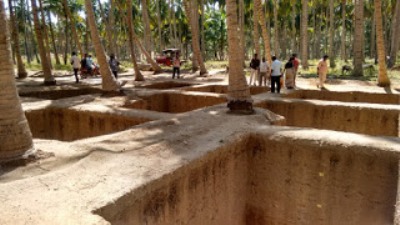
Excavation trenches between coconut palms at Keezhadi (Keeladi) in 2016
Keezhadi
Photographed 2016-10-11
Third, the Kerala record needs the primary reports and older survey documentation behind the accessibility problems identified by Abhayan and colleagues. Particular value would come from reports that document habitation rather than only funerary architecture and that supply reproducible location, stratigraphy, ceramic context, and absolute dating. ↗7 ↗8
Fourth, Nachivayal and Alampetti need secure dating before they are used as core-period examples. The 2013 article is unusually useful because its authors themselves delimit the problem: their work is preliminary and a particular chronology cannot yet be established. That uncertainty is a substantive archaeological result and should be preserved rather than explained away. ↗6
Finally, the 2013 article was read in full as text, but its ceramic drawings, maps and photographs were not examined. The conclusions here do not depend on measurements or on reading those images, but the figures should be checked before any of them is reused or closely interpreted.
Bibliography and source notes
Annotated bibliography
**Das, N. Nikhil, P. P. Joglekar, and R. K. Mohanty. 2013. “New Light on the Unresolved Problem of Megalithic Habitation Sites in Kerala.” Artha Journal of Social Sciences 12(3): 1–18. ** (Note: printed DOI 10.12724/ajss.26.1 resolves in Crossref to an unrelated paper; use the journal URL directly.) Full article text read. This is the key source for the Marayoor survey methodology, Nachivayal trial trench, Alampetti surface/pit evidence, recovery bias, and the authors' explicit chronological caution. Journal landing page: https://journals.christuniversity.in/index.php/artha/article/view/724. ↗6 ↗16
Tamil Nadu Department of Archaeology. “Pattaraiperumbudur” / “Report on Archaeological Excavation Conducted During 2015–16 Field Season.” Official HTML excavation account, partially read in substantial detail. It preserves the discovery history, village-to-village survey context, trench A1/PPR-II stratigraphy, and broad artefact inventory used here. https://www.tnarch.gov.in/excavation/ and https://www.tnarch.gov.in/pattaraiperumbudur. ↗1 ↗4
Tamil Nadu Department of Archaeology. “Andipatti.” Official excavation summary for the 2004–05 campaign. Used for the two excavated localities and the Department's broad first-century-BCE-to-twelfth-century-CE chronology. Full report not yet consulted directly. https://www.tnarch.gov.in/node/34. ↗3
Tamil Nadu Department of Archaeology. “Mangudi.” Official excavation summary for the 2001–02 campaign. Used for the ten trenches, site-selection history, two broad cultural periods, and Department's second-century-BCE attribution of the inscribed sherd. https://www.tnarch.gov.in/mangudi. ↗2
Tamil Nadu Department of Archaeology. “மாளிகைமேடு” [Maligaimedu]. Tamil-language official page, directly reviewed for the relevant claims rather than relying on a later translation. It reports the 1999–2000 excavation, principal material classes, three cultural phases, and the Department's broad 300 BCE–1300 CE occupation span. https://www.tnarch.gov.in/ta/%E0%AE%AE%E0%AE%BE%E0%AE%B3%E0%AE%BF%E0%AE%95%E0%AF%88%E0%AE%AE%E0%AF%87%E0%AE%9F%E0%AF%81. ↗5
Abhayan, G. S., S. V. Rajesh, Akinori Uesugi, Preeta Nayar, B. S. Mohammed Muhaseen, et al. 2021. “Megalithic cist burial excavation at Enadimangalam in Kerala and its implications in cist burial architecture and burial practices.” Archaeological Research in Asia 27: 100293. DOI 10.1016/j.ara.2021.100293. Publisher abstract, introduction, and section snippets read; full text remained paywalled. Important here because it explicitly separates a burial excavation from the inferred settlement landscape and documents broader Kerala reporting/database limitations. https://doi.org/10.1016/j.ara.2021.100293. ↗7 ↗8
Shajan, K. P., P. J. Cherian, R. Tomber, and V. Selvakumar. 2008. “The external connections of Early Historic Pattanam, India: the ceramic evidence.” Antiquity 82(315): 1–5. DOI 10.15184/S2978855200904645. Full HTML project-gallery text read. Used principally for the historiography of Kerala settlement discovery and the observation that modern occupation both obscured and exposed archaeology. https://doi.org/10.15184/S2978855200904645. ↗10
Tamil Nadu Department of Archaeology. “Archaeological Excavations conducted by the Department of Archaeology” and “E-Publication.” Official administrative inventories. Useful for identifying excavation campaigns and precise report-sources still to consult, but deliberately not treated as regional settlement surveys. https://www.tnarch.gov.in/archaeology-excavation and https://www.tnarch.gov.in/e-publication-books?term_node_tid_depth=216. ↗9 ↗11
Rajan, K. 1997. Archaeological Gazetteer of Tamil Nadu. Thanjavur: Manoo Pathippakam. 359 pp. Bibliographic metadata checked; contents not yet consulted directly. It is an important next source still to consult for testing whether a usable regional denominator can be reconstructed. Catalogue record: https://ci.nii.ac.jp/ncid/BA49585365. ↗13
Department of Archaeology, Government of Kerala. “Protected Monuments in Kerala.” Official heritage context read only for the nature of the statutory register. It is useful for understanding preservation visibility but is not a settlement census. https://www.archaeology.kerala.gov.in/monuments/thrikkur-rock-cut-temple/74. ↗12
005Photographs
Photographs of the places and objects this study discusses. Each item carries its creator’s credit, licence and documented source. See all 412 photographs and source images ↗
Enadimangalam
Excavated cist burial at Enadimangalam, Figure 1, published page 568
Keezhadi · Photographed 2016-10-11
Excavation trenches between coconut palms at Keezhadi in 2016
Enadimangalam
Ceramics from the Enadimangalam study area, Figure 3, published page 569

Keezhadi · Photographed 2019-09-06
Stacked ceramic rings exposed in a Keezhadi excavation section
Enadimangalam
Unexcavated cist burials in the Enadimangalam study area, Figure 2, published page 568

Keezhadi · Photographed 2015-09-14
Trench section and small exposed archaeological features at Keezhadi in 2015

Keezhadi · Photographed 2019-09-06
Preserved brick feature within the Keezhadi excavation trenches

Keezhadi · Photographed 2015-09-14
Stratified trench wall and exposed features at Keezhadi in 2015
Show 5 more photographs and source images ↓
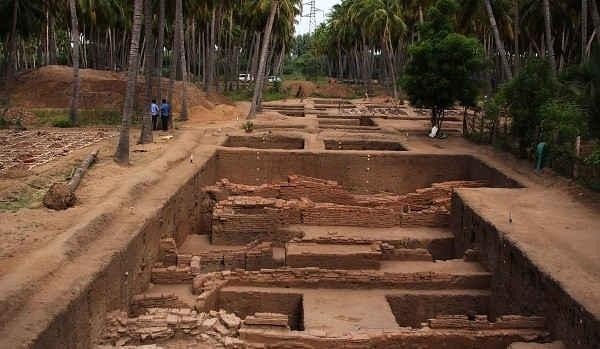
Keezhadi · Photographed 2018-05-28
Long view across excavation trenches and exposed brick structures at Keezhadi
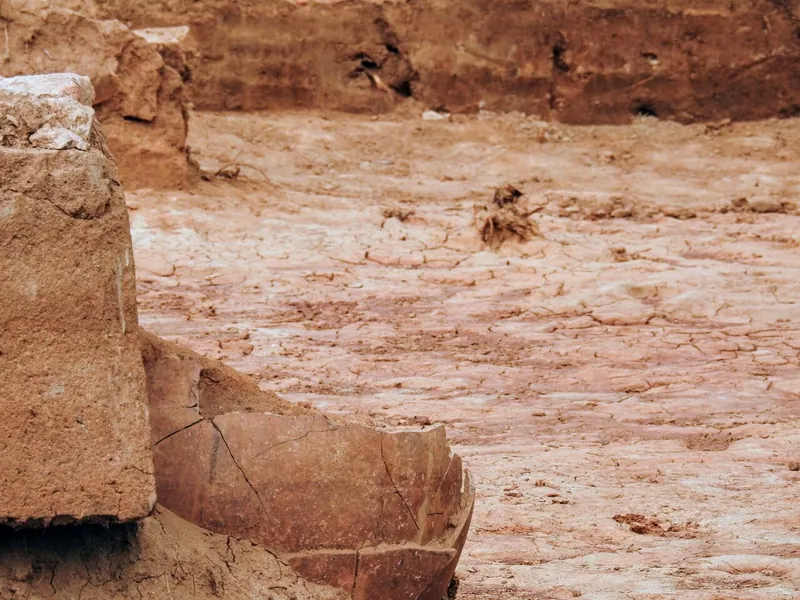
Keezhadi · Photographed 2019-09-06
A pottery vessel exposed within the excavated ground at Keezhadi

Keezhadi · Photographed 2019-09-06
Brickwork and associated deposits exposed at Keezhadi
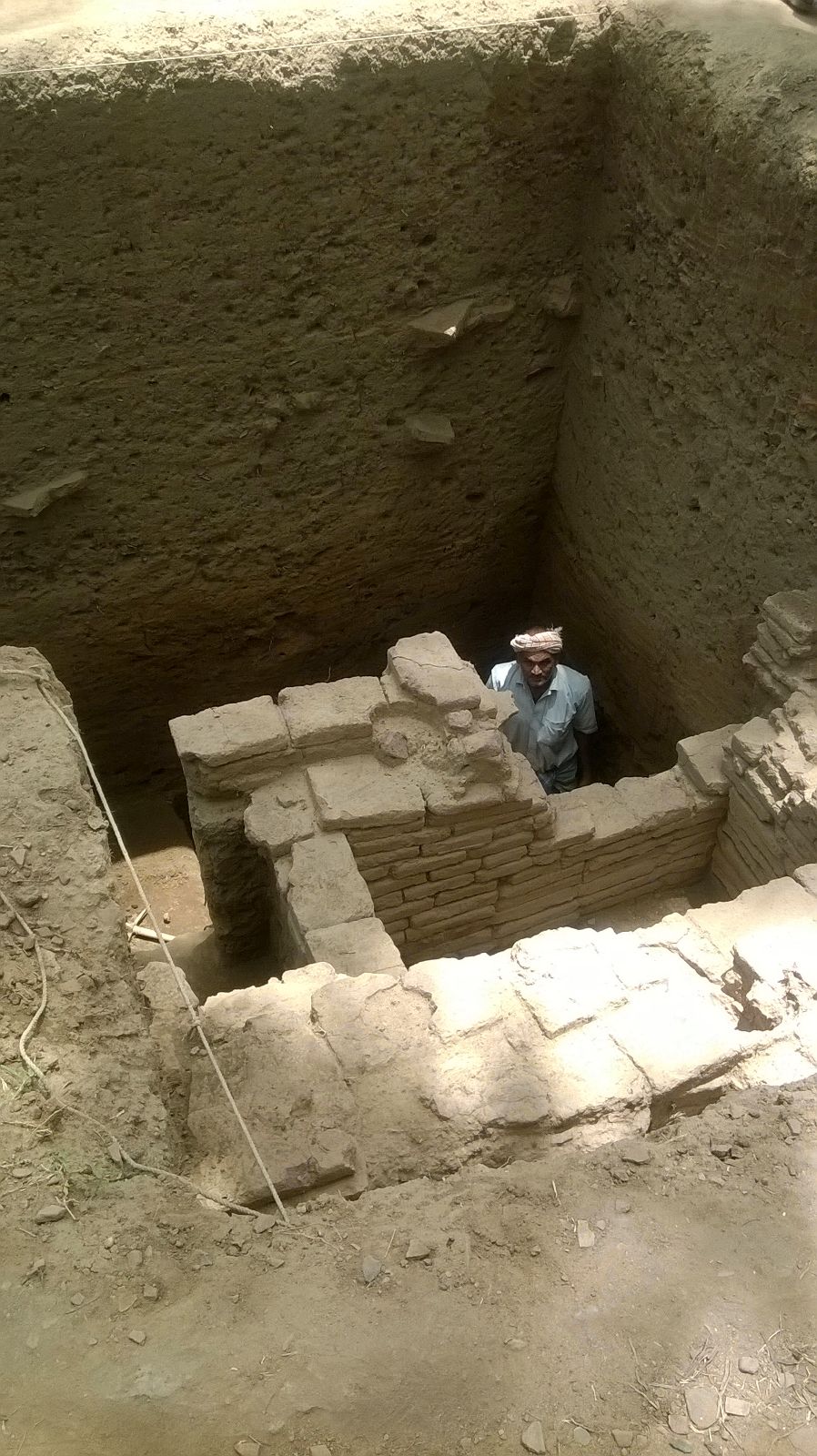
Keezhadi · Photographed 2015-09-14
Excavated brickwork within a Keezhadi trench in 2015
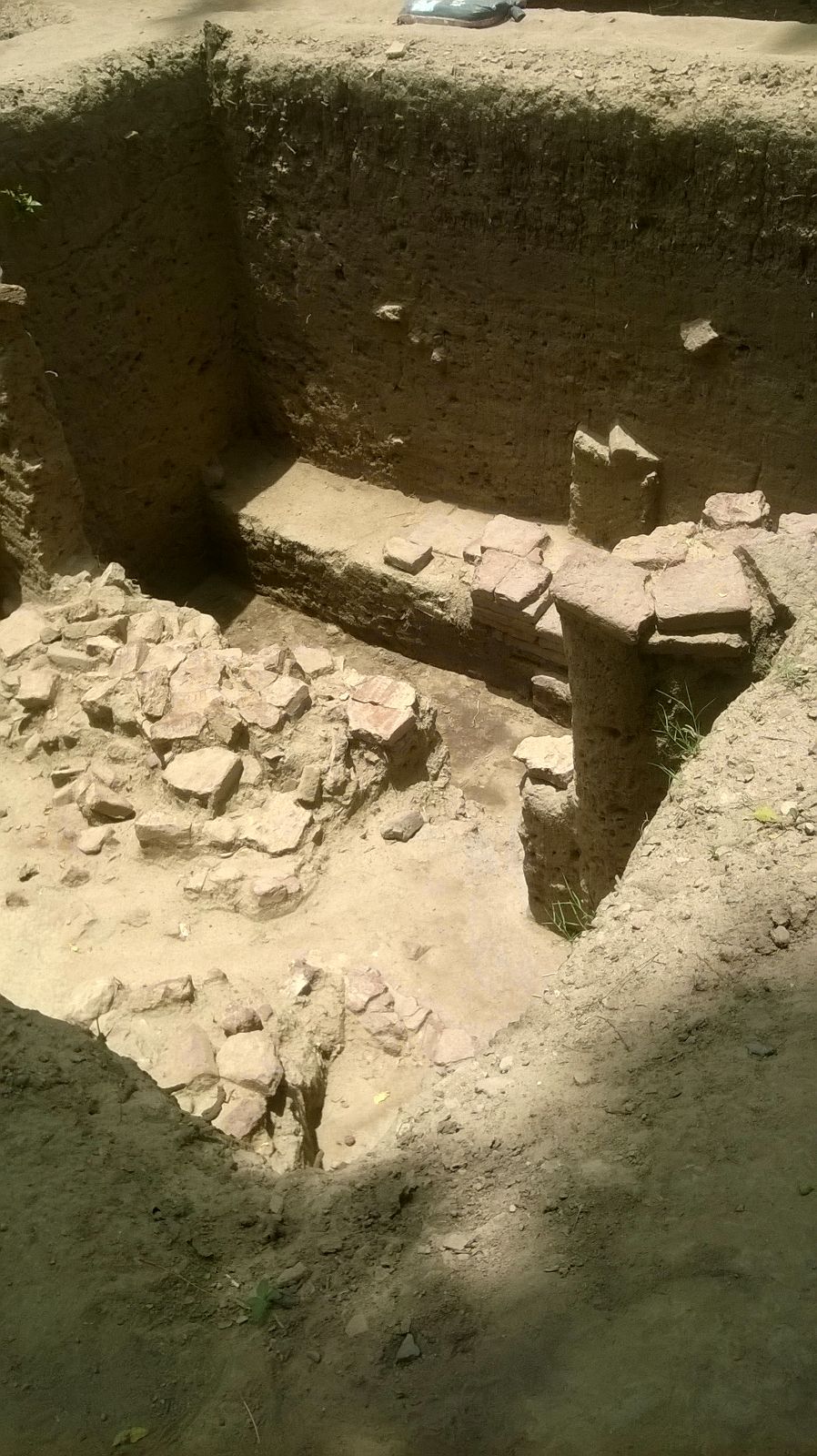
Keezhadi · Photographed 2015-09-14
Brick structural remains exposed in a Keezhadi trench in 2015
006Two views
Both views are shown at equal weight; this site does not choose between them.
Why so few ancient habitation sites are known in Kerala
- One view
- Older accounts described Iron Age and Early Historic habitation as missing or nearly missing from Kerala.
- Another view
- Das, Joglekar and Mohanty (2013) and the Enadimangalam team (2021) point to modern land use, soils, erosion, and too little systematic survey and reporting.
- What would settle it
- A bounded regional survey reporting searched area, surface visibility, negative results, subsurface tests and secure dates.
007Where next
All related studies, connected material, books and sources23 · 11
Elsewhere on this site
Multi-Script Glossary Terms: ūr (ஊர் / ഊർ / ഊര്)
Connected material
Photographs, drawings, books, videos and other studies linked to this study. A link helps you explore; it does not prove a historical claim.
- Excavated cist burial at Enadimangalam, Figure 1, published page 568photographic figureShows the subject
- Unexcavated cist burials in the Enadimangalam study area, Figure 2, published page 568photographic figureShows the subject
- Ceramics from the Enadimangalam study area, Figure 3, published page 569photographic figureShows the subject
- Trench section and small exposed archaeological features at Keezhadi in 2015photographBackground
- Excavated brickwork within a Keezhadi trench in 2015photographBackground
- Stratified trench wall and exposed features at Keezhadi in 2015photographBackground
- Brick structural remains exposed in a Keezhadi trench in 2015photographBackground
- Excavation trenches between coconut palms at Keezhadi in 2016photographBackground
- Long view across excavation trenches and exposed brick structures at KeezhadiphotographBackground
- A pottery vessel exposed within the excavated ground at KeezhadiphotographBackground
- Preserved brick feature within the Keezhadi excavation trenchesphotographBackground
- Stacked ceramic rings exposed in a Keezhadi excavation sectionphotographBackground
- Brickwork and associated deposits exposed at KeezhadiphotographBackground
008Sources
The study lists the sources it consulted; we have not rechecked them. A working link does not show that a source was read, and a valid identifier does not show that it supports a claim. We do not link to unofficial uploads or copies of publications. Where a study cited one, we show the published citation, or a publisher, DOI or Internet Archive link when we have one. Tracking codes are removed from links, and the sources themselves are not republished here.
N Nikhil Das, P P Joglekar and R K Mohanty. 2013. 'New Light on the Unresolved Problem of Megalithic Habitation Sites in Kerala.' Artha Journal of Social Sciences 12(3): 1-18. DOI 10.12724/ajss.26.1.
Tamil Nadu Department of Archaeology. 'Archaeological Excavations conducted by the Department of Archaeology.' Official site inventory.
Pattaraiperumbudur: Report on Archaeological Excavation Conducted During 2015-16 Field Season
Tamil Nadu Department of Archaeology. 'Pattaraiperumbudur' / report on archaeological excavation conducted during the 2015-16 field season.
Tamil Nadu Department of Archaeology. 'Andipatti.' Official excavation summary for the 2004-2005 campaign.
Tamil Nadu Department of Archaeology. 'Mangudi.' Official excavation summary for the 2001-2002 campaign.
Tamil Nadu Department of Archaeology. 'Maligaimedu.' Official excavation summary; Tamil-language page states excavation in 1999-2000 and occupation spanning 300 BCE-1300 CE.
G.S. Abhayan et al. 2021. 'Megalithic cist burial excavation at Enadimangalam in Kerala and its implications in cist burial architecture and burial practices.' Archaeological Research in Asia 27:100293. DOI 10.1016/j.ara.2021.100293.
K.P. Shajan, P.J. Cherian, R. Tomber and V. Selvakumar. 2008. 'The external connections of Early Historic Pattanam, India: the ceramic evidence.' Antiquity 82(315):1-5. DOI 10.15184/S2978855200904645.
Department of Archaeology, Government of Kerala. 'Protected Monuments in Kerala.' Official protected-monument register/context page.
K. Rajan. 1997. Archaeological Gazetteer of Tamil Nadu. Thanjavur: Manoo Pathippakam. 359 pages.
Tamil Nadu Department of Archaeology. 'E-Publication.' Official bibliography of excavation reports and other departmental publications.
Researchers and institutions whose work this study uses: K. Rajan, P. J. Cherian, V. Selvakumar, K. P. Shajan, Roberta Tomber
How we know The evidence, claims and dates behind this study
What this study draws on
- Full reading of Das, Joglekar and Mohanty's 2013 Marayoor survey paper, including the Nachivayal trial trench.
- Tamil Nadu Department of Archaeology summaries for Pattaraiperumbudur, Andipatti, Mangudi and Maligaimedu (the last read in Tamil).
- The abstract and accessible sections of the 2021 Enadimangalam cist-burial paper; the full text was paywalled.
- Sorting each site by evidence type: excavated, trial trench, surface or pit, burial only, or inferred.
Dates in this study
| What is dated | Date | How it was dated |
|---|---|---|
| Early Historic period (300 BC-AD 500) | 300 BCE – 500 CE | Period assigned by excavators or scholars |
| 300 BCE to 1300 CE | 300 BCE – 1300 CE | Period assigned by excavators or scholars |
| 2nd century BCE | 200–100 BCE | Date from writing, coins or texts |
| from the 1st century BCE till the 12th century CE | 100 BCE – 1200 CE | How it was dated is not stated |
See these dates on the timeline
The study’s claims
16 claims · 16 source passages · 68 paragraphs
Browse the study paragraph by paragraphArchaeological evidence for non-port, non-royal habitation exists in the reviewed Tamil Nadu record, but the accessible evidence is a collection of purposively investigated sites rather than a representative statewide settlement-density dataset.
Supported in this study
'Ordinary' is used operationally for settlements outside major port/royal-centre framing; it is not a demonstrated ancient social-status category.
For Kerala, the historical claim of an absence of Iron Age-Early Historic habitation is better treated as a visibility and documentation problem than as evidence of an empty landscape, because targeted survey recovered habitation evidence while the authors themselves identified major survey and preservation biases.
Supported with qualifications
The reviewed Kerala habitation cases are few and chronologically weak; visibility bias does not prove dense or continuous occupation.
Excavated habitation, surface-survey habitation, burial-only sites, and settlements inferred from burial distributions must be kept as separate evidence classes because they differ in stratigraphic control and directness.
Supported in this study
Modern cultivation and occupation, durable and legally protected funerary monuments, uneven survey intensity, inaccessible or unpublished reports, and excavation selection based on visible artefact scatters all bias the archaeological visibility of ordinary settlement.
Supported in this study
The relative magnitude of each bias has not been quantified.
Pattaraiperumbudur is the strongest reviewed Tamil Nadu example of directly excavated multi-period habitation outside a major port or royal centre: it was identified by village-to-village survey, then excavated with multiple trenches, with relative stratigraphy separating prehistoric, Iron Age and Early Historic deposits.
Supported in this study
The official web report does not provide an absolute chronology for the Iron Age/Early Historic levels used here.
Andipatti provides excavated habitation evidence at two localities, but the accessible official summary compresses a very long first-century-BCE-to-twelfth-century-CE sequence and therefore has limited resolution for the 1000 BCE-600 CE editorial window.
Supported with qualifications
Mangudi provides excavated Early Historic habitation evidence from ten trenches, while its selection history also demonstrates recovery bias: excavation followed the prior discovery of Roman pottery in surface exploration.
Supported in this study
Maligaimedu is an excavated habitation case with material assigned by the Tamil Nadu Department to a broad 300 BCE-1300 CE span; this mixed chronology is useful for demonstrating continuity but insufficient by itself for fine-grained settlement change within 1000 BCE-600 CE.
Supported with qualifications
Nachivayal has direct subsurface evidence for a habitation deposit from trial trench NVL-1, but only a 1 x 1 m test was reported and the site was heavily disturbed by cultivation.
Supported in this study
Nachivayal cannot securely be assigned to the Iron Age from the consulted publication: the excavators explicitly decline a firm chronology and tentatively compare its ceramics with Early Historic/Historic and possibly later first-millennium assemblages.
Supported in this study
Alampetti is evidence of a probable habitation locality from surface finds and an owner-dug pit, not a formally excavated habitation deposit; its proposed pre-Christian date is typological and preliminary.
Supported with qualifications
Enadimangalam is a burial excavation, not a settlement excavation; the published inference that scattered burials reflect smaller settlements is therefore an inferred-settlement hypothesis rather than direct habitation evidence.
Supported in this study
The Enadimangalam burial distribution cannot be converted into a count or density of settlements without independent evidence for burial contemporaneity and nearby habitation, especially because repeated use of burial structures is itself considered possible.
Supported with qualifications
This is a methodological inference from the source's own burial-reuse and landscape discussion, not a rejection of the authors' smaller-settlement hypothesis.
Pattanam shows that settlement visibility in Kerala is historically contingent: it was located from a surface artefact concentration, and modern occupation both hindered investigation and exposed subsurface material. It should be used as a visibility comparator, not as a proxy for ordinary rural settlement.
Supported in this study
The reviewed Tamil Nadu-Kerala asymmetry in documented habitation cannot be interpreted as a difference in ancient population or settlement density, because survey coverage, recovery conditions, publication depth and site-selection procedures are not standardized between the two states.
Supported in this study
No defensible regional population total, settlement hierarchy, or claim of empty landscapes can be derived from the reviewed inventory; those questions require bounded and reproducibly surveyed areas, comparable detection protocols, chronological control, and a documented denominator of surveyed land and sites.
Supported in this study
This conclusion is deliberately negative about quantification while positive about the existence of occupation evidence.
Trace one claim through the study’s records
Explore the evidenceOther source lists
Numbered citation links from the study
The numbered links in the study text point here.
Excavation | Department Of Archaeology
Mangudi | Department Of Archaeology
Andipatti | Department Of Archaeology
Pattaraiperumbudur | Department Of Archaeology
மாளிகைமேடு | தொல்லியல் துறை
Web page (journals.christuniversity.in)
Megalithic cist burial excavation at Enadimangalam in Kerala and its implications in cist burial architecture and burial practices - ScienceDirect
Megalithic cist burial excavation at Enadimangalam in Kerala and its implications in cist burial architecture and burial practices - ScienceDirect
Archaeological Excavations conducted by the Department of Archaeology | Department Of Archaeology
The external connections of Early Historic Pattanam, India: the ceramic evidence | Antiquity Project Gallery, 2002-2016
E-Publication | Department Of Archaeology
Protected Monuments in Kerala | Department of Archaeology | Govt of Kerala
CiNii Books - Archaeological gazetteer of Tamil Nadu
Archaeology Publication | Department Of Archaeology
E-Publication | Department Of Archaeology
New Light on the Unresolved Problem of Megalithic Habitation Sites in Kerala | Artha Journal of Social Sciences
தொல்பொருளியல் திணைக்களத்தால் நடத்தப்பட்ட தொல்பொருள் அகழ்வுகள் | தொல்லியல் துறை
About this study Status, corrections and how it was made
Status
Draft study, revision 6. No historian, archaeologist, or Tamil or Malayalam specialist has reviewed it yet.
How it was made
Compiled as an editorial synthesis from published scholarship around questions we framed. About this project & workflow
The summary, How sure lines and Two views notes on this page were prepared from this study and cross-checked against its passages. That is an editorial check, not a specialist review.
Technical details
Study code LTS-SUP09. The text fingerprint changes whenever the study text changes.
- The study text is shown as written. Links from its paragraphs to citations help you move around the study; they are not new claims or checked source passages.
See how this study’s records were extracted
Text fingerprint (SHA-256): LTS-SUP09 · 4f69e780d6b5d5a3270533de… · v6
Evidence tables and technical details are on the web page: https://layersofthesouth.org/read/f8e8f29649