Raw incense ingredients, including frankincense (modern comparative photograph)
18 November 2006 (original upload date)
Modern comparative materials; the photograph does not identify an ancient resin residue or establish an ancient trade route.
- Across the water
- Khor Rori / Sumhuram & Quseir al-Qadim
Reported frankincense at Pattanam still needs a chemical test
Frankincense is reported among Pattanam's plant remains; residue chemistry, as used at Qasr Ibrim and Pompeii, shows what confirming it would require.
- This page
- 2,097 words · revision 6
Draft study · Awaiting specialist review · Updated
001Dates and places
Places on the atlas that name this study.
- Khor Rori / Sumhuram & Quseir al-Qadim
Connected overseas port · Shown in Western Indian Ocean Inset
outside this map
Dates in this study are stated in words only.
- 1 Well supported
- 1 Likely
- 1 Not known
002How sure
In brief
PAMA and Mahatma Gandhi University project summaries of the Pattanam excavations on the Kerala coast list frankincense among the site's plant remains, while describing further characterization and archaeomolecular work as still to come and offering no trench-level sample record or published chemical spectrum. This study shows what confirming such a report would take. Frankincense and myrrh come from different trees, Boswellia and Commiphora, in parts of Africa and southern Arabia. In 1997, chemists reported boswellic acids, marker compounds of frankincense, in resin-like material from Qasr Ibrim. In 2026, a study of incense burners at Pompeii found a resin, probably Canarium, in one sample, with no frankincense markers – showing that a burner's shape or label does not identify what was burned in it. The Periplus, a first-century merchant's guide, keeps African and Arabian aromatics markets apart. Until a dated Pattanam sample is tested chemically, the reported frankincense remains a lead.
Key researchers cited in this study: P. J. Cherian (KCHR Pattanam Excavations) · Wilfred H. Schoff (Periplus Translation & Commentary) · Kerala Council for Historical Research (KCHR) · Full bibliography
How sure
- Well supported
Frankincense and myrrh come from trees of two different genera.
Botanical records place Boswellia and Commiphora in separate genera with different products.
- Likely
One Pompeii censer residue held a probable Canarium resin and no frankincense markers.
No frankincense markers were detected, but the resin is only probably Canarium and controls were missing.
- Not known
Frankincense was present at Pattanam.
Listed in PAMA and MGU project summaries without sample records, a specialist report or chemical testing.
Why it matters
A find list that names frankincense at an Indian port is only a lead until chemistry and a dated context confirm it.
003Key findings
What the study concludes
- Frankincense and myrrh are not one plant: different species and landscapes stand behind the traded names.
- Residue analysis can distinguish materials that an incense-burner label cannot; a 2026 Pompeii study did not detect the characteristic frankincense markers in the relevant sample.
- Modern Boswellia research reveals pressures on living trees, but does not retrospectively measure ancient forests or authorize a harvesting recipe.
In the study’s own words. How sure each point is, is shown above.
The summary above is the short read. The full study is the complete text it was drawn from, with its tables and source notes.
What the full study covers
- Main findings
- The fragrance had a landscape before it had an altar
- Two genera, several useful products
- Ancient writers knew the product better than the tree
- Africa and Arabia were not interchangeable shores
- An incense burner does not name its fuel
- A new Pompeii study changes the question
- Living trees reveal costs that cargo lists conceal
- Keep the scent and the evidence together
- What remains uncertain
- The next questions
- References and access notes
004The study
Main findings
- Frankincense is reported among Pattanam’s plant remains; confirming it would need the specialist report and chemical tests of the kind described here.
- Frankincense and myrrh are not one plant: different species and landscapes stand behind the traded names.
- Residue analysis can distinguish materials that an incense-burner label cannot; a 2026 Pompeii study did not detect the characteristic frankincense markers in the relevant sample.
- Modern Boswellia research reveals pressures on living trees, but does not retrospectively measure ancient forests or authorize a harvesting recipe.
The fragrance had a landscape before it had an altar
Frankincense is reported among the plant remains from Pattanam on the Kerala coast, and this study asks what it would take to confirm that report. Incense can make the tree disappear from view. A reader sees a small quantity placed near a flame, but not the place it came from or the work that separated it from a living plant. This study looks at that earlier history without pretending that every fragrant ancient offering can be identified as frankincense. It asks which plants are involved, what kinds of evidence identify their products, and how labor and ecological cost enter the story. The inquiry crosses periods deliberately. Botanical records describe living species. Pliny and the Periplus describe a first-century commercial and intellectual world. Archaeological chemistry examines particular surviving materials. Recent ecological studies concern modern trees and harvest systems. Their connections are informative only while their differences remain visible.
Two genera, several useful products
Kew describes Boswellia sacra in parts of northeastern Africa and southern Arabia, including Somali and southern Arabian landscapes. The profile describes papery bark and trees capable of occupying rocky sites. It concerns one frankincense-producing species, not a botanical synonym for every resin traded under the word frankincense. 1 Commiphora myrrha belongs to another genus. Kew’s record describes a spiny plant with papery bark and an exudate that hardens into a gum-resin, distributed in eastern Africa and southern Arabia. Its flora description calls the fresh exudate hardly scented. That small detail warns against writing identical sensory descriptions for fresh exudate, a stored product and material being heated. 2 The comparison complicates the easy picture of one incense forest supplying everything. To identify an actual shipment, we would need more than an evocative name. Different source plants can enter related commercial categories, and a prepared product may no longer carry the features used to recognize the tree. Named species and plant parts belong in a botanical description; a record of an ancient cargo can carry only the more limited identification its own evidence allows.
Ancient writers knew the product better than the tree
Pliny openly reports disagreement about the incense tree’s appearance. He also describes demand encouraging an additional harvest and presents accounts of collecting, sorting and guarding the product. These passages are useful because they expose both commercial concerns and the limits of his knowledge. They are not a modern field report on a single identified Boswellia population. 3 The distinction makes it possible to read critically without discarding everything. A writer may know that buyers judge a resin, that handling matters and that demand affects work, yet remain uncertain about the producer’s environment. Nor do we need to repeat his judgments about the honesty of different peoples. Those moral contrasts belong to the text’s argument, not to a verified description of whole communities. The useful questions concern the form in which a buyer received resin, why one lot was desirable and who carried information about quality. They connect with measures and credit, but the source does not answer them for a particular transaction. A fragrant commodity should retain its workers and material conditions.
Africa and Arabia were not interchangeable shores
The Periplus names myrrh and forms of frankincense among commodities at African trading places and describes Arabian ports associated with aromatics. Its entries preserve distinctions between locations and trading arrangements. We should use those distinctions rather than replace the whole region with a generalized Arab incense route. 4 The account’s value here is geographic differentiation, not a guarantee that every English product label has been botanically verified. Likewise, a modern species distribution does not tell us which vessel carried a particular ancient lot. The historical picture can include several communities engaged in production and exchange without making them interchangeable or treating the western buyer as the only person whose purposes mattered. Ships from Limyrike, the coast of Muziris and Nelcynda, also reached southern Arabia: “Hoq cave names western Indian sailors; Sumhuram has a Tamil name” discusses the Periplus account of vessels from Limyrike and Barygaza at Moscha Limen (Sumhuram), some of which wintered there.
Papery bark of Boswellia Sacra – Modern frankincense tree or resin, as botanical/process context
Photographed 2013-12-14
An incense burner does not name its fuel
Van Bergen and colleagues identified boswellic acids and related compounds in resin-like material from Qasr Ibrim. Their abstract describes complementary analyses of soluble material and insoluble residues. This is stronger evidence for material identification than the shape of a burner alone. The consulted abstract, however, does not supply the specific samples’ date, species or source region. 5 A material identification is not automatically a date of arrival, place of growth or record of a user. The archaeological context is needed to connect chemistry with trade history. A long-lived site name or an uninspected summary cannot supply the missing sample date.
A new Pompeii study changes the question
Eber and colleagues’ 2026 study examined residues in Pompeian censers. In one sample they found markers consistent with a Burseraceae resin, probably Canarium, but did not detect the characteristic boswellic acids, acetates or degradation products expected for frankincense. The authors also acknowledge that missing sediment controls limit interpretation of some associated substances. 6 This is an especially useful counterexample to the assumption that an incense vessel necessarily contained frankincense. The proposed identification remains qualified. It does not establish a particular tree species, an Indian estate, a direct shipment or a named worshipper. Nor does the failure to detect frankincense in one residue disprove its use elsewhere. A particular analytical result should remain particular in both directions. “Western Ghats uplands were settled; forest producers are unnamed” lists securely dated Canarium or dammar resin studies among the evidence still needed for the southern Western Ghats; the Pompeii result is not such evidence, since it does not establish a source region.
The same test applies to the frankincense reported among Pattanam’s plant remains. Project summaries from PAMA and Mahatma Gandhi University list frankincense among Pattanam's plant remains while describing further molecular work as prospective 9. The KCHR interim reports, where the find was first reported, were not checked for this study for trench, layer or a specialist resin report. “Pattanam finds: wide trade links, unevenly dated and sourced” and “Malabathrum and cardamom: Kerala hill origins not shown” survey the same institutional reporting. Confirming frankincense at Pattanam would require a specimen from a known, dated context tested for the boswellic-acid markers described above; a vessel shape or find-list entry is not enough.
Living trees reveal costs that cargo lists conceal
Two modern studies of Boswellia papyrifera concern living trees, not ancient forests. Bongers and colleagues (2019) report a shortage of smaller trees in most of the 23 populations they sampled, and Negussie and colleagues (2021) link continuous tapping in northern Ethiopia to more longhorn-beetle damage. 78 The tapping study gives a modern reason to ask how harvesting affects the resource itself; neither study describes a first-century harvest.
Keep the scent and the evidence together
The main conclusion is simple. Frankincense and myrrh belong to histories of plants and work as well as trade and belief. Their names do not identify every sample, and an evocative smell does not date itself. By attending to species, context, analysis and the limits of each source, we recover a more inhabited world: one in which a small fragrant offering depended on distant lives, difficult judgments and material choices. For Pattanam, the reported frankincense remains a lead until it is tested.
What remains uncertain
- No species-level provenance or exact ancient harvest calendar is reconstructed from the literary trade names.
- The Qasr Ibrim paper was consulted at abstract level; its particular sample dates are not supplied here.
- The Pompeii resin attribution is qualified, with missing controls disclosed; contemporary ecological findings do not establish ancient forest conditions.
The next questions
- Investigate dated resin analyses from Arabian and African production and transit sites, and from Pattanam if the reported frankincense is sampled.
- Review historic harvesting rights and local knowledge with region-specific evidence and appropriate community participation.
- Examine the full Qasr Ibrim report and context before adding chronological or provenance claims.
References and access notes
1 Royal Botanic Gardens, Kew (Continuously maintained; checked 2026). Boswellia sacra Flück.: taxonomy and plant profile. Distribution and plant profile: habit, bark and rocky growing places. Taxonomy, distribution and descriptive profile read. One frankincense-producing species, not a synonym for every traded frankincense. Modern ecology is not a reconstruction of all ancient harvests. Open source: powo.science.kew.org
2 Royal Botanic Gardens, Kew (Continuously maintained; checked 2026). Commiphora myrrha (T.Nees) Engl.: taxonomy and plant description. Distribution and Flora of Tropical East Africa description: habit, exudate and scent. Distribution and Flora of Tropical East Africa descriptive material read. The record describes the fresh exudate as hardly scented; fresh exudate, dried product and burned material are not interchangeable sensory descriptions. Not all resins called myrrh are identified by this record. Open source: powo.science.kew.org
3 Pliny the Elder; English translation by H. Rackham, presented by Attalus (First century CE; modern English translation). Natural History, Book 12, second part: aromatics. Natural History 12.55–60: conflicting tree descriptions, additional harvest and collection accounts. Selected passages read in the English presentation; Latin not newly collated. Pliny reports disagreement, hearsay and moral judgments. Modern species identifications in links or translation are not independent ancient botanical evidence. Historical claims about remedies, tasting and smoke are not instructions for readers. Open source: www.attalus.org
4 Anonymous; translated by Wilfred H. Schoff (1912 translation). The Periplus of the Erythraean Sea. Periplus §§8–12 and 27–29: African and southern Arabian aromatics and ports. Relevant numbered sections read. University of Washington transcription of the 1912 translation, with some later editorial glosses. Ancient composition is usually placed around the middle of the first century CE, not the translation date. Schoff’s translation is public domain in the United States; no complete modern translation is reproduced. Open source: depts.washington.edu
5 P. F. van Bergen; T. M. Peakman; E. C. Leigh-Firbank; R. P. Evershed (1997). Chemical evidence for archaeological frankincense: boswellic acids and their derivatives in solvent soluble and insoluble fractions of resin-like materials. Abstract: Qasr Ibrim material, solvent fractions and pyrolysis products. Publisher abstract and University of Bristol bibliographic record read; full paper not read. The abstract does not establish the date of the particular samples, tree species or geographic source. These are not supplied from an uninspected secondary citation. Open source: www.sciencedirect.com
6 Johannes Eber; Shira Gur-Arieh; Robert C. Power; Maxime Rageot; Philipp Wolfgang Stockhammer (2026). Ashes from Pompeii: incense burners, residue analyses and domestic cult practices. Results: organic residues in sample 2.2; missing frankincense biomarkers; absence of sediment controls. Full HTML read selectively: evidence, sampling, organic residue results, limitations and discussion; images and supplementary laboratory data not reanalysed. Probable resin attribution is not a species-level geographic provenance or an identified trade itinerary. Absence of sediment controls limits interpretation of some associated residues. Open source: doi.org
7 Frans Bongers and colleagues (2019). Frankincense in peril. Abstract: sampled populations, trees and regeneration findings. Institutional abstract and bibliographic record read; full demographic models and raw data not read. The research concerns Boswellia papyrifera populations. Its future projections start from the study’s assumptions and date, not from today, and are not forecasts adopted by this website. Open source: research.wur.nl
8 Aklilu Negussie; Kindeya Gebrehiwot; Mekonnen Yohannes; Lindsey Norgrove; Ermias Aynekulu (2021). Continuous resin tapping for frankincense harvest increases susceptibility of Boswellia papyrifera (Del.) Hochst trees to longhorn beetle damage. Abstract: continuous tapping, resting and beetle-damage findings. Research-network abstract and citation read; indexed PMC context cross-checked. Full statistical results not independently evaluated. Used as a modern, species-specific management study. No cutting schedule, wound count or ancient harvest practice is prescribed. Open source: archive.iwmi.org
9 PAMA – Institute for the Advancement of Transdisciplinary Archaeological Sciences (dir. P. J. Cherian), “Pattanam – Current Project” (https://www.pama.org.in/currentprojects/Pattanam), and Mahatma Gandhi University, School of Social Sciences, “Early Historic Age Collection – Pattanam” (https://sss.mgu.ac.in/early-historic-age-collection/). Institutional project summaries listing frankincense among Pattanam archaeobotanical finds without trench-level sample records or published chemical spectra, with further characterization described as prospective.
005Photographs
Photographs of the places and objects this study discusses. Each item carries its creator’s credit, licence and documented source. See all 412 photographs and source images ↗
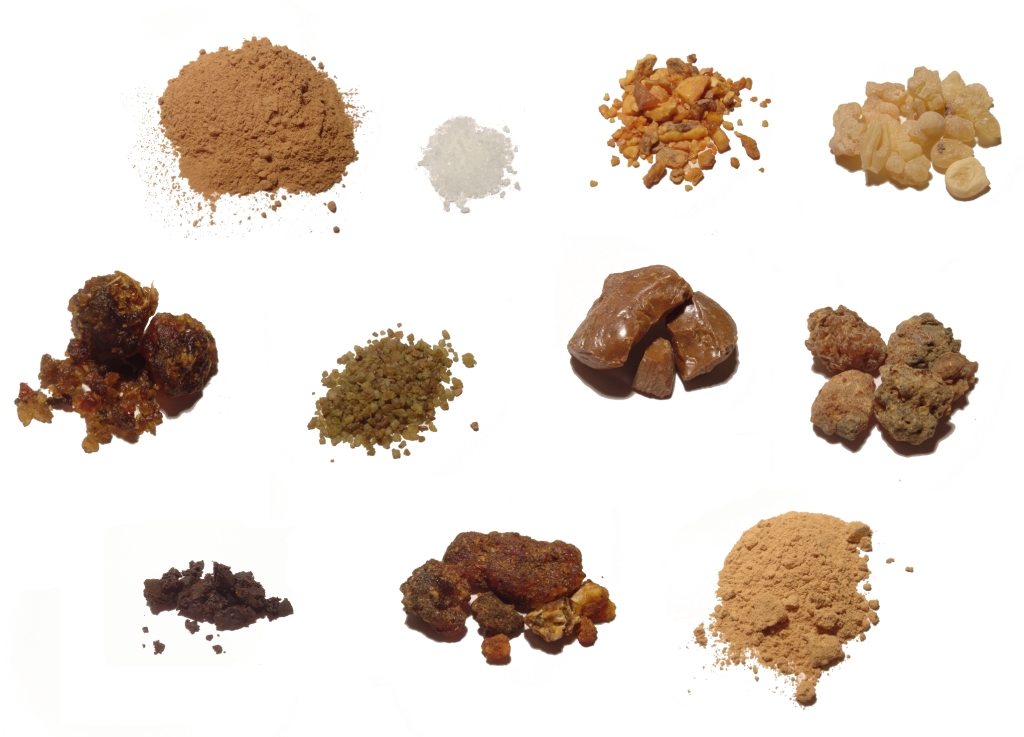
18 November 2006 (original upload date)
Raw incense ingredients, including frankincense (modern comparative photograph)
A modern comparison of raw incense ingredients, including frankincense; no tree is shown.
Modern comparative materials; the photograph does not identify an ancient resin residue or establish an ancient trade route.

Photographed 2013-12-14 08:37:58
Papery bark of Boswellia Sacra – Modern frankincense tree or resin, as botanical/process context
Papery bark of Boswellia Sacra. Modern frankincense tree or resin, as botanical/process context.
006Where next
Same place: Khor Rori / Sumhuram & Quseir al-Qadim
On the atlasKhor Rori / Sumhuram & Quseir al-QadimConnected overseas port · Shown in Western Indian Ocean Inset
Explore nextPapery bark of Boswellia Sacra – Modern frankincense tree or resin, as botanical/process contextAll related studies, connected material, books and sources17 · 10
Elsewhere on this site
Excavation Atlas Sites: Khor Rori / Sumhuram & Quseir al-Qadim
Connected material
Photographs, drawings, books, videos and other studies linked to this study. A link helps you explore; it does not prove a historical claim.
007Sources
The study lists the sources it consulted; we have not rechecked them. A working link does not show that a source was read, and a valid identifier does not show that it supports a claim. We do not link to unofficial uploads or copies of publications. Where a study cited one, we show the published citation, or a publisher, DOI or Internet Archive link when we have one. Tracking codes are removed from links, and the sources themselves are not republished here.
Royal Botanic Gardens, Kew (Continuously maintained; checked 2026). Boswellia sacra Flück.: taxonomy and plant profile. Distribution and plant profile: habit, bark and rocky growing places. Taxonomy, distribution and descriptive profile read. One frankincense-producing species, not a synonym for every traded frankincense. Modern ecology is not a reconstruction of all ancient harvests.
Royal Botanic Gardens, Kew (Continuously maintained; checked 2026). Commiphora myrrha (T.Nees) Engl.: taxonomy and plant description. Distribution and Flora of Tropical East Africa description: habit, exudate and scent. Distribution and Flora of Tropical East Africa descriptive material read. The record describes the fresh exudate as hardly scented; fresh exudate, dried product and burned material are not interchangeable sensory descriptions. Not all resins called myrrh are identified by this record.
Pliny the Elder; English translation by H. Rackham, presented by Attalus (First century CE; modern English translation). Natural History, Book 12, second part: aromatics. Natural History 12.55–60: conflicting tree descriptions, additional harvest and collection accounts. Selected passages read in the English presentation; Latin not newly collated. Pliny reports disagreement, hearsay and moral judgments. Modern species identifications in links or translation are not independent ancient botanical evidence. Historical claims about remedies, tasting and smoke are not instructions for readers.
Anonymous; translated by Wilfred H. Schoff (1912 translation). The Periplus of the Erythraean Sea. Periplus §§8–12 and 27–29: African and southern Arabian aromatics and ports. Relevant numbered sections read. University of Washington transcription of the 1912 translation, with some later editorial glosses. Ancient composition is usually placed around the middle of the first century CE, not the translation date. Schoff’s translation is public domain in the United States; no complete modern translation is reproduced.
P. F. van Bergen; T. M. Peakman; E. C. Leigh-Firbank; R. P. Evershed (1997). Chemical evidence for archaeological frankincense: boswellic acids and their derivatives in solvent soluble and insoluble fractions of resin-like materials. Abstract: Qasr Ibrim material, solvent fractions and pyrolysis products. Publisher abstract and University of Bristol bibliographic record read; full paper not read. The abstract does not establish the date of the particular samples, tree species or geographic source. These are not supplied from an uninspected secondary citation.
Johannes Eber; Shira Gur-Arieh; Robert C. Power; Maxime Rageot; Philipp Wolfgang Stockhammer (2026). Ashes from Pompeii: incense burners, residue analyses and domestic cult practices. Results: organic residues in sample 2.2; missing frankincense biomarkers; absence of sediment controls. Full HTML read selectively: evidence, sampling, organic residue results, limitations and discussion; images and supplementary laboratory data not reanalysed. Probable resin attribution is not a species-level geographic provenance or an identified trade itinerary. Absence of sediment controls limits interpretation of some associated residues.
Frans Bongers and colleagues (2019). Frankincense in peril. Abstract: sampled populations, trees and regeneration findings. Institutional abstract and bibliographic record inspecte
Frans Bongers and colleagues (2019). Frankincense in peril. Abstract: sampled populations, trees and regeneration findings. Institutional abstract and bibliographic record read; full demographic models and raw data not read. The research concerns Boswellia papyrifera populations. Its future projections start from the study’s assumptions and date, not from today, and are not forecasts adopted by this website.
Aklilu Negussie; Kindeya Gebrehiwot; Mekonnen Yohannes; Lindsey Norgrove; Ermias Aynekulu (2021). Continuous resin tapping for frankincense harvest increases susceptibility of Boswellia papyrifera (Del.) Hochst trees to longhorn beetle damage. Abstract: continuous tapping, resting and beetle-damage findings. Research-network abstract and citation read; indexed PMC context cross-checked. Full statistical results not independently evaluated. Used as a modern, species-specific management study. No cutting schedule, wound count or ancient harvest practice is prescribed.
PAMA (dir. P. J. Cherian), Pattanam Current Project & MGU Early Historic Collection summaries
PAMA – Institute for the Advancement of Transdisciplinary Archaeological Sciences, 'Pattanam – Current Project' (https://www.pama.org.in/currentprojects/Pattanam) and Mahatma Gandhi University School of Social Sciences, 'Early Historic Age Collection – Pattanam' (https://sss.mgu.ac.in/early-historic-age-collection/).
Cherian et al. (2009), Current Science 97(2): 236–240, and KCHR Pattanam Interim Reports
P. J. Cherian et al. (2009), 'Chronology of Pattanam: A multi-cultural port site on the Malabar coast', Current Science 97(2): 236–240; P. J. Cherian (ed.), Pattanam Excavations: Interim Reports (KCHR, including Eighth Season, 2014).
Researchers and institutions whose work this study uses: P. J. Cherian, Wilfred H. Schoff, Kerala Council for Historical Research
How we know The evidence, claims and dates behind this study
What this study draws on
- Kew plant records for Boswellia sacra and Commiphora myrrha.
- Van Bergen and colleagues (1997) on Qasr Ibrim resin, read as an abstract, and Eber and colleagues (2026) on Pompeii censers.
- Pliny, Natural History book 12, and Periplus sections 8–12 and 27–29 in English translation.
- Pattanam find lists as assessed in related studies of the site.
Dates in this study
This study has no dates recorded in a form we can chart, so there is no date chart. Any dates it gives are in the full study.
The study’s claims
0 claims · 0 source passages · 21 paragraphs
Browse the study paragraph by paragraphThis study has no separately listed claims. Its paragraphs can be browsed one by one.
About this study Status, corrections and how it was made
Status
Draft study, revision 6. No historian, archaeologist, or Tamil or Malayalam specialist has reviewed it yet.
How it was made
Compiled as an editorial synthesis from published scholarship around questions we framed. About this project & workflow
The summary, How sure lines and Two views notes on this page were prepared from this study and cross-checked against its passages. That is an editorial check, not a specialist review.
Technical details
Study code R052. The text fingerprint changes whenever the study text changes.
- The study text is shown as written. Links from its paragraphs to citations help you move around the study; they are not new claims or checked source passages.
See how this study’s records were extracted
Text fingerprint (SHA-256): R052 · 2c1b03d11b7be6c329e91e39… · v6
Evidence tables and technical details are on the web page: https://layersofthesouth.org/read/a2e18e5f8e