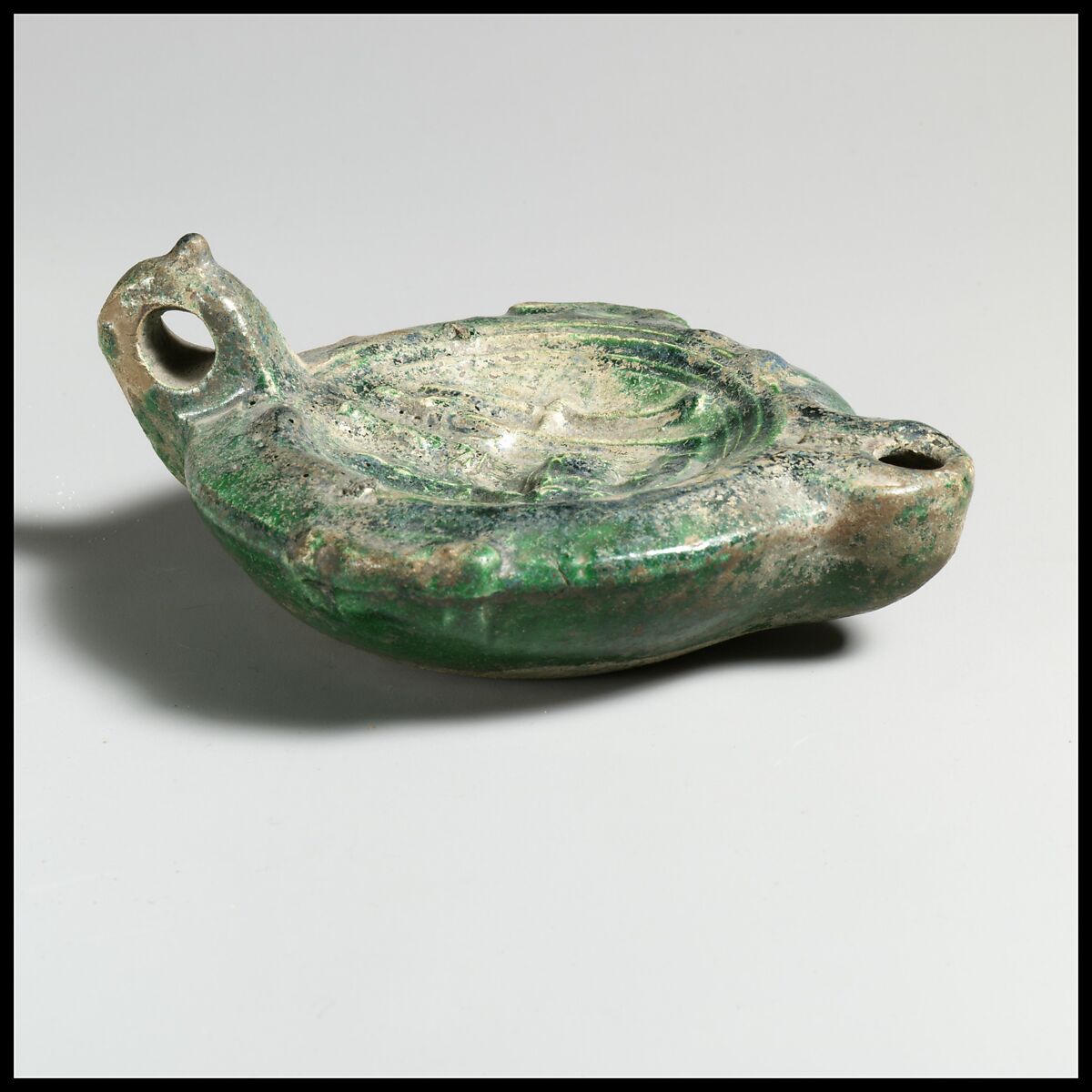
Terracotta lamp, late 1st–2nd century CE
late 1st–2nd century CE
- Everyday lives
Evening lamps in early Tamil poems, and how fuel is identified
Early Tamil poems show household, ritual, palace and camp lamps, but which fuel a lamp burned needs chemical evidence from the find itself.
- This page
- 1,377 words · revision 6
Draft study · Awaiting specialist review · Updated
001Dates and places

No mapped place in this study.
Dates in this study are stated in words only.
- 1 Well supported
- 1 Likely
- 1 Possible
- 1 Not known
002How sure
In brief
This study looks at evening light in early Tamil poems and at how lamp fuel can be identified. Purananuru 326 places a small flame beside a woman's cotton work. The Nedunalvadai describes iron lamps lit for evening offerings, palace figure lamps credited to Yavana craftsmen, and wind-bent flames in a war camp. Translations of the palace passage (reported in the companion Neṭunalvāṭai study) describe lamp bowls filled with ney (ghee or oil), a general word that does not identify a plant or animal source. Excavations in Kerala and Tamil Nadu, described in other studies on this site, have found iron lamps in burials and terracotta lamps in settlement layers. Calling something an “oil lamp” names a guessed use, not its fuel. Identifying the fuel needs residue analysis tied to the find's context, and the sources used report none for a lamp from this region. Replica experiments help only when they record the lamp's shape, fuel, wick, setting and task.
Key researchers cited in this study: Vaidehi Herbert (Sangam Poetry Translations & Commentaries) · Full bibliography
How sure
- Well supported
Early Tamil poems describe lamps in household, ritual, palace and camp settings.
The passages were read in Vaidehi Herbert's English translations, with the Tamil text alongside.
- Likely
Iron and terracotta lamps were in use in Kerala and Tamil Nadu in this period.
Excavated finds are reported, but most are dated by burial type, not direct measurement.
- Possible
Fish oil fuelled small lamps in coastal settlements.
An early Tamil poem is reported in secondary literature to mention fish oil in a shell lamp; the passage has not been checked here, and a poem is a literary scene, not a residue.
- Not known
Which fuel any excavated lamp from the region burned.
No residue analysis of a Kerala or Tamil Nadu lamp is reported in the sources used.
Why it matters
It shows how to describe an ancient lamp without inventing its fuel or its brightness.
003Key findings
What the study concludes
- Early Tamil poems connect lamps with distinct settings – a small flame beside domestic cotton work in Purananuru 326, evening offerings, Yavana figurine lamps in royal chambers, and wind-bent flames in a military camp in Nedunalvadai.
- Calling a vessel an 'oil lamp' states an interpreted function rather than a chemical identification of its fuel; residue and use-alteration studies are required to identify specific plant or animal oils.
- Lighting requires a working arrangement of vessel, wick, fuel, and placement; replica experiments clarify practical constraints without supplying a single ancient fuel budget.
In the study’s own words. How sure each point is, is shown above.
The summary above is the short read. The full study is the complete text it was drawn from, with its tables and source notes.
What the full study covers
004The study
The evening is not empty
Darkness is easily used as a shortcut when describing an ancient household: a room grows dim, somebody lights a lamp, and the conversation continues. Yet the lamp changes the room rather than abolishing its darkness. What can be seen? Who needs the best place? What work is worth continuing? Which parts of the evening concern prayer, pleasure, care or simply finding something that has fallen? This article investigates those questions through objects and texts. It keeps the practical lamp separate from the cultural meanings people might give it. A vessel can survive without its fuel; a poem can describe a flame without telling us the vessel’s dimensions. Neither kind of source must answer every question to be valuable. The goal is a more particular evening, not a single model of how all ancient people spent the night.
Light beside cotton, light in a palace
Purananuru 326 connects a woman’s cotton work with a small flame, a frightened hen and the household’s hospitality. Read as a literary scene, it makes activity after dark visible without measuring its duration or brightness. It does not identify the oil or prove that cotton work was always performed by women at night. 1 “Spinning and weaving in early Tamil Nadu and the Red Sea” uses the same poem in its study of thread-making. Nedunalvadai gives different settings. Lines 36–44 describe women lighting iron lamps and making offerings in an evening scene. The same poem places figure lamps attributed to Yavana craftsmen in the royal chambers (lines 101–107) 2 – where translations (reported in the companion Neṭunalvāṭai study; not collated in a Tamil edition here) describe bowls filled with ney (ghee or oil), a general word that does not identify a plant or animal source – and wind-bent lamp flames in the king’s war camp (lines 168–177). 3 “The Nedunalvadai pictures palace and camp, not a building record” gives the full reading of these passages and their commentary, and “The label Yavana named different roles, not one nationality” discusses the Yavana attribution. Ordinary activity, ritual and courtly display are distinct literary uses of light, not interchangeable examples of a typical household.
“Oil lamp” does not finish the fuel question
Bastien Rueff’s experimental study of Minoan lamps investigates deposits and ultraviolet responses to distinguish categories of fuel, including liquid, semi-solid, and solid materials. Its value here is methodological: a dark deposit on a nozzle is not, without testing, the name of a particular plant or animal product.4 The phrase 'oil lamp' describes an interpreted function, not a chemical analysis of its contents. Identifying sesame oil, coconut oil, castor oil, ghee or fish oil as the actual fuel in a South Indian lamp requires context-specific residue support.
What would an honest lighting experiment show? Aleksei Vaiman’s published experiment makes lamp form, fuel, and experimental conditions explicit concerns.5 A replica experiment should document geometry, fuel, wick, surroundings, and the task being attempted, asking how placement and draft affected work after sunset without claiming a universal ancient illumination figure.
Lamps found in Kerala and Tamil Nadu
Excavated lamps from the region are described in other studies on this site, and most come from burials. Iron hooked lamps and a handled lamp lay in stone-circle pit burials at Cheramanangad (“Cheramanangad’s stone markers do not predict what lies beneath”); no direct laboratory date is reported for these burials, which are placed by type in Kerala's Iron Age–Early Historic tradition. Iron lamps were among the grave goods in the Anakkara urns (“Anakkara: excavated burials in Kerala's Bharathapuzha valley”, also discussed in “Bharathappuzha basin: many burials, little dated settlement” and “Palakkad graves show early iron use, not yet local smelting”). Secondary accounts list an iron lamp from an umbrella-stone burial near Perambra and iron saucer lamps from a stone circle with a rock-cut chamber at Naduvil (“Four northern Kerala Iron Age burials differ in form and finds”). Terracotta lamps come from settlement layers at Perur, in a phase assigned to the third to sixth centuries CE (“Perur yielded glass beads but no sign that they were made there”), and at Adiyamankottai, in phases dated about 300–1000 CE and later (“Adiyamankottai: an early settlement, a twelfth-century rampart”). None of these studies reports a residue analysis of a lamp, so their fuel is unknown. “Parathavar poems show fishers with a stake in salt, not pilots” reads Narrinai 175 as linking a small lamp with fish oil in a fishing settlement. Two cautions apply: petrography (study of the clay) showed that a lamp from Qana in southern Arabia that could be mistaken for an Indian type was compatible with a Nubian source (“Hoq cave names western Indian sailors; Sumhuram has a Tamil name”), and the bright lights that fishermen count in Pattinappalai are not called warehouse lamps in the poem (“Pattinappalai shows a taxed, busy port, not a customs bureau”).
What a responsible reconstruction shows
An educational reconstruction should use an evidenced South Indian lamp type, distinguish its shape from an inferred fuel, and explain placement. In Tamil poetry, Purananuru 326 and Nedunalvadai show that light could mean a tiny domestic flame beside cotton work, an evening offering, a sculpted Yavana lamp in a palace, or wind-bent lamp flames in a war camp. Archaeological science and replica experiments show how fuel and wick behavior can be tested. Together they allow us to investigate light as something practical, maintained, and socially meaningful.
What remains uncertain
- No context-specific chemical identification of lamp fuel from a Kerala or Tamil Nadu site was found in the sources used here; candidate fuels (such as sesame, coconut, ghee, or the fish oil that “Parathavar poems show fishers with a stake in salt, not pilots” reads in Narrinai 175) remain separate research questions.
- The exact dates and specialized material vocabulary of the Tamil literary scenes in Purananuru 326 and Nedunalvadai require original-language review.
- No reconstructed room was tested, and no universal fuel consumption or brightness figure is claimed.
The next questions
- Locate stratified terracotta and metal lamp catalogues and organic-residue studies for Early Historic Kerala and Tamil Nadu sites.
- Compare the Tamil terms for lamp vessels (viḷakku, akaḻ), wicks, and fuels across Sangam editions before illustrating them.
References and access notes
1 Thankal Porkollanar (traditional attribution); translation and notes by Vaidehi Herbert (ancient poem; modern online translation). Purananuru 326: cotton work, a lamp and hospitality. Purananuru 326, lines 1–12; small-light scene and its limits. Tamil text, English translation and notes for poem 326 read. A separate poem record on the same webpage as another source in this list; these are not independent translations. The small-lamp scene is literary evidence, not a dated household census or identification of the fuel. Open source: sangamtranslationsbyvaidehi.com
2 Traditionally attributed to Nakkirar; translation by Vaidehi Herbert (ancient composition; modern online translation). Nedunalvadai: Tamil text, translation and notes. Nedunalvadai 36–44 and 101–107. Tamil text and English passages read, especially lines 36–44, 101–107 and 168–177. The evening ritual, royal interior and military camp are literary settings. The exact composition date, vocabulary and material identifications require specialist review; this is not a local excavation inventory. Open source: learnsangamtamil.com
3 Traditionally attributed to Nakkirar; translation by Vaidehi Herbert (ancient composition; modern online translation). Nedunalvadai: Tamil text, translation and notes. Nedunalvadai 168–177; battlefield visit. Tamil text and English passages read, especially lines 36–44, 101–107 and 168–177. The evening ritual, royal interior and military camp are literary settings. The exact composition date, vocabulary and material identifications require specialist review; this is not a local excavation inventory. Open source: learnsangamtamil.com
4 Bastien Rueff (2024). Macroscopic identification of Minoan lamps’ fuels. An experimental use-alteration and ultraviolet analysis. Journal of Archaeological Science: Reports 54, 104405; abstract and conclusion. Publisher abstract, highlights and accessible Results/Conclusion excerpts read; full paper not yet checked directly. Experimental method distinguishes fuel categories and complements residue chemistry. Bronze Age Minoan material is a methodological comparison, not proof of fuel at Pattanam. Open source: www.sciencedirect.com
5 Aleksei Vaiman (2020). Experiment with Kindling Oil Lamps. EXARC Journal 2020/3; experimental setup and lighting discussion. Publisher-indexed report read; reported measurements were not independently replicated. Experimental lamps and conditions vary in date and design. No reported lux value, fuel runtime, textual attribution or universal reading capacity is adopted here. Open source: exarc.net
005Photographs
Photographs of the places and objects this study discusses. Each item carries its creator’s credit, licence and documented source. See all 412 photographs and source images ↗
late 1st–2nd century CE
Terracotta lamp, late 1st–2nd century CE
Terracotta lamp, late 1st–2nd century CE. Roman comparative object bearing Serapis and Cerberus. Not a Tamilakam find or evidence of a Kerala household’s religious affiliation.
006Where next
 Related study
All related studies, connected material, books and sources11 · 5
Elsewhere on this site
Connected material
Photographs, drawings, books, videos and other studies linked to this study. A link helps you explore; it does not prove a historical claim.
- Terracotta lamp, late 1st–2nd century CEphotographBackground
007Sources
The study lists the sources it consulted; we have not rechecked them. A working link does not show that a source was read, and a valid identifier does not show that it supports a claim. We do not link to unofficial uploads or copies of publications. Where a study cited one, we show the published citation, or a publisher, DOI or Internet Archive link when we have one. Tracking codes are removed from links, and the sources themselves are not republished here.
Thankal Porkollanar (traditional attribution); translation and notes by Vaidehi Herbert (ancient poem; modern online translation). Purananuru 326: cotton work, a lamp and hospitality. Purananuru 326, lines 1–12; small-light scene and its limits. Tamil text, English translation and notes for poem 326 read. A separate poem record on the same webpage as another source in this list; these are not independent translations. The small-lamp scene is literary evidence, not a dated household census or identification of the fuel.
Traditionally attributed to Nakkirar; translation by Vaidehi Herbert (ancient composition; modern online translation). Nedunalvadai: Tamil text, translation and notes. Nedunalvadai 36–44 and 101–107. Tamil text and English passages read, especially lines 36–44, 101–107 and 168–177. The evening ritual, royal interior and military camp are literary settings. The exact composition date, vocabulary and material identifications require specialist review; this is not a local excavation inventory.
Traditionally attributed to Nakkirar; translation by Vaidehi Herbert (ancient composition; modern online translation). Nedunalvadai: Tamil text, translation and notes. Nedunalvadai 168–177; battlefield visit. Tamil text and English passages read, especially lines 36–44, 101–107 and 168–177. The evening ritual, royal interior and military camp are literary settings. The exact composition date, vocabulary and material identifications require specialist review; this is not a local excavation inventory.
Bastien Rueff (2024). Macroscopic identification of Minoan lamps’ fuels. An experimental use-alteration and ultraviolet analysis. Journal of Archaeological Science: Reports 54, 104405; abstract and conclusion. Publisher abstract, highlights and accessible Results/Conclusion excerpts read; full paper not yet checked directly. Experimental method distinguishes fuel categories and complements residue chemistry. Bronze Age Minoan material is a methodological comparison, not proof of fuel at Pattanam.
Aleksei Vaiman (2020). Experiment with Kindling Oil Lamps. EXARC Journal 2020/3; experimental setup and lighting discussion. Publisher-indexed report read; reported measurements were not independently replicated. Experimental lamps and conditions vary in date and design. No reported lux value, fuel runtime, textual attribution or universal reading capacity is adopted.
Researchers and institutions whose work this study uses: Vaidehi Herbert
How we know The evidence, claims and dates behind this study
What this study draws on
- Purananuru 326 and the Nedunalvadai, read in Vaidehi Herbert's English translations with the Tamil text alongside.
- Bastien Rueff's 2024 experiments on Minoan lamp fuels, used as a method comparison.
- Aleksei Vaiman's 2020 replica-lamp experiment, used as a model for recording lighting tests.
- Excavated lamp finds summarised from other studies of Kerala and Tamil Nadu sites.
Dates in this study
This study has no dates recorded in a form we can chart, so there is no date chart. Any dates it gives are in the full study.
The study’s claims
0 claims · 0 source passages · 13 paragraphs
Browse the study paragraph by paragraphThis study has no separately listed claims. Its paragraphs can be browsed one by one.
About this study Status, corrections and how it was made
Status
Draft study, revision 6. No historian, archaeologist, or Tamil or Malayalam specialist has reviewed it yet.
How it was made
Compiled as an editorial synthesis from published scholarship around questions we framed. About this project & workflow
The summary, How sure lines and Two views notes on this page were prepared from this study and cross-checked against its passages. That is an editorial check, not a specialist review.
Technical details
Study code R023. The text fingerprint changes whenever the study text changes.
- The study text is shown as written. Links from its paragraphs to citations help you move around the study; they are not new claims or checked source passages.
See how this study’s records were extracted
Text fingerprint (SHA-256): R023 · 090b111d535e1ced81215196… · v6
Evidence tables and technical details are on the web page: https://layersofthesouth.org/read/0106764c09