Muciṟi · Mouziris · Muziriscandidate search zone, not a pinpoint
50 km
The rings stand 10 km and 25 km from each stored position.
Modern coastline, main rivers and the Western Ghats ridge; ancient river mouths and shorelines differed
Modern coastline from Natural Earth (public domain). Places are at coarse town or district positions.
COMPARATIVE REGIONAL SPECIMEN
Comparative / Regional Reference (Contextual / Environmental): Not a direct trench photograph of Kottayam.
British Museum display: Tiberius silver denarius found in India, Indian imitation, and Kushan coin of Kujula Kadphises: British Museum display of a Tiberius denarius found in India, an Indian imitation, and a Kushan coin of Kujula Kadphises copying an Augustan type. This British Museum display is not linked to a specific Kerala hoard.Uploadalt (Wikimedia Commons) · CC BY-SA 3.0 · Source ↗ · Open photograph record
002The evidence record
What was found, what it shows, and what stays open
In 1847 or 1850, a very large hoard of Roman gold coins was found at Kottayam, about ten miles east of Kannur in North Malabar. Its identified coins run mainly from Augustus to Nero. In September 1983, a pot of Roman gold aurei and imitations was found by chance at Valluvally, near North Paravur in Ernakulam district. Its latest coins date to Antoninus Pius.
Why it matters: They are key evidence that Roman gold reached both North Malabar and the lower Periyar.
The place summary's grade
How sure:Well supported. Both finds are well supported; how many coins each held, and when they were buried, is not known.
Two gold coins: one cut, one pierced. Schematic drawing, not to scale.
Two major Roman gold bullion recoveries from distinct Kerala regions: the 1847 Kottayam find in North Malabar (Kannur district hinterland, exact findspot unknown) and the 1983 Valluvally pot hoard in the lower Periyar hinterland (Ernakulam district).
What it is taken to show
Shows Roman gold coins reaching both North Malabar and the lower Periyar; their counts and burial dates are not known.
Still uncertain
Exact findspot coordinates of the 1847 North Malabar Kottayam discovery (often confused in secondary summaries with modern Kottayam in south-central Kerala) and how many coins from the 1983 Valluvally find were dispersed before official recovery.
Dates and how they were obtained
1st century BCE to 2nd century CE Roman gold issues (Kottayam 1847 find; Valluvally 1983 hoard extending to Antonine emperors). (Numismatic cataloguing (Caldwell, Drury, Turner, Suresh, Berghaus, State Archaeology Department).) Coins from Augustus to Antoninus Pius; burial dates unknown
Who dug or recorded it
Documented by H. Drury & W. Elliot (1847 Kottayam find), Kerala State Department of Archaeology (Valluvally 1983), Paula J. Turner, and S. Suresh
Main finds
Roman gold aurei: the 1847 or 1850 Kottayam hoard in North Malabar (about ten miles east of Cannanore; identified coins mainly Augustus to Nero) and the 1983 Valluvally hoard near North Paravur (aurei and imitations; latest Antoninus Pius, possibly Marcus Aurelius; no recorded clipping or cuts).
Evidence basis
Roman gold coins found by chance
Visiting
Recovered Valluvally coins are curated in Kerala State Archaeology museums (Hill Palace Museum, Tripunithura).
003Studies filed at this place
Graded statements from studies filed at this place
Each block shows one study's graded statements in stored order. A core says how sure that study is about each statement; it is not a score for the place.
Later scholarship (including CHRE's 83 Roman coins plus separate punch-marked objects and Radhakrishnan 2020) gives 117; the 1963 and 1965 catalogues were not checked page by page.
Purakkad and older proposals compete (with Varkala usually placed at the 'Red Mountain' south of Bakare); no inscription or diagnostic finds decide between them.
Coins minted from the 2nd century BCE to the 2nd century CE; buried later
Eyyal (Thrissur) & Valluvally (Ernakulam) in Central Kerala, and Kottayam in North Malabar (Kannur District)
Photographs
For comparison: finds from other sites (2)
COMPARATIVE REGIONAL SPECIMEN
Comparative / Regional Reference (Contextual / Environmental): Not a direct trench photograph of Kottayam.
Indian imitation of a Roman imperial coin, photographed at the British Museum: the source description identifies the prototype as Tiberius. It is not linked to any specific Kerala hoard.PHGCOM (Wikimedia Commons) · CC BY-SA 3.0 · Source ↗ · Open photograph recordCOMPARATIVE REGIONAL SPECIMEN
Comparative / Regional Reference (Contextual / Environmental): Not a direct trench photograph of Kottayam.
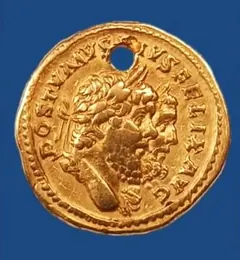
Roman gold coin pierced for suspension, shown in a Polish numismatic video: comparative evidence for secondary use of coins.Gabinet Numizmatyczny D. Marciniak (Wikimedia Commons) · CC BY 3.0 · Source ↗ · Open photograph record