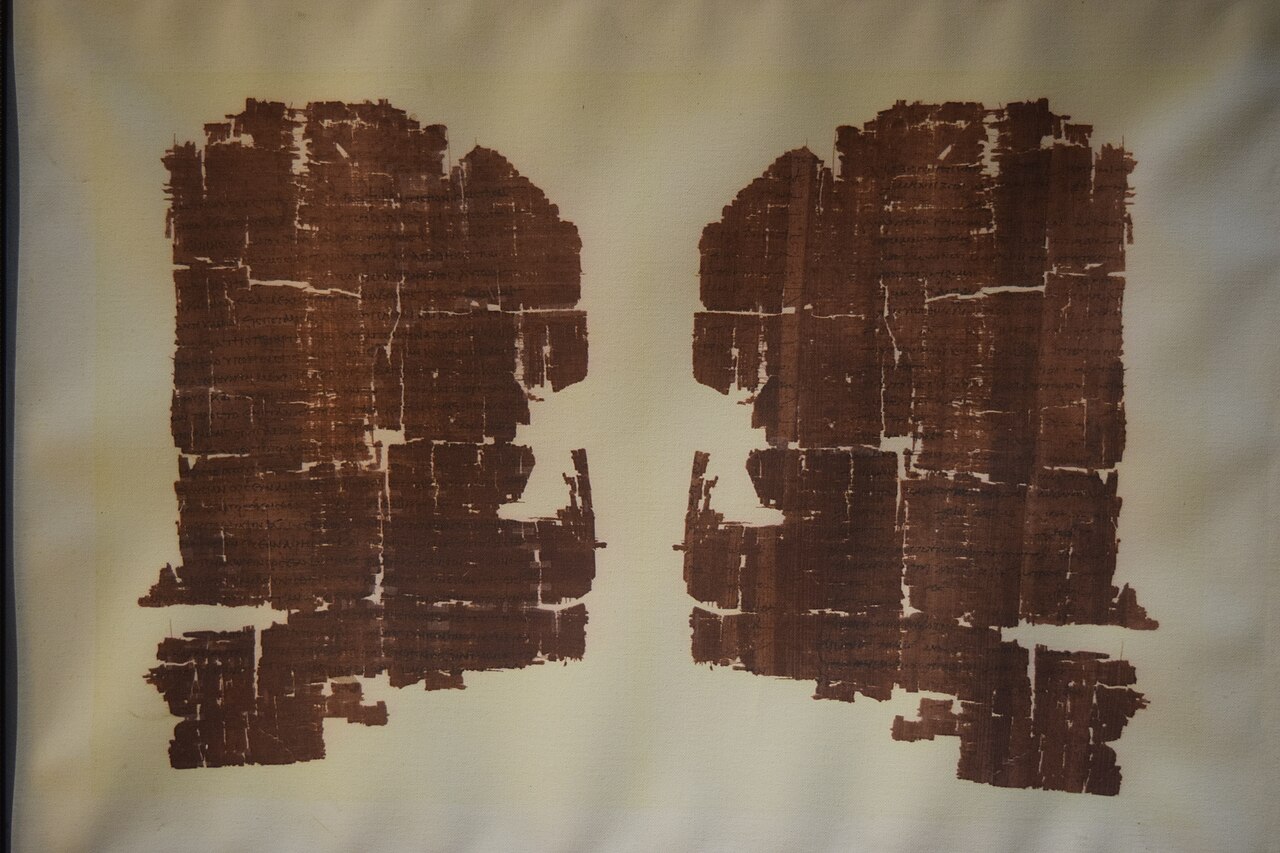
The Muziris Papyrus is a Greek papyrus placed by its handwriting around the mid-second century CE.
It sets out how the cargo was to be moved: from a Red Sea arrival point across the desert to Koptos, into public warehouses, on a Nile boat and on to Alexandria.
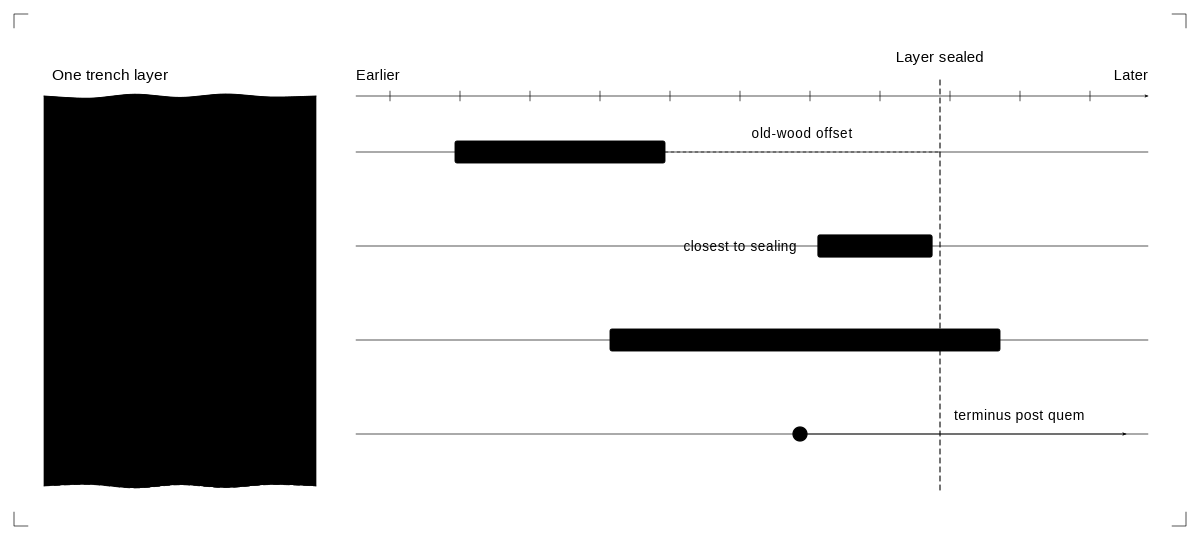
Its pepper quantities are reconstructions from damaged figures, arithmetic and parallels, not labels that can be read on the papyrus.
The Periplus, a Greek guide for sea traders, names Cottonara as the inland pepper district.
Who made this?
When was it made, or written down?
What can't it tell us?
What the card says it cannot tell us
Documents survive in pieces: the papyrus has lost the name of the Red Sea port where its cargo arrived.
Imported Mediterranean pottery reached Pattanam around the turn of the era.
The ceramic report describes Pattanam as an Early Historic settlement with long-distance connections.
A waterlogged waterfront with a canoe, posts and a brick-lined edge was excavated there.
Later layers held West Asian jars lined with bitumen.
Who made this?
When was it made, or written down?
What can't it tell us?
What the card says it cannot tell us
No source checked for this website's study reports a secure Early Historic inscription naming Muziris or Muciri from Pattanam or Kodungallur. That does not prove that no such inscription exists. A find bearing the name would change the assessment.
For each place, sort three short statements written from the atlas and studies: what the excavations recorded on the ground, what scholars interpret it to show, and what remains open to debate.
Pattanam (North Paravur, Periyar Delta)
Ernakulam District, Kerala
Excavations uncovered a waterlogged brick-lined wharf, a wooden dugout canoe, teak bollards, and sherds of local and imported pottery.
Scholars interpret the site as a major Early Historic port settlement linked to Indian Ocean maritime trade.
Scholars still debate whether ancient Muziris was centred at Pattanam itself, spread across the estuary, or centred near Kodungallur.
Archaeologists classify these monuments as Iron Age funerary markers of central and northern Kerala.
Because no modern excavation or laboratory date is published for Ariyannur, scholars still do not know when the stones were erected or what lies beneath them.
Dressed laterite umbrella stones stand at this protected site in Thrissur district, each with a domed capstone resting on tapered stone legs.
Archaeologists treat Mangadu as key evidence that Kerala's Iron Age urn-burial tradition began much earlier than older mid-century estimates assumed.
Scholars still ask how broadly the Mangadu dates apply to undated urn fields across southern Kerala.
Excavations in 1991 (published 1992) recorded twelve burial urns under three laterite stone circles holding burnt bone, black-and-red pottery, iron tools and charcoal samples.
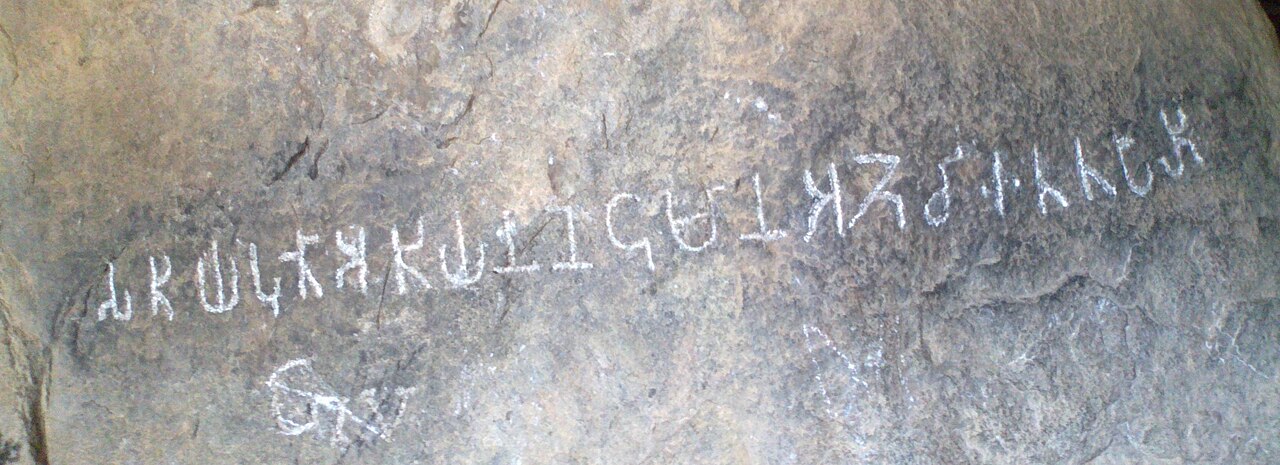
Deeply grooved rock engravings of human figures, animals and symbols cover the cleft walls alongside short Brahmi and Vattezhuthu (Vaṭṭeḻuttu / Vatteluttu) inscriptions.
Scholars interpret the shelter as a repeated focus of rock art and early royal or chiefly inscriptions in the Wayanad hills.
Archaeologists still debate when the earliest engravings were carved and how broad a territory the named rulers controlled.
Two statements on one subject from different kinds of evidence. Do they agree? What does each add?
Roman coins in Kerala
Ground
Roman gold and silver coins reached several parts of Kerala, including inland Thrissur and Idukki.
Ground
Double-pierced coins were worn or attached as ornaments
Do they agree? What does each add?
How sure each study is
What comparing both adds: Both statements rest on coin hoards from the ground rather than texts: Kerala hoards show Roman coins reaching inland routes, while pierced and slashed aurei show coins were altered and reused as bullion or ornaments.
Well supported
Four published hoard records demonstrate arrival and inland movement.
Indian goods, including pottery, pepper and teak, moved through these ports
Greek or Latin text
A regulated camel-and-river corridor linked the Red Sea ports with Alexandria
Do they agree? What does each add?
How sure each study is
What comparing both adds: Physical finds from Berenike corroborate the Red Sea-to-Alexandria corridor described in classical texts, showing that Indian commodities reached Egypt without identifying the ethnicity of every merchant who carried them.
Well supported
Indian-made jars, a large pepper deposit and teak are reported in excavation publications.
Iron weapons were buried in Iron Age and Early Historic graves
Laboratory
South Indian smiths made deliberate high-carbon steel before 600 CE
Do they agree? What does each add?
How sure each study is
What comparing both adds: Grave finds of iron weapons across South India sit alongside workshop and laboratory analysis at Kodumanal; iron smelting is well attested, while dated early crucible steelmaking remains Possible rather than settled.
Well supported
Rea's 1915 catalogue and the 2020 ASI report list swords, spearheads, daggers and arrowheads at Adichanallur.
Pattanam was part of the wider Muziris port landscape on the lower Periyar.
Do they agree? What does each add?
How sure each study is
What comparing both adds: The texts name Muziris; the excavations show a port with long-distance links at Pattanam. Matching the two is a modern inference: the links are Well supported, the exact identification only Possible.
Possible
Its dates, imports and river setting make Pattanam a leading candidate, while other scholars propose Kodungallur or a wider estuary; excavators still keep the match open with no naming inscription.
Dense Mediterranean, West Asian and Indian port finds fit ancient accounts of the lower Periyar harbour zone, though no inscription names the settlement.
Ancient writers link pepper with an inland producing district called Cottonara.
Do they agree? What does each add?
How sure each study is
What comparing both adds: Two documentary sources point to black pepper along this coast: the Periplus names Cottonara as the inland pepper district, while the Muziris papyrus lists pepper among a ship's cargo, showing texts agreeing with texts rather than excavation finds.
Likely
It is reconstructed from damaged figures and the Periplus; the word does not survive legibly.
Rice and pulses are among the plant remains reported from Pattanam, with black pepper listed as probable and cardamom as tentative.
Laboratory
Coconut and black pepper were present at early Pattanam.
Do they agree? What does each add?
How sure each study is
What comparing both adds: Both are about Pattanam: a list of plant remains and a peat-layer study. They agree on coconut and on black pepper being probable; the 2020 study gave no date for the peat, and plant lists do not reconstruct recipes.
Likely
Reported in the Mahatma Gandhi University collection account and KCHR interim summaries; a full archaeobotanical report with context data is not published, and a 2020 peat study (reported in the companion pepper study) lists black pepper as probable and cardamom as tentative.
The Periplus links direct open-sea crossings to seasonal winds.
Greek or Latin text
Pliny's forty days run from Ocelis to Muziris, not from Berenice or Egypt.
Do they agree? What does each add?
How sure each study is
What comparing both adds: Both Greek and Latin maritime texts describe seasonal open-sea crossings across the Arabian Sea, while Pliny's forty-day figure applies only to the eastward leg from Ocelis to Muziris and gives no sailing date for any single ship.
Well supported
Stated in the text, read here in Schoff's 1912 translation.
Writing on pottery was part of everyday settlement life at Keezhadi (Keeladi)
Inscription
Tamil-Brahmi was adapted from the Brahmi script family.
Do they agree? What does each add?
How sure each study is
What comparing both adds: Both lines come from archaeology and script study: Keezhadi sherds show writing in everyday settlement use, while letter comparisons link Tamil-Brahmi to the wider Brahmi family without settling the exact starting century.
Well supported
Both excavation reports publish repeated inscriptions on red and black-and-red ware.
You chose {chosen}. The study gives the same level.You chose {chosen}. The study gives a different level: read its reason, then decide whether yours is as good.Your choice matches the study.Your choice is not the one the study supports. Read why below.{right} of {total} in the place the atlas gives them.