Muciṟi · Mouziris · Muziriscandidate search zone, not a pinpoint
10 km
The rings stand 1 km and 5 km from each stored position.
Modern coastline, main rivers and the Western Ghats ridge; ancient river mouths and shorelines differed
Modern coastline from Natural Earth (public domain). Places are at coarse town or district positions.
IN-SITU INSCRIPTION / MONUMENTView down into the multi-chambered Kattakampal burial caveDvellakat (Wikimedia Commons) · CC BY-SA 4.0 · Source ↗ · Open photograph record
002The evidence record
What was found, what it shows, and what stays open
Kattakampal, near Kunnamkulam, is a burial monument cut into laterite. Steps lead down to a sunken court, and four chambers open from it. V. D. Krishnaswami's 1949 account of a 1946 survey states that it lacks a central pillar. Benches and small entrances, about half a metre wide, were recorded in 2025. Pottery and iron implements are reported from excavation, but where they lay is not recorded.
Why it matters: It shows how features of other caves can be wrongly added to one site's reconstruction.
The place summary's grade
How sure:Well supported. The cave's plan is well supported; it has no laboratory date and is attributed to the Iron Age.
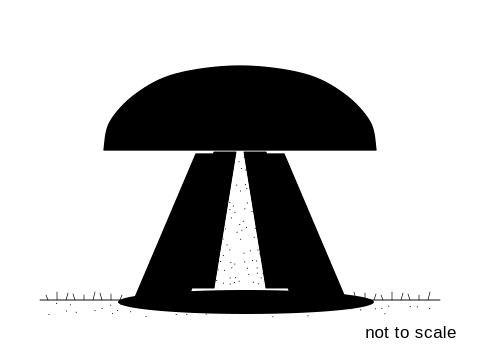
Laterite megalithic monument form in elevation. Schematic drawing, not to scale.
A subterranean multi-chambered cave cut into laterite bedrock with steps descending to a sunken court and four chambers (with benches and no central pillar); pottery and iron implements were reported without detailed internal provenience.
What it is taken to show
A multi-chambered rock-cut burial cave. Features recorded at other caves, such as circular roof openings, should not be added to its reconstruction.
Still uncertain
Chronological sequence of multi-chamber vs single-chamber laterite caves in northern and central Kerala.
Dates and how they were obtained
Iron Age / Megalithic period. (Architectural survey (1946 survey reported by V. D. Krishnaswami in 1949; Y. D. Sharma 1956; 2025 monument documentation) and associated iron/ceramic typology.) Attributed to the Iron Age; no laboratory date
Who dug or recorded it
Archaeological Survey of India (1946 survey reported by V. D. Krishnaswami, 1949; documented by Y. D. Sharma, 1956)
Main finds
A burial cave cut into laterite: steps lead down to a sunken court, and four chambers open from it. Benches are recorded; the earliest survey states that there is no central pillar.
Evidence basis
A rock-cut burial cave plan
Visiting
Protected ASI monument.
003Studies filed at this place
Graded statements from studies filed at this place
Each block shows one study's graded statements in stored order. A core says how sure that study is about each statement; it is not a score for the place.
Krishnaswami's 1949 survey states it; Sharma's 1956 measured plan and sections draw none and his text contrasts Kattakampal with pillared chambers elsewhere; the 2025 by-laws show none.
An official Iron Age attribution in 2025 heritage documents and Sharma's 1956 comparison with dated megaliths elsewhere; no excavated find has a laboratory date.
Monument typology, black-and-red ware and Kuttikol Burial 2 (8th–6th centuries BCE) support this, though Kuttikol Burial 1 yielded 15th–17th century CE charcoal.
Only Kuttikol has published radiocarbon dates (Burial 2, 8th–6th c. BCE; Burial 1, 15th–17th c. CE), and they date sampled charcoal rather than the cutting of the chamber.