Skip to content
Layers of the South
Search

Lesson D4 · Unit D: How sure can we be?

Testing popular claims

Why do some popular claims go further than the evidence?

Project this lessonClass vote

Ages
Ages 14 to 18
Minutes
50 / 60
Ladder step
4 Test, 5 Argue

Curriculum

  • Department for Education (England) National curriculum in England: history programmes of study, Aims on interpretations and methods of enquiry

No school board has reviewed or endorsed these mappings.

Draft written with AI assistance; not yet tried in a classroom

Three-tier stepped foundation diagram with recorded material and texts at the base, specialist inference in the middle, and open scholarly debate at the top.
Every dossier and atlas entry distinguishes what excavators physically recorded from what specialists infer and where scholarly disagreement remains unresolved.

001At a glance

Students trace claims about the ancient south back to the evidence, name the step where each goes further, and write fair judgements on claims that matter to people today.

Objectives

  • I can trace a claim back to the evidence it rests on and find the step where it goes further.
  • I can name the kind of stretch: a date moved to another thing, an absence read as proof, a local change read as a lost land, or a resemblance read as a line of descent.
  • I can write a fair judgement on a claim that matters to people today, with a level and the evidence that would change it.

Pupils should already know

  • In lesson D1, students found that the iron announcement rests on charcoal dated by association. If they have not done D1, the model step gives the example in full.
  • In lesson D3, students wrote a judgement with a level and the evidence that would change it. This lesson asks them to do the same for claims that many people repeat.

Materials

Print
  • One sheet per student: support, core or stretch
  • The cut-out page for each group: three source cards and the key-word strip
  • A claim-testing grid for each group, on the sheet or copied from the board
Screen
  • The classroom screen for this lesson
Devices
  • Optional: the claims bench set on the students page, one device per pair

Key words

secular
Not connected with religion or worship.
residue analysis
A laboratory test of traces left on a surface, such as pigment or chemicals.
ring well ഉറക്കിണർ
A well lined with stacked rings of baked clay.
geophysics
Detecting buried or underwater features by measurement, without digging.
Lemuria or Kumari Kandam
A lost continent proposed in modern times; not a finding from Poompuhar.
institution
An established practice with its own schools, training or rules.
continuity
An unbroken line of passing on, from an earlier practice to a later one.
hero stone നടുകല്ല് / വീരക്കല്ല്
A memorial stone set up to honour a fallen warrior or another person.
sacred grove കാവ്
A protected sacred grove or wooded shrine.

002Sequence

Step by step

Lesson length
  1. 45hook

    Teacher Show the photograph of the coast at Poompuhar and run the think, puzzle, explore routine. Then tell students that some accounts speak of a lost continent beyond this coast. Collect the puzzles. One of them should be a version of "What would you need to see to believe that?"

    Pupils Say what you think the sea has changed, what puzzles you, and how you could find out.

    Screen 1 of 15: Look first

  2. 78model

    Teacher Model a claim test with the iron announcement from lesson D1. Ask aloud: what does the claim say? Iron was in use at Sivagalai about 5,300 years ago, which the study rates Not known. What does the evidence show? A laboratory measured three charcoal samples, rated Well supported, and iron in use in parts of Tamil Nadu by about 1500 BCE is rated Possible. Where is the gap? The 2025 book links the charcoal to iron only by association with urn burials, so a date on one material is used for another. Name this kind of stretch: a date moved from one thing to another. Then name the other kinds students will look for today: an absence read as proof, a local change read as a lost land, and a resemblance read as a line of descent.

    Pupils Copy the questions and the kinds of stretch into your grid. Fill the iron row as your teacher talks.

    Screen 2 of 15: Look at how these statements differ.

  3. 1012guided

    Teacher Groups take the cards. For each claim, they fill one row of the grid: what the claim says, what the evidence shows, where the gap is, and which kind of stretch it is. Check that groups keep what was found apart from what is claimed, and that they locate the gap in the evidence, not in the people who hold the claim.

    Pupils Fill one row of the grid for each claim: the claim, the evidence, the gap, the kind of stretch.

    Screen 4 of 15: Keezhadi (Keeladi): what the trenches show

  4. 810independent

    Teacher Give half the groups the note on whether Keezhadi's brick tanks were dye vats, and half the note on whether Theyyam continues a deep ancient complex. On the tanks, View A is the Tamil Nadu archaeology department's 2019 and 2025 reports, which read tanks, ring wells, pipes and textile tools together as a dyeing system; View B is the 2018 report on the first two Archaeological Survey of India seasons, which called the functions of partly exposed tanks tentative. On Theyyam, View A is a strong-continuity reading that treats ancient Tamil hero and possession motifs, memorial stones, hero cults and Theyyam as stages of one regional complex; View B is a stricter source-critical reading that accepts the resemblances as clues but requires dated intermediate steps before calling them continuity. Students list what each view accepts as evidence, then write what the note says would settle it.

    Pupils List what each view accepts as evidence. Then write what would settle the question.

    Screen 7 of 15: Two views

  5. 1417claim

    Teacher Students grade the statements in the claim task, then compare with the studies. When they have graded, point out that a statement can earn a high level because it says that a claim is modern: the study of Poompuhar rates the lost continent as a modern idea at the highest level. Ask anyone whose level differs to explain. A reason that names real evidence or a real gap earns credit even when the level differs.

    Pupils Grade each statement. Write a reason that names the evidence or the gap. Then compare with the study.

    Screen 9 of 15: How sure can we be?

  6. 78exit

    Teacher Students answer the enquiry question with two examples of different kinds of stretch, each with its level, and the evidence that would change one of them.

    Pupils Why do some popular claims go further than the evidence? Give two examples of different kinds, each with a level, and say what would change one of them.

    Screen 15 of 15: Before you go

003Source cards

The three source cards

19 bound lines · 9 graded · 9 claims · 1 other records

Graded lines carry their How-sure glyph and 6-char hash; claims carry no fill glyph.

D4-SC1 · From the ground

Keezhadi: what the trenches show
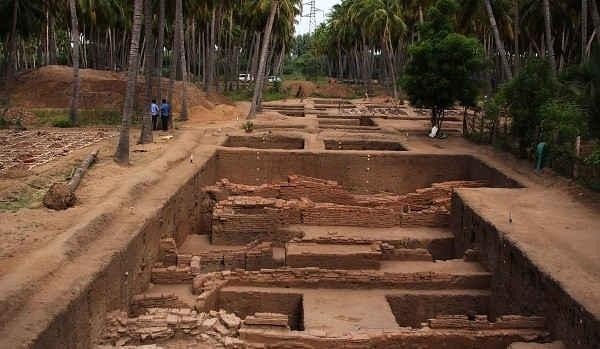
Long view across excavation trenches and exposed brick structures at Keezhadi.

Photo: Ophelia S (Wikimedia Commons). Licence: CC BY-SA 4.0 (https://creativecommons.org/licenses/by-sa/4.0). Source: https://commons.wikimedia.org/wiki/File:Keezhadi_excavation.jpg

What it cannot tell us Only part of the site has been excavated. Stands on: R108-C013 · a claim the study makes (not graded)
Look
What did the excavators find, and what is the claim about?
Talk
Can the absence of a kind of find show what people believed? Why or why not?
Ask
What would you need to find to test the claim either way?

D4-SC2 · About a place

Poompuhar: a coast partly lost to the sea

Present-day coastal and river-mouth landscape at Poompuhar, viewed from the lighthouse.

Photo: Destination8infinity (Wikimedia Commons). Licence: CC BY-SA 4.0 (https://creativecommons.org/licenses/by-sa/4.0). Source: https://commons.wikimedia.org/wiki/File:Poompuhar-Kaveri-Puhum-Pattinam-View-from-Lighthouse.jpg

What it cannot tell us Present water depth is not an archaeological date. Stands on: R239-C002 · a claim the study makes (not graded)
Look
What has been found here, and where?
Talk
How does a local drowned coast differ from a lost continent?
Ask
What evidence would show the age of the 23 m feature?

D4-SC3 · From the ground

Old weapons, later traditions

Historic monochrome catalogue plate showing iron weapons and implements from Adichanallur.

Photo: Alexander Rea (catalogue author; individual plate photographer not separately credited) (Wikimedia Commons). Licence: Public domain (https://commons.wikimedia.org/wiki/Template:PD-old-auto-expired). Source: https://commons.wikimedia.org/wiki/File:Catalogue_of_the_prehistoric_antiquities_from_Adichanallur_and_Perumbair_(page_73_crop).jpg

What it cannot tell us The dating of a present ritual form is not the same as the age of every motif within it. Stands on: R186-C015 · a claim the study makes (not graded)
Look
Which of these things are dated, and how?
Talk
Does an old weapon or an old poem show that a present-day tradition is ancient? What would show it?
Ask
What kind of dated evidence would link a tradition to the period before 600 CE?

    004Differentiation

    One task at three levels

    The three sheets use the same sources and the same task. Only the help changes.

    Support

    1. For each card, underline the claim and circle the evidence.
    2. Match each claim to its kind of stretch: a date moved, an absence read as proof, a local change read as a lost land, a resemblance read as descent.
    3. For your note, tick the evidence each view accepts and circle what would settle the question.
    4. Choose a level for each statement from the box and circle the evidence on the card that decided you.
    5. Complete: This claim goes further than the evidence because ... It would change if ...

    Help on the sheet

    • A grid with four columns: the claim, the evidence, the gap, the kind of stretch
    • Key words glossed beside the text: secular, residue analysis, geophysics, institution, continuity
    • The four levels with their meanings in a box
    • Sentence frames for a fair judgement that tests the claim and does not label the people who hold it

    Core

    1. The claim says ... The evidence shows ... The gap is ...
    2. This claim stretches the evidence by ...
    3. View A accepts ... as evidence. View B accepts ... It would be settled by ...
    4. I graded this statement ... because ... The study's level differs from mine because ...
    5. Some popular claims go further than the evidence because ...

    Stretch

    1. For each claim, trace it back to the evidence and name the step where it goes further.
    2. Sort the claims by the kind of stretch. Is any claim stretched in more than one way?
    3. Weigh the two views on your note. What kind of evidence does each accept, and what would settle it?
    4. Grade each statement. Which statements are well supported because they say that a claim is not, and why do such statements matter?
    5. Write a judgement on one claim that a person who holds the claim could read as fair.

    Extension

    Find a claim about the ancient past in a newspaper, a video or a textbook. Test it with the questions from the model step and write a short, fair reply.

    005Assessment

    How you will know

    The grading task

    Grade each statement on the four levels and give the reason. Then compare your level with the study's, and explain any difference.

    1. Keezhadi was a secular society.
    2. Particular brick tanks were dye vats.
    3. A lost continent called Lemuria or Kumari Kandam is a modern construction, not a finding from Poompuhar.
    4. Is PMR2, the 23 m feature, a human-built structure of known age?
    5. Kalaripayattu's schools and drills can be traced back only to about the twelfth century, long after 600 CE.
    6. Theyyam descends in an unbroken line from megaliths or hero stones.

    Exit task

    Why do some popular claims go further than the evidence? Use two examples of different kinds of stretch, each with its level, and say what evidence would change one of them.

    Open the answer key

    The key gives what this website's summary says for each task, two examples written by us, and how to credit a reasoned disagreement.

    006Misunderstandings

    Misunderstandings to listen for (not yet observed in a classroom)

    • If something has not been found, it did not exist.

      At Keezhadi, the absence of identified worship objects in a partial excavation is insufficient to establish a secular settlement.

    • A study that rates a claim Not known is saying the claim is false.

      Not known means the evidence does not settle it. The Theyyam finding is a bounded result of one source search, not a claim that no future evidence can exist.

    • Anything found deep under the sea must be very old.

      Present water depth is not an archaeological date. The 23 m feature off Poompuhar has no dated cultural material securely tied to it in the record inspected.

    • Old iron weapons prove that a martial art is ancient.

      The Kodumanal dagger's analysis establishes how it was made, not a particular fighting style or training institution.

    007With or without a screen

    With or without a screen

    Paper only

    Print the cut-out page for each group and a sheet for each student. Draw the claim-testing grid on the board and fill the iron row with the class. Print the classroom screen that shows the two notes, one copy per group, and tell each half of the class which note to work on. Students grade on paper and shade their levels in pencil.

    One screen and a projector

    Show the Poompuhar photograph for the hook, then the iron row for the model step, then each card, then the claim statements. Keep the grid on the board while groups fill their rows.

    Classroom screen

    008Teacher notes

    Teacher notes

    • Treat each claim as a question to test, not a belief to mock. Quote only the studies, and never label the people who hold a view. Several of these claims matter to people today, some for reasons of faith or identity.
    • Theyyam and sacred groves are living traditions. The studies ask only what dated evidence shows about their age; they make no judgement about the meaning or value of the traditions. The dating of a current ritual form is not the same as the age of every motif within it.
    • The study of serpent groves found no inspected witness from before 600 CE that joins grove, serpent deity and ritual. That is a bounded search, not proof of absence; say so if a student asks.
    • If students raise claims that later caste rules go back to the earliest period, do not make it a class task. The study of early Tamil records finds that the inscriptions it reviewed attest rank, service, occupations, merchant organisation and patronage, but do not by themselves establish later caste institutions such as hereditary occupational closure. That is a bounded result for the inscriptions inspected.
    • Never link a present-day community to an ancient group of workers in class. The study of early Kerala rice labour finds that the reviewed Kerala evidence does not directly identify how wet-rice labour was organised.
    • The model step reuses the iron announcement students tested in lesson D1. If they have done D1, let a student lead the model.
    • Before showing any image of a claimed discovery in class, check who made it, where it was published and what it actually shows.
    • The England line is for skills only: interpretations of the past and methods of enquiry. No English programme of study names South India.
    • On Kalaripayattu: Zarrilli's twelfth-century estimate is a scholarly inference about when the institution took shape, not a twelfth-century document. The earliest surviving eyewitness descriptions of kalari training come from early modern visitors such as Duarte Barbosa, long after the period of these studies.

    Sensitive topics

    Theyyam and sacred groves are living religious traditions, and claims about Keezhadi and a lost continent matter to many people today. Treat each claim as a question about evidence, quote only the studies, and never label the people who hold a view. Caste appears only in the teacher notes; it is never a student task in this lesson.

    On this website

    009Sources used

    Sources used

    Every fact in this lesson comes from these studies. The codes name the statements the lesson cites.

    010Downloads

    Everything to print

    Each document prints on A4 or US Letter. The Malayalam sheets are drafts that no Malayalam editor has yet reviewed.

    The unit pack

    Lesson D4 · Ages 14 to 18 · Lesson plan

    Testing popular claims

    Why do some popular claims go further than the evidence?

    Unit D: How sure can we be? · Ladder step Test, Argue · Draft written with AI assistance; not yet tried in a classroom

    Objectives

    • I can trace a claim back to the evidence it rests on and find the step where it goes further.
    • I can name the kind of stretch: a date moved to another thing, an absence read as proof, a local change read as a lost land, or a resemblance read as a line of descent.
    • I can write a fair judgement on a claim that matters to people today, with a level and the evidence that would change it.

    Pupils should already know

    • In lesson D1, students found that the iron announcement rests on charcoal dated by association. If they have not done D1, the model step gives the example in full.
    • In lesson D3, students wrote a judgement with a level and the evidence that would change it. This lesson asks them to do the same for claims that many people repeat.
    Layers of the South/educators/lessons/testing-popular-claims/a97585a61f00Draft written with AI assistance; not yet tried in a classroomMalayalam draft, not yet reviewed by a Malayalam editorText CC BY-SA 4.0; photos as creditedPage 1/2

    Lesson D4 · Ages 14 to 18 · Lesson plan

    Testing popular claims

    Materials

    • Print One sheet per student: support, core or stretch; The cut-out page for each group: three source cards and the key-word strip; A claim-testing grid for each group, on the sheet or copied from the board
    • Screen The classroom screen for this lesson
    • Devices Optional: the claims bench set on the students page, one device per pair
    • Paper only Print the cut-out page for each group and a sheet for each student. Draw the claim-testing grid on the board and fill the iron row with the class. Print the classroom screen that shows the two notes, one copy per group, and tell each half of the class which note to work on. Students grade on paper and shade their levels in pencil.

    Misunderstandings to listen for (not yet observed in a classroom)

    • If something has not been found, it did not exist. At Keezhadi, the absence of identified worship objects in a partial excavation is insufficient to establish a secular settlement.
    • A study that rates a claim Not known is saying the claim is false. Not known means the evidence does not settle it. The Theyyam finding is a bounded result of one source search, not a claim that no future evidence can exist.
    • Anything found deep under the sea must be very old. Present water depth is not an archaeological date. The 23 m feature off Poompuhar has no dated cultural material securely tied to it in the record inspected.
    • Old iron weapons prove that a martial art is ancient. The Kodumanal dagger's analysis establishes how it was made, not a particular fighting style or training institution.
    Layers of the South/educators/lessons/testing-popular-claims/a97585a61f00Draft written with AI assistance; not yet tried in a classroomMalayalam draft, not yet reviewed by a Malayalam editorText CC BY-SA 4.0; photos as creditedPage 2/2