Testing popular claims: Cut-out cards
Cut-out cards
D4 Testing popular claims
2 pages, A4 or US Letter3 pages, A4 or US Letter
Print at actual size, with scaling turned off.
Lesson D4 · Ages 14 to 18 · Cut-out cards
Cut along the lines. One set for each group.
D4-SC1 · From the ground
Keezhadi: what the trenches show
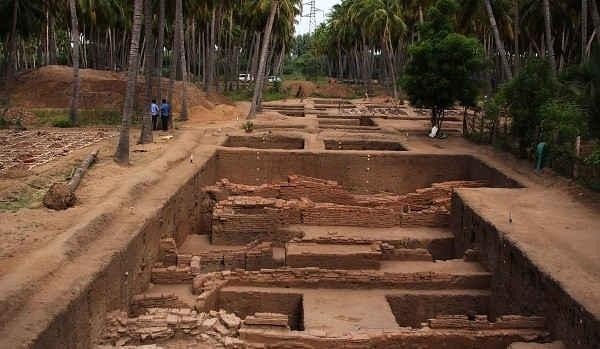
Photo: Ophelia S (Wikimedia Commons). Licence: CC BY-SA 4.0 (https://creativecommons.org/licenses/by-sa/4.0). Source: https://commons.wikimedia.org/wiki/File:Keezhadi_excavation.jpg
- Excavation reports describe brick buildings, ring wells, drains and furnaces at Keezhadi (Keeladi), trench by trench.
- Several published radiocarbon dates suggest that people were active there in the sixth century BCE; full calibration details were not found.
- Spindle whorls, bone tools and a needle support textile work.
- Some reports read brick tanks, ring wells, pipes and textile tools together as a dyeing system; an earlier report called the use of partly exposed tanks tentative.
- Some accounts describe Keezhadi as a secular settlement.
What it cannot tell us Only part of the site has been excavated.
- Look What did the excavators find, and what is the claim about?
- Talk Can the absence of a kind of find show what people believed? Why or why not?
- Ask What would you need to find to test the claim either way?
D4-SC2 · About a place
Poompuhar: a coast partly lost to the sea

Photo: Destination8infinity (Wikimedia Commons). Licence: CC BY-SA 4.0 (https://creativecommons.org/licenses/by-sa/4.0). Source: https://commons.wikimedia.org/wiki/File:Poompuhar-Kaveri-Puhum-Pattinam-View-from-Lighthouse.jpg
- Parts of the Early Historic port landscape at Poompuhar were eroded or submerged by coastal change.
- Brickwork between the tides, ring wells and finds in shallow water are documented.
- A seabed feature called PMR2, about 23 m deep, was detected by geophysics and inspected by divers.
- The publication record inspected ties no diagnostic dated cultural material to it.
- A 2022 core study proposes a tsunami about 1,540 years ago; independent cores and secure dating are still needed.
- The lost continent of Lemuria, or Kumari Kandam, has been traced to nineteenth-century speculation.
What it cannot tell us Present water depth is not an archaeological date.
- Look What has been found here, and where?
- Talk How does a local drowned coast differ from a lost continent?
- Ask What evidence would show the age of the 23 m feature?
Lesson D4 · Ages 14 to 18 · Cut-out cards
Cut along the lines. One set for each group.
D4-SC3 · From the ground
Old weapons, later traditions

Photo: Alexander Rea (catalogue author; individual plate photographer not separately credited) (Wikimedia Commons). Licence: Public domain (https://commons.wikimedia.org/wiki/Template:PD-old-auto-expired). Source: https://commons.wikimedia.org/wiki/File:Catalogue_of_the_prehistoric_antiquities_from_Adichanallur_and_Perumbair_(page_73_crop).jpg
- Iron weapons were buried in Iron Age and Early Historic graves: swords, spearheads, daggers and arrowheads are listed at Adichanallur.
- A Kodumanal dagger had a relatively hard high-carbon edge, apparently forge-welded to a softer core. That shows how it was made, not a fighting style or a training school.
- The scholar Zarrilli traces Kalaripayattu to at least the twelfth century. The study found no source before 600 CE that shows its schools or drills.
- Scholars place the present form of Theyyam in late-medieval north Malabar, as an attributed reconstruction.
- An early Tamil poem values guarded trees in groves, but the passage does not attest serpent worship.
What it cannot tell us The dating of a present ritual form is not the same as the age of every motif within it.
- Look Which of these things are dated, and how?
- Talk Does an old weapon or an old poem show that a present-day tradition is ancient? What would show it?
- Ask What kind of dated evidence would link a tradition to the period before 600 CE?
Key words English · Malayalam · Tamil
secular
Not connected with religion or worship.
residue analysis
A laboratory test of traces left on a surface, such as pigment or chemicals.
ring wellഉറക്കിണർஉறைகிணறு
A well lined with stacked rings of baked clay.
geophysics
Detecting buried or underwater features by measurement, without digging.
Lemuria or Kumari Kandam
A lost continent proposed in modern times; not a finding from Poompuhar.
institution
An established practice with its own schools, training or rules.
continuity
An unbroken line of passing on, from an earlier practice to a later one.
hero stoneനടുകല്ല് / വീരക്കല്ല്நடுகல்
A memorial stone set up to honour a fallen warrior or another person.
sacred groveകാവ്காவு / பொழில்
A protected sacred grove or wooded shrine.
Lesson D4 · Ages 14 to 18 · Cut-out cards
Cut along the lines. One set for each group.
Key words English · Malayalam · Tamil
secular
Not connected with religion or worship.
residue analysis
A laboratory test of traces left on a surface, such as pigment or chemicals.
ring wellഉറക്കിണർஉறைகிணறு
A well lined with stacked rings of baked clay.
geophysics
Detecting buried or underwater features by measurement, without digging.
Lemuria or Kumari Kandam
A lost continent proposed in modern times; not a finding from Poompuhar.
institution
An established practice with its own schools, training or rules.
continuity
An unbroken line of passing on, from an earlier practice to a later one.
hero stoneനടുകല്ല് / വീരക്കല്ല്நடுகல்
A memorial stone set up to honour a fallen warrior or another person.
sacred groveകാവ്காவு / பொழில்
A protected sacred grove or wooded shrine.
D4-SC1 · From the ground
Keezhadi: what the trenches show
Photo: Ophelia S (Wikimedia Commons). Licence: CC BY-SA 4.0 (https://creativecommons.org/licenses/by-sa/4.0). Source: https://commons.wikimedia.org/wiki/File:Keezhadi_excavation.jpg
- Excavation reports describe brick buildings, ring wells, drains and furnaces at Keezhadi, trench by trench.
- Several published radiocarbon dates suggest that people were active there in the sixth century BCE; full calibration details were not found.
- Spindle whorls, bone tools and a needle support textile work.
- Some reports read brick tanks, ring wells, pipes and textile tools together as a dyeing system; an earlier report called the use of partly exposed tanks tentative.
- Some accounts describe Keezhadi as a secular settlement.
What it cannot tell us Only part of the site has been excavated.
- Look What did the excavators find, and what is the claim about?
- Talk Can the absence of a kind of find show what people believed? Why or why not?
- Ask What would you need to find to test the claim either way?
Lesson D4 · Ages 14 to 18 · Cut-out cards
Cut along the lines. One set for each group.
D4-SC2 · About a place
Poompuhar: a coast partly lost to the sea
Photo: Destination8infinity (Wikimedia Commons). Licence: CC BY-SA 4.0 (https://creativecommons.org/licenses/by-sa/4.0). Source: https://commons.wikimedia.org/wiki/File:Poompuhar-Kaveri-Puhum-Pattinam-View-from-Lighthouse.jpg
- Parts of the Early Historic port landscape at Poompuhar were eroded or submerged by coastal change.
- Brickwork between the tides, ring wells and finds in shallow water are documented.
- A seabed feature called PMR2, about 23 m deep, was detected by geophysics and inspected by divers.
- The publication record inspected ties no diagnostic dated cultural material to it.
- A 2022 core study proposes a tsunami about 1,540 years ago; independent cores and secure dating are still needed.
- The lost continent of Lemuria, or Kumari Kandam, has been traced to nineteenth-century speculation.
What it cannot tell us Present water depth is not an archaeological date.
- Look What has been found here, and where?
- Talk How does a local drowned coast differ from a lost continent?
- Ask What evidence would show the age of the 23 m feature?
Lesson D4 · Ages 14 to 18 · Cut-out cards
Cut along the lines. One set for each group.
D4-SC3 · From the ground
Old weapons, later traditions
Photo: Alexander Rea (catalogue author; individual plate photographer not separately credited) (Wikimedia Commons). Licence: Public domain (https://commons.wikimedia.org/wiki/Template:PD-old-auto-expired). Source: https://commons.wikimedia.org/wiki/File:Catalogue_of_the_prehistoric_antiquities_from_Adichanallur_and_Perumbair_(page_73_crop).jpg
- Iron weapons were buried in Iron Age and Early Historic graves: swords, spearheads, daggers and arrowheads are listed at Adichanallur.
- A Kodumanal dagger had a relatively hard high-carbon edge, apparently forge-welded to a softer core. That shows how it was made, not a fighting style or a training school.
- The scholar Zarrilli traces Kalaripayattu to at least the twelfth century. The study found no source before 600 CE that shows its schools or drills.
- Scholars place the present form of Theyyam in late-medieval north Malabar, as an attributed reconstruction.
- An early Tamil poem values guarded trees in groves, but the passage does not attest serpent worship.
What it cannot tell us The dating of a present ritual form is not the same as the age of every motif within it.
- Look Which of these things are dated, and how?
- Talk Does an old weapon or an old poem show that a present-day tradition is ancient? What would show it?
- Ask What kind of dated evidence would link a tradition to the period before 600 CE?