Skip to content
Layers of the South
Search

Classroom screen · D4

Testing popular claims

The screen fills the window. Right and Left arrows, or Page Down and Page Up, move between screens. Home and End go to the first and last. F fills the whole screen. T starts a timer.

Each screen prints on its own landscape page, for a classroom without a projector.

Back to the lesson plan

00:00 / 05:00

    Timings are the plan's suggestion, not a measure of pupils.

    Look first

    Present-day coastal and river-mouth landscape at Poompuhar, viewed from the lighthouse.

    Photo: Destination8infinity (Wikimedia Commons). Licence: CC BY-SA 4.0 (https://creativecommons.org/licenses/by-sa/4.0). Source: https://commons.wikimedia.org/wiki/File:Poompuhar-Kaveri-Puhum-Pattinam-View-from-Lighthouse.jpg

    This is the coast at Poompuhar today. What do you think the sea has changed here? What puzzles you? How could you find out?

    • I think
    • It puzzles me
    • I could find out by

    1/15

    Look at how these statements differ.

    Copy the questions and the kinds of stretch into your grid. Fill the iron row as your teacher talks.

    • Iron was in use at Sivagalai about 5,300 years ago.Not known
    • Beta Analytic measured three Sivagalai charcoal samples at 4300–4670 radiocarbon years BP.Well supported
    • Iron was in use in parts of Tamil Nadu by about 1500 BCE.Possible

    The 2025 book links the Sivagalai charcoal dates to iron only by association with urn burials containing iron objects, and does not publish the samples' positions, depths or wood species, or any direct date on Sivagalai iron.

    2/15

    Two views

    Whether the Sivagalai charcoal dates date the iron

    One view

    K. Rajan and R. Sivanantham, the book's authors, say yes. The charcoal came from urn burials with iron, and several samples, laboratories and methods were used.

    Another view

    The archaeologist Disha Ahluwalia says early dates need proper context. The writer P. A. Krishnan says charcoal and pottery ages were transferred to the iron. Charcoal can be older than the burial it lies in.

    What would settle it

    Direct AMS dates on carbon extracted from Sivagalai iron objects, and short-lived grain from inside the urns that gave the early charcoal.

    3/15

    From the ground

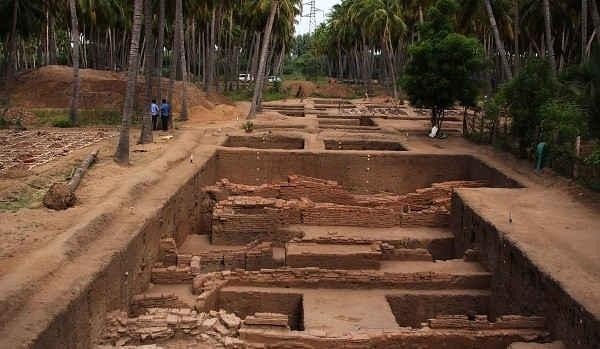
    Keezhadi: what the trenches show

    Long view across excavation trenches and exposed brick structures at Keezhadi.

    Photo: Ophelia S (Wikimedia Commons). Licence: CC BY-SA 4.0 (https://creativecommons.org/licenses/by-sa/4.0). Source: https://commons.wikimedia.org/wiki/File:Keezhadi_excavation.jpg

    • Excavation reports describe brick buildings, ring wells, drains and furnaces at Keezhadi (Keeladi), trench by trench.
    • Several published radiocarbon dates suggest that people were active there in the sixth century BCE; full calibration details were not found.
    • Spindle whorls, bone tools and a needle support textile work.

    What it cannot tell us Only part of the site has been excavated.

    • Teacher notes Some reports read brick tanks, ring wells, pipes and textile tools together as a dyeing system; an earlier report called the use of partly exposed tanks tentative. Some accounts describe Keezhadi as a secular settlement.
    • Look What did the excavators find, and what is the claim about?
    • Talk Can the absence of a kind of find show what people believed? Why or why not?
    • Ask What would you need to find to test the claim either way?

    4/15

    About a place

    Poompuhar: a coast partly lost to the sea

    Present-day coastal and river-mouth landscape at Poompuhar, viewed from the lighthouse.

    Photo: Destination8infinity (Wikimedia Commons). Licence: CC BY-SA 4.0 (https://creativecommons.org/licenses/by-sa/4.0). Source: https://commons.wikimedia.org/wiki/File:Poompuhar-Kaveri-Puhum-Pattinam-View-from-Lighthouse.jpg

    • Parts of the Early Historic port landscape at Poompuhar were eroded or submerged by coastal change.
    • Brickwork between the tides, ring wells and finds in shallow water are documented.
    • A seabed feature called PMR2, about 23 m deep, was detected by geophysics and inspected by divers.

    What it cannot tell us Present water depth is not an archaeological date.

    • Teacher notes The publication record inspected ties no diagnostic dated cultural material to it. A 2022 core study proposes a tsunami about 1,540 years ago; independent cores and secure dating are still needed. The lost continent of Lemuria, or Kumari Kandam, has been traced to nineteenth-century speculation.
    • Look What has been found here, and where?
    • Talk How does a local drowned coast differ from a lost continent?
    • Ask What evidence would show the age of the 23 m feature?

    5/15

    From the ground

    Old weapons, later traditions

    Historic monochrome catalogue plate showing iron weapons and implements from Adichanallur.

    Photo: Alexander Rea (catalogue author; individual plate photographer not separately credited) (Wikimedia Commons). Licence: Public domain (https://commons.wikimedia.org/wiki/Template:PD-old-auto-expired). Source: https://commons.wikimedia.org/wiki/File:Catalogue_of_the_prehistoric_antiquities_from_Adichanallur_and_Perumbair_(page_73_crop).jpg

    • Iron weapons were buried in Iron Age and Early Historic graves: swords, spearheads, daggers and arrowheads are listed at Adichanallur.
    • A Kodumanal dagger had a relatively hard high-carbon edge, apparently forge-welded to a softer core. That shows how it was made, not a fighting style or a training school.
    • The scholar Zarrilli traces Kalaripayattu to at least the twelfth century. The study found no source before 600 CE that shows its schools or drills.

    What it cannot tell us The dating of a present ritual form is not the same as the age of every motif within it.

    • Teacher notes Scholars place the present form of Theyyam in late-medieval north Malabar, as an attributed reconstruction. An early Tamil poem values guarded trees in groves, but the passage does not attest serpent worship.
    • Look Which of these things are dated, and how?
    • Talk Does an old weapon or an old poem show that a present-day tradition is ancient? What would show it?
    • Ask What kind of dated evidence would link a tradition to the period before 600 CE?

    6/15

    Two views

    List what each view accepts as evidence. Then write what would settle the question.

    Whether Keezhadi's brick tanks were dye vats

    One view

    The Tamil Nadu archaeology department's 2019 and 2025 reports read tanks, ring wells, pipes and textile tools together as a dyeing system.

    Another view

    The 2018 report on the first two Archaeological Survey of India seasons called the functions of partly exposed tanks tentative.

    What would settle it

    Residue, pigment or sediment-chemistry tests on a named tank, published with its exact context.

    7/15

    Two views

    Whether Theyyam continues a deep ancient complex

    One view

    A strong-continuity reading treats ancient Tamil hero and possession motifs, memorial stones, hero cults and Theyyam as stages of one regional complex.

    Another view

    A stricter source-critical reading accepts the resemblances as clues but requires dated intermediate steps before calling them continuity.

    What would settle it

    Early Kerala memorials of known findspot with later cult use, dated medieval shrine records, or dated early manuscripts of tōṟṟam songs.

    8/15

    How sure can we be? 1/6

    Keezhadi was a secular society.

    • Well supported
    • Likely
    • Possible
    • Not known

    9/15

    How sure can we be? 2/6

    Particular brick tanks were dye vats.

    • Well supported
    • Likely
    • Possible
    • Not known

    10/15

    How sure can we be? 3/6

    A lost continent called Lemuria or Kumari Kandam is a modern construction, not a finding from Poompuhar.

    • Well supported
    • Likely
    • Possible
    • Not known

    11/15

    How sure can we be? 4/6

    Is PMR2, the 23 m feature, a human-built structure of known age?

    • Well supported
    • Likely
    • Possible
    • Not known

    12/15

    How sure can we be? 5/6

    Kalaripayattu's schools and drills can be traced back only to about the twelfth century, long after 600 CE.

    • Well supported
    • Likely
    • Possible
    • Not known

    13/15

    How sure can we be? 6/6

    Theyyam descends in an unbroken line from megaliths or hero stones.

    • Well supported
    • Likely
    • Possible
    • Not known

    14/15

    Before you go

    Why do some popular claims go further than the evidence? Use two examples of different kinds of stretch, each with its level, and say what evidence would change one of them.

    15/15