Iron artifacts displayed in the Iron Age to Early Historic section of Pattanam Museum
Pattanam
Photographed 2019-01-05
- Made by hand
- Anakkara
- Nilambur
Palakkad graves show early iron use, not yet local smelting
Anakkara’s megalithic burials yielded iron objects and one slag fragment, but no furnace, ore source or ironworking community is yet established in Palakkad or neighbouring Malappuram.
- This page
- 5,239 words · revision 6
Draft study · Awaiting specialist review · Updated
001Dates and places
Places on the atlas that name this study.
- Anakkara & Bharathappuzha Megalithic Complexes
Coarse river-basin orientation · Palakkad District
- Nilambur & Chaliyar Basin Gold/Iron Landscapes
Coarse river-basin orientation · Malappuram District
1000–500 BCE
Different beginnings
500–200 BCE
Marks & materials
200 BCE–300 CE
Connected worlds
300–600 CE
Change & continuity
After 600 CE
- between mid-first millennium BCE and mid-first millennium CE
- cannot be dated before 3rd or 2nd century BCE and perhaps ... early centuries of the Christian era
- 670+/-80 BP; reported calibrated ranges AD 1270-1326 and AD 1217-1422
- Laboratory date
- Period assigned by excavators or scholars
Each date belongs to what was dated (a sample, an object, a layer or a text), which is not always the event the study asks about.
Each period has the same width, so spacing is not to scale.
The full table of dates, with their ranges, is under How we know.
- 1 Well supported
- 1 Possible
- 2 Not known
002How sure
In brief
In 2008, excavators at Anakkara in Palakkad found many iron grave goods in megalithic burials. They also found one fragment of iron slag at 85 cm, in the packing of a stone burial monument. The excavators read it cautiously as a sign of possible ironworking nearby. No furnace, tuyère (air pipe), ore or working floor was reported, so an on-site furnace is not established. Pottery suggests that part of the later phase is no earlier than the third or second century BCE, but it has no direct date. At Thrikkalangode in Malappuram, a 2019 news report describes urns, iron tools and possible ore workings, without technical records. No analysis yet ties the iron to laterite, magnetite or sand ore, and nothing ties its makers to the Kollan smith caste.
Key researchers cited in this study: K. Rajan (Kodumanal & Porunthal Excavations / Epigraphy) · V. Selvakumar (Maritime & Prehistoric Archaeology) · K. P. Shajan (Geoarchaeology & Periyar Palaeochannels) · M. R. Raghava Varier (Kerala Epigraphy & Vattezhuthu / Vaṭṭeḻuttu Studies) · Full bibliography
How sure
- Well supported
Iron was used at Anakkara
Finished iron tools and fittings were excavated directly from the 2008 burial contexts.
- Possible
Some ironworking happened near Anakkara
One slag fragment was found in monument packing and read cautiously by the excavators; no furnace or waste heap is reported.
- Not known
A furnace operated at the excavated site
No furnace, tuyère, ore charge, or working floor is reported from either Anakkara or Thrikkalangode.
- Not known
Which ore the early ironworkers used
No metallurgical or mineral analysis of ore, slag, or artefacts links the iron to any source.
Why it matters
It shows why a single slag fragment or a finished iron tool cannot, by itself, show that iron was made on the spot.
003Key findings
What the study concludes
- Iron artefact use is well documented at Anakkara, but local smelting is only suggested by one slag fragment.
- Thrikkalangode is the best Malappuram production lead located, but it needs primary field and laboratory documentation.
- Modern Malappuram geology includes banded magnetite quartzite; this does not validate a magnetic-sand or laterite source for archaeological iron.
- No early context reviewed identifies ironworkers as Kollan.
In the study’s own words. How sure each point is, is shown above.
The summary above is the short read. The full study is the complete text it was drawn from, with its tables and source notes.
What the full study covers
004The study
Summary
What archaeological evidence identifies early ironworking in Malappuram and Palakkad? It is sometimes said that Malappuram and Palakkad had early bloomeries smelting lateritic magnetic sand, worked by Kollan smiths. Testing those claims across 1000 BCE–600 CE requires keeping furnace, slag, tuyère, ore, charcoal, raw-material, chronology, and occupational-identity evidence separate.
The evidence supports a narrower conclusion. Early iron use is considerably better evidenced than a securely excavated and dated bloomery-smelting installation in either target district. At Anakkara in Palakkad, the 2008 excavation recorded numerous finished iron grave goods and, more importantly for production, one fragment of iron slag at 85 cm depth in the exterior/packing zone of kudakkal ANK 08-I. The excavators themselves treated that slag cautiously as suggesting possible iron manufacture nearby. Because the published context does not include a furnace, tuyère, ore charge, slag concentration, production floor, or analytical classification of the slag, this is evidence for possible nearby ironworking, not proof of an in-situ bloomery. Shajan et al. 2013–14
The Anakkara chronology is also less secure than a simple “Iron Age” label implies. The excavation authors state that the relevant Iron Age–Early Historic phase cannot yet be dated securely. Their broad comparative range extends from roughly the middle of the first millennium BCE to the middle of the first millennium CE, while russet-coated painted ware leads them to consider a date no earlier than the third or second century BCE and potentially in the early centuries CE. The charcoal exposed at greater depth in the trial trench belongs instead to an aceramic microlithic horizon interpreted as Mesolithic and therefore must not be reassigned as bloomery charcoal. Shajan et al. 2013–14
For Malappuram, the strongest production-oriented lead recovered in this study is Thrikkalangode/Pathapiriyam. A 2019 report concerning a University of Calicut local-history field workshop describes broken urns, iron tools or weapons, and features interpreted by participating researchers as remnants of iron-ore extraction and processing. It gives an age of about 2,000 years, but the accessible account supplies no laboratory date, excavation locus, furnace description, tuyère, characterized slag, ore specimen number, or analytical table. It is therefore a promising but low-strength lead requiring primary documentation, not yet a securely demonstrated Early Historic smelting installation. ↗3
The claim that early smiths smelted lateritic magnetic sand is currently unsupported. Kerala's Department of Mining and Geology lists Malappuram's identified iron-ore occurrence among banded magnetite quartzite deposits and treats heavy-mineral sands as a separate geological category. Thus “magnetic sand,” laterite, and banded magnetite quartzite cannot responsibly be treated as synonyms. No consulted study chemically or mineralogically links the Anakkara slag or iron objects, or the reported Thrikkalangode material, to laterite, the Korattimala magnetite-quartzite occurrence, or magnetic sand. ↗4
A Mahatma Gandhi University institutional page displaying an Anakkara iron object makes a broader statement that Kerala iron came from locally available laterite, but it supplies no specimen-specific mineralogical, compositional, or provenance analysis establishing that proposition for Anakkara. The statement is useful as an institutional interpretation, not as an archaeometallurgical provenance result. ↗5
Linking early ironworking to the Kollan occupational community is likewise not demonstrated. None of the consulted early Malappuram or Palakkad contexts identifies its workers as members of the modern Kollan occupational category. Recent South Indian archaeometallurgical research explicitly warns that ethnographic and ethnohistoric observations are specific to period, region, and raw-material conditions. Modern or recent traditional ironworking can therefore generate hypotheses but cannot establish continuity of caste identity or furnace practice across two millennia without an independent historical bridge. ↗6
Overall evidential judgment
| Proposition | Current judgment | Evidence strength | Principal reason |
|---|---|---|---|
| Iron was used at Anakkara | Supported | High | Excavated finished iron objects in mortuary contexts |
| Ironworking occurred somewhere near Anakkara | Plausible | Moderate | One excavated slag fragment; no diagnostic production complex |
| An in-situ bloomery operated at excavated Anakkara | Unproven | Low | No published furnace/tuyère/ore/production-floor package |
| Thrikkalangode preserves iron-production activity | Promising candidate | Low | Field interpretation reported journalistically; primary technical record unavailable |
| Early target-district iron used lateritic ore | Unresolved | Low | No ore–slag–artefact provenance analysis |
| “Magnetic sand” was the ore | Unresolved and presently unsupported | Low | Geological categories have been conflated |
| Early ironworkers can be identified as Kollan | Unsupported | Low | No early contextual or documentary bridge |
A more accurate description is “Early ironworking evidence in Malappuram and Palakkad: contexts, chronology, and ore-source tests.” That formulation preserves the valid research problem while avoiding premature claims about furnace type, ore type, and social identity.
Scope, chronology, and research design
No new excavation, laboratory analysis or specialist consultation was performed.
Four separate lines of evidence structure the assessment.
| Evidence angle | Question being tested | Best evidence required | Current evidentiary status |
|---|---|---|---|
| Production-context archaeology | Is there an actual early iron-smelting installation? | Furnace/furnace base, tuyère, diagnostic smelting slag, ore, fuel, working floor and stratigraphic association | Not demonstrated in accessible target-district publications |
| Raw-material provenance | Was the ore laterite, magnetite quartzite, magnetic/placer sand, or something else? | Mineralogy and chemistry of ore + slag; ideally artefact inclusion comparison | Unresolved |
| Chronology and site formation | Is the production evidence actually within 1000 BCE–600 CE and primary rather than redeposited? | Direct dates from secure production contexts plus stratigraphic controls | Anakkara indirect; Thrikkalangode undocumented |
| Social attribution | Can ironworkers be identified with a historically known occupational community? | Contemporaneous textual/epigraphic evidence or demonstrable historical continuity | Not established |
This separation is important because the relevant observations answer different questions. A finished iron implement demonstrates iron circulation and use; it does not identify where the metal was smelted. Slag demonstrates some metallurgical process only after its character is established; isolated slag may derive from smelting, smithing, recycling, or redeposition. Laterite in an archaeological layer may be construction material rather than ore. Charcoal is useful for fuel reconstruction or dating only when its stratigraphic relation to the metallurgical event is secure. Peer-reviewed experimental and archaeological work on lateritic materials, slag inclusions, and production debris repeatedly shows why technological classification requires mineralogical/contextual analysis rather than labels alone. ↗7
For this study, “high” evidential strength means a directly documented observation in a reasonably secure archaeological or analytical context. “Moderate” means the observation itself is reasonably secure but its technological or chronological interpretation remains underdetermined. “Low” means the relevant proposition rests on indirect, secondary, incompletely published, or non-diagnostic evidence. This allows, for example, the observation of a slag fragment at Anakkara to be strong while the inference from that fragment to an on-site bloomery remains weak.
Chronologically, the evidence falls into three layers. Core-period evidence is potentially datable between 1000 BCE and 600 CE; earlier background includes the deeper Anakkara microlithic/charcoal horizon; later comparison includes the Ezhavannikonam chronology problem discussed below. This is deliberately a mixed chronology study rather than a presumption that every “Megalithic” or traditional-smelting observation falls within 1000 BCE–600 CE.
Palakkad evidence: Anakkara
Anakkara is the best-published target-district case recovered in this study. The relevant preliminary report concerns the 2008 season and documents excavation of megalithic mortuary structures, associated habitation evidence, and an earlier microlithic horizon. Its value for this study lies not in a complete smelting installation but in the unusual combination of finished iron artefacts and one production-related waste fragment. “Anakkara: excavated burials in Kerala's Bharathapuzha valley” covers the Anakkara investigations as a whole, and “Bharathappuzha basin: many burials, little dated settlement” places the site in the wider Bharathappuzha basin. ↗10
At kudakkal ANK 08-I, the excavators opened a 3.5 × 3.5 m trench. In the exterior/packing area they encountered crushed laterite and laterite blocks associated with the stone structure; at about 85 cm depth they recovered a single fragment of iron slag. The paper interprets this as suggesting possible iron manufacture in the vicinity. That wording is appropriately cautious. The find establishes that metallurgical waste entered the archaeological deposit, but the consulted publication does not report a furnace wall, furnace base, tuyère, slag pit, ore pile, tapping channel, production floor, or a concentration of repeatedly generated waste tied to the fragment. Shajan et al. 2013–14
Laterite quarry, Malappuram, Kerala
Photographed 2008-05-07
That distinction is decisive. The slag fragment could represent nearby smelting, nearby smithing, waste brought in with packing material, or another metallurgical process. Without macroscopic classification and microstructural/mineralogical analysis, the term “slag” does not itself resolve those alternatives. Lateritic packing in the same interval likewise cannot be converted into “lateritic ore”: the excavators describe it as part of the monument's packing construction, and independent archaeometallurgical work demonstrates why lateritic nodules must be tested rather than assumed to have served as smelting feedstock. Shajan et al. 2013–14
One residue can help separate smithing from smelting. Hammerscale is the small magnetic flakes, and less common spheres, produced when iron is hot-worked, as in forging and welding. David Dungworth and Roger Wilkes joined archaeological examination of hammerscale to forging and fire-welding experiments, and high-speed recording showed spheres forming during an experimental weld. Their work gives archaeologists a tested route from a smithing operation to a residue on a working floor. The inference should not be reversed without care: showing that a process can make a residue does not prove that every similar particle came from exactly that operation, and a cluster on a surface still has to be read against deposition and disturbance. Hammerscale is therefore one of the residues that could help decide between the smelting and smithing alternatives above. (David Dungworth and Roger Wilkes (2007). An Investigation of Hammerscale: https://historicengland.org.uk/research/results/reports/26-2007.)
Anakkara nevertheless provides substantial evidence for iron use. The mortuary assemblages include several categories of finished iron object, among them rods, weapons or weapon-like forms, tools and other grave equipment. The report lists items including rods, a tripod, a trident, arrowheads, a lamp, a dagger and a miniature sickle. These artefacts demonstrate access to worked iron and its incorporation into burial practice. They do not, by themselves, identify the smelting location or the ore source. Disturbance including root action also reinforces the need to keep artefact deposition separate from assumptions about original production context. Shajan et al. 2013–14
The chronology requires equal caution. In the nearby trial trench, the upper archaeological sequence contains ceramics interpreted as habitation evidence connected broadly with the mortuary landscape. Deeper red loam, approximately 1.0–2.3 m below the surface, produced microliths and charcoal but no pottery and was assigned to an earlier Mesolithic horizon. It follows that the mere existence of charcoal at Anakkara cannot be used as evidence for charcoal-fuel preparation in the later ironworking phase. A metallurgical fuel claim would require charcoal from a furnace, slag heap, ore-roasting feature, or comparable securely associated context. Shajan et al. 2013–14
Where charcoal does come from a production context, laboratory tests can say more about it. Laura McParland and colleagues compared charcoal from laboratory heating, modern smelting and casting experiments, and natural wildfires, using the reflectance of polished charcoal cell walls as a measure of heating history. Reheated charcoal can take on the signature of a later, higher temperature, so a fragment can record more than its first conversion from wood; reading it needs calibrated comparison, not visual guesswork. The method has limits: it does not identify the tree species, woodland rights or the amount of forest cleared. A fuel history still needs botanical identification, archaeological context and evidence about supply. (Laura C. McParland, Margaret E. Collinson, Andrew C. Scott and Gill Campbell (2009). The use of reflectance values for the interpretation of natural and anthropogenic charcoal assemblages: https://link.springer.com/article/10.1007/s12520-009-0018-z.)
For the later phase, the authors explicitly refrain from claiming an exact absolute date. They discuss a broad regional span from roughly the middle of the first millennium BCE to the middle of the first millennium CE and use ceramic comparison, especially russet-coated painted ware, to suggest that at least part of the assemblage may not precede the third or second century BCE and could belong to the early centuries CE. This means Anakkara potentially falls within the site's main period, but its smelting-related observation lacks a direct production-context date. Shajan et al. 2013–14
| Anakkara observation | What it directly establishes | What it does not establish |
|---|---|---|
| One iron-slag fragment at 85 cm | Metallurgical debris was present in the ANK 08-I exterior/packing deposit | Furnace type, smelting rather than smithing, primary deposition |
| Crushed laterite/laterite blocks in packing | Laterite was used/present in monument construction | Laterite was smelting ore |
| Numerous finished iron objects | Iron was circulating, worked and deposited | Metal was locally smelted |
| Charcoal in deeper microlithic horizon | Combustion material existed in an earlier aceramic occupation | Fuel for later iron production |
| Ceramic comparative dating | Later mortuary/habitation phase plausibly falls within Iron Age–Early Historic times | Direct date of the slag-producing event |
The evidence strength can therefore be expressed precisely: high confidence in iron use; moderate confidence that some ironworking occurred in the wider vicinity; low confidence in an excavated on-site bloomery; no current analytical basis for specifying the ore.
One primary-source issue remains important. The article refers to additional work, including a 2009 season, outside the scope of the consulted preliminary report. Those season records should be acquired before concluding that the 2008 publication represents all metallurgical evidence from the locality. A publisher-quality copy should also be used to inspect plans and sections visually, particularly the exact relationship between the 85-cm slag find, the packing, monument stones, and any disturbances. The web-accessible textual version allowed the contextual statement to be checked, but not the figure-dependent spatial interpretation at the standard desirable for a final archaeological publication.
Malappuram evidence: Thrikkalangode
The strongest Malappuram production lead located in the sources consulted comes from Thrikkalangode/Pathapiriyam, reported publicly in March 2019 after a University of Calicut local-history workshop. The report describes broken burial urns and iron artefacts and states that participating researchers identified remains interpreted as old iron-ore mining and ore-processing places. It characterizes the material as around two millennia old. ↗3
This is potentially important because, unlike a cemetery containing only finished iron objects, an actual extraction-and-processing locality could address production directly. But nearly every archaeological control needed to evaluate that interpretation is absent from the accessible report. No trench or locus system is published. No furnace morphology is described. No tuyère is specified. No slag typology, polished section, SEM-EDS result, XRF chemistry, ore mineralogy, charcoal sample, laboratory code, or radiocarbon determination is supplied. The approximate age appears as an interpretive statement rather than a reported scientific measurement. ↗3
Consequently, the correct evidential status is candidate production locality, not confirmed bloomery. A field interpretation can be entirely correct and still be insufficient for publication-grade verification. Features described informally as “mining caves” or “processing places” need plans, stratigraphy, extraction marks or geological context, associated debris, and preferably diagnostic laboratory characterization before they can be distinguished from natural cavities, later extraction, or other landscape features.
This creates a particularly clear source still to consult. The University of Calicut archive, participating department or researchers should be asked specifically for the workshop's field notebook, locality plan, georeferenced-but-access-controlled site record, photographs, specimen register, pottery description, ore and slag samples, any laboratory results, and the basis for the circa-2,000-year age. The exact vulnerable findspot need not be published openly.
The contrast between Anakkara and Thrikkalangode is analytically useful:
| Criterion | Anakkara, Palakkad | Thrikkalangode, Malappuram |
|---|---|---|
| Published archaeological context | Yes, preliminary excavation report | Not located; news account only |
| Finished iron objects | Yes | Reported |
| Slag | One excavated fragment | Not technically documented in accessible account |
| Furnace | Not reported in read paper | Not technically documented |
| Tuyère | Not reported | Not technically documented |
| Ore | No archaeologically analyzed ore | “Mined iron ore” reported, not analytically published |
| Charcoal tied to production | No | Not documented |
| Absolute date for production | No | No laboratory result supplied |
| Production inference | Possible nearby ironworking | Potential mining/processing locality |
| Current confidence in smelting | Low | Low |
This does not mean Malappuram lacks early production evidence. It means that the strongest lead located here cannot yet be elevated to the evidential level of an excavated and dated metallurgical installation. The difference is one of documentation, not a negative archaeological verdict.
Raw materials and diagnosing production
The phrase “lateritic magnetic sand bloomery” compresses at least three separate geological and technological propositions: that the ore was lateritic, that it was a magnetic sand, and that it was reduced in a bloomery. None follows automatically from the others.
The Government of Kerala Department of Mining and Geology lists iron-ore resources in northern Kerala as banded magnetite quartzite, including an occurrence in Malappuram. Its resource table gives the Korattimala deposit as roughly 4.4 million tonnes in total and reports iron percentages in the mid-30s, while the same official resource page treats Kerala's heavy-mineral sands separately and describes minerals such as ilmenite, rutile, zircon, monazite and sillimanite in placer deposits. This alone demonstrates that “magnetic sand” and Malappuram's listed magnetite-quartzite iron ore are not interchangeable geological labels. ↗4
Nor does geological availability prove archaeological exploitation. An ore body can exist near a site without having supplied it. Conversely, iron objects can circulate over substantial distances as blooms, bars, billets, finished goods, scrap, or recycled metal. A source attribution needs an analytical chain linking candidate geological material to production waste and, where possible, artefact inclusions. The current target-district evidence does not provide that chain. ↗14
The MGU institutional description of an Anakkara iron object is therefore best treated as a hypothesis-generating statement when it says that locally available laterite supplied iron in Kerala. No ore sample, slag chemistry, mineralogical comparison or trace-element/provenance argument is supplied on that page for the displayed Anakkara object. ↗5
The broader archaeometallurgical literature provides a practical test strategy. Cawte and Boyd's investigation of lateritic nodules asks precisely whether archaeological laterite can credibly have functioned as iron ore, rather than assuming it from appearance or association. Blakelock and colleagues experimentally assess the use of slag inclusions in iron artefacts for provenance, showing both the potential and limits of linking artefacts to production environments. Humphris and colleagues demonstrate substantial variability even within individual smelting episodes, cautioning against over-generalization from a single or arbitrary slag sample. ↗7
Recent South Indian work illustrates an appropriate analytical toolkit. Srivastava and colleagues use combinations of X-ray fluorescence, microscopy, electron backscatter diffraction, X-ray diffraction and energy-dispersive spectroscopy to investigate Iron Age and Early Historic iron artefacts from the Kaveri valley. The significance for this study is methodological rather than a direct Kerala provenance claim: target-district specimens need the same kind of material characterization before production technique and raw material are given archaeological specificity. ↗15
A recent Kerala comparator makes a similar methodological point from another type of evidence. John, Indu G.K. and Lal's 2026 study of Pattanam sediments employs geochemical measurements to identify anthropogenic metal signatures associated with Early Historic activity. Its lead-enrichment results do not demonstrate iron smelting in Malappuram or Palakkad, but they show that Kerala archaeology increasingly permits analytical tests instead of relying only on typological labels. ↗16
For Anakkara, the evidence reaches an excavated slag fragment but not yet its classification, a comparison with candidate ores, or a direct date for the production event. For Thrikkalangode, even the step from a reported field interpretation to characterized slag and ore remains undocumented in an accessible primary publication.
Laterite quarry, Angadipuram, photographed in 1969
Photographed created 1969
An efficient analytical program would first characterize the Anakkara slag macroscopically and microscopically before consuming large amounts of archaeological material. A representative sample set should then compare archaeological slag with candidate local ore materials, including lateritic horizons and the relevant magnetite-quartzite occurrence where access, conservation, and geological sampling permissions allow. Finished artefacts should be sampled only where curatorial ethics permit; non-destructive or minimally destructive approaches should be preferred. The purpose is not to force a local-source conclusion but to discriminate among local laterite, magnetite-rich geological sources, imported metal, and recycling.
Chronology, social attribution, and comparative controls
The most useful chronological comparator recovered is Ezhavannikonam in Thiruvananthapuram district, outside the target geography. Indian Archaeology 1995–96 – A Review reported it as an ancient iron-ore-smelting locality and provisionally described it as probably late Megalithic, mentioning iron-bearing/crucible-like material, burnt wood or charcoal, slag and lateritic gravel and a metallurgical result of roughly 35% iron in analyzed material. IAR 1995–96
A later University of Kerala thesis, citing P. Rajendran and C.P.S. Iyer's 2015 chapter on ancient metallurgy in Kerala, reports a radiocarbon age of 670 ± 80 BP and medieval calibrated ranges for an associated Ezhavannikonam context. The 2015 chapter itself was not directly accessible in this study, so the exact sample material, laboratory code, calibration curve, and relationship between the dated sample and smelting debris remain unresolved. Even with that limitation, the comparison is methodologically valuable: a field context initially described typologically as “probably late Megalithic” can turn out to involve substantially later activity.
Two closer Kerala burial-landscape comparators reinforce the same caution that slag beside graves is not yet dated smelting. At Mangadu in Kollam district (reported via “Mangadu’s Iron Age urn burials date to the first millennium BCE”, citing T. Satyamurthy 1992; not read directly here), iron slag pieces were reported from the burial pit without distinguishing smelting from smithing. Closer still, in Kozhikode district adjoining Malappuram, salvage excavation at Kinalur (reported via “Four northern Kerala Iron Age sites show varied burials, none yet dated”, citing V. Selvakumar 2020) documented a cluster of iron slag beside urn burials that the excavator treats as undated. Together with Anakkara's single fragment, they are the slag finds from Kerala burial sites discussed in this collection.
That is precisely why Anakkara's slag and any Thrikkalangode production evidence need directly associated dates, rather than inheriting a period label from pottery, urn burial form, or general “megalithic” appearance.
Social attribution needs the same chronological discipline. Popular accounts often associate early regional ironworking with the Kollan iron-smith community. That may be relevant to the history of later or modern craft communities, but no consulted Anakkara or Thrikkalangode archaeological record identifies its workers by caste, lineage, community name, or other social label. An iron-working technology and an occupational community can each persist, transform, migrate, divide, or disappear; archaeological resemblance by itself cannot establish a continuous group identity. Recent archaeometallurgical scholarship explicitly warns against treating ethnographic ironworking observations as timeless templates because technologies depend on period, region and raw materials. ↗6
Accordingly, traditional furnace reconstructions should be used only as comparative models: for example, to generate hypotheses about air supply, slag morphology, furnace wall vitrification or charcoal requirements that can then be tested archaeologically. They cannot be used to fill absent archaeological data with assumed temperatures, furnace dimensions, labour organization, caste ownership, or technological recipes.
The same rule applies to connected-region comparators such as Kodumanal and Kaveri-valley sites in Tamil Nadu. B. Sasisekaran's publications on Tamil Nadu metallurgy (1999, 2001, 2002) are relevant for technological comparison, but they are not evidence that the same production sequence, ore, or social organization operated in Malappuram or Palakkad. ↗19
Computer models raise the same issue. G. R. Tabor, D. Molinari and G. Juleff combined archaeology, reconstruction and computational airflow modelling to study shallow wind-driven iron furnaces in Sri Lanka, an industry their abstract places in the later first millennium CE; their conclusion discusses the seventh to eleventh centuries. The model relates furnace shape and exposure to a pressure difference that draws air through the furnace, and it makes stated assumptions about the material packed inside. A working reconstruction tests whether a proposed arrangement can operate; a model explores how it behaves under stated assumptions. Neither is evidence for Kerala: this is a later Sri Lankan comparison. (G. R. Tabor, D. Molinari and G. Juleff (2005). Computational simulation of air flows through a Sri Lankan wind-driven furnace: https://www.sciencedirect.com/science/article/pii/S0305440305000099. Further reading: Gillian Juleff (1996). An ancient wind-powered iron smelting technology in Sri Lanka. Publisher abstract on www.nature.com.)
Reconstruction drawings need the same separation. An excavated furnace profile, a modern airflow model, an artist's placement of tools and an inferred fuel store should not share one caption, so that a viewer can tell why each feature appears.
The strongest disagreements and the observations that would resolve them can therefore be stated directly:
| Disagreement | Present alternatives | Discriminating evidence |
|---|---|---|
| Nature of Anakkara slag | Smelting / smithing / recycling / redeposited metallurgical debris | Slag morphology, polished section, SEM-EDS/XRD, spatial context |
| Anakkara production location | On-site / nearby / imported waste | Additional excavation, waste concentration, furnace fabric/tuyères |
| Thrikkalangode interpretation | Genuine ancient extraction-processing complex / mixed or later feature / natural feature | Primary plans, stratigraphy, associated slag/ore, direct date |
| Ore source | Laterite / magnetite quartzite / another source / imported metal | Comparative ore–slag–inclusion geochemistry/mineralogy |
| Period | Iron Age / Early Historic / mixed/reused contexts | Directly associated AMS or other suitable dates |
| Social identity | Continuity with later Kollan communities / different or unknowable identities | Contemporaneous textual/epigraphic evidence plus historical bridge |
No one of these questions should be settled by analogy alone.
Conclusions, recommendations, and bibliography
The investigation yields a defensible but evidence-limited conclusion. Palakkad currently has the stronger published archaeological case: Anakkara provides substantial evidence for iron use and one directly excavated slag fragment that makes nearby ironworking plausible. It does not yet provide a demonstrated bloomery installation. Malappuram has a potentially important production lead at Thrikkalangode, but the accessible evidence is secondary and lacks the field and laboratory documentation necessary to establish an early smelting complex. Shajan et al. 2013–14
The raw-material question remains open. The official geological record establishes that northern Kerala contains iron-bearing formations, including banded magnetite quartzite in Malappuram, while distinguishing these from heavy-mineral sands. Archaeological exploitation of any one source has not been demonstrated. The “lateritic magnetic sand” wording should therefore be dropped unless future specimen-level evidence supports one of those materials with a properly defined geological meaning. ↗4
Likewise, the “Kollan” attribution should be removed from the early archaeological proposition. It can be investigated separately as a historical and ethnographic question, but the early archaeological contexts presently provide no identity bridge. ↗6
The most useful next work is specific rather than open-ended:
-
Recover the primary Anakkara archive. Obtain a publisher-quality article copy, inspect ANK 08-I plans/sections, recover the 2009 season documentation, and locate the museum/catalogue identity of the slag fragment. This is the fastest route to determining whether additional metallurgical material exists beyond the single published fragment. ↗10
-
Characterize the Anakkara slag before expanding the historical narrative. Establish whether it is smelting slag, smithing slag, or another metallurgical material through appropriate petrographic/mineralogical and microchemical methods. Because production debris can vary substantially even within a single smelting episode, a later program should sample a representative assemblage if more slag exists rather than making a technology claim from one fragment. ↗21
-
Acquire the Thrikkalangode primary record. The decisive documents are the University of Calicut field report or notebook, plan, context descriptions, photographs, specimen catalogue, ore/slag samples, and basis for the circa-2,000-year age. Until those are recovered, publication should describe Thrikkalangode explicitly as a reported candidate locality. ↗3
-
Date production rather than the monument type. Any charcoal proposed for AMS dating should come from a demonstrably associated production feature or sealed metallurgical deposit; the Anakkara deeper microlithic charcoal illustrates why proximity alone is insufficient. The Ezhavannikonam chronology dispute reinforces the same principle. Shajan et al. 2013–14
-
Run an ore–slag–artefact provenance program only after contexts are secured. Candidate laterite, magnetite quartzite, archaeological slag and, where ethically permissible, slag inclusions in objects should be compared analytically. The result may support local production, multiple ore sources, recycling, or imported iron; the design should permit all of those outcomes. ↗23
-
Separate craft history from caste continuity. A parallel historical study can examine inscriptions, textual references, later documentary evidence, occupational terminology and securely dated ethnography concerning smith communities. That evidence should meet the archaeology at a demonstrated chronological bridge rather than being projected backward. ↗6
-
Look beyond single finds. Securely phased smelting and smithing floors with slag, tuyère and fuel analyses are needed, together with evidence for how raw iron, charcoal and refractory clay moved between upland workshops and the coast.
Selected bibliography and source URLs
Shajan, K.P., V. Selvakumar, K.P. Rajesh, Sreelatha Damodaran et al. “Archaeological Excavation at the Megalithic Site of Anakkara, Palakkad Dt, Kerala, South India: A Preliminary Report of 2008 Season.” Tamil Civilization 25(1–4), 2013–2014. Repository record: https://www.researchgate.net/publication/401020357_ARCHAEOLOGICAL_EXCAVATION_AT_THE_MEGALITHIC_SITE_OF_ANAKKARA_PALAKKAD_DT_KERALA_SOUTH_INDIA_A_PRELIMINARY_REPORT_OF_2008_SEASON ↗24
Department of Mining and Geology, Government of Kerala. “Mineral Resources.” ↗4
Deccan Chronicle. “Iron age artefacts unearthed from Thrikkalangode.” 15 March 2019. https://www.deccanchronicle.com/nation/politics/150319/iron-age-artefacts-unearthed-from-thrikkalangode.html ↗3
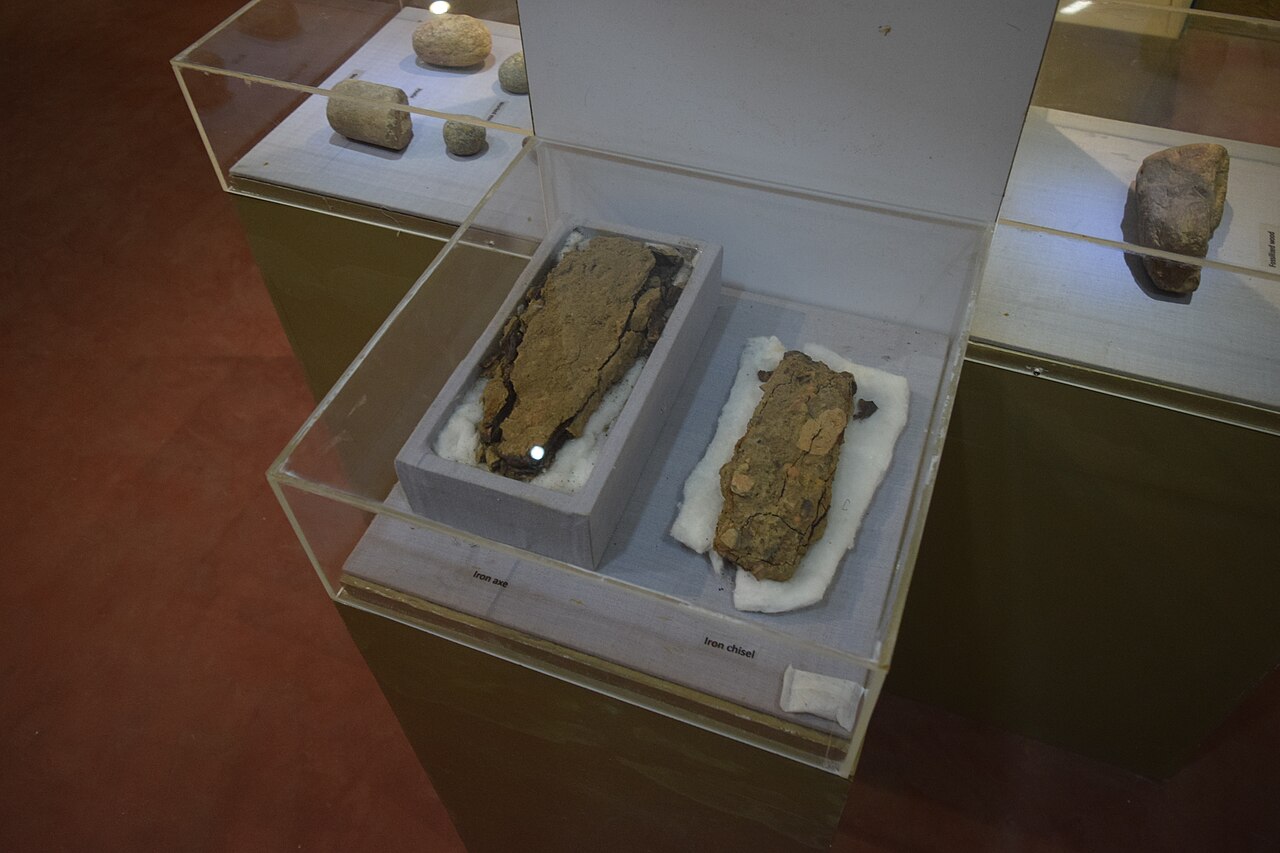
Iron axe and chisel displayed at Pattanam Museum
Pattanam
Photographed 2019-01-05
Cawte, H., and W.E. Boyd. “Laterite nodules: A credible source of iron ore in iron age northeast Thailand?” Geoarchaeology 25(5), 2010: 626–644. DOI 10.1002/gea.20326; https://doi.org/10.1002/gea.20326 ↗25
Blakelock, E., M. Martinón-Torres, H.A. Veldhuijzen, and T. Young. “Slag inclusions in iron objects and the quest for provenance: an experiment and a case study.” Journal of Archaeological Science 36(8), 2009: 1745–1757. DOI 10.1016/j.jas.2009.03.032; https://doi.org/10.1016/j.jas.2009.03.032 ↗14
Humphris, J., M. Martinón-Torres, T. Rehren, and A. Reid. “Variability in single smelting episodes – a pilot study using iron slag from Uganda.” Journal of Archaeological Science 36(2), 2009: 359–369. DOI 10.1016/j.jas.2008.09.020; https://doi.org/10.1016/j.jas.2008.09.020 ↗21
Srivastava, Nishkarsh, Amit Kumar Singh, Alok Kumar Kanungo, Amit Arora, Karaigowder Rajan, and Veerasamy Selvakumar. “Comparative microstructural and elemental analysis of iron artefacts from Kaveri valley archaeological sites.” Archaeometry 65(6), 2023: 1246–1259. DOI 10.1111/arcm.12895; https://doi.org/10.1111/arcm.12895 ↗15
John, Arun J., Indu G.K., and Arunima M. Lal. “Roman metallurgy and early Anthropocene footprints in Kerala, South India: geochemical reflections from Muziris sediments.” Anthropocene Coasts 9, article 10, 2026. DOI 10.1007/s44218-025-00115-8; https://doi.org/10.1007/s44218-025-00115-8 ↗16
Archaeological Survey of India. Indian Archaeology 1995–96 – A Review (New Delhi: ASI), Ezhavannikonam entry (consulted via text copy; ASI PDF page verification pending).
Kumbodharan, S. Megalithic Sites in Thiruvananthapuram District with Special Reference to Nedumangadu, Kattakkada, Chirayinkeezhu and Varkala Taluks. M.Phil. thesis, University of Kerala, 2020. https://www.researchgate.net/publication/347751902_Megalithic_Sites_in_Thiruvananthapuram_District_with_Special_Reference_to_Nedumangadu_Kattakkada_Chirayinkeezhu_and_Varkala_Taluks ↗26
Rajendran, P., and C.P.S. Iyer. “Characteristics of Ancient Metallurgy in Kerala, South India.” In Megalithic Traditions in India: Archaeology and Ethnography, vol. II, edited by K.K. Basa, R.K. Mohanty and S.B. Ota, 2015. Host-volume catalogue: https://www.si.edu/es/object/megalithic-traditions-india-archaeology-and-ethnography-edited-kishor-k-basa-rabindra-k-mohanty%3Asiris_sil_1092952 The chapter text was not consulted directly for this study. ↗27
Sasisekaran, B., and B.R. Rao. “Technology of Iron and Steel in Kodumanal – An Ancient Industrial Centre in Tamil Nadu.” Indian Journal of History of Science 34(4), 1999: 263–272. https://insa.nic.in/writereaddata/UpLoadedFiles/IJHS/Vol34_4_1_BSasisekaran.pdf ↗28
Sasisekaran, B. “Metallurgy and Metal Industry in Ancient Tamil Nadu – An Archaeological Study.” Indian Journal of History of Science 37, 2002. https://insa.nic.in/writereaddata/UpLoadedFiles/IJHS/Vol37_1_2_BSasisekaran.pdf ↗29
Sasisekaran, B., and B. Raghunatha Rao. “Iron in Ancient Tamilnadu.” In Metallurgy in India – A Retrospective, National Metallurgical Laboratory, 2001. https://eprints.nmlindia.org/id/eprint/5805/ ↗30
School of Social Sciences, Mahatma Gandhi University. “Megalitic Iron objects.” https://sss.mgu.ac.in/megalitic-iron-objects/ ↗5
The evidence does not yet support a claim of a “lateritic magnetic-sand bloomery.” The observations needed to transform that proposition from a hypothesis into a historical finding are identifiable and finite: a primary production context, direct chronology, metallurgical classification, and ore-provenance evidence.
005Photographs
Photographs of the places and objects this study discusses. Each item carries its creator’s credit, licence and documented source. See all 412 photographs and source images ↗
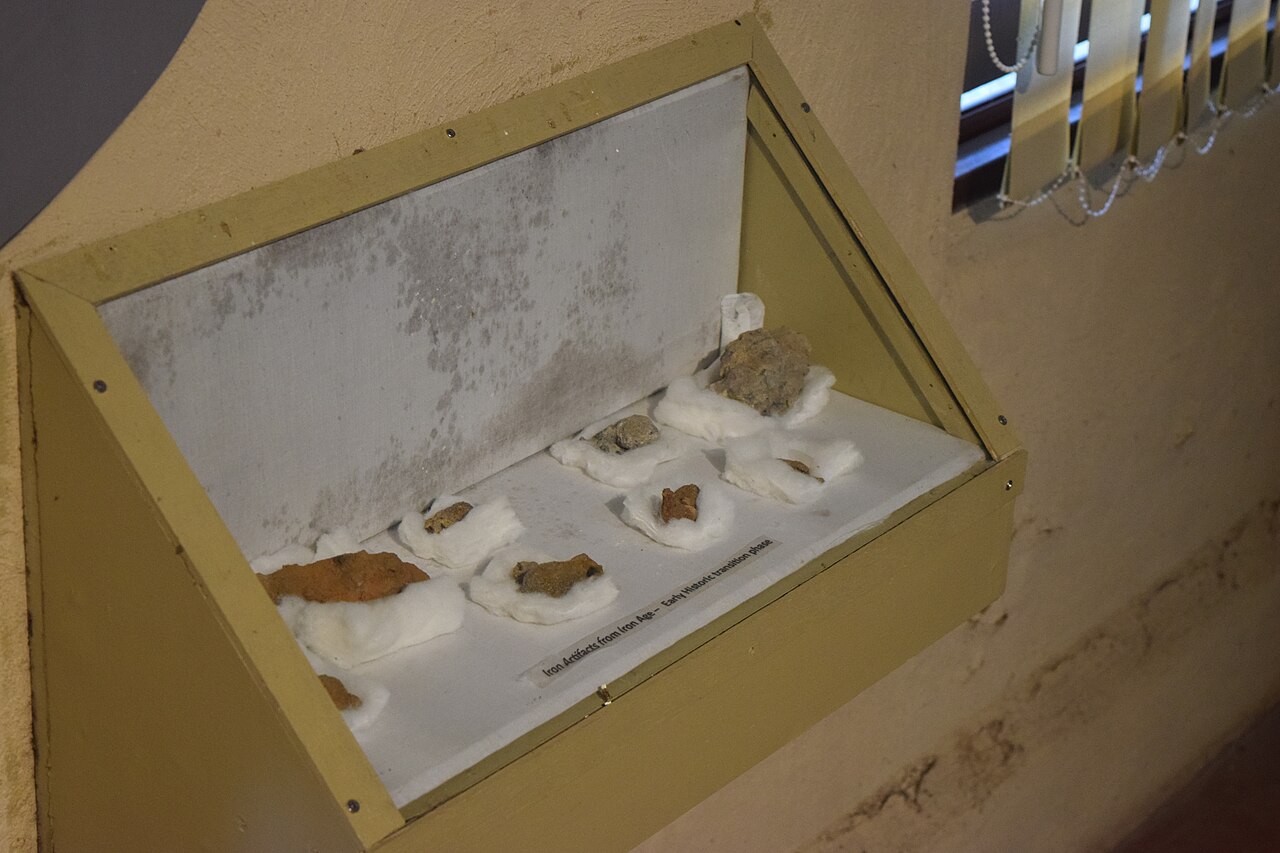
Pattanam · Photographed 2019-01-05 16:27:39
Iron artifacts displayed in the Iron Age to Early Historic section of Pattanam Museum

Photographed 2008-05-07
Laterite quarry, Malappuram, Kerala
Laterite quarry, Malappuram, Kerala. Modern geological and material context; not an ancient quarry or excavation photograph.

Photographed created 1969
Laterite quarry, Angadipuram, photographed in 1969
Laterite quarry, Angadipuram, photographed in 1969. Modern geological and material context; not an ancient quarry or excavation photograph.
Pattanam · Photographed 2019-01-05 16:42:23
Iron axe and chisel displayed at Pattanam Museum
Pattanam · Photographed 2018-01-21 00:42
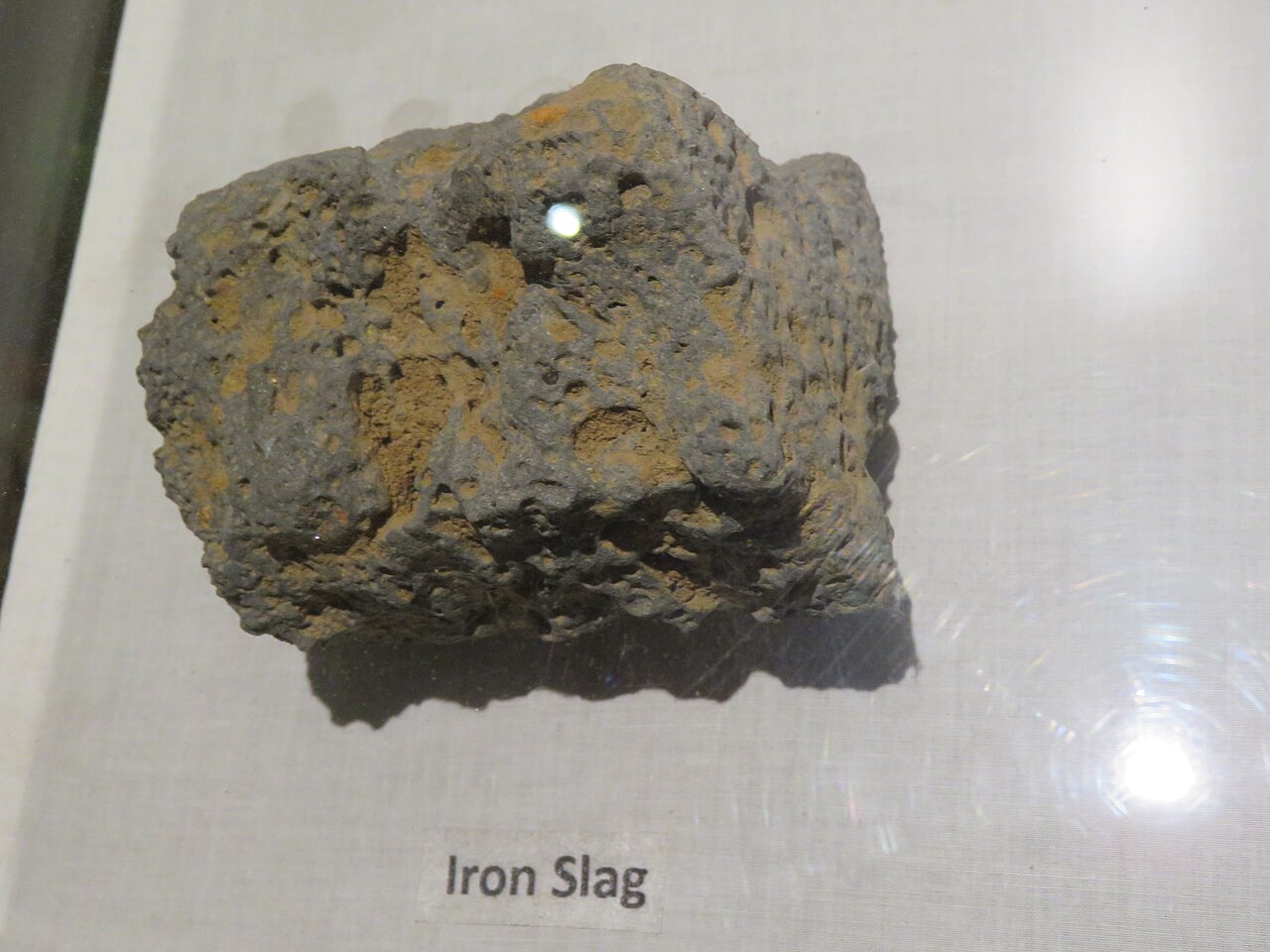
A piece of iron slag displayed at Pattanam Museum
006Where next
Compare iron from Palakkad’s graves, where no furnace has yet been found, with the evidence for early high-carbon steel elsewhere in South India.
On the atlasAnakkara & Bharathappuzha Megalithic ComplexesCoarse river-basin orientation · Palakkad District
Explore nexturukku / eḵku (Kannada/Telugu ukku) (உருக்கு / எஃகு / ഉരുക്ക്)All related studies, connected material, books and sources20 · 16
Elsewhere on this site
Excavation Atlas Sites: Anakkara & Bharathappuzha Megalithic Complexes · Nilambur & Chaliyar Basin Gold/Iron Landscapes
Classroom Lesson Plans: Module 5 · Iron, Stone Monuments & Everyday Craft: Technology in Early South India
Multi-Script Glossary Terms: urukku / eḵku (Kannada/Telugu ukku) (உருக்கு / எஃகு / ഉരുക്ക്) · ūtu-kuḻal (Terracotta Tuyère / Bellows Nozzle) (ஊதுகுழல் (உலைக் குழாய்) / ഊതുകുഴൽ (ചൂളക്കുഴൽ / ട്യൂയർ)) · irumpu-k-kiṭṭam (Metallurgical Tap Slag & Furnace Bloom) (இரும்புக் கிட்டம் / ഇരുമ്പുകിട്ടം (സ്ലാഗ്))
Connected material
Photographs, drawings, books, videos and other studies linked to this study. A link helps you explore; it does not prove a historical claim.
- Iron axe and chisel displayed at Pattanam MuseumphotographShows the subject
- Iron artifacts displayed in the Iron Age to Early Historic section of Pattanam MuseumphotographShows the subject
- A piece of iron slag displayed at Pattanam MuseumphotographShows the subject
- Laterite quarry, Angadipuram, photographed in 1969photographBackground
- Laterite quarry, Malappuram, KeralaphotographBackground
- Three materials, different tracesdiagramThe slag panel follows this study’s caution: one slag fragment from Anakkara does not by itself show local smelting.
Books, videos and websites
Outside reading on this topic. These are not part of the study and we have not checked every claim in them. See all books and videos
- Dr Oishi Roy. Understanding Early Iron Age: Zonal Differences in Indian Subcontinent. Nov 1, 2025 Video · Oishi Roy · IISER Mohali, Palaeo-Arch Lab, postdoctoral fellow at event · 1:50:15 · Research lecture comparing regional Iron Age developments and metal technologies across the Indian subcontinent. Offers a specialist framework for distinguishing regional evidence instead of assuming a single uniform Iron Age. Do not advertise this as confirming the earliest dates claimed for Sivagalai or Mayiladumparai; no such segment was verified.
007Sources
The study lists the sources it consulted; we have not rechecked them. A working link does not show that a source was read, and a valid identifier does not show that it supports a claim. We do not link to unofficial uploads or copies of publications. Where a study cited one, we show the published citation, or a publisher, DOI or Internet Archive link when we have one. Tracking codes are removed from links, and the sources themselves are not republished here.
K.P. Shajan et al., 'Archaeological Excavation at the Megalithic Site of Anakkara, Palakkad Dt, Kerala, South India: A Preliminary Report of 2008 Season,' Tamil Civilization 25(1-4), Apr. 2013-Jan. 2014, pp. 26-50; repository metadata labels April 2014.
Department of Mining and Geology, Government of Kerala, 'Mineral Resources,' current official webpage.
Print or offline sourceSource recordDeccan Chronicle, 'Iron age artefacts unearthed from Thrikkalangode,' 15 March 2019.
H. Cawte and W.E. Boyd, 'Laterite nodules: A credible source of iron ore in iron age northeast Thailand?', Geoarchaeology 25(5), 2010, 626-644. DOI 10.1002/gea.20326.
E. Blakelock et al., 'Slag inclusions in iron objects and the quest for provenance: an experiment and a case study,' Journal of Archaeological Science 36(8), 2009, 1745-1757. DOI 10.1016/j.jas.2009.03.032.
J. Humphris, M. Martinón-Torres, T. Rehren and A. Reid, 'Variability in single smelting episodes – a pilot study using iron slag from Uganda,' Journal of Archaeological Science 36(2), 2009, 359-369. DOI 10.1016/j.jas.2008.09.020.
N. Srivastava, A.K. Singh, A.K. Kanungo, A. Arora, K. Rajan and V. Selvakumar, 'Comparative microstructural and elemental analysis of iron artefacts from Kaveri valley archaeological sites,' Archaeometry 65(6), 2023, 1246-1259. DOI 10.1111/arcm.12895.
B. Sasisekaran and B.R. Rao, 'Technology of Iron and Steel in Kodumanal – An Ancient Industrial Centre in Tamil Nadu,' Indian Journal of History of Science 34(4), 1999, 263-272.
B. Sasisekaran, 'Metallurgy and Metal Industry in Ancient Tamil Nadu – An Archaeological Study,' Indian Journal of History of Science 37, 2002.
B. Sasisekaran and B. Raghunatha Rao, 'Iron in Ancient Tamilnadu,' in Metallurgy in India – A Retrospective, National Metallurgical Laboratory, Jamshedpur, 2001.
Indian Archaeology 1995–96 – A Review (Ezhavannikonam entry)
Archaeological Survey of India, Indian Archaeology 1995-96 – A Review, Kerala exploration entry for Ezhavannikonam; accessed through a text mirror.
Print or offline sourceSource recordS. Kumbodharan, 'Megalithic Sites in Thiruvananthapuram District with Special Reference to Nedumangadu, Kattakkada, Chirayinkeezhu and Varkala Taluks,' M.Phil. thesis, University of Kerala, 2020.
P. Rajendran and C.P.S. Iyer, 'Characteristics of Ancient Metallurgy in Kerala, South India,' in K.K. Basa, R.K. Mohanty and S.B. Ota (eds), Megalithic Traditions in India: Archaeology and Ethnography, vol. II, 2015.
Arun J. John, Indu G.K. and Arunima M. Lal, 'Roman metallurgy and early Anthropocene footprints in Kerala, South India: geochemical reflections from Muziris sediments,' Anthropocene Coasts 9, article 10, 2026. DOI 10.1007/s44218-025-00115-8.
School of Social Sciences, Mahatma Gandhi University, 'Megalitic Iron objects' (institutional museum webpage for an Anakkara object).
Catalogue lead: 'Sasisekaran & Raghava Varier, Traditional Iron Smelting in Kerala.'
Print or offline sourceSource record
Researchers and institutions whose work this study uses: K. Rajan, V. Selvakumar, K. P. Shajan, M. R. Raghava Varier, B. Sasisekaran, P. Rajendran, Thilo Rehren, Archaeological Survey of India
How we know The evidence, claims and dates behind this study
What this study draws on
- The preliminary report of the 2008 Anakkara excavation (Shajan, Selvakumar and others)
- Kerala Department of Mining and Geology records of iron ore and mineral sands
- A 2019 news report on Thrikkalangode, and the Ezhavannikonam site, first called late Megalithic, which a later radiocarbon date places in medieval times
- Published methods for analysing slag, hammerscale and charcoal
Dates in this study
| What is dated | Date | How it was dated |
|---|---|---|
| between mid-first millennium BCE and mid-first millennium CE | 500 BCE – 500 CE | Period assigned by excavators or scholars |
| cannot be dated before 3rd or 2nd century BCE and perhaps ... early centuries of the Christian era | 300 BCE – 300 CE | Period assigned by excavators or scholars |
| 670+/-80 BP; reported calibrated ranges AD 1270-1326 and AD 1217-1422 | 1217–1422 CE | Laboratory date |
See these dates on the timeline
The study’s claims
14 claims · 17 source passages · 76 paragraphs
Browse the study paragraph by paragraphAt Anakkara in Palakkad, the strongest published production-related find in the 2008 excavation is a single iron-slag fragment from 85 cm depth in the exterior/packing zone of kudakkal ANK 08-I; this supports possible ironworking nearby but does not by itself identify an in-situ smelting furnace.
Supported with qualifications
The numerous iron objects in Anakkara burial urns securely document iron artefact use and mortuary deposition, but finished objects are not evidence that smelting occurred at the burial site.
Supported in this study
Charcoal reported in Anakkara Trial Trench 1 occurs in a deeper aceramic microlithic red-loam horizon assigned to the Mesolithic; it should not be recast as bloomery fuel for the later burial phase.
Supported in this study
The 2008 Anakkara report does not provide an absolute date for the Iron Age-Early Historic phase; its chronology is comparative/ceramic and the authors explicitly allow an Early Historic, rather than earlier Iron Age, placement.
Supported in this study
For Malappuram, the clearest iron-production lead found is the 2019 Thrikkalangode/Pathapiriyam field report of iron artefacts plus features interpreted as ore-mining and ore-processing remains; because the accessible account is journalistic and lacks published furnace, slag, tuyere, specimen or laboratory data, the production claim remains unverified.
Supported with qualifications
Modern official geology identifies Malappuram's listed iron-ore occurrence as part of a banded-magnetite-quartzite deposit set, not as an archaeological 'magnetic sand' source; geological availability does not establish prehistoric use.
Supported in this study
Kerala's official mineral-resource inventory treats heavy-mineral sands and banded-magnetite-quartzite iron ore as distinct deposit classes, so 'magnetic sand', 'laterite', and 'magnetite quartzite' should not be used interchangeably.
Supported in this study
No consulted target-district study chemically or mineralogically links Anakkara slag/iron objects or the reported Thrikkalangode material to laterite, Korattimala magnetite quartzite, or magnetic sand; the raw-material assignment is therefore unresolved.
Unresolved in this study
Not finding a provenance study does not prove that none exists.
Methodologically, laterite at a site cannot be assumed to be smelting ore, and an isolated slag fragment cannot be assumed to be smelting slag; slag mineralogy/microstructure, furnace context, and representative sampling are needed to distinguish smelting from smithing or redeposition.
Supported in this study
The inherited citation 'Sasisekaran & Raghava Varier, Traditional Iron Smelting in Kerala' could not be resolved as a publication in the sources consulted; verified Sasisekaran records found instead concern Tamil Nadu and are co-authored with B.R./B. Raghunatha Rao or authored alone.
Supported with qualifications
The unresolved earlier title has not been traced, and it is not declared nonexistent.
No consulted early Malappuram or Palakkad context provides evidence that can identify its ironworkers with the modern Kollan occupational caste; such a continuity claim would require independent historical evidence rather than ethnographic analogy alone.
Supported with qualifications
This is a bounded evidential conclusion, not a denial of later or modern Kollan ironworking traditions.
Ezhavannikonam, outside the target districts, shows why typological 'Megalithic' labels cannot substitute for direct dating: the 1995-96 review called the smelting site probably late Megalithic, while a later secondary report of the 2015 study gives a 670±80 BP radiocarbon result with medieval calibrated ranges for the associated context.
Debated in the sources
A 2026 Pattanam geochemical study demonstrates that recent Kerala archaeometallurgy can detect anthropogenic metal signatures with analytical methods, but its lead-sediment signal is not evidence for iron smelting in Malappuram or Palakkad.
Supported in this study
The current evidence supports early iron use in both study districts more securely than it supports excavated bloomery smelting installations; that earlier title's combined assertion of lateritic magnetic-sand bloomery production is not established.
Supported with qualifications
Palakkad has a direct slag find but no published furnace/tuyere package in the consulted report; Malappuram has a production lead reported in news but lacks accessible primary documentation.
Trace one claim through the study’s records
Explore the evidenceOther source lists
Numbered citation links from the study
The numbered links in the study text point here.
K. P. Shajan et al. (2013–14), Archaeological Excavation at Anakkara: Preliminary Report of 2008 Season, Tamil Civilization 25: 25–51
K. P. Shajan, V. Selvakumar, P. Radhika, K. P. Rajesh and Sreelatha Damodaran, 'Archaeological Excavation at the Megalithic Site of Anakkara, Palakkad Dt, Kerala, South India: A Preliminary Report of 2008 Season,' Tamil Civilization 25(1–4) (2013–14): 25–51.
Print or offline sourceK. P. Shajan et al. (2013–14), Archaeological Excavation at Anakkara: Preliminary Report of 2008 Season, Tamil Civilization 25: 25–51
K. P. Shajan, V. Selvakumar, P. Radhika, K. P. Rajesh and Sreelatha Damodaran, 'Archaeological Excavation at the Megalithic Site of Anakkara, Palakkad Dt, Kerala, South India: A Preliminary Report of 2008 Season,' Tamil Civilization 25(1–4) (2013–14): 25–51.
Print or offline sourceIron age artefacts unearthed from Thrikkalangode | Iron age artefacts unearthed from Thrikkalangode
Mineral Resources – Department of Mining and Geology
Print or offline sourceMegalitic Iron objects - MG School of Social Sciences : MG School of Social Sciences
Comparative microstructural and elemental analysis of iron artefacts from Kaveri valley archaeological sites - Srivastava - 2023 - Archaeometry - Wiley Online Library
Laterite nodules: A credible source of iron ore in iron age northeast Thailand? - Cawte - 2010 - Geoarchaeology - Wiley Online Library
Technology of Iron and Steel in Kodumal – An Ancient Industrial Centre in Tamil Nadu
K. P. Shajan et al. (2013–14), Archaeological Excavation at Anakkara: Preliminary Report of 2008 Season, Tamil Civilization 25: 25–51
K. P. Shajan, V. Selvakumar, P. Radhika, K. P. Rajesh and Sreelatha Damodaran, 'Archaeological Excavation at the Megalithic Site of Anakkara, Palakkad Dt, Kerala, South India: A Preliminary Report of 2008 Season,' Tamil Civilization 25(1–4) (2013–14): 25–51.
Print or offline sourceARCHAEOLOGICAL EXCAVATION AT THE MEGALITHIC SITE OF ANAKKARA, PALAKKAD DT, KERALA, SOUTH INDIA: A PRELIMINARY REPORT OF 2008 SEASON
K. P. Shajan et al. (2013–14), Archaeological Excavation at Anakkara: Preliminary Report of 2008 Season, Tamil Civilization 25: 25–51
K. P. Shajan, V. Selvakumar, P. Radhika, K. P. Rajesh and Sreelatha Damodaran, 'Archaeological Excavation at the Megalithic Site of Anakkara, Palakkad Dt, Kerala, South India: A Preliminary Report of 2008 Season,' Tamil Civilization 25(1–4) (2013–14): 25–51.
Print or offline sourceK. P. Shajan et al. (2013–14), Archaeological Excavation at Anakkara: Preliminary Report of 2008 Season, Tamil Civilization 25: 25–51
K. P. Shajan, V. Selvakumar, P. Radhika, K. P. Rajesh and Sreelatha Damodaran, 'Archaeological Excavation at the Megalithic Site of Anakkara, Palakkad Dt, Kerala, South India: A Preliminary Report of 2008 Season,' Tamil Civilization 25(1–4) (2013–14): 25–51.
Print or offline sourceSlag inclusions in iron objects and the quest for provenance: an experiment and a case study - ScienceDirect
Comparative microstructural and elemental analysis of iron artefacts from Kaveri valley archaeological sites - Srivastava - 2023 - Archaeometry - Wiley Online Library
Roman metallurgy and early Anthropocene footprints in Kerala, South India: geochemical reflections from Muziris sediments | Anthropocene Coasts
ASI, Indian Archaeology 1995–96 – A Review (Ezhavannikonam entry)
Archaeological Survey of India, Indian Archaeology 1995–96 – A Review (New Delhi: ASI), Ezhavannikonam entry.
Print or offline sourceMegalithic Sites in Thiruvananthapuram District with Special Reference to Nedumangadu, Kattakkada, Chirayinkeezhu and Varkala Taluks
Technology of Iron and Steel in Kodumal – An Ancient Industrial Centre in Tamil Nadu
K. P. Shajan et al. (2013–14), Archaeological Excavation at Anakkara: Preliminary Report of 2008 Season, Tamil Civilization 25: 25–51
K. P. Shajan, V. Selvakumar, P. Radhika, K. P. Rajesh and Sreelatha Damodaran, 'Archaeological Excavation at the Megalithic Site of Anakkara, Palakkad Dt, Kerala, South India: A Preliminary Report of 2008 Season,' Tamil Civilization 25(1–4) (2013–14): 25–51.
Print or offline sourceVariability in single smelting episodes – a pilot study using iron slag from Uganda - ScienceDirect
K. P. Shajan et al. (2013–14), Archaeological Excavation at Anakkara: Preliminary Report of 2008 Season, Tamil Civilization 25: 25–51
K. P. Shajan, V. Selvakumar, P. Radhika, K. P. Rajesh and Sreelatha Damodaran, 'Archaeological Excavation at the Megalithic Site of Anakkara, Palakkad Dt, Kerala, South India: A Preliminary Report of 2008 Season,' Tamil Civilization 25(1–4) (2013–14): 25–51.
Print or offline sourceLaterite nodules: A credible source of iron ore in iron age northeast Thailand? - Cawte - 2010 - Geoarchaeology - Wiley Online Library
ARCHAEOLOGICAL EXCAVATION AT THE MEGALITHIC SITE OF ANAKKARA, PALAKKAD DT, KERALA, SOUTH INDIA: A PRELIMINARY REPORT OF 2008 SEASON
Laterite nodules: A credible source of iron ore in iron age northeast Thailand? - Cawte - 2010 - Geoarchaeology - Wiley Online Library
Megalithic Sites in Thiruvananthapuram District with Special Reference to Nedumangadu, Kattakkada, Chirayinkeezhu and Varkala Taluks
Megalithic traditions in India : archaeology and ethnography / edited by Kishor K. Basa, Rabindra K. Mohanty, Simadri B. Ota | Smithsonian Institution
Technology of Iron and Steel in Kodumal – An Ancient Industrial Centre in Tamil Nadu
Metallurgy and Metal Industry in Ancient Tamil Nadu – An Archaeological Study
Iron in Ancient Tamilnadu - Eprints@NML
About this study Status, corrections and how it was made
Status
Draft study, revision 6. No historian, archaeologist, or Tamil or Malayalam specialist has reviewed it yet.
How it was made
Compiled as an editorial synthesis from published scholarship around questions we framed. About this project & workflow
The summary, How sure lines and Two views notes on this page were prepared from this study and cross-checked against its passages. That is an editorial check, not a specialist review.
Technical details
Study code R182. The text fingerprint changes whenever the study text changes.
- The study text is shown as written. Links from its paragraphs to citations help you move around the study; they are not new claims or checked source passages.
See how this study’s records were extracted
Text fingerprint (SHA-256): R182 · d1316510a31405c73deb02a9… · v6
Evidence tables and technical details are on the web page: https://layersofthesouth.org/read/60f5690829