Mission B1 · Ages 9 to 11 · About 20 minutes
Is deeper always older?
Is the deepest thing always the oldest?
Look closely
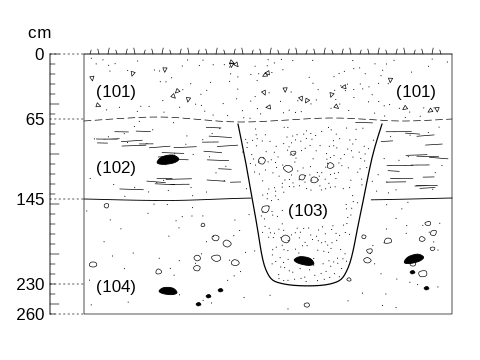
Invented teaching section.
A drawing made for this website.
Look at the practice trench. Which layer do you think is the oldest? Why?
Turn it over: what do we know?
What the picture cannot tell us
The numbers and depths are for practice. They do not come from a real dig.
What we know
- A pit is newer than the floor it cuts through.
- At Pattanam, a layer of broken pots lay under an old canoe.
Nobody knows yet
- nobody knows yetNobody knows yet when the Pattanam wharf was built.
Where did this come from?
Facts from: Pattanam's radiocarbon dates give no single date for its wharf, Evidence has layers: observed, stated, inferred and unknown.
Three steps
- 1 Dig the practice trench, one layer at a time.
- 2 Find the pit that cuts through the floor.
- 3 Decide which came first, the floor or the pit.
Three quick checks
1. If a pit cuts through a clay floor, which came later?
The pit: A floor must be there before anyone can dig a pit through it.
2. Why can a deep find sit in a younger layer?
A later pit can carry old bits deep down: Diggers check cut edges and layer order, not depth alone.
3. At Pattanam, what lay under the old canoe?
A layer of broken pots: Diggers found a layer of broken pots under the canoe.
Words to know
- trench
- A long, deep hole dug with care to see the layers.
- layer
- One band of soil lying on top of another.
- pit
- A hole dug down into the ground, later filled in.