Classroom screen · D1
What does a date measure?
The screen fills the window. Right and Left arrows, or Page Down and Page Up, move between screens. Home and End go to the first and last. F fills the whole screen. T starts a timer.
Each screen prints on its own landscape page, for a classroom without a projector.
D1 What does a date measure?
Back to the lesson planTimings are the plan's suggestion, not a measure of pupils.
Look first
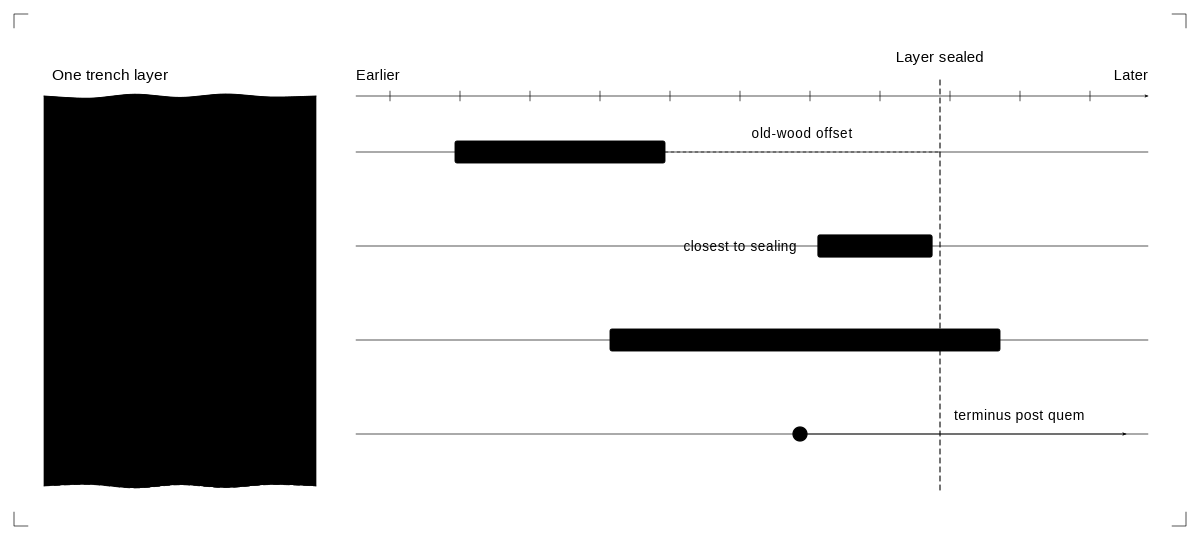
In 2025 the state government announced that iron was in use at Sivagalai, in Tamil Nadu, some 5,300 years ago. What do you think was actually dated? What puzzles you? How could you check?
- I think
- It puzzles me
- I could find out by
1/13
Work it through together
Copy the column heads into your grid. Fill the canoe row as your teacher talks.
Pattanam waterfront: a canoe and posts with very broad wood dates
Wood ages: canoe 1300–100 BCE; not dates of use
Sample C · Waterlogged Anjili Trunk Wood (Pattanam Canoe Context)
- Material
- Long-lived forest tree trunk (Old-Wood Effect possible)
- Laboratory result
- Calibrated 1300–100 BCE (95.4% 2σ wood interval)
2/13
From the ground
Rice in a burial urn at Sivagalai

Photo: Perumalism (Wikimedia Commons). Licence: CC BY-SA 4.0 (https://creativecommons.org/licenses/by-sa/4.0). Source: https://commons.wikimedia.org/wiki/File:Sivakalai_archaeological_site_14.jpg
- One burial urn at Sivagalai is reported as intact and lidded, with bones, iron objects and paddy inside it.
- The paddy from that urn measured 2950 ± 30 BP.
- The state archaeology department publishes it as 1155 BCE: one calendar value, not a complete range.
What it cannot tell us Iron objects in the same urn support an association, but they do not turn the paddy's date into a direct date on each iron object.
- Teacher notes Paddy grows in a single season, so it avoids the centuries of inbuilt age possible in heartwood. The measurement belongs to the sampled plant material. It does not by itself date the whole Sivagalai site.
- Look What exactly was dated, and where did it lie?
- Talk Which event does this date come closest to, and which events can it not reach on its own?
- Ask What would you need to know before using this date for the iron objects in the same urn?
3/13
From a laboratory
Charcoal and the iron announcement
- A laboratory measured three charcoal samples from Sivagalai at 4300 to 4670 radiocarbon years BP.
- The 2025 government book links these charcoal dates to iron only by association with urn burials that contained iron objects.
- It does not publish the samples' positions, depths or wood species, or any direct date on Sivagalai iron.
What it cannot tell us Charcoal can be older than the burial it lies in.
- Teacher notes For one charcoal sample, the state book publishes 3345 BCE; the laboratory measured charcoal, not an iron object. The government announcement said iron was in use at Sivagalai by about 3345 BCE, some 5,300 years ago.
- Look Which material did the laboratory measure, and which material does the announcement talk about?
- Talk How many steps lie between the charcoal and the claim about iron? Name each one.
- Ask What would a direct test on the iron itself need?
4/13
From a laboratory
Charcoal at Mayiladumparai, grain at Porunthal
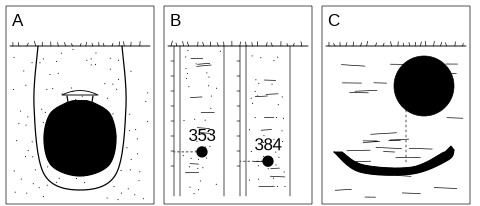
- At Mayiladumparai, two charcoal samples gave the reported second- and third-millennium BCE dates (one laboratory sheet calibrates to 1634–1504 cal BCE).
- The excavators assigned the charcoal to an iron-bearing layer. No named iron object was dated directly.
- Published depths for the samples disagree: 104 and 130 cm in one tradition, 120 and 140 cm in another.
What it cannot tell us Harry Falk argues that the Porunthal marks are megalithic signs, not Brahmi letters. His criticism concerns the marks, not the rice date.
- Teacher notes At Porunthal, paddy from the graves known as MEG I and MEG IV was dated directly. One grave held a ring stand with marks that the excavation team read as Tamil-Brahmi letters. The dated grain dates the grain. It does not independently date an inscription.
- Look For each site, what material was dated, and what is the date used for?
- Talk Why does it matter that the reports give different depths for the Mayiladumparai samples?
- Ask What would you need before using the Porunthal grain to date the marks?
5/13
Two views
List the evidence behind each view. Then write what would settle the question.
Whether the Sivagalai charcoal dates date the iron
One view
K. Rajan and R. Sivanantham, the book's authors, say yes. The charcoal came from urn burials with iron, and several samples, laboratories and methods were used.
Another view
The archaeologist Disha Ahluwalia says early dates need proper context. The writer P. A. Krishnan says charcoal and pottery ages were transferred to the iron. Charcoal can be older than the burial it lies in.
What would settle it
Direct AMS dates on carbon extracted from Sivagalai iron objects, and short-lived grain from inside the urns that gave the early charcoal.
6/13
How sure can we be? 1/6
The dated paddy lay inside the intact, lidded urn, not in the pot's clay.
- Well supported
- Likely
- Possible
- Not known
7/13
How sure can we be? 2/6
The rice grain dates to about 1155 BCE.
- Well supported
- Likely
- Possible
- Not known
8/13
How sure can we be? 3/6
The paddy was placed in the urn as a funeral offering.
- Well supported
- Likely
- Possible
- Not known
9/13
How sure can we be? 4/6
Iron was in use at Sivagalai about 5,300 years ago.
- Well supported
- Likely
- Possible
- Not known
10/13
How sure can we be? 5/6
Iron was smelted at Mayiladumparai by 2172 BCE.
- Well supported
- Likely
- Possible
- Not known
11/13
How sure can we be? 6/6
The marks on the ring stand are Tamil-Brahmi writing.
- Well supported
- Likely
- Possible
- Not known
12/13
Before you go
What does a date actually date? Answer with a rule, one example from the cards, and the evidence that would tie a date to the event people want.
13/13