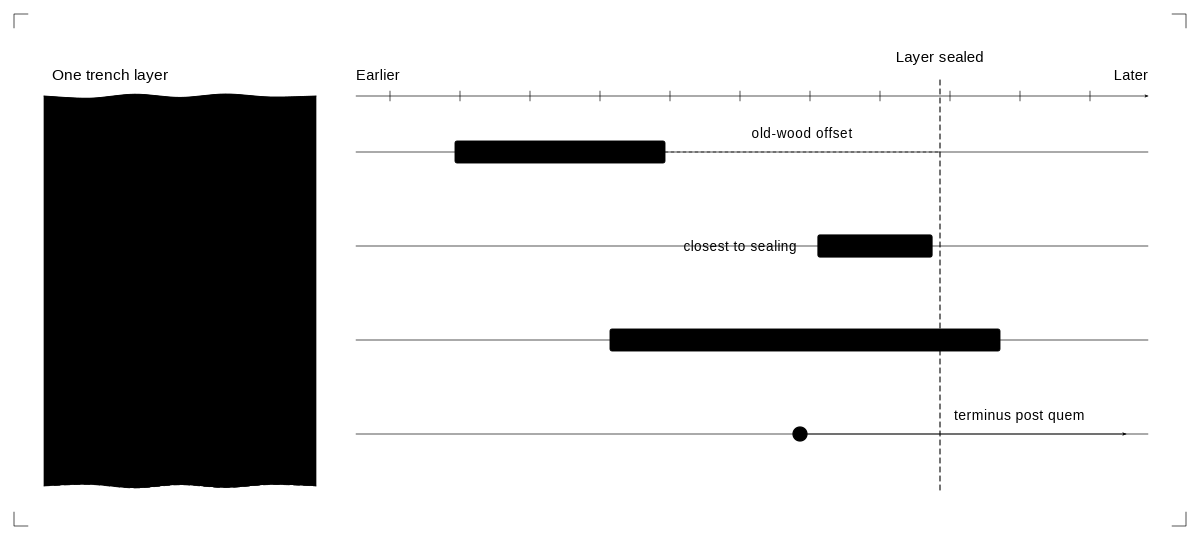
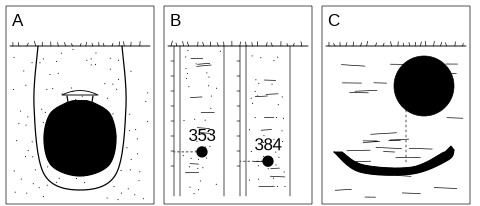
Read the three cards first. Then work through the tasks on paper or in your notes. The answers are not on this page: compare your levels with the studies on the evidence bench.
One burial urn at Sivagalai is reported as intact and lidded, with bones, iron objects and paddy inside it.
The paddy from that urn measured 2950 ± 30 BP.
The state archaeology department publishes it as 1155 BCE: one calendar value, not a complete range.
Paddy grows in a single season, so it avoids the centuries of inbuilt age possible in heartwood.
The measurement belongs to the sampled plant material. It does not by itself date the whole Sivagalai site.
What it cannot tell us Iron objects in the same urn support an association, but they do not turn the paddy's date into a direct date on each iron object.
Look
What exactly was dated, and where did it lie?
Talk
Which event does this date come closest to, and which events can it not reach on its own?
Ask
What would you need to know before using this date for the iron objects in the same urn?
Laboratory
Charcoal and the iron announcement
A laboratory measured three charcoal samples from Sivagalai at 4300 to 4670 radiocarbon years BP.
The 2025 government book links these charcoal dates to iron only by association with urn burials that contained iron objects.
It does not publish the samples' positions, depths or wood species, or any direct date on Sivagalai iron.
For one charcoal sample, the state book publishes 3345 BCE; the laboratory measured charcoal, not an iron object.
The government announcement said iron was in use at Sivagalai by about 3345 BCE, some 5,300 years ago.
What it cannot tell us Charcoal can be older than the burial it lies in.
Look
Which material did the laboratory measure, and which material does the announcement talk about?
Talk
How many steps lie between the charcoal and the claim about iron? Name each one.
Ask
What would a direct test on the iron itself need?
Laboratory
Charcoal at Mayiladumparai, grain at Porunthal
At Mayiladumparai, two charcoal samples gave the reported second- and third-millennium BCE dates (one laboratory sheet calibrates to 1634–1504 cal BCE).
The excavators assigned the charcoal to an iron-bearing layer. No named iron object was dated directly.
Published depths for the samples disagree: 104 and 130 cm in one tradition, 120 and 140 cm in another.
At Porunthal, paddy from the graves known as MEG I and MEG IV was dated directly.
One grave held a ring stand with marks that the excavation team read as Tamil-Brahmi letters.
The dated grain dates the grain. It does not independently date an inscription.
What it cannot tell us Harry Falk argues that the Porunthal marks are megalithic signs, not Brahmi letters. His criticism concerns the marks, not the rice date.
Look
For each site, what material was dated, and what is the date used for?
Talk
Why does it matter that the reports give different depths for the Mayiladumparai samples?
Ask
What would you need before using the Porunthal grain to date the marks?
002Tasks
Work through the tasks
The … card dates … The event people want it to date is …
Between the laboratory result and the claim about iron, these steps happen: …
View A says the charcoal dates the iron because … View B says … It would be settled by …
I graded this statement … because … The study's level differs from mine because …
My rule: a date measures … So the claim about iron is … because …
003How sure can we be?
Grade each statement
For each statement, choose one of the four levels and give one reason from the cards. A different level with a good reason is good history.
The dated paddy lay inside the intact, lidded urn, not in the pot's clay.
The rice grain dates to about 1155 BCE.
The paddy was placed in the urn as a funeral offering.
Iron was in use at Sivagalai about 5,300 years ago.
Iron was smelted at Mayiladumparai by 2172 BCE.
The marks on the ring stand are Tamil-Brahmi writing.