Do the texts and the finds tell the same story about trade?
Read the three cards first. Then work through the tasks on paper or in your notes. The answers are not on this page: compare your levels with the studies on the evidence bench.
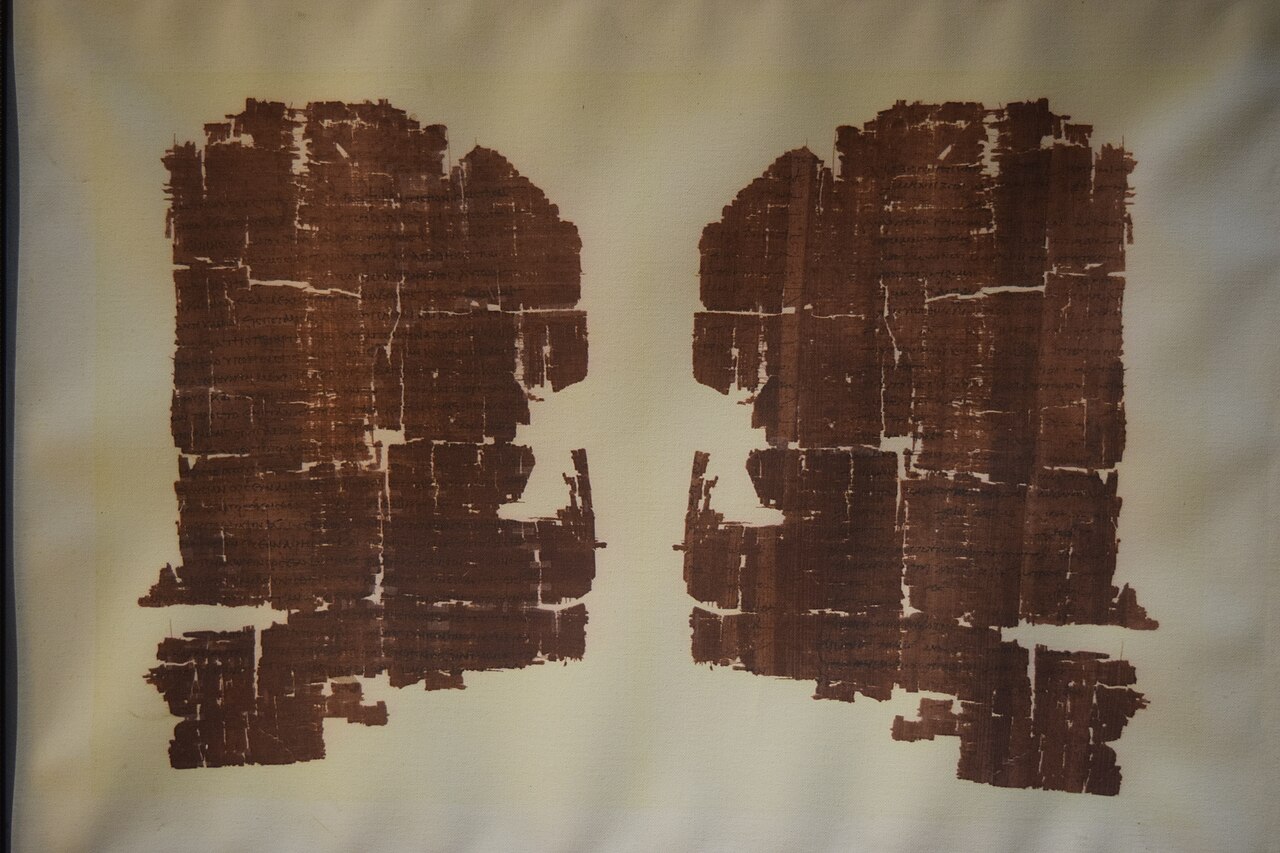
The Muziris Papyrus is a Greek papyrus placed by its handwriting around the mid-second century CE.
It sets out how the cargo was to be moved: from a Red Sea arrival point across the desert to Koptos, into public warehouses, on a Nile boat and on to Alexandria.
Its pepper quantities are reconstructions from damaged figures, arithmetic and parallels, not labels that can be read on the papyrus.
The Periplus, a Greek guide for sea traders, names Cottonara as the inland pepper district.
Early Tamil poems probably use the word Yavana for people in several different roles: the study read the Tamil through one modern translation.
What it cannot tell us Documents survive in pieces: the papyrus has lost the name of the Red Sea port where its cargo arrived.
Look
What does each document say about goods, and what does it say about people?
Talk
Which of these statements rest on a surviving word, and which on a reconstruction?
Ask
What would you want to know about who wrote each document, and why?
Ground
What was found in Egypt
Tamil inscriptions in Tamil-Brahmi letters have been published from pots at Quseir al-Qadim and at Berenike, Red Sea ports of Roman Egypt.
Iravatham Mahadevan reads personal names on two Quseir sherds.
At Berenike, an Indian-made storage jar excavated in 1999 held more than 7.5 kg of black peppercorns.
Berenike has teak pieces with maritime features, and reused Late Roman beams interpreted as ship parts.
One Indian pot at Quseir carries a South Arabian monogram: where a pot was made does not tell us who later wrote on it.
What it cannot tell us The sherds show Tamil written in the trade network. On their own they do not show where the writers lived, what work they did or who they were.
Look
Which finds are goods, and which carry writing?
Talk
Which tells you more about people: a jar of pepper or a name scratched on a pot? Why?
Ask
What else would you need to find to show that Tamil speakers lived at these ports?
Ground
What was found in South India
At Arikamedu, people lived before Mediterranean imports and Rouletted Ware arrived.
Mediterranean amphorae there show that goods moved, not who carried or used them.
Imported Mediterranean objects do not establish a Roman colony at Arikamedu.
Roman gold and silver coins reached several parts of Kerala, including inland Thrissur and Idukki.
Nobody knows yet who buried the coin hoards, or why: their find contexts are poor.
Roman coins do not by themselves prove that Roman traders were physically present.
What it cannot tell us A findspot cannot identify the carrier, the direction or the exact route.
Look
Which finds came from far away, and which were made or used locally?
Talk
Which statements on this card are about goods, and which are about people?
Ask
What kind of find would show that foreign merchants lived here?
002Tasks
Work through the tasks
The … card is made of … It shows … but not …
A text and a find agree that …
Morelli reads … De Romanis reads … The question would be settled by …
I graded this statement … because … The study's level differs from mine because …
The texts and the finds tell the same story about … but not about …, because …
003How sure can we be?
Grade each statement
For each statement, choose one of the four levels and give one reason from the cards. A different level with a good reason is good history.
Tamil was written on pottery that reached Egypt's Red Sea ports.
Pepper was part of the missing cargo.
Tamil-speaking people were present at the ports themselves.
Tamil or Malabar merchant communities lived at the ports.
Rouletted Ware was fired at Arikamedu and Mediterranean merchants lived there.
The Yavanas of the Tamil poems were Roman citizens or soldiers.