Unit pack
Unit C: Kingdoms, trade and the evidence
64 pages, A4 or US Letter90 pages, A4 or US Letter
Print at actual size, with scaling turned off.
Unit C · Ages 11 to 14
Kingdoms, trade and the evidence
How do we know about the early kingdoms of the south and their trade?
Five lessons for ages 11 to 14, each about 45 minutes. Students use monuments, poems, inscriptions, coins, trade texts and finds, ask what each kind of source can and cannot tell us, and test where two kinds of evidence agree.
Lessons in this pack
| C1 Megaliths as sources | What can megaliths tell us, and what can't they? | 30 / 45 / 60 |
|---|---|---|
| C2 Poems as evidence | Can a love poem be historical evidence? | 30 / 45 / 60 |
| C3 Kings in stone and coin | How do we know the names of early kings? | 30 / 45 / 60 |
| C4 Pepper and the monsoon | How did pepper travel west, and how do we know? | 30 / 45 / 60 |
| C5 Local history from remains | How would you write the early history of one place? | 30 / 45 / 60 |
When the lessons sit in time
- C2
- C3
- C4
1000 BCE–600 CE Entire principal period: C1, C5
Places in this unit
- Cheramanangad (Kudakkallu Parambu) Thrissur District, Kerala C1, C5
- Ariyannur Umbrella Stones Thrissur District, Kerala C1
- Mangadu Iron Age Urn Burial Site Kollam District, Kerala C1
- Porkalam Megalithic Urn & Cist Site Thrissur District, Kerala C1
- Kattakampal Multi-Chambered Rock-Cut Cave Thrissur District, Kerala C1
- Puhar (Kaveripoompattinam) Mayiladuthurai District, Tamil Nadu C2
- Kodumanal (Noyyal River Craft & Trade Town) Erode District, Tamil Nadu C2
- Jambai, Mangulam & Pugalur Rock Inscription Sites Jambai (Kallakurichi District, 11.96°N, 79.01°E); paired here with Mangulam (Madurai District, 10.03°N, 78.24°E) & Pugalur (Karur District, 11.06°N, 77.97°E), Tamil Nadu C3
- Karur (Amaravathi River Trade Node & Proposed Chera Capital Vanchi) Karur District, Tamil Nadu C3
- Berenike (Red Sea Port, Egypt) Red Sea Governorate, Egypt (Inset View) C4
- Vizhinjam Coastal Fort & Harbour Terrace Thiruvananthapuram District, Kerala C5
Unit C · Ages 11 to 14
Class record sheet
Write pupils' names by hand. Nothing here is stored or sent anywhere.
| Pupil | C1 | C2 | C3 | C4 | C5 | Comment |
|---|---|---|---|---|---|---|
Unit C · Ages 11 to 14
Marking rubric
Choose the two or three dimensions that match a lesson's objectives. The levels describe what a pupil's answer shows, never a pupil's ability.
| Not yet | Developing | Secure | Extended | |
|---|---|---|---|---|
| 1. Observation & Source Handling | Gives an unsupported impression or confuses a modern reconstruction/diagram with an excavated find. | Identifies a relevant detail from the source card but mixes visible observation with interpretation. | Accurately identifies relevant details and distinguishes what the source records from one's own inference. | Explains how excavation recording, preservation, translation, or sampling affects what can be observed. |
| 2. Claim & Evidence Connection | States a conclusion without citing any clue from the source cards. | Mentions a relevant detail from a source card but leaves its link to the claim implicit. | Answers the historical question with specific evidence and explains why ('because...') it supports the claim. | Weighs evidence of differing strength and revises or calibrates the claim to match its actual reach. |
| 3. Context, Chronology & Genre | Transfers facts between sites, centuries, or genres without justification. | Notices a date, site, or genre difference but does not apply it consistently. | Keeps the relevant site, period window (1000 BCE–600 CE vs earlier/later), and source purpose attached to the claim. | Explains how stratigraphic context, textual transmission, or poetic convention changes the historical interpretation. |
| 4. Limits & Alternative Explanations | Treats a possibility as 100% settled fact, or claims nothing at all can be known. | Mentions a generic uncertainty ('we weren't there') without tying it to the specific source. | States a specific evidential limit and explains what remains reasonably supported alongside what is open. | Compares a plausible alternative model and names the exact kind of new evidence that could distinguish between them. |
| 5. Communication & Attribution | Reasoning cannot be followed or sources are unidentifiable. | Gives a partly clear explanation with incomplete references to the source cards. | Makes the reasoning clear in any accessible format and cites the relevant source card or locator. | Builds a coherent argument while representing scholarly disagreement and source dependence accurately. |
Unit C · Ages 11 to 14
Cut along the lines. One set for each group.
The four certainty cards
Lesson C1 · Ages 11 to 14 · Lesson plan
Megaliths as sources
What can megaliths tell us, and what can't they?
Unit C: Kingdoms, trade and the evidence · Ladder step Look, Grade · Draft written with AI assistance; not yet tried in a classroom
Objectives
- I can describe a monument before I explain it.
- I can say what a monument's shape, the burial beneath it and a laboratory date each tell us, and what they cannot.
- I can grade a statement about megaliths and give a reason that names the evidence.
Pupils should already know
- Students have sorted what was found from what was worked out, and graded statements on the four How-sure levels, in unit B. If they have not, add five minutes at the start to introduce the levels.
- Students can find central, northern and southern Kerala on a map.
Materials
- Print One sheet per student: support, core or stretch; The cut-out page for each group: three source cards and the key-word strip; A Shape, Beneath, Date grid for each group, on the sheet or copied from the board
- Screen The classroom screen for this lesson
- Paper only Print the cut-out page for each group and a sheet for each student. The photograph on the umbrella stone card works in black and white, because the task is to describe shape and material. Draw the Shape, Beneath, Date grid on the board. Students shade their levels in pencil.
Lesson C1 · Ages 11 to 14 · Lesson plan
Megaliths as sources
Timings
| Step | 30 minutes | 45 minutes | 60 minutes |
|---|---|---|---|
| hook Show the photograph of the umbrella stone and run the see, think, wonder routine. | 3 | 5 | 6 |
| model Model careful looking with the umbrella stone card. | 5 | 8 | 10 |
| guided Groups read the Cheramanangad card and fill the Beneath column. | 7 | 10 | 13 |
| independent Pairs read the card on dates and fill the Date column. | 5 | 8 | 11 |
| claim Students grade the statements in the claim task, using the levels and their meanings. | 6 | 9 | 13 |
| exit Return to the wonders from the start. | 4 | 5 | 7 |
Misunderstandings to listen for (not yet observed in a classroom)
- Every umbrella stone has a burial under it. At Cheramanangad, the umbrella stone that was opened held no burial. "Urns beneath umbrella stones" does not hold as a rule there.
- Umbrella stones are found only in Kerala. They cluster in central and northern Kerala, but a full survey outside Kerala was not completed. "Distinctive" fits the evidence better than "unique".
- A laboratory date from a grave tells us when the monument was built. A laboratory date measures its sample. At Kuttikol, the dates come from sampled carbon, not from the cutting of the chambers.
- Rich grave goods prove that the person buried was a ruler. There are two views. One, from 1915, reads deep urns and gold-rich graves as signs of rank. The study's caution is that the differences are real but could reflect age, ritual office, household practice, date or a particular ceremony.
Lesson C1 · Ages 11 to 14 · Support
Megaliths as sources
What can megaliths tell us, and what can't they?
Look first
This photograph shows a stone monument at Cheramanangad in Kerala. What do you see? What do you think? What do you wonder?
- umbrella stone A Kerala stone monument: a laterite dome resting on four shaped stone supports.
- laterite An iron-rich weathered rock that can be cut and shaped with hand tools.
- urn A large pot. At Cheramanangad, an urn under one monument held bone.
- laboratory date An age measured in a laboratory from a sample, such as charcoal.
Shape, Beneath, Date grid
Copy the grid. Put one thing you can see in the Shape column.
| Shape | Beneath | Date |
|---|---|---|
- 01
Circle the words that describe what you can see on the umbrella stone: dome, four supports, laterite, bones, a date.
- 02
Tick what was found under the Cheramanangad monuments: an urn with bone, iron objects, nothing at all.
- an urn with bone
- iron objects
- nothing at all
- 03
Circle the right ending: A laboratory date measures the sample / the building of the monument.
Lesson C1 · Ages 11 to 14 · Support
Megaliths as sources
NameThe four levels
- Well supportedShade it inDirect, clear evidence supports this specific statement.
- LikelySlanting linesThe available evidence favours this interpretation, with uncertainty.
- PossibleDotsPlausible, but the evidence is limited or contested.
- Not knownLeave it empty and ring itThe evidence reviewed here does not settle the question.
- 04
Choose a level for each statement from the box.
| Well supported | Likely | Possible | Not known | ||
|---|---|---|---|---|---|
| A | Umbrella stones cluster in central and northern Kerala. | ||||
| B | Monument burial in Kerala had begun by the first half of the first millennium BCE. | ||||
| C | The empty monuments were symbolic burials. | ||||
| D | How old are Kerala's umbrella stones and hood stones? | ||||
| E | Graves with gold and bronze mark a ranked elite. |
- 05
Complete: Megaliths can tell us They can't tell us
What nobody knows yet
- Nobody knows yet exactly when the Cheramanangad monuments were built.
Exit ticket
Cut along the line and hand it in.What can megaliths tell us, and what can't they? Write one sentence for each, and name the card each comes from.
Lesson C1 · Ages 11 to 14 · Core
Megaliths as sources
What can megaliths tell us, and what can't they?
Look first
This photograph shows a stone monument at Cheramanangad in Kerala. What do you see? What do you think? What do you wonder?
Shape, Beneath, Date grid
Copy the grid. Put one thing you can see in the Shape column.
| Shape | Beneath | Date |
|---|---|---|
- 01
I can see It is made of
- 02
Under the monuments at Cheramanangad, the excavators found
- 03
A laboratory date measures so it does not tell us
Lesson C1 · Ages 11 to 14 · Core
Megaliths as sources
Name- 04
I graded this statement … because …
| Well supportedShade it in | LikelySlanting lines | PossibleDots | Not knownLeave it empty and ring it | ||
|---|---|---|---|---|---|
| A | Umbrella stones cluster in central and northern Kerala. | ||||
Because | |||||
| B | Monument burial in Kerala had begun by the first half of the first millennium BCE. | ||||
Because | |||||
| C | The empty monuments were symbolic burials. | ||||
Because | |||||
| D | How old are Kerala's umbrella stones and hood stones? | ||||
Because | |||||
| E | Graves with gold and bronze mark a ranked elite. | ||||
Because | |||||
- 05
Megaliths can tell us but they can't tell us
What nobody knows yet
- Nobody knows yet exactly when the Cheramanangad monuments were built.
Exit ticket
Cut along the line and hand it in.What can megaliths tell us, and what can't they? Write one sentence for each, and name the card each comes from.
Lesson C1 · Ages 11 to 14 · Stretch
Megaliths as sources
What can megaliths tell us, and what can't they?
Look first
This photograph shows a stone monument at Cheramanangad in Kerala. What do you see? What do you think? What do you wonder?
- 01
Describe the umbrella stone as exactly as you can before you explain anything about it.
- 02
What does the Cheramanangad excavation show about using a monument's shape as evidence?
- 03
Why are laboratory dates for Kerala's monuments so important, and why are they not enough?
- 04
Grade each statement and explain how you weighed the evidence.
| Well supportedShade it in | LikelySlanting lines | PossibleDots | Not knownLeave it empty and ring it | ||
|---|---|---|---|---|---|
| A | Umbrella stones cluster in central and northern Kerala. | ||||
Because | |||||
Lesson C1 · Ages 11 to 14 · Stretch
Megaliths as sources
Name| Well supportedShade it in | LikelySlanting lines | PossibleDots | Not knownLeave it empty and ring it | ||
|---|---|---|---|---|---|
| B | Monument burial in Kerala had begun by the first half of the first millennium BCE. | ||||
Because | |||||
| C | The empty monuments were symbolic burials. | ||||
Because | |||||
| D | How old are Kerala's umbrella stones and hood stones? | ||||
Because | |||||
| E | Graves with gold and bronze mark a ranked elite. | ||||
Because | |||||
- 05
What can megaliths tell us about the people who made them, and what can't they? Use all three cards.
What nobody knows yet
- Nobody knows yet exactly when the Cheramanangad monuments were built.
Exit ticket
Cut along the line and hand it in.What can megaliths tell us, and what can't they? Write one sentence for each, and name the card each comes from.
Lesson C1 · Ages 11 to 14 · Cut-out cards
Cut along the lines. One set for each group.
Key words English · Malayalam · Tamil
umbrella stoneകുടക്കല്ല്குடைக்கல்
A Kerala stone monument: a laterite dome resting on four shaped stone supports.
lateriteചെങ്കല്ല് / വെട്ടുകല്ല്செம்புறைக்கல் / செம்பாறை / வெட்டுக்கல்
An iron-rich weathered rock that can be cut and shaped with hand tools.
megalith
A monument made of large stones. Kerala's Iron Age is known mainly from such burial monuments.
excavate
To dig a site carefully, recording what is found and where.
urn
A large pot. At Cheramanangad, an urn under one monument held bone.
symbolic burial
The excavators' name for a grave monument with no burial in it.
laboratory date
An age measured in a laboratory from a sample, such as charcoal.
elite
A small group with more wealth or rank than others.
millennium
A thousand years.
BCE
Years before year one, counted backwards.
hood stone
A name for a kind of Kerala stone monument. Different authors use it, and "hat stone", in different ways.
first millennium BCE
The thousand years from 1000 BCE down to the last year before year one begins.
C1-SC1 · From the ground
An umbrella stone

Photo: Ranjith Siji (Wikimedia Commons). Licence: CC BY-SA 4.0 (https://creativecommons.org/licenses/by-sa/4.0). Source: https://commons.wikimedia.org/wiki/File:Kudakkallu_Parambu_DSC_0638.JPG
- The photograph shows an umbrella stone at Kudakkallu Parambu, Cheramanangad.
- An umbrella stone is a dome of laterite resting on four shaped stone supports.
- Laterite is a rock that can be cut and shaped with hand tools.
- Umbrella stones cluster in central and northern Kerala.
- They are distinctive, but they have not been shown to be found only in Kerala.
What it cannot tell us The shape on the surface does not, on its own, tell us what lies beneath.
- Look Describe the monument: its parts, its shape and what it is made of.
- Talk What can you tell from the outside, and what can't you?
- Ask What would you need to do to find out what lies beneath it?
Lesson C1 · Ages 11 to 14 · Cut-out cards
Cut along the lines. One set for each group.
C1-SC2 · From the ground
What lay beneath at Cheramanangad
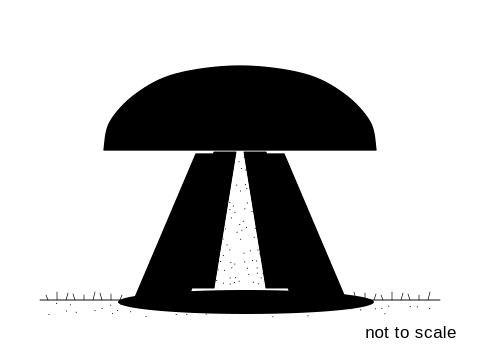
Drawing: Not to scale.
- In 1990–91 the Archaeological Survey of India opened one example of five monument types here.
- Two of the five held no burial; one of these was an umbrella stone.
- Another held an urn with bones, pots and an iron object.
- A monument with a granite capstone covered an urn, pots and bone.
- A stone circle held three pits, each with iron objects and a copper bowl.
- The excavators called the empty monuments symbolic burials.
What it cannot tell us The study found no laboratory date for this site.
- Look What was found under each kind of monument?
- Talk Which sentence on this card was worked out rather than found?
- Ask Why might people build a grave monument with no burial in it?
C1-SC3 · From a laboratory
Many graves, few dates

Drawing: A strip of this website’s 1000 BCE–600 CE window zooms to 1000–400 BCE, where two Adichanallur urn paddy samples show their ASI-reported calibrated ranges and probabilities.
- More than a thousand Iron Age burial sites are recorded in Kerala.
- The oldest laboratory dates from any Kerala burial come from two charcoal samples at Mangadu.
- Scientists think that charcoal dates to roughly 1300–800 BCE.
- A laboratory date measures the sample, such as charcoal, not the building of a monument.
- No umbrella stone has a laboratory date in the published sources the study read.
- Excavated umbrella stones lack the beads that are used to date graves by comparison.
What it cannot tell us The Mangadu samples do not date the whole of southern Kerala's Iron Age.
- Look Which monuments on this card have a laboratory date, and which have none?
- Talk A laboratory date measures a sample. Why does that matter when we try to date a monument?
- Ask Which sample would you most like to find under an umbrella stone, and why?
Lesson C1 · Ages 11 to 14 · Answer key and mark guidance
What the study says
Megaliths as sources What can megaliths tell us, and what can't they?
For the teacher only. Each level and reason below comes from this website's own draft summary of the published research. Keep this page away from pupils until they have answered.
How sure can we be?
Well supportedstrong evidence
Umbrella stones cluster in central and northern Kerala.
Documented in Peter's 2015 distribution survey; a full survey outside Kerala was not completed.
Likelyprobably
Monument burial in Kerala had begun by the first half of the first millennium BCE.
Two Mangadu charcoal dates and one Kuttikol wood date support it. They are few, the wood may be older than its use, and the Mangadu sheets raise a half-life question.
Possiblemaybe
The empty monuments were symbolic burials
Pupils read The empty monuments were symbolic burials.
This is the excavators’ interpretation; an empty pit alone cannot show its purpose.
Not knownnobody knows yet
The age of Kerala's umbrella stones and hood stones.
Pupils read How old are Kerala's umbrella stones and hood stones?
None has a laboratory date in the published sources we read, and excavated umbrella stones lack the beads used for comparative dating.
Possiblemaybe
Graves with gold and bronze mark a ranked elite.
Rea and the ASI suggest status, but no cemetery-wide analysis has tested it.
The other tasks
C1-SC1 Talk What can you tell from the outside, and what can't you?
From the outside we can describe the form, the material and the setting. We cannot tell what lies beneath: at Cheramanangad, surface form alone did not predict what lay underneath.
C1-SC2 Look What was found under each kind of monument?
Two of the five held no burial, one of them an umbrella stone. Another held an urn with bones, pots and an iron object. A monument with a granite capstone covered an urn, pots and bone, and a stone circle held three pits, each with iron objects and a copper bowl.
C1-SC2 Talk Which sentence on this card was worked out rather than found?
That the empty monuments were symbolic burials. It is the excavators' interpretation; the absence of a burial alone cannot show what a monument was for.
C1-SC3 Talk A laboratory date measures a sample. Why does that matter when we try to date a monument?
The sample may not be the same age as the building of the monument. At Kuttikol, the dates come from sampled carbon, not from the cutting of the chambers.
Lesson C1 · Ages 11 to 14 · Answer key and mark guidance
Megaliths as sources
Core 02 Under the monuments at Cheramanangad, the excavators found ...
An urn with bones, pots and an iron object under one monument; an urn with pots and bone under a monument with a granite capstone; three pits with iron objects and a copper bowl in each under a stone circle; and no burial at all under two monuments, one of them an umbrella stone.
Core 03 A laboratory date measures ... so it does not tell us ...
The sample, such as charcoal. So it does not tell us when the monument was built.
Exit ticket What can megaliths tell us, and what can't they? Write one sentence for each, and name the card each comes from.
Can: the form and material of a monument, where such monuments cluster, what was buried in excavated examples, and the age of dated samples. Cannot, on their own: what lies under a monument nobody has opened, or when the umbrella stones were built, since the study found no laboratory date for any of them. Credit any pair with a reason from a card.
What to look for
- Observation & Source Handling Describes a monument's form and material before explaining it.
- Claim & Evidence Connection Supports each point with a named card: the umbrella stone, the Cheramanangad excavation or the card on dates.
- Context, Chronology & Genre Keeps each date with its sample and its place: the Mangadu dates belong to charcoal from one cemetery.
- Limits & Alternative Explanations Says what megaliths cannot show on their own, such as the age of the umbrella stones or what lies under a monument nobody has opened.
A different level with a reason that names real evidence or a real gap earns the reasoning credit. Note the reason.
Secure Example written by us, not real pupil work
The umbrella stone is a dome of laterite on four shaped supports. Its shape does not tell us what is under it: at Cheramanangad an umbrella stone that was opened held no burial, while a monument with a granite capstone covered an urn with bone. A laboratory date measures a sample such as charcoal, not the building of a monument, and the study found no laboratory date for any umbrella stone. So megaliths can show how people built and what they placed in some graves, but not, on their own, when most of them were built.
Comment Describes before explaining, uses the excavation to show that shape does not predict what lies beneath, keeps the date with its sample, and ends with a real limit.
Developing Example written by us, not real pupil work
Megaliths are graves from over 4,000 years ago. Under every umbrella stone there is a body.
Comment Repeats a popular age that has no published dating support, and assumes that every umbrella stone covers a burial. Next step: read the Cheramanangad card and the card on dates, and ask which evidence each sentence rests on.
What nobody knows yet
- Nobody knows yet exactly when the Cheramanangad monuments were built.
- Nobody knows yet the exact age of Kerala's umbrella stones and hood stones.
- Nobody knows yet when Ariyannur's umbrella stones were built.
Lesson C2 · Ages 11 to 14 · Lesson plan
Poems as evidence
Can a love poem be historical evidence?
Unit C: Kingdoms, trade and the evidence · Ladder step Grade · Draft written with AI assistance; not yet tried in a classroom
Objectives
- I can say where a line sits in its poem before I use it as evidence.
- I can say what a poem can show and what it cannot show on its own.
- I can grade a statement about a poem and give a reason that names the evidence.
Pupils should already know
- Students have graded statements on the four How-sure levels, in unit B and in lesson C1. If they have not, add five minutes at the start to introduce the levels.
- Students know that a poem can describe real things and can also praise or exaggerate.
Materials
- Print One sheet per student: support, core or stretch; The cut-out page for each group: three source cards and the key-word strip; An evidence grid for each group, on the sheet or copied from the board: kind of text, what it describes, what it can show, what it cannot show on its own
- Screen The classroom screen for this lesson; Optional: the website's reading page for Akananuru 149 (/literature/readings/aka149-muciri/), to show the whole passage in Tamil and in English
- Paper only Print the cut-out page for each group and a sheet for each student. Read the first card aloud for the hook, so that every student hears the poem's frame before its trade lines. The grid works on paper, and students shade their levels in pencil.
Timings
| Step | 30 minutes | 45 minutes | 60 minutes |
|---|---|---|---|
| hook Read the summary of the whole poem aloud, then the four Tamil lines. | 3 | 5 | 6 |
Lesson C2 · Ages 11 to 14 · Lesson plan
Poems as evidence
| Step | 30 minutes | 45 minutes | 60 minutes |
|---|---|---|---|
| model Model the rule of this lesson: read the whole poem before using any line. | 6 | 8 | 10 |
| guided Groups read the landscapes card and the port card. | 7 | 10 | 14 |
| independent Pairs write, for each card, one sentence the text can support and one it cannot support on its own. | 4 | 8 | 11 |
| claim Students grade the statements in the claim task, using the levels and their meanings. | 6 | 9 | 12 |
| exit Return to the wonders from the start. | 4 | 5 | 7 |
Misunderstandings to listen for (not yet observed in a classroom)
- If a poem mentions trade, it is a record of trade. The Musiri trade passage in Akananuru 149 sits inside a poem about wealth and separation. Read whole, it is a love poem that uses trade, not a record of trade.
- Excavation dates from Keezhadi (Keeladi) tell us when the Sangam poems were written. A radiocarbon date measures when a sample's organism lived. It dates a layer, not words composed elsewhere.
- The pepper sacks in the poems were stored in warehouses. In the poem that describes the pepper sacks, the word for where they were piled means house, not warehouse.
- The Yavana in the poem were Romans. Keep the poem's word. Modern scholarship stresses that many kinds of traders took part, so Yavanar should not be silently replaced by "Romans".
Lesson C2 · Ages 11 to 14 · Support
Poems as evidence
Can a love poem be historical evidence?
Look first
Listen to this card about a Tamil love poem that names a port. What do you notice? What do you think? What do you wonder?
- tinai A poetic landscape, or the way of behaving linked with it, in early Tamil poetry.
- Yavana An early Tamil word for people from the west.
- praise poem A poem written to praise its subject.
Evidence grid
Fill one row of the grid for each card.
| Kind of text | What it describes | What it can show | What it cannot show on its own | |
|---|---|---|---|---|
| C2-SC1 A love poem that names Musiri (Akananuru 149) | ||||
| C2-SC2 Five landscapes: a poets' code | ||||
| C2-SC3 A praise poem about a busy port |
- 01
Circle what Akananuru 149 is mainly about: trade, or a hero who gives up a journey to seek wealth.
- trade
- a hero who gives up a journey to seek wealth
- 02
Tick the places where rice, millets and pulses were found: Kodumanal, Perur.
- Kodumanal
- Perur
- 03
Circle the sentence on the port card that the excavation at Kilayur fits best.
Lesson C2 · Ages 11 to 14 · Support
Poems as evidence
NameThe four levels
- Well supportedShade it inDirect, clear evidence supports this specific statement.
- LikelySlanting linesThe available evidence favours this interpretation, with uncertainty.
- PossibleDotsPlausible, but the evidence is limited or contested.
- Not knownLeave it empty and ring itThe evidence reviewed here does not settle the question.
- 04
Choose a level for each statement from the box.
| Well supported | Likely | Possible | Not known | ||
|---|---|---|---|---|---|
| A | Pattinappalai describes toll work, two-way cargo transfer and tiger-marked goods. | ||||
| B | The five tinai were not five separate economies. | ||||
| C | The earlier wharf phase dates to about 300–200 BCE. | ||||
| D | Pepper reached Puhar by cart from the Western Ghats. | ||||
| E | When were individual Sangam poems composed? |
- 05
Complete: A love poem can be evidence for but not for
What nobody knows yet
After you have graded, write one thing nobody knows yet.
Exit ticket
Cut along the line and hand it in.Can a love poem be historical evidence? Write your answer, one example and one limit.
Lesson C2 · Ages 11 to 14 · Core
Poems as evidence
Can a love poem be historical evidence?
Look first
Listen to this card about a Tamil love poem that names a port. What do you notice? What do you think? What do you wonder?
Evidence grid
Fill one row of the grid for each card.
| Kind of text | What it describes | What it can show | What it cannot show on its own | |
|---|---|---|---|---|
| C2-SC1 A love poem that names Musiri (Akananuru 149) | ||||
| C2-SC2 Five landscapes: a poets' code | ||||
| C2-SC3 A praise poem about a busy port |
- 01
Akananuru 149 is mainly about The trade lines come
- 02
The Tolkappiyam names The crop remains show
- 03
Pattinappalai describes The excavation at Kilayur shows
Lesson C2 · Ages 11 to 14 · Core
Poems as evidence
Name- 04
I graded this statement … because …
| Well supportedShade it in | LikelySlanting lines | PossibleDots | Not knownLeave it empty and ring it | ||
|---|---|---|---|---|---|
| A | Pattinappalai describes toll work, two-way cargo transfer and tiger-marked goods. | ||||
Because | |||||
| B | The five tinai were not five separate economies. | ||||
Because | |||||
| C | The earlier wharf phase dates to about 300–200 BCE. | ||||
Because | |||||
| D | Pepper reached Puhar by cart from the Western Ghats. | ||||
Because | |||||
| E | When were individual Sangam poems composed? | ||||
Because | |||||
- 05
A love poem can be historical evidence for but not for
What nobody knows yet
After you have graded, write one thing nobody knows yet.
Exit ticket
Cut along the line and hand it in.Can a love poem be historical evidence? Write your answer, one example and one limit.
Lesson C2 · Ages 11 to 14 · Stretch
Poems as evidence
Can a love poem be historical evidence?
Look first
Listen to this card about a Tamil love poem that names a port. What do you notice? What do you think? What do you wonder?
- 01
Explain why the whole poem matters when you use the trade lines of Akananuru 149.
- 02
How far do the crop remains support or challenge the idea of one economy for each landscape?
- 03
Where do the port poem and the excavation at Kilayur agree, and what can the excavation not check?
Lesson C2 · Ages 11 to 14 · Stretch
Poems as evidence
Name- 04
Grade each statement and explain how you weighed the evidence.
| Well supportedShade it in | LikelySlanting lines | PossibleDots | Not knownLeave it empty and ring it | ||
|---|---|---|---|---|---|
| A | Pattinappalai describes toll work, two-way cargo transfer and tiger-marked goods. | ||||
Because | |||||
| B | The five tinai were not five separate economies. | ||||
Because | |||||
| C | The earlier wharf phase dates to about 300–200 BCE. | ||||
Because | |||||
| D | Pepper reached Puhar by cart from the Western Ghats. | ||||
Because | |||||
| E | When were individual Sangam poems composed? | ||||
Because | |||||
- 05
Exit ticket Can a love poem be historical evidence? Argue your answer using two cards.
What nobody knows yet
After you have graded, write one thing nobody knows yet.
Lesson C2 · Ages 11 to 14 · Cut-out cards
Cut along the lines. One set for each group.
C2-SC1 · From a poem
A love poem that names Musiri (Akananuru 149)

Musiri passage from the poem
சுள்ளியம் பேரியாற்று வெண்ணுரை கலங்க
யவனர் தந்த வினைமாண் நன்கலம்
பொன்னொடு வந்து கறியொடு பெயரும்
வளங்கெழு முசிறிCulliyam Periyarru vennurai kalanka / yavanar tanta vinaiman nankalam / ponnotu vantu kariyotu peyarum / valankelu Muciri
Draft working gloss: Churning the white foam of the Periyar river, fine Yavanar ships arrive with gold and leave with pepper (kari) at prosperous Musiri.
- In the edition the study used, Akananuru 149 is a love poem in which the hero speaks to his own heart.
- He gives up a journey to seek wealth, because leaving would make his beloved weep.
- The poem goes on to name Musiri of the Cheras and the river beside it.
- There, Yavana ships arrive with gold and leave with pepper.
- The Tamil word kari in these lines is usually taken to mean pepper.
- The same lines go on to tell how a Pandya king, Ceḻiyaṉ, attacked rich Musiri and seized an image.
What it cannot tell us A poem is literary evidence, not a customs account. On its own, it cannot show how much was traded.
- Look What is the poem mainly about? Where do the lines about trade come?
- Talk Why does it matter that the trade lines sit inside a poem about love and leaving?
- Ask What would you want to know about the person who translated the poem?
C2-SC2 · From a text
Five landscapes: a poets' code

Drawing: Five landscape vignettes, Kuṟiñci, Mullai, Marutam, Neytal and Pālai, each with its situation of love, above four palm-leaf strips: verse, colophon, commentary and printed edition.
- In early Tamil poetry, a tinai is a poetic landscape.
- The Tolkappiyam, an early book of rules for poetry, names seven tinai and singles out a middle five.
- An older reading tied each tinai to one way of making a living, such as hunting, herding, rice farming or fishing.
- In that older reading, the hill landscape, kurinci, goes with growing millets.
- At Kodumanal in Tamil Nadu, crop remains include rice beside small millets and pulses.
- Perur, also in Tamil Nadu, has rice, millets and pulses too.
What it cannot tell us That the landscapes are a poets' code does not mean the places in them were unreal.
- Look How many tinai does the Tolkappiyam name, and how many does it single out?
- Talk Do the crop remains fit the idea of one way of living for each landscape? Why?
- Ask What would you need to find to test what people grew in one landscape?
Lesson C2 · Ages 11 to 14 · Cut-out cards
Cut along the lines. One set for each group.
C2-SC3 · From a poem
A praise poem about a busy port

Drawing: Philological stratigraphy diagram showing Layer 1 (oral bardic composition), Layer 2 (anthology compilation and colophon), and Layer 3 (medieval commentary and palm-leaf copying).
Goods arriving at Puhar
நீரின் வந்த நிமிர்பரிப் புரவியும்
காலின் வந்த கருங்கறி மூடையும்Nirin vanta nimirparip puraviyum / kalin vanta karunkari mutaiyum
Draft working gloss: Tall horses arrive by water, and sacks of black pepper arrive by kal (read as wind and sea by one commentator, or carts by land by others).
- Pattinappalai praises Puhar, the Chola port named in early Tamil poems.
- In lines 116 to 141, workers collect tolls, and goods are marked with a tiger.
- Cargo moves from the water to the land and from the land to the water.
- Readers disagree whether one line brings pepper by sea or by cart.
- At Kilayur, part of the Puhar site, excavations found wooden poles, and later a brick wharf built around them.
- One old test on wood from the earlier phase, not recalibrated in the modern way, gave a date of about 300 to 200 BCE.
What it cannot tell us The wharf shows a working waterfront. It cannot check the poem's details about how tolls were run.
- Look What work does the poem describe at the port?
- Talk The poem praises the port. How might praise change what a poet describes?
- Ask What could archaeology find that would check a detail in the poem?
Key words English · Malayalam · Tamil
tinaiതിണதிணை
A poetic landscape, or the way of behaving linked with it, in early Tamil poetry.
Musiriമുസിരിസ് / മുചിരിமுசிறி
A celebrated early port named in Sangam poems and in Greco-Roman accounts.
Yavanaയവനർயவனர்
An early Tamil word for people from the west.
Sangam poems
Early Tamil poetry: eighteen works in two collections.
anthology
A collection of poems gathered together into one work.
Tolkappiyam
An early Tamil work that sets out rules for poetry.
praise poem
A poem written to praise its subject.
kurinciകുറിഞ്ഞിகுறிஞ்சி
The hill landscape of early Tamil poems, linked with growing millets in the uplands.
Lesson C2 · Ages 11 to 14 · Answer key and mark guidance
What the study says
Poems as evidence Can a love poem be historical evidence?
For the teacher only. Each level and reason below comes from this website's own draft summary of the published research. Keep this page away from pupils until they have answered.
How sure can we be?
Well supportedstrong evidence
Pattinappalai describes toll work, two-way cargo transfer and tiger-marked goods
Pupils read Pattinappalai describes toll work, two-way cargo transfer and tiger-marked goods.
Lines 116–141 say so in the Tamil text and Vaidehi Herbert’s annotated translation.
Likelyprobably
The five tinai were not five separate economies
Pupils read The five tinai were not five separate economies.
Devadevan, Haricharan and Keerthi, and mixed crop evidence all argue against exclusive zones.
Possiblemaybe
The earlier wharf phase dates to about 300–200 BCE
Pupils read The earlier wharf phase dates to about 300–200 BCE.
One legacy radiocarbon result on wood supports this rough date; no modern recalibration was found.
Not knownnobody knows yet
Pepper reached Puhar by cart from the Western Ghats
Pupils read Pepper reached Puhar by cart from the Western Ghats.
Commentators read the key phrase as wind or carts; the mountain clause concerns sandalwood.
Not knownnobody knows yet
When individual Sangam poems were composed.
Pupils read When were individual Sangam poems composed?
The study leaves poem dating open, and the dating of the anthologies is disputed.
The other tasks
C2-SC1 Talk Why does it matter that the trade lines sit inside a poem about love and leaving?
Because the trade lines are part of a poem about wealth and separation, not a record of trade. Read whole, the poem uses Musiri's wealth for its own purpose.
C2-SC2 Talk Do the crop remains fit the idea of one way of living for each landscape? Why?
Not well. At Kodumanal and Perur, rice, millets and pulses were found together, and the tinai should not be equated with five separate economic zones. Credit a reasoned case for the older reading that names evidence.
C2-SC3 Talk The poem praises the port. How might praise change what a poet describes?
A praise poem can make a place sound richer and better run than it was, so its picture of plenty and order is not a measurement.
Lesson C2 · Ages 11 to 14 · Answer key and mark guidance
Poems as evidence
Core 03 Pattinappalai describes ... The excavation at Kilayur shows ...
Pattinappalai describes toll work, cargo moving between water and land, and goods marked with a tiger. The excavation at Kilayur shows wooden poles and then a brick wharf.
Exit ticket Can a love poem be historical evidence? Write your answer, one example and one limit.
Yes, with care. Akananuru 149 is evidence that poets linked Musiri with gold, pepper and ships, but on its own it cannot show how much was traded, and its date is debated. Credit any answer that uses one card and states one real limit.
Support 03 Circle the sentence on the port card that the excavation at Kilayur fits best.
The sentence about cargo moving from the water to the land and from the land to the water: the wharf shows a working waterfront. It cannot check the poem's details about how tolls were run.
What to look for
- Observation & Source Handling Says what each poem is about as a whole before using one of its lines.
- Claim & Evidence Connection Supports a point with a named poem or text, and with the excavation where it applies.
- Context, Chronology & Genre Keeps a poem apart from its date: the poems reach us through later copies, and no poem on these cards gives its own date.
- Limits & Alternative Explanations States something a poem cannot show on its own, such as how much was traded or how tolls were run.
A different level with a reason that names real evidence or a real gap earns the reasoning credit. Note the reason.
Secure Example written by us, not real pupil work
Akananuru 149 is a love poem: the hero gives up a journey to seek wealth because his beloved would weep. Its lines about Yavana ships bringing gold and taking pepper sit inside that argument. So the poem is good evidence that poets linked Musiri with gold and pepper, but it is not a customs account and cannot show how much was traded. Pattinappalai is similar: it praises Puhar's tolls and busy cargo, and the wharf at Kilayur shows a working waterfront, but the excavation cannot check how the tolls were run.
Comment Reads the poem whole, separates what the poem shows from what it cannot, and uses the excavation as a different kind of evidence.
Developing Example written by us, not real pupil work
Yes. The poem proves that Roman ships came to Musiri every year with gold and took away pepper.
Comment Uses the trade lines without the rest of the poem, replaces the poem's word Yavana with "Roman", and adds "every year", which no card says. Next step: read the whole first card and underline what the hero decides.
What nobody knows yet
- Nobody knows yet whether pepper reached Puhar by cart from the Western Ghats.
- Nobody knows yet when individual Sangam poems were composed.
Lesson C3 · Ages 11 to 14 · Lesson plan
Kings in stone and coin
How do we know the names of early kings?
Unit C: Kingdoms, trade and the evidence · Ladder step Grade · Draft written with AI assistance; not yet tried in a classroom
Objectives
- I can grade a statement about an early ruler and give a reason that names the evidence.
- I can find a name that appears in two kinds of evidence and judge how strong the match is.
- I can explain why a matching name is a clue, not a proof.
Pupils should already know
- Students have read early Tamil poems as evidence in lesson C2, including a praise poem.
- Students have graded statements on the four How-sure levels. If they have not, add five minutes at the start to introduce the levels.
- Students may have met letters scratched on pots in lesson B2. Today the writing is on rock and on coins.
Materials
- Print One sheet per student: support, core or stretch; The cut-out page for each group: three source cards and the key-word strip; A grid for each group, on the sheet or copied from the board: kind of source, names, how it is dated, what it cannot show
- Screen The classroom screen for this lesson
- Paper only Print the cut-out page for each group and a sheet for each student. The Jambai photograph and the Pugalur tracing are on the cards, so each group can do the hook from its own Jambai card. Write the rule "same name, same person?" on the board. Students shade their levels in pencil.
Timings
| Step | 30 minutes | 45 minutes | 60 minutes |
|---|---|---|---|
| hook Show the photograph of the Jambai inscription and run the see, think, wonder routine. | 3 | 5 | 6 |
Lesson C3 · Ages 11 to 14 · Lesson plan
Kings in stone and coin
| Step | 30 minutes | 45 minutes | 60 minutes |
|---|---|---|---|
| model Model how to judge a name match with a statement that is not in the claim task. | 6 | 8 | 10 |
| guided Groups read the Pugalur card and the coin card. | 7 | 10 | 14 |
| independent Pairs look for a name that appears in different kinds of evidence. | 5 | 8 | 11 |
| claim Students grade the statements in the claim task, then compare with the study's level and its reason. | 6 | 9 | 12 |
| exit Return to the rule on the board. | 3 | 5 | 7 |
Misunderstandings to listen for (not yet observed in a classroom)
- If two names match, they belong to the same person. Even the strong Satiyaputo match links a political line or group, not the same individual across the two inscriptions.
- Aśoka ruled the south, because his edict names southern peoples. Naming a people is not evidence of Mauryan rule over them.
- The coins were made by Roman craftsmen, because the portraits look Roman. Production by Roman or Yavana artisans is not shown by the evidence the study inspected. It is one scholar's interpretation.
- The Pugalur inscriptions show that Karur was the capital of the Cheras. The Pugalur family tree alone does not establish fixed reign years, a capital at Karur, or Chera borders.
Lesson C3 · Ages 11 to 14 · Support
Kings in stone and coin
How do we know the names of early kings?
Look first
This photograph shows writing cut into a cave wall at Jambai in Tamil Nadu. What do you see? What do you think? What do you wonder?
- inscription Writing cut or scratched into stone or another hard surface.
- edict A public message from a ruler, such as the edicts cut into rock.
- paḷi A rock shelter with a ledge to keep off rain and stone beds, made for monks.
- Tamil-Brahmi The earliest known way of writing Tamil: Brahmi letters adapted, with extra letters for Tamil sounds.
Grid
Fill one row of the grid for each card: kind of source, names, how it is dated, what it cannot show.
| Kind of source | Names | How it is dated | What it cannot show | |
|---|---|---|---|---|
| C3-SC1 A family named at Pugalur | ||||
| C3-SC2 A gift at Jambai and an emperor's edict | ||||
| C3-SC3 Silver coins with a ruler's name |
- 01
For each card, circle the kind of evidence: writing on stone, or writing on a coin.
- 02
Draw a line from each name to its card: Kō Ātaṉ Cel Irumpoṟai, Atiyan Neṭumāṉ Añci, Makkotai.
- 1 Kō Ātaṉ Cel Irumpoṟai
- 2 Atiyan Neṭumāṉ Añci
- 3 Makkotai
C3-SC1 A family named at PugalurC3-SC2 A gift at Jambai and an emperor's edictC3-SC3 Silver coins with a ruler's name - 03
Circle the word that is found both in Aśoka's edict and at Jambai.
Lesson C3 · Ages 11 to 14 · Support
Kings in stone and coin
NameThe four levels
- Well supportedShade it inDirect, clear evidence supports this specific statement.
- LikelySlanting linesThe available evidence favours this interpretation, with uncertainty.
- PossibleDotsPlausible, but the evidence is limited or contested.
- Not knownLeave it empty and ring itThe evidence reviewed here does not settle the question.
- 04
Choose a level for each statement from the box.
| Well supported | Likely | Possible | Not known | ||
|---|---|---|---|---|---|
| A | Inscription 61 names three generations linked by the word makaṉ, 'son'. | ||||
| B | Aśoka's Satiyaputo refers to the Atiyan or Atiyaman political line. | ||||
| C | The coin names belong to kings praised in early Tamil poems. | ||||
| D | The Pugalur rulers are the kings praised in the Pathitruppathu poems. | ||||
| E | What was the exact, continuous list of early Pandya and Chola kings? |
- 05
Complete: A matching name is a clue, but
What nobody knows yet
- Nobody knows yet the Atiyan line's full genealogy, its territory, or the exact date of the related poems.
Exit ticket
Cut along the line and hand it in.How do we know the names of early kings? Write one sentence on the evidence and one on what makes it hard.
Lesson C3 · Ages 11 to 14 · Core
Kings in stone and coin
How do we know the names of early kings?
Look first
This photograph shows writing cut into a cave wall at Jambai in Tamil Nadu. What do you see? What do you think? What do you wonder?
Grid
Fill one row of the grid for each card: kind of source, names, how it is dated, what it cannot show.
| Kind of source | Names | How it is dated | What it cannot show | |
|---|---|---|---|---|
| C3-SC1 A family named at Pugalur | ||||
| C3-SC2 A gift at Jambai and an emperor's edict | ||||
| C3-SC3 Silver coins with a ruler's name |
- 01
The card is writing on It names
- 02
It is dated by so its date is
- 03
The name appears in both and
- 04
I graded this statement … because …
| Well supportedShade it in | LikelySlanting lines | PossibleDots | Not knownLeave it empty and ring it | ||
|---|---|---|---|---|---|
| A | Inscription 61 names three generations linked by the word makaṉ, 'son'. | ||||
Because | |||||
Lesson C3 · Ages 11 to 14 · Core
Kings in stone and coin
Name| Well supportedShade it in | LikelySlanting lines | PossibleDots | Not knownLeave it empty and ring it | ||
|---|---|---|---|---|---|
| B | Aśoka's Satiyaputo refers to the Atiyan or Atiyaman political line. | ||||
Because | |||||
| C | The coin names belong to kings praised in early Tamil poems. | ||||
Because | |||||
| D | The Pugalur rulers are the kings praised in the Pathitruppathu poems. | ||||
Because | |||||
| E | What was the exact, continuous list of early Pandya and Chola kings? | ||||
Because | |||||
- 05
We know the names of early kings from but joining them up is hard because
What nobody knows yet
- Nobody knows yet the Atiyan line's full genealogy, its territory, or the exact date of the related poems.
Exit ticket
Cut along the line and hand it in.How do we know the names of early kings? Write one sentence on the evidence and one on what makes it hard.
Lesson C3 · Ages 11 to 14 · Stretch
Kings in stone and coin
How do we know the names of early kings?
Look first
This photograph shows writing cut into a cave wall at Jambai in Tamil Nadu. What do you see? What do you think? What do you wonder?
- 01
Compare how the three cards are dated, and how secure each date is.
- 02
Which match between two kinds of evidence is strongest, and why?
- 03
What would you need before calling the Pugalur family the kings of a kingdom?
Lesson C3 · Ages 11 to 14 · Stretch
Kings in stone and coin
Name- 04
Grade each statement and explain how you weighed the evidence.
| Well supportedShade it in | LikelySlanting lines | PossibleDots | Not knownLeave it empty and ring it | ||
|---|---|---|---|---|---|
| A | Inscription 61 names three generations linked by the word makaṉ, 'son'. | ||||
Because | |||||
| B | Aśoka's Satiyaputo refers to the Atiyan or Atiyaman political line. | ||||
Because | |||||
| C | The coin names belong to kings praised in early Tamil poems. | ||||
Because | |||||
| D | The Pugalur rulers are the kings praised in the Pathitruppathu poems. | ||||
Because | |||||
| E | What was the exact, continuous list of early Pandya and Chola kings? | ||||
Because | |||||
- 05
Exit ticket How do we know the names of early kings? Use all three cards, and say how far the names can be joined into one history.
What nobody knows yet
- Nobody knows yet the Atiyan line's full genealogy, its territory, or the exact date of the related poems.
Lesson C3 · Ages 11 to 14 · Cut-out cards
Cut along the lines. One set for each group.
Key words English · Malayalam · Tamil
inscription
Writing cut or scratched into stone or another hard surface.
Tamil-Brahmiതമിഴി (തമിഴ് ബ്രാഹ്മി)தமிழி (தமிழ் பிராமி)
The earliest known way of writing Tamil: Brahmi letters adapted, with extra letters for Tamil sounds.
edict
A public message from a ruler, such as the edicts cut into rock.
Aśoka
The emperor whose Rock Edict II names southern peoples by the third century BCE.
generation
One step in a family line: a father, his son, his grandson.
paḷiപാഴി / പള്ളിபளி / பள்ளி & பாழி
A rock shelter with a ledge to keep off rain and stone beds, made for monks.
Atiyan Neṭumāṉ Añciസതിയപുതോ അതിയൻ നെടുമാൻ അഞ്ചിசதியபுதோ அதியன் நெடுமான் அஞ்சி
The giver named in the Jambai cave inscription, who is called satiyaputō there.
Pugalur inscriptionsപുകളൂർ ചേര ഇരുമ്പൊറൈ തമിഴ്-ബ്രാഹ്മി ലിഖിതംபுகளூர் சேரல் இரும்பொறை தமிழி கல்வெட்டு
Tamil-Brahmi inscriptions near Karur that name three generations of one ruling family.
portrait coinമാക്കോതൈ, കുട്ടുവൻ കോതൈ ചേര നാണയങ്ങൾமாக்கோதை & குட்டுவன் கோதை சேர நாணயங்கள்
An early silver coin with a portrait head and a Tamil-Brahmi name, found mainly at Karur.
Pathitruppathu
An early Tamil collection of poems that praise rulers; also spelled Patiṟṟuppattu.
Jaina
Belonging to the Jain religion.
C3-SC1 · Writing on stone or pottery
A family named at Pugalur
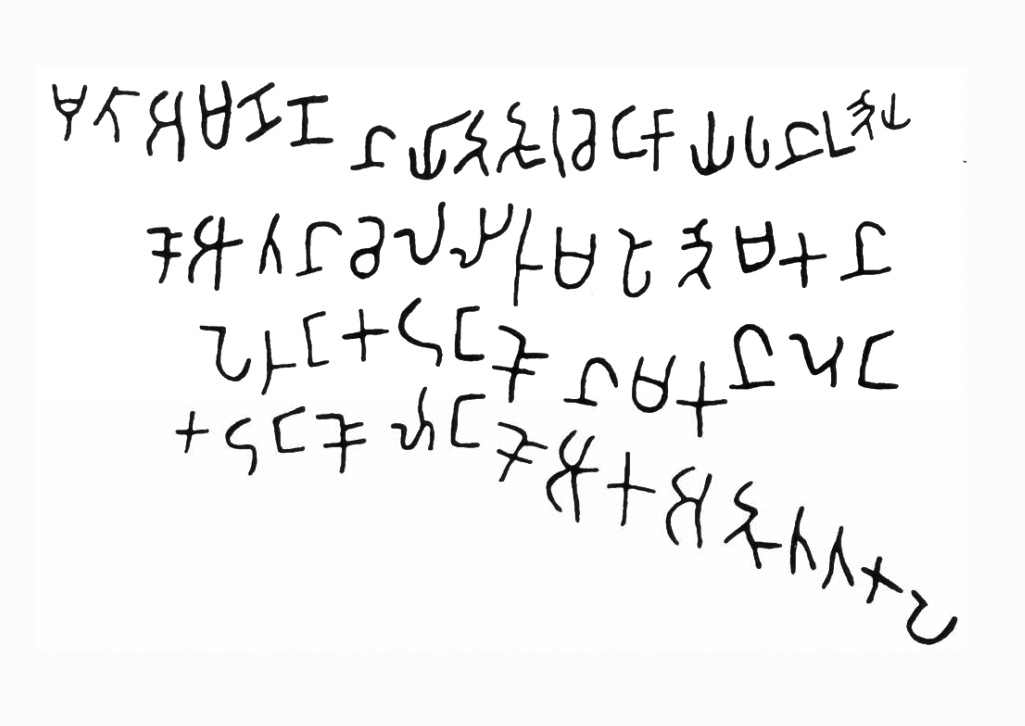
Photo: Rajesh of Raigad (Wikimedia Commons). Licence: CC BY-SA 4.0 (https://creativecommons.org/licenses/by-sa/4.0). Source: https://commons.wikimedia.org/wiki/File:Chera_Inscription_from_Pugalur,_near_Karur.jpg
- Inscriptions 61 and 62 are cut on a rock shelter at Pugalur, close to Karur.
- Inscription 61 names three generations, linked by the word makaṉ, "son".
- They are Kō Ātaṉ Cel Irumpoṟai, his son Peruṅkaṭuṅkōṉ and his grandson Iḷaṅkaṭuṅkō.
- The shelter is named as the home of a Jaina monk, Ceṅkāyapaṉ.
- Mahadevan's collection of inscriptions dates the letter shapes to about the second century CE; others say the third to fourth centuries CE.
What it cannot tell us The inscriptions give no reign years, no capital and no borders.
- Look Which names does the inscription give, and how are they linked?
- Talk The stone names a family. What would you need before calling them the kings of a kingdom?
- Ask Which other kind of evidence could tell us when these men lived?
Lesson C3 · Ages 11 to 14 · Cut-out cards
Cut along the lines. One set for each group.
C3-SC2 · Writing on stone or pottery
A gift at Jambai and an emperor's edict
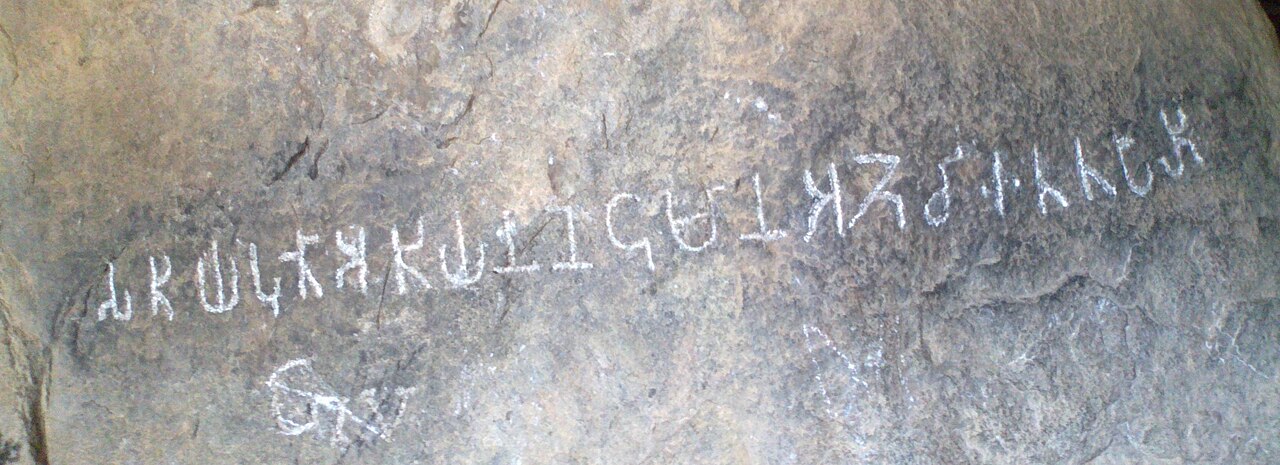
Photo: Tnexplore (Wikimedia Commons). Licence: CC BY-SA 3.0 (https://creativecommons.org/licenses/by-sa/3.0). Source: https://commons.wikimedia.org/wiki/File:Jambai_Tamil_Brahmi.jpg
- In a cave at Jambai, one line of writing records the gift of a paḷi, a cave shelter.
- It names the giver as Atiyan Neṭumāṉ Añci and calls him satiyaputō.
- Its letter shapes place it around the first century CE, though one official page says the first century BCE.
- Aśoka's Rock Edict II lists southern names: Choda, Pandiya, Kelalaputo and Satiyaputo.
- The edict shows that Chola and Pandya were known southern names by the third century BCE.
- Naming a people in an edict is not evidence that the emperor ruled them.
What it cannot tell us A one-line gift gives no family tree, no territory and no date for any poem.
- Look Which word appears both in the edict and at Jambai?
- Talk The edict and the Jambai line were cut centuries apart. Does a shared word make them about the same people? Why?
- Ask What would you want to know about the person who cut the Jambai line?
C3-SC3 · From the ground
Silver coins with a ruler's name

Drawing: A worn punch-marked silver piece, a schematic Roman denarius with a chisel cut, both faces of a square Chera copper coin, and an Eyyal jar timeline: minted, cut, buried after 98–99 CE, found 1945.
- Small silver coins show a portrait head and a name or title in Tamil-Brahmi.
- One series reads Makkotai above the portrait, and its other side is plain.
- Scholars think the portraits look like Roman imperial coin portraits.
- Excavations at Karur report Roman coins and pieces of Mediterranean jars.
- The coins are linked to the Amaravathi riverbed at Karur, but the sources checked place none in a dated excavation layer.
- Scholars' dates for one of these coins run from the first century BCE to the late third or early fourth century CE.
What it cannot tell us A name on a coin does not, on its own, give the ruler's family or the poem that praised him.
- Look From the card, what is on each side of the coin?
- Talk The coins were not found in a dated layer. Why does that make them harder to date?
- Ask What test could help to date the coins?
Lesson C3 · Ages 11 to 14 · Answer key and mark guidance
What the study says
Kings in stone and coin How do we know the names of early kings?
For the teacher only. Each level and reason below comes from this website's own draft summary of the published research. Keep this page away from pupils until they have answered.
How sure can we be?
Well supportedstrong evidence
Inscription 61 names three generations linked by the word makaṉ, 'son'.
Substantially preserved in the edited text; inscription 62 repeats it with restored letters.
Likelyprobably
Aśoka's Satiyaputo refers to the Atiyan or Atiyaman political line.
A strong identification, but still an inference between inscriptions about three centuries apart.
Possiblemaybe
The coin names belong to kings praised in early Tamil poems
Pupils read The coin names belong to kings praised in early Tamil poems.
The names match, but no independent date or text links issuer and poem king.
Possiblemaybe
The Pugalur rulers are the kings praised in the Pathitruppathu poems.
Mahadevan matches the three generations to the Irumporai kings of Pathitruppathu decades 7 to 9; the names are close rather than identical, and the match is disputed.
Not knownnobody knows yet
An exact, continuous list of early Pandya and Chola kings.
Pupils read What was the exact, continuous list of early Pandya and Chola kings?
No reviewed source links the rulers in sequence; poems are not reign tables.
The other tasks
C3-SC1 Talk The stone names a family. What would you need before calling them the kings of a kingdom?
Separate evidence. The inscriptions give no reign years, capital or borders, and calling the family Chera is a scholars' classification, not a statement written on the stone.
C3-SC2 Look Which word appears both in the edict and at Jambai?
Satiyaputo: the edict lists a southern people of that name, and the Jambai line calls the giver satiyaputō.
C3-SC2 Talk The edict and the Jambai line were cut centuries apart. Does a shared word make them about the same people? Why?
It is strong evidence that the edict's Satiyaputo meant the Atiyan line or group, but it links a political line, not the same individual across the two inscriptions.
C3-SC3 Talk The coins were not found in a dated layer. Why does that make them harder to date?
Without a dated layer, the date rests on the shapes of the letters, and scholars' dates for one coin run from the first century BCE to the late third or early fourth century CE.
Lesson C3 · Ages 11 to 14 · Answer key and mark guidance
Kings in stone and coin
Core 03 The name ... appears in both ... and ...
Satiyaputo, in Aśoka's Rock Edict II and in the Jambai inscription.
Exit ticket How do we know the names of early kings? Write one sentence on the evidence and one on what makes it hard.
Evidence: names come from inscriptions on stone, such as Pugalur and Jambai, from coins, and from an emperor's edict that names peoples. Hard: a matching name is a clue, not a proof; the dates rest on letter shapes; and the inscriptions give no reign years. Credit any answer that names one kind of evidence and one real difficulty.
What to look for
- Observation & Source Handling Names the kind of each source (cave inscription, edict, coin) and the names it gives.
- Claim & Evidence Connection Supports a point about a ruler with a named source, and finds a name that appears in two kinds of evidence.
- Context, Chronology & Genre Keeps each source with its date and says how it was dated: letter shapes for the inscriptions and the coins, and the third century BCE for the edict.
- Limits & Alternative Explanations Explains why a matching name is a clue, not a proof, and names a real gap in the evidence.
A different level with a reason that names real evidence or a real gap earns the reasoning credit. Note the reason.
Secure Example written by us, not real pupil work
The Pugalur inscriptions name three generations of one family, linked by makaṉ, "son", but they give no reign years or capital. At Jambai, a cave line calls the giver satiyaputō, and Aśoka's edict lists a southern people called Satiyaputo, so both probably refer to the same political line, although they were cut centuries apart. The silver coins carry names such as Makkotai, but the sources checked place none in a dated layer, and scholars' dates for one coin run from the first century BCE to the fourth century CE. So we know some names well, but joining them to the kings in poems is at best possible.
Comment Keeps each name with its source, grades the Satiyaputo match below certainty with a reason, and ends with the real gap.
Developing Example written by us, not real pupil work
We know the kings because their names are on stones and coins and in poems, so the Pugalur kings are the kings in the poems.
Comment Knows the kinds of evidence, but treats a matching name as proof. Next step: compare the model statement about Mangulam with the Pugalur card, and ask what else would be needed.
What nobody knows yet
- Nobody knows yet the Atiyan line's full genealogy, its territory, or the exact date of the related poems.
- Nobody knows yet an exact, continuous list of early Pandya and Chola kings.
Lesson C4 · Ages 11 to 14 · Lesson plan
Pepper and the monsoon
How did pepper travel west, and how do we know?
Unit C: Kingdoms, trade and the evidence · Ladder step Test · Draft written with AI assistance; not yet tried in a classroom
Objectives
- I can say what kind of evidence each source is, and what it can and cannot show.
- I can find a point where a text and a find agree about pepper.
- I can say what no source here tells us about the pepper trade.
Pupils should already know
- Students can find Kerala, the Arabian Sea, Arabia, the Red Sea and Egypt on a map.
- Students have used the four How-sure levels in unit B. If they have not, add five minutes at the start to introduce them.
Materials
- Print One sheet per student: support, core or stretch; The cut-out page for each group: three source cards and the key-word strip; An evidence grid for each group, on the sheet or copied from the board
- Screen The classroom screen for this lesson; Optional: the seasonal winds lab on the projector
- Devices Optional: the seasonal winds lab, one device per group
- Paper only Print the cut-out page for each group and a sheet for each student. For the hook, every group looks at the jar drawing on its own Berenike card. The evidence grid works on paper, and students shade their levels in pencil.
Timings
| Step | 30 minutes | 45 minutes | 60 minutes |
|---|---|---|---|
| hook Show the drawing of the pepper jar at Berenike and run the see, think, wonder routine. | 3 | 5 | 6 |
Lesson C4 · Ages 11 to 14 · Lesson plan
Pepper and the monsoon
| Step | 30 minutes | 45 minutes | 60 minutes |
|---|---|---|---|
| model Model how to question a source, using the Periplus card. | 5 | 8 | 10 |
| guided Groups read the Pliny card and the Berenike card. | 7 | 10 | 14 |
| independent Ask where a text and a find agree. | 5 | 8 | 12 |
| claim Students grade the statements in the claim task, then compare with the study's level and its reason. | 6 | 9 | 11 |
| exit Return to the wonders from the start. | 4 | 5 | 7 |
Misunderstandings to listen for (not yet observed in a classroom)
- The voyage from Egypt to India took forty days. Pliny's forty days run from Ocelis to Muziris only. A separate leg of about thirty days, from Berenice to Ocelis, came first.
- Pliny's forty days were the time pepper took to reach Egypt. Pliny's forty days are for sailing east across the Arabian Sea, from Ocelis to Muziris. They are not a time for the voyage back with the pepper.
- Pepper was grown at the ports it was shipped from. The Periplus lists pepper among the exports of Muziris and Nelkynda, but a port's export list does not show that the goods were produced nearby. Several items on that list came from other regions.
- Seasonal winds meant that ships sailed on fixed dates. The sailing dates or duration of any particular ancient voyage are not known. The study reconstructs no ancient weather.
Lesson C4 · Ages 11 to 14 · Support
Pepper and the monsoon
How did pepper travel west, and how do we know?
Look first
This drawing shows a jar of pepper found at a port in Egypt. What do you notice? What do you think? What do you wonder?
- Periplus A Greek handbook for merchants that describes ports and cargoes.
- monsoon A seasonal wind that reverses its direction during the year.
- Bacare A coastal anchorage at a river mouth, where large ships loaded pepper.
- corroborate To check a claim against a separate, independent source.
Evidence grid
Fill one row of the grid for each card: kind of source, pepper, journey, cannot show.
| Kind of source | Pepper | Journey | Cannot show | |
|---|---|---|---|---|
| C4-SC1 The Periplus: a guide for sea traders | ||||
| C4-SC2 Pliny on the sea route | ||||
| C4-SC3 Pepper in the sand at Berenike |
- 01
For each card, circle the kind of source: a guidebook, a writer's report or a find.
- 02
For each card, tick what it says about pepper.
- 03
Circle the sentence on the Periplus card that agrees with the Berenike jar.
Lesson C4 · Ages 11 to 14 · Support
Pepper and the monsoon
NameThe four levels
- Well supportedShade it inDirect, clear evidence supports this specific statement.
- LikelySlanting linesThe available evidence favours this interpretation, with uncertainty.
- PossibleDotsPlausible, but the evidence is limited or contested.
- Not knownLeave it empty and ring itThe evidence reviewed here does not settle the question.
- 04
Choose a level for each statement from the box.
| Well supported | Likely | Possible | Not known | ||
|---|---|---|---|---|---|
| A | Pliny's forty days run from Ocelis to Muziris, not from Berenice or Egypt. | ||||
| B | Pepper was carried both overland and by boat. | ||||
| C | Pliny's Becare and the Periplus's Bacare are the same port. | ||||
| D | How long did any particular ancient voyage take, and on what sailing dates? |
- 05
Complete: Nobody knows
What nobody knows yet
After you have graded, write one thing nobody knows yet.
Exit ticket
Cut along the line and hand it in.How did pepper travel west, and how do we know? Write one sentence on the journey and one on the evidence.
Lesson C4 · Ages 11 to 14 · Core
Pepper and the monsoon
How did pepper travel west, and how do we know?
Look first
This drawing shows a jar of pepper found at a port in Egypt. What do you notice? What do you think? What do you wonder?
Evidence grid
Fill one row of the grid for each card: kind of source, pepper, journey, cannot show.
| Kind of source | Pepper | Journey | Cannot show | |
|---|---|---|---|---|
| C4-SC1 The Periplus: a guide for sea traders | ||||
| C4-SC2 Pliny on the sea route | ||||
| C4-SC3 Pepper in the sand at Berenike |
- 01
The card is a It tells us
- 02
About pepper, it says
- 03
A text and a find agree that
Lesson C4 · Ages 11 to 14 · Core
Pepper and the monsoon
Name- 04
I graded this statement … because …
| Well supportedShade it in | LikelySlanting lines | PossibleDots | Not knownLeave it empty and ring it | ||
|---|---|---|---|---|---|
| A | Pliny's forty days run from Ocelis to Muziris, not from Berenice or Egypt. | ||||
Because | |||||
| B | Pepper was carried both overland and by boat. | ||||
Because | |||||
| C | Pliny's Becare and the Periplus's Bacare are the same port. | ||||
Because | |||||
| D | How long did any particular ancient voyage take, and on what sailing dates? | ||||
Because | |||||
- 05
No source here tells us
What nobody knows yet
After you have graded, write one thing nobody knows yet.
Exit ticket
Cut along the line and hand it in.How did pepper travel west, and how do we know? Write one sentence on the journey and one on the evidence.
Lesson C4 · Ages 11 to 14 · Stretch
Pepper and the monsoon
How did pepper travel west, and how do we know?
Look first
This drawing shows a jar of pepper found at a port in Egypt. What do you notice? What do you think? What do you wonder?
- 01
For each card, say what kind of source it is and how close it is to the events it describes.
- C4-SC1 The Periplus: a guide for sea traders
- C4-SC2 Pliny on the sea route
- C4-SC3 Pepper in the sand at Berenike
- 02
Explain what each card can and cannot tell us about pepper.
- C4-SC1 The Periplus: a guide for sea traders
- C4-SC2 Pliny on the sea route
- C4-SC3 Pepper in the sand at Berenike
- 03
Where do two kinds of evidence agree? How strong is that agreement?
Lesson C4 · Ages 11 to 14 · Stretch
Pepper and the monsoon
Name- 04
Grade each statement and explain how you weighed the evidence.
| Well supportedShade it in | LikelySlanting lines | PossibleDots | Not knownLeave it empty and ring it | ||
|---|---|---|---|---|---|
| A | Pliny's forty days run from Ocelis to Muziris, not from Berenice or Egypt. | ||||
Because | |||||
| B | Pepper was carried both overland and by boat. | ||||
Because | |||||
| C | Pliny's Becare and the Periplus's Bacare are the same port. | ||||
Because | |||||
| D | How long did any particular ancient voyage take, and on what sailing dates? | ||||
Because | |||||
- 05
What is the most important thing no source here shows? Why does it matter?
What nobody knows yet
After you have graded, write one thing nobody knows yet.
Exit ticket
Cut along the line and hand it in.How did pepper travel west, and how do we know? Write one sentence on the journey and one on the evidence.
Lesson C4 · Ages 11 to 14 · Cut-out cards
Cut along the lines. One set for each group.
C4-SC1 · From a text
The Periplus: a guide for sea traders

Drawing: Map from Alexandria to Sri Lanka with monsoon wind arrows, a Malabar coast bracket, the Nile, Koptos and candidate Red Sea ports; a Muziris Papyrus drawing; and a section of offshore cargo transfer.
- The Periplus is a Greek guide for sea traders, written about 40 to 70 CE.
- It lists pepper among the goods for export from the ports of Muziris and Nelkynda.
- It links pepper with an inland district named Cottonara.
- It links sailing straight across the open sea with seasonal winds.
- It names Bacare, an anchorage at a river mouth below Nelkynda where large ships loaded pepper.
What it cannot tell us A list of a port's exports does not show that the goods were produced near the port.
- Look List the ports and places the Periplus names.
- Talk The Periplus lists pepper as an export of Muziris and Nelkynda. Does that show the pepper grew near those ports? Why?
- Ask What would you want to know about the person who wrote the Periplus?
C4-SC2 · From a text
Pliny on the sea route

Drawing: Two Arabian Sea maps: summer winds blow toward India, winter winds back toward Arabia, with legs Pliny reports. A river-mouth section shows a ship anchored beyond a shallow bar.
- Pliny, writing in the first century CE, gives forty days for one stretch of sea: from Ocelis to Muziris.
- Before that stretch, ships took about thirty days from Berenice to Ocelis.
- The forty days are for sailing east across the Arabian Sea, towards Muziris.
- He says ships set off for home around December or January.
- He reports the route from others. He does not describe a voyage of his own.
- Pliny says pepper from Cottonara reached Becare in single-log boats, while an early Tamil poem (Perumpanarruppatai) shows pack donkeys carrying pepper.
What it cannot tell us The forty days belong to one stretch of one route. They are not a timetable for every ship.
- Look Where do Pliny's forty days start, and where do they end?
- Talk Pliny did not describe a voyage of his own. Does that make his forty days less useful? Why?
- Ask What would you need to know before using the forty days for every ship?
Lesson C4 · Ages 11 to 14 · Cut-out cards
Cut along the lines. One set for each group.
C4-SC3 · From the ground
Pepper in the sand at Berenike

Drawing: A diagram shows a storage jar, probably made in India, set into a first-century CE courtyard floor at Berenike, with black peppercorns inside and the Great Temple to the south. The courtyard is only conditionally linked to the temple. A map shows Berenike and the south-west Indian pepper region as geographical context; it does not identify the growers or carriers of this find. The jar shape and section are explanatory, not a measured excavation drawing.
- Berenike was a Roman-period port on Egypt's Red Sea coast.
- Excavators found a jar described as Indian-made. It held more than 7.5 kg of black pepper.
- Dry desert sand kept the peppercorns whole.
- The pepper jar is reported from first-century CE layers.
- From the Red Sea ports, a camel-and-river route led to Alexandria.
What it cannot tell us The jar shows that pepper reached the port. It does not show who carried it.
- Look What exactly was found, and where?
- Talk Which statement on the other cards does this find agree with?
- Ask What would a find in Kerala add to this story?
Key words English · Malayalam · Tamil
Periplusപെരിപ്ലസ് മാരിസ് എറിത്രേയിபெரிப்ளஸ் (செங்கடல் பயண நூல்)
A Greek handbook for merchants that describes ports and cargoes.
Muzirisമുസിരിസ് / മുചിരിமுசிறி
A celebrated early port named in Sangam poems and in Greco-Roman accounts.
Nelkyndaനെൽക്കിണ്ടநெல்கிந்தா
A river port on the south-west coast, south of Muziris.
Berenike and Myos Hormosബെറനിക്കെയും മയോസ് ഹോർമോസുംபெரெனிகே & மியோஸ் ஹோர்மோஸ்
The two main Red Sea ports of Roman Egypt, where ships sailed for Muziris.
black pepperമുളക് / കുരുമുളക്மிளகு / கறி
A spice plant native to the Malabar coast and the Western Ghats.
Bacareബക്കാരെ / പുറക്കാട്பக்கரே / புறக்காடு
A coastal anchorage at a river mouth, where large ships loaded pepper.
monsoon
A seasonal wind that reverses its direction during the year.
corroborate
To check a claim against a separate, independent source.
Lesson C4 · Ages 11 to 14 · Answer key and mark guidance
What the study says
Pepper and the monsoon How did pepper travel west, and how do we know?
For the teacher only. Each level and reason below comes from this website's own draft summary of the published research. Keep this page away from pupils until they have answered.
How sure can we be?
Well supportedstrong evidence
Pliny's forty days run from Ocelis to Muziris, not from Berenice or Egypt.
Explicit in the Mayhoff and PHI Latin texts of Natural History 6.104.
Likelyprobably
Pepper was carried both overland and by boat.
A Tamil poem shows pack donkeys and Pliny describes log boats; neither records one actual consignment.
Likelyprobably
Pliny's Becare and the Periplus's Bacare are the same port.
Both the Periplus (section 55) and Pliny place it below Nelkynda and link it with Cottonara pepper; they are usually taken as one port, though its modern site is not identified.
Not knownnobody knows yet
The sailing dates or duration of any particular ancient voyage.
Pupils read How long did any particular ancient voyage take, and on what sailing dates?
The study reconstructs no ancient weather; each leg would need its own evidence.
The other tasks
C4-SC1 Talk The Periplus lists pepper as an export of Muziris and Nelkynda. Does that show the pepper grew near those ports? Why?
No. The Periplus links pepper with an inland district, and a port's export list does not show that the goods were produced near the port.
C4-SC2 Look Where do Pliny's forty days start, and where do they end?
They start at Ocelis and end at Muziris. That stretch runs east across the Arabian Sea, so it is not the time pepper took to travel west.
C4-SC2 Talk Pliny did not describe a voyage of his own. Does that make his forty days less useful? Why?
It makes the forty days a report that Pliny compiled from others, not a measurement of his own. It is still useful, because Pliny is explicit about which stretch of sea the forty days cover.
C4-SC3 Talk Which statement on the other cards does this find agree with?
It agrees with the Periplus, which lists pepper among the exports of Muziris and Nelkynda: pepper did reach a port on Egypt's Red Sea coast. It does not show who carried it.
Core 03 A text and a find agree that ...
Strongest agreement: the Periplus lists pepper among the exports of Muziris and Nelkynda, and a jar holding black pepper was found at Berenike.
Lesson C4 · Ages 11 to 14 · Answer key and mark guidance
Pepper and the monsoon
Core 05 No source here tells us ...
Nobody knows yet where Cottonara lay. No source gives a modern identification, a dated farm-to-port route or crop-financing arrangements.
Nobody knows yet when any particular voyage sailed. The study reconstructs no ancient weather; each leg would need its own evidence.
Exit ticket How did pepper travel west, and how do we know? Write one sentence on the journey and one on the evidence.
Journey: accept any accurate sequence, such as pepper linked with an inland district, a sea crossing helped by seasonal winds, then camel and river boat across Egypt to Alexandria. Evidence: credit naming at least one text and one find, and noting that no single source follows one shipment all the way.
What to look for
- Observation & Source Handling Names the kind of each source (guidebook, writer's report, excavated find) and what it records.
- Claim & Evidence Connection Supports a point about the pepper trade with a named source, and shows where a text and a find agree.
- Context, Chronology & Genre Keeps each source with its date: the Periplus and Pliny in the first century CE, and the Berenike jar in first-century CE layers.
- Limits & Alternative Explanations States something no source here shows, such as where Cottonara lay or the dates of any particular voyage.
A different level with a reason that names real evidence or a real gap earns the reasoning credit. Note the reason.
Secure Example written by us, not real pupil work
The Periplus links pepper with an inland district called Cottonara and lists pepper among the exports of Muziris and Nelkynda. Ships crossed the open sea with seasonal winds. Pliny's forty days cover only one stretch, from Ocelis to Muziris, sailing east. From the Red Sea ports, a camel-and-river route led to Alexandria. A text and a find agree: the Periplus lists pepper as an export, and a jar of pepper was found at Berenike. But no single source follows one shipment all the way, and nobody knows where Cottonara lay.
Comment Uses every card, keeps Pliny's forty days to their stretch of sea and their direction, states a real agreement between a text and a find, and ends with what is not known.
Developing Example written by us, not real pupil work
Pepper went from India to Egypt by ship in forty days with the monsoon. We know because Pliny says so.
Comment Knows the main movement, but misreads Pliny's forty days. They cover one stretch, from Ocelis to Muziris, not the whole journey. That stretch also runs east, the opposite way to the pepper. Next step: reread the Pliny card for where the forty days start and end.
What nobody knows yet
- Nobody knows yet where Cottonara lay, the route taken, and how growers were paid.
- Nobody knows yet the sailing dates or exact duration of any particular ancient voyage.
Lesson C5 · Ages 11 to 14 · Lesson plan
Local history from remains
How would you write the early history of one place?
Unit C: Kingdoms, trade and the evidence · Ladder step Sort, Grade · Draft written with AI assistance; not yet tried in a classroom
Objectives
- I can sort what was recorded at a place from what was worked out and what is still debated.
- I can keep early evidence apart from later evidence at the same place.
- I can write a short history of a place in which each sentence is as sure as its evidence.
Pupils should already know
- Students have sorted what was found from what was worked out in unit B, and have graded statements in lessons C1 to C4.
- Students met the Periplus, a Greek guide for sea traders, in lesson C4.
- Students met Cheramanangad in lesson C1. If they have not, read the model step slowly and show the site on a map.
Materials
- Print One sheet per student: support, core or stretch; The cut-out page for each group: three source cards and the key-word strip; A sorting grid for each group, on the sheet or copied from the board, with three columns: recorded, worked out, debated or not known; Optional: the atlas page of a place near your school, printed from this website's atlas, for the extension
- Screen The classroom screen for this lesson; Optional: the atlas page for Vizhinjam on the projector
- Devices Optional: the atlas, one device per group, for the extension
- Paper only Print the cut-out page for each group and a sheet for each student. Draw the sorting grid on the board and read the Cheramanangad model aloud from this plan. The photograph of the modern harbour works in black and white. Students sort, grade and write on paper, and shade their levels in pencil.
Timings
| Step | 30 minutes | 45 minutes | 60 minutes |
|---|---|---|---|
| hook Show the photograph of Vizhinjam harbour and run the see, think, wonder routine. | 3 | 5 | 6 |
Lesson C5 · Ages 11 to 14 · Lesson plan
Local history from remains
| Step | 30 minutes | 45 minutes | 60 minutes |
|---|---|---|---|
| model Model the sort with a place from lesson C1. | 5 | 8 | 10 |
| guided Groups take the Vizhinjam cards and sort every sentence into the grid. | 8 | 11 | 15 |
| claim Students grade the statements in the claim task, then compare with the study's level and its reason. | 6 | 9 | 11 |
| independent Each student writes a short early history of Vizhinjam in no more than five sentences. | 5 | 8 | 12 |
| exit Students read one sentence of their history to a partner, who says whether it is as sure as its evidence. | 3 | 4 | 6 |
Misunderstandings to listen for (not yet observed in a classroom)
- A coin from a place tells us how old the place is. The Ptolemy II coin was reported from a jeweller's possession. Its find place and context are unknown, so it cannot securely date an excavated level.
- Everything found at a site belongs to its earliest phase. Later pottery at Vizhinjam shows sea contacts that went on long after the early settlement. Later phases should not be used to date it.
- Torpedo jars are Roman jars. At Vizhinjam they are read as West Asian transport containers, broadly of the fourth to seventh centuries CE.
- A place named in an old text can be found on a modern map from its name. The Periplus describes Balita, but the ancient text does not identify Balita with modern Vizhinjam.
Lesson C5 · Ages 11 to 14 · Support
Local history from remains
How would you write the early history of one place?
Look first
This photograph shows boats at Vizhinjam harbour in 2010. What do you see? What do you think? What do you wonder about this place long ago?
- torpedo jar A tall, handleless transport jar lined with bitumen, made in Mesopotamia or the Persian Gulf.
- rouletted ware Fine grey-and-black dishes made on a wheel, with rings of small pressed marks inside the base.
- Periplus A Greek handbook for merchants that describes ports and cargoes.
- radiocarbon date An age measured in a laboratory from a sample that was once alive, such as wood.
- 01
Tick the things found in the trenches: rouletted ware, torpedo jars, a small structure, a gold coin held by a jeweller.
- rouletted ware
- torpedo jars
- a small structure
- a gold coin held by a jeweller
- 02
For each sentence on the cards, circle R (recorded), W (worked out) or D (debated or not known).
- R recorded
- W worked out
- D debated or not known
No. Which card R W D Early Later 1 C5-SC1 R W D 2 R W D 3 R W D 4 R W D 5 R W D 6 R W D 7 C5-SC2 R W D 8 R W D No. Which card R W D Early Later 9 C5-SC2 R W D 10 R W D 11 R W D 12 C5-SC3 R W D 13 R W D 14 R W D 15 R W D 16 R W D - 03
Circle each sentence that is about a later time.
Lesson C5 · Ages 11 to 14 · Support
Local history from remains
NameThe four levels
- Well supportedShade it inDirect, clear evidence supports this specific statement.
- LikelySlanting linesThe available evidence favours this interpretation, with uncertainty.
- PossibleDotsPlausible, but the evidence is limited or contested.
- Not knownLeave it empty and ring itThe evidence reviewed here does not settle the question.
- 04
Choose a level for each statement from the box.
| Well supported | Likely | Possible | Not known | ||
|---|---|---|---|---|---|
| A | A coastal settlement existed at Vizhinjam from the first centuries CE. | ||||
| B | People in the earliest phase relied heavily on fish and other sea foods. | ||||
| C | Vizhinjam was the Periplus port of Balita. | ||||
| D | Ay rulers controlled Vizhinjam before 600 CE. |
- 05
Complete the history: Excavators found People probably Vizhinjam may have been Nobody knows yet
What nobody knows yet
After you have graded, write one thing nobody knows yet.
Exit ticket
Cut along the line and hand it in.How would you write the early history of one place? Write two rules you followed today.
Lesson C5 · Ages 11 to 14 · Core
Local history from remains
How would you write the early history of one place?
Look first
This photograph shows boats at Vizhinjam harbour in 2010. What do you see? What do you think? What do you wonder about this place long ago?
Sorting grid
Sort every sentence into the grid. Mark each one early or later.
- R recorded
- W worked out
- D debated or not known
| No. | Which card | R | W | D | Early | Later |
|---|---|---|---|---|---|---|
| 1 | C5-SC1 | R | W | D | ||
| 2 | R | W | D | |||
| 3 | R | W | D | |||
| 4 | R | W | D | |||
| 5 | R | W | D | |||
| 6 | R | W | D | |||
| 7 | C5-SC2 | R | W | D | ||
| 8 | R | W | D |
| No. | Which card | R | W | D | Early | Later |
|---|---|---|---|---|---|---|
| 9 | C5-SC2 | R | W | D | ||
| 10 | R | W | D | |||
| 11 | R | W | D | |||
| 12 | C5-SC3 | R | W | D | ||
| 13 | R | W | D | |||
| 14 | R | W | D | |||
| 15 | R | W | D | |||
| 16 | R | W | D |
- 01
The excavators recorded
- 02
This sentence was worked out, not recorded, because
- 03
This sentence is about a later time, because
Lesson C5 · Ages 11 to 14 · Core
Local history from remains
Name- 04
I graded this statement … because …
| Well supportedShade it in | LikelySlanting lines | PossibleDots | Not knownLeave it empty and ring it | ||
|---|---|---|---|---|---|
| A | A coastal settlement existed at Vizhinjam from the first centuries CE. | ||||
Because | |||||
| B | People in the earliest phase relied heavily on fish and other sea foods. | ||||
Because | |||||
| C | Vizhinjam was the Periplus port of Balita. | ||||
Because | |||||
| D | Ay rulers controlled Vizhinjam before 600 CE. | ||||
Because | |||||
- 05
My early history of Vizhinjam:
What nobody knows yet
After you have graded, write one thing nobody knows yet.
Exit ticket
Cut along the line and hand it in.How would you write the early history of one place? Write two rules you followed today.
Lesson C5 · Ages 11 to 14 · Stretch
Local history from remains
How would you write the early history of one place?
Look first
This photograph shows boats at Vizhinjam harbour in 2010. What do you see? What do you think? What do you wonder about this place long ago?
- 01
Sort every sentence on the cards and explain one choice that was hard.
- R recorded
- W worked out
- D debated or not known
No. Which card R W D Early Later 1 C5-SC1 R W D 2 R W D 3 R W D 4 R W D 5 R W D 6 R W D 7 C5-SC2 R W D 8 R W D No. Which card R W D Early Later 9 C5-SC2 R W D 10 R W D 11 R W D 12 C5-SC3 R W D 13 R W D 14 R W D 15 R W D 16 R W D - 02
Which evidence belongs to the early settlement, and which to later times? How can you tell?
- 03
How strong is the case that Vizhinjam was Balita, and what would settle it?
Lesson C5 · Ages 11 to 14 · Stretch
Local history from remains
Name- 04
Grade each statement and explain how you weighed the evidence.
| Well supportedShade it in | LikelySlanting lines | PossibleDots | Not knownLeave it empty and ring it | ||
|---|---|---|---|---|---|
| A | A coastal settlement existed at Vizhinjam from the first centuries CE. | ||||
Because | |||||
| B | People in the earliest phase relied heavily on fish and other sea foods. | ||||
Because | |||||
| C | Vizhinjam was the Periplus port of Balita. | ||||
Because | |||||
| D | Ay rulers controlled Vizhinjam before 600 CE. | ||||
Because | |||||
- 05
Write the early history of Vizhinjam in a paragraph in which every sentence is as sure as its evidence.
What nobody knows yet
After you have graded, write one thing nobody knows yet.
Exit ticket
Cut along the line and hand it in.How would you write the early history of one place? Write two rules you followed today.
Lesson C5 · Ages 11 to 14 · Cut-out cards
Cut along the lines. One set for each group.
C5-SC1 · From the ground
Vizhinjam: what the excavations recorded

Photo: Luidger (Wikimedia Commons). Licence: CC BY 3.0 (https://creativecommons.org/licenses/by/3.0). Source: https://commons.wikimedia.org/wiki/File:20100105-Vishinjam_Port.JPG
- 1University of Kerala archaeologists dug eleven trenches at Vizhinjam in 2011 to 2013.
- 2Seven radiocarbon dates and the finds place the first phase at about 1 to 800 CE.
- 3In that first phase they found rouletted ware and pieces of torpedo jars.
- 4They also found household equipment and a small structure.
- 5About 73 percent of the identified early animal remains came from the sea.
- 6Some layers were mixed.
What it cannot tell us A gold coin of Ptolemy II was held by a jeweller, so it cannot date any layer at the site.
- Look List what the excavators found. Which finds come from the sea?
- Talk Why can the gold coin not help to date the site, when the pottery can?
- Ask What would you want to know about the mixed layers?
C5-SC2 · From a text
Balita: a port in an old sailing guide
Drawing: Two Arabian Sea maps: summer winds blow toward India, winter winds back toward Arabia, with legs Pliny reports. A river-mouth section shows a ship anchored beyond a shallow bar.
- 7The Periplus, a Greek guide for sea traders, describes a place called Balita.
- 8It calls Balita a coastal village with a good harbour.
- 9Next in its list of places comes Komar.
- 10Some scholars have proposed that Vizhinjam was Balita.
- 11The ancient text does not say which modern place Balita was.
What it cannot tell us No inscription or seal naming the port has been found at Vizhinjam.
- Look What does the Periplus say about Balita?
- Talk The harbour fits the description. Is that enough to say that Vizhinjam was Balita? Why?
- Ask What find would settle whether Vizhinjam was Balita?
Lesson C5 · Ages 11 to 14 · Cut-out cards
Cut along the lines. One set for each group.
C5-SC3 · About a place
Later times at Vizhinjam

Drawing: Two-scale orientation map for Vizhinjam Coastal Fort & Harbour Terrace: local geographic frame with scale bar and regional inset.
- 12The excavators date the torpedo jars broadly to the fourth to seventh centuries CE.
- 13Early Tamil poems praise an Ay ruler, Āy Aṇṭiraṉ, but the poems the study checked do not name Vizhinjam.
- 14The clearest evidence linking Ay rulers to a fort at Vizhinjam belongs mainly to the seventh to ninth centuries and later.
- 15Chinese and European pottery shows that sea contacts went on much later.
- 16Calling early Vizhinjam a "Southern Ay Outpost" goes further than the early archaeology shows.
What it cannot tell us Later finds should not be used to date the early settlement.
- Look Which sentences on this card are about times after the first centuries CE?
- Talk Why might later evidence make a place's early history sound grander than it was?
- Ask What would you need to find to show who ruled Vizhinjam in its early phase?
Key words English · Malayalam · Tamil
torpedo jarപേർഷ്യൻ ഗൾഫ് ഭരണികൾமேற்காசியச் சாடி
A tall, handleless transport jar lined with bitumen, made in Mesopotamia or the Persian Gulf.
rouletted wareറൗലറ്റഡ് വെയർ (കൊത്തുപണി മൺപാത്രങ്ങൾ)சக்கரப் பொறிப்பு மண்பாண்டம் (ரௌலட்டட் பாண்டம்)
Fine grey-and-black dishes made on a wheel, with rings of small pressed marks inside the base.
Periplusപെരിപ്ലസ് മാരിസ് എറിത്രേയിபெரிப்ளஸ் (செங்கடல் பயண நூல்)
A Greek handbook for merchants that describes ports and cargoes.
radiocarbon date
An age measured in a laboratory from a sample that was once alive, such as wood.
trench
A long, deep hole dug with care to see the layers.
phase
A stretch of time in the life of a site, such as its first phase.
Ay
A ruling line praised in early Tamil poems, such as the ruler Āy Aṇṭiraṉ.
local history
The history of one place, written from the evidence found there and about it.
Lesson C5 · Ages 11 to 14 · Answer key and mark guidance
What the study says
Local history from remains How would you write the early history of one place?
For the teacher only. Each level and reason below comes from this website's own draft summary of the published research. Keep this page away from pupils until they have answered.
How sure can we be?
Likelyprobably
A coastal settlement existed at Vizhinjam from the first centuries CE
Pupils read A coastal settlement existed at Vizhinjam from the first centuries CE.
Seven Beta Analytic radiocarbon dates are reported, but individual sample contexts, codes and raw ages were not tabulated in the 2013–2014 reports read (a 2015 Routledge chapter has not yet been read in full), and some layers are mixed.
Possiblemaybe
In the earliest broad phase (c. 1–800 CE) most identified food remains were marine
Pupils read People in the earliest phase relied heavily on fish and other sea foods.
About 73 percent (38 of 52) of identifiable Period I remains are marine, but the sample is 52 fragments from mixed layers spanning well past 600 CE.
Possiblemaybe
Vizhinjam was the Periplus port of Balita
Pupils read Vizhinjam was the Periplus port of Balita.
The sheltered bay and early sequence fit, but Schoff (1912, §58) identified Balita with Varkala, Casson (1989) treats it as not securely identified, and no name-bearing inscription or seal has been found.
Not knownnobody knows yet
Ay rulers controlled Vizhinjam before 600 CE
Pupils read Ay rulers controlled Vizhinjam before 600 CE.
The Ay poems in Purananuru 127–136 do not name Vizhinjam; the fort evidence points to the eighth century and later.
The other tasks
C5-SC1 Talk Why can the gold coin not help to date the site, when the pottery can?
The coin was held by a jeweller, so its find place and context are unknown. The pottery comes from the excavated levels.
C5-SC2 Talk The harbour fits the description. Is that enough to say that Vizhinjam was Balita? Why?
No. The match is a plausible modern identification, not an established one: the ancient text does not identify Balita with modern Vizhinjam, and it needs stronger evidence from the site.
C5-SC3 Look Which sentences on this card are about times after the first centuries CE?
The torpedo jars, of the fourth to seventh centuries CE; the fort evidence of the seventh to ninth centuries and later; and the Chinese and European pottery.
Core 01 The excavators recorded ...
Eleven trenches; rouletted ware and pieces of torpedo jars in the earliest levels; household equipment and a small structure; animal remains, most of them from the sea; and some mixed layers.
Exit ticket How would you write the early history of one place? Write two rules you followed today.
Any two rules such as: sort what was recorded from what was worked out; keep later evidence out of the early history; make each sentence as sure as its evidence; never date a layer with a find whose find place is unknown. Credit any rule the student also used in the history.
Lesson C5 · Ages 11 to 14 · Answer key and mark guidance
Local history from remains
Support 02 For each sentence on the cards, circle R (recorded), W (worked out) or D (debated or not known).
Card 1, recorded: the eleven trenches; rouletted ware and torpedo-jar pieces in the first phase; household equipment and a small structure; the share of sea animals among the animal remains; some mixed layers. Worked out: the first phase of about 1 to 800 CE, from seven radiocarbon dates and the finds. The Periplus card, recorded in the text: what the Periplus says about Balita and Komar. Debated or not known: whether Vizhinjam was Balita, since the text does not say which modern place Balita was. Card 3, worked out: the dating of the torpedo jars to the fourth to seventh centuries CE, and later sea contacts from the later pottery. Debated or not known: who ruled early Vizhinjam, since the poems checked do not name it and the fort evidence is later; and the "Southern Ay Outpost" label. Credit another column when the reason names the evidence: for example, the 73 percent figure is recorded, but what it shows about diet is worked out.
Core 03 This sentence is about a later time, because ...
Later: the torpedo jars, of the fourth to seventh centuries CE, which fall inside the long first phase but not at its start; the fort evidence of the seventh to ninth centuries and later; the Chinese and European pottery. Early: settlement from the first centuries CE. The first phase as a whole runs from about 1 to 800 CE, so the sea-food figure for that phase is not early on its own.
What to look for
- Observation & Source Handling Sorts each sentence into what was recorded, what is worked out and what is debated or not known.
- Context, Chronology & Genre Keeps the early settlement apart from later evidence: the torpedo jars, the fort and the later pottery.
- Claim & Evidence Connection Supports each sentence of the history with a find, a date or a text from the cards.
- Limits & Alternative Explanations Writes each sentence as sure as its evidence, and says what nobody knows yet, such as who ruled the early settlement.
- Communication & Attribution Writes a short, clear history that a reader could check against the cards.
A different level with a reason that names real evidence or a real gap earns the reasoning credit. Note the reason.
Secure Example written by us, not real pupil work
Archaeologists found a settlement at Vizhinjam that probably existed from the first centuries CE; seven radiocarbon dates support it, but some layers are mixed. In the first phase, about 1 to 800 CE, people may have relied heavily on fish and other sea foods, but the sample of bones is small. Torpedo jars from West Asia arrived later in that long phase, broadly in the fourth to seventh centuries CE. Vizhinjam may have been the Periplus port of Balita, but no inscription or seal names it. Nobody knows yet whether Ay rulers controlled it before 600 CE.
Comment Every sentence carries its own level, the later jars are kept apart from the start of the first phase, and the history ends with what is not known.
Developing Example written by us, not real pupil work
Vizhinjam was the great port of Balita, ruled by the Ay kings, who traded torpedo jars with West Asia, and a gold coin of Ptolemy II shows how old it is.
Comment Knows the main evidence, but states a possible identification as fact, puts later rulers and later jars into the early history, and dates the site with a coin whose find place is unknown. Next step: sort each sentence and mark it early or later.
What nobody knows yet
- Nobody knows yet whether Ay rulers controlled Vizhinjam before 600 CE.
Unit C · Ages 11 to 14
Kingdoms, trade and the evidence
How do we know about the early kingdoms of the south and their trade?
Five lessons for ages 11 to 14, each about 45 minutes. Students use monuments, poems, inscriptions, coins, trade texts and finds, ask what each kind of source can and cannot tell us, and test where two kinds of evidence agree.
Lessons in this pack
| C1 Megaliths as sources | What can megaliths tell us, and what can't they? | 30 / 45 / 60 |
|---|---|---|
| C2 Poems as evidence | Can a love poem be historical evidence? | 30 / 45 / 60 |
| C3 Kings in stone and coin | How do we know the names of early kings? | 30 / 45 / 60 |
| C4 Pepper and the monsoon | How did pepper travel west, and how do we know? | 30 / 45 / 60 |
| C5 Local history from remains | How would you write the early history of one place? | 30 / 45 / 60 |
When the lessons sit in time
- C2
- C3
- C4
1000 BCE–600 CE Entire principal period: C1, C5
Places in this unit
- Cheramanangad (Kudakkallu Parambu) Thrissur District, Kerala C1, C5
- Ariyannur Umbrella Stones Thrissur District, Kerala C1
- Mangadu Iron Age Urn Burial Site Kollam District, Kerala C1
- Porkalam Megalithic Urn & Cist Site Thrissur District, Kerala C1
- Kattakampal Multi-Chambered Rock-Cut Cave Thrissur District, Kerala C1
- Puhar (Kaveripoompattinam) Mayiladuthurai District, Tamil Nadu C2
- Kodumanal (Noyyal River Craft & Trade Town) Erode District, Tamil Nadu C2
- Jambai, Mangulam & Pugalur Rock Inscription Sites Jambai (Kallakurichi District, 11.96°N, 79.01°E); paired here with Mangulam (Madurai District, 10.03°N, 78.24°E) & Pugalur (Karur District, 11.06°N, 77.97°E), Tamil Nadu C3
- Karur (Amaravathi River Trade Node & Proposed Chera Capital Vanchi) Karur District, Tamil Nadu C3
- Berenike (Red Sea Port, Egypt) Red Sea Governorate, Egypt (Inset View) C4
- Vizhinjam Coastal Fort & Harbour Terrace Thiruvananthapuram District, Kerala C5
Unit C · Ages 11 to 14
Class record sheet
Write pupils' names by hand. Nothing here is stored or sent anywhere.
| Pupil | C1 | C2 | C3 | C4 | C5 | Comment |
|---|---|---|---|---|---|---|
Unit C · Ages 11 to 14
Marking rubric
Choose the two or three dimensions that match a lesson's objectives. The levels describe what a pupil's answer shows, never a pupil's ability.
| Not yet | Developing | Secure | Extended | |
|---|---|---|---|---|
| 1. Observation & Source Handling | Gives an unsupported impression or confuses a modern reconstruction/diagram with an excavated find. | Identifies a relevant detail from the source card but mixes visible observation with interpretation. | Accurately identifies relevant details and distinguishes what the source records from one's own inference. | Explains how excavation recording, preservation, translation, or sampling affects what can be observed. |
| 2. Claim & Evidence Connection | States a conclusion without citing any clue from the source cards. | Mentions a relevant detail from a source card but leaves its link to the claim implicit. | Answers the historical question with specific evidence and explains why ('because...') it supports the claim. | Weighs evidence of differing strength and revises or calibrates the claim to match its actual reach. |
Unit C · Ages 11 to 14
| Not yet | Developing | Secure | Extended | |
|---|---|---|---|---|
| 3. Context, Chronology & Genre | Transfers facts between sites, centuries, or genres without justification. | Notices a date, site, or genre difference but does not apply it consistently. | Keeps the relevant site, period window (1000 BCE–600 CE vs earlier/later), and source purpose attached to the claim. | Explains how stratigraphic context, textual transmission, or poetic convention changes the historical interpretation. |
| 4. Limits & Alternative Explanations | Treats a possibility as 100% settled fact, or claims nothing at all can be known. | Mentions a generic uncertainty ('we weren't there') without tying it to the specific source. | States a specific evidential limit and explains what remains reasonably supported alongside what is open. | Compares a plausible alternative model and names the exact kind of new evidence that could distinguish between them. |
| 5. Communication & Attribution | Reasoning cannot be followed or sources are unidentifiable. | Gives a partly clear explanation with incomplete references to the source cards. | Makes the reasoning clear in any accessible format and cites the relevant source card or locator. | Builds a coherent argument while representing scholarly disagreement and source dependence accurately. |
Unit C · Ages 11 to 14
Cut along the lines. One set for each group.
The four certainty cards
Lesson C1 · Ages 11 to 14 · Lesson plan
Megaliths as sources
What can megaliths tell us, and what can't they?
Unit C: Kingdoms, trade and the evidence · Ladder step Look, Grade · Draft written with AI assistance; not yet tried in a classroom
Objectives
- I can describe a monument before I explain it.
- I can say what a monument's shape, the burial beneath it and a laboratory date each tell us, and what they cannot.
- I can grade a statement about megaliths and give a reason that names the evidence.
Pupils should already know
- Students have sorted what was found from what was worked out, and graded statements on the four How-sure levels, in unit B. If they have not, add five minutes at the start to introduce the levels.
- Students can find central, northern and southern Kerala on a map.
Materials
- Print One sheet per student: support, core or stretch; The cut-out page for each group: three source cards and the key-word strip; A Shape, Beneath, Date grid for each group, on the sheet or copied from the board
- Screen The classroom screen for this lesson
- Paper only Print the cut-out page for each group and a sheet for each student. The photograph on the umbrella stone card works in black and white, because the task is to describe shape and material. Draw the Shape, Beneath, Date grid on the board. Students shade their levels in pencil.
Lesson C1 · Ages 11 to 14 · Lesson plan
Megaliths as sources
Timings
| Step | 30 minutes | 45 minutes | 60 minutes |
|---|---|---|---|
| hook Show the photograph of the umbrella stone and run the see, think, wonder routine. | 3 | 5 | 6 |
| model Model careful looking with the umbrella stone card. | 5 | 8 | 10 |
| guided Groups read the Cheramanangad card and fill the Beneath column. | 7 | 10 | 13 |
| independent Pairs read the card on dates and fill the Date column. | 5 | 8 | 11 |
| claim Students grade the statements in the claim task, using the levels and their meanings. | 6 | 9 | 13 |
| exit Return to the wonders from the start. | 4 | 5 | 7 |
Misunderstandings to listen for (not yet observed in a classroom)
- Every umbrella stone has a burial under it. At Cheramanangad, the umbrella stone that was opened held no burial. "Urns beneath umbrella stones" does not hold as a rule there.
- Umbrella stones are found only in Kerala. They cluster in central and northern Kerala, but a full survey outside Kerala was not completed. "Distinctive" fits the evidence better than "unique".
- A laboratory date from a grave tells us when the monument was built. A laboratory date measures its sample. At Kuttikol, the dates come from sampled carbon, not from the cutting of the chambers.
- Rich grave goods prove that the person buried was a ruler. There are two views. One, from 1915, reads deep urns and gold-rich graves as signs of rank. The study's caution is that the differences are real but could reflect age, ritual office, household practice, date or a particular ceremony.
Lesson C1 · Ages 11 to 14 · Support
Megaliths as sources
What can megaliths tell us, and what can't they?
Look first
This photograph shows a stone monument at Cheramanangad in Kerala. What do you see? What do you think? What do you wonder?
- umbrella stone A Kerala stone monument: a laterite dome resting on four shaped stone supports.
- laterite An iron-rich weathered rock that can be cut and shaped with hand tools.
- urn A large pot. At Cheramanangad, an urn under one monument held bone.
- laboratory date An age measured in a laboratory from a sample, such as charcoal.
Shape, Beneath, Date grid
Copy the grid. Put one thing you can see in the Shape column.
| Shape | Beneath | Date |
|---|---|---|
Lesson C1 · Ages 11 to 14 · Support
Megaliths as sources
Name- 01
Circle the words that describe what you can see on the umbrella stone: dome, four supports, laterite, bones, a date.
- 02
Tick what was found under the Cheramanangad monuments: an urn with bone, iron objects, nothing at all.
- an urn with bone
- iron objects
- nothing at all
- 03
Circle the right ending: A laboratory date measures the sample / the building of the monument.
The four levels
- Well supportedShade it inDirect, clear evidence supports this specific statement.
- LikelySlanting linesThe available evidence favours this interpretation, with uncertainty.
- PossibleDotsPlausible, but the evidence is limited or contested.
- Not knownLeave it empty and ring itThe evidence reviewed here does not settle the question.
- 04
Choose a level for each statement from the box.
| Well supported | Likely | Possible | Not known | ||
|---|---|---|---|---|---|
| A | Umbrella stones cluster in central and northern Kerala. |
Lesson C1 · Ages 11 to 14 · Support
Megaliths as sources
Name| Well supported | Likely | Possible | Not known | ||
|---|---|---|---|---|---|
| B | Monument burial in Kerala had begun by the first half of the first millennium BCE. | ||||
| C | The empty monuments were symbolic burials. | ||||
| D | How old are Kerala's umbrella stones and hood stones? | ||||
| E | Graves with gold and bronze mark a ranked elite. |
- 05
Complete: Megaliths can tell us They can't tell us
What nobody knows yet
- Nobody knows yet exactly when the Cheramanangad monuments were built.
Exit ticket
Cut along the line and hand it in.What can megaliths tell us, and what can't they? Write one sentence for each, and name the card each comes from.
Lesson C1 · Ages 11 to 14 · Core
Megaliths as sources
What can megaliths tell us, and what can't they?
Look first
This photograph shows a stone monument at Cheramanangad in Kerala. What do you see? What do you think? What do you wonder?
Shape, Beneath, Date grid
Copy the grid. Put one thing you can see in the Shape column.
| Shape | Beneath | Date |
|---|---|---|
- 01
I can see It is made of
Lesson C1 · Ages 11 to 14 · Core
Megaliths as sources
Name- 02
Under the monuments at Cheramanangad, the excavators found
- 03
A laboratory date measures so it does not tell us
- 04
I graded this statement … because …
| Well supportedShade it in | LikelySlanting lines | PossibleDots | Not knownLeave it empty and ring it | ||
|---|---|---|---|---|---|
| A | Umbrella stones cluster in central and northern Kerala. | ||||
Because | |||||
| B | Monument burial in Kerala had begun by the first half of the first millennium BCE. | ||||
Because | |||||
| C | The empty monuments were symbolic burials. | ||||
Because | |||||
Lesson C1 · Ages 11 to 14 · Core
Megaliths as sources
Name| Well supportedShade it in | LikelySlanting lines | PossibleDots | Not knownLeave it empty and ring it | ||
|---|---|---|---|---|---|
| D | How old are Kerala's umbrella stones and hood stones? | ||||
Because | |||||
| E | Graves with gold and bronze mark a ranked elite. | ||||
Because | |||||
- 05
Megaliths can tell us but they can't tell us
What nobody knows yet
- Nobody knows yet exactly when the Cheramanangad monuments were built.
Exit ticket
Cut along the line and hand it in.What can megaliths tell us, and what can't they? Write one sentence for each, and name the card each comes from.
Lesson C1 · Ages 11 to 14 · Stretch
Megaliths as sources
What can megaliths tell us, and what can't they?
Look first
This photograph shows a stone monument at Cheramanangad in Kerala. What do you see? What do you think? What do you wonder?
- 01
Describe the umbrella stone as exactly as you can before you explain anything about it.
- 02
What does the Cheramanangad excavation show about using a monument's shape as evidence?
Lesson C1 · Ages 11 to 14 · Stretch
Megaliths as sources
Name- 03
Why are laboratory dates for Kerala's monuments so important, and why are they not enough?
- 04
Grade each statement and explain how you weighed the evidence.
| Well supportedShade it in | LikelySlanting lines | PossibleDots | Not knownLeave it empty and ring it | ||
|---|---|---|---|---|---|
| A | Umbrella stones cluster in central and northern Kerala. | ||||
Because | |||||
| B | Monument burial in Kerala had begun by the first half of the first millennium BCE. | ||||
Because | |||||
| C | The empty monuments were symbolic burials. | ||||
Because | |||||
Lesson C1 · Ages 11 to 14 · Stretch
Megaliths as sources
Name| Well supportedShade it in | LikelySlanting lines | PossibleDots | Not knownLeave it empty and ring it | ||
|---|---|---|---|---|---|
| D | How old are Kerala's umbrella stones and hood stones? | ||||
Because | |||||
| E | Graves with gold and bronze mark a ranked elite. | ||||
Because | |||||
- 05
What can megaliths tell us about the people who made them, and what can't they? Use all three cards.
What nobody knows yet
- Nobody knows yet exactly when the Cheramanangad monuments were built.
Exit ticket
Cut along the line and hand it in.What can megaliths tell us, and what can't they? Write one sentence for each, and name the card each comes from.
Lesson C1 · Ages 11 to 14 · Cut-out cards
Cut along the lines. One set for each group.
C1-SC1 · From the ground
An umbrella stone
Photo: Ranjith Siji (Wikimedia Commons). Licence: CC BY-SA 4.0 (https://creativecommons.org/licenses/by-sa/4.0). Source: https://commons.wikimedia.org/wiki/File:Kudakkallu_Parambu_DSC_0638.JPG
- The photograph shows an umbrella stone at Kudakkallu Parambu, Cheramanangad.
- An umbrella stone is a dome of laterite resting on four shaped stone supports.
- Laterite is a rock that can be cut and shaped with hand tools.
- Umbrella stones cluster in central and northern Kerala.
- They are distinctive, but they have not been shown to be found only in Kerala.
What it cannot tell us The shape on the surface does not, on its own, tell us what lies beneath.
- Look Describe the monument: its parts, its shape and what it is made of.
- Talk What can you tell from the outside, and what can't you?
- Ask What would you need to do to find out what lies beneath it?
C1-SC2 · From the ground
What lay beneath at Cheramanangad
Drawing: Not to scale.
- In 1990–91 the Archaeological Survey of India opened one example of five monument types here.
- Two of the five held no burial; one of these was an umbrella stone.
- Another held an urn with bones, pots and an iron object.
- A monument with a granite capstone covered an urn, pots and bone.
- A stone circle held three pits, each with iron objects and a copper bowl.
- The excavators called the empty monuments symbolic burials.
What it cannot tell us The study found no laboratory date for this site.
- Look What was found under each kind of monument?
- Talk Which sentence on this card was worked out rather than found?
- Ask Why might people build a grave monument with no burial in it?
Lesson C1 · Ages 11 to 14 · Cut-out cards
Cut along the lines. One set for each group.
C1-SC3 · From a laboratory
Many graves, few dates
Drawing: A strip of this website’s 1000 BCE–600 CE window zooms to 1000–400 BCE, where two Adichanallur urn paddy samples show their ASI-reported calibrated ranges and probabilities.
- More than a thousand Iron Age burial sites are recorded in Kerala.
- The oldest laboratory dates from any Kerala burial come from two charcoal samples at Mangadu.
- Scientists think that charcoal dates to roughly 1300–800 BCE.
- A laboratory date measures the sample, such as charcoal, not the building of a monument.
- No umbrella stone has a laboratory date in the published sources the study read.
- Excavated umbrella stones lack the beads that are used to date graves by comparison.
What it cannot tell us The Mangadu samples do not date the whole of southern Kerala's Iron Age.
- Look Which monuments on this card have a laboratory date, and which have none?
- Talk A laboratory date measures a sample. Why does that matter when we try to date a monument?
- Ask Which sample would you most like to find under an umbrella stone, and why?
Lesson C1 · Ages 11 to 14 · Cut-out cards
Cut along the lines. One set for each group.
Key words English · Malayalam · Tamil
umbrella stoneകുടക്കല്ല്குடைக்கல்
A Kerala stone monument: a laterite dome resting on four shaped stone supports.
lateriteചെങ്കല്ല് / വെട്ടുകല്ല്செம்புறைக்கல் / செம்பாறை / வெட்டுக்கல்
An iron-rich weathered rock that can be cut and shaped with hand tools.
megalith
A monument made of large stones. Kerala's Iron Age is known mainly from such burial monuments.
excavate
To dig a site carefully, recording what is found and where.
urn
A large pot. At Cheramanangad, an urn under one monument held bone.
symbolic burial
The excavators' name for a grave monument with no burial in it.
laboratory date
An age measured in a laboratory from a sample, such as charcoal.
elite
A small group with more wealth or rank than others.
millennium
A thousand years.
BCE
Years before year one, counted backwards.
hood stone
A name for a kind of Kerala stone monument. Different authors use it, and "hat stone", in different ways.
first millennium BCE
The thousand years from 1000 BCE down to the last year before year one begins.
Lesson C1 · Ages 11 to 14 · Answer key and mark guidance
What the study says
Megaliths as sources What can megaliths tell us, and what can't they?
For the teacher only. Each level and reason below comes from this website's own draft summary of the published research. Keep this page away from pupils until they have answered.
How sure can we be?
Well supportedstrong evidence
Umbrella stones cluster in central and northern Kerala.
Documented in Peter's 2015 distribution survey; a full survey outside Kerala was not completed.
Likelyprobably
Monument burial in Kerala had begun by the first half of the first millennium BCE.
Two Mangadu charcoal dates and one Kuttikol wood date support it. They are few, the wood may be older than its use, and the Mangadu sheets raise a half-life question.
Possiblemaybe
The empty monuments were symbolic burials
Pupils read The empty monuments were symbolic burials.
This is the excavators’ interpretation; an empty pit alone cannot show its purpose.
Not knownnobody knows yet
The age of Kerala's umbrella stones and hood stones.
Pupils read How old are Kerala's umbrella stones and hood stones?
None has a laboratory date in the published sources we read, and excavated umbrella stones lack the beads used for comparative dating.
Possiblemaybe
Graves with gold and bronze mark a ranked elite.
Rea and the ASI suggest status, but no cemetery-wide analysis has tested it.
The other tasks
C1-SC1 Talk What can you tell from the outside, and what can't you?
From the outside we can describe the form, the material and the setting. We cannot tell what lies beneath: at Cheramanangad, surface form alone did not predict what lay underneath.
Lesson C1 · Ages 11 to 14 · Answer key and mark guidance
Megaliths as sources
C1-SC2 Look What was found under each kind of monument?
Two of the five held no burial, one of them an umbrella stone. Another held an urn with bones, pots and an iron object. A monument with a granite capstone covered an urn, pots and bone, and a stone circle held three pits, each with iron objects and a copper bowl.
C1-SC2 Talk Which sentence on this card was worked out rather than found?
That the empty monuments were symbolic burials. It is the excavators' interpretation; the absence of a burial alone cannot show what a monument was for.
C1-SC3 Talk A laboratory date measures a sample. Why does that matter when we try to date a monument?
The sample may not be the same age as the building of the monument. At Kuttikol, the dates come from sampled carbon, not from the cutting of the chambers.
Core 02 Under the monuments at Cheramanangad, the excavators found ...
An urn with bones, pots and an iron object under one monument; an urn with pots and bone under a monument with a granite capstone; three pits with iron objects and a copper bowl in each under a stone circle; and no burial at all under two monuments, one of them an umbrella stone.
Core 03 A laboratory date measures ... so it does not tell us ...
The sample, such as charcoal. So it does not tell us when the monument was built.
Exit ticket What can megaliths tell us, and what can't they? Write one sentence for each, and name the card each comes from.
Can: the form and material of a monument, where such monuments cluster, what was buried in excavated examples, and the age of dated samples. Cannot, on their own: what lies under a monument nobody has opened, or when the umbrella stones were built, since the study found no laboratory date for any of them. Credit any pair with a reason from a card.
What to look for
- Observation & Source Handling Describes a monument's form and material before explaining it.
Lesson C1 · Ages 11 to 14 · Answer key and mark guidance
Megaliths as sources
- Claim & Evidence Connection Supports each point with a named card: the umbrella stone, the Cheramanangad excavation or the card on dates.
- Context, Chronology & Genre Keeps each date with its sample and its place: the Mangadu dates belong to charcoal from one cemetery.
- Limits & Alternative Explanations Says what megaliths cannot show on their own, such as the age of the umbrella stones or what lies under a monument nobody has opened.
A different level with a reason that names real evidence or a real gap earns the reasoning credit. Note the reason.
Secure Example written by us, not real pupil work
The umbrella stone is a dome of laterite on four shaped supports. Its shape does not tell us what is under it: at Cheramanangad an umbrella stone that was opened held no burial, while a monument with a granite capstone covered an urn with bone. A laboratory date measures a sample such as charcoal, not the building of a monument, and the study found no laboratory date for any umbrella stone. So megaliths can show how people built and what they placed in some graves, but not, on their own, when most of them were built.
Comment Describes before explaining, uses the excavation to show that shape does not predict what lies beneath, keeps the date with its sample, and ends with a real limit.
Developing Example written by us, not real pupil work
Megaliths are graves from over 4,000 years ago. Under every umbrella stone there is a body.
Comment Repeats a popular age that has no published dating support, and assumes that every umbrella stone covers a burial. Next step: read the Cheramanangad card and the card on dates, and ask which evidence each sentence rests on.
What nobody knows yet
- Nobody knows yet exactly when the Cheramanangad monuments were built.
- Nobody knows yet the exact age of Kerala's umbrella stones and hood stones.
- Nobody knows yet when Ariyannur's umbrella stones were built.
Lesson C2 · Ages 11 to 14 · Lesson plan
Poems as evidence
Can a love poem be historical evidence?
Unit C: Kingdoms, trade and the evidence · Ladder step Grade · Draft written with AI assistance; not yet tried in a classroom
Objectives
- I can say where a line sits in its poem before I use it as evidence.
- I can say what a poem can show and what it cannot show on its own.
- I can grade a statement about a poem and give a reason that names the evidence.
Pupils should already know
- Students have graded statements on the four How-sure levels, in unit B and in lesson C1. If they have not, add five minutes at the start to introduce the levels.
- Students know that a poem can describe real things and can also praise or exaggerate.
Materials
- Print One sheet per student: support, core or stretch; The cut-out page for each group: three source cards and the key-word strip; An evidence grid for each group, on the sheet or copied from the board: kind of text, what it describes, what it can show, what it cannot show on its own
- Screen The classroom screen for this lesson; Optional: the website's reading page for Akananuru 149 (/literature/readings/aka149-muciri/), to show the whole passage in Tamil and in English
- Paper only Print the cut-out page for each group and a sheet for each student. Read the first card aloud for the hook, so that every student hears the poem's frame before its trade lines. The grid works on paper, and students shade their levels in pencil.
Timings
| Step | 30 minutes | 45 minutes | 60 minutes |
|---|---|---|---|
| hook Read the summary of the whole poem aloud, then the four Tamil lines. | 3 | 5 | 6 |
Lesson C2 · Ages 11 to 14 · Lesson plan
Poems as evidence
| Step | 30 minutes | 45 minutes | 60 minutes |
|---|---|---|---|
| model Model the rule of this lesson: read the whole poem before using any line. | 6 | 8 | 10 |
| guided Groups read the landscapes card and the port card. | 7 | 10 | 14 |
| independent Pairs write, for each card, one sentence the text can support and one it cannot support on its own. | 4 | 8 | 11 |
| claim Students grade the statements in the claim task, using the levels and their meanings. | 6 | 9 | 12 |
| exit Return to the wonders from the start. | 4 | 5 | 7 |
Misunderstandings to listen for (not yet observed in a classroom)
- If a poem mentions trade, it is a record of trade. The Musiri trade passage in Akananuru 149 sits inside a poem about wealth and separation. Read whole, it is a love poem that uses trade, not a record of trade.
- Excavation dates from Keezhadi tell us when the Sangam poems were written. A radiocarbon date measures when a sample's organism lived. It dates a layer, not words composed elsewhere.
- The pepper sacks in the poems were stored in warehouses. In the poem that describes the pepper sacks, the word for where they were piled means house, not warehouse.
- The Yavana in the poem were Romans. Keep the poem's word. Modern scholarship stresses that many kinds of traders took part, so Yavanar should not be silently replaced by "Romans".
Lesson C2 · Ages 11 to 14 · Support
Poems as evidence
Can a love poem be historical evidence?
Look first
Listen to this card about a Tamil love poem that names a port. What do you notice? What do you think? What do you wonder?
- tinai A poetic landscape, or the way of behaving linked with it, in early Tamil poetry.
- Yavana An early Tamil word for people from the west.
- praise poem A poem written to praise its subject.
Evidence grid
Fill one row of the grid for each card.
| Kind of text | What it describes | What it can show | What it cannot show on its own | |
|---|---|---|---|---|
| C2-SC1 A love poem that names Musiri (Akananuru 149) | ||||
| C2-SC2 Five landscapes: a poets' code | ||||
| C2-SC3 A praise poem about a busy port |
Lesson C2 · Ages 11 to 14 · Support
Poems as evidence
Name- 01
Circle what Akananuru 149 is mainly about: trade, or a hero who gives up a journey to seek wealth.
- trade
- a hero who gives up a journey to seek wealth
- 02
Tick the places where rice, millets and pulses were found: Kodumanal, Perur.
- Kodumanal
- Perur
- 03
Circle the sentence on the port card that the excavation at Kilayur fits best.
The four levels
- Well supportedShade it inDirect, clear evidence supports this specific statement.
- LikelySlanting linesThe available evidence favours this interpretation, with uncertainty.
- PossibleDotsPlausible, but the evidence is limited or contested.
- Not knownLeave it empty and ring itThe evidence reviewed here does not settle the question.
- 04
Choose a level for each statement from the box.
| Well supported | Likely | Possible | Not known | ||
|---|---|---|---|---|---|
| A | Pattinappalai describes toll work, two-way cargo transfer and tiger-marked goods. |
Lesson C2 · Ages 11 to 14 · Support
Poems as evidence
Name| Well supported | Likely | Possible | Not known | ||
|---|---|---|---|---|---|
| B | The five tinai were not five separate economies. | ||||
| C | The earlier wharf phase dates to about 300–200 BCE. | ||||
| D | Pepper reached Puhar by cart from the Western Ghats. | ||||
| E | When were individual Sangam poems composed? |
- 05
Complete: A love poem can be evidence for but not for
What nobody knows yet
After you have graded, write one thing nobody knows yet.
Exit ticket
Cut along the line and hand it in.Can a love poem be historical evidence? Write your answer, one example and one limit.
Lesson C2 · Ages 11 to 14 · Core
Poems as evidence
Can a love poem be historical evidence?
Look first
Listen to this card about a Tamil love poem that names a port. What do you notice? What do you think? What do you wonder?
Evidence grid
Fill one row of the grid for each card.
| Kind of text | What it describes | What it can show | What it cannot show on its own | |
|---|---|---|---|---|
| C2-SC1 A love poem that names Musiri (Akananuru 149) | ||||
| C2-SC2 Five landscapes: a poets' code | ||||
| C2-SC3 A praise poem about a busy port |
- 01
Akananuru 149 is mainly about The trade lines come
Lesson C2 · Ages 11 to 14 · Core
Poems as evidence
Name- 02
The Tolkappiyam names The crop remains show
- 03
Pattinappalai describes The excavation at Kilayur shows
- 04
I graded this statement … because …
| Well supportedShade it in | LikelySlanting lines | PossibleDots | Not knownLeave it empty and ring it | ||
|---|---|---|---|---|---|
| A | Pattinappalai describes toll work, two-way cargo transfer and tiger-marked goods. | ||||
Because | |||||
| B | The five tinai were not five separate economies. | ||||
Because | |||||
| C | The earlier wharf phase dates to about 300–200 BCE. | ||||
Because | |||||
Lesson C2 · Ages 11 to 14 · Core
Poems as evidence
Name| Well supportedShade it in | LikelySlanting lines | PossibleDots | Not knownLeave it empty and ring it | ||
|---|---|---|---|---|---|
| D | Pepper reached Puhar by cart from the Western Ghats. | ||||
Because | |||||
| E | When were individual Sangam poems composed? | ||||
Because | |||||
- 05
A love poem can be historical evidence for but not for
What nobody knows yet
After you have graded, write one thing nobody knows yet.
Exit ticket
Cut along the line and hand it in.Can a love poem be historical evidence? Write your answer, one example and one limit.
Lesson C2 · Ages 11 to 14 · Stretch
Poems as evidence
Can a love poem be historical evidence?
Look first
Listen to this card about a Tamil love poem that names a port. What do you notice? What do you think? What do you wonder?
- 01
Explain why the whole poem matters when you use the trade lines of Akananuru 149.
- 02
How far do the crop remains support or challenge the idea of one economy for each landscape?
Lesson C2 · Ages 11 to 14 · Stretch
Poems as evidence
Name- 03
Where do the port poem and the excavation at Kilayur agree, and what can the excavation not check?
- 04
Grade each statement and explain how you weighed the evidence.
| Well supportedShade it in | LikelySlanting lines | PossibleDots | Not knownLeave it empty and ring it | ||
|---|---|---|---|---|---|
| A | Pattinappalai describes toll work, two-way cargo transfer and tiger-marked goods. | ||||
Because | |||||
| B | The five tinai were not five separate economies. | ||||
Because | |||||
Lesson C2 · Ages 11 to 14 · Stretch
Poems as evidence
Name| Well supportedShade it in | LikelySlanting lines | PossibleDots | Not knownLeave it empty and ring it | ||
|---|---|---|---|---|---|
| C | The earlier wharf phase dates to about 300–200 BCE. | ||||
Because | |||||
| D | Pepper reached Puhar by cart from the Western Ghats. | ||||
Because | |||||
| E | When were individual Sangam poems composed? | ||||
Because | |||||
- 05
Exit ticket Can a love poem be historical evidence? Argue your answer using two cards.
What nobody knows yet
After you have graded, write one thing nobody knows yet.
Lesson C2 · Ages 11 to 14 · Cut-out cards
Cut along the lines. One set for each group.
C2-SC1 · From a poem
A love poem that names Musiri (Akananuru 149)
Musiri passage from the poem
சுள்ளியம் பேரியாற்று வெண்ணுரை கலங்க
யவனர் தந்த வினைமாண் நன்கலம்
பொன்னொடு வந்து கறியொடு பெயரும்
வளங்கெழு முசிறிCulliyam Periyarru vennurai kalanka / yavanar tanta vinaiman nankalam / ponnotu vantu kariyotu peyarum / valankelu Muciri
Draft working gloss: Churning the white foam of the Periyar river, fine Yavanar ships arrive with gold and leave with pepper (kari) at prosperous Musiri.
- In the edition the study used, Akananuru 149 is a love poem in which the hero speaks to his own heart.
- He gives up a journey to seek wealth, because leaving would make his beloved weep.
- The poem goes on to name Musiri of the Cheras and the river beside it.
- There, Yavana ships arrive with gold and leave with pepper.
- The Tamil word kari in these lines is usually taken to mean pepper.
- The same lines go on to tell how a Pandya king, Ceḻiyaṉ, attacked rich Musiri and seized an image.
What it cannot tell us A poem is literary evidence, not a customs account. On its own, it cannot show how much was traded.
- Look What is the poem mainly about? Where do the lines about trade come?
- Talk Why does it matter that the trade lines sit inside a poem about love and leaving?
- Ask What would you want to know about the person who translated the poem?
Lesson C2 · Ages 11 to 14 · Cut-out cards
Cut along the lines. One set for each group.
C2-SC2 · From a text
Five landscapes: a poets' code
Drawing: Five landscape vignettes, Kuṟiñci, Mullai, Marutam, Neytal and Pālai, each with its situation of love, above four palm-leaf strips: verse, colophon, commentary and printed edition.
- In early Tamil poetry, a tinai is a poetic landscape.
- The Tolkappiyam, an early book of rules for poetry, names seven tinai and singles out a middle five.
- An older reading tied each tinai to one way of making a living, such as hunting, herding, rice farming or fishing.
- In that older reading, the hill landscape, kurinci, goes with growing millets.
- At Kodumanal in Tamil Nadu, crop remains include rice beside small millets and pulses.
- Perur, also in Tamil Nadu, has rice, millets and pulses too.
What it cannot tell us That the landscapes are a poets' code does not mean the places in them were unreal.
- Look How many tinai does the Tolkappiyam name, and how many does it single out?
- Talk Do the crop remains fit the idea of one way of living for each landscape? Why?
- Ask What would you need to find to test what people grew in one landscape?
Lesson C2 · Ages 11 to 14 · Cut-out cards
Cut along the lines. One set for each group.
C2-SC3 · From a poem
A praise poem about a busy port
Drawing: Philological stratigraphy diagram showing Layer 1 (oral bardic composition), Layer 2 (anthology compilation and colophon), and Layer 3 (medieval commentary and palm-leaf copying).
Goods arriving at Puhar
நீரின் வந்த நிமிர்பரிப் புரவியும்
காலின் வந்த கருங்கறி மூடையும்Nirin vanta nimirparip puraviyum / kalin vanta karunkari mutaiyum
Draft working gloss: Tall horses arrive by water, and sacks of black pepper arrive by kal (read as wind and sea by one commentator, or carts by land by others).
- Pattinappalai praises Puhar, the Chola port named in early Tamil poems.
- In lines 116 to 141, workers collect tolls, and goods are marked with a tiger.
- Cargo moves from the water to the land and from the land to the water.
- Readers disagree whether one line brings pepper by sea or by cart.
- At Kilayur, part of the Puhar site, excavations found wooden poles, and later a brick wharf built around them.
- One old test on wood from the earlier phase, not recalibrated in the modern way, gave a date of about 300 to 200 BCE.
What it cannot tell us The wharf shows a working waterfront. It cannot check the poem's details about how tolls were run.
- Look What work does the poem describe at the port?
- Talk The poem praises the port. How might praise change what a poet describes?
- Ask What could archaeology find that would check a detail in the poem?
Key words English · Malayalam · Tamil
tinaiതിണதிணை
A poetic landscape, or the way of behaving linked with it, in early Tamil poetry.
Musiriമുസിരിസ് / മുചിരിமுசிறி
A celebrated early port named in Sangam poems and in Greco-Roman accounts.
Yavanaയവനർயவனர்
An early Tamil word for people from the west.
Sangam poems
Early Tamil poetry: eighteen works in two collections.
anthology
A collection of poems gathered together into one work.
Tolkappiyam
An early Tamil work that sets out rules for poetry.
praise poem
A poem written to praise its subject.
kurinciകുറിഞ്ഞിகுறிஞ்சி
The hill landscape of early Tamil poems, linked with growing millets in the uplands.
Lesson C2 · Ages 11 to 14 · Answer key and mark guidance
What the study says
Poems as evidence Can a love poem be historical evidence?
For the teacher only. Each level and reason below comes from this website's own draft summary of the published research. Keep this page away from pupils until they have answered.
How sure can we be?
Well supportedstrong evidence
Pattinappalai describes toll work, two-way cargo transfer and tiger-marked goods
Pupils read Pattinappalai describes toll work, two-way cargo transfer and tiger-marked goods.
Lines 116–141 say so in the Tamil text and Vaidehi Herbert’s annotated translation.
Likelyprobably
The five tinai were not five separate economies
Pupils read The five tinai were not five separate economies.
Devadevan, Haricharan and Keerthi, and mixed crop evidence all argue against exclusive zones.
Possiblemaybe
The earlier wharf phase dates to about 300–200 BCE
Pupils read The earlier wharf phase dates to about 300–200 BCE.
One legacy radiocarbon result on wood supports this rough date; no modern recalibration was found.
Not knownnobody knows yet
Pepper reached Puhar by cart from the Western Ghats
Pupils read Pepper reached Puhar by cart from the Western Ghats.
Commentators read the key phrase as wind or carts; the mountain clause concerns sandalwood.
Not knownnobody knows yet
When individual Sangam poems were composed.
Pupils read When were individual Sangam poems composed?
The study leaves poem dating open, and the dating of the anthologies is disputed.
Lesson C2 · Ages 11 to 14 · Answer key and mark guidance
Poems as evidence
The other tasks
C2-SC1 Talk Why does it matter that the trade lines sit inside a poem about love and leaving?
Because the trade lines are part of a poem about wealth and separation, not a record of trade. Read whole, the poem uses Musiri's wealth for its own purpose.
C2-SC2 Talk Do the crop remains fit the idea of one way of living for each landscape? Why?
Not well. At Kodumanal and Perur, rice, millets and pulses were found together, and the tinai should not be equated with five separate economic zones. Credit a reasoned case for the older reading that names evidence.
C2-SC3 Talk The poem praises the port. How might praise change what a poet describes?
A praise poem can make a place sound richer and better run than it was, so its picture of plenty and order is not a measurement.
Core 03 Pattinappalai describes ... The excavation at Kilayur shows ...
Pattinappalai describes toll work, cargo moving between water and land, and goods marked with a tiger. The excavation at Kilayur shows wooden poles and then a brick wharf.
Exit ticket Can a love poem be historical evidence? Write your answer, one example and one limit.
Yes, with care. Akananuru 149 is evidence that poets linked Musiri with gold, pepper and ships, but on its own it cannot show how much was traded, and its date is debated. Credit any answer that uses one card and states one real limit.
Support 03 Circle the sentence on the port card that the excavation at Kilayur fits best.
The sentence about cargo moving from the water to the land and from the land to the water: the wharf shows a working waterfront. It cannot check the poem's details about how tolls were run.
What to look for
- Observation & Source Handling Says what each poem is about as a whole before using one of its lines.
Lesson C2 · Ages 11 to 14 · Answer key and mark guidance
Poems as evidence
- Claim & Evidence Connection Supports a point with a named poem or text, and with the excavation where it applies.
- Context, Chronology & Genre Keeps a poem apart from its date: the poems reach us through later copies, and no poem on these cards gives its own date.
- Limits & Alternative Explanations States something a poem cannot show on its own, such as how much was traded or how tolls were run.
A different level with a reason that names real evidence or a real gap earns the reasoning credit. Note the reason.
Secure Example written by us, not real pupil work
Akananuru 149 is a love poem: the hero gives up a journey to seek wealth because his beloved would weep. Its lines about Yavana ships bringing gold and taking pepper sit inside that argument. So the poem is good evidence that poets linked Musiri with gold and pepper, but it is not a customs account and cannot show how much was traded. Pattinappalai is similar: it praises Puhar's tolls and busy cargo, and the wharf at Kilayur shows a working waterfront, but the excavation cannot check how the tolls were run.
Comment Reads the poem whole, separates what the poem shows from what it cannot, and uses the excavation as a different kind of evidence.
Developing Example written by us, not real pupil work
Yes. The poem proves that Roman ships came to Musiri every year with gold and took away pepper.
Comment Uses the trade lines without the rest of the poem, replaces the poem's word Yavana with "Roman", and adds "every year", which no card says. Next step: read the whole first card and underline what the hero decides.
What nobody knows yet
- Nobody knows yet whether pepper reached Puhar by cart from the Western Ghats.
- Nobody knows yet when individual Sangam poems were composed.
Lesson C3 · Ages 11 to 14 · Lesson plan
Kings in stone and coin
How do we know the names of early kings?
Unit C: Kingdoms, trade and the evidence · Ladder step Grade · Draft written with AI assistance; not yet tried in a classroom
Objectives
- I can grade a statement about an early ruler and give a reason that names the evidence.
- I can find a name that appears in two kinds of evidence and judge how strong the match is.
- I can explain why a matching name is a clue, not a proof.
Pupils should already know
- Students have read early Tamil poems as evidence in lesson C2, including a praise poem.
- Students have graded statements on the four How-sure levels. If they have not, add five minutes at the start to introduce the levels.
- Students may have met letters scratched on pots in lesson B2. Today the writing is on rock and on coins.
Materials
- Print One sheet per student: support, core or stretch; The cut-out page for each group: three source cards and the key-word strip; A grid for each group, on the sheet or copied from the board: kind of source, names, how it is dated, what it cannot show
- Screen The classroom screen for this lesson
- Paper only Print the cut-out page for each group and a sheet for each student. The Jambai photograph and the Pugalur tracing are on the cards, so each group can do the hook from its own Jambai card. Write the rule "same name, same person?" on the board. Students shade their levels in pencil.
Timings
| Step | 30 minutes | 45 minutes | 60 minutes |
|---|---|---|---|
| hook Show the photograph of the Jambai inscription and run the see, think, wonder routine. | 3 | 5 | 6 |
Lesson C3 · Ages 11 to 14 · Lesson plan
Kings in stone and coin
| Step | 30 minutes | 45 minutes | 60 minutes |
|---|---|---|---|
| model Model how to judge a name match with a statement that is not in the claim task. | 6 | 8 | 10 |
| guided Groups read the Pugalur card and the coin card. | 7 | 10 | 14 |
| independent Pairs look for a name that appears in different kinds of evidence. | 5 | 8 | 11 |
| claim Students grade the statements in the claim task, then compare with the study's level and its reason. | 6 | 9 | 12 |
| exit Return to the rule on the board. | 3 | 5 | 7 |
Misunderstandings to listen for (not yet observed in a classroom)
- If two names match, they belong to the same person. Even the strong Satiyaputo match links a political line or group, not the same individual across the two inscriptions.
- Aśoka ruled the south, because his edict names southern peoples. Naming a people is not evidence of Mauryan rule over them.
- The coins were made by Roman craftsmen, because the portraits look Roman. Production by Roman or Yavana artisans is not shown by the evidence the study inspected. It is one scholar's interpretation.
- The Pugalur inscriptions show that Karur was the capital of the Cheras. The Pugalur family tree alone does not establish fixed reign years, a capital at Karur, or Chera borders.
Lesson C3 · Ages 11 to 14 · Support
Kings in stone and coin
How do we know the names of early kings?
Look first
This photograph shows writing cut into a cave wall at Jambai in Tamil Nadu. What do you see? What do you think? What do you wonder?
- inscription Writing cut or scratched into stone or another hard surface.
- edict A public message from a ruler, such as the edicts cut into rock.
- paḷi A rock shelter with a ledge to keep off rain and stone beds, made for monks.
- Tamil-Brahmi The earliest known way of writing Tamil: Brahmi letters adapted, with extra letters for Tamil sounds.
Grid
Fill one row of the grid for each card: kind of source, names, how it is dated, what it cannot show.
| Kind of source | Names | How it is dated | What it cannot show | |
|---|---|---|---|---|
| C3-SC1 A family named at Pugalur | ||||
| C3-SC2 A gift at Jambai and an emperor's edict | ||||
| C3-SC3 Silver coins with a ruler's name |
- 01
For each card, circle the kind of evidence: writing on stone, or writing on a coin.
Lesson C3 · Ages 11 to 14 · Support
Kings in stone and coin
Name- 02
Draw a line from each name to its card: Kō Ātaṉ Cel Irumpoṟai, Atiyan Neṭumāṉ Añci, Makkotai.
- 1 Kō Ātaṉ Cel Irumpoṟai
- 2 Atiyan Neṭumāṉ Añci
- 3 Makkotai
C3-SC1 A family named at PugalurC3-SC2 A gift at Jambai and an emperor's edictC3-SC3 Silver coins with a ruler's name - 03
Circle the word that is found both in Aśoka's edict and at Jambai.
The four levels
- Well supportedShade it inDirect, clear evidence supports this specific statement.
- LikelySlanting linesThe available evidence favours this interpretation, with uncertainty.
- PossibleDotsPlausible, but the evidence is limited or contested.
- Not knownLeave it empty and ring itThe evidence reviewed here does not settle the question.
- 04
Choose a level for each statement from the box.
| Well supported | Likely | Possible | Not known | ||
|---|---|---|---|---|---|
| A | Inscription 61 names three generations linked by the word makaṉ, 'son'. |
Lesson C3 · Ages 11 to 14 · Support
Kings in stone and coin
Name| Well supported | Likely | Possible | Not known | ||
|---|---|---|---|---|---|
| B | Aśoka's Satiyaputo refers to the Atiyan or Atiyaman political line. | ||||
| C | The coin names belong to kings praised in early Tamil poems. | ||||
| D | The Pugalur rulers are the kings praised in the Pathitruppathu poems. | ||||
| E | What was the exact, continuous list of early Pandya and Chola kings? |
- 05
Complete: A matching name is a clue, but
What nobody knows yet
- Nobody knows yet the Atiyan line's full genealogy, its territory, or the exact date of the related poems.
Exit ticket
Cut along the line and hand it in.How do we know the names of early kings? Write one sentence on the evidence and one on what makes it hard.
Lesson C3 · Ages 11 to 14 · Core
Kings in stone and coin
How do we know the names of early kings?
Look first
This photograph shows writing cut into a cave wall at Jambai in Tamil Nadu. What do you see? What do you think? What do you wonder?
Grid
Fill one row of the grid for each card: kind of source, names, how it is dated, what it cannot show.
| Kind of source | Names | How it is dated | What it cannot show | |
|---|---|---|---|---|
| C3-SC1 A family named at Pugalur | ||||
| C3-SC2 A gift at Jambai and an emperor's edict | ||||
| C3-SC3 Silver coins with a ruler's name |
- 01
The card is writing on It names
Lesson C3 · Ages 11 to 14 · Core
Kings in stone and coin
Name- 02
It is dated by so its date is
- 03
The name appears in both and
- 04
I graded this statement … because …
| Well supportedShade it in | LikelySlanting lines | PossibleDots | Not knownLeave it empty and ring it | ||
|---|---|---|---|---|---|
| A | Inscription 61 names three generations linked by the word makaṉ, 'son'. | ||||
Because | |||||
| B | Aśoka's Satiyaputo refers to the Atiyan or Atiyaman political line. | ||||
Because | |||||
| C | The coin names belong to kings praised in early Tamil poems. | ||||
Because | |||||
Lesson C3 · Ages 11 to 14 · Core
Kings in stone and coin
Name| Well supportedShade it in | LikelySlanting lines | PossibleDots | Not knownLeave it empty and ring it | ||
|---|---|---|---|---|---|
| D | The Pugalur rulers are the kings praised in the Pathitruppathu poems. | ||||
Because | |||||
| E | What was the exact, continuous list of early Pandya and Chola kings? | ||||
Because | |||||
- 05
We know the names of early kings from but joining them up is hard because
What nobody knows yet
- Nobody knows yet the Atiyan line's full genealogy, its territory, or the exact date of the related poems.
Exit ticket
Cut along the line and hand it in.How do we know the names of early kings? Write one sentence on the evidence and one on what makes it hard.
Lesson C3 · Ages 11 to 14 · Stretch
Kings in stone and coin
How do we know the names of early kings?
Look first
This photograph shows writing cut into a cave wall at Jambai in Tamil Nadu. What do you see? What do you think? What do you wonder?
- 01
Compare how the three cards are dated, and how secure each date is.
- 02
Which match between two kinds of evidence is strongest, and why?
Lesson C3 · Ages 11 to 14 · Stretch
Kings in stone and coin
Name- 03
What would you need before calling the Pugalur family the kings of a kingdom?
- 04
Grade each statement and explain how you weighed the evidence.
| Well supportedShade it in | LikelySlanting lines | PossibleDots | Not knownLeave it empty and ring it | ||
|---|---|---|---|---|---|
| A | Inscription 61 names three generations linked by the word makaṉ, 'son'. | ||||
Because | |||||
| B | Aśoka's Satiyaputo refers to the Atiyan or Atiyaman political line. | ||||
Because | |||||
| C | The coin names belong to kings praised in early Tamil poems. | ||||
Because | |||||
Lesson C3 · Ages 11 to 14 · Stretch
Kings in stone and coin
Name| Well supportedShade it in | LikelySlanting lines | PossibleDots | Not knownLeave it empty and ring it | ||
|---|---|---|---|---|---|
| D | The Pugalur rulers are the kings praised in the Pathitruppathu poems. | ||||
Because | |||||
| E | What was the exact, continuous list of early Pandya and Chola kings? | ||||
Because | |||||
- 05
Exit ticket How do we know the names of early kings? Use all three cards, and say how far the names can be joined into one history.
What nobody knows yet
- Nobody knows yet the Atiyan line's full genealogy, its territory, or the exact date of the related poems.
Lesson C3 · Ages 11 to 14 · Cut-out cards
Cut along the lines. One set for each group.
C3-SC1 · Writing on stone or pottery
A family named at Pugalur
Photo: Rajesh of Raigad (Wikimedia Commons). Licence: CC BY-SA 4.0 (https://creativecommons.org/licenses/by-sa/4.0). Source: https://commons.wikimedia.org/wiki/File:Chera_Inscription_from_Pugalur,_near_Karur.jpg
- Inscriptions 61 and 62 are cut on a rock shelter at Pugalur, close to Karur.
- Inscription 61 names three generations, linked by the word makaṉ, "son".
- They are Kō Ātaṉ Cel Irumpoṟai, his son Peruṅkaṭuṅkōṉ and his grandson Iḷaṅkaṭuṅkō.
- The shelter is named as the home of a Jaina monk, Ceṅkāyapaṉ.
- Mahadevan's collection of inscriptions dates the letter shapes to about the second century CE; others say the third to fourth centuries CE.
What it cannot tell us The inscriptions give no reign years, no capital and no borders.
- Look Which names does the inscription give, and how are they linked?
- Talk The stone names a family. What would you need before calling them the kings of a kingdom?
- Ask Which other kind of evidence could tell us when these men lived?
C3-SC2 · Writing on stone or pottery
A gift at Jambai and an emperor's edict
Photo: Tnexplore (Wikimedia Commons). Licence: CC BY-SA 3.0 (https://creativecommons.org/licenses/by-sa/3.0). Source: https://commons.wikimedia.org/wiki/File:Jambai_Tamil_Brahmi.jpg
- In a cave at Jambai, one line of writing records the gift of a paḷi, a cave shelter.
- It names the giver as Atiyan Neṭumāṉ Añci and calls him satiyaputō.
- Its letter shapes place it around the first century CE, though one official page says the first century BCE.
- Aśoka's Rock Edict II lists southern names: Choda, Pandiya, Kelalaputo and Satiyaputo.
- The edict shows that Chola and Pandya were known southern names by the third century BCE.
- Naming a people in an edict is not evidence that the emperor ruled them.
What it cannot tell us A one-line gift gives no family tree, no territory and no date for any poem.
- Look Which word appears both in the edict and at Jambai?
- Talk The edict and the Jambai line were cut centuries apart. Does a shared word make them about the same people? Why?
- Ask What would you want to know about the person who cut the Jambai line?
Lesson C3 · Ages 11 to 14 · Cut-out cards
Cut along the lines. One set for each group.
C3-SC3 · From the ground
Silver coins with a ruler's name
Drawing: A worn punch-marked silver piece, a schematic Roman denarius with a chisel cut, both faces of a square Chera copper coin, and an Eyyal jar timeline: minted, cut, buried after 98–99 CE, found 1945.
- Small silver coins show a portrait head and a name or title in Tamil-Brahmi.
- One series reads Makkotai above the portrait, and its other side is plain.
- Scholars think the portraits look like Roman imperial coin portraits.
- Excavations at Karur report Roman coins and pieces of Mediterranean jars.
- The coins are linked to the Amaravathi riverbed at Karur, but the sources checked place none in a dated excavation layer.
- Scholars' dates for one of these coins run from the first century BCE to the late third or early fourth century CE.
What it cannot tell us A name on a coin does not, on its own, give the ruler's family or the poem that praised him.
- Look From the card, what is on each side of the coin?
- Talk The coins were not found in a dated layer. Why does that make them harder to date?
- Ask What test could help to date the coins?
Lesson C3 · Ages 11 to 14 · Cut-out cards
Cut along the lines. One set for each group.
Key words English · Malayalam · Tamil
inscription
Writing cut or scratched into stone or another hard surface.
Tamil-Brahmiതമിഴി (തമിഴ് ബ്രാഹ്മി)தமிழி (தமிழ் பிராமி)
The earliest known way of writing Tamil: Brahmi letters adapted, with extra letters for Tamil sounds.
edict
A public message from a ruler, such as the edicts cut into rock.
Aśoka
The emperor whose Rock Edict II names southern peoples by the third century BCE.
generation
One step in a family line: a father, his son, his grandson.
paḷiപാഴി / പള്ളിபளி / பள்ளி & பாழி
A rock shelter with a ledge to keep off rain and stone beds, made for monks.
Atiyan Neṭumāṉ Añciസതിയപുതോ അതിയൻ നെടുമാൻ അഞ്ചിசதியபுதோ அதியன் நெடுமான் அஞ்சி
The giver named in the Jambai cave inscription, who is called satiyaputō there.
Pugalur inscriptionsപുകളൂർ ചേര ഇരുമ്പൊറൈ തമിഴ്-ബ്രാഹ്മി ലിഖിതംபுகளூர் சேரல் இரும்பொறை தமிழி கல்வெட்டு
Tamil-Brahmi inscriptions near Karur that name three generations of one ruling family.
portrait coinമാക്കോതൈ, കുട്ടുവൻ കോതൈ ചേര നാണയങ്ങൾமாக்கோதை & குட்டுவன் கோதை சேர நாணயங்கள்
An early silver coin with a portrait head and a Tamil-Brahmi name, found mainly at Karur.
Pathitruppathu
An early Tamil collection of poems that praise rulers; also spelled Patiṟṟuppattu.
Jaina
Belonging to the Jain religion.
Lesson C3 · Ages 11 to 14 · Answer key and mark guidance
What the study says
Kings in stone and coin How do we know the names of early kings?
For the teacher only. Each level and reason below comes from this website's own draft summary of the published research. Keep this page away from pupils until they have answered.
How sure can we be?
Well supportedstrong evidence
Inscription 61 names three generations linked by the word makaṉ, 'son'.
Substantially preserved in the edited text; inscription 62 repeats it with restored letters.
Likelyprobably
Aśoka's Satiyaputo refers to the Atiyan or Atiyaman political line.
A strong identification, but still an inference between inscriptions about three centuries apart.
Possiblemaybe
The coin names belong to kings praised in early Tamil poems
Pupils read The coin names belong to kings praised in early Tamil poems.
The names match, but no independent date or text links issuer and poem king.
Possiblemaybe
The Pugalur rulers are the kings praised in the Pathitruppathu poems.
Mahadevan matches the three generations to the Irumporai kings of Pathitruppathu decades 7 to 9; the names are close rather than identical, and the match is disputed.
Not knownnobody knows yet
An exact, continuous list of early Pandya and Chola kings.
Pupils read What was the exact, continuous list of early Pandya and Chola kings?
No reviewed source links the rulers in sequence; poems are not reign tables.
Lesson C3 · Ages 11 to 14 · Answer key and mark guidance
Kings in stone and coin
The other tasks
C3-SC1 Talk The stone names a family. What would you need before calling them the kings of a kingdom?
Separate evidence. The inscriptions give no reign years, capital or borders, and calling the family Chera is a scholars' classification, not a statement written on the stone.
C3-SC2 Look Which word appears both in the edict and at Jambai?
Satiyaputo: the edict lists a southern people of that name, and the Jambai line calls the giver satiyaputō.
C3-SC2 Talk The edict and the Jambai line were cut centuries apart. Does a shared word make them about the same people? Why?
It is strong evidence that the edict's Satiyaputo meant the Atiyan line or group, but it links a political line, not the same individual across the two inscriptions.
C3-SC3 Talk The coins were not found in a dated layer. Why does that make them harder to date?
Without a dated layer, the date rests on the shapes of the letters, and scholars' dates for one coin run from the first century BCE to the late third or early fourth century CE.
Core 03 The name ... appears in both ... and ...
Satiyaputo, in Aśoka's Rock Edict II and in the Jambai inscription.
Exit ticket How do we know the names of early kings? Write one sentence on the evidence and one on what makes it hard.
Evidence: names come from inscriptions on stone, such as Pugalur and Jambai, from coins, and from an emperor's edict that names peoples. Hard: a matching name is a clue, not a proof; the dates rest on letter shapes; and the inscriptions give no reign years. Credit any answer that names one kind of evidence and one real difficulty.
What to look for
- Observation & Source Handling Names the kind of each source (cave inscription, edict, coin) and the names it gives.
Lesson C3 · Ages 11 to 14 · Answer key and mark guidance
Kings in stone and coin
- Claim & Evidence Connection Supports a point about a ruler with a named source, and finds a name that appears in two kinds of evidence.
- Context, Chronology & Genre Keeps each source with its date and says how it was dated: letter shapes for the inscriptions and the coins, and the third century BCE for the edict.
- Limits & Alternative Explanations Explains why a matching name is a clue, not a proof, and names a real gap in the evidence.
A different level with a reason that names real evidence or a real gap earns the reasoning credit. Note the reason.
Secure Example written by us, not real pupil work
The Pugalur inscriptions name three generations of one family, linked by makaṉ, "son", but they give no reign years or capital. At Jambai, a cave line calls the giver satiyaputō, and Aśoka's edict lists a southern people called Satiyaputo, so both probably refer to the same political line, although they were cut centuries apart. The silver coins carry names such as Makkotai, but the sources checked place none in a dated layer, and scholars' dates for one coin run from the first century BCE to the fourth century CE. So we know some names well, but joining them to the kings in poems is at best possible.
Comment Keeps each name with its source, grades the Satiyaputo match below certainty with a reason, and ends with the real gap.
Developing Example written by us, not real pupil work
We know the kings because their names are on stones and coins and in poems, so the Pugalur kings are the kings in the poems.
Comment Knows the kinds of evidence, but treats a matching name as proof. Next step: compare the model statement about Mangulam with the Pugalur card, and ask what else would be needed.
What nobody knows yet
- Nobody knows yet the Atiyan line's full genealogy, its territory, or the exact date of the related poems.
- Nobody knows yet an exact, continuous list of early Pandya and Chola kings.
Lesson C4 · Ages 11 to 14 · Lesson plan
Pepper and the monsoon
How did pepper travel west, and how do we know?
Unit C: Kingdoms, trade and the evidence · Ladder step Test · Draft written with AI assistance; not yet tried in a classroom
Objectives
- I can say what kind of evidence each source is, and what it can and cannot show.
- I can find a point where a text and a find agree about pepper.
- I can say what no source here tells us about the pepper trade.
Pupils should already know
- Students can find Kerala, the Arabian Sea, Arabia, the Red Sea and Egypt on a map.
- Students have used the four How-sure levels in unit B. If they have not, add five minutes at the start to introduce them.
Materials
- Print One sheet per student: support, core or stretch; The cut-out page for each group: three source cards and the key-word strip; An evidence grid for each group, on the sheet or copied from the board
- Screen The classroom screen for this lesson; Optional: the seasonal winds lab on the projector
- Devices Optional: the seasonal winds lab, one device per group
- Paper only Print the cut-out page for each group and a sheet for each student. For the hook, every group looks at the jar drawing on its own Berenike card. The evidence grid works on paper, and students shade their levels in pencil.
Timings
| Step | 30 minutes | 45 minutes | 60 minutes |
|---|---|---|---|
| hook Show the drawing of the pepper jar at Berenike and run the see, think, wonder routine. | 3 | 5 | 6 |
Lesson C4 · Ages 11 to 14 · Lesson plan
Pepper and the monsoon
| Step | 30 minutes | 45 minutes | 60 minutes |
|---|---|---|---|
| model Model how to question a source, using the Periplus card. | 5 | 8 | 10 |
| guided Groups read the Pliny card and the Berenike card. | 7 | 10 | 14 |
| independent Ask where a text and a find agree. | 5 | 8 | 12 |
| claim Students grade the statements in the claim task, then compare with the study's level and its reason. | 6 | 9 | 11 |
| exit Return to the wonders from the start. | 4 | 5 | 7 |
Misunderstandings to listen for (not yet observed in a classroom)
- The voyage from Egypt to India took forty days. Pliny's forty days run from Ocelis to Muziris only. A separate leg of about thirty days, from Berenice to Ocelis, came first.
- Pliny's forty days were the time pepper took to reach Egypt. Pliny's forty days are for sailing east across the Arabian Sea, from Ocelis to Muziris. They are not a time for the voyage back with the pepper.
- Pepper was grown at the ports it was shipped from. The Periplus lists pepper among the exports of Muziris and Nelkynda, but a port's export list does not show that the goods were produced nearby. Several items on that list came from other regions.
- Seasonal winds meant that ships sailed on fixed dates. The sailing dates or duration of any particular ancient voyage are not known. The study reconstructs no ancient weather.
Lesson C4 · Ages 11 to 14 · Support
Pepper and the monsoon
How did pepper travel west, and how do we know?
Look first
This drawing shows a jar of pepper found at a port in Egypt. What do you notice? What do you think? What do you wonder?
- Periplus A Greek handbook for merchants that describes ports and cargoes.
- monsoon A seasonal wind that reverses its direction during the year.
- Bacare A coastal anchorage at a river mouth, where large ships loaded pepper.
- corroborate To check a claim against a separate, independent source.
Evidence grid
Fill one row of the grid for each card: kind of source, pepper, journey, cannot show.
| Kind of source | Pepper | Journey | Cannot show | |
|---|---|---|---|---|
| C4-SC1 The Periplus: a guide for sea traders | ||||
| C4-SC2 Pliny on the sea route | ||||
| C4-SC3 Pepper in the sand at Berenike |
Lesson C4 · Ages 11 to 14 · Support
Pepper and the monsoon
Name- 01
For each card, circle the kind of source: a guidebook, a writer's report or a find.
- 02
For each card, tick what it says about pepper.
- 03
Circle the sentence on the Periplus card that agrees with the Berenike jar.
The four levels
- Well supportedShade it inDirect, clear evidence supports this specific statement.
- LikelySlanting linesThe available evidence favours this interpretation, with uncertainty.
- PossibleDotsPlausible, but the evidence is limited or contested.
- Not knownLeave it empty and ring itThe evidence reviewed here does not settle the question.
- 04
Choose a level for each statement from the box.
| Well supported | Likely | Possible | Not known | ||
|---|---|---|---|---|---|
| A | Pliny's forty days run from Ocelis to Muziris, not from Berenice or Egypt. |
Lesson C4 · Ages 11 to 14 · Support
Pepper and the monsoon
Name| Well supported | Likely | Possible | Not known | ||
|---|---|---|---|---|---|
| B | Pepper was carried both overland and by boat. | ||||
| C | Pliny's Becare and the Periplus's Bacare are the same port. | ||||
| D | How long did any particular ancient voyage take, and on what sailing dates? |
- 05
Complete: Nobody knows
What nobody knows yet
After you have graded, write one thing nobody knows yet.
Exit ticket
Cut along the line and hand it in.How did pepper travel west, and how do we know? Write one sentence on the journey and one on the evidence.
Lesson C4 · Ages 11 to 14 · Core
Pepper and the monsoon
How did pepper travel west, and how do we know?
Look first
This drawing shows a jar of pepper found at a port in Egypt. What do you notice? What do you think? What do you wonder?
Evidence grid
Fill one row of the grid for each card: kind of source, pepper, journey, cannot show.
| Kind of source | Pepper | Journey | Cannot show | |
|---|---|---|---|---|
| C4-SC1 The Periplus: a guide for sea traders | ||||
| C4-SC2 Pliny on the sea route | ||||
| C4-SC3 Pepper in the sand at Berenike |
- 01
The card is a It tells us
Lesson C4 · Ages 11 to 14 · Core
Pepper and the monsoon
Name- 02
About pepper, it says
- 03
A text and a find agree that
- 04
I graded this statement … because …
| Well supportedShade it in | LikelySlanting lines | PossibleDots | Not knownLeave it empty and ring it | ||
|---|---|---|---|---|---|
| A | Pliny's forty days run from Ocelis to Muziris, not from Berenice or Egypt. | ||||
Because | |||||
| B | Pepper was carried both overland and by boat. | ||||
Because | |||||
Lesson C4 · Ages 11 to 14 · Core
Pepper and the monsoon
Name| Well supportedShade it in | LikelySlanting lines | PossibleDots | Not knownLeave it empty and ring it | ||
|---|---|---|---|---|---|
| C | Pliny's Becare and the Periplus's Bacare are the same port. | ||||
Because | |||||
| D | How long did any particular ancient voyage take, and on what sailing dates? | ||||
Because | |||||
- 05
No source here tells us
What nobody knows yet
After you have graded, write one thing nobody knows yet.
Exit ticket
Cut along the line and hand it in.How did pepper travel west, and how do we know? Write one sentence on the journey and one on the evidence.
Lesson C4 · Ages 11 to 14 · Stretch
Pepper and the monsoon
How did pepper travel west, and how do we know?
Look first
This drawing shows a jar of pepper found at a port in Egypt. What do you notice? What do you think? What do you wonder?
- 01
For each card, say what kind of source it is and how close it is to the events it describes.
- C4-SC1 The Periplus: a guide for sea traders
- C4-SC2 Pliny on the sea route
- C4-SC3 Pepper in the sand at Berenike
- 02
Explain what each card can and cannot tell us about pepper.
- C4-SC1 The Periplus: a guide for sea traders
- C4-SC2 Pliny on the sea route
- C4-SC3 Pepper in the sand at Berenike
Lesson C4 · Ages 11 to 14 · Stretch
Pepper and the monsoon
Name- 03
Where do two kinds of evidence agree? How strong is that agreement?
- 04
Grade each statement and explain how you weighed the evidence.
| Well supportedShade it in | LikelySlanting lines | PossibleDots | Not knownLeave it empty and ring it | ||
|---|---|---|---|---|---|
| A | Pliny's forty days run from Ocelis to Muziris, not from Berenice or Egypt. | ||||
Because | |||||
| B | Pepper was carried both overland and by boat. | ||||
Because | |||||
| C | Pliny's Becare and the Periplus's Bacare are the same port. | ||||
Because | |||||
Lesson C4 · Ages 11 to 14 · Stretch
Pepper and the monsoon
Name| Well supportedShade it in | LikelySlanting lines | PossibleDots | Not knownLeave it empty and ring it | ||
|---|---|---|---|---|---|
| D | How long did any particular ancient voyage take, and on what sailing dates? | ||||
Because | |||||
- 05
What is the most important thing no source here shows? Why does it matter?
What nobody knows yet
After you have graded, write one thing nobody knows yet.
Exit ticket
Cut along the line and hand it in.How did pepper travel west, and how do we know? Write one sentence on the journey and one on the evidence.
Lesson C4 · Ages 11 to 14 · Cut-out cards
Cut along the lines. One set for each group.
C4-SC1 · From a text
The Periplus: a guide for sea traders
Drawing: Map from Alexandria to Sri Lanka with monsoon wind arrows, a Malabar coast bracket, the Nile, Koptos and candidate Red Sea ports; a Muziris Papyrus drawing; and a section of offshore cargo transfer.
- The Periplus is a Greek guide for sea traders, written about 40 to 70 CE.
- It lists pepper among the goods for export from the ports of Muziris and Nelkynda.
- It links pepper with an inland district named Cottonara.
- It links sailing straight across the open sea with seasonal winds.
- It names Bacare, an anchorage at a river mouth below Nelkynda where large ships loaded pepper.
What it cannot tell us A list of a port's exports does not show that the goods were produced near the port.
- Look List the ports and places the Periplus names.
- Talk The Periplus lists pepper as an export of Muziris and Nelkynda. Does that show the pepper grew near those ports? Why?
- Ask What would you want to know about the person who wrote the Periplus?
Lesson C4 · Ages 11 to 14 · Cut-out cards
Cut along the lines. One set for each group.
C4-SC2 · From a text
Pliny on the sea route
Drawing: Two Arabian Sea maps: summer winds blow toward India, winter winds back toward Arabia, with legs Pliny reports. A river-mouth section shows a ship anchored beyond a shallow bar.
- Pliny, writing in the first century CE, gives forty days for one stretch of sea: from Ocelis to Muziris.
- Before that stretch, ships took about thirty days from Berenice to Ocelis.
- The forty days are for sailing east across the Arabian Sea, towards Muziris.
- He says ships set off for home around December or January.
- He reports the route from others. He does not describe a voyage of his own.
- Pliny says pepper from Cottonara reached Becare in single-log boats, while an early Tamil poem (Perumpanarruppatai) shows pack donkeys carrying pepper.
What it cannot tell us The forty days belong to one stretch of one route. They are not a timetable for every ship.
- Look Where do Pliny's forty days start, and where do they end?
- Talk Pliny did not describe a voyage of his own. Does that make his forty days less useful? Why?
- Ask What would you need to know before using the forty days for every ship?
Lesson C4 · Ages 11 to 14 · Cut-out cards
Cut along the lines. One set for each group.
C4-SC3 · From the ground
Pepper in the sand at Berenike
Drawing: A diagram shows a storage jar, probably made in India, set into a first-century CE courtyard floor at Berenike, with black peppercorns inside and the Great Temple to the south. The courtyard is only conditionally linked to the temple. A map shows Berenike and the south-west Indian pepper region as geographical context; it does not identify the growers or carriers of this find. The jar shape and section are explanatory, not a measured excavation drawing.
- Berenike was a Roman-period port on Egypt's Red Sea coast.
- Excavators found a jar described as Indian-made. It held more than 7.5 kg of black pepper.
- Dry desert sand kept the peppercorns whole.
- The pepper jar is reported from first-century CE layers.
- From the Red Sea ports, a camel-and-river route led to Alexandria.
What it cannot tell us The jar shows that pepper reached the port. It does not show who carried it.
- Look What exactly was found, and where?
- Talk Which statement on the other cards does this find agree with?
- Ask What would a find in Kerala add to this story?
Key words English · Malayalam · Tamil
Periplusപെരിപ്ലസ് മാരിസ് എറിത്രേയിபெரிப்ளஸ் (செங்கடல் பயண நூல்)
A Greek handbook for merchants that describes ports and cargoes.
Muzirisമുസിരിസ് / മുചിരിமுசிறி
A celebrated early port named in Sangam poems and in Greco-Roman accounts.
Nelkyndaനെൽക്കിണ്ടநெல்கிந்தா
A river port on the south-west coast, south of Muziris.
Berenike and Myos Hormosബെറനിക്കെയും മയോസ് ഹോർമോസുംபெரெனிகே & மியோஸ் ஹோர்மோஸ்
The two main Red Sea ports of Roman Egypt, where ships sailed for Muziris.
black pepperമുളക് / കുരുമുളക്மிளகு / கறி
A spice plant native to the Malabar coast and the Western Ghats.
Bacareബക്കാരെ / പുറക്കാട്பக்கரே / புறக்காடு
A coastal anchorage at a river mouth, where large ships loaded pepper.
monsoon
A seasonal wind that reverses its direction during the year.
corroborate
To check a claim against a separate, independent source.
Lesson C4 · Ages 11 to 14 · Answer key and mark guidance
What the study says
Pepper and the monsoon How did pepper travel west, and how do we know?
For the teacher only. Each level and reason below comes from this website's own draft summary of the published research. Keep this page away from pupils until they have answered.
How sure can we be?
Well supportedstrong evidence
Pliny's forty days run from Ocelis to Muziris, not from Berenice or Egypt.
Explicit in the Mayhoff and PHI Latin texts of Natural History 6.104.
Likelyprobably
Pepper was carried both overland and by boat.
A Tamil poem shows pack donkeys and Pliny describes log boats; neither records one actual consignment.
Likelyprobably
Pliny's Becare and the Periplus's Bacare are the same port.
Both the Periplus (section 55) and Pliny place it below Nelkynda and link it with Cottonara pepper; they are usually taken as one port, though its modern site is not identified.
Not knownnobody knows yet
The sailing dates or duration of any particular ancient voyage.
Pupils read How long did any particular ancient voyage take, and on what sailing dates?
The study reconstructs no ancient weather; each leg would need its own evidence.
The other tasks
C4-SC1 Talk The Periplus lists pepper as an export of Muziris and Nelkynda. Does that show the pepper grew near those ports? Why?
No. The Periplus links pepper with an inland district, and a port's export list does not show that the goods were produced near the port.
Lesson C4 · Ages 11 to 14 · Answer key and mark guidance
Pepper and the monsoon
C4-SC2 Look Where do Pliny's forty days start, and where do they end?
They start at Ocelis and end at Muziris. That stretch runs east across the Arabian Sea, so it is not the time pepper took to travel west.
C4-SC2 Talk Pliny did not describe a voyage of his own. Does that make his forty days less useful? Why?
It makes the forty days a report that Pliny compiled from others, not a measurement of his own. It is still useful, because Pliny is explicit about which stretch of sea the forty days cover.
C4-SC3 Talk Which statement on the other cards does this find agree with?
It agrees with the Periplus, which lists pepper among the exports of Muziris and Nelkynda: pepper did reach a port on Egypt's Red Sea coast. It does not show who carried it.
Core 03 A text and a find agree that ...
Strongest agreement: the Periplus lists pepper among the exports of Muziris and Nelkynda, and a jar holding black pepper was found at Berenike.
Core 05 No source here tells us ...
Nobody knows yet where Cottonara lay. No source gives a modern identification, a dated farm-to-port route or crop-financing arrangements.
Nobody knows yet when any particular voyage sailed. The study reconstructs no ancient weather; each leg would need its own evidence.
Exit ticket How did pepper travel west, and how do we know? Write one sentence on the journey and one on the evidence.
Journey: accept any accurate sequence, such as pepper linked with an inland district, a sea crossing helped by seasonal winds, then camel and river boat across Egypt to Alexandria. Evidence: credit naming at least one text and one find, and noting that no single source follows one shipment all the way.
What to look for
- Observation & Source Handling Names the kind of each source (guidebook, writer's report, excavated find) and what it records.
Lesson C4 · Ages 11 to 14 · Answer key and mark guidance
Pepper and the monsoon
- Claim & Evidence Connection Supports a point about the pepper trade with a named source, and shows where a text and a find agree.
- Context, Chronology & Genre Keeps each source with its date: the Periplus and Pliny in the first century CE, and the Berenike jar in first-century CE layers.
- Limits & Alternative Explanations States something no source here shows, such as where Cottonara lay or the dates of any particular voyage.
A different level with a reason that names real evidence or a real gap earns the reasoning credit. Note the reason.
Secure Example written by us, not real pupil work
The Periplus links pepper with an inland district called Cottonara and lists pepper among the exports of Muziris and Nelkynda. Ships crossed the open sea with seasonal winds. Pliny's forty days cover only one stretch, from Ocelis to Muziris, sailing east. From the Red Sea ports, a camel-and-river route led to Alexandria. A text and a find agree: the Periplus lists pepper as an export, and a jar of pepper was found at Berenike. But no single source follows one shipment all the way, and nobody knows where Cottonara lay.
Comment Uses every card, keeps Pliny's forty days to their stretch of sea and their direction, states a real agreement between a text and a find, and ends with what is not known.
Developing Example written by us, not real pupil work
Pepper went from India to Egypt by ship in forty days with the monsoon. We know because Pliny says so.
Comment Knows the main movement, but misreads Pliny's forty days. They cover one stretch, from Ocelis to Muziris, not the whole journey. That stretch also runs east, the opposite way to the pepper. Next step: reread the Pliny card for where the forty days start and end.
What nobody knows yet
- Nobody knows yet where Cottonara lay, the route taken, and how growers were paid.
- Nobody knows yet the sailing dates or exact duration of any particular ancient voyage.
Lesson C5 · Ages 11 to 14 · Lesson plan
Local history from remains
How would you write the early history of one place?
Unit C: Kingdoms, trade and the evidence · Ladder step Sort, Grade · Draft written with AI assistance; not yet tried in a classroom
Objectives
- I can sort what was recorded at a place from what was worked out and what is still debated.
- I can keep early evidence apart from later evidence at the same place.
- I can write a short history of a place in which each sentence is as sure as its evidence.
Pupils should already know
- Students have sorted what was found from what was worked out in unit B, and have graded statements in lessons C1 to C4.
- Students met the Periplus, a Greek guide for sea traders, in lesson C4.
- Students met Cheramanangad in lesson C1. If they have not, read the model step slowly and show the site on a map.
Materials
- Print One sheet per student: support, core or stretch; The cut-out page for each group: three source cards and the key-word strip; A sorting grid for each group, on the sheet or copied from the board, with three columns: recorded, worked out, debated or not known; Optional: the atlas page of a place near your school, printed from this website's atlas, for the extension
- Screen The classroom screen for this lesson; Optional: the atlas page for Vizhinjam on the projector
- Devices Optional: the atlas, one device per group, for the extension
- Paper only Print the cut-out page for each group and a sheet for each student. Draw the sorting grid on the board and read the Cheramanangad model aloud from this plan. The photograph of the modern harbour works in black and white. Students sort, grade and write on paper, and shade their levels in pencil.
Timings
| Step | 30 minutes | 45 minutes | 60 minutes |
|---|---|---|---|
| hook Show the photograph of Vizhinjam harbour and run the see, think, wonder routine. | 3 | 5 | 6 |
Lesson C5 · Ages 11 to 14 · Lesson plan
Local history from remains
| Step | 30 minutes | 45 minutes | 60 minutes |
|---|---|---|---|
| model Model the sort with a place from lesson C1. | 5 | 8 | 10 |
| guided Groups take the Vizhinjam cards and sort every sentence into the grid. | 8 | 11 | 15 |
| claim Students grade the statements in the claim task, then compare with the study's level and its reason. | 6 | 9 | 11 |
| independent Each student writes a short early history of Vizhinjam in no more than five sentences. | 5 | 8 | 12 |
| exit Students read one sentence of their history to a partner, who says whether it is as sure as its evidence. | 3 | 4 | 6 |
Misunderstandings to listen for (not yet observed in a classroom)
- A coin from a place tells us how old the place is. The Ptolemy II coin was reported from a jeweller's possession. Its find place and context are unknown, so it cannot securely date an excavated level.
- Everything found at a site belongs to its earliest phase. Later pottery at Vizhinjam shows sea contacts that went on long after the early settlement. Later phases should not be used to date it.
- Torpedo jars are Roman jars. At Vizhinjam they are read as West Asian transport containers, broadly of the fourth to seventh centuries CE.
- A place named in an old text can be found on a modern map from its name. The Periplus describes Balita, but the ancient text does not identify Balita with modern Vizhinjam.
Lesson C5 · Ages 11 to 14 · Support
Local history from remains
How would you write the early history of one place?
Look first
This photograph shows boats at Vizhinjam harbour in 2010. What do you see? What do you think? What do you wonder about this place long ago?
- torpedo jar A tall, handleless transport jar lined with bitumen, made in Mesopotamia or the Persian Gulf.
- rouletted ware Fine grey-and-black dishes made on a wheel, with rings of small pressed marks inside the base.
- Periplus A Greek handbook for merchants that describes ports and cargoes.
- radiocarbon date An age measured in a laboratory from a sample that was once alive, such as wood.
Lesson C5 · Ages 11 to 14 · Support
Local history from remains
Name- 01
Tick the things found in the trenches: rouletted ware, torpedo jars, a small structure, a gold coin held by a jeweller.
- rouletted ware
- torpedo jars
- a small structure
- a gold coin held by a jeweller
- 02
For each sentence on the cards, circle R (recorded), W (worked out) or D (debated or not known).
- R recorded
- W worked out
- D debated or not known
No. Which card R W D Early Later 1 C5-SC1 R W D 2 R W D 3 R W D 4 R W D 5 R W D 6 R W D 7 C5-SC2 R W D 8 R W D No. Which card R W D Early Later 9 C5-SC2 R W D 10 R W D 11 R W D 12 C5-SC3 R W D 13 R W D 14 R W D 15 R W D 16 R W D - 03
Circle each sentence that is about a later time.
The four levels
- Well supportedShade it inDirect, clear evidence supports this specific statement.
- LikelySlanting linesThe available evidence favours this interpretation, with uncertainty.
- PossibleDotsPlausible, but the evidence is limited or contested.
- Not knownLeave it empty and ring itThe evidence reviewed here does not settle the question.
Lesson C5 · Ages 11 to 14 · Support
Local history from remains
Name- 04
Choose a level for each statement from the box.
| Well supported | Likely | Possible | Not known | ||
|---|---|---|---|---|---|
| A | A coastal settlement existed at Vizhinjam from the first centuries CE. | ||||
| B | People in the earliest phase relied heavily on fish and other sea foods. | ||||
| C | Vizhinjam was the Periplus port of Balita. | ||||
| D | Ay rulers controlled Vizhinjam before 600 CE. |
- 05
Complete the history: Excavators found People probably Vizhinjam may have been Nobody knows yet
What nobody knows yet
After you have graded, write one thing nobody knows yet.
Exit ticket
Cut along the line and hand it in.How would you write the early history of one place? Write two rules you followed today.
Lesson C5 · Ages 11 to 14 · Core
Local history from remains
How would you write the early history of one place?
Look first
This photograph shows boats at Vizhinjam harbour in 2010. What do you see? What do you think? What do you wonder about this place long ago?
Sorting grid
Sort every sentence into the grid. Mark each one early or later.
- R recorded
- W worked out
- D debated or not known
| No. | Which card | R | W | D | Early | Later |
|---|---|---|---|---|---|---|
| 1 | C5-SC1 | R | W | D | ||
| 2 | R | W | D | |||
| 3 | R | W | D | |||
| 4 | R | W | D | |||
| 5 | R | W | D | |||
| 6 | R | W | D | |||
| 7 | C5-SC2 | R | W | D | ||
| 8 | R | W | D |
| No. | Which card | R | W | D | Early | Later |
|---|---|---|---|---|---|---|
| 9 | C5-SC2 | R | W | D | ||
| 10 | R | W | D | |||
| 11 | R | W | D | |||
| 12 | C5-SC3 | R | W | D | ||
| 13 | R | W | D | |||
| 14 | R | W | D | |||
| 15 | R | W | D | |||
| 16 | R | W | D |
Lesson C5 · Ages 11 to 14 · Core
Local history from remains
Name- 01
The excavators recorded
- 02
This sentence was worked out, not recorded, because
- 03
This sentence is about a later time, because
- 04
I graded this statement … because …
| Well supportedShade it in | LikelySlanting lines | PossibleDots | Not knownLeave it empty and ring it | ||
|---|---|---|---|---|---|
| A | A coastal settlement existed at Vizhinjam from the first centuries CE. | ||||
Because | |||||
| B | People in the earliest phase relied heavily on fish and other sea foods. | ||||
Because | |||||
Lesson C5 · Ages 11 to 14 · Core
Local history from remains
Name| Well supportedShade it in | LikelySlanting lines | PossibleDots | Not knownLeave it empty and ring it | ||
|---|---|---|---|---|---|
| C | Vizhinjam was the Periplus port of Balita. | ||||
Because | |||||
| D | Ay rulers controlled Vizhinjam before 600 CE. | ||||
Because | |||||
- 05
My early history of Vizhinjam:
What nobody knows yet
After you have graded, write one thing nobody knows yet.
Exit ticket
Cut along the line and hand it in.How would you write the early history of one place? Write two rules you followed today.
Lesson C5 · Ages 11 to 14 · Stretch
Local history from remains
How would you write the early history of one place?
Look first
This photograph shows boats at Vizhinjam harbour in 2010. What do you see? What do you think? What do you wonder about this place long ago?
- 01
Sort every sentence on the cards and explain one choice that was hard.
- R recorded
- W worked out
- D debated or not known
No. Which card R W D Early Later 1 C5-SC1 R W D 2 R W D 3 R W D 4 R W D 5 R W D 6 R W D 7 C5-SC2 R W D 8 R W D No. Which card R W D Early Later 9 C5-SC2 R W D 10 R W D 11 R W D 12 C5-SC3 R W D 13 R W D 14 R W D 15 R W D 16 R W D
Lesson C5 · Ages 11 to 14 · Stretch
Local history from remains
Name- 02
Which evidence belongs to the early settlement, and which to later times? How can you tell?
- 03
How strong is the case that Vizhinjam was Balita, and what would settle it?
- 04
Grade each statement and explain how you weighed the evidence.
| Well supportedShade it in | LikelySlanting lines | PossibleDots | Not knownLeave it empty and ring it | ||
|---|---|---|---|---|---|
| A | A coastal settlement existed at Vizhinjam from the first centuries CE. | ||||
Because | |||||
| B | People in the earliest phase relied heavily on fish and other sea foods. | ||||
Because | |||||
Lesson C5 · Ages 11 to 14 · Stretch
Local history from remains
Name| Well supportedShade it in | LikelySlanting lines | PossibleDots | Not knownLeave it empty and ring it | ||
|---|---|---|---|---|---|
| C | Vizhinjam was the Periplus port of Balita. | ||||
Because | |||||
| D | Ay rulers controlled Vizhinjam before 600 CE. | ||||
Because | |||||
- 05
Write the early history of Vizhinjam in a paragraph in which every sentence is as sure as its evidence.
What nobody knows yet
After you have graded, write one thing nobody knows yet.
Exit ticket
Cut along the line and hand it in.How would you write the early history of one place? Write two rules you followed today.
Lesson C5 · Ages 11 to 14 · Cut-out cards
Cut along the lines. One set for each group.
Key words English · Malayalam · Tamil
torpedo jarപേർഷ്യൻ ഗൾഫ് ഭരണികൾமேற்காசியச் சாடி
A tall, handleless transport jar lined with bitumen, made in Mesopotamia or the Persian Gulf.
rouletted wareറൗലറ്റഡ് വെയർ (കൊത്തുപണി മൺപാത്രങ്ങൾ)சக்கரப் பொறிப்பு மண்பாண்டம் (ரௌலட்டட் பாண்டம்)
Fine grey-and-black dishes made on a wheel, with rings of small pressed marks inside the base.
Periplusപെരിപ്ലസ് മാരിസ് എറിത്രേയിபெரிப்ளஸ் (செங்கடல் பயண நூல்)
A Greek handbook for merchants that describes ports and cargoes.
radiocarbon date
An age measured in a laboratory from a sample that was once alive, such as wood.
trench
A long, deep hole dug with care to see the layers.
phase
A stretch of time in the life of a site, such as its first phase.
Ay
A ruling line praised in early Tamil poems, such as the ruler Āy Aṇṭiraṉ.
local history
The history of one place, written from the evidence found there and about it.
Lesson C5 · Ages 11 to 14 · Cut-out cards
Cut along the lines. One set for each group.
C5-SC1 · From the ground
Vizhinjam: what the excavations recorded
Photo: Luidger (Wikimedia Commons). Licence: CC BY 3.0 (https://creativecommons.org/licenses/by/3.0). Source: https://commons.wikimedia.org/wiki/File:20100105-Vishinjam_Port.JPG
- 1University of Kerala archaeologists dug eleven trenches at Vizhinjam in 2011 to 2013.
- 2Seven radiocarbon dates and the finds place the first phase at about 1 to 800 CE.
- 3In that first phase they found rouletted ware and pieces of torpedo jars.
- 4They also found household equipment and a small structure.
- 5About 73 percent of the identified early animal remains came from the sea.
- 6Some layers were mixed.
What it cannot tell us A gold coin of Ptolemy II was held by a jeweller, so it cannot date any layer at the site.
- Look List what the excavators found. Which finds come from the sea?
- Talk Why can the gold coin not help to date the site, when the pottery can?
- Ask What would you want to know about the mixed layers?
Lesson C5 · Ages 11 to 14 · Cut-out cards
Cut along the lines. One set for each group.
C5-SC2 · From a text
Balita: a port in an old sailing guide
Drawing: Two Arabian Sea maps: summer winds blow toward India, winter winds back toward Arabia, with legs Pliny reports. A river-mouth section shows a ship anchored beyond a shallow bar.
- 7The Periplus, a Greek guide for sea traders, describes a place called Balita.
- 8It calls Balita a coastal village with a good harbour.
- 9Next in its list of places comes Komar.
- 10Some scholars have proposed that Vizhinjam was Balita.
- 11The ancient text does not say which modern place Balita was.
What it cannot tell us No inscription or seal naming the port has been found at Vizhinjam.
- Look What does the Periplus say about Balita?
- Talk The harbour fits the description. Is that enough to say that Vizhinjam was Balita? Why?
- Ask What find would settle whether Vizhinjam was Balita?
C5-SC3 · About a place
Later times at Vizhinjam
Drawing: Two-scale orientation map for Vizhinjam Coastal Fort & Harbour Terrace: local geographic frame with scale bar and regional inset.
- 12The excavators date the torpedo jars broadly to the fourth to seventh centuries CE.
- 13Early Tamil poems praise an Ay ruler, Āy Aṇṭiraṉ, but the poems the study checked do not name Vizhinjam.
- 14The clearest evidence linking Ay rulers to a fort at Vizhinjam belongs mainly to the seventh to ninth centuries and later.
- 15Chinese and European pottery shows that sea contacts went on much later.
- 16Calling early Vizhinjam a "Southern Ay Outpost" goes further than the early archaeology shows.
What it cannot tell us Later finds should not be used to date the early settlement.
- Look Which sentences on this card are about times after the first centuries CE?
- Talk Why might later evidence make a place's early history sound grander than it was?
- Ask What would you need to find to show who ruled Vizhinjam in its early phase?
Lesson C5 · Ages 11 to 14 · Answer key and mark guidance
What the study says
Local history from remains How would you write the early history of one place?
For the teacher only. Each level and reason below comes from this website's own draft summary of the published research. Keep this page away from pupils until they have answered.
How sure can we be?
Likelyprobably
A coastal settlement existed at Vizhinjam from the first centuries CE
Pupils read A coastal settlement existed at Vizhinjam from the first centuries CE.
Seven Beta Analytic radiocarbon dates are reported, but individual sample contexts, codes and raw ages were not tabulated in the 2013–2014 reports read (a 2015 Routledge chapter has not yet been read in full), and some layers are mixed.
Possiblemaybe
In the earliest broad phase (c. 1–800 CE) most identified food remains were marine
Pupils read People in the earliest phase relied heavily on fish and other sea foods.
About 73 percent (38 of 52) of identifiable Period I remains are marine, but the sample is 52 fragments from mixed layers spanning well past 600 CE.
Possiblemaybe
Vizhinjam was the Periplus port of Balita
Pupils read Vizhinjam was the Periplus port of Balita.
The sheltered bay and early sequence fit, but Schoff (1912, §58) identified Balita with Varkala, Casson (1989) treats it as not securely identified, and no name-bearing inscription or seal has been found.
Not knownnobody knows yet
Ay rulers controlled Vizhinjam before 600 CE
Pupils read Ay rulers controlled Vizhinjam before 600 CE.
The Ay poems in Purananuru 127–136 do not name Vizhinjam; the fort evidence points to the eighth century and later.
The other tasks
C5-SC1 Talk Why can the gold coin not help to date the site, when the pottery can?
The coin was held by a jeweller, so its find place and context are unknown. The pottery comes from the excavated levels.
Lesson C5 · Ages 11 to 14 · Answer key and mark guidance
Local history from remains
C5-SC2 Talk The harbour fits the description. Is that enough to say that Vizhinjam was Balita? Why?
No. The match is a plausible modern identification, not an established one: the ancient text does not identify Balita with modern Vizhinjam, and it needs stronger evidence from the site.
C5-SC3 Look Which sentences on this card are about times after the first centuries CE?
The torpedo jars, of the fourth to seventh centuries CE; the fort evidence of the seventh to ninth centuries and later; and the Chinese and European pottery.
Core 01 The excavators recorded ...
Eleven trenches; rouletted ware and pieces of torpedo jars in the earliest levels; household equipment and a small structure; animal remains, most of them from the sea; and some mixed layers.
Exit ticket How would you write the early history of one place? Write two rules you followed today.
Any two rules such as: sort what was recorded from what was worked out; keep later evidence out of the early history; make each sentence as sure as its evidence; never date a layer with a find whose find place is unknown. Credit any rule the student also used in the history.
Support 02 For each sentence on the cards, circle R (recorded), W (worked out) or D (debated or not known).
Card 1, recorded: the eleven trenches; rouletted ware and torpedo-jar pieces in the first phase; household equipment and a small structure; the share of sea animals among the animal remains; some mixed layers. Worked out: the first phase of about 1 to 800 CE, from seven radiocarbon dates and the finds. The Periplus card, recorded in the text: what the Periplus says about Balita and Komar. Debated or not known: whether Vizhinjam was Balita, since the text does not say which modern place Balita was. Card 3, worked out: the dating of the torpedo jars to the fourth to seventh centuries CE, and later sea contacts from the later pottery. Debated or not known: who ruled early Vizhinjam, since the poems checked do not name it and the fort evidence is later; and the "Southern Ay Outpost" label. Credit another column when the reason names the evidence: for example, the 73 percent figure is recorded, but what it shows about diet is worked out.
Core 03 This sentence is about a later time, because ...
Later: the torpedo jars, of the fourth to seventh centuries CE, which fall inside the long first phase but not at its start; the fort evidence of the seventh to ninth centuries and later; the Chinese and European pottery. Early: settlement from the first centuries CE. The first phase as a whole runs from about 1 to 800 CE, so the sea-food figure for that phase is not early on its own.
Lesson C5 · Ages 11 to 14 · Answer key and mark guidance
Local history from remains
What to look for
- Observation & Source Handling Sorts each sentence into what was recorded, what is worked out and what is debated or not known.
- Context, Chronology & Genre Keeps the early settlement apart from later evidence: the torpedo jars, the fort and the later pottery.
- Claim & Evidence Connection Supports each sentence of the history with a find, a date or a text from the cards.
- Limits & Alternative Explanations Writes each sentence as sure as its evidence, and says what nobody knows yet, such as who ruled the early settlement.
- Communication & Attribution Writes a short, clear history that a reader could check against the cards.
A different level with a reason that names real evidence or a real gap earns the reasoning credit. Note the reason.
Secure Example written by us, not real pupil work
Archaeologists found a settlement at Vizhinjam that probably existed from the first centuries CE; seven radiocarbon dates support it, but some layers are mixed. In the first phase, about 1 to 800 CE, people may have relied heavily on fish and other sea foods, but the sample of bones is small. Torpedo jars from West Asia arrived later in that long phase, broadly in the fourth to seventh centuries CE. Vizhinjam may have been the Periplus port of Balita, but no inscription or seal names it. Nobody knows yet whether Ay rulers controlled it before 600 CE.
Comment Every sentence carries its own level, the later jars are kept apart from the start of the first phase, and the history ends with what is not known.
Developing Example written by us, not real pupil work
Vizhinjam was the great port of Balita, ruled by the Ay kings, who traded torpedo jars with West Asia, and a gold coin of Ptolemy II shows how old it is.
Comment Knows the main evidence, but states a possible identification as fact, puts later rulers and later jars into the early history, and dates the site with a coin whose find place is unknown. Next step: sort each sentence and mark it early or later.
What nobody knows yet
- Nobody knows yet whether Ay rulers controlled Vizhinjam before 600 CE.