Unit pack
Unit A: What did people leave behind?
51 pages, A4 or US Letter72 pages, A4 or US Letter
Print at actual size, with scaling turned off.
Unit A · Ages 7 to 9
What did people leave behind?
What can the things people left behind tell us about their lives?
Four lessons for ages 7 to 9, each about 30 minutes. Children look closely at things people left behind, separate what was found from what people say about it, and meet the four certainty cards.
Lessons in this pack
| A1 Two-colour pots | Why is this pot two colours? | 30 / 45 |
|---|---|---|
| A2 Stones that mark | Do these stones always mark a grave? | 30 / 45 |
| A3 Toy carts | Did children long ago have toys? | 30 / 45 |
| A4 What was for dinner? | What did people eat? | 30 / 45 |
When the lessons sit in time
- A3
1000 BCE–600 CE Entire principal period: A1, A2, A4
Places in this unit
- Keezhadi (Vaigai River Brick Settlement) Sivaganga District, Tamil Nadu A1
- Cheramanangad (Kudakkallu Parambu) Thrissur District, Kerala A2
- Ariyannur Umbrella Stones Thrissur District, Kerala A2
- Pattanam (North Paravur, Periyar Delta) Ernakulam District, Kerala A4
- Kodumanal (Noyyal River Craft & Trade Town) Erode District, Tamil Nadu A4
- Sivagalai Urn Burial & Habitation Complex Thoothukudi District, Tamil Nadu A4
Unit A · Ages 7 to 9
Class record sheet
Write pupils' names by hand. Nothing here is stored or sent anywhere.
| Pupil | A1 | A2 | A3 | A4 | Comment |
|---|---|---|---|---|---|
Unit A · Ages 7 to 9
Marking rubric
Choose the two or three dimensions that match a lesson's objectives. The levels describe what a pupil's answer shows, never a pupil's ability.
| Not yet | Developing | Secure | Extended | |
|---|---|---|---|---|
| 1. Observation & Source Handling | Gives an unsupported impression or confuses a modern reconstruction/diagram with an excavated find. | Identifies a relevant detail from the source card but mixes visible observation with interpretation. | Accurately identifies relevant details and distinguishes what the source records from one's own inference. | Explains how excavation recording, preservation, translation, or sampling affects what can be observed. |
| 2. Claim & Evidence Connection | States a conclusion without citing any clue from the source cards. | Mentions a relevant detail from a source card but leaves its link to the claim implicit. | Answers the historical question with specific evidence and explains why ('because...') it supports the claim. | Weighs evidence of differing strength and revises or calibrates the claim to match its actual reach. |
| 3. Context, Chronology & Genre | Transfers facts between sites, centuries, or genres without justification. | Notices a date, site, or genre difference but does not apply it consistently. | Keeps the relevant site, period window (1000 BCE–600 CE vs earlier/later), and source purpose attached to the claim. | Explains how stratigraphic context, textual transmission, or poetic convention changes the historical interpretation. |
| 4. Limits & Alternative Explanations | Treats a possibility as 100% settled fact, or claims nothing at all can be known. | Mentions a generic uncertainty ('we weren't there') without tying it to the specific source. | States a specific evidential limit and explains what remains reasonably supported alongside what is open. | Compares a plausible alternative model and names the exact kind of new evidence that could distinguish between them. |
| 5. Communication & Attribution | Reasoning cannot be followed or sources are unidentifiable. | Gives a partly clear explanation with incomplete references to the source cards. | Makes the reasoning clear in any accessible format and cites the relevant source card or locator. | Builds a coherent argument while representing scholarly disagreement and source dependence accurately. |
Unit A · Ages 7 to 9
Cut along the lines. One set for each group.
The four certainty cards
Lesson A1 · Ages 7 to 9 · Lesson plan
Two-colour pots
Why is this pot two colours?
Unit A: What did people leave behind? · Ladder step Look · Draft written with AI assistance; not yet tried in a classroom
Objectives
- I can say what I see before I say what I think.
- I can tell what is in the black part and the red part.
- I can hold up a how-sure card with my group and say what its words mean.
Pupils should already know
- Children know that clay pots are shaped first and then baked hard.
- Children have seen smoke leave black marks on something, such as a cooking pot or a lamp.
Materials
- Print One sheet per child: support, core or stretch; The cut-out page for each group: three source cards and the four certainty cards; A black crayon and a red crayon for each child; One colour print of the pot card for each group (see the print-only note if you have no colour printer); A cup to turn upside down, for the teacher
- Screen The classroom screen for this lesson, if you have a projector
- Paper only Print the cut-out page once per group and a sheet for each child. The pot card needs colour, because the task is to see its black top and its red bottom. Print that card in colour for each group if you can. Without a colour printer, each group colours its pot card at the start, with the black crayon on the top and the red crayon on the bottom, as the card's own words say. Read the test card and the firing card aloud. Children shade their certainty boxes with a pencil, so the rest of the sheet works in black and white.
Timings
| Step | 30 minutes | 45 minutes |
|---|---|---|
| hook Show the pot on the screen or hold up the pot card. | 5 | 7 |
Lesson A1 · Ages 7 to 9 · Lesson plan
Two-colour pots
| Step | 30 minutes | 45 minutes |
|---|---|---|
| model Show how to give an idea with a reason. | 3 | 5 |
| guided Read the test card aloud. | 7 | 10 |
| guided Read the firing card and point to its drawing, where the side that got less air is marked. | 5 | 8 |
| claim Give each group a set of certainty cards and read their words: strong evidence, probably, maybe, nobody knows yet. | 6 | 8 |
| exit Ask each child to draw a two-colour pot, shade the black part, and write or say one thing they still wonder. | 4 | 7 |
Misunderstandings to listen for (not yet observed in a classroom)
- The pot was painted black and red. The test found carbon on the black part and hematite on the red part. Scientists link the colours to the way the pots were fired.
- If scientists think something, it must be true. "Scientists think" marks a good idea that fits the clues. The firing story is rated Likely because the exact kiln steps are reconstructed, not seen.
- "Nobody knows yet" means nobody will ever know. It means the evidence has not settled it so far. No study checked here has tested the white paint with an instrument. A test like that could settle it.
Lesson A1 · Ages 7 to 9 · Support
Two-colour pots
Why is this pot two colours?
Look first
Look at the pot. What do you see? What do you think? What do you wonder?
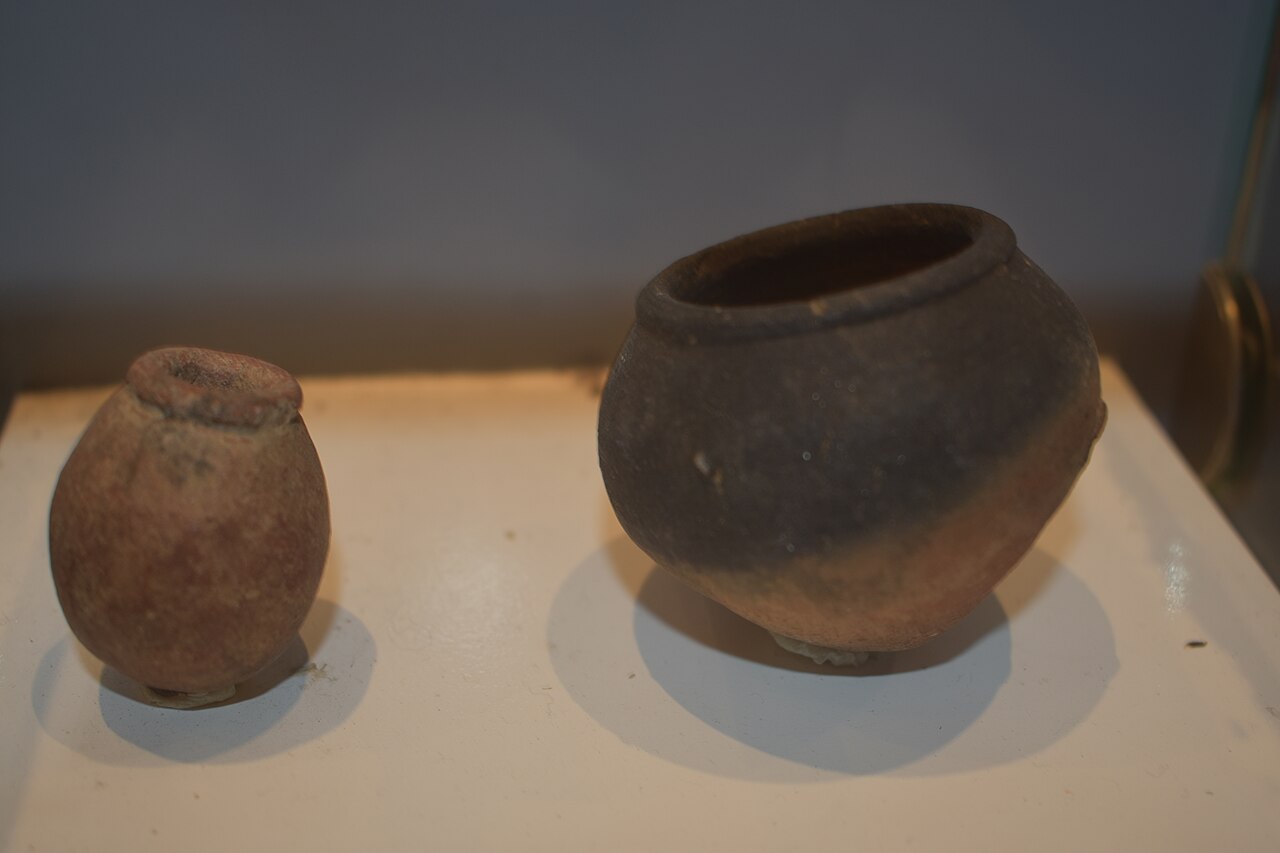
Photo: Rajeshodayanchal (Wikimedia Commons). Licence: CC BY-SA 4.0 (https://creativecommons.org/licenses/by-sa/4.0). Source: https://commons.wikimedia.org/wiki/File:Keezhadi (Keeladi)-archeological-site-photos_100.jpg
- 01
Circle the colour at the top of the pot: black or red.
- black
- red
- 02
Draw a line from carbon to the black part.
- 03
Draw a line from hematite to the red part.
- 04
Circle how the pots went into the fire: upside down or the right way up.
- upside down
- the right way up
Lesson A1 · Ages 7 to 9 · Support
Two-colour pots
Name- 05
Shade a box for the card your group held up for the fire.
- strong evidenceShade it in
- probablySlanting lines
- maybeDots
- nobody knows yetLeave it empty and ring it
What nobody knows yet
After you have graded, write one thing nobody knows yet.
Exit ticket
Cut along the line and hand it in.Draw a two-colour pot. Shade the black part. Write or say one thing you wonder.
Lesson A1 · Ages 7 to 9 · Core
Two-colour pots
Why is this pot two colours?
Look first
Look at the pot. What do you see? What do you think? What do you wonder?
- 01
I see
- 02
The black part has in it.
- 03
The red part has in it.
- 04
Scientists think the pots went into the fire
- 05
Shade a box for the card your group held up for the fire. The study gives it the card
- strong evidenceShade it in
- probablySlanting lines
- maybeDots
- nobody knows yetLeave it empty and ring it
What nobody knows yet
After you have graded, write one thing nobody knows yet.
Exit ticket
Cut along the line and hand it in.Draw a two-colour pot. Shade the black part. Write or say one thing you wonder.
Lesson A1 · Ages 7 to 9 · Stretch
Two-colour pots
Why is this pot two colours?
Look first
Look at the pot. What do you see? What do you think? What do you wonder?
- 01
Describe the pot to someone who cannot see it.
- 02
Explain what is in the black part and how it got there.
- 03
Explain what is in the red part.
Lesson A1 · Ages 7 to 9 · Stretch
Two-colour pots
Name- 04
Explain how the pots were fired.
- 05
Shade a box for the card your group held up for the fire. Then write the reason your teacher gave for the study's card.
- strong evidenceShade it in
- probablySlanting lines
- maybeDots
- nobody knows yetLeave it empty and ring it
What nobody knows yet
After you have graded, write one thing nobody knows yet.
Exit ticket
Cut along the line and hand it in.Draw a two-colour pot. Shade the black part. Write or say one thing you wonder.
Lesson A1 · Ages 7 to 9 · Cut-out cards
Cut along the lines. One set for each group.
A1-SC1 · From the ground
A pot with two colours
Photo: Rajeshodayanchal (Wikimedia Commons). Licence: CC BY-SA 4.0 (https://creativecommons.org/licenses/by-sa/4.0). Source: https://commons.wikimedia.org/wiki/File:Keeladi-archeological-site-photos_100.jpg
This card needs colour. Without a colour printer, colour the top black and the bottom red before you start.
- This kind of pot was made long, long ago.
- Its top is black.
- Its bottom is red.
- People call pots like this black-and-red ware.
What it cannot tell us Looking cannot tell us what makes the colours. Scientists needed a test.
- Look What colours can you see?
- Talk Why might one pot have two colours?
- Ask What would you ask the person who made it?
A1-SC2 · From a laboratory
What the test found

Drawing: Not to scale.
- Scientists tested a piece of black-and-red pot.
- The piece came from a place called Keezhadi.
- The black part has carbon in it.
- The red part has hematite in it.
What it cannot tell us They tested a piece from Keezhadi. They did not test every pot.
- Look Which part has carbon in it?
- Talk Why did the scientists need a test?
- Ask What else would you like a test to find out?
Lesson A1 · Ages 7 to 9 · Cut-out cards
Cut along the lines. One set for each group.
A1-SC3 · From a laboratory
How the pots were fired
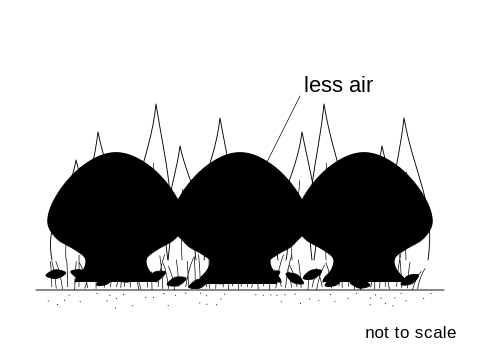
Drawing: Less air. Not to scale.
- Scientists think the pots went into the fire upside down.
- They think plants went into the fire with them.
- They think this gave one side less air.
- They think the burnt plants left black carbon on that side.
What it cannot tell us Nobody watched these potters at work. Scientists worked out the steps from clues.
- Look Which way up did the pots go into the fire?
- Talk How could burning plants make one side black?
- Ask What would you need to see to be sure?
The four certainty cards
Lesson A1 · Ages 7 to 9 · Answer key and mark guidance
What the study says
Two-colour pots Why is this pot two colours?
For the teacher only. Each level and reason below comes from this website's own draft summary of the published research. Keep this page away from pupils until they have answered.
How sure can we be?
Well supportedstrong evidence
In a Keezhadi sample, the black surface holds carbon and the red surface holds hematite.
Pupils read In a Keezhadi sample, the black surface has carbon and the red surface has hematite.
Measured directly by Raman spectroscopy on a Keezhadi sample in a fully read study.
Likelyprobably
Pots were fired inverted with plant matter, so one side lacked oxygen.
Pupils read The pots went into the fire upside down, with plants, so one side got less air.
The model rests on excavated kilns, but the exact firing steps are reconstructed.
Not knownnobody knows yet
The white designs on russet-coated painted ware were painted with kaolin.
Pupils read The white patterns on some old pots were painted with kaolin.
Older literature names kaolin, but the sources checked include no instrumental analysis of a white motif.
The other tasks
A1-SC1 Look What colours can you see?
A black top and a red bottom. Accept any colour words that match what is visible.
A1-SC2 Look Which part has carbon in it?
The black part has carbon in it. The red part has hematite.
A1-SC3 Look Which way up did the pots go into the fire?
Upside down, with plants. The study rates this Likely: scientists think it, but nobody saw it.
Core 02 The black part has ... in it.
Carbon.
Core 03 The red part has ... in it.
Hematite.
Lesson A1 · Ages 7 to 9 · Answer key and mark guidance
Two-colour pots
Core 04 Scientists think the pots went into the fire ...
Upside down, with plants.
Core 05 Shade a box for the card your group held up for the fire. The study gives it the card ...
The study rates the firing story Likely, the "probably" card. A child who chooses another card and gives a reason, such as "nobody saw it", earns the credit for reasoning.
Exit ticket Draw a two-colour pot. Shade the black part. Write or say one thing you wonder.
Any drawing with the black part shaded. A wonder question is a good answer; it does not need to be one anybody can answer yet.
What to look for
- Observation & Source Handling Says what is visible on the pot, a black top and a red bottom, before giving an idea about why.
- Claim & Evidence Connection Links the black part to carbon and the red part to hematite, using the test card.
- Limits & Alternative Explanations Shows that the firing story is a good idea but not certain, for example by choosing the "probably" card.
A different level with a reason that names real evidence or a real gap earns the reasoning credit. Note the reason.
Secure Example written by us, not real pupil work
The top of the pot is black and the bottom is red. The tested piece had carbon in its black part and hematite in its red part. I think the pots went into the fire upside down with plants. I held up "probably" because nobody watched them do it.
Comment Separates what is seen from what is thought, uses both test words correctly, and gives a reason for the "probably" card.
Developing Example written by us, not real pupil work
The pot is black and red. The fire made it black. I held up the strong evidence card.
Comment Describes the colours, but gives the firing story the strong evidence card and does not use the test words. Next step: ask "How do we know?" and point to the test card.
What nobody knows yet
- Nobody knows yet whether the white designs on russet-coated painted ware were painted with kaolin.
Lesson A2 · Ages 7 to 9 · Lesson plan
Stones that mark
Do these stones always mark a grave?
Unit A: What did people leave behind? · Ladder step Look, Sort · Draft written with AI assistance; not yet tried in a classroom
Objectives
- I can say what I see on a stone before I say what I think.
- I can sort what the diggers found from what people think.
- I can hold up a how-sure card with my group and say what its words mean.
Pupils should already know
- Children have used "I see, I think, I wonder" to look at a pot in lesson A1.
- Children have met the four certainty cards in lesson A1. If they have not, add five minutes at the start to introduce the cards.
Materials
- Print One sheet per child: support, core or stretch; The cut-out page for each group: three source cards and the four certainty cards; For a lesson of 45 minutes: a paper plate, four paper tubes and sticky tape for each group, to build a model umbrella stone
- Screen The classroom screen for this lesson, if you have a projector
- Paper only Print the cut-out page once per group and a sheet for each child. Hold up the stone card for the looking routine; the photograph works in black and white. Read the diggers' card and the idea card aloud. Write the six sentences to sort on the board, or read them aloud one at a time. Children sort on paper and shade their certainty boxes with a pencil.
Lesson A2 · Ages 7 to 9 · Lesson plan
Stones that mark
Timings
| Step | 30 minutes | 45 minutes |
|---|---|---|
| hook Show the umbrella stone on the screen or hold up the stone card. | 5 | 7 |
| model Show the difference between a find and an idea. | 4 | 5 |
| guided Read the diggers' card aloud. | 6 | 8 |
| independent Children sort six sentences into two boxes on their sheet, Found and Think. | 6 | 9 |
| claim Give each group a set of certainty cards and read their words: strong evidence, probably, maybe, nobody knows yet. | 6 | 9 |
| exit Ask each child to draw an umbrella stone with the ground under it, and to write or say one thing the diggers found and one thing people think. | 3 | 7 |
Misunderstandings to listen for (not yet observed in a classroom)
- There is a grave under every umbrella stone. Two of the five excavated monument forms at Cheramanangad held no burial, so a stone on the surface does not always mark a grave.
- If the diggers think something, it must be true. The idea that the empty monuments were symbolic burials is the excavators' interpretation. It is rated Possible, because an empty pit alone cannot show its purpose.
- If nobody knows when a stone was built, nobody has tried to find out. "Nobody knows yet" means the evidence checked does not settle it. For Ariyannur the study recovered no excavation report or laboratory date.
Lesson A2 · Ages 7 to 9 · Support
Stones that mark
Do these stones always mark a grave?
Look first
Look at the big stone. What do you see? What do you think? What do you wonder?

Photo: Ranjith Siji (Wikimedia Commons). Licence: CC BY-SA 4.0 (https://creativecommons.org/licenses/by-sa/4.0). Source: https://commons.wikimedia.org/wiki/File:Ariyannur_Umbrellas_DSC_0764.JPG
- 01
Circle what holds up the round top: upright stones or a wall.
- upright stones
- a wall
- 02
Circle how many of the five stones had no burial under them: two or five.
- two
- five
Lesson A2 · Ages 7 to 9 · Support
Stones that mark
Name- 03
Draw a line from each sentence to its box: Found or Think.
- 1Diggers opened five of them, each of a different kind.
- 2Two of the five had no burial under them.
- 3One of the empty ones was an umbrella stone.
- 4Under some other kinds of stone, they found buried pots called urns.
- 5Some old stones stand outside the fence around the protected stones.
- 6They think the empty ones may be graves made as a sign.
FoundThink - 04
Shade a box for the card your group held up for the empty stones.
- strong evidenceShade it in
- probablySlanting lines
- maybeDots
- nobody knows yetLeave it empty and ring it
What nobody knows yet
- Nobody knows yet how many stones there were at Cheramanangad at the start.
Exit ticket
Cut along the line and hand it in.Draw an umbrella stone. Write or say one thing the diggers found and one thing people think.
Lesson A2 · Ages 7 to 9 · Core
Stones that mark
Do these stones always mark a grave?
Look first
Look at the big stone. What do you see? What do you think? What do you wonder?
- 01
I see
- 02
The diggers opened five stones. They found
- 03
Sort each sentence into a box: Found or Think.
- 1Diggers opened five of them, each of a different kind.
- 2Two of the five had no burial under them.
- 3One of the empty ones was an umbrella stone.
- 4Under some other kinds of stone, they found buried pots called urns.
- 5Some old stones stand outside the fence around the protected stones.
- 6They think the empty ones may be graves made as a sign.
FoundThink
Lesson A2 · Ages 7 to 9 · Core
Stones that mark
Name- 04
Shade a box for the card your group held up for the empty stones. The study gives it the card
- strong evidenceShade it in
- probablySlanting lines
- maybeDots
- nobody knows yetLeave it empty and ring it
What nobody knows yet
- Nobody knows yet how many stones there were at Cheramanangad at the start.
Exit ticket
Cut along the line and hand it in.Draw an umbrella stone. Write or say one thing the diggers found and one thing people think.
Lesson A2 · Ages 7 to 9 · Stretch
Stones that mark
Do these stones always mark a grave?
Look first
Look at the big stone. What do you see? What do you think? What do you wonder?
- 01
Describe the umbrella stone to someone who cannot see it.
- 02
Explain what the diggers found under the five stones.
- 03
Sort each sentence into Found or Think. Say why for one of them.
- 1Diggers opened five of them, each of a different kind.
- 2Two of the five had no burial under them.
- 3One of the empty ones was an umbrella stone.
- 4Under some other kinds of stone, they found buried pots called urns.
- 5Some old stones stand outside the fence around the protected stones.
- 6They think the empty ones may be graves made as a sign.
FoundThink
Lesson A2 · Ages 7 to 9 · Stretch
Stones that mark
Name- 04
Shade a box for the card your group held up for the empty stones. Then write the reason your teacher gave for the study's card.
- strong evidenceShade it in
- probablySlanting lines
- maybeDots
- nobody knows yetLeave it empty and ring it
What nobody knows yet
- Nobody knows yet how many stones there were at Cheramanangad at the start.
Exit ticket
Cut along the line and hand it in.Draw an umbrella stone. Write or say one thing the diggers found and one thing people think.
Lesson A2 · Ages 7 to 9 · Cut-out cards
Cut along the lines. One set for each group.
A2-SC1 · From the ground
A stone like an umbrella
Photo: Ranjith Siji (Wikimedia Commons). Licence: CC BY-SA 4.0 (https://creativecommons.org/licenses/by-sa/4.0). Source: https://commons.wikimedia.org/wiki/File:Ariyannur_Umbrellas_DSC_0764.JPG
- This big stone stands at Ariyannur, in Kerala.
- It has a round stone top on upright stones.
- People call it an umbrella stone.
- Umbrella stones are found most in the middle and north of Kerala.
- The study found no report of a dig at Ariyannur. It found no test of how old the stones are.
What it cannot tell us From the outside, we cannot see what is under the stone.
- Look What shape is the top? What holds it up?
- Talk Why might people have made a stone like this?
- Ask What would you like to know about what is under it?
A2-SC2 · From the ground
What the diggers found
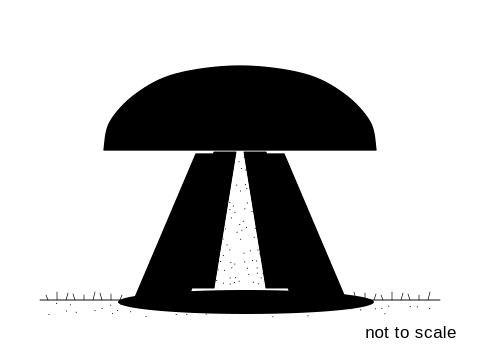
Drawing: Not to scale.
- At Cheramanangad, there are many old stone monuments close together.
- Diggers opened five of them, each of a different kind.
- Two of the five had no burial under them.
- One of the empty ones was an umbrella stone.
- Under some other kinds of stone, they found buried pots called urns.
What it cannot tell us One dig cannot tell us what is under every stone.
- Look How many of the five had no burial under them?
- Talk Does an umbrella stone always have a grave under it?
- Ask What else would you like the diggers to find out?
Lesson A2 · Ages 7 to 9 · Cut-out cards
Cut along the lines. One set for each group.
A2-SC3 · From a text
What the diggers think

Drawing: Four Kerala burial forms on one ground line with cutaway subsoil: an umbrella stone with no burial found below, a rock-cut chamber, a slab cist with a porthole, and a lidded urn deep in a pit.
- The diggers had an idea about the empty stones.
- They think the empty ones may be graves made as a sign, with nobody buried there.
- An empty pit on its own cannot show what it was for.
- Some old stones also stand outside the fence around the protected stones.
- So nobody knows yet how many stones there were at the start.
What it cannot tell us The study found no test of how old the stones at Cheramanangad are.
- Look Which sentence tells us an idea, not a find?
- Talk How could anyone check an idea like this?
- Ask What would you like to ask the diggers?
The four certainty cards
Lesson A2 · Ages 7 to 9 · Answer key and mark guidance
What the study says
Stones that mark Do these stones always mark a grave?
For the teacher only. Each level and reason below comes from this website's own draft summary of the published research. Keep this page away from pupils until they have answered.
How sure can we be?
Well supportedstrong evidence
Umbrella stones cluster in central and northern Kerala.
Pupils read Umbrella stones are found most in the middle and north of Kerala.
Documented in Peter's 2015 distribution survey; a full survey outside Kerala was not completed.
Well supportedstrong evidence
Two of the five excavated monument forms held no burial
Pupils read Two of the five stones the diggers opened had no burial under them.
The ASI excavation report records no interment in Megaliths II and III.
Possiblemaybe
The empty monuments were symbolic burials
Pupils read The empty stones were graves made as a sign, with nobody buried there.
This is the excavators’ interpretation; an empty pit alone cannot show its purpose.
Not knownnobody knows yet
When Ariyannur's umbrella stones were built.
Pupils read When were the Ariyannur umbrella stones built?
No Ariyannur excavation report or laboratory date was recovered; only a broad Iron Age attribution exists.
The other tasks
A2-SC1 Look What shape is the top? What holds it up?
A round stone top on upright stones. Accept any words that match what is visible.
A2-SC2 Look How many of the five had no burial under them?
Two of the five.
A2-SC2 Talk Does an umbrella stone always have a grave under it?
No. Two of the five stones the diggers opened had no burial under them, and one of those was an umbrella stone.
Core 02 The diggers opened five stones. They found ...
Two of them had no burial under them. Under some other kinds of stone there were urns.
Lesson A2 · Ages 7 to 9 · Answer key and mark guidance
Stones that mark
Core 03 Sort each sentence into a box: Found or Think.
Found: diggers opened five of them, each of a different kind; two of the five had no burial under them; one of the empty ones was an umbrella stone; under some other kinds of stone there were urns; some old stones stand outside the fence around the protected stones. Think: the diggers' idea that the empty ones may be graves made as a sign. The sentence about how many stones there were at the start is the one printed in the "What nobody knows yet" box. Credit a different box when the child gives a sound reason.
Core 04 Shade a box for the card your group held up for the empty stones. The study gives it the card ...
The study rates the idea about the empty stones Possible, the "maybe" card. A child who chooses another card and gives a reason, such as "an empty pit cannot show what it was for", earns the credit for reasoning.
Exit ticket Draw an umbrella stone. Write or say one thing the diggers found and one thing people think.
Any drawing of an umbrella stone. One thing found, for example that two of the five stones had no burial under them, and one thing people think, for example that the empty ones may be graves made as a sign.
What to look for
- Observation & Source Handling Says what is visible on the stone, a round top on four legs, before saying what it might be for.
- Claim & Evidence Connection Uses the diggers' card to answer the enquiry question: two of the five stones they opened had no burial.
- Limits & Alternative Explanations Keeps the diggers' idea about the empty stones apart from what they found, for example by putting it in the Think box or choosing the "maybe" card.
A different level with a reason that names real evidence or a real gap earns the reasoning credit. Note the reason.
Secure Example written by us, not real pupil work
The stone has a round top on four legs. The diggers opened five stones and two had no burial under them. So the stones do not always mark a grave. The diggers think the empty ones may be graves made as a sign. I held up "maybe" because an empty pit cannot show what it was for.
Comment Describes the stone before explaining it, answers the enquiry question from the diggers' card, and gives a reason for the "maybe" card.
Developing Example written by us, not real pupil work
There is a grave under every umbrella stone. Somebody is buried there.
Comment Gives the usual idea, which is a good start, but has not used the diggers' card. Next step: read "Two of the five had no burial under them" and ask: so is there always a grave?
What nobody knows yet
- Nobody knows yet when Ariyannur's umbrella stones were built.
- Nobody knows yet how many monuments the cemetery originally had.
- Nobody knows yet exactly when the Cheramanangad monuments were built.
Lesson A3 · Ages 7 to 9 · Lesson plan
Toy carts
Did children long ago have toys?
Unit A: What did people leave behind? · Ladder step Look · Draft written with AI assistance; not yet tried in a classroom
Objectives
- I can say what a poem shows before I say what I think it means.
- I can say what an old object shows, and what it cannot tell us.
- I can hold up a how-sure card with my group and say what its words mean.
Pupils should already know
- Children have used "I see, I think, I wonder" in lessons A1 and A2.
- Children know that a poet makes up a poem, and that a poem can be about real or imagined things.
Materials
- Print One sheet per child: support, core or stretch; The cut-out page for each group: three source cards and the four certainty cards; Pencils in a few colours, for the drawing task
- Screen The classroom screen for this lesson, if you have a projector
- Paper only Print the cut-out page once per group and a sheet for each child. Hold up the game piece card for the looking routine. Read the poems card and the palm-leaf card aloud. Children draw on their sheets and shade their certainty boxes with a pencil, so the sheet works in black and white.
Timings
| Step | 30 minutes | 45 minutes |
|---|---|---|
| hook Show the toy-cart drawing on the poems card or on the screen. | 5 | 7 |
Lesson A3 · Ages 7 to 9 · Lesson plan
Toy carts
| Step | 30 minutes | 45 minutes |
|---|---|---|
| model Show how to look at a poem before explaining it. | 4 | 5 |
| guided Read the poems card aloud and show its drawing: its label says it is drawn from a poem, not a find. | 7 | 10 |
| independent Each child draws what the poems show: a child with a small toy cart. | 5 | 9 |
| claim Give each group a set of certainty cards and read their words: strong evidence, probably, maybe, nobody knows yet. | 6 | 8 |
| exit Ask the enquiry question again: did children long ago have toys? | 3 | 6 |
Misunderstandings to listen for (not yet observed in a classroom)
- A poem is a true report of what happened. The poems show an imagined literary world; they are not records of real households. They still show how the poets wrote about children.
- Because one poem names a child after the grandfather, children were usually named that way. One poem gives one literary instance; it does not prove a household naming rule.
- We know the rules of the old board games. Boards and pieces survive without their rules; rules shown today are modern reconstructions.
Lesson A3 · Ages 7 to 9 · Support
Toy carts
Did children long ago have toys?
Look first
Look closely at the toy cart drawn from two old Tamil poems. What can you see? What do you think it shows?
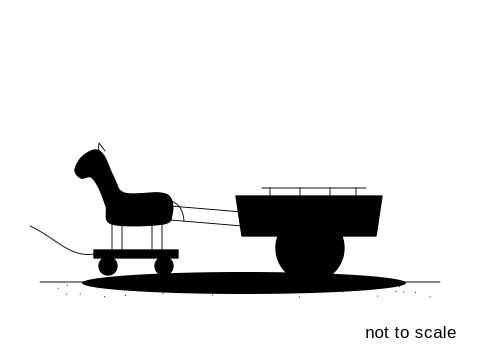
Drawing: Not to scale. Drawn from a poem, not a find.
- 01
Circle what you can see in the toy cart drawing: wheels, a horse, or a board game.
- wheels
- a horse
- a board game
- 02
Circle what the poems were copied onto: palm leaves or stone.
- palm leaves
- stone
- 03
Circle where the die was dug up: Egypt or Kerala.
- Egypt
- Kerala
Lesson A3 · Ages 7 to 9 · Support
Toy carts
Name- 04
Shade a box for the card your group held up for the rules of old games.
- strong evidenceShade it in
- probablySlanting lines
- maybeDots
- nobody knows yetLeave it empty and ring it
What nobody knows yet
After you have graded, write one thing nobody knows yet.
Exit ticket
Cut along the line and hand it in.Did children long ago have toys? Say or write one thing a poem shows and one thing nobody knows yet.
Lesson A3 · Ages 7 to 9 · Core
Toy carts
Did children long ago have toys?
Look first
Look closely at the toy cart drawn from two old Tamil poems. What can you see? What do you think it shows?
- 01
In the toy cart drawing I see
- 02
The two poems show children with
- 03
Draw what the poems show. Label it: My drawing, not an old toy.
Lesson A3 · Ages 7 to 9 · Core
Toy carts
Name- 04
Shade a box for the card your group held up for the rules of old games. The study gives it the card
- strong evidenceShade it in
- probablySlanting lines
- maybeDots
- nobody knows yetLeave it empty and ring it
What nobody knows yet
After you have graded, write one thing nobody knows yet.
Exit ticket
Cut along the line and hand it in.Did children long ago have toys? Say or write one thing a poem shows and one thing nobody knows yet.
Lesson A3 · Ages 7 to 9 · Stretch
Toy carts
Did children long ago have toys?
Look first
Look closely at the toy cart drawn from two old Tamil poems. What can you see? What do you think it shows?
- 01
Describe the toy cart drawing to someone who cannot see it. Explain why it is not a photo of an old toy.
- 02
Explain what the two poems show, and why a poem is not a photo.
- 03
Draw what the poems show. Write a label that says what your drawing is and what it is not.
Lesson A3 · Ages 7 to 9 · Stretch
Toy carts
Name- 04
Shade a box for the card your group held up for the rules of old games. Then write the reason your teacher gave for the study's card.
- strong evidenceShade it in
- probablySlanting lines
- maybeDots
- nobody knows yetLeave it empty and ring it
What nobody knows yet
After you have graded, write one thing nobody knows yet.
Exit ticket
Cut along the line and hand it in.Did children long ago have toys? Say or write one thing a poem shows and one thing nobody knows yet.
Lesson A3 · Ages 7 to 9 · Cut-out cards
Cut along the lines. One set for each group.
A3-SC1 · From a poem
Two old poems
Drawing: Not to scale. Drawn from a poem, not a find.
- Long ago, poets made poems in the Tamil language.
- The poems Kuruntokai 61 and Ainkurunuru 403 show children with small toy carts.
- In one poem, a child has the same name as the grandfather.
- The grown-ups in the poems are tender towards children.
What it cannot tell us A poem is not a photo. It shows a world the poet imagined. It is not a record of a real family.
- Look What do the children in the poems have?
- Talk Is a poem the same as a photo? Why or why not?
- Ask What would you like to ask the poet?
A3-SC2 · From a text
How old poems reach us

- Many old Tamil poems are now called Sangam poems.
- They are about love, war, kings, gifts and ports.
- Each poem has a note, added later, that names its poet.
- People copied the poems by hand onto palm leaves.
- Much later, the poems were printed in books.
What it cannot tell us The copies we read today were made long after the poems.
- Look What were the poems copied onto?
- Talk Why might people copy a poem by hand?
- Ask What would you like to know about the people who copied the poems?
Lesson A3 · Ages 7 to 9 · Cut-out cards
Cut along the lines. One set for each group.
A3-SC3 · From the ground
Game pieces and missing rules

Drawing: Grid of five micro-object inspection cards showing a peppercorn, an inscribed sherd, a carnelian bead, a spindle whorl, and an iron chisel.
- An ivory die was found in Egypt, far away from South India.
- It is not shown here as a toy from South India.
- It does not show how children played in South India.
- Old game boards and pieces have been found.
- But their rules did not survive with them.
- The rules people show today were worked out much later.
What it cannot tell us A game piece does not come with its rules.
- Look Why is an ivory die from Egypt not proof of games in South India?
- Talk Can a die tell us the rules of a game?
- Ask What would you like to know about the people who played with it?
The four certainty cards
Lesson A3 · Ages 7 to 9 · Answer key and mark guidance
What the study says
Toy carts Did children long ago have toys?
For the teacher only. Each level and reason below comes from this website's own draft summary of the published research. Keep this page away from pupils until they have answered.
How sure can we be?
Well supportedstrong evidence
Kuruntokai 61 and Ainkurunuru 403 show children with small toy carts
Pupils read The poems on the card show children with small toy carts.
Both scenes are explicit in the poems, read in an online translation with notes.
Possiblemaybe
The poems' tenderness reflects how real households treated children
Pupils read The poems show how real families long ago treated their children.
The poems show an imagined literary world; they are not records of real households.
Not knownnobody knows yet
Naming a child after the grandfather was a general rule
Pupils read Long ago, children were usually named after a grandfather.
One poem gives one literary instance; it does not prove a household naming rule.
Not knownnobody knows yet
The rules once played on ancient game boards and pieces
Pupils read What rules were played on the old game boards and pieces?
Boards and pieces survive without their rules; rules shown today are modern reconstructions.
The other tasks
A3-SC1 Look What do the children in the poems have?
Small toy carts.
A3-SC1 Talk Is a poem the same as a photo? Why or why not?
No. The poems show an imagined literary world; they are not records of real households. Accept any answer that says a poet made it up or chose what to show.
A3-SC2 Look What were the poems copied onto?
Palm leaves. Much later the poems were printed in books.
Lesson A3 · Ages 7 to 9 · Answer key and mark guidance
Toy carts
Core 02 The two poems show children with ...
Small toy carts.
Exit ticket Did children long ago have toys? Say or write one thing a poem shows and one thing nobody knows yet.
Any answer that gives one thing a poem shows, such as children with small toy carts, and one thing the cards say nobody knows yet.
What to look for
- Observation & Source Handling Says what the poems show, children with small toy carts, before saying what it might mean.
- Claim & Evidence Connection Uses a card to answer the enquiry question: two old poems show children with small toy carts.
- Limits & Alternative Explanations Says what a poem or a game piece cannot tell us, for example that a poem is not a photo, or that the rules of old games did not survive.
A different level with a reason that names real evidence or a real gap earns the reasoning credit. Note the reason.
Secure Example written by us, not real pupil work
Both poems show children with small toy carts. A poet may have drawn on real families, but a poem is not a record, so I held up "maybe" for real families. The die from Egypt shows people there played games. Old game boards have been found, but their rules did not survive. Nobody knows yet how they played.
Comment Says what the poems show before explaining, keeps poem and real life apart, and uses "nobody knows yet" with a reason.
Developing Example written by us, not real pupil work
Yes. Children had toy carts and played board games with this die.
Comment Uses the poems, which is a good start, but treats the poem as a photo and the die as a South Indian toy. Next step: read the limitation on each card and ask what the source cannot tell us.
What nobody knows yet
- Nobody knows yet whether naming a child after the grandfather was a general rule.
- Nobody knows yet the rules once played on ancient game boards and pieces.
Lesson A4 · Ages 7 to 9 · Lesson plan
What was for dinner?
What did people eat?
Unit A: What did people leave behind? · Ladder step Look, Sort · Draft written with AI assistance; not yet tried in a classroom
Objectives
- I can say what I see in a photo before I say what I think.
- I can sort foods that were found from foods scientists think were there.
- I can say one thing nobody knows yet about old meals.
Pupils should already know
- Children have sorted what was found from what people think in lesson A2.
- Children have held up the four certainty cards in lessons A1 to A3.
- Children know that rice and pepper come from plants.
Materials
- Print One sheet per child: support, core or stretch; The cut-out page for each group: three source cards and the four certainty cards; Optional: a few grains of rice and a few peppercorns from a kitchen, in a closed clear bag, to pass round
- Screen The classroom screen for this lesson, if you have a projector
- Paper only Print the cut-out page once per group and a sheet for each child. Hold up the Pattanam card for the looking routine. Read the three cards aloud. Write the food words and the coconut sentence on the board. Children sort them on their sheets and shade their certainty boxes with a pencil, so the sheet works in black and white.
Lesson A4 · Ages 7 to 9 · Lesson plan
What was for dinner?
Timings
| Step | 30 minutes | 45 minutes |
|---|---|---|
| hook Show the pepper photo on the screen or hold up the Pattanam card. | 5 | 7 |
| model Show how to sort, using the tested-grains card. | 4 | 5 |
| guided Read the Pattanam card and the tested-grains card aloud. | 7 | 10 |
| independent Children sort the food words on their sheet into the boxes Found, Think and Nobody knows yet. | 6 | 9 |
| claim Give each group a set of certainty cards and read their words: strong evidence, probably, maybe, nobody knows yet. | 5 | 8 |
| exit Ask the enquiry question again: what did people eat? | 3 | 6 |
Misunderstandings to listen for (not yet observed in a classroom)
- People here have always cooked with chillies. Chillies came from the Americas, so they do not belong in a meal from this coast long ago.
- If seeds were found, we know the recipe. Plant finds show which food plants were there. No source the study used gives a dated household menu, a recipe or who did each kitchen task.
- A photo of a plant is an old find. The pepper photo is a modern botanical photograph for identification; it is not archaeological evidence of ancient use.
Lesson A4 · Ages 7 to 9 · Support
What was for dinner?
What did people eat?
Look first
Look at the photo. What do you see? What do you think? What do you wonder?
- 01
Circle what the photo shows: pepper growing today, or an old find.
- pepper growing today
- an old find
- 02
Draw a line from each food to its box: Found, Think or Nobody knows yet.
- 1 pepper
- 2 rice
- 3 pulses
- 4 cardamom
- 5 coconut
- 6 The coconut is from long ago.
- 7 millets
- 8 bananas
FoundThinkNobody knows yet
Lesson A4 · Ages 7 to 9 · Support
What was for dinner?
Name- 03
Circle where chillies first grew: the Americas or Kerala.
- the Americas
- Kerala
- 04
Shade a box for the card your group held up for coconut at Pattanam.
- strong evidenceShade it in
- probablySlanting lines
- maybeDots
- nobody knows yetLeave it empty and ring it
What nobody knows yet
- Nobody knows yet whether domesticated banana or areca was grown at the six sites.
Exit ticket
Cut along the line and hand it in.Draw one food that diggers found. Write or say one thing nobody knows yet about old meals.
Lesson A4 · Ages 7 to 9 · Core
What was for dinner?
What did people eat?
Look first
Look at the photo. What do you see? What do you think? What do you wonder?
- 01
I see I think
- 02
Sort each food into a box: Found, Think or Nobody knows yet.
- 1 pepper
- 2 rice
- 3 pulses
- 4 cardamom
- 5 coconut
- 6 The coconut is from long ago.
- 7 millets
- 8 bananas
FoundThinkNobody knows yet
Lesson A4 · Ages 7 to 9 · Core
What was for dinner?
Name- 03
Chillies were not in meals here long ago, because
- 04
Shade a box for the card your group held up for coconut at Pattanam. The study gives it the card
- strong evidenceShade it in
- probablySlanting lines
- maybeDots
- nobody knows yetLeave it empty and ring it
What nobody knows yet
- Nobody knows yet whether domesticated banana or areca was grown at the six sites.
Exit ticket
Cut along the line and hand it in.Draw one food that diggers found. Write or say one thing nobody knows yet about old meals.
Lesson A4 · Ages 7 to 9 · Stretch
What was for dinner?
What did people eat?
Look first
Look at the photo. What do you see? What do you think? What do you wonder?
- 01
Describe the photo. Then explain why it is not an old find.
- 02
Sort each food into a box. Explain one of your choices.
- 1 pepper
- 2 rice
- 3 pulses
- 4 cardamom
- 5 coconut
- 6 The coconut is from long ago.
- 7 millets
- 8 bananas
FoundThinkNobody knows yet
Lesson A4 · Ages 7 to 9 · Stretch
What was for dinner?
Name- 03
Explain why chillies do not belong in a meal from this coast long ago.
- 04
Shade a box for the card your group held up for coconut at Pattanam. Then write the reason your teacher gave for the study's card.
- strong evidenceShade it in
- probablySlanting lines
- maybeDots
- nobody knows yetLeave it empty and ring it
What nobody knows yet
- Nobody knows yet whether domesticated banana or areca was grown at the six sites.
Exit ticket
Cut along the line and hand it in.Draw one food that diggers found. Write or say one thing nobody knows yet about old meals.
Lesson A4 · Ages 7 to 9 · Cut-out cards
Cut along the lines. One set for each group.
A4-SC1 · From the ground
Plant bits from Pattanam

Photo: K Hari Krishnan (Wikimedia Commons). Licence: CC BY-SA 3.0 (https://creativecommons.org/licenses/by-sa/3.0). Source: https://commons.wikimedia.org/wiki/File:Black_Pepper_(Piper_nigrum)_fruits.jpg
- This photo shows pepper growing today. It is not an old find.
- At Pattanam in Kerala, diggers found the remains of plants.
- Among them were rice and pulses; black pepper is listed as probable and cardamom as tentative.
- Coconut was found there too, in a buried layer of soil.
- Scientists think the coconut is from long ago.
What it cannot tell us Finds like these show which plants were there. They do not show what anyone cooked.
- Look Which foods were found at Pattanam?
- Talk Why is the pepper photo not an old find?
- Ask What would you like to find out about these plants?
A4-SC2 · From the ground
Grains that were tested

Drawing: Flotation splits a soil sample into light and heavy fractions; charred rice, millet and mung bean are compared; pot, bone and poem are separate clues.
- At Kodumanal in Tamil Nadu, diggers washed soil in water to find tiny seeds.
- People there used millets, pulses, rice and cotton.
- Scientists tested the rice to find out how old it is.
- At Sivagalai, rice was found inside a big clay pot with a lid.
- A test shows this rice is very old.
- Its exact date still needs checking.
What it cannot tell us Rice in a pot like this shows that rice was there. It does not show what people ate every day.
- Look Which plants did people use at Kodumanal?
- Talk Why did the diggers wash the soil in water?
- Ask What else would you test, if you were a scientist?
Lesson A4 · Ages 7 to 9 · Cut-out cards
Cut along the lines. One set for each group.
A4-SC3 · From a text
Foods that are missing

Drawing: Enlarged charred rice, pulse and pepper; a cooking pot with soot and an enlarged wall showing a crust; a long bone with cut marks and a burnt patch; a fish vertebra.
- Chillies first grew far away, in the Americas.
- So chillies do not belong in a meal from this coast long ago.
- One find at Pattanam looks a bit like a chilli, but experts do not trust it.
- A study looked at plant finds from six old sites.
- The study found no old bananas in the reports it read.
What it cannot tell us Finds and old books show some foods. They do not show a whole meal.
- Look Where did chillies first grow?
- Talk Why does the chilli-like find not count?
- Ask What would someone need to find to know what a family ate for dinner?
The four certainty cards
Lesson A4 · Ages 7 to 9 · Answer key and mark guidance
What the study says
What was for dinner? What did people eat?
For the teacher only. Each level and reason below comes from this website's own draft summary of the published research. Keep this page away from pupils until they have answered.
How sure can we be?
Likelyprobably
Rice and pulses are among the plant remains reported from Pattanam, with black pepper listed as probable and cardamom as tentative.
Pupils read Diggers at Pattanam found rice and pulses, with black pepper listed as probable and cardamom as tentative.
Reported in the Mahatma Gandhi University collection account and KCHR interim summaries; a full archaeobotanical report with context data is not published, and a 2020 peat study (reported in the companion pepper study) lists black pepper as probable and cardamom as tentative.
Likelyprobably
Coconut and black pepper were present at early Pattanam.
Pupils read Coconut was at Pattanam long ago.
Coconut is identified and pepper probable, but the 2020 study gave no date for the peat.
Well supportedstrong evidence
Chillies came from the Americas and do not belong in a first-century Malabar meal.
Pupils read Chillies came from the Americas, so they were not in meals here long ago.
Kew gives chillies an American origin; a chilli-like Pattanam specimen is described as problematic.
Not knownnobody knows yet
What an ordinary household ate, and who did each kitchen task.
Pupils read What did an ordinary household eat, and who did each kitchen task?
No source used gives a dated household assemblage, recipe, quantitative diet or division of labour.
The other tasks
A4-SC1 Look Which foods were found at Pattanam?
Rice and pulses. Black pepper is listed only as probable and cardamom only as tentative; coconut was also identified in a buried peat layer.
A4-SC1 Talk Why is the pepper photo not an old find?
It is a modern botanical photograph of pepper growing today, not archaeological evidence of its ancient use.
A4-SC2 Talk Why did the diggers wash the soil in water?
To find tiny seeds: seeds float off when soil is washed in water.
A4-SC3 Look Where did chillies first grow?
In the Americas.
Lesson A4 · Ages 7 to 9 · Answer key and mark guidance
What was for dinner?
Core 02 Sort each food into a box: Found, Think or Nobody knows yet.
Found: rice, pulses, millets, coconut. Think: pepper (listed as probable), cardamom (listed as tentative), and "The coconut is from long ago" (the 2020 study gave no date for the peat). Nobody knows yet: bananas. Credit a different box when the child gives a sound reason.
Core 03 Chillies were not in meals here long ago, because ...
Chillies came from the Americas.
Core 04 Shade a box for the card your group held up for coconut at Pattanam. The study gives it the card ...
The study rates coconut at early Pattanam Likely, the "probably" card: coconut is identified, but the 2020 study gave no date for the peat. A child who chooses another card and gives a reason earns the credit for reasoning.
Exit ticket Draw one food that diggers found. Write or say one thing nobody knows yet about old meals.
Any drawing of rice, pulses, millets or coconut, together with one thing nobody knows yet, such as what an ordinary household ate, who did each kitchen task, or whether bananas were grown there.
What to look for
- Observation & Source Handling Says what the photo shows, pepper growing today, before saying what it tells us about the past.
- Claim & Evidence Connection Sorts foods using the cards: found at Pattanam or Kodumanal, or thought to be there.
- Limits & Alternative Explanations Says one thing nobody knows yet, such as what an ordinary family ate, and keeps chillies out of the old meal.
A different level with a reason that names real evidence or a real gap earns the reasoning credit. Note the reason.
Secure Example written by us, not real pupil work
The photo shows pepper growing today, so it is not an old find. Diggers at Pattanam found rice and pulses, with black pepper listed as probable and cardamom as tentative. Coconut was found there too, and scientists think it is from long ago. Nobody knows yet what one family ate for dinner, because the study found no old menu or recipe.
Comment Looks before explaining, keeps found and think apart, and gives a bounded reason for "nobody knows yet".
Developing Example written by us, not real pupil work
People long ago ate rice with chilli and bananas.
Comment Names a found food, but adds chillies, which came from the Americas, and bananas, which no report the study read shows. Next step: read the card about missing foods and sort again.
What nobody knows yet
- Nobody knows yet what an ordinary household ate or who did each kitchen task.
- Nobody knows yet whether domesticated banana or areca was grown at the six sites.
Unit A · Ages 7 to 9
What did people leave behind?
What can the things people left behind tell us about their lives?
Four lessons for ages 7 to 9, each about 30 minutes. Children look closely at things people left behind, separate what was found from what people say about it, and meet the four certainty cards.
Lessons in this pack
| A1 Two-colour pots | Why is this pot two colours? | 30 / 45 |
|---|---|---|
| A2 Stones that mark | Do these stones always mark a grave? | 30 / 45 |
| A3 Toy carts | Did children long ago have toys? | 30 / 45 |
| A4 What was for dinner? | What did people eat? | 30 / 45 |
When the lessons sit in time
- A3
1000 BCE–600 CE Entire principal period: A1, A2, A4
Places in this unit
- Keezhadi (Vaigai River Brick Settlement) Sivaganga District, Tamil Nadu A1
- Cheramanangad (Kudakkallu Parambu) Thrissur District, Kerala A2
- Ariyannur Umbrella Stones Thrissur District, Kerala A2
- Pattanam (North Paravur, Periyar Delta) Ernakulam District, Kerala A4
- Kodumanal (Noyyal River Craft & Trade Town) Erode District, Tamil Nadu A4
- Sivagalai Urn Burial & Habitation Complex Thoothukudi District, Tamil Nadu A4
Unit A · Ages 7 to 9
Class record sheet
Write pupils' names by hand. Nothing here is stored or sent anywhere.
| Pupil | A1 | A2 | A3 | A4 | Comment |
|---|---|---|---|---|---|
Unit A · Ages 7 to 9
Marking rubric
Choose the two or three dimensions that match a lesson's objectives. The levels describe what a pupil's answer shows, never a pupil's ability.
| Not yet | Developing | Secure | Extended | |
|---|---|---|---|---|
| 1. Observation & Source Handling | Gives an unsupported impression or confuses a modern reconstruction/diagram with an excavated find. | Identifies a relevant detail from the source card but mixes visible observation with interpretation. | Accurately identifies relevant details and distinguishes what the source records from one's own inference. | Explains how excavation recording, preservation, translation, or sampling affects what can be observed. |
| 2. Claim & Evidence Connection | States a conclusion without citing any clue from the source cards. | Mentions a relevant detail from a source card but leaves its link to the claim implicit. | Answers the historical question with specific evidence and explains why ('because...') it supports the claim. | Weighs evidence of differing strength and revises or calibrates the claim to match its actual reach. |
Unit A · Ages 7 to 9
| Not yet | Developing | Secure | Extended | |
|---|---|---|---|---|
| 3. Context, Chronology & Genre | Transfers facts between sites, centuries, or genres without justification. | Notices a date, site, or genre difference but does not apply it consistently. | Keeps the relevant site, period window (1000 BCE–600 CE vs earlier/later), and source purpose attached to the claim. | Explains how stratigraphic context, textual transmission, or poetic convention changes the historical interpretation. |
| 4. Limits & Alternative Explanations | Treats a possibility as 100% settled fact, or claims nothing at all can be known. | Mentions a generic uncertainty ('we weren't there') without tying it to the specific source. | States a specific evidential limit and explains what remains reasonably supported alongside what is open. | Compares a plausible alternative model and names the exact kind of new evidence that could distinguish between them. |
| 5. Communication & Attribution | Reasoning cannot be followed or sources are unidentifiable. | Gives a partly clear explanation with incomplete references to the source cards. | Makes the reasoning clear in any accessible format and cites the relevant source card or locator. | Builds a coherent argument while representing scholarly disagreement and source dependence accurately. |
Unit A · Ages 7 to 9
Cut along the lines. One set for each group.
The four certainty cards
Lesson A1 · Ages 7 to 9 · Lesson plan
Two-colour pots
Why is this pot two colours?
Unit A: What did people leave behind? · Ladder step Look · Draft written with AI assistance; not yet tried in a classroom
Objectives
- I can say what I see before I say what I think.
- I can tell what is in the black part and the red part.
- I can hold up a how-sure card with my group and say what its words mean.
Pupils should already know
- Children know that clay pots are shaped first and then baked hard.
- Children have seen smoke leave black marks on something, such as a cooking pot or a lamp.
Materials
- Print One sheet per child: support, core or stretch; The cut-out page for each group: three source cards and the four certainty cards; A black crayon and a red crayon for each child; One colour print of the pot card for each group (see the print-only note if you have no colour printer); A cup to turn upside down, for the teacher
- Screen The classroom screen for this lesson, if you have a projector
- Paper only Print the cut-out page once per group and a sheet for each child. The pot card needs colour, because the task is to see its black top and its red bottom. Print that card in colour for each group if you can. Without a colour printer, each group colours its pot card at the start, with the black crayon on the top and the red crayon on the bottom, as the card's own words say. Read the test card and the firing card aloud. Children shade their certainty boxes with a pencil, so the rest of the sheet works in black and white.
Timings
| Step | 30 minutes | 45 minutes |
|---|---|---|
| hook Show the pot on the screen or hold up the pot card. | 5 | 7 |
Lesson A1 · Ages 7 to 9 · Lesson plan
Two-colour pots
| Step | 30 minutes | 45 minutes |
|---|---|---|
| model Show how to give an idea with a reason. | 3 | 5 |
| guided Read the test card aloud. | 7 | 10 |
| guided Read the firing card and point to its drawing, where the side that got less air is marked. | 5 | 8 |
| claim Give each group a set of certainty cards and read their words: strong evidence, probably, maybe, nobody knows yet. | 6 | 8 |
| exit Ask each child to draw a two-colour pot, shade the black part, and write or say one thing they still wonder. | 4 | 7 |
Misunderstandings to listen for (not yet observed in a classroom)
- The pot was painted black and red. The test found carbon on the black part and hematite on the red part. Scientists link the colours to the way the pots were fired.
- If scientists think something, it must be true. "Scientists think" marks a good idea that fits the clues. The firing story is rated Likely because the exact kiln steps are reconstructed, not seen.
- "Nobody knows yet" means nobody will ever know. It means the evidence has not settled it so far. No study checked here has tested the white paint with an instrument. A test like that could settle it.
Lesson A1 · Ages 7 to 9 · Support
Two-colour pots
Why is this pot two colours?
Look first
Look at the pot. What do you see? What do you think? What do you wonder?
Photo: Rajeshodayanchal (Wikimedia Commons). Licence: CC BY-SA 4.0 (https://creativecommons.org/licenses/by-sa/4.0). Source: https://commons.wikimedia.org/wiki/File:Keeladi-archeological-site-photos_100.jpg
- 01
Circle the colour at the top of the pot: black or red.
- black
- red
Lesson A1 · Ages 7 to 9 · Support
Two-colour pots
Name- 02
Draw a line from carbon to the black part.
- 03
Draw a line from hematite to the red part.
- 04
Circle how the pots went into the fire: upside down or the right way up.
- upside down
- the right way up
- 05
Shade a box for the card your group held up for the fire.
- strong evidenceShade it in
- probablySlanting lines
- maybeDots
- nobody knows yetLeave it empty and ring it
What nobody knows yet
After you have graded, write one thing nobody knows yet.
Lesson A1 · Ages 7 to 9 · Support
Two-colour pots
NameExit ticket
Cut along the line and hand it in.Draw a two-colour pot. Shade the black part. Write or say one thing you wonder.
Lesson A1 · Ages 7 to 9 · Core
Two-colour pots
Why is this pot two colours?
Look first
Look at the pot. What do you see? What do you think? What do you wonder?
- 01
I see
- 02
The black part has in it.
- 03
The red part has in it.
- 04
Scientists think the pots went into the fire
Lesson A1 · Ages 7 to 9 · Core
Two-colour pots
Name- 05
Shade a box for the card your group held up for the fire. The study gives it the card
- strong evidenceShade it in
- probablySlanting lines
- maybeDots
- nobody knows yetLeave it empty and ring it
What nobody knows yet
After you have graded, write one thing nobody knows yet.
Exit ticket
Cut along the line and hand it in.Draw a two-colour pot. Shade the black part. Write or say one thing you wonder.
Lesson A1 · Ages 7 to 9 · Stretch
Two-colour pots
Why is this pot two colours?
Look first
Look at the pot. What do you see? What do you think? What do you wonder?
- 01
Describe the pot to someone who cannot see it.
- 02
Explain what is in the black part and how it got there.
Lesson A1 · Ages 7 to 9 · Stretch
Two-colour pots
Name- 03
Explain what is in the red part.
- 04
Explain how the pots were fired.
- 05
Shade a box for the card your group held up for the fire. Then write the reason your teacher gave for the study's card.
- strong evidenceShade it in
- probablySlanting lines
- maybeDots
- nobody knows yetLeave it empty and ring it
Lesson A1 · Ages 7 to 9 · Stretch
Two-colour pots
NameWhat nobody knows yet
After you have graded, write one thing nobody knows yet.
Exit ticket
Cut along the line and hand it in.Draw a two-colour pot. Shade the black part. Write or say one thing you wonder.
Lesson A1 · Ages 7 to 9 · Cut-out cards
Cut along the lines. One set for each group.
A1-SC1 · From the ground
A pot with two colours
Photo: Rajeshodayanchal (Wikimedia Commons). Licence: CC BY-SA 4.0 (https://creativecommons.org/licenses/by-sa/4.0). Source: https://commons.wikimedia.org/wiki/File:Keeladi-archeological-site-photos_100.jpg
This card needs colour. Without a colour printer, colour the top black and the bottom red before you start.
- This kind of pot was made long, long ago.
- Its top is black.
- Its bottom is red.
- People call pots like this black-and-red ware.
What it cannot tell us Looking cannot tell us what makes the colours. Scientists needed a test.
- Look What colours can you see?
- Talk Why might one pot have two colours?
- Ask What would you ask the person who made it?
Lesson A1 · Ages 7 to 9 · Cut-out cards
Cut along the lines. One set for each group.
A1-SC2 · From a laboratory
What the test found
Drawing: Not to scale.
- Scientists tested a piece of black-and-red pot.
- The piece came from a place called Keezhadi.
- The black part has carbon in it.
- The red part has hematite in it.
What it cannot tell us They tested a piece from Keezhadi. They did not test every pot.
- Look Which part has carbon in it?
- Talk Why did the scientists need a test?
- Ask What else would you like a test to find out?
Lesson A1 · Ages 7 to 9 · Cut-out cards
Cut along the lines. One set for each group.
A1-SC3 · From a laboratory
How the pots were fired
Drawing: Less air. Not to scale.
- Scientists think the pots went into the fire upside down.
- They think plants went into the fire with them.
- They think this gave one side less air.
- They think the burnt plants left black carbon on that side.
What it cannot tell us Nobody watched these potters at work. Scientists worked out the steps from clues.
- Look Which way up did the pots go into the fire?
- Talk How could burning plants make one side black?
- Ask What would you need to see to be sure?
The four certainty cards
Lesson A1 · Ages 7 to 9 · Answer key and mark guidance
What the study says
Two-colour pots Why is this pot two colours?
For the teacher only. Each level and reason below comes from this website's own draft summary of the published research. Keep this page away from pupils until they have answered.
How sure can we be?
Well supportedstrong evidence
In a Keezhadi sample, the black surface holds carbon and the red surface holds hematite.
Pupils read In a Keezhadi sample, the black surface has carbon and the red surface has hematite.
Measured directly by Raman spectroscopy on a Keezhadi sample in a fully read study.
Likelyprobably
Pots were fired inverted with plant matter, so one side lacked oxygen.
Pupils read The pots went into the fire upside down, with plants, so one side got less air.
The model rests on excavated kilns, but the exact firing steps are reconstructed.
Not knownnobody knows yet
The white designs on russet-coated painted ware were painted with kaolin.
Pupils read The white patterns on some old pots were painted with kaolin.
Older literature names kaolin, but the sources checked include no instrumental analysis of a white motif.
The other tasks
A1-SC1 Look What colours can you see?
A black top and a red bottom. Accept any colour words that match what is visible.
Lesson A1 · Ages 7 to 9 · Answer key and mark guidance
Two-colour pots
A1-SC2 Look Which part has carbon in it?
The black part has carbon in it. The red part has hematite.
A1-SC3 Look Which way up did the pots go into the fire?
Upside down, with plants. The study rates this Likely: scientists think it, but nobody saw it.
Core 02 The black part has ... in it.
Carbon.
Core 03 The red part has ... in it.
Hematite.
Core 04 Scientists think the pots went into the fire ...
Upside down, with plants.
Core 05 Shade a box for the card your group held up for the fire. The study gives it the card ...
The study rates the firing story Likely, the "probably" card. A child who chooses another card and gives a reason, such as "nobody saw it", earns the credit for reasoning.
Exit ticket Draw a two-colour pot. Shade the black part. Write or say one thing you wonder.
Any drawing with the black part shaded. A wonder question is a good answer; it does not need to be one anybody can answer yet.
Lesson A1 · Ages 7 to 9 · Answer key and mark guidance
Two-colour pots
What to look for
- Observation & Source Handling Says what is visible on the pot, a black top and a red bottom, before giving an idea about why.
- Claim & Evidence Connection Links the black part to carbon and the red part to hematite, using the test card.
- Limits & Alternative Explanations Shows that the firing story is a good idea but not certain, for example by choosing the "probably" card.
A different level with a reason that names real evidence or a real gap earns the reasoning credit. Note the reason.
Secure Example written by us, not real pupil work
The top of the pot is black and the bottom is red. The tested piece had carbon in its black part and hematite in its red part. I think the pots went into the fire upside down with plants. I held up "probably" because nobody watched them do it.
Comment Separates what is seen from what is thought, uses both test words correctly, and gives a reason for the "probably" card.
Developing Example written by us, not real pupil work
The pot is black and red. The fire made it black. I held up the strong evidence card.
Comment Describes the colours, but gives the firing story the strong evidence card and does not use the test words. Next step: ask "How do we know?" and point to the test card.
What nobody knows yet
- Nobody knows yet whether the white designs on russet-coated painted ware were painted with kaolin.
Lesson A2 · Ages 7 to 9 · Lesson plan
Stones that mark
Do these stones always mark a grave?
Unit A: What did people leave behind? · Ladder step Look, Sort · Draft written with AI assistance; not yet tried in a classroom
Objectives
- I can say what I see on a stone before I say what I think.
- I can sort what the diggers found from what people think.
- I can hold up a how-sure card with my group and say what its words mean.
Pupils should already know
- Children have used "I see, I think, I wonder" to look at a pot in lesson A1.
- Children have met the four certainty cards in lesson A1. If they have not, add five minutes at the start to introduce the cards.
Materials
- Print One sheet per child: support, core or stretch; The cut-out page for each group: three source cards and the four certainty cards; For a lesson of 45 minutes: a paper plate, four paper tubes and sticky tape for each group, to build a model umbrella stone
- Screen The classroom screen for this lesson, if you have a projector
- Paper only Print the cut-out page once per group and a sheet for each child. Hold up the stone card for the looking routine; the photograph works in black and white. Read the diggers' card and the idea card aloud. Write the six sentences to sort on the board, or read them aloud one at a time. Children sort on paper and shade their certainty boxes with a pencil.
Lesson A2 · Ages 7 to 9 · Lesson plan
Stones that mark
Timings
| Step | 30 minutes | 45 minutes |
|---|---|---|
| hook Show the umbrella stone on the screen or hold up the stone card. | 5 | 7 |
| model Show the difference between a find and an idea. | 4 | 5 |
| guided Read the diggers' card aloud. | 6 | 8 |
| independent Children sort six sentences into two boxes on their sheet, Found and Think. | 6 | 9 |
| claim Give each group a set of certainty cards and read their words: strong evidence, probably, maybe, nobody knows yet. | 6 | 9 |
| exit Ask each child to draw an umbrella stone with the ground under it, and to write or say one thing the diggers found and one thing people think. | 3 | 7 |
Misunderstandings to listen for (not yet observed in a classroom)
- There is a grave under every umbrella stone. Two of the five excavated monument forms at Cheramanangad held no burial, so a stone on the surface does not always mark a grave.
- If the diggers think something, it must be true. The idea that the empty monuments were symbolic burials is the excavators' interpretation. It is rated Possible, because an empty pit alone cannot show its purpose.
- If nobody knows when a stone was built, nobody has tried to find out. "Nobody knows yet" means the evidence checked does not settle it. For Ariyannur the study recovered no excavation report or laboratory date.
Lesson A2 · Ages 7 to 9 · Support
Stones that mark
Do these stones always mark a grave?
Look first
Look at the big stone. What do you see? What do you think? What do you wonder?
Photo: Ranjith Siji (Wikimedia Commons). Licence: CC BY-SA 4.0 (https://creativecommons.org/licenses/by-sa/4.0). Source: https://commons.wikimedia.org/wiki/File:Ariyannur_Umbrellas_DSC_0764.JPG
- 01
Circle what holds up the round top: upright stones or a wall.
- upright stones
- a wall
Lesson A2 · Ages 7 to 9 · Support
Stones that mark
Name- 02
Circle how many of the five stones had no burial under them: two or five.
- two
- five
- 03
Draw a line from each sentence to its box: Found or Think.
- 1Diggers opened five of them, each of a different kind.
- 2Two of the five had no burial under them.
- 3One of the empty ones was an umbrella stone.
- 4Under some other kinds of stone, they found buried pots called urns.
- 5Some old stones stand outside the fence around the protected stones.
- 6They think the empty ones may be graves made as a sign.
FoundThink
Lesson A2 · Ages 7 to 9 · Support
Stones that mark
Name- 04
Shade a box for the card your group held up for the empty stones.
- strong evidenceShade it in
- probablySlanting lines
- maybeDots
- nobody knows yetLeave it empty and ring it
What nobody knows yet
- Nobody knows yet how many stones there were at Cheramanangad at the start.
Exit ticket
Cut along the line and hand it in.Draw an umbrella stone. Write or say one thing the diggers found and one thing people think.
Lesson A2 · Ages 7 to 9 · Core
Stones that mark
Do these stones always mark a grave?
Look first
Look at the big stone. What do you see? What do you think? What do you wonder?
- 01
I see
- 02
The diggers opened five stones. They found
Lesson A2 · Ages 7 to 9 · Core
Stones that mark
Name- 03
Sort each sentence into a box: Found or Think.
- 1Diggers opened five of them, each of a different kind.
- 2Two of the five had no burial under them.
- 3One of the empty ones was an umbrella stone.
- 4Under some other kinds of stone, they found buried pots called urns.
- 5Some old stones stand outside the fence around the protected stones.
- 6They think the empty ones may be graves made as a sign.
FoundThink - 04
Shade a box for the card your group held up for the empty stones. The study gives it the card
- strong evidenceShade it in
- probablySlanting lines
- maybeDots
- nobody knows yetLeave it empty and ring it
Lesson A2 · Ages 7 to 9 · Core
Stones that mark
NameWhat nobody knows yet
- Nobody knows yet how many stones there were at Cheramanangad at the start.
Exit ticket
Cut along the line and hand it in.Draw an umbrella stone. Write or say one thing the diggers found and one thing people think.
Lesson A2 · Ages 7 to 9 · Stretch
Stones that mark
Do these stones always mark a grave?
Look first
Look at the big stone. What do you see? What do you think? What do you wonder?
- 01
Describe the umbrella stone to someone who cannot see it.
- 02
Explain what the diggers found under the five stones.
Lesson A2 · Ages 7 to 9 · Stretch
Stones that mark
Name- 03
Sort each sentence into Found or Think. Say why for one of them.
- 1Diggers opened five of them, each of a different kind.
- 2Two of the five had no burial under them.
- 3One of the empty ones was an umbrella stone.
- 4Under some other kinds of stone, they found buried pots called urns.
- 5Some old stones stand outside the fence around the protected stones.
- 6They think the empty ones may be graves made as a sign.
FoundThink - 04
Shade a box for the card your group held up for the empty stones. Then write the reason your teacher gave for the study's card.
- strong evidenceShade it in
- probablySlanting lines
- maybeDots
- nobody knows yetLeave it empty and ring it
Lesson A2 · Ages 7 to 9 · Stretch
Stones that mark
NameWhat nobody knows yet
- Nobody knows yet how many stones there were at Cheramanangad at the start.
Exit ticket
Cut along the line and hand it in.Draw an umbrella stone. Write or say one thing the diggers found and one thing people think.
Lesson A2 · Ages 7 to 9 · Cut-out cards
Cut along the lines. One set for each group.
A2-SC1 · From the ground
A stone like an umbrella
Photo: Ranjith Siji (Wikimedia Commons). Licence: CC BY-SA 4.0 (https://creativecommons.org/licenses/by-sa/4.0). Source: https://commons.wikimedia.org/wiki/File:Ariyannur_Umbrellas_DSC_0764.JPG
- This big stone stands at Ariyannur, in Kerala.
- It has a round stone top on upright stones.
- People call it an umbrella stone.
- Umbrella stones are found most in the middle and north of Kerala.
- The study found no report of a dig at Ariyannur. It found no test of how old the stones are.
What it cannot tell us From the outside, we cannot see what is under the stone.
- Look What shape is the top? What holds it up?
- Talk Why might people have made a stone like this?
- Ask What would you like to know about what is under it?
Lesson A2 · Ages 7 to 9 · Cut-out cards
Cut along the lines. One set for each group.
A2-SC2 · From the ground
What the diggers found
Drawing: Not to scale.
- At Cheramanangad, there are many old stone monuments close together.
- Diggers opened five of them, each of a different kind.
- Two of the five had no burial under them.
- One of the empty ones was an umbrella stone.
- Under some other kinds of stone, they found buried pots called urns.
What it cannot tell us One dig cannot tell us what is under every stone.
- Look How many of the five had no burial under them?
- Talk Does an umbrella stone always have a grave under it?
- Ask What else would you like the diggers to find out?
Lesson A2 · Ages 7 to 9 · Cut-out cards
Cut along the lines. One set for each group.
A2-SC3 · From a text
What the diggers think
Drawing: Four Kerala burial forms on one ground line with cutaway subsoil: an umbrella stone with no burial found below, a rock-cut chamber, a slab cist with a porthole, and a lidded urn deep in a pit.
- The diggers had an idea about the empty stones.
- They think the empty ones may be graves made as a sign, with nobody buried there.
- An empty pit on its own cannot show what it was for.
- Some old stones also stand outside the fence around the protected stones.
- So nobody knows yet how many stones there were at the start.
What it cannot tell us The study found no test of how old the stones at Cheramanangad are.
- Look Which sentence tells us an idea, not a find?
- Talk How could anyone check an idea like this?
- Ask What would you like to ask the diggers?
The four certainty cards
Lesson A2 · Ages 7 to 9 · Answer key and mark guidance
What the study says
Stones that mark Do these stones always mark a grave?
For the teacher only. Each level and reason below comes from this website's own draft summary of the published research. Keep this page away from pupils until they have answered.
How sure can we be?
Well supportedstrong evidence
Umbrella stones cluster in central and northern Kerala.
Pupils read Umbrella stones are found most in the middle and north of Kerala.
Documented in Peter's 2015 distribution survey; a full survey outside Kerala was not completed.
Well supportedstrong evidence
Two of the five excavated monument forms held no burial
Pupils read Two of the five stones the diggers opened had no burial under them.
The ASI excavation report records no interment in Megaliths II and III.
Possiblemaybe
The empty monuments were symbolic burials
Pupils read The empty stones were graves made as a sign, with nobody buried there.
This is the excavators’ interpretation; an empty pit alone cannot show its purpose.
Not knownnobody knows yet
When Ariyannur's umbrella stones were built.
Pupils read When were the Ariyannur umbrella stones built?
No Ariyannur excavation report or laboratory date was recovered; only a broad Iron Age attribution exists.
Lesson A2 · Ages 7 to 9 · Answer key and mark guidance
Stones that mark
The other tasks
A2-SC1 Look What shape is the top? What holds it up?
A round stone top on upright stones. Accept any words that match what is visible.
A2-SC2 Look How many of the five had no burial under them?
Two of the five.
A2-SC2 Talk Does an umbrella stone always have a grave under it?
No. Two of the five stones the diggers opened had no burial under them, and one of those was an umbrella stone.
Core 02 The diggers opened five stones. They found ...
Two of them had no burial under them. Under some other kinds of stone there were urns.
Core 03 Sort each sentence into a box: Found or Think.
Found: diggers opened five of them, each of a different kind; two of the five had no burial under them; one of the empty ones was an umbrella stone; under some other kinds of stone there were urns; some old stones stand outside the fence around the protected stones. Think: the diggers' idea that the empty ones may be graves made as a sign. The sentence about how many stones there were at the start is the one printed in the "What nobody knows yet" box. Credit a different box when the child gives a sound reason.
Core 04 Shade a box for the card your group held up for the empty stones. The study gives it the card ...
The study rates the idea about the empty stones Possible, the "maybe" card. A child who chooses another card and gives a reason, such as "an empty pit cannot show what it was for", earns the credit for reasoning.
Exit ticket Draw an umbrella stone. Write or say one thing the diggers found and one thing people think.
Any drawing of an umbrella stone. One thing found, for example that two of the five stones had no burial under them, and one thing people think, for example that the empty ones may be graves made as a sign.
Lesson A2 · Ages 7 to 9 · Answer key and mark guidance
Stones that mark
What to look for
- Observation & Source Handling Says what is visible on the stone, a round top on four legs, before saying what it might be for.
- Claim & Evidence Connection Uses the diggers' card to answer the enquiry question: two of the five stones they opened had no burial.
- Limits & Alternative Explanations Keeps the diggers' idea about the empty stones apart from what they found, for example by putting it in the Think box or choosing the "maybe" card.
A different level with a reason that names real evidence or a real gap earns the reasoning credit. Note the reason.
Secure Example written by us, not real pupil work
The stone has a round top on four legs. The diggers opened five stones and two had no burial under them. So the stones do not always mark a grave. The diggers think the empty ones may be graves made as a sign. I held up "maybe" because an empty pit cannot show what it was for.
Comment Describes the stone before explaining it, answers the enquiry question from the diggers' card, and gives a reason for the "maybe" card.
Developing Example written by us, not real pupil work
There is a grave under every umbrella stone. Somebody is buried there.
Comment Gives the usual idea, which is a good start, but has not used the diggers' card. Next step: read "Two of the five had no burial under them" and ask: so is there always a grave?
What nobody knows yet
- Nobody knows yet when Ariyannur's umbrella stones were built.
- Nobody knows yet how many monuments the cemetery originally had.
- Nobody knows yet exactly when the Cheramanangad monuments were built.
Lesson A3 · Ages 7 to 9 · Lesson plan
Toy carts
Did children long ago have toys?
Unit A: What did people leave behind? · Ladder step Look · Draft written with AI assistance; not yet tried in a classroom
Objectives
- I can say what a poem shows before I say what I think it means.
- I can say what an old object shows, and what it cannot tell us.
- I can hold up a how-sure card with my group and say what its words mean.
Pupils should already know
- Children have used "I see, I think, I wonder" in lessons A1 and A2.
- Children know that a poet makes up a poem, and that a poem can be about real or imagined things.
Materials
- Print One sheet per child: support, core or stretch; The cut-out page for each group: three source cards and the four certainty cards; Pencils in a few colours, for the drawing task
- Screen The classroom screen for this lesson, if you have a projector
- Paper only Print the cut-out page once per group and a sheet for each child. Hold up the game piece card for the looking routine. Read the poems card and the palm-leaf card aloud. Children draw on their sheets and shade their certainty boxes with a pencil, so the sheet works in black and white.
Timings
| Step | 30 minutes | 45 minutes |
|---|---|---|
| hook Show the toy-cart drawing on the poems card or on the screen. | 5 | 7 |
Lesson A3 · Ages 7 to 9 · Lesson plan
Toy carts
| Step | 30 minutes | 45 minutes |
|---|---|---|
| model Show how to look at a poem before explaining it. | 4 | 5 |
| guided Read the poems card aloud and show its drawing: its label says it is drawn from a poem, not a find. | 7 | 10 |
| independent Each child draws what the poems show: a child with a small toy cart. | 5 | 9 |
| claim Give each group a set of certainty cards and read their words: strong evidence, probably, maybe, nobody knows yet. | 6 | 8 |
| exit Ask the enquiry question again: did children long ago have toys? | 3 | 6 |
Misunderstandings to listen for (not yet observed in a classroom)
- A poem is a true report of what happened. The poems show an imagined literary world; they are not records of real households. They still show how the poets wrote about children.
- Because one poem names a child after the grandfather, children were usually named that way. One poem gives one literary instance; it does not prove a household naming rule.
- We know the rules of the old board games. Boards and pieces survive without their rules; rules shown today are modern reconstructions.
Lesson A3 · Ages 7 to 9 · Support
Toy carts
Did children long ago have toys?
Look first
Look closely at the toy cart drawn from two old Tamil poems. What can you see? What do you think it shows?
Drawing: Not to scale. Drawn from a poem, not a find.
- 01
Circle what you can see in the toy cart drawing: wheels, a horse, or a board game.
- wheels
- a horse
- a board game
Lesson A3 · Ages 7 to 9 · Support
Toy carts
Name- 02
Circle what the poems were copied onto: palm leaves or stone.
- palm leaves
- stone
- 03
Circle where the die was dug up: Egypt or Kerala.
- Egypt
- Kerala
- 04
Shade a box for the card your group held up for the rules of old games.
- strong evidenceShade it in
- probablySlanting lines
- maybeDots
- nobody knows yetLeave it empty and ring it
What nobody knows yet
After you have graded, write one thing nobody knows yet.
Lesson A3 · Ages 7 to 9 · Support
Toy carts
NameExit ticket
Cut along the line and hand it in.Did children long ago have toys? Say or write one thing a poem shows and one thing nobody knows yet.
Lesson A3 · Ages 7 to 9 · Core
Toy carts
Did children long ago have toys?
Look first
Look closely at the toy cart drawn from two old Tamil poems. What can you see? What do you think it shows?
- 01
In the toy cart drawing I see
- 02
The two poems show children with
Lesson A3 · Ages 7 to 9 · Core
Toy carts
Name- 03
Draw what the poems show. Label it: My drawing, not an old toy.
- 04
Shade a box for the card your group held up for the rules of old games. The study gives it the card
- strong evidenceShade it in
- probablySlanting lines
- maybeDots
- nobody knows yetLeave it empty and ring it
Lesson A3 · Ages 7 to 9 · Core
Toy carts
NameWhat nobody knows yet
After you have graded, write one thing nobody knows yet.
Exit ticket
Cut along the line and hand it in.Did children long ago have toys? Say or write one thing a poem shows and one thing nobody knows yet.
Lesson A3 · Ages 7 to 9 · Stretch
Toy carts
Did children long ago have toys?
Look first
Look closely at the toy cart drawn from two old Tamil poems. What can you see? What do you think it shows?
- 01
Describe the toy cart drawing to someone who cannot see it. Explain why it is not a photo of an old toy.
- 02
Explain what the two poems show, and why a poem is not a photo.
Lesson A3 · Ages 7 to 9 · Stretch
Toy carts
Name- 03
Draw what the poems show. Write a label that says what your drawing is and what it is not.
- 04
Shade a box for the card your group held up for the rules of old games. Then write the reason your teacher gave for the study's card.
- strong evidenceShade it in
- probablySlanting lines
- maybeDots
- nobody knows yetLeave it empty and ring it
Lesson A3 · Ages 7 to 9 · Stretch
Toy carts
NameWhat nobody knows yet
After you have graded, write one thing nobody knows yet.
Exit ticket
Cut along the line and hand it in.Did children long ago have toys? Say or write one thing a poem shows and one thing nobody knows yet.
Lesson A3 · Ages 7 to 9 · Cut-out cards
Cut along the lines. One set for each group.
A3-SC1 · From a poem
Two old poems
Drawing: Not to scale. Drawn from a poem, not a find.
- Long ago, poets made poems in the Tamil language.
- The poems Kuruntokai 61 and Ainkurunuru 403 show children with small toy carts.
- In one poem, a child has the same name as the grandfather.
- The grown-ups in the poems are tender towards children.
What it cannot tell us A poem is not a photo. It shows a world the poet imagined. It is not a record of a real family.
- Look What do the children in the poems have?
- Talk Is a poem the same as a photo? Why or why not?
- Ask What would you like to ask the poet?
Lesson A3 · Ages 7 to 9 · Cut-out cards
Cut along the lines. One set for each group.
A3-SC2 · From a text
How old poems reach us
- Many old Tamil poems are now called Sangam poems.
- They are about love, war, kings, gifts and ports.
- Each poem has a note, added later, that names its poet.
- People copied the poems by hand onto palm leaves.
- Much later, the poems were printed in books.
What it cannot tell us The copies we read today were made long after the poems.
- Look What were the poems copied onto?
- Talk Why might people copy a poem by hand?
- Ask What would you like to know about the people who copied the poems?
Lesson A3 · Ages 7 to 9 · Cut-out cards
Cut along the lines. One set for each group.
A3-SC3 · From the ground
Game pieces and missing rules
Drawing: Grid of five micro-object inspection cards showing a peppercorn, an inscribed sherd, a carnelian bead, a spindle whorl, and an iron chisel.
- An ivory die was found in Egypt, far away from South India.
- It is not shown here as a toy from South India.
- It does not show how children played in South India.
- Old game boards and pieces have been found.
- But their rules did not survive with them.
- The rules people show today were worked out much later.
What it cannot tell us A game piece does not come with its rules.
- Look Why is an ivory die from Egypt not proof of games in South India?
- Talk Can a die tell us the rules of a game?
- Ask What would you like to know about the people who played with it?
The four certainty cards
Lesson A3 · Ages 7 to 9 · Answer key and mark guidance
What the study says
Toy carts Did children long ago have toys?
For the teacher only. Each level and reason below comes from this website's own draft summary of the published research. Keep this page away from pupils until they have answered.
How sure can we be?
Well supportedstrong evidence
Kuruntokai 61 and Ainkurunuru 403 show children with small toy carts
Pupils read The poems on the card show children with small toy carts.
Both scenes are explicit in the poems, read in an online translation with notes.
Possiblemaybe
The poems' tenderness reflects how real households treated children
Pupils read The poems show how real families long ago treated their children.
The poems show an imagined literary world; they are not records of real households.
Not knownnobody knows yet
Naming a child after the grandfather was a general rule
Pupils read Long ago, children were usually named after a grandfather.
One poem gives one literary instance; it does not prove a household naming rule.
Not knownnobody knows yet
The rules once played on ancient game boards and pieces
Pupils read What rules were played on the old game boards and pieces?
Boards and pieces survive without their rules; rules shown today are modern reconstructions.
Lesson A3 · Ages 7 to 9 · Answer key and mark guidance
Toy carts
The other tasks
A3-SC1 Look What do the children in the poems have?
Small toy carts.
A3-SC1 Talk Is a poem the same as a photo? Why or why not?
No. The poems show an imagined literary world; they are not records of real households. Accept any answer that says a poet made it up or chose what to show.
A3-SC2 Look What were the poems copied onto?
Palm leaves. Much later the poems were printed in books.
Core 02 The two poems show children with ...
Small toy carts.
Exit ticket Did children long ago have toys? Say or write one thing a poem shows and one thing nobody knows yet.
Any answer that gives one thing a poem shows, such as children with small toy carts, and one thing the cards say nobody knows yet.
What to look for
- Observation & Source Handling Says what the poems show, children with small toy carts, before saying what it might mean.
Lesson A3 · Ages 7 to 9 · Answer key and mark guidance
Toy carts
- Claim & Evidence Connection Uses a card to answer the enquiry question: two old poems show children with small toy carts.
- Limits & Alternative Explanations Says what a poem or a game piece cannot tell us, for example that a poem is not a photo, or that the rules of old games did not survive.
A different level with a reason that names real evidence or a real gap earns the reasoning credit. Note the reason.
Secure Example written by us, not real pupil work
Both poems show children with small toy carts. A poet may have drawn on real families, but a poem is not a record, so I held up "maybe" for real families. The die from Egypt shows people there played games. Old game boards have been found, but their rules did not survive. Nobody knows yet how they played.
Comment Says what the poems show before explaining, keeps poem and real life apart, and uses "nobody knows yet" with a reason.
Developing Example written by us, not real pupil work
Yes. Children had toy carts and played board games with this die.
Comment Uses the poems, which is a good start, but treats the poem as a photo and the die as a South Indian toy. Next step: read the limitation on each card and ask what the source cannot tell us.
What nobody knows yet
- Nobody knows yet whether naming a child after the grandfather was a general rule.
- Nobody knows yet the rules once played on ancient game boards and pieces.
Lesson A4 · Ages 7 to 9 · Lesson plan
What was for dinner?
What did people eat?
Unit A: What did people leave behind? · Ladder step Look, Sort · Draft written with AI assistance; not yet tried in a classroom
Objectives
- I can say what I see in a photo before I say what I think.
- I can sort foods that were found from foods scientists think were there.
- I can say one thing nobody knows yet about old meals.
Pupils should already know
- Children have sorted what was found from what people think in lesson A2.
- Children have held up the four certainty cards in lessons A1 to A3.
- Children know that rice and pepper come from plants.
Materials
- Print One sheet per child: support, core or stretch; The cut-out page for each group: three source cards and the four certainty cards; Optional: a few grains of rice and a few peppercorns from a kitchen, in a closed clear bag, to pass round
- Screen The classroom screen for this lesson, if you have a projector
- Paper only Print the cut-out page once per group and a sheet for each child. Hold up the Pattanam card for the looking routine. Read the three cards aloud. Write the food words and the coconut sentence on the board. Children sort them on their sheets and shade their certainty boxes with a pencil, so the sheet works in black and white.
Lesson A4 · Ages 7 to 9 · Lesson plan
What was for dinner?
Timings
| Step | 30 minutes | 45 minutes |
|---|---|---|
| hook Show the pepper photo on the screen or hold up the Pattanam card. | 5 | 7 |
| model Show how to sort, using the tested-grains card. | 4 | 5 |
| guided Read the Pattanam card and the tested-grains card aloud. | 7 | 10 |
| independent Children sort the food words on their sheet into the boxes Found, Think and Nobody knows yet. | 6 | 9 |
| claim Give each group a set of certainty cards and read their words: strong evidence, probably, maybe, nobody knows yet. | 5 | 8 |
| exit Ask the enquiry question again: what did people eat? | 3 | 6 |
Misunderstandings to listen for (not yet observed in a classroom)
- People here have always cooked with chillies. Chillies came from the Americas, so they do not belong in a meal from this coast long ago.
- If seeds were found, we know the recipe. Plant finds show which food plants were there. No source the study used gives a dated household menu, a recipe or who did each kitchen task.
- A photo of a plant is an old find. The pepper photo is a modern botanical photograph for identification; it is not archaeological evidence of ancient use.
Lesson A4 · Ages 7 to 9 · Support
What was for dinner?
What did people eat?
Look first
Look at the photo. What do you see? What do you think? What do you wonder?
- 01
Circle what the photo shows: pepper growing today, or an old find.
- pepper growing today
- an old find
- 02
Draw a line from each food to its box: Found, Think or Nobody knows yet.
- 1 pepper
- 2 rice
- 3 pulses
- 4 cardamom
- 5 coconut
- 6 The coconut is from long ago.
- 7 millets
- 8 bananas
FoundThinkNobody knows yet
Lesson A4 · Ages 7 to 9 · Support
What was for dinner?
Name- 03
Circle where chillies first grew: the Americas or Kerala.
- the Americas
- Kerala
- 04
Shade a box for the card your group held up for coconut at Pattanam.
- strong evidenceShade it in
- probablySlanting lines
- maybeDots
- nobody knows yetLeave it empty and ring it
What nobody knows yet
- Nobody knows yet whether domesticated banana or areca was grown at the six sites.
Lesson A4 · Ages 7 to 9 · Support
What was for dinner?
NameExit ticket
Cut along the line and hand it in.Draw one food that diggers found. Write or say one thing nobody knows yet about old meals.
Lesson A4 · Ages 7 to 9 · Core
What was for dinner?
What did people eat?
Look first
Look at the photo. What do you see? What do you think? What do you wonder?
- 01
I see I think
- 02
Sort each food into a box: Found, Think or Nobody knows yet.
- 1 pepper
- 2 rice
- 3 pulses
- 4 cardamom
- 5 coconut
- 6 The coconut is from long ago.
- 7 millets
- 8 bananas
FoundThinkNobody knows yet
Lesson A4 · Ages 7 to 9 · Core
What was for dinner?
Name- 03
Chillies were not in meals here long ago, because
- 04
Shade a box for the card your group held up for coconut at Pattanam. The study gives it the card
- strong evidenceShade it in
- probablySlanting lines
- maybeDots
- nobody knows yetLeave it empty and ring it
Lesson A4 · Ages 7 to 9 · Core
What was for dinner?
NameWhat nobody knows yet
- Nobody knows yet whether domesticated banana or areca was grown at the six sites.
Exit ticket
Cut along the line and hand it in.Draw one food that diggers found. Write or say one thing nobody knows yet about old meals.
Lesson A4 · Ages 7 to 9 · Stretch
What was for dinner?
What did people eat?
Look first
Look at the photo. What do you see? What do you think? What do you wonder?
- 01
Describe the photo. Then explain why it is not an old find.
Lesson A4 · Ages 7 to 9 · Stretch
What was for dinner?
Name- 02
Sort each food into a box. Explain one of your choices.
- 1 pepper
- 2 rice
- 3 pulses
- 4 cardamom
- 5 coconut
- 6 The coconut is from long ago.
- 7 millets
- 8 bananas
FoundThinkNobody knows yet - 03
Explain why chillies do not belong in a meal from this coast long ago.
Lesson A4 · Ages 7 to 9 · Stretch
What was for dinner?
Name- 04
Shade a box for the card your group held up for coconut at Pattanam. Then write the reason your teacher gave for the study's card.
- strong evidenceShade it in
- probablySlanting lines
- maybeDots
- nobody knows yetLeave it empty and ring it
What nobody knows yet
- Nobody knows yet whether domesticated banana or areca was grown at the six sites.
Exit ticket
Cut along the line and hand it in.Draw one food that diggers found. Write or say one thing nobody knows yet about old meals.
Lesson A4 · Ages 7 to 9 · Cut-out cards
Cut along the lines. One set for each group.
A4-SC1 · From the ground
Plant bits from Pattanam
Photo: K Hari Krishnan (Wikimedia Commons). Licence: CC BY-SA 3.0 (https://creativecommons.org/licenses/by-sa/3.0). Source: https://commons.wikimedia.org/wiki/File:Black_Pepper_(Piper_nigrum)_fruits.jpg
- This photo shows pepper growing today. It is not an old find.
- At Pattanam in Kerala, diggers found the remains of plants.
- Among them were rice and pulses; black pepper is listed as probable and cardamom as tentative.
- Coconut was found there too, in a buried layer of soil.
- Scientists think the coconut is from long ago.
What it cannot tell us Finds like these show which plants were there. They do not show what anyone cooked.
- Look Which foods were found at Pattanam?
- Talk Why is the pepper photo not an old find?
- Ask What would you like to find out about these plants?
Lesson A4 · Ages 7 to 9 · Cut-out cards
Cut along the lines. One set for each group.
A4-SC2 · From the ground
Grains that were tested
Drawing: Flotation splits a soil sample into light and heavy fractions; charred rice, millet and mung bean are compared; pot, bone and poem are separate clues.
- At Kodumanal in Tamil Nadu, diggers washed soil in water to find tiny seeds.
- People there used millets, pulses, rice and cotton.
- Scientists tested the rice to find out how old it is.
- At Sivagalai, rice was found inside a big clay pot with a lid.
- A test shows this rice is very old.
- Its exact date still needs checking.
What it cannot tell us Rice in a pot like this shows that rice was there. It does not show what people ate every day.
- Look Which plants did people use at Kodumanal?
- Talk Why did the diggers wash the soil in water?
- Ask What else would you test, if you were a scientist?
Lesson A4 · Ages 7 to 9 · Cut-out cards
Cut along the lines. One set for each group.
A4-SC3 · From a text
Foods that are missing
Drawing: Enlarged charred rice, pulse and pepper; a cooking pot with soot and an enlarged wall showing a crust; a long bone with cut marks and a burnt patch; a fish vertebra.
- Chillies first grew far away, in the Americas.
- So chillies do not belong in a meal from this coast long ago.
- One find at Pattanam looks a bit like a chilli, but experts do not trust it.
- A study looked at plant finds from six old sites.
- The study found no old bananas in the reports it read.
What it cannot tell us Finds and old books show some foods. They do not show a whole meal.
- Look Where did chillies first grow?
- Talk Why does the chilli-like find not count?
- Ask What would someone need to find to know what a family ate for dinner?
The four certainty cards
Lesson A4 · Ages 7 to 9 · Answer key and mark guidance
What the study says
What was for dinner? What did people eat?
For the teacher only. Each level and reason below comes from this website's own draft summary of the published research. Keep this page away from pupils until they have answered.
How sure can we be?
Likelyprobably
Rice and pulses are among the plant remains reported from Pattanam, with black pepper listed as probable and cardamom as tentative.
Pupils read Diggers at Pattanam found rice and pulses, with black pepper listed as probable and cardamom as tentative.
Reported in the Mahatma Gandhi University collection account and KCHR interim summaries; a full archaeobotanical report with context data is not published, and a 2020 peat study (reported in the companion pepper study) lists black pepper as probable and cardamom as tentative.
Likelyprobably
Coconut and black pepper were present at early Pattanam.
Pupils read Coconut was at Pattanam long ago.
Coconut is identified and pepper probable, but the 2020 study gave no date for the peat.
Well supportedstrong evidence
Chillies came from the Americas and do not belong in a first-century Malabar meal.
Pupils read Chillies came from the Americas, so they were not in meals here long ago.
Kew gives chillies an American origin; a chilli-like Pattanam specimen is described as problematic.
Not knownnobody knows yet
What an ordinary household ate, and who did each kitchen task.
Pupils read What did an ordinary household eat, and who did each kitchen task?
No source used gives a dated household assemblage, recipe, quantitative diet or division of labour.
Lesson A4 · Ages 7 to 9 · Answer key and mark guidance
What was for dinner?
The other tasks
A4-SC1 Look Which foods were found at Pattanam?
Rice and pulses. Black pepper is listed only as probable and cardamom only as tentative; coconut was also identified in a buried peat layer.
A4-SC1 Talk Why is the pepper photo not an old find?
It is a modern botanical photograph of pepper growing today, not archaeological evidence of its ancient use.
A4-SC2 Talk Why did the diggers wash the soil in water?
To find tiny seeds: seeds float off when soil is washed in water.
A4-SC3 Look Where did chillies first grow?
In the Americas.
Core 02 Sort each food into a box: Found, Think or Nobody knows yet.
Found: rice, pulses, millets, coconut. Think: pepper (listed as probable), cardamom (listed as tentative), and "The coconut is from long ago" (the 2020 study gave no date for the peat). Nobody knows yet: bananas. Credit a different box when the child gives a sound reason.
Core 03 Chillies were not in meals here long ago, because ...
Chillies came from the Americas.
Core 04 Shade a box for the card your group held up for coconut at Pattanam. The study gives it the card ...
The study rates coconut at early Pattanam Likely, the "probably" card: coconut is identified, but the 2020 study gave no date for the peat. A child who chooses another card and gives a reason earns the credit for reasoning.
Exit ticket Draw one food that diggers found. Write or say one thing nobody knows yet about old meals.
Any drawing of rice, pulses, millets or coconut, together with one thing nobody knows yet, such as what an ordinary household ate, who did each kitchen task, or whether bananas were grown there.
Lesson A4 · Ages 7 to 9 · Answer key and mark guidance
What was for dinner?
What to look for
- Observation & Source Handling Says what the photo shows, pepper growing today, before saying what it tells us about the past.
- Claim & Evidence Connection Sorts foods using the cards: found at Pattanam or Kodumanal, or thought to be there.
- Limits & Alternative Explanations Says one thing nobody knows yet, such as what an ordinary family ate, and keeps chillies out of the old meal.
A different level with a reason that names real evidence or a real gap earns the reasoning credit. Note the reason.
Secure Example written by us, not real pupil work
The photo shows pepper growing today, so it is not an old find. Diggers at Pattanam found rice and pulses, with black pepper listed as probable and cardamom as tentative. Coconut was found there too, and scientists think it is from long ago. Nobody knows yet what one family ate for dinner, because the study found no old menu or recipe.
Comment Looks before explaining, keeps found and think apart, and gives a bounded reason for "nobody knows yet".
Developing Example written by us, not real pupil work
People long ago ate rice with chilli and bananas.
Comment Names a found food, but adds chillies, which came from the Americas, and bananas, which no report the study read shows. Next step: read the card about missing foods and sort again.
What nobody knows yet
- Nobody knows yet what an ordinary household ate or who did each kitchen task.
- Nobody knows yet whether domesticated banana or areca was grown at the six sites.